Improving online learning through the use of design thinking
Professor Neil Anderson School of Education James Cook University, Australia
Cairns Institute
E-mail: [email protected]
Dr Carolyn Timms James Cook University
Karim Hajhashemi School of Education James Cook University, Australia
Anderson, N., Timms, C., & Hajhashemi, K. (2014). Improving Online Learning through the Use of Design Thinking (Translated into Chinese by Junhong
Xiao).Distance Education in China, 9:512. DOI:10.13541/j.cnki.chinade.2014.09.002
Abstract: The paper reports on a component of a larger on-going national Australian study funded by the Australian Office for Learning and Teaching, which is currently examining the use of design thinking strategies and steps in Australian universities across multiple discipline areas and in various modes, including online and face-to-face subjects. One illustrative case study is presented that outlines how design
thinking was used in an online subject, and examines the perceptions of the university staff in relation to design thinking. The academic staff used design thinking strategies when planning the course and the students’ main assessment piece involved the use of design thinking to create an innovative, web-based learning activity for their school-based students. The key findings were that university students could successfully use design thinking strategies to improve their design of online learning activities for school-based students and that university instructors could successfully use design thinking to improve online university subject design. Instructors had varying, but compatible perceptions regarding the concept of design thinking and its usefulness.
Keywords: Design thinking, online learning, e-learning, higher education, distance education, ICT
Background:
The background and aims of the main study will be briefly outlined. The wider project, “Design thinking frameworks as transformative cross-disciplinary pedagogy” explores design thinking models as transformative cross-disciplinary pedagogy to meet undergraduate and postgraduate generic attribute requirements in the area of innovation, creativity and problem solving. The Bradley Review of Higher Education in Australia (2008) placed more emphasis on the need to develop innovation than any other issue and constantly refers to universities and higher education providers as playing a pivotal role in our ‘national innovation system’.
Design thinking has been defined as the way that designers go about solving
restrictive than some other models; for example, Immersion (observation and study of the user and the system they operate in through various participatory methods); Ideation (generation of ideas through feedback, use of prompts, development of design concepts and prototypes through synthesis and collaborative processes) and Implementation (completion and testing of the solution or product). Design thinking has been integrated into the curriculum of elite universities in their premier programs such as Harvard MBA, Stanford and MIT engineering on the basis of its successful application in world leading companies such as Apple and IDEO.
We expect design thinking to have a major impact in achieving strong generic
graduate attributes in the area of innovation, creativity and problem solving, partly by providing much needed, research-based evidence to support the further development and implementation of design thinking use in higher education.
This pilot study aims to answer the following critical questions which will generate important outcomes:
What models for design thinking are available and what is the basis for these models in empirical studies?
To what extent is design thinking already integrated in James Cook University curricula and how does it impact on meeting generic graduate attributes in the area of problem solving, creativity and innovation?
Method:
The method for the wider study includes the development of a comprehensive and critical literature review; the development of illustrative case studies; the delivery of a lecture series and workshops in the Australian cities of Brisbane, Melbourne, Darwin and Perth and the Malaysian capital, Kuala Lumpur. The lectures and workshops have now been completed, providing a venue for academics across Australia to contribute examples of how design thinking has been used in subject delivery and to share their perceptions of design thinking. This paper is based on data gathered about one illustrative case study at James Cook University, where the same subject is delivered in four modes, with two modes being completely online and two modes being face-to-face. The case study was documented after research and analysis using a mixed method case study approach (Yin, 2009). The investigators collaborated closely with lecturers and students using a mix of methods that include participatory observation, semi- structured interviews about academics perceptions of design thinking and focus groups. The case is an interesting one because design thinking strategies are used by the coordinator (lecturer in charge overall), lecturers (academic staff members working on different modes and sites on the subject) and tutor (part time staff taking smaller group tutorials or online tutorials) to design the subject, pre-service teachers study design thinking strategies and steps and apply that in creating an online learning resource for their school age students for their major assessment piece.
Illustrative Case Study
that students studying from distant locations did not have access to the face-to-face computer laboratory sessions where they received instruction on the technical aspects of creating webpages. The webpages that they created hosted online learning activities that they needed to design for their major assessment piece. The second problem arose because past students in both modes tended to create web-based learning activities that demonstrated poor design that impacted on the quality of the materials. The two strategies adopted to address these problems involved the creation of web-based video tutorials to teach the students the technical aspects of creating websites using ‘Google Sites’ and the use of design thinking strategies to improve the design of the websites and associated online learning activities.
The students consisted of a 3rd year cohort undertaking a 4-year undergraduate education degree in the areas of secondary, primary and early childhood education. The subject ED3441 (Technologies Across the Curriculum) is offered in 4 modes at a regional university in Queensland, Australia. The four groups included 38 students who studied on-campus at a smaller regional city, another group of 110 students who studied on-campus at the main university site, a completely online group of 48 students who specialize in early childhood education and another smaller group of 12 who undertake distance learning in remote communities with the assistance of tutors.
Design thinking strategies were employed by the subject designers to address the problem of lack of access to face-to-face technical tutorials for web creation. The subject designers considered the needs of the users in an empathetic manner and considered the system (environment) the users (online students) operated in. The solution was the creation of a series of videos that took the students through the main aspects of the software, step by step, solved the first problem of providing students with support in developing the technical skills of using ‘Google Sites’ without attending face-to face computer laboratory workshop. The students could view the videos repeatedly and see the screen capture of the necessary steps in using the software and listen to the voice of the tutor. The software ‘Captivate’ was used to create the videos but since the videos were created, we have started to experiment with a low-cost i-Pad app ‘Explain Everything’ that can also produce excellent results. The videos were made available in downloadable form (for students with slower internet connections) or were available on YouTube. An example of the instruction video can be seen at:
https://www.youtube.com/watch?v=oWTJiMg-AdQ
The resources such as the instructional videos were made available through the subject site within the university ‘Blackboard’ learning management system. Students studying all subjects at the university provide feedback on the usefulness of course materials through the subject discussion board and through anonymous feedback in the end of semester survey. The response to the instruction videos has been overwhelmingly positive. Likewise, He, Swenson and Lents (2012, p.1131) found that “online video tutoring delivered to students through Blackboard effectively helps students master knowledge points and improve their performance”.
thinking and to review various step by step models and strategies used in the field of design thinking, including the model outlined by Bell and another key paper by Carroll et al. (2010). Students were then required to use Bell’s steps and to reflect on the use of the steps in a written piece that formed part of the assessment. All students in the subject managed to successfully demonstrate their use of design thinking in creating their web-based learning activity and all students reached at least an acceptable standard for their main assessment piece.
Design thinking strategies have emerged from the on-going study of the design practices of professional designers and innovators. The aim of these strategies is twofold. They are strategies that can be used by designers of online courses and materials, in order to improve the quality, or they can be used by the students undertaking online courses to enable them to creatively solve complex problems. Online learning activities across many disciplines have been designed using the design thinking methodology and this type of scaffold has received a great deal of attention in recent years due to the promotion and development of design thinking models or frameworks in elite institutions such as Stanford and Harvard universities. Many research studies across multiple discipline areas have supported the advantages of using design thinking strategies or formal steps to support the processes of solving problems or creating products – including web-based, online learning products. Some of these studies will be briefly outlined in the following paragraphs.
Design thinking has been defined in the literature in different ways. For example, Dunne and Martin (2006) claim that “design thinking is the way designers think: the mental processes they use to design objects, services or systems, as distinct from the end results of elegant and useful products” (p. 517). Other researchers define design thinking as a heuristic, a series of steps or as strategies that scaffold people to have the ability to solve complex or ‘wicked’ problems or to create an innovative product (Razzouk & Shute, 2012). MacFadyen (2014, p.1) argues that “design thinking uses divergent and convergent thinking to ‘flesh out’ potential solutions for problems at any level” and recommends the use of design thinking in nursing education and in medical practice. Rodgers (2013, p.434) links the use of design thinking to economic success and points out that “many leading organizations as well as several key figures in notable business schools around the world have adopted this approach and now see design in general and design thinking in particular as a key driver for economic and other forms of success.”
The Stanford University model of design thinking uses broad categories that include multiple strategies within each main category
(See: https://dschool.stanford.edu/groups/k12/wiki/17cff/).
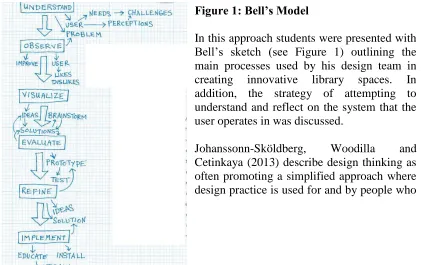
These include: understand, observe, point of view, ideate, prototype and test. They emphasize that these categories are not necessarily in linear order, since that depends on the particular problem and context. In contrast, other exponents of design thinking such as Bell (2008) map out the steps that they take in approaching a problem and although using steps may be restrictive and simplistic, they have been useful in particular contexts which are quite different to Bell’s original context of library design.
Within this subject at James Cook University, the Stanford Model was introduced along with a modified version of Bell’s steps to support students who design web-based learning activities within an undergraduate subject that prepares students to become teachers. Students were also directed to a wide range of literature on design thinking as further reading. As pre-service teachers need to be able to design and create web-based materials, it was necessary to develop technical skills in mastering web creation software but also to develop their skills of design and their ability to solve complex problems. This is why design thinking strategies were selected as an ideal way of assisting their development.
[image:5.595.89.513.566.831.2]Design thinking strategies were introduced in an attempt to eliminate some major weaknesses in the students’ online creations that had persisted for several years, despite attention given to remedy this situation. In particular, students did not adequately understand the needs and requirements of the users; did not give adequate attention to the system that the users operated in and did not show sufficient empathy for the users and were often reluctant to try different prototypes, following a preference to stick with what they had started with. These steps are presented to the students as a selection of strategies within an overall methodology, rather than as a ‘recipe’ that adequately encompasses the notion of ‘design thinking’ or designerly thinking’. It is emphasized that many different strategies have been developed to assist people to think like designers and employ design approaches and that a relatively simplistic and superficial model might serve as a good starting point to address specific deficiencies in past practice and serve as a stepping stone to more considered practice that leverages on design practice and research.
Figure 1: Bell’s Model
In this approach students were presented with Bell’s sketch (see Figure 1) outlining the main processes used by his design team in creating innovative library spaces. In addition, the strategy of attempting to understand and reflect on the system that the user operates in was discussed.
do not have a scholarly background in design. This case fits within that category but in assessing the advantages and limitations of this approach, it became apparent that simple or complex approaches to design practice cannot completely capture and make explicit the important dimension of tacit (hidden) knowledge employed by designers. While this paper will briefly examine the advantages of using Bell’s model with this particular group of 3rd year, undergraduate, education students, it will then move to a discussion of particular types of tacit knowledge that reflection on design practice would not adequately reveal.
Students in this course had previously been exposed to extensive research, theory and practice concerning effective pedagogy, since their 4-year course prepares them to be early childhood, primary or secondary school teachers. Apart from the small group of pre-service teachers specializing in art/design education, they had not been exposed to design research, theory or practice. With this limitation in prior experience in mind, Bell’s model was selected as a way of introducing students to consider design approaches as a way of improving their design of online learning activities. Since the use of online learning is becoming more important at all levels of education in the Australian system, it is critical that future teachers are skilled in the design of such activities and equipped to have a capacity for innovation. It was apparent with these cohorts that they were more familiar with an analytical and scientific approach where examination of what exists was more familiar than an innovative approach involving the creation of what ‘might be’.
With the changing nature of new digital technologies being both a challenge and a great opportunity for pre-service teachers in improving school-based educational offerings, the design approach has the advantage of being able to foster innovative and creative mindsets. In such a changing and challenging environment, students will need the capabilities of imagination and creativity to initiate new ways of using ICT in face-to-face or online learning. Using the design thinking strategies improved the students’ attention to ensuring that the web-based learning activities were designed with the user in mind and that they would work well within the constraints of a public education system. It encouraged the students to try multiple prototypes, rather than repairing and modifying the design for one online learning activity. Students were encouraged to lose their fear of failure, through the use of design processes. It is a common problem with undergraduate students that their first attempt should be a success. By contrast, design thinking strategies emphasise the importance of trying multiple versions and therefore can be used as a tool to assist students to overcome their fear of initial failure or inadequacy.
Johansson-Sköldberg et al (2013) contend that links should be made between the different design thinking models in the discourse to open up designerly ways of thinking to non-designers by considering the five different, parallel streams of academic research in the design area that they identified through an extensive and well-considered literature review. This five streams are:
1. Design and designerly thinking as the creation of artefacts 2. Design and designerly thinking as a reflexive practice
3. Design and designerly thinking as a problem-solving activity
Using this approach alleviate professional designers concerns that their work is being taken and re-represented in simplistic and superficial ways through much of the design thinking discourse. Even if this better meshing of the academic work between design thinking research within and beyond design education occurs, a limitation will be the difficulty in reflecting and making explicit particular elements of the design process that involve tacit knowledge. Johansson-Sköldberg et al hint as this when they briefly discuss ‘intuition’.
Tacit knowledge is understood to be ‘hidden knowledge’, but debate exists as to the extent that this hidden knowledge can be made explicit or codified. The academic literature concerning tacit knowledge exhibits similar challenges to the design thinking literature. For example, the importance of tacit knowledge has been widely recognized across disciplines, often in superficial and simplistic ways that has led to an expectation that all tacit knowledge can be captured through reflection and other techniques. This has been challenged by researchers and theorists such as Day (2005), Tsoukas (2003) and Castillo (2002). Johnson (2007) argues that although tacit knowledge has been incorporated in knowledge strategy and management theory, few theorists have operationalized tacit knowledge adequately apart from Ambrosini and Bowman (2001) and Castillo (2002). Castillo’s four dimensions of tacit knowledge are particularly useful in relation to limitations of making design practices explicit and go beyond the notion of ‘intuition’.
Castillo (2002) identifies four dimensions of tacit knowledge of which two dimensions (non-espistle and sociocultural) are of particular relevance to implementing design thinking. They are: non-epistle tacit knowledge; sociocultural tacit knowledge; semantic tacit knowledge and sagacious tacit knowledge. Non-epistle tacit knowledge is described by Castillo as a very personal form of indescribable knowledge, similar to what people describe as ‘gut feelings’. This form of knowledge cannot be codified or verbalized and is often unconscious in nature and is related to ‘implicit knowledge’ in the psychology literature. Taylor (2007, p.67) describes non-epistle tacit knowledge as “completely unarticulable” and “deeply ingrained”. The second dimension is ‘sociocultural tacit knowledge’ described by Castillo (2002) as not being associated with any one individual but part of the overall cultural fabric where it is developed through as lived experience as being part of a particular social group. Next is ‘semantic tacit knowledge’ which is a type of professional tacit knowledge that develops within a group engaged with a job such as engineering, science, design etc. that leads to the development of a shared understanding and way of communication. Taylor refers to this as explicit knowledge that has been internalized by experts who share a common understanding. The last category is ‘sagacious tacit knowledge’ that involves a spontaneous ability to solve problems or see solutions without being able to articulate the processes that lead to that ability through an internal combination of understanding of theory combined with knowledge and practice over a period of time.
Results: Interview Analysis –Perceptions of Academics concerning design thinking
A semi-structured interview design was employed in this section of the research to determine the perceptions of the academics involved, in relation to design thinking. There were three interview subjects, all currently involved in the preparation and implementation of university level pre-service teacher education course material that is delivered online and face-to-face. The overall coordinator had expansive research and practical experience in Information Communication Technology (ICT) in Education and online learning. The Lecturer 2 and Tutor each taught various undergraduate subjects in Education and have had extensive experience with online learning, including ICT industry experience and qualifications in the case of the tutor. The three interviewees are committed to sharing design thinking principles with their students and in using design thinking when planning their online subjects.
Interestingly, however they revealed differing emphases in their personal definitions of design thinking.
The coordinator (lecturer 1) and Lecturer 2 emphasized the problem solving
component of design thinking, for example, “my definition is that it’s a methodology for… solving problems or designing a product and within that methodology is a series of strategies” (The coordinator, lecturer 1)). Whereas the tutor’s emphasis was the end user of the products of design thinking, “my understanding of design thinking is that it’s a client-based with human centered design and the idea that um…there are problems out there and that design solutions can actually make a difference to people, to people’s lives”.
The interviewees reported using aspects of a number of different design thinking frameworks. Lecturer 2, who uses design thinking when scaffolding student teachers’ design of wikis, reported that he uses one of two Stanford models (https://dschool.stanford.edu/groups/k12/wiki/17cff/) because it begins with “understand” and because students can readily grasp the concepts from the diagram provided. According to Lecturer 2, “students understood that it’s not just one linear process and there’s movement between each of the steps both forward and back as part of the design thinking model”. The Stanford Model was also the coordinator’s (lecturer 1) preferred model, although he combined it with that of Bell (2008) and Carroll et al (2010), “the only difference is that Bell’s steps have a stronger emphasis on considering the system that the user operates in and Carroll didn’t emphasize that in the initial steps and I think that ‘systems-based thinking’ is an important element of design thinking”. The rationale for this being, “before we had the design thinking framework students would often forget about tailoring it properly for the user or the system that the user operates in”. The tutor on the other hand reported that he used aspects of a number of different frameworks rather than any specific one.
In regard the value of teaching design thinking to student teachers, all three interviewees reported that it provided a valuable tool. Lecturer 2 saw it more as a valuable addition to students’ teaching repertoire: “so, they can then draw on it when they see students struggling to understand how to design or to explore a problem and how to solve the problem creatively”. Similarly the coordinator (lecturer 1)’s
...if you look at the steps of problem based learning, it doesn’t actually scaffold students to solve the problems; it just has steps of you know presenting what’s the problem is, and they go about trying to solve it but doesn’t actually tell them how to go about solving the problem by giving explicit strategies, whereas design thinking gives within the methodology, strategies that students can use to solve the problems…
The tutor emphasized the conscious nature of the design thinking process as a skill that could be taught to students:
I think the idea of thinking about design and working towards creating better design, especially in online learning, is not something that just happens. It’s something that you can practice and need to be aware of what you’re doing.
Lecturer 2 also commented that design thinking forced student teachers to consider how users (their students) would interact with their products (such as online learning resources) and this process “definitely helps them to produce better design and better product”.
In regard to the place of design thinking within current educational curriculum guidelines (which tend to emphasis literacy and numeracy to the exclusion of other important areas) the coordinator (lecturer 1) commented that design thinking was:
“critical in our course. I try to make sure that students value creativity and innovation and have a chance to develop that sort of a mindset because in schools at the moment because of national testing in literacy and numeracy in school-based education it’s become too focused on what can be tested under those two basic areas which leaves out a lot of the really important areas of education; so, if we improve in those tests people say on the news and the media that school-based education is improving because the test result is improving, but actually it’s not improving because they’re spending far less time on other important aspects of education, aspects that are probably more important than just mastering basic facts”
The tutor and Lecturer 2 both suggested that changing the mindsets of pre-service teachers was the main difficulty in the transmission of design thinking ideas. According to the tutor, students invariably have difficulty with the translation of design thinking from its origins as a client-focused industrial concept to their own experience of teaching students:
In a school context, it’s not about what the teacher thinks is a fantastic interesting lesson or online resource. It’s about making an interesting fantastic lesson for the student. They might be two completely different things and so (to some of the student teachers that I’m talking to), it’s about making their ego take a back seat and say: look, you’re not designing for yourself. You’re designing for your client and your client is a grade 2 student or a grade 10 student whoever it is, and I think that’s something that these people just haven’t really considered in the past.
between models that reflect vastly different contexts, such as online learning or face-to-face learning, in which design thinking can be applied.
I guess the challenge is to pick the right strategies for the task or at least if gets students more experienced, so, later they can pick their own strategies according to the task that they have to do. The other challenge is, uh… it’s always a big challenge in education to have something that’s transferrable; because the design thinking strategies are transferrable.
When asked to reflect more broadly on the value of design thinking to individuals and to education, interviewees demonstrated quite varied perspectives. According to the tutor, the construct provides people with flexible strategies that will be necessary in a constantly changing and digital world environment “I think there will be a change eventually when they realize that scoring well on certain tests is not the be all and end all of education, We need to develop students who are innovative in a variety of contexts, especially in the online environment”. Lecturer 2 expressed a need for the individual benefit of design thinking to be clearly expressed in official documentation:
until it crosses into that space where its explicit (how it relates to the educators), then it will have some relative value for most of my peers and for future students.
The coordinator (lecturer 1)’s concern remained with the current almost exclusive focus within school-based education on literacy and numeracy. Because they are easily tested with observable results they can be used as an objective measure of school performance. However in a world where ingenuity and creativity are requisite and highly rewarded attributes of employees, he felt that education may well be doing students a disservice. He suggested (in reference to consciously using design thinking in pre-service teacher education),
“hopefully by using this framework we’ll give them the tools to ensure that school students in the future aren’t just concentrating on learning literacy and numeracy basics and that they are able to take full advantage of emerging digital tools and online learning in order to be life-long learners and that their teachers will be capable of designing interesting, creative and effective online spaces for learning.”
Conclusion
Design thinking is particularly useful for academics involved in designing online curricula and for the students (pre-service teachers) who were participants in the course under review, since their main assessment piece was to create an online, web-based learning activity that was suitable for their school-aged students. Its usefulness centres on providing explicit scaffolds for designing new ways of delivering and supporting online learning using innovative and creative techniques, rather than trying to ‘fit’ ICT and online learning within traditional pedagogy and approaches.
fully through the design of new models. In addition to the case study presented in this paper, the wider on-going project seeks to gather a variety of case studies from Australian universities along with a comprehensive examination of academics’ perceptions concerning the concept of design thinking and its usefulness along with approaches taken.
In Japan, Futjitsu has championed the ‘Design Thinking for Future Schools Project’ where cross-disciplinary teams have used a design thinking model to assist teachers to re-engineer learning experiences that fully integrate ICT in non-traditional ways (Takeda, 2013). With the Australian pre-service teachers studying online from geographically isolated areas, the use of design thinking strategies meant that they would be ready to start their teaching careers equipped to design innovative online learning activities for their students in schools and therefore would not need outside intervention as in the Japanese case.
For the students, in their beginning stages of their engagement with design practices to enhance their efforts at designing web-based learning activities, it is important to recognize the limitations of simplistic models but also recognize their usefulness in certain contexts. Although models such as Bell’s cannot adequately capture all the nuances and complexity of the design process, they can be very valuable in scaffolding non-designers, such as our undergraduate pre-service teachers to use some of the main elements of design thinking to produce higher quality online learning activities. This approach has the advantage of moving students from a predominantly analytical approach to examining existing models of online learning activities to an approach emphasizing synthesis, creation and innovation and empathy. Once students have mastered the use of more restrictive and simple design thinking steps they could then move to studying more comprehensive and nuanced design strategies, similar to what would be studied in design schools.
References
Ambrosini, V. & Bowman, C. (2001). Tacit knowledge: Some suggestions for operationalization. Journal of Management Studies 38(6), 811-825.
Anderson, Neil (2013). Design thinking as a means of enhancing the creative and innovative abilities of undergraduate students when creating web based learning activities. In: Proceedings of Society for Information Technology and Teacher Education 24th Annual Conference, pp. 4181-4186. From: Society for Information Technology and Teacher Education 24th International Conference, 25-29 March 2013, New Orleans, Louisiana, USA.
Bell, S. (2008). Design thinking. American Libraries, 39(1/2), 44-49.
Bradley, D., Noonan, P., & Scales, B. (2008). Review of Australian Higher Education. Retrieved from:
http://www.innovation.gov.au/HigherEducation/Documents/Review/PDF/Higher%20 Education%20Review_Title%20page%20to%20chapter%202.pdf
classroom. International Journal of Art & Design Education, 29(1), 37-53. doi: 10.1111/j.1476-8070.2010.01632.x
Castillo, J. (2002). A note on the concept of tacit knowledge. Journal of Management Inquiry, 11(1), 46-57.
Day, R. (2005). Clearing up implicit knowledge: Implications for knowledge management, information science, psychology and social epistemology. Journal of the American Society for Information Science and Technology, 56(6), 630-635.
Dunne, D., & Martin, R. (2006). Design thinking and how it will change management education: An interview and discussion. Academy of Management Learning & Education, 5(4), 512-523.
Johansson-Sköldberg U., Woodilla, J. & Cetinkaya, M. (2013). Design thinking: Past, present and possible futures. Creativity and Innovation Management, 22(2), 121-146. Johnson, W. (2007). Mechanisms of tacit knowing: pattern recognition and synthesis. Journal of Knowledge Management, 11(4), 123-139.
He, Y., Swenson, S. & Lents, N. (2012). Online Video Tutorials Increase Learning of Difficult Concepts in an Undergraduate Analytical Chemistry Course. Journal of Chemical Education, 89, 1128-1132.
Kimbell, L. (2009). Beyond Design Thinking. Proceedings of CRESC Conference, Manchester, September 2009.
MacFadyen (2014). Design Thinking, Holistic Nursing Practice, 28(1), 3-5.
Razzouk, R., & Shute, V. (2012). What is design thinking and why is it important? Review of Educational Research, 82, 330–348.
Rodgers, P. (2013). Articulating Design Thinking. Design Studies, 34(4), 433-437.
Stanford University D-School website
https://dschool.stanford.edu/groups/k12/wiki/17cff/
Takeda, K. (2013). Design Thinking for Future Schools. Fujitsu Science Tech Journal, 49(4), 455-462.
Taylor, H. (2007). Tacit Knowledge: Conceptualizations and operationalizations. International Journal of Knowledge Management, 3(3), 60-73.
Tsoukas, H. (2003). Do we really understand tacit knowledge? In M. Easterby-Smith & M. Lyles (Eds), Handbook of organizational learning and knowledge, 410-427). London: Blackwell.
Biodata:
Professor Neil Anderson holds the distinguished Pearl Logan Chair in Rural Education at James Cook University and is a Senior Fellow in the Cairns Institute. He has held the positions of Deputy Head of School for 5 years and Acting Dean for 1 year and has received major research grants from the Australian Research Council. He served on the national selection panel for Australia's Future Fellow Scheme in 2011. He has been the recipient of awards such as the Vice Chancellor's award for research supervision, Emerald Journals Literati Award and an 'Outstanding contribution to research award' from the Australian Computer Society.
Dr Carolyn Timms is an organizational psychologist and adjunct research associate with the School of Education at James Cook University. She completed her PhD in psychology, examining the issue of worker burnout. She served as a senior research associate on Australian Research Council grants led by Professor Anderson at James Cook University and also as a research fellow at Griffith University in the ‘Worklife Balance Project’.
Karim Hajhashemi is a PhD. student of Education at James Cook University in Australia. He has completed his MA. in English language at Universiti Putra Malaysia and holds a B.A. in English Translation from Islamic Azad University, Central Tehran Branch, Iran. He has published several books and articles on various topics in applied linguistics in general and in multiple intelligences and online learning, in particular. His main research interests are multiple intelligences, language learning strategies, second language acquisition, reading comprehension, online learning, and CMC.