A Formal Framework for Agent Interaction Semantics
Shamimabi Paurobally
University of Southampton Southampton SO17 1BJ, UK.[email protected]
Jim Cunningham
Imperial College London SW7 2BZ, UK.[email protected]
Nicholas R. Jennings
University of Southampton Southampton SO17 1BJ, UK.[email protected]
ABSTRACT
Although informative, the semantic definition proposed for the most standard agent communication language (FIPA ACL 1997) is complicated and contentious, while published inter-action protocols (IPs) tend to be ambiguous, incomplete, and unverified with respect to message semantics. To clarify and help rectify these problems, this paper proposes an integrated framework based on Propositional Dynamic Logic and Be-lief and Intention modalities (called the PDL-BI language). Specifically, we provide an axiomatisation of PDL-BI and for an agent’s propositional attitudes (beliefs and intentions) and social attitudes (such as sincerity and trustworthiness). Then, we suggest a revised and simpler core semantics for many of the FIPA ACL speech acts, which, in turn, lead to the spec-ification of the semantics of IPs. As a case study, we specify the semantics of the contract net protocol (CNP) in PDL-BI, which allows to prove that the CNP terminates.
Categories and Subject Descriptors
I.2.11 [Artificial Intelligence]: Distributed AI
General Terms
Languages, Verification, Theory
Keywords
semantics, belief, intention, ACL, protocol, interaction state
1.
INTRODUCTION
Social interactions, such as cooperation, coordination and ne-gotiation, are enacted through a variety of agent communi-cation languages (ACLs) and interaction protocols (IPs). An ACL (for example KQML, FIPA ACL [1]) specifies the indi-vidual communicative acts (CAs), typically as classes of asyn-chronous messages modelled on the theories of speech acts [10]. The 1997 semantic specification for FIPA ACL is ex-pressed using a logic of belief and intention, derived from [9]. While this specification is informative, it has been criticised on various grounds [8],[12], not least that it is unverifiable.
Permission to make digital or hard copies of all or part of this work for personal or classroom use is granted without fee provided that copies are not made or distributed for profit or commercial advantage and that copies bear this notice and the full citation on the first page. To copy otherwise, to republish, to post on servers or to redistribute to lists, requires prior specific permission and/or a fee.
AAMAS’05, July 25-29, 2005, Utrecht, Netherlands. Copyright 2005 ACM 1-59593-094-9/05/0007 ...$5.00.
While these criticisms can be contested, this is not our pur-pose here. Rather we provide a corrected semantics for the ACL and a similar style of semantics for an IP. An interac-tion protocol like the contract net protocol (CNP) [11], or an English auction protocol, purports to specify the message se-quences that can lead towards a goal state. Ideally, in an agent world, each message would be the content conveyed by an in-dividual communicative act of the ACL. However, the pub-lished specifications of protocols suffer from ambiguities and incompleteness [7]. This lack of precision arises from the in-herent inexpressiveness of diagrammatic representations such as Petri-nets and AUML [6], and from a focus on a conceptual level of discussion using informal language rather than formal logic. Consequently, while the published protocol specifica-tions may well be helpful for comprehension, in practice they are inadequate for prescribing the individual messages of an implementation.
Against this background, we propose a framework that sep-arates the different components for developing agent interac-tions. To specify these components, we first specify the PDL-BI language, which combines an extended form of Proposi-tional Dynamic Logic (PDL) with Belief and Intention (BI) modalities. We provide an axiomatisation of PDL-BI for rep-resenting and reasoning about the semantics of ACLs and IPs, and we formulate axioms for expressing both an agent’s social attitudes (such as sincerity or cooperation) and its be-lief about the exchange of messages over a network. Given this framework, we specify a simpler semantics for an ACL and provide a similar style of semantics for the CNP when expressed in the ACL. Together, these allow us to prove the properties of the CNP. In this context, we view the CNP case study as an example of the broader endeavour of deriving the semantics of IPs and verifying IPs.
pro-vides a heuristic justification for this sort of reasoning. For these reasons, PDL-BI is used as a common language for ex-pressing the semantics of ACLs and IPs. This relation be-tween the semantics of ACLs and IPs, although implicit in current research in IPs, has never been made explicit before. In light of criticisms about ambiguities in ACL semantics and indeed in our earlier endeavours to address these issues, athird contribution is to provide a simpler, corrected and clearer core ACL semantics based on FIPA ACL rather than considering a more radical change in style (say to commitment-based) or in abstraction level (e.g. in institutional signalling conventions [4] or argumentation).
The remainder of this paper is structured in the following way. Section 2 provides an informal summary of the current limitations in ACLs and IPs. Section 3 presents the layers in our framework for facilitating agent interactions. In section 4, we specify the syntax and semantics of PDL-BI and provide axioms for its modalities and for expressing an agent’s social attitudes. Section 5 presents our revised FIPA ACL seman-tics. These are used in section 6 to specify the semantics of the CNP and to prove the termination of its interpretation. Section 8 concludes.
2.
ACLS AND IPS
Agent interactions, achieved through ACLs and IPs, can help interoperation in multi-agent systems. Specifically, through an ACL, an agent can communicate its intentions to other agents. In FIPA ACL there is a feasibility pre-condition (FP) and a rational effect (RE) associated with each CA. The for-mer conjoins a sincerity condition (SC) with a typically more complex Gricean condition (GC) to preclude a redundant message. The RE expresses the condition that the sender may use in planning the communicative act. For example, consider the FIPAinform(or KQMLtell), which is the basic CA. As a message it has parameters for senders, receiverr, and propositional contentφ. The SC iss believes φ(Bs φ) and the RE is r believes φ (Br φ). The GC expresses the belief that the sender does not believe the receiver believesφ, or is uncertain about it.
The obvious criticism is that the Gricean condition intro-duces inessential complexity, even if the term “inform” is in-appropriate without it. To remedy this, in this paper, we will simply drop the GC part of the FP (on the grounds that it is really a social protocol for human communication which need not be presumed in the context of any other interac-tion protocol), but retain the SC part as a simpler FIPA-like pre-condition, and allow the FIPA RE as a trustworthiness assumption (see section 4.5). Now, it turns out that the re-maining FIPA ACL messages that we use can be re-expressed as special cases of theinformact in context. This was known when the standard was prepared, but, in some cases, was ob-scured and made erroneous by the inessential complexity we have sought to remove. For example aproposemessage, sent by a potential CNP contractor to the manager, is aninform with the propositional content being thatif the sender be-lieves that the receiver intends the action to be done by the sender,thenthe sender (will) intend this (too). So a sincere acceptorreject requires belief by the manager in the propo-sitional content of such a proposal, and becomes an inform message with content expressing the manager’s intention, so that the contractor can discharge the conditional “promise”. There are other deeper issues with the FIPA semantics. The semantic conditions as expressed are sender oriented and there
is no overt association between the semantic conditions and the occurrence of the message itself (after all, sincerity and non-redundancy are social, not mechanical conditions). Al-though these concerns have been pointed out in [12], we take a new step in removing much of their impact by re-expressing the semantics in the belief-intention logic itself. The key step is not obvious and indeed exploits an obvious “hack” in the logic, which is to avoid the detailed expression of temporal-ity or causation by using the special formuladone(a, act), for any agentaand actionact. In PDL-BI notation, we express
done(a, act) asdone(a.act). Now the formulaeIs done(s.m)
andBrdone(s.m), respectively, express that the sender agent
s intends thatm be sent, and receiver agentrbelieves that
mhas been sent bys. These are the tightest pre- and post-conditions we can express in the logic. More details are given in section 4.4.
Given these problems in the semantics of ACLs, there are also weaknesses in the current representations of IPs. Ambi-guities and incompleteness in specifications of several known protocols have been exposed in [7]. In this paper, we use the CNP as a case study because it involves multiple agents interacting in an open environment, and this multi-lateral fea-ture reflects the limitations of current proposals to represent IPs [7]. Specifically, current representations in Petri Nets or AUML fail to concisely capture the binding between specific agents and exchanged messages. For example, the manager should not send an acceptance of contractorc1’s proposal to contractor c2. Petri nets and the AUML notation show an explosion in diagrammatic complexity when representing in-teractions between multiple agents because the messages can-not be bound to a particular agent, without introducing new partitions or timelines, respectively.
3.
FRAMEWORK FOR INTERACTION
Figure 1 illustrates the five layers in our proposed frame-work for specifying and verifying IPs. Specifically, PDL-BI is a multi-modal language extending PDL and including be-lief and intention modalities. Given this language, in the first (lowest) layer in figure 1 we provide axioms for the proposi-tional attitudes of the agents (beliefs and intentions) in order to assist in the proof of properties. The second component (Communication Axioms) of the first layer consists of axioms regarding the beliefs and intentions of a sender and receiver about the message exchange between them. Here we assume that the agent interaction occurs above the standard Internet protocols and that sent messages are eventually relayed. An agent’s propositional attitudes about message exchange are not explicit in current ACL proposals. Nevertheless, such re-lations are important because, for example, the sender must intend to send a message before actually sending it and the receiver must receive it before believing its RE.
seman-Verification of Protocols Verifying Properties such as Termination, Correctness
Speech−acts and their Semantics Representation and Semantics of IPs
Assumptions of Sincery, Trustworthiness, etc.
PDL−BI Language
Interaction Protocols
Social Attitudes
Propositional Attitudes
Belief and Intention Axioms Beliefs and Intentions about Message Exchange
Communication Axioms Agent Communication Languages
Figure 1: Framework for Facilitating IP Verification
tics. In layer 4, interaction protocols specify how individual CAs can be sequenced so as to form a meaningful conversa-tion between agents towards a desired goal. There are two aspects to specifying an interaction protocol, the definition of the protocol and its semantics. An interaction protocol can be represented in AUML, Petri nets, statecharts or PDL while the semantics of the IP specify the meaning of a conversation and can be derived from the semantics of its constituent CAs. Finally, these underlying layers facilitate verification of the properties of an IP (such as correctness, completeness and termination). Such properties are important for successful agent conversations and for choosing between various IPs. For example, an incorrect or incomplete protocol can allow contradictory actions (such as a manager accepting and re-jecting the same proposal) or it may allow misunderstandings between participants (such as a contractor not sending back the results of the execution of its proposal). There are a num-ber of methods that can be used for verifying IPs (e.g. model checking or theorem proving). The remainder of this paper is concerned with specifying the components of each layer and then applying them in a case study.
4.
THE PDL-BI LANGUAGE
4.1
Syntax
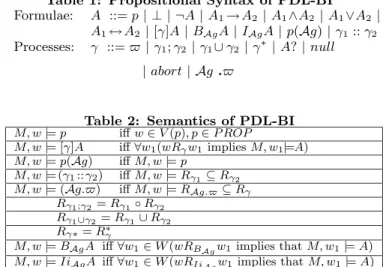
The PDL-BI language is an extension of PDL and includes modal operators for belief and intention similar to BDI logics. Monadic modal operators for a belief (Bi) and an intention (Ii) of an agentiare used as intellectual props for deductive inference and treated as independent except for explicit inter-action axioms. The syntax of PDL-BI is defined in table 1. We assume throughout that each atomic formula, agent and instance of an atomic process can be denoted by a distinct identifying term.
Letatomic formulae be denoted byp,q,. . . and letφ de-note the set of atomic formulae. Examples of an atomic for-mula areproposed, informed andrejected. Letϕ denote the set of formulae formed from atomic formulae using the stan-dard connectives (¬,∧,∨,→,↔), the modal operators and the last two formulae in table 1. LetA denote a formula in
ϕ. The formula ⊥=def (p∧ ¬p) holds. Let G denote a fi-nite group of agents (for example, a group of contractors), i, j an agent, and Ag an agent or a group of agents in G. The syntax of PDL-BI remains propositional because we only deal with finite sets, and for convenience we use quantifica-tion over such finite sets. Let $ denote an atomic process. Examples of atomic processes arepropose,accept andinform. We assume atomic processes are successfully executed. As
Table 1: Propositional Syntax of PDL-BI
Formulae: A ::=p| ⊥ | ¬A|A1→A2|A1∧A2|A1∨A2| A1↔A2 |[γ]A|BAgA|IAgA|p(Ag)|γ1::γ2 Processes: γ ::=$|γ1;γ2 |γ1∪γ2 |γ∗|A?|null
|abort| Ag.$
Table 2: Semantics of PDL-BI M, w|=p iffw∈V(p), p∈P ROP
M, w|= [γ]A iff∀w1(wRγw1impliesM, w1|=A)
M, w|=p(Ag) iffM, w|=p
M, w|= (γ1::γ2) iffM, w|=Rγ1⊆Rγ2
M, w|= (Ag.$) iffM, w|=RAg.$⊆Rγ
Rγ1;γ2=Rγ1◦Rγ2
Rγ1∪γ2=Rγ1∪Rγ2
Rγ∗=R∗γ
M, w|=BAgA iff∀w1∈W(wRBAgw1 implies thatM, w1|=A)
M, w|=IiAgA iff∀w1∈W(wRIiAgw1implies thatM, w1|=A)
for PDL, complex processesγ are generated from the set of atomic processes [2].
The formula [γ]Ahas the intended meaning: Aholds after executing processγ. The complex process (γ1;γ2) denotes the sub-processγ1followed byγ2, the process (γ1∪γ2) is eitherγ1 orγ2non-deterministically,γ∗denotes zero or more iterations of process γ. A state test operator “?” allows sequential composition to follow only if the tested state holds. A null process represents no execution, while anabortprocess results in a failed state. We extend the program logic of PDL so as to express multi-agent interactions. Set notation is used to manipulate sets of agents. Our extensions are formulae of type p(Ag) and γ1 :: γ2, and processes of type Ag.$, and their semantics are given in the next section.
4.2
Semantics
The PDL-BI logic is multi-modal. Despite the need for Inten-tion to be treated as a non-normal modality, the logic can be given a formal “possible worlds” semantics using an extended multi-relational Kriple model denoted by:
M = (W, Rγ, V,RBAg,RI1Ag,RI2Ag,RI3Ag ) [2]. Here W is a non-empty set of worlds. The functionV is an assign-ment from sets of possible worlds to propositions. V :φ→2W whereV(p) is the set of worlds where atomic formulapholds.
Rγ, RBAg and eachRIiAg are accessibility relations on the worlds inW (in order to model processes, beliefs, and inten-tions, respectively). The model semantics are then as spec-ified in table 2, subject to the supplementary requirements that the relation RBAg is serial, transitive, and Euclidean (see [5]), and that each formula of the form IAgA is trans-lated into¬I1Ag¬(I2AgA∧ ¬I3AgA) (see [3]). As we do not use the semantics of table 2 in any explicit way, it serves only as a statement that a fairly conventional, if complex, se-mantics can be provided. We do, however, reason informally about multi-modal formulae, and recognize that a complex semantic model can have hidden problems.
p(Ag) such as proposed(C) holds in world w if and only if p holds in w. We treat an agent or a group of agents as executing atomic actions through the expression Ag.$ (e.g. ci.proposemeansciexecutes theproposeprocess)1. Using set notation, we can express a joint process between two parties, for example{ci, cj}.deliberate.
4.3
Axiomatisation
In this sub-section, we define axioms holding in PDL-BI, as part of the first layer in figure 1. PDL-BI contains the axioms of PDL in addition to the KD45 axioms for belief. Axioms K, D, 4 and 5 respectively express closure under implication, consistency, and positive and negative introspection. We as-sume that each agent in a group has such a system of belief. The formula EGA is read as everyone in a group of agents, G, believes A, whereA itself may express an agent’s beliefs and intentions. We also re-use the FIPA SL done operator [1]. Here,done(i.γ)(done(i,γ)in FIPA SL) means that agent ihas performed actionγ. Pre-conditionspfor doingγcan be expressed as part of a process (e.g. p?;γ). In addition to the KD45 axioms for belief, table 3 gives axioms for intentions and for beliefs about intentions. Let an arbitrary formula be denoted byAand a process byγ.
Table 3: Belief-Intention Axioms
(A0) p(Ag)→p
(A1) BiBiA↔BiA (D-Int) IiA→ ¬Ii¬A (Int-A) BiIiA↔IiA (Int-B) Bi¬IiA↔ ¬IiA (A2) IiA→IiBiA (A3) IiA→ ¬BiA (A4) BiBiA→ ¬IiBiA (A5) BiA→ ¬IiA (A6) IiA→ ¬IiIiA
(A7) BiIi. . . BiIiA↔Ii. . . IiA (A8) IiA∧Bi[γ]A→[γ]BiA (A9) Iidone(γ)∧Bi[γ]A→[γ]BiA (A10) IiA∧Bi[γ]A→Iidone(γ) (A11) Ii(done(γ1;γ2))→[γ1]Iidone(γ2)
(A12) Ii(done(γ1∪γ2))→Iidone(γ1)∨Iidone(γ2)
Axiom (A0) can be obtained from the definition of p(Ag). If a state such asproposed(ci)holds, the stateproposed also holds. Axiom (A1) makes iterated belief redundant. This is proved in [5] from the KD45 axioms for belief. Axiom (D-Int)ensures that an agent’s intentions are consistent. Axioms (Int-A)and(Int-B)are respectively analagous to positive and negative introspection for belief. An agent is aware of its in-tentions (Int-A) and its non-inin-tentions (Int-B).
Axiom (A2) expresses that if agenti intends A, then it in-tends to believeA. The reverse implication does not hold (i.e. an agent may intend to believeA but not intendA because it is not capable of bringing aboutA).
Axiom (A3) defines the simplest relation between intention and belief [3]. Thus, if agent i intends A, then it does not believeA holds. This is weaker than believing ¬A, because doing so results in an inconsistency with axiom (A4). Axiom (A4), derived by replacingAwithBiAin axiom (A3), means an agent does not intend to believe what it already believes.
1We may extend the language to associate an agent with roles. For example,ci:contractor meansci acts as a contractor.
Axiom (A5) is the contraposition of axiom (A3) and means an agent does not intendAif it believesAalready holds. Axiom (A6) is obtained by replacing A with IiA in axiom (A4) and then applying axiom (D-Int). It implies that if i intends something, it does not intend to intend it. Thus, in contrast to beliefs, intentions do not expand nor collapse. Axiom (A7)is obtained from axiom (Int-A) and allows us to simplify alternating beliefs and intentions to only intentions. We also specify axioms to relate process execution in PDL with beliefs and intentions. Axioms (A8) and (A9) define that ifi intendsA (ordone(γ)) and it believes thatAholds after executingγ, then afterγ is executed,i believesA. Axiom (A10)expresses that ifiintendsAand it believes that Aholds after executingγ, then it will intenddone(γ). Axiom (A11)states ifi intends a sequence of processes, then it intends the next process in the sequence after each process execution.
Axiom (A12)expresses thatiintends either sub-process when intending a complex process consisting of alternative pro-cesses. Given the above axioms relating to the modalities in PDL-BI, we can now define axioms regarding message ex-change, which is the second component of the first layer in figure 1.
4.4
Communication Axioms
A speech-act consists of an illocutionary forcesaand a propo-sitional contentp[10]. Thus using PDL-BI notation, a CA is a tuple of the forms.sa(r,A), wheresis the sender,r the re-ceiver andAa formula representing the propositional content of the act. We assume that sent messages are successfully re-layed across the network, implying that the actions.sa(r,A) always succeeds. This suggests the following PDL-BI axiom schema:
Isdone(s.sa(r, A))↔[s.sa(r, A)]Brdone(s.sa(r, A)) The precondition Isdone(s.sa(r, A)) is necessary because a message should not be sent unless the sender intends to send it. It is sufficient for the receiver to presume these intentions in order that the precondition to be itself a primitive plan by which the sender can attain the RE. This causality style of schema is potentially verifiable in a logic that is grounded in machine states, but for our purposes it enables us to sepa-rate the FP and RE from the message transport. FIPA-like semantics are re-instated by assuming that the receiver be-lieves that the message transport post-condition entails the message RE, (Brdone(s.sa(r, A))→BrREsa). The FIPA se-mantics do not assume the sender intends the RE, but one can take the view that the FP should be strengthened to entail
Isdone(s.sa(r, A)).
Let FP(sa) denote the FP of the CA sa being sent and RE(sa) denote the RE ofsa. In general, the FP relates to a sender’s intentions to convey some formula and the RE relates to the receiver’s beliefs. Thus, we have the following two axioms:
Message Sending: Isdone(s.sa(r, A))→F P(sa).
Message Receipt: Brdone(s.sa(r, A))→RE(sa). If the sender intends to send a message, then the FP of the message (its CA) should hold, and likewise for the receiver to believe the RE of the message on receiving it. These com-munication axioms may change according to the properties of the network layer.
4.5
Social Attitudes
whether they are sincere, trustworthy or selfish). As a first step, we assume sincere and trustworthy behaviour and in this section we define the axioms that capture such attitudes. These attitudes are implicit in FIPA ACL and in this section we make them explicit, so that they may be relaxed in other scenarios.
Sincerity Axioms: Agents are sincere and the sender does not intend the receiver to believe what it does not believe itself. IsBrBsA →BsA and IsBrIsA→IsA. Using axiom (A1) onIsBrBsA→BsA, we haveIsBrA→BsA.
Trust Axiom1: Ifr believes that agents sent a message to agent r that A holds, thenr believes A. Receivers trust the sender. BrIsBrA→BrA.
Trust Axiom2: IfAis a proposition or a belief formula in Trust Axiom1, thenr also believessbelievesA. BrIsBrA→
BrBsA.
Cooperative Axiom: Agents are cooperative and, thus, on receiving a message, they will reply even if it is with a refusal or a rejection. BrIsIrA→(IrBsIrA∨IrBs¬IrA).
The above axioms can also be related to a message sent or received. For example, the trust axiom can be re-formulated as: ¬Br¬A → [s.sa(r, A)]BrA. This means that if the re-ceiverrdoes not believe thatAdoes not hold, then on being informed bysthatAholds,r believesA.
Given the above system for an agent’s propositional and social attitudes, we can now specify the semantics of CAs in terms of the intentions of a message sender and the receiver’s beliefs.
5.
SEMANTICS FOR CAS
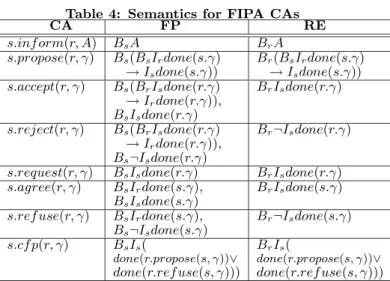
We analyse the semantics of the most commonly used CAs, as given by FIPA in the SL language, and discuss the incorrect-ness of these semantics with respect to the intended meaning of the CA. As a remedy, we then provide a corrected, simpler and more intuitive semantics (in table 4). In what follows, we refer to the SL semantics as “FIPA semantics” and we refer to our revised semantics as “BIS” (Belief Intention Seman-tics). In all cases,sandrrespectively denote the sender and receiver,Adenotes a formula andγ a process.
Table 4: Semantics for FIPA CAs
CA FP RE
s.inf orm(r, A) BsA BrA
s.propose(r, γ) Bs(BsIrdone(s.γ) Br(BsIrdone(s.γ)
→Isdone(s.γ)) →Isdone(s.γ))
s.accept(r, γ) Bs(BrIsdone(r.γ) BrIsdone(r.γ)
→Irdone(r.γ)),
BsIsdone(r.γ)
s.reject(r, γ) Bs(BrIsdone(r.γ) Br¬Isdone(r.γ)
→Irdone(r.γ)),
Bs¬Isdone(r.γ)
s.request(r, γ) BsIsdone(r.γ) BrIsdone(r.γ)
s.agree(r, γ) BsIrdone(s.γ), BrIsdone(s.γ)
BsIsdone(s.γ)
s.ref use(r, γ) BsIrdone(s.γ), Br¬Isdone(s.γ)
Bs¬Isdone(s.γ)
s.cf p(r, γ) BsIs( BrIs(
done(r.propose(s, γ))∨ done(r.propose(s, γ))∨
done(r.ref use(s, γ))) done(r.ref use(s, γ)))
As for FIPA semantics, we give the preconditions (FP) and postconditions (RE) holding, respectively, before sending and after receiving a CA. To be compatible with the way FIPA semantics are expressed, using axiom (Int-A), we prefix the
intentions of a sender with its beliefs about those intentions (e.g. BsIsBrA instead of IsBrA). For reasons mentioned in section 2, we drop the Gricean conditions from the FP of all the CAs. Although it may not be appropriate to repeat sending aninform CA, removing the GC does not affect the meaning of the other CAs. In any case, a sender repeating an informdoes not change the sender’s or receiver’s beliefs about the propositional content after the first inform. We discuss below the semantics of some of the most salient CAs.
s.inform(r,A). s informs r that A holds. In the FIPA se-mantics, the FP includes the GC and the fact that the sender believes A. The RE includes the fact that the receiver be-lieves A. As mentioned in section 4.4, BsA is not strong enough as FP in the FIPA semantics since we need to repre-sent the intention ofsto send the message. We could express this asBsIsBrA, the sender intends the receiver to believeA. By the sincerity axiom, the FP simplifies toBsAand by the trust axiom the RE simplifies toBrA.
FIPA FP:BsA∧ ¬Bs(BifrA∨U ifrA)
inform RE:BrA BIS FP:BsA
inform RE:BrA
s.propose(r,γ). sproposesrforsitself to doγ. In the FIPA semantics FP, the senderswill intend to doγifrintendssto doγ. However,smay not know whatrintends and therefore cannot consequently infer that it should intend to doγ. For sto be aware thatr intendsdone(s.γ), it must have received an accept to its proposal. As such, FIPA semantics specify that s adopts an intention by being privy to the individual beliefs ofr. In our BIS semantics, both the FP and RE specify thats (the proposer) believes thatr intendsdone(s.γ), fors to adopt the same intention. Therefore,BsIrdone(s.γ) is the premise forsto adopt the intention to doγ.
FIPA FP:BsA∧ ¬Bs(BifrA∨U ifrA)
propose RE:BrA where,
A=Irdone(< s, γ >)→Isdone(< s, γ >) BIS FP:Bs(BsIrdone(s.γ)→Isdone(s.γ))
propose RE:Br(BsIrdone(s.γ)→Isdone(s.γ))
s.accept(r,γ). ssends an accept proposal tor, forr to doγ. The FIPA semantics foraccepting a proposal do not consider the context of sending an accept. As FP,sbelieves that it in-tendsrto doγ. There is no notion in the FP thatsis accept-ing a proposal thatr must have sent. As long assintends r to doγ, it can send anaccept without any prior proposal from r or even with a previous refusal fromr. Thus, the FIPA FP and RE foraccept could also hold in other speech-acts such as tell and they do not distinguish an accept-proposal from them. In our BIS semantics, we include in the FP that the sender believes thatr sent a proposal previously and it is up to s to accept it. The other part is the choice of the sender to intend the receiver to do γ2. Here our semantics of the accept CA show the necessity of having both the FP and RE for specifying the semantics of a CA. The FP and RE involve more than just the sender intending Abefore sending a CA and the receiver believingAin the RE. For example, for the accept CA, only the FP of accept includes the belief about a prior proposal.
FIPA FP:BsA∧ ¬Bs(BifrA∨U ifrA)
accept RE:BrA, whereA=Isdone(< r, γ >). BIS FP:Bs(BrIsdone(r.γ)→Irdone(r.γ)),
accept BsIsdone(r.γ) RE:BrIsdone(r.γ)
s.cfp(r,γ). s sends a call for proposal tor to doγ. In the FIPA semantics, the FP for a call for proposal includes that both sender and receiver intend the receiver to performγ if feasible. However, these intentions are premature given that rhas yet to propose andsto accept forrto doγ. It does not leave the possibility for refusal or rejection. The rest of the se-mantics forcfpis so complicated that its meaning is unclear. In our semantics, a call for proposal fromstoris equivalent to a request froms to r for r to make a proposal or a re-fusal tos. Thuss.cfp(r,γ)is partly equivalent tos.request(r, r.propose(s,γ)). Using our BIS semantics fors.request(r, γ), as shown in table 4, we can specify a call for proposal bysas having FPBsIs(done(r.propose(s, γ))∨done(r.ref use(s, γ))). This means thatsintends r to either send a proposal or re-fusal to doγ(for example becausercannot doγ). In turn, the RE of a call for proposal is thatrbelievessintendsrto make a proposal or to refuse. The FP and RE ofcfpcan be further expressed in beliefs and intentions by replacing its constituent CAsproposeandrefuse with their own BIS semantics.
6.
INTERACTION PROTOCOLS
Interaction protocols (the fourth layer in figure 1) can be rep-resented diagrammatically in statechart like notation [7] (for the sake of comprehension) and logically in extended PDL (for verification purposes). Specifically, an interaction pro-tocol consists of state transitions and a hierarchy of states. Let the predicateone of be defined to returntrueif only one of the formulae in its given set holds. Therefore,one of({A,
A1, A2, A3})holds if only one of the formula in the set {A, A1, A2, A3}holds.
Sub-states. These are represented using implication and equivalence relations between states. For example,
A0 ↔one of({A1, A2}) expresses that A1 and A2 are
sub-states ofA0. The equivalence relation ensures that the state A0 cannot hold unless eitherA1 orA2 holds.
State transitions. The formulaA1↔[γ]A2expresses a state transition from source state A1 to target state A2 through processγ. Equivalence in the formula allows us to infer the source state after a transition has occurred. To apply our framework, the remainder of this section is concerned with the CNP as a case study of an IP.
6.1
Representation of the CNP
We can express the CNP using CAs and the modalities in PDL. We treat the exchange of CAs as the execution of pro-cesses. Our extensions to PDL allow us to express agents executing actions and thus sending CAs. A fragment of the representation of the CNP is given in figure 2. The corre-sponding formal semantics of the protocol are described in section 6.2. LetM denote the manager and,i andj contrac-tors.
Figure 2 provides the logical theory of most of the CNP in extended PDL. Axioms (1)-(3) specify relations between the states. For example, a contract net state is either open or closed, where the sub-states ofclosed are given in axiom (2) and those of open in axiom (3). A manager may initiate a contract net into acfpedstate by issuing a call for proposals
contract net↔one-of ({open, closed}) (1) closed↔one-of({(failed∧informed),cancelled,refused}) (2) open ↔one-of({deliberating, executing}) (3)
¬contract net↔[M.cfp(G,γM)] cfped(M,G,γM) (4) cfped(M,G,γM)↔(
[i.refuse(M,γM); M.wait]cfped(M,G, γM)
∨[i.refuse(M,γM); timeout?] refused(γM)
∨[i.propose(M,γi);C\ {i}; P\ {γi}] proposed(C, P)) (5) proposed(C, P)↔
[j.propose(M,γj);C\(C∪ {j});P\(P∪ {γj})]proposed(C,P)
∨[M.deliberate(C,Acc,P)]to-be-accepted(C,Acc,P) (6) to-be-accepted(C,Acc,P)↔
∀i∈Acc[M.accept(i, γi)] accepted(Acc, P)∧
∀j∈(C-Acc) [M.reject(j, γj)]rejected(C-Acc, P) (7)
Figure 2: A fragment of the CNP in extended PDL
to a group of contractors G, only if the interaction has not yet started, leading to thecfped state (Axiom 4).
Axioms (5)-(7) define the state transitions of the CNP. Ax-iom (5) expresses that in acfpedstate, contractors may refuse the manager’scfp, and if the manager receives only refusals by the deadline, the process terminates in arefused state. Oth-erwise, some contractors may refuse whilst others (proposers) send a proposal, leading toproposed(C, P)whereC is the set of proposers and P the set of proposals. In the setP, each proposal is associated with its proposer (i.e. γiis associated to proposer i). In axiom (6), further proposals from other proposers are added to the setsC (viaC\(C∪ {j})) andP. The manager deliberates which proposals to accept and add them to the set Acc. Acc is the set of proposals which the manager will accept. Thus, in axiom (7) the manager sends anaccept message to all contractors inAcc, and rejections to those in(C-Acc).
6.2
Semantics of the CNP
To specify the semantics of an IP, we must first specify the semantics of its state transitions, which, in turn, lead to a corresponding semantics for its states. On combining the se-mantics of an IP’s states and transitions according to the allowable sequences of transitions defined in the representa-tion of the protocol (figure 2), we obtain an interpretarepresenta-tion of the protocol and its semantics (layer 4 in figure 1). This interpretation can then be verified for properties such as cor-rectness, termination or completeness (see section 7.1). First, we specify the semantics of the transitions in the CNP. There are two types of transitions in the CNP, CAs (mostly) and the internal actions of the agents. The semantics of the CAs are defined in section 5 and thus we specify the semantics of the internal actions below before we address the states of the CNP.
6.2.1
Internal Actions.
inter-nally performs the process M.deliberate(C, Acc, P) to select which proposals to accept. The semantics ofdeliberate are given in table 5. The precondition requires thatM believes that the setC contains those agents which sent a proposal. The postcondition specifies that after adeliberate action, the setAcccontains the contractors whose proposalsM will ac-cept and the set(C-Acc)those that will be sent rejections.
6.2.2
Semantics of the States of the CNP.
The interaction states of the CNP can be grouped into three categories: public, shared and individual. A public state is believed by all the agents, a shared state is believed by a par-ticular subset of the group, and an individual state is believed by only one agent. In the CNP, a statesi is equivalent to
done(γi), where actionγitriggers state si. For example, the statecfped(M, G, γ)can be re-written asdone(M.cfp(G,γ)) and likewise for the other states. For the sake of readability, we prefer to name a state as the past tense (e.g. cfped) of an action leading to it (e.g. cfp), instead of a parameterised done(e.g. done(cfp)). Let a group of contractors be denoted byG and the manager byM. Let EGA be read as everyone in groupGbelieves A.
Public States:The public states in the CNP arecfped, open andclosed. These states are believed by the manager and all the contractors inG. We give here the semantics ofcfped, and in table 5 the semantics of the other public states are simi-larly specified in terms of the beliefs of the groupGM (where
GM=G∪ {M}). In the statecfped(M, G,γM), everyone in the groupGM believes done(M.cfp(G,γM)).
That is, EGM∀i ∈ G(done(M.request(i, i.propose(M, γi)))). This entails that everyone believes the FP and RE of a cfp:
EGM∀i∈G(IM(done(i.propose(M, γi))∨done(i.ref use(M, γM)))), which can be expressed in only beliefs and intentions by re-placingproposeandrefuse with their own BIS semantics.
Shared States: In the CNP, the shared states are believed by the manager and a contractor. For example, only the manager and a contractorisending a proposal to doγibelieve and mutually believe that contractori has sent the manager the proposal to do γi. The shared states of the CNP are proposed, accepted, rejected, cancelled, refused, informed and failed. Their semantics are given in terms of the beliefs of the manager and a contractor. Here we explain the semantics of theproposed states, while the semantics of the other shared states are given in table 5.
In the stateproposed(C,P), the beliefs betweenM and each contractori inC are derived from the semantics of the pro-pose CA. The FP and RE of thepropose CA are:
BM(BiIMdone(i.γi)→Iidone(i.γi)) and
Bi(BiIMdone(i.γi)→Iidone(i.γi)) leading to the shared be-lief betweeni andM in the stateproposed(C,P):
∀i∈C(E{M,i}(BiIMdone(i.γi)→Iidone(i.γi))).
Individual States: In the CNP, the two individual states resulting from its two internal actions areto-be-accepted and completed, as the private state of the manager and a contrac-tor respectively. In the state to-be-accepted(C,Acc, P), the manager privately believes that it will send an acceptance to all contractors inAcc. This state’s semantics are:
∀i ∈ C (BM(BiIMdone(i.γi) → Iidone(i.γi))), M believes that all contractors inC sent it a proposal.
∀i ∈ Acc (BM(IMdone(i.γi)∧IMBiIMdone(i.γi))). M in-tends that all agents in Acc execute their proposal and M
intends to let them know about its acceptance.
∀i∈(C−Acc)BM(¬IMdone(i.γi)∧IMBi¬IMdone(i.γi)) like-wise holds for the agents thatM decided to reject.
7.
INTERPRETATION OF THE CNP
We can validate our semantics for the CNP and its CAs by proving useful properties of the protocol. We do this by rea-soning about the possible paths in the CNP.
S0
S1
S2
S3
S4
S7
S8
S5 S6
M.cfp(G,γM)
n.refuse(M,γM);
i.propose(M,γi);C\{i};P\{γi}
∀i∈CM.cancel(i,γi)
j.propose(M,γj);
(M.accept(i,γi)∩M.reject(j,γj))
∀i∈Acc(i.γi)
j.failure(M, γj) ∀i∈B, j∈(Acc-B)
M.deliberate(C, Acc, P)
∀i∈Acc, j∈(C-Acc)
i.inform(M, done(i, γi))
Figure 3: Execution Paths of CNP
Table 5: Semantics of Execution Paths fromS0 toS6 S0 F PM.cf p(G,γM) ∀i∈G(BMIM(done(i.propose(M, γM))
∨done(i.ref use(M, γM))))
S1
REM.cf p(G,γM) ∀i∈G(BiIM(done(i.propose(M, γM))
∨done(i.ref use(M, γM))))
cf ped(M, G, γM) EGM∀i∈G(IM(done(i.propose(M, γi))
∨done(i.ref use(M, γM))))
F Pi.propose(M,γi) Biαi
S2
REi.propose(M,γi) BMαi
proposed(C, P) ∀i∈C(E{M,i}αi)
P redeliberate ∀i∈C(BMαi)
S3
P ostdeliberate Acc⊆C∧
∀i∈Acc(BMIMBiIMdonei),
∀j∈(C−Acc)(BMIMBj¬IMdonej) to-be-accepted ∀i∈C(BMαi),
(C,Acc,γ) ∀i∈Acc(BMIM(donei∧BiIMdonei)),
∀j∈(C−Acc)BM¬IMdonej
∧IMBj¬IMdonej
F PM.accept(i,γi) BMαi, BMIMdonei
F PM.reject(j,γj) BMαj, BM¬IMdonej
S4
REM.accept(i,γi) BiIMdonei
REM.reject(j,γj) Bj¬IMdonej
accepted(Acc, P) ∀i∈Acc E{M,i}αi,(E{M,i}IMdonei) rejected(C-Acc,P) ∀j∈(C-Acc)E{M,j}(αj∧ ¬IMdonej
∧¬Ijdonej)
P re∀i∈Acc(i.γi) ∀i∈Acc BiIidonei
S5
P ost∀i∈Acc(i.γi) ∀i∈B Bidonei
completed ∀i∈B(Bidonei∧IiBMdonei)
(Acc, B, P) ∀j∈(Acc-B)∧Bj(¬donej∧ ¬Ijdonej∧
IjBM¬donej∧IjBM¬Ijdonej)
F Pi.inf orm(M,donei) Bidonei
F Pj.f ailure(M,γj) Bj(¬donej∧ ¬Ijdonej)
S6
REi.inf orm(M,donei) BMdonei
REj.f ailure(M,γj) BM(¬donej∧ ¬Ijdonej) informed(B,donei) ∀i∈B(E{M,i}donei)
failed(Acc-B,γ) ∀j∈(Acc−B)(E{M,j}(¬donej)))
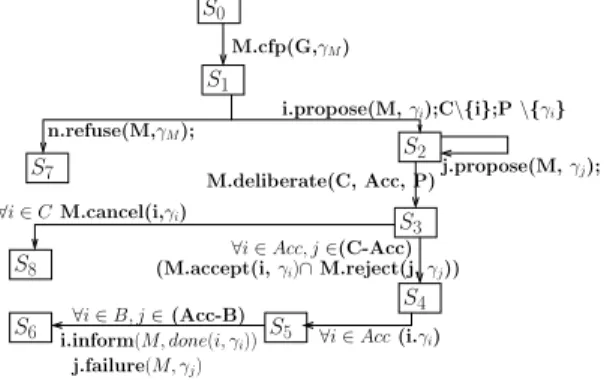
completion (withrefusals, cancellations orinforms). Figure 3 includes all possible paths in the execution of the CNP. The pathS0toS6is the longest execution path in the CNP (disre-garding iterative proposals), and the semantics for this path are given in table 5. We refer to the states si in the CNP as interaction states (e.g. proposed, accepted, informed), and to the statesSi in figure 3 as execution states. In table 5, an execution state, Si, regroups the RE of the action lead-ing toSi, the semantics of the interaction state si and the FP of the next action fromSi. For example, the action cfp leads to stateS1 in figure 3, and thus in table 5, the stateS1 groups the RE ofcfp, the semantics of thecfped interaction state, and the FP of the next actionpropose. As before, let M denote the manager, i, j denote contractors and G the group of contractors. In table 5, let done(i.γi) be abbrevi-ated to donei and done(j.γj) be abbreviated to donej. Let
αi denoteBiIMdone(i.γi) →Iidone(i.γi) and let αj denote
BjIMdone(j.γj)→Ijdone(j.γj).
7.1
Termination of the CNP
Using table 5 as the semantics of the CNP, we can prove some of its properties (such as termination, completeness, correct-ness, liveness and consistency). Here, by means of an illustra-tion of our framework, we arbitrarily pick one of these, (i.e. termination), and prove that any interpretation of the CNP will terminate.
Theorem 1. In a CNP between a manager M and a group
of contractors G, the formula
(cf ped(M, G, γM)→[P athsALL]closed)
holds, where the processP athsALLexpresses all complete paths of execution in our framework.
Proof. Assuming cf ped(M, G, γM), [P athsALL]closed is
proved. Let the notations in table 5 be used.
We prove that theclosed state is eventually reached from the cfped interaction state. Let the process ρi lead to the interaction statesiand the execution stateSi. The CNP de-fines what processρi+1 may follow the process ρi. Proving termination for all processes in P athsALL requires proving that all paths in figure 3 terminate. Thus, we prove that all transitions (actions) in the paths in figure 3 are feasible from their source state. That is, the FP of all processesρi+1 should hold after actionρi and in interaction state si. The premise is that the CNP has been started with a call for pro-posals. The premise holds from the statecf ped(M, G, γM). Then theREcf p (RE of cfp) holds, stating that contractors should either reply with a refusal or a proposal. The cooper-ative axiom in our framework and the RE ofcfptriggers the next state. So the process proceeds to the stateproposed or refused. Sincerefused is a sub-state ofclosed, all paths from refuseterminate. Using table 5, we now prove that the paths following apropose terminate. That is, after execution state
S1, for all actionsρi theF Pρi+1 is possible from the interac-tion statesiand theREρi. This can be seen in table 5 where the pre-condition ofdeliberateholds from theREpropose. Also the FP of the action ∀i ∈ Acc(M.accept(i, γi)) holds since the stateto-be-acceptedincludes the belief∀i∈C(BMαi) and ∀i ∈ Acc(BMIMdonei). Similarly, the FP of thereject action holds from the beliefs in theto-be-acceptedstate. Thus, both acceptance and rejection processes can occur. Then the precondition of the next actioni.γi can be derived from the beliefs of the stateto-be-accepted. From table 5 it can then be seen that the FP of bothinform andfailure are implied by
the beliefs in the statecompleted, leading to the sub-states of closed.
8.
CONCLUSIONS
We believe that many of the current problems in enabling agent interactions stem from issues in specifying ACLs and IPs. In particular, there is a lack of consensus on a suitable ACL for agent interaction because of the bewildering array of approaches to formalising an ACL’s semantics. Likewise, there is a similarly strong need for formal specification and verification of interaction protocols and their semantics. To highlight these needs and in an attempt to satisfy them, this paper used the contract net protocol as a non-trivial case study. We specified a four-layered framework, separating out the different components for facilitating agent interactions and we proposed the PDL-BI language and its axiomatisa-tion to specify these components. The layers in our frame-work range from specifying axioms for the propositional and social attitudes of an agent, to specifying the semantics of the ACLs and of IPs. These semantics allow us to verify the properties of IPs such as the CNP and to illustrate the capa-bilities of our framework we proved that our interpretation of the CNP terminates.
9.
REFERENCES
[1] FIPA.FIPA Communicative Act Library Specification. Foundation for Intelligent Physical Agents,
http://www.fipa.org, 2002.
[2] R. Goldblatt.Logics of Time and Computation. CSLI, 1987.
[3] A. Herzig and D. Longin. A logic of intention with cooperation principles and with assertive speech acts as communication primitives. InAAMAS, pages 920 – 927, 2002.
[4] A. J. I. Jones and X. Parent. Conventional signalling acts and conversation. InWorkshop on Agent Communication Languages, pages 1–17, 2003.
[5] J. Meyer and W. Van Der Hoek.Epistemic Logic for AI and Comp. Science. Cambridge Univ. Press, 1995. [6] J. Odell, H. Parunak, and B. Bauer. Representing
Agent Interaction Protocols in UML. InAOSE Workshop, pages 121–140, 2001.
[7] S. Paurobally and R. Cunningham. Verification of protocols for negotiation between agents. InECAI-15, pages 43–48, 2002.
[8] J. Pitt and A. Mamdani. Communication protocols in MAS. InWork. on Specifying and Implementing Conversation Policies, pages 39–48, 1999.
[9] D. Sadek. A study in the logic of intentions. In3rd Conf. on Principles of Knowledge Representation and Reasoning, pages 462–473, 1992.
[10] J. R. Searle.Speech acts: An essay in the philosophy of language. Cambridge University Press, 1969.
[11] R. G. Smith. The contract net protocol: High-level communication and control in a distributed problem solver.IEEE Transactions on Computers,
C-29(12):1104–1113, 1981.
[12] M. Wooldridge. Semantic issues in the verification of agent communication languages.Journal of