Trust-Based Mechanism Design
∗Rajdeep K. Dash
Sarvapali D. Ramchurn
School of Electronics and Computer Science
University of Southampton, Southampton, UK.
Nicholas R. Jennings
{
rkd02r,sdr01r,nrj
}
@ecs.soton.ac.uk
Abstract
We define trust-based mechanism design as an augmenta-tion of tradiaugmenta-tional mechanism design in which agents take into account the degree of trust that they have in their coun-terparts when determining their allocations. To this end, we develop an efficient, individually rational, and incentive compatible mechanism based on trust. This mechanism is embedded in a task allocation scenario in which the trust in an agent is derived from the reported performance success of that agent by all the other agents in the system. We also empirically study the evolution of our mechanism when it-erated and show that, in the long run, it always chooses the most successful and cheapest agents to fulfill an allocation and chooses better allocations than other comparable mod-els when faced with biased reporting.
1. Introduction
Mechanism design (MD) is the field of microeconomics that studies how to devise systems such that the interactions be-tween strategic, autonomous and rational agents lead to out-comes that have socially-desirable global properties. Given that the designer of a multi-agent system (MAS) typically has many of the same aims, there is a growing body of work that seeks to exploit the tools and concepts of MD to this end [3]. However, an important facet of MAS that is rarely con-sidered in MD is that agents do not always complete their tasks as planned or promised (this means they are not ways sucessful). Thus, for example, an agent may not al-ways complete every task it starts or it may default on pay-ment for a good. Furthermore, in traditional MD an agent chooses to interact with partners based on their costs or val-uations only. However, cheapest is not always best and these agents may ultimately not be the most successful. Thus, in many practical situations the choice of interaction partners is motivated by an agent’s individual model of its
counter-∗ The first author gratefully acknowledges funding from a BAE studentship and ORS scholarship. The authors thank Dr. R.Mason for helpful initial comments.
parts, as well as by information gathered from its environ-ment about them. For example, on eBay buyers determine the credibility of particular sellers by considering their own interaction experiences with them (if they have any) and by referring to the historic evaluation information provided by other buyers. To capture this phenomenon, we exploit the notion of trust to represent an agent’s perception of another agent’s probability of success (POS) in completing a task [1] (as opposed to the agent’s own belief about its own POS [9]). This, in turn, leads us to propose the area of trust-based mechanism design (TBMD) as an extension of traditional MD that adds trust as an additional factor to costs and valu-ations in decision making.
In more detail, the trust in an agent is generally defined as the expectation that it will fulfill what it agrees to do, given its observable actions and information gathered from other agents about it [1]. By their very nature, different agents are likely to hold different opinions about the trust of a particular agent depending on their experiences and the specifics of the trust model they use [10]. As a result, we cannot simply extend the conventional MD solution (e.g. the Vickrey-Clarke-Groves (VCG) mechanism) to encom-pass the notion of trust because such work is predicated on the fact that agents have private and independent informa-tion which determines their choice over outcomes. Trust, on the other hand, implies public and interdependent informa-tion.
In this work, we specifically consider MD in the context of task allocation (where it has often been applied [11]). In our scenario, agents may have different probabilities of suc-cess in completing a task assigned to them (e.g. it may be believed that a particular builder has a95%chance of mak-ing a roof in five days, while another builder may be be-lieved to have a 75%chance of doing so). Moreover, an agent may assign different weights to the reports of other agents depending on the similarity of their types. For exam-ple, consider a “repair engine” task assigned to a garage. In this case, two agents owning a Ferrari would assign higher weights to each other’s report about the POS of the garage than they would to the report of another agent which owns a Robin Reliant.
eval-uates the notion of trust-based mechanism design. We also define the general properties that trust models must exhibit to allow a trust-based mechanism to generate an optimal al-location of tasks. In particular, we advance the state of the art in the following ways:
1. We specify the properties that trust models must sat-isfy to be incorporated in mechanisms that permit effi-cient allocations.
2. We generalise the standard VCG mechanism to incor-porate the notion of trust.
3. We prove that the trust-based mechanism we develop is efficient, individually rational, and incentive com-patible.1
4. We empirically show that our trust-based mechanism leads to the most successful and cheapest agents being selected to fulfill an allocation in the long run and that it performs better than comparable mechanisms when agents’ reports of POS are biased.
The remainder of the paper is structured as follows. Sec-tion 2 discusses related work in the areas of trust and mech-anism design. Section 3 describes the basic task allocation problem with a standard VCG solution. Section 4 presents our trust-based mechanism design and develops an appro-priate mechanism for trust-based task allocation. In sec-tion 5 we show the generality of our mechanism by re-ducing it to various known instances. Section 6 empirically evaluates the mechanism with respect to other comparable mechanisms. Finally, section 7 concludes and outlines fu-ture work.
2. Related Work
In associating trust to mechanism design, we build upon work in both areas. In the area of trust and reputation, a number of computational models have been developed (see [10] for a review). While these models can help in choosing the most successful agents, they are not shown to generate efficient outcomes in any given mechanism. An exception to this is the work on reputation mechanisms [4, 6]. However, these mechanisms only produce efficient outcomes in very constrained scenarios and under strict assumptions (e.g. in [4] sellers are monopolists and each buyer interacts at most once with a seller and in [6] the majority of agents must al-ready be truthful for the mechanism to work).
In the case of MD, there has been comparatively lit-tle work on achieving efficient, incentive-compatible and individually-rational mechanisms that take into account un-certainty in general. An exception to this rule is the dAGVA
1 The mechanism we develop also forms the only class of mechanisms that have these properties under a Nash equilibrium strategy when fac-toring trust into the decision making process. Intuitively, this follows from the uniqueness of the VCG which charges agents their marginal contribution to the system. Since we use a similar technique to de-velop our mechanism we believe the same result will ensue (the for-mal proof of this assertion is beyond the scope of this paper).
mechanism [7] which considers the case when the types of agents are unknown to themselves but are drawn from a probability distribution of types which is common knowl-edge to all agents. However, in our case, the agents know their types and these incorporates their uncertainty related to fulfilling a task. Porter et al. [9] have also considered this case and their mechanism is the one that is most closely re-lated to ours. However, they limit themselves to the case where agents can only report on their own POS. This is a drawback because it assumes the agents can measure their own POS accurately and it does not consider the case where this measure may be biased (i.e. different agents perceive the success of the same event differently). Thus our mecha-nism is a generalisation of theirs (see section 5 for the for-mal proof).
Finally, our work may also seem to be a case of inter-dependent, multidimensional allocation schemes [2] where there is an impossibility result of not being able to achieve efficiency when considering interdependent, multidimen-sional signals [5]. However, we circumvent this by relating the trust values to a probability that an allocation is com-pleted, rather than to an absolute valuation or cost signal.
3. A Standard VCG Task Allocation Scheme
We consider a set of agentsI, whereI ={1, . . . , I}, and a set of possible tasksT. Each agenti ∈ I has a particu-lar value,vi(τ, θi), for having a task (completed by another agent),τ ∈ T, which is dependent on its type θi drawn from a possible set of types,Θi. An agentialso has a cost,
ci(τ, θi), of attempting to complete a task. Given a vector of values,v(τ, θ), and costs,c(τ, θ), from the set of agents, we can determine the value of an allocationK ∈ Kwhere Kis the set of all possible mappings ofT toI. Once a cer-tain allocationKis implemented, an agentiis then asked to pay for the task(s) it requested or receive payment for the task(s) it performed. The overall transfer of money to a par-ticular agentiis denoted byri. As is common in this do-main, we assume that an agent is rational (expected utility maximiser) and has a quasi-linear utility function [7].
Definition 1. A quasi-linear utility function is one that can
be expressed as:
ui(K, ri, θi) =vi(K, θi)−ci(K, θi) +ri (1)
Agents Auctioneer(centre)
ti
g1,g2,...gI (trust models of
agents)
Agents Auctioneer(centre)
vK
i
K,r
c(K,
(1) (2) (3) (4) (5)
(7)
K,r Agents
(6)
[image:3.595.57.296.80.222.2]^ ^
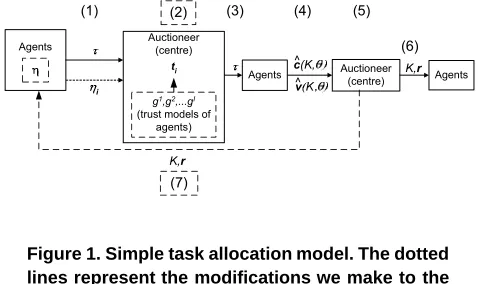
Figure 1. Simple task allocation model. The dotted lines represent the modifications we make to the mechanism when using trust in the feedback loop. ThegIfunctions represent the trust functions that are used to aggregate all POS values from other agents into a common measure of trust.
the agents. The problem at hand is then to find a mecha-nismM(v(τ,θ),c(τ,θ)) ={K,r}that fulfills the follow-ing commonly sought objectives in MD:
• Efficiency: an allocation that maximises the total util-ity of all the agents in the system.
• Individual Rationality: an allocation scheme is individ-ually rational if agents are willing to participate in the scheme rather than opting out of it. It is commonly as-sumed that the utility of an agent choosing to opt out of a scheme,ui(.), is 0. Hence, it is sufficient to en-sure that the agents derive a utilityui ≥0by being in the system.
• Incentive Compatibility: an incentive compatible sys-tem is one in which the agents will find no better op-tion than to reveal their true type.
Amongst the class of mechanisms that satisfy the above properties, the VCG mechanism implements an efficient al-location under dominant strategies (i.e. each agent has a best strategy no matter what other agents’ strategies are) [7]. Us-ing the VCG mechanism, our task allocation problem is then reduced to the following protocol which is shown in figure 1:
1. The centre receives the set of tasksτ to be allocated from the agents (step 1).
2. The centre then posts these tasks in the vectorτ (step 3). Each agentithen reports its costci(K, θi)(in the vector c(K,θ)) for completing a set of tasks in the set of allocationsKalong with the reported valuation
vi(K, θi)(in the vectorv(K,θ)) it derives from hav-ing a set of tasks completed (step 4). In the rest of the paper, we will superscript with ‘ˆ’ those variables and functions that are reported to the centre (auctioneer) to differentiate from those that are privately known. Of course, the reported values and costs can be different from the actual values and costs.
3. The centre then solves the following standard VCG auction equation (step 5):
K∗= arg maxK∈K
i∈I[vi(K, θi)−ci(K, θi)]and computes each transferriin the vectorras:
ri =j∈−ivj(K∗, θj)−cj(K∗, θj)
− maxK∈Kj∈−i[vj(K, θj)−cj(K, θj)] where −i≡ I \i.
4. The centre allocates the tasks according to the optimal allocationK∗and implements the transfersri(step 6).
The VCG mechanism results in an alignment of the goal of each agent with that of the mechanism designer via the use of the transfer part of the mechanism. Basi-cally, each agent has as its best strategy the social opti-mum goal, which can only be achieved via a truthful rev-elation. That is, for each agenti,ci(K, θi) =ci(K, θi)and
vi(K, θi) = vi(K, θi). Since the agents find it optimal to report their true valuations and costs, the centre thus finds the efficient allocation in step 3 (i.e. K∗ =K∗). The sec-ond part of the transfer ensures that agents haveuj ≥0and thereby makes the mechanism incentive compatible.
We have thus presented a standard DRM for our task-allocation problem that achieves efficiency, incentive com-patibility, and individual rationality under dominant strat-egy equilibrium. However, this mechanism only considers the cost and value of the tasks. In the next section we in-troduce trust as another dimension to be used in the com-putation of the efficient allocation and show why the stan-dard VCG is neither incentive compatible nor efficient when trust is taken into account.
4. Trust-Based Mechanism Design
To incorporate trust, a further dimension needs to be added to the utility function in equation 1 which, in turn, re-quires both the allocation and payment schemes in the VCG mechanism to be modified to take this additional dimen-sion into account. Having defined our mechanism (see sec-tion 4.4), we prove that it is incentive-compatible, efficient and individually-rational (in section 4.5). Before doing this, however, we first need to specify the generic properties that allow trust to be defined as a measure that can be used in computing efficient allocations.
4.1. Properties of the Trust Model
Many computational trust models have been developed to allow agents to choose their most trustworthy interaction partners (as discussed in section 2). However, at their most fundamental level, these models can be viewed as alterna-tive approaches for achieving the following properties2:
prop-1. The trust measure of an agentiin an agentj depends both oni’s perception ofj’s POS and on the perception of other agents onj’s POS. This latter point encapsu-lates the concept of reputation whereby the society of agents generally attributes some characteristic to one of its members by aggregating some/all the opinions of its other members about that member. Thus, each agent considers this societal view on other members when building up its own measure of trust in its coun-terparts [1]. The trust of agentiin its counterpartj,
tji ∈[0,1], is given by a function,g: [0,1]|I|→[0,1], (which, in the simplest case, is a weighted sum) of all POS measures sent by other agents to agenti about agentjas shown below:
tj
i =g({η1j, . . . , ηji, . . . , ηNj}) (2)
whereηji ∈[0,1]is the POS of agentjas perceived by agentiandg is the function that combines both per-sonal measures of POS and other agents’ measures. In general, trust models compute the POS measures over multiple interactions. Thus, the level of success recorded in each interaction is normally averaged to give a representative value (see [10] for a general dis-cussion on trust metrics).
2. Trust results from an analysis of an agent’s POS in per-forming a given task. The more successful, the more trustworthy the agent is. Thus, the models assume that trust is monotonic increasing with POS. Therefore, the relationship between trust and POS is expressed as:
∂tj i
∂ηj
i > 0, wheret
j
i is the trust ofiin agentj andηij is the actual POS of agentjas perceived byi.
Given the above, agents can update their trust rating for another agent each time they interact (both by recording their view of the success of their counterpart and by gath-ering new reports from other agents about it). Thus, if an agent’s POS does not change, the trust measure in it should become more precise as more observations are made and re-ceived from other agents. Moreover, having the trust mono-tonic increasing with POS ensures Mirrlees’s condition re-garding fixed points in allocation schemes [8] (which is a necessary condition for the mechanism to be efficient) is satisfied.
4.2. Augmenting the Task Allocation Scenario
In this section we show how trust is to be calculated and taken into account in the task allocation example we de-scribed in section 3. Here, any trust model satisfying the properties discussed in section 4.1 can be used when actu-ally building the system. The following changes are made (as shown in figure 1):
erties of our mechanism are independent of any specific trust model.
• Each agent i reports to the centre their POS vector
ηi= [η1i . . .ηiI](step 1). This is the POS that an agent has observed about the other agents. This vector may not be complete if agents have not experienced any past interactions with other agents. However, this does not affect the properties of the mechanism since the centre will only pick those POSs that are relevant (and calculate trust according to these).
• The agents must also submit their respective trust cal-culation function (equation 2) that applies over the vec-tor of all (or part of) other agents’ reported POSs (i.e.
η),ti = g(η), to the centre before the allocation of tasks (step 2). This allows the centre to compute the trust of agentiin all other agents (giveni’s own per-ception, as well as other agents’ perceptions of the task performer’s POS). Given that the trusttionly affects the allocation of tasks originating from agenti, the lat-ter has no incentive to lie about its trust function to the centre (otherwise it could result ini’s task not being al-located to the agent deemed most trustworthy byi).
The trust functiong(.)may assign different weights to the reports of different agents depending on the level of similar-ity between the types of agentsiand−i(where−i≡ I \i). Thus, given the trust functions and reports of POS of each agent, we now require the centre to maximise the overall expected valuation of the allocation (in step 5), as opposed to the valuation of the allocation independent of trust (i.e. which the standard VCG does). This is because an agent has a certain probability of completing the task to a degree of success which may be less than one. We denote asγthe completion vector of an allocationK which measures the level to which each task in an allocation is deemed com-pleted. Thus, the expected value of an allocation is then
E[γ|K,t
i]
i∈Ivi(K, θi)−i∈Ici(K, θi)
given the
trust vectorti. This captures the fact that the agenti, that al-located the task, determines the value ofγ. Moreover, agent
j, to which the task has been allocated, incurs a cost inde-pendent of how agentievaluates the task. This effectively means that the valuations are non-deterministic while the costs are deterministic. The centre thus determines the effi-cient allocationK∗(step 7) such that the value of the effi-cient allocation is maximised.
Having shown how to fit trust into the process of deter-mining the value of allocations, in the next subsection we provide a simple example to show why the standard VCG solution of section 3 is not incentive compatible (and thus not efficient). This then motivates the search for a mecha-nism that is.
4.3. Failure of the VCG Solution
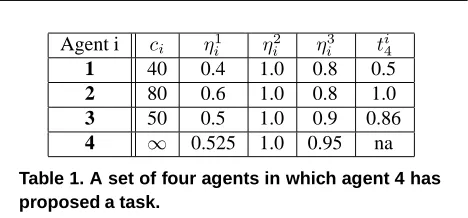
Consider a system of four agents where agent 4 has asked for a taskτ to be allocated and its valuation of this task is
Agent i ci η1i η2i ηi3 ti4
1 40 0.4 1.0 0.8 0.5
2 80 0.6 1.0 0.8 1.0
3 50 0.5 1.0 0.9 0.86
[image:5.595.61.295.75.184.2]4 ∞ 0.525 1.0 0.95 na
Table 1. A set of four agents in which agent 4 has proposed a task.
task by itself) and does not derive any value from the task being performed. Now, suppose that the trust function of agent 4 is a weighed sum of the POS reports by the agents (i.e.ti4 =αηiwhereα= [0.3 0.2 0.1 0.4]). Note that we do not concern ourselves with the reportsηi4since the task is proposed by agent 4 itself. Table 1 shows the costci of attempting the task, and the observed POS value of each agent,ηi, as well as the trust computed by agent4,ti4, if each agent reports truthfully on itsηi.
The VCG solution of section 3 determines the alloca-tion and payments based only on cost and valuaalloca-tions. How-ever, this would clearly fail to find an efficient allocation since agent 1 would be allocated the task despite being the least trusted and hence most likely to fail. If we instead im-plemented the VCG mechanism with the expected valua-tions (taking into account the trust and POS reports), we then haveK∗ = [0010](i.e agent 3 is allocated the task),
r1=r2= 0andr3= 210γ−130. Thus, agent 3 will then derive an average payment of0.87×210−130 = 52.7. However, this scheme is not incentive-compatible because agent 2 can lie aboutη23 by reportingη32 ≤ 0.7357which will then lead to agent2 being allocated the task and de-riving a positive utility from this allocation. Note that this scheme is exactly that of [9] for a single-task scenario (with the modification that we useγ as a level of success rather than a binary indicator function of success or failure).
As can be seen, the VCG mechanism needs to be ex-tended to circumvent this problem. Specifically, we require a mechanism that is efficient given the reports of the agents on their costs and valuations of allocations, as well as their observed POS vector (since the VCG is affected by false re-ports of POS). In effect, we need to change the payment scheme so as to make the truthful-reporting of POSs an op-timal strategy for the agent again. Once this is achieved, the centre can then choose the efficient allocation based on ex-pected utilities. The difficulty with designing such a mech-anism is that the centre cannot check on the validity of POS reports of agents because it is based on a private observa-tion carried out by the agent. Thus two agents may legiti-mately differ in their observed POS of another agent due to their different interaction histories with that agent.
4.4. The Trust-Based Mechanism
Before presenting our trust-based mechanism (TBM), we first introduce some notation. Let the sum of utilities of all agents in a system given an alloca-tion K and a completion vector γ be denoted as
U(K,θ, γ) = i∈Ivi(K, θi, γ) − i∈Ici(K, θi). Then the expected utility U(K,θ, γ) before the allo-cation is carried out is E[γ|K,t
i][U(K,θ, γ)] where
θ is the vector containing all agent types. We also denote the marginal contribution of the agent i to the system given an efficient allocation K∗ as
mci = U−i(K∗,θ, γ) − max
K∈KU−i(K,θ−i, γ)
where maxK∈KU−i(K,θ−i, γ) is the overall ex-pected utility of the efficient allocation that would have re-sulted if agenti were not present in the system. Now, we can detail TBM:
1. Find the efficient allocationK∗such that:
K∗= arg max
K∈KU(K,θ, γ) (3)
This finds the best allocation; that is, the one that max-imises the sum of expected utilities of the agents, con-ditional on the reports of the agents. We note here that we do not take into consideration the reward functions of the agents when calculating the overall utility since these rewards are from one agent to another and there-fore do not make a difference when calculating the overall utility of the agents.
2. We now calculate the efficient allocation that would have resulted if agenti’s report is taken out:
K∗
−i = arg maxK∈KE[γ|K,t
i][U(K,θ, γ)] where
t
i=g(η\ ηi). This computes howηiaffects which
al-location is deemed efficient.
3. We now find the effect that an agent’s ηi has had on its marginal contribution. Thus, findDi=U(K∗, .)−
U(K∗
−i, .). This distils the effect of an agent’s ηi re-port on its marginal contribution.
4. GivenK∗, the paymentrimade to the agentiis then:
ri=mci−Di (4)
Naturally, if ri is negative it implies that i makes a payment to the centre. The first part of the payment scheme,mci, calculates the effect that an agent’s pres-ence has had on overall expected utility of the system. We also subtractDito take into account the effect that an agent’s POS report has on the chosen allocation. This is in line with the intuition behind VCG mecha-nisms in which an agent’s report affects the allocation but not the payment it receives or gives.
4.5. Properties of TBM
Proposition 1. TBM is incentive-compatible in ex-ante
Nash Equilibrium.
Proof. We first need to calculate the expected util-ity, E[γ|K,t
i][ui(K, θi, γ)], that an agent derives from TBM because the goal of a rational agent is to max-imise its expected utility. We note here that we are assuming that the agent is myopic in that it is only con-cerned with its current expected utility given the cost vec-tor,c(K,θ), the value vector,v(K,θ), and the trust vector t. The expected utility that an agent, ui(K∗, θi, γ), de-rives from an efficient allocation, as calculated from equation 3, given the reports of all agents in the sys-tem is:
ui(K∗, θi, γ) =E[γ|K∗,ti]
vi(K∗, θi, γ)−ci(K∗, θi) +mci(K∗, θ
i, γ)−Di =E[γ|K∗,t
i]
vi(K∗, θ
i, γ)−vi(K∗, θi, γ) −ci(K∗, θ
i)−ci(K∗, θi)
+ U(K∗
−i,θ, γ)−maxK∈K
U−i(K,θ−i, γ) (5)
¿From 5 we will firstly prove the following lemma:
Lemma 1. An agent has an equilibrium strategy to reveal
its observed POS values.
Proof. We consider how ηi affects ui(K∗, θi, γ). From equation 5 we observe that ηi cannot affect
U(K−i,θ, γ) − maxK∈KU−i(K,θ−i, γ). Thus, an
agent only has an incentive to lie so that K∗ is se-lected such thatE[γ|K∗,t
i]
vi(K∗, θ
i, γ)−vi(K∗, θi, γ)−
ci(K∗, θ
i)−ci(K∗, θi)
is maximised. If an agent
re-veals its cost and valuation truthfully i.e.v(.) = v(.)and
c(.) =c, we then have the term as zero. Then an agent can-not gain from an untruthful reporting of ηi. If, however, an agent is to gain from such an untruthful report-ing, it needs to set eitherv(.) < v(.)orc(.) > cor both. However, doing so would decrease the chance ofi success-fully allocating a task or winning an allocation. Therefore,i would not reveal untruthful values forc(.)andv(.). More-over, i will actually report truthfully its ηi since this al-lows the centre to choose those agents thatideems to have a high POS (as well as helping other agents chooseias hav-ing a perception close to theirs). Thus, reporthav-ingηi=ηiis an ex-ante Nash equilibrium strategy.
Given lemma 1, we can now show that TBM is incentive compatible. Suppose an agent is truth-ful about v(.) and c(.). Then it derives as util-ity U(K−∗i,θ, γ) − maxK∈KU−i(K,θ−i, γ). Now assume that the agent lies about v(.) and
c(.) so as to increase its utility. This then means that E[γ|K∗,ti]
vi(K∗, θ
i, γ) − vi(K∗, θi, γ) −
ci(K∗, θi)−ci(K∗, θi) + U(K
−i,θ, γ) >
U(K∗
−i,θ, γ) where K−i is the efficient allocation found with c(.) and v(.) without the report of ηi. How-ever, as argued earlier, an agent would not report a lower value or a higher cost. Thus E[γ|K,t
i]
vi(K∗, θ
i, γ) −
vi(K∗, θi, γ) − ci(K∗, θi)−ci(K∗, θi) ≤ 0.
Fur-thermore, by the maximisation of step 2 of TBM,
U(K
−i,θ, γ) < U(K−∗i,θ, γ) if all other agents re-port truthfully. Thus, TBM is incentive-compatible in an ex-ante Nash equilibrium.
Proposition 2. TBM is efficient.
Proof. Given that the agents are incentivised to report truth-fully (proposition 1), the centre will calculate the efficient allocation according to equation 3 (i.e.K∗=K∗).
Proposition 3. TBM is individually-rational (in expected
utility).
Proof. We need to show that the expected utility of any agent from an efficient allocationK∗is greater than if the agent were not in the scheme (i.e. ui(K∗, θi, γ) ≥ 0). As a result of the inherent uncertainty in the completion of tasks, we cannot guarantee that the mechanism will be ex-post individually-rational for an agent. Rather, we prove that the mechanism is individually-rational for an agent if we consider expected utility. Given truthful reports, the utility of an agent from equation 5 isU(K−∗i,θ, γ)−
maxK∈KU−i(K,θ−i, γ). The first maximisation is
car-ried out without the reportsη−i i,whereas the second max-imisation is carried out over the set of agentsI \i. Thus, the second maximisation is carried out over a smaller set than the first one. As a resultmaxK∈KU−i(K,θ−i, γ)≥
U(K∗
−i,θ, γ)such thatui(K∗, θi, γ)≥0.
5. Instances of TBM
TBM can be viewed as a generalised version of the VCG mechanism in which there exist uncertainties about whether a set of agents will carry out an allocation and about the relevance of reports of POS by agents. In this section, we demonstrate its generality by analysing two specific in-stances of the mechanism.
5.1. Self-POS Reports Only
The non-combinatorial mechanism developed in [9] is a special case of TBM. Specifically, agents only report on their own POS (i.e.ηi=ηii) and agents assign a relevance of 1 to reports by all other agents. However, since in their model there is no notion of varying perceptions of success, we need to introduce the notion of a report agent that has
is undefined). The centre then calculates the efficient allo-cation as:K∗ = arg maxK∈K
U(K∗,θ, γ)and the
pay-ment to agentiisri=mci−Di=mci. The termDi= 0 since, as a result of the report agent,U(K∗, .) =U(K−∗i, .) (becausetis equal in both cases).
5.2. Single-Task Scenario
Consider the single task scenario (as presented in table 1) where an agentkproposes a single taskτk. Using equation 3, the efficient allocation is then simplified to:
K∗= arg maxK∈KU(K∗,θ, γ).
The payment to agenti, from equation 4, is then:
ri = E[γ|K∗ −i,tk]
vk(K∗
−i, θk, γ) + ci(K∗, θi, γ) −
i∈Ici(K−∗i, θi, γ)−maxK∈K E[γ|K,tk][vk(K, θk, γ)]−
j∈−icj(K,θ−i, γ)
.
Since the above single-task scenario is an instance of the TBM, it is still incentive compatible. Therefore, when applying the above allocation scheme to the example, we can take the reported values of the agents as being truth-ful. Given this, the efficient allocation is agent 3 getting to do the task. Then, we need to check whether agent 3’s report has made itself more attractive. To do so, we remove the re-port of agent 3 and end up with agent 4 having a trust vector ti
4 = [0.5 1.0 0.9]which again leads to agent 3 being
al-located the task. Thus agent 3 will get an expected utility of
210∗0.8667 − 50 + 50 −130−50 = 2. Agent1and2 no longer have an incentive to lie about the POSs since this would not increase their utility. However, suppose that, af-ter the allocation, every type becomes common knowledge. Then agent 2 can deduce that lying about its costs and re-ported POS would allow its utility to increase. This would have been maximised when agent 2 reports c2(.) = 110 andη32 = 0. However, before the allocation is carried out and payments are made, agent 2 would not know about the private types of other agents and may reduce its chance of deriving a positive utility by reportingc2(.) > c2(.). Fur-thermore, agent2does not report η−22 < η2−2 since then
u2(.) = 0 even if it wins the allocation. A similar argu-ment applies to agent1. Thus, the mechanism has an ex-ante Nash Equilibrium of truthful reporting.
6. Experimental Evaluation
Here we empirically evaluate TBM by comparing it with the fault tolerant mechanism (FTM) of [9] (this is chosen because it also deals with the POS of agents as discussed in sections 2 and 5.1) and the standard VCG. We refer to task performing agents as contractors in what follows. In our experiments we perform 500 successive allocations, in the scenario described in section 4, with six agents each given one task to complete. After each allocation, contractors per-form tasks and the level of success is measured and reported
to all agents. Each agent can then update its measure of the contractors’ POSs as well as the contractors’ trustworthi-ness as discussed in section 4.1. The valuations and POS of each agent are obtained from a uniform distribution and the costs are the same for all tasks. We iterate the process and average the results (here for 200 iterations). Given the properties of TBM and FTM we postulate the following hy-potheses and validate them as shown below:
Hypothesis 1. TBM always chooses the efficient allocation
(K∗) in the long run.
This hypothesis reflects the fact that we expect agents in TBM to take a number of interactions to model the true POS of their counterparts, using their individual trust mod-els. After this time, however, the mechanism can choose those contractors that are most successful at completing a given task. As can be seen in figure 2, the optimal alloca-tion chosen by TBM,K∗T BM, reaches the efficient allo-cationK∗(given real POSs) after 116 interactions.3 After 116 interactions, the POS of each contractor is accurately modelled, as is the trust of agents in their contractors. Thus, the most trusted and utility maximising allocation is found by the TBM. This result is observed for all cases where the POSs of contractors are varied.
Hypothesis 2. TBM finds better allocations than FTM
when contractors’ own reported POS are biased.
While FTM only takes into account a contractor’s own reports, TBM uses the trust model of the various individ-ual agents (which take into account reports not only from the contractor) to make an allocation. In the particular trust model we use in TBM, an agent can give different weights to reports from different agents (as shown in section 4.3). We therefore varied the weight w, assigned to a contrac-tor’s report of its own POS in the trust model of an agent. Here we exemplify the cases wherew = 0.5(i.e. the con-tractor’s report is given equal weighting to the agent’s per-ceived POS),w = 0.25andw = 0(i.e. no importance is given to the contractor’s report).
As can be seen, our hypothesis is validated by the results given in figure 2 (with normalised expected values). Note here thatK∗V CGis the allocation independent of POSs or if POSs of agents are all equal. We note asK∗T BMwthe allocation chosen by TBM with a weight w. In more de-tail,T BM0(i.e. TBM) reaches the optimal allocationK∗ (i.e. equivalent to zero bias from the seller) after 116 iter-ations, whileT BM0.25 andT BM0.5settle around a sub-optimal allocation (the expected value of which decreases with increasing w). Moreover, FTM is seen to settle at
K∗F T M = 0.8after 82 iterations. In general, it is noted
that FTM always settles at K∗F T M < K∗ (and
0.75 0.8 0.85 0.9 0.95 1
1 101 201 301 401 501
Iteration
E
x
p
e
c
te
d
V
a
lu
e
o
f A
llo
c
a
ti
o
n
K*FTM K*TBM0.5
K*VCG K*
K*TBM0.25
K* TBM
[image:8.595.59.296.78.222.2]116
Figure 2. Expected value of chosen allocations for TBM and FTM whereK∗= 1,K∗V CG= 0.909, and at equilibrium,K∗T BM= 1,0.97> K∗T BM0.25>
0.94,0.86> K∗T BM0.5>0.84, andK∗F T M= 0.8.
times evenK∗F T M < K∗V CGas in figure 2) depend-ing on the valuations agents have for the tasks. This result is explained by the fact that the biased reports cause bi-ased trust values to be obtained by the centre which then chooses a sub-optimal allocation (i.e. less thanK∗ which chooses agents according to their ‘real POSs’).T BM0.25 andT BM0.5are less affected by biased reports since the weighted trust model reduces the effect of bias on the over-all trust values (but still affects the mechanism). In most trust models, however,w ≥ 0.5is never given to the con-tractors’ POS report and here it only represents an extreme case [10]. Moreover, if the bias is removed, then FTM and the weighted TBMs behave the same as TBM since the agents then perceive the same POS and all achieveK∗. It was also observed that the speed with which TBM and FTM achieveK∗also depends on the difference between the op-timum allocation and other allocations. This is because the smaller the differences, the harder it becomes to differen-tiate these allocations given imperfect estimations of POSs (i.e. the larger the samples, the more accurate the POSs are, hence the longer the learning rate).
7. Conclusions ansd Future Work
In this paper we have introduced the notion of trust-based mechanism design (TBMD) which generalises the VCG mechanism by using the trust model of individual agents in order to generate efficient allocations. We have developed a trust-based mechanism (TBM) and proved that it is effi-cient, individually rational, and incentive compatible. More-over, we have empirically evaluated TBM and shown that it always achieves the optimum allocation in the long run and achieves better allocations than its closest comparison when contractors provide biased reports of POS.
Future empirical work will develop trust models that
learn the similarity between the different types of agents to achieve more efficient allocations faster in a context where agents may be of different types (i.e. where different groups of agents sense different degrees of success). Theoretical work will focus on showing that our TBM is the only class of mechanism that can result in efficient allocations based on trust reports. Moreover we will remove the assumption of myopicity of agents and develop a mechanism which considers how agents might strategise over rounds of allo-cation. We also aim to show instances where the compara-tively brittle Nash equilibrium can be strengthened as a re-sult of ex-post actions (such as checking by the centre [9], or rewarding for past performance). Finally we will attempt to make the mechanism group incentive compatible (i.e. be-ing robust to collusion) by developbe-ing a cross-monotonic payment scheme.
References
[1] P. Dasgupta. Trust as a commodity. In D. Gambetta, editor,
Trust: Making and Breaking Cooperative Relations, pages
49–72. Blackwell, 1998.
[2] P. Dasgupta and E. Maskin. Efficient auctions. Quarterly
Journal of Economics, 115:341–388, 2000.
[3] R. K. Dash, D. C. Parkes, and N. R. Jennings. Computa-tional mechanism design: A call to arms. IEEE Intelligent
Systems, 18(6):40–47, 2003.
[4] C. Dellarocas. Goodwill hunting: An economically efficient online feedback mechanism for environments with variable product quality. In Proc. of the Workshop on Agent-Mediated
Electronic Commerce, pages 238–252, 2002.
[5] P. Jehiel and B. Moldovanu. Efficient design with interde-pendent valuations. Econometrica, 69(5):1237–59, 2001. [6] R. Jurca and B. Faltings. An incentive compatible
reputa-tion mechanism. In Proc. of the IEEE Conf. on E-Commerce, pages 285–292, 2003.
[7] A. MasColell, M. Whinston, and J.R. Green. Microeconomic
Theory. Oxford University Press, 1995.
[8] R. Mirrlees. An exploration in the theory of optimum in-come taxation. Review of Economic Studies, 38:175–208, 1971.
[9] R. Porter, A. Ronen, Y. Shoham, and M. Tennenholtz. Mech-anism design with execution uncertainty. In Proc. of the Int.
Conf. on Uncertainty in AI, pages 414–421, 2002.
[10] S. D. Ramchurn, D. Huynh, and N. R. Jennings. Trust in multi-agent systems. The Knowledge Engineering Review, 2004.
[11] T. Sandholm. Making markets and democracy work: A story of incentives and computing. In Proceedings of the Int. Joint