Teck-Yong Eng, Ph.D
The effects of learning on relationship value in a business network context
ABSTRACT
In today’s intense global competition, a firm’s ability to learn from its networks of
business relationships is an important source of sustainable competitive advantage.
Learning in a network of relationships involves a constellation of resource linkages
among business partners tied together by interconnected resources. This has the
potential of increasing the relationship value of a firm in terms of knowledge created
through interactions among firms in the business network. Prior research has not yet
examined the effects of learning in and through relationships in a business network
context. Interdependence of firms in business networks gives rise to learning effects
of adaptation and coordination that can have implications for relationship value. An
empirical study of 215 business relationships from a network of nine high-technology
companies in the United Kingdom shows that learning in and through relationships as
a result of interactions and resource interdependencies in networks of relationships
has a positive effect on a firm’s relationship value. Furthermore, an understanding of
the network context through interactions among firms facilitates learning and
development of the firm’s learning capabilities that enhance relationship value.
INTRODUCTION
The increasing global competition has resulted in more interfirm linkages that are tied
together by multifaceted business relationships. These linkages are formed through
human interactions in the process of developing capabilities among firms engaged in
business relationships. As noted in industrial (business) networks (Axelsson and
Easton, 1992; Håkansson and Snehota, 1995) and development (Lall, 1992, 1993)
literatures, firms do not develop capabilities in isolation. The interactions of firms in
business networks support learning through the exchange of information and
resources. A business network provides a shared context that is conducive for learning
and knowledge creation such as Nonaka and Konno’s (1998) concept of ``ba,’’ that
view a firm as a knowledge creating entity in a shared context. Thus, learning has
become the only source of sustainable source of competitive advantage in today’s
intense global competition.
The critical questions for firms in business networks are: How does learning
occur in boundaryless networks of relationships? What determine learning among
firms in networks for knowledge creation? If learning helps develop the competitive
advantage of the business network, what impact, if any, learning in a business
network context has on the relationship value of a firm? What, then, are the
implications for managing networks of relationships in order to facilitate learning and
knowledge creation? Drawing on the knowledge-based theory of the firm and the
network perspective, the present study attempts to provide some answers for these
questions.
A business network can be defined as a set of two or more connected business
relationships, where exchange in one of them is contingent upon exchange in the other
business networks, a business relationship is not confined to a dyad relation but can be
connected both directly and indirectly to other firms in an open system. A network of
relationships may include many interfirm linkages connected directly or indirectly in
order to perform relevant activities of individual firms. The interaction of firms in the
business network entails the exchange, use, development and access to organizational
resources. Nooteboom (1992) notes that interfirm linkages generate a ``cross-firm
economy of learning.’’ The connectedness and spillover of knowledge across a
variety of interfirm linkages can lead to an interfirm ecology of learning, where
learning takes a network and distributed character. Thus, learning in a network of
connected relationships is critical as knowledge is distributed (i.e., learning takes
many dimensions through different connections) (Håkansson et al., 1999), and
knowledge created through interactions cannot be owned even by the participants of
the interactions (Nonaka et al., 2000).
The interactions in a network of connected relationships can be explained by
resource linkages, where initial exchange is motivated by resource heterogeneity but
subsequent interactions are characterized by commitment of huge amount of resources
that can impede the process of learning (cf. Sorenson, 2003) as well as complement
existing resources (Håkansson and Waluszewski, 2002). The term ``resource
linkages’’ is used here to denote connections that are directly or indirectly established
through relationships in an overall business network. Within resource linkages,
interdependence exists as result of resource interdependencies of resource ties and
constellations. Resource ties and constellations are underpinned by the concept of
actors-activities-resources model (Håkansson and Snehota, 1995) and based on three
main assumptions of business relationships: interdependence, resource heterogeneity
connections in a business network regardless of importance in terms of direct
interdependence, changes initiated by the firm and its immediate counterparts may
affect the extent of resource interdependencies in the overall business network. An
overall view of resource linkages reflects the dynamics of interaction rather taking the
view of isolated interdependencies between focal firms. To conceptualize learning in
and through business relationships, this study investigates the learning effects of
adaptation and coordination as a result of resource interdependencies and their impact
on relationship value.
However, the process of learning in networks of connected relationships is
complex and the measurement of learning outcomes is problematic. Previous research
has examined the transfer of knowledge and skills between organizations based on the
overaching resource-based view of the firm and the concept of network resource
flows (e.g., Gupta and Govindarajan, 2000; Gynawali and Madhavan, 2001). The
focus is on knowledge flows rather than learning, which precedes knowledge transfer
and must occur in order to access new knowledge from outside the firm such as from
a business network (Cohen and Levinthal, 1990). Also, knowledge flows between
firms are often conceptualized and examined in terms of specific entities such as focal
relationships, whereas network capabilities are not confined or owned by primary or
focal relationships. In order to account for the learning effects of adaptation and
coordination of connected network relationships on the relationship value of a firm,
this study adopts an overall view of a firm’s networks based on the relationship or
interaction perspective of learning in networks (Håkansson and Snehota, 1985;
Nonaka et al., 2000).
As indicated above, the relationship value of a firm connected to networks of
interfirm relationships. In this sense, the value of a relationship does not belong to an
individual firm but resides in the network. This complicates a straightforward
assessment of value because the value of a relationship as a whole is a composite
concept and is ``perceptual in nature’’ (Anderson et al., 1993, p. 5). Also, the value of
a relationship connected to networks of relationships can be influenced by
cross-relational effects of strategic action among interfirm relations and network
participants (cf. Porter, 1980). This article contends that value can derive from overall
resource linkages of interconnected relationships in a business network. Since it
would be impossible to foresee all the effects of learning from interactions in
networks of relationships, the specific outcomes of connected network relationships
depend on perceptions of overall relationship value. The perceptions affect firms’
actions in terms of anticipated outcomes and hence commitment of resources, which
further strengthens resource linkages. More important, learning is a dynamic process
that requires an understanding of human interactions as firms continuously develop
and acquire knowledge. Since knowledge is context specific (Hayek, 1945), the
business network provides the context for learning. Thus, the resource linkages of an
overall business network have bearing on knowledge creation and relationship value
(cf. Holm et al., 1999).
In the next section, the article examines the effects of learning on relationship
value in a business network context by reviewing concepts related to resource
interdependencies, and by specifying relevant types of learning in networks of
connected relationships. The knowledge-based theory of the firm is used as a basis for
explaining the implications of learning in networks of connected relationships for the
relationship value of a firm. This includes specification of testable hypotheses for the
presented and shared. The article concludes with a discussion of the implications for
practice, theory and research.
THEORY AND HYPOTHESES
Theoretical Foundations
Two dominant theoretical perspectives found in the business networks and knowledge
management literatures are the network perspective on markets and the
knowledge-based theory of the firm. As suggested by the above definition of a business network,
the network perspective is used to identify networks as a form of governance as
opposed to an analytical tool (Powell and Smith-Doerr, 1994). This perspective views
networks as providing an organizing structure for relations between actors (e.g.,
firms) and includes a diverse forms of markets such as the Industrial Districts (Piore
and Sabel, 1984) and the entrepreneurial networks (Larson, 1992). Importantly, the
network perspective as a governance structure does not assume an imposed structure
of a dominant organization but rather it emphasizes governance as achieved through
relationships, and the network as a way of understanding the generalized
connectedness that prevails through relationships, particularly in business markets
(McLoughlin and Horan, 2002). This generalized connectedness implies an
aggregated structure of resource linkages established through interactions and
interdependencies, which involve learning among exchange partners (Håkansson and
Snehota, 1995). The network context of resource linkages is enacted by selective ties
and relationships between autonomous actors (Håkansson and Snehota, 1995). Thus, a
business network context is dynamic as the network continually learns and improves
the value of their relationships.
Since capabilities embedded in the network are context specific, Nonaka and
theory of the firm. In the knowledge-based theory of the firm, a firm is considered ``a
social community specializing in the speed and efficiency in the creation and transfer
of knowledge’’ (Kogut and Zander, 1996, p. 503). Ba (Japanese for place) can be
thought of as a shared space that serves as a foundation for knowledge creation such
as networks and industrial districts. The focus is on human interactions in a specific
time and space that is shared by those who interact with each other. It is through such
interactions that those who participate in the context of ba itself evolve through
self-transcendence to create knowledge from emerging relationships among individuals,
and between an individual and its environment (Nonaka et al., 2000). A network
context represents the place where the processes of learning and knowledge
sedimentation take place (Corno et al., 1999).
While the network perspective and the concept of ba have similar views of the
role of relationships in the process of learning and knowledge creation, the effects of
learning on relationship value in a business network have not as yet been the subject
of extensive empirical investigation. Much empirical work exist on the benefits of
learning based on ``learning curve’’ as a means of reducing production costs (e.g.,
Spence, 1981; Fundenberg and Tirole, 1984; Lieberman, 1984; Ghemawat and
Spence, 1985), and on the organizational forms that support knowledge creation
through relational trust, sharing and cooperation among participants in the network for
joint performance and promoting relationship learning (e.g., Powell, 1990; Kogut,
2000; Selnes and Sallis, 2003). Also, to date, work on the dynamic creation of
knowledge has been primarily conceptual and limited to the process of learning within
a firm (e.g., Nonaka and Konno, 1998; Nonaka et al., 2000). Researchers have yet to
overall business network by analyzing the resource interdependency of firms sharing a
network context, which is the focus of this study.
The effects of Learning on Relationship Value
Relationship value
Scholars have conceptualized and examined value in business relationships in many
different ways depending on individual objectives as well as theoretical perspectives.
However, there is little consensus on what constitutes value as scholars may focus on
beliefs (Flint et al., 1997), competitive advantage (Wilson, 1995), goal attainment
(Woodruff and Gardial, 1996), cash benefits (Anderson and Narus, 1984), and
financial and social benefits (Anderson and Narus, 1999). Traditionally, value in
business relationships is conceptualized as the worth of a seller’s bundle of physical
goods and services that is exchanged for some price with the buyer. In this instance,
Newman (1988) observes that value received by customer is generally defined as the
quality of the product offering divided by price.
As research on business relationships progresses, scholars have incorporated
different aspects of a relationship for assessing value. Specifically, relationship value
can be explored with respect to: (1) the value-in-use of the product offering that is
exchanged (Wind, 1990) based on a customer’s assessment of value related to the
perceived economic value of alternative offerings (Forbis and Mehta, 1981); (2) value
of relationship between companies is an aggregation of economic, behavioural and
strategic elements (Wilson and Jantrania, 1994); (3) value as a function of criticality
and quantity of goods exchanged, replaceability of the counterpart, and the cost
savings resulting from the practices and procedures of the counterpart (Krapfel et al.,
1991); and (4) value as perceived outcomes in specific relationship situations
In addition, the definition of value can be categorized as either focusing on
short-term monetary benefits (Gladstein, 1984) or long-term anticipation of future
rewards that include non-monetary benefits (Wilson, 1995). The former is
exemplified by Anderson and Narus’s (1999, p. 5) definition of value as the worth in
monetary terms of the economic, technical, service and social benefits a customer
firm receives in exchange for the price it pays for a product offering. In contrast, a
long-term view of relationship value focuses on the aggregate worth of all exchanges
that will occur between two firms. This view is based on the resource-based theory
that regards the relationship as a core asset of the firm (Barney, 1991; Hunt and
Morgan, 1995, Eng, 2004a). Jackson (1985) proposes a single discount rate of the net
present value of the cash benefits that accrue from current and future transactions.
This approach explicitly acknowledges that much of the worth of a business
relationship lies in the ability of the partners to identify opportunities to reduce costs
or increase benefits over time. Since Jackson (1985) did not include non-monetary
benefits such as technology transfer or quality improvements that can be derived from
interaction of the firms, Wilson (1995) adopts a strategic perspective of value as a
process requiring time for the partners to develop the trust and communication needed
to find mutually beneficial outcomes from their interaction. Hogan (2001) further
develops this perspective by specifying the time period in which the perceived net
worth of the tangible benefits to be derived over the life of the relationship (also
termed as expected relationship value. Similarly, Johnson and Selnes (2004) develop a
model of customer portfolio lifetime value to examine the dynamics of value creation
and the profitability of the different types of relationships over time.
The above conceptualizations offer some guidelines for estimating value in a
particular, relationship value in a business network context can derive from
interactions from the learning effects. Also, ownership of relationship value in a
business network context is shared among participants and different participants value
benefits differently. The dynamic nature of learning in networks of relationships
means that a firm’s ability to anticipate and respond to contingencies cannot be
prespecified and must be learned. In other words, the effects of learning on
relationship value will to a large extent depend on managerial perceptions, which
guide managerial actions, such as resource allocation to particular relationships. As
illustrated above, many scholars have conceptualized relationship value based on
perceptions and/or in the ability to identify opportunities, i.e., anticipate outcomes.
Drawing on Wilson and Jantrania’s (1994) definition and both short- and long-term
perspectives to relationship value, the present study conceives relationship value in a
business network context as the aggregate worth of all exchanges that encompass
economic, behavioural and strategic elements of a shared network context. This
definition is consistent with the strategic process of knowledge-creation within a
shared network context (Nonaka et al., 2000), and with the importance of behavioural
factors such as trust and cooperation for promoting learning through relationships
(Selnes and Sallis, 2003), though these factors are not within the scope of this
research. Thus, the study’s definition of relationship value includes both perceived
non-monetary benefits and perceived monetary performance.
Learning in a business network context
In the knowledge-based theory of the firm, knowledge has been regarded as an
interconnected web of relationships in which human interpretative acts ceaselessly
shape and maintain, both intentionally and unintentionally, the relational setting of the
This dynamic process of learning within the network (or web of relationships) is said
to produce network capabilities that are inherently tied to the interaction of agents
within the firm and may include learning capabilities (Nelson and Winter, 1982; Foss,
1999). Network capabilities do not reside in or belong to an individual firm but
comprise of collective resources of firms in that particular network. Such capabilities
are often referred to as ``tacit’’ or ``experiential’’ (Johanson and Vahlne, 1977)
knowledge (as opposed to explicit or articulated knowledge (Senker and Faulkner,
1996)) that is highly personal and hard to formalize, making it difficult to
communicate or to share with others. For example, firm gains experience from
interacting with other firms and the experience provides a reference for future
interactions. This may include inexplicable subjective insights, intuitions and hunches
for creating knowledge (Polanyi, 1966). In contrast, explicit knowledge is more easily
processed and shared with others. The dichotomy of tacit versus explicit knowledge is
well documented in the literature (e.g., Choi and Lee, 1997; Kogut and Zander, 1993;
Senker and Faulkner, 1996). The implication is that network capabilities are
difficult-to-imitate and to a large extent inaccessible to other firms outside the network.
Learning from external partners in and through relationships becomes the key for
successful acquisition of knowledge and network capabilities.
Organizational learning can be divided into: adaptive learning (single-loop
learning) and generative learning (double-loop learning) (for a further discussion on
different dimensions of learning see: Argyris and Schön, 1978; Shrivastava, 1983;
Senge, 1990 Tomassini, 1991; McKee, 1992). Adaptive learning involves incremental
change within an existing framework, occurring within a set of recognized and
unrecognized constraints (i.e., the learning boundary) that reflect the organization’s
traditional scope of the organization’s activities that can inhibit innovation
(Leonard-Barton, 1992). Generative learning involves transformative change and the testing of
underlying assumptions. It requires the development of a new way of looking at the
world based on an understanding of the systems and relationships that link key issues
and events. Much has been written about the way organizations learn such as from
experience (Child and Kieser, 1981), through collective learning (Prahalad and
Hamel, 1990) and socialization (Van Maanen and Schein, 1979). Of particular
interests are the effects of learning that occur in a business network context and the
implications for relationship value.
Bångens and Araujo (2002) note that firms that develop capabilities on their
own may find it difficult, slow and expensive, and may end up unable to operate
efficiently. This is most pertinent to tacit network capabilities, which are
noncodifiable and transmitted through an individual’s involvement within a specific
context of interfirm relations. Stacey (2000) asserts that any knowledge always
depends on a set of relationships to other knowledge in the framework of the whole
social reality. As noted previously, the emergence of knowledge is embedded in a
network, which facilitates the transfer and the creation of new knowledge. The main
implications for learning in networks are: firms (actors) need to access and acquire
relevant stocks of knowledge through interactions, and combine and convert explicit
to tacit knowledge and vice versa.
Nonaka and Konno (1998) propose their SECI (Socialization, Externalization,
Combination and Internalization) model as a viable approach to understanding how
interactions are initiated and organized in actual social and organizational settings.
They suggest four types of ba in relation to each stage of the SECI model (Kakihara
feelings, emotions, experiences and mental models. This type of ba is to be the
platform for socialization processes in the SECI model. Physical and face-to-face
interactions facilitate the sharing of individual tacit knowledge with other individuals.
Second, dialoguing ba is where individuals reflect not only their own but also others’
mental models and share them in an explicit form at a group level. This ba facilitates
externalization process of knowledge creation. Third, systemizing ba is a place where
new explicit knowledge is combined with existing explicit knowledge, being a
platform for combination processes of knowledge creation. In this phase, group
knowledge comes to be shared at an organization level, and effectively organized and
stored, in most cases, helped by various information technology applications. Finally,
exercising ba is a platform for internalization of knowledge, that is, new sets of
explicit knowledge converge into individuals’ tacit knowledge by, for example,
on-the-job-training and participative learning.
The SECI model illustrates the process of knowledge creation through social
interactions. In business markets, such interactions are driven by resource
interdependencies that create linkages among firms in the network. The application of
the concept of ba and SECI model shows that learning can take place in dense
networks of formal and informal relationships with suppliers, customers, and other
third parties such as consultants, research institutes, and educational institutions.
Although the concept of ba recognizes the resource concentration of the
organization’s knowledge assets, the focus is on intellectualizing capabilities of the
knowledge-creating firm (i.e., knowledge conversion processes). Consistent with the
knowledge-based theory of the firm, this study attempts to contribute to an
networks of connected relationships in terms of resource interdependencies, resource
fit and network boundaries for learning in and through relationships.
Learning and resource interdependencies
Learning in business networks can take different forms, namely through own
development of resources, experience gained from interaction and joint learning that
involves collective partners in the network (Håkansson and Snehota, 1995). The need
to learn or to develop relationships with other firms is based on the assumption of
resource heterogeneity (Alchian and Demsetz, 1972). For example, firms may form
different relationships for economic benefits, technology, market access, economies
of scale and learning. Firms develop relationships for exchange of resources that they
perceive others can provide what they need. This creates interdependence in terms of
the need to interact with each other for the exchange of valuable resources and to
carry out activities directed to each other. Interdependence in a network of connected
relationships is the extent to which business partners perceive a need for their
relationship, value each other’s contribution of skills, resources or value added to the
relationship, and perceive that the relationship cannot be readily replaced (cf.
Thompson, 1967). In this sense, interdependence is central to the
actors-activities-resources model, whereby operational linkages between two or more actors, activities
and resources interact and determine an outcome jointly. As such, the extent to which
exchange (or non-exchange) affect one another is contingent upon the degree of
dependence and interdependence. Also, each relationship is different, which could
give different marginal returns depending on what resources the relationship brings
with it and how they are combined.
However, the value of a relationship in a business network cannot be isolated
the preceding paragraphs, resource linkages in the overall network encompass
resource interdependencies at the focal level of business relationships and beyond.
Resource linkages give each network its own identity based on its unique resource ties
and constellations (cf. Anderson et al., 1994). The concept of resource ties and
constellations is conceptualized in relation to the actors-activities-resources model
(Håkansson and Snehota, 1995). Resource ties comprise of two parties in the
relationship whereas resource constellations include many resource ties and extend
beyond immediate or direct relationships. Learning occurs through the simultaneous
interaction of actors-activities-resources, as actors (firms) adapt, perform activities,
and access, exchange, combine and develop resources with their counterparts.
The implication of the dynamic and simultaneous interactions of
interdependent firms is that separating independent actions from a relationship will
not capture the relationship value of a firm in a business network. Also, learning is a
path-dependent process, where the acquisition of further knowledge depends on
existing knowledge of the same kind and obstructs the acquisition of incompatible
knowledge (Loasby, 1998). Tacit knowledge of capabilities dissolves clear-cut
boundaries between knowing and learning about resource interdependencies of
connected network relationships (Bångens and Araujo, 2002). As such, it is important
that firms have a good knowledge of resource interdependencies in relation to actors
and activities in their business networks. This suggests that:
Hypothesis 1 (H1): The effects of learning on relationship value in a business network
context will relate positively with the extent of perceived resource interdependencies.
Learning and resource fit
The type of interdependencies may involve firms relying on simple exchange of
capabilities are complex as they are connected directly or indirectly to various
interdependent technologies, routines, individuals and resources linked to a particular
knowledge or asset (cf. Simonin, 1999). For example, technology is a complex bundle
of knowledge embodied in a wide range of artefacts, human capital, procedures and
organizational practices (Lall, 1992, 1993). Also, path dependence in learning (also
termed as ``heaviness’’) can hinder the development of new knowledge and
innovations (Håkansson and Waluszewski, 2002). Although path dependence can also
facilitate innovations, learning inertia due to related investments may slow down
adaptations and affect relationship value. Similarly, the presence of a large variety of
resources through combinations and interactions in connected network relationships
has an impact on both network capabilities and relationship value. For example,
interdependence can impede the process of organizational learning by interrupting the
effective diffusion of information (Sorenson, 2003). This is because the generation of
knowledge depends on the element of capability building (the ability to learn and
know how) inside the firm (Cohen and Levinthal, 1990). Thus, it is important that
specific resource interdependencies fit users and providers in the business network.
As indicated in the SECI model and the knowledge-based theory of the firm,
tacit knowledge that originates from a shared network context must be converted into
explicit knowledge through learning and collective understanding among network
members. In order to achieve this, different knowledge bases between firms must be
related. However, tacit knowledge may include individual experiences and
perceptions (Polanyi, 1966), which affect the perceived value of a relationship. The
extent to which tacit knowledge from networks is assimilated and internalized within
the firm could also be seen as a function of resource fit (Galbraith, 1977; Tushman
among firms in the network. It indicates how well a firm makes sense of and utilizes
the resources acquired in a business network context (cf. Daft and Lengel, 1986)
based on the assumption that human resources (human interactions) are the producers
and accumulators of knowledge within a firm (Farjoun, 1994; Chang 1996). It is
worth pointing out that resource fit is not about identical resources but is concerned
with knowledge or skills gaps among users and providers of resources (Hamel, 1991;
Grant 1996). The premise of fit is that firms must match tacit knowledge of resource
capabilities in terms of how they are used, spread, coordinated with other providers
and users of resource interdependencies. This suggests:
Hypothesis 2 (H2): The effects of learning on relationship value in a business network
context will relate positively with the extent of resource fit.
Learning and network boundaries
In addition to resource fit, effective diffusion of knowledge is influenced by a firm’s
perceived boundary in the business network. But the multidimensional nature of
resources implies numerous possibilities for combining and integrating a large variety
of resources among firms. Håkansson and Waluszewski (2002, p. 562) note that every
single resource will have as many features as there are other resources it can be
combined with, and the possibilities for creating new resources by combining old ones
are infinite. Resources include valuable tangible and intangible internal and external
organizational assets (Wernerfelt, 1984) that may include any valued activity, service
or commodity (Cook, 1977). Since network boundary extends without limits through
connected relationships or boundaryless (Anderson et al., 1994), learning to acquire
and combine resources with the variety of network members can present opportunities
as well as threats in terms of uncertainty with demand and technology. A firm must
opportunities or to cope with uncertainties. Such knowledge is developed through
interactions among individuals that cannot be owned even by the participants of the
interactions (Nonaka et al., 2000). In other words, interactions produce knowledge
(Kakihara and Sorenson, 2002), and relationships facilitate learning through
interactions rather than through sheer ownership of valuable resources.
The effects of learning on relationship value can be described as a process of
using, accessing, adapting, combining, coordinating and developing resources in the
evolution of a business network. Interactions through exchange relationships are
important catalyst for the evolution of interfirm relationships in terms of knowledge
acquisition, accumulation and creation. For example, exchange of resources among a
small number of firms can have important knowledge spillover and resource linkage
effects for the overall business network (Piore and Sabel, 1984). Such effects
contribute to network capabilities particularly over time and embedded in the business
network context. The multiple dimensions of resources have two important
implications for relationship value. Firstly, the firm’s knowledge of network
boundaries in terms of strategic resource linkages can affect knowledge sharing and
development. Secondly, the dynamics of a business network context can bring about
change, and hence knowledge hinges on ongoing relationship development. These
highlight the importance of learning in business networks and its potential impact on
relationship value. The multifaceted dimensions of resources for learning can be
facilitated through relationships, in that, the more dense the firm’s connections
(boundaries) the more opportunity to learn and enhance relationship value. Also, it
can be argued that a firm’s resources that are interdependent and connected to
network relationships will increase the potential for learning among partners in a
Hypothesis 3 (H3): The effects of learning on relationship value in a business network
context will relate positively with the firm’s relationship connections.
Hypothesis 4 (H4): In a business network context, the firm’s resource interdependency
and relationship connections will increase learning effects in the form of relationship
value.
Learning capability and relationship value
In the knowledge-creating theory of the firm, the capability of each firm to use the
communicative potential of the network is the key for absorption, creation and
diffusion of knowledge (Corno et al., 1999). As Schendel (1996, p. 3) points out: the
process of learning rather than what is learned, meaning that the capacity to develop
organizational capability [in knowledge management] may be more important in
creating competitive advantage than the specific knowledge gained. The ability of a
firm to learn by assimilating and internalizing external knowledge such as in a
business network context is critical for coping with change as well as for exploiting
emergence of new knowledge from interactions. The importance of knowledge
internalization is consistent with the SECI model, for example, the model stresses the
importance of absorptive capacity (Cohen and Levinthal, 1990) and identifies six
organizational factors that affect the rate of knowledge conversion between explicit
knowledge and tacit knowledge through interactions: knowledge vision,
organizational form, incentive system, corporate culture and organizational routines,
and leadership (Nonaka et al., 2000).
A network of connected relationships provides the context for learning, and
for developing specific capabilities based on the existing resources and the dynamics
of a network context. This learning capability is also known as dynamic capability
and develop new ones. It can be accumulated only through learning-by-doing. The
simultaneous interaction of actors-activities-resources in business networks reflects a
collective practice of learning-by-doing in a shared context that takes place with
others and in relation to others. The effects of learning in and through relationships on
the value of a relationship have been recognized in the formation of international joint
ventures (e.g., Beamish and Banks, 1987; Hamel, 1991; Grant and Baden-Fuller,
1995) but have not yet been empirically examined in a business network context. In
this instance, the interfaces between firms can bring about access to complementary
but dissimilar capabilities of other firms. As such, learning provides the potential of
enhancing the value of resource combinations in connected network relationships.
Since learning is path-dependent and cumulative, the importance of combining
prior experience with present knowledge for a firm’s learning capability is supported
by the business network context. As noted earlier, a business network context is
shared, created and utilized for the firm’s prior related knowledge, which is a function
of a firm’s absorptive capacity (Cohen and Levinthal, 1990). Individual experiences
and perceptions of tacit learning predetermine a firm’s ability to use context specific
knowledge (see von Hippel, 1994). For example, Zander and Kogut (1995) emphasize
that cumulative experience with a technology is a critical factor in understanding new
technologies. This form of experiential-based learning can derive from the function of
an organization’s age and effort (Garvin, 1993). Researchers have considered
experiential learning as the ability to learn (e.g., Grewal et al., 2001) or organizational
capabilities (e.g., Prahalad and Hamel, 1990). The main implication is that current
knowledge base of a firm will need to match prior experience of connected network
relationships in order to upgrade existing resources. Thus, the following final
base for related exchange of valuable resources among firms and for enhancing
relationship value.
Hypothesis 5 (H5): The effects of learning on relationship value in a business network
context will relate positively with the firm’s learning capability.
Hypothesis 6 (H6): In a business network context, the firm’s resource fit and learning
capability will increase learning effects in the form of relationship value.
METHOD
Sample and Data Collection
The sampling frame of this study was a random list of 500 medium-sized
high-technology firms located in one geographical region in the southeast of England. The
high-tech firms were selected based on Standard Industrial Classification (SIC) codes
from a national business directory. The concentration of high-tech firms in one
geographical region provided a suitable research context. They are highly networked
to deal with the complex nature of technology business that demands a high degree of
specialisation, learning and knowledge exchange, and cooperation with external
partners (Eng, 2004b).
In order to examine networks of relationships, all the relationships connected
through a firm’s focal relationships both directly and indirectly had to be considered.
If networks of relationships were analyzed in relation to the focal company, research
access granted by several companies would generate a large number of connected
relationships, which could include many companies from the sampling frame. A
random sample of 50 firms was drawn from the sampling frame with prior knowledge
that negotiating research access would be difficult. The Chief Executive Officers
(CEOs) or Managing Directors of each company were first contacted by telephone to
total of nine companies agreed to participate on the condition that the identity of the
firms is kept anonymous. Of the nine companies, 215 business relationships
(connected firms) were identified and these relationships constituted their networks of
connected relationships.
Before the administration of the survey, key informants (names) responsible
for individual business relationships or strategic business units were identified
through the nine companies. Criteria for selecting key informants such as being
knowledgeable about the phenomenon under study were used for informant selection
(Campbell, 1955). A questionnaire was developed and pretested with managers from
the nine companies. Refinements on wording of scale items were made accordingly
(see Table 2 for measurement items). Each informant was subsequently mailed the
required number of questionnaires for the firm’s network relationships and requested
to complete them with respect to the learning effects of resource interdependency,
resource fit, relationship connections and learning capability on the firm’s relationship
value with whom it is connected.
Measures
The dependent variable, value of a relationship, was measured by a set of items
describing the firm’s expected financial gains and perceived non-monetary benefits
from connected network relationships. As noted previously, common criticisms of a
relationship value measurement are: it does not account for non-cash benefits,
long-term costs and benefits and future outcomes. Thus, for the purpose of this study,
relationship value was measured by taking into account non-monetary benefits
(Wilson, 1995) and performance outcomes (Gladstein, 1984). The former is strategic
and based on perception about future outcomes of the interaction between firms, such
interaction of the firms. Performance outcomes can be viewed as the perceived
aggregate worth of outcomes related to current and future benefits of a relationship
such as satisfaction, profitability and sales volume. The focus on transaction and
long-term benefits is consistent with the inherently dynamic nature of business
relationships (Anderson and Narus, 1999; Wilson, 1995; Hogan, 2001).
The main independent variables examined in relation to relationship value of
firms connected network relationships were: (1) resource interdependency, (2)
resource fit, (3) relationship connections, and (4) learning capability. Firstly, resource
interdependency, examines the dependence and joint use of resources between firms
in verifying the effects of learning on relationship value. The resource
interdependency items were adapted from Cannon and Perreault’s (1999) scale of
operational linkages, which has been validated in terms of its internal psychometric
properties. This measure captures the extent to which systems, procedures and
routines are interlinked to facilitate operations, where learning through relationships
occur in intercoupled systems of actors-activities-resources to facilitate the flow of
goods, services or information. Secondly, resource fit was based on the similarity of
human resource profiles between a firm and a particular business (Farjoun, 1994;
Chang, 1996). The items in the resource fit scale describe the extent to which
availability of the knowledge base of a firm is related to connected relationships. For
example, previous research suggests that the higher the resource fit in terms of
leveraging related resources and intangible skills, the greater the potential for sharing
tangible resources in areas such as procurement and production (Biggadike, 1979;
Farjoun, 1994). Thirdly, relationship connections, examine a firm’s perceived
knowledge of network boundary that affects intensity of actors-activities-resources
the interactions with network members, the more resource dimensions provide
learning opportunities. This is consistent with the notion that closely linked actors
increase the effects of learning through interlinking activities and resources (Anderson
et al., 1994). Finally, learning capability, describes the firm’s experience and
knowledge of learning and applying external knowledge of connected relationships.
The perception of knowledge is based on the notion that the firm’s ability to learn is
limited by the degree of experience of the knowledge seeker (Grant, 1996; Simonin,
1999).
Additionally, two control variables were included in the analyses to control for
other effects of learning on relationship value. First, it is possible that a firm’s
dependence on partners’ resources may not result in learning such as in protected
patents and contracts for access to resources rather than for use and development. To
control for this effect, the measure of resource coordination was used as a proxy for
learning from external partners such as joint and collective learning. As Håkansson
and Snehota (1995) note, the need to coordinate necessitates learning to use and
combine other resource elements which gives different marginal returns depending on
what other resources they are combined with. Second, while closer interactions
between firms may provide a wider scope of exploration for the use and combination
of resources, relationship value may be affected by any relationship in a business
network regardless of whether they are closely linked or not. The measure of the
number of connected relationships that has bearing on relationship value was included
in the analyses. Presumably, the more the number of connected relationships, the
larger the available number of resource interfaces for learning in terms of closely
Measure Validation
The multi-item measures, resource interdependency, resource fit, relationship
connections, learning capability and relationship value were subjected to item-to-total
correlations and exploratory factor analysis to verify unidimensionality. Each set of
items was examined to identify items that did not belong to the specific domain. The
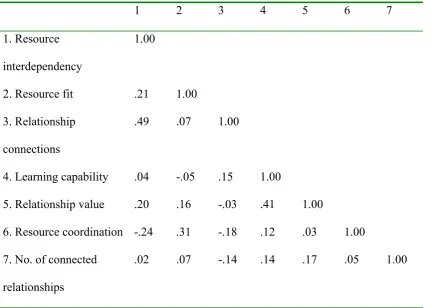
correlation matrix for the variable set is shown in Table 1. Using LISREL VII
(Jöreskog and Sörbom, 1989), the resulting pool of items was subjected to
confirmatory factor analysis to verify the hypothesized factor structure. Five factor
models of the measures were estimated using the maximum likelihood fitting
function.
<Take in Table 1 about here>
As shown in Table 2, there is a good fit to the data (X2 = 83.61, d.f. = 51, p = .015), Comparative Fit Index (CFI; Bentler, 1990) = .94; Incremental Fit Index (IFI;
Bollen, 1989) = .92; Root Mean Square Residual (RMSR) = .062; Root Mean Square
Error of Approximation (RMSEA) = .046). To assess discriminant validity, a series of
chi-square difference tests on the respective factor correlations were performed by
comparing two models: the original five constructs being distinct is constrained to
equal 1.0 and another in which the correlation is free to vary. Each provided evidence
of strong evidence of discriminant validity. Finally, the coefficient alphas for the item
sets show reasonable evidence of reliability. Measures of alphas ranged from .78 to
.96.
A further test of construct validity was performed by comparing the multi-item
independent variables with a dissimilar measure of the estimated number of years
required to develop a relationship. All correlations are positive and significant as
expected (r = .40, p < .001; r = .35, p < .001; r = .41, p < .001; r = .36, p < .001) for
resource interdependency, resource fit, relationship connections and learning
capability respectively. All the measures demonstrate evidence of convergent validity.
Hypotheses Tests and Results
<Take in Table 3 about here>
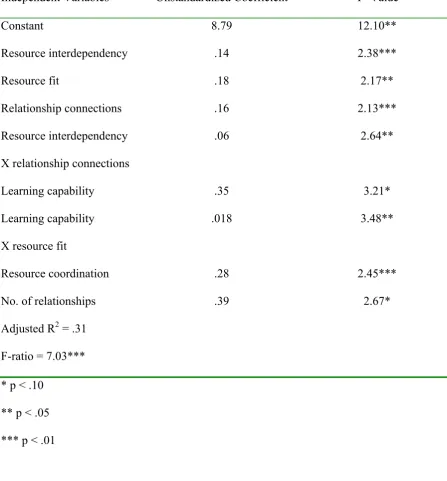
Table 3 summarizes the results of hypothesis tests, using an ordinal least squares
regression model. The main effects of H1 to H3 and H5, involved regressing the
variable of relationship value against each of the four main independent variables. The
interaction terms of H4 and H6 examined the interaction between the independent
variables against the dependent variable of relationship value. Typically, multiplying
the appropriate independent variables creates indicators for the interaction terms. But
this approach is prone to collinearity (Jaccard et al., 1990). In order to avoid this
limitation, the interaction effects were computed by following the standard procedures
of three-stage least squares model to obtain significant increase in explained variance
(for statistical details, see Hansen, 1982; White, 1983).
As shown in Table 3, all the hypotheses are supported. The effects of learning
on relationship value relate positively with the extent of perceived resource
interdependencies, as H1 predicts (t = 2.38, p < .01). There is evidence that resource
fit between firms in networks of relationships helps firms make sense of knowledge
(H2: t = 2.17, p < .05). A firm’s view of its network boundary not only determines the
intensity of interactions with business partners but also influences opportunities for
learning and enhancing relationship value (H3: t = 2.13, p < .01). The corresponding
interaction term between resource interdependency and a firm’s relationship
connections is also statistically significant (H4: t = 2.64, p < .05). The results support
that a firm’s learning capability is supported by interactions and knowledge base of a
shared network context (H5: t = 3.21, p < .10). Moreover, the interaction term between
resource fit and learning capability is significant (H5: t = 3.48, p < .05). These results
suggest that learning in and through relationships is facilitated by prior experience and
specific network context, which has a positive influence on relationship value.
For the control variables, the results lend support for H1 (t = 2.45. p < .01),
that resource interdependencies among firms in networks of relationships derive from
actors-activities-resources model are likely to involve resource coordination that
require interfirm learning. Finally, firms connected to a large number of relationships
do not necessarily have a positive influence on relationship value (t = - 74, p > .10).
As confirmed by H3, the results indicate that the greater the interface of resource
dimensions between firms in a relationship, the more intense the development and use
of resources or the more opportunities for learning, regardless of the number of firms
connected to the network of relationships. This has a positive influence on
relationship value.
DISCUSSION
Theoretical Implications
As noted by the actors-activities-resources model, firms in connected relationships
interact and learn to use and access each other’s contribution of resources to the
business networks provide firms with the opportunities to learn from each. In a
business network context, the notion of interdependence is not limited to individual
perceptions of dependence but it can include established routines (Nelson and Winter,
1982) over time through interactions that enhance relationship value. The established
routines embedded in a shared network context serve as the platform for knowledge
creation through constant interactions among individual firms. This platform is
analogous to knowledge frames that capture linkages of individual units of knowledge
and their priorities (Kusunoki et al., 1998). Consistent with the concept of ba, the
shared network context allows firms to interact and share their knowledge base such
as resources within the knowledge frames of established routines, skills and
experience. The co-evolution of relationships enables firms in a specific network
context to build up incremental knowledge. In this sense, the creation of knowledge
from emerging relationships in a network context may take advantage of the existence
of knowledge shared and the availability of network resources in a particular network
context.
Although resource interdependency may impede the process of organizational
learning by requiring timely coordination of resources and dissemination of
information among individual firms (cf. Sorenson, 2003), exchange and development
of critical resources in business relationships do not occur without cooperation and
substantial investment of time. In a business network context, firms co-evolve, for
example, in the search for business solutions to their problems, and they apply
knowledge from their interactions. This co-evolutionary nature of business
relationships is likely to support learning, though individual firms may be constrained
by ``heaviness’’ of resources that relationships create (Håkansson and Waluszewski,
1996). In this respect, the results of this study indicate that a firm’s resources that are
interlinked with business partners has a positive influence on relationship value. The
effects of learning on relationship value cannot be separated from the networks of
relationships in which the firm is embedded. This implies that learning to enhance
relationship value in a business network is the result of a network of actions and
interdependencies rather than optimization of routines through an individual firm.
As indicated by the SECI model of the theory of knowledge-creating firm,
sharing explicit knowledge involves combining and disseminating relevant data to
users. In a business network context, the variety of resources from connected network
relationships needs to be assessed, adapted and coordinated to fit the purpose of the
firm in terms of benefits for developing competitive advantage, such as
complementary assets and new technology. For example, the utilization of
interdependent resources of network members requires coordinating mechanisms in
order to organize collective inputs for strategic action. Also, the more coordinating
effort is required as a result of skills gap (Hamel, 1991) and resource incompatibility
(Barney, 1991), the less the value added to a relationship. This study proposed that the
effects of learning on relationship value are influenced by resource fit between firms.
There is evidence that firms with a higher resource fit in exchange relationships have
a positive influence on relationship value. This finding suggests that an important
aspect of knowledge combination and internalization in the SECI model is ensuring
that resource interdependencies are built upon existing knowledge base through
interactions in a business network context. However, the process of knowledge
internalization was not the focus of this study.
Consistent with Cohen and Levinthal’s (1990) concept of absorptive capacity,
partners and its understanding of resources utilized in interactions have a positive
influence on relationship value. The presence of resource fit in a firm’s learning
capability significantly increased the degree of influence on relationship value. The
results suggest that the firm’s prior stock of knowledge (i.e., experience) is related to
the network context, in that the level of familiarity with network resources and
context facilitate learning in and through relationships. Knowledge cannot be
understood without understanding situated cognition and action (Suchman, 1987). The
dense and varied networks of relationships provide a dynamic context for
learning-by-doing and/or learning-by-interacting that constitutes the learning capability of firms.
In essence, the firm’s learning capability resides both within the organization as well
as in a shared business network context particularly in relation to the sharing of a
common stock of knowledge. For example, it is difficult to disentangle socially
constructed experience clouded by interactive complexity and shaped by many actors
simultaneously from complicated combination of resources specific to the context.
Thus, learning in and through relationships is the key for matching and combining
current capabilities for the development of new knowledge such as in the effort to
enhance relationship value.
An important characteristic of business relationships is the presence of
connected resource ties and constellations. The study provides support for the
existence of multiple facets of resource inter-linkages between firms. Conceivably,
there are limitless potential for firms to learn from using and combining resources of a
business network. The stability and variety of relationships provide a dynamic setting
for constant adaptation of resources in relationship development and in response to
change (Håkansson and Snehota, 1995). As illustrated by the results, resource
connected relationships in terms of resource usage and exchange. In other words, it is
the interface of resources through active relationship development that engage the
interaction of actors-activities-resources rather than merely connected network
relationships. Individuals in business relationships can be regarded as learning agents
of the firm in the process of acquiring and creating knowledge that belonged or shared
by network members through interactions. From a theoretical perspective, the present
research provides some preliminary insight into the importance of a business network
context for the firm’s learning capability and the significance of resource usage and
exchange through interactions.
Practical Implications
The study shows that learning effects on relationship value of a firm in a business
network context are influenced by the perceived resource interdependencies, resource
fit, relationship connections and learning capability. The presence of learning effects
on relationship value in relation to resource interdependencies suggests that
interactions between firms in a business network context are important sources of
knowledge creation. However, the dynamics of resource interdependency in terms of
their effects on relationship value can rarely be fully specified in advance and by
extension, they are difficult to manage. Therefore, learning to add value to existing
relationships from the knowledge base of a business network is critical for long-term
success.
From a practical standpoint, the implications for firms in connected
relationships are two-fold. Firstly, learning in and through relationships can build-up
substantial experience bases for leveraging complementary assets from resource
interdependencies. The results suggest that prior experience of firms in terms of
is path dependent, e.g., acquiring or switching to new capabilities are constrained by
learning inertia, knowledge bases and capabilities gained from learning through
interactions are embedded in a network context. The task of exploiting the creation of
knowledge within a particular business network depends collectively on all the
network members rather than on any single firm. In particular, externalization of
knowledge requires learning-by-doing which is non-transferable through markets
(Cohen and Levinthal, 1990). This suggests that from learning-by-doing firms that
recognize the resource fit of interdependent network resources and strategic actions
are more likely to succeed in learning or importing knowledge from partners.
Secondly, firms that enter into various relationships have to commit resources,
such as sharing resources with exchange counterparts in the process of
learning-by-doing. Although resource commitments are essential in relationship development,
they can be costly in terms of time and non-recoverable costs associated with
exchange of resources. In light of this, the results provide some insight into the role of
connected network relationships underlie by dense and varied resources rather than by
merely having many relationships to increase learning opportunities. This is consistent
with the notion of information stickiness where the path dependent nature of learning
renders the difficulty of knowledge transfer between firms. In a business network
context, there is stability for learning particularly for converting explicit knowledge
into the firm’s tacit knowledge and subsequently deploying the tacit knowledge (cf.
Kogut and Zander, 1992; Corno et al., 1999). Therefore, firms that regard their
network context as a repertoire of knowledge bases and as dynamics of interaction
supported by business relationships are likely to open up learning opportunities and
Since the study examined all connected network relationships of each firm, the
study can better capture the learning effects in business networks than subsume
learning to an individual firm detached from its networks of relationships. This
approach is robust to allowing learning effects to be examined across firms. Given the
inseparable dynamic interactions of knowledge in a business network context, it is
important that firms adopt a network view of connected relationships emerging from
interaction. Of particular interest to firms is the immobility of knowledge created
within a business network, also known as network capabilities (Håkansson, 1993;
Foss, 1999), which not only impact positively on relationship value but may also help
sustain competitive advantage. While it is not within the scope of this study to
examine the process in which firms import and transfer network capabilities with each
other, firms must make strategic commitments and decisions pertaining to the
incremental nature of learning and knowledge accumulation. In other words, firms
may need to allocate more resources to certain relationships and balance the trade-off
of current profitability against longer-term success. This also has implications for
current related knowledge (tacit) and the firm’s future ability, internal capacity to
evaluate, absorb and utilize complex processes embedded in a business network
context.
LIMITATIONS AND FURTHER RESEARCH
It is worth noting some limitations of this research. The data of this research were
limited to one industry for examining the effects of learning in a homogeneous
network context. This limits the generalizability of the findings. Furthermore, this
research only begins to explore why firms learn in a business network context in the
first instance and its perceived impact on a firm’s relationship value. Inevitably, from
necessitated primarily due to the complexity of learning phenomena in connected
networks of relationships, though it has been widely documented that managers’
perceptions shape behaviour and are critical for choice of relationships in strategy
making (e.g., Venkatraman and Ramanujam, 1986, 1987; Lefebvre, 1997; Spanos and
Lioukas, 2001).
Finally, some research questions remain unanswered. In particular, the specific
relationship governance mechanisms for knowledge externalization and
internalization in a business network context deserve future research attention. This
has important implications for the firm’s learning capabilities and mobilization of
network capabilities. For example, if learning to acquire knowledge and utilize
network capabilities is dynamic and socially constructed through interactions in a
shared network context, there is a need to understand how to manage complex chain
of resource interdependencies in order to mobilize collective capabilities embedded in
a network context. Given creation of new knowledge out of existing knowledge can
only be accumulated through learning-by-doing (Nonaka et al., 2000), examining the
link between dynamics of relationships in a network context and learning strategies
Table 1: Correlation Matrix
1 2 3 4 5 6 7
1. Resource
interdependency
1.00
2. Resource fit .21 1.00
3. Relationship
connections
.49 .07 1.00
4. Learning capability .04 -.05 .15 1.00
5. Relationship value .20 .16 -.03 .41 1.00
6. Resource coordination -.24 .31 -.18 .12 .03 1.00
7. No. of connected
relationships
.02 .07 -.14 .14 .17 .05 1.00
Table 2: Multi-Item Scales
Measures and items
Resource interdependency α = .81
(3 items, 7-item Likert Scale, ``Strongly Disagree – Strongly Agree’’)
Our resources are closely linked to other firms in the network.
Our relationships with firms in the network are essential to our business operation.
Some of our resources are closely connected to firms in the network.
Resource fitα = .78
(3 items, 7-item Likert Scale, ``Strongly Disagree – Strongly Agree’’)
Our experience and skills are closely related to connected relationships.
Our important business relationships are related to our target product markets.
A large proportion of our resources match our existing business relationship needs.
Relationship connectionsα = .85
(3 items, 7-item Likert Scale, ``Strongly Disagree – Strongly Agree’’)
Our directly connected relationships are characterized by intense interactions between
individuals and firms.
Our important business relationships provide multiple resources in business
interactions.
A large proportion of our business activities are supported by closely linked network
relationships.
Learning capabilityα = .92
(4 items, 7-item Likert Scale, ``Strongly Disagree – Strongly Agree’’)
We thought learning would increase our efficiency.
We expected learning to reduce our costs associated with managing relationships in
We thought learning would streamline our business with other business partners in the
network.
We believed that learning would reduce the cost associated with transacting business
with our exchange partners.
Relationship value α = .96
(4 items, 7-item Likert Scale, ``Strongly Disagree – Strongly Agree’’)
A large proportion of our volume of business comes from relationships in the
network.
We form relationships with other firms in the network to gain non-monetary revenues
such as competence, market position and social rewards.
A large number of our business contracts are the result of our business relationships
with firms in the network.
The profitability of our relationships to a large extent is influenced by other firms in
our business networks.
Five-factor measurement model X2 (51) = 83.61 (p = .015)
Table 3: Estimated Model – Dependent Variable: Relationship Value
Independent Variables Unstandardized Coefficient T- Value
Constant 8.79 12.10**
Resource interdependency .14 2.38***
Resource fit .18 2.17**
Relationship connections .16 2.13***
Resource interdependency
X relationship connections
.06 2.64**
Learning capability .35 3.21*
Learning capability
X resource fit
.018 3.48**
Resource coordination .28 2.45***
No. of relationships .39 2.67*
Adjusted R2 = .31 F-ratio = 7.03***
* p < .10
** p < .05
References
Alchian, A.A. and Demsetz, H. (1972) Production, information costs and economic organisation. The American Economic Review, 62, 777-95.
Anand, B.N. and Khanna, T. (2000) Do firms learn to create value? the case of alliances. Strategic Management Journal, 21, 295-315.
Anderson, J.C. and Narus, J.A. (1984) A model of the distributor’s perspective of distributor-manufacturer working relationships. Journal of Marketing, 48, 62-74.
Anderson, J.C., Jain, D.C. and Chintagunta, P.K. (1993) Customer value assessment in business markets: a state-of-the-practice study. Journal of Business-to-Business Marketing, 1, 3-29.
Anderson, J.C., Håkansson, H. and Johanson, J. (1994) Dyadic business relationships within a business network context. Journal of Marketing,58, October, 1-15.
Anderson, J.C. and Narus, J.A. (1999) Business market management: understanding, creating and delivering value, Prentice-Hall, Upper Saddle River, New Jersey.
Argyris, C. and Schön, D. (1978) Organizational learning, Addison-Wesley, Reading,
MA.
Axelsson, B. and Easton, G. (eds.) (1992) Industrial networks: a new view of reality,
Routledge, London.
Barney, J. (1991) Firm resources and sustained competitive advantage. Journal of Management,17, 99-120.
Bångens, L. and Araujo, L. (2002) The structures and processes of learning: a case study. Journal of Business Research, 55, 571-581.
Beamish, P.W. and Banks, J.C. (1987) Equity joint ventures and the theory of the multinational enterprise. Journal of International Business Studies, 18(2), 1-16.
Bentler, P.M. (1990) Comparative fit indexes in structural models. Psychological Bulletin, 107(2), 238-246.
Biggadike, R. (1979) Corporate diversification: entry strategy and performance,
Harvard University Press, Harvard, MA.
Bollen, K.A. (1989) A new incremental fit index for general structural equation models. Sociological Methods and Research, 17, February, 303-316.
Campbell, D.T. (1955) The informant in quantitative research. American Journal of Sociology, 60, January, 339-342.