Engineering Enzyme Systems by
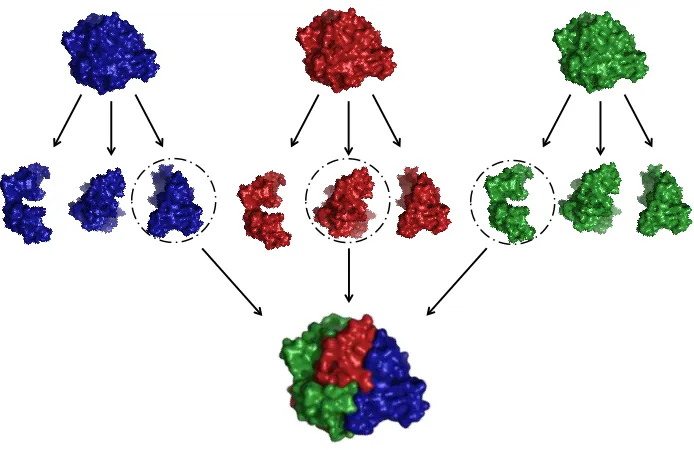
Recombination
Thesis by Devin Lee Trudeau
In Partial Fulfillment of the Requirements for the degree of Doctor of Philosophy
CALIFORNIA INSTITUTE OF TECHNOLOGY Pasadena, California
2014
2014
ACKNOWLEDGEMENTS
I’d like to thank my advisor Frances Arnold for seeing me through four years of failure and
success. Frances has continually challenged my ideas and work, which has taught me how to be a better scientist, thinker, and bioengineer. In her lab I’ve had the freedom to pursue many different
ideas, and interact with people of diverse personalities and research interests.
The Arnold lab has been my home these last few years. I’d like to thank Florence
Mingardon and Yousong Ding for being my two mentors as I was learning the art of protein engineering. Toni Lee has been a great collaborator on our endoglucanase project, and I’m happy
that our efforts were as synergistic as our enzymes. Matthew Smith and Indira Wu have both been invaluable sources of advice on cellulase engineering. Sabrina Sun was a pleasure to work with over the course of two summers and a fourth-year project. Joseph Meyerowitz was my collaborator on the aldehyde tolerance project. Sabine Bastian kept the lab running smoothly, and has provided excellent advice on directed evolution methodology. Jackson Cahn, Ardemis Boghossian, Phil Romero, Ryan Lauchli, John McIntosh, Martin Engqvist, Chris Farwell, and Jane Wang have been great feedback for my (mostly crazy) ideas— and good friends.
I’d like to thank Frank Chang and the rest of my biofuels collaborators in the Ho and Chao labs at Academia Sinica. I’d like to thank my committee members Professors David Tirrell, Thomas
F. Miller III, Mikhail Shapiro, Steve Mayo, and Rob Phillips for their time and guidance during my candidacy and defense.
ABSTRACT
Homologous recombination is a source of diversity in both natural and directed evolution. Standing genetic variation that has passed the test of natural selection is combined in new ways, generating functional and sometimes unexpected changes. In this work we evaluate the utility of homologous recombination as a protein engineering tool, both in comparison with and combined with other protein engineering techniques, and apply it to an industrially important enzyme: Hypocrea jecorina Cel5a.
Chapter 1 reviews work over the last five years on protein engineering by recombination. Chapter 2 describes the recombination of Hypocrea jecorina Cel5a endoglucanase with homologous enzymes in order to improve its activity at high temperatures. A chimeric Cel5a that is 10.1 °C more stable than wild-type and hydrolyzes 25% more cellulose at elevated temperatures is reported. Chapter 3 describes an investigation into the synergy of thermostable cellulases that have been engineered by recombination and other methods. An engineered endoglucanase and two engineered cellobiohydrolases synergistically hydrolyzed cellulose at high temperatures, releasing over 200% more reducing sugars over 60 h at their optimal mixture relative to the best mixture of wild-type enzymes. These results provide a framework for engineering cellulolytic enzyme mixtures for the industrial conditions of high temperatures and long incubation times.
TABLE OF CONTENTS
Acknowledgements ... iii
Abstract ... iv
Table of Contents ... v
List of Figures ... ix
List of Tables ... xi
Nomenclature ... xii
Chapter 1: Innovation by homologous recombination ... 1
1.1 Abstract ... 1
1.2 Introduction ... 1
1.3 Structural and sequence information facilitates recombination ... 4
1.4 Exploring the limits of homologous recombination ... 6
1.5 Recombination promotes innovation ... 9
1.5.1 Stability ... 9
1.5.2 Enzyme substrate specificity ... 11
1.5.3 Optogenetic properties ... 12
1.6 Modeling and predicting desired chimeras ... 13
1.7 Conclusions... 15
Chapter 2: Recombination-based thermostabilization of a fungal endoglucanase II reveals protein fold dependence of contact epistasis ... 16
2.1 Abstract ... 16
2.2 Introduction ... 17
2.4 Adapting linear regression to account for non-additive block interactions .... 20
2.5 Regression modeling predicts a highly stable chimera ... 24
2.6 Contact penalties among SCHEMA libraries ... 24
2.7 A highly thermostable fungal endoglucanase II chimera ... 27
2.8 Non-additive block interactions can constrain thermostabilization by recombination ... 29
2.9 Methods ... 32
2.10 Supplementary information ... 35
Chapter 3: A synergistic set of engineered thermostable fungal cellulases accelerates high-temperature cellulose hydrolysis ... 41
3.1 Abstract ... 41
3.2 The utility of thermostable cellulase mixtures ... 42
3.3 Engineering the most stable known fungal endoglucanase ... 43
3.4 Evaluating the synergy of engineered thermostable cellulases ... 47
3.5 An optimized mixture of engineered cellulases accelerates cellulose hydrolysis ... 49
3.6 Discussion ... 51
3.7 Methods ... 53
3.8 Supplementary information ... 55
Chapter 4: Directed evolution of an enolase for next-generation biofuels and chemicals ... 56
4.1 Abstract ... 56
4.2 Natural enzymes limit production of biofuels and biochemical ... 57
4.3 Assessment of enolase candidates for engineering... 60
4.5 Directed evolution of an enolase– Substrate walking ... 64
4.6 Directed evolution of an enolase– Growth selections ... 65
4.7 Directed evolution of an enolase– Rational design ... 65
4.8 Discussion ... 68
4.9 Methods ... 69
Chapter 5: Directed evolution of an alcohol dehydrogenase for improved biofuels production from lignocellulose ... 74
5.1 Abstract ... 74
5.2 Toxic byproducts restrict chemical methods for hydrolyzing lignocellulosic biomass ... 75
5.3 Lignocellulose hydrolysate toxicity ... 76
5.4 Modes of resistance ... 79
5.5 ADH6 promotes aldehyde tolerance ... 81
5.6 Directed evolution of ADH6 for broadly increased aldehyde resistance ... 81
5.7 Directed evolution of alcohol dehydrogenases for increased resistance on single aldehydes ... 82
5.8 Discussion ... 84
5.9 Methods ... 86
5.10 Supplementary information ... 89
Chapter 6: Towards synthetic gene-targeted hypermutagenesis in E. coli ... 92
6.1 Abstract ... 92
6.2 Gene-targeted mutagenesis ... 93
6.3 Coupling transcription with mutation activity ... 94
6.4 Discussion ... 96
Appendix 1: General materials and methods ... 99
A1.1 Chemicals and commercial kits ... 99
A1.2 Laboratory equipment ... 100
A1.3 Molecular cloning ... 100
A1.4 Protein purification ... 104
Appendix 2: Sequences and alignments ... 106
Appendix 3: Matlab code ... 130
Bibliography ... 134
LIST OF FIGURES
Chapter 1
1-1 Recombination swaps sequence elements from related proteins to
create novel chimeras whose properties can differ from the parents’ ... 3 1-2 Recombination of structurally similar elements from unrelated proteins ... 8 1-3 Thermostability contributions of recombined blocks can be
determined using linear regression of data from a sample set of chimeras .... 10 Chapter 2
2-1 Cel5a recombination scheme ... 21 2-2 Linear regression modeling of a maximally informative subset of the
Cel5a recombination library ... 22 2-3 Block contributions to thermostability depend on contact disruption ... 23 2-4 Thermostability effects of single mutations from stabilizing blocks in
HjCel5a ... 25 2-5 A highly stable Cel5a chimera ... 25 2-6 Mutations found by recombination mapped onto the HjCel5a structure... 28 2-7 Average mutation level and disruption score for Cel5a recombination
libraries designed by SCHEMA ... 31 S2-1 Example raw data used to determin TA50 ... 36 S2-2 Linear regression model for thermostability without using contact
disruption as a parameter ... 37 Chapter 3
3-2 A highly stable engineered Cel5a endoglucanase ... 46
3-3 Synergistic cellulose hydrolysis by wild-type and engineered- thermostable Cel5a, Cel6A, and Cel7A ... 48
3-4 Total cellobiose equivalents released during 60 h hydrolysis with wild-type and engineered-thermostable cellulase mixtures at 60 °C and 70 °C ... 50
S3-1 Synergistic activity of wild-type cellulase mixtures at 50 °C, 60 °C, and 70 °C ... 55
Chapter 4 4-1 Proposed substrate engineering for EcYfaW ... 59
4-2 Predicted structure of top Rosetta design for EcYfaW ... 67
Chapter 5 5-1 Growth inhibition of S. cerevisiae by aldehydes present in lignocellulose hydrolysate ... 78
5-2 Overexpression of ADH6 in the yeast strain BY4741 increases lysate activity on cinnamaldehyde and 5-HMF ... 81
5.3 Overexpression of ADH6 in the yeast strain BY4741 can improve aldehyde resistance on cinnamaldehyde and 5-HMF ... 81
S5-1 SDS-PAGE of alcohol dehydrogenases expressed in S. cerevisiae ... 90
S5-2 Example activity assay of ADH6 ... 90
S5-3 ADH6 circular dichroism spectra and thermal denaturation curve ... 91
LIST OF TABLES
Chapter 2
2-1 SCHEMA library parameters ... 26 S2-1 Thermostabilities and contact disruption scores of Cel5a chimeras... 38 S2-2 Thermostabilities of HjCel5a single point mutants ... 40 Chapter 3
3-1 Stabilizing mutations combined to create OptCel5a ... 45 Chapter 4
4-1 EcYfaW biochemical parameters ... 61 4-2 Libraries screened ... 63 4-3 Top Rosetta-based designs for 2R-DHV ... 67 Chapter 5
5-1 A few key S. cerevisiae growth inhibitors present in lignocellulose
hydrolysate ... 77 5-2 Alcohol dehydrogenase libraries created and screened ... 83 Chapter 6
NOMENCLATURE
ADH. Alcohol dehydrogenase.
AID. Activation induced cytidine deaminase. BSA. Bovine serum albumin.
CBHI. Cellobiohydrolase I. CBHII. Cellobiohydrolase II. CBM. Cellulose binding module.
Cel5a. Family 5 cellulase (endoglucanase II). Cel6a. Family 6 cellulase (cellobiohydrolase II). Cel7a. Family 7 cellulase (cellobiohydrolase I). ChR. Channelrhodopsin.
CV. Column volume. Da. Dalton.
2R-DHIV. R-2,3-dihydroxyisovalerate.
DMSO. Dimethyl sulfoxide. DNPH. 2,4-Dinitrophenylhydrazine.
EcYfaw. Rhamnonate dehydrase (YfaW) from Escherichia coli. EGII. Endoglucanase II.
Fe-S. Iron-sulfur cluster.
GzYfaW. Rhamnonate dehydratase (YfaW) from Gibberella zeae.
4-HBA. 4-hydroxybenzaldehyde. HjCel5a. Cel5a from Hypocrea jecorina.
HPLC. High-performance liquid chromatography. IPTG. Isopropyl β-D-1-thiogalactopyranoside. KIV. 2-ketoisovalerate.
LB. Lysogeny (Luria) broth. MWCO. Molecular weight cut-off. OD600. Optical density at 600 nm. PDB. Protein databank.
PdCel5a. Cel5a from Penicillium decumbens.
PIPES. Piperazine-N,N′-bis(2-ethanesulfonic acid) PgCel5a. Cel5a from Phialophora sp. G5.
PpCel5a. Cel5a from Penicillium pinophilum.
PpYfaW. Rhamnonate dehydratase (YfaW) from Penicillium pinophilum.
SCA. Semicarbazide.
SD-Ura. Synthetic defined media without uracil. SOB. Super-optimal broth.
StYfaw. Rhamnonate dehydratase (YfaW) from Salmonella typhimurium. TA50. Temperature with 50% maximal activity.
Tm. Melting temperature.
T7RNAP. RNA polymerase from T7 phage. WT. Wild-type.
C h a p t e r 1
INNOVATION BY HOMOLOGOUS RECOMBINATION
A modified version of this chapter appears in: Trudeau D.L., Smith M.A., Arnold F.H.
(2013) “Innovation by homologous recombination”,
Current Opinion in Chemical Biology
, and
is published with permission from Elsevier.
1.1 Abstract
Swapping fragments among protein homologs can produce chimeric proteins with a wide range of properties, including properties not exhibited by the parents. Computational methods that use information from structures and sequence alignments have been used to design highly functional chimeras and chimera libraries. Recombination has generated proteins with diverse thermo- and mechanical stability, enzyme substrate specificity, and optogenetic properties. Linear regression, Gaussian processes, and support vector machine learning have been used to model sequence-function relationships and predict useful chimeras. These approaches enable engineering of protein chimeras with desired functions, as well as elucidation of the structural basis for these functions.
1.2 Introduction
The costs and benefits of recombination have been studied at the level of individual proteins, particularly as a search strategy for directed evolution2. In a pioneering 1998 study, Pim Stemmer and colleagues showed that DNA shuffling (which generates new genetic sequences by both random mutation and recombination) of four cephalosporinases increased resistance to the antibiotic moxalactam by ~270 fold, almost two orders of magnitude more than what was attained with random mutagenesis alone3. Recombination has been used since then in a large number of directed evolution efforts, and many groups have contributed to an understanding of how functional and structural properties of recombined, or ‘chimeric’, proteins depend on factors such as the
number and sequence identity of the parents, choice and number of recombination sites, and measures of structural disruption.
1.3 Structural and sequence information facilitates recombination
It is straightforward to recombine genes using DNA shuffling and related methods, as long as there are sufficient stretches of DNA sequence identity to promote crossovers. The more divergent the parent sequences, however, the more difficult it is for methods like DNA shuffling just to generate crossovers. Furthermore, shuffling more divergent sequences introduces more mutations and more structural disruption in the protein, with the consequence that many of the resulting chimeras are non-functional. Juxtaposing elements from different parent proteins can introduce steric clashes or disrupt favorable interactions, resulting in chimeras that do not fold or function. Nonetheless, homologous mutations (mutations chosen from homologous sequences) are significantly less disruptive than random mutations5; 6.
Judicious choice of recombination sites (crossover locations) can mitigate mutation-induced disruption. Minimizing structural disruption enriches the fraction of folded and functional proteins in a given chimera library7; 8. A further advantage is that libraries with fixed crossover locations can be constructed by any number of methods for assembling DNA fragments. Although the sequence space is dramatically reduced when crossovers are fixed, the fitness landscape can be sampled and searched quite efficiently using machine-learning methods9; 10; 11.
The SCHEMA method for choosing crossover locations to make a high-quality library of chimeric proteins uses a simple metric to assess disruption. The SCHEMA disruption energy E is the sum of all broken contacts in a chimera. Two amino acids are in contact if they are within a certain distance of one another (e.g. 4.5Å) in the structure. If a chimera inherits a contacting pair that is not present in a parent sequence, that contact is said to be broken. This assumes that new contacts are deleterious far more often than they are beneficial. Chimeras are more likely to fold and function if they have fewer broken contacts, and therefore a lower SCHEMA energy E.
make chimeric cytochrome P450s10, cellulases12; 13; 14; 15, and arginases16 that have much higher levels of mutation (sometimes 100 mutations or more) than what is attainable using DNA shuffling or random mutagenesis. The Silberg and Suh labs have recently applied SCHEMA recombination to the capsid protein of adeno-associated virus (AAV), creating chimeras of AAV serotypes 2 and 4 with over 100 mutations relative to each parent17. They found that chimeric AAV structural integrity and infectivity were correlated with low SCHEMA energies, suggesting that this metric can be important for recombination of higher-order molecular assemblies like viruses.
Several laboratories have considered whether there might be better metrics than counting broken contacts for predicting whether a given chimera will fold and function and for designing libraries of shuffled proteins. For example, Maranas and coworkers developed the Famclash algorithm, which uses a multiple sequence alignment to predict amino acid interactions based on pair-wise conservation of charge, volume, and hydrophobicity18. Another scoring function from the same group, S2, combines conservation of amino acid properties with a SCHEMA-like contact metric19. Bailey-Kellogg and coworkers generalized the structural contact idea to multi-residue interactions using a weighted hypergraph model20. Residues within 8Å were defined as interacting, and their interaction score was based on evolutionary conservation in a multiple sequence alignment. This metric could predict functionality in a published beta-lactamase chimera library. None of these proposed metrics, however, have been tested in library design.
1.4 Exploring the limits of homologous recombination
Even with the crossovers chosen to minimize average disruption, chimeras of highly divergent parents usually have high levels of structural disruption because they have high levels of mutation. Romero et al. 8 developed a random field model parameterized with experimental data from eight SCHEMA libraries to investigate how parent sequence identity and number of crossovers affect the fraction of chimeras that are expected to be folded and functional. Parent sequence identity is the most important factor, but the number of crossovers also contributes to disruption, with more crossovers leading to greater disruption, on average. Choosing crossover locations to minimize disruption can improve the library significantly. Merely choosing contiguous sequence elements, however, also captures and retains many local contacts that would be broken if homologous mutations were made individually rather than taken in blocks from parent proteins. Thus the conservative nature of recombination comes from both the conservative nature of the individual homologous mutations and conservation of their local interactions in a sequence block.
Non-contiguous recombination has also been tested onfungal cellobiohydrolase I’s (CBHI)23, where 32 of 35 chimeras constructed by total gene synthesis were active cellulases, despite having an average of 83 mutations relative to the closest parent.
Do protein parents really need to be homologous, i.e. evolutionarily related, or can proteins accommodate structurally compatible swaps from parents whose overall structures are different? Because homologous parents generally exhibit much greater sequence identity and therefore less mutational disruption upon recombination, we might e pect structural similarity to be insufficient for successful recombination, at least on average. ecent e periments from the H cker laboratory
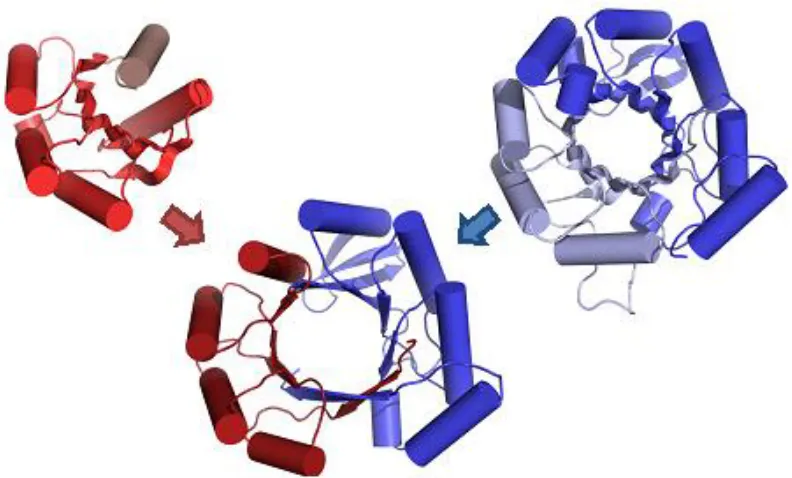
illustrate chimeras constructed by combining structurally similar blocks taken from unrelated proteins. Noting that the (βα)5-flavodoxin-like fold from bacterial response regulator CheY is structurally similar to half of the (βα)8-barrel fold from imidazole glycerol phosphate synthase
(HisF), Bharat et al. replaced this half of HisF with CheY24. This resulted in a stable protein with a (βα)8-like fold (save for an additional β strand inside the (βα)8-barrel) and 81 mutations (out of 253)
from the closest parent, HisF (see Figure 1-2). Further engineering using Rosetta design introduced five mutations at the interface between the two pieces that allowed the e tra β strand to be removed, resulting in a more natural (βα)8-barrel fold25
. The HisF-CheY chimera could be engineered to bind a phosphorylated substrate by targeted mutation at two residues known to confer binding in the related HisA protein. Half of the (βα)8-barrel from HisF could also be recombined with the
Figure 1-2. Recombination of structurally similar elements from unrelated proteins. Bharat et al. (2008) used the (βα)5-flavodoxin-like fold from bacterial response regulator CheY (top left) to replace half of the (βα)8-barrel fold from imidazole glycerol phosphate synthase HisF (top right). This created a stable (βα)8-barrel-like fold, with an e tra β strand inside the barrel— a (β9α8)-barrel. Further mutation at the interface could remove this e tra β strand to make a more natural
1.5 Recombination promotes innovation
Recombination can generate libraries with a high fraction of folded proteins and a high level of mutational diversity. Experiments have shown that the chimeric proteins can also exhibit a range of properties, including properties not exhibited by any of the parents. Thus recombination is both conservative and innovative. Here we cover three properties that have been investigated in recent work: stability, enzyme substrate spectrum, and optogenetic properties of membrane rhodopsins.
1.5.1 Stability
Another interesting property is mechanical stability, important for proteins in tissue extracellular matrices, spider silk, and other biomaterials. The Li lab explored the structural basis of mechanical stability by recombining structural elements from two homologous immunoglobulin domains (I27 and I32) from the muscle protein titin28; 29. Using atomic force microscopy to test the mechanical stability of the different chimeras, the Li lab correlated stability with specific sequence and structure elements. Recombination has also been used by Billings et al. and Lu et al. to explore mechanical stability of immunoglobulin domains30; 31, and by Ng et al. to explore mechanical stability of fibronectin type III domains32.
1.5.2 Enzyme substrate spectrum
Recombination can generate large and sometimes quite unexpected changes in enzyme activity on non-native substrates, including the ability to accept new substrates. Clouthier et al. looked at the ability of three chimeras of TEM-1 and PSE-4 beta-lactamases (43% identity) to hydrolyze five different cephalosporins33. Although the chimera activities on each substrate were usually intermediate between the activities of the parent enzymes, one of only three they studied was almost twice as active on the clinically important antibiotic cefotaxime as the most active parent.
its thermophilic parent, but also gained the human parent’s activity on glyceraldehyde and bias towards using NADP(H) as cofactor.
Van Beek et al. swapped a substrate-binding subdomain of thermostable phenylacetone monooxygenase with corresponding elements from homologs that accept a broader range of substrates, a cyclohexanone monooxygenase and a steroid monooxygenase36. These Baeyer-Villiger monooxygenases are potential industrial biocatalysts. The resulting two chimeras were more stable than the parent cyclohexanone monooxygenase and steroid monooxygenase and exhibited broad substrate ranges, with higher activity and enantioselectivity than their parents on selected substrates. In a more library-based approach, Jones shuffled six loop regions from serine proteases of the subtilisin family into a Savinase framework37. The loops were selected for their known functional importance in substrate binding, metal ion binding, and catalysis. He found chimeric proteases with increased activity on and specificity towards each of four tested colorimetric peptide substrates, including two substrates that Savinase hydrolyzes poorly.
1.5.3 Optogenetic properties
helices. They found that the wavelength activation profiles, as well as the desensitization profiles of the chimeras, were intermediate between the two parents. Most of this variation was found to come from the fifth transmembrane helix, particularly the Y226(ChR1)/N187(ChR2) site. Two chimeras that were similar to ChR2 but with improved properties were found: one had broader activation wavelength sensitivity and lower desensitization, and one had very fast on/off kinetics and small desensitization. Li et al. and Wen et al. also found similar results when they recombined ChR2 and ChR140; 41.
To create a red-shifted opsin for combinatorial control of neuron activation, Yizhar et al. recombined ChR2 and Channelrhodopsin-1 from Volvox carteri (VChR1), which was known to have a redshift of over 70nm compared to ChR2, but also low expression and weak photocurrents38. Yizhar et al. made single crossover recombinants of VChR1 and ChR1 and measured expression and photocurrent in HEK cells. By replacing the first two alpha helices of VChR1 with the corresponding ones from ChR1, they were able to increase VChR1 expression and photocurrent while retaining its large redshift. Interestingly, this chimera had a slower deactivation rate than either parent, a property that is not optimal for control of neurons. However, this rate could be improved by introducing two mutations known to improve deactivation rate in ChR2. With this new chimeric opsin, Yizhar et al. were able to explore neuronal control of social behavior in mice.
1.6 Modeling and predicting desired chimeras
The large-scale ‘recombinational fitness landscape’8 is characterized by a high degree of additivity that correlates with mutations being in conserved parental structural contexts (as opposed to new interfaces generated by recombination), which is exactly what SCHEMA recombination attempts to maximize. That the landscape is largely additive means that relatively simple models can be used to build sequence-function models and predict the properties of chimeras that have not yet been tested. Linear regression can be used, for example, to predict highly stable chimeras from small sample data sets from SCHEMA and noncontiguous recombination libraries42. This approach has generated a variety of stable, active enzymes10; 12; 13; 14; 15; 16; 23.
Modeling by linear regression requires a relatively small sample set because chimera sequences are much reduced compared to the whole protein (chimera sequences are described at the block rather than amino acid level). However, the contributions of individual mutations cannot be identified unless they are made separately, as Heinzelman et al. did to uncover a single highly stabilizing mutation in a fungal cellobiohydrolase II block13.
Romero et al.9 recently used a new class of Bayesian machine-learning tools called Gaussian processes to sample and model the fitness landscape. Their methods can be used to both design maximally-informative sample sets and predict improved sequences. With a structure-based kernel function to describe how sequences are expected to co-vary (i.e. it does not assume simple additivity, but includes pair-wise interactions between residues), their methods can be used to investigate the contributions of individual mutations, and also combine chimera data with information on single mutations. Romero and coworkers found good predictive ability for cytochrome P450 thermostability, catalytic activity on non-native substrates, and ligand binding affinity. Moreover, the model was able to predict the thermostabilities of cytochrome P450s that had mutations not present in the chimera library, and also predicted a new cytochrome P450 variant that was more thermostable than any previously engineered variant.
from a SCHEMA library generated by recombining three bacterial cytochrome P450s, their model could predict the properties of sequences generated by DNA shuffling of human P450s.
1.7 Conclusions
C h a p t e r 2
CHIMERAGENESIS OF FUNGAL ENDOGLUCANASE II REVEALS EPISTATIC CONSTRAINTS TO THERMOSTABILIZATION BY RECOMBINATION
2.1 Abstract
Recombination is an efficient way of using natural protein variation to create chimeras with diverse properties. However, recombination can also create non-functional chimeras by breaking beneficial amino acid interactions and introducing steric clashes between amino acids. Studies have employed algorithms like SCHEMA to choose recombination breakpoints that minimize these non-favorable amino acid interactions in chimera libraries and thereby improve the fraction of folded and functional chimeras.
We wished to explore quantitatively how non-favorable amino acid interactions between recombined structural subunits affect chimera thermostability, and how successful recombination break point optimization is in reducing these effects. To do this, we used the SCHEMA recombination algorithm to design a chimera library with four fungal endoglucanases as parents, including the industrially-relevant Hypocrea jecorina endoglucanase II (HjCel5a). This library had the lowest predicted average number of non-favorable amino acid interactions (or “disruption score”) of all previously designed SCHEMA recombination libraries.
facilitated construction of an HjCel5a mutant, which was over 10 °C more stable than any parent and released 25% more cellobiose at its optimum temperature. These results highlight the importance of accounting for non-favorable amino acid interactions when modeling chimeras, and that these effects can be minimized (but not avoided) by computational chimera library design methods.
2.2 Introduction
Over the last 15 years, homologous protein recombination has been used to engineer properties as diverse as substrate specificity, thermo- and mechanostability, and optogenetic characteristics43. An important finding from these studies is that introduction of structurally incompatible amino acids by recombination can result in a high fraction of unfolded or inactive chimeras, and that judicious choice of recombination breakpoints may be needed to create a functional chimera library7; 8; 18; 19.
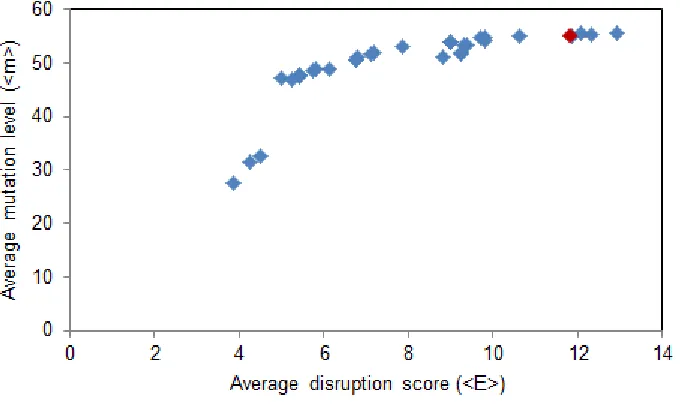
The SCHEMA algorithm is one approach that has been developed to improve the folded and functional fraction of chimera libraries7. SCHEMA scores a chimera by a simple metric: two amino acids form a contact if their heavy chain atoms are within 4.5Å of each other in a reference crystal structure, and if a contacting pair is present in chimera but not in any parent, the contact is said to be disrupted7. The “disruption score” (E) is the sum of disrupted contacts. Chimera library designs that minimize this disruption score have been found to be enriched in folded and functional variants8; 10; 12; 15; 16; 44. Disruption score and mutation level are correlated21, and therefore library functionality and diversity have inherent trade-offs.
libraries to be made with very low average disruption scores (<E> < 25), while maintaining high average mutation levels (<m> > 50)23.
How successful are these chimera library designs with low predicted disruption scores at reducing the effects of disrupted amino acid contacts? In particular, in these libraries how amenable to improvement are useful properties like thermostability? We set out to address this question by applying structure-guided recombination to explore thermostability of endoglucanase II (Cel5a), an enzyme that cleaves intrachain β-glucosyl bonds in cellulose. Cel5a constitutes over 55% of
endoglucanase activity in the industrially important fungus Hypocrea jecorina46. Thermostabilized Cel5a would allow high-temperature degradation of cellulose synergistic with other engineered thermostable cellulases12; 44; 47; 48.
In this study, we recombined Hypocrea jecorina Cel5a with three homologues from thermophilic fungi (Phialophora sp. G5, Penicillium decumbens, Penicillium pinophilum). This chimera library had the lowest disruption score of any SCHEMA library created thus far, while retaining a high mutation level. The library was enriched in active and stable chimeras, many of which were more stable than any parent. Stabilizing single mutations from the most stable chimeras combined to create an HjCel5a mutant which was more stable and hydrolyzed cellulose more efficiently at high temperatures. Computational analysis of the chimera library found that disrupted amino acid contacts had a significant negative contribution to the thermostability of chimeras, and that accounting for these interactions improved predictability of improved chimeras.
2.3 Non-contiguous recombination of fungal endoglucanase II
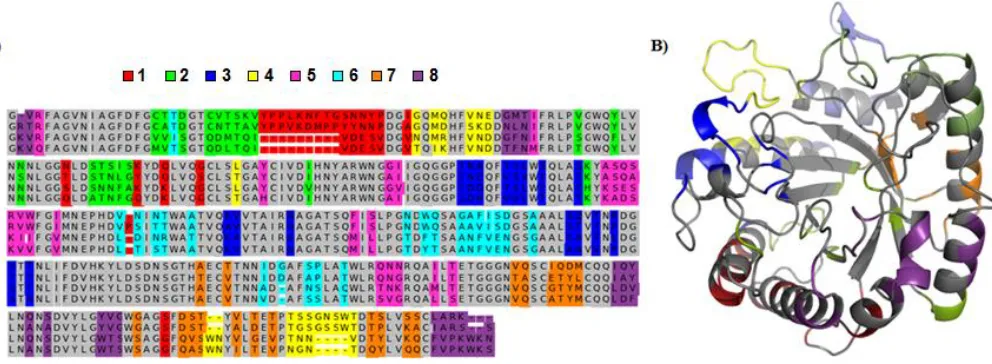
63 °C. The recombination scheme is shown in Figure 2-1, which defines a library with average disruption score <E> of 12.1 and average mutation level <m> of 55.4.
The eight-block, four-parent chimera library defined by the blocks indicated in Figure 2-1 has 65,536 members. Assaying even 1% of this library would be extremely time-consuming. However, assuming that each block contributes additively to the thermostability of a chimera10, a linear regression model can be created that predicts the effect of substituting each block into a parent of interest:
∑ ∑
In this model, is the TA50 of an arbitrary parent (e.g. HjCel5a), is the effect of substituting block i from parent j, and is either 1 or 0, depending on whether the block is present.The linear
regression model for the library investigated here has 25 parameters, one for , and 24 for each (8 blocks from 3 parents). This model requires the thermostability of at least 25 chimeras (including parents) to be evaluated in order to not be rank deficient. In principle, any combination of blocks can be used in a test set, as long as each block appears at least once. However, to account for non-additive behavior in the library arising from possible interactions between blocks, we chose chimeras that also had maximal mutual information between each block16.
We synthesized 25 chimeras, appending to the N-terminus of each the cellulose binding module (CBM) from H. jecorina Cel5a, as well as a C-terminal His6 tag for purification. We expressed the chimeras in Saccharomyces cerevisiae and purified them using column chromatography. 23 out of 25 chimeras were catalytically active, and we measured their thermostabilities by finding the temperature at which the enzyme loses half of its activity relative to that at its optimum temperature over a 2 h reaction (the “TA50”)23. We measured TA50’s for all the
2.4 Adapting linear regression to account for non-additive block interactions
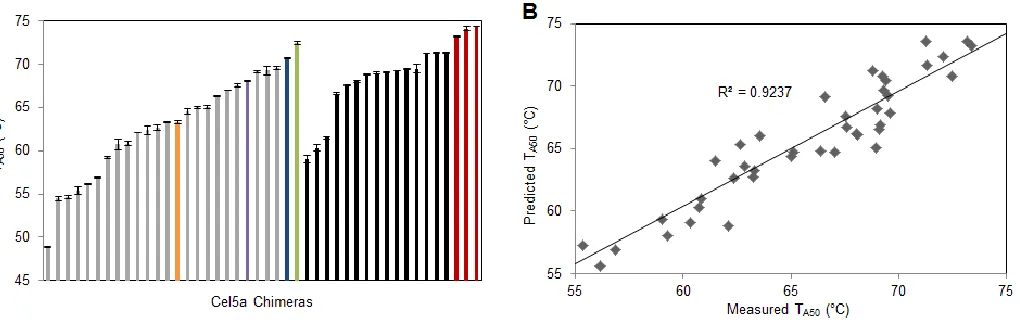
Linear regression was applied to this initial test set to model block contributions to thermostability. This model was used to inform the design of a second test set to explore potentially stabilizing blocks (shown in black in Figure 2-2A). Eighteen additional chimeras that had high mutual information, and that were predicted to be more stable than the parent enzymes, were chosen for expression and characterization. Three chimeras from this set were slightly more stable than any parent (shown in red in Figure 2-2A).
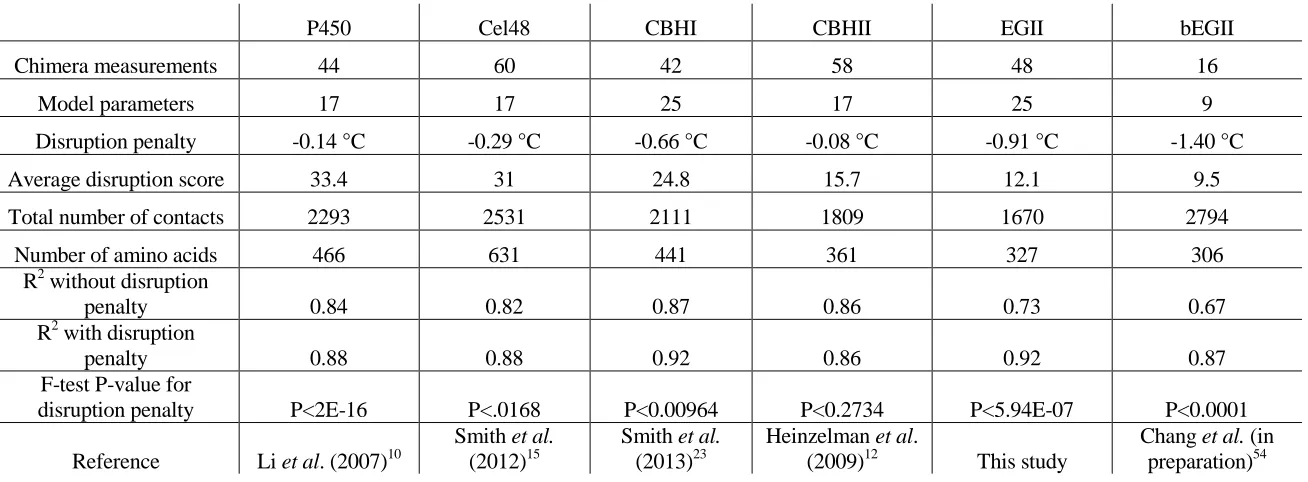
To find the chimera with the highest predicted thermostability in the library, we repeated linear regression on the new data set containing both the original and optimized test set chimeras. The R2 value for this data set was only 0.73, suggesting that the block contributions to chimera stability had significant non-additive components. However, when we added the disruption score of chimeras as an additional parameter to the model (which is known to improve linear regression15), we found that the R2 value increased to 0.92, with each disrupted contact reducing thermostability by an average of 0.91 °C. This model, shown below, adds as an additional parameter, where is the disruption score (E) of a chimera, and is a “disruption penalty”, a thermostability decrease associated with the disrupted contacts.
∑ ∑
2.5 Regression modeling predicts a highly stable chimera
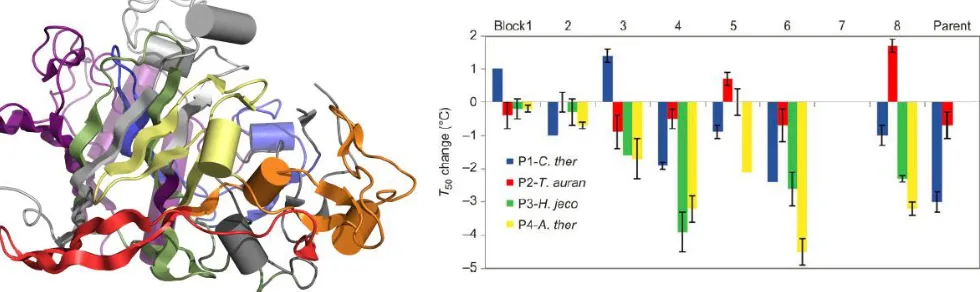
The revised linear regression model predicts that only two blocks are stabilizing relative to HjCel5a: blocks 6 and 7 from PgCel5a (+1.0 °C and +3.3 °C, respectively).Combining these two blocks allowed us to create chimera 110, which is 4.3 °C more stable and 18 mutations away from its closest parent, HjCel5a. Since chimera blocks may contain both stabilizing and destabilizing point mutations, we introduced each of the 18 single amino acid mutations in these blocks into HjCel5a individually and tested the thermostabilities of the mutant enzymes.
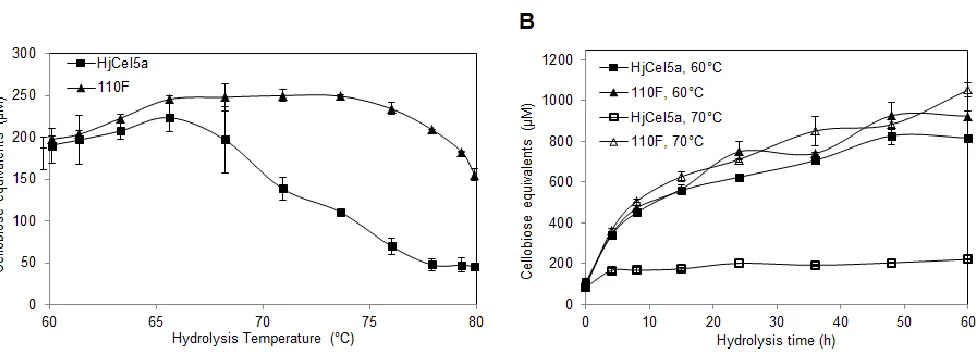
As shown in Figure 2-4, nine of the eighteen mutations were stabilizing, and seven were destabilizing. Two had no effect. We next combined all stabilizing mutations (save for T233V, which compromised activity slightly) to create chimera 110F. This chimera had a stability increase (as measured by TA50) of 10.1 °C relative to HjCel5a (Figure 2-5A). Its optimal temperature was also increased by ~10 °C, and its activity was not compromised by thermostabilization.
To evaluate the improvement of 110F over industrially relevant time scales, we compared its activity to that of HjCel5a over 60 h hydrolyses at 60 °C and 70 °C. As shown in Figure 2-5B, 110F displays more activity at both temperatures. Importantly, it remains highly active at 70 °C over a 60 h period, while wild-type HjCel5a is nearly inactive at this temperature.
2.6 Disruption penalties vary among SCHEMA libraries
Figure 2-4. Thermostability effects of single mutations from stabilizing blocks in HjCel5a. Point mutations from thermostabilizing blocks were introduced into HjCel5a and their thermostabilities were evaluated using the TA50 assay.
[image:38.612.117.488.79.264.2] [image:38.612.85.574.383.559.2]Table 2-1: Disruption penalty varies between SCHEMA libraries. Linear regression models were analyzed for previously investigated chimera libraries. Parameters relating to disruption penalty for each library are listed.
P450 Cel48 CBHI CBHII EGII bEGII
Chimera measurements 44 60 42 58 48 16
Model parameters 17 17 25 17 25 9
Disruption penalty -0.14 °C -0.29 °C -0.66 °C -0.08 °C -0.91 °C -1.40 °C
Average disruption score 33.4 31 24.8 15.7 12.1 9.5
Total number of contacts 2293 2531 2111 1809 1670 2794
Number of amino acids 466 631 441 361 327 306
R2 without disruption
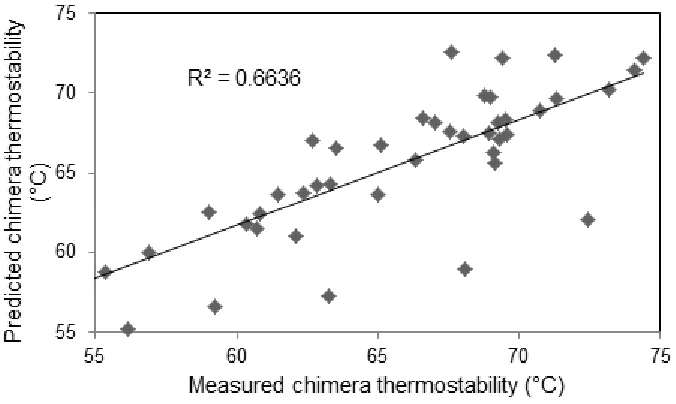
penalty 0.84 0.82 0.87 0.86 0.73 0.67
R2 with disruption
penalty 0.88 0.88 0.92 0.86 0.92 0.87
F-test P-value for
disruption penalty P<2E-16 P<.0168 P<0.00964 P<0.2734 P<5.94E-07 P<0.0001 Reference Li et al. (2007)10
Smith et al. (2012)15
Smith et al. (2013)23
Heinzelman et al.
(2009)12 This study
linear regression models for all libraries, except for CBHII, were improved by adding disruption score as a parameter, as evaluated by the F-test (P <0.05). For these libraries, disruption penalty was a more important parameter than any individual block substitution. Disruption penalties were -0.14, -0.29, -0.66, -0.08, and -1.40 °C for P450, Cel48, CBHI, CBHII, and bEGII, respectively.
2.7A highly thermostable fungal endoglucanase II chimera
These results demonstrate that SCHEMA-guided structure-based recombination can be used to create a thermostable fungal-derived endoglucanase II (Cel5a). The best variant, 110F, has enhanced activity at high temperatures relative to wild-type HjCel5a. This thermostable Cel5a is compatible with other cellulases engineered by this group and others to work efficiently and synergistically at high temperatures47; 48; 55.
Recent work has shown that HjCel5a is amenable to a variety of stabilization approaches. These include consensus design, core and helix stabilization by computational design, and energy minimization using the FoldX and Rosetta force fields (Lee et al., in preparation). Each of these methods was able to find multiple amino acid substitutions, which increased thermostability with an overall success rate of 5-20%. Thermostabilization by recombination performed favorably, finding nine stabilizing mutations, five of which were not found by any other method (F191V, T233V, S242A, V265T, and S322A). G189A and G293A were identified by consensus design56, whereas D271Y and S318P were identified by FoldX57. Building the thermostability model required the construction and evaluation of no more than 45 chimeras, which was comparable to the number of mutations screened for the rational design methods.
Figure 2-6 (Previous page). Thermostabilizing mutations introduced by recombination are conservative. Mutations F191V (A), T233V (B), S242A (C), V265T (D), and S322A (E) are shown mapped onto the structure of HjCel5a (PDB 3QR3). Residues within 5 A are shown as sticks. Unchanged residues are colored blue, the wild-type residues at mutated sites are colored green, and the mutated residues are colored grey. Oxygen atoms are colored red, and nitrogen atoms are colored blue. F191V shrinks a residue in a hydrophobic pocket. T233V, S242A, and S322A replace small hydrophilic residues on the surface of the protein with small hydrophobic residues. V265T may form a new hydrogen bond at the N-terminus of an alpha helix (shown in yellow).
in more favorable packing. T233 is found in a loop region on the surface of the enzyme and does not appear to form any hydrogen bonds. It is unclear how mutating T233 into V improves stability. S242 is present at the N-terminus of an alpha helix. Mutations at this residue have been implicated in stabilizing the helix dipole58, but mutation to alanine is unlikely to have this effect. V265 is also present at the N-terminus of an alpha helix, and mutation to threonine may help stabilize the helix by forming a new hydrogen bond to the nitrogen on the backbone of residue 268. Explicit design for helix stabilization did not find this mutation, even though it was one of the most stabilizing mutations found by chimeragenesis (+ 2.0 ºC)58. S322 is present in an alpha helix near the C-terminus of the protein. The amino acid is solvent exposed, and does not appear to participate in any hydrogen bonds. It is unclear how mutation to alanine improves thermostability for this residue.
2.8 Non-additive block interactions can constrain engineering by recombination
as a parameter, most of these blocks were predicted to be destabilizing or neutral (Figure 2-4B). Therefore, in this library, the destabilizing effect of non-favorable amino acid contacts introduced by recombination (-0.91 ºC per contact) significantly compromised thermostability of the library. Indeed, since the average disruption score of chimeras in the library was 12.1, amino acid disruptions reduced average library thermostability by an estimated 11 ºC. This effect was smaller but still present in many other SCHEMA recombination libraries that have been investigated previously, with disruption penalties predicted to range from -0.14 ºC to -1.40 ºC.
Disrupted amino acid contacts are a fundamentally non-additive, or epistatic, phenomenon, since they arise from interactions between recombined blocks. Molecular epistasis has a variety of causes, including stability thresholds, synergism, and suppressor mutations59, and is a complicating factor for both engineering enzymes60 and studying evolution61 because it can lead to highly rugged fitness landscapes. In fact, epistasis has recently been shown to play a major role in molecular evolution62.
2.9 Methods
General methods are described in Appendix 1.
Cel5A Plasmid Construction
Genes encoding Hypocrea jecorina Cel5a, Phialophora sp. G5 Cel5a, Penicillium decumbens Cel5a, and Penicillium pinophilum Cel5a were synthesized with S. cerevisiae codon bias (DNA 2.0, Menlo Park, CA), and cloned into the yeast secretion vector YEp352/PGK91-1-αss as described previously 47; 48. Each gene had a C-terminal linker and carbohydrate binding module from H. jecorina Cel5a. Sequences of all genes are in Appendix 2.
SCHEMA guided structure-based recombination
Optimal Experimental Design.
We used the Submodular Function Optimization Matlab toolbox64 to choose chimeras that had both low SCHEMA disruption and maximal mutual information between the sampled chimeras and the rest of the library, as described16.
Chimera Library Construction
Chimeras were constructed from 500bp DNA fragments via overlap extension PCR, as described previously65. The DNA fragments (“gBlocks”) were synthesized by Integrated DNA Technologies (San Jose, CA). Codons were optimized for yeast expression using Gene Designer software from DNA 2.0 (Menlo Park, CA)66. Genes were cloned into the YEp352/PGK91-1-αss vector using Gibson assembly67.
Enzyme Purification
YEp352/PGK91-1-αss vectors containing Cel5a chimeras were transformed into the BY4742 Δkre2 strain of yeast ( BY4742; Mat a; his3D1; leu2D0; lys2D0; ura3D0;
TA50 Thermostability Measurements
100 µL samples in 50mM sodium acetate buffer, pH 5.0 containing 0.2 µM Cel5a and 1% (w/v) Avicel were incubated at a range of temperatures for 2 h. A modified Park-Johnson reducing sugar assay was used to measure activity 69; briefly, reaction mixtures were spun at 1000 g for 5 min to remove Avicel. 50 µL of supernatant was removed and transferred to a mixture of 100 µL ferricyanide reagent (0.5 g/L K3Fe(CN)6, 34.84 g/L K2HPO4, pH 10.6) and 50 µL carbonate-cyanide reagent (5.3 g/L Na2CO3, 0.65 g/L KCN). The reaction was heated at 95 ºC for 15 min in an Eppendorf Mastercycler, and then cooled on ice for 5 min. 180 µL of the reaction was removed and mixed with 90 µL ferric iron solution (2.5 g/L FeCl3, 10 g/L polyvinyl pyrrolidone, 2 N H2SO4). After 2 min, absorbance at 595 nm was taken, using solutions of 0 µM to 300 µM cellobiose as standards.
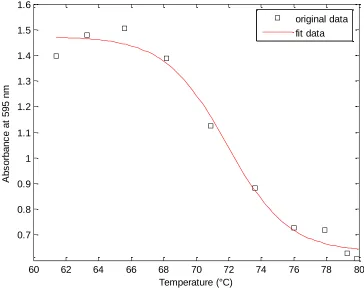
TA50 was determined by plotting activities against the temperature using Matlab (Mathworks, Natick, MA) and fitted using 4-parameter sigmoidal curves. The TA50 value is the temperature at which enzyme activity is halfway between optimal activity and no activity. Reported values were averaged from at least two independent measurements.
Cellulase Activity Measurements
mixed with 50 µL arsenomolybdate solution (50 g/L (NH4)2MoO4, 1.5 N H2SO4, 6 g/L NaH2AsO4). After mixing, absorbance at 520 nm was read, using 0 to 2mM cellobiose solutions as standards.
2.10 Supplementary information
Figure S2-1. Example raw data used to determine T
A50. Curve is fit to a Boltzmann fourparameter sigmoidal function.
60 62 64 66 68 70 72 74 76 78 80
0.7 0.8 0.9 1 1.1 1.2 1.3 1.4 1.5 1.6
Temperature (°C)
A
b
s
o
rb
a
n
c
e
a
t
5
9
5
n
m
Table S2-1. Thermostabilities and contact disruption scores of Cel5a chimeras.
First
set is the Cel5a parents, second set is the initial test set, third group is an optimized test set
of predicted stabilizing blocks, and forth group are chimeras designed for optimized
stability.
Chimera TA50 (°C) E Notes 00000000 72.0 0
[image:51.612.105.359.205.700.2]00003000 68.9 11 00002000 69.3 3 03000000 66.6 4 01000000 69.1 5
00000013 74.4 6 Decreased activity 12002010 60.3 17
12002013 59.0 21 2000000 61.5 8 13002010 63.5 11 13002013 68.0 15 00000100 73.4 0
Table S2-1. Thermostabilities of HjCel5a single point mutants. Wild-type TA50 is 72.0ºC.
HjCel5a mutant ΔTA50 (°C) N153S N155T G189A F191V A230T T233V
-1.10 +/- 0.14 0.09 +/- 0.27 0.92 +/- 0.10 0.89 +/- 0.32 -4.29 +/- 0.33 0.87 +/- 0.09 G239D S242A V265T Q266A I269E Q270T D271Y M272L V302A T304D S318P S322A
C h a p t e r 3
A SYNERGISTIC SET OF ENGINEERED THERMOSTABLE FUNGAL CELLULASES ACCELERATES HIGH-TEMPERATURE CELLULOSE HYDROLYSIS
3.1 Abstract
A major obstacle to the widespread use of cellulose as a source of renewable fuels
and chemicals is the difficulty in converting cellulose into soluble sugars for fermentation,
as the cellulases used to catalyze cellulose hydrolysis are slow and expensive. One possible
solution is to engineer cellulases that are more thermostable, allowing higher activity at
higher reaction temperatures. We have previously combined directed evolution, rational
design,
and
structure-based
recombination
to
engineer
thermostable
fungal
cellobiohydrolases Cel6a and Cel7a. Here we describe the creation of the most stable
known fungal endoglucanase, a derivative of
Hypocrea jecorina
(anamorph
Trichoderma
reesei
) Cel5a, by combining mutations isolated from chimera studies, consensus design,
and other computational methods. The engineered endoglucanase is 17
°
C more
thermostable than
H. jecorina
Cel5a and hydrolyzes 50% more cellulose over 60 h at its
optimum temperature. A set of thermostabilized cellulases (Cel5a, Cel6a, Cel7a)
synergistically hydrolyzes cellulose at an optimum performance temperature of 70
°
C, with
total sugar production three times greater than the of wild-type enzymes at their optimum
3.2 The utility of thermostable cellulase mixtures
Cellulases engineered for increased thermostability can reduce lignocellulose biomass degradation times and costs, facilitating the use of this feedstock for biofuels and specialty chemicals72. Thermostable cellulases can have increased cellulolytic activity at higher temperatures and remain active for longer at these temperatures73; 74. Moreover, biomass degradation at elevated temperatures reduces cooling costs following pre-treatment and reduces the risk of microbial contamination72.
Effective cellulose degradation requires four cellulase activities: cellobiohydrolases I and II processively hydrolyze opposite ends (reducing and non-reducing, respectively) of the cellulose chain, endoglucanases cleave intrachain bonds, and beta-glucosidases break down cellobiose molecules released by other cellulases75. Over the last four years, this lab has engineered thermostable class I cellobiohydrolases (Cel7a)44; 47 and class II cellobiohydrolases (Cel6a)12; 48 using a combination of SCHEMA recombination, rational design, and directed evolution. As reported by Wu and Arnold48, combining thermostabilized Cel6a and Cel7a increases the amount of released cellobiose by approximately 80% over a 60 h incubation, relative to the wild-type Cel6a and Cel7a mixture, when each mixture operates at its optimum temperature (70 °C for engineered and 60 °C for wild-type). Since fungal beta-glucosidases with optimum temperatures above 70 °C are already known76, the final step to creating a thermostable cellulolytic enzyme mixture was to engineer a thermostable fungal endoglucanase that retains high catalytic activity.
3.3 Engineering the most stable known fungal endoglucanase
To create a thermostable HjCel5a we combined stabilizing mutations identified from homologous recombination (Chapter 2) and various computational approaches58. In Chapter 2 we reported the creation of an HjCel5a (called 110F) with an optimal temperature of 74 °C. Lee et al. reported the creation of an HjCel5a (called s13pt4) with an optimal temperature between 75 and 78 °C using various computational methods58. Here we combined all the thermostabilizing mutations from these studies that did not compromise activity. When two suitable mutations were at the same site, we chose the more thermostabilizing of the two.
The mutations identified by chimeragenesis were F191V, T233V, and V265T. Thermostabilizing mutations E53D, T57N, S79P, T80E, V101I, S133R, N155E, G189S, G239E, G293A, and S309W were described by Lee et al.58. D271Y and S318P were identified in both studies. A list of the combined mutations is shown in Table 3-1, and their locations in HjCel5a are shown in Figure 3-1.
The resulting HjCel5a variant (OptCel5a) has an optimal temperature of 81.1 °C when used to hydrolyze crystalline cellulose (Avicel) for 2 h (Figure 3-2A). This makes OptCel5a more than 17 °C more thermostable than wild-type HjCel5a, more than 7 °C more stable than the 110F variant, and 3 °C more stable than the s13pt4 variant. It is the most stable fungal endoglucanase reported.
Table 3-1. Stabilizing mutations combined to create OptCel5a.
Mutation Thermostability increase (ºC) Stabilization method Source
F191V 0.89 Chimeragenesis Chapter 2
T233V 0.87 Chimeragenesis
V265T 2.01 Chimeragenesis
S318P D271Y
3.43 2.67
FoldX/Chimeragenesis FoldX/Chimeragenesis
Chapter 2 Lee et al.58
S79P 0.29 FoldX Lee et al.58
E53D 2.72 Consensus Lee et al.58
T57N 1.12 Consensus
G293A 3.58 Consensus
V101I 0.12 Core stabilization Lee et al.58
N155E 0.54 Helix dipole stabilization Lee et al.58
T80E 0.50 Helix dipole stabilization
S133R 0.44 Helix dipole stabilization
G239E 0.24 Helix dipole stabilization
S309W 0.35 Triad ddG Lee et al.58
3.4 Evaluating the synergy of engineered thermostable cellulases
It has been known for the last 40 years that endoglucanases and cellobiohydrolases act synergistically to degrade cellulose75; 80; 81. We explored the synergy between cellobiohydrolases Cel6a, Cel7a, and endoglucanase Cel5a by comparing mixtures of the wild-type enzymes with engineered-thermostable cellulase mixtures. The engineered-thermostable mixture consists of OptCel5a as the Cel5a variant, 3C6P as the Cel6A48, and TS8 as the Cel7A47. Each of these enzymes has an optimal activity at or greater than 70 °C when measured over 60 h incubations. As our wild-type mixture, we used Cel5a from H. jecorina, Cel6A from H. insolens, and Cel7A from T. emersonii, which are the most thermostable known homologues of each enzyme. These enzymes exhibit an optimal activity of 60 °C over 60 h48.
In these experiments the total cellulase concentration was fixed at 0.5 µM, and the relative concentrations of each cellulase were varied in steps of 0.1 µM, allowing a ternary synergy diagram to be constructed81. Reactions were carried out on Avicel over 60 h at 60 °C for wild-type and 70 °C for engineered enzymes. These conditions were chosen to be consistent with previous synergy studies48; 81; 82 and industrial conditions of high temperatures and incubation times. As shown in Figures 3-2A and B, both enzyme mixtures exhibited substantial synergy, with the mixtures more active than any of the enzymes alone. The degree of synergy, obtained by dividing the activity of the mixture by the sum of the activities of the individual cellulases, ranged from 1.0 to 1.6 for the wild-type enzymes, and from 1.0 to 2.1 for the engineered enzymes79.
The mixture with highest hydrolysis activity shifted from predominantly Cel7a for wild-type mixtures to predominantly Cel6a concentrations for engineered mixtures. As shown in Figure 3-2 C and D, this change in optimal enzyme loadings reflected the relative activities of Cel6a and Cel7a in the wild-type and engineered cases 48. Figures 3-2 C and D also show the activities of the optimal cellulase mixtures for two and three enzymes. The best mixture of wild-type enzymes in this experiment was over 1.5X better than any of its constituent enzymes, while the optimal mixture of engineered thermostable enzymes was over 2.5X better. The optimal engineered thermostable mixture was also 1.16X better than a mixture containing only engineered Cel6a and Cel7a, with an equal total enzyme concentration.
3.5 An optimized mixture of engineered cellulases accelerates cellulose hydrolysis
We searched the region of maximum activity more closely in steps of 0.04 µM and found the optimal mixture for wild-type to be 0.16: 0.28: 0.56 Cel5a:Cel6a:Cel7a. The optimal engineered thermostable mixture is 0.08:0.56:0.36 Cel5a:Cel6a:Cel7a. We call the optimized engineered thermostable mixture T-PRIMED. We evaluated the activity of T-PRIMED over 60 h at both 60 °C and 70 °C and compared it to the activity of the best wild-type mixture. We ran this assay on 1%, 3%, and 5% Avicel to see the effects of varying cellulose concentrations (Figure 3-3A,B,C). T-PRIMED has the highest activity at 70 °C, where it is approximately three times more active than the best mixture of wild-type enzymes at 60 °C. The activity of all cellulase mixtures increased at higher cellulose concentrations, with the activity ratio remaining approximately constant.
3.6 Discussion
We report here the engineering of the most stable reported HjCel5a variant, OptCel5a, and the characterization of its synergy with other engineered thermostable cellulases. This enzyme has an optimal temperature (over 2 h incubations) of 81 ºC, and releases over 1.5X more soluble sugar over 60 h incubations compared to wild-type Cel5a from Hypocrea jecorina.
OptCel5a works synergistically with previously reported engineered thermostable cellobiohydrolases I and II48. T-PRIMED, an optimized mixture of these enzymes, releases over 3X more soluble sugar over 60 h incubations on crystalline cellulose (Avicel) compared to a similarly optimized wild-type mixture. T-PRIMED is also more active on model cellulose substrates derived from corn stover and rice straw.
The synergy studies presented here on engineered thermostable fungal cellulases extend the results from synergy studies on wild-type fungal cellulases79; 81; 84; 85; 86; 87; 88; 89; 90. An optimal mixture of fungal cellulases requires at least three different cellulase activities: endoglucanase, cellobiohydrolase I, and cellobiohydrolase II, and this holds true for both engineered and wild-type mixtures. The engineered endoglucanase reported here increases the activity of a previously reported mixture of engineered cellobiohydrolases48 by 16 %. The degree of synergism also increases from a maximum of 1.6 for wild-type cellulases to a maximum of 2.1 for engineered thermostable cellulases. These synergy values are typical for reaction of fungal cellulase mixtures on Avicel, which range from 1.3 to 2.2 for Hypocrea jecorina cellulases79. Although these data suggests a temperature dependent effect on synergy, wild-type mixtures assessed for cellulase activity at 50 ºC, 60 ºC, and 70 ºC have similar synergy values (Supplementary Figure 3-1).
a higher proportion of chain ends, and therefore the optimum mixture of cellulases will change depending on substrate. Moreover, the results here show that the optimum temperature can change based on substrate as well: T-PRIMED displays an optimum temperature of 70 °C displayed on Avicel and corn stover, while on treated rice-straw it has an optimal activity of 60 °C. This change in optimum temperature reflects the fact that the thermostability of cellulase mixtures can depend on binding to cellulose74, and binding is likely to change based on composition of the substrate79.
Synergy is also expected to decrease with hydrolysis time90 and enzyme loadings84, two properties that were not investigated here. These results together imply that engineered cellulase mixtures will likely need to be optimized for particular applications. High-throughput approaches for optimizing cellulase mixtures, such as robotic platforms91 and computationally guided approaches92, will likely be required.
3.7 Methods
General methods are described in Appendix 1.
Cel5A Plasmid Construction
Genes encoding Cel6A, and Cel7A were cloned into the yeast secretion vector YEp352/PGK91-1-αss as described previously47; 48. The gene encoding wild-type Cel5A gene (including its cellulose binding module) was synthesized with S. cerevisiae codon optimization (DNA 2.0, Menlo Park, CA). Sequences of all genes are in Supplementary Information.
Enzyme Purification
Yeast colonies expressing Cel5a and Cel6A with C-terminal His6 tags and Cel7A with an N-terminal His8 tag were grown at 30 °C: first overnight in 5 mL SD-Ura medium, then expanded into 50 mL SD-Ura (+50 µg/mL kanamycin) medium for 24 h, and then expanded into 1 L YPD (+50 µg/mL) medium for an additional 48 h. Cultures were centrifuged at 4500 g for 20 min, and the supernatant was filtered with 0.2 mm PES filter unit from Nalgene (VWR, Radnor, PA). Protein was purified using 5mL HisTrap columns (GE Healthcare, Pittsburgh, PA). Purified cellulases were buffered-exchanged to 50mM sodium acetate buffer pH 5.0 using Vivaspin 20 ultrafiltration spin tubes (GE Healthcare, Pittsburgh, PA). Protein concentrations were determined using A280, with theoretical extinction coefficients found using ProtParam on the ExPASy server68.
Thermostability Measurements
Cellulase Activity Measurements
All cellulase activity measurements were conducted in 50 mM sodium acetate buffer, pH 5.0. Constant temperature was maintained using an Eppendorf Mastercycler (Hamburg, Germany). To determine activity-temperature profiles of Cel5A, samples containing 0.2 µM of purified Cel5a and 1% (w/v) Avicel were incubated at 60 and 70 °C for 60 h. To determine the activity of the Cel5a, Cel6A, and Cel7A mixtures, purified Cel5a, Cel6A, and Cel7A were combined at different ratios to a final concentration of 0.5 µM along, with 1% Avicel in 100 µL and incubated 60 °C and 70 °C for 60 h. After hydrolysis, reaction supernatants were sampled for reducing sugar concentrations via a modified Nelson–Somogyi assay70; 71, as described in Chapter 2.
Cellulose hydrolysis activity over time to determine optimized engineered and wild-type cellulase mixtures was carried out on 1% and 3% Avicel at 60 °C and 70 °C. Time points were taken at 0 h, 4 h, 8 h, 15 h, 24 h, 36 h, 48 h, and 60 h. Reducing sugar concentration was quantified as above.
treated lignocellulose from corn stover was obtained as a gift from Alex Nisthal. Pre-treated lignocellulose from rice straw was obtained as a gift from Frank C. J. Chang and prepared according to Hsu et al. (2010)93. Activity assays were carried out for optimized engineered and wild-type cellulase mixtures on 3% substrate at 60 °C and 70 °C for 60 h. Released cellobiose at the end of 60 h was quantified as above.
Data analysis
Cellulase activity and thermostability data were plotted using Microsoft Excel (Redmond, WA). Synergy plots were made in Matlab (The Mathworks, Inc., Natick, MA), using the Ternplot package developed by Carl Sandrock.
3.8 Supplementary Information
[image:68.612.57.581.238.438.2]Figure S3-1 shows the synergistic activity of wild-type cellulase mixtures incubated at 50 ºC, 60 ºC, and 70 ºC for 24 h on Avicel. The mixtures had similar synergy values (maximum observed synergy of ~2) at these temperatures.
C h a p t e r 4
DIRECTED EVOLUTION OF AN ENOLASE FOR NEXT-GENERATION BIOFUELS
4.1 Abstract
Enzymes often use complex and expensive cofactors to perform both essential cellular reactions and industrially important chemical transformations. The creation of enzymes with simpler and more efficient cofactors would be significant for understanding how nature has optimized enzyme cofactor choice and for improving cost-effective production of fuels and chemicals. In this study we investigated the dehydration of R-2,3-dihydroxyisovalerate (2R-DHIV)
into 2-ketoisovalerate (KIV), a reaction involved in branched-chain amino acid biosynthesis as well as industrial isobutanol biosynthesis. In nature this reaction is catalyzed by dihydroxyacid dehydratase (DHAD), an enzyme which contains an oxygen-sensitive iron-sulfur cluster cofactor whose maturation requires a complicated and energetically expensive biosynthetic process. In contrast, members of the enolase family of enzymes catalyze the dehydration of similar substrates, using only a simple magnesium ion cofactor.
provide an example of the limitations of protein engineering to alter reactivity. We speculate that cofactor choice may be optimal for some natural enzymatic reactions.
4.2 Natural enzymes limit production of biofuels and biochemical
A major obstacle to the widespread adoption of biosynthetic strategies for production of fuels and chemicals as sustainable, affordable, and environmentally-friendly replacements to existing industrial processes is the low production yield from microorganisms. One reason for this is that the natural enzymes used to synthesize biofuels and chemicals have not been optimized for this task, having insufficient reaction rates and inappropriate reaction conditions.
Protein engineering by methods like directed evolution and recombination has made significant progress in improving the stability12; 44; 48, activity94, and substrate specificity95 of natural enzymes as a step towards introducing them into industrial processes. These efforts have focused on engineering the primary sequence of enzymes; however, many enzymes have highly reactive cofactors that dictate their catalytic behavior and properties. For example, many complex metal cofactors are oxygen sensitive and expensive to biosynthesize (such as the iron molybdenum cofactor in nitrogenases96, or the iron-sulfur cofactor in dehydratases97), which can limit the industrial utility of these enzymes as well as inhibit engineering by directed evolution.
Can cofactor choice in natural enzymes be engineered? Recently this lab used directed evolution to switch the cofactor preference of ketol-acid reductoisomerase (KARI) from NADPH to the structurally similar NADH98; 99. This cofactor switch allowed KARIs to operate efficiently under anaerobic conditions where NADPH is limiting.