Decision Support Frameworks and Tools for Conservation
Mark W. Schwartz1, Carly N. Cook2, Robert L. Pressey3, Andrew S. Pullin4, Michael C. Runge5, Nick Salafsky6, William J. Sutherland7, & Matthew A. Williamson1
1The John Muir Institute of the Environment, University of California, Davis, CA, 95616, USA 2School of Biological Sciences, Monash University, Clayton, Victoria 3800, Australia
3Australian Research Council Centre of Excellence for Coral Reef Studies, James Cook University, Townsville, Queensland, Australia 4Centre for Evidence-Based Conservation, Bangor University, Bangor, Gwynedd, LL57 2UW, UK
5Patuxent Wildlife Research Center, U.S. Geological Survey, Laurel, MD 20708, USA 6Foundations of Success, Bethesda, MD 20816, USA
7Conservation Science Group, Department of Zoology, University of Cambridge, Cambridge CB2 3QZ, UK
Keywords
Adaptive management; planning; decision analysis; evidence based; futures research; structured decision making; systematic conservation planning; project management.
Correspondence
Mark W. Schwartz, The John Muir Institute of the Environment, University of California, Davis, CA 95616, USA.
Tel: +1 530 752-0671 Fax +1 530 753-3350
E-mail: [email protected]
Received 9 January 2017 Accepted 7 June 2017
doi: 10.1111/conl.12385
Abstract
The practice of conservation occurs within complex socioecological systems fraught with challenges that require transparent, defensible, and often so-cially engaged project planning and management. Planning and decision sup-port frameworks are designed to help conservation practitioners increase plan-ning rigor, project accountability, stakeholder participation, transparency in decisions, and learning. We describe and contrast five common frameworks within the context of six fundamental questions (why, who, what, where, when, how) at each of three planning stages of adaptive management (project scoping, operational planning, learning). We demonstrate that decision sup-port frameworks provide varied and extensive tools for conservation planning and management. However, using any framework in isolation risks dimin-ishing potential benefits since no one framework covers the full spectrum of potential conservation planning and decision challenges. We describe two case studies that have effectively deployed tools from across conservation frame-works to improve conservation actions and outcomes. Attention to the critical questions for conservation project planning should allow practitioners to op-erate within any framework and adapt tools to suit their specific management context. We call on conservation researchers and practitioners to regularly use decision support tools as standard practice for framing both practice and re-search.
Introduction
The practice of conservation increasingly takes place in complex, uncertain, and dynamic socioecological con-texts (Folk et al. 2005). Given this complexity, there is increasing attention toward methods for doing a bet-ter job of linking knowledge to action (e.g., Sunderland et al. 2009; Walshet al. 2015). These challenges require increased attention to conservation planning (Groves & Game 2015). The goal of conservation planning is to support actions to achieve explicitly defined objectives through documented, structured, and socially engaged processes (Groves & Game 2015). To identify and select
We define a conservation framework as a cohesive set of tools and guidelines within which one may structure the planning and management of a conservation pro-gram or project (e.g., Systematic Conservation Planning; Margules & Pressey 2000). We define tools as a struc-tured set of specific activitiesused to accomplish one or more critical planning steps (e.g., Vulnerability Assess-ment; Glicket al.2011). As such, we distinguish our use of tools from the array of highly valuable conservation information sources, such as IUCN redlists or geospatial databases that also sometimes referred to as tools (e.g., Maceet al.2008). A number of frameworks now exist that contribute to a varied, if not somewhat confusing, suite of toolkits for conservation practitioners. We seek to help structure and clarify thinking about conservation tools, frameworks, and their potential utility toward deploying effective conservation actions by linking tools to funda-mental questions within the planning steps of adaptive management. We focus on tools that have been devel-oped within five prominent conservation planning and decision-making frameworks.
Our purpose is threefold. First, we seek to provide con-ceptual guidance to practitioners who are confronted by a seemingly endless array of new and nuanced frame-works that claim to improve conservation practices. Fur-ther, deploying tools in support of conservation is costly and no effort can deploy all the available tools; tool se-lection is an important decision. Although this guidance points to specific tools, our approach is to focus on struc-turing how to think about a conservation challenge in or-der to find effective solutions. Second our synthetic focus on choosing tools for the question at hand seeks to reduce the apparent current tension around choosing “the right” framework for a conservation project. Third, we identify gaps in the conservation toolkit and suggest directions for conservation scientists seeking to augment the existing toolkit for conservation. Through this, we call on conser-vation scientists to revisit the need for coordinated efforts to establish broadly accepted standards of conservation practice.
Five decision support frameworks
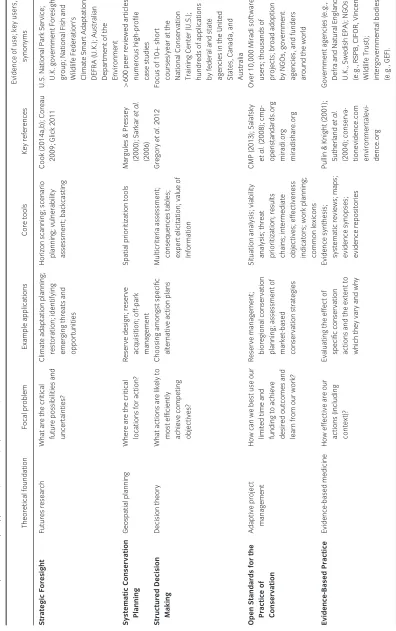
Advances in conservation planning and decision support have been driven by a suite of frameworks that have be-come generally recognizable and broadly used. We ex-amine five decision support frameworks selected because of their general conservation utility and their deploy-ment by multiple resource managedeploy-ment agencies and/or nongovernmental conservation organizations (Table 1). Our focal frameworks are: (1) Strategic Foresight (SF) (Cooket al.2014a), (2) Systematic Conservation Planning (SCP) (Margules & Pressey 2000; Sarkaret al.2006), (3)
Structured Decision Making (SDM) (Martin et al.2009; Gregory et al. 2012), (4) Open Standards for the Prac-tice of Conservation (OS) (CMP 2013), and (5) Evidence-Based Practice (EBP) (Sutherland 2000; Pullin & Knight 2001; Sutherlandet al.2004).
Strategic Foresight emphasizes planning actions given uncertain future conditions of the social and natural world (Cooket al.2014a). SF provides a structured pro-cess to assess a range of plausible future conditions and identify actions most likely to achieve a desired future state (Coreau et al. 2009; Cook et al. 2014a,b). SF can address the fundamental questions of conservation relat-ing to the uncertainties associated with forecastrelat-ing future states (e.g., what actions are most likely to succeed across different future scenarios). Tools in SF tend to focus on helping stakeholders target critical future uncertainties in management choices.
Systematic Conservation Planningseeks to optimize where to deploy conservation actions, on which targets, and how best to protect diversity (e.g., protecting habitats, implementing weed management) (Margules & Pressey 2000; Sarkar et al.2006; Groveset al.2012). SCP seeks cost-efficient solutions, each consisting of a portfolio of areas, that achieve multiple, quantitative objectives in the face of practical constraints (Margules & Pressey 2000; Sarkar et al. 2006). Tools associated with SCP include identifying and prioritizing where to take action, min-imizing cost (e.g., dollars, forgone opportunities) while achieving conservation, or other, objectives (Sarkaret al. 2006).
Structured Decision Makingseeks to identify optimal ac-tions to achieve desired outcomes while balancing diverse stakeholder objectives, often in the face of uncertainty (Runge et al. 2011a, Gregory et al. 2012). SDM seeks quantitative, explicit assessment of the consequences and trade-offs of choosing amongst a set of alternative actions. Tools deployed through SDM range across a wide array of approaches that are designed to facilitate making choices among actions that differentially achieve a set of poten-tially competing objectives (Gregoryet al.2012).
Table 1 Five critical decision support frameworks in common p ractice b y g lobally distributed g overnment and n ongovernmental practitioners. Each framewo rk is linked to its conceptual foundation a nd its core focal q uestion. E xample applications, core tools, key references, a nd evidence of their u se in conservation are a lso d escribed Theoretical foundation Focal problem E xample applications Core tools Key references Evidence of use; key u sers, synonyms Strategic F oresight Futures research W hat a re the critical future possibilities a nd uncertainties? Climate adaptation p lanning; restoration; identifying emerging threats a nd opportunities Horizon scanning; scenario planning; vulnerability assessment; b ackcasting Cook (2014a,b); Coreau 2009; Glick 2011 U.S. National Park S ervice; U.K. government Foresight group; National Fish and Wildlife Federation’s Climate S mart Adaptation; DEFRA (U.K.); Australian Department of the Environment Systematic Conservation Planning Geospatial planning Where a re the critical locations for action? Reserve d esign; reserve acquisition; off-park management Spatial p rioritization tools M argules & Pressey (2000); S arkar et al. (2006) > 600 peer reviewed articles; numerous h igh-profile case studies Structured Decision Making Decision theory What actions a re likely to most efficiently achieve competing objectives? Choosing a mongst specific alternative a ction p lans Multicriteria a ssessment; consequences tables; expert elicitation; value of Information Gregory et al. 2012 Focus of 10 + short courses/year at the National Conservation Training Center (U.S.); hundreds of applications by federal a nd state agencies in the United States, C anada, and Australia Open Standards for the Practice of Conservation Adaptive project management How can we best use o ur limited time and funding to a chieve desired o utcomes a nd learn from our w ork? Reserve m anagement; bioregional conservation planning; a ssessment of market-based conservation strategies Situation a nalysis; viability analysis; threat prioritization; results chains; intermediate objectives; e ffectiveness indicators; w ork p lanning; common lexicons CMP (2013); S alafsky et al. (2008);
cmp-openstandards.org miradi.org miradishare.org
Over 10,000 Miradi software users; thousands o f projects; broad a doption by NGOs, government agencies, a nd funders around the w orld Evidence-Based Practice Evidence-based m edicine H ow effective a re our actions (including context)? Evaluating the e ffect of specific conservation actions a nd the e xtent to which they vary and w hy Evidence synthesis; systematic reviews; maps; evidence synopses; evidence repositories Pullin & Knight (2001); Sutherland et al. (2004);
conserva-tionevidence.com environmentalevi- dence.org
[image:3.594.96.492.74.705.2]Evidence-Based Practice seeks to synthesize and dis-seminate evidence on the effectiveness of manage-ment interventions (Sutherland 2000; Pullin & Knight 2001; Sutherland et al. 2004). The products of evi-dence synthesis tools, such as systematic reviews (Pullin & Knight 2001) and evidence synopses (Dicks et al. 2014), can provide support for rapid selection of the most effective management actions for the decision context. Tools associated with EBP tend to facilitate synthesis of existing knowledge and assist in deter-mining where past actions/interventions may be most applicable.
Common framework attributes
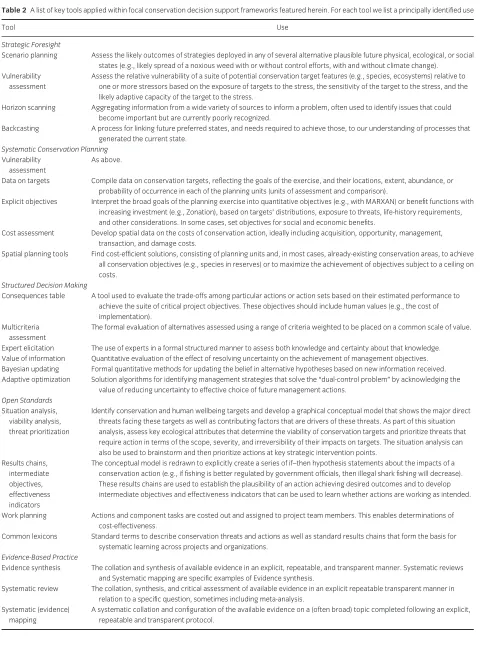
Our focal conservation frameworks share common prin-ciples of establishing clear objectives, identifying criti-cal uncertainties, and creating a documented planning process that integrates knowledge into decision sup-port. Changing conditions, knowledge, and technolo-gies, along with the likelihood of imperfect outcomes, call for decisions to be revisited, making each frame-work iterative (some explicitly, others implicitly). An-other common theme among frameworks is that they embrace flexibility. Each provides a diversity of tools based on problem needs, but practitioners using these frameworks have promoted the value of mixing and matching tools from other frameworks based on the pe-culiarities of the conservation challenge and the rele-vant project stage (e.g., planning, action or learning) (Table 2). For example, Bryanet al.(2011) integrated sce-nario planning (SF) as a tool into systematic conservation planning in the Lower Murray River Basin (Australia), while Schofield et al.(2013) applied an evidence-based approach to learning within a systematic conservation planning context for a marine protected area in Greece. This transferability of tools is useful to consider for scien-tists when developing new approaches to problem solv-ing and to practitioners when seeksolv-ing tools that are fit for purpose.
Evidence of the perceived value of using decision support frameworks in conservation practice abounds (Table 1). We find this evidence in the investment by conservation NGOs in developing and training in frame-works, such as the OS (Redfordet al. 2015). Likewise, government agencies are increasingly using these de-cision frameworks (Runge et al. 2011a; Pressey et al. 2013). For example, many U.S. Federal and State Fish and Wildlife agencies are using the OS in their planning work (AFWA 2012; USFWS 2014), the National Conser-vation Training Center offers training in SDM to hun-dreds of practitioners each year (Johnson et al. 2015),
and centers for EBP are emerging globally (Pullin & Knight 2013).
Fundamental process questions of conservation
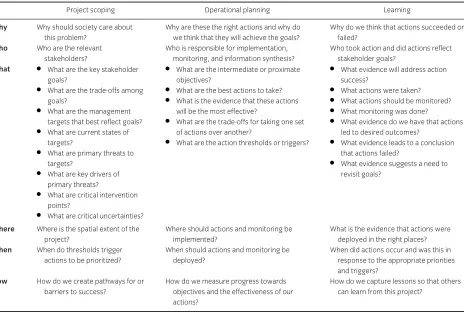
Conservation practice requires answering a series of familiar and fundamental questions: why should soci-ety seek to conserve some part of nature and what are the specific objectives for management; who has a stake in and responsibility for decisions related to a conservation project; what actions are most likely to achieve stated objectives;whereshould conservation ac-tions occur; when do we need to take action; and how will we know if the action achieves intended objec-tives? These are foundational questions that can be reframed in different ways in different contexts, but serve to outline fundamental issues that conservation projects address through planning and decision support (Table 3).
Within an adaptive approach to conservation plan-ning and project management these fundamental ques-tions must be revisited several times: to guide overarching planning (project scoping), specific action planning ( opera-tional planning), and structuring information acquisition and assessment to foster learning (learning) (Table 3). Al-though action is the primary concern of conservation, it is not our focus here. Actions are varied, project-specific and involve myriad specific implementations. Our focus is on supporting decisions to take actions through delib-erative planning processes.
Through project scoping, answering fundamental ques-tions frame the larger context for management decisions, such as establishing goals and including stakeholders (Table 3). In operational planning, questions focus on ex-plicit objectives and the supporting decisions for specific actions, such as why we think one set of actions is bet-ter than another (Table 3). The learning phase focuses on questions that help us understand the impact and effec-tiveness of the actions that were taken and how we can adapt to improve practice (Table 3).
revisit-Table 2 A list of key tools applied within focal conservation decision support frameworks featured herein. For each tool we list a principally identified use
Tool Use
Strategic Foresight
Scenario planning Assess the likely outcomes of strategies deployed in any of several alternative plausible future physical, ecological, or social states (e.g., likely spread of a noxious weed with or without control efforts, with and without climate change).
Vulnerability assessment
Assess the relative vulnerability of a suite of potential conservation target features (e.g., species, ecosystems) relative to one or more stressors based on the exposure of targets to the stress, the sensitivity of the target to the stress, and the likely adaptive capacity of the target to the stress.
Horizon scanning Aggregating information from a wide variety of sources to inform a problem, often used to identify issues that could become important but are currently poorly recognized.
Backcasting A process for linking future preferred states, and needs required to achieve those, to our understanding of processes that generated the current state.
Systematic Conservation Planning
Vulnerability assessment
As above.
Data on targets Compile data on conservation targets, reflecting the goals of the exercise, and their locations, extent, abundance, or probability of occurrence in each of the planning units (units of assessment and comparison).
Explicit objectives Interpret the broad goals of the planning exercise into quantitative objectives (e.g., with MARXAN) or benefit functions with increasing investment (e.g., Zonation), based on targets’ distributions, exposure to threats, life-history requirements, and other considerations. In some cases, set objectives for social and economic benefits.
Cost assessment Develop spatial data on the costs of conservation action, ideally including acquisition, opportunity, management, transaction, and damage costs.
Spatial planning tools Find cost-efficient solutions, consisting of planning units and, in most cases, already-existing conservation areas, to achieve all conservation objectives (e.g., species in reserves) or to maximize the achievement of objectives subject to a ceiling on costs.
Structured Decision Making
Consequences table A tool used to evaluate the trade-offs among particular actions or action sets based on their estimated performance to achieve the suite of critical project objectives. These objectives should include human values (e.g., the cost of implementation).
Multicriteria assessment
The formal evaluation of alternatives assessed using a range of criteria weighted to be placed on a common scale of value.
Expert elicitation The use of experts in a formal structured manner to assess both knowledge and certainty about that knowledge. Value of information Quantitative evaluation of the effect of resolving uncertainty on the achievement of management objectives. Bayesian updating Formal quantitative methods for updating the belief in alternative hypotheses based on new information received. Adaptive optimization Solution algorithms for identifying management strategies that solve the “dual-control problem” by acknowledging the
value of reducing uncertainty to effective choice of future management actions.
Open Standards
Situation analysis, viability analysis, threat prioritization
Identify conservation and human wellbeing targets and develop a graphical conceptual model that shows the major direct threats facing these targets as well as contributing factors that are drivers of these threats. As part of this situation analysis, assess key ecological attributes that determine the viability of conservation targets and prioritize threats that require action in terms of the scope, severity, and irreversibility of their impacts on targets. The situation analysis can also be used to brainstorm and then prioritize actions at key strategic intervention points.
Results chains, intermediate objectives, effectiveness indicators
The conceptual model is redrawn to explicitly create a series of if–then hypothesis statements about the impacts of a conservation action (e.g., if fishing is better regulated by government officials, then illegal shark fishing will decrease). These results chains are used to establish the plausibility of an action achieving desired outcomes and to develop intermediate objectives and effectiveness indicators that can be used to learn whether actions are working as intended.
Work planning Actions and component tasks are costed out and assigned to project team members. This enables determinations of cost-effectiveness.
Common lexicons Standard terms to describe conservation threats and actions as well as standard results chains that form the basis for systematic learning across projects and organizations.
Evidence-Based Practice
Evidence synthesis The collation and synthesis of available evidence in an explicit, repeatable, and transparent manner. Systematic reviews and Systematic mapping are specific examples of Evidence synthesis.
Systematic review The collation, synthesis, and critical assessment of available evidence in an explicit repeatable transparent manner in relation to a specific question, sometimes including meta-analysis.
Systematic (evidence) mapping
[image:5.594.52.534.64.711.2]Table 3A proposed list of fundamental questions that are addressed within project scoping, operational planning, and learning stages of conservation project management
Project scoping Operational planning Learning
Why Why should society care about this problem?
Why are these the right actions and why do we think that they will achieve the goals?
Why do we think that actions succeeded or failed?
Who Who are the relevant stakeholders?
Who is responsible for implementation, monitoring, and information synthesis?
Who took action and did actions reflect stakeholder goals?
What
r
What are the key stakeholder goals?r
What are the trade-offs among goals?r
What are the management targets that best reflect goals?r
What are current states oftargets?
r
What are primary threats to targets?r
What are key drivers of primary threats?r
What are critical intervention points?r
What are critical uncertainties?r
What are the intermediate or proximate objectives?r
What are the best actions to take?r
What is the evidence that these actionswill be the most effective?
r
What are the trade-offs for taking one set of actions over another?r
What are the action thresholds or triggers?r
What evidence will address action success?r
What actions were taken?r
What actions should be monitored?r
What monitoring was done?r
What evidence do we have that actions led to desired outcomes?r
What evidence leads to a conclusion that actions failed?r
What evidence suggests a need to revisit goals?Where Where is the spatial extent of the project?
Where should actions and monitoring be implemented?
What is the evidence that actions were deployed in the right places? When When do thresholds trigger
actions to be prioritized?
When should actions and monitoring be deployed?
When did actions occur and was this in response to the appropriate priorities and triggers?
How How do we create pathways for or barriers to success?
How do we measure progress towards objectives and the effectiveness of our actions?
How do we capture lessons so that others can learn from this project?
ing steps and stages as conditions and decision contexts change.
Tools for conservation practice
Each of the five frameworks described above is imple-mented through a suite of tools, a selection of which is described in Table 2. These tools are designed to support project scoping, operational planning, and learning. De-ploying tools requires information, and this provides an opportunity for research to inform practice. Framing con-servation research around concon-servation practice may in-crease the likelihood of its utility and improve the prac-tice of conservation. However, framing research this way requires viewing the research problem from the context of the practitioner’s need for information and the context in which that information will be used. Increasingly, re-searchers are recognizing the value of their closer links to practitioners (e.g., Cashet al.2003; Cooket al.2013; Beier et al.2017; Boweret al, 2017).
Collectively the emerging tools of conservation plan-ning and management represent a diverse and flexible
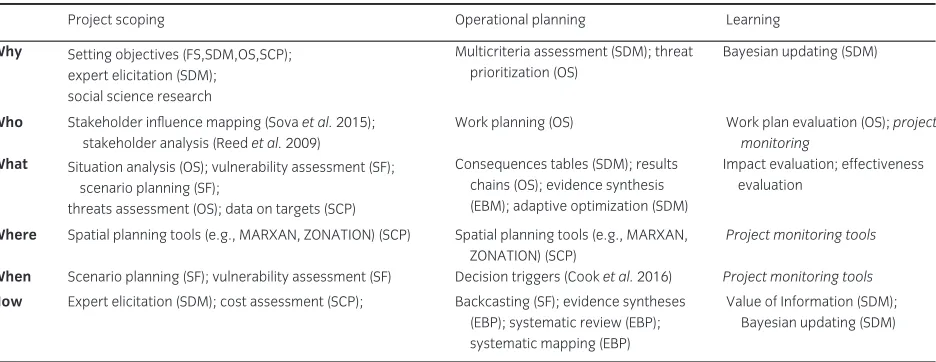
toolkit that can address problems within any natural re-source management decision context (Table 2). Choosing the right tool for a specific challenge requires understand-ing the potential suite of available tools, which funda-mental question they are designed to address, and how they can help practitioners resolve particular challenges within the planning cycle (Table 4). Embedding tools within a framework allows practitioners to systematically address fundamental conservation questions within the contexts of project scoping, operational planning, and learning.
Gaps and complexities in planning tools
Table 4 Examples of how tools can help to answer one or more of six fundamental questions within the three critical planning phases of adaptive management described in this article. Tools are linked, wherever possible, to focal frameworks or a key citation. Linking to a citation indicates a tool that has been developed outside the specific context of these focal frameworks. Italicized generic terms (e.g., project monitoring) refer to practices often engaged in, but lacking specific call-out tools. Underlined items are areas of potential new tool development
Project scoping Operational planning Learning
Why Setting objectives (FS,SDM,OS,SCP); expert elicitation (SDM);
social science research
Multicriteria assessment (SDM); threat prioritization (OS)
Bayesian updating (SDM)
Who Stakeholder influence mapping (Sovaet al.2015); stakeholder analysis (Reedet al.2009)
Work planning (OS) Work plan evaluation (OS);project monitoring
What Situation analysis (OS); vulnerability assessment (SF); scenario planning (SF);
threats assessment (OS); data on targets (SCP)
Consequences tables (SDM); results chains (OS); evidence synthesis (EBM); adaptive optimization (SDM)
Impact evaluation; effectiveness evaluation
Where Spatial planning tools (e.g., MARXAN, ZONATION) (SCP) Spatial planning tools (e.g., MARXAN, ZONATION) (SCP)
Project monitoring tools
When Scenario planning (SF); vulnerability assessment (SF) Decision triggers (Cooket al.2016) Project monitoring tools
How Expert elicitation (SDM); cost assessment (SCP); Backcasting (SF); evidence syntheses (EBP); systematic review (EBP); systematic mapping (EBP)
Value of Information (SDM); Bayesian updating (SDM)
(March 14, 2017; search terms “stakeholder and “con-servation” or “natural resource management”) returned 1,664 papers, 1,197 (72%) of which were published in 2010 or later. Our focal frameworks do not identify specific tools for stakeholder identification, although most recognize that choosing stakeholders depends on who is funding a project, making decisions, and living with outcomes (CMP 2013). The care needed in choos-ing stakeholders increases with the degree of conflict or divergence in values and objectives among groups that control decisions envisioned by the planning team. Stake-holder influence mapping (Sova et al.2015) and stake-holder analysis (Reedet al.2009) begin to form structure for developing robust stakeholder groups.
Identifying threats has been a primary preoccupation of conservation research (Fazeyet al.2005). Considering threats within a planning context (“What”; Table 4) is likely to shift focus away from assessments of isolated threats toward evaluating the relative cost of an inte-grated suite of threats (e.g., threat syndromes; Burgman et al. 2007). Practitioners are nearly always forced to consider a suite of threats, possibly relating to competing objectives, and to understand threats within the context of social acceptability of specific actions (Gregory et al. 2012). Thus, for researchers to contribute to improving the understanding of conservation threats, it would be far more helpful to consider integrated threats assessments than to offer an assessment of a particular kind of threat to an individual species. Integrated threats assessments, however, are difficult to conduct within a research context.
A subtle, but critical, point of distinction between the tools offered by various frameworks centers around cer-tainty that an action will result in a particular out-come. Two frameworks (SDM and SCP) place a large emphasis on quantitative assessments to optimize what or where actions should be taken. Within this emphasis there is sometimes a presumption that an action will re-sult in an intended outcome. SDM encompasses several branches of decision theory that focus on making deci-sions in the face of uncertainty (risk analysis, Burgman 2005; info-gap decision theory, Ben-Haim 2006) and addressing uncertainty is built into most optimization processes (e.g., Runge et al. 2011a). But multiobjective criteria assessment, consequences tables and spatial plan-ning tools work best when there is a reasonable certainty that an outcome will be achieved through an action (e.g., protecting a parcel will protect a species found in that parcel). This is in fact, often a defensible position.
These subtle but important distinctions need consider-ation for two reasons. First, they imply that SDM and SCP tools may partner well with SF, OS and EBM tools in specifying action-to-outcome hypotheses, testing them through action, and optimizing action selections based on numeric models. Second, it is important to recog-nize these differences because of the challenge of implicit bias and the potential for experts to overestimate confi-dence in knowledge of complex systems (Gregoryet al. 2012).
Capturing learning, analyzing information, and sharing information is critical for improving conservation prac-tice (Pullin & Knight 2009). Conservation practitioners increasingly understand that adaptation of initial plans is inevitable, given limitations of data and models about biodiversity and socioeconomic variables relevant to im-plementation on the ground (Pressey et al. 2013). Yet, figuring out what actions are effective is rarely a focus of conservation research. A review of what conservation scientists published (Fazeyet al.2005) found that 40% of the conservation literature documented threats to bio-diversity, while only 13% tested potential conservation interventions. This problem is hardly unique to conserva-tion. Evidence-based approaches have emerged in many fields as a means to better assess what works and what does not (Sutherlandet al.2004).
Learning is important at two scales: within an individ-ual project and among projects to inform broader con-servation practice. Two frameworks, OS and SDM, ex-plicitly include tools to foster learning at the project scale (Table 2). OS identifies steps to plan monitoring of critical information, collect data and compare outcomes to spe-cific, measurable, achievable, relevant, and time-specific (SMART) objectives (Maxwellet al.2015), in order to as-sess progress and to learn. Unfortunately, reviews of im-pact monitoring, assessment, and learning suggest that this is functionally a weak point of conservation prac-tice (Redfordet al.2015). SDM provides quantitative tools for evaluating the value to a decision maker of acquir-ing more information before actacquir-ing (Rungeet al.2011b). EBM is specifically designed to aggregate and assess infor-mation so as to learn which actions work on what prob-lems and what does not (Sutherlandet al.2004). Clearly identifying and distinguishing these forms of learning is critical in choosing the right tool for a particular problem.
Case studies in cross-fertilization
Numerous research papers have described integration of tools from different frameworks to advance research on conservation practice (e.g., Bryanet al. 2011; Schofield et al.2013). It is more difficult to find examples of current
projects that have made a conscientious effort to deploy tools from multiple frameworks in order to improve con-servation practice. We highlight two such cases.
The Puget Sound Partnership (PSP) is a Washington State agency tasked with leading a regional effort to pro-tect and restore the Puget Sound and its terrestrial water-sheds, an ecosystem that spans 30,000 km2 and con-tains nearly 5 million people. The PSP convenes hundreds of partner organizations to identify priorities, advance a common agenda, and strategically invest in actions with the highest likelihood of gains in mission success. The PSP initially engaged in convening partners to create a common framework to identify priorities within nine lo-cal subareas of the Puget Sound, lo-called Lolo-cal Integrat-ing Organizations (LIO’s). Each LIO developed a situation analysis (OS), threats/pressure assessment (OS) to iden-tify recovery targets ( http://www.psp.wa.gov/science-open-standards.php). The PSP also uses SDM tools to create a Vital Signs assessment and provide objectives ratings for their action agenda (http://www.psp.wa.gov/ science-based-decision-making.php), while the LIO’s use consequences tables (SDM) in their annual work plans to evaluate trade-offs in achieving objectives among ac-tions. Together, integrating OS and SDM tools has been a powerful combination for integrating actions and report-ing achievements and challenges to the public.
The Daly River Catchment is one of three catch-ments to coast projects in northern Australia (http:// conservationplanning.org/research/catchment-to-coast-planning/), and is earmarked for further agricultural development due to its arable soils and reliable water supply. To understand possible future states of the catch-ment and the impacts of expanded agriculture on diverse local and regional stakeholders, researchers have used a combination of scenario planning (SF), spatial planning tools (SCP) and a variety of SDM tools (e.g., expert elicita-tion, multiobjective evaluation criteria) to shape choices for local groups engaged in resource management in this 52,000 km2 region (Alvarez-Romeroet al.2015). These efforts culminated in a Daly River Management Advisory Committee plan (http://www.nespnorthern.edu.au/ wp-content/uploads/2015/11/1.1 fact sheet web.pdf). Government funding for the committee’s planning and implementation work was terminated in 2013, although the integrated planning studies remain relevant to decisions by government, natural resource management groups, and conservation NGOs (Adamset al.2016).
Improving the practice of conservation
management planning stages can help sharpen the focus for picking the right tool for the right problem. Focus-ing on tool selection, we argue, will foster broader cross-framework deployment of tools and improve conserva-tion practice. It has been our collective experience that there is a tendency for conservation scientists to cling a little too tightly to the framework that each knows the best. Breadth is a strength, and we need to lever-age that strength for successful practice. Each of our fo-cal frameworks approaches conservation practice from a unique angle, bringing specific strengths to particular kinds of challenges. However, each framework is also flexible and can be amended to use tools for a variety of purposes and from a variety of sources, including merg-ing with other frameworks. While it may be too much to expect practitioners to become and remain conversant in all frameworks, guidance for where and when par-ticular tools have been deployed successfully will help practitioners broaden their toolkits and identify the most appropriate tools for their context. Just as science is strengthened by an approach that focuses on answering questions, adaptive management for conservation is strengthened by planning and decision support that iden-tifies and answers questions critical to achieving desired outcomes.
Second, gaps in tool coverage point to potential fruitful research to develop and hone tools for conservation. Al-though there are tools for many questions at most stages, tools for particular questions at particular planning stages remain less developed (Table 4). Tools to guide planning and action are diverse and nuanced to reflect the diver-sity of challenges that arise around the specifics of ac-tions. Within this context, some tools have garnered a large fraction of the interest among researchers. Deploy-ing spatial plannDeploy-ing tools, or multicriteria assessments is a frequent focus of conservation research. In both cases, a large number of papers have been published on these top-ics since 2010 (at least 860 for spatial planning tools; 159 for multicriteria assessments) (ISI Web of Science search of “conservation” or “natural resource management” and first “Marxan” or “Zonation” or “spatial planning,” then “decision” and “multicriteria”; 20 June 2017). In contrast, tools to gauge public support for a project (why conserve some target?) or harness civic engagement are often less quantitative, and less frequently researched. It may be that social processes are more fruitfully guided by prin-ciples and good practices, rather than tools, models, and quantification. If so, then integration of best practices for these processes into frameworks, similarly, seems to re-quire further development.
Awareness of how decision support tools are being deployed can also help researchers frame questions to en-gage more readily in ongoing resource management
deci-sions. Numerous researchers have observed that research often fails to inform practice as intended (Knight et al. 2008; Sunderland et al. 2009; Matzek et al. 2014) and describe the benefits of a more engaged approach to research (Arlettazet al.2010; Beieret al.2017; Cooket al. 2013; McKinleyet al.2013; Muller & Opgenoorth 2014). Increasing the understanding of conservation practice by researchers can help break down barriers between knowledge and implementation (Sunderlandet al.2009). Surveys that describe research priorities identified by practitioners (e.g., Braunisch et al. 2012; Habel et al. 2013) is a positive step. Likewise, structured partner-ships between practitioners and scientists (e.g., through boundary organizations) (Guston 2001) also serve as a venue for refining research questions for specific practitioner needs (Cooket al.2013; Opdamet al.2013). Increasing awareness of conservation planning tools for decision support among the research community is likely to help researchers better frame their questions for utility in practice.
Conducting management-relevant conservation re-search requires a clear vision of the conservation context as well as an operational plan for action and learning. Natural resource management decisions are increasingly complex and contested (Schmolkeet al.2010; Larsonet al. 2013). Practitioners often make management decisions about clearly defined threats (e.g., habitat loss), but do so in a world where multiple objectives compete for limited conservation resources, social resistance to particular so-lutions may preclude their implementation, and our un-derstanding of action outcomes carries high uncertainty. The consequence is that research focused on a single threat, in the absence of the broader context, may go un-heeded. The tendency in research is to reduce complexity in favor of answering questions with as much certainty as possible. Although designing studies to address multi-ple problems is likely to increase uncertainty, careful at-tention to the decision process will allow researchers to place their hard-earned conservation scholarship within the broader decision context in which the conserva-tion practiconserva-tioner must operate, thereby increasing its utility.
and stewardship leaders of the major conservation NGOs to jointly engage with thought leaders in decision sup-port research to examine what practices have been most effective and where research can help further develop the next generation of tools for effective conservation practice.
Acknowledgments
MWS and MAW thank the USGS SW Climate Science Center; WJS is funded by Arcadia. RLP acknowledges the support of the Australian Research Council. Any use of trade, firm, or product names is for descriptive pur-poses only and does not imply endorsement by the U.S. Government.
References
Adams, V.M., Pressey, R.L. & ´Alvarez-Romero, J.G. (2016).
Using optimal land-use scenarios to assess trade-offs between conservation, development, and social values.
PLoS One,11, e0158350.
Alvarez-Romero, J., Adams, V.M., Pressey, R.L.et al.(2015).
Integrated cross-realm planning: a decision-makers’
perspective.Biol. Conserv.,191, 799-808.
AFWA - Association of Fish and Wildlife Agencies. (2012).
Best practices for state wildlife action plans: voluntary guidance to states for revisions and implementation. Association of Fish and Wildlife Agencies, Washington, D.C. 80 p.
Arlettaz, R., Schaub, M., Fournier, J.et al.(2010). From
publications to public actions: when conservation biologists bridge the gap between research and implementation.
Bioscience,60, 835-842.
Beier, P., Hansen, L.J., Helbrecht, L. & Behar, D. (2017). A how-to guide for coproduction of actionable science.
Conserv. Lett.,10, 288-296.
Ben-Haim, Y. (2006)Info-gap decision theory(2nd ed.). Oxford,
UK, Academic Press.
Bower, S.D., Danylchuk, A.J., Raghavan, R.et al.(2017).
Involving recreational fisheries stakeholders in development of research and conservation priorities for
mahseer (Torspp.) of India through collaborative
workshops.Fisher. Res.,186, 665-671.
Braunisch, V., Home, R., Pellet, J. & Arlettaz, R. (2012). Conservation science relevant to action: a research agenda
identified and prioritized by practitioners.Biol. Conserv.,
153, 201-210.
Bryan, B.A., Crossman, N.D., King, D. & Meyer, W.S. (2011). Landscape futures analysis: assessing the impacts of environmental targets under alternative spatial policy
options and future scenarios.Environ. Model. Softw.,26,
83-91
Burgman, M.A. (2005).Risks and decisions for conservation and
environmental management. Cambridge, UK, Cambridge University Press.
Burgman, M.A., Keith, D., Hopper, S.D., Widyatmoko, D. & Drill, C. (2007). Threat syndromes and conservation
of the Australian flora.Biol. Conserv.,134,
73-82.
Cash, D.W., Clark, W.C., Alcock, F.et al.(2003). Knowledge
systems for sustainable development.Proc. Nat. Acad. Sci.,
100, 8086-8091.
CMP (Conservation Measures Partnership). (2013). The open standards for the practice of conservation. Ver. 3.0.
Conservation Measures Partnership,http://cmp-open
standards.org/wp-content/uploads/2014/03/CMP-OS-V3-0-Final.pdfAccessed, June 20, 2017.
Cook, C.N., Mascia, M.B., Schwartz, M.W., Possingham, H.P. & Fuller, R.A. (2013). Achieving conservation science that
bridges the knowledge-action boundary.Conserv. Biol.,27,
669-678.
Cook, C.N., Inayatullah, S., Burgman, M.A., Sutherland, W.J. & Wintle, B.A. (2014a). Strategic foresight: how planning for the unpredictable can improve
environmental decision-making.Trends Ecol. Evol.,29,
531-541.
Cook, C.N., Wintle, B.C., Aldrich, S.C. & Wintle, B.A. (2014b). Using strategic foresight to assess. Accessed, June
20, 2017. conservation opportunity.Conserv. Biol.,28,
1474-1483.
Cook, C.N., de Bie, K., Keith, D.A. & Addison, P.F.E. (2016). Decision triggers are a critical part of evidence-based
conservation.Biol. Conserv.,195, 46-51.
Coreau, A., Pinay, G., Thompson, J.D., Cheptou, P.O. & Mermet, L. (2009) The rise of research on futures in
ecology, rebalancing scenarios and predictions.Ecol. Lett.,
12, 1277-1286.
Dicks, L., Hodge, V.I., Randall, N.P.et al.(2014). A
transparent process for ”evidence-informed” policy
making.Cons. Lett.,7, 119-125.
Folke, C., Hahn, T., Olsson, P. & Norberg, J. (2005). Adaptive
governance of social-ecological systems.Ann. Rev. Environ.
Resour.,30, 441-473.
Fazey, I., Fischer, J. & Lindenmayer, D.B. (2005). What
do conservation biologists publish?Biol. Conserv.,124,
63-73.
Glick, P., Stein, B.A. & Edelson, N.A. (editors). (2011).
Scanning the conservation horizon: a guide to climate change vulnerability assessment. National Wildlife Federation, Washington, D.C.
Gregory, R., Failing, L., Harstone, M., Long, G., McDaniels, T.
& Ohlson, D. (2012).Structured decision making: a practical
guide to environmental management decisions. Wiley-Blackwell, Chichester, West Sussex, UK.
Groves, C.R. & Game, E.T. (2015).Conservation
Groves, C.R., Game, E.T., Anderson, M.G.et al.(2012). Incorporating climate change into systematic conservation
planning.Biodiv. Conserv.,21, 1651-1671.
Guston, D.H. (2001). Boundary organizations in
environmental policy and science: an introduction.Science,
Tech., Human Values,26, 399–408.
Habel, J.C., Gossner, M.M., Meyer, S.T.et al.(2013). Mind the
gaps when using science to address conservation concerns.
Biodivers. Conserv.,22, 2413-2427.
Johnson, F.A., Eaton, M.J., Williams, J.H., Jensen, G.H. & Madsen, J. (2015). Training conservation
practitioners to be better decision makers.Sustainability,7,
8354-8383.
Knight, A.T., Cowling, R.M., Rouget, M., Balmford, A., Lombard, A.T. & Campbell, B.M. (2008) Knowing but not doing: selecting priority conservation areas
and the research-implementation gap.Conserv. Biol.,22,
610-617.
Larson, S., De Freitas, D.M. & Hicks, C.C. (2013). Sense of place as a determinant of people’s attitudes
towards the environment: implications for natural resources management and planning in
the Great Barrier Reef, Australia.J Environ. Manag.,117,
226-234.
Mace, G.M., Collar, N.J., Gaston, K.J.et al.(2008).
Quantification of extinction risk: IUCN’s system for
classifying threatened species.Conserv. Biol.,22,
1424-1442.
Margules, C.R. & Pressey, R.L. (2000). Systematic
conservation planning.Nature,405, 243-253.
Martin, J., Runge, M.C., Nichols, J.D., Lubow, B.C. & Kendall, W.L. (2009). Structured decision making as a conceptual framework to identify thresholds for conservation and
management.Ecol. Appl.,19, 1079-1090.
Matzek, V., Covino, J., Funk, J.L. & Saunders, M. (2014). Closing the knowing-doing gap in invasive plant management: accessibility and interdisciplinarity of
scientific research.Cons. Lett.,7, 208-215.
Maxwell, S.L., Milner-Gulland, E.J., Jones, J.P.et al.(2015).
Being smart about SMART environmental targets.Science,
347, 1075-1076.
McKinley, D.C., Briggs, R.D. & Bartuska, A.M. (2013). When peer-reviewed publications are not enough! Delivering
Science for natural resource management.Forest Policy
Econ.,21, 1-11.
Muller, J. & Opgenoorth, L. (2014). On the gap between science and conservation implementation—a national park
perspective.Basic Appl. Ecol.,15, 373-378.
Opdam, P., Nassauer, J.I., Wang, Z.F.et al.(2013). Science for
action at the local landscape scale.Landscape Ecol.,28,
1439-1445.
Pressey, R.L., Mills, M., Weeks, R. & Day, J.C. (2013). The plan of the day: managing the dynamic transition from regional conservation designs to local conservation actions.
Biol. Conserv.,166, 155-169.
Pullin, A.S. & Knight, T.M. (2001). Effectiveness in conservation practice: pointers from medicine
and public health.Conserv. Biol.,15,
50-54.
Pullin, A.S. & Knight, T.M. (2009). Doing more good than harm: building an evidence-base for conservation
and environmental management.Biol. Conserv.,142,
931-934.
Pullin, A.S. & Knight, T.M. (2013). Time to build capacity for
evidence synthesis in environmental management.Environ.
Evid.,2, 21.https://doi.org/10.1186/2047-2382-2-21. Redford, K.H., Schwartz, M.W. & Hulvey, K. (2015).
Summative evaluation of conservation measures partnership and conservation coaches network to strengthen results-based management in conservation. http://www.conservationmeasures.org/wp-content/ uploads/sites/4/2015/07/CMP CCNet-Evaluation-Jan-2015.pdf
Reed, M.S., Graves, A., Dandy, N.et al.(2009). Who’s in and
why? A typology of stakeholder analysis methods for
natural resource management.J. Environ. Manag.,90,
1933-1949.
Runge, M.C., Bean, E., Smith, D.R. & Kokos, S. (2011a).
Non-native Fish Control Below Glen Canyon Dam—Report. U.S. Geological Survey Open-File Report 2011-1012. 74 p. http://pubs.usgs.gov/of/2011/1012/pdf/ofr20111012.pdf. Accessed 20 June 2017.
Runge, M.C., Converse, S.J. & Lyons, J.E. (2011b). Which uncertainty? Using expert elicitation and expected value of
information to design an adaptive program.Biol. Conserv.,
144, 1214-1223.
Salafsky, N., Salzer, D., Stattersfield, A.J.et al.(2008). A
standard lexicon of biodiversity conservation: unified
classifications of threats and actions.Conserv. Biol.,22,
897-911.
Sarkar, S., Pressey, R.L., Faith, D.P.et al.(2006). Biodiversity
conservation planning tools: present status and
challenges for the future.Annu. Rev. Env. Resour.,31,
123-159.
Schmolke, A., Thorbek, P., DeAngelis, D.L. & Grimm, V. (2010). Ecological models supporting environmental
decision making: a strategy for the future.Trends Ecol. Evol.,
25, 479-486.
Schofield, G., Scott, R., Dimadi, A.et al.(2013).
Evidence-based marine protected area planning for a
highly mobile endangered marine vertebrate.Biol. Conserv.,
161, 101-109.
Sova, C.A., Helfgott, A., Chaudhury, A.S., Matthews, D., Thornton, T.F. & Vermeulen, S.J. (2015) Multi-level stakeholder influence mapping: visualizing power relations across actor levels in Nepal’s agricultural climate change
adaptation regime.Syst. Pract. Action Res.,28,
383-409.
information access and exchange between conservation biologists and field practitioners be improved for
better conservation outcomes?Biotropica,41,
549-554.
Sutherland, W.J. (2000).The conservation handbook:
research, management and policy. Wiley-Blackwell, Oxford.
Sutherland, W.J., Pullin, A.S., Dolman, P.M. & Knight, T.M.
(2004). The need for evidence-based conservation.Trends
Ecol. Evol.,19, 305-308.
USFWS (United States Fish and Wildlife Service). (2014).
Standard measures of effectiveness and threats for wildlife conservation in central Africa: guidance for USFWS applicants. US Fish and Wildlife Service, Washington, D.C.
https://www.fws.gov/international/pdf/guidance-effectiveness-measures-central-africa.pdf. Walsh, J.C., Dicks, L.V. & Sutherland, W.J. (2015).
The effect of scientific evidence on conservation
practitioner’s management decisions.Conserv. Biol.,29,