Accounting
TENTH EDITION
John Hoggett
John Medlin
Keryn Chalmers
Claire Beattie
Andreas Hellmann
Tenth edition published 2018 by John Wiley & Sons Australia, Ltd 42 McDougall Street, Milton Qld 4064 First edition published 1987
© John Wiley & Sons Australia, Ltd 2018
Australian edition © John Wiley & Sons Australia, Ltd 1987, 1990, 1992, 1996, 2000, 2003, 2006, 2009, 2012, 2015 Typeset in 10/12pt Times LT Std
The moral rights of the authors have been asserted. National Library of Australia
Cataloguing-in-Publication data
Author: Hoggett, J. R. (John Robert), 1948–, author.
Title: Accounting / John Hoggett, John Medlin, Keryn Chalmers, Claire Beattie, Andreas Hellmann, Jodie Maxfield
Edition: Tenth edition.
ISBN: 9780730344568 (ebook)
Subjects: Accounting — Australia — Textbooks. Accounting — Australia — Problems, exercises. Other Authors
/Contributors: Medlin, John, author.
Chalmers, Keryn, 1961– author. Beattie, Claire, author. Hellmann, Andreas, author. Maxfield, Jodie, author.
Reproduction and Communication for educational purposes
The Australian Copyright Act 1968 (the Act) allows a maximum of 10% of the pages of this work or — where this work is divided into chapters — one chapter, whichever is the greater, to be reproduced and/or communicated by any educational institution for its educational purposes provided that the educational institution (or the body that administers it) has given a remuneration notice to Copyright Agency Limited (CAL). Reproduction and Communication for other purposes
Except as permitted under the Act (for example, a fair dealing for the purposes of study, research, criticism or review), no part of this book may be reproduced, stored in a retrieval system, communicated or transmitted in any form or by any means without prior written permission. All inquiries should be made to the publisher.
CONTENTS
CHAPTER 1
Decision making and the role of
accounting 1
Chapter preview 2
1.1 The dynamic environment of accounting 3 1.2 Decisions in everyday life 4
Steps in decision making 4
1.3 Economic decisions 5 1.4 The nature of accounting 7
Accounting defined 8
1.5 Users of accounting information 10
1.6 Using information in economic decisions 11 1.7 Accounting information and decisions 13 1.8 Management and financial accounting 14
What is management accounting? 14 What is financial accounting? 14 Management accounting versus financial
accounting 15
1.9 Accounting as a profession — Australian perspective 16
1.10 Public accounting versus commercial accounting 17
Public accounting 17
Accountants in commerce and industry 18 Public sector and not‐for‐profit accounting 20
1.11 Ethics and accounting 20
Ethics in business 21
Ethics and professional accounting bodies 22 Ethics in practice 22
Key terms 24
Discussion questions 24 Exercises 25
Decision analysis 31 Critical thinking 31
Communication and leadership 32 Ethics and governance 33 Financial analysis 33 Acknowledgements 34
CHAPTER 2
Financial statements for
decision making 35
Chapter preview 37
2.1 Types of business entities 37
2.2 Management functions 38
Role of managers 38
2.3 Basic financial statements 40
The balance sheet 41 The income statement 44
The statement of changes in equity 45 The statement of cash flows 45
2.4 Assumptions made and characteristics of information 48
The accounting entity assumption 48 The accrual basis assumption 48 The going concern assumption 49 The period assumption 49
Fundamental qualitative characteristics 49 Enhancing qualitative characteristics 50 The concept of materiality 51
Benefits and costs 51
2.5 The effects of transactions on the accounting equation and financial statements 52
Key terms 58
Discussion questions 60 Exercises 60
Problems 65 Decision analysis 74 Critical thinking 74
Communication and leadership 75 Ethics and governance 75 Financial analysis 76 Acknowledgements 77
CHAPTER 3
Recording transactions 78
Chapter preview 79 3.1 Transactions 80
Types of transactions 80
Transactions of a business entity 80 Source documents 81
3.2 The accounting cycle 82
The ledger account 83 Account formats 85
Accounts commonly used 86 Accounts: balance sheet 86 Accounts: income statement 88 General ledger 89
iv CONTENTS
3.3 Double‐entry accounting 92
Debit and credit rules 92 Normal account balances 94 Expanded accounting cycle 94
3.4 General journal 95
Recording transactions in a journal 95 Posting from journal to ledger 96
Illustrative example of journal and ledger 98
3.5 Trial balance 112
Limitations of the trial balance 113 Correcting errors 114
Use of dollar signs and decimal points 114 Key terms 116
Discussion questions 117 Exercises 118
Problems 124 Decision analysis 131 Ethics and governance 133 Financial analysis 133
Appendix Introduction to the goods and services tax in Australia 134
The GST in practice 135 Accounting for the GST 136 Accounts for recording GST 137 Acknowledgements 137
CHAPTER 4
Adjusting the accounts
and preparing financial
statements 138
Chapter preview 139
4.1 Measurement of profit 140
Cash basis 140 Accrual basis 140
4.2 The accounting cycle — expansion to include adjusting entries 142
The need for adjusting entries 143
4.3 Classification of adjusting entries 144
Adjusting entries for deferrals 145 Adjusting entries for accruals 152
4.4 Adjusted trial balance 157
Preparation of financial statements 159
4.5 Distinguishing current and non‐current assets and liabilities 163
Current assets 163
4.6 Preparing financial statements from a worksheet 165
Preparation of the worksheet 165 Preparation of financial statements 170
4.7 Financial statements and decision making 172
Key terms 174
Discussion questions 175 Exercises 176
Problems 182 Decision analysis 193
Communication and leadership 193 Ethics and governance 194 Financial analysis 194 Acknowledgements 194
CHAPTER 5
Completing the accounting
cycle — closing and reversing
entries 196
Chapter preview 197
5.1 The complete accounting cycle 198 5.2 Closing temporary accounts 199 5.3 Using the worksheet to record adjusting
entries 200
Recording adjusting entries 202
5.4 The closing process 203
Closing the income (including revenue) accounts 206
Closing the expense accounts 207
Closing the Profit or Loss Summary account 208 Closing the Drawings account 209
Account balances after the closing process 209 The post‐closing trial balance 218
5.5 Accrual entries in subsequent periods 219
Reversing entries 220
5.6 Accounting procedures applicable to a partnership or a company 225
Accounting for a partnership 226 Accounting for a company 226 Key terms 229
Discussion questions 229 Exercises 230
Problems 236 Decision analysis 248 Critical thinking 248
Communication and leadership 249 Financial analysis 249
Acknowledgements 249
CHAPTER 6
Accounting for retailing 251
Chapter preview 252 6.1 Inventory 253
CONTENTS v
6.2 Condensed income statement for a retailer 254
6.3 Accounting for sales transactions, including GST 255
Retailing and the goods and services tax 255 Tax invoices 255
Adjustment notes 256
Accounting for sales transactions 258 Sales returns and allowances 258 Cash (settlement) discounts 259 Trade discounts 261
Freight outwards 261
6.4 Accounting for purchases and cost of sales 262
Perpetual inventory system 262 Periodic inventory system 268
Perpetual and periodic inventory systems contrasted 272
6.5 End of period processes 274
Illustration of worksheets in retail businesses 274 Perpetual inventory system 277
Periodic inventory system 277
6.6 Detailed income statement for a retailer 278 6.7 Net price method and settlement
discounts 280
6.8 Profitability analysis for decision making 281
Gross profit ratio 281 Profit margin 281
Expenses to sales ratio 282 Inventory turnover 282 Ratios illustrated 282 Key terms 284
Discussion questions 285 Exercises 286
Problems 289 Decision analysis 297 Critical thinking 297 Ethics and governance 298 Financial analysis 298 Acknowledgements 298
CHAPTER 7
Accounting systems 300
Chapter preview 302
7.1 Operation and development of an accounting system 302
Operation of an accounting system 302 Converting data to information 303 Development of an accounting system 303 Important considerations in developing an
accounting system 304
7.2 Internal control systems 305
Internal control systems defined 305 Principles of internal control systems 306 Limitations of internal control systems 308
7.3 Manual accounting systems — subsidiary ledgers 309
Control accounts and subsidiary ledgers 309
7.4 Manual accounting systems — special journals 311
Sales journal 312 Purchases journal 314 Cash receipts journal 316 Cash payments journal 320 Use of the general journal 323
7.5 Abnormal balances in subsidiary ledgers 325
Account set‐offs 326 Demonstration problem 327
7.6 Accounting software 333
Electronic spreadsheets 333 General ledger programs 334
Computerised accounting — advantages and disadvantages 334
7.7 Accounting cycle — manual and computerised 336
Key terms 337
Discussion questions 337 Exercises 338
Problems 345 Decision analysis 357 Critical thinking 358 Ethics and governance 358 Financial analysis 359 Acknowledgements 359
CHAPTER 8
Partnerships: formation,
operation and reporting 360
Chapter preview 361 8.1 Partnership defined 362
8.2 Advantages and characteristics of a partnership 362
Characteristics of a partnership 362
8.3 Partnership agreement 364 8.4 Accounting for a partnership 365
Method 1: Capital accounts that include profits and losses 365
Method 2: Fixed capital accounts 365
vi CONTENTS
8.6 Allocation of partnership profits and losses 368
Fixed ratio 369
Ratio based on capital balances 369 Fixed ratio after allowing for interest and
salaries 370
8.7 Drawings and loans made by partners 373
Drawings 373
Loans or advances by partners 375
8.8 Financial statements for a partnership 376
Key terms 379
Discussion questions 379 Exercises 380
Problems 384 Decision analysis 394
Communication and leadership 394 Ethics and governance 394 Financial analysis 395 Acknowledgements 395
CHAPTER 9
Companies: formation and
operations 397
Chapter preview 398 9.1 Types of companies 399
Limited companies 399 Unlimited companies 401 No‐liability companies 401 Special companies 401
Advantages and disadvantages of the corporate entity 401
9.2 Forming a company 403
Replaceable rules and constitution 403 The certificate of registration 404 The prospectus 404
Administering a company 404
9.3 Categories of equity in a company 406
Share capital 406 Retained earnings 407 Other reserves 407
9.4 Accounting for share issues 408
Private share placements 408 Public share issue, payable in full on
application 409
Public share issue, payable by instalments 410 Undersubscription and oversubscription 413 Rights issue of shares 414
Bonus share issues 415
Formation costs and share issue costs 415 Preference shares 416
9.5 Dividends 417
Cash dividends 418 Preference dividends 418 Share dividends 420 Share splits 421
Comparison of share dividends and share splits 422
9.6 Reserves 422
Creation of reserves 422 Disposal of reserves 423
9.7 Income tax 423
9.8 Preparing the financial statements 424
Illustrative example: preparation of financial statements 424
Key terms 431
Discussion questions 432 Exercises 432
Problems 436 Decision analysis 446 Critical thinking 448
Communication and leadership 448 Financial analysis 448
Acknowledgements 449
CHAPTER 10
Regulation and the
Conceptual
Framework
450
Chapter preview 452
10.1 Regulation and development of accounting standards 452
Brief history of regulation 452 Financial Reporting Council 454
Australian Accounting Standards Board 454 Australian Securities and Investments
Commission 455
Australian Securities Exchange 456 International Accounting Standards Board
(IASB) 456
The IFRS Interpretations Committee 457 Financial Accounting Standards Board (FASB) 457 The Asian‐Oceanian Standard‐Setters Group
(AOSSG) 458
10.2 The Conceptual Framework 459
Background to developing the Conceptual Framework 460
10.3 The reporting entity 461
10.4 Objectives of general purpose financial reporting 464
10.5 Qualitative characteristics of financial information 465
CONTENTS vii
Enhancing qualitative characteristics 468 The cost constraint on relevant, faithfully
representative information 470
10.6 Definitions of elements in financial statements 470
Assets in the current Conceptual Framework 470 Assets in the proposed framework 471
Liabilities in the current Conceptual Framework 472
Liabilities in the proposed framework 472 Equity in the current Conceptual Framework 473 Income in the current Conceptual Framework 473 Expenses in the current Conceptual
Framework 474
10.7 Recognition of the elements 475
Asset recognition in the current Conceptual Framework 475
Liability recognition in the current Conceptual Framework 475
Asset and liability recognition in the proposed framework 475
Income recognition in the current Conceptual Framework and standards 476
Expense recognition in the current Conceptual Framework 479
10.8 Measurement 481
Measurement in the proposed framework 481 Concepts of capital 481
Key terms 483
Discussion questions 484 Exercises 485
Problems 490 Decision analysis 498 Critical thinking 498
International issues in accounting 499 Financial analysis 499
Acknowledgements 499
CHAPTER 11
Cash management and
control 501
Chapter preview 502 11.1 Cash defined 502 11.2 Control of cash 503
Control of cash receipts 504 Control of cash payments 505
11.3 Bank accounts and reconciliation 507
Cheque accounts 507 Electronic funds transfer 508 The bank statement 509 Bank reconciliation 511
11.4 The petty cash fund 516
Establishing the fund 516
Making payments from the fund 517 Reimbursing the fund 517
11.5 Cash budgeting 520
Need for cash budgeting 520 Preparation of a cash budget 520
11.6 Cash management 523
Principles of cash management 523
11.7 Analysing adequacy of cash flows 524
Key terms 525
Discussion questions 525 Exercises 526
Problems 531 Decision analysis 544 Critical thinking 544 Ethics and governance 544 Financial analysis 545 Acknowledgements 545
CHAPTER 12
Receivables 546
Chapter preview 547
12.1 Types of receivables 548
Accounts receivable 548 Bills receivable 548 Other receivables 549
12.2 Accounts receivable (trade debtors) 549
Recognition of accounts receivable 549 Valuation of accounts receivable 550
12.3 Bad and doubtful debts 550
Allowance method of accounting for bad debts 551
Estimating doubtful debts 552 Writing off bad debts 555
Recovery of an account written off 556 Direct write‐off method 557
Demonstration problem 558
12.4 Management and control of accounts receivable 560
Credit policies 560
Monitoring credit policies 561 Internal control of accounts
receivable 563
Disposal of accounts receivable 563 Key terms 566
Discussion questions 566 Exercises 567
viii CONTENTS
Communication and leadership 575 Ethics and governance 576 Financial analysis 576 Acknowledgements 577
CHAPTER 13
Inventories 578
Chapter preview 579
13.1 Determining the cost of inventory on hand 580
Performing a stocktake 580 Transfer of ownership 581 Goods on consignment 581 The cost of inventory 581
13.2 Assignment of cost to ending inventory and cost of sales — periodic system 582
Specific identification method — periodic 584 First‐in, first‐out (FIFO) method — periodic 585 Last‐in, first‐out (LIFO) method — periodic 586 Weighted average method — periodic 586 Comparison of costing methods 587 Consistency in using a costing method 589
13.3 Costing methods in the perpetual inventory system 589
First‐in, first‐out method 590 Last‐in, first‐out method 592 Moving average method 592
13.4 Comparison of inventory systems 593 13.5 The lower of cost and net realisable value
rule 595
13.6 Sales returns and purchases returns 597
Returns using the first‐in, first‐out method 598 Returns using the moving average method 599
13.7 Inventory errors 599 13.8 Estimating inventories 601
Retail inventory method 602 Gross profit method 604
13.9 Presentation in financial statements 605 13.10 Effect of costing methods on decision
making 605
Key terms 607
Discussion questions 608 Exercises 608
Problems 613 Decision analysis 623 Critical thinking 623
Communication and leadership 624 Financial analysis 624
Acknowledgements 624
CHAPTER 14
Non‐current assets: acquisition
and depreciation 625
14.1 The nature of property, plant and equipment 626
14.2 Determining the cost of property, plant and equipment 627
14.3 Apportioning the cost of a lump‐sum acquisition 629
14.4 Assets acquired under a lease agreement 630
14.5 Depreciation 631
The nature of depreciation 631
Determining the amount of depreciation 632 Depreciation methods 633
Comparison of depreciation methods 637 Revision of depreciation rates and methods 638 Accumulated depreciation does not represent
cash 639
14.6 Subsequent costs 639
Day‐to‐day repairs and maintenance 640 Overhauls and replacement of major parts 641 Leasehold improvements 641
Spare parts and service equipment 642
14.7 Property and plant records 643 14.8 Disclosure of property, plant and
equipment 645
14.9 Analysis, interpretation and management decisions 645
Analysis and interpretation 645 Management decisions 646 Key terms 648
Discussion questions 649 Exercises 650
Problems 653 Decision analysis 659 Critical thinking 659
Communication and leadership 660 Ethics and governance 660 Financial analysis 661 Acknowledgements 661
CHAPTER 15
Non‐current assets:
revaluation, disposal and other
aspects 662
Chapter preview 663
15.1 The revaluation model 664
CONTENTS ix
Initial revaluation decreases 667
Reversals of increases and decreases 667
15.2 The impairment test 669
15.3 Derecognition of non‐current assets 671
Scrapping non‐current assets 671 Sale of non‐current assets 672 Derecognition of revalued assets 674 Exchanging non‐current assets 674 Exchanging dissimilar assets 674
15.4 Composite‐rate depreciation 675 15.5 Mineral resources 677
Exploration and evaluation costs 677 Development costs, construction costs and
inventories 678 Amortisation 678
Depreciation of related construction assets 679
15.6 Biological assets and agricultural produce 679
15.7 Intangible assets 681
Separately acquired intangibles 681 Internally generated intangibles 682
Intangibles subsequent to initial recognition 682 Amortisation 683
Patents and research and development costs 683
Copyrights 684
Trademarks and brand names 684 Franchises 684
15.8 Goodwill in a business combination 686
Key terms 688
Discussion questions 689 Exercises 689
Problems 694 Decision analysis 703 Critical thinking 704
Communication and leadership 704 Financial analysis 704
Acknowledgements 705
CHAPTER 16
Liabilities 706
Chapter preview 708 16.1 Liabilities defined 708
Present obligation 708 Past event 709
Future outflow of resources embodying economic benefits 709
16.2 Recognition of liabilities 710
Why recognition is important 710 Criteria for recognition 710
16.3 Provisions and contingent liabilities 711
Nature of provisions 711
Items excluded from provisions — future costs 712
Contingent liabilities 712
16.4 Classification of liabilities 714
Need for classification 714 Basis of classification 714 Categories 714
16.5 Current liabilities 715
Accounts payable (trade creditors) 715 Bills payable 715
Employee benefits 717 Warranties 721 Onerous contracts 722 GST payable 723
16.6 Non‐current liabilities 725
The types of non‐current liabilities 725 Debentures 726
Other non‐current liabilities 728
Why finance through long‐term debt? 731
16.7 Analysing liabilities for decision making 732
Liquidity ratios 733 Financial stability ratios 734 Illustration of ratios 735 Key terms 737
Discussion questions 738 Exercises 739
Problems 742 Decision analysis 746
Communication and leadership 747 Ethics and governance 747 Financial analysis 747 Acknowledgements 748
CHAPTER 17
Presentation of financial
statements 749
Chapter preview 751
17.1 External reporting requirements 751
Annual financial report 751 Concise report 753 Interim financial report 754
General requirements for the annual report 754
17.2 Statement of profit or loss and other comprehensive income 757
Disclosure of income and expenses 758
Key terms 772
Discussion questions 772 Exercises 773
Problems 778 Decision analysis 786
Communication and leadership 786 Ethics and governance 787 Financial analysis 787 Acknowledgements 787
CHAPTER 18
Statement of cash flows 789
Chapter preview 791
18.1 Purpose of the statement of cash flows 791
18.2 General format of the statement of cash flows 792
18.3 Concept of cash 794
18.4 Classification of cash flow activities 795
Cash flows from operating activities 795 Cash flows from investing activities 796 Cash flows from financing activities 796 Summary of classification 796
18.5 Preparing the statement of cash flows — direct method 797
Analysis of cash and other records 798 Analysis of financial statements 799
18.6 Notes to the statement of cash flows 810
Items included in cash and cash equivalents 811 Reconciliation note of profit and cash flows from
operating activities (indirect method) 811 Other notes 814
18.7 Advanced issues 815
Impact of the GST 815 Trade accounts receivable 817 Trade accounts payable and discount
received 819
Non‐trade receivables and payables 819 Bills receivable and bills payable 820 Short‐term investments 821 Dividends 821
Income tax 822
18.8 Comprehensive example 826
Step 1: Cash from operating activities — direct method 829
Step 2: Cash from investing activities 830 Step 3: Cash from financing activities 832 Step 4: Net cash increase/decrease 832 Step 5: Cash and cash equivalents at beginning
and end 832
Notes to the statement 832
The indirect method of determining net cash from operating activities 833
Analysing the statement of cash flows 834
18.9 Limitations of the statement of cash flows 836
Key Terms 838
Discussion questions 838 Exercises 839
Problems 850 Decision analysis 868
Communication and leadership 868 Ethics and governance 869 Financial analysis 869 Acknowledgements 870
CHAPTER 19
Analysis and interpretation of
financial statements 872
Chapter preview 874
19.1 Sources of financial information 874 19.2 The need for analytical techniques 874 19.3 Percentage analysis 878
Horizontal analysis 878 Trend analysis 879 Vertical analysis 879
19.4 Ratio analysis 880
Profitability ratios 880 Liquidity ratios 886 Financial stability ratios 889
19.5 Some important relationships 891 19.6 Analysis using cash flows 892
Cash sufficiency ratios 893 Cash flow efficiency ratios 895
19.7 Limitations of financial analysis 898 19.8 The impact of capital markets research on
the role of financial statement analysis 899
Key terms 902
Discussion questions 902 Exercises 903
Problems 908 Decision analysis 916 Financial analysis 917 Ethics and governance 918 Communication and leadership 919 Acknowledgements 919
CHAPTER 20
Accounting for
manufacturing 920
Chapter preview 921
20.1 Costs and decision making 921
20.2 Nature of manufacturing operations 922
Manufacturing entities and the GST 922 Production flows 923
Inventories — manufacturing and non‐ manufacturing 923
Product and period costs 925
20.3 Manufacturing cost elements 926
Direct materials cost 926 Direct labour cost 927 Factory overhead cost 927
20.4 Absorption costing and cost behaviour 928
Variable costs 929 Fixed costs 929
20.5 Financial statements — retailing and manufacturing 930
Cost of sales 930 Income statement 930
Cost of goods manufactured statement 930 Balance sheet 931
20.6 Accounting systems considerations 933
Periodic inventory system for a manufacturing entity 933
Worksheet for a manufacturing entity 934 Closing entries for a manufacturing entity 938 Valuation of inventories in manufacturing 939 Limitations of a periodic inventory system 940
20.7 Sustainable manufacturing 941
Key terms 944
Discussion questions 945 Exercises 945
Problems 950 Decision analysis 960
Sustainable manufacturing 960 Communication and leadership 961 Ethics and governance 961 Financial analysis 961 Acknowledgements 962
CHAPTER 21
Cost accounting systems 963
Chapter preview 964 21.1 Cost accounting 964
Job order costing and process costing 965 Cost accounting in non‐manufacturing entities 965
21.2 Job order costing 965
Cost flows in a job order cost system 966 Job cost order 967
21.3 Job order costing procedures 968
Accounting for materials 969
Accounting for labour 970
Accounting for factory overhead 970 Overapplied and underapplied overhead 972 Limitation of direct labour as a cost driver 973 Accounting for the completion of a job 973 Accounting for the sale of a job 973
21.4 Process costing 975
Process costing — cost flows 975 Equivalent units 976
Cost of production report 978
21.5 Process costing procedures 979 21.6 Comparison of job order and process
costing 982
21.7 Cost accounting in service entities 982
Illustrative example 983
21.8 Just‐in‐time processing 984 21.9 Activity‐based costing 985
Key terms 987
Discussion questions 987 Exercises 988
Problems 994 Decision analysis 1001 Critical thinking 1002 Ethics and governance 1002 Financial analysis 1003 Acknowledgements 1003
CHAPTER 22
Cost–volume–profit analysis for
decision making 1005
Chapter preview 1006
22.1 Cost behaviour and assumptions of cost–volume–profit analysis 1006
Variable cost behaviour 1007 Fixed cost behaviour 1008 Mixed cost behaviour 1009
Assumptions of cost–volume–profit analysis 1011
22.2 Cost behaviour and income statement 1012
Contribution margin 1013
22.3 Profit planning with CVP analysis 1014 22.4 Break‐even analysis 1015
Break‐even equation 1015
Contribution margin approach 1016 Graphic approach 1016
22.5 Margin of safety and target sales 1017
Determining a margin of safety 1017 Determining target sales and profit 1017
22.6 Analysing CVP relationships for profit planning 1019
Change in selling price 1019
Change in variable costs 1020
Change in fixed and variable costs 1020 Change in fixed costs and sales volume 1021
22.7 Using CVP analysis with multiple products 1022
22.8 Contribution margin variance analysis 1023
Sales price variance 1024 Sales volume variance 1024 Variable expense variance 1024 Key terms 1025
Discussion questions 1025 Exercises 1026
Problems 1030 Critical thinking 1037 Ethics and governance 1038 Communication and leadership 1038 Financial analysis 1039
Acknowledgements 1039
CHAPTER 23
Budgeting for planning and
control 1040
Chapter preview 1042
23.1 The nature of budgetary planning and control 1043
23.2 Organisational structure and budgeting 1043
23.3 Management participation and acceptance 1044
23.4 Benefits of budgeting 1045 23.5 The master budget 1047
Service organisations 1047 Retail entities 1048 Manufacturing entities 1048 Not-for-profit organisations 1050 Government entities 1050
23.6 Income/sales forecast 1050 23.7 Operating and financial budgets for
service entities 1052
Operating budgets for service entities 1052 Financial budgets for service entities 1055
23.8 Operating and financial budgets for retail and manufacturing entities 1059
Operating budgets for retail and manufacturing entities 1059
Financial budgets for retail and manufacturing entities 1068
23.9 Financial control with budgeting 1071
Key terms 1073
Discussion questions 1073 Exercises 1074
Problems 1082 Decision analysis 1092 Critical thinking 1093 Ethics and governance 1094 Financial analysis 1094 Acknowledgements 1094
CHAPTER 24
Performance evaluation for
managers 1096
Chapter preview 1098
24.1 Responsibility accounting 1099
Responsibility centres 1099
Tailoring the accounting system to organisational structure 1099
Controllability of activities by individual managers 1100
Participation of managers 1100 Responsibility reporting 1100 Management by exception 1101
24.2 Departmental/segmental accounting 1102
Departmental gross profit: retail business 1103
24.3 Direct and indirect expenses 1106
Direct expenses 1106 Indirect expenses 1106
24.4 Departmental income statement 1110 24.5 Departmental contribution 1110
Demonstration problem 1113
24.6 Flexible budgeting 1115
Fixed (static) and flexible budgets 1115 Limitations of a fixed budget for performance
evaluation 1115
Preparation of a flexible budget 1116 Performance evaluation with a flexible
budget 1117
24.7 Standard costs 1119
Establishing standard costs 1119 Benefits of standard costs 1120 Standard costs and performance
evaluation 1120
24.8 Management systems and performance evaluation 1121
The balanced scorecard — the basics 1121 The balanced scorecard and performance
evaluation 1123 Key terms 1125
Discussion questions 1126 Exercises 1126
Problems 1132 Decision analysis 1142
Critical thinking 1143
Communication and leadership 1143 Ethics and governance 1144 Financial analysis 1145 Acknowledgements 1145
CHAPTER 25
Differential analysis,
profitability analysis and capital
budgeting 1146
Chapter preview 1147
25.1 Management decision making 1148 25.2 Differential analysis 1149
Evaluation of a special order 1150
Evaluation of a make‐or‐buy decision 1151 Treatment of joint product costs 1151 Product mix decisions 1153
25.3 Profitability analysis 1154 Return on investment analysis 1154 Residual profit analysis 1155
25.4 Capital budgeting decisions 1156 Nature and importance of capital budgeting
decisions 1156
25.5 Use of cash flows in capital budgeting 1157 Time value of money: an overview 1157
25.6 Capital budgeting methods based on the time value of money 1160
Net present value method 1160 Cost of capital 1161
Net present value index 1163 Internal rate of return method 1163 25.7 Other capital budgeting methods 1164
Payback period method 1164
Return on average investment method 1164 Demonstration problem 1165
Key terms 1167
Discussion questions 1167 Exercises 1168
Problems 1172 Decision analysis 1179
Communication and leadership 1180 Ethics and governance 1180 Financial analysis 1180 Acknowledgements 1181
GST Appendix 1182
CHAPTER 1
Decision making and
the role of accounting
LEARNING OBJECTIVES
After studying this chapter, you should be able to:
1.1 outline the dynamic environment in which accountants work
1.2 discuss the nature of decisions and the decision‐making process
1.3 outline the range of economic decisions made in the marketplace
1.4 explain the nature of accounting and its main functions
1.5 identify the potential users of accounting information
1.6 apply information to make basic economic decisions
1.7 describe the role of accounting information in the decision‐making process
1.8 compare accounting information for management and external users
1.9 summarise how the accounting profession is organised in Australia
1.10 identify the different areas of the economy in which accountants work
2 Accounting
SCENE SETTER
Getting started with accountancy A uniquely caring, fair and inclusive view of society is most often the product of a recipe that includes powerful life lessons, positive cul-tural understanding and thoughtful reflection.
These influences have turned Corinne Proske CPA into the person she is today. What is per-haps most surprising is that she fell so comfort-ably into accounting.
Proske grew up in Melbourne, but spent time in the US, France and Germany when she was young. Her parents’ respect for nature was passed on to Proske who, as a teenager, once considered chaining herself to a tree during an anti‐logging protest. Instead, a philosophical discussion with her father led her in an unex-pected direction.
‘We had a talk about whether it is more effective to strap yourself to the tree and wait for the bull-dozer or to drive the bullbull-dozer yourself,’ she says.
‘I began to realise the power of blending two worlds together.’
Proske originally dreamed of becoming a park ranger but instead studied commerce, specialising in environmental economics and later completing her accounting professional qualification.
‘There is a role for people to be outraged but, using the skills of accounting and economics, I have been able to make the most impactful influences and decisions.’
Proske worked with NAB as head of community finance and development and led NAB’s impact invest-ment business, an emerging field of investinvest-ment activities that aims to generate a measurable and beneficial social or environmental impact along with a financial return. The Australian market for impact investment is estimated to reach A$32 billion by 2022, so it makes economic sense for the bank to be involved.
From ‘behind the wheel of the bulldozer’, she developed, managed and launched NAB’s microfinance program, offering assistance to individuals and businesses that have difficulty accessing mainstream finance.
‘There are two key commercial drivers,’ says Proske. ‘One is that, economically, it makes sense to include everybody; it is good for GDP. Second, we will be regulated if we don’t get this right. It is also simply about doing the right thing.’
Research from the Centre for Social Impact, conducted on behalf of NAB, shows that three million adult Australians are fully or severely financially excluded.
Corinne is now General Manager, Online and Retail at Good Shepherd Microfinance.
‘I would never have got here without my accounting knowledge and experience,’ says Proske. ‘It has allowed me some real clarity.
‘The tools that accounting offered me have been absolutely essential.’
One piece of advice
‘Doing the right thing and achieving commercial outcomes need to, and can, align. Business is only successful when society succeeds. Accountants need to look beyond the numbers.’
Source: Excerpts from Sheedy, C 2016, ‘A natural progression’, InTheBlack, June 2016, p. 70, http://intheblack.com/ articles/2016/06/01/could-394000-microfinance-projects-change-australian-market.
Chapter preview
CHAPTER 1 Decision making and the role of accounting 3
Whether you are studying this subject with a view to following a career in community finance (as has Corinne Proske in our scene setter), sports management, financial planning, or simply to gain a basic understanding of the field as it relates to other areas of business, we hope that you find your study of the subject enjoyable, challenging and useful. Inevitably, a study of accounting requires a basic under-standing of record keeping, but accounting is far more than that. Accounting plays a vital role in the decision‐making processes of every organisation, whether it is a for‐profit organisation (e.g. Common-wealth Bank), not‐for‐profit organisation (e.g. a charity such as Oxfam) or a government organisation (e.g. a local council).
1.1 The dynamic environment of accounting
LEARNING OBJECTIVE 1.1 Outline the dynamic environment in which accountants work.
Accountants traditionally have been viewed as the ‘bean counters’ or ‘number‐crunchers’ of an organ-isation, but this is no longer their major task. Computerised accounting systems can now do much of the work. Even small businesses have access to computerised accounting systems such as Mind Your Own Business (MYOB) or Xero, so the role of accountants has changed radically. Accountants working in organisations have become important members of the management team, as organisations have to con-tend with social changes caused by several factors such as:
• the dramatic development of information and communications technology including electronic banking, the Internet and e‐commerce
• the increasing demand by society for information of a non‐financial nature. This may include information about an entity’s attention to such issues as occupational health and safety, social and equity diversity (e.g. employment of people with disabilities and indigenous people), and environmental considerations (e.g. water usage, the organisation’s carbon footprint and other sustainability practices). • the globalisation of business. Instead of merely being involved in a particular local community, many
organisations are seeing the world as their marketplace and as their source of labour and knowledge. This has placed increasing demands on organisations to be accountable for their corporate behaviour in foreign countries, including abiding by their rules and regulations, and their impact on the society and environment of those countries. Questions being asked include: How well does an organisation treat and pay its employees in developing countries? Is business conducted by way of political payments (bribes) to influential officials in those countries? What corporate governance practices apply in those countries?
• the globalisation of regulations affecting business organisations, such as the development and adoption of international financial reporting standards
• digital disruption and unlocking the power of big data.
One thing is certain: change will continue. In order to cope, accountants of the future need to have not only record‐keeping knowledge but also analytical and communication skills, and business strategy and planning know‐how. They need the ability to think clearly and critically in order to solve problems, a familiarity with information systems and technology, strong interpersonal communication skills with clients and business associates, and sound ethical behaviour in different cultural environments.
This text is designed for all students studying accounting for the first time at university level, both those majoring in accounting and those seeking a basic understanding of accounting but studying in other fields, such as marketing, management, economics, information technology, law, engineering, the arts and sciences. Accounting is usually a core unit in business degrees as it is the ‘language of business’.
4 Accounting
that having a good grasp of accounting concepts is an advantage and enhances the opportunities for suc-cess in their chosen careers.
We begin the text by considering decision making in everyday life, and the role of accounting in pro-viding information for the decision‐making process. Also in this chapter, we acquaint you with the types of activities that are carried out by a professional accountant working in business.
LEARNING CHECK
■ Accountants are not purely record keepers but are part of the management team in an organisation. ■ Accountants need to have not only record‐keeping knowledge but also analytical skills, and
business strategy and planning know‐how.
■ Accountants need the ability to think clearly and critically in order to solve problems, a familiarity with information systems and technology, strong interpersonal communication skills with clients and business associates, and sound ethical behaviour in different cultural environments.
1.2 Decisions in everyday life
LEARNING OBJECTIVE 1.2 Discuss the nature of decisions and the decision‐making process.
We make many decisions every day. For example, we decide when to get out of bed each morning (sometimes prompted by our parents!); we decide the appropriate clothes to wear for the coming day’s activities (influenced by our peers); we decide what to eat for breakfast, unless we are in too much of a hurry, in which case we make another decision to go without breakfast.
Decisions involve choices because it is not possible to do everything we might like to do, as time and resources are always limited. Some decisions can be made in no time at all with little thought, such as putting on a coat if the weather is cold, but others may require much thinking, planning and information gathering, such as choosing a career, buying a house or a car, moving from one city to another, going on an overseas trip, choosing which subjects to study at university, and deciding when to retire from active employment.
Sometimes, decisions made in haste can affect us adversely for the rest of our lives. Each decision we make has outcomes which then affect decisions to be made at a later time. Ultimately, the decisions we make, or the decisions made by others which affect us, determine our destiny in life. Decisions affect our appearance, our economic wellbeing, even our emotional and spiritual wellbeing, so it is important that we make decisions after careful consideration of all information available at the time.
Steps in decision making
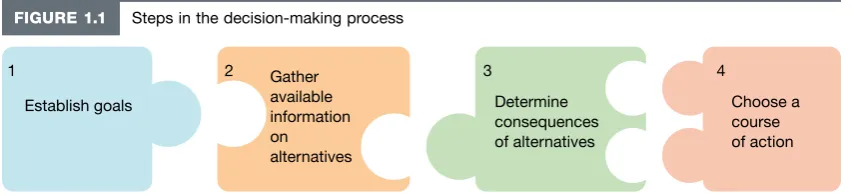
In simple terms, a decision is the making of a choice between two or more alternatives. Every time a problem arises and we need to make a decision, we consciously or unconsciously follow four main steps, which can be framed as questions.
1. What are we trying to achieve? We must identify each situation in which a decision is needed and determine the goals we wish to achieve. The decision we make will be influenced by our values, motives and desires.
2. What information do we need? Information can help change our attitudes, beliefs or expectations. Information relevant to each decision helps us determine the alternatives available from which to choose given the time, resources and degree of effort that we are prepared to commit to making a choice.
CHAPTER 1 Decision making and the role of accounting 5
uncertainty, which means that there is an element of risk in achieving a desired outcome. For example, even a decision to take out car insurance involves a degree of risk as we balance the likelihood of causing a car accident with the cost of the insurance premium.
4. Which course of action will we choose? Finally, after consideration of the alternatives available and the consequences of those alternatives, we must choose a course of action which we hope will achieve the goals that we established in the first place.
[image:20.612.95.521.189.287.2]The steps in the decision‐making process are illustrated in figure 1.1.
FIGURE 1.1 Steps in the decision‐making process
Establish goals
1 Gather
available information on alternatives 2
Determine consequences of alternatives 3
Choose a course of action 4
Once we have made a choice, we eventually find a set of actual outcomes or consequences. We may be satisfied or dissatisfied with these outcomes. If we are dissatisfied, we may need to make further decisions to achieve our ultimate goals. Hence, the outcomes or consequences of decisions commonly lead to further decisions, which in turn have further outcomes, and so on.
LEARNING CHECK
■ The decision‐making process involves four main steps: (1) establishing goals, (2) gathering information on alternatives, (3) determining the consequences of alternatives, and (4) choosing a course of action.
1.3 Economic decisions
LEARNING OBJECTIVE 1.3 Outline the range of economic decisions made in the marketplace.
Many (if not most) of the decisions that we make involve the use of economic resources. These are resources that are traded in the marketplace at a price because they are in limited or scarce supply. Some decisions are made for consumption purposes, such as what to eat for lunch and which brand of petrol to buy for the car. Other decisions are made for investment purposes. These decisions usually require major uses of resources, such as the decision to buy a car or a house. In business, some decisions require the investment or commitment of many millions of dollars for the purchase of large items of machinery. Still other decisions are of a financial nature, for example if a business wants to make an investment decision to purchase new machinery, a decision must be made to find a source of finance.
However, even though the economic aspects of decisions are very important, other factors must also be considered, and may be more important than economic factors in a particular circumstances:
• personal taste — our decision to buy a certain brand of clothing may be determined on the basis of preferred appearance or fabrics rather than price
• social factors — such as the impact on unemployment in the local community if a business decides to withdraw from that community
• environmental factors — such as the potential for carbon emissions or water pollution
• religious and/or moral factors — our decision not to purchase particular types of meat may depend on religious beliefs
6 Accounting
Economic decisions usually involve a flow of money. We may purchase goods for immediate cash payment, on EFTPOS, payWave or on credit, in which case the flow of money occurs at a later date than the flow of goods. The use of credit card facilities allows businesses to sell merchandise or provide ser-vices to us and to collect money from our bank, which then charges the cost to our account. Purchase of goods and services through the use of EFTPOS or payWave facilities, or through the Internet also allows a business to charge the cost to our bank account, which means that the flow of money may occur at a different time from the flow of goods and services.
Individuals and business entities make economic decisions in many different marketplaces. The mar-ketplace with which we are all familiar is the retail market, where we make decisions as we buy gro-ceries, mobile devices, cars, home furnishings and electrical goods. Then there is the wholesale market, where retailers decide to buy their supplies of goods in large quantities from various manufacturers for sale in their different retail outlets. Another popular market is the stock market, where individuals and business entities buy and sell shares, debentures and options. Even the flea market is a place where people make decisions to buy and sell merchandise, some of which they have handcrafted, others of which are second‐hand. Services are also traded in a marketplace.
BUSINESS INSIGHT
Professional accountants needed in South-East Asia
With the year coming to a close, many countries in the South-East Asian region are busy preparing for the formal establishment of the ASEAN Economic Community (AEC).
From where I stand, the AEC offers opportunities, not just challenges, for Indonesian businesses, especially professional accountants, who will join a bigger market not limited by borders. The busi-nesses that will reap the benefits are those that meet competition head on, by lifting their skills and knowledge.
For accountants, seeking professional certification would not only support them to do their job well but, more importantly, give them credibility and a competitive edge in AEC markets.
The government of Indonesia is on the right track in addressing the low number of professional accountants. In 2014, the government initiated a strategy to create an additional 100,000 professional accountants over the next few years.
In addition to increasing the number of accountants, the Government blueprint also aims to strengthen accounting regulation, improve the quality of accountants through certification and increase cooperation between the professional accounting association, the regulator and professional accountants.
Throughout history, accounting has always been at the core of every successful business, which makes accounting one of the oldest professions in the world.
In 1954, the Accountant Law (UU Akuntan) was ratified in Indonesia, following the country’s indepen-dence to secure the national treasury. To satisfy government demand for accountants, the country established the National College of Accounting (STAN) in 1964. Demand for professional accountants then increased in the private sector as Indonesia’s economic focus moved to crude oil. However, even with the increase, the number of professional accountants is still low.
Data from the Finance Ministry’s Accountants and Appraisers Supervisory Center (PPAJP) in 2014 reveals that Indonesia is still in need of more professional accountants.
In 2014, the Ministry had recorded less than 16,000 professional accountants. Meanwhile, there are more than 226,000 companies in Indonesia that require accounting services. From this, one can see that many opportunities still exist for Indonesian accountants domestically let alone regionally.
To tap into the opportunities provided by the AEC, let alone the untapped domestic demand, quality education is a key factor in determining whether an accountant is able to compete with their ASEAN counterparts.
With the framework already well positioned by Indonesia’s Finance Ministry, professional Indonesian accountants have a bright future with a large pool of untapped domestic market potential, and with even bigger regional opportunities ahead.
CHAPTER 1 Decision making and the role of accounting 7
Economic decisions may be made not only in the local marketplace but also in markets in different cities, states or countries. Many organisations have been prepared to establish places of business not only in their home country but also in overseas countries.
Hence, whenever an economic decision is to be made, there are many aspects and alternatives to consider, and this makes the decision‐making process a fascinating study in itself. How do people in business organisations make decisions? What role does accounting play in the decision‐making process? If decision makers are able to gain a certain level of accounting knowledge and understand the con-cepts and standards on which accounting information and reports are based, this will help them make more informed economic decisions, regardless of whether they are engineers, marketers, human resource managers, or any other business decision makers. In the scene setter at the start of the chapter, Corinne Proske, as an accountant, has been confronted with making many decisions about investing for measur-able and beneficial social or environmental impact as well as financial return.
LEARNING CHECK
■ Economic decisions are made for consumption purposes, investment purposes and/or financial purposes.
■ Various factors must be considered when making economic decisions such as: financial aspects, personal taste, social factors, environmental factors, religious and/or moral factors, and government policy.
■ Individuals and business entities make economic decisions in many different marketplaces, including the retail market, the wholesale market and the stock market, locally, nationally and overseas.
1.4 The nature of accounting
LEARNING OBJECTIVE 1.4 Explain the nature of accounting and its main functions.
Accounting is a service activity. Its function is to provide and interpret financial information that is intended to be useful in making economic decisions. Business entities, government departments, chari-table organisations and not‐for‐profit organisations, family units and individuals all engage in economic activity which involves making decisions about allocating available resources effectively. People need relevant information to be able to make sound economic decisions.
In a complex society, decision makers have to rely on data supplied by specialists in various fields. For example, lawyers provide information about the ramifications of existing and changing legislation, and medical practitioners offer advice about the possible effects of different healthcare decisions. Accounting as a profession has evolved in response to society’s need for economic information to help people make economic decisions. The accountant’s main role is to be involved in steps 2 and 3 of the decision‐making process illustrated in figure 1.1, to offer advice regarding step 4, and to measure the outcomes or con-sequences of the decision‐making process. However, as you will see once you have studied accounting more closely, much of the information needed to make an economic decision never makes its way into the accounting records, but exists outside of those records.
8 Accounting
The importance of understanding accounting information is not restricted to those engaged directly in business. Many people with little knowledge of accounting must interpret accounting data. For example, lawyers must often understand the meaning of accounting information if they are to represent their clients effectively, marketing consultants must be aware of the costs of developing advertising cam-paigns, and engineers and architects must consider cost data when designing new equipment and build-ings. Thus, accounting plays a significant role in society and, in a broad sense, everyone is affected by accounting information.
Although accounting techniques are used in all types of economic units, in this text we concentrate mainly on accounting for business entities. Business owners and managers need information provided by the accounting system to plan, control and make decisions about their business activities. In addition, shareholders, creditors, government departments and not‐for‐profit organisations (such as clubs and societies) need financial information to help make investing, lending, regulatory and tax‐related decisions.
Accounting defined
Accounting has been defined as the process of identifying, measuring, recording and communicating economic information to permit informed judgements and economic decisions by users of the information.
Identification involves observing economic events and determining which of those events rep-resent economic activities relevant to a particular business. Selling goods to a customer, paying wages to employees and providing services to a client are examples of economic activities. Economic events of an entity are referred to by accountants as transactions, and are of two types, external and internal. Accountants use the single term transaction to refer to both internal and external transactions. Transactions constitute the inputs of the accounting information system.
External transactions (often called exchange transactions) are those that involve economic events between one entity and another entity. When an entity purchases goods from a supplier, borrows money from a bank, or sells goods and services to customers, it participates in external or exchange trans-actions. Internal transactions are those economic events that take place entirely within one entity. For example, when a car component is transferred from the stores department to the assembly line in a car manufacturing business, the transfer must be accounted for, even if it is by simply transferring the cost of the component from the records of one department to those of the other. Similarly, the depreciation of machinery used in the production of goods must be accounted for, and since it does not concern an outside party, it is an internal transaction. Internal transactions may even involve such things as the growth of grapevines held by the entity or the market value of trading securities, because, under cer-tain accounting standards, the increased value of these items must be recognised in the accounts of the organisation.
Measurement must take place before the effects of transactions can be recorded. If accounting infor-mation is to be useful, it must be expressed in terms of a common denominator so that the effects of transactions can be combined. We cannot add apples to oranges unless we express them in terms of a common measuring unit. In our economy, business activity is measured by prices expressed in terms of money. Money serves as both a medium of exchange and as a measure of value, allowing us to compare the value or worth of diverse objects and to add and subtract the economic effects of various trans-actions. Accounting transactions are therefore measured and recorded in terms of some monetary unit, such as the dollar.
Recording provides a history of the economic activities of a particular entity. Recording is the pro-cess of systematically maintaining a file of all transactions which have affected the business entity after they have been identified and measured. Simply measuring and recording transactions, however, would provide information of limited use. The recorded data must be classified and summarised to be useful in making decisions.
CHAPTER 1 Decision making and the role of accounting 9
• Summarisation of financial data is presented in reports and financial statements, which are provided for use by both management and external users of accounting information. These reports usually summarise the effects of all transactions occurring during some time period such as a month, a quarter or a year.
Communication is the final part of the accounting process. Identifying, measuring and recording economic activities are pointless unless the information contained in accounting records can be com-municated in some meaningful form to the potential users of the information. Communication can be described as the process of preparing and distributing accounting reports to potential users of accounting information. Once the users of accounting reports have access to appropriate reports, they are able, after analysing and interpreting the reports, often with the assistance of professional advice, to make informed economic decisions. The most common forms of accounting reports are the financial statements, which are introduced in the chapter that looks at financial statements for decision making.
[image:24.612.95.519.277.350.2]The accounting process briefly overviewed above can be summarised diagrammatically as shown in figure 1.2.
FIGURE 1.2 The accounting process
Identification
Transactions
Measurement
Quantification in money terms
Recording
Recording; classification; summarisation
Communication
Accounting reports
Analysis and interpretation
Many people with little knowledge of accounting tend to view it as being limited to the recording process and do not distinguish clearly between the recording and communicating of accounting data. The recording or record‐keeping process involves measuring and recording business transactions and may take place in one of several forms: handwritten records, mechanical or electronic devices, or simply magnetic tapes or disks in a computerised system.
The communication process is a much broader function of accounting. It consists of placing accounting data that have been classified and summarised into financial statements, as well as preparing interpretive disclosures necessary to make the data understandable. The process requires extensive training, business experience and professional judgement.
Computers have had a significant impact on the recording phase of the accounting process. The pro-cesses of recording, classification and summarisation can be done electronically, and hence the recording process is much more automated. However, the output from a computerised system is only as good as the data input. Full coverage of the manual system is given in this text to help students understand the processes performed by computerised accounting systems.
The communication process involves many potential users, and accountants who prepare reports must have a full appreciation of who the users of the reports are and their needs for accounting information in order to help them make economic decisions effectively. In this way, the accountant adds significant value to the running of the organisation.
LEARNING CHECK
■ Accounting is defined as the process of identifying, measuring, recording and communicating economic information so that people can make informed judgements and decisions about scarce resources.
10 Accounting
1.5 Users of accounting information
LEARNING OBJECTIVE 1.5 Identify the potential users of accounting information.
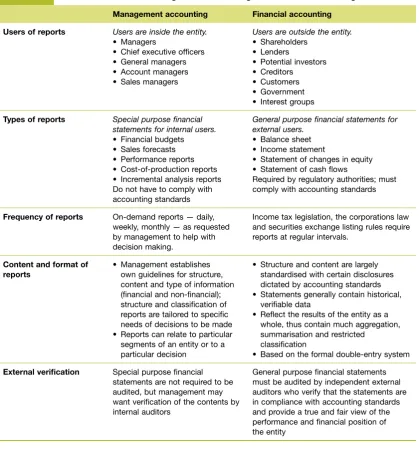
Although accountants are involved mainly in the analysis and interpretation of financial data when they serve as advisers to users of accounting information, the first objective of accounting is to provide infor-mation in reports which can be used by internal and external decision makers.
Managers (internal decision makers) must have financial data for planning and controlling the oper-ations of the business entity and hence need answers to such questions as follows.
• How much profit is being earned? • What products should be produced? • What resources are available?
• What is the most efficient production process?
• How much does it cost to reduce carbon emissions from the production process? • What will be the effect of increasing or decreasing selling prices?
• How much is owing to outsiders?
• Will cash be available to pay debts as they fall due?
• What are the benefits of purchasing an asset as opposed to leasing it?
Providing data to help answer these and many other questions generally called management
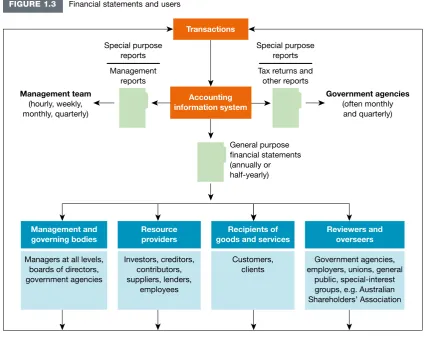
accounting. The data are presented to management in the form of special purpose financial statements. These are prepared for users who have specialised needs and who possess the authority to obtain infor-mation to meet those needs. Apart from internal management (which includes marketing, production, finance, human resources, research and development, information systems and general managers), some external users such as banks and government agencies (e.g. Australian Taxation Office) also have the authority to command the type and nature of the information they require and may demand special pur-pose reports.
External decision makers such as resource providers (creditors and investors), recipients of goods and services (customers) and reviewers and overseers of business entities (employers, unions, government agencies) need accounting information for making decisions concerning granting credit, investing, pur-chasing goods and services, and complying with tax laws and other regulatory requirements. Questions raised by external users include the following.
• Should I invest money in this business? • Am I likely to be paid my wages?
• Will the business be able to repay money lent to it? • What are the company’s earnings prospects? • Is the business financially sound?
• Is the business providing products that are socially and environmentally friendly?
Reports prepared for external users include financial statements which generally consist of an income statement (also called a statement of comprehensive income), a balance sheet (also called a statement of financial position), a statement of changes in equity and a statement of cash flows. These are often called general purpose financial statements because they provide general information for use by all external users.
CHAPTER 1 Decision making and the role of accounting 11
FIGURE 1.3 Financial statements and users
Management team
(hourly, weekly, monthly, quarterly)
Government agencies
(often monthly and quarterly)
Management and governing bodies
Managers at all levels, boards of directors, government agencies
Transactions
Accounting information system
Resource providers
Investors, creditors, contributors, suppliers, lenders,
employees
Recipients of goods and services
Customers, clients
Reviewers and overseers
Government agencies, employers, unions, general
public, special-interest groups, e.g. Australian Shareholders’ Association Special purpose
reports Management
reports
Special purpose reports Tax returns and
other reports
General purpose financial statements (annually or half-yearly)
LEARNING CHECK
■ Internal decision makers — managers — require special purpose financial statements to help in planning and controlling the operations of an entity.
■ External decision makers — creditors, investors, customers, employees, unions, government agencies — receive general purpose financial statements to obtain information about an entity. These are designed to meet the information needs of a wide range of users who are unable to command the preparation of statements tailored specifically for their needs.
1.6 Using information in economic decisions
LEARNING OBJECTIVE 1.6 Apply information to make basic economic decisions.
Economic decisions are made in business every day. To illustrate, consider the following business scenario.
12 Accounting
First she will need to invest in some equipment. The required items are listed below with their esti-mated costs.
Second‐hand van $32 000
Massage tables 2 500
Manicure tables and chairs 1 950 Booking information system 2 600
Facial skin machine 2 150
Manicure and pedicure machines 1 600
Waxing pots 1 700
Uniforms 2 000
Towels 2 400
Robes 1 800
Cash register 1 850
52 550
Therefore, Cynthia needs approximately $53 000 in cash to establish the business.
She is unsure about the running costs of the business, but expects the cost of power, beauty products and laundry to be about $320 per week. She is hoping to be able to provide services to about ten clients per day, and to work for 6 days each week. She wants to work only 48 weeks of the year and have 4 weeks holiday. Furthermore, she intends to pay $150 per week to her boyfriend, Fred, for keeping the records, doing the banking, and helping with some of the maintenance duties. (For the time being, we are ignoring employer superannuation payments, workers compensation and insurances, but in reality these would need to be taken into account.) Thus, running costs per week are estimated to be as follows.
Power, beauty products and repairs and maintenance $320
Part‐time employee (Fred) 150
470
Initially, Cynthia expects to have the following numbers of clients for the various services she intends to provide the following.
Waxing (under a regular program) 42 Facials, manicures and pedicures (under a regular program) 12
Spray tans (as requested) 24
Based on this client list, each day she plans to perform waxing services on seven clients, and facials, manicures and pedicures on two clients. She expects that the waxing will take, on average, 30 minutes per client; facials, manicures and pedicures will take 1 hour per client; and spray tans will take about 15 minutes per client. The cost of each of the services is as shown.
Waxing $40
Facials, manicures and pedicures 80
Spray tans 10
In each week, the approximate amount of cash received, ignoring spray tan activities which are requested on an irregular basis, is expected to be as follows.
CHAPTER 1 Decision making and the role of accounting 13
This means that her gross annual turnover for the year’s work of 48 weeks is equal to $2640 × 48 = $126 720, plus spray tan revenue. Because her annual turnover is greater than $50 000, her accountant tells her that she will have to get an Australian business number (ABN) from the Australian Taxation Office (ATO) and that she will be required to collect goods and services tax (GST) from each of her clients and forward the GST to the ATO at regular intervals. Also, the cost she will pay to her accountant for preparing the annual tax return and GST documents is $1632. On a weekly basis over 48 weeks, this adds $34 per week ($1632 ÷ 48) for accounting services to the $470 per week calculated previously, a total of $504 per week. (Detailed consideration of the GST is covered in other chapters. It is assumed in this chapter that the figures quoted include the GST where applicable.)
Therefore, the expected weekly cash flow, excluding spray tanning revenue, is $2640 less the weekly costs of $504, equalling $2136. Since Cynthia is so enthusiastic about owning her own beauty salon, after consultation with Fred she decides to proceed with the business. Thus, a decision is made after considering how much money she will need to contribute to set up the business (financing activity), the equipment she will need to buy (investing activity), the running costs of the business and the weekly cash inflow (operating activity).
Note that the decision is based on the steps illustrated in figure 1.1 — establishing goals (earning a living while working as a beauty therapist), collecting information about the proposed business, and considering the future consequences of conducting such a business. Of course, many of the factors considered in making such a decision are estimates of future events and, hence, there is a need to proceed with caution. Cynthia would be very wise to keep a careful eye on how well these cash flow estimates approximate reality.
Particularly important are the financial results. Will the actual weekly performance of Cynthia’s busi-ness live up to the estimated performance? How much impact does the spray tanning service have on the actual results? Is the waxing service more profitable than the facial, manicure and pedicure, or spray tan services? When does Cynthia plan to replace the assets she bought at the start? How will she account for the fact that these assets gradually wear out over time through use? And how much income tax and GST will she have to pay? Cynthia may not have considered many of these aspects in making her decision, and much of this information can be provided by an accountant.
In the next four chapters, we shall consid