Transition support for
students with Special
Needs
Transitions from Primary to Secondary for students with Special Needs
Context
Australian Bureau of Statistics 2009 data indicated that 35% of students with identified disabilities fail to complete Year 12, and many were overly represented in suspension and exclusions from schools (Victorian Equal Opportunity and Human Rights Commission, 2012). These figures did not include those students without an identified disability but who had been recognised as having learning difficulties or high levels of anxiety in their Primary school contexts, therefore it could be assumed that figures for this entire cohort of students would be considerably higher.
Evidence suggests that student disengagement from learning is most likely to occur in the middle years (Ministerial Council on Education, Employment, Training and Youth Affairs, 2008). For students with special learning requirements this middle phase of their
development and learning is a particularly difficult one and there have been calls for further research regarding this challenging time (Australian Institute of Health and Welfare, 2006). Such data suggests the importance of a successful transition from primary to secondary contexts so students have a positive start to these middle years of schooling.
In 2015, Queensland aligned itself with other Australian states so that Primary schools conclude with Year 6 and Secondary schools commence at Year 7. This meant that in 2015 a double cohort of students with special learning needs were making the transition into
secondary school contexts at the same time as their peers. The data on which this research is based was collected in 2014 within two secondary schools and two feeder primary schools. Past experiences were discussed, as well as the current strategies being employed to support the double cohort transition. Participants were mainly teachers and Heads of Special
Education Programs (SEP) and their staff. However, students, parents and teacher aides were involved in the discussions within the primary contexts.
For this research the question posed was “What are the key principles that underpin inclusive school practices that support students with special needs as they transition from primary into secondary school contexts?” In order to answer the question it is important to clarify the
parameters of what is meant by inclusive school practices.
Inclusive School Practices
In recent years there has been much debate about just what it means to be an ‘inclusive school’. UNESCO’s definition states:
Shaddock, Giorcelli and Smith describe inclusive practice as “any and all efforts made by a school and its community to make students and their parents feel welcome” (2007, p. 4). Queensland’s Inclusive Education Statement (2005) is a particularly insightful one and raises issues and approaches to education that require an immediate and ongoing response from school communities. The statement talked about:
fostering “a learning community that questions disadvantage and challenges social injustice”
maximising “the educational and social outcomes of all students through the identification and reduction of barriers to learning, especially for those who are vulnerable to marginalisation and exclusion”
ensuring “all students understand and value diversity so that they have the knowledge and skills for positive participation in a just, equitable and democratic global society” The current statement talks about responding constructively to the needs of all students; viewing difference as a resource; ensuring all school members feel safe and free from discrimination; and, promoting locally negotiated responses to student, family and community needs (Queensland Government, 2015).
Rouse and Florian (2012, p. 7) “consider how it might be possible for teachers to develop new ways of believing that all children can learn, that they have the knowledge and skill to make a difference to children’s lives and that such work is their responsibility”. However, a goal such as this is not easily achievable by teachers operating alone within the four walls of their classroom. Although teachers are certainly a key to improving all student outcomes, if the word ‘teachers’ is changed to that of ‘school communities’ then it more accurately captures the fundamental changes to the way schools must support and work with their students, staff, parents and communities to ensure that inclusive school practices become embedded and sustainable school-wide. Thus inclusive schools are characterised by the processes which support students, staff, families and community on a daily basis and which can be expanded on to increase support at significant moments within a student’s learning journey.
There are a number of key factors in these statements that need highlighting. Inclusive school practice:
1. is a process;
2. aligns to a common vision;
3. promotes locally negotiated responses; 4. involves changes and modifications;
5. increases participation and maximises outcomes eliminating exclusion within and from education;
6. lies at the heart of a learning community that questions and challenges current practice;
7. ensures that all students understand and value diversity; 8. values difference as a resource;
10.means supporting and working with students, staff, parents and communities. Working together these factors indicate the types of school-wide strategies and ways of working that have enabled students to transition successfully from the primary to the
secondary context within a number of the case study schools. These factors work in synergy with one another and support the establishment of an inclusive school culture capable of supporting all students, families and staff, and in particular those students with special learning needs.
The research approach
[image:4.595.80.303.310.540.2]A case study approach was adopted to answer the research question. Data analysis and interpretation was based upon identifying themes and then grouping these according to the ten inclusive factors outlined previously and by consideration of how these show evidence of basic norms and assumptions indicative of school culture as aligned to Schein’s Model of Organisational Culture (Figure 1).
Figure 1: A Model of Organisational Culture indicators (Schein, 2001)
The participants
Permission was gained from Education Queensland and the school principals, and university Ethics Approval received. Principals indicated that staff could volunteer to be involved and in the Primary Schools they also suggested a number of parents and students who would be interested in this research because of its relevancy for them. Students took part in a focus group discussion at both primary schools. Generally staff and parents engaged in individual conversations with the researcher and, in addition at one of the secondary schools, a teacher focus group was conducted. Conversations were digitally recorded and then transcribed. Data from Secondary School 2 was limited due to a limited number of volunteers.
Both Primary schools had been identified by regional office staff as having quality outcomes and inclusive environments. The two secondary schools were selected due to the number of primary students that would be transitioning to these schools in 2015. Both Primary Schools had similar numbers of students. Primary School 1 (PS 1) had above average levels of
students with special needs (12% of total enrolment). Primary School 2 (PS 2) had an average sized special needs program (9%) but around 50% of students came from backgrounds where English was an additional language or dialect with over 27 languages being spoken in the home.
Secondary School 1 (SS 1) had a reputation in the region as a strongly supportive school environment where students with diverse learning needs, and from diverse cultural and family backgrounds, were enabled to succeed. Total enrolments were around 1350 students with approx. 11% of students being diagnosed with special learning needs and students came from over 40 diverse cultural backgrounds. Students from Primary School 2 often made the transition to this school.
Secondary School 2 (SS 2) received large numbers of students from Primary School 1. In 2014, the HOSE and the Principal were reconceptualising school support strategies for students with diverse learning needs as well as engaging closely with local schools in
preparation for the 2015 transition. Total enrolments were approximately 1500 students with around 10% of students being diagnosed with special learning needs. Cultural diversity was expanding.
The findings
Excerpts of interview data illustrating findings are woven throughout this report. Schools have been numbered and participants identified by a coding system:
Participant Codes
T1 – Teacher 1
SEdT1 – Special Education Teacher 1
TA1 – Teacher Aide 1
P1 – Parent 1
S1 – Student
Principal - Principal
HOSE - Head of the Special Education Program
The data indicated a number of strategies (Appendix 1) that appeared to be effective when supporting students and staff in the transition process. A number of these inclusive support strategies are a part of daily practice in one or more schools. Others are specific to a
particular school or specific to the transition year only. All have potential to support the transition process for students with a wide range of special needs including those who do not have a formal diagnosis. All are indicative of a number of the broader themes that emerged.
Themes collated from initial data interpretations
It was obvious as the data was filtered down to strategies, themes and principles that it was difficult to disconnect general cultural school practices from specific transition based practices. Underpinning cultural assumptions and beliefs impact the choices made within each organisation. These choices influenced how each school engaged with their partner schools, students and parents in the transition process.
Both primary schools had surprisingly similar ways of working and there were definite synergies in initial themes. Therefore in the case of the two primary schools, themes have been collated as being applicable to both schools. Extracts from the data that illustrate a theme are taken from either one or perhaps both schools.
Not all points within themes have been illustrated with examples but the data clearly supports the theme with small snippets of conversation and synthesised interpretations. The schools in which a theme is strong are indicated in brackets, as are the theme correlations to the 10 key inclusive factors outlined previously.
Case Study Primary Schools (PS1 & PS2)
Key Theme 1:School organisation and structures are strongly student centredand inclusive (Factors 1, 2, 3 & 5)
The strategic foundationswithin the school are linked to the school’s vision, and values.(PS1 & 2)
Everybody works together to ensure every student has their needs met (PS1 & 2).
fighting to be included because of where they came from and things like that…Where now, they seem to just come and everyone’s happy. We make things work!” (T1 PS2)
Key Theme 2: Explicit teaching of social skills and the valuing of diversity (Factors 7, 8 & 9).
Tolerance, acceptance, empathy, active listening and clear high expectations are explicitly taught as are school values. (PS1 & 2)
I usually get parents in, because parents then feel like they’re part of the classroom as well…Wetalk about everyone’s religion because religion is such a big thing in the cultures at the school… Then I find after that the kids value.
(T2 PS2)
Difference is celebrated. (PS1&2)
I think the kids come now and they’re taught… that everyone’s the same, everyone has the right to speak, everyone has the right to say what they need to say and no-one is different.” (T3 PS2)
I think the greatest strength of this school is the fact that we have so many children from diverse nationalities, cultures and these children do fit in.
(TA1 PS2)
Key Theme 3: Clear communication, shared language and shared expectations (Factors 1, 2, 6 & 8).
Clear communication strategies. (PS1 & 2)
We communicate really clearly here. The expectations in my class are the same as everywhere else with just a little flexibility – some days more than others but they still have to adhere to the school values it comes under that umbrella, our vision. (T2 PS1)
Well defined understandings of specific students by teachers and peers. (PS1&2) You need to understand that sometimes certain behaviours are driven by things beyond their control. (T2 PS1)
Once their stories are told, then the respect comes in, then if anyone goes outside we can say “remember we have to respect them because they don’t like that. (T1 PS2)
Well defined behaviour management procedures. (PS1&2)
We are all on the same page as far as behaviour expectations go. (T2 PS1) A lot of the kids who come understand rules and they like rules and they like to know what they have to do. Because we’ve got [behaviour walls and sets of rules]…it’s seen and it’s shown and everyone says the same thing, the kids understand that it’s the same thing throughout the school. (T1 PS2)
Key Theme 4: It’s all about positive relationships between staff, students, parents and community (Factors 3, 7, & 10).
Lots of meetings…You’ve just got to persist…Let’s try to get specialist appointments, let’s do this testing, the evidence is saying this. (T2 PS1)
Initiating positive communications with parents from early in the year onwards.
We keep in contact from the beginning – just say hi – how’s it going? - therefore when harder conversations may be required we already have a relationship with the parent. (T4 PS1)
Strong supportive parent committee seeks to strengthen relationships with teachers and back up initiatives.
They’re valuing diversity, they’re valuing difference and they’re enjoying and valuing the Visions program that we do on a Monday and they feel like it is very important for their children so that gives us the basis to keep going with this. (T1 PS1)
Key Theme 5: Strong sense of safety, family and ‘wrap around’ support for all students (and not just verified students). (Factor 9, 10).
Creating spaces and places where staff, students and parents feel safe and accepted is important in an inclusive culture -
I think that it is the safety that the children feel – and the fact that parents are really partners in their child’s education. (HOSE PS1)
I’ve seen a lot of young kids come with a lot of anger and a lot of hate towards different people…different races and colours. It takes probably around six weeks for that to go away and realise they’re in a safe place, there is no danger. (T1 PS2)
Key theme 6: Best fit choices - students, teachers, teacher aides, resources and environment (Factors 3, 4, & 6)
Timetables are developed as ‘best fit’ choices – student to class, teacher to class, aide to teacher, and aide to student – staff strengths and environmental aspects are also considered. (PS1&2)
All kids that come into the school, we want to do our best for them and we’re going to try and tailor programs (whether they’ve got a disability or not) to suit that child … even down to changing Human Resources and fiddling current structures and processes around. (HOSE PS1)
Key Theme 7: Transitions are a priority - communication between schools starts early
(1, 10)
Both primary schools worked closely with secondary schools facilitating class visits
We take the kids to Master classes at the high school and other activities we are invited to like musicals (T2 PS1)
Teachers actively taught and promoted independent responsibility for actions, possessions and organisation in preparation for secondary school
Key Theme 8: Teachers use information and data to make adjustments and engage learners (Factors 4, 5, 6 & 8)
Collated data is regularly used to level activities and to plan for support and differentiation to ensure all learners are able to engage
We pull all that data out and put it all on this big spreadsheet and then we colour code… work out where our kids are and then over on the side we start to plan our differentiation. (T5 PS1)
I’ve found that from the data one child shouldn’t be following the general programme for the year level, I will need to do a separate plan written for them. (T3 PS2)
Understandings of the fact that some students require different strategies to enable them to focus and learn
They let kids have what they need - some may need MP3 players in their ears to listen to while they are doing their work…some may need fiddle toys in their desk. Some may need a break time so they take a break card and they go and have five minutes and then they come back. (P1 PS1)
Key Theme 9: Differentiated learning is implemented to varying degrees of success
(Factors 5, 7 & 8)
Some teachers are more confident in relation to differentiation than others – a strange mix of differentiation and inclusion is applied to all students
Sometimes not gifted just better at it. Then our support teacher goes away and he writes enrichment programs for those children to help the teachers. (T6 PS1)
We look at every child individually…we have differentiation in place for many of our children – other kids are great helping new ones come on board too. (T2 PS2)
Mary (pseudonym) is my little selected mute I think of ways to non-verbally communicate with her and vice-versa and I also liaise with the speech language pathologist. (T4 PS2)
Key Theme 10: Professional learning and sharing between staff (Factors 4 & 6)
Much time and money is spent on building the capacity of all staff to meet the needs of students
[Our support teacher] has been doing lots of PD with our casual aides and that has made a big difference to our results…and teacher aides have really taken ownership of it. We call them para-professionals and they are fantastic.
(T 5 PS1)
We look at what needs the students have and where the challenges are for staff and then tailor professional development or intervention to support them.. (HOSE PS1)
Key Theme 11: Strong leadership structure and direction
I came from a school where there was not the support that you get here. The kids are tough sometimes – because of multiple needs - but the leadership team will do what they can for teachers and they really care about the kids.
(T4 PS2)
Has a clear vision and direction for the school (PS1&2)
Clearly articulates expectations consistently and regularly (PS1&2)
Is solutions focussed, and as a result this approach permeates down to all staff within the school (PS1&2)
Expects that that all staff will contribute and establish high expectations for students (PS1&2)
Key Theme 12: Empowered parallel leadership evident at all levels of the school
Parallel leadership with a strong teacher leadership team is very strong in Primary School 1 but less obvious in Primary School 2 though the student leadership team seems strong
The leadership team as a whole is aware of and fully support Principal direction and intent (PS1&2)
The leadership style of the Principal harmonises and complements that of the Head of the Special Education Program and echoed by those in supporting leadership roles (PS1&2)
We’re the Ying and Yang (HOSE PS1).
The leadership team works to build capacity in others - teachers and teacher aides and student leaders. Student leadership is promoted and the older students have a clear understanding of the role they play in setting an example for younger students (PS1 &2).
Case Study Secondary Schools
Although a number of similar themes emerged the secondary schools had generally different approaches to transition and appeared to have differing interpretations of the concept of inclusion. It is important to note that school principals were not interviewed in this research. This was intentional as the intent was to try and uncover the underpinning ‘norms and
assumptions’ indicative of school culture. Therefore, it was the reflection of school direction, ways of working and general expectations by staff that were deemed to be indicative of the ‘essence’ of each school rather than possibly unsubstantiated rhetoric from the leadership team.
Secondary School 1 (SS1)
General perceptions from the data were that this is a school staff committed to ensuring that every student is supported to succeed and that alternatives and multiple layers of support are provided for students who may be ‘at risk’. The emphasis on prioritising both transition planning and junior school staffing set the groundwork for inclusive school practices.
The Head of the Special Education Program clearly articulates and describes a culture that is strongly student focused, with school structures, organisation and staffing polices aimed at achieving the best outcomes for all students.
By pairing teachers in teaching teams, who teach core subjects to “their assigned class” in an assigned home room, the school appears to be fostering an emphasis on consistency, safety and security for young people when they first enter high school.
Classes are mixed with a range of students assigned to class groups.
Individual difference in students (and staff) appears to be accepted and tolerated.
Remediation and peer support are in place for students at risk to
…head off issues at the pass (Teacher 1).
Newly appointed staff appear to be inducted into the culture.
“Cultural messages” are communicated through newsletters, student forums and faculties meetings.
The principal has her catch cry – everyone knows what it is and what is expected. (T3 SS1)
Key Theme 2: Explicit teaching of social skills and the valuing of diversity (Factors 7, 8
& 9)
Explicit expectations about behaviour and school values is reinforced from day one
We just have an expectation of being a family and a team. Because we are team teachers, and we present as a team to the kids when they first meet us…we’re a team and we won’t accept anything else. So when you come into this room you are going to be safe and you are going to be respected. (T5)
All classes have times when social skills and the valuing of difference is specifically taught. There is general commitment to this within staff.
Key Theme 3: Clear communication, shared language and shared expectations (Factors 1, 2, 4, 6 & 8)
There appeared to be consistency in language across HOSES and teachers in how practices, expectations and school culture are described.
There also appeared to be a shared understanding of language, process and procedures across staff members.
There is minimum rhetoric and lots of description about actual practice rather than use of systemic terms describing processes and rituals.
An inclusive culture has been built over a long period of time and is actively enhanced with a constant focus on improvement in structures and processes.
In evidence, is the concept of flexibility and being able to work within a strongly aligned structure which still allows for the wrapping of students in support rather than trying to make students ‘fit’ into existing practice.
Processes of advanced planning, data collection and communication are well
another. This means that there are less ‘surprises’ to deal with so the few that do occur are easier to manage and action is based on information and not just instinct.
Key Theme 4: It’s all about positive relationships between staff, students, parents and community (Factors 3, 7 & 10).
Parents’ involvement is perceived as being an important part of the partnership in supporting studentsand parents are welcome at the school at any time
I rang the mother and she’s coming to see me…it’s bridging the gap sometimes (T2)
Multiple engagement points are offered from the traditional interviews, class and individual meetings and information nights to electronic and phone engagements
Positive and negative information is shared with parents with positive being shared first
There is an emphasis on building positive relationships between students and teachers
You can just see it. Our teaching pairs just work so hard with their group, warts and all. They have that real, ‘This is my class.’ And I think that goes a long way towards that because the kids actually have that belonging. (T4 SS1)
Key Theme 5: Strong sense of safety, family and ‘wrap around’ support for all students (and not just verified students). (Factors 9 & 10)
All staff appear to be both collectively and individually committed to being accountable for student success.
I just see that sense of belonging, that sense of ownership for the students in that first year.” (T2)
While not explicitly stated, there appeared to be collective commitment to every student – not just those in a particular class.
There is recognition that if a student “falls out” then there is nowhere else for that student to go - the school is vital in providing support to students.
Well we don’t let them, that’s the problem, there is nowhere else for them to go.” (HOSES)
Remediation and peer support are in place for students at risk
We try and head off issues at the pass (SEdT1)
Teacher respondents talk about a sense of family (teachers as well as students) as being a key platform to ensuring that students succeed.
Students arerespected and …… there is an instant expectation that we are all different and we are family, that’s the way we are going to roll. (Teacher 2)
Teachers appear to personally know and understand students.
HOSE and teachers constantly refer to students as “our kids” rather than using non personal descriptors such as “students” or “them”, thereby by further illustrating personal “ownership” of students and their success.
Many of our kids struggle with organisation and time management…We have comfy chairs in the foyer where our kids can come in if they are
lunch time…The year 8 camp is a very good camp… It really helps our kids get to know each other and us. (SEdP staff focus group)
Peer support programs, where older students mentor and support younger students, is a genuine means of intervention and student support.
Staff appear to be willing to ‘go the extra mile” for students and the school by volunteering for additional student supervisor and tutorial activities in and out of school hours.
Key Theme 6: Best fit choices - students, teachers, teacher aides, resources and environment (Factors 3, 4 & 6)
The school prioritises staffing, transition, and pastoral care of students commencing with year 7s through to the seniors, rather than the other way round of staffing and prioritising senior classes first and then staffing the junior school with remaining staff
Early intervention is provided in order to eliminate issues before they escalate
Teachers volunteer to teach Year 7 & 8 resulting in teachers who are more suited and committed to teaching in the junior year levels
Key Theme 7: Transitions are a priority - communication between schools starts early
(Factors 1 & 10)
Time and energy is put into ensuring that students successfully transition into the school’s culture. A platform for future success is established by creating a sense of student identity and belonging.
If students are happy and feeling safe, enjoying school …. The rest looks after itself.” (Teacher 4)
All junior school teachers attend beginning of the year camp in order to get to know their students.
Teacher aides remain with classes throughout their junior years (to Year 10) providing constancy and familiarity enabling a sharing of knowledge about students with
subsequent teachers.
Key Theme 8: Teachers use information and data to make adjustments and engage learners (Factors 4, 5, 6 & 8)
Data is used to understand and know students.
The HOSE spend considerable time collecting information on students from feeder schools. This involves identifying students, collecting student data and making the adjustments required.
Class teachers are provided with information and data on students in their classes.
ONE SCHOOL is used extensively to record and share information on students.
Student interests and personalities, and social and emotional needs appear to be as important as systemic student data (NAPLAN) and standardised tests.
standardised tests) in order to understand students and to differentiate and make necessary adjustments to promote learning success.
Data and information appears to be valued and used by teachers.
Of the 290 odd students we’ve got this year, we’d have information on probably 250 – 260 of them. And that all goes on to a data base so that the ONE SCHOOL stuff plus the data base prints out onto a little sheet. ….. There is a little summary of every student in a class before that start.” (T3).
Key Theme 9: Differentiated learning is implemented to varying degrees of success.
(Factors 5, 7 & 8)
There appears to be use of personal devices (IPADS) and software programs to support student learning.
Teachers use ONENOTE and ED STDUIO to share curriculum and teaching activities.
ONESCHOOOL is used to record and collate student information.
Verified students received more tailored intensive support in the mainstream.
Students will be grouped in a class so that a teacher aide can provide ongoing support – it seems to work (T3)
Making adjustments in the classroom involves knowing the student, varying the pathway (the teaching approach used) and building the student’s capacity.
The HOW TO SHEETS (relating to specific disabilities) assist teachers in understanding students and in making adjustments in the classroom.
Sharing practice and content on differentiation on ONENOTE and in professional development sessions appears to be greatly valued by teachers and something of which they want more.
The art of differentiation and the actual practices involved in differentiating learning within a large mixed class still appears to be a stumbling block for many teachers.
Making adjustments for some particular students is acknowledged as also benefiting others.
Students with special learning needs to reduced load from start – a tutorial class is scheduled where students can receive additional help and drops subject load from 6 to 5 by Senior – gives students breathing space.
Many teachers still find differentiation challenges but are prepared to learn from others
What you’re describing there in terms of differentiation is much further than what I do. I think a lot of staff do struggle with that big time. (T3)
Key Theme 10: Professional learning and sharing between teachers (Factors 4 & 6)
A preparedness by teachers to seek assistance and not accept that current practice was good enough.
Teacher are happy to share what works for them
I think a lot of the younger teachers have their hands on it more, through their training. We can really learn from them. (T3)
New teachers are supported and inducted into shared ways of working
Forward thinking by leadership teams ensures that professional development is offered to teachers and aides to ensure they are fully equipped to deal with diverse student needs
A lot of our PD over the last couple of years has been about differentiation. It’s been about looking at literacy levels and working out how you can be teaching reading in the classroom. Because we know that we’ve got kids coming in and although we’ve got a SOSE class, you’ve still got to teach reading because these kids can’t read. (T2)
Key Theme 11: Strong moral leadership structure and direction
Strong moral leadership from the principal who:
Has a clear vision and direction for the school which fosters the existing school culture“[The Principal] really believes in inclusion”. (Teacher aide 1)
Clearly articulates expectations consistently and regularly
[The Principal] has her little catchphrase…And that’s the expectation of the school. If you come to school you are going to be safe, you are going to be respected and you are going to learn. And that’s just the expectation from the top through. (Teacher 1)
Models expected behaviour
Reads all report cards and identifies students at risk and acts on the information
Is solutions focussed, and as a result this approach permeates down to all staff within the school.
Expects that that all staff will deliver on school expectations and school vision.
Key Theme 12: Empowered parallel leadership clearly evident at all levels of the school
Roles and responsibilities are clearly articulated and defined.
Staff including teacher aides are given responsibilities and provided with opportunities and space to carry out delegated roles and responsibilities.
Senior students are given significant responsibility in relation to mentoring and supporting all students within the school –
They’re just like another layer of the leadership team (Teacher 4)
Secondary School 2 (SS2)
Leadership within the school appeared hierarchical in nature with decision making not widely shared.
There appeared to be an absence of a shared and collective understanding about differentiation and inclusion.
There appeared to be an absence of a binding whole school vision and although expectations about inclusivity, tolerance of difference and differentiation were articulated there was no ‘shared language’ or understandings in evidence.
Some staff comments appeared rhetorical and aspirational rather than descriptions of actual practices and actions.
There appeared to be clear structures and roles for staff working with verified students but mainstream teachers were not clear about these.
There appeared to be some use of streaming of verified students and students at risk.
There was an acknowledgement that some students do fall through the system, and an acceptance that the school had no way of catering for such students and they were better off going elsewhere.
At times responses to issues tended to be more systemic and policy focused rather than student and solutions focussed.
All classes have within their timetable a time when social skills and the valuing of difference is specifically taught. Staff commitment to this time varied considerably.
Collective ownership and commitment to successful student outcomes seemed less assured. While there was some use of “our kids” when talking about students, a couple of respondents frequently used non personal descriptors such as “students” or
“them” when referring to students.
However, there were clear indicators that some processes to ensure students transitioned well from one school to another were well established and the following themes were identified.
Key Theme 4: It’s all about positive relationships between staff, students, parents and community (Factor 10)
Parent involvement is perceived as being an important part of supporting students.
Parent involvement is achieved through multiple formats.
Multiple engagement points are offered from the traditional interviews, meeting and information night to electronic and phone engagements.
Parents of verified students are encouraged to participate.
Parents are encouraged to make formal meetings times (rather than to drop in).
Key Theme 7: Transitions are a priority (Factors 3 & 5)
Information is collected from feeder schools to identify the numbers of students and the adjustments that each student requires.
Class teachers and support staff are provided with data on students in their classes at the beginning of the school year, however, some staff rarely referred to such
information stating that they
…allow them to startwith a clean slate (T2).
Incoming verified students have an opportunity to participate in transition sessions onsite at the school.
There appears to be a focus on standardised testing to gather and share information, with a lessor focus on providing information on student’s social and emotional needs.
ONESCHOOL is used by teachers to record and share information in the transition year.
There is a strong relationship with external providers which assists in developing programs for verified students.
Key Theme 9: Differentiated learning is implemented to varying degrees of success.
(Factors 4 & 5)
There appears to be some use of personal devices (IPADS) and software programs to support student learning.
ONESCHOOOL is used to record and collate student information.
Verified students received more tailored intensive support as funding is available for intervention programs.
Non verified students are at a high risk level for disengagement.
The art of differentiation and the actual practices involved in differentiating learning within a secondary class appears to be an issue for teachers.
I have researched what it means to differentiate but I don’t know how
widespread understandings are – our HOSE is working with staff on that (T3)
Remediation and intervention programs are in place for students at risk.
Peer support programs appear to be used as a student intervention option. However detail and specific examples were not clear.
Theme topics PS1 PS2 SS1 SS2 Key Factors
1. School organisation and structures are
strongly student centred and inclusive
1, 2, 3,
2. Explicit teaching of social skills and the
valuing of diversity
5, 7, 8
3. Clear communication, shared language and
shared expectations
2, 6
4. It’s all about positive relationships between
staff, students, parents and community
3, 10
5. Strong sense of safety, family and ‘wrap
around’ support for all students
9, 10
6. Best fit choices - students, teachers, teacher
aides, resources and environment
4, 6
7. Transitions are a priority - communication
between schools starts early.
1, 10
8. Teachers use information and data to make
adjustments and engage learners
6, 4, 5, 8
9. Differentiated learning is implemented to
varying degrees of success.
10. Professional learning and sharing between
staff
4, 6
11. Strong moral leadership structure and
direction
12. Empowered parallel leadership evident at all
[image:18.595.73.519.72.156.2]levels of the school
Table 1: Themes across schools and matched to key factors
A Model of Inclusive School factors
As can be seen from the combined themes from all four schools, many align with the 10 factors pertaining to an inclusive school environment. However, there are significant leadership themes in addition to the factors previously identified. These are the themes of
strong moral leadership structures and direction, and the interrelated theme of empowered parallel leadershipat multiple levels.
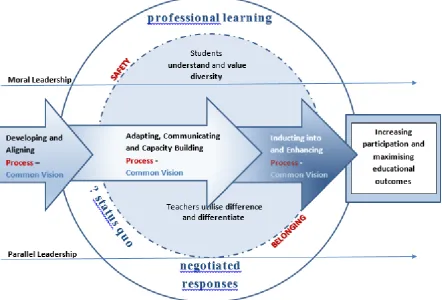
The inter-relationship of all factors are at the heart of the Model of Key Inclusive School Factors (Figure 2).
Figure 2. A Conceptual Model of Key Inclusive School Factors
With this model in mind the answer to the research question became clear:
[image:18.595.78.521.350.650.2]The principles are:
1. The principle of moral commitment to a vision of inclusion – the language of inclusion and support is heard from the top down; the message is reinforced by teachers, support staff and the leadership team as a whole; a message that never waivers and is never compromised.
2. The principle of parallel leadershipat multiple levels – Principal, teacher leaders,
teacher aides and student leaders are empowered to plan and act in the best interest of others with a focus on inclusion and support and leaders are prepared to challenge the status quo when needed.
3. The principle of professional student-centred learning – making time and space for professional conversations centred on student need; a willingness to adapt and be flexible with structures, timetables and human resources; commitment to providing and undertaking professional development.
4. The principle of information and communication – the need to ‘know’ students and their needs, aspirations and hooks into learning; frequent interactions between schools, and with students and families, for preferably a year in advance of the transition.
5. The principle of collective commitment to whatever it takes – a strong commitment to meeting the needs of all students through proactive planning; forward thinking;
dealing with possible obstacles well in advance; believing that all students have the right to an education in their parents’ school of choice; visits and conversations with medical staff; focus on how ‘we’ will make this work.
6. The principle of getting it right from the start – organisation and management focused on successful transition; teachers volunteer as ‘experts’ in middle year schooling; teachers supported to improve their knowledge and skills; teacher aides provide consistency; clearly articulated boundaries and a well-developed social skills and values program mean that older students are constant role models for others.
Conclusion
Where there is strong moral commitment to a vision of inclusion (Principle 1) and that commitment is articulated at every opportunity, then staff, students and community become united in the desire to support all students, no matter how complex their need, as they make the transition from primary into secondary contexts. Successful transitions, like successful inclusive school practices, rely on a number of capacity building processes to work together. The first of these is the sharing of responsibility for action by consciously developing parallel
leadershipat multiple levels (Principle 2). Leaders ensure there are shared understandings of
expectations and develop processes for collecting and disseminating information. Through clear lines of communication (Principle 3) enabling strengths and challenges to be planned for in advance. As information is collated and discussed with staff, families and perhaps medical advisors, complex student needs requiring additional resourcing, from physical and equipment needs through to additional professional student-centred learning (Principle 4),
can be planned for, thus effectively laying the groundwork for success. Finally, successful transitions requires all sections of the school community to have collective commitment to
(Principle 6) by developing strong relationships with feeder schools, parents, community and system staff and ensuring the ‘right fit’ between staff and students.
Point to note: It would be of major benefit to continue this research and interview parents and students of those students who made the transition into 2015.
References
Abawi, Lindy-Anne (2012) Introducing refractive phenomenology. International Journal of Multiple Research Approaches, 6 (2). pp. 141-149. ISSN 1834-0806
Archambault, I., Janosz, M. Fallu, JS. & Pagini, LS. (2009). Student engagement and its relationship with early high school dropout. Journal of Adolescence, 32(3)651-670. Department of Education and the Arts (2005). Inclusive Education Statement. DETA:
Brisbane
Queensland Government (2015). Inclusive Education Statement. Retrieved from
http://education.qld.gov.au/schools/inclusive/index.html
European Agency for Development in Special Needs Education (2011) Teacher Education for Inclusion Across Europe – Challenges and Opportunities. Odense, Denmark: European Agency for Development in Special Needs Education
Hale, C. (2013). Urban special education policy and the lived experience of stigma in a high school science classroom. Available from
http://link.springer.com/article/10.1007/s11422-013-9548-x/fulltext.html .
Leadership Research International (LRI) team (2010). Research-based framework for organisational alignment. University of Southern Queensland.
Masters, G. (2010). Teaching and learning school improvement framework.
http://research.acer.edu.au/monitoring_learning/16 Queensland Government (2015). Retrieved from
http://education.qld.gov.au/schools/inclusive/index.html
Rouse, M. & Florian, L. (2012). Inclusive Practice Project: Final Report. University of Aberdeen.
Schein, E. H. (1992). Organizational culture and leadership (2nd ed.). San Francisco, CA: Jossey-Bass.
Shulman, L. S. (2005). Signature pedagogies in the professions. Daedalus, 134(3)52-59. (doi: 10.1162/0011526054622015)
Shaddack, T., Giorcelli, L. & Smith, S. (2007). Students with Disabilities in Mainstream Classrooms: a resource for teachers.
Smyth, J. & Wrigley, T. (2013). Living on the edge: Rethinking poverty, class and schooling.
New York: Peter Lang.
UNESCO. (2009). Policy Guidelines on Inclusion in Education. Retrieved from
University of Southern Queensland | Document title 21 Appendix 1: Effective strategies to support transition processes
Prior to transition year
Staff/Teacher focus
Developing staff capacity the year prior to needing the skills to support student/s with a particular need and then refresher sessions as needed
Prioritising staffing in the Junior School and the transition year to ensure a positive start to secondary school through using staff committed to a middle years philosophy
Collaborating across the school to ensure planning is comprehensive and meets all parties needs e.g. special support staff, teachers, teacher aides and the leadership team
Providing multiple opportunities within the primary classroom for students to build metacognitive skills through mental processing tasks and ‘talk alouds’ so students learn how to express their learning and emotional needs
Parent/Community focus
Communicating with parents/caregivers/family up to a year in advance
Providing multiple and varied opportunities for parents to express their concerns and be ‘heard’ and reassured
Consulting with medical practitioners and support personnel up to a year in advance
Student focus
Developing peer relationships and support groups up to a year in advance
Orienting students to new campuses e.g. possibly an App; maps; and guided tours assisted by colour coded pathways
Providing multiple opportunities within the primary classroom for students to share their passions and hobbies in order to find ‘triggers’ and ‘hooks’ into learning
Promoting independent learning skills within the primary classroom through
supporting students to set their own learning goals and by planning how to attain these through small achievable steps
Whole school/System focus
Detailing school adjustments to process, environment and resources well in advance and the cost to school (actual and personnel) to fully inform planning
Liaising with District Support staff a year in advance indicating the probability of requiring extra resources or equipment
Communicating between schools up to a year in advance
University of Southern Queensland | Document title 22 Transition year support
Staff/Teacher focus
Communicating on a daily basis staff to staff, and staff to admin e.g. sticky notes; work booklets and communication booklets work well
Providing timely support for teachers through a walkie-talkie system or peer support system to ensure both staff and students feel safe and respected
Constant sharing of effective teaching practice through well-developed and prioritised professional learning communities
Teaching specific school values, social skills and the valuing of others with diverse abilities and ways of learning, communicating and living
Teachers/teacher aides sharing differentiation strategies related to both teaching and assessment to build teacher capacity according to context specific need
Providing multiple opportunities within the secondary classroom for students to build metacognitive skills through mental processing tasks and ‘talk alouds’ so students learn how to express their learning and emotional needs
Parent/Community focus
Constantly communicating with parents and allowing parents to ‘transition’ to a new way of supporting their child (for as long as it takes)
Providing multiple means of communication for parents with school and with student e.g. text, phone, meetings, drop ins, newsletters, websites
Welcoming parents through ‘Meet and Greets’ and through positive contact from teachers before the end of week 2
Visibly celebrating learning both within and external to the school context
Engaging the community in support activities and mentoring programs
Student focus
As needed, providing alternative arrangements for ‘at risk’ students in the first few weeks of school e.g. providing additional quiet time; a safe place for before school time and lunch hours; mentor support
Mentoring via student leadership team e.g. familiarisation with campus; support for English as an Additional Language or Dialect students; a debriefing mentor
Ongoing celebrations of student progress both academically and behaviourally
Providing time out cards and processes and spaces that support students needing time out
Providing multiple opportunities within the secondary classroom for students to share their passions and hobbies in order to find ‘triggers’ and ‘hooks’ into learning
Promoting independent learning skills within the secondary classroom through
University of Southern Queensland | Document title 23 Whole school/System focus
Ensuring a ‘no blame’ culture is established so students, families and staff can unrestrainedly ask for support and share problems
Grouping students requiring extra support so additional teacher aide time can be maximised
Maximising support of teacher aides and special education staff at lunch breaks etc by not having them timetabled as part of regular playground duty rosters or home group classes thus facilitating targeted and more flexible timetabling and support by trained personnel
Timetabling in opportunities for staff to meet and hold deep professional conversations