University of Southern Queensland
Faculty of Health, Engineering and Sciences
QUANTIFYING THE TIME AND COST
ASSOCIATED WITH THE REQUEST FOR
INFORMATION (RFI) OR TECHNICAL QUERY
(TQ) PROCESS - A DESIGNERS
PERSPECTIVE
A dissertation submitted by
Mr Peter John Sparksman
in fulfilment of the requirements of
Courses ENG4111 and 4112 Research Project
towards the degree of
Bachelor of Engineering Honours (Civil)
Abstract
Within the modern construction industry, shrinking budgets have forced consultants to significantly reduce costs to remain competitive. Inside the overall design and documentation structure, the Request of Information (RFI) process is identified as a critical but non-value adding activity. To reduce the impact of this process on the efficiency of the designer, this research project aims to accurately quantify the time and cost accrued by the designer.
To meet the defined research objective a detailed methodology was created to collect data from real world projects. This case study data includes the collection of the project factors, the designers costs and additional factors. This collected data was then manipulated and analysed to revel potential relationships between the project data and the cost to designers.
From this analysis it was identified that the construction value of a project had the strongest correlation with the number of RFI’s produced. This finding also confirms previous studies into this aspect of the process. More importantly to the research objectives, it was identified that the project factors with the strongest correlation to the average cost per RFI to designers, is the Construction Value, the Construction Duration and the Number of Construction Plans.
Following these conclusions, the factors identified were used to develop a method of estimating the number of RFIs on a project and the average cost per RFI to designers. By combining these methods, a means of estimating the total costs for responding to RFIs on a project, for within the limitations set for this research project, was developed.
These developed methods however do not reduce the number and cost of RFIs. To do this the root causes of RFI’s on the case study projects were investigated. This investigation revealed that the major cause of RFI’s within the data set includes the ‘Insufficient Information’ and ‘Other’ categories. To remedy these major causes several recommendations were made. These recommendations included; the better education of employees, the implementation of a definitive internal auditing process and the better definition of communication systems within the contract documents.
University of Southern Queensland
Faculty of Health, Engineering and Sciences
ENG4111/ENG4112 Research Project
Limitations of Use
The Council of the University of Southern Queensland, its Faculty of Health, Engineering & Sciences, and the staff of the University of Southern Queensland, do not accept any responsibility for the truth, accuracy or completeness of material contained within or associated with this dissertation. Persons using all or any part of this material do so at their own risk, and not at the risk of the Council of the University of Southern Queensland, its Faculty of Health, Engineering & Sciences or the staff of the University of Southern Queensland.
University of Southern Queensland
Faculty of Health, Engineering and Sciences
ENG4111/ENG4112 Research Project
Certification of Dissertation
I certify that the ideas, designs and experimental work, results, analyses and conclusions set out in this dissertation are entirely my own effort, except where otherwise indicated and acknowledged.
I further certify that the work is original and has not been previously submitted for assessment in any other course or institution, except where specifically stated.
Peter John Sparksman 0050106248
Acknowledgements
I would first and foremost like to thank my supervisor Mr Paul Tilley for his ongoing help and support. Without his ideas and inception of the project, none of the following report would have been possible.
I would also like to thank my employer, Kehoe Myers Consulting Engineers for providing access to the resources and data for my project and the other contributing design firms including, Brandon and Associates, RMA Engineers and the Harrison Infrastructure Group, for their additional data.
Table of Contents
Abstract ... i
Limitations of Use ... ii
Certification of Dissertation... iii
Acknowledgements ... iv
Table of Contents ... v
Table of Figures ... viii
List of Tables ... x
List of Appendices ... xi
CHAPTER 1 - Introduction ... 1
1.1 Background History ... 2
1.2 Research Objectives ... 2
1.3 Overview of Dissertation ... 4
CHAPTER 2 - Literature Review ... 5
2.1 Introduction ... 5
2.2 Construction Projects ... 6
2.2.1 Types of Construction Projects ... 7
2.2.2 Types of Procurement ... 10
2.2.3 Roles within the Construction Process ... 11
2.3 The Request for Information (RFI) Process ... 15
2.3.1 Types of RFI ... 16
2.3.2 The Principal ... 17
2.3.3 The Superintendent ... 17
2.3.4 The Design Engineer ... 17
2.3.5 The Contractor ... 18
2.4 The RFI Form ... 19
2.4.1 The RFI Register ... 22
2.4.2 Construction Discipline ... 22
2.5 Major Causes of RFIs ... 24
2.5.1 Design and Documentation Quality ... 24
2.5.2 Project Cost, Size and Duration ... 26
2.5.3 Project Organisation ... 28
2.6 RFI Efficiency ... 29
2.6.1 Abuse of the RFI system ... 29
2.6.2 Addressing Inefficiency and Abuse ... 30
2.6.3 Improving Design and Documentation Quality ... 31
2.7.1 Impacts on the Principal ... 34
2.7.2 Impacts on the Superintendent ... 35
2.7.3 Impacts on the Design Engineer ... 35
2.7.4 Impacts on the Contractor ... 36
CHAPTER 3 - Methodology ... 37
3.1 Overview ... 37
3.2 Case Study Projects ... 38
3.2.1 Design Firms ... 38
3.2.2 Project Location ... 38
3.2.3 Construction Type ... 40
3.2.4 Construction Value ... 40
3.2.5 Construction Year ... 40
3.2.6 Construction Duration ... 41
3.2.7 Number of Plans ... 41
3.2.8 Number of Projects ... 41
3.3 Design Engineers Data ... 42
3.3.1 RFI’s ... 42
3.3.2 RFI Topics ... 42
3.3.3 Response Time ... 43
3.3.4 RFI Causes ... 43
3.3.5 Project Factors ... 44
3.4 Costs Incurred by the Design Engineer... 45
3.5 Data Collection ... 46
3.6 Data Processing and Analysis ... 47
3.6.1 Statistical Analysis ... 49
3.6.2 Further Analysis ... 51
3.7 Project Planning ... 52
3.7.1 Ethical Issues ... 52
CHAPTER 4 - Results ... 53
4.1 Project Data ... 53
4.1.1 Project Location ... 54
4.1.2 Construction Type ... 54
4.1.3 Construction Value ... 55
4.1.4 Construction Year ... 56
4.1.5 Construction Duration ... 57
4.1.6 Number of Plans ... 59
4.2 Design Engineers Data ... 61
4.2.1 Number of RFI’s ... 61
4.2.3 Response Time ... 64
4.2.4 RFI Causes ... 67
4.2.5 Project Factors ... 68
4.3 The Design Engineers Costs ... 69
4.3.1 Hours Spent on Response ... 69
4.3.2 Average Time Spent on Response ... 71
4.3.3 Cost of Response ... 73
4.3.4 Average Cost of Response ... 74
4.3.5 Comparison of Time and Cost ... 76
CHAPTER 5 - Data Analysis ... 80
5.1 Average Number of RFIs ... 81
5.1.1 Average Number of RFIs by Contract Value ... 81
5.2 Average Cost per RFI ... 85
5.2.1 Average Cost per RFI by Project Location ... 85
5.2.2 Average Cost per RFI by Project Type ... 86
5.2.3 Average Cost per RFI by Construction Value ... 87
5.2.4 Average Cost per RFI by Construction Duration ... 88
5.2.5 Average Cost per RFI by Number of Plans ... 89
5.2.6 Average Cost per RFI by Number of RFI’s ... 91
5.2.7 Average Cost per RFI by RFI Topic ... 93
5.2.8 Average Cost per RFI by Response Time ... 94
5.2.9 Average Cost per RFI by RFI Cause ... 96
CHAPTER 6 - Discussion ... 98
6.1 Number of RFI’s ... 98
6.2 Average Cost per RFI ... 100
6.3 Causes of RFIs ... 107
CHAPTER 7 - Recommendations and Conclusions ... 109
7.1 Causes of RFI’s ... 109
7.1.1 Insufficient Information ... 109
7.1.2 Other Types ... 111
7.2 Limitations ... 113
7.3 Further Work ... 114
7.4 Conclusions ... 115
CHAPTER 8 - References ... 117
Table of Figures
Figure 1: Total Construction Work (2004-2009) (Australian Bureau of Statistics 2010) ... 6
Figure 2: Westridge Shopping Centre (Kehoe Myers 2015a) ... 7
Figure 3: Homestyle Bakery (Kehoe Myers 2015a) ... 8
Figure 4: St Vincents Hospital (Kehoe Myers 2015a) ... 8
Figure 5: New England Highway Stormwater Culvert (Kehoe Myers 2015a) ... 9
Figure 6: Kara View Estate (Kehoe Myers 2015a) ... 9
Figure 7: Construction Project Structure ... 11
Figure 8: Flowchart of general construction management (Hutchinson Builders 2013) ... 14
Figure 9: Overview of the RFI process (Aconex 2014) ... 16
Figure 10: Request for Information (RFI) Form (Hutchinson Builders 2013) ... 19
Figure 11: Request for Information (RFI) Register (Hutchinson Builders 2013) ... 22
Figure 12: Number of RFI’s Issued by Construction Value (Hughes et al. 2013) ... 26
Figure 13: Number of RFI’s Issued by Project Duration (Hughes et al. 2013) ... 26
Figure 14: Visual trend for Contract Value verses number of RFIs (Dinsmore 2013) ... 27
Figure 15: Map of Project Extents. (Wikimedia Commons 2009) ... 39
Figure 16: Typical Data Sheet for entry of project data. ... 48
Figure 17: Typical Comparision of Data Sets. ... 50
Figure 18: Project Construction Value ... 55
Figure 19: Project Construction Value Histogram ... 56
Figure 20: Project Construction Duration ... 57
Figure 21: Project Construction Duration Histogram ... 58
Figure 22: Number of Project Plans ... 59
Figure 23: Number of Project Plans Histogram ... 60
Figure 24: Case Study Projects – Number of RFI’s ... 61
Figure 25: Case Study Projects – Number of RFI’s Histogram ... 62
Figure 26: Case Study Projects – Number of RFI’s by Category ... 63
Figure 27: Case Study Projects – Number of RFI’s by Category Histogram ... 64
Figure 28: Case Study Projects – RFI Response Time ... 65
Figure 29: Case Study Projects – Average RFI Response Time ... 65
Figure 30: Case Study Projects – Average RFI Response Time Histogram ... 66
Figure 31: Case Study Projects – Number of RFI's by Cause Histogram ... 67
Figure 32: Case Study Projects – Hours Spent ... 69
Figure 33: Case Study Projects – Hours Spent Histogram ... 70
Figure 34: Case Study Projects – Average Hours Spent ... 71
Figure 35: Case Study Projects – Average Hours Spent Histogram ... 72
Figure 36: Case Study Projects – Total Cost of Response ... 73
Figure 37: Case Study Projects – Total Cost of Response ... 73
Figure 39: Case Study Projects – Average Cost of Response Histogram ... 75
Figure 40: Case Study Projects – Total Hours vs Total Cost of Response ... 76
Figure 41: Case Study Projects – Average Hours vs Average Cost of Response ... 78
Figure 42: Projects by Construction Value vs Total Number of RFI’s ... 81
Figure 43: Number of RFI's per $1 Million Histogram ... 83
Figure 44: Projects by Location vs Average RFI Cost ... 85
Figure 45: Projects by Construction Type vs Average RFI Cost ... 86
Figure 46: Projects by Construction Value vs Average RFI Cost ... 87
Figure 47: Projects by Construction Duration vs Average RFI Cost ... 88
Figure 48: Number of Construction Plans vs Average RFI Cost ... 90
Figure 49: Number of RFI’s vs Average RFI Cost ... 91
Figure 50: RFI Topic vs Average RFI Cost ... 93
Figure 51: Response Time vs Average RFI Cost ... 94
Figure 52: Average RFI Cost by RFI Cause ... 96
Figure 53: Number of RFI's by Construction Value ... 98
Figure 54: Average RFI Cost by Construction Value ... 100
Figure 55: Average RFI Cost by Construction Duration ... 101
Figure 56: Average RFI Number of Construction Plans ... 101
Figure 57: Average RFI Cost by Complexity Factor... 103
Figure 58: Average RFI Cost by Complexity Factor and Construction Value ... 105
List of Tables
Table 3-1: Typical Statistical Analysis ... 49
Table 4-1: Case Study Project Locations ... 54
Table 4-2: Case Study Project Construction Types ... 54
Table 4-3: Case Study Project Construction Value Statistics ... 56
Table 4-4: Case Study Project Construction Year ... 57
Table 4-5: Case Study Project Construction Duration Statistics ... 58
Table 4-6: Case Study Project Number of Plans Statistics ... 60
Table 4-7: Case Study Projects – Number of RFI’s Statistics ... 62
Table 4-8: Case Study Projects – Average RFI Response Time Statistics ... 66
Table 4-9: Case Study Projects – Hours Spent Statistics ... 70
Table 4-10: Case Study Projects – Average Hours Spent Statistics ... 72
Table 4-11: Case Study Projects – Total Cost of Response Statistics ... 74
Table 4-12: Case Study Projects – Average Cost of Response Statistics ... 75
Table 4-13: Case Study Projects – Total Time & Total Cost of Response Statistics ... 77
Table 4-14: Case Study Projects – Total Time vs Total Cost of Response Statistics ... 77
Table 4-15: Case Study Projects – Average Time & Average Cost of Response Statistics ... 78
Table 4-16: Case Study Projects – Average Time vs Average Cost of Response Statistics... 79
Table 5-1: Construction Value (million$) & Total Number of RFI’s ... 82
Table 5-2: Construction Value (million$) vs Total Number of RFI’s ... 82
Table 5-3: Number of RFI's per $1 Million Histogram Statistics ... 83
Table 5-4: Construction Value (million$) & Average Cost Statistics ... 87
Table 5-5: Construction Value (million$) vs Average Cost Statistics ... 88
Table 5-6: Construction Duration (Weeks) & Average Cost Statistics ... 89
Table 5-7: Construction Duration (Weeks) vs Average Cost Statistics ... 89
Table 5-8: Number of Plans & Average Cost Statistics... 90
Table 5-9: Number of Plans vs Average Cost Statistics ... 91
Table 5-10: Number of RFI’s & Average Cost Statistics ... 92
Table 5-11: Number of RFI’s vs Average Cost Statistics ... 92
Table 5-12: RFI Topic & Average Cost Statistics ... 93
Table 5-13: Response Time & Average Cost Statistics ... 94
Table 5-14: Response Time & Average Cost Statistics ... 95
Table 5-15: Average RFI Cost by RFI Cause Statistics ... 96
Table 6-1: Known Number of RFIs vs Estimated Number ... 99
Table 6-2: Known Average Cost per RFI vs Estimated Cost ... 104
Table 6-3: Known Average Cost per RFI vs Final Estimated Cost ... 106
Table 9-1: Project Resource Requirements ... 123
Table 9-2: Risk Assessment – Probability vs Consequence Matrix ... 124
Table 9-3: Personal Risk Assessment ... 125
List of Appendices
APPENDIX A - Project Specification ... 120
APPENDIX B - Example RFI Form ... 121
APPENDIX C - Example RFI Register ... 122
APPENDIX D - Additional Project Planning ... 123
APENDIX D.1 Resource Requirements ... 123
APENDIX D.2 Risk Assessment ... 123
APPENDIX D.2.1 Personal Risk Assessment ... 124
APPENDIX D.2.2 Project Risk Assessment ... 126
APPENDIX E Case Study Projects Database ... 127
APPENDIX F Data Analysis Calculations ... 133
APPENDIX F.1 Calculation of Average Cost by Complexity Factor ... 133
APPENDIX F.2 Plot of Average Cost by Complexity Factor ... 134
APENDIX A.1 Calculation of Average RFI Cost by Complexity Factor and Construction Value ... 135
CHAPTER 1 - Introduction
In the modern construction industry, the formal process in which the contractor or builder requests further information from the projects designers is known as the ‘Request for Information’, or RFI process.
The RFI process begins during a construction project where the contractor encounters a problem or has a question regarding how a certain aspect of the project is to be completed. To start the process the contractor will create and submit a formal ‘Request for Information’ (RFI) form. This form should accurately detail the problem or question that needs to be answered. Once the RFI is created by the contractor it is passed to the owner, their representative, the project manager or the superintendent.
When the RFI is received by the project manager it is either answered directly or forwarded to the relevant technical consultant so that a solution or formal response can be drafted. This solution may be in the simple form of a written instruction or complex, such as a complete revision of construction drawings. If the solution is acceptable in terms of time and cost, the response is then forwarded back to the contractor. If the contractor then agrees with the response the RFI is closed and work proceeds.
1.1 Background History
During the post war modernising of the construction industry in the nineteen fifties and sixties, the industry shifted away from the traditional design and build approach. Where once ‘master builders’ would be in charge of the entire process a modern segregated system emerged. In this modern process the ‘master builder’ has been replaced by three main people, the architects, the engineer and the contractor. (Salisbury 1997)
This separation into specialty areas occurred because of a number of reasons including the increasing number, scale and complexity of projects. However this separation of services unfortunately lead to the breakdown of communication between parties and ultimately the increase of problems encountered on construction sites. To facilitate communication between parties, the ‘request for information’ (RFI) or ‘technical query’ (TQ) process was created. This process was eventually formalised in the 1970’s due to the increased requirement for project documentation, driven by public liability legislation (Simpson, Atkins & Atkins 2008). This defined process was then refined over the years into the current system that we see today. In the following chapters this process will be further investigated to detail the roles of each stakeholder, critical steps, major causes and the overall effect of the process.
1.2 Research Objectives
To better define the overall process and total cost of RFI’s on construction projects, more research must be undertaken. Further to this, a small section of the process has been chosen to be the topic for this research paper. To better understand the whole system, this research project aims to quantify the time and cost associated with this process from a designer's perspective.
To achieve this goal, this research project will first conduct a detailed literature review into the current RFI process and a brief overview of construction projects. This review will then define the roles and responsibilities of all parties involved within the RFI process and review all components, such as the RFI Form and Register. The review also aims to define key factors in the process that will affect the designer’s efficiency so that these may be further investigated.
After thorough analysis of the current process and procedures, the project will then develop a methodology for selecting a group of case study projects. This involves developing parameters that will determine what case study projects are to be collected. It will then detail the specific project and designer’s data that is to be collected. A model of these factors and the cost incurred by the designer on these projects will then be created and combined into a usable database. This data will then be analysed to identify factors that influence both the number of RFI’s, associated costs incurred by the designers and the actual cause of the RFI.
1.3 Overview of Dissertation
This dissertation contains seven main chapters and brief summary of these chapters is provided below.
1. Introduction - A brief introduction to the historical evolution of the RFI
process, how the current system operates and the objectives of this research project.
2. Literature Review - Provides a detailed review of the current literature in
regards to the RFI process. The review also identifies key factors that may influence the amount of RFI’s on a project and potentially the cost to designers.
3. Methodology - This chapter details the methodology required to meet the
research objectives. This includes the parameters for collection of data, how the collected data will be analysed and the associated requirements involved.
4. Results - Using the above methodology, the data will be collected and
collated to obtain an accurate model of case study projects, their factors and the actual designer’s time and cost in responding to RFI’s.
5. Data Analysis - From this model, the actual cost accrued by designers in the
RFI process will be compared to the collected project factors, to identify any correlations or relationships.
6. CHAPTER 5 -Discussion - Using the above comparison, key factors
identified in the results will be discussed and further analysis will be undertaken to create a method of estimating costs to designers on future projects.
7. Recommendations and Conclusions - Recommendations will then be made
CHAPTER 2 - Literature Review
2.1 Introduction
Since the introduction of the ‘Request for Information’ or ‘RFI’ process, the formal structure has been modified and modernised into the process that exists today. This process is generally employed within the construction phase of a project but can often occur within separate stages in the overall development time frame, with completely different stakeholders. An example of this would be the well-defined RFI process in the planning and design phase. In this type of process, the entire request is between consultants and authorities, such as a local council or service providers. In this type of RFI, the authorities are requesting further information on the planning and design of a project, from the consultants such as planner’s architects or engineers. As this type of RFI generally occurs prior to the construction phase they will not be considered within this research project.
In the modern construction process, a contractor will generally employ the use of a RFI when he requires further information, encounters a problem or needs clarification on a technical issue. This is done by issuing a formal RFI form to the owner or their representative. This form should include the details of the problem or query, a time frame for response and any cost implications or estimates. The owner or their representative is then required to respond to the RFI by issuing a formal response or technical instruction. Once this is received by the contractor and they agree with the instruction the process is complete. (Ikigai Consulting 2014) This process is now very formal and well documented so that all parties have sufficient records of the enquiries and responses throughout the life of the project.
2.2 Construction Projects
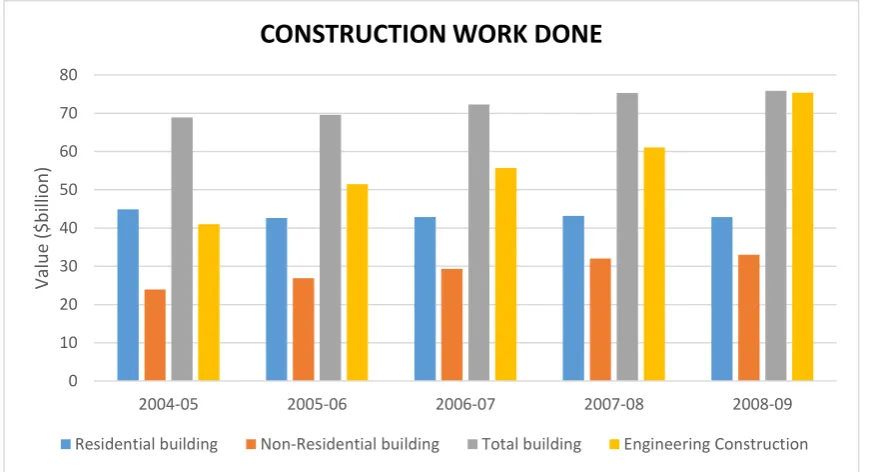
[image:18.595.70.505.302.538.2]During the past century the construction industry has developed into an important part of the Australia economy. According to the Australian Bureau of Statistics as of 2009 the construction industry accounted for 6.8% of Gross Domestic Product and for 9.1% of the national work force. (Australian Bureau of Statistics 2010) These statistics place the construction industry as the fourth largest industry in the modern Australian economy. In terms of total construction project value the industry is split almost evenly between building projects and engineering projects, with a total value of $156 billion dollars in 2009, as shown below in Figure 1.
Figure 1: Total Construction Work (2004-2009) (Australian Bureau of Statistics 2010)
Although these figures have dropped over the past years due to the down turn in the national economy, the construction industry remains one of the true pillars of the economy. This down turn in funding within the industry has been shown to place even more pressure on stakeholders to perform the same roles but more efficiently. This pressure has also been shown to additionally reduce the level of service delivered and the consequences of this can be far reaching. These concepts will be further investigated within this chapter.
0 10 20 30 40 50 60 70 80
2004-05 2005-06 2006-07 2007-08 2008-09
Va
lu
e ($b
ill
io
n
)
CONSTRUCTION WORK DONE
2.2.1 Types of Construction Projects
As shown above by the figures from the Australian Bureau of Statistics projects are split evenly into large groups. (Australian Bureau of Statistics 2015)
Building projects such as residential, commercial, industrial and intuitional buildings.
Engineering projects such as roads, highways, sub divisions, bridges and infrastructure.
These groups are further detailed in the subs sections below.
2.2.1.1 Residential Buildings
Residential buildings includes all new places of residence such as houses, townhouses, units or flats. These building projects can range from smaller two story buildings to large sky scrapers. However as the majority of these projects are generally small in value and complexity and therefore RFI’s are not very common on these projects. The exception to this is multistorey apartment buildings where the sheer size and complexity of the project is known to increase the number of RFI’s.
2.2.1.2 Commercial Buildings
[image:19.595.73.498.539.751.2]Commercial Buildings include all retail, trade, entertainment, accommodation and office buildings. These construction projects can have a very wide range on size and complexity from small office buildings to large multistorey hotels and shopping complexes.
2.2.1.3 Industrial Buildings
Industrial Buildings include projects related to heavy industry such as factories, warehouses, mining operations and agricultural projects. The nature and size of these projects is generally large with most industrial areas needing a lot of room and facilities.
Figure 3: Homestyle Bakery (Kehoe Myers 2015a)
2.2.1.4 Institution Buildings
Institutional buildings include all schools, hospitals, healthcare, religious and aged care projects. These projects are generally very complex in nature as all of these buildings require vast amounts of services to be provided in high detail.
2.2.1.5 Infrastructure Projects
Infrastructure projects account for almost half of all projects completed in Australia by total value. This category relates to all infrastructure projects both public and private such as: roads, highways, bridges, railways, airports, water, sewerage, electrical and telecommunications.
Figure 5: New England Highway Stormwater Culvert (Kehoe Myers 2015a)
2.2.1.6 Subdivisions
Subdivisional works make up a large portion of the above infrastructure group as each subdivision includes several differed types of infrastructure to be installed at the same time. This category is also commonly a pre-requisite to all building projects as most buildings are created on new or reconfigured land.
2.2.2 Types of Procurement
These construction projects as shown above, either public or private are first initiated when a need for new infrastructure is identified. At the start of a construction project the proponent must first decide on the type of the procurement route to complete the development. This decision general depends on the timeframe, complexity and type of the project. The most common type of procurement route is traditional 'design bid build' method. (Designing Buildings 2015)
In the traditional type of procurement, the proponent engages a team of professionals to investigate and complete the project. In most instances the proponent first engages a Principal Consultant who in turn engages sub-consultants and ultimately the contractor who will carry out the construction.
This is in contrast to the modern design and construct process (D&C) where the construction contractor is involved from the inception of the project. In this model the contractor effectively takes control of the entire project as the superintendent, directing the consultant teams and the construction teams to deliver the project. This means that the RFI’s being submitted to the superintendent will not be of technical details because the design of the project is done within the project team (Rowe 1998). However in these Design and Construct jobs the superintendent will receive a number of RFI’s on how the design is to be completed such as site layout questions or aesthetics ect. The number of requests from the type of contract may be higher or lower than a normal construction project depending on the project complexity.
Another common type of contract is the modern construction alliance type. This procurement method attempts to strike the balance between the traditional and design and construct models. By focussing on the greater collaborate between design consultants and the contractor in good faith, the overall aim is to provide the best possible outcome for the project.
2.2.3 Roles within the Construction Process
Within the traditional construction contract framework, the individual tasks and responsibilities of each stakeholder is well defined and are critical to the project’s success. The individual roles of each party within this process is summarised in the following Figure 7 and detailed in the sections below.
Figure 7: Construction Project Structure
2.2.3.1 The Principal
The Principal, owner or client in the construction process is in some regards the most important, as they initiate the development and provide the funds for the work to be completed. This process normally begins with a project that the client needs completed whether it is a straight forward private development or major public infrastructure.
2.2.3.2 The Principal Consultant
The Principal Consultant within the construction project is the consultant engaged by the principal to manage the project and all sub consultants. The particular consultant chosen to be the principle consultant may come from many different disciplines depending on the nature of the project. For example building projects will usually have an architect as the principal consultant whereas a road or drainage project would usually employ a civil engineer. The chosen principal consultant is generally also appointed as the superintendent responsible for administering the construction contract, depending on the ability of the consultant to fill this role. Their role in the project includes organisation of the all project components such as the design and documentation, organisation of sub consultants, tendering, contract administration and construction management. (University of Illinois 2010 )
The first role of the principal consultant or superintendent includes the design and documentation of the project. In this stage the owner engages the principal consultant to fully design and document the project in preparation for approvals, tendering and construction. This may include the use of sub consultants such as surveyors, planners, architects, certifiers or engineers. The range of sub consultants needed is entirely dependent on the type, complexity and requirements of the project.
Once the project has progressed through the design and documentation stage it is then put out to tender. In this process the project documentation is sent out to multiple contractors so that they may submit their proposed estimate of time and cost to complete the project. After the tender period has expired the principal consultant then provides to the owner a recommendation of which tenderer should be selected to complete the project. This can be based on several factors including price, timing, competency, qualifications and special project specific requirements.
These documents are based on the appropriate Australian Standard for contracts such as AS2124 or AS4000 and will reference specific causes from these documents. This contract agreement once signed by all parties becomes a legally binding document and entitles the contractor to start work at the agreed time. (American Council of Engineering Companies of Kansas 2014)
After the projects contract has been prepared and signed the superintendent then shifts into a contract administration and project management role. At this point a sub consultant that specialises in project management may be engaged, depending on the type and complexity of the project. In the contract administration role the superintendent’s job is to ensure that the conditions of contract are met by both parties such as progress claims, payments and contractual specifications. (Standards Australia 1992)
Management of the project is normally also assigned to the superintendent. This can be desirable so that any issues raised during construction can be quickly answered, maximising continuity and efficiency. Depending on the type of project this role may incorporate a range of responsibilities from undertaking inspections to project management and construction certification. (Government of Tasmania 2014)
2.2.3.3 The Designer
On smaller construction projects it is very common for the principal consultant or superintendent to be also the projects designer. As this research project is in fulfilment of the requirements of a Bachelor of Civil Engineering all further reference to ‘the designer’ will relate to a Civil Engineer known as the ‘Design Engineer’.
2.2.3.4 The Contractor
The internal management structure of the contractor varies depending on the size and nature of the company. The general framework usually consists of the ground staff, a site foreman and a project manager. An example of the general construction management frame work is shown in Figure 8 below. (Hutchinson Builders 2013) Depending on the complexity of the project it may be necessary to engage in sub-contractors to complete some of the work if the main sub-contractors do not have the sufficient skills or resources available.
2.3 The Request for Information (RFI) Process
At the start of a construction project a set of contract documents is agreed upon by both the principal and contractor. These documents which are normally prepared by the engineer or architect include the contract agreement, project drawings and specifications. On a perfect project these documents would be all that is required to complete the works, however this is rarely the case. In circumstances where additional information is needed to complete the project the contractor will employ the use of the Request for Information (RFI) process. (American Council of Engineering Companies of Kansas 2014).
The RFI process generally begins with a question raised by the contractors’ management, an employee or a sub-contractor. This question will then be vetted up through the contractor’s management framework and either rejected, answered or made into an official RFI. The official RFI first begins with the creation of the RFI form. This form should accurately detail the problem or question that needs to be answered. Additionally the RFI needs to reference the relevant project drawings, specifications, impact on time, quantify additional cost and if possible, propose a solution.
In some project management systems this traditional manual creation of forms has been replaced with virtual cloud based systems of creation, submission and resolution. These systems have the great advantage of automatic pre filling of information, tracking and redundancy systems. But at the same time the use of these systems in not wide spread and can also be expensive and hard to implement. Because of the limited use of these systems only the traditional method of creating RFI’s will be considered in this research project.
Figure 9: Overview of the RFI process (Aconex 2014)
2.3.1 Types of RFI
Although the request for additional information is the most general type of RFI used, there are several different roles that they can play including: (Kajewski, Weipper & Tilley 2002)
Information Clarification. A request for clarification on a certain detail from the design engineer.
Information Conformation. A request for conformation of a detail from the design engineer.
Request for Approval. A request for approval of methods or materials.
Request for Substitution. A request for approval of alternative materials.
Alternative Design Solutions. A request for approval of an alternative design solution/s.
Within the overall RFI process, most stakeholders within the construction project will be involved. The following subsections give a summary of the roles of each participants in the RFI process.
2.3.2 The Principal
The principal or client’s role in the construction process is somewhat removed from the RFI process. Because the principal has generally engaged a consultant to act as their representative within the contract, they will rarely be involved directly in the RFI process. However in the instance where an RFI may result in a major change or additional cost to the project, the owner may need to be involved to approve such a variation.
In occasions where the principal dose not engage a superintended they will therefore be the receiving party for all requests. In this case it will be the responsibility of the principal to either answer the RFI, if they have the required technical expertise or alternatively forward to an appropriate party who can answer it.
2.3.3 The Superintendent
As the superintendent is acting as the principal’s representative within the contract, it is their role within the RFI process to review and answer the query. If the request cannot be directly answered by the superintendent it is his responsibility to pass it onto a nominated consultant or sub-consultant. In most circumstances this means that the RFI would be passed to a discipline specific representative that would be qualified to answer the query. (Aconex 2014)
Once the RFI is received by the relevant consultant a solution or formal response is created. This may be in the simple form of a written instruction or a complex as a complete revision of construction drawings. The formal response is then verified by the superintendent and then passed back to the contractor.
2.3.4 The Design Engineer
Depending on the contractual arrangement, enquires maybe directed to the design engineer from the superintendent. Alternatively if the design engineer is the superintendent or principal consultant they are able to answer questions directly. Being able to answer these questions directly can save a significant amount of time and money on projects, as responses can be given directly to the contractor rather than having to be passed back through the superintendent.
2.3.5 The Contractor
Within the RFI process the contractor is both responsible for creating, tracking and concluding RFI’s. During a project if the design and documentation is lacking detail, approval is needed, a problem is encountered or alternative solutions are proposed the contractor may then employee the use of the RFI process. Within the construction management framework, questions or site issues may first be raised by employees or sub-contractors. In these cases it is important that the request is first passed up through the framework to the foreman, site manager and then project manager. This ensures that the request is not solvable by the contractor and will require an external solution from the superintendent.
Following this procedure it should be the responsibility of the project manager in all projects to create the official RFI Form and start the official process. This is generally completed using their specific system to create a RFI form relevant to the specific project. This form includes all significant details to the query such as the project, the problem and the time and cost associated. This form is then sent to the superintendent and logged on the RFI register.
2.4 The RFI Form
The RFI form is in most cases the official start of the RFI process. While the contents of the form are generally the same, each contracting company will have a different format. This will depend on several factors such as the type of query, specific program or even the type of project. An example of the general layout of the RFI form is in shown in Figure 10 below.
The general structure of an RFI form will be similar to the example form shown above. This will first include an official title or header that includes:
The project name and number. This project name and number is to help track the project through the contractor’s internal documentation system. The superintendents or consultants project number may also be listed to assist with document control.
The RFI number. The official RFI number is used to give reference to the RFI so that it may be tracked through the process.
The name of the company and person responsible. The request like a formal letter will be addressed to the company responsible for the response and made attention of the person in charge. In most cases this will be the superintendent and the appropriate contact.
Contact details. The RFI is always addressed from person responsible for raising the RFI which in most cases will be the project manager. Their contact details are always included on the RFI so that a response can be sent back to them promptly.
The main purpose of the RFI is then detailed within the subject section of the RFI form. This section should include all of the relevant details regarding the request depending on the type of request such as: (American Council of Engineering Companies of Kansas 2014)
Clarification Needed. Details what aspect or detail of the project requires clarification. This type of request would normally include the drawings or specifications with areas of clarification highlighted.
Information Conformation. The specifics of an item or detail that needs to be confirmed by the designers.
Request for Approval. Methods or materials are requested to be approved by the designers or superintendent. This would include any relevant details on the method or material such as product specifications and/or standards.
to that specified in the contract documentation. This request would have to include all relevant information on the proposed product.
Alternative Design Solutions. A request for approval of an alternative design solution/s. This request would be accompanied by the specifics of the alternative design solution including proposed methods, materials and specifications.
All of the above request types would usually be accompanied by the following: (American Council of Engineering Companies of Kansas 2014)
References to any relevant drawings, details or specifications
A statement of the impact of the request, including time and costs.
2.4.1 The RFI Register
The RFI register is the main tool that contractors and consultants use to keep track of the RFI’s issued on a project. The sheet normally includes the details of the project, RFI numbers, the current status, brief description, date requested/required and any additional notes. (Royal Melbourne Institute of Technology 2002) This basic summary of the requests is a good tool for tacking RFI’s and summarising all of the essential information on one page. In most modern RFI systems the register is automatically populated and updated as requests are produced and resolved. An example of a register is shown in below in Figure 11.
Figure 11: Request for Information (RFI) Register (Hutchinson Builders 2013)
2.4.2 Construction Discipline
As most Civil Engineering projects share common disciplines, the following categories have been adopted for this research project.
Site Works. This category includes all enquiries related to the general site works such as clearing, bulk earthworks, building works, traffic control or geotechnical investigation.
Road Works. All enquires in relation to roadworks fall into this category such as quires regarding road or kerb alignments and levels.
Stormwater. All enquiries regarding all site stormwater is placed into this category. Such as pipe types, class, grades and levels.
Sewerage. The category includes all enquiries regarding the sewerage reticulation. This could range from pipe sizes to manhole depths and drops.
Water Reticulation. All enquiries regarding the water reticulation in a project. This may include questions regarding the alignment, clashes with other services or testing procedures.
Electrical and Communications. This category includes all questions regarding electrical and communications on the project. Although these questions will normally be answered by the electrical designer it is the responsibility of the principal consultant to forward these queries on.
While these categories will cover the basic works on most civil projects it is noted that other types of projects, such as building projects, will produce RFIs that do not fit into any of these categories. Because of this it is proposed that a seventh category is adopted to cover these types. This seventh category is defined as:
2.5 Major Causes of RFIs
As the construction industry has modernised, the complexity of projects is also seen to be increasing. In recent years, this increase in complexity has also been restricted by shrinking budgets, forcing the owners, consultants, designers and contractors to improve efficiency wherever possible.
Separately increased competition within the engineering and architectural fields has increased in recent years, leading to consultants having to reduce the level of service offered in order to remain competitive. This coupled with the increase in project complexity has greatly increased the chance of errors and omissions being made in project documentation. (Zack 1998) Minor errors in the design drawings and documentation however are not normally noticed until the project is under construction. By this time the contractor is required to employ the RFI system to resolve the issue.
In a perfect world the documentation of a project would be so comprehensive that there would be no reason for the RFI process. In reality to achieve efficiency and commercial sustainability this level of documentation is not viable and hence the RFI system will be used to resolve any issues. (Mohamed, Tilley & Tucker 1999) The number of RFIs raised during a project can be directly related to the number of factors such as, project size, duration, organisation, contractual arrangement and the quality of the design drawings and documentation.
2.5.1 Design and Documentation Quality
The design and documentation, or the lack of, is arguably the largest cause of RFI’s in all projects. This is due to the fact that if the design and documentation is lacking in quality or detail then the contractor will experience a large number of problems on site and subsequently produce a large amount of RFIs. This major cause can be broken down into the following sub categories (Tilley, Wyatt & Mohamed 1997).
Incorrect Information. In some cases the designer will have detailed or specified something that is incorrect or that the contractor knows is wrong. These kind of enquiries must be answered by the designer so that the correct information can be passed on to the contractor.
Insufficient Information. On some projects the lack of sufficient detail in the design documentation will force the contractor to request further information so that the project can be completed.
Questionable Information. On some projects the information supplied in the contract documents is considered to be inappropriate for its application. This leads to an RFI been created to request the use of an appropriate solution. In addition to these sub categories other notable cause of RFI’s include:
Misleading Information. In some projects the contractor or designer could be given incorrect information that leads misleading information. The most common cause of this is incorrect survey or as constructed information where the contractor is asked to match into existing but the connection is not in the specified location or not possible. In these cases the contractor is required to submit a request for additional information or may even request entire redesigns.
Unforeseen Circumstances. In some cases there may be latent ground conditions (for example the presence of un-expected soil or ground water) that was not expected with the available information at the time of design and documentation. In these cases the contractor will submit an RFI to get appropriate direction from the designer.
In this competitive industry often the level of service must be lowered to reduce the total costs so that jobs can be won. This lowering of service offered means that there will be more omissions within on the drawings and hence more RFIs will be created on the project.
2.5.2 Project Cost, Size and Duration
Although the cost, size and duration of a project is not the direct cause of RFI’s there has been a well-documented increase in RFI under these circumstances. In a recent study of RFIs and their impact on construction projects by the Navigant Construction Forum found that on larger projects (with a contract value between $5 million and $5 billion) the total amount of RFI dramatically increases with the cost and duration.(Hughes et al. 2013) The findings of the article are shown below in Figure
12 and Figure 13.
Figure 12: Number of RFI’s Issued by Construction Value (Hughes et al. 2013)
As can be seen in these figures, both project cost and duration display a strong relationship with the total number of RFIs’ on a project. It should however be noted that these values were collected on major infrastructure projects from all over the world with very large construction values and durations. Because of these constraints, care must be taken when making comparisons to this data.
Other studies of contractors and construction projects have shown similar relationships between factors. A 2013 study of the effects of the RFI process on contractors, collected data for total construction value of projects and plotted them against the total number of RFIs. These graphs are presented in Figure 14 below. (Dinsmore 2013)
Figure 14: Visual trend for Contract Value verses number of RFIs (Dinsmore 2013)
From visual inspection of the above figure it can be seen that a significant relationship exists between the contract value and the number of RFIs on a given project.
Other conclusions from this study were that overall the number of RFIs increased with the following factors: (Dinsmore 2013).
The projects are of high value from $15 to $34 million
Have durations exceeding 11 months
Complex projects such as residential dwellings or retirement villages.
Of the above factors it is likely that both the project value and duration are both related to the complexity of the project. Additionally as complexity increases so do the amount of materials, costs and time required to construct the project. It can then be assumed that project complexity is a factor of the projects size, cost and duration. The level of complexity of a project, is seen to drive the overall number of RFI’s as it also ties into the quality of documentation on any given project. With the increase of complexity of a project the complexity and extent of the documentation of the project also increases. This could lead to a higher chance of errors and omissions in the design and documentation, thus an increasing the number of RFI’s
2.5.3 Project Organisation
The organisation of a project and its contractual arrangements can also have a large effect on the number of RFI issued during a project. This is due to not only the management of the site but also the effectiveness of communication and the amount of resources available to all parties.
On large construction project the potential for poor management of site and communications has the greatest potential to affect the amount of RFI’s issued on a project. This is simply because of the large amount of personnel on site the higher chance that this framework may break down. A specific example of this is if the project manager is not reviewing RFI’s sufficiently, two separate subcontractors could encounter the same problem and then two requests for the same information may be created.
2.6 RFI Efficiency
Overall there are many different factors that influence the efficiency of the RFI process. The common factors include the effectiveness of communication between all parties, the administration time needed for requests and responses, and simple mistakes made while producing or responding to an RFI.
In the majority of cases the overall efficiency of the RFI process is directly linked to how well the parties involved are able to communicate. If all parties are able to effectively communicate, then problems and solutions are able to be communicated and understood, eliminating the need for continual clarification of the subject. Whereas poor communication can lead to incorrect information given in either the request or response and could lead to either party being misled as to what the actual problem or solution really is.
Administrative processes between parties can also have a large effect on the time taken to produce or respond to an RFI. These delays can either be caused by the administrative system employed or the staff involved with both the request and response. In larger projects the handling of RFI’s is the duty of a specific employee. But on smaller projects this employee may have many other responsibilities and thus will not be able to handle the request quickly.
The other major factor that can impact to the efficiency of the RFI system is the potential abuse of the system by both contractors and consultants.
2.6.1 Abuse of the RFI system
While the general use of the RFI system is both useful and needed, there is now a growing trend with the construction industry towards the abuse of the RFI system. It is important to note that abuse of the system occurs on a small minority of projects but all parties need to be informed of the causes and consequences in case they arise.
The abuse of the RFI system usually occurs by the contractor using the system for normal communications (Simpson, Atkins & Atkins 2008) such as:
Inappropriate Questions. RFIs containing questions that are not appropriate to be answered by the superintendent or designers such as information on propriety products. This also covers cases where the contractor asks for details that are already stated within the drawings or specifications.
Submissions of information. In this case the contractor is submitting information to the designers or superintendent such as test results.
Responses to conformances. If the contractor is given a non-conformance notice they sometimes submit an RFI in response to the notice.
Disagreeing with the Response. In some cases the contractor will receive an answer to an RFI, wait a length of time and then respond by either disagreeing with the response or asking for further clarification. By doing this the contractor effectively delays the closing date of the RFI, creating the illusion of delay.
2.6.2 Addressing Inefficiency and Abuse
While the majority of contractors will use the RFI system efficiently and without abuse, steps should be taken to ensure that efficiency is maintained and abuse is unlikely occur. In the journal article ‘RFIs - use, abuse, control’ the authors recommend that the solution to both efficiency and abuse is the implementation of clear definition of the communication procedures. (Zack 1998) The recommended definitions and processes that are to be considered for inclusions into the contract documents are the following:
Drawing or Detail Clarification. Define a proper drawing or detail clarification system. Establish what the system should be used for and what the response time should be limited to.
In this system the time frames of both the notice and the response is agreed upon by all parties.
Project Communications. Define a clear communication pathway that information such as requests and responses will follow. Within this defined system an understanding must be reinforced that communications may be rejected if they do not conform to the proper procedures.
Requests for Information. Establish that the RFI system should only be used when the contractor is in need of additional information that is not included within the drawings or specifications. Within this system make allowances that the RFI’s may be rejected if they are simply routine communications or should be covered by a different system.
Request for Conformation, Approval or Substitution. Establish and define a clear system for the contractor to submit requests for approval, conformations and substitutions.
Improperly Made Requests. Define within the contract the contractor may not be entitled to claim extensions of time or variations where they have elected not to follow the previously defined procedures for submitting requests.
If these definitions and processes (or something similar) are included in the contract documents and adhered to by all parties, the efficiency of the RFI process could potentially be improved and the potential abuse of the RFI system should be mitigated.
2.6.3 Improving Design and Documentation Quality
As identified above in Section 2.5.1, one of the major cause of RFIs on a project is the quality of the Design and Documentation. Unlike any other of the major causes of RFIs, this category is unique as the Design Engineering exercises a large amount of control on it and can hence directly influence the potential number of RFIs on a project.
“The survey results indicate that there are still major problems with the design and documentation process in the Australian construction industry, which are leading to
construction inefficiencies and increased project costs and durations. To achieve
improvements in overall construction process efficiency it is necessary to improve
design and documentation quality well above their currently declining levels. “ (Tilley,
McFallan & Sinclair 2001)
To achieve these improvements the authors proposed that an overall change in the industry is required to shift away from the risk avoidance culture and cost based procurement process that is seen to drive the current industry. In addition to these overall proposals, the authors also proposed number of strategies to improve the quality of design and documentation. These strategies include:
Education and Training.
Provide greater education and training to all employees through tertiary training and CPD
Design & Documentation Coordination.
Set predetermined standards for the coordination of design elements between parties.
Design & Documentation Time Allowances.
Create a greater awareness of the actual time require to properly design and document a project.
Design & Documentation Fee Allowances.
Educate on the advantages of non-price based selection of design consultants.
Procurement Methodologies.
Investigate the appropriate method of procurement for a project before commencement.
Independent Reviews.
Appoint an independent 3rd party consultant to review the documentation
against minimum standards, prior to the documents being issued.
Value Management.
Industry Perceptions.
Designers need to properly define their engagement with the client and need accurately consider the contractors capabilities when preparing documentation.
Accountability of design consultants.
Hold design consultants financially accountable for the consequences caused by lack of quality in design and documentation.
Client Briefs.
Client briefs need to clearly state what their requirements are for the project.
Knowledge Management.
All stakeholders within the industry must develop a method to capture and retain knowledge for the overall benefit of the industry.
2.7 Effects of the RFI Process
Although the use of the RFI system is necessary to handle site issues found during construction, due to the competitive nature of the industry, the time and cost associated with the RFI process is rarely documented. Significant time and cost can be incurred quickly due to a large number of RFI’s being submitted, this has the potential to send the entire project off budget, for all parties involved. This research project aims to help define and quantify this process so that it can be better understood for all parties. The following subsections proved a brief overview of the impacts of the process on each stakeholder.
2.7.1 Impacts on the Principal
Although the costs involved within the RFI process are rarely documented, it can be assumed due to the competitive nature of the industry that some of the cost are passed on and shared by all stakeholders. However this does not account for additional costs that the principal would sustain that are unique to the principal. The first major impact on the principal in the RFI process is obviously the potential increase in the cost of the project. At the start of the project the principal signs a contract with the contractor to complete the works for a certain price. Normally the client will then prepare a final budget with a certain amount of contingency in place for construction problems. If a severe RFI is encountered during the project and large change in design is required, the cost implications of this may exceed the contingency amount allowed for in the principal’s budget
The second major cost to the project from the RFI system is the additional time needed to produce, resolve and implement the RFI. This delay time has the potential to significantly delay the project practical completion date and thus set back the hand over to the owner. Depending on the type of project this could potentially result in the inclusion of significant holding costs (such as interest repayments), additional penalties, fees and charges for financial arrangements, cash flow issues with delayed sales etc.
2.7.2 Impacts on the Superintendent
As the role of the superintendent can vary so drastically the impacts of the RFI process on the superintendent can also vary. In some projects the superintendent may not be the design engineer so the only cost will be the management costs associated with handing requests on to the appropriate consultants and delivering solutions back to the contractor.
In this research project it has been assumed that the Design Engineer is the superintendent to the project. This assumption has been made to allow the collection of data from consultants easier and hence impacts on the superintendent are considered as impact on the Design Engineer.
2.7.3 Impacts on the Design Engineer
Depending on the contractual arrangements, the design engineer can have a wide range of responsibilities such as creating the project construction documentation, drawings, specifications and may also be required to answer any queries regarding them. This process has the potential to exhaust the design engineer’s entire budget for the project depending on the amount and severity of the RFI’s.
This process becomes critical to the design engineers budget if a large amount of RFI’s are made and there is a high level of complexity and rework required for the responses. If the RFI’s are minor in nature it may be possible to answer them quickly and the cost to the design engineer will be minimal. However in some cases, the RFI will bring into question major design elements or highlight major issues with the constructability of the project. In these cases, a major redesign of the project may be required. This has the potential to undermine the design engineers ability to cover their costs for undertaking the work and any chance of a making a profit.
2.7.4 Impacts on the Contractor
As it is normally the contractor who initiates the RFI process they are largely in control of the process and ultimately the number of RFI’s created on a particular project. During the tender stage of the project the contractor formulates his estimate of the time and cost of the required to complete the works based off a set of project documents. If the tender documents are missing information or some aspects, then the design engineer is generally asked to answer any questions directly without the contractor having to raise an official RFI. If the questions become prolific, multiple contractors are asking the same question or the design documentation is required to be changed, the design engineer may opt to issue an addendum to all of the tenderers. The contractor who is successful in the tender process is then awarded the contract and they are then required to complete the works for the quoted price detailed within the contract.
As the project progresses and circumstances cause the contractor to request further information, the time and administrative costs associated with this process are added to their expenses. This delay in time can have large flow on effects like having to reschedule major works that could lead to financial costs such as cancellation or rescheduling fees. The delay in completion of the project may also entitle the projects principal to liquidated damages depending on the contractual arrangements. As the scope of this research project is to focus on the time and cost accrued by the design engineer, further aspects of the costs to the contractor on construction projects will not be investigated.
CHAPTER 3 - Methodology
3.1 Overview
This chapter will detail the methodology adopted to meet the project objectives as outlined above in Section 1.2. The adopted project methodology will feature the following topics: