This is a repository copy of Agreeing on efficient emissions reduction. White Rose Research Online URL for this paper:
http://eprints.whiterose.ac.uk/88389/ Version: Submitted Version
Article:
Bos, Olivier, Roussillon, Beatrice and Schweinzer, Paul orcid.org/0000-0002-6437-7224 (2016) Agreeing on efficient emissions reduction. Scandinavian Journal of Economics. pp. 1-32. ISSN 1467-9442
https://doi.org/10.1111/sjoe.12164
[email protected] https://eprints.whiterose.ac.uk/ Reuse
Items deposited in White Rose Research Online are protected by copyright, with all rights reserved unless indicated otherwise. They may be downloaded and/or printed for private study, or other acts as permitted by national copyright laws. The publisher or other rights holders may allow further reproduction and re-use of the full text version. This is indicated by the licence information on the White Rose Research Online record for the item.
Takedown
If you consider content in White Rose Research Online to be in breach of UK law, please notify us by
Agreeing on efficient emissions reduction
∗
Olivier Bos
†B´eatrice Roussillon
‡Paul Schweinzer
§Abstract
We propose a simple mechanism providing incentives to reduce harmful emissions to their efficient level without infracting upon productive efficiency. The mechanism employs a contest creating incentives among participating nations to simultaneously exert efficient productive and efficient abatement efforts. Participation in the most stylised form of the scheme is voluntary and individually rational; all rules are mutually agreeable and are unanimously adopted if proposed. The scheme balances its budget and requires no principal. In a perhaps more realistic stochastic output version which could potentially inform policy decisions, we show that the transfers required by the efficient mechanism create a mutual insurance motive which may serve as effective rationale for the (gradual) formation of International Environmental Agreements. (JELC7, D7, H4, Q5. Keywords: Climate policy, Contests, Agreements.)
1
Introduction
The disappointing series of failures to reach agreement among the 196 members of the United Nations Framework Convention on Climate Change in Copenhagen, Canc´un, Durban, Doha, Warsaw, and Lima (2009–14) highlights the international impasse in preventing further global warming. Yet action seems to be called for: recent research reports shrinking ice mass balance from both Greenland and Antarctica with a projected sea-level rise of one to two meters by 2100.1 Since an estimated
180 million people live currently in locations less than one meter above sea level, the impact of such
∗
We are grateful for very helpful comments and suggestions to two anonymous referees and the editor. We benefitted from comments and suggestions from Heski Bar-Isaac, Valentina Bosetti, Jia Chen, Reyer Gerlagh, Alex Gershkov, Thomas Giebe, Robert O. Keohane, Dan Kovenock, Jianpei Li, Philipp Wichardt and seminar participants at the University of Manchester, Paris School of Economics, University of Milan, University of Copenhagen, University of Munich, Coll`ege de France and CESifo, Munich. This paper supersedes two previously independent working papers, Efficient emissions reduction, and Risk pooling in redistributive agreements. Schweinzer appreciates the generous hospitality of CESifo and his coauthors’ employers. This research has been conducted as part of the project Labex MME-DII (ANR11-LBX-0023-01). Financial support from the University of York Research and Impact Support Fund is gratefully acknowledged. (19-Jul-2015) †LEMMA-Department of Economics, Panth´eon-Assas University, 4 rue Blaise Desgoffe, 75006 Paris, France,[email protected]. ‡Univ. Grenoble Alpes, GAEL, F-38000 Grenoble, France and INRA, GAEL, F-38000 Grenoble, [email protected]. §Department of Economics, University of York, Heslington, York YO10 5DD, United Kingdom,[email protected].
1 See, for instance, Dasgupta et al. (2009) or Allison et al. (2009). Mitrovica et al. (2009) predict less uniform
a change on the world economy will be substantial.2 This paper studies and answers two questions
arising in this context: i) How can incentives be provided to reduce harmful emissions to their socially efficient levels while not infracting upon productive efficiency?3 ii) How can international
agreement on the parameters of this or similar redistributive mechanisms be found?
In our simple model environment with additively separable cost of production and abatement, there are two ways to reduce emissions: by producing less or by abating more; there is no trade in in-puts or outin-puts. The mechanism we propose plays on these two aspects in order to achieve efficiency in both: a stylised contest—based on a relative ranking of all nations’ abatement efforts—rewards the countries with the highest abatement efforts with some share of joint agreement output. In a nutshell, marginal production is ‘taxed’ to fund a prize pool, and marginal abatement increases the probability of winning a share of this pool. By designing the contest appropriately, both equilibrium incentives can be set efficiently at the margin. The precision with which the contest ranking is correct, i.e., the precision of mutual abatement monitoring, is one of the design parameters of our proposed mechanism.
In equilibrium, this efficiency inducing contest takes the form of a redistributive mechanism which returns some share of the collected tax pool in the form of prizes to the participants. As it turns out, for sufficiently volatile individual GDP, the variance of the redistributed income is lower than that of standalone individual income, even when the added randomness through the contest’s prize structure is taken into account. In this case, the redistributive contest mechanism can fulfill aspects of a mutual insurance agreement which can entice a country with a sufficiently strong dislike of income fluctuations to join an agreement on which, in the absence of this income smoothing argument, it would prefer to free ride.
The main emissions type we have in mind for our model is greenhouse gases. These are widely seen as the main contributing factor to global warming. Emitted by one country as inherent part of the productive process, they are distributed around the globe regardless of where they were produced and, as such, present an externality. A reduction of emissions benefits all countries but the costs of such reductions are carried individually. This generates a classic free-rider problem in which each country would like the threat of global warming removed but none is ready to pay the cost.4 We think of the abatement efforts as the difference between ‘business as usual’ investments
and green investments; the former are the investments that firms make without considering their environmental impact while green investments purposefully intend to reduce CO2emissions generated during production.
Nordhaus (2006), among others, advocates the implementation of market-based instruments and, more specifically, a world harmonised tax on each ton of CO2 emissions, the revenue from
2 The original estimate of 180 million is from Nicholls (1995); Hanson et al. (2011) estimate the economic effects
of climate change on coastal cities and ports. A recent analysis of migration induced through climate change is, for instance, Kniveton et al. (2012).
3 Both productive and abatement efficiency are defined as the respective levels of efforts which maximise social
welfare in the absence of information deficiencies or incentive aspects.
4 One may advocate the view that some countries could climatically benefit from warming. Russian President
which may be used at will by each national government. This proposal presents many advantages over the status quo; it can achieve efficient abatement at the world level, is simple to implement, and taxes are well-known instruments. However, imposing a new, harmonised tax (unilaterally) may be politically unattractive while the individualised winning incentives that our contest scheme presents make participation individually attractive. Moreover, for a tax to correct abatement incentives and simultaneously provide efficient production incentives, it needs to be complemented with a subsidy.5 This type of combined mechanism, however, will typically not balance its budget and will
therefore give rise to further negotiations. In addition, as abatement efforts are difficult to measure in absolute terms, countries may be tempted to present productive investment as abatement efforts to get higher subsidies. In contrast, the informational requirements for a relative ranking of abatement efforts may be easier to satisfy than those for a cardinal scale. Moreover, a contest prize can be fixed independently of the competitors’ abatement efforts while fixed subsidies based on piece-rates depend on absolute levels. As our ranking is relative, it would not be affected by an overall abatement measurement inflation. Thus, a ranking allows to use indirect abatement measurements which could be less easily manipulated than other, cardinal, measures entering tax calculations.
This paper makes two contributions. First, we show that a contest can implement efficiency in a specific environmental model along both productive and abatement effort dimensions. Second, we demonstrate that (gradual) agreement formation is possible in this model if nations are sufficiently averse to income-variance. Both results are theoretical. In addition, we provide a benchmark result showing which model-resources are required to implement the first-best solution under the following objectives: absence of a principal, efficiency (i.e., no distortions of the welfare maximising allocation) in both effort dimensions, and budget-balancing. Even if the highly stylised mechanism we discuss may seem unrealistic and difficult to implement directly, we hope that our analysis can deliver new and significant insights on the available options, on the cost of abatement, and on the implementation of agreement mechanisms.
Related literature
Public goods & contests. The most directly related studies of public goods provision problems relating to contests that we are aware of are Morgan (2000) and Giebe & Schweinzer (2014).6
Morgan (2000) studies a lottery mechanism which uses proceeds obtained from ticket sales for the provision of a public good. Contrasting with our analysis, he is neither concerned with designing a mechanism to implement exact efficiency nor with balancing the mechanism’s budget. Using a fixed precision contest, he obtains the result that contests are unable to implement exact efficiency. Giebe & Schweinzer (2014) explore the possibility of the efficient provision of a public good through
5 The incentive scheme we propose is based on a verifiable, relative ranking of abatement efforts. We do not require
the verifiability or cardinal measurement of these efforts. A subsidy, however, is likely to require both cardinal measurement and some verification mechanism.
6 The idea that in many circumstances efficient efforts can be induced by awarding a prize on the basis of a rank
non-distortionary taxation of a private good which is linked to a lottery. By fine tuning the tax with the lottery, they are able to get efficient consumption levels for both private and public goods. This is in a similar spirit as the present analysis, but their individual public good contribution is only a function of the private good consumption and not at the individual’s discretion. Moreover, our specific environmental model needs to balance two dimensions of inefficiency: excessive production and insufficient reduction of emissions. This is impossible in their single-dimensional model where tailoring only private goods consumption can lead to efficiency.7
Agreements. Our team setup is motivated by the generally accepted necessity for international environmental agreements (IEA) to be self-enforcing: there is no supranational principal to enforce such arrangements between countries. The consensus in the literature seems to be that there is no consistent theoretical basis on which large voluntary agreements can be formed among independent states which do not have to revert to exogenous reward, punishment or exclusion strategies to avoid free-riding on emissions reduction.8 The main contributions have found that IEA are either unlikely
to consist of many participants, or if they do, are similarly unlikely to produce substantial benefits. The basis for the risk-sharing argument which is the main underlying motivation for our players to voluntarily join an agreement is Wilson (1968) who discusses the optimal behaviour of individuals making a common decision under uncertainty that results in a payoff to be shared. As in our model, the strictly risk-averse players face individual payoff uncertainty which they pool in a team.9
Recent contributions to the literature on IEA-membership dynamics include Breton et al. (2010) and Harstad (2015). Referring to climate change agreements, the latter shows how short-term agreements may have adverse effects on countries’ investments in green technology. Indeed, as Buchholz & Konrad (1994) and Beccherle & Tirole (2011) point out, anticipating negotiations can decrease the level of R&D and green investments.10
Plan of paper. Following the model definition in section 2 we present our main efficiency results in section 3. The model is closed using a simple, simultaneous agreement game based on deterministic output. A much more general (and realistic) participation argument is developed in section 4 for stochastic output. Finally, we present a short, intuitive example which conveys much of the intuition of our results in section 5. Several model extensions, examples, an alternative family
7 In several interesting papers, Buchholz et al. (2011), Gerber & Wichardt (2009), Gersbach & Winkler (2012) and
Gersbach & Winkler (2011) develop ingenious efficient public goods provision mechanisms. Although we share important ideas with these papers, neither models productive efforts and therefore cannot consider the issue of efficiently balancing polluting overproduction with abatement efforts.
8 See Barrett (1994), Barrett (2003), Aldy & Stavins (2007), and Guesnerie & Tulkens (2009) for the main results
and further discussion.
9 This idea found multiple notable extensions and applications, for instance, in the work of Banks et al. (2001), or
Demange (2008). Deaton (1991) models the optimal intertemporal consumption behaviour of consumers whose labour income is stochastic over time. He shows that individual savings can act like a buffer stock, protecting individual consumption against shocks. The same idea has been used to model consumption-savings choices and insurance motives across consumers’ life-cycles. The same variance-compression idea is present in Green (1987) who discusses tax-financed unemployment insurance and Arnott & Stiglitz (1991) who model voluntary, non-market insurance between households under moral hazard.
10 Many environmental papers employ contests to model lobbying activities; see, for example, Hurley & Shogren
of success functions, and the details of proofs are relegated to appendices A–D which are available as “online supplementary material.”
2
The symmetric model
There is a set N of n ≥ 2 risk-neutral players. These players are symmetric in the basic model.11
Each playeri∈ N exerts efforts along two dimensions: productive effort ei ∈[0,∞)and abatement
effortfi ∈[0,∞). The abatement efforts need not, in principle, be verifiable.12 We denote the full
effort vectors by e=e1, . . . , en and f =f1, . . . , fn, respectively. The effort costs ce(ei)and cf(fi)
are assumed to be strictly convex and zero for zero effort. Productive efforts generate strictly concave individual gains ofy(ei)and cause strictly convex global emissions ofm(max{0,Pheh−Phfh})—
only depending on the difference between global productive and abatement efforts—of which player
i suffers a known share si.13 Emissions are seen as an externality, a by-product (or factor) of
production.14 We normalise P
hsh = 1 which introduces a public bad team problem and summarise
a player’s utility in the absence of any incentive mechanism as
(1)
y(ei)−sim
X
j∈N
(ej−fj)
!
−ce(ei)−cf(fi).
Into this problem we introduce an incentive system based on a ranking of individual abatement efforts and award the top-ranked players prizes. The total prize poolP, from which these prizes are taken is defined as the sum of fraction (1−α) of each participant’s individual income or output
y(ei), i.e., P = Pi(1−α)y(ei). Thus, the incentive mechanism redistributes income and its
budget balances by definition. The incentive mechanism awards β1P to the winner, β2P to the player coming second, and so on, withPhβh = 1.
We assume that some noisy (partial) ranking of the players’ abatement efforts is observable and verifiable. We interpret this ranking technology as arising from the agreement’s monitoring of mutual abatement efforts. It is part of the mechanism the players need to agree on and gives player
i’s probabilityph
i(f)of being awarded prizeh as a function of the imperfectly monitored abatement
efforts of all participants. We write pi(f) = (p1i(f), . . . , pin(f)) and assume that p1i(f) is strictly
increasing in fi, strictly decreasing in all other arguments, equal to 1/n for identical arguments,
11 Our main results apply to the symmetric setting. Subsection 3.3 generalises the model to the asymmetric case;
its workings are illustrated in several examples in appendix D.1 and D.2.
12 We view the ranking introduced below as generated by some automaton or monitoring device (see also footnote
15). While agreement on this machine and verifiability of its readings are indispensable, the underlying efforts themselves need neither be observable nor verifiable. If we were to add a zero-mean noise term to output (without changing anything else) productive efforts could not be deduced from output either.
13 Requiring non-negative differences in the damage functionm(
·)ensures that abatement efforts cannot substitute for productive efforts. Since this requirement is fulfilled for most of our analysis, we redefinem =m(Pheh−
P
hfh) and only make the non-negative argument explicit when necessary. (The implied non-differentiabilities play no role in our model.)
14 We can think ofc
twice continuously differentiable, and zero for fi = 0 with at least one fj6=i > 0, j ∈ N.15 Ties
are broken randomly. While we consider this monitoring technology as endogenous to a realistic agreement formation process, we assume that this technology is already determined when the actual environmental contest game is played. Hence, we treat the contest’s ranking precision p(f) as exogenous to all matters dealing with the characterisation and existence of equilibria.
We use the above introduced interpretation of ph
i(f) as a probability of winning the full prize
because this is the standard reading used in contest models. This is entirely equivalent, however, to the interpretation of ph
i(f) as the ‘cardinal’ share of the tax pool P that is allocated to playeri in
dependence of all players abatement efforts. Since this interpretation does not require the transfer of exorbitantly large payments to a ‘winning’ player, it might well be the more practically fruitful way of interpreting our model. Formally, as pointed out above, the two interpretations are equivalent.
Given a rankingp(f) = (p1(f), . . . , pn(f)), a (subgame perfect) equilibrium in this contest game
consists of two elements: an identity independent pair(α, β)specifying the tax and tournament prizes and a pair of efforts(e, f)determining output and winning probabilities. Since we are implementing efficiency we are looking for a symmetric equilibrium in pure strategies.16
2.1
Timing and participation
This subsection defines a symmetric, simultaneous agreement formation game in order to derive the efficient mechanism in a simple setting. Note that a more general participation game supporting gradual agreement formation is defined in section 4 on the basis of a mutual insurance idea resulting from stochastic output.
Since the players’ expected payoffs are symmetric in the basic model, we can think of a simple proposal game in which the identity independent design parametershα, β;p(f)iare proposed by one randomly chosen player and the game is played if and only if all others simultaneously agree to the proposed parameters. The equilibrium concept used in such a game is subgame-perfect equilibrium which our solution satisfies. In order to discourage strategic disagreement, our design is slightly more involved: we propose a two-stage mechanism at the first stage of which an arbitrary player (called player 1) is randomly chosen to propose the two balanced budget contractsC =hα, β;p(f)i
and C′ = hα′, β′;p(f)′i. The first contract C is invoked if all players agree to participate in the agreement. It implements efficient efforts in subgame perfect equilibrium. The second contractC′
is invoked by the agreeing players if at least one player fails to participate and implements inefficient
15 Since this contest success function is general, the abatement efforts determining the contest outcome can be
easily normalised with respect to, for instance, the individual (perceived) emission consumption share si. As usual, this ranking technology can be interpreted as monitoring technology, i.e., the slope of the function can be determined, e.g., by the frequency of inspections or the design of surveillance equipment. From a design point of view, the underlying assumption is that higher monitoring precision comes at a higher cost; infinite precision is not attainable. The inclusion of some monitoring costω financed out of the prize pool which is then splitβP, 1−β−ω,ω)is straightforward and does not qualitatively change any of our results.
16 The efficient allocation is symmetric because of the assumed concavity of production and cost convexity. Especially
efforts which successfully deter non-agreement.17
More precisely, at the first stage of the game, if all players accept C, then the contest specified by C is set up, players commit their output shares(1−α)y(ei) and the game proceeds to the next
stage. If at least one player rejects C, the agreeing players form a residual agreement, implement
C′ and again proceed to the second stage. If fewer than two players agree to setting up the mechanism(C, C′), the game ends and each player obtains their individual utility without agreement. At the second stage, conditional on the formation of an agreement, players choose their efforts simultaneously to maximise own expected utilities. The noisy ranking of abatement efforts specifies a winner, second, etc, final output realises, and the prize pool is redistributed to the winner, second, etc, according to the contract specified by C, or C′, respectively.
Non-participation in the agreement can be discouraged by either the simple simultaneous agree-ment game described above, or the threat of agreeagree-ment members to impleagree-ment C′. It is easy to see that such a sufficiently strong punishment contract C′ always exists: setting C′ =hα′ = 1,·;·i replicates the pre-agreement scenario in which all players are worse off than with an agreement.18
This extreme form of punishment, however, will typically not be necessary. As illustrated in sub-section 3.2 and example D.3 in the appendix, a second-best contract C′ will generally be able to implement higher levels of abatement than those materialising absent an IEA.19
2.2
First-best benchmark
Much of the economics behind our results can be understood from the simple symmetric two players case on which the main body of the paper rests. An intuitive two player example can be found in section 5; it conveys most of the intuition while involving only minimal technicalities. For this two-player setup, we label players as i, j with i = 1,2 and j = 3− i. We define the efficient levels of both productive and abatement efforts (e∗, f∗) as those maximising social welfare absent of incentive aspects20
(2)
max
(e,f)
u(e,f) = 2y(e)−m(2e−2f)−2ce(e)−2cf(f)
∂u ∂e,
∂u ∂f ⇔
(
y′(e∗) = m′(2e∗−2f∗) +c′
e(e∗),
m′(2e∗−2f∗) =c′
f(f∗).
17 Formally, this second problem is equivalent to allowing a signatory to exit the agreement (i.e., renege on his
commitments) after the agreement is formed. As pointed out by Chander & Tulkens (2009), this contract will typically not be renegotiation proof and commitment toC′is crucial. We discuss alternative enforcement measures
in appendix A.1 and a general agreement model based on stochastic output in section 4.
18 For a detailed study of how punishments can be used to force agreement see Chander & Tulkens (1995).
19 DesigningC′
just sufficiently bad to serve as a deterrent resembles the idea ofγ-core stability in Chander (2007). An alternative way of deterring this kind of free-riding on the agreement is to grant most favoured ‘green’ trading terms only to participating nations. This idea is further explored in appendix A.1. For a simulation of agreement stability using plausible data based on an integrated assessment model see Bosetti et al. (2013).
20 The expressions following the curly bracket are the necessary first-order conditions for optimality. In the social
In the absence of an incentive scheme, a playeri= 1,2individually maximises
(3)
max
(ei,fi)
ui(ei, fi) = y(ei)−sim(ei +ej −fi−fj)−ce(ei)−cf(fi)
∂u ∂ei,
∂u ∂fi ⇔
(
y′(e) =s
im′(2e−2f) +c′e(e),
sim′(2e−2f) =c′f(f).
in which si is player i’s local share of global emissions. We write e = ei = ej, f = fi = fj after
maximisation. Since we normalise si +sj = 1, the individual first-order conditions in (3) cannot
both equal those in (2). In order to overcome this inefficiency in bothdimensions, we introduce an endogenised rank-order emissions reduction reward scheme, i.e., a contest. We ask each participating nation to commit to contributing a share (1−α) of their individual output y(ei) to the mechanism
and therefore form a pool of prize money of sizeP = (1−α) (y(ei) +y(ej)). In a contest specifying
player i’s winning probability aspi(f) based on both players’ abatement efforts, we want to assign
βP to the winner and (1− β)P to the player coming second. Notice that such a mechanism redistributes income. The individual problem under our incentive mechanism is therefore21
max
(ei,fi)
αy(ei)
| {z }
retained output
+pi(f)βP
| {z }
first prize
+ (1−pi(f))(1−β)P
| {z }
second prize
−sim(ei+ej−fi−fj)
| {z }
damage from emissions
−(ce(ei) +cf(fi))
| {z }
effort costs
.
We define individual rationality as the requirement that the utility from participating in this mecha-nism for appropriately chosenhα, β;p(f)iexceedsi)the utility from non-formation of the agreement (3), ii) of free-riding on the others’ abatement efforts within the agreement and iii) on free-riding on the others’ abatement efforts outside the agreement. In the first case, no agreement exists at all while in the third case, an agreement outsider benefits from the abatement efforts of the agree-ment members. The second case concerns an agreeagree-ment member’s inefficient effort provision with committed output share.
3
The deterministic output model
3.1
Equilibrium characterisation and existence
We begin by characterising the design parameters which induce efficiency in our model. Recall that, under the contest scheme, an individual participant i= 1,2 chooses a pair of efforts(ei, fi) to
(4)
max
(ei,fi)
αy(ei) +p(f)βP + (1−p(f))(1−β)P −sim(ei+ej −fi−fj)−ce(ei)−cf(fi)
in which p(f) is the probability of coming first in a ranking of abatement efforts f and the prize pool isP = (1−α)(y(e1) +y(e2)). We require thaty′ >0,y′′<0,m′ >0,m′′>0, andc′1,2 >0,
c′′
1,2 >0. We moreover assume that m(·) only depends on the difference of total productive minus abatement efforts. Taking derivatives with respect to both effort types, we obtain the simultaneous pair of first-order conditions defining individually optimal efforts (ei, fi) as
(5)
c′e(ei) +sim′(ei+ej −fi−fj) = (1−α)(1−β)(1−p(fi, fj))y′(ei)
+(1−α)βp(fi, fj)y′(ei),
c′
f(fi) +p′(fi, fj)(1−β)P = sim′(ei+ej−fi−fj) +p′(fi, fj)βP.
21 In the two-players setting, note thatp
Assuming tentatively that a symmetric equilibrium e =ei =ej, f =fi =fj, si =1/2 exists (until existence is demonstrated in proposition 2) this simplifies to
(6)
2c′e(e) +m′(2e−2f) = (α+ 1)y′(e),
2c′
f(f)−m′(2e−2f) = 4(1−α)(2β−1)p′(f, f)y(e).
Equating these efforts to the efficient effortse∗, f∗ resulting from the solution to the social planner’s problem in (2), we obtain
(7)
4p′(f∗)(2β−1) = y ′(e∗)
y(e∗) ⇔
(
c′e(e∗) =αy′(e∗),
c′
f(f∗) = 4(1−α)(2β−1)p′(f∗)y(e∗)
in which f∗ = (f∗, f∗). We know from (2) that there exists an α ∈ [0,1] to satisfy the first
equation. Substituting thisα into the second equation determines β ∈[1/
2,1] for a suitably chosen ranking p(·). Without further restrictions on the design parameters—and in particular the slope of the ranking technology p(·) in equilibrium—the set of necessary conditions in (7) can always be satisfied. Taking equilibrium existence as given (until we verify it in proposition 2), the following proposition establishes the precise criteria on the parameters for both productive and abatement efficiency to obtain simultaneously for any number of players n ≥ 2. In all following results we employ the simple prize structure β = β1,1−β1
n−1, . . . , 1−β1
n−1
assigning a single winning prize and another prize to all losers. This is not necessary but simplifies the exposition considerably.
Proposition 1. For appropriately chosen hα, β;p(f)i and P = (1−α)Pjy(ej), player i ∈ N
chooses efficient productive as well as abatement efforts (e∗, f∗) in
(8 )
max
(ei,fi)
αy(ei) +
X
h
βhphi(f)P−sim
X
h
(eh−fh)
−ce(ei)−cf(fi).
The proof can be found in appendix B. As in (7), the main idea is to insert the efficient efforts into the first-order conditions of the incentive game and solve the resulting system for the mechanism’s design parameters hα, β;p(f)i. Proposition 3 below shows that a simple symmetric model in which every player decides simultaneously on whether to set up an agreement or not results in both unanimous agreement and full participation in symmetric, subgame perfect equilibrium.
A consequence of this first result is that full efficiency in the symmetric n-player model can be obtained with just two different prizes: one for the winner and another for everyone else. As one only needs to check for a winning ‘abatement-champion,’ such a scheme is easy to monitor. Since the general objective (8) is not necessarily well-behaved without further assumptions on p(·), we proceed to show that equilibria exist for the subclass of problems governed by the Tullock success functionpi(f) =fir/(f1r+· · ·+fnr). Hence, for the following proposition we concern ourselves with
Proposition 2. Consider a mechanism hα, β;ri. Under the Tullock success function, if cf is
sufficiently convex, a symmetric pure-strategy equilibrium exists in which production and abatement are efficient.
The proof of this proposition establishes a sufficient condition for quasi-concavity of the players’ objective. The main idea is to ‘iron out’ the non-concavity of the objective introduced through the success function by choosing a sufficiently convex cost function. The sufficient threshold OA:(15),22
derived in appendix B, ensures the existence of a symmetric pure-strategy equilibrium for contests
hα, β;ri governed by the Tullock success function by specifying an upper bound on admissible
r. If this condition is respected, an equilibrium implementing the efficient efforts characterised in proposition 1 is certain to exist. Since r can be chosen by the agreement, this condition can in principle always be satisfied. If, however, for an exogenously given environment, the effort cost of abatement are insufficiently convex or, equivalently, the chosen monitoring precision r (or the equivalent slope of p(f)) is too high, then pure-strategy equilibria fail to exist. In that case, giving up the simple ‘flat-loser’ prize structure β = β1,1−β1
n−1, . . . , 1−β1
n−1
in favour of a structure which awards multiple first prizes β′ = (β1 =β2 ≥ · · · ≥βn)eases the existence problem at the expense
of the implemented abatement efforts.23
3.2
Agreement formation
In the symmetric and simultaneous case, the argument for full participation is almost trivial since every player’s utility is identical and there is no improvement for any player if the agreement is not unanimously formed. Equilibrium existence then implies that free-riding on the abatement effort is not attractive once a nation is committed to the agreement.24 However, as the number of
participants in the mechanism goes up, the utility from free-riding on an existing agreement increases as the disutility from pollution m(Ph(eh−fh)) approaches the efficient level. Hence, if gradual
agreement formation is allowed, then the only leverage left in the efficient contractC is the contest on the pre-committed output share(1−α)—which is generally not sufficient to deter free-riding on an existing agreement. The contractC′ is, however, capable of eradicating all gains from free-riding on the agreement by—in its most extreme form—replicating non-agreement pollution levels.
Proposition 3. Participation in the symmetric mechanism specifying the pair of contracts C = hα∗, β∗;p∗(f)i determined through (8) and C′ =hα′ = 1, β′ =1/
2;·i is individually rational in the sense that the utility from free-riding efforts es, fs on C′ cannot exceed the utility obtained when agreeing toC
(9 )
y(esi)−sim(esi + (n−1)e′(α′, β′,·)−fis−(n−1)f′(α′, β′,·))−ce(esi)−cf(fis)≤ui(e∗, f∗).
22 We identify equation (n) in the appendix using the reference OA:(n).
23 It is easy to see why this is the case: an equilibrium in which every player gets the same prize must exist (with
zero abatement efforts). By continuity, equilibria (with small abatement efforts) will exist under a prize structure which gives the same prize to every player except the one coming last. For details see Schweinzer & Segev (2012). 24 Once a nation has committed her share of output(1−α)y(e
This result is intuitive as the agreement parameters are identity independent and the efficient allocation maximises welfare. The symmetric agreement will therefore always be formed. As partici-pation in the agreement is individually rational, free-riding is fully deterred. Off the equilibrium path, the second-best contract C′—which is implemented if at least one player fails to participate—may still allow substantial emissions reductions. Our example D.3 shows that the agreement’s raison d’ˆetre needs not necessarily be surrendered to holdup attempts. Further (ad-hoc) ways in which agreement participation can be ensured in the deterministic output version of our model, i.e., grant-ing most favoured ‘green’ tradgrant-ing terms only to participatgrant-ing nations and environmental certification, are illustrated in appendix A.1.
3.3
The asymmetric model
In order to show that our efficiency result is not an artifact of our symmetry assumptions, this subsection explores cost asymmetries among players. As in general asymmetric contracting problems, the efficient asymmetric mechanism needs to be identity dependent, i.e., the simple symmetric mechanism components (α, β) now need to be designed for each individual player in the form
(αi, βi), i∈ N. This is interpreted as the requirement for each player to pay an individualised tax
rate αi and obtain a share βiP in case of winning (resulting in losers’ shares which depend on the
identity of the winning player).
Leti∈ N and n≥2. The following result shows that, for appropriately chosen hαi, βi;p(f)ini,
prize poolP =Pnj=1(1−αj)yj(ej), and prize structure βi,1−n−1βi, . . . ,1−n−1βi
, efficient solutions exist to player i’s asymmetric problem
(10)
max
(ei,fi)
αiyi(ei) +p1i(f)βiP +
X
i6=j
p1j(f)
1−βj
n−1
P −sim n
X
i=1
ei−fi
!
−ci,e(ei)−ci,f(fi).
Analogous to (2), let playeri’s asymmetric efficient efforts be given by
(11)
yi′(e∗i) = m′(G) +c′ei(e
∗
i)and m′(G) =c′fi(f
∗
i)
in which G=Pnj=1(ej−fj).
Let the payment shares αi and winning shares be identity-dependent, i.e., a winning player i
gets shareβi and a winning j gets share βj of the total prize pool P =
Pn
j=1(1−αj)yj(ej). Thus,
taking all e∗
j, fj∗, j 6= i, as given by (11), player i maximises (10). Taking derivatives with respect
to ei, fi and inserting (11), determines player i’s best response through
(12)
αi =
yi′(ei)(1−Hi)−(1−si)m′(G)
y′
i(ei)(1−Hi)
, where Hi =βip1i(f) +
P
j6=i(1−βj)p1j(f)
(n−1) ,
βi =
(n−1) ((1−si)m′(G))−Pj6=i(1−βj)p1j(fi)(f)P
p1
i(fi)(f)(n−1)P
and p1
i(fi)(f) denotes
∂ ∂fip
1
i(f). The mechanism (12) elicits asymmetric efficient efforts (e∗i, fi∗).
Without putting any restrictions on the numbers αi and βi, a (numerical) solution to (12) can
Proposition 4. A solution to the asymmetric system (12) exists.
The proof relies on a fixed point argument to demonstrate that a solution to the asymmetric problem exists. For the asymmetric environment, we can provide a complete, analytic characteri-sation of the asymmetric abatement contest only for specific functional forms. For an exhaustive illustration that and how this is possible, see section D.1 in the appendix.
3.4
Asymmetric players with relative per-unit-GDP abatement efforts
This section indicates how to extend the above asymmetric model to an asymmetric contest based onrelative abatement efforts per-unit-GDP. This alternative to the standard model incorporates an equally ‘fair’ measure of abatement effort for all asymmetric contestants. This asymmetric contest takes the form
(13)
ui(e,f) =
output
z }| {
αiy(ei) +
winning
z }| {
p1i(e,f)βiP+
losing
z }| {
X
j6=i∈N
p1j(e,f))1−βj n−1P−
damage
z }| {
sim(
X
h
(eh−fh))−
ci(ei, fi)
| {z }
cost
, for the redistribution pool P =
n
X
i=1
(1−αi)y(ei),
in which the winning probability p1
i(e,f) is a two-dimensional version of the generalised Tullock
success function. In particular, the winning probability p1
i(e,f) is now based on the ratio x of the
two strategic variables: abatement efforts over a function of productive efforts25
(14)
p1i(e,f) = x
r i
xr
1+· · ·+xrn
, xi =
fi
y(ei)
.
The probabilities p1
j6=i(e,f) are defined in the same way as player j’s probability of winning in a
contest not involving player i. We again use identity dependent tax ratesαi and winning shares βi.
For simplicity, we again only discriminate between winners and losers, i.e., if player i wins, then we award βiP to the winner and 1−n−1βiP to each of the losing players.26
The contest success function employed in this subsection is therefore the following multi-dimensional version of the generalised Tullock success function27
(16)
p1i(e,f) = (fi/y(ei))
r
(f1/y(e1))r+· · ·+ (fn/y(en))r
= x
r i
xr
1+· · ·+xrn
, r >0.
25 For completeness, we define that p
i(e,f) = 1 if y(ei) = 0, fi > 0 and all y(e−i) > 0. Similarly, we let
pi(e,f) = 1/mifm=|y(ej) = 0|j∈N.
26 This particular prize structure is not chosen for its normative appeal but for analytical convenience. Any other
monotonic prize structure would be equally acceptable without qualitatively changing our results. 27 To exclude unbounded ratiosxi, we assume thatp1
i(e,f) = 0ifei= 0. This discontinuity at zero plays no role in the examples discussed in this setup. The idea can be easily generalised to more than two dimensions. A simple way of achieving this is to use
(15) ˜
xi=
fi
y1
i(e1i) +· · ·+yim(emi )
in whiche1 i, . . . , e
m
i is player i’sm-dimensional ‘normalisation’ effort transformed, if necessary, by the functions
yh
Example D.2 in the appendix illustrates that efficiency can again be obtained in this mechanism using a numerical example.
Although we demonstrate most of our results in a simplified symmetric setup, our asymmetric discussion above together with the examples in the appendix suggest that at least some of the attractive properties of the mechanism we introduce carry over to the asymmetric case. Finally, the question whether and in how far the efficient asymmetric abatement levels can be used directly as inputs into the contest success function or not is, of course, politically charged. We therefore restrict ourselves to pointing out that any standard normalisation of input efforts is feasible. For instance, it is perfectly possible to normalise inputs such that each country which exerts its efficient abatement level has the same equilibrium chance of winning the first prize 1/
n. An interesting implementation
of this normalisation idea is to assign a vector of individual weights ψ = (ψ1, . . . , ψn), with each
ψi >0, to the heterogenous contestants’ abatement efforts turning the basic success function into
(17)
pi(f, ψ) =
ψifir
P
jψjfjr
, in which ψi
δr i
= ψj δr j
∀j 6=i
and thus ‘levelling the playing field.’28 Following the assignment of ψ, one can proceed with the
analysis of section 3 without further change. Thus, a strength of a contest-based mechanism is its ability to adopt different success functions: our concept of abatement effort can incorporate fairness considerations by encompassing, e.g., population, geographic size, or GDP.
4
The stochastic output model
Since the section 3.2 suggests that we cannot generally secure participation of an outsider in an existing agreement without recurring to punishments or other renegotiation-prone (ad-hoc) mea-sures, this section exploits the fact that the efficient mechanism introduced in the previous sections has redistributive properties. This allows us to derive a stronger, more methodical argument for agreement formation. In order to capture the mutual insurance idea of redistributive agreements, we make two key modifications to the deterministic framework of the model section 2: we allow for stochastic output y and consider risk-averse decision makers. In particular, we assume that a nation’s output process is stochastic, i.e., given by y(ei, εi) = ˜y(ei) +εi, in which y(e˜ i) is weakly
concave and the shocks εi are distributed according to the law L(µ= 0, σ2) characterised by the
meanµand the finite varianceσ2 of some continuously differentiable distribution F with symmetric probability density F′ over (any subset) of (−∞,∞).29 As suggested by, e.g., Chamberlain (1983)
or Owen & Rabinovitch (1983), any member of the class of elliptical distributions is eligible for this
28 This idea of creating a more symmetric contest through the appropriate choice ofψwas studied recently, among
others, by Franke et al. (2011), and Franke (2012).
29 The additive structure of the shock is crucial for the arguments we develop. We keep the stochastic process
distribution F.30
The full timing of the modified interaction is
0 1 2 3 4
Participation decision
Simultaneous choice ofe, f
Shocks realise
Ranking realises
Payoffs realise
time.
4.1
Preferences and information
Expected utility functions are defined over a decision maker’s uncertain wealth w. The idea of risk aversion is incorporated in the curvature of a Bernoulli-utility function v over certain payoffs. We assume that this v is concave and that all players’ embodied attitude towards risk is identical. The only stochastic influence in our model comes from idiosyncratic shocks to output. We adopt the following formulation for player i∈ N
(18)
E[ui(e,f;εi)] =
Z ∞
−∞
v(αy(ei, εi) +
X
h
βhph i(f)P
−sim
X
i∈N
(ei−fi)
!
−ce(ei)−cf(fi)
| {z }
risk-neutral wealth
)dF(εi)
with Bernoulli utility function v(0) = 0, v′ > 0, and v′′ ≤ 0 and P = (1−α)P
jy(ej, εj). Since
the player’s choice of efforts are invariant under any increasing, concave transformation ofv, we can split the optimisation stage—giving the choice of efforts—from the risk-based participation decision. Hence, methodologically, we start by analysing the above underbraced decision problem in isolation— this step is equivalent our risk-neutral analysis in section 3—and discuss the risk transformation separately in this section.
4.2
The efficient stochastic mechanism
Our results on the stochastic output mechanism show that, ceteris paribus, nations endowed with variance-averse preferences favour the redistributive contest over standing alone. The idea behind this variance compression in the agreement is easiest to see for independently distributed stochastic output of the form y(ei, εi) = ˜y(ei) +εi, i.i.d. εi ∼ L(µ = 0, σ2). We start with the general
participation result for the contest game discussed in section 3.1 in this i.i.d. framework.
4.2.1 The contest mechanism
Proposition 5. Consider individual output y(ei, εi) = ˜y(ei) +εi, i ∈ N, for independently and
identically distributed εi ∼ L(µ = 0, σ2). Then the equilibrium individual payoff variance of the
symmetric, balanced budget contest mechanismhα∗, β∗;p(f)icharacterised in proposition 1 is lower than the standalone payoff variance provided that standalone output varianceσ2 is sufficiently high.
30 Elliptical distributions are a generalisation of the normal family containing, among others, the Student-t, Logistic,
The threshold condition identified in the proof of the previous proposition is satisfied whenever there is a sufficiently high standalone income variance σ2 which the redistribution mechanism can compress. If σ2 exceeds this threshold, then the insurance arising from pooling individual output outweighs the payoff variance introduced by the contest. In our standard example for the two players case and for r = 2, squared output E[y(e, ε)2] ≃ .28 and our sufficient condition implies that the
redistributed payoff variance is below individual output variance wheneverσ2 ≥0.0039, i.e., for any reasonable variation. (This is demonstrated in example D.4 in the appendix.) As the threshold is increasing in the number of agreement participants n, however, the condition gets harder to satisfy for larger agreements. Hence, the theory predicts that multiple smaller agreements are easier to sustain than one large agreement.
We now extend the previous result to the case where the covariance between individual shocks is positive. For reasons of tractability we assume identical covariance between all pairsCov(εi, εj) =
¯
σ2,i6=j ∈ N. Then the following result provides a sufficient condition for the possibility of variance compression.
Proposition 6. Consider individual output y(ei, εi) = ˜y(ei) + εi, i 6= j ∈ N, for identically
distributedεi ∼ L(µ= 0, σ2)withCov(εi, εj) = ¯σ2. Then the equilibrium individual payoff variance
of the symmetric, balanced budget contest mechanismhα∗, β∗;p(f)icharacterised in proposition 1 is lower than the standalone payoff variance provided that standalone output varianceσ2 is sufficiently higher than the uniform covariance σ¯2.
The idea behind the proof is that whenever individual outputs are not perfectly aligned, a redistributive agreement can compress the variance of individual payoff. The resulting threshold condition is, however, more demanding than the corresponding condition in the i.i.d. environment.
4.2.2 The sharing mechanism
This subsection shifts attention from the contest interpretation of our mechanism to the sharing interpretation in which pi(f) is seen as a deterministic, endogenous share of the tax pool that
is allocated to player i in dependence of all players abatement efforts. This interpretation should be applicable to a much wider class of existing agreements than the precise contest mechanism analysed in the previous subsection. Under this interpretation, there are no ‘winning’ or ‘losing’ players and each player gets the share specified by pi(f) bounded from above by βP and from
below by(1−β)P. For this purpose, in contrast to the contest interpretation, abatement efforts f
need to be contractible to some extent. Then, while the incentives incorporated in the mechanism ensure efficient efforts along both dimensions, all symmetric equilibrium transfers cancel out and there is no contest variance that adds to the participation problem. In this simpler setting, all we require for the general participation result is that not all εi, i ∈ N, exhibit perfect positive
correlation.
Proposition 7. Consider individual output y(ei, εi) = ˜y(ei) +εi, i∈ N, for identically distributed
redistributive, i.e.,α∗ <1and symmetric, i.e., assigns equal winning probabilities in symmetric pure strategy equilibrium, has a lower variance than individual output.
The main idea of our participation argument is that this reduction in income risk can be used to motivate the formation of an agreement. Although we study exclusively incentives for joining an international environmental agreement in this paper, the same basic variance compression argument should be applicable to many other international bodies. In order to show the versatility of the idea, we now turn to the analysis of the asymmetric redistributive mechanism.
The next proposition verifies the variance-compression intuition developed for the symmetric redistributive pool for the asymmetric case under both independent and non-independent shocks. Again, we assume that shocks ε1 and ε2 are not perfectly positively correlated.
Proposition 8. Consider a two-player, balanced budget sharing mechanism which is redistributive, i.e., α1 < 1, α2 < 1, and asymmetric, i.e., assigning not necessarily equal winning probabilities
p1(e,f), p2(e,f)in asymmetric pure strategy equilibrium. The equilibrium payoff from this class of mechanisms has a lower variance than individual output if and only if the following conditions are fulfilled for all(i, j)∈ {1,2}
(19 )
1> β2
i(1−αj)2 + (βi−αiβi−αi)2+ 4αiβi(1−αi)for i.i.d. shocks,
1> βi(3−2αi−αj)(2αi+βi−βiαj) + (βi−αiβi−αi)2 otherwise.
The condition for variance compression depends on there being some redistribution in the first place: α∗1 +α∗2 < 2. Moreover, since we are only looking at two players, each α∗i < 1 in order to allow for risk pooling. From the point of view of player i = 1,2, her winner’s share βi∗ > 1/2
determines the income transfer in case of winning and 1−βj∗, j = 3−i, determines how much income is redistributed in case she loses. For asymmetric winning probabilitiespi(e,f), the interplay
of these variables in (19) determines when risk-pooling is possible.
Equations (19) look more complicated than they are. The reason is that we want to specify parameters (α, β) in sufficient generality to be applicable for any redistribution problem. Indeed, the conditions mean that our efficient mechanism leads to a lower variance than individual output if and only if the pair of parameters(αi, βi) fori={1,2}are small enough. To provide an intuition,
remark that if αi → 0 and αj → 0, our mechanism is better in terms of variance reduction if and
only if βi, βj ∈ [0,
√
6/2]. Moreover our mechanism is still better if βi → 0 and βj → 0 for all
values of αi, αj in [0,1].
4.3
The general participation result
We now show that our variance-compression results can be used to argue that the distribution of the shock expected by a player not participating in the redistribute agreement is a mean-preserving spread of the shock expected by agreement members.31 As a consequence, we can show that a
sufficiently variance-averse player will prefer to join the agreement over staying outside.
In the simplest case of a n-member, redistributional mechanism (superscript rm), a symmetric agreement member’s expected equilibrium payoff is
(20)
E[urm(e∗,f∗;εrm)] = Z +∞
−∞
(˜y(e∗) +εrm
−sim(ne∗−nf∗)−ce(e∗)−cf(f∗))dFˆ(εrm)
in which εrm summarises the total sum of variances from the employed (contest) mechanism and
the individual payoff shocks; we call the distribution of this compound variable Fˆ(0,σˆ2). Given an existing agreement withn−1participants, the equilibrium payoff of a playeri∈ N who is free-riding (superscript fr) on the abatement efforts of the agreement is
(21)
E[ufr(e˜,f˜;εfr)] = Z +∞
−∞
˜
y(˜e) +εfr−s
im(˜e+ (n−1)e∗−f˜−(n−1)f∗)
−ce(˜e)−cf( ˜f)
dF(εfr)
in whiche˜,f˜are equal toe∗,f∗with the free-rider’s positions replaced bye,˜ f˜. We show below that, under a sufficiently concave transformationv of the utility implied by (20) and (21), we can ascertain agreement participation, i.e., thatE[v(urm(e∗,f∗;εrm))]≥E[v(ufr(e˜,f˜;εfr))]. Notice that, for the
purpose of deriving a sufficient condition, we can ignore the influence of the individually suffered damage share sim(ne∗−nf∗))< sim(˜e+ (n−1)e∗−f˜−(n−1)f∗) which works in our favour.
Existing results for the case ofεrm =εfr ≡0show,32 that the typical case isE[urm(e˜,f˜;εrm)]≤
E[ufr(e∗,f∗
);εfr] which implies that no agreement is formed because
(22)
urm(e∗,f∗
;εrm)
εrm≡0
< ufr(
˜
e,f˜;εfr)
εfr≡0
.
In our stochastic environment, remark that εfr and εrm are two random variables which follow two
specific—zero mean—distributions, εfr ∼ L(0, σ2) and εrm ∼ L(0,σˆ2) with σ2 >σˆ2, i.e., V[εfr]>
V[εrm]. Indeed, in contrast to an isolated free rider whose income shocks are distributed as for
independent individuals, agreement members can mutualise risk to some extent through pooling their resources. As shown in propositions 5 & 6 for the contest game and propositions 7 & 8 for general (riskless) redistributive mechanisms, the ex-post variance of the distribution of partly mutualised risk is lower than standalone income variance, even if we consider the additional equilibrium income variance created through a contest. Since the symmetric equilibrium solutions to (20) and (21) are invariant under increasing concave transformations, the equilibrium choice of effort does not change if the concerned decision makers change their degree of risk aversion. Hence, there exists a function
v(·), with v′(·) > 0, v′′(·) ≤ 0, which leads to E[v(urm(e∗,f∗;εrm))] ≥E[v(ufr(e˜,f˜;εfr))] for any
positive differenceV[εfr]−V[εrm]. Our main participation result then follows immediately.
Proposition 9. For every positive difference of the equilibrium variances between the redistributive and the free-riding mechanisms, there is a family of concave functions v which provides a higher payoff to the redistributive mechanism.
32 Solid theoretical arguments against agreement participation in the deterministic case were derived, for instance,
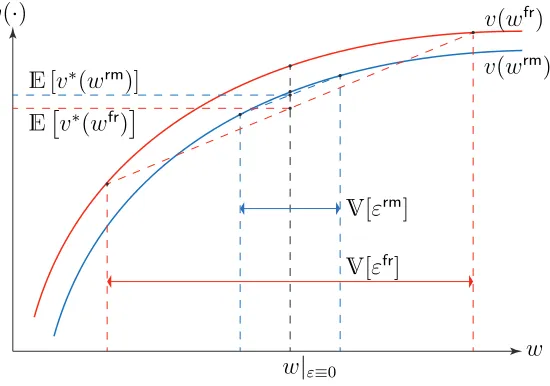
This result shows that, in our stochastic setup, there is a degree of risk aversion which leads to full participation in the symmetric redistribution agreement. An illustration of the intuition is attempted in figure 1.
w v(·)
E[v∗(wrm)]
Ev∗(wfr)
v(wfr)
v(wrm)
w|ε≡0
V[εrm]
[image:19.595.165.440.125.318.2]V[εfr]
Figure 1: Variance compression leads to participation under sufficient variance aversion.
In this section, we present a redistributive agreement model in which an individual member’s variance of income is compressed through joining the agreement. Under the assumptions we make, variance aversion implies risk aversion and, hence, risk averse players prefer less to more income vari-ance. The variance compression is reached on the part of income which is pooled and redistributed among members: the risk sharing is an effect of the reduced risk of the pooled and redistributed income. We use this property of redistributive agreements in both a contest and a sharing model which implements efficient effort choices among nations facing multiple external effects. Since this balanced budget contest must redistribute wealth in order to implement efficient efforts—through awarding member states prizes—the efficient contest compresses the income risk of member states. Although the model we present is highly stylised and our distributional assumptions are made for reasons of modelling simplicity rather than realism, the insurance property can be derived as an entirely general feature of redistributional mechanisms. This insurance aspect is a formidable reason to join international agreements which, so far, seems to have been overlooked in the agreement formation literature. Since, moreover, our variance compression results are already obtained for small agreements (with a low number of participants), this paper presents a theoretical rationale to start an agreement among a handful of progressive nations, let them reap the benefits of risk sharing, and only gradually enlarge the successful international agreement.
5
A simple symmetric example
build on this example in the online appendix to illustrate further results. All examples share the same quadratic costs and square root production function to demonstrate the basic ideas. In this setup, a benevolent planner maximising the sum of social utility net of total cost (2) maximises
(23)
max
(e,f) 2e 1/
2 −(2e−2f)2−2(e2+f2) ⇔
(
e∗ ≈0.2823,
f∗ ≈0.1882.
The corresponding individual problem (in the absence of an incentive mechanism) leads to inefficient provision of efforts because
(24)
max
(ei,fi)
e1/2
i −si(ei+ej −fi−fj)2−(e2i +fi2) ⇔
(
e≈0.3029> e∗,
f ≈0.1514< f∗,
for symmetric damage shares s1 =s2 = 1/2. Notice that, with respect to the efficient efforts, the combined externality and free-riding inherent in the problem imply that players both produce too much and abate too little.
For our incentive agreement we assume in the present example that the probability of winning the reduction award is given by the (generalised) Tullock success function specifying a player’s probability of winning as a function of that player’s effort over the total sum of efforts.33 The prize pool which
we collect for incentive purposes is P = (1−α)(e1/2
i +e
1/ 2
j ). Then, an individual’s problem under
the incentive scheme is
(25)
max
(ei,fi)
αe12
i +
fir
fr i +fjr
βP + f
r j
fr i +fjr
(1−β)P −si(ei+ej−fi−fj)2−(e2i +fi2)
for some exponentr >0specifying the precision with which the ranking selects the highest reduction effort nation among the set of competitors.34 We interpret this exponent as the accuracy with which
the agreement monitors the emissions reduction efforts of its members. Whenever we consider the Tullock example case in the following, we write the corresponding contract as hα, β;ri instead of the general ranking based contract hα, β;p(f)i.
Upon maximisation, this gives the two simultaneous first-order conditions
(26)
16ei = 8fi+
1 +α √e
i
, 2ei = 4fi+
√e
ir(α−1)(2β−1)
2fi
.
We again consider the simplest case in which symmetric nations are identical (as we did before for the planner) and set e = e1 =e2, f =f1 =f2, with si = 1/2. We then force the resulting efforts
33 Under a Tullock contest success function, the contestant with the highest effort does not necessarily win the prize.
Hence, the resulting ranking has occasionally been referred to as ‘non-fully discriminatory,’ ‘non-deterministic,’ ‘noisy,’ or ‘fuzzy.’ Our interpretation is that the ranking is inexact in the sense that the monitoring technology it is based on is not perfect. The Tullock (or Logit) form has been axiomatised by Skaperdas (1996) and follows naturally from micro-foundations `a la Fu & Lu (2012) or Jia (2008).
34 The particular monitoring technology is not very important as we generalise over the set of applicable success
functions in online appendix A.2. What is important is that the success function incorporates enough randomness in its outcome. If the ranking is too precise (as is the case with the all-pay auction—which can be viewed as the
in line with the efficient efforts by imposing e = e∗ and f = f∗ from (23) and solve (26) for the efficiency inducing design parameters hα, β;ri
(27)
α∗ = 3 5, β
∗
= 1 2 +
1 6r.
Asβ∗depends on the precision of the monitoring technologyr, the rewards scheme—and in particular the relative size of the prizes paid to the winner and loser given byβ—can be designed as seen fit and compatible with the chosen monitoring technology.35 The mechanism satisfiesβ ∈[1
2,1]ifr ≥ 1/
3, implying that the losing nation needs never pay more than the committed share 1−α. Figure 2
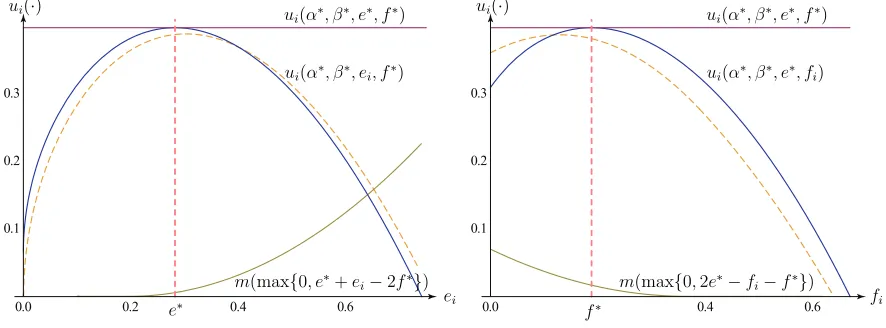
0.0 0.2 0.4 0.6
0.1 0.2 0.3
0.0 0.4 0.6
0.1 0.2 0.3
ui(·)
ei ui(·)
fi
e∗ f∗
ui(α∗, β∗, e∗, f∗) ui(α∗, β∗, e∗, f∗)
ui(α∗, β∗, ei, f∗) ui(α∗, β∗, e∗, fi)
m(max{0, e∗+e
[image:21.595.78.521.224.388.2]i−2f∗}) m(max{0,2e∗−fi−f∗})
Figure 2: The top, horizontal line is the equilibrium utility from (α∗, β∗, e∗, f∗) implementing efficient efforts e∗ andf∗. The curves below show the utility from unilaterally deviating in either effort dimension. Notice the positive utility from free-riding at zero efforts. The dashed curves give the (outside) utility from no agreement formation exhibiting both overproduction in ei and underprovision of abatementfi relative
to the socially efficient levels.
shows that participating in the contest gives higher utility than staying out and free-riding on the other’s effort. It confirms(α∗, β∗, e∗, f∗)as equilibrium in pure strategies with full participation (on an appropriately chosen plot-range outside of which utility is negative).
The economics of this example is simple: An increase in productive efforts ei causes individual
output y(ei)—and, hence, the prize pool P—as well as global pollution m(Pheh −Phfh) to
rise. Of these, the player retains shares α and si, respectively. An increase in abatement efforts fi
enlarges the player’s chance to win the prize share β in the reduction contest (while decreasing the competitors’ chances) and simultaneously decreases global pollution. Trading offαagainstβ allows us to fine-tune efforts to their efficient levels. A simple quantification based on 2011 global GDP in online appendix D gives a feeling for the magnitudes of redistribution implied by this two players example. A whole sequence of examples which extend this main example and illustrate the paper’s further results is provided in online appendix D.
35 There are well-known existence issues with symmetric pure-strategy equilibrium withr >2in rent-seeking contests
6
Concluding remarks
This paper gives theoretical reasons for independent nations which are sufficiently averse to income shocks to agree on a simple, redistributive contest, organised among themselves, which can imple-ment both efficient productive and pollution abateimple-ment efforts. Our formal results rely critically on assumptions about the curvature and separability of the involved cost and production functions. As customary in the IEA literature we assume that the abatement costs are increasing and convex (see, e.g., Barrett 2006, Diamantoudi & Sartzetakis 2006 and Carraro et al. 2009). We make similar assumptions on the damage function which are criticised, among others, by Weitzman (2010) but convexity seems nonetheless the most commonly used form (Revesz et al., 2014). Even if all these technical conditions turn out to be innocuous, the desirable characterisation of many properties of this mechanism must be left for future work: Which share of global (per capita) GDP would have to be redistributed—in reality—to the country with the highest emissions reduction in order to implement our results? Is the resulting wealth redistribution one we would like to see? Can the mechanism’s design parameters be effectively negotiated? Can international (emissions certificate) trade be successfully incorporated into the model? Answers to all these questions have significant policy implications, are to a large extent empirical and are at least partly determined by politics. At any rate we do not feel qualified to answer these questions now.
There is, however, a set of immediate challenges to the mechanism we propose which we can respond to now and would like to address in the remainder of this concluding discussion. i) Mea-surement of output. At the national level, y corresponds to GDP. But GDP measurement relies on approximation, and GDP estimates are often revised. If we are seriously contemplating large inter-national cash transfers that depend on inter-national output figures, the accuracy, and manipulability, of those measures is a concern. While it is not sufficient for the measure ofy to be ‘right on average’ in order to achieve efficiency, it is also true that our measure of efficiency (welfare maximisation) relies on the same measurement imperfections. So our mechanism is as good as acomplete information
mechanism can be in this setup. Obviously, introducing private information would improve the re-alism of our setup greatly—but since we do not have a model implementing efficiency and ensuring participation even under full information, we are reluctant to attempt a solution of the incomplete information case directly.
ii) Non-manipulability of the ‘abatement effort monitoring device.’ Similarly, the manipulability of any monitoring device must be an issue for our mechanism. It is remarkable, however, that monitoring of abatement efforts f as required by our model does not need to be perfect—on the contrary, the precision of the detector is a design element of the agreement we propose. Imperfect discrimination is one of the main features of the contest technology we employ.