This is a repository copy of Modulated patterns in a reduced model of a transitional shear flow.
White Rose Research Online URL for this paper: http://eprints.whiterose.ac.uk/93691/
Version: Accepted Version
Article:
Beaume, C, Knobloch, E, Chini, GP et al. (1 more author) (2016) Modulated patterns in a reduced model of a transitional shear flow. Physica Scripta, 91 (2). 024003. ISSN
0031-8949
https://doi.org/10.1088/0031-8949/91/2/024003
Reuse
Unless indicated otherwise, fulltext items are protected by copyright with all rights reserved. The copyright exception in section 29 of the Copyright, Designs and Patents Act 1988 allows the making of a single copy solely for the purpose of non-commercial research or private study within the limits of fair dealing. The publisher or other rights-holder may allow further reproduction and re-use of this version - refer to the White Rose Research Online record for this item. Where records identify the publisher as the copyright holder, users can verify any specific terms of use on the publisher’s website.
Takedown
If you consider content in White Rose Research Online to be in breach of UK law, please notify us by
Modulated patterns in a reduced model of a
transitional shear flow
C. Beaume
1,2, E. Knobloch
3, G. P. Chini
4, K. Julien
51
Department of Aeronautics, Imperial College London, London SW7 2AZ, UK
2
Department of Applied Mathematics, University of Leeds, Leeds LS2 9JT, UK
2
Department of Physics, University of California, Berkeley CA 94720, USA
3
Department of Mechanical Engineering & Program in Integrated Applied Mathematics,
University of New Hampshire, Durham NH 03824, USA
4
Department of Applied Mathematics, University of Colorado, Boulder CO 80309, USA
Abstract
states lie on branches exhibiting complex dependence on the Reynolds number but no homoclinic snaking.
PACS numbers: 02.40.-k, 12.39.Dc, 14.80.Hv
1
Introduction
Many parallel shear flows are characterised by a laminar unidirectional flow state that is
linearly stable regardless of the value of the Reynolds number Re ≡ UL/ν, where U is
a typical flow speed, L is a characteristic length scale and ν is the kinematic viscosity of
the fluid. Despite the stability of the laminar flow, experiments and numerical simulations
invariably reveal the presence of turbulence at large values of Re. Unlike fully developed
turbulent flows, transitional parallel shear flows are characterised by the importance of
exact coherent structures (ECS): patterned stationary or time-periodic states that are exact
solutions of the Navier–Stokes equations. These ECS are formed at moderate values of the
Reynolds number, Re = O(100), through saddle-node bifurcations and are characterized
by a small number of unstable eigendirections. As a result, they attract transitional flow
trajectories which can then be thought of as bouncing from ECS to ECS [12, 17]. Of
these, two specific ECS are of particular interest in small domains: the least unstable
lower branch solution and the associated upper branch solution. The lower branch ECS
are typically attractors on the separatrix between the stable laminar unidirectional flow
and the attracting turbulent state and are referred to as edge states [23]. As the Reynolds
number increases, the energy of this states decreases and the basin of attraction of the
laminar state shrinks in favor of that of turbulence. On the other hand, the upper branch
ECS are known to reproduce important low-order statistics of the turbulent flow associated
a backbone of turbulence in small domains [12]. The situation in large domains is naturally
more complicated, although simulations have provided some insight, notably into spatially
extended edge states [11, 25].
In small domain plane Couette flow, edge states can be decomposed into Fourier modes
in the streamwise direction and continued to higher values of the Reynolds number to
reveal a characteristic scaling with inverse powers of the Reynolds number [29], confirming
earlier scaling theory [26, 13, 27]. This particular ECS consists of a streamwise-invariant
streamwise velocity mode that remains O(1) at all values of Re: the streaks. These are
complemented withrolls, a streamwise-invariant vorticity/streamfunction mode whose
am-plitude decays likeRe−1
, andfluctuations, i.e., the streamwise dependent part of the
solu-tion that decays roughly like Re−0.9
. In this paper, we use a reduced model based on this
scaling derived by Beaume et al. [2, 5] to calculate spatially extended ECS in the spanwise
direction. In the next section, we introduce the reduced model, followed in section 3 by a
description of the new ECS computed in a moderately large domain. The paper ends with
a brief conclusion.
2
Reduced model
We consider Waleffe flow in which a fluid confined between two parallel stationary
stress-free walls is driven by a streamwise-invariant volume force varying sinusoidally with the
wall-normal direction, f = √2π2
4Re sin( πy
2 )ˆx, where y ∈ [−1,1]. The streamwise ˆx and
span-wiseˆzdirections are considered periodic. This flow was first introduced by Drazin & Reid
as an exception to Rayleigh’s inflection point theorem [10]. It has also been used by
Wal-effe as an analogy to plane Couette flow that makes it possible to project solutions onto a
small set of Fourier modes [27]. The flow was recently used to motivate the reduced model
but without the boundary layers present in Couette flow [5, 8]. As emphasized below the
reduced model that results is independent of the specific choice of base flow.
The Reynolds number scaling of the lower branch solutions observed in plane Couette
flow [29] can be used as part of a multiscale analysis by introducing the small quantity
ǫ = Re−1
≪ 1 and a slow time scale T =ǫt. The incompressible Navier–Stokes equation
for Waleffe flow then takes the form
(∂t+ǫ∂T)u+ (u· ∇)u =−∇p+ǫ∇ 2
u+ǫ√2π2
4 sin πy
2
ˆ
x, (1)
∇ ·u= 0, (2)
where u = (u, v, w) is the velocity field and p the pressure. The following expansion is
assumed:
u(x, y, z, t, T)∼u0(y, z, T) +ǫ
u1(y, z, T) +u′1(y, z, t, T)e
iαx+c.c.
+O(ǫ2
), (3)
v(x, y, z, t, T)∼ǫv1(y, z, T) +v1′(y, z, t, T)e
iαx+c.c.
+O(ǫ2
), (4)
w(x, y, z, t, T)∼ǫw1(y, z, T) +w1′(y, z, t, T)e
iαx+c.c.
+O(ǫ2
), (5)
with p expanded analogously to ensure incompressibility. In writing these expressions,
we have used the numerical observation of Wang et al. [29] and introduced the
stream-wise wavenumber α. The quantities with an overline represent streamwise-invariant
quan-tities while primed quanquan-tities represent fluctuations about this mean state. Note that
Using these expansions in equations (1) and (2), and averaging overxandt, we obtain:
∂Tu0+ (v1⊥· ∇⊥)u0 =∇ 2
⊥u0+
√
2π2
4 sin πy
2
, (6)
∂Tv1⊥+∇⊥·
v1⊥v1⊥+v′
1⊥v1′⊥
=−∇⊥p2+∇2
⊥v1⊥, (7)
∇⊥·v1⊥= 0, (8)
where v1⊥ ≡(v1, w1),v′1⊥ ≡(v′1, w1′), ∇⊥ ≡(∂y, ∂z); v′1⊥v1′⊥ denotes the (x, t)-average of
the product of the fluctuations. The fluctuations in turn obey a set of quasilinear equations
obtained by substracting the above system to the Navier–Stokes equations:
∂tu′1+iαu0u′1+ (v1′⊥· ∇⊥)u0 =−iαp′1, (9)
∂tv′1⊥+iαu0v′
1⊥ =−∇⊥p′1, (10)
iαu′
1+∇⊥·v1′⊥= 0. (11)
The above set of equations is further simplified by writing it in terms of the
stream-function φ1 for the rolls: v1 =−∂zφ1,w1 =∂yφ1, and the associated vorticity ω1 =∇ 2
⊥φ1.
Taking the divergence of the fluctuation equations (9) and (10) and using the
incompress-ibility condition (11) we obtain a Helmholtz problem for the pressure that does not involve
the streamwise fluctuation u′
1. Since this quantity is also absent from the Reynolds stress
term ∇⊥·v′
1⊥v′1⊥ there is no need to solve equation (9). Lastly, the fluctuations are
therefore the following:
∂Tu0+J(φ1, u0) =∇ 2
⊥u0+
√
2π2
4 sin πy
2
, (12)
∂Tω1+J(φ1, ω1) + 2 ∂ 2 y −∂
2 z
(R(v1w∗1)) + 2∂y∂z(w1w∗1−v1v1∗) =∇ 2
⊥ω1, (13)
(α2− ∇2
⊥)p1 = 2iα(v1∂yu0+w1∂zu0), (14)
∂tv1⊥+iαu0v1⊥ =−∇⊥p1+ǫ∇ 2
⊥v1⊥. (15)
In writing these equations we have dropped all overbars and primes and introduced the
notation J(φ1,·) = ∂yφ1∂z · −∂zφ1∂y·. The symbol R denotes the real part of a
com-plex quantity while an asterisk denotes comcom-plex conjugation. The boundary conditions
associated with Waleffe flow read:
∂yu0 =ω1 =φ1 =v1 =∂yw1 = 0 on y=±1. (16)
The reduced system (12)–(15) represents a simplification of the full three-dimensional
Navier–Stokes system. First, the equations have been projected onto a two-dimensional
spatial domain. Second, the mean equations (12) and (13) have O(1) diffusion while the
fluctuation equations (14) and (15) are weakly diffusive and quasilinear with respect to the
fluctuations. The resulting system bears some similarity with earlier work based on critical
layer theory at very large Reynolds numbers [14], but we focus here on transitional states
and hence on moderate Reynolds numbers. In particular we allow the critical layer to have
a finite width, hereafter called a critical region, by retaining a subdominant diffusion term
in equation (15). This regularizing term allows us to work with an equation set that is
defined on the entire two-dimensional domain while retaining the Re-dependence of the
ECS through the parameter ǫ≡Re−1.
connected to any trivial solution. The same difficulty is encountered in the fully
three-dimensional Navier–Stokes framework but the structure of the reduced system allows easier
computation. The streamwise-invariant quantities evolve slowly (with T) while the
fluctu-ations possess fast dynamics. The streaks in equfluctu-ations (14) and (15) can then be thought of
as frozen, resulting in a linear problem for the fluctuations. The fluctuation system is then
solved as an eigenvalue problem for the (fast) growth rate σ of the fluctuations, assuming
that u0 is fixed. Consequently, obtaining a good ECS guess involves a two-step iterative
algorithm: selecting fluctuations with the smallest growth rate for the given u0 and then
finding the corresponding steady solution (u0, φ1) from the streamwise-averaged equations.
Repeating these two steps several times while tuning the amplitude of the fluctuations
enables us to adjust the growth rate σ of the fluctuations to near zero, thereby yielding
a good initial condition that can be converged to stationary ECS using an appropriately
designed preconditioned Newton method on the complete system (12)–(15). The resulting
solution is then numerically continued in Re. A more detailed description of the method
is available in [6].
3
Extended states
In this section, we compute time-independent exact solutions of the reduced system (12)–
(15) with the boundary conditions (16). We choose α = 0.5 for which the lower branch
solution in plane Couette flow is only once unstable [23], and discretize the (y, z)
do-main using equidistributed points. Minimal meshes consist of 16 points per unit length
in the wall-normal direction and 32/π points per unit length in the spanwise direction.
The calculations are carried out in Fourier space and fully dealiased. For simplicity
we impose the three-dimensional reflection symmetry R : (u0, ω1, φ1, v1, w1)(y, z)
3.1
Spatially periodic states
Converged ECS from the reduced system (12)–(15) have already been investigated in small
periodic domains [5, 6]. For a domain of spanwise period Lz =π, these solutions take the
form of canonical ECS reminiscent of the Nagata states in plane Couette flow [21]. In
the asymptotically reduced model of Waleffe flow these states are formed at a
saddle-node bifurcation at Resn≈136, forming upper and lower ECS branches. These solutions,
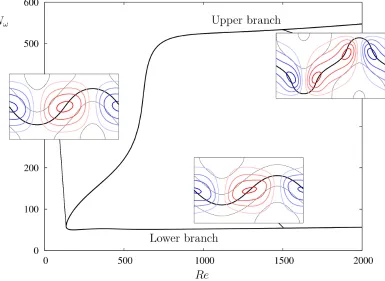
together with their bifurcation diagram, are shown in figure 1. The primary difference
between the lower and upper branch states lies in the O(1) streaks. The lower branch
streaks undulate with small amplitude aroundy = 0 as opposed to the upper branch streaks
which are more pronounced, nearly spanning the entire domain. The streak deformation
is the result of their interaction with O(ǫ) rolls which are generated by O(ǫ) fluctuations
accumulating around the u0 = 0 contour, that is, around the curve of vanishing streaks.
In the nominally inviscid problem, i.e., the regime of very high Reynolds numbers, this
contour corresponds to the so-called critical layer. The lower branch ECS display
quasi-circular rolls, explaining the sinusoidal shape of the u0 = 0 contour. As the Reynolds
number is decreased toward the saddle-node, the rolls strengthen while maintaining their
nearly circular shape and the undulation amplitude grows. The rolls associated with the
upper branch ECS are more complex: away from the saddle-node they become bimodal
with a pair of local cores replacing the single core along the lower branch. These cores
gradually move apart, toward the extrema of the u0 = 0 contour, considerably deforming
the contour near its extrema (figure 1).
3.2
Modulated states
It is known that a number of different instabilities leading to spatial modulation can arise
Figure 1: Bifurcation diagram for a domain with spanwise periodLz =π and streamwise
wavenumber α = 0.5. The normalized enstrophy: Nω = 1 D
R
Dω
2
1dy dz is shown as a
function of the Reynolds number Re. Here D represents the two-dimensional domain and D =R
D dy dz. The insets represent the lower and upper branch states at Re≈ 1500 and
the solution at the saddle-node Re ≈ Resn. The thick black line represents the critical
layer u0 = 0, and thinner black contours are plotted for u0 = ±0.5,±1. The rolls are
vicinity of saddle-nodes of spatially periodic states [1, 25]. This process has been studied in
detail in the context of the bistable Swift–Hohenberg equation posed on a one-dimensional
domain with a large spatial period [7], and becomes analytically accessible in the context of
the corresponding Ginzburg–Landau equation [15]. The resulting modulational instability
may lead to the development of a hole within the spatially periodic pattern when the
amplitude of modulation becomes so large that the periodic state is invaded by intervals
of the trivial (laminar) state.
With this in mind, we set the domain size to Lz = 4π and look for the formation
of modulated structures at Re ≈ Resn. The modulational instabilities described in the
Swift–Hohenberg equation [7, 15] or in other fluid problems [18, 3] are linear instabilities
occurring close to the saddle-node. We therefore consider the following initial conditions
g0 for our Newton method:
g0 =
h
1− χ
2
1 + cosz 2
i
gper+
hχ
2
1 + cosz 2
i
glam. (17)
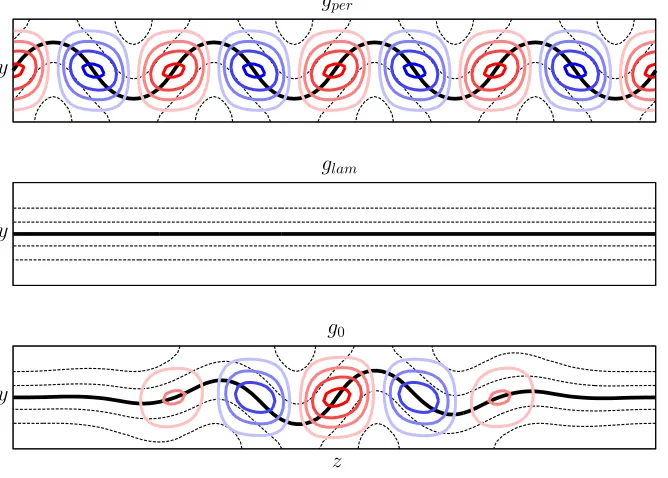
Here gper is the spatially periodic solution at the saddle-node, glam is the homogeneous
laminar solution and χ is a modulation factor. For χ = 0, the initial condition is the
unmodulated periodic state gper; as χ increases spatial modulation with wavelength 4π
(i.e., the spanwise period of the domain) of the pattern develops until χ = 1 where the
modulation is maximum: at z = 0 and z = 4π, the corresponding solution looks like the
laminar profile while at z = 2π its profile takes the form of the saddle-node solution. An
example of such an initial condition is shown in figure 2 together with the exact periodic
state gper and the trivial laminar state glam.
To identify initial conditions that converge to a modulated state, we scanned the (Re, χ)
parameter space. When the Reynolds number is too close to Resn, small values of χ
gper
glam
g0
z y
[image:12.595.134.468.266.505.2]y y
Figure 2: Relevant solutions, gper and glam, used to generate the initial condition g0 using
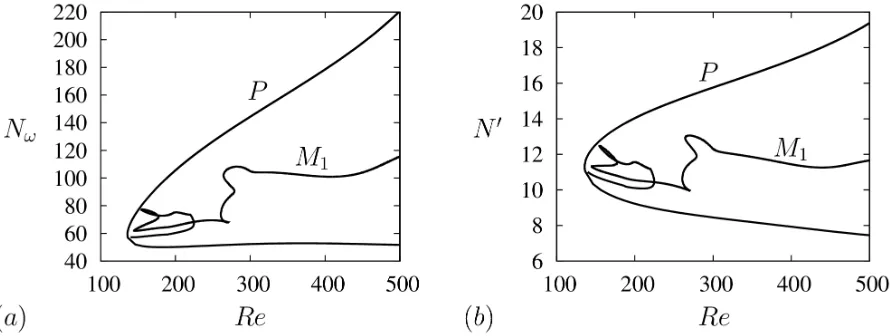
Figure 3: Bifurcation diagram for the modulated state M1 obtained using the initial
con-dition (17) for Re = 140 and χ = 0.2. The quantities represented in (a) are the same as in figure 1 while a measure of the fluctuation energy N′ = 1
D
R
D(v
2 1+w
2
1)dy dz is shown in
(b). The upper branch, lower branch and saddle-node solutions of the periodic states P
are shown in detail in figure 1.
iteration converges to it. However, beyond a threshold value of χ all attempts at
conver-gence failed, the initial condition being structurally too far away from any physical state.
Likewise, values of Rethat were too far fromResn also failed to converge regardless of the
choice ofχ. However, a converged modulated state was found forRe= 140 andχ= 0.2 and
this state was then continued using our continuation algorithm [6] to trace out the branch
M1of the corresponding solutions (figure 3). As expected, the modulated solution emerges
from a bifurcation close to the saddle-node of the branch of spatially periodic states. As
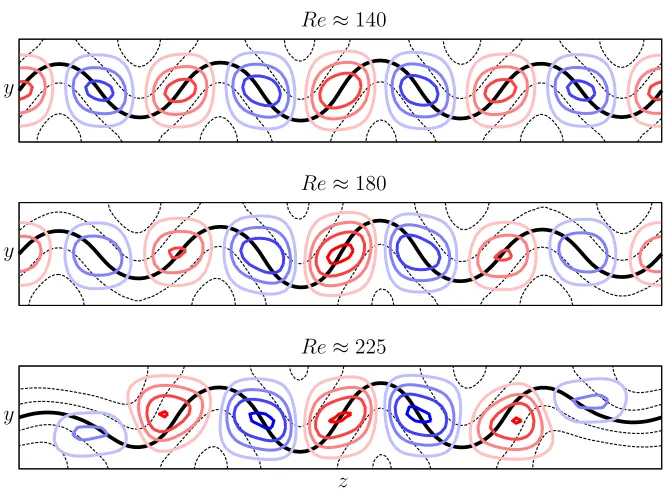
the solution branch is continued, the modulation of the roll amplitude (and therefore of
the streaks) becomes the dominant feature (figure 4): the central (counter-clockwise) roll
becomes stronger while the adjacent rolls become progressively weaker. This is particularly
noticeable close to the first saddle-node of the modulated states at Re ≈225. There, the
ccounter-clockwise roll located at the edge of the (periodic) domain has nearly completely
vanished and the adjacent clockwise rolls (in blue in figure 4) are substantially weaker,
Re≈140
Re≈180
Re≈225
z y
[image:14.595.131.463.256.502.2]y y
Figure 4: Progressive modulation of the amplitude of the modulated state as the M1
the displacement of the weaker rolls, we substitute the fluctuation velocities from equation
(15) into equation (14) and obtain:
α2
− ∇2
⊥
p1 =
2
u0
−∇⊥p· ∇⊥u0+ǫ∇⊥u0· ∇ 2
⊥v1⊥
. (18)
Here the term ǫ∇⊥u0 · ∇ 2
⊥v1⊥ arises from the nature of the asymptotics performed in
Section 2 but ǫ∇2
⊥v1⊥ is never large. However, the presence of u0 in the denominator of
the right side of equation (18) is responsible for the presence of enhanced forcing of the
fluctuations in the vicinity of the contour u0 = 0, implying that fluctuations necessarily
concentrate in the critical region, where they strengthen the rolls and in particular the
counter-clockwise central roll. The weak clockwise rolls at either end deform the u0 = 0
contour less, resulting in a displacement of the contour downward on the left and upward
on the right (figure 4, bottom panel).
As the branch M1 turns around towards lower values of the Reynolds number near
the Re ≈ 225 saddle-node, the clockwise rolls weaken while the counter-clockwise rolls
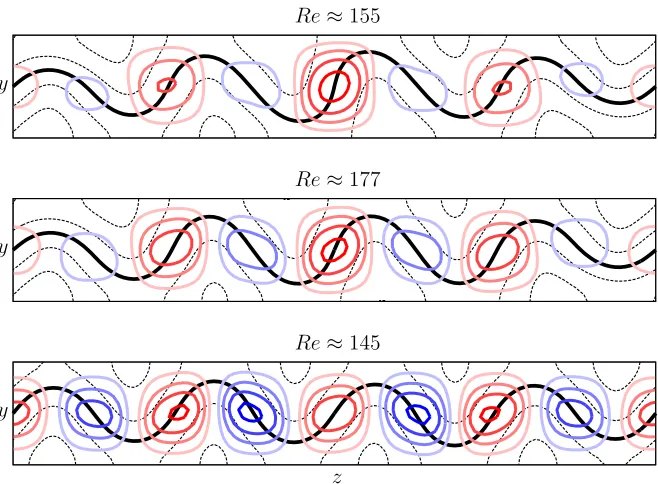
strengthen. The resulting solution is shown in figure 5 for Re= 155 (top panel). At this
location the M1 branch has a saddle-node; by the next saddle-node (atRe≈177, middle
panel) the central roll is starting to lose its dominance, and this evolution continues towards
the leftmost saddle-node (at Re ≈ 145, bottom panel) resulting in a roll pattern with
a rather weak but nonetheless complex modulation structure characterized by a weaker
central roll embedded between a pair of stronger counter-rotating rolls on either side.
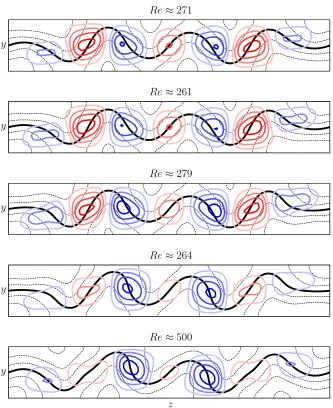
This modulation structure strengthens and by the next saddle-node at Re ≈ 271 a
fully-developed double-well modulation is present, centered on the roll pairs on either side of
the counter-clockwise central roll (figure 6). The modulation strenghens the roll pairs on
either side of the central roll while progressively weakening the central roll; this evolution
Re≈155
Re≈177
Re≈145
z y
[image:16.595.134.463.252.494.2]y y
Figure 5: Evolution of the M1 branch after its first saddle-node atRe≈225. From top to
bottom: solutions at successive saddle-nodes until the leftmost saddle-node at Re ≈145.
Re≈271
Re≈261
Re≈279
Re≈264
Re≈500
z y
[image:17.595.132.465.160.568.2]y y y y
Figure 6: Evolution of theM1 states after their approach to the periodic state (see figure 5).
The solutions are shown, from top to bottom, at the four successive saddle-nodes between
Re= 250 and Re= 300, starting from the one of least energy; the final solution is taken at Re ≈500. The corresponding bifurcation diagram is shown in figure 3. The solutions
M2atRe≈221.0741
M1atRe≈220.0320
z y
[image:18.595.132.464.111.271.2]y
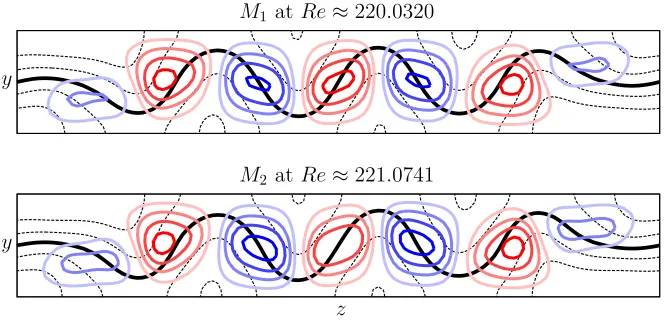
Figure 7: NearbyM1 andM2 solutions represented as in previous figures with
streamfunc-tion contours that are multiples of 0.6. These solutions are indicated with a solid dot in the corresponding bifurcation diagram shown in figure 8.
weak clockwise structures towards the outside. The next saddle-node on the left reveals
the presence of dramatic weakening of the outer counter-clockwise rolls while the inner
clockwise rolls strengthen resulting in the steeping of theu0 = 0 contour within the latter,
a process that is progressively enhanced as Re increases (figure 6, bottom panel), in a
manner suggestive of incipient roll-up. The fold at Re ≈ 145 is therefore responsible
for the splitting of the one-pulse state into two pulses. Similar splitting of a single-pulse
localized structure occurs in rotating convection [4].
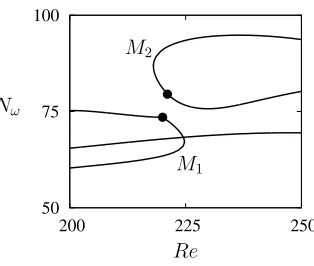
While tracking the M1 state in figure 3, we noticed the presence of a (well-resolved)
sharp angle in the direction of the branch at Re≈220 in all the quantities we monitored.
This type of event might indicate an imperfect bifurcation and therefore the existence of
another branch nearby with similar solutions. We initialized a Newton search with an
M1 solution at Re ≈ 220.0320 and slightly perturbed it by increasing its amplitude and
the Reynolds number. Using this procedure we were able to converge to another kind
of modulated state, labelled M2. The M1 solution we picked together with the M2 state
we converged to are represented in figure 7 to illustrate the similarities and differences
50 75 100
200 225 250
Nω
Re M2
[image:19.595.220.377.113.246.2]M1
Figure 8: Close-up of the region where the M1 and M2 states approach each other. The
solution on M1 indicated by the solid dot was used to converge to the M2 solution also
indicated by a solid dot.
Figure 9: Bifurcation diagram for the modulated states M1 and M2. The quantities
repre-sented are the same as in figure 3.
bifurcation diagram of the M2 states is shown in figure 9. Continuation of the modulated
statesM2shows that these states are created at a saddle-node atRe≈218. The upper and
lower branches emanating from this saddle-node then have completely different fate. The
upper M2 branch evolves monotonically to larger Reynolds numbers while the modulation
of the amplitude of the rolls increases and the size of the central roll decreases. This
simple evolution is shown in figure 10. The lower branch has a more complex structure,
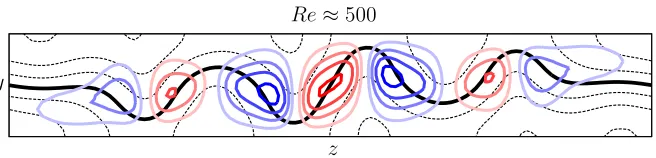
[image:19.595.75.522.320.487.2]Re≈500
[image:20.595.136.464.109.188.2]z y
Figure 10: Solution taken along the upper M2 branch at Re ≈ 500. The corresponding
bifurcation diagram is shown in figure 9. The solution is represented as in figure 2 with multiples of 0.6 for the streamfunction contours.
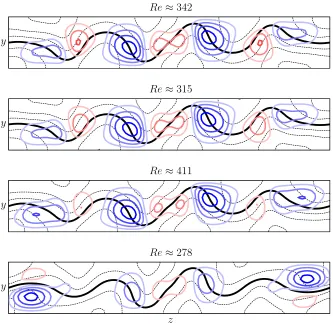
remaining counter-clockwise rolls also weaken leaving a structure dominated by a pair of
strong clockwise rolls. This process manifests itself in the presence of a small loop between
Re ≈ 315 and Re ≈ 342 and terminates near the Re ≈ 411 saddle-node in figure 11.
The branch then turns around and both N and N′ increase dramatically. During this
process the two clockwise rolls near the center of the domain that dominate the flow at
Re ≈ 411 are swamped by the growth of a pair of clockwise rolls near either side of the
domain and the associated elimination of counter-clockwise rolls from all but the center
of the domain where a weak counter-clockwise roll persists. It is significant that the new
clockwise rolls that appear are no longer centered on the u0 = 0 contour. This appears to
be a consequence of their proximity in a domain with periodic boundary conditions and
of the resulting roll-up. This incipient roll-up may in turn be responsible for the dramatic
increase in roll and fluctuation energies observed in figure 9. This behavior hints at a
possible failure of the asymptotic approach in this regime, although we have not pushed
the calculations into this regime. We reiterate that all the solutions reported here are fully
Re≈342
Re≈315
Re≈411
Re≈278
z y
[image:21.595.132.465.212.537.2]y y y
Figure 11: Solutions along the lower M2 branch at successive saddle-nodes at Re ≈ 342,
Re ≈ 315, Re ≈ 411 and Re ≈ 278. The corresponding bifurcation diagram is shown in
figure 9. The solution is represented as in figure 2 with multiples of 0.7 for the stream-function contours, except for the Re≈ 278 saddle-node where multiples of 1.2 have been
4
Conclusion
In this paper, we have obtained and numerically continued the first spanwise-modulated
states in a reduced model of parallel shear flow, focusing on time-independent solutions
with the symmetryR. These states were found using insight from pattern-forming systems:
the saddle-node of subcritical spatially periodic states in extended systems is known to give
rise to modulational instabilities. We constructed an artificial modulation of the
saddle-node solution and converged it to a modulated state referred to as M1 that we have
successfully continued to unveil a complex bifurcation structure reminiscent of fully
three-dimensional shear flows [22, 12, 19]. Additional solutions such as theM2 modulated states
were identified by perturbing theM1 state close to what looks like an imperfect bifurcation,
and these were likewise continued numerically to substantially different Reynolds numbers.
We mention that states with a shift-reflect symmetry, corresponding to a cross-stream
reflection followed by a half wavelength shift in the streamwise direction, are also expected
to be present [24, 6]. Such solutions are not stationary, however, but drift steadily in the
streamwise direction, i.e., they are traveling waves. We have not computed traveling states
of this type.
The reduced model used for this purpose has been derived based on the scaling
proper-ties of the lower branch state observed in plane Couette flow [29]. The resulting equations
are in effect projected in the streamwise direction on the fundamental and first Fourier
components of the velocity and pressure fields but spanwise and wall-normal directions are
treated as in fully simulated flows. As a result, 3 real fields (u0, ω1 and φ1) and 3 complex
fields (p1,v1 andw1) have to be solved for on aNy×Nz mesh, whereNy (resp. Nz) stands
for the number of points in the wall-normal (resp. spanwise) direction. The computation
of such states using a direct numerical solver on the primitive equations typically involves 4
withNx =O(10) at least [23, 12, 19]. The calculations presented here would therefore have
been at least 10 times slower had a fully three-dimensional solver been used. Additional
difficulties arise in the Newton iteration as the number of degrees of freedom increases.
The finding of the modulated states M1 and M2 in a reduced model has several
impli-cations for transitional shear flows. It shows that the reduced model (12)–(15), originally
designed to capture the lower branch solutions, not only captures the upper branch states,
but also bifurcations from these states and even more complex, unconnected states. This
property of the reduced model is expected to provide substantial help in the systematic
study of both extended and spatially localized ECS [24]. In the present study no ECS
localized in the spanwise direction were found but some of the modulated states strongly
suggest that spanwise-localized modulated states do, in fact, exist although no homoclinic
snaking was observed. The M1 and M2 states nearly coincide in an imperfect
bifurca-tion around Re = 220. Had they connected their connection would have given rise to a
branch starting from the saddle-node of the periodic states, spending some time around
Re = 220, before extending monotonically to large Reynolds numbers and resulting in
solutions consisting of a spatially modulated roll pattern with a simple structure. Similar
modulated states that do not snake but instead extend monotonically to large parameter
values have been found in Marangoni convection [1] and studied in detail in the context
of binary fluid convection [20]. These studies, in conjunction with earlier studies of model
equations such as the Swift–Hohenberg equation [7, 9], indicate that in finite domains the
behavior of branches of modulated structures is strongly affected by the spanwise spatial
period imposed on the system, suggesting that for a different choice of this period
homo-clinic snaking may in fact be present in the reduced shear flow model studied here. This
is particularly so for moderately large domains, such as Lz = 4π, as used here. However,
despite this limitation, the present study serves as a proof of concept that reduced models,
been designed for, thereby paving the way for future studies on larger domains at lesser
computational cost.
Acknowledgments: This work was presented at the Turbulent Mixing and Beyond
Workshop at the Abdus Salam International Centre for Theoretical Physics (Trieste, Italy)
in August 2014 by CB. He is grateful for the financial support received from the conference
organizers. The research reported here was supported by the National Science
Founda-tion under grants DMS-1211953 and DMS-1317596 (EK), 0934827 (GPC) and
OCE-0934737 and DMS-1317666 (KJ).
References
[1] P. Assemat, A. Bergeon and E. Knobloch, Fluid Dyn. Res., 40 (2008) 852–876
[2] C. Beaume, Proc. Geophysical Fluid Dynamics Program, Woods Hole Oceanographic
Inst. (2012) 389–412
[3] C. Beaume, E. Knobloch and A. Bergeon, Phys. Fluids, 25 (2013) 114102
[4] C. Beaume, E. Knobloch and A. Bergeon, Phys. Fluids, 25 (2013) 124105
[5] C. Beaume, E. Knobloch, G. P. Chini and K. Julien, Fluid Dyn. Res., 47 (2015) 015504
[6] C. Beaume, G. P. Chini, K. Julien and E. Knobloch, Phys. Rev. E, 91 (2015) 043010
[7] A. Bergeon, J. Burke, E. Knobloch and I. Mercader, Phys. Rev. E, 78 (2008) 046201
[8] M. Chantry, L. S. Tuckerman and D. Barkley, arXiv:1506.05002 (2015)
[9] J. H. P. Dawes, SIAM J. Appl. Dyn. Syst., 8 (2009) 909–930
[10] P. G. Drazin and W. H. Reid, Hydrodynamic Stability, Cambridge University Press
[11] Y. Duguet, P. Schlatter and D. S. Henningson, Phys. Fluids, 21 (2009) 111701
[12] J. F. Gibson, J. Halcrow, and P. Cvitanovi´c, J. Fluid Mech., 638 (2009) 243–266
[13] P. Hall and F. T. Smith, J. Fluid Mech., 227 (1991) 641–666
[14] P. Hall and S. J. Sherwin, J. Fluid Mech., 661 (2010) 178–205
[15] H.-C. Kao and E. Knobloch, Phys. Rev. E, 85 (2012) 026211
[16] G. Kawahara and S. Kida, J. Fluid Mech., 449 (2001) 291–300
[17] G. Kawahara, M. Uhlmann and L. van Veen, Annu. Rev. Fluid Mech., 44 (2012)
203–225
[18] D. Lo Jacono, A. Bergeon and E. Knobloch, Phys. Fluids, 22 (2010) 073601
[19] K. Melnikov, T. Kreilos and B. Eckhardt, Phys. Rev. E, 89 (2014) 043008
[20] I. Mercader, O. Batiste, A. Alonso and E. Knobloch, J. Fluid Mech., 667 (2011)
586–606
[21] M. Nagata, J. Fluid Mech., 217 (1990) 519–527
[22] A. Schmiegel, PhD dissertation, Marburg University (1990)
[23] T. M. Schneider, J. F. Gibson, M. Lagha, F. de Lillo and B. Eckhardt, Phys. Rev. E,
78 (2008) 037301
[24] T. M. Schneider, J. Gibson and J. Burke, Phys. Rev. Lett., 104 (2010) 104501
[25] T. M. Schneider, D. Marinc and B. Eckhardt, J. Fluid Mech., 646 (2010) 441–451
[28] F. Waleffe, J. Fluid Mech., 435 (2001) 93–102