THE COUNCIL
OF THE EUROPEAN COMMUNITY
Council of the European Communities
General Secretariat
Information Service
The Council
of the
European Community
An introduction
to its structures and activities
Cataloguing data can be found at the end of this publication.
Situation on 30 October 1990
Text by Jean-Pierre Sabsoub Photographs by Leon Crabbe
Cover photo: maquette of the future Council building
Luxembourg: Office for Official Publications of the European Communities, 1992
ISBN 92-824-0969-4
©
ECSC-EEC-EAEC, Brussels • Luxembourg, 1991Reproduction is authorized, except for commercial purposes, provided the source is acknowledged.
Table of contents
Foreword
- The European Community and the Council's role A - HISTORICAL BACKGROUND
B - COMMUNITY INSTITUTIONS AND BODIES1 I. 2. 3. 4. 5. 6.
The European Parliament The Commission
The Court of Justice of the European Communities The Court of Auditors of the European Communities The Economic and Social Committee
The European Investment Bank C - THE COUNCIL
D - EUROPEAN POLITICAL COOPERATION E - THE EUROPEAN COUNCIL
II - The organization and working methods of the Council A - LEGAL BASES
I. The Treaties
2. Single European Act 3. Rules of Procedure
B - THE WORKING FRAMEWORK
I.
Meetings (General points - Agenda - Minutes) 2.1. Permanent Representatives Committee (Coreper) 2.2. Special Committee on Agriculture3. Committees 4. Working parties
5. General Secretariat (General points - The Secretary-General - Organization and role)
C DECISION-MAKING PROCEDURES
I. Before the vote - How the Council establishes its intentions 1.1. Standard procedure
(a) Commission proposal
(b) Examination of the Commission proposal
(c) Permanent Representatives Committee proceedings (d) Written procedure
1 Other than the Council.
1.2. Cooperation procedure 34
1.3. Budget procedure 36
(a) Presentation of the budget procedure 36
(b) 'Tripartite dialogue' and coordination procedure: special
cases in the budget procedure 38
2. The vote - Taking decisions 39
3. After the vote - Ways in which the Council's intentions are
conveyed 41
3.1. Council acts 41
(a) Regulations 42
(b) Directives 42
(c) Decisions 42
(d) Recommendations, opinions and Council assent 43 (e) Other ways in which the Council's intentions are conveyed 43 (f) 'Mixed' acts and decisions of the representatives of the
Governments of the Member States 43
3.2. Implementing and management powers 43
Ill Council activities in the world 45
1. Relations with non-member countries in general 45 2. Association and cooperation with certain non-member countries 47
3. The Lome ACP-EEC Convention 47
4. Specialized Committees 49
5. European Political Cooperation 50
IV -
The Council and the Community's future ANNEXES1.
2. 3. 4.The Treaties
Recent and future Presidencies
Voting procedures laid down by the EEC Treaty
Association Agreements and Cooperation Agreements with non-member countries of the Mediterranean basin
BIBLIOGRAPHY TABLES 1. 2. 3A. 3B. 4.
Community institutions and bodies
Organization chart of the Council General Secretariat Diagram showing how the Council establishes its intentions (standard procedure)
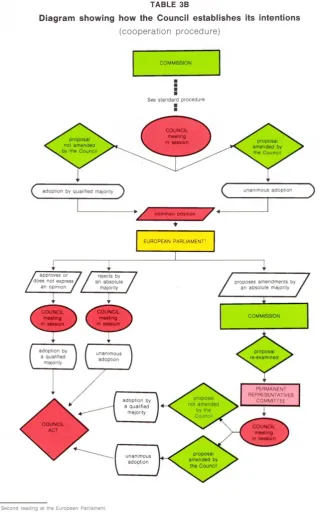
Diagram showing how the Council establishes its intentions (cooperation procedure)
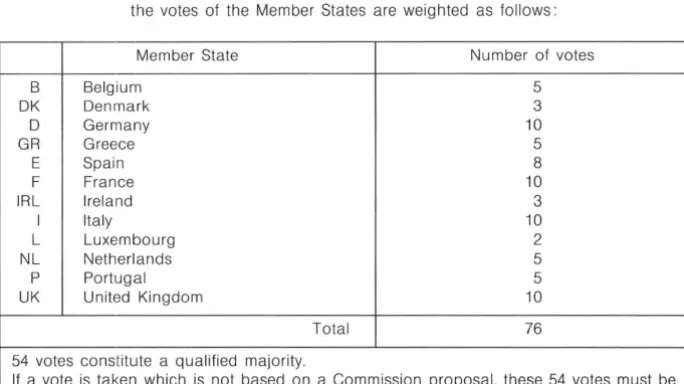
Weighting of votes
Foreword
The story of the development of the Communities up till now, and certainly the story (still to be told) of its future develop-ment, is one of a gradual and careful transfer of portions of national sovereignty to European institutions, for the greater good of all concerned. It follows that, just as each Member State has always worked out procedures and mechanisms for for -mulating and implementing its policies, so the Community is no less in need of proce-dures and mechanisms of its own. The only difference is that national procedures and mechanisms are-by and large-familiar to the citizens of the country concerned,
because they are part of their culture, their history, their immediate physical environ-ment, and indeed their educational
curri-' l
Niels Ersb0//
Secretary-General of the Council.
culum, while Community procedures and mechanisms are to a great extent still unknown or even misportrayed and misunderstood, which is even more serious. This is regrettable, and unnecessary, because seen from the inside the Commun-ity's way of doing things is actually surprisingly rational and efficient, given the size of the tasks that it has to undertake and the fact that it is continually called upon to break new ground.
The Council is at the heart of the Community's legislative process; working from within the Council, the Information Service of the General Secretariat has attempted to set out, as clearly and as exhaustively as possible, all aspects of the Council and its work. This has-perhaps surprisingly- not been done by us before in published form, and I have long felt that an information brochure of this type would fulfil a very real need.
Niels Ersb0ll
I
The European Community
and the Council's role
A -
HISTORICAL BACKGROUND
The Second World War and its harrowing consequences led the leaders of many Western European States to strive for closer union between their countries, while the wish to avoid the mistakes made just after the First World War drove them to seek solutions to problems through economic cooperation or even integration.
The Organization for European Economic Cooperation (OEEC) Treaty was signed in April 1948.1 On the initiative of Winston Churchill in particular, a Congress on Europe was held in The Hague in May 1948. The Council of Europe was set up in May 1949.
It is however the declaration on 9 May 1950 of the French Minister for Foreign Affairs, Robert Schuman, which is regarded as the starting point of the new process of European unification.
In his declaration, inspired to a large extent by Jean Monnet, Robert Schuman proposed the creation of a large European market in the framework of a European Federation open to all the States of the continent. His initiative, limited initially to two well-defined and at the time strategic sectors, led to the signing on 18 April 1951 in Paris of the treaty establishing the European Coal and Steel Community (ECSC), concluded for a period of 50 years. Six countries became members: Belgium, the Federal Republic of Germany, France, Italy, Luxembourg and the Netherlands.
Attempts to set up a European Defence Community and a European Political Community ended in failure. However, in June 1955 in Messina the Governments of the Europe of The Six decided to continue their efforts towards economic integration begun for coal and steel by extending it to the entire economy and to the use of atomic energy.
The negotiations which opened in May 1956, on the basis of a report from an intergovernmental committee chaired by the Belgian statesman Paul Henri Spaak, led to the signing by the Six, on 25 March 1957 in Rome, of the Treaties establishing the European Economic Community (EEC) and the European Atomic Energy Community (EAEC or Euratom). These two Treaties are of unlimited duration.
The favourable results of the development of the Six prompted Ireland, Denmark, the United Kingdom and Norway to apply to join the three Communities in 1961/62.
These requests encountered the veto of the French Government, which was to be upheld in 1967, at the time of the second request for accession by these four countries.
At the summit meeting in The Hague on I and 2 December 1969, the Heads of State or Government of the Six gave negotiations the political impetus required: the Accession Treaties were signed on 22 January 1972 in Brussels and ratified shortly afterwards by the parliaments of Denmark, 1 Ireland 1 and the United Kingdom and
those of the Member States. On I January 1973, the enlarged European Community had nine members.
After the return to democracy of the southern European countries, a further stage in the enlargement of the Community began. The requests for accession by Greece (12 June 1975), Portugal (28 March 1977) and Spain (28 July 1977) were followed by lengthy negotiations. The Treaty of Accession of Greece was signed in Athens on 28 May 1979: Greece became the I Oth Member State on I January 19BI. The Treaty with Spain and Portugal was signed on 12 June 1985 in Lisbon and in Madrid successively. Accession became effective on 1 January 1986: the European Community now had 12 Member States.2
1 Following a favourable referendum in these countries.
2 As a result of its integration in the Federal Republic of Germany on 3 October 1990, the territory of the former German Democratic Republic is an integral part of the European Community.
8 -
CO
MM
UN
I
TY
I
NST
I
TUT
I
ONS
AND BODIES
1
Although we usually speak of the 'European Community' as a whole, which
emphasizes its unity, the three Communities are still legally separate. They share several common institutions: The European Parliament, the Council, 2 the Commis-sion 2 and the Court of Justice. The Council and the Commission are assisted by an Economic and Social Committee. The audit is carried out by a Court of Auditors.
1
.
The European Parliament
The European Parliament, established by the Rome Treaties as the single 'Assembly' for the three Communities, replaced the pre-existing ECSC Assembly. At their inaugural meeting in March 1958 in Strasbourg, the Assembly representatives had already introduced in some languages the term 'European Parliament', officially adopted subsequently by the Single European 4\ct. 3
Consisting at first of delegates from national Parliaments, the European Parlia -ment is elected by direct universal suffrage, following a Council decision in
September 1976, in accordance with the objective laid down by the Treaties: the first election was held in June 1979 and the second in June 1984.
Since the third election, in June 1989, the European Parliament has had 518 members from the 12 Member States, each country being entitled to a specific number of representatives. They hold office for five years and are divided into political groups organized at Community level, not national delegations.
The European Parliament elects its President, currently Enrique Baron Crespo, 4 and 14 Vice-Presidents. It holds its plenary sessions in Strasbourg, generally for one week each month. Between sessions, the 18 Parliamentary Committees prepare its work, mainly in Brussels. The European Parliament's General Secretariat and its
departments, located in Luxembourg, employ some 3 000 officials, half of them for translation and interpreting duties.
Although the European Parliament's powers are more limited than those of national parliaments, they are nevertheless very extensive. It exercises permanent control over the Commission, particularly when examining the General Report on the activities of the European Communities, at the beginning of each year, or
1 Other than the Council.
2 Since 1 July 1967, the date of the entry into force of the Treaty establishing a Single Council
and a Single Commission of the European Communities, signed on 8 April 1965 in Brussels, and also called the Merger Treaty. These institutions were previously separate for each Community.
3 See page 17. 4 Since 25 July 1989.
4
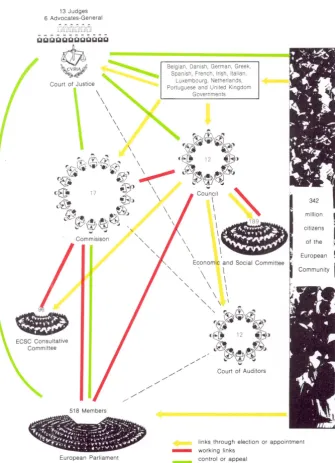
TABLE 1
Community institutions and bodies
(simplified diagram)
13 Judges 6 Advocates-General
JSJ~~~u]rfu
gg
gggggggggg
@
w
Court of Justice
ECSC Consultative Committee
518 Members
European Parliament
Belgian, Dan1sh, German, Greek, Spanish, French, Irish, Italian,
Luxembourg, Netherlands, Portuguese and United Kingdom
Governments
342
million
citizens
of the
European
Community
links through election or appointment - working links
[image:10.393.38.373.73.536.2]through written or oral questions.1 It can compel the Commission to resign, by
adopting a censure motion carried by a two-thirds majority.
The European Parliament adopts resolutions on its own initiative concerning the various aspects of Community and international policy. It set in motion the proceedings which led to the Single European Act. 2 It takes part in the preparation of Community legislation,3 and, above all, adopts the Community budget.4
The European Parliament's debates, opinions and resolutions are published in the Official Journal of the European Communities.
2. The Commission
The Commission has 17 Members, at least one from each Community country. Commissioners are appointed by common agreement by the Governments of the Member States; their term of office is four years and renewable.
The President, at present Jacques Oelors, 5 and the six Commission Vice-Presidents are appointed from among its Members for two years in accordance with the same procedure.
Commissioners act in the interest of the Community alone, and may not receive instructions from any Government. If the European Parliament adopts a censure motion, the Members of the Commission must resign from their duties as a body.
Commission decisions are taken by a majority of Members. The Commission departments, located mainly in Brussels but with some in Luxembourg, include some 14 000 staff, of whom about 800 are assigned to research.
Under the Treaties the Commission is entrusted with many important responsi-bilities. In the first place, as guardian of the Treaties, it ensures that their provisions and those taken by Community institutions are implemented. For this purpose, it has powers of investigation and may instigate infringement procedures at the Court of Justice. It may grant temporary dispensations to the rules of the Treaties where the Treaties so provide in exceptional cases (safeguard clause).
The Commission also plays a full part in the legislative proceedings of the Communities: it submits its communications and proposals to the Council and a member of the Commission attends each Council meeting.
Finally, it is as a rule the Commission which exercises powers of implementation for Council Decisions, either alone or assisted by a Committee which is usually
1 In 1989: 3 048, including questions put to the Council and European Political Cooperation.
In 1988 the figure was 3933 and in 1987 4051.
2 See page 17.
3 See page 31 et seq.
4 See page 36 et seq. 5 Since 6 January 1985.
composed of representatives of the Governments of the Member States.1 In addition the Commission administers the various Community funds and pro-grammes. It adopts regulations and directives, takes decisions and formulates recommendations and opinions, which are all published in the Official Journal of the European Communities.
3. The Court of Justice
of the European Communities
The Court of Justice of the European Communities, located in Luxembourg, ensures that the law is observed in the interpretation and application of the Treaties: it rules on the legality of the acts of the Member States and the In-stitutions. It consists of 13 Judges, assisted by six Advocates-General; the latters' role is to make reasoned submissions in open court on cases brought before the Court.
The Judges and Advocates-General are appointed by common accord of the Governments of the Member States for a term of six years. The Judges elect the President of the Court of Justice from among their number for a term of three years. He may be re-elected, just as the others may be re-appointed.
The Court of Justice, which had already been in existence since 1951 as an institution of the ECSC, has extended its jurisdiction to all Community domains since it began to function in October 1958.
A Court of First Instance was attached to it in 1988: its role is to examine certain classes of action or proceeding brought by natural or legal persons. It is composed of 12 members.
The Court of Justice and the Court of First Instance have about 730 staff.
Most of the cases referred to the Court do not come from Member States or Community institutions but from private businesses or ordinary individuals. At the request of national courts, the Court rules on the validity and interpretation of the provisions of Community law.
Community law prevails over national law. The rulings of the Court of Justice are enforceable in the Member States.
4. The Court of Auditors
of the European Communities
The Court of Auditors of the European Communities, set up in October 1977,2 replaced, with extended powers, the pre-existing external control bodies: a control commission for the EEC and Euratom and an auditor for the ECSC.
6
See page 25 and also page 43.
By the Treaty amending Certain Financial Provisions of the Treaties establishing the
The Court of Auditors consists of 12 members, one for each Member State, appointed by common agreement for six years by the Council after consulting the European Parliament. The members appoint their President from among their number for a term of three years. The Court of Auditors, located in Luxembourg,
has an establishment of some 380 officials.
The Court of Auditors examines the accounts and the legality of all Community revenue and expenditure, and as a rule also those of any body created by the Community. Its decisions are taken by a majority of its members. The results of the audits carried out by the Court of Auditors are published in reports, the most important of which is the annual report on the Community accounts.
5.
The Economic and Social Committee
The Economic and Social Committee, established by the Rome Treaties, held its first plenary session in May 1958. It consists of 189 representatives of the various categories representing the economic and social life of the Member States.
Members are appointed by the Council acting unanimously for a renewable term of office of four years. The Committee appoints its Chairman and its Bureau from among its members for a term of two years. About 500 officials work in its offices,
located in Brussels.
The Economic and Social Committee is a consultative assembly of the Commun-ity, based on a model common to most of the Member States. Its members continue to perform their respective professional duties, but come to Brussels to take part in working party meetings and, about once a month, to attend plenary sessions.
The Economic and Social Committee delivers opinions, not only when consulted by the Council and the Commission, 1 a mandatory requirement in some cases, but also on its own initiative. Its opinions are published in the Official Journal of the
European Communities.
6. The European Investment Bank
The EEC Treaty created the European Investment Bank, an independent body
located in Luxembourg whose members are the 12 Community States.2 The Bank's mission is to help the balanced development of the Community. By granting loans
and guarantees in all sectors of the economy it participates in the development of the less developed regions, the modernization or restructuring of businesses or the
creation of new jobs and in projects of common interest to several Member
States.
1 The Commission is assisted by an ECSC Advisory Committee for questions affecting coal
and steel, and by a Scientific and Technical Committee for some questions covered by the
Euratom Treaty. These Committees, which are advisory, have a similar structure to that of
the Economic and Social Committee.
The European Investment Bank also grants loans under the agreements between the Community and the ACP States and those of the Mediterranean Basin, as well as to overseas countries and territories and-in certain cases-to other non-member countries. In this capacity it is represented at meetings of the Council of
the European Communities and at those of other bodies, when questions affecting
financial cooperation with those countries have to be examined.1
*
* *
The Community has nine official languages, in which the Official Journal of the European Communities is published. 2
*
*
*
The unity of the Community institutions is symbolized by the Community flag: 3 raised for the first time on 29 May 1986, it is rectangular with a circle of 12 gold stars in the middle on a blue background.
1 See also page 49.
2 Spanish, Danish, German, Greek, English, French, Italian, Dutch and Portuguese, following the alphabetical order of the original classification. Some basic texts are published in Irish.
3 This flag is already used by the Council of Europe.
C -
THE COUNCIL
The Council of the European Communities consists of representatives of the 12 Member States, each Government delegating one of its members to it. This is why it is also called Council of Ministers, a title which further emphasizes its nature as a
representative institution of the Member States. It is in the Council that the particular interests of the Member States and those of the Community meet, and it is there that agreement must be reached.
The composition of the Council varies according to the subjects to be dealt with: 1 as a general rule national ministers take part in meetings held on their respective fields (agriculture, environment, transport, economics and finance etc.).
The Council meets when convened by its President on his initiative or at the request of one of its members or of the Commission. The Presidency of the Council is held by each Member State in turn for six months in accordance with a pre-established order.2 The President carries out his function of coordination and synthesis in the fullest possible way.
The President ensures the smooth running of Council proceedings and endeav-ours to find practical solutions to the problems submitted to the Council. Ministers also meet at informal meetings, in order to discuss topics of general interest together and to have as free as possible an exchange of views on them. These informal meetings, normally limited to seven per Presidency, do not replace the normal work of Councils.
The Council's Presidency-in-Office also cooperates with the previous and
following Presidencies to achieve better organization of work in certain areas, for example the internal market: in that case the three Presidencies together are known as the Troika.
In accordance with the Rome Treaties (EEC, Euratom), the Council coordinates
the general economic policies of the Member States and has powers of decision. All general provisions or those of a certain importance are adopted by the Council
1 Thus in 1989 the Council had 89 meetings in 19 different fields.
2 The rhythm of work which the first half of the year represents for a Presidency is not the
same as that represented by the second half: for example, apart from the effect of the different holiday periods, it may be said that work on agricultural prices takes place in the first half while work on the annual budget of the Communities takes place in the second half. In a Community with 12 members, to avoid a given Member State always having to hold the Presidency during the same period in the course of each cycle of six years, the Treaties provide for two cycles for holding the Presidency. In the first cycle, the Presidency is held in accordance with the following order: Belgium, Denmark, Germany, Greece, Spain,
France, Ireland, Italy, Luxembourg, the Netherlands, Portugal, and the United Kingdom,
while in the following cycle the order is as follows: Denmark, Belgium, Greece, Germany,
France, Spain, Italy, Ireland, the Netherlands, Luxembourg, the United Kingdom, and Portugal.
which, except in a very small number of cases, can only take a decision on the basis of a Commission proposal.
An important difference between the Rome Treaties and the Paris Treaty (ECSC) is that under the former the Council generally decides on the basis of a proposal
from the Commission, while according to the latter the Commission generally decides when the Council has given its assent.1
The Rome Treaties provide that unless there are provisions to the contrary the
Council's decisions are reached by a majority of its members, i.e. by simple majority.
However, in many cases the Treaties prescribe unanimity or a qualified majority.
With the entry into force of the Single European Act,2 qualified majority voting has been extended to certain areas which hitherto required unanimity, for example most matters involving the achievement of the internal market, 3 economic and social cohesion, and technological research and development.
The Council has a staff in Brussels 4 of a little over 2 000 officials. In April, June and October, the Council holds its meetings in Luxembourg, while the other meetings are normally held in Brussels. 5
See page 43. See page 17.
3 See also Annex 3.
4 The General Secretariat: see page 26.
5 See the Decision of the Representatives of the Governments of the Member States on the
provisional location of certain institutions and Treaties Departments of the Communities, dated 8 April 1965. As an exception to the rule, a meeting may be held outside the normal places of work: for example, the 11 04th Council meeting was held on 20 September 1986 in Punta del Este, on the occasion of the GATT Conference, and the 1283rd Council meeting was held on 4 December 1988 in Montreal in the same context.
D
-
EUROPEAN POLITICAL COOPERATION
Foreign policy cooperation between the Community countries, instituted by the adoption of the Luxembourg report in 1970 and subsequently extended, was given confirmation by the Single European Act in February 1986. The Act supplemented the procedures agreed on and tt1e practices progressively established between Member States, thus basing such cooperation on a Treaty for the first time.
European Political Cooperation and the European Communities, as the Single Act states, 'have as their objective to contribute together to making concrete progress towards European unity'.
To achieve this aim, the Member States endeavour jointly to formulate and implement a European foreign policy. They inform and consult each other on any foreign policy matters of general interest so as to ensure that their combined influence is exercised as effectively as possible, in particular through the conver-gence of their positions and the implementation of joint action. Each Member State takes account of the positions of the other partners in adopting its positions and in its national measures.
In addition, in order to increase their capacity for joint action in the foreign policy field, the Member States ensure that common principles and objectives are gradually developed and defined. The determination of a common position on most of the major international issues constitutes a point of reference for the policies of the Member States.
Cooperation in international forums is an important aspect of European Political Cooperation. The diplomatic missions of the Twelve in non-member countries also
cooperate closely both on political questions and on other problems. In the case of joint measures on behalf of the Twelve, action is taken by the Presidency-in-Office or the Troika, 1 thereby providing proof of the reality of European cooperation.
This cooperation is implemented in the framework of the following structures: European Council ;2 meetings of Ministers for Foreign Affairs, at least twice per Presidency in the framework of European Political Cooperation (and if required also on the occasion of meetings of the Council of the European Communities); the Political Committee, which brings together officials with responsibility for political affairs from the Ministries of Foreign Affairs; and the Correspondents Group, which includes an official from the Ministry of Foreign Affairs of each country. About 20 Working Parties meet in accordance with the directives of the Political Committee.
The Commission is fully associated with the work of Political Cooperation; it is represented at all its meetings. The Member States also ensure that the European Parliament is closely associated with such cooperation: the Presidency keeps the European Parliament informed of the foreign policy issues which are being
The Presidency-in-Office and the previous and following Presidencies. See page 9. See page 14.
examined within the framework of Political Cooperation and ensures that the Parliament's views are duly taken into consideration.
The Presidency is held by the Member State presiding over the Council of the European Communities. In the preparation and implementation of Political Cooper-ation activities, it has been assisted since the beginning of 1987 by a Secretariat located in Brussels.1 It consists of a Head of Secretariat, appointed by the Ministers for Foreign Affairs, and five officials seconded from their Ministries, in accordance with a rota system. It has a small administrative and technical staff, drawn from national civil services. European Political Cooperation meetings are held in the capital of the country holding the Presidency or at the Secretariat.
1 In the premises of the Council General Secretariat, under an Agreement signed in 1986 with
E -
THE
EUROPEAN COUNCIL
At a summit conference in December 197 4 in Paris, the Heads of State or Government of the Member States decided to meet, accompanied by the Ministers for Foreign Affairs, three times a year and whenever necessary, as Council of the Community and in the context of political cooperation. It was also provided that the President of the Commission, assisted by a Vice-President, should participate.
The European Council, as it is now known, has taken the place of the European Summits held previously, one of the most notable of which was held in The Hague
in December 1969. The decisions taken on that occasion led to Community policy
being relaunched in numerous fields: the common agricultural policy, the own resources system, negotiations with countries applying for membership, progress towards political unification and so on.
These meetings at the highest level, by putting the questions discussed on a global footing, by establishing links and setting priorities, help to reaffirm the primacy of political objectives and to break the deadlock in certain situations. The
European Council takes decisions on political alternatives, lays down general
guidelines and provides new impetus by asking the institutions to deal with certain problems, by adopting joint declarations or by taking political decisions. It is an arbitration body at the highest level and it has made it possible, in particular, to solve the major problems which are fundamental to the Community's future (for example, long-term financing, accessions, reform of the agricultural policy).
The European Council plays a leading role in furthering European construction, but it is not its task to replace the Community institutions.
The Head of State or Government of the country holding the Presidency of the Council of the European Communities is the President of the European Council. The President-in-Office also appears regularly before the European Parliament to present the results of proceedings and the conclusions reached regarding various
Community matters, as well as the discussions on political cooperation ;1 he
sometimes also addresses the European Parliament before the European Council's discussions. In addition, the European Council submits a written report each year
to the Parliament on the progress made towards European union.
In June 1983, the Stuttgart European Council set out in its Solemn Declaration on European Union the details of its role and methods of work in the framework of the
Community institutions. The Single European Act 2 has now incorporated the
European Council in the enacting terms of the Treaties, although it has not
included it amongst the institutions themselves and as a result the way the
European Council operates and its precise powers have not been laid down.
Article 2 of the Single Act states that 'the European Council shall bring together the Heads of State or Government of the Member States and the President of the
See page 12. See page 17.
Commission of the European Communities. They shall be assisted by the Ministers for Foreign Affairs and by a Member of the Commission'.
Meetings of the European Council are held at least twice a year, normally in a city of the country holding the Presidency, or in addition, in a city hosting Community institutions. The process of preparing its proceedings varies according to the topic: Community themes are prepared by the Council of Ministers for General Affairs, assisted by the Permanent Representatives Committee, while Political Cooperation themes are prepared by the Political Committee 1 and if required by the Ministers for F'oreign Affairs meeting in Political Cooperation.
II
The organization and working
methods of the Council
A
LEGAL
BASES
1. The Treaties
1In addition to the Paris and Rome Treaties already mentioned, which constitute
the original Treaties, and the Treaties of Accession or withdrawal (Greenland), there are three main Treaties revising those Treaties:
- the Treaty establishing a Single Council and a Single Commission of the European Communities, signed in Brussels on 8 April 1965, and also known as
the Merger Treaty since it brought together the Community institutions initially set up separately for each Community;2
- the Treaty amending Certain Budgetary Provisions of the Treaties establishing
the European Communities and of the Treaty establishing a Single Council and
a Single Commission of the European Communities, signed in Luxembourg on
22 April 1970. This Treaty regulates the budget procedure between the institutions;
- the Treaty amending Certain Financial Provisions of the Treaties establishing
the European Communities and of the Treaty establishing a Single Council and
a Single Commission of the European Communities, signed in Brussels on
22 July 1975. This established the Court of Auditors.
2. Single European Act
Important modifications were made to the Treaties by the Single European Act, which was signed in February 1986 and entered into force on 1 July 1987. It was in response to the Solemn Declaration on European Union, in which the June 1983 Stuttgart European Council expressed its wish to move forward on the path of
European union, that an Intergovernmental Conference drew up the outline for Community reform in 1985.
With the Single European Act, the Twelve reaffirmed their wish to 'transform
relations as a whole among their States into a European Union', giving priority to
1 A list of the Treaties concerned is given in Annex 1, with the dates of their entry into force.
The text of these Treaties has been published in two volumes by the Office for Official Publications of the European Communities in each Community language
2 This Treaty also lays down in Article 4 that a 'committee consisting of the Permanent Representatives of the Member States shall be responsible for preparing the work of the Council and for carrying out the tasks assigned to it by the Council' This is the Permanent Representatives Committee. Article 5 lays down that 'the Council shall adopt its rules of procedure'. See page 23.
setting up the single market before the end of 1992. The Single Act confirmed the role of the European Council and of European Political Cooperation by incorpor-ating them in Community practice. It also strengthened the role of the European
Parliament in the legislative process by a cooperation procedure, and increased the possibilities for the Council to take decisions by a qualified majority.1
The Single European Act specifically extended the field of Community powers in
the monetary, economic and social areas, as well as adding technological research and development, the environment and regional policy.
The Single Act also amended the terms under which the Council takes its decision on a request for accession to the Community by a European State:
Article 237 of the EEC Treaty requires a unanimous decision by the members of the
Council after the Commission has been consulted and the European Parliament
has given its assent.
3. Rules of Procedure
The Rules of Procedure of the Council currently in force go back to 24 July 1979.
Some amendments were made on 20 July 1987. These Rules lay down the arrangements for the Council's work, and in particular the role of the President. 2
It is his task to convene Council meetings on his own initiative or at the request of one of its members or of the Commission. The President lays down the dates planned for Council meetings, and draws up the provisional agendas for them.
The Rules of Procedure are the legal basis for the existence of the General
Secretariat of the Council. 3
1 See pages 31-36 and pages 39-41.
2 Rules of Procedure of the Council of 24 July 1979 as amended on 20 July 1987. See page 9.
3 See page 26.
B
-
THE WORKING
FRAMEWORK
1. Meetings
(General points -
Agenda -
Minutes)
The Council holds about 80 meetings per year.1 If required, meetings may be spread over several days, sometimes even with an interval of one or more weeks. More than one Council meeting may be held at the same time, obviously with different members and on different matters. The Council has set itself the aim of avoiding an excessive concentration of meetings in June and December (at the end of a Presidency). 2
Council meetings, as stated in the Rules of Procedure, 'shall not be public, unless the Council unanimously decides otherwise. The Commission shall be invited to take part in meetings of the Council. The Council may, however, decide to deliberate without the presence of the Commission'.
Generally, the Governments of the Member States and the Commission are represented by a spokesman, who may be accompanied by at most six persons per delegation in the conference room. A member of the Council unable to attend a meeting may be represented by someone else. The members of the Permanent Representatives Committee responsible for preparing a Council meeting, as well as the Secretary-General and General Secretariat officials also attend meetings, which may as a result bring together nearly 100 people.
The Council's legislative activity is constantly increasing. This is why, since the beginning of 1989, each Presidency has drawn up a detailed work programme before its term of office forming the basis for the organization of its work, with the assistance of the Secretary-General of the Council and in contact with the Secretary-General of the Commission. Drawing up such a programme every six months makes for better preparation of meetings and a more effective transition between Presidencies. The main features of the work programme are communi-cated in advance to the various Permanent Representations3 and the Commission for information.
*
* *
1 80 in 1987, 77 in 1988, and 89 in 1989. Of these, 14 meetings were given over to general
affairs (including external relations), 12 were on agriculture, 10 on the internal market, 8 on economics and finance, etc., the composition of the Council naturally corresponding on each occasion to the matter dealt with. Over the years the number of meetings each year has risen gradually; there were 41 in 1969, 51 in 1974, 62 in 1977, 72 in 1982, and so on.
Council meetings have been numbered regardless of the topic discussed since the creation of the Single Council under the Merger Treaty (1967): the 1 OOOth meeting was held on 2 May 1985 (on agriculture as it happens).
2 As part of the improvements to working methods the Council decided on at its meeting of
19 December 1988.
3 Each Member State has a Permanent Representation to the European Communities,
located in Brussels. See also page 23.
At the beginning of each meeting, the Council adopts its agenda.
The provisional agenda for each meeting, drawn up by the President on the basis of the six-monthly work programme, is sent to the other members of the Council and the Commission at least 14 days before the beginning of the meeting. As laid down in the Rules of Procedure, the provisional agenda includes the items for which a request for inclusion and any documentation have reached the General Secretariat at least 16 days before the beginning of the meeting: it is not unusual for there to be several dozen. An item may be added at the beginning of the meeting only by unanimous agreement. The provisional agenda also shows which items a vote may be taken on.
The provisional agenda is divided into part A and part B.
Following agreement reached within the Permanent Representatives Committee, those items for which Council approval without a debate is possible are entered in part A; this does not rule out the possibility for each of the members of the Council and for the Commission of expressing their opinion when these items are adopted and of having statements entered in the minutes. However, where a position is taken on an 'A' item which might result in further discussion, the item is normally postponed to a subsequent meeting unless the Council decides otherwise. Having
'A' items on the agenda thus simplifies procedure: about two-thirds of Council decisions are dealt with as 'A' items.
Part B covers the other items on the agenda, normally to be debated, if possible with an indication of the assigned objective: items submitted for negotiation, policy debate, establishing a common position, and so on. An agenda usually includes on average between five and ten such items. A Council meeting may be called to discuss a single part B item.
*
* *
As laid down in Article 7 of the Rules of Procedure, minutes are drawn up for each meeting. The draft minutes are prepared by the General Secretariat within 15 days and submitted to the Council for approval. They generally include, for each item on the agenda, a reference to the documents submitted to the Council, the decisions taken or the conclusions reached by the Council and any statements made by the Council or which a member or the Commission has asked to be entered in the minutes.
Each member of the Council or the Commission may propose an amendment to the draft minutes. Once they have been approved the President-in-Office and the Secretary-General sign them.
Press releases drawn up by the General Secretariat provide substantial informa-tion on the Council's conclusions or proceedings for each meeting, and also state which members attended.
2.1. Permanent Representatives Committee
(Coreper)
1The Permanent Representatives Committee assists the Council by preparing its discussions and carrying out the instructions given to it by the Council. As provided
for in the Merger Treaty and the Council's Rules of Procedure, the Permanent Representatives Committee has two parts, the first part (Coreper I) consisting of the
Deputy Permanent Representatives and the second (Coreper II) consisting of the
Permanent Representatives, who have Ambassador status. The matters to be examined are divided among the agendas for the meetings of each of the
Committee's two parts; Coreper II normally deals with questions of a more general and political nature.
The Permanent Representatives Committee operates in accordance with proce-dures similar to those of the Council and at its meetings endeavours-with the assistance of Commission representatives-to find solutions to the problems being discussed or to pave the way for the Council to take a decision. The Permanent Representatives Committee differs however from the Council in that each
Perma-nent Representative must express his Government's views in the Committee, but is also at the same time the Community's mediator with his Government.
Each part of the Permanent Representatives Committee meets one or more times
per week. The Committee normally examines questions two or three weeks before the date planned for discussions within the Council in accordance with the six-monthly work programme of the Presidency-in-Office.
In addition to its main task of preparing Council discussions (including drawing up provisional draft agendas for Council meetings), very often the Committee has to act on the political decisions taken within the Council, which involves, in
particular, preparing the legislative texts likely to be adopted.
2.2. Special Committee on Agriculture
Common agricultural policy questions fall within the purview of the Special
Committee on Agriculture, because of the importance of this area in Community activity. The mandate of this Committee, which was set up by the Representatives of the Governments of the Member States in the framework of their Decision of 12 May
1960 on speeding up the pace of achieving the objectives of the EEC Treaty, was subsequently confirmed by the Council. The Special Committee on Agriculture
operates in the same way as the Permanent Representatives Committee.
3. Committees
2Numerous other Committees, generally set up by a Council Act, have been entrusted with well-defined tasks. Some of them are presented below.
1 Its French acronym.
2 See also page 49.
Article 113 Committee
This Committee, set up under Article 113 of the EEC Treaty, is entrusted with
assisting the Commission in the negotiations it conducts on behalf of the
Community on trade and tariffs.
The country holding the Presidency of the Council presides over this
Commit-tee.
Standing Committee on Employment
The Standing Committee on Employment was set up by a Council Decision on
14 December 1970. Its task is to ensure that there is dialogue, cooperation and
consultation, in compliance with the Treaties and the powers of Community
institutions and bodies, between the Council or the representatives of the
Govern-ments of the Member States as appropriate, the Commission and both sides of
industry.
Such dialogue, cooperation and consultation take place in order to coordinate
Member States' employment policies by harmonizing them with Community objec-tives.
Each side appoints its own representatives. The Committee is chaired by the State holding the Presidency of the Council.
Committee on Scientific and Technical Research (Crest)
This Committee, established by the Council Resolution of 14 January 1974 on the
coordination of national policies and the definition of projects of Community
interest in the field of science and technology, is responsible for assisting the
Community institutions in defining objectives and developing a common policy in
these areas.
The Committee consists of representatives of the Member States and the
Commission. It is chaired by a representative of the Commission and its Secretariat
is provided by the General Secretariat of the Council, with the assistance of
Commission experts for scientific and technical problems.
Budget Committee
This Committee, set up at the Community's inception (1959) in the framework of the Permanent Representatives Committee, and whose activities are at present
based on Article 125 of the Financial Regulation of 21 December 1977,1 differs from
other groups of national experts operating within the Council because of its
threefold mission.
In addition to preparing the discussions of the Permanent Representatives
Committee on the general budget of the Communities, the Budget Committee also
prepares opinions for the Committee on the financial implications of Community
1 As amended by Council Regulation (Euratom, ECSC, EEC) No 610/90 of 13 March 1990.
measures submitted for discussion in other forums. Finally, it has the specific task of approving the budget forecasts for the General Secretariat of the Council as such, as well as those of the Economic and Social Committee.
The Committee consists of representatives of the Member States and the Commis-sion. It is chaired by the country holding the Presidency of the Council.
*
* *
It should also be noted that the Advisory Committees1 set up under Council acts for various matters2 assist the Commission in the implementation and management
of Council decisions. Their members are appointed by the Council and represent in part the Governments of the Member States and in part the organizations concerned. They usually deliver opinions on draft measures submitted to them by the Commission. Advisory Committees are chaired by a Commission representa-tive.
4. Working parties
The Permanent Representatives Committee is also assisted by working parties of
counsellors in all areas or working parties set up on an ad hoc basis for special matters.
These working parties, consisting of national civil servants, examine proposals or prepare Permanent Representatives Committee meetings, with the participation of Commission representatives. A Commission proposal sent to the Council is allocated to a given working party which examines it and reports to the higher authority (normally the Permanent Representatives Committee). The working parties operate in accordance with procedures similar to the Council's, and are subject to the supervision of the Permanent Representatives Committee or the Special Committee on Agriculture.
In practice, unless given an urgent mandate, a working party examines a specific topic every two or three weeks, thus leaving an interval for the compilation of reports and documents and translation into all the Community languages. Work continues until the working party's chairman considers the matter is ready to be referred to the Permanent Representatives Committee. In straightforward cases, the working party may send in its report after only one or two meetings, while several months' work may be required for complex matters.
The Permanent Representatives Committee may also set up or disband working
parties, but supervision of discussions is the responsibility of the Presidency-in-Office of the Council. The number of working parties may vary in accordance
1 See also page 5 above and page 43.
2 For example, the Advisory Committee on Freedom of Movement for Workers was set up by
Council Regulation (EEC) No 1612/68 of 15 October 1968, published in Official Journal of the European Communities L 257 of 19 October 1968.
with Council requirements, but over the last few years there have always been more than 100.1
*
* *
In this way, national civil services participate directly in the Council's work,
through the various committees and working parties.2
5. General
Secretariat
(General
points -
The
Secretary-General
Organization
and
role)
As laid down in Article 17 of the Rules of Procedure, 'the Council shall be
assisted by a General Secretariat under the direction of a Secretary-Genera/'.
At its first meeting from 8 to 10 September 1952, the Special Council of Ministers
of the European Coal and Steel Community established a Secretariat to assist it
and appointed Mr Christian Calmes as Secretary; he became Secretary-General in July 1954.
At the meeting of the six Ministers for Foreign Affairs held in Messina in June
1955 the Secretary-Genera/ was instructed to provide the Secretariat for the
conferences and committees responsible for preparing the new European Treaties.
With the creation of the European Economic Community and the European Atomic
Energy Community in 1958, Mr Calmes was put in charge of the General Secretariat
of the three Councils which became a single Council with the entry into force of the Merger Treaty in 1967.
After Mr Calmes, Mr Nicolas Hommel was Secretary-General from 1 July 1973 to
7 October 1980. The present Secretary-General is Mr Niels Ersb0ll, appointed by a
Council decision with effect from 8 October 1980; his term of office was renewed for the first time in 1985 and for the second time in 1990 (until 1 July 1994).
The Secretariat was located in Luxembourg at first, but some services worked in
Brussels from J u/y 1955 onwards for the conferences and committees which
prepared the Rome Treaties. In 1958 it moved to 2 rue Ravenstein and then in
December 1971 to the Charlemagne Building at 170 rue de Ia Loi. Some services
are at present located in other buildings. A new building intended to house all the services of the Council General Secretariat is being built near the Rond-Point
Schuman. Completion is scheduled for 1994.
In 1958 there were 238 people working for the General Secretariat. On 30 October 1990 there were 2 008, governed by the Staff Regulations for Officials of the
Over 150 on 1 January 1990.
The committees and working parties had 1 932 days of meetings in 1989, 2 000 in 1988 and 1 828 in 1987.
European Communities in the case of staff appointed to permanent posts, or the
Conditions of Employment of other employees of the European Communities in other cases. 1
*
*
*
When the new Secretary-General was appointed2 in October 1980, the Council
wanted to strengthen his role in assisting the Council and the Presidency to carry
out their tasks, in order to achieve better coordination of the Council's work and greater continuity between successive Presidencies.
To this end, the Secretary-General endeavours to help the Council to take decisions based on compromises by means of preparatory meetings with delega-tions. He keeps the Council's workload down by endeavouring to reach substantive
agreements within the Permanent Representatives Committee on a large number of questions.
The Secretary-General, together with the General Secretariat which assists him, does not therefore merely play a technical role, but also plays an active role in the Council's political operations.
*
*
*
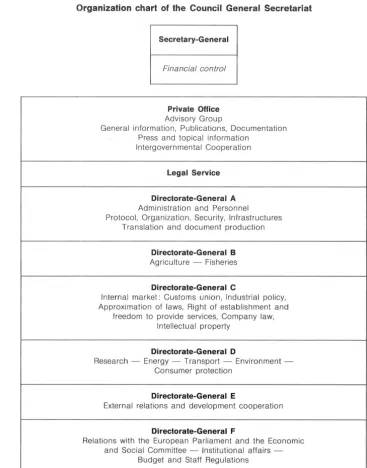
In addition to the Secretary-General's Private Office, the General Secretariat has
a Legal Service and seven Directorates-General, classified from A to G. 3
The task of the Legal Service is to assist the Council, the Permanent
Represent-atives Committee and the working parties set up by the Council in all problems of a legal nature raised by the preparation of Council acts, 4 particularly as regards the
compliance of such acts with the law, their proper form and the conditions for publication. The Legal Service represents the Council before the Court of Justice in the various cases in which the Council is involved.
The General Secretariat provides the Council's administrative and practical infrastructure, at three levels: working parties, the Permanent Representatives
Committee and the Council itself. It also assists some bodies in the field of intergovernmental cooperation. It supplies the technical back-up for meetings by providing participants with conference rooms, interpreting services and security staff. Since most documents have to be issued in nine languages, a large number of officials are involved in document translation, 5 typing, reproduction and
management.
1 On 30 October 1990: no other employees.
2 By the Council acting unanimously, as laid down in Article 17 of the Rules of Procedure.
See Council Decision of 26 September 1980.
3 See Table 2. 4 See page 41.
5 On 30 October 1990: 433, i.e: over 20% of the establishment.
TABLE 2
Organization chart of the Council General Secretariat
Secretary-General
Financial control
Private Office
Advisory Group
General information, Publications, Documentation Press and topical information
Intergovernmental Cooperation
Legal Service
Directorate-General A
Administration and Personnel Protocol, Organization, Security, Infrastructures
Translation and document production
Directorate-General B
Agriculture - Fisheries
Directorate-General C
Internal market: Customs union, Industrial policy,
Approximation of laws, Right of establishment and
freedom to provide services, Company law, Intellectual property
Directorate-General D
Research - Energy - Transport - Environment -Consumer protection
Directorate-General E
External relations and development cooperation
Directorate-General F
Relations with the European Parliament and the Economic
and Social Committee - Institutional affairs
-Budget and Staff Regulations
Directorate-General G Economic, financial and social affairs
Charlemagne conference room. The simultaneous interpretation booths can be seen at the sides.
The General Secretariat assists each incoming Presidency in the preparation of the planning for its term of office. It also ensures that Council activities in each six-monthly period correspond as closely as possible to the Presidency's work programme, by means in particular of a computerized monitoring system.
The General Secretariat is entirely at the service of the Presidency, supporting it
in its efforts to find compromise solutions, coordinate work or arrive at an overall view. Each Council or Permanent Representatives Committee meeting is therefore preceded by a detailed briefing enabling the Secretary-General and the Directors-General responsible to discuss the matters concerned with the Presidency, and to submit possible proposals for tactics and solutions.
Finally, the General Secretariat distributes documents, and draws up reports and notes in which it reports on the progress made and assesses discussions between the Member States, advising on the procedure to be followed or proposing alternatives.
*
* *
The General Secretariat represents a factor of continuity in the work of the
Council, whose archives it administers. Like the other Community institutions, the
Council has given the public access to its historical archives, consisting of
documents produced more than 30 years ago.
The European University of Florence is responsible for keeping the Community's
historical archives in general. Council documents are, however, available at the
General Secretariat in microfiche form. An inventory of the Council's historical
archives, starting with the year 1952, is now being published. 1
1 lnventaire des archives historiques du Conseil. Annee 1952. Edition provisoire. Bruxelles, 1986. Published in French only. As of 30 October 1990, the inventories corresponding to the years 1952 to 1959 are available.