THE ADMINISTRATION OF FOREIGN AID IN INDONESIA, 1969/70 - 1982/83
by
Soehartono Soedargo
-A thesis submitted in partial fulfilment of the requirements for the degree of Master of Social Science (M.Soc.Sc.)
Administration
List of Contents Acknowledgments Abbreviations Introduction Chapter I Chapter II
Development and Objectives of Foreign Aid Foreign Aid and National Development 1969/70 - 1982/83
Chapter III: The Administration of Foreign Aid Chapter IV : Profile of the Indonesian Institute of
Sciences Chapter V Conclusion Annexes
Bibliography
page
i l i
i i i
vi
1
19 36
i i
-ACKNOWLEDGEMENTS
I wish to thank the academic staff of the Department of Political Science, University of Tasmania for their support during my studies. In particular, I am indebted to my supervisor Dr. P.J. Eldridge who has been an inexhaustible source of knowledge about Indonesian affairs. Without his assistance this thesis would not have been possible.
My studies have benefited assistance from numerous other
...
~ ,, ":_dil1QIestablishments and individuals. In particular I would like to express my thanks to:
the Indonesian Institute of Sciences (LIPI) for granting me study leave;
the Australia Government for its financial support under the Colombo Plan;
the librari~ns from variou~ libraries;
my colleagues in Jakarta who assisted with data collection; and
I
•the
Tasmani~n
families who make me feel at home in Hobart.My special thanks to my father and mother, Mr. and Mrs. Soedargo, who gave continual moral support during my stay in Hobart. I am also deeply grateful to my wife Farida who has accepted the whole responsibility of taking care of our children, Sari, Riko and Gina throughout the period of my study.
ABBREVIATIONS
ADAB Australian Development Assistance Bureau ADB Asian Development Bank
ASEAN Association of South East Asian Nations
BFTC Bureau of Foreign Technical Cooperation (Biro Kerjasama Teknik Luar Negeri)
BIES Bulletin of Indonesian Economic Studies
BIR Bureau of International Relations LIPI (Biro Hubungan Internasional LIPI)
CC FTC Coordinating Committee for Foreign Technical Cooperation (Panitia Koordinasi Kerjasama Teknik Luar Negeri)
DAC Development Assistance Committee
DBC Division of Bilateral Cooperation LIPI (Bagian KerJasama Bilateral LIPI)
DIC Division of International Cooperation (Bagia~ Kerjasama International LIPI)
GNP Gross
Nat~onal
ProductIDRC International Development Research Centre '
IGGI Inter Governmental Group on Indonesia IUD Intra Utirine Device
JICA Japan International Cooperation Agency JSPS Japan Society for the Promotion of Science
KAI ST Korea Advance Institute of Science and Technology
NIE National Institute for Electronique LIPI (Lembaga Elektronika Nasional LIPI)
NIEO New International Economic Order
OECD ORR
R & D S & T TCDC TOR
UN
UNDP
US AID
iv
-Organisation for Economic Cooperation and Development Office of Resident Representative - UNDP
Research and Development Science and Technology
Technical Cooperation Amongst Developing Countries Terms of Reference
United Nations
United Nations Development Programme
United States Agency for International Development
---INDONESIAN ABBREVIATIONS AND ACRONYMS
Bappenas Badan Perencanaan Pembangunan Nasional (Agency for National Development Planning) GBHN Garis-garis Besar Haluan Negara
(The Guidelines of State Policy)
IPB Institut Pertanian Bogor (Bogor Agriculture University)
LIPI Lembaga Ilmu Pengetahuan Indonesia (Indonesian Institute of Sciences)
Pelita Pembangunan Lima Tahun (Five Year Development) PKTLN Panitia Koordinasi Kerjasama Teknik Luar Negeri
(Coordinating Committee for Foreign Technical Cooperation)
PUSKESMAS Pusat Kesehatan Masyarakat (Public Health Centre) RAPBN Rencana Anggaran Pendapatan dan Belanja Negara
(National Estimate of Income and Expenditure)
Repel it a Rencana Pernbangunan Lima Tahun (Five Year Development Plan)
Rp Rupiah (Indonesi'an Currency)
Set Kab Sekretariat Kabinet (Cabinet Secretariat)
Tabanas Tabungan Pembangunan Nasional (National Saving for Development)
vi
-INTRODUCTION
At the time Indonesia proclaimed her Independence the concept of a Welfare Stateiwas already part of the ethos of Indonesian·
nationalism. This idea implicates the State Ideology 11
Pancasila111,
which was incorporated in the last paragraph of the preamble of the 1945 Constitution. · Welfare for the entire people particularly refers to the principles of Social Justice. To achieve this the government has launched many development programmes. In particular, since 1969/70 the New Government has implemented a series of Five Year Development Plans (Repelita). These provide directives for general dev~lopment, based on priorities to be achieved. Each concrete
I
programme, however, is formulated in the development project section of the annual budget.
The implementation of these programmes has not been easy. It has required notlonly skill and expertise in various sectors but
I ,
also considerable funds. Because domestic resources were insufficient I
I
to create savings to finance economic development it was clear that
I ,
\
foreign aid was: needed. The success of the stabilisation programme and the rate of early economic progress improved the international credit rating of Indonesia and much more aid was given. With the increase in the amount of foreign aid received one of the arguments which emerged was whether the existing administrative structure was capable of coping w~th the overall programme. Clearly £oreign aid itself is not a panacea for economic development if it is not used
properly. The existing administrative structure, the bureaucracy and the availability of qualified personnel all play an important role in determining the effectiveness of foreign aid.
The main aims of this study is to examine the administration of foreign aid in Indonesia. Particularly the way in which foreign aid has been administered in order to achieve development goals. So that the administration of foreign aid can be understood it will also be neceasary to briefly discuss the role of foreign aid in the
economic development of Indonesia. This is reflected particularly in the changes in its relative position as a proportion of total development spending.
Because the total scope of the administration of foreign aid is very broad, this study will be limited to the administration of foreign aid in those government sectors which are administered under
I
the directive of the Coordinating Committee for Foreign Technical Cooperation (Panitia: Koordinasi Kerjasama Teknik Luar Negeri = PKTLN).
!
Particular emphasis will be given to the experience of the Indonesian Institute of Sciences (Lembaga Ilmu Pengetahuan Indonesia= LIPI).
Government publications and other reports as well as
individuals interested in:foreign aid are used as primary sources to illustrate the contribution of foreign aid to National Development. In analyzing the available material a descriptive approach will be applied throughout the study.
viii
-Introduction
Chapter I Development and Objectives of Foreign Aid Chapter II Foreign Aid and National Development
1969/70 - 1982/83
Chapter IIr The Administration of Foreign Aid Chapter IV 1
Profile of the Indonesian Institute of Sciences (LIPI)
Chapter V Conclusions
Chapter I deals with the development and objectives of foreign aid in general. This is discussed both theoretically and in terms of what was actually happening in Indonesia. In theory foreign aid is needed either as a supplement to or substitute for domestic funds. The basic expectation in Indonesia is that foreign aid is a
supplement to domestic funds albeit this only occured after the last year of Repelita I.
I
Chapter II If information especially
this study will firstly provide background about political changes and problems faced during the first three years of the New Order Government. It is followed by discussion about government policies particularly Repelita (Rencana Pembangunan Lima Tahun
=
Five Year Development Plan), which lead to the achievement of development goals. Finally the discussion will canvass the role of foreign aid in national development because foreign aid constitutes a relatively large proportion of development funds.securing foreign aid, namely active and passive processes. Every ye1ar the government proposes foreign aid to donors. Consequently
and in many·c~ses without waiting for an official offer, project proposals hav'e to be prepared by the executing agency. In some cases donors may offer such funds only for a particular field and therefore specific project proposals will only be made after the offer is received. These two techniques however, follow the same cycle.
Chapter IV dis'cusses the tasks and functions of the Indonesian Institute of Sciences (LIPI), particularly its administrative
structure and the way in which contribute to the national development '
effort. The key' coristraints on the achievement of development goals in Indonesia, as in other developing countries are, inter alia, an inadequate budget for science and technology; dearth of qualified or skilled scientists and technologists. Further, existing science and technology actiyities"may
1
not support development endeavours. This
I
poses a dilemma as scienc~ ~nd technology can provide important inputs : i
to decision making processes in particular how to find a short cut in the achievement of deyelopment goals.
Chapter V, the last chapter, will summarise the more
important findings of the study. It will show that foreign aid in Indonesia has played an important role in achieving development goals. For example during the stabilisation periods and the first four years of Repelita I it was indispensable. The administration of foreign aid has greatly affected the quality of the foreign aid implementation .process. This is partly because the aid administration process is so
x
-administration of the aid processes could provide a basis for
simplification leading to greater efficiency and should bring
about improvement in the quality of implementation. On the other
hand great centralisation and heavy administrative burden will
continue to consume time and energy. As a result, it would disturb
the overall aid implementation process and greatly hamper its
CHAPTER I
DEVELOPMENT AND OBJECTIVES OF FOREIGN AID
Like other developing countries one of the main problems faced by Indonesia in financing development programmes is the
scarcity of development funds. In other words, there is a resources gap in Indonesia which makes it difficult to implement development programmes in order to achieve the economic growth rate targeted in the tlevelopment plan. To fulfil this resources gap the government has secured funds from abroad. This is known as foreign aid.
Foreign aid may: take a number of forms. It can be classified as bilateral or, multilateral. It may be offered as grants or loans which may be tied or untied to specific purposes and may be made under specific conditions. It may also be in project, programme,
financial, commodity or technical aid. The particular form of aid will be partly dependent upon the result of discussion between officials of both donor and recipient countries. Each side has its own viewpoint
I
and policies which uequires the formation of an aceeptable compromise. In brief, aid diplomacy plays an important role in determining
foreign aid not only the amount of aid needed but also its type and the conditions under which it provided. Before examining the types and sources of foreign aid this chapter will discuss the development and objectives of foreign aid. The country of origin and the types of foreign aid obtained will also be discussed.
1. Development of Foreign Aid
2.
Marshall Plan to extend foreign aid to both her allies and her former enemies in Europe in order to enable them to survive the' early post war years. Extensive aid was given to European countries and their economies generally began to rapidly recover. Over time they gradually became donor countries. In particular the Federal Republic of Germany, France, the United Kingdom, the Netherlands and the Scandinavian countries. Most of them became members of the v
Development Assistance Committee (DAC)2 of the Organisation for Economic Cooperation and 'Development (OECD).
The success of the Marshall Plan in European countries helped inspire the United States of America to assist Developing Countries in Asia, Africa and Latin America. However, the problems faced by post-war European countries and those of Developing Countries were completely different. Before the Second World War European countries were mature both culturally and economically. Institutions and
skilled personnel required for economic development were already available. So after the war main shortfall was in capital ·funds to repair the physical damage of the war. Consequently when resources became available from the United States they relatively quickly restored their economies and set them on the path of self sustaining growth.
'
The situation and condition of the Developing Countries were considerably different. Most of them were newly independent states and many lacked political stability and cultural continuity. Their economies not only lacked capital but were deficient in institutional
structure, professional skill, managerial expertise and most other factors needed for accelerating economic development. In some cases they did not exist at all. In addition available financial and human resources were mainly directed towards the achievement of political stability. In essence, political and economic conditions were not conducive to development. When the Marshall Plan approach
of giving capital goods and funds was tried the results were disappointing.
In 1960 the United Nations embarked upon a development programme. The first decade of this development programme was
1961-1969. It emphasized the importance of foreign aid in promoting development endeavours. However, the results were not encouraging. Recognising the failure of the first decade, the Second decade of development was launched in 1971-1980. One of the most important ideas of this programme associated with foreign aid was that it was suggested that the Developed Countries should transfer up to 1% of their GNP to Developing Countries. 0.7 of this should be in the form of Official Develop~ent Assistance (ODA). This target, however, was not achieved in any
1instance.
I
Most Developing Countries became aware that the obstacles to achieving development goals were not only the scarcity of capital but also, and probably more importantly, the world economic structure. Many Developing Countries came to believe thAt the structure of the world economic system impeded their development efforts. For example
investment, 93% .of its industry and almost 100% of its scientific and technological research.3 It is clear that developed countries dominate world economic structure. Developing countries on the otper hand have li~tle opportunity to equally participate in the
4.
world economy. Their bargaining position has been very weak. Efforts to increase the competativeness on international market have to be made. For examp,le Indonesia has been using influence amongst
Developing Countries to promote joint action. This kind of activity will hopefully improve the bargaining position of the Developine;
Countries.
Such countries have made an attempt to examine the need to restructure the international economic system by creating an
organisation they called the New International Economic Order (NIEO). One of the important programmes of NIEO was the fostering of Technical Cooperation amongst Developing Countries (TCDC). This arose because it seemed that development problems faced by Developing Countries are
I
similar. It, there~ore appeared that cooperation amongst themselves would be beneficial .1
This was because they could exchange experiences and hence try to avoid the mistakes made in other similar countries.
'
I
Furthermore, social and cultural conditions amongst Developing Countries are also similar and this should also enable them to encourage and strengthen cooperation. The aims of the cooperative activities include:
to strengthen Developing Countries themselves in order to
J I I
find appropriate solutions to their own development problems; to complement the conduct of existing development programmes and hence strengthen the position of Developing Countries
i
in the world economic system;
to increase technical capability in each country and so reduce their dependence upon developed countries.
In Indonesia, discussions about the importance of foreign aid for economic development was already understood at the time of independence. According to Hatta, as cited by F.W. Weinstein,
"the Indonesian leaders were fully aware that they would need foreign
4
aid for many years to come in order to build our country" This was true even for the late President Sukarno, who claimed that his policies were drawn up without any expectation of foreign aid and who became known for his shibboleth, "Go to hell with your aid". In fact his actual practises stressed the importance of foreign aid for
development. For instance in a February 1950 speech, he explicated
l . "d 5 ' 1
"d ' d
tllS i ea. Foreign ai was neede to cover the balance of payment
! I
deficit, to finance development projects and to facilitate the
I
purchase of necessities such as rice, pharmaceuticals and cheap clothing. So it was clear that in fact he didn't oppose foreign aid in practice.
Recoginising the importance of foreign aid, various
discussions with foreign countries and international agencies were
4. Weinstein, F.W. Indonesian Policy and Dilemma of Dependence from Sukarno to Soeharto. Ithaca and London, Cornell
organised to secure foreign aid. In the early years more than 50% of foreign aid was obtained from Communist Countries. This is shown in Table I.l, Foreign Debt at 31 December 1965.
Table I.l
Indonesian Foreign Debt at 31 December 1965 (US $000)
Aid Sources Amount
1. Communist Countries 1,404
2. Western Countries 587
3. Asian Countries 261
4.
African Countries 45. International Agencies 102
Total 2,358
Source Survey of Recent Developments, BIES, No.4, June 1966
!
Although foreign aid was needed for promoting economic development it was diverted to be primarily used for political
6.
prestige expenditure which would strengthen the continuation of the existing regime. As a result, most aid was spent on non productive civil expenditure and to buy military hardware. The only industrial base activity financed by foreign aid funds was the "Cilegon" Steel Plant. Originally, however, this was regarded as a political goal rather than economic objective. Financial assistance for this project mainly came from the Soviet Union. This project was not completed.
Indonesia (IGGI) in February 1967, foreign aid ceased to be widely misused. Thereafter the extent of foreign aid needed by
Indonesia was discussed and settled in the international setting of IGGI meetings. IGGI is not a broad international organisation, but a limited consortium of representatives from governments which are interested in assisting Indonesia. The structural organisation of IGGI is informal. The IGGI meeting is followed by a Bilateral meeting between representatives of Indonesia and particular countries prepared to donate aid.
In 1967 Indonesia was re-admitted to the World Bank.6 The involvement of the World Bank in Indonesia economic development came into effect in June 1968 when Robert McNamara, President of the World Bank, visited in Indonesia. Since then the World Bank, in addition to IGGI, has also been playing a significant role in the overall arrangements for securing foreign aid. The World Bank has a
Representative in Jakarta and has assisted the Indonesian government I
in arranging foreign aid from the non bank sources as well as from the bank. It has been concerned with a much wider range of technical assistance to the Indonesian qovernment than merely help in
preparing proposals for investment projects. Based on a joint report drawn up by the World Bank and Bappenas, the overall quantities and type of foreign aid required were then decided.
Because the 1
Indonesian economy was still regarded as weak,
I
most foreign aid secured was in the form of soft loan. These known
8.
as Official Development Assistance (ODA) loans. Their characteristics are as follows:
the rate of interest was low : 3 - 3.4% annually;
the grace period before the first repayment were due was between 7 to 10 years;
the period of repayment was long between 30 - 40 years.
The government has also made continual attempts to obtain adequate foreign resources to allow it to maintain a balanced budget whilst achieving its development investment goals. The latest
example of this is the sale of bonds abroad.7 In this case
Indonesian bonds were sold in the Federal Republic of Germany and in Japan. This meant that development funds have been obtained in the form of loans from foreign corporations and individuals rather than their governments. Such commercial funds raising has strict
requirements. Characteristically these are as follows:
the period of repayment is ten years; and
the rate of interest is high : 7% and 7.5% annually for bonds sold in Germany and Japan respectively.
A question which emerged was : "Why did Germans and Japanese buy Indonesian bonds?" Apparently it was because the international credit rating of Indonesia has improved particularly in comparison with other third world borrowers. It is therefore,
the obligation of the Indonesian people in general and the government in particular to ensure that development funds are efficiently managed and used so that repayment will not become a burden for the next· generation. Because the funds do not only come from domestic resources only but also from foreign countries in
I
the form of grants, loans from governments, international agencies and even societies.
2. Obje~tlves of Foreign Aid
There are many reasons why advanced countries believe they should give aid to the developing countries. Even so, their official statements of why they give aid are often confusing or even
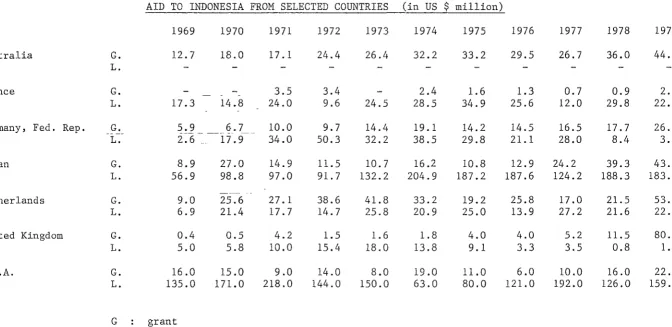
contradictory. Some countries apparently feel obliged to give aid to former colonial territories. For instance, most British aid goes to Commonwealth countries, most Australian aid goes to Papua New Guinea and most French aid is to former colonies. The biggest proportion of aid t~ Indonesia, which was formerly a Dutch colony,
I
' I
comes from Japan and the United States (See Table I.2). However, being a small countJy
1
t~e
Netherlands is still generous to 'Indonesia.1
1 .1
In addition, the Dutch Minister for Economic Cooperation has always acted as chairman of IGGI.
For other countries, moral obligation is an important
motivator and some o~ertly foresee an ultimate commercial advantage. 8 I
According to R.D. Beckwell , however, many analysts see the principal motives of aid donor~ as based on consideration that are strategic,
TABLE I. 2
AID TO INDONESIA FROM SELECTED COUNTRIES (in US $ million)
1969 1970 1971 1972 1973 1974 1975 1976 1977 1978 1979
Australia G. 12.7 18.0 17.1 24.4 26.4 32.2 33.2 29.5 26.7 36.0 44.2
L.
France G. 3.5 3.4 2.4 1.6 1.3 0.7 0.9 2.3
L. 17.3 14.8 24.0 9.6 24.5 28.5 34.9 25.6 12.0 29.8 22.5
Germany, Fed. Rep. G. 5.9 - - --·- - - - - --6.7 · - - 10.0 9.7 14.4 19. 1 14.2 14.5 16.5 17.7 26.5
L. 2.6 17.9 34.0 50.3 32.2 38.5 29.8 21.1 28.0 8.4 3.5
Japan G. 8.9 27.0 14.9 11.5 10.7 16.2 10.8 12.9 24.2 39.3 43.6
L. 56.9 98.8 97.0 91. 7 132.2 204.9 187.2 187.6 124.2 188.3 183.3
Netherlands G. 9.0 25.6 27.1 38.6 41.8 33.2 19.2 25.8 17.0 21.5 53.2
L. 6.9 21.4 17.7 14.7 25.8 20.9 25.0 13.9 27.2 21.6 22.6
United Kingdom G. 0.4 0.5 4.2 1. 5 1. 6 1.8 4.0 4.0 5.2 11. 5 80.0
L. 5.0 5.8 10.0 15.4 18.0 13.8 9.1 3.3 3.5 0.8 1.5
U.S.A. G. 16.0 15.0 9.0 14.0 8.0 19.0 11.0 6.0 10.0 16.0 22.0
L. 135.0 171.0 218.0 144.0 150.0 63.0 80.0 121. 0 192.0 126.0 159.0
G grant L loan
[image:21.839.105.777.96.422.2]conunercial, political and cultural rather than altruistic, though altruism does play a part.
Intellectual debate about foreign aid theory is basically divided into theories about transaction and transfer of resources. John White9, for example, argues that transaction theories are characterised as political theories while transfer theories are
characterised as economic theories. Each theory has its own emphasis. Political theories are of two kinds. One theory stressed the donor as the aid user. Foreign aid is regarded as an instrument of foreign policy. Donors are seen as having interest in foreign aid primarily because it augments their foreign policy. The other theory is
recipient oriented. It concentrates on the recipient as aid user. As it is concerned with aid as an instrument of domestic policy.
Economic theories about foreign aid can be divided into two groups. The first group pays attention to the vital role of domestic
I
I '
resources for economic development. Foreign aid is seen as relevant only if domestic re9ources are insufficient. The second group of theories departs from the assumption that foreign aid is an
i
alternative resource for economic development. Although domestic resources for development are available foreign aid may also be
secured on the ground that it will be of benefit to the country as it will accelerate the rate of growth.
12.
In Indonesia the objective of foreign aid likely falls
into this first category. Foreign aid needed to supplement internal sources. However, the implementation of this principle became
possible only since the last year of Repelita I. Most development programmes are now financed by indigenous government funds. Further details of this will be discussed in Chapter II.
3. Source and Form of Foreign Aid
Foreign aid may be secured in bilateral or multilateral programmes. Each of these has its own advantages and disadvantages. Bilateral aid programmes involve only single donor country. The most dominant factors within bilateral aid are political,
strategic and commercial. The donor countries believe that they can further their foreign policy objectives by giving aid. In other words, foreign aid is used to implement foreign policy. The donors consequently prefer to extend their aid on tied project basis and
' l
rather on untied loans or grants. The main argument which are usually,
I
put forward by the donor is that they want to make sure that the
I '.
allotted aid will be.used efficiently by the recipient country. On
the other hand the recipient countries do not share this view. This is because tied projects involve the donor interferring in the
internal affairs of the recipient country. To avoid this negative aspect of bilateral aid recipient countries may seek foreign aid from multilateral agencies. Multilateral means that aid is provided by more than one country, the World Bank or by an international agency such as UNDP, FAO, etc.
main negative aspect of bilateral aid. Table I.2 above also
indicates the biggest source of bilateral aid. Each donor country, A 1 . lO "d b h d 1
except ustra ia , provi es ot grants an oans. All Australian aid is extended in the form of grants.
Foreign aid can be extended in the form of grants or loans. Grants impose no obligation on the recipient country to repay. On the other hand loan aid imposes an obligation to repay the funds in due course. Debate about the merits of these two forms of aid is as follows.
Grants are regarded as the best form aid as they will increase the purchasing power of the recipient country without any obligation to repay. Moreover some scholars assert that if aid is given as a grant there may be little or no serious attempt in the recipient country to utilize it wisely. In other words, there is a fear in some donor countries that the simple transfer of resources to recipient cou~tries twill not be the best way .to help economic
progress. Such a view also holds that aid which is extended in the form of loan encourages the recipient to attempt to use it as
efficiently as possible in order to create the means of repaying the loan. Unfortunately however, loans create additional foreign aid debt and add to the problems of the recipient country. At the core of this debate is the problem that in most developing countries qualified personnel who have expertise in foreign aid management and other
10. Australian aid to Indonesia see: Eldridge, P.J. : Indonesia and Australia: the Politics of Aid and Development Since 1966. ANU, Development Studies Centre, Monograph No. 18, p.31.
14.
related development activities are few or even totally
unavail?-ble. Clearly,, loans preserve the autonomy of the recipient country in the management of its development programme. In the final analysis decisions to accept or reject foreign aid loans will be wisely made, only if the recipient country has the ability
to foresee the effects
1 pf accepting a loan. As this context,
problems caused ,by the need t? fund the loan repayments will not always be appFeciated. As a result, the utilisation of foreigi; aid is not as well p,lanr;tyfl as might be desired in more perfect world. This is well illustr~ted by the problems caused both to donors and reef pient by the huge Bra,zilian foreign debt.
I I I
Foreign aid to Indonesia, both in the form of grants and loans f ram 196 9 to 19 79, are shown in Table I. 3.
Although foreign aid may be extended as grants or loans it can take varipus forms. Foreign aid can also be distinguished
''
' I I
by whether it is tie~ or, untied. Tied aid may also be tied to
I ! f
products or services supplied by the country of origin as well as
I 1,
,tied to projects. M~ch, aid is tied in both ways. Consequently it, can be spent for importing goods and services from designated sources and for particular projects. The most obvious reason for tying aid is commercial. It also shows the dominance of donor self interest in aid giving. So a donor country with a surplus of a particular product may give aid on the condition that the aid will be used to buy the surplus product. Another form of tied aid is
TABLE I.3
GRANTS AND LOANS TO INDONESIA 1969 to 1979 (in US
$
million)Year Grant Loan Total
1969 67.1 261.8 328.9
1970 109.7 355.3 465.0
1971 103. 7 483.3 587.0
1972 130.6 372.2 502.8
1973 140.4 476.0 616.4
1974 174 .1 489.2 663.3
1975 152.6 539.4 692.0
1976 141. 9 526.9 668.8
1977 161. L, 354.0 615.4
1978 191. 5 443.8 635.3
1979 281. 4 439.5 720.9
Source OECD, Geog
1
raphical Distribution of Financial Flow to Developing Countries, 1976 and 1980.
recipient.
Untied aid allows the recipient flexibility in spending funds so as to get value for money. For example, the recipient country may be allowed to invite international tenders for equipment procurement for a specific project. However, there may still be limitation on using the funds. Thus the money will still be spent within the scope of the programme approved by the donor. Therefore ·untied aid is close or similar to programme aid. In this respect the
I
[image:26.564.102.518.146.465.2]16.
to the country's priorities. For example US AID has extended
us
$5 million for science and technology development programme inI
Indonesia. Utilisation of these funds depends on Indonesia,
, I
provided that the funds will be used for scientific and
technological development. Indonesia may select the particular project which will be financed by the fund.
Most recipient countries are likely to pref er programme
'
aid rather than project aid. Programme aid, however, demands high
I '
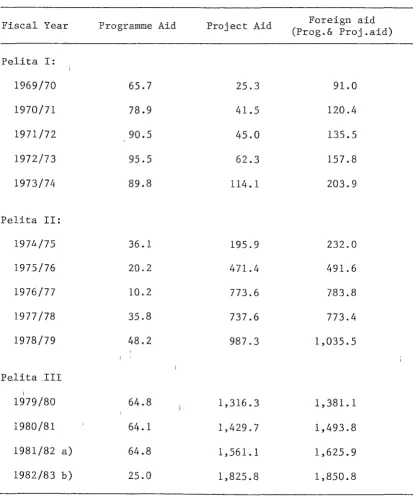
managerial expertise in the recipient bureaucracy otherwise the funds will not be used efficiently. Unfortunately many developing countries have to~ few skilled managers. At times this is overcome by establishing a joint committee involving the executing agency and representatives of donor. Project and programme aid to Indonesia is shown in Table I.4.
I
The first fquk years of Repelita I programme aid was bigger
I
than project aid1
• This allowed the government to spend foreign aid
I I
primarily in accordance with the priorities of ,R~pelita, i.e.
l
; !
rehabilitation of the existing productive capacities. In other
I
words, the foreign aid received was relatively untied. Year by year, foreign aid obtained increased rapidly, except for the year 1977/78
I
which declined by 10.4 billion rupiah or approximately 1.3% from the previous year. Since the last year of Repelita I there was an
increase of foreign aid, however, as it can be seen in Table I.4, mostly in the form of project aid. The consequence of this was that
TABLE I.4
FOREIGN AID 1969/70 - 1982/83 (in billions of rupiah)
Fiscal Year Programme Aid Project Aid Foreign aid (Frog.& Proj.aid)
Pelita I:
1969 /70 65.7 25.3 91.0
1970/71 78.9 41.5 120.4
1971 /72 90.5 45.0 135.5
1972/73 95.5 62.3 157.8
1973/74 89.8 114.1 203.9
Pelita II:
1974/75 36.1 195.9 232.0
1975/76 20.2 471.4 491. 6
1976/77 10.2 773.6 783.8
1977 /78 35.8 737.6 773.4
1978/79 48.2 987.3 1,035.5
Pelita .III
I
1979/80 64.8 1,316.3 1,381.1
1980/81 64.1 1,429. 7 1,493.8
1981/82 a) 64.8 1,561.1 1,625.9
1982/83 b) 25.0 1,825.8 1,850.8
a) budget
b) draft of the budget
[image:28.566.108.521.134.636.2]I I
18.
I
Finally foreign aid can be classified into financial, commodity and technical aid. Financial aid may also be tied to
i I
finance a particular component of a project. The most frequent
I
commodity aid is food aid. Commodity aid however, does not include
I I
commodities which are bought with project or programme aid funds. Technical aid normally known as technical assistance, is associated with technical services. This type of aid includes inviting foreign experts to serve in recipient countries. The aid can also include the provision uf equipment to be used by the foreign expert.
Technical training and post graduate study financed by foreign aid are also regarded as technical assistance. It is clear therefore, that technical aid is very important for developing countries as a major constraint on the developing countries seeking to carry out programmes is the shortage of qualified indigenous personnel.
In the next chapter the role of foreign aid in the economic development of Indonesia will be examined. The basic expectation of Indonesia, as stated in the Guidelines of State Policy (GBHN), is that foreign aid will serve as a supplement to internal funding
I
CHAPTER II
FOREIGN AID AND NATIONAL DEVELOPMENT I 1969/70 - 1982/83
When the New, Order Government came into power in March 1966, the Indonesian economy had virtually collapsed. It was
h . d b h" h f . fl . 11 f d 1 h
c aracterise y a 1g rate o in ation , oo supp y s ortages, difficulties, in importing capital goods due to lack of foreign
' I
exchange, etc. The Government then launched stabilisation and
'
rehabilitation programmes which provided a basis for economic growth. The first section of this chapter is intended to provide background
, ' I
information on political and economic changes particularly during the years before the Repelitas were lRunched. It is followed by
discussion about government policies related to Repelita. The
implementation of each Repelita required considerable funds from both domestic and foreign resources. This chapter therefore will also examine the role of foreign aid in Indonesian National Development. This is reflected in the portion and composition of development
I
budget.! Finally it will discuss the resulting contribution of
I
i
foreign aid to economic growth. Particular emphasis will be placed
on the period 1970-1982, so that comparison with other countries can be made.
1. Political and Economic Changes
The abortive September 1965 Coup was a most important event as it greatly changed the direction of Indonesian politics and the operation of the economy. The attitude of the old regime to solving
20.
the problems of economic development was also different. The slogan "Go to hell with your aid" which was popular during the old regime was abandoned by the New Order Government. On the contrary, foreign aid was seen as the only way to quickly overcome problems and restore the Indonesian economy. The attitude of the
bureaucrats ,of the New Order Government to solving the problems of economic development was not only reflected in the way of providing funds but also many others. During the early years of his
administration, President Socharto recruited many leading economists as his assistant who later became Ministers of his Cabinet. This indicated that the government has made serious attempts to solve its economic problems. It is therefore those who have expertise in development efforts that are consulted and participate in helping the government design appropriate economic strategy.
In addition, the President every year delivers an address
:
, I
before the House of the People's Representatives; This address is
I I
, : ! I :
in the form of an. am:iµal report of his achievements. It is known as the Address of the State. In this report he elaborates the progress of development efforts, sector by sector. Even some individual projects are explained. This report becomes an important document and is used as guidelines for the daily work of both government
officials and those in the private sector. Because the report covers not only what has been achieved but also includes a warning on what is likely to happen in the coming years and what has to be done to prevent unfavourable or negative occurrences. This address is
disseminated by mass media through newspapers, radio and television . . Hopefully the majority of the people are well informed about what is
1-fuen the new government came into power the Indonesian Economy was in chaos. By December 1965, foreign aid debt was US $2,358 million. In fiscal year 1966 payments due were
US $530 million while foreign exchange earnings were estimated at only US $430 million12. The economy of Indonesia therefore was effectively bankrupt as far as its foreign dealings were concerned. Weaknesses in the bureaucratic structure, fiscal policy, banking system and foreign trade all impeded economic development. The government then embarked upon a policy of stabilisation,
reorganisation and rehabilitation of the economy which was intended to provide a basis for economic growth. To overcome the foreign aid debt problem an attempt was made to seek a moratorium from creditors. A series of aid missions headed by high ranking officials held
discussions with foreign creditors. In these meetings not only the rescheduling or rearrangement of Indonesian debts was discussed but also the need for new aid which would enable Indonesia to survive. Emergency aid was sought and secured from all over the world. The United ,States of America extended US $49 million. Japan offerec.l
i
US $30 million. These were followed by offers from Federal Republic of Germany US $7.5 millioµ, the Netherlands US $18 million and
Singapore US $32.7 million. By late October 1966 the total available was US $174 million13.
With the initiative of the Dutch Government, a meeting of 14
donor countries was held in Amsterdam in Fedruary 1967 . This body
12. Survey of Recent Development. Bulletin of Indonesian Economic Studies, No.4, June 1966, pp.4-6.
13. Palmer, I., The Indonesian Economy Since 1965 : A case study of Political Economy. London, Frank Cass, 1978, p.27.
22.
became known as the Inter-Governmental Group on Indonesia (IGGI). IGGI has always been chaired by the Dutch Minister for Development
I
Cooperation. Several meetings of IGGI were held to assess the Indonesian economy, to review progress and performance under the stabilisation and rehabilitation programmes of Indonesia. Response from members of IGGI was encouraging. Donor countries as well as international agencies expressed their willingness to assist Indonesia as much as possible. The United States of America and
I
Japan for example, during the period of stabilisation, provided the biggest portion of aid needed. As a result, stabilisation was achieved in three years. In the meantime Repelita I (the first Five Year Development Plan), was launched and became effective on 1 April 1969. Repelita I was also advertised as a stabilisation programme.
In addition to the above mentioned foreign aid which was needed to finance national rlevelopment, foreign companies were also encouraged to operate in Indonesia as a means of accelerating
economic development. To facilitate their operation a Foreign Investment Law was introduced in April 1967. It was amended in
1970 and again in 197415. Since foreign investment was to be part of long term development, the basic idea was not merely rehabilitation, but to create job opportunities which would have a multiplier effect throughout the Indonesian Economy. Foreign companies were given incentive as follows:
Exemption from corporation tax for two to six years for projects in priority sectors;
Normally they are entitled to accelerated depreciation, compensation for losses resulting from state expropriation, investment allowances and a limited period of exemption from dividend1 tax;
Repatriation of profits is permitted though capital may not be repatriated during the period in which a project is enj oyin:g tax and other concessions.
2. Pelita and its achievements
Repelita I commenced when stabilisation had just been achieved. The GNP and average economic growth from Repelita I are shown in Table II.l.
Dur:l11g Repelita I (the first five years) the average growth
',
rate was 8.4% per annum. By 1973 the Gross National Product was
:
Rp. 6,753.4 billion. It seems that during that time policy-makers
I
and planners were occupied by endeavours of how to increase the "National Pie". They were not concerned about how to distribute it as it was still very small. In addition, it was believed that the question of distribution could take care of itself through automatic mechanism. Increasing production however, did not in fact
automatically benefit the majority of the people. As some people did not receive a share they disputed the opinion of the government that distributive intervention was necessary. As a result much social tension emerged. This was reflected, inter alia, by student
24.
TABLE II. l
THE GNP AND ECONOMIC GROWTH RATE
GNP in Rp. Billion Ee. Growth Rate
Year
(%)
1969 4,820.5
1970 5,182.0 7.5
I
1971 5,544.7 7.0
1972 6,067.2 9. L~
1973 6,753.4 11. 3
1974 7,269.0 7.6
1975 7,630.8 5.0
1976 8,156.3 6.9
1977 8,882.0 8.9
1978 9,566.5 7.7
1979 10,164.9 6.3
1980 11,169.2 9.9
I I
1981 I i 12,054.6 7.9
I
1982 12,325.4 2.2
i I
I
I
16
I I
Source: Draft of the 1984/85 Budget.
three development objectives, which became known as the Trilogy of Development, has changed. In Repelita I and Repelita II the objectives, in order of priority, were national stability, economic growth and equitable distribution. In Repe1ita III the order of the
16. On 9 January 1984, President Suharto delivered an before the H9use of the People's Representative. the progress of development efforts .. For further for example: Kompas,
io
January 1984.address
objectives became eq~itable distribution, economic growth and
national stability. Equitable distribution was pursued along eight different lines or the eight paths to equality (delapan jalur
pemerataan) as follo~s:
an equitable distribution of access to means of fulfilling basic human needs;
an equitable distribution of access to education; an equitable distribution of income;
an equitable: distribution of employment opportunities; an equitable' distribution of business opportunities; an equitable distribution of access to participation in development;
an equitable distribution of development efforts;
an equitable distribution of opportunities to obtain justice.
Government policy was ,then directed to the above strategy. It was not an easy task.
i I
human needs17, which: has
I
Take as an example the fulfilment of basic been accepted as an alternative approach to development. The government has made serious attempts to achieve this by the use of relevant programmes. Take as an example the low cost housing programme. Initially this was intended to help the majority of the people who have low incomes. In actual practice, however, rich people tended to benefit from this scheme. This
17. For detailed discussion about basic human needs approach, see, for example: Soedjatmoko, National Policy Implications of the Basic Needs Model. Prisma, No.9, March 1978, pp.3-25.
happened because the scheme demanded a down payment which apparently could not be met by the poor. In addition, it also required high monthly instalments which could not be affordedly. The experience has shown that the instalments would have taken more than 50% of their incomes. As a result, the poor could rarely benefit from this programme. It was not surprising that this programme was mainly used by the middle income group and even some
I
high income earners.
Provision of water supply is another example. The
government gave a subsidy for the provision of clean water. However the people have to meet the cost of connecting their houses to the reticulation system. This charge was relatively expensive,
i.e., Rp 50,000 (US $1
=
Rp 415.0). Thus only the rich people who could afford to meet the water connection fee benefited from clean26.
b 'd' d 18
su si ize water . In addition, because the water was very cheap it was used lavishly. Conversely the poor people who could not afford
the connection charge have to buy from private water vendors at a high price.
Public Health Centres (Pusat Kesehatan Hasyarakat ==
Puskesmas) which provided health services only operated for a few hours each day. This consequently only benefited the people who lived close to the centre. Others who live far from the centre had little benefit from the centres.
· 18. Noormohamed, S., Housing for the Poor in Jakarta, in J. Fox et.al. (eds.): Indonesia: Australian Perspective,
It is clear that in actual practice the benefits are not as wide as hoped, due to the difficulties experienced in the
I
implementation. Succintly, although the objective of the government was meritorious, i.e. to reduce the gap between the poor and the rich, due to circumstances over which it had little control, the result was the other way around.
There has been debate about whether foreign aid is a necessary or useful instrument for promoting the development of developing
countries. Indeed it has been questioned whether such growth can be promoted at all. In Indonesia this debate is still in progress. The proponents argue that to achieve the goal of high economic growth, say 7% annually, it is necessary to be able to maintain pace with population growth. Such a great growth rate can only be achieved with foreign aid. This is because domestic resources are insufficient
to provide the needed capital. The opponents of foreign aid mostly argue that the trickle down effect of development activities did not reach the majority of the people. Such a view asserts that the usual result of development is to benefit only a small group of people. As
' '
a result, foreign aid will not stimulate domestic economic development. On the contrary it makes for continuing dependence on foreign
countries. This was one of the causes of a demonstration by students during the visit of the Japanese Prime Minister Tanaka in January 1974.
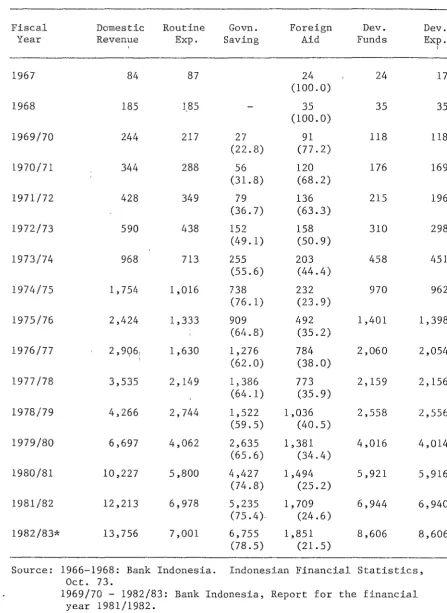
In any event Indonesia has increasingly been the recipient of foreign aid from various countries and international agencies .
. Table II.2 below shows this clearly. Year by year the total
28.
TABLE II.2
DEVELOPMENT BUDGET 1966 - 1982/83 (in billions of rupiah)
Fiscal Domestic Routine Govn. Foreign Dev. Dev.
Year Revenue Exp. Saving Aid Funds Exp.
I
1967 84 87 24 24 17
(100. 0)
1968 185 l,85 35 35 35
(100. O)
1969/70 244 217 27 91 118 118
(22. 8) (77. 2)
1970/71 344 288 56 120 176 169
(31.8) (68. 2)
1971/72 428 349 79 136 215 196
(36. 7) (63.3)
1972/73 590 Lf38 152 158 310 298
(49 .1) (50.9)
1973/74 968 713 255 203 458 451
(55.6) (44.4)
1974/75 1,754 1,016 738 232 970 962
(76. 1) (23.9)
1975/76 2,424 1,333 909 492 1,401 1,398
(64. 8) (35. 2)
1976/77 2, 9Q6, 1,630 1,276 784 2,060 2, 05Li
I
(62.0) (38.0)
1977 /78 3,535 2,1Lf9 1,386 773 2, 159 2, 156
(64.1) (35.9)
1978/79 4,266 2,744 1,522 1,036 2,558 2,556
(59.5) (40.5)
1979/80 6,697 4,062 2,635 1,381 4,016 4,014
(65.6) (34. 4)
1980/81 10,227 5,800 4,427 1,494 5,921 5,916
(74.8) (25. 2)
1981/82 12,213 6,978 5,235 1,709 6,944 6,940
(75.4)- (24.6)
1982/83* 13,756 7,001 6,755 1,851 8,606 8,606
(78.5) (21. 5)
Source: 1966-1968: Bank Indonesia. Indonesian Financial Statistics, Oct. 73.
1969/70 - 1982/83: Bank Indonesia, Report for the financial year 1981/1982.
*
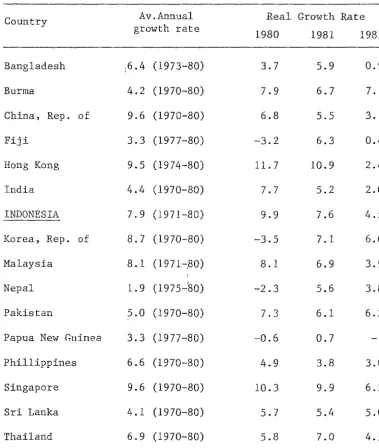
Budget draft [image:39.569.100.548.144.758.2]Table II. 3 below shows the estimated rates of real growth in 1970-1982 for selected countries.
TABLE II.3
ESTIMATED RATE OF REAL GROWTH 1970-1982 OF SELECTED COUNTRIES
Country
Bangladesh Burma
China, Rep. of Fiji
Hong Kong India INDONESIA Korea, Rep. of Malaysia
Nepal Pakistan
Papua New Guinea Phillippines Singapore Sri Lanka Thailand
Av.Annual growth rate
,6. 4 (1973-80) 4.2 (1970-80) 9.6 (1970-80) 3. 3 (1977-80) 9.5 (1974-80) 4.4 (1970-80) 7. 9 (1971-80) 8.7 (1970-80) 8.1 (1971-,80)
1. 9 (1975-1
80) 5.0 (1970-80) 3. 3 (1977-80) 6.6 (1970-80) 9.6 (1970-80) 4.1 (1970-80) 6.9 (1970-80)
Real Growth Rate 1980 1981 1982
3.7 5.9 0.9
7.9 6.7 7. 1
6.8 5.5 3.1
-3.2 6.3 0.4
11. 7 10.9 2.4
7.7 5.2 2.0
9.9 7.6 4.5
-3.5 7. 1 6.0
8 .1 6.9 3.9
-2.3 5.6 3.8
7.3 6.1 6.2
-0.6 0.7
4.9 3.8 3.0
10.3 9.9 6.3
5.7 5.4 5.0
5.8 7.0 4.5
Source: Asian Development Bank, Annual Report 1982, p.94.
~'< : estimation
[image:40.575.106.485.221.668.2]30.
By 1981 the annual rate of real economic growth in
Indonesia was 7.6%. This performance is relatively better than that of most member countries of the Asian Development Bank (ADE). It was only bettered by Hong Kong and Singapore which achieved growth rates of 10.9% and 9.9% respectively. See Table II.2 above. During
1971-80, the average annual growth rate was 7.9%. This was comparable with that of the ASEAN (Association of the Southeast Asian Nations)
countries. The increase of growth rate seems partly dur to the oil boom during Repelita II. This input from oil wealth apparently did
I
not happen in Repelita III. The 1982 growth rate is estimated to be only 4.5%, and it seems likely to continue declining if the export of commodities other than oil can not be increased. To maintain the level of growth rate it will require more investment, particularly when the economy reaches saturation point. Consequently additional funds have to be found. Government revenue will have to be increased while routine expenditure will have to be curtailed. In other words, an attempt has to be made to increase government saving to enable to maintenance of the annual growth rate. However, if the level of
government saving is not enough it is possible that more foreign aid will be sought. Each investment possibility has to be considered and careful planning, which especially takes account of the economy's capacity for repayment is necessary. It would seem that foreign aid should be especially directed towards productive sectors which are likely to generate a high rate of economic growth and especially those which will generate foreign exchange earnings. This will avoid the repayment of foreign debt becoming a burden for the next generation. However, if development activities do not generate foreign earnings . the problem could become acute. To maintain the existing export in
31.
3. The Role of Foreign Aid
Foreign aid is needed for National Development because there are inadequate resources to finance the desired development
programmes. The basic philosophy of budgeting adopted by Indonesia is a balanced budget. This means that deficit spending is not allowed. To achieve economi~ 1growth set forth in Repelita programmes the
government has to provide development funds. Ideally this comes from domestic sources. However, the Government's development funds which are generated by taxation are insufficient. Consequently foreign aid has to be sought in order to achieve a balanced budget to provide adequate development funds.
The general policies for Indonesian Economic Development are laid down in the Development Plans. Before 1969/70 there were two plans. The Five Year Development Plan of 1956-1961 and the Eight Year Development Plan of 1961-1969. These two plans were launched during the' period of economic. deterioration. The then existing
'
I I
regulations, bureaucratic structure and hyper-inflation made it
: I. j
impossible to design and implement economic development activities and the plans collapsed.
The new Government's plans were labelled as "Repelita"
32.
bureaucratic structure needed to be altered and directed towards the acceleration of economic development.
I
Development spending, as is shown in Table II.2, increased dramatically year by year. During Repelita I it was directed
towards the rehabilitation of existing productive capacities. This provided the foundation for further development. During Repelita II and Repelita III development spending was mainly for the purpose of creating new producllve facilities. lt also sought to accelerate economic growth and ensure a broad sharing of the benefits of growth across society. In the first year of Repelita I development
expenditure was Rupiah 118 billion. The first year Repelita II saw the expenditure of Rupiah 962 billion. 4,401 billion rupiah was spent in the first year of Repelita III. Thus development expenditure
expanded eight fold from the beginning of Repelita I to Repelita II. By the first year of Repelita III it had increased to be 34 times.
The actual role and contribution of foreign aid can be examined in the structure of development funds. The amount and
, I
relative contribution of it can be deduced from Table II.2 above. During the last years before Repelita I commenced, foreign aid constituted the totality of available development funds.
In an ideal situation, such as that enjoyed by developed countries, development programmes are financed by government savings, i.e. domestic revenue and internal borrowing minus routine expenditure. But until 1968 there was no government saving in Indonesia .
funds comprised two elements: foreign aid and government savings.
Until 1973/74 foreign aid still constituted more than 50% of
development funds. Since then,the last year of the first Repelita,
its contribution has been less than 50%. It is still decreasing.
State Policy Guidelines state that National Development requires
large-scale investment which should be based on self reliance, with
19
foreign aid serving as a supplement It is therefore anticipated
that the contribution of foreign aid to development funds will
continue declining over the next several years.
Dependence on foreign aid for financing development
programmes can be reduced in many ways. For example. increasing
state revenue by taxation from sources outside petroleum and natural
gas. To allow this to occur, the taxation system has to be easily
understood by tax payers and tax payers must become aware of their
obligations to pay tax. It will also be necessary to have an
efficient agency to ,enforce the payments taxes. Hopefully, however,
I I
state revenue can be increased. In addition domestic private funds
should be mobilised for national development purposes. It is
important that the National Saving for Development programme known as
"Tabanas" and the like are encouraged and developed. This will allow
development funds to be accumulated from the savings of the majority
of the people. Hopefully the people will come to feel that they are
part of the national development effort. If so they will probably
make increasing attempts to increase their savings and thus
participation in the development programme. Ultimately dependence on
· 19. Decree of the People's Consultative Assembly of the Republic
of Indonesia, No. IV/MPR/1978, on the Guidelines of State
34.
foreign aid can also be reduced.
During the past decade foreign aid has played an important role in economic development. It served as a supplementary fund to finance the overseas balance of payments. This enabled Indonesia to import goods and services which are not yet available internally or not yet available in sufficient quantities. Furthermore, foreign aid was also used as instrument for the transfer of technology. One of the main constrainto in carrying out economic development was the dearth of skilled and trained manpower in particular sectors which are essential for development. To overcome this problem,
manpower development has been given high priority. For example, young university graduates and middle ranking workers or technicians in many sectors have been given opportunities to undertake further training or to attend a post graduate study abroad with financial support from foreign aid. As adequate manpower becomes available development problems can be more easily identified and hopefully ways will be found to appropriate solutions. Another example of manpower
!
I i
development is the use of expatriate experts. These have been invited to come to Indonesia ~nder foreign aid schemes. Each has an Indonesian counterpart and as a team they would train Indonesians in skills relevant to development needs. Ultimately this knowledge would be further disseminated to other Indonesians.
35.
committee however, has a very difficult position. In examining
36.
CF.APTER III
THE ADMINISTRATION OF FOREIGN AID
There is concern about the administration of foreign aid in both donor and recipient countries. The main concern of the donors has been with the difficulties of extending the limited funds available for aid. The recipients however, have been concerned with difficulties in obtaining aid. Both parties however, have a common objective. This is the prompt and effective use of foreign aid allocation as a support for sound economic and social development. Bearing in mind that their basic objective is the same, the effort of both will be directed towards its achievement. In actual practice however, the administration process is very lengthy both in donor and recipient countries. As a result this process still dominates the overall foreign aid arrangements. Therefore a serious attempt has to be made so that foreign aid becomes an ends in itself.
I
This chapter particularly deals with the administration of foreign aid in Indonesia which is carried out under the directive of the Coordinating Committee for Foreign Technical Cooperation (CCFTC). CCFTC acts as the focal point for the control of foreign aid in
1. The Administrative Setting
One of the distinguishing characteristics of the work of a foreign aid administration is that it is complicated by complex administrative structures within both donor and recipient countries. Each donor country has its own administrative structure which is usually similar to the donor government's bureaucracy. Changes in government in donor countries may thus effect the administrative arrangements. Each recipient country has a parallel situation. Local bureaucratic structure and custom and the objectives of the development programme will all affect its administrative arrangements.
In Indonesia the highest authority dealing with the administration of foreign aid as mentioned earlier is the
Coordinating Committee for Foreign Technical Cooperation (CCFTC)20. Members of the CCFTC are representatives from appropriate departments and relevant institutions. Its secretariat, which provides
I
administrative support, is located in the office of the Cabinet Secretary. The main tasks of CCFTC are:
firstly to assist the Cabinet in the formulation of
government policies on the utilization of foreign aid, and secondly to monitor the implementation of government
policies in relation to technical cooperation.
In order to accomplish these tasks CCFTC is assigned to the following functions: