Christou, C., Pittalis, M., Mousoulides, N., Pitta, D., Jones, K., Sendova, E. & Boytchev, P. (2007), Developing an Active Learning Environment for the Learning of Stereometry. Paper presented at the 8th
International Conference on Technology in Mathematics Teaching (ICTMT8),Hradec Králové, Czech Republic, July 1-4, 2007.
Developing an Active Learning Environment for the Learning of Stereometry
Christou, C.*, Pittalis, M.*, Mousoulides, N.*, Pitta, D.*, Jones, K.**, Sendova, E.*** & Boytchev, P.***
* Department of Education, University of Cyprus ** School of Education, University of Southampton, UK
*** Department of Information Technologies, Sofia University, Bulgaria
[email protected], [email protected], [email protected], [email protected], [email protected], [email protected], [email protected]
Abstract
This paper reports on the design of a dynamic environment for the learning of stereometry (DALEST) and the teaching of spatial geometry and visual thinking. The development of the software was in the framework of DALEST project which aimed at developing a dynamic three-dimensional geometry microworld that enables students to construct, observe and manipulate geometrical figures in space, and to focus on modelling geometric situations. The environment will also, support teachers in helping their students to construct a suitable understanding of stereometry. During the developmental process of software applications the key elements of spatial ability and visualization were carefully taken into consideration with emphasis on enhancing dynamic visualization as an act of construction of transformations between external media and student’s mind.
Keywords: stereometry, spatial sense and reasoning, visualization, computer applications, software design
Introduction and Theoretical Background
Spatial visualization is an important skill that deserves instructional attention. Space is a fundamental category of thought, one that plays a deep role in many aspects of human cognition. Because space is a fundamental feature of our environment, spatial knowledge and spatial perception play crucial roles in even the most ordinary human problem solving (National Science Foundation, 1997). Strong evidence supports the claim that “measures of mathematical ability tend to be strongly correlated with spatial ability”. The Principles and Standards of the National Council of Teachers of Mathematics (2000) recommend that 2D and 3D spatial visualization and reasoning are core skills that all students should develop. There is every reason to believe that time spent helping students to develop their spatial visualization skills will have additional benefits to their mathematical growth (Chavez, Reys & Jones, 2005).
students are expected to develop an appreciation of geometry as a means of describing the physical world.
In recent years, much disquiet has been expressed about the limitations of traditional approaches to the teaching and learning of geometry and specifically of spatial abilities that constrain the visualisation and advancement of teaching and learning in geometry. Most current curriculum materials and computer-based systems address the investigation of 3D geometry by requiring students to operate within two dimensional representations of 3D geometry which is not a natural way of investigating human 3D spatial ability. To overcome the limitations of these representations
the DALEST project aimed at developing a dynamic three-dimensional geometry microworld that
enables students to construct, observe and manipulate geometrical figures in space, and to focus on modelling geometric situations, and supports teachers in helping their students to construct a suitable understanding of stereometry. In this paper we focus on presenting applications’ design and capabilities and possible teaching potential with emphasis on dynamic visualization. In the theoretical background below, we delineate fundamental theoretical spatial ability considerations upon which the design of the software applications were based and in the following sections provide a description of the capabilities of the software for the teaching of spatial geometry.
The aim of developing the Dalest software was to enhance the abilities and processes in students that are
closely associated with the idea of visual imagery as a mental scheme depicting spatial information (Presmeg, 1986). It is generally accepted that learning 3D geometry is strongly associated with spatial and visual ability. From this perspective, spatial abilities are important cognitive factors in learning geometry and incorporating spatial visualization and manipulation into learning activity could improve geometric learning. As a result, mathematics curricula in a range of countries (see, as an example, the National Council of Teachers of Mathematics, 2000) emphasize the importance of spatial abilities in mathematics education and recommend that 2D and 3D spatial visualization and reasoning are core skills that all students should develop.
A 3D dynamic geometry software should provide to the learner a variety and richness of spatial images. The richer and more diverse the store of spatial representations, the easier is to use images in solving problems. Dynamic visualization can be a very powerful tool to gain a greater understanding of many mathematical concepts or it can be a resource to solve mathematical problems (Harel & Sowder, 1998; Presmeg, 1986). Taking into consideration the gap-bridging power of computers which has been extensively reported on in the research literature, we claim that dynamic representations of mathematical processes may enable “the mind to manipulate them in a far more fruitful way than could ever be achieved starting from static text and pictures in a book”. Dynamic spatial abilities are those that are required to reason about moving stimuli. The advent of computer testing has led to renewed interest in the ability to reason about motion and the ability to integrate spatial information over time (Hegarty & Waller, 2005). Dynamic visualization is an act of construction of transformations between external media and individual’s mind. Individuals who possess this ability can reason about the essential properties of moving, shrinking, and rotating figures, which appear on the screen or, in their mind, and thus they can solve the mathematical problems (Boz, 2005). There are research evidences too, which show that some students spontaneously develop this ability to move figures in their heads, to stretch and shrink them, to rotate them, to see them interact, and hence solve problems by using this kind of technique (Harel & Sowder, 1998).
Dalest Software Design
General Characteristics of Stereometry Learning Environment: The distinguished feature
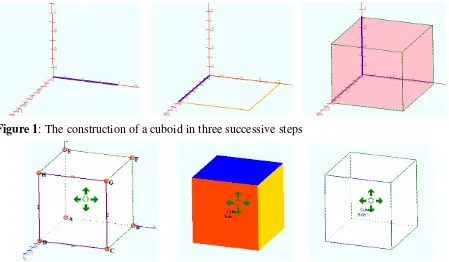
implemented in the software is the ability to construct geometrical objects in successive steps that correspond to their mathematical properties. For example, a cuboid is constructed is three successive movements, defining in each movement the length of one of the bone edges of the solid (see figure 1). The manual construction of solids gives to the user and intuitive conception of the 3D nature of the solid. The geometrical objects created on the screen can be manipulated, moved and reshaped interactively by means of the mouse. The realisation of the software allows students to see a geometric solid represented in several possible ways on the screen and to transform it, the intention here being to help students to acquire and develop abilities of visualization in the context of 3D geometry. As Gutiérrez (1996) argues, when a person handles a real 3-dimensional solid and rotates it, the rotations made with the hands are so fast and unconscious that the person can hardly reflect on such actions. The design of the software facilitates the informed manipulation of directions of rotation.
[image:3.595.61.510.254.516.2]
Figure 1: The construction of a cuboid in three successive steps
Figure 2: Different representations of a cube
[image:4.595.92.497.71.271.2]
(a) (b) (c)
Figure 3: Grouping of cubes and cuboids
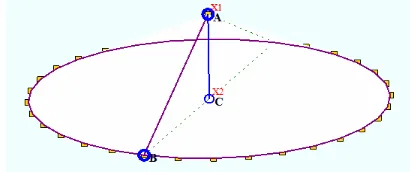
The dragging capability of the software enables students to rotate, move and resize 3D objects in much the same way as the commonly available 2D dynamic geometry software environments. The design approach focused on enabling rotation to be executed in all directions through the provision of an on-screen rotation cursor that could also be used to determine the speed of the rotation. In addition, the design was made such that students are able to resize, proportionally, all the dimensions of the object or resize it only in one dimension, according to the requirements of the problem with the use of hot points. For example, students can resize a cone, as illustrated in Figure 4, by shrinking or enlarging the radius BC (by dragging the hot point B), or by shrinking or enlarging the height AC (by dragging the hot point A). The dynamic characteristic of the measurement facility allows learners dynamically to explore the properties within and amongst figures; for example, students can obtain the measure of the volume of the cone and then double its height and see how its volume is altered.
Figure 4: Resizing the dimensions of a cone
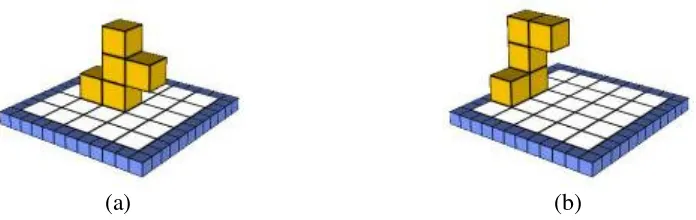
Cubix Editor: An editor which can be used by students to create 3D structures built of unit-sized
[image:4.595.286.491.465.551.2](a) (b)
Figure 5: Two compositions of unit-size cubes as part of a logical 3D problem
Conclusion
The design of the DALEST applications is in the process of development. As presented earlier, the main purpose of these applications is to enhance students’ understanding 3-D geometrical reasoning and visualization and spatial thinking. Thus, during the developmental process the key elements of visualization as defined by several researchers are carefully taken into consideration. We expect that the final library of DALEST applications will constitute a powerful tool in the teaching of stereometry and spatial geometry. We also expect that applications will enhance students’ dynamic visualization ability and enable them to gain a greater understanding of 3D mathematical and spatial concepts.
Acknowledgements
This project was part-funded by the European Union (grant 224269-CP-1-2005-1-CY-MINERVA-M). The views expressed are those of the authors and do not necessarily reflect the views of the EU or any of its sub-agencies. The authors acknowledge the contribution to the project of all members of the project consortium.
References
Boytchev, P., Chehlarova, T., & Sendova, E. (2007). Enhancing spatial imagination of young students by acticities in 3D Elica applications. Paper presented at the Spring 2007 conference of the Bulgarian Union of Mathematicians.
Boz, N. (2005) Visualization and software environments. Turkish Online Journal of Educational
Technology, 4(1), article 3, http://www.tojet.net/articles/413.htm
Chávez, Ó., Reys, R. & Jones, D. (2005). Spatial visualization: What happens when you turn it?
Mathematics Teaching in the Middle School, 11(4), 190-196.
Harel, G., & Sowder, L. (1998). Student proof schemes result from exploratory studies. In A. Schoenfeld, J. Kaput and E. Dubinsky (Eds.), Research in Collegiate Mathematics III (pp.
234-282).American Mathematical Society.
Hegarty, M., & Waller, D. (2005). Individual differences in spatial abilities. In P. Shah & A.Miyake (Eds.), The Cambridge Handbook of Visuo-spatial Thinking (pp. 121-169). Cambridge University
Press.
Jones, K. (2001), Learning Geometrical Concepts using Dynamic Geometry Software. In K.Irwin (Ed), Mathematics Education Research: A catalyst for change. Auckland, New Zealand:
University of Auckland.
National Council of Teachers of Mathematics (2000). Principles and Standards for School
Mathematics. Reston, Va: NCTM.
National Science Foundation (1997). Report on The National Science Foundation Research
Planning Workshop, http://www.princeton.edu/~jjg/nsf_report.html
Presmeg, N. (1986) Visualization in high school mathematics. For the Learning of Mathematics, 6(3), 42-46.