Learning Word Representations from Relational Graphs
Danushka Bollegala Takanori Maehara Yuichi Yoshida Ken-ichi Kawarabayashi
The University of Liverpool, Liverpool, L69 3BX, United Kingdom.National Institute of Informatics, 2-1-2, Hitotsubashi, Chiyoda-ku, Tokyo, 101-8430, Japan. JST, ERATO, Kawarabayashi Large Graph Project.
Preferred Infrastructure, Inc., Hongo 2-40-1, Bunkyo-ku, Tokyo 113-0033, Japan.
Abstract
Attributes of words and relations between two words are central to numerous tasks in Artificial Intelligence such as knowledge representation, similarity measure-ment, and analogy detection. Often when two words share one or more attributes in common, they are con-nected by some semantic relations. On the other hand, if there are numerous semantic relations between two words, we can expect some of the attributes of one of the words to be inherited by the other. Motivated by this close connection between attributes and rela-tions, given a relational graph in which words are inter-connected via numerous semantic relations, we propose a method to learn a latent representation for the individ-ual words. The proposed method considers not only the co-occurrences of words as done by existing approaches for word representation learning, but also the semantic relations in which two words co-occur. To evaluate the accuracy of the word representations learnt using the proposed method, we use the learnt word representa-tions to solve semantic word analogy problems. Our ex-perimental results show that it is possible to learn better word representations by using semantic semantics be-tween words.
Introduction
The notions of attributes and relations are central to Artificial Intelligence. In Knowledge Representation (KR) (Brachman and Levesque 2004), a concept is described using its attributes and the relations it has with other con-cepts in a domain. If we already know a particular concept such aspets, we can describe a new concept such as dogs by stating the semantic relations that the new concept shares with the existing concepts such asdogsbelongs-topets. Al-ternatively, we could describe a novel concept by listing all the attributes it shares with existing concepts. In our exam-ple, we can describe the concept dog by listing attributes such asmammal,carnivorous, anddomestic animalthat it shares with another concept such as thecat. Therefore, both attributes and relations can be considered as alternative de-scriptors of the same knowledge. This close connection be-tween attributes and relations can be seen in knowledge rep-resentation schemes such as predicate logic, where attributes
Copyright c2015, Association for the Advancement of Artificial Intelligence (www.aaai.org). All rights reserved.
are modelled by predicates with a single argument whereas relations are modelled by predicates with two or more argu-ments.
Learning representations of words is an important task with numerous applications (Bengioet al.2013). Better rep-resentations of words can improve the performance in nu-merous natural language processing tasks that require word representations such as language modelling (Collobertet al. 2011; Bengio et al. 2003), part-of-speech tagging (Zheng et al.2013), sentiment classification (Socheret al.2011b), and dependency parsing (Socheret al.2013a; Socheret al. 2011a). For example, to classify a novel word into a set of existing categories one can measure the cosine similarity be-tween the words in each category and the novel word to be classified. Next, the novel word can be assigned to the cate-gory of words that is most similar to (Huang et al.2012). However, existing methods for learning word representa-tions only consider the co-occurrences of two words within a short window of context, and ignore any semantic relations that exist between the two words.
Considering the close connection between attributes and relations, an obvious question is,can we learn better word representations by considering the semantic relations that exist among words? More importantly whether word rep-resentations learnt by considering the semantic relations among words could outperform methods that focus only on the co-occurrences of two words, ignoring the semantic re-lations. We study these problems in this paper and arrive at the conclusion that it is indeed possible to learn better word representations by considering the semantic relations be-tween words. Specifically, given as input a relational graph, a directed labelled weighted graph where vertices repre-sent words and edges reprerepre-sent numerous semantic relations that exist between the corresponding words, we consider the problem of learning a vector representation for each vertex (word) in the graph and a matrix representation for each la-bel type (pattern). The learnt word representations are evalu-ated for their accuracy by using them to solve semantic word analogy questions on a benchmark dataset.
regard, the relation between the two wordsostrichandbird is similar to the relation betweenlionandcat(lion is a large cat) as well as to the relation betweenpenguinandbird (pen-guin is a flightless bird). Second, a single semantic relation can be expressed using multiple lexical patterns. For exam-ple, the two lexical patternsX is a large Yand largeYs such asXrepresent the same semantic relationis-a-large. Beside lexical patterns, there are other representations of se-mantic relations between words such as POS patterns and dependency patterns. An attribute learning method that op-erates on semantic relations must be able to handle such complexities inherent in semantic relation representations. Third, the three-way co-occurrences between two words and a pattern describing a semantic relation is much sparser than the co-occurrences between two words (ignoring the seman-tic relations) or occurrences of individual words. This is par-ticularly challenging for existing methods of representation learning where one must observe a sufficiently large num-ber of co-occurrences to learn an accurate representation for words.
Given a relational graph, a directed labeled weighted graph describing various semantic relations that exist be-tween words denoted by the vertices of the graph, we pro-pose an unsupervised method to factorise the graph and as-sign latent attributional vectorsx(u)for each vertex (word) uand a matrixG(l)to each label (pattern)l in the graph. Then, the co-occurrences between two wordsuandvin a patternlthat expresses some semantic relation is modelled as the scalar productx(u)>G(l)x(v). A regression model that minimises the squared loss between the predicted co-occurrences according to the proposed method and the ac-tual co-occurrences in the corpus is learnt. In the relational graphs we construct, the edge between two vertices is la-beled using the patterns that co-occur with the correspond-ing words, and the weight associated with an edge represents the strength of co-occurrence between the two words under the pattern.
Our proposed method does not assume any particular pat-tern extraction method or a co-occurrence weighting mea-sure. Consequently, the proposed method can be applied to a wide-range of relational graphs, both manually created ones such as ontologies, as well as automatically extracted ones from unstructured texts. For concreteness of the pre-sentation, we consider relational graphs where the seman-tic relations between words are represented using lexical patterns, part-of-speech (POS) patterns, or dependency pat-terns. Moreover, by adjusting the dimensionality of the de-composition, it is possible to obtain word representations at different granularities. Our experimental results show that the proposed method obtain robust performances over a wide-range of relational graphs constructed using differ-ent pattern types and co-occurrence weighting measures. It learns compact and dense word representations with as low as 200 dimensions. Unlike most existing methods for word representation learning, our proposed method considers the semantic relations that exist between two words in their co-occurring contexts. To evaluate the proposed method, we use the learnt word representations to solve semantic analogy problems in a benchmark dataset (Mikolovet al.2013a).
Related Work
Representing the semantics of a word is a fundamen-tal step in many NLP tasks. Given word-level representa-tions, numerous methods have been proposed in composi-tional semantics to construct phrase-level, sentence-level, or document-level representations (Grefenstette 2013; Socher et al.2012). Existing methods for creating word representa-tions can be broadly categorised into two groups: counting-basedmethods, andprediction-basedmethods.
Counting-based approaches follow the distributional hy-pothesis (Firth 1957) which says that the meaning of a word can be represented using the co-occurrences it has with other words. By aggregating the words that occur within a pre-defined window of context surrounding all instances of a word from a corpus and by appropriately weighting the co-occurrences, it is possible to represent the semantics of a word. Numerous definitions of co-occurrence such as within a proximity window or involved in a particular depen-dency relation etc. and co-occurrence measures have been proposed in the literature (Baroni and Lenci 2010). This counting-based bottom-up approach often results in sparse word representations. Dimensionality reduction techniques such as the singular value decomposition (SVD) have been employed to overcome this problem in tasks such as mea-suring similarity between words using the learnt word rep-resentations (Turney and Pantel 2010).
Prediction-based approaches for learning word represen-tations model the problem of representation learning as a prediction problem where the objective is to predict the pres-ence (or abspres-ence) of a particular word in the context of an-other word. Each word w is assigned a feature vectorvw
of fixed dimensionality such that the accuracy of predic-tions of other words made usingvw is maximised.
Differ-ent objective functions for measuring the prediction accu-racy such as perplexity or classification accuaccu-racy, and dif-ferent optimisation methods have been proposed. For ex-ample, Neural Network Language Model (NLMM) (Bengio et al. 2003) learns word representations to minimise per-plexity in a corpus. The Continuous Bag-Of-Words model (CBOW) (Mikolovet al.2013b) uses the representations of all the wordsc in the context ofwto predict the existence ofw, whereas the skip-gram model (Mikolovet al.2013c; Mikolov et al.2013a) learns the representation of a word wby predicting the wordscthat appear in the surrounding context ofw. Noise contrastive estimation has been used to speed-up the training of word occurrence probability mod-els to learn word representations (Mnih and Kavukcuoglu 2013).
we replace all patterns by a single pattern that indicates co-occurrence, ignoring the semantic relations.
Our work in this paper can be categorised as a prediction-based method for word representation learning. However, prior work in prediction-based word representation learn-ing have been limited to considerlearn-ing the co-occurrences be-tween two words, ignoring any semantic relations that ex-ist between the two words in their co-occurring context. On the other hand, prior studies on counting-based ap-proaches show that specific co-occurrences denoted by de-pendency relations are particularly useful for creating se-mantic representations for words (Baroni and Lenci 2010). Interestingly, prediction-based approaches have shown to outperform counting-based approaches in comparable set-tings (Baroni et al. 2014). Therefore, it is natural for us to consider the incorporation of semantic relations between words into prediction-based word representation learning. However, as explained in the previous section, three-way co-occurrences of two words and semantic relations ex-pressed by contextual patterns are problematic due to data sparseness. Therefore, it is non-trivial to extend the existing prediction-based word representation methods to three-way co-occurrences.
Methods that use matrices to represent adjectives (Baroni and Zamparelli 2010) or relations (Socheret al.2013b) have been proposed. However, high dimensional representations are often difficult to learn because of their computational cost (Papernoet al.2014). Although we learn matrix repre-sentations for patterns as a byproduct, our final goal is the vector representations for words. An interesting future re-search direction would be to investigate the possibilities of using the learnt matrix representations for related tasks such as relation clustering (Ducet al.2010).
Learning Word Representations from
Relational Graphs
Relational Graphs
We define arelational graphG(V,E)as a directed labelled weighted graph where the set of verticesV denotes words in the vocabulary, and the set of edges E denotes the co-occurrences between word-pairs and patterns. A pattern is a predicate of two arguments and expresses a semantic re-lation between the two words. Formally, an edge e ∈ E
connecting two vertices u, v ∈ V in the relational graph
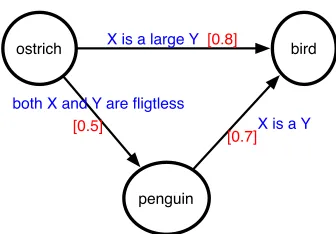
G is a tuple(u, v, l(e), w(e)), wherel(e)denotes the label type corresponding to the pattern that co-occurs with the two words uandv in some context, andw(e)denotes the co-occurrence strength betweenl(e)and the word-pair(u, v). Each word in the vocabulary is represented by a unique ver-tex in the relational graph and each pattern is represented by a unique label type. Because of this one-to-one correspon-dence between words and vertices, and patterns and labels, we will interchange those terms in the subsequent discus-sions. The direction of an edge e is defined such that the first slot (ie.X) matches withu, and the second slot (ie.Y) matches withvin a patternl(e). Note that multiple edges can exist between two vertices in a relational graph correspond-ing to different patterns. Most manually created as well as
ostrich bird
penguin
X is a large Y [0.8]
X is a Y [0.7] both X and Y are fligtless
[image:3.612.353.521.50.167.2][0.5]
Figure 1: A relational graph between three words.
automatically extracted ontologies can be represented as re-lational graphs.
Consider the relational graph shown in Figure 1. For ex-ample, let us assume that we observed the contextostrich is a large bird that lives in Africain a corpus. Then, we ex-tract the lexical patternXis a largeYbetweenostrichand birdfrom this context and include it in the relational graph by adding two vertices each forostrichandbird, and an edge fromostrichtobird. Such lexical patterns have been used for related tasks such as measuring semantic similarity between words (Bollegala et al.2007). The co-occurrence strength between a word-pair and a pattern can be computed using an association measure such as the positive pointwise mutual information (PPMI). Likewise, observation of the contexts both ostrich and penguin are flightless birdsandpenguin is a birdwill result in the relational graph shown in Figure 1.
Learning Word Representations
Given a relational graph as the input, we learn d dimen-sional vector representations for each vertex in the graph. The dimensionalitydof the vector space is a pre-defined pa-rameter of the method, and by adjusting it one can obtain word representations at different granularities. Let us con-sider two verticesuandvconnected by an edge with labell and weightw. We represent the two wordsuandv respec-tively by two vectorsx(u),x(v)∈Rd, and the labellby a matrixG(l)∈Rd×d. We model the problem of learning
op-timal word representationsx(ˆ u)and pattern representations ˆ
G(l)as the solution to the following squared loss minimisa-tion problem
argmin x(u)∈Rd,G(l)∈Rd×d
1 2
X
(u,v,l,w)∈E
(x(u)>G(l)x(v)−w)2. (1)
by,
E=1 2
X
(u,v,l,w)∈E
(x(u)>G(l)x(v)−w)2. (2)
In Eq. 2. The gradient of the error w.r.t.x(u)andG(l)are given by,
∇x(u)E =
X
(u,v,l,w)∈E
(x(u)>G(l)x(v)−w)G(l)x(v) +
X
(v,u,l,w)∈E
(x(v)>G(l)x(u)−w)G(l)>x(u) (3)
∇G(l)E=
X
(u,v,l,w)∈E
(x(u)>G(l)x(v)−w)x(v)x(u)> (4)
In Eq. 4,x(v)x(u)>denotes the outer-product between the two vectorsx(v)andx(u), which results in ad×dmatrix. Note that the summation in Eq. 3 is taken over the edges that contain eitheruas a start or an end point, and the summation in Eq. 4 is taken over the edges that contain the labell.
The SGD update for thei-th dimension ofx(u)is given by,
x(u)((ti+1)) =x(u)((ti))−s η0
t
P
t0=1
∇x(u)(t0)E
(i) 2
∇x(u)(t)E
(i)
.
(5) Here,∇x(u)(t)E
(i)denotes thei-th dimension of the
gra-dient vector ofEw.r.t.x(u)(t), and the superscripts(t)and (t+ 1)denote respectively the current and the updated val-ues. We use adaptive subgradient method (AdaGrad) (Duchi et al.2011) to schedule the learning rate. The initial learning rate,η0is set to0.0001in our experiments.
Likewise, the SGD update for the(i, j)element ofG(l) is given by,
G(l)((ti,j+1)) =G(l)((ti,j))−s η0
t
P
t0=1
∇G(l)(t0)E
(i,j) 2
∇G(l)(t)E
(i,j).
(6) Recall that the positive semidefiniteness ofG(l)is a re-quirement for the convergence of the above procedure. For example, ifG(l)is constrained to be diagonal then this re-quirement can be trivially met. However, doing so implies thatx(u)>G(l)x(v) = x(v)>G(l)x(u), which means we can no longer capture asymmetric semantic relations in the model. Alternatively, without constrainingG(l)to diagonal matrices, we numerically guarantee the positive semidefi-niteness ofG(l)by adding a small noise termδIafter each update toG(l), whereIis thed×didentity matrix andδ∈R is a small perturbation coefficient, which we set to0.001in our experiments.
Pseudo code for the our word representation learning al-gorithm is shown in Alal-gorithm 1. Alal-gorithm 1 initialises word and pattern representations randomly by sampling from the zero-mean and unit variance Gaussian distribution. Next, SGD updates are performed alternating between up-dates forx(u)andG(l)until a pre-defined number of maxi-mum epochs is reached. Finally, the final values ofx(u)and G(l)are returned.
Algorithm 1Learning word representations.
Input: Relational graphG, dimensionalitydof the word represen-tations, maximum epochsT, initial learning rateη0.
Output: Word representationsx(u)for wordsu∈ V.
1: Initialisation:For each vertex (word)u∈ V, randomly sam-pleddimensional real-valued vectors from the normal distri-bution. For each label (pattern)l∈ L, randomly sampled×d
dimensional real-valued matrices from the normal distribution.
2: fort= 1, . . . , Tdo
3: foredge(u, v, l, w)∈ Gdo
4: Updatex(u)according to Eq. 5 5: UpdateG(l)according to Eq. 6 6: end for
7: end for
8: return x(u),G(l)
Experiments
Creating Relational Graphs
We use the English ukWaC1 corpus in our experiments. ukWaC is a 2 billion token corpus constructed from the Web limiting the crawl to .uk domain and medium-frequency words from the British National Corpus (BNC). The corpus is lemmatised and Part-Of-Speech tagged using the TreeTag-ger2. Moreover, MaltParser3 is used to create a dependency parsed version of the ukWaC corpus.
To create relational graphs, we first compute the co-occurrences of words in sentences in the ukWaC corpus. For two wordsuandvthat co-occur in more than100sentences, we create two word-pairs(u, v)and(v, u). Considering the scale of the ukWaC corpus, low co-occurring words often represents misspellings or non-English terms.
Next, for each generated word-pair, we retrieve the set of sentences in which the two words co-occur. For explanation purposes let us assume that the two wordsuandvco-occur in a sentences. We replace the occurrences ofuinsby a slot markerXandvbyY. If there are multiple occurrences of u or v in s, we select the closest occurrences uandv measured by the number of tokens that appear in between the occurrences in s. Finally, we generate lexical patterns by limiting prefix (the tokens that appears before Xins), midfix (the tokens that appear in betweenXandYins), and suffix (the tokens that appear after Yins) each separately to a maximum length of 3tokens. For example, given the sentenceostrich is a large bird that lives in Africa, we will extract the lexical patterns Xis a largeY,Xis a largeY that,Xis a largeYthat lives, andXis a largeYthat lives in. We select lexical patterns that co-occur with at least two word pairs for creating a relational graph.
In addition to lexical patterns, we generate POS patterns by replacing each lemma in a lexical pattern by its POS tag. POS patterns can be considered as an abstraction of the lex-ical patterns. Both lexlex-ical and POS patterns are unable to capture semantic relations between two words if those words
1http://wacky.sslmit.unibo.it/doku.php?id=corpora 2
www.cis.uni-muenchen.de/∼schmid/tools/TreeTagger
3
are located beyond the extraction window. One solution to this problem is to use the dependency path between the two words along the dependency tree for the sentence. We con-sider pairs of words that have a dependency relation between them in a sentence and extract dependency patterns such as Xdirect-object-of Y. Unlike lexical or POS patterns that are proximity-based, the dependency patterns are extracted from the entire sentence.
We create three types of relational graphs using127,402 lexical (LEX) patterns ,57,494POS (POS) patterns, and 6835dependency (DEP) patterns as edge labels. Moreover, we consider several popular methods for weighting the co-occurrences between a word-pair and a pattern as follows.
RAW: The total number of sentences in which a pattern l co-occurs with a word-pair(u, v)is considered as the co-occurrence strengthw.
PPMI: The positive pointwise mutual information between a patternland a word-pair(u, v)computed as,
max
0,log
h(u, v, l)×h(∗,∗,∗)
h(u, v,∗)×h(∗,∗, l)
.
Here,h(u, v, l)denotes the total number of sentences in whichu,v, andl co-occurs. The operator∗ denotes the summation ofhover the corresponding variables.
LMI: The local mutual information between a patternland a word pair(u, v)is computed as,
h(u, v, l)
h(∗,∗,∗)log
h(u, v, l)
×h(∗,∗,∗)
h(u, v,∗)×h(∗,∗, l)
.
LOG: This method considers the logarithm of the raw co-occurrence frequency as the co-co-occurrence strength. It has been shown to produce vector spaces that demonstrate vector substraction-based analogy representations (Pen-ningtonet al.2014).
ENT: Patterns that co-occur with many word-pairs tend to be generic ones that does not express a specific semantic relation. Turney (2006) proposed the entropy of a pattern over word-pairs as a measure to down-weight the effect of such patterns. We use this entropy-based co-occurrence weighting method to weigh the edges in relational graphs.
Evaluation
We use the semantic word analogy dataset first proposed by Mikolov et al. (2013a) and has been used in much previ-ous work for evaluating word representation methods. Un-like syntactic word analogies such as the past tense or plu-ral forms of verbs which can be accurately captured using rule-based methods (Lepage 2000), semantic analogies are more difficult to detect using surface-level transformations. Therefore, we consider it is appropriate to evaluate word representation methods using semantic word analogies. The dataset contains8869word-pairs that represent word analo-gies covering various semantic relations such as the capital of a country (e.g.Tokyo, Japanvs.Paris, France), and fam-ily (gender) relationships (e.g.boy, girlvs.king, queen).
[image:5.612.366.506.105.169.2]A word representation method is evaluated by its abil-ity to correctly answer word analogy questions using the
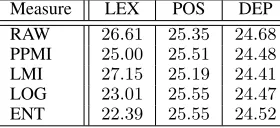
Table 1: Semantic word analogy detection accuracy using word representations learnt by the proposed method from relational graphs with different pattern types and weighting measures.
Measure LEX POS DEP
RAW 26.61 25.35 24.68
PPMI 25.00 25.51 24.48
LMI 27.15 25.19 24.41
LOG 23.01 25.55 24.47
ENT 22.39 25.55 24.52
word representations created by that method. For example, the semantic analogy dataset contains word pairs such as (man, woman) and (king,queen), where the semantic rela-tions between the two words in the first pair is similar to that in the second. Denoting the representation of a word w by a vector v(w), we rank all wordsw in the vocabu-lary according to their cosine similarities with the vector, v(king)−v(man) +v(woman). The prediction is consid-ered correct in this example only if the top most similar vec-tor isv(queen). During evaluations, we limit the evaluation to analogy questions where word representations have been learnt for all the four words. Moreover, we remove three words that appear in the question from the set of candidate answers. The set of candidates for a question is therefore the set consisting of fourth words in all semantic analogy ques-tions considered as valid (after the removal step described above), minus the three words in the question under con-sideration. The percentage of correctly answered semantic analogy questions out of the total number of questions in the dataset (ie. micro-averaged accuracy) is used as the evalua-tion measure.
Results
To evaluate the performance of the proposed method on re-lational graphs created using different pattern types and co-occurrence measures, we train 200dimensional word rep-resentations (d = 200) using Algorithm 1. 100 iterations (T = 100) was sufficient to obtain convergence in all our experiments. We then used the learnt word representations to obtain the accuracy values shown in Table 1. We see that the proposed method obtains similar results with all pat-tern types and co-occurrence measures. This result shows the robustness of our method against a wide-range of typi-cal methods for constructing relational graphs from unstruc-tured texts. For the remainder of the experiments described in the paper, we use the RAW co-occurrence frequencies as the co-occurrence strength due to its simplicity.
Table 2: Comparison of the proposed method (denoted byProp) against prior work on word representation learning. Method capital-common capital-world city-in-state family (gender) currency Overall Accuracy
SVD+LEX 11.43 5.43 0 9.52 0 3.84
SVD+POS 4.57 9.06 0 29.05 0 6.57
SVD+DEP 5.88 3.02 0 0 0 1.11
CBOW 8.49 5.26 4.95 47.82 2.37 10.58
skip-gram 9.15 9.34 5.97 67.98 5.29 14.86
GloVe 4.24 4.93 4.35 65.41 0 11.89
Prop+LEX 22.87 31.42 15.83 61.19 25.0 26.61
Prop+POS 22.55 30.82 14.98 60.48 20.0 25.35
Prop+DEP 20.92 31.40 15.27 56.19 20.0 24.68
0 200 400 600 800 1000 0
5 10 15 20 25 30
Dimensionality of the representations.
Accuracy on Semantic Analogies
LEX POS DEP
Figure 2: The effect of the dimensionality of the word rep-resentation on the accuracy of the semantic analogy task.
LEX stabilises with the least number of dimensions followed by POS and DEP. Note that LEX patterns have the great-est level of specificity compared to POS and DEP patterns, which abstract the surface-level lexical properties of the se-mantic relations. Moreover, relational graphs created with LEX patterns have the largest number of labels (patterns) followed by that with POS and DEP patterns. The ability of the proposed method to obtain better performances even with a highly specified, sparse and high-dimensional feature representations such as the LEX patterns is important when applying the proposed method to large relational graphs.
We compare the proposed method against several word representation methods in Table 2. All methods in Table 2 use200dimensional vectors to represent a word. A baseline method is created that shows the level of performance we can reach if we represent each worduas a vector of patterns lin whichuoccurs. First, we create a co-occurrence matrix between wordsuand patternsl, and use Singular Value De-composition (SVD) to create 200 dimensional projections for the words. Because patterns represent contexts in which words appear in the corpus, this baseline can be seen as a version of the Latent Semantic Analysis (LSA), that has been widely used to represent words and documents in infor-mation retrieval. Moreover, SVD reduces the data sparseness in raw co-occurrences. We create three versions of this base-line denoted by SVD+LEX, SVD+POS, and SVD+DEP corresponding to relational graphs created using respec-tively LEX, POS, and DEP patterns.CBOW(Mikolovet al. 2013b),skip-gram(Mikolovet al.2013c), andGloVe
(Pen-nington et al. 2014) are previously proposed word repre-sentation learning methods. In particular, skip-gram and GloVe are considered the current state-of-the-art methods. We learn200dimensional word representations using their original implementations with the default settings. We used the same set of sentences as used by the proposed method to train these methods. Proposed method is trained using 200 dimensions and with three relational graphs (denoted byProp+LEX,Prop+POS, andProp+DEP), weighted by RAW co-occurrences.
From Table 2, we see that Prop+LEXobtains the best overall results among all the methods compared. We note that the previously published results for skip-gram and CBOW methods are obtained using a 100B token news cor-pus, which is significantly large than the 2B token ukWaC corpus used in our experiments. However, the differences among theProp+LEX,Prop+POS, andProp+DEP meth-ods are not significantly different according to the Binomial exact test. SVD-based baseline methods perform poorly in-dicating that de-coupling the 3-way co-occurrences between (u, v)andl into 2-way co-occurrences betweenuandl is inadequate to capture the semantic relations between words. Prop+LEXreports the best results for all semantic relations except for the familyrelation. Comparatively, higher accu-racies are reported for the family relation by all methods, whereas relations that involve named-entities such as loca-tions are difficult to process. Multiple relaloca-tions can exist be-tween two locations, which makes the analogy detection task hard.
Conclusion
References
[Baroni and Lenci 2010] Marco Baroni and Alessandro Lenci. Distributional memory: A general framework for corpus-based semantics. Computational Linguistics, 36(4):673 – 721, 2010.
[Baroni and Zamparelli 2010] Marco Baroni and Roberto Zamparelli. Nouns are vectors, adjectives are matrices: Rep-resenting adjective-noun constructions in semantic space. In EMNLP, pages 1183 – 1193, 2010.
[Baroniet al.2014] Marco Baroni, Georgiana Dinu, and Germ´an Kruszewski. Don’t count, predict! a systematic comparison of context-counting vs. context-predicting se-mantic vectors. InACL, pages 238–247, 2014.
[Bengioet al.2003] Yoshua Bengio, R´ejean Ducharme, Pas-cal Vincent, and Christian Jauvin. A neural probabilistic language model. Journal of Machine Learning Research, 3:1137 – 1155, 2003.
[Bengioet al.2013] Yoshua Bengio, Aaron Courville, and Pascal Vincent. Representation learning: A review and new perspectives. IEEE Transactions on Pattern Analysis and Machine Intelligence, 35(8):1798 – 1828, March 2013. [Bollegalaet al.2007] Danushka Bollegala, Yutaka Matsuo,
and Mitsuru Ishizuka. Websim: A web-based semantic sim-ilarity measure. In Proc. of 21st Annual Conference of the Japanese Society of Artitificial Intelligence, pages 757 – 766, 2007.
[Boydet al.2010] Stephen Boyd, Neal Parikh, Eric Chu, Borja Peleato, and Jonathan Exkstein. Distributed opti-mization and statistical learning via the alternating direction method of multipliers. Foundations and Trends in Machine Learning, 3(1):1 – 122, 2010.
[Brachman and Levesque 2004] Ronald Brachman and Hec-tor J. Levesque. Knowledge Representation and Reason-ing. The Morgan Kaufmann Series in Artificial Intelligence. Morgan Kaufmann Publishers Inc., June 2004.
[Collobertet al.2011] Ronan Collobert, Jason Weston, Leon Bottou, Michael Karlen, Koray Kavukcuoglu, and Pavel Kuska. Natural language processing (almost) from scratch. Journal of Machine Learning Research, 12:2493 – 2537, 2011.
[Ducet al.2010] Nguyen Tuan Duc, Danushka Bollegala, and Mitsuru Ishizuka. Using relational similarity between word pairs for latent relational search on the web. In IEEE/WIC/ACM International Conference on Web Intelli-gence and Intelligent Agent Technology, pages 196 – 199, 2010.
[Duchiet al.2011] John Duchi, Elad Hazan, and Yoram Singer. Adaptive subgradient methods for online learning and stochastic optimization. Journal of Machine Learning Research, 12:2121 – 2159, July 2011.
[Firth 1957] John R. Firth. A synopsis of linguistic theory 1930-55.Studies in Linguistic Analysis, pages 1 – 32, 1957.
[Grefenstette 2013] Edward Grefenstette. Towards a formal distributional semantics: Simulating logical calculi with ten-sors. In*SEM, pages 1 – 10, 2013.
[Huanget al.2012] Eric H. Huang, Richard Socher, Christo-pher D. Manning, and Andrew Y. Ng. Improving word representations via global context and multiple word pro-totypes. InACL, pages 873 – 882, 2012.
[Lepage 2000] Yves Lepage. Languages of analogical strings. InACL, pages 488 – 494, 2000.
[Mikolovet al.2013a] Tomas Mikolov, Kai Chen, and Jef-frey Dean. Efficient estimation of word representation in vector space.CoRR, abs/1301.3781, 2013.
[Mikolovet al.2013b] Tomas Mikolov, Ilya Sutskever, Kai Chen, Gregory S. Corrado, and Jeffrey Dean. Distributed representations of words and phrases and their composition-ality. InNIPS, pages 3111 – 3119, 2013.
[Mikolovet al.2013c] Tomas Mikolov, Wen tau Yih, and Geoffrey Zweig. Linguistic regularities in continous space word representations. InNAACL, pages 746 – 751, 2013. [Mnih and Kavukcuoglu 2013] Andriy Mnih and Koray
Kavukcuoglu. Learning word embeddings efficiently with noise-contrastive estimation. InNIPS, 2013.
[Papernoet al.2014] Denis Paperno, Nghia The Pham, and Marco Baroni. A practical and linguistically-motivated ap-proach to compositional distributional semantics. InACL, pages 90–99, 2014.
[Penningtonet al.2014] Jeffery Pennington, Richard Socher, and Christopher D. Manning. Glove: global vectors for word representation. InEMNLP, 2014.
[Socheret al.2011a] Richard Socher, Cliff Chiung-Yu Lin, Andrew Ng, and Chris Manning. Parsing natural scenes and natural language with recursive neural networks. InICML, 2011.
[Socheret al.2011b] Richard Socher, Jeffrey Pennington, Eric H. Huang, Andrew Y. Ng, and Christopher D. Manning. Semi-supervised recursive autoencoders for predicting sen-timent distributions. InEMNLP, pages 151–161, 2011. [Socheret al.2012] Richard Socher, Brody Huval,
Christo-pher D. Manning, and Andrew Y. Ng. Semantic composi-tionality through recursive matrix-vector spaces. InEMNLP, pages 1201–1211, 2012.
[Socheret al.2013a] Richard Socher, John Bauer, Christo-pher D. Manning, and Ng Andrew Y. Parsing with com-positional vector grammars. InACL, pages 455–465, 2013. [Socheret al.2013b] Richard Socher, Danqi Chen,
Christo-pher D. Manning, and Andrew Y. Ng. Reasoning with neural tensor networks for knowledge base completion. InNIPS, 2013.
[Turney and Pantel 2010] Peter D. Turney and Patrick Pan-tel. From frequency to meaning: Vector space models of se-mantics.Journal of Aritificial Intelligence Research, 37:141 – 188, 2010.
[Turney 2006] P.D. Turney. Similarity of semantic relations. Computational Linguistics, 32(3):379–416, 2006.