Rochester Institute of Technology
RIT Scholar Works
Theses
Thesis/Dissertation Collections
7-1-1980
The effect of emulsion stabilizers on the rate of
solution of silver halide grains
Christopher L. Dumont
Follow this and additional works at:
http://scholarworks.rit.edu/theses
This Thesis is brought to you for free and open access by the Thesis/Dissertation Collections at RIT Scholar Works. It has been accepted for inclusion
in Theses by an authorized administrator of RIT Scholar Works. For more information, please contact
.
Recommended Citation
THE EFFE
CT
OF E
MULSI ON
ST
ABILIZERS
ON THE R
ATE O
F SOLUTIO
N
O
F SILVER HALIDE
GR
AINS
by
C
HRISTOPHER
L.
DUMONT
A the
sis
submitted in partial fulfillment
of the requirements for the degree of
Bache
lor
of Science in the Schoo
l
of
Photographic Arts
and Sciences in the
Col lege
of G
raphic
A
rts
and Pho
tography
o
f
the Rocheste
r Ins t i t ut e of Techno
logy
Jul
y.
1980
Sign.a tur
e
of the Author
.
Photographic Science
and In
strumentation
C
e r t i f i e d
b
y
_
.
.
·
.
Thesis Adviso
r
Acce
p t ed b
y
...,
-
.
.. . ... ...
•
. . . . .
• •..
.. . .. • . .
.
<k-33Ll>251
THE EFFECT
OF
EMULSION
STABILIZERS
ON
THE
RATE
OF
SOLUTION
OF
SILVER
HALIDE
GRAINS
by
CHRISTOPHER
L.
DUMONT
Submitted
to
the
Photographic
Science
andInstrumentation Division
in
partialfulfillment
ofthe
requirementsfor
the
Bachelor
ofScience
degree
at
the
Rochester
Institute
ofTechnology
ABSTRACT
The
effects ofthe
emulsionstabilizers,
4-hydroxy-6-methyl-l
,33a,7-tetraazaindene andl-phenyl-2-tetrazoline-5-thione
onthe
rate of solution-physicaldevelopment
of amonodisperse
AgBr
emulsioncontaining
Carey-Lea
silver solwere measured at a series of concentrations.
A
study
ofthe
effects of
the
silverhalide
solvent,
sulfitehas
been
studied
along
with alow-solvent
surfacedeveloper.
It
wasfound
that
the
tetraazaindene
definitely
had
an effect onthe
rateof solution-physical
development,
whilethe
l-phenyl-2-ACKNOWLEDGEMENTS
I
wouldlike
to
thank
the
following
people and organizations
for
their
partin
my
project.Mark Hinz
for
showing
methe
hand
emulsioncoating
techniques.
The
Polaroid
Corporation
for
donating
the
silver nitrate usedin
my
emulsions.
The Eastman
Kodak
Corporation
for
providing
the
emulsion stabilizers
that
weretested.
Above
allI
wouldlike
to
sincerely thank Dr.
Burt H.
Carroll
for
his
unselfishcontribution of
his
time
andguidance,
without whichmy
project
couldn'thave been
completed.TABLE
OF
CONTENTS
PAGE
LIST
OF
FIGURES
iv
INTRODUCTION
1
HYPOTHESIS
4
EXPERIMENTAL
5
DATA
11
ANALYSIS
OF
DATA
17
DISCUSSION
AND
CONCLUSIONS
.19LIST
OF
REFERENCES
22
BIBLIOGRAPHY
25
APPENDIX A
2?
APPENDIX
B
29
APPENDIX
C
31
APPENDIX
D
33
LIST
OF
FIGURES
Figure
1
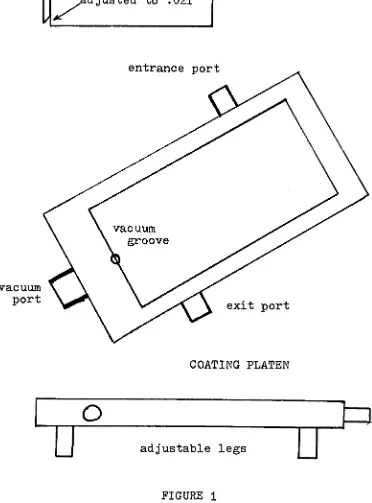
Diagram
ofCoating
Platen
andCoating
Knife...
7
Figure
2
Density
vs.Relative
Log
Exposure
in
HP9
12
Figure
3
Density
vs.Time
ofDevelopment
With Various
Concentrations
ofPMT,
Developed
in
HP9
With
1.0
g/1 ofKBr
13
Figure
4
Density
vs.Time
ofDevelopment With
Various
Concentrations
ofPMT,
Developed
in
D76
14
Figure
5
Density
vs.Time
ofDevelopment With Various
Concentrations
ofTAI,
Developed
in
HP9,
andD76
15
Figure
6
Density
vs.CLS
Sample,
andControl Sample
in
D76, Dk50,
&
HP9
16
INTRODUCTION
The
basis
ofthis
experiment comesfrom
the
different
methods
in
whichdevelopment
ofthe
silverhalide
grainsoccurs.
The
silverhalide
grainmay be
reducedby
adeveloper
which at
the
startdoes
not containany
silver salt.The
silver
for development
comesfrom the
silverhalide
grainitself.
This
is
called chemicaldevelopment.
In
anotherform
ofdevelopment,
called physicaldevel
opment,
the
silveris
presentin the
developer
in
the
form
of a soluble silver salt.
This
soluble silver saltthen
plates out around
the
latent-image
centersduring
development.
When
the
silverhalide
dissolves
in
the
developer,
the
silver
ions
canbe
reducedby
physicaldevelopment
atthe
latent-image
centers or onthe
growing
silver surfacesthat
have
already
formed
aroundthe
latent-image
centers.This
process,
whichinvolves
solution ofthe
silverhalide
andthen
physicaldevelopment,
is
called solution-physicaldevel
opment.
The
rate of solution-physicaldevelopment
is mainly
determined
by
the
ratein
whichthe
silverhalide
is
dis
solved .
2
the
rate of solution of silverhalide
in
a monodisperse emul sion.Carey-Lea
silver sol was addedto
the
emulsionformula
andthen
it
was coated.The
silver particles provided nucleifor
the
silverto
plate out onduring
development
in
alow
solvent action metol-d-araboascorbic acid surfacedeveloper.
Fixing
andwashing
weredone
normally.If
the
development
conditions were chosen sothe
rate ofthe
reduction of silverions
atthe
Carey-Lea
silver nucleiwas rapid as compared
to
the
rate ofthe
plating
out ofthe
silver,
then
the
rate of accumulation ofthe
silver was afunction
ofthe
rate at whichthe
silverions
were present atthe
nuclei.The
tests
weredone
on unexposedemulsions,
the
Carey-Lea
silveracting
aslatent-image
sites.Density
vs.time
ofdevelopment
was used asthe
analysis.In
alater
experimentJames
andVanselow
found
that
the
rate of solution-physicaldevelopment
wasdetermined
by
the
rate of soltion of silverhalide
grainsin the
developer.
If
a silverhalide
solventis
present,
the
rate of solution
ofthe
silverhalide
grainsincreased
withthe
increase
in
solubility
ofthe
silverhalide
respectively.The
data
in
the
emulsioncontaining
C
arey-Lea silver soldo
not givethe
actual rate of solution ,but
it
does
givethe
relativeeffect,
sincethe
changein
rate ofdeposi
tion
ofthe
reduced silverhalide
onthe
colloidal silver nucleiis
similarto
that
which occurs with an exposed emulthat
the
rate ofdeposition
of silver remains constantthrough
out
the
process ofdevelopment
andthe
Carey-Lea
silverdoes
not undergo a change.
An
activedeveloper
is
used sothat
the
solvent actionof
the
silverhalide
crystalsis kept
at a minimum soit
won'tbe
acontributing
factor
in
the
rate of solution ofthe
silverhalide.
A
hydroquinone-phenidone
developer
willbe
used ratherthen
the
metol-ascorbic aciddeveloper
usedby
James
andVanse-6
low
for
a couple of reasons.One
is
that
the
hydroquinone-phenidone
developer
is
believed
to
be
oflower
solvent actionand
that
the
oxidationby-products
ofthis
developer
are cleanand will not
interfere
withthe
analysis.Ascorbic
acid willbe
used asthe
preservative sinceit
has
low
solvent action.An
activedeveloper
ofhigh
solvent action will alsobe
usedduring
these
experiments.Although
emulsion stabilizers are usedtoday
in
mostemulsion
formulas,
there
has
notbeen
anisolated
study
ofthe
effects ofthese
stabilizers onthe
rate of solution ofHYPOTHESIS
A
hypothesis
is
formulated
that
the
emulsion stabilizerswill
have
an effect onthe
rate of solution of silverhalide
grains.
Since
both
emulsionstabilizers,
h-hydroxy-6-methyl-l
,3.3a,7-tetraazaindene
(TAI)' andl-phenyl-2-tetrazoline-5-thione
Q
(PMT)
, are adsorbedby
the
silverhalide,
it
is
hypothesized
EXPERIMENTAL
There
arefour
major areasthat
have
to be
completedto
test
the
hypothesis:
1
)
Make
the
Carey-Lea
silver sol2)
Precipitate
aAgBr
emulsion3)
Construct
alow-solvent
developer
b)
Testing
the
hypothesis
Attempts
atmaking
a pure colloidal silver solby
reduction
withhydrazine
winthe
presence of gelatinfailed
and aCarey-Lea
silversol,
dextrin
reduction,
was usedinstead.
The
dextrin
acts asthe
reducing
agent and also asthe
protective
colloid.The
sol was coagulatedtwice
using
methanol.The
coagulum wasthen
redispersedin
ak%
inert
gelatin solution.
The
formula
for
the
Carey-Lea
silver sol canbe
found
in
appendixA.
A
monodisperse emulsion of .1 mole silverhalide/liter
o
was made
using
methods similarto
Berrimans
technique
, except
that
phthaloyl gelatin was usedto
aid coagulation.The
double
jet
emulsion was precipitatedfor
k
minutes and40
sec-o -bl
onds at
k5
C.
The
halide
excess waskept
constant at5x10
NKBr
atthe
start andfinish.
The
precipitate was coagulatedrefrigerator
to
settle-The
liquid
wasthen drained
from
the
coagulum and rinsed with
distilled
water.The
coagulum wasredispersed
in
a6%
inert
gelatin solutionthat
contained27
ml of .INNaOH and
5x10
^NKBr.
The
final
volume wasbrought
to
800
ml andNaOH
was addedto
bring
the
final
pHto
6.30
at40
C
.No
ripening,
chemical sensitization or stabilizationwas
done
onthe
emulsion unless stated.The
emulsion wasstored
in
a refrigerator when notin
use.The
formula
for
this
emulsion canbe
found
in
appendixB.
The
coating
ofthe
emulsion samples weredone
by
hand
using
a platen andcoating knife
depicted
in figure
1
.The
platen was
leveled
for
each sample coated.An
aspirationsystem provided
the
vacuumby
whichthe
film base
washeld
to
the
platen.A
7$
saponin solution was addedto
the
samplesto
aidin coating
evenly.The
platen wasfirst
heated
by
running hot
waterthrough
it
and afterwardsto
allowthe
emulsion
to
coat evenly.It
wasvery important
that
each samplewas
the
samethickness
throughout
the
samples or erroneousdata
would result.The
platen was cooledby
running
coldwater
through
the
platento
setthe
emulsion.The
set emulsions were
then
tacked
down
to
aflat mounting board
andplaced
in
alight
tight
drawer
to
dry.
The
samples contained10
ml of emulsion plusany
ofthe
addendabeing
tested.
In
formulating
the
low-solvent
developer,
hydroquinone-coating
knife
entrance port
vacuum
port
exit port
COATING PLATEN
O
U
adjustablelegs
3=i
FIGURE
1
[image:13.550.107.479.153.656.2]8
phenidone was
the
developing
agents andborax
was used asthe
alkali.
The
pH was adjustedusing NaOH to
a pH of9.0
at20C
.It
wasfound
that
a pH above9
gavetoo
high
afog
level.
This
developer
willbe
referredto
asHP9
in
the
rest ofthis
paper.
The
formula
for
HP9
canbe
found
in
appendixC
Preceeding
the
testing
ofthe
emulsion stabilizers werepreliminary
experimentsto
make surethe
procedurein
making
the
Carey-Lea
siversol,
the
emulsion,
the
developer
formula,
and
the
coating
technique
did
nothave
an effect onthe
endresults.
Trials
ofthe
colloidal silver alonein
inert
gelatintested
in
HP9
andD76
both
showed aB&F
ofO.03.
A
sample ofthe
colloidal silver with0.5
mg
ofdextrin
wastested
alsogave a
B&F
of0.03.
The
unexposed emulsion wastested
in
the
HP9
formula
which gave aB&F
of0.05
after5
minutesdevel
opment,
and a0.08
level
after a10
minutedevelopment.
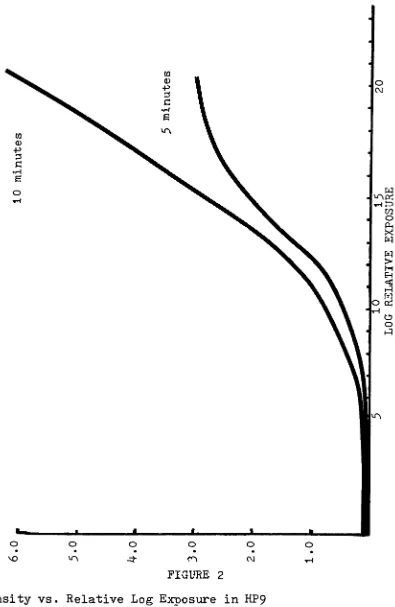
An
EG&G
sensitometer exposure of10
^ seconds without compensation
generatedthe
density
vs. relativelog
exposure curvesshown
in
figure
2,
for
5
and10
minutedevelopment
times
in
HP9
.A
test
ofthe
Carey-Lea
silverfixed
for
5
minutes without
development
gave aB&F
ofO.03.
During
these
tests
it
wasfound
that
a sufficientstop
bath
wasextremely important
to
insure
a completehalt
ofdevelopment,
or solution-physicaldevelopment
would occurin
the
fixing
bath.
The
stop
bath time
that
was sufficientto
9
then
fixed
for
5
minutes,
washedfor
5
minutes and airdried.
The
formulas
for
the
stop
bath
andfixer
canbe
found
in
appendix
C
.To
test
for
consistency
ofthe
coatings aDmax
of eachcoating
samples wastaken
with aresulting
standarddeviation
of .04.
Controls
ofthe
emulsion withoutthe
colloidal silverpresent was
done
with each processing.To
make sure eachsample was
consistent,
the
Carey-Lea
silver andthe
7%
saponinwas
added,
in
the
correct proportionsto
200
ml ofthe
emulsion and
thoroughly
mixedto
provide consistenttesting.
The
calculationfor
the
amount ofCarey-Lea
silver addedto
the
samples was .066mg ofAg/lO
ml sample of emulsion.This
is
the
samelevel
of colloidal silver/
halide
silver usedby
James
andVanselow in
coating A
oftheir
experimentSamples
containing the
colloidal silverin the
emulsionwere processed
for
2i
and5
minutesin
HP9, DK50,
andD76,
each with a control sample
that
did
not containCarey-Lea
silver.
These
developers
allhad
adifferent
level
of silverhalide
solvent.The
stabilizers weretested
in D76
(which
containedthe
highest
level
ofsulfite,
lOOg/l)
for
2%
and5
minutesdevel
opment
times.
The
levels
ofTAI
tested
were0.25g
andl.OOg
TAI/
mole silverhalide.
The
levels
ofPMT
tested
were25.0
mg,
5.0mg,
l.Omg,
0.25mg
and .0063mgPMT/mole
silverhalide.
A
final
controltest
wasdone
on each ofthe
abovelevels
10
emulsion samples.
These
tests
proved negative onany
effectwithout
the
colloidal silver onthe
unexposed samples.Three
replicates andfinding
the
mean was used asthe
plotted
data
points.A
standarddeviation
was calculated andused as
the
measurement of error.All
ofthe
points plottedfell
withinthe
standarddeviations
calculated.Beckman
research pH meters were usedfor
pH measurements,a
Mettler
H10
analysticalbalance
was usedfor measuring
chemical
weights,
anddensity
values were measured on aMcBeth TD
11
DATA
The
data
obtainedin
this
experiment consists of graphsof
density
vs. relativelog
exposure(fig.
2),
density
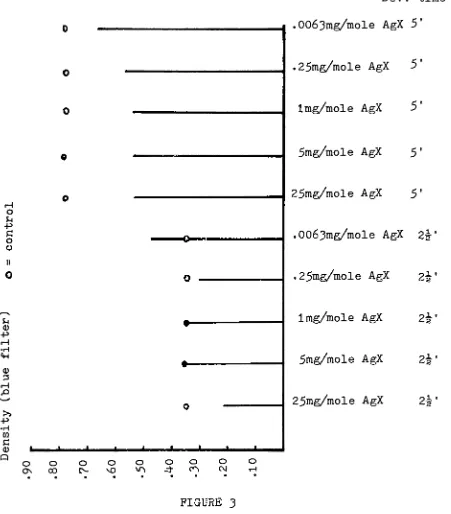
vs.time
ofdevelopment
with various concentrations ofPMT,
de
veloped
in
HP9
with1.0
g/l ofKBr
(fig.
3).
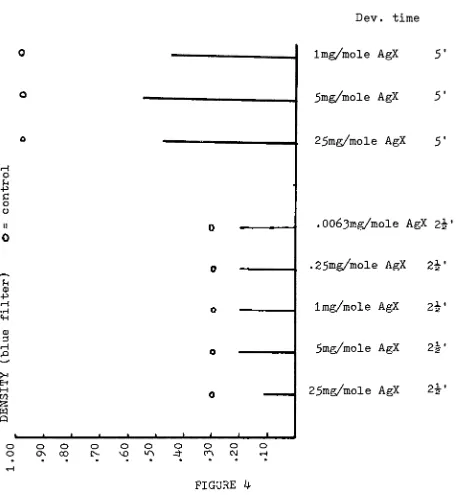
density
vs.time
ofdevelopment
with various concentrations ofPMT,
de
veloped
in
D76
(fig.
4),
density
vs.time
ofdevelopment
withvarious concentrations of
TAI,
developed
in
HP9
andD76
(fig.
5),
anddensity
vs.Carey-Lea
silver sample containedin
anemulsion
sample,
and acontrol samplein
D76,
DK50
andHP9
12
o
VO
O o o
FIGURE
2
o
CM
[image:18.550.79.474.77.684.2]13
o $-1 pC
o o u <D -P H H CO 3 >> -P H CQ C CD Q 'Dev.
time
.0063mg/moleAgX
5' .25mg/moleAgX
5'lmg/mole
AgX
5
'5mg/mole
AgX
5'25mg/mole
AgX
5'.0063mg/mole
AgX
2^'.25mg/mole
AgX
2|
'lmg/mole
AgX
2*'5mg/mole
AgX
2*'25mg/mole
AgX
2*'o o
ON CO
o o o o o o o
o- \o ^o ^t <^ w
-FIGURE
3
[image:19.550.57.508.100.614.2]14
0
o o H O U , P c o o u0
u Q) P H H CD 3 H .Q >H EH Mt/3 0 ^^
a w Q o o ooooooooo
ON 00 N \0 >A 4 C^CM r-i
Dev.
time
lmg/mole
AgX
5'5mg/mole
AgX
5
'25mg/mole
AgX
5'0063mg/mole
AgX
2i
.25mg/mole
AgX
2i
lmg/mole
AgX
2|'5mg/mole AgX
2*'25mg/mole
AgX
2|'FIGURE
4
DENSITY
vs.TIME
OF DEVELOPMENT
WITH VARIOUS
CONCENTRATIONS
[image:20.550.49.505.68.563.2]15
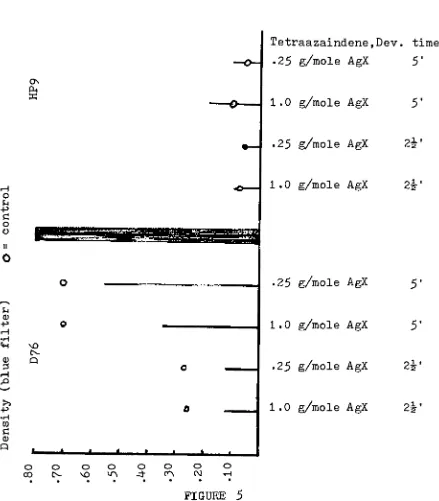
o U P o o u CO P H H <H CO 3 P H to CO Q ON PL. VO o co .J ITetraazaindene.Dev.
time
.25 g/mole
AgX
5'
1
.0
g/moleAgX
.25 g/mole
AgX
.25 g/mole
AgX
1
.0
g/moleAgX
.25 g/mole
AgX
1
.0
g/moleAgX
o o o o o o o
i>- vo un cn cm r-i
5'
)1 1
1
.0 g/moleAgX
[image:21.550.57.496.107.608.2]2|' 5' 5" 2i' >i
FIGURE
5
-=
blue
filter
reading
O
= visualfilter
reading
D76
(100
g/1 sulfite)DK50(30
g/1sulfite,
.5g/lKBr)
HP9
(0.0
g/1sulfite,
O.Og/l
KBr)
p H O
CO CM
CO ,-H
Q
i I I 1 1 I I I
o o o 00 o \o o
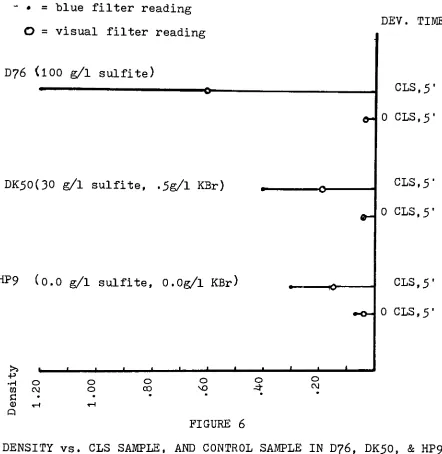
FIGURE
6
-o-16
DEV.
TIME
CLS.5'0
CLS.5' ' CLS.5"0
CLS,5' CLS.5'0
CLS.5' o CM [image:22.550.54.496.128.582.2]17
ANALYSIS
OF DATA
For
the
experimental procedure usedto
determine
the
effects of
the
emulsionstabilizers,
a check ofJames
andVanselows
resultsfrom
using
Carey-Lea
silver sol as nuclei11
sites
for
solution-physicaldevelopment
, andtheir
resultsthat
increasing
the
rate of solution-physicaldevelopment
is
the
result ofthe
increased
solubility
ofthe
silverhalide
in
the
presence of a silverhalide
solvent such as sulfite.In
looking
atfigure
6
it
is
shownthat
increasing
the
solubility
of a silverhalide
by
using
sulfite or potassiumbromide,
increased
the
rate of solution-physicaldevelopment
by
deposition
of silver onthe
Carey-Lea
silver nuclei .The
higher
the
level
of silverhalide
solventin
adevelopment
time
long
enoughto
overcomethe
induction
period(5
minutes),
showed a
higher
density
level
then
adeveloper
that
did
notcontain
any
silverhalide
solvent.The largest
changein
density
occurredin
D76,
which containedthe
highest
level
of sulfite
(100
g/l).As
the
level
of silverhalide
solventdecresed,
the
less
of adifference
in
density
was observedbetween
the
control emulsion sample and onethat
containedCarey-Lea
silver nuclei .In
the
testing
ofthe
TAI
onthe
rate of solution-phys18
slows
down the
rate ofsolution-physical
development.
The
effect was more pronounced at
the
l.Og/mole
AgX
then
atthe
25g/mole
AgX
level
whendeveloped
in
D76
.In
the
low-solvent
action
developer,
HP9,
it
seemsto
acceleratethe
rate ofsolution-physical
development
slightly.The
results ofPMT
developed
in D76
showed anincrease
in
solution-physicaldevelopment
(figure
4),
but
in this
casethe
sulfite presentin
D76
couldbe
the
cause ofthe
effectobtained.
When
the
PMT
wastested
in the
low-solvent
action,
surface
developer,
HP9 (figure 3)
the
effectis
less
pronounced.
In comparing the
resultsin
figure
3
andthe
results
in
figurw
4,
the
effect ofthe
PMT
onthe
rate ofsolution-physical
development
is very
small,
if
at all withinthe
standarddeviation limits
of .04.An
interesting
effect ofthe
lowest
level
ofPMT
(.0063
mg/mole of
AgX)
was observed.The PMT
seemedto
increase
the
rate of solution-physicaldevelopment
atthe
2i
minutedevelopment
time
in
HP9.
The
errorlimits
of -.05fall
within
the
data,
althoughit
remainsvery
close.A
closercheck of
this
resultusing
more replicates would provide aanswer-19
DISCUSSION
AND
CONCLUSIONS
The
result oftesting 4-hydroxy-6-methyl-l
,3,3a,
7-tetraazaindene
onthe
rate of solution ofthe
silverhalide
proved
that
it
definitely
slowsdown
the
rate ofsolution-physical
development
using the
Carey-Lea
silver as nucleisites.
This
is
consistent withthe
fact
that
TAI
is
ananti-1 3
ripening
agent andis
adsorbed onthe
silverhalide
.This
adsorption
to
the
silverhalide
slowsdown
the
rate of solution
ofthe
silverhalide.
TAI
alsointerferes
withOstwald
ripening,
orthe
smaller crystalsdissolving
andreprecipita-14
ting
onthe
coarser crystals .TAI
stopsthe
ripening
ofthe
crystals even
though it
is
weakly
adsorbed.There
is
much1 5
more
activity
presentfrom
the
TAI
then
is
expected .The
hypothesis
has
been
found
correctin
the
case of4-hydroxy-6-1
,33a,7-tetraazaindene.The
result oftesting
the
effects ofPMT
onthe
rate ofsolution of silver
halide
proved negative.If there
wasany
effect,
there
mightbe
only
a slightincrease
in
the
rateof solution-physical
development
using this
experimentaltechnique.
There
aremany
possibilitiesin this
experimentthat
could effectthe
results ofadding PMT
to
an emulsion.20
produced
by
the
colloidal silvermay
be
a result of a changein
the
colloidal silverthat has
occurredduring
development.
In
using PMT
as an emulsionstabilizer,
muchless
is
added since
it
is
morestrongly
adsorbedthen
TAI,
but
PMT's
activity is
less
then
the
amount of stabilizer adsorbed/surface
area ofthe
crystal as comparedto
the
TAI.
Both
TAI
andPMT
arecompeting
adsorbers onthe
silverhalide
crystal and canbe
important
factors
in
the
photographic17
action .
They
can replace certainsensitizing dyes
onthe
surface of
the
silverhalide
grains,
andthus
reducethe
1
fi
spectral
sensitivity
ofthe
emulsion .One
ofthe
reasonsthat
have
been
proposedfor
the
reduction
ofsensitivity
by
the
emulsion stabilizersis
the
de
struction of
the
sensitivity
centersby
these
anti-ripening
19
agents .
Either
the
centers arefilled
by
the
stabilizersor
the
sensitivity
centersmay be
destroyed
by
the
stabilizers.20
"Thomas R.
Thompson
has
proposedthat
restraining
compoundsmay
preventthe
growth of active orpartially
formed
sensiti-vityspecks.
"
Another
possible cause ofthe
results obtainedmay be
acause of
interactions
withthe
stabilizers withthe
thiosul-fate
in
the
fixing
bath.
The
thiosulfate
is
alsostrongly
adsorbed
by
the
silverhalide,
and couldby
poisoning
the
21
rate of reaction ofthe
silverhalide
There
aremany
factors
beside
the
emulsion stabilizers21
development.
Gelatin
concentrations,
development
effects onthe
colloidalsilver,
anddevelopment
times
arejust
afew
suggestions of other possible
interactions.
There
are stillmany
areasthat
mustbe
better
understoodto
find
out moreabout
the
effects ofthe
stabilizersin
all phases ofthe
22
23
LIST
OF
REFERENCES
1.
T.H.
James
andW.
Vanselow,
"The Rate
ofSolution
ofSilver
Halide Grains
In
a Developer,"Photographic
Science
andTechnology.
2,
(2)
135
(19531
2.
Ibid
1
3.
T.H.
James
andW.
Vanselow,
"The Role
ofSilver Halide
Solvents
in
Practical
Development,"Photographic
Engineering.
7.
90
(1956)
4.
Ibid
2
5-
Ibid
1
6.
Conversation
withDr.
B;
H.
Carroll
7.
C.
E.
K.
Mees
andT.
H.
James,
"The
Theory
ofthe
Photographic
Process."Macmillan
Publishing
Co.,
Inc.
3rd
Edition,
1966,
p
11
.8.
Ibid
7,
p
330.
9.
R.
W.
Berriman,
"Crystal Growth
During
the
Formation
of aSilver-Bromide Dispersion
in
Gelatin,"Journal
ofPhotographic Science.
12,
121
(I96l)
10.
Ibid
1
11.
Ibid
1
12.
Ibid
2
13.
G.
F.
Duffin,
"Photographic
Emulsion
Chemistry."Focal
Press,
I966,
pi38.
14.
Grant
Haist,
"Modern Photographic
Processing.
"John
Wiley
andSons,
vol2,
1979,
p
63.
15.
Conversation
withDr.
B.
H.
Carroll
139-24
17.
Ibid
7,
p
11.
18.
E.
J.
Birr,
"Stabilization
ofPhotographic
Silver Halide
Emulsions.
"The Focal
Press,
p
150.
19-
Ibid
18
20.
Thomas R.
Thompson,
"Action
ofOrganic
Stabilizers
ona
Photographic
Emulsion,
"
Photographic
Science
andEngineering.
3,
272
(1959)
25
26
BIBLIOGRAPHY
1.
T.H^
James
andG.C.
Higgins,
"Fundamentals
of zyaN
.Y
.1
95
Photographic
Theory.
"John
Wiley
andSons,
Inc.,
New
York,
".Y.
1954
2.
C.
E.
K.
Mees
andT.H.
James,
"The
Theory
ofthe
Photographic
Process."Macmillan
Publishing-0n.r
Inc.
1977
3.
T.
H.
James,
"The Reduction
ofSilver
Ions
by
Hydroquinone,
"Journal
ofPhysical
Chemistry
Society.
61,
648
(1939)
4.
T.H.
James,
"Development
by
Hydroquinone,"Journal
ofPhysical
Chemistry.
43.
701
(1939)
5-
E.
Klein,
"The
Influence
ofSilver
Halide
Solvents
in
the
Developer
onthe
Characteristic Curve
in
Negative
andReversal
Development,
"The
Journal
ofPhotographic
Science,
8,
178
(I960)
6.
Shiao,
Fortmiller
andHertz,
"Dissolution Rates
ofAqueous
Silver
Halide
Dispersions,"Journal
ofPhysical
Chemistry.
79,
816
(1975)
7
Grant
Haist,
"Modern
Photographic
Processing.
"John
Wiley
andSons,
Inc.,
volume1,
1979
8.
W.
H.
Simpson,
andJ.
J.
Hourigan,
Jr.,
"Relative
Dissolution Rates
ofSilver Halide
Crystals
by
Kinetic
Calorimetry,
"Photographic
Science
andEngineering.
24,1
(198O)
9.
Zolio
C.
H.
Tan,
"Investigation
ofthe
Formation
of
Simple
andMixed Complexes
in
the
Silver-Phenylmercapto-tetrazolate-Halide
System,
"Photographic
Science
andEngineering.
19,
1
(1975)
10.
R.M.
Cole
andR.
B.
Pontius,
"Characteristics
ofPhysical
Development
withDeveloper
Solutions
Containing
Thio
sulfate-SilverComplex
Ions",
Photographic
Science
andEngineering.
5,
3
(1961)
11.
G.
F.
Duffin,
Photographic
Emulsion
Chemistry.
27
28
APPENDIX A
CAREY-LEA
SILVER
FORMULA
A)
5.0
g
Dextrin in
50
mldistilled
water1
ml of0.5N
Sodium Hydroxide
B)
0.1000
g
Silver Nitrate in
10
mldistilled
waterMix
solutionA
and solutionB
with constantstirring for
approximately
5
minutes,
let
solution stir until color remainsconstant
(brownish-yellow
color) .Coagulate
solution with methanol.Let
solutionsettle,
drain
offliquid
and saveit.
Add
50
ml ofdistilled
waterto
coagulum and stir.Coagulate
a secondtime
using
methanol.Let
solution settle anddrain liquid
saving
the
liquid
andadding
it
to
the previously drained
material.Add
additionalmethanol
to
the
drained
offliquid
to
insure
that
all ofthe
reduced silver
has
been
coagulated.Add any
additional material
that
has
been
coagulatedto
the
rest ofthe
coagulum.Redisperse
the
coagulumin
a4$
inert
gelatin solution.The
4$
gelatin solution consists of20
g inert
gelatin and29
30
APPENDIX
B
SILVER
BROMIDE
EMULSION FORMULA
A
0.1
mole silverbromide
/
liter
emulsion(monodisperse)
is
precipitated asfollows:
A)
Pthaloyl
gelatin6.0
g
Potassium
bromide
0.24g
Distilled
waterto
make800
mlB)
Silver
nitrate34.0
g
Distilled
waterto
make100
mlC)
Potassium
bromide
24.14
g
Distilled
waterto
make100ml
Run
solutionB
and solutionC
into
solutionA
at45C
following
double
jet
emulsiontechniques
under constanttur
bine
stirring.Run
time
of4
minutes and40
seconds.Add
14
ml of7N
H
SO^
to
coagulatethe
emulsion.Let
the
solution settle overnight
in
refrigerator.Drain
liquid
from
coagulum and rinse with cold
distilled
water.Redisperse
the
coagulum
in
a solutionthat
contained27
ml of0.1N
NaOH
and5x10
N KBr
in
aninert
6%
gelatin solution.Add
sufficientNaOH
to
bring
pHto6.30
at40C
.Bring
final
volumeto
800ml.
Store
emulsionin
stainless steelbeaker
covered with aluminum31
32
APPENDIX
C
HP9,
FIXER
andSTOP
BATH
FORMULAS
HP
9
FORMULA:
750
ml ofdistilled
water at125F
20
g
D-(-)-araboascorbic
acid12
g
Hydroquinone
40
g Borax
.5
g
Phenidone
Distilled
waterto
make1.0
liter,
adjust pHto
9.0
@
20C
FIXER
FORMULA:
750
ml ofdistilled
water at125F
200
g Sodium
thiosulfate
(pentahydrated)
20
g
Sulfite
Distilled
waterto
make1.0
liter
@
20C
STOP
BATH
FORMULA
125
ml28$
acetic acid33
34
APPENDIX D
CALCULATIONS
FOR
AMOUNT
OF
CAREY-LEA
SILVER
SOL
FOR
10
mlEMULSION SAMPLE
.10 mole silver
halide
moles silverhalide
800
ml10
ml_3
=
1.25
x10
^ moles silverhalide
(MW
AgBr
187-77)
(1-25
x 10"3 moles silverhalide)
=
2.347
x10"3g
silverhalide
in
10
mlCarey-Lea
Silver
solCarey-Lea
silver sol _2.813
x10
g
silver/silverhalide
to
addto
10
ml emulsion7^
2.347
xlO;g
=
6.602
xmg
Carey-Lea
silverml
Carey-Lea
silver solto
add= gilver
to
10
ml emulsion sample_
500
mlCarey-Lea
silver sol2.64
ml ofCarey-Lea
silversol
to
addto
10