World Transactions on Engineering and Technology Education © 2005 UICEE Vol.4, No.2, 2005
INTRODUCTION
The use of First Year Engineering Experience (FYEE) courses has become very prevalent around the world. However, their introduction is often ad hoc and occurs without all the proper questions being posed. Some of these questions are: how important is it to expend much energy to retain students; are faculty members supposed to be teachers, researchers, scholars or pastoral guardians; how poorly are students prepared for university and should the FYEE be used to address the inadequacy of high schools in teaching mathematics; do FYEEs impact on grades, retention and produce better
graduates; what should be the role of industry in designing and funding a FYEE and, how does the FYEE fit into the overall engineering programmes?
RETAINING FIRST YEAR ENGINEERS
In today’s world, universities are compared to, and are very often expected to operate as, commercial enterprises. State and national governments desire universities to provide students with a fulfilling educational experience, but within very tight budgetary constraints. This is not helped by a public perception where universities may be seen as being elitist and wastrels of public monies. In such a situation, management must ensure that any investment in new courses and facilities (such as FYEEs) strongly benefits the university.
In general, student fees for tertiary education have increased continuously in the western world over the last three decades as governments hypothesise that it is no longer of national strategic importance to inject funds into a system that will obey normal market forces. Labour shortages (in professional engineering) in many developed countries are addressed by fine-tuning immigration policies and relying on superior living standards to entice foreign nationals. In such a situation, university managers see that more students, combined with low
attrition levels, means more fee income and the ability to better sustain their university.
An Example of Retention Success
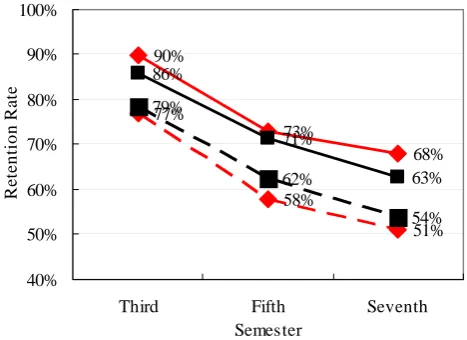
The College of Engineering (COE) at the University of Colorado, Boulder (UCB), in Boulder, USA, offers a FYEE programme, GEEN1400 – First Year Engineering Projects (FYEP), which is conducted in its Integrated Teaching and Learning Laboratory (ITLL). Detailed information has been published about the success of the course in increasing retention levels across all engineering disciplines [1] (Figure 1).
90%
73%
68% 77%
58%
51% 86%
71%
63% 79%
62%
54%
40% 50% 60% 70% 80% 90% 100%
Third Fifth Seventh
Semester
Re
te
n
tio
n
R
a
[image:1.595.320.554.530.700.2]te
Figure 1: ITLL retention data to graduation.
Between the Fall 1994 and Fall 2001 semesters, 4,393 students enrolled in the COE classified as freshmen, non-transfer students. Of these, 1,809 took the FYEP course and 2,584 did not take the course. During this time, 258 students began as civil engineering majors (CVEN). Of these, 41 took the FYEP
The role of the First Year Engineering Experience (FYEE) course
Frank Bullen† & Daniel Knight‡
University of Tasmania, Hobart, Australia† University of Colorado, Boulder, USA‡
course and 217 students did not take the course. Students are classified as FYEP takers if they took the course during their first two semesters. Retention data were collected for students at the third, fifth, and seventh semesters, with students classified as retained if they remain in the COE.
Figure 1 shows that FYEP takers are retained at a significantly higher rate than non-takers across all measured semesters. Results were strongest at the seventh semester, with stronger results for CVEN students (+33%) than the overall population (+16%).
Financial Implications: a Hypothetical Case Study
A simple NPV calculation can be undertaken to place a dollar value on the effect of FYEE on income using the data from Figure 1. Over the period from 1994 to 2001, there was about a 19% difference in graduation levels of the two CVEN cohorts. The data in Table 1 is for a first year intake of 100 students and uses a Net Present Value (NPV), with an annual student fee of US$20,000. While the data is simplistic, it serves to illustrate the principles. It assumes that of those students who enter as freshmen, 50% of the cohort enrols in GEEN1400, and 50% select other technical electives. If it is assumed that the trend continues for four years, then the income forfeited would be $1.54M at a discount rate of 3%, $1.41 at a discount rate of 5% and $1.29 at a discount rate of 7%.
Table 1: Progression data for students.
Data for 100 Freshmen
Not in
ITLL In ITLL Loss Annual Loss Freshmen 50 50 0 $ - Sophomores 39 45 6 $ 120,000 Juniors 29 36 7 $ 140,000 Seniors 25 34 9 $ 180,000
Graduation 51% 68% - -
One response could be to mandate that all students enroll in GEEN1400, and to also employ a dedicated pastoral carer for four years at an annual cost of $80,000. The Department would remain better off by $65,000 for the 2006 first year student cohort alone. If the future cohorts of 2007, 2008 and 2009 were taken into account, and it is assumed no extra resources are required, the net benefit would be around $1.1M (at 3% discount rate). This amount may even increase if the overall retention rate could be improved above 68% by the combined effect of enrolling freshmen in GEEN1400, and extending pastoral care for all students.
Using the FYEE in Marketing and Ranking
Most FYEEs involve hands-on design and manufacture of a
product. Many universities use their FYEEs and the derived products as a resource for recruiting new cohorts of students. At the UCB, the ITLL holds a Design Expo at the end of the fall and spring semesters and participation is compulsory for students enrolled in GEEN1400. Teams must display a poster about their project and are judged by industry, academics and course instructors with respect to design robustness, creativity and innovation. The Expo is well advertised and the public is also provided with the opportunity to vote for the People's Choice Award. Thus, the FYEE indirectly helps increase the number of first year students entering the programme, resulting in increased income generation for both the University and its engineering departments.
Retention rates for freshmen are used by US News when compiling their annual list of America’s Best Colleges [2]. The tied, top ranked colleges for 2006, are Harvard and Princeton, both listed as being most exclusive, having annual fees in excess of US$30,000, freshmen retention rates of 97% and acceptance rates less than 12%. Improved retention rates can help colleges to move up ranking lists and may also provide them with marketing opportunities otherwise not available, such as The (hypothetical) University of Belmont is in the top 50 US colleges for using innovative teaching to achieve excellent freshmen retention.
In the case of elitist universities, high retention rates may not really be an indication of excellence in teaching or pastoral care, but reflects the difficulty of entry and the very high academic quality of the students. As one moves down the ranking lists, retention rates can start to become indicative of the effort expended to retain students.
However, as one moves deeper into the rankings, it is worth pondering how a university, ranked as being non-selective and with students with low academic levels entering as freshmen, is able to achieve high retention rates. As an example in the US News 2006 list, the UCB is ranked 78 overall, its engineering is ranked 30 and civil engineering is ranked 19. However, graduation rates in civil engineering are not particular high at about 54% and the opportunity to improve retention, and perhaps ranking, exists.
PASTORAL CARE
The role of the academic has changed greatly from the aloof learned scholar to the all-rounder who can research, teach, mentor and care for students. While much has been written about scholarship and the importance of the teaching-research nexus in engineering, very little has been published about the academic’s role as a pastoral caregiver [3][4].
The role of pastoral caregivers exceeds the normal duties of academics, whose future careers will be determined primarily by their research successes, and secondly by their teaching dedication and innovations. Typically, executive management looks to research funds as a more important means of generating revenue and confirming status locally, nationally and internationally. Good teaching outcomes are of secondary financial importance and teaching excellence only recognised when it is (mistakenly) related to student course scores and retention rates, which are wrongly used to rank universities with respect to good teaching performance.
Pastoral care is bundled into teaching by most universities and seen as a departmental responsibility, with degree of care varying greatly across a university. Pastoral care beyond the classroom exceeds that which can be expected from the vast majority of academic staff. Thus, such care must come from elsewhere, noting that this is especially important for first and second year students who make great transitions in their social and study habits.
ASSISTING THE ILL-PREPARED
[image:3.595.309.564.568.718.2]The general belief that the main reason that high school students are ill prepared for studying engineering is a lack of mathematical skills. This was confirmed by a national survey carried out by MathSoft Engineering, which found that the top reason that US engineering faculty felt that freshmen were not performing well at university was that high schools were failing in their role of providing students with the necessary (mathematical) skills and, in particular, algebra and geometry [5]. The top five reasons cited in the study for poor freshman performance are shown in Table 2.
Table 2: Top five reasons why students do not succeed.
Faculty Belief Responses High schools are failing 29% Lack of support at university 16% More practical applications needed 15%
Poor work ethic 14%
More software needed 10%
These beliefs and trends are, of course, not limited to the USA. Green et al, when outlining their HELM (Helping Engineers Learn Mathematics) Project in the UK, summarises the important role that mathematics plays in the practice and study of engineering; mathematics pervades all areas of engineering
[6]. They cite numerous publications where it has been shown that high schools no longer provide adequate skills in mathematics [7][8].
The role of an FYEE in helping students deal with a lack of math and physical sciences skills is through application. As students are able to apply and advance their knowledge through FYEE projects, they see the value of staying in the programme. They see a glimmer of light ahead – real engineering applications of mathematics and physical sciences.
In the USA, UK, Australia, as well as many other western countries, high schools no longer see universities as their prime stakeholders, but rather recognise that their focus should be more on preparing large cohorts of young people with the skills to enter and play a contributing role to their local communities and society in general. The process has become one where academic streaming is less obvious and the teaching of broad skills in numerical, communication and information technology rule. When combined with the expansion of courses able to be studied at high school, this means that real funding for high -level mathematics and physical sciences has diminished substantially over the last three decades.
The changing role of high schools, combined with the great expansion of tertiary education over the last 30 years, means that universities accept students with an ever-widening spectrum of social background and academic merit. Action now towards changing the current situation in high schools will not produce any significant outcomes for at least 8-10 years. Thus, universities who wish to retain their engineering and physical science departments should simply get on with the job of dealing with the problem in a systematic way, and by providing adequate support at a strategic level.
If (engineering) programmes wish to retain the quality of their graduates, while increasing the diversity of intake, then something must happen. There will either be an increase in attrition rates, or departments will have to continually vary
their teaching and assessment methods and provide ever more flexible pathways for their students. There can only be two outcomes – either provide bridging programmes or vary programme content and delivery, such as via FYEEs.
Rowe sees that assessment strategies play an important role in achieving good progression rates as teachers move away from final examinations (that promote rote learning) to continuous assessment, Problem-Based Learning (PBL) and better linking learning outcomes to assessment criteria [9]. As an implied word of caution, Rowe states that examinations in engineering
would seem to divide the engineers from the non-engineers in a way that continuous assessment and course work cannot [9]. The diverse assessment methods able to be employed in an FYEE answer Rowe’s concerns.
The answer to this question of high school performance is simple – yes, high schools are failing universities by not better preparing students for their tertiary studies. But universities must ask themselves if this is the role that society sees for high schools. Expecting that answer will be no, universities should assess these issues at a strategic level and plan for the future (including the use of FYEEs), noting that their local communities will continue to expect to be provided with education excellence.
THE IMPACT OF FYEES ON GRADES/QUALITY
The PBL part of the FYEE has been around for more than 35 years in the USA, being introduced at McMaster University in 1969, and over 25 years in Australia after being introduced at the University of Newcastle in 1978 [10][11]. Its use in engineering has become endemic in tertiary education, flowing from its early application in medical schools. Engineering educators have embraced the concept wholeheartedly [12][13].
Indeed, most papers written on PBL nowadays tend to be based on innovative applications of PBL in specific courses and programmes. It is accepted that it is a good thing to do, and that PBL has a special role to play in the FYEE. The data in Figure 1 from the ITLL at the UCB is typical for many FYEEs and positively answers the question regarding whether retention rates are improved by freshmen taking a FYEE.
Table 3: GPA data for all engineering students.
COE Overall, n = 4,393, p < 0.05
Semester Overall
(out of 4) Takers Non-Takers Change Third 2.83 2.86 2.81 2% Fifth 2.93 2.94 2.93 0% Seventh 3.02 3.01 3.02 0%
CVEN, n = 258, p < 0.05
Semester Overall
(out of 4) Takers Non-Takers Change
Third 2.73 2.79 2.71 3%
Fifth 2.89 2.88 2.89 0%
Seventh 2.99 2.98 2.99 0%
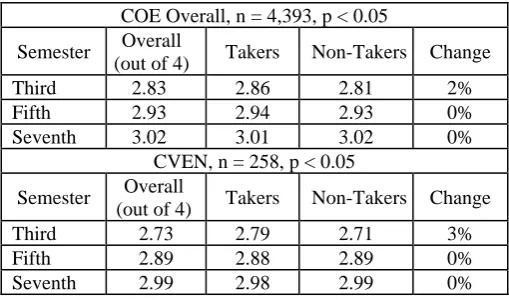
Overall, differences were few between FYEP takers and non-takers (Table 3). One significant difference was found, with FYEP takers in the overall population scoring slightly higher (2%) than non-takers at the third semester. A similar difference was found for CVEN students, but this difference tested as non-significant. The data shows that the two cohorts have similar grades expressed as GPAs, which was expected given the similar SAT banding for both cohorts. The only conclusion that can be made here is that the FYEE does not significantly impact on graduate quality as measured by GPA for the UCB. No data could be located that indicated how the different cohorts were perceived by their profession after graduation.
INDUSTRY AND COURSE DESIGN
If one were to be pragmatic, one could summarise that universities are interested in collaborating with industry for two reasons: accessing their wisdom and their money. In return for this, universities will often state that it is the responsibility for industry to invest, as they (universities) provide them (industry) with intellectual and human resources, without which they could not survive.
Industry input into engineering programmes should span, and be integrated across, the entire spectrum of engineering education, from the provision of case studies, course and programme advising, to strategic planning. It is usually only in times of shortages of graduates that industry becomes interested in issues like programme design and attrition rates. In times of shortages, the quantity of graduates can tend to become almost as important as the quality of graduates.
One question that industry should ask is how it evaluates the support of FYEE programmes and facilities. At the UCB, various bodies (David and Lucile Packard, Hewlett-Packard, AT&T, and Gates Family Foundations, Quantum, National Instruments and Lockheed Martin Corporations) contributed to the formation of the ITLL. Ongoing support also exists; for example, Microsoft sponsors the Annual Design Exposition, which showcases the design capabilities of first years to the public. Contributors would surely like to see how their support (of an FYEE) has changed the nature of graduates from the programme and benefited their industries. Are higher retention rates an adequate measure?
The most common industry access is via Engineering Advisory Committees (EAC) or Industry Advisory Boards (IAB) at various management levels, and quite complex structures can be formed at larger universities [14]. Typically, such advisory groups have specific terms of reference, are chaired by senior representative from a major industry and have a number of standing committees or working parties to provide advice on aspects such as outreach, curriculum design and development, research, and endowments.
It is also very popular to involve industry at the course level (including FYEEs) with the obvious benefits being: students being exposed to real-world professional engineering; faculty obtaining support in their teaching and access to potential research; and industry being provided with the opportunity to influence course curricula and access potential employees [15-17]. This level of interaction is typically at the individual faculty level and the use of industry panels to review course curriculum is also well established [18].
As suggested earlier, industry partners may not derive full benefits from the symbiotic relationship if they do not take a proactive role in academic issues like attrition rates, curriculum and facilities development, and also review the implementation of their recommendations. Selvaduray terms this to be
constructive interference and suggests that many industries spend significant resources providing additional training [19]. This training is in areas such as ethics, environmental issues, multi-discipline design and globalisation, all of which are components of a well-designed and industry-supported FYEE.
INTEGRATION INTO THE OVERALL PROGRAMME
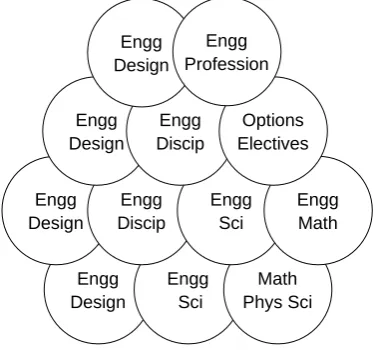
[image:4.595.338.525.353.528.2]The strategy of truly integrating an FYEE into the curricula is very complex and difficult, but worthwhile pursuing. Froyd and Ohland rationalise that an integrated curricula both helps and retains students by improving intra-disciplinary and inter-disciplinary learning [14]. The complexity of programme integration stems from the fact that it is neither the integration of a year, nor a stream, but rather an entire matrix. As an example for freshmen, Math 1 must integrate with the Physical Sciences and Engineering Sciences, while preparing the same students for their sophomore studies in Math 2 and specific engineering discipline courses. Figure 2 shows a representation of an ideal programme, which has overlapping and seamless knowledge integration.
Figure 2: A programme with ideal integration.
It is worth noting again that while the FYEE provides the perfect vehicle for introducing new engineering students to design, a lack of integration with other first year courses and senior years will largely waste all investment in the FYEE.
CONCLUSIONS
The use of FYEE programmes as a tool to successfully retain students has become widespread. The need for engineering departments to meet accreditors’ desires to expose first years to design has assisted this spread. However, the available data does not indicate any change in student outcomes as measured by their GPA. However, the improved retention rate is a marketing and financial boon for the university, and engineering departments should factor such benefits into their decision strategies.
There is little data available that shows that students who have undertaken an FYEE possess better attributes than those who have not. This reflects both the difficulty of measuring such variables and the fact that the FYEE is usually not well
Engg Design
Engg Sci
Math Phys Sci Engg
Design
Engg Discip
Engg Sci
Engg Math Engg
Design
Engg Discip
Options Electives Engg
Design
integrated into the overall programme. This integration is very complex and no solution is presented here, other than the issue must be considered at the strategic level when introducing a FYEE into a programme.
The profession and industry can and should play a larger role in developing and funding FYEEs, as it has been the profession’s need for more rounded graduates that has stimulated FYEE growth. Involvement costs industry significant funds and they will look to be provided with measurable outcomes, including entry and retention rates.
The value of an FYEE remains largely unquantified (other than retention), even in universities where very significant funds have been invested. This is because using an FYEE as the foundation of a well-integrated programme is very difficult and complex with many variables to be considered. These include the following aspects:
• Attracting good students;
• Having excellent progression;
• Graduating professionally orientated students who meet industry needs;
• Providing a pool for graduate students, while also meeting the criteria specified by accreditors.
It is an exercise that requires strategic planning and management at the highest level.
REFERENCES
1. Knight, D.W., Carlson, L.E. and Sullivan, J.F., Staying in engineering: impact of a hands-on, team-based, first-year projects course on student retention. Proc. 2003 ASEE Annual Conf. & Expo., Session 3553, Nashville, USA (2003).
2. US News (2005),
http://www.usnews.com/usnews/edu/college/rankings/brie f/natudoc/tier1/t1natudoc_brief.php
3. Centre for Higher Education Quality, The Teaching-Research Nexus: a Discussion Paper. Melbourne: Centre for Higher Education Quality, Monash University (2003), http://www.adm.monash.edu.au/cheq/academic/trn/gw-trn-discussion-paper.pdf
4. Bullen, F. and Karri, V., Enriching teaching through research – incorporating case studies. Proc. 2004 ASEE Annual Conf. & Expo., Session 3357, Salt Lake City, USA (2004).
5. MathSoft Engineering & Education, Inc., Analysis of Higher Education Survey and Higher Education Survey (2001),
http://www.educationnews.org/mathsoft_engineering.htm 6. Green, D.R., Harrison, M.C. and Ward, J.P., Mathematics
for engineers – the HELM Project. Proc. PROGRESS 3 National Conf. – Engng. Progressions and Retention Strategies, Hull, England, UK (2003).
7. Sutherland, R. and Pozzi, S., The Changing Mathematical Background of Undergraduate Engineers – a Review of the Issues. London: The Engineering Council (1995). 8. Hibberd, S. and Mustoe, F. (Eds), Proc. 4th IMA Conf. on
the Mathematical Educ. of Engnrs, Loughborough, England, UK (2003).
9. Rowe, J.W.K., Assessment strategies and progression.
Proc. PROGRESS 3 National Conf. – Engng. Progressions and Retention Strategies, Hull, England, UK (2003). 10. Samford University, PBL Center for Teaching, Learning
and Scholarship (2005), http://www/samford.edu/pbl/ 11. Finucane, P.M., Johnson, S.M. and Prideaux,
D.J., Problem-based learning: its rationale and efficacy. The Medical J. of Australia (1997), http://www.mja.com.au/public/issues/may4/finucane/finuc ane.html
12. Osborn, M. and Nag, D., Innovative approaches to first year engineering education. Proc. 2002 ASEE Annual Conf. & Expo., Session 2793 (2002).
13. Northwood, M.D., Northwood, D.O. and Northwood, M.G., Problem-Based Learning (PBL): from the health sciences to engineering to value-added in the workplace.
Global J. of Engng. Educ.,7, 2, 157-164 (2003).
14. Froyd, J.E. and Ohland, M.W., Integrated engineering curricula. J. of Engng. Educ., January, 147-164 (2005). 15. University of Manitoba, Teaching Matters, 15 (2005),
http://www.umanitoba.ca/engineering/design/thoughts_on _design/teaching_matters/teaching_matters_15.pdf
16. Loughborough University, Engineering Centre for Excellence in Teaching and Learning (2005), http://www.engcetl.ac.uk/
17. Penn State University, The Learning Factory: Industry Advisory Board (2004), http://www.lf.psu.edu/lf/iab.html 18. Ross, J.T., Industrial Feedback for a Microelectronics
Curriculum (1997),
http://www1.pacific.edu/eng/faculty/ross/micro97.pdf 19. Selvaduray, G.A., Case for constructive interference.
Chip Scale Review, June (1998),