Complete Citation: Tehan, Gerald and Hauff, Helen M. (2000). Proactive
interference effects on aging: is inhibition a factor? Australian Psychologist, 35 (3), 249-254. ISSN 0005-0067.
Accessed from USQ ePrints http://eprints.usq.edu.au
Proactive Interference Effects on Aging: Is Inhibition a Factor?
Gerald Tehan Helen M. Hauff
University of Southern Queensland
Running Head: Aging and PI Address correspondence to Gerry Tehan
Department of Psychology
Univesity of Southern Queensland Toowoomba, QLD. Australia. 4350. e-mail: [email protected]
Abstract
Elderly people show memory deficits over short retention intervals. One explanation for this effect that has been proposed is that the elderly have problems with inhibiting irrelevant material. To test this proposition, younger and older adults were compared on a short-term cued recall task in which proactive interference was manipulated. Elderly people were expected to be more susceptible to PI than the younger group. While there were age differences in absolute levels of performance there was no evidence for differential susceptibility to PI. The error patterns were the same for both groups suggesting that over short retention intervals, inhibition
Proactive Interference Effects on Aging: Is Inhibition a Factor? As people grow older they begin to show memory deficits over very short retention intervals in both working memory tasks (Salthouse & Babcock, 1991; Salthouse, Babcock & Shaw, 1991) and in more standard short-term memory tasks such as immediate serial recall (Kausler & Puckett, 1979; Parkinson, 1982). There have been a number of theories proposed for these age deficits such as differences in cognitive resources (Craik & Byrd, 1982), cognitive slowing (Salthouse, 1986) and in failures to inhibit irrelevant material (Hasher & Zacks, 1988; Rouleau & Belleville, 1996). We are interested primarily in the possibility that age differences over short retention intervals can be attributed to problems with inhibition.
Hasher and Zacks (1988) proposed the idea that inhibition might be an important determinant of age decrements. They suggested that elderly people might have trouble suppressing irrelevant ideas, thoughts or memories. For example, Hasher, Stoltzfus, Zacks and Rypma (1991) used a negative priming task to explore participants’ ability to suppress information that they processed on the immediately preceding trial. The younger participants demonstrated significant levels of inhibition by way of negative priming, whereas the older ones did not. To explain age
The theories of inhibition effects have traditionally been based upon
performance on the negative priming and Stroop tasks. However, similar arguments have been made where “fan effects” and proactive interference (PI) have been manipulated (Rosen & Engle, 1997, 1998). In PI experiments participants generally study related items in two different contexts. At test participants are required to recall the second set. From an inhibition perspective, to recall the most recent set, the first set must be suppressed in some way. Recent evidence suggests that this can be problematic for people who have low working memory capacity. For example,
Dempster and Cooney (1982) looked at proactive interference effects in a serial recall task and found that those people who had high spans seemed to be less vulnerable to the effects of PI than those who had low spans. Similarly, Rosen and Engle (1998) explored the relationship between working memory and vulnerability to PI in a paired associate task. In their task they had participants learn a series of paired associate lists in which PI was manipulated via an AB-AC design. They found that those people who had high working memory capacity were less prone to recalling items from the AB list when requested to recall the AC list. That is, the high span people could inhibit the interfering items from the first list.
Bain, 1988; Wickens, Moody & Dow, 1981; Tehan & Humphreys, 1995; 1998). Such immunity suggests that younger people can inhibit previous learning in some fashion. However, there are conditions where PI is observed which likewise suggesting that there are conditions where it is hard to inhibit previous learning. Consequently, a short-term PI task may well be a more sensitive method for exploring age and inhibition effects.
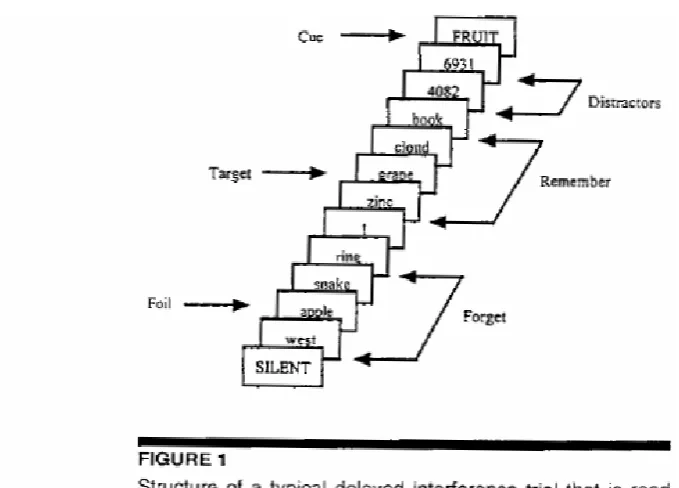
PI effects in short-term memory have not been studied extensively in tasks other than the Brown-Peterson distractor task. However, we have recently developed a short-term cued recall task that seems appropriate for exploring age effects in inhibition (Tehan & Humphreys, 1995, 1998). In the cued recall task participants study critical trials that consist of two four-word blocks, an example of which is presented in Figure 1. The instructions stress that on these trials, the first block is to be forgotten and the second block remembered. On each trial a single target is presented in the most recent block among three filler items. The task is to recall the target in response to a category cue that is presented either immediately after the final word in the block or after a brief filled retention interval. PI is manipulated by placing either an unrelated filler (no-interference) or a second instance of the category
condition and the foil is recalled relatively frequently. If it is the case that elderly people have problems with inhibition, this should become manifest in increased recall of the foil or a decrease in the number of omission errors made in the interference lists. The latter prediction assumes that normally, an activated foil will inhibit the production of the target item such that the participant responds with an “I don’t remember” response.
There are other possible explanations for difference in PI effects across
retention intervals that do not involve assumptions about inhibition. In fact, Tehan and Humphreys explain PI effects by arguing that easily degraded phonemic
representations play a key role in determining the presence or absence of PI effects. They argue that on any trial representations of the target and the foil are elicited by the retrieval cue. However, due to differential learning and forgetting rates associated with different codes, they assume that on an immediate test a phonemic representation of the target item, but not of the foil, is present and facilitates recall. Thus, if dog is the foil, cat is the target, knowing that the target contains at will facilitate the process of discriminating between the target and the foil. On a delayed test they argue that the phonological representations of the target have been lost and as a result the
discrimination process is more difficult and as such PI emerges (see Tehan & Humphreys (1995, 1998) for a full account of this argument). The important feature of this explanation is that suppression of the foil is not a necessary processing requirement. In fact, they assume that the foil is always a competitor for the target. The task is a discrimination task in which transient phonological codes play a crucial role.
affect the level of PI. In order to check this possibility we have included a
manipulation that is know to affect the strength of phonological representations. It is well established in the memory span literature that auditory presentation or visual presentation that is read aloud by the participant, produces higher levels of recall than does silent reading of visually presented items. This result is often explained in terms of auditory presentation producing stronger phonological traces. Thus, if the source of age differences in short-term recall is due to processes in phonological coding, then a difference in modality effects might appear.
Method Subjects
A total of 44 subjects participated in this experiment. The 22 young subjects (Mean Age = 22.50 years, SD = 6.6 Range =17-46) were graduate and undergraduate students at the University of Southern Queensland, most of whom received course credit for participating. Eleven of this group were female and 11 were male. The 22 older subjects (Mean Age = 76.50 years, SD = 7.34 Range = 63-88) were voluntary participants from the local area, of whom 14 were females and 8 were males. Fourteen of this group resided in a retirement home and eight were own-home dwellers.
Before the experiment began, demographic details concerning age, years of education and ratings (on a scale of 1 to 5,5 being good) of current health status and perceived memory ability were collected. Each subject also completed a word knowledge test that consisted of all odd-numbered items from the 100-item Test of Word Knowledge - Adult Form B (Australian Council for Educational Research, 1960).
3.35), F (1, 42) = 4.35, p < .05, and on a scale of 1 to 5 (5 = good), rated their health significantly better (Younger Mean = 4.36, SD = .73; Elderly Mean = 3.86, SD = .89), F (1, 42) = 4.17, p < .05. Memory ratings, also scaled from 1 to 5 (5 = good), did not differ reliably between groups (Younger Mean = 3.68, SD = .84; Elderly Mean = 3.32, SD = .94), F (1, 42) = 1.82. The two age groups did not record significantly different Word Knowledge test scores (Younger Mean = 34.18, SD = 4.19; Elderly Mean = 34.73, SD = 9.69), F (1, 42) = 0.06.
Materials
Four-word blocks formed the basic unit for the 120 trials studied by each subject in the current study. Each of the 96 critical trials consisted of two four-word blocks, in which memory for the items in the second block was tested via cued recall. The structure of these trials is presented in Figure 1. On the remaining 24 trials, only one four-item block was studied. These trials were serial recall filler trials that were utilised to ensure that subjects attended to material in the first block and to provide some benchmark serial recall data.
--- Insert Figure 1 about here ---
used twice within the experiment, a particular target or interfering item only ever appeared once. The filler-items were derived from the remaining categories from the South Florida norms, and the Shapiro and Palermo (1970) category norms.
The 24 one-block, serial recall trials were constructed by sampling randomly without replacement from the filler word pool. The two-block trials were created for each subject in the following manner. For each no-interference trial, four filler items were randomly assigned to the four positions in the first block. One low-dominant target item was then allocated to either the second or third position in the second block, while three filler items were randomly placed in the remaining list positions in block two. The same procedure was used to construct the interference except that one of the filler words from the first block was replaced with a high-dominant item from the same category as the target. The allocation of category to interference or control conditions was randomised for each participant.
On half the trials in both interference conditions target recall was tested immediately after learning; on the remaining trials recall was tested after a two-second retention interval in which participants verbally shadowed two four-digit numbers that followed the last item on the second block.
Presentation order of the 96 two-block trials was arranged in two 48-trial sections. This ensured that a category cue appeared only once in each section of the study trials. Each section also contained 12 one-block serial recall trials. The order of the 60 trials within each section was randomised, so that subjects would never be aware in advance of what type of trial they were going to receive.
Procedure
only ever have to remember the most recently studied block. Thus, in a two-block trial they were to forget the first block and to concentrate on the last four items, since memory for these items that would be tested.
Every trial began with a two-second "READY" signal in capital letters, which was followed a two-second instruction, also capitalised, specifying the reading mode for that trial. If the word ALOUD was presented, participants were required to say each item aloud as it appeared on the screen. If the instruction SILENT appeared, then subjects were requested to read the items silently. The list items were then presented individually in lower case letters at the rate of one word per second. One-block trials were followed by the instruction RECALL, at which point participants attempted to verbally recall the four items in serial order. Participants were instructed to substitute the word "something" in the serial position of any forgotten item in the series.
Prior to testing, a practice session was held to familiarise subjects with the experimental procedure. The practice session consisted of a slow version of the different types of trials that would be encountered during testing, followed by a normal-speed version of the same trials. Subjects were encouraged to spend as much time as they desired on both the slow- and normal-speed practice trials, in order to familiarise themselves with the procedure.
The younger subjects studied the two sections of the experiment in the one experimental session with only a brief pause between sections. Our experience with the elderly population indicated that they were easily fatigued. Consequently, the two sections were run 7 days apart for the elderly group.
Results Serial Recall of Filler Trials
The probability of recalling an item in the correct serial position for the younger adults was .91 whereas for the elderly group it was .70. This difference was reliable, F (1,42) = 15.18, p < .001. Both groups appear to be attending to the first block as requested, but age differences emerged on the task as it has in a number of other studies (Kausler & Puckett, 1979; Parkinson, 1982).
Cued Recall Trials
In the cued recall task it is possible to make four different types of response. The target can correctly be recalled, the foil can be recalled instead of the target, a non-presented instance of the category can be produced (an extra-list intrusion) or the participant can say, “I don’t remember” and thus produce an omission error. In the current experiment there were very few extra-list intrusions and they were not
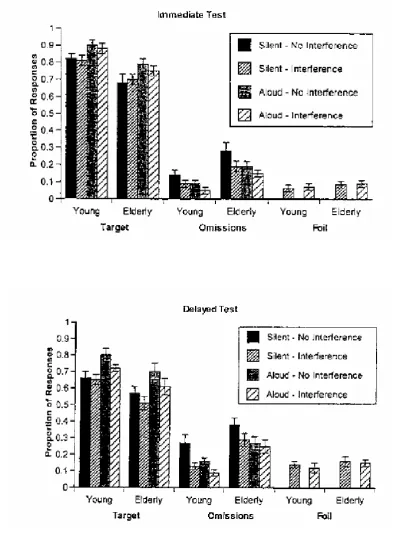
Target Recall. In looking at Figure 2 there are a number of features that are
clearly evident with respect to target recall. Reading aloud leads to better performance than reading silently, younger subjects recall more than the elderly subjects and interference effects appear to be stronger on a delayed test than on an immediate test. These observations were confirmed by a 2 (age) * 2 (modality) * 2 (interference) * 2 (retention interval) mixed design ANOVA. There were main effects for age, F (1,42) = 11.42, = .010, p. < .01, modality, F (1,42) = 39.79, MSE = .019, p. < .001, retention interval, F (1,42) = 79.05, MSE = .021, p. < .001, and interference, F (1,42) = 9.99, MSE = .012, p. < .01. The only interaction that approached significance was that of interference by retention interval. Simple main effects analysis indicated that there was no difference between interference and control trials on an immediate test, F (1,42) = <1, whereas there were strong interference effects on the delayed test, F (1,42) = 10.36, MSE = .016, p. < .01. A power analysis indicated that if the effect size that was obtained on a delayed test for each group were to be obtained on an
immediate test we would have had to test over 800 elderly participants and over 300 younger participants. Thus, we are confident that the different PI effects for
immediate and delayed tests reflect real differences and not just statistical artefacts. Finally, there were no hints of any interactions in any of these analyses that involved age.
Omission Errors. The pattern of omission errors in Figure 2 also looks to be
straightforward. Elderly people make more omissions than the younger subjects do, there are fewer omissions when the items are read aloud and there are fewer
(1,42) = 41.75, MSE = .014, p. < .001, and interference, F (1,42) = 30.14, MSE = .013, p. < .001. The only interaction was that between modality and interference, F (1,42) = 7.33, MSE = .007, p. = .01. Simple effects analysis, indicated that the high frequency of omissions in the control conditions was significant for both modalities but was stronger for the read silently, F (1,42) = 35.31, MSE = .011, p.< .001, than for the aloud condition, F (1,42) = 7.41, MSE = .011, p. < .01. Again there were no hints of any interactions involving age.
Foil Recall. When it comes to recall of the foil, the pattern appears to change.
There are no age or modality differences in recall of the foil. The only difference appears to be that the foil is produced more frequently on a delayed test than on an immediate test. The ANOVA on foil recall produced only one significant effect, that of retention interval, F (1,42) = 21.01, MSE = .008, p. < 001. Again there were no interactions that involved age, and more importantly, there was no main effect of age.
Discussion
production of the foil increases. Lastly, the presence of a modality effect replicates previous short-term memory results.
With regards to the central issue of differential inhibition effects, the results are also quite clear. Elderly people are not any more vulnerable to interference effects than younger people. There are three lines of evidence that support this conclusion. For a start the elderly group show the same pattern of interference effects as do young people, that is, immunity to PI on an immediate test and PI on a delayed test. Even when the elderly group are showing interference effects, the difference between interference and control trials is no larger than that displayed by the younger group. The second piece of evidence is that there is no difference between the two age
groups in the recall of the interfering foil on either an immediate test or a delayed test. This result is probably the strongest test of the inhibition argument in that Rosen and Engle (1998) have suggested that the ability to suppress an interfering item from an earlier study episode is a key aspect of the inhibitory process. Thirdly, from an inhibition perspective one might expect more omission errors to be made in the interference conditions than the control conditions. For both young and elderly groups the reverse is true. More omissions are made in the control condition than in the interference condition. It would seem that the target and the foil, rather than inhibit each other, partially reinforce each other such that one or other of them is more likely to be recalled. Clearly the results do not support the proposition that there are age differences in inhibitory processes, in fact there is very little evidence of inhibition effects at all.
effects by looking at the irrelevant speech effect in immediate serial recall.
Background irrelevant speech has a detrimental effect upon immediate serial recall, which some have interpreted as an indication that participants have trouble in inhibiting the distracting material (Rouleau & Belleville, 1996). Rouleau and Belleville (1996) proposed that elderly people may have difficulty in inhibiting irrelevant speech and that this would be reflected in differences in immediate serial recall performance. They found no evidence to support such a claim. The elderly group produced the same pattern of effects as the younger group and was no more prone to the influence of interfering material than were the younger group. Rouleau and Belleville suggested that the inhibition hypothesis could be salvaged if it was assumed that the phonological component of memory was intact in elderly people but other memory components were susceptible to changes in inhibition.
Problems with phonological coding do not appear to be a cause of age differences in the task either. Both groups show modality effects on both an immediate and delayed tests and the magnitude of the effect is equivalent for both groups. These results again complement those of Rouleau and Belleville (1996) in showing that phonological based processing in short-term memory does not appear to be overly affected by age.
group. This did not happen. The question is how to explain the differences in omission errors.
Most current models of short-term memory assert that recall is based upon a degraded phonemic trace that must be reconstructed or redintegrated (Schweickert, 1993). While there are a number of models of this redintegration process our preferred explanation is based upon connectionist models of memory (Chappell & Humphreys, 1994). In these models recall occurs against a noisy background in which the signal to noise ratio is a strong determinant of what is recalled. If the signal is strong and the noise weak then reconstructing the target item is relatively easy. However, if the difference between signal and noise is attenuated, the process of retrieving a target item becomes more problematic and leads to an increase in omission errors. In other research we have been able to demonstrate that PI effects in the cued recall task are dependent upon the cross talk between items stored in memory (Tehan & Humphreys, 1998). That is, subjects are attempting to recall an item from a memory trace that contains not only features of the target but those of other list items as well. These other activated features represent one source of noise in the retrieval process. One way of explaining the age differences in the number of omissions made is to assume that the memory systems of elderly people are “noisier” than that of younger adults. With a much smaller signal to noise ration, selecting a target from amongst the noise would be increasingly difficult.
decay or interference for the elderly. Thus, information becomes so degraded (noisy) that it either becomes useless or time and resources must be devoted to reconstructing to-be-remembered items. We think that the omission data fit in well with this
explanation.
References
Australian Council for Educational Research. (1960). Test of Word Knowledge: Adult Form B. Melbourne: ACER.
Chappell, M., & Humphreys, M. S. (1994). An auto-associative neural
network for sparse representations: Analysis and application to models of recognition and cued recall. Psychological Review, 101, 103-128.
Craik, F. I. M., & Byrd, M. (1982). Aging and cognitive deficits: The role of attentional resources. In F. I. M. Craik and S. Trehub (Eds.) Aging and Cognitive Processes. (pp191-211). New York: Penlum.
Dempster, F. N. & Cooney, J. B. (1982). Individual differences in digit span, susceptibility to proactive interference, and aptitude/achievement test scores.
Intelligence, 6, 399-416.
Halford, G. S., Mayberry, M. T., & Bain, J. D. (1988). Set- size effects in primary memory: An age-related capacity limitation? Memory and Cognition, 16, 480-487.
Hasher, L., Stoltzfus, E. R., Zacks, R. T., & Rypma, B. (1991). Age and inhibition. Journal of Experimental Psychology: Learning Memory and Cognition, 17, 163-169.
Hasher, L., & Zacks, R. T. (1988). Working memory, comprehension and aging: A review and new view. The Psychology of Learning and Motivation, 30, 193-225.
Kausler, D. H. & Puckett, J. M. (1979). Effects of word frequency on adult age differences in word memory span. Experimental Aging Research, 5, 161-169.
Parkinson, S. R. (1982). Performance deficits in short-term memory tasks: A comparison of amnesic Korsakoff patients and the aged. In L. S. Cermak (Ed.) Human Memory and Amnesia. Lawrence Erlbaum, Hillsdale, NJ.
Rosen, V. M. & Engle, R. W. (1997). The role of working memory capacity in retrieval. Journal of Experimental Psychology: General, 126, 211-217.
Rosen, V. M. & Engle, R. W. (1998). Working memory capacity and suppression. Journal of Memory and Language, 39, 418-436.
Rouleau, N., & Belleville, S. (1996). Irrelevant speech effect in aging: An assessment of inhibitory processes in working memory. Journals of Gerontology: Psycholgical Sciences and Social Sciences, 51B, P356-P363.
Salthouse, T.A. (1996). The processing-speed theory of adult age differences in cognition. Psychological Review, 103, 403-428.
Salthouse, T.A., & Babcock, R. L. (1991). Decomposing adult age differences in working memory. Developmental Psychology, 27, 763-776.
Salthouse, T.A., Babcock, R. L. & Shaw, R. J. (1991). Effects of adult age on structural and operational capacities in working memory. Psychology and Aging, 6, 118-127.
Schweickert, R. S. (1993). A multinomial processing tree model for
degradation and redintegration in immediate recall. Memory and Cognition, 21, 168-175.
Shapiro, S. I., & Palermo, D. S. (1970). Conceptual organization and class membership: Normative data for representations of 100 categories. Psychonomic Monograph Supplements, 3, 107-127.
Tehan G, & Humphreys, M. S. (1998). Creating Proactive Interference in Immediate Recall: Building a Dog from a Dart, a Mop and a Fig. Memory and Cognition,26, 477-489.
Verhaeghen, P., & De Meersman, L. (1998a). Aging and the Stroop effect: A meta-analysis. Psychology and Aging, 13, 120-126.
Verhaeghen, P., & De Meersman, L. (1998b). Aging and the negative priming effect: A meta-analysis. Psychology and Aging, 13, 435-444.
Figure Captions