Theses Thesis/Dissertation Collections
5-2016
Toward Establishing a Catalog of Security
Architecture Weaknesses
Joanna Cecilia da Silva Santos
[email protected]Follow this and additional works at:http://scholarworks.rit.edu/theses
This Thesis is brought to you for free and open access by the Thesis/Dissertation Collections at RIT Scholar Works. It has been accepted for inclusion in Theses by an authorized administrator of RIT Scholar Works. For more information, please [email protected].
Recommended Citation
Security Architecture Weaknesses
by
Joanna Cecilia da Silva Santos
A Thesis Submitted
in
Partial Fulfillment of the
Requirements for the Degree of
Master of Science
in
Software Engineering
Supervised by
Dr. Mehdi Mirakhorli
Department of Software Engineering
B. Thomas Golisano College of Computing and Information Sciences
Rochester Institute of Technology
Rochester, New York
The thesis “Toward Establishing a Catalog of Security Architecture Weaknesses” by Joanna Cecilia da Silva Santos has been examined and approved by the following Exami-nation Committee:
Dr. Mehdi Mirakhorli Assistant Professor Thesis Committee Chair
Dr. J. Scott Hawker Associate Professor
Dedication
To Clarice (mother), Messias (father) and Lucas (brother) for their love and assistance. To my friends, who make my days happier and more enjoyable.
To professor Anselmo, whose classes triggered my passion for STEM fields. To professor Admilson, whose lessons and advice positively contributed in my academic
Acknowledgments
I am extremely thankful to Dr. Mehdi Mirakhorli for the opportunity, guidance, patience and support while pursuing my Master’s degree. I am also thankful to Dr. Hawker for his valuable comments on my thesis work. I also would like to thank Jairo Vidal for his review
over the CAWE catalog. I am grateful to Waleed Zogaan, Raghuram Gopalakrishnan, Nuthan Munaiah and Harold Valdivia-Garcia for their relevant feedback over my thesis
Abstract
Toward Establishing a Catalog of Security Architecture Weaknesses
Joanna Cecilia da Silva Santos
Supervising Professor: Dr. Mehdi Mirakhorli
Contents
Dedication. . . iii
Acknowledgments . . . iv
Abstract . . . v
1 Introduction. . . 1
1.1 Objectives . . . 3
1.2 Research Questions . . . 3
1.3 Thesis Organization . . . 4
2 Designing for Security . . . 5
2.1 Security Patterns . . . 5
2.2 Flaws in a Security Architecture . . . 6
3 Catalog of Architectural Weaknesses . . . 8
3.1 Creating the Catalog . . . 8
3.2 Catalog Structure . . . 10
3.3 Catalog Overview . . . 11
4 Results and Discussion . . . 13
4.1 RQ1: Architectural Weaknesses . . . 13
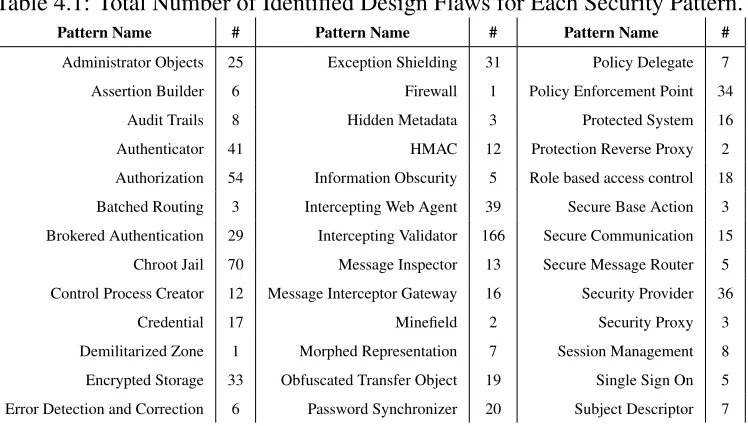
4.2 RQ2: Most Impacted Security Patterns . . . 13
4.3 RQ3: The Most Common Design Issues . . . 14
4.3.1 Vulnerabilities Dataset . . . 14
4.3.2 Results . . . 15
4.4 Examples of Architectural Weaknesses . . . 17
5 Application of the CAWE Catalog . . . 24
6 Related Work . . . 27
7 Threats to Validity . . . 29
8 Conclusion and Future Work . . . 31
8.1 Future Work . . . 31
List of Tables
3.1 An Example of an Architectural Weakness from the Catalog . . . 12
4.1 Total Number of Identified Design Flaws for Each Security Pattern. . . 14
4.2 Overview of the Vulnerability Dataset . . . 15
List of Figures
3.1 Partial Structure of MITRE‘s CWE Collection with its Upper Elements. . . 9 3.2 Structure of the CAWE catalog . . . 10 4.1 Session Hijacking in PHP. . . 19 4.2 Session Fixation Exploitation in PHP. . . 21 5.1 Taxonomy Mapping to Help Identify Design Flaws Associated with
Chapter 1
Introduction
Software security, which is concerned about engineering a software that remains work-ing under malicious attacks, is a relatively new field [27] and has been pointed as an af-terthought: firstly, the software is released, then the security problems that are found during its usage are fixed. This fact can be observed when reading the release notes of a software product, which usually indicate some patches to fix vulnerabilities. The problem with this reactive approach is that there could be potential consequences with the exploitation of the discovered breaches (such as brand reputation damage and money losses [36]).
The architecture of a software exhibits the set of design decisions made by the archi-tect to satisfy quality requirements, such as availability, performance, security and so forth. Thus, software architecture design is the first and the fundamental step to address secu-rity concerns early in the software development lifecycle. To satisfy a secusecu-rity concern, an architect must consider alternate design solutions, evaluate their trade-offs, identify the risks and select the best option [4]. These design decisions are often based on well-known security patterns [3, 4, 20, 21], which provide reusable solutions for enforcing the required authentication, authorization, confidentiality, data integrity, privacy, accountability, avail-ability, safety and non-repudiation requirements, even when the system is under attack.
can have a greater impact on the security aspect of a software than purely coding bugs [1].
Design flaws in the architecture of a software system mean that successful attacks could lead to enormous consequences.
Design flaws(or only “flaws”) are different fromBugs, as the latter are more code-level (such as buffer overflows caused by miscalculations) while the former are at a higher-level of abstraction, require a deeper analysis on the software’s design and are much more subtle than bugs [1]. Although a software system will always have bugs, recent studies show that the security of many software applications is breached due to flaws in the architecture [1, 32].
Architectural flaws are results of inappropriate design choices in early stages of soft-ware development, incorrect implementation of security patterns, or degradation of security architecture over time [29, 40]. An example of an architectural flaw is the “Use of Client-Side Authentication” [10], in which a client/server product performs authentication within the client code, but not in the server code. This design decision allows the authentication feature to be bypassed via a modified client that omits the authentication check. It cre-ates a flaw in the security architecture that can be successfully exploited by an intruder with reverse-engineering skills. Another instance of an architectural flaw is the “Cleartext Transmission of Sensitive Information”, in which a sensitive information (e.g.credit card number) is exchanged without encryption [15]. In this flaw, an attacker could steal this information by capturing the messages being transmitted in the network.
1.1
Objectives
As discussed in the introduction, there is still a need for tackling this problem in terms of design flaws [32]. Hence, the primary goal of this work is to approach security according to an architectural point of view through the new concept ofCommon Architectural Weakness Enumeration (CAWE): a catalog of architectural weaknesses (i.e. security issues rooted in the software security architecture). The overall idea is to provide an artifact to help developers and architects in understanding the consequences of having such breaches in their software and identify possible ways to avoid them to occur. This catalog was built on top of a previous library of Common Software Weaknesses Enumeration (CWE)1, which
is a community-developed enumeration of common types of vulnerabilities (weaknesses) maintained by the MITRE Corporation. This library, however, does not categorize weak-nesses based on their architectural impacts and does not clearly distinguish architecture-related issues from purely programming issues.
The second objective is to report the results of an analysis of the vulnerabilities from four large complex systems (namely Linux Kernel, Chrome, Thunderbird, and PHP) and to demonstrate instances of architectural weaknesses within these systems. Besides that, this work discusses the practical aspects of CAWE catalog, indicating how it can be used in activities within the software development lifecycle and how it can be integrated into the existing MITRE’s library.
1.2
Research Questions
This work addresses the following research questions:
• RQ1: What security weaknesses are rooted in the software architecture?
The answer to this question proposes to identify, among the documented types of security weaknesses from the MITRE’s library, which ones can happen due to a
design flaw or an architectural drift.
• RQ2: What security patterns are more likely to have associated vulnerabilities?
By knowing the answer of R1, we aim to classify each security weakness per security pattern. This way, we can spot the security patterns that are more likely to introduce vulnerabilities when improperly applied and in which ways these vulnerabilities may occur.
• RQ3: What are the most common design issues in real software systems?
In this research question, we aim to verify the proportion of vulnerabilities in exist-ing systems are rooted in their architecture, identifyexist-ing what are the most common architectural flaws in software systems.
1.3
Thesis Organization
Chapter 2
Designing for Security
Security principles need to be implemented from the ground up to ensure an application is secure. During requirements analysis, malicious practices are taken for granted, and requirements engineers identify all the use cases which are interests of an attacker. During architecture design, architects carefully analyze these requirements and adopts appropriate security patterns to resist, detect and/or recover from attacks [34].
2.1
Security Patterns
Security patterns are the building blocks of a security architecture. A combination of pat-terns are required to be implemented to deliver a secure system in which the legitimate users are properly authenticated; access controls are applied to enforce that only authorized users can access their designated functionality; user activities are audited, so recovering from a malicious activity is feasible; information integrity is preserved and similar security char-acteristics are addressed.
software domain and underlying technical choices [34].
While these security patterns provide a well-formed solution to address various security concerns, if these patterns are not adopted and implemented carefully, they can result in severe breaches in a security architecture. In the subsequent section, we discuss several ways that a security architecture can be flawed or degraded.
2.2
Flaws in a Security Architecture
The IEEE Center for Secure Design has been focusing on identifying the most relevant design flaws based on experiences in the industry, academia, and government. Currently, it identified top ten design flaws that are caused either by a weak design (i.e. an incomplete architecture whose security mechanisms can be bypassed by attackers) or due to lack of design decisions (e.g.not having an authorization enforcement in the system) [1]. Even if the architecture fulfills all security requirements appropriately, previous studies have shown that the architecture can erode as the software evolves or may be wrongly implemented in the code [24, 29, 40]. Consequently, based on these observations, we can classify architec-tural flaws to Omission, Commission and Realization Flaws:
• Omission Flaws are caused by decisions that were never made (e.g. ignoring a
• Commission Flawsrefer to the design decisions which were made and could lead to undesirable consequences. An example of such type of flaw is “Client side authen-tication” [10], mentioned earlier in the introduction. While architects have made a design decision, the flaw in this design will enable attackers to bypass the authenti-cation through implementing a modified client that does not have the authentiauthenti-cation check. Another example of such flaw is “Using a Weak Cryptography for Passwords” to achieve better performance while maintaining data confidentiality. In this flaw, the passwords are stored with an obfuscation mechanism that is computationally less complex but easier for attackers to guess [13]. Consequently, such improper design choice makes it possible that attackers to recover the passwords via an exhaustive search.
• Realization Flaws are the design decisions that are correct (i.e. satisfies the soft-ware’s security requirements), but its implementation suffers from a coding mistake. For example, a developer fails to perform authenticity check in the critical parts of the system [14]. In another instance, the developers incorrectly sanitize special ele-ments in user-provided inputs, which can lead to many consequences, such as crashes (denial of service) or bypass of protection mechanisms [12].
Chapter 3
Catalog of Architectural Weaknesses
The MITRE Corporation, with the support of the National Cyber Security Division at US Department of Homeland Security (DHS), maintains a collection of common software weaknesses (http://cwe.mitre.org/). This collection contains over 1,000 software weak-nesses, but these vulnerabilities are not categorized based on their architectural impacts and implications. Thus, we classified those weaknesses architecture-related vulnerabili-ties. As a result, we have developed the Common Architectural Weakness Enumeration (CAWE), a catalog that enumerates common architectural flaws in a software system that can lead to a security vulnerability.
The next sections of this Chapter detail the systematic process followed to create the catalog and how the data within is structured.
3.1
Creating the Catalog
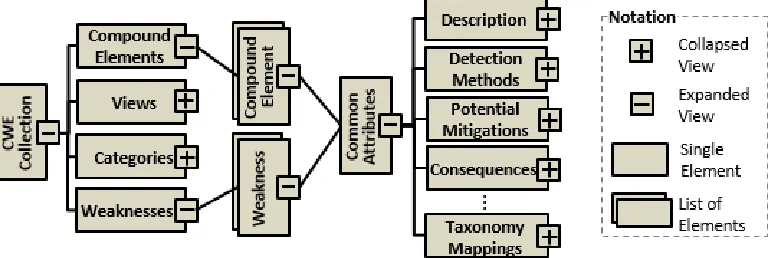
As briefly mentioned before, the CAWE catalog was built on top of the MITRE’s compila-tion of software weaknesses (CWE colleccompila-tion). Figure 3.1 shows a structural overview of the CWE collection, in which we only showed some of the elements for the sake simplic-ity1. As noted in this figure, each entry in the CWE collection can be of four types: View
(for grouping weaknesses in a given perspective),Category(used to categorize weaknesses based on a common attribute),Weakness(an actual security issue) andCompound Element
1The complete structure of the CWE collection can be found at MITRE’s Website:
(a security issue due to the occurrence of other weaknesses in a time sequence). For each
[image:19.612.120.508.165.294.2]Weakness and Compound Elements types, the collection provides information about the issue, such as its description, mitigation techniques, code examples, and so forth.
Figure 3.1: Partial Structure of MITRE‘s CWE Collection with its Upper Elements. Since the CWE collection is available as an XML (eXtensible Markup Language) doc-ument in the MITRE’s Web site2, we retrieved a list of all entries that are of typeWeakness
orCompound Elements. The other element types (CategoriesandViews) were not included as they serve more as a grouping of weaknesses rather than providing details about a spe-cific type of vulnerability. Then, we analyzed each collected entry to classify whether it is rooted in the security architecture. Once we considered that an entry has an architectural implication, we further investigated it to verify (i) which security pattern(s) can be related to the weakness and (ii) and how the related pattern(s) may be impacted.
To increase the accuracy of this mapping, a second graduate student in Software En-gineering, who was familiar with security patterns and software architecture design, peer reviewed the catalog. Thus, this individual inspected the entries from the MITRE’s col-lection and performed the same steps described before (classification of the entries into architectural/non-architectural and identification of the related security patterns), sharing the rationale behind each mapping. After this peer review process, we established the
3.2
Catalog Structure
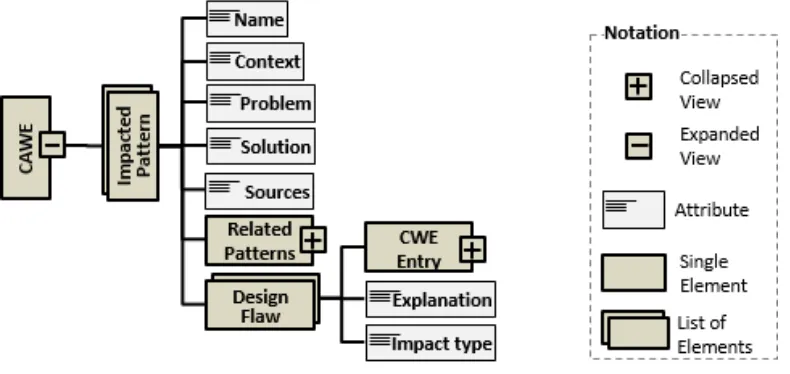
[image:20.612.115.510.292.479.2]To accommodate all the gathered information and to provide a rich knowledge base about architectural weaknesses, we structured the CAWE catalog as shown in Figure 3.2. In this figure, we note that the catalog organizes the design flaws based on the security patterns that are impacted by them. This way, the CAWE catalog encompasses a list ofImpacted Pattern elements, which are used to provide the details about each security pattern (its context, problem, solution, and so forth) and the relationships between the pattern and one or more design flaws.
Figure 3.2: Structure of the CAWE catalog .
As discussed in Chapter 2,a missing design choice, an incorrect implementation of an architectural choice or an improper design decision can cause flaws in the software. There-fore, eachDesign Flawelement contains animpact typeattribute, which indicates whether the flaw is anomission,commissionor arealizationflaw, and anexplanation
3.3
Catalog Overview
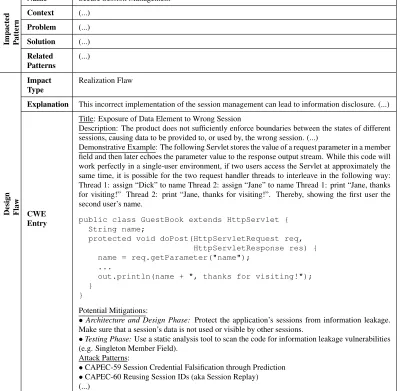
The CAWE catalog is publicly available online at http://design.se.rit.edu/ cawe. It currently contains 384 flaws that were categorized based on their impacts over 39 security patterns. Table 3.1 shows an entry from the CAWE catalog, which presents a weakness due to an incorrect implementation (Realization Flaw) of the Secure Session Managementpattern [34] (some text in this Table was hidden for the sake of clarity). From this table, we observe that each CAWE instance refers to an entry from the MITRE’s li-brary of software weaknesses. This reference contains the detailed information about the design flaw, such as a textual description, source code examples, mitigation techniques and detection methods of the weakness. Moreover, a CWE entry can indicate how this flaw can be exploited by an intruder through pointing to external entries from the Common At-tack Pattern Enumeration and Classification (CAPEC) [11], which is a dictionary of known attack patterns.
Table 3.1: An Example of an Architectural Weakness from the Catalog
Impacted Patter
n
Name Secure Session Management
Context (...) Problem (...) Solution (...) Related Patterns (...) Design Flaw Impact Type Realization Flaw
Explanation This incorrect implementation of the session management can lead to information disclosure. (...)
CWE Entry
Title: Exposure of Data Element to Wrong Session
Description: The product does not sufficiently enforce boundaries between the states of different sessions, causing data to be provided to, or used by, the wrong session. (...)
Demonstrative Example: The following Servlet stores the value of a request parameter in a member field and then later echoes the parameter value to the response output stream. While this code will work perfectly in a single-user environment, if two users access the Servlet at approximately the same time, it is possible for the two request handler threads to interleave in the following way: Thread 1: assign “Dick” to name Thread 2: assign “Jane” to name Thread 1: print “Jane, thanks for visiting!” Thread 2: print “Jane, thanks for visiting!”. Thereby, showing the first user the second user’s name.
public class GuestBook extends HttpServlet { String name;
protected void doPost(HttpServletRequest req, HttpServletResponse res) { name = req.getParameter("name");
...
out.println(name + ", thanks for visiting!"); }
}
Potential Mitigations:
•Architecture and Design Phase: Protect the application’s sessions from information leakage. Make sure that a session’s data is not used or visible by other sessions.
•Testing Phase:Use a static analysis tool to scan the code for information leakage vulnerabilities (e.g. Singleton Member Field).
Attack Patterns:
Chapter 4
Results and Discussion
4.1
RQ1: Architectural Weaknesses
RQ1: What security weaknesses are rooted in the software architecture?
Once we consolidated the CAWE catalog, we observed that, among the 727 entries of type Weaknesses or Compound Elements from the CWE library, there were 384 of them with architectural implications. A full list of these security architectural weaknesses is provided in our Web site (http://design.se.rit.edu/cawe).
4.2
RQ2: Most Impacted Security Patterns
RQ2: What security patterns are more likely to have associated vulnerabilities?
Table 4.1: Total Number of Identified Design Flaws for Each Security Pattern.
Pattern Name # Pattern Name # Pattern Name #
Administrator Objects 25 Exception Shielding 31 Policy Delegate 7
Assertion Builder 6 Firewall 1 Policy Enforcement Point 34
Audit Trails 8 Hidden Metadata 3 Protected System 16
Authenticator 41 HMAC 12 Protection Reverse Proxy 2
Authorization 54 Information Obscurity 5 Role based access control 18
Batched Routing 3 Intercepting Web Agent 39 Secure Base Action 3
Brokered Authentication 29 Intercepting Validator 166 Secure Communication 15
Chroot Jail 70 Message Inspector 13 Secure Message Router 5
Control Process Creator 12 Message Interceptor Gateway 16 Security Provider 36
Credential 17 Minefield 2 Security Proxy 3
Demilitarized Zone 1 Morphed Representation 7 Session Management 8
Encrypted Storage 33 Obfuscated Transfer Object 19 Single Sign On 5
Error Detection and Correction 6 Password Synchronizer 20 Subject Descriptor 7
4.3
RQ3: The Most Common Design Issues
RQ3: What are the most common design issues in real software systems?
To respond to this third research question, we investigated the reported vulnerabilities from four real and complex systems. The software systems chosen as case studies were: the
Linux Kernel (contains the core functions of the Linux Operating System), the Google
Chrome (a Web browser), theMozilla Thunderbird(an application for managing email
and news feeds) andPHP(the interpreter of the PHP language). These four systems were selected because they are among the open source projects with a higher number of known vulnerabilities and from distinct domains, which can enrich this discussion of architectural flaws.
4.3.1
Vulnerabilities Dataset
Vulnerability Database (NVD) 1 to obtain all the reported vulnerabilities for each case study. As a response, the NVD provides the vulnerabilities of a project as a list of CVE (Common Vulnerabilities and Exposures) instances [7]. In short, these CVE instances identify the severity of the vulnerability, the date it was reported, a description and links to external resources with more details about the breach (such as URLs to threads discussion about the issue, bug tracking systems, etc.). Each CVE instance sometimes also indicate its root cause through atagthat points to a documented software weakness from MITRE’s collection (CWE entry). Thus, in the presence of this link, we verify whether the problem is anarchitectural flawor apurely coding bugthrough comparing the referred CWE instance against our CAWE catalog. For the CVEs without any further information about its causes (i.e. without atag), we manually inspected them to obtain such information.
4.3.2
Results
[image:25.612.94.487.575.653.2]Table 4.2 shows the size of these projects (in terms of the number of files in the latest ver-sion) and the amount of vulnerabilities collected for each project. This table also presents the total number of CVEs that have an explicit CWE tag and the amount of CVEs that we manually tagged. It is important to highlight that there were vulnerabilities that were deprecated (i.e. invalid) or external to the architecture of the case studies (such as vulner-abilities in applications that execute in a Linux environment but not in the Linux Kernel itself). Therefore, we discarded these vulnerabilities from our dataset, so Table 4.2 reports only the instances that are under the scope of our analysis.
Table 4.2: Overview of the Vulnerability Dataset
Project # Files #CVEs #With Tags #No Tags #Arch. CVEs #Non-arch. CVEs
Chrome 46,544 1251 1067 184 441 810
Thunderbird 19617 704 517 187 310 394
PHP 2028 425 267 158 214 211
Linux Kernel 39787 1342 918 424 540 802
In this table, we observe that approximately 50% of the reported vulnerabilities for PHP had an impact on its security architecture, being the project with the highest percentage of architectural issues. In the other systems, this percentage of architectural vulnerabilities was 35% for Chrome, 44% for Thunderbird and 40% for Linux Kernel.
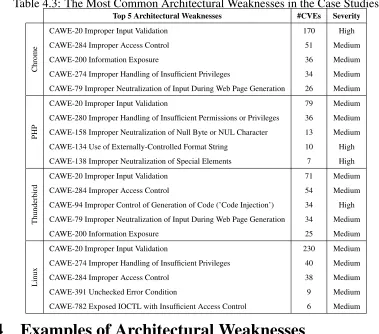
Table 4.3 shows the most common security issues in those cases studies as well as the severity level of these problems (Low, Medium, High or Critical), as provided by the NVD based on the Common Vulnerability Scoring System (CVSS) version 2 [28]. From this table, we note that most of the architectural issues in those case studies is a problem in failing to implement the Intercepting Validator pattern properly (CAWE-20, CAWE-79, CAWE-94, CAWE-134, CAWE-138 and CAWE-158). Failing to validate consistently the user-provided data can lead to a variety of consequences, such as crashes (denial of service) and leakage of sensitive information. We also observe that issues related to enforcing access control (CAWE-200, CAWE-274, CAWE-280, CAWE-284, and CAWE-782) are also common among those systems. These weaknesses are mostly caused by an incorrect implementation of patterns related to permission management such as “Authorization”, “Role-based access control” and “Policy Enforcement Point”. Lastly, we observe that the architectural flaws expose these systems to consequences that are at least at a “Medium” severity level.
One of the reasons that resulted in such high number of input validation issues is due to the fact that some architectural flaws can only occur in certain contexts. For example, the Client Side Authentication Flaw only occurs in software with the client-server architecture. However, regardless of the software domain, a software will be provided which may be valid or malformed (intentionally by attackers or unconsciously by misuses from legitimate users) thereby, input validation issues can happen in any software system.
Table 4.3: The Most Common Architectural Weaknesses in the Case Studies.
Top 5 Architectural Weaknesses #CVEs Severity
Chrome
CAWE-20 Improper Input Validation 170 High
CAWE-284 Improper Access Control 51 Medium
CAWE-200 Information Exposure 36 Medium
CAWE-274 Improper Handling of Insufficient Privileges 34 Medium
CAWE-79 Improper Neutralization of Input During Web Page Generation 26 Medium
PHP
CAWE-20 Improper Input Validation 79 Medium
CAWE-280 Improper Handling of Insufficient Permissions or Privileges 36 Medium
CAWE-158 Improper Neutralization of Null Byte or NUL Character 13 Medium
CAWE-134 Use of Externally-Controlled Format String 10 High
CAWE-138 Improper Neutralization of Special Elements 7 High
Thunderbird
CAWE-20 Improper Input Validation 71 Medium
CAWE-284 Improper Access Control 54 Medium
CAWE-94 Improper Control of Generation of Code (’Code Injection’) 34 High
CAWE-79 Improper Neutralization of Input During Web Page Generation 34 Medium
CAWE-200 Information Exposure 25 Medium
Linux
CAWE-20 Improper Input Validation 230 Medium
CAWE-274 Improper Handling of Insufficient Privileges 40 Medium
CAWE-284 Improper Access Control 38 Medium
CAWE-391 Unchecked Error Condition 9 Medium
CAWE-782 Exposed IOCTL with Insufficient Access Control 6 Medium
4.4
Examples of Architectural Weaknesses
CVE ID:CVE-2002-0121
Description:PHP 4.0 through 4.1.1 stores session IDs in temporary files whose name contains the session ID, which allows local users to hijack web connections.
Main Impacted File:ext/session/mod file.cc
46. #define FILE_PREFIX "sess_" (...)
108. strcat(buf, FILE_PREFIX); 109. strcat(buf, key);
Related CAWEs:
CAWE-311: Missing Encryption of Sensitive Data
CAWE-538: File and Directory Information Exposure
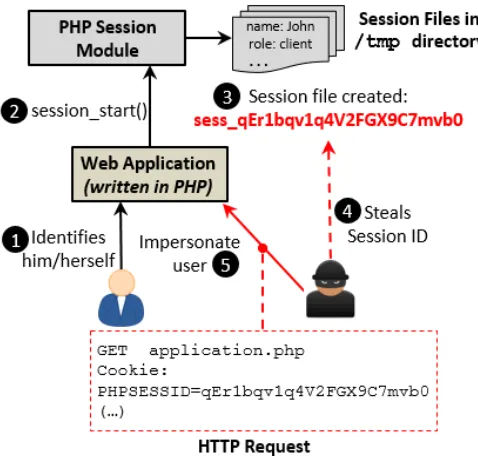
Per this description we note that PHP was designed to store each session data in files in a temporary directory without using a security mechanism for storing these session files (such as encryption). When closely inspecting the source code of PHP in version 4.0, we observe that themod file.ccnames every session file as “sess xyz” (where “xyz” is the session ID), as shown in the code snippet presented above (where buf is a variable later used when creating the session files).
Figure 4.1: Session Hijacking in PHP.
From this scenario, we note that such architectural weakness can lead to many conse-quences. First, if the user has an administrative role in the application, the attacker will be able to perform all the administrative tasks. Second, the attacker may be able to read the contents of the session file, thereby accessing the data about the user, which may be sen-sitive. It is important to highlight that such flaw affects not only the Secure Session Man-agement but also other security patterns (e.g. Authentication and Authorization) which use the Secure Session Management for performing authentication and access control of users. The excerpt below shows an example from PHP of an architectural weakness that facil-itates the session fixation:
CVE ID:CVE-2011-4718
Description:Session fixation vulnerability in the Sessions subsystem in PHP before 5.5.2 allows remote attackers to hijack web sessions by specifying a session ID.
Main Impacted File:ext/session/mod files.c
69. static int ps_files_valid_key(const char *key) 70. {
(...)
76. for (p = key; (c = *p); p++) {
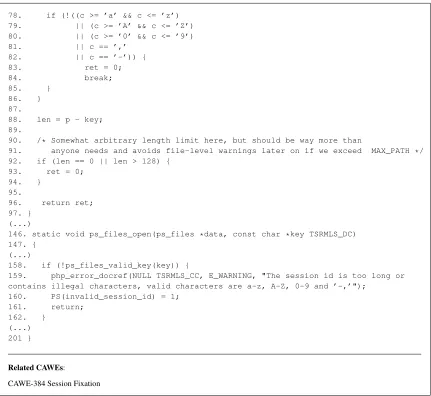
78. if (!((c >= ’a’ && c <= ’z’) 79. || (c >= ’A’ && c <= ’Z’) 80. || (c >= ’0’ && c <= ’9’) 81. || c == ’,’
82. || c == ’-’)) {
83. ret = 0;
84. break;
85. } 86. } 87.
88. len = p - key; 89.
90. /* Somewhat arbitrary length limit here, but should be way more than
91. anyone needs and avoids file-level warnings later on if we exceed MAX_PATH */ 92. if (len == 0 || len > 128) {
93. ret = 0; 94. }
95.
96. return ret; 97. }
(...)
146. static void ps_files_open(ps_files *data, const char *key TSRMLS_DC) 147. {
(...)
158. if (!ps_files_valid_key(key)) {
159. php_error_docref(NULL TSRMLS_CC, E_WARNING, "The session id is too long or contains illegal characters, valid characters are a-z, A-Z, 0-9 and ’-,’");
160. PS(invalid_session_id) = 1; 161. return;
162. } (...) 201 }
Related CAWEs:
CAWE-384 Session Fixation
When verifying the session implementation in the source code of PHP version 5, we note that there is an incorrect implementation (i.e. a realization flaw) in the PHP’s session module that accepts uninitialized session IDs before using it for authentication/authorization purposes. In fact, in the line 158 shown above, the function ps files valid key()
[image:30.612.95.526.93.489.2]does not correctly validate the session ID. This function only checks whether it contains a valid charset and has a correct length but does not verify whether the ID exists associated to the client performing the HTTP request.
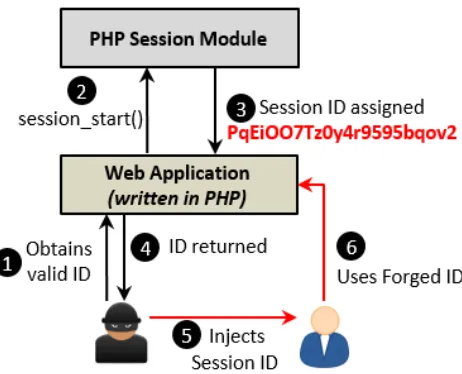
user to authenticate him/herself in the system using the attacker’s session ID (steps 5 and 6).
Figure 4.2: Session Fixation Exploitation in PHP.
A common architectural flaw across all case studies is an improper implementation of the validation mechanism for data before its usage in the software. A real example of this design flaw can be observed in Thunderbird:
CVE ID:CVE-2009-2408
Description: Mozilla Network Security Services (NSS) before 3.12.3, Firefox before 3.0.13, Thunderbird before 2.0.0.23, and SeaMonkey before 1.1.18 do not properly handle a ’
0’ character in a domain name in the subject’s Common Name (CN) field of an X.509 certificate, which allows man-in-the-middle attackers to spoof arbitrary SSL servers via a crafted certificate issued by a legitimate Certification Authority. NOTE: this was originally reported for Firefox before 3.5.
Main Impacted File:mozilla/security/nss/lib/certdb/certdb.c
1390. cert_VerifySubjectAltName(const CERTCertificate *cert, const char *hn) 1391. {
(...)
1446. int cnLen = current->name.other.len; 1447. if (cnLen + 1 > cnBufLen) {
1448. cnBufLen = cnLen + 1;
1449. cn = (char *)PORT_ArenaAlloc(arena, cnBufLen); (...)
1518. }
Related CAWEs:
In this flaw, the validation mechanism fails to validate a field of an X.509 certificate that contains the NULL terminator (’\0’ character). As shown in the code snippet, at line 1446 the length of the CN field is calculated without a proper escaping the string variable. Given that the ’\0’ is used to indicate the end of a string, thecnLenvariable will have a smaller value than the actual length of the CN field. This improper validation may allow attackers to get a malicious certificate signed through placing the NULL terminator in the certificate’s CN field. This way, users would be tricked to consider that the forged certificate is valid then accepting it as trusted when it is not.
One example of a commission flaw was also observed in the PHP project. Initially, the PHP was designed to have a configuration parameter (safe mode) for enforcing access control of files and directories on the Web server. The security requirement behind this parameter was to ensure that applications written in PHP and running on the same Web server would not be able to access files from each other inadvertently [19]. Thus, once the
safe modewas enabled, whenever a PHP script tried to access (read/write) a file in the server, the PHP would: (i) check whether the owner of the script’s source code file is the same of the file being requested; (ii) then, grant access to those scripts that satisfies this condition. However, such design is inappropriate to the context of PHP [19]. In this case a better design would be that the enforcement was done in the executing environment (i.e. the Operating System).
Moreover, such enforcement mechanism needed to be implemented throughout the modules of PHP that performed any file-related operations. However, in some cases the developers did not implement the check whether thesafe modewas enabled and, then in-voking the function that does the access control verification, thereby bypassing the designed access control mechanism. Hence, applications that were relying on this safe mode
mechanism would have a breach. Therefore, PHP was later redesigned (version 5.4.0+) to remove this safe modeconfiguration, outsourcing this access control at the Web server and Operating System level.
the security architecture but also touched upon usability concerns. These types of vulner-abilities were caused by an incorrect implementation/design of a security concern which introduced a breach that intruders can exploit through “user-assisted” attacks 2. For ex-ample, the CVE-2005-2602 reports a problem in the input validation of a long URI in Thunderbird resulting in a blank address bar, which facilitates phishing attacks.
2“User-assisted” attacks refer to exploitations that only succeed when the user perform an unusual specific
Chapter 5
Application of the CAWE Catalog
Since the CAWE catalog provides detailed information about architectural weaknesses, it can be used to guide architects and developers make appropriate design and implementation decisions to preserve security concerns throughout the software development lifecycle. For example, code reviews, which is a common practice applied in many IT organizations [18], are usually performed through a meeting focused on finding bugs through technical discussions and analysis of the source code and other related artifacts (such as a portion of the requirements document, the architecture, etc). Therefore, the reviewers, who are responsible for inspecting the code, could use the CAWE catalog to check common security issues that happen in the software domain under their review.
Past experiences in industry lead to the creation of security-driven software develop-ment processes, which emphasizes security concerns early in the software developdevelop-ment lifecycle, such as CLASP (Comprehensive, Lightweight Application Security Process) [30] and Microsoft’s SDL (Security Development Lifecycle) [23]. A common aspect of these processes is the recommendation of providing proper training of the employees to develop a common background in software security [41]. With this respect, our catalog could be used to aid such training and promote the awareness of the potential architectural issues that their systems may be exposed.
the usage of threat libraries, built from a small subset of weaknesses from the MITRE’s catalog, for aiding this threat modeling process [16].
In addition, architectural risk analysis, which is a systematic approach for evaluating design decisions against quality requirements, could also benefit from our catalog. For ar-chitectural risk analysis to be effective, the evaluators need to have a previous knowledge of architectural flaws based on the software context (such as its requirements, architectural patterns applied, etc.). Consequently, the CAWE catalog could be used as guidance when performing such assessment. This guidance is twofold: on one hand, the enumerated flaws of omission could be used as a roadmap for evaluators to identify missing relevant archi-tectural decisions; on the other hand, the categorized flaws of commission and realization allows to spot issues in the current architecture of the system, being the first step to assess its impacts and risks.
5.1
Integration Into MITRE/DHS Collection of CWEs
To support the reuse of our findings and release the list of Common Architecture Weak-nesses, we can integrate the CAWE catalog to the existing collection of software weak-nesses (CWE) collected by the US Department of Homeland Security along with The MITRE Corporation. This integration will be available online in MITRE’s collection.
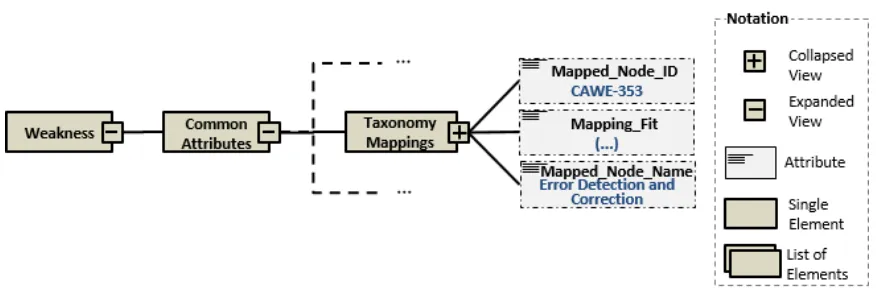
The CWE library supports introducing new concepts without changes in its structure. This is done through theTaxonomy Mappingelement (presented in Figure 3.1), which allows that every Weaknesses or Compound Elements to reference nodes in an external taxonomy that have any sort of conceptual relation. Thus, we can use the Taxonomy Mappingelement to establish a connection between security patterns and software design flaws, thereby augmenting the CWE collection with software architecture concepts.
attribute is used to indicate the impacted pattern, the Mapped Node IDrefers to the iden-tifier of a CAWE entry in the catalog and the Mapping Fit (which is hidden to simplify the image) summarizes the impact of the weakness over the pattern. In this example, the value ofMapping Fitexplains that not applying the “Error Detection and Correction” when transmitting data over an unreliable communication channel allows the software to use cor-rupted data inadvertently.
Chapter 6
Related Work
Despite the research community efforts to create techniques and tools for developing more secure software, there is a gap for procedures that address the security problem using an architectural point of view [32]. Currently, there are many research and books focused on the identification, categorization, and detailing of security patterns [20, 21, 25, 34, 38]. In this work, however, we take one step further towards observing how these patterns could be compromised when incorrectly implemented or inappropriately designed, thereby filling the existing gap of overcoming security challenges from avoiding architectural flaws.
The usage of security knowledge bases to help developers and engineers in their daily activities have been discussed in the research community. In this matter, security ontolo-gies, which represents knowledge within the security domain, have been created to support some activities (e.g. requirements engineering [37] and quantitative risk analysis [17]). These ontologies, however, does not introduce architectural concepts on it [5].
In this context, similarly to a security ontology, Wuet al.[42] proposed the use of se-mantic templatesto keep track of the key details related to vulnerabilities. These templates are a structured description of generic patterns of relationship between software compo-nents, faults and security consequences built on top of the CWE collection and the CVE dictionary. However, that work does not have a full complete list of templates for all the CWE entries.
and guide the architect to select the architectural tactics that would better address the re-quirements. The primary goal of that work was to minimize the impacts of design decisions being informally done and dependent on the architect’s experience to select architectural choices. Another example is described by Ryooet al.[33], which proposes a vulnerability-oriented architectural analysis approach that reuses the knowledge from known vulnerabil-ities as a checklist when evaluating and designing an architecture. Unlike our work, these efforts are focused on helping to engineer a secure software specifically in architectural analysis activities, whereas the scope of our catalog is broader to other software develop-ment activities.
Chapter 7
Threats to Validity
The threats to validity can be classified asconstruct,internalandexternalvalidity. Below we explain the threats that may have impacted this work and the ways these threats were mitigated.
External validity evaluates the generalizability of the approach and the extent to which the results of a study can be generalized to other systems. A potential threat in this cat-egory is that we analyzed our catalog against historical vulnerability reports from Linux Kernel, PHP, Chrome and Thunderbird. However, we carefully selected these case studies from different software domains. Therefore, we expect it to be representative of a typical software engineering environment, which suggests that it could generalize to a broader set of systems. Another threat to the external validity is that we focused our discussion on 39 security patterns. We tried to mitigate this threat through selecting security patterns that satisfy different security concerns (such as privacy, authentication, non-repudiation, and so on). Consequently, we believe that the results would not be overly different from other security patterns.
Chapter 8
Conclusion and Future Work
This thesis presented the new concept of CAWE (Common Architectural Weakness Enu-meration), to stimulate security design thinking into developers daily coding activities through a catalog that documents potential weaknesses related to security patterns. This work aimed to fill in the gap of architectural knowledge of architecture-related security issues.
In addition to creating the CAWE collection, this work reported the analysis of four large case studies and observed that at least 35% of the investigated vulnerabilities are rooted in the architecture of those case studies. Besides that, improper validation of inputs and access control were the two most design flaws observed in real systems.
8.1
Future Work
The current state of the art of vulnerability detection tools is still focused on finding low-level issues (bugs). This way, this catalog could be used as a knowledge base for automated techniques to detect architectural-level vulnerabilities from source code. One potential way to do this is through, firstly, detecting security patterns, then using the CAWE catalog to reason about potential associated weaknesses. This is one research direction of this work.
Bibliography
[1] Ivan Arce, Kathleen Clark-Fisher, Neil Daswani, Jim DelGrosso, Danny Dhillon, Christoph Kern, Tadayoshi Kohno, Carl Landwehr, Gary McGraw, Brook Schoen-field, Margo Seltzer, Diomidis Spinellis, Izar Tarandach, and Jacob West. Avoiding the top 10 software security design flaws.https://www.computer.org/cms/ CYBSI/docs/Top-10-Flaws.pdf, 2014. (Accessed on 05/08/2016).
[2] Brad Arkin, Scott Stender, and Gary McGraw. Software penetration testing. IEEE Security & Privacy, (1):84–87, 2005.
[3] Felix Bachmann, Len Bass, and Mark Klein. Deriving Architectural Tactics: A Step Toward Methodical Architectural Design. Technical Report, Software Engineering Institute, 2003.
[4] Len Bass, Paul Clements, and Rick Kazman. Software Architecture in Practice (3rd Edition). Addison-Wesley Professional, 3 edition, October 2012.
[5] Carlos Blanco, Joaquin Lasheras, Rafael Valencia-Garc´ıa, Eduardo Fern´andez-Medina, Ambrosio Toval, and Mario Piattini. A systematic review and comparison of security ontologies. InAvailability, Reliability and Security, 2008. ARES 08. Third International Conference on, pages 813–820. Ieee, 2008.
[6] Brian Chess and Gary McGraw. Static analysis for security.IEEE Security & Privacy, (6):76–79, 2004.
[7] The MITRE Corporation. Cve - common vulnerabilities and exposures (cve). http: //cve.mitre.org/. (Accessed on 04/29/2016).
[8] The MITRE Corporation. Cwe-256: Plaintext storage of a password.http://cwe. mitre.org/data/definitions/256.html. (Accessed on 04/29/2016). [9] The MITRE Corporation. Cwe-354: Improper validation of integrity check value
[10] The MITRE Corporation. Cwe-603: Use of client-side authentication (2.9).
https://cwe.mitre.org/data/definitions/603.html. (Accessed on 05/09/2016).
[11] The MITRE Corporation. Capec - common attack pattern enumeration and classifi-cation. http://capec.mitre.org/, 2015. (Accessed on 05/09/2016).
[12] The MITRE Corporation. Cwe-159: Failure to sanitize special element, 2015. (Ac-cessed on 04/29/2016).
[13] The MITRE Corporation. Cwe-261: Weak cryptography for passwords. http: //cwe.mitre.org/data/definitions/261.html, 2015. (Accessed on 04/29/2016).
[14] The MITRE Corporation. Cwe-306: Missing authentication for critical function.
http://cwe.mitre.org/data/definitions/306.html, 2015. (Ac-cessed on 04/29/2016).
[15] The MITRE Corporation. Cwe-319: Cleartext transmission of sensitive information.
https://cwe.mitre.org/data/definitions/319.html, 2015. (Ac-cessed on 05/09/2016).
[16] Danny Dhillon. Developer-driven threat modeling: Lessons learned in the trenches.
IEEE Security & Privacy, (4):41–47, 2011.
[17] Andreas Ekelhart, Stefan Fenz, Markus Klemen, and Edgar Weippl. Security ontolo-gies: Improving quantitative risk analysis. In System Sciences, 2007. HICSS 2007. 40th Annual Hawaii International Conference on, pages 156a–156a. IEEE, 2007. [18] Michael E. Fagan. Pioneers and Their Contributions to Software Engineering: sd&m
Conference on Software Pioneers, Bonn, June 28/29, 2001, Original Historic Contri-butions, chapter Design and Code Inspections to Reduce Errors in Program Develop-ment, pages 301–334. Springer Berlin Heidelberg, Berlin, Heidelberg, 2001.
[19] The PHP Group. Php: Safe mode - manual. http://php.net/manual/en/ features.safe-mode.php. (Accessed on 04/27/2016).
[20] Munawar Hafiz, Paul Adamczyk, and Ralph E. Johnson. Organizing security patterns.
[21] Munawar Hafiz, Paul Adamczyk, and Ralph E. Johnson. Growing a pattern language (for security). In Proceedings of the ACM International Symposium on New Ideas, New Paradigms, and Reflections on Programming and Software, Onward! 2012, pages 139–158, New York, NY, USA, 2012. ACM.
[22] Shawn Hernan, Scott Lambert, Tomasz Ostwald, and Adam Shostack. Threat modeling-uncover security design flaws using the stride approach. MSDN Magazine-Louisville, pages 68–75, 2006.
[23] Michael Howard and Steve Lipner. The security development lifecycle. O’Reilly Media, Incorporated, 2009.
[24] Clemente Izurieta and James M. Bieman. How software designs decay: A pilot study of pattern evolution. InESEM, pages 449–451, 2007.
[25] Darrell M. Kienzle, Matthew C. Elder, David Tyree, and James Edwards-hewitt. Se-curity patterns repository, version 1.0, 2006.
[26] John McDermott and Chris Fox. Using abuse case models for security requirements analysis. InComputer Security Applications Conference, 1999.(ACSAC’99) Proceed-ings. 15th Annual, pages 55–64. IEEE, 1999.
[27] Gary McGraw. Software security: building security in, volume 1. Addison-Wesley Professional, 2006.
[28] P. Mell, K. Scarfone, and S. Romanosky. Common vulnerability scoring system.
IEEE Security Privacy, 4(6):85–89, Nov 2006.
[29] Mehdi Mirakhorli, Yonghee Shin, Jane Cleland-Huang, and Murat Cinar. A tactic centric approach for automating traceability of quality concerns. In International Conference on Software Engineering, ICSE (1), 2012.
[30] OWASP. Owasp clasp project. https://www.owasp.org/index.php/ Category:OWASP_CLASP_Project, 2016. (Accessed on 05/08/2016).
[32] S. Rehman and K. Mustafa. Research on software design level security vulnerabilities.
SIGSOFT Softw. Eng. Notes, 34(6):1–5, December 2009.
[33] Jungwoo Ryoo, Rick Kazman, and Priya Anand. Architectural analysis for security.
IEEE Security & Privacy, (6):52–59, 2015.
[34] Markus Schumacher, Eduardo Fernandez-Buglioni, Duane Hybertson, Frank Buschmann, and Peter Sommerlad. Security Patterns: Integrating security and sys-tems engineering. John Wiley & Sons, 2013.
[35] Edward J Schwartz, Thanassis Avgerinos, and David Brumley. All you ever wanted to know about dynamic taint analysis and forward symbolic execution (but might have been afraid to ask). InSecurity and privacy (SP), 2010 IEEE symposium on, pages 317–331. IEEE, 2010.
[36] IBM Security. Ibm statistics on data breach epidemic. http://www-935.ibm. com/services/us/en/it-services/security-services/data-breach, 2014. (Accessed on 05/06/2015).
[37] Amina Souag, Camille Salinesi, Isabelle Wattiau, and Haris Mouratidis. Using secu-rity and domain ontologies for secusecu-rity requirements analysis. InComputer Software and Applications Conference Workshops (COMPSACW), 2013 IEEE 37th Annual, pages 101–107. IEEE, 2013.
[38] Chritopher Steel and Ramesh Nagappan. Core Security Patterns: Best Practices and Strategies for J2EE”, Web Services, and Identity Management. Pearson Education India, 2006.
[39] Frank Swiderski and Window Snyder. Threat modeling. Microsoft Press, 2004. [40] Jilles van Gurp, Sjaak Brinkkemper, and Jan Bosch. Design preservation over
subse-quent releases of a software product: a case study of baan erp: Practice articles. J. Softw. Maint. Evol., 17:277–306, July 2005.
[41] Bart De Win, Riccardo Scandariato, Koen Buyens, Johan Grgoire, and Wouter Joosen. On the secure software development process: Clasp, sdl and touchpoints compared.