What do pedometer counts represent? A comparison between
pedometer data and data from four different questionnaires
Katrien A De Cocker*, Ilse M De Bourdeaudhuij and Greet M Cardon
Department of Movement and Sports Sciences, Ghent University, Watersportlaan 2, B-9000 Ghent, Belgium
Submitted 12 June 2007: Accepted 14 January 2008: First published online 20 March 2008
Abstract
Objectives: To compare physical activity (PA) reported through pedometer registrations (step counts) with PA reported in four different questionnaires; to compare step count thresholds (7500, 10 000 and 12 500 steps/d) with the PA guideline of 30 min of moderate to vigorous PA (MVPA) per day.
Subjects:A sample of 310 healthy adults, mean age 38?7 (SD11?9) years, volun-teered to participate. Forty-seven per cent was male and 93 % of the sample was employed.
Methods:PA was assessed by interview (Minnesota Leisure Time Physical Activity Questionnaire (MLTPAQ)), three self-administered questionnaires (long version and short version of the International Physical Activity Questionnaire (long-form IPAQ, short-form IPAQ), Baecke questionnaire) and seven consecutive days of pedometer registration.
Results: Step counts correlated positively with questionnaire-based PA. The strongest correlations were found between step counts and total PA reported in the long-form IPAQ (rs50?37), moderate PA reported in the short-form IPAQ (rs50?33), total and moderate PA reported in the MLTPAQ (rs50?32), and the total and leisure-time PA indices (excluding sport) reported in the Baecke questionnaire (rs50?44). According to step counts, 22?6 % of the participants were somewhat active, 18?7 % active and 39?4 % highly active. As assessed by the long-form IPAQ, short-form IPAQ and MLTPAQ, the guideline of 30 min MVPA/d was reached by respectively 85?4 %, 84?8 % and 68?0 % of participants.
Conclusion: Pedometer-based data offer adequate information to discriminate between levels of PA. Caution is needed when comparing active samples based on different PA recommendations.
Keywords
Step counter Survey Health guidelines IPAQ
The amount of usual physical activity (PA) accumulated by an individual is strongly related with all-cause mor-bidity and mortality risk(1). Healthy adults should accu-mulate 30 min or more of moderate-intensity aerobic PA on 5 d each week or a minimum of 20 min of vigorous-intensity aerobic activity on 3 d each week(2). The use of step count recommendations as useful behavioural PA targets has been suggested in the past(3,4). These step count thresholds are more practical than the 30 min MVPA/d guideline since they do not imply constant time tracking and summing of at least moderate-intensity activity during the day, which is impractical for PA assessment on individual and population levels. Addi-tionally, more detailed pedometer-based indices for public health (sedentary: ,5000 steps/d; low active: 5000–7499 steps/d; somewhat active: 7500–9999 steps/d; active: 10 000–12 499 steps/d; highly active: $12 500 steps/d) have been introduced by Tudor-Locke and Bassett(5).
accelerometers (approximately $US 150–500). Despite their limitations such as variability between different brands, insensitivity to non-ambulatory activities (i.e. cycling, swimming) and increased errors at slow walking speeds (,60 m/min)(8), pedometers have become popu-lar devices for public use and for researchers. Moreover, step counts have proved to be useful in PA studies in free-living populations(8). However, the question remains of which exactly dimensions of PA are measured by ped-ometers. Several researchers(8,10) report that pedometer step counts are an appropriate measurement of the dis-tance walked, while others believe that pedometers also enable the quantification of ambulatory behaviour during occupational, leisure-time, household and transportation activity(11,12). In addition, one could wonder if step counts are simply a measure for walking or if they can also be associated with self-reports of PA that encompass inten-sity (other moderate and vigorous PA, besides walking). Therefore, the first purpose of the present study was to compare pedometer data with data from questionnaires, the most commonly used(7) and practical method for PA assessment in large-scale studies(13). The objective was to evaluate the associations between step counts and PA (walking, moderate PA, vigorous PA) reported in four different validated questionnaires: the interviewer-administered Minnesota Leisure Time Physical Activity Questionnaire(14) (MLTPAQ), the self-administered long version and self-administered short version of the Inter-national Physical Activity Questionnaire(15) (long-form IPAQ, short-form IPAQ), and the self-administered Baecke Questionnaire(16). Additionally, questionnaire-based PA was compared between the five ‘step count groups’ based on the pedometer health indices of Tudor-Locke and Bassett(5). A third objective of the present study was to compare step count thresholds (7500, 10 000 and 12 500 steps/d) with the guideline of 30 min of moderate to vigorous PA (MVPA) per day. Wilde et al.(17) found that sedentary women who added a 30 min walk to their daily habits accumulated approximately 10 000 steps. Another study(18) also revealed that on days when women took a 30 min walk, their average step count was close to 10 000. Other researchers(19)found that women who took 10 000 steps/d were more likely to meet the current MVPA guideline, compared with those not accumulating as many steps.
Miller and Brown(20)found only a moderate level of agree-ment between meeting 10 000 steps/d and 150 min or more of PA over five or more sessions per week. However, no research could be located in either gender or in a European sample assessing whether step count thresholds are corre-sponding to the 30 min MVPA/d guideline. Therefore, the present study explored whether adults reaching 7500, 10 000 and 12 500 steps/d also reached 30 min MVPA/d, based on self-reports.
Methods
Participants and procedures
A convenience sample of 310 volunteers (146 men) living in Flanders, Belgium participated in the present study. Participant characteristics are shown in Table 1. No gender differences were found for the proportions of employed participants, mean ages and average daily step counts.
All participants were visited at home by research assis-tants for the completion of the MLTPAQ. After this interview, participants were asked to complete the self-administered long-form IPAQ, the self-administered short-form IPAQ and the Baecke questionnaire. Then, participants were asked to register pedometer-based step counts for seven consecutive days. They were instructed to wear the pedometer on their waistband or belt during waking hours. All participants were asked to carry on their usual activities, to remove the pedometer only while swimming, bathing or showering, and to complete an activity log at the end of each day. All participants provided written informed consent and the study was approved by the Ethical Committee of Ghent University. Research assistants (masters-level graduates, native speakers) were given 2 h of training and interview practice.
Instruments
Pedometers
[image:2.595.58.542.614.714.2]The Yamax Digiwalker SW-200 (Yamax, Tokyo, Japan) was used in the present study as it is known to be a valid, reliable and accurate instrument for counting steps in adult populations(21).
Table 1Characteristics of the study participants: healthy adult volunteers, Flanders, Belgium
Total group Male Female
n % n % n % Gender comparison
Gender 310 100?0 146 47?1 164 52?9 x251?05NS
Employed 288 92?9 139 95?2 149 90?9 x250?35NS
Mean SD Mean SD Mean SD
Age (years) 38?7 11?9 39?1 12?5 38?3 11?4 t50?56NS Daily step counts 12 087 4888 12 452 4983 11 762 4792 t51?24NS
NS,P.0?05.
Activity log
Based on procedures of Tudor-Locke et al.(22), partici-pants were asked to keep daily activity records in an activity log during the seven consecutive days of pedo-meter registration. They were requested to record the date, the number of steps recorded at the end of the day, and the type and duration of non-ambulatory activities (e.g. 20 min of biking/swimming). Following established guidelines(23,24), 150 steps were added to the daily total for every minute of reported biking and/or swimming. The average daily step count was 9981 (SD3455) without adding the equivalent for biking/swimming and 12 087 (SD4888) with the added steps for biking/swimming. Of the total sample, 152 people (49?0 %) reported biking/ swimming during the week of pedometer registration (mean: 7?6 (SD15?1) min/d).
MLTPAQ
A structured interview was used to solicit detailed infor-mation on leisure-time PA over a 1-year period. A Dutch version of the validated MLTPAQ, developed for the Belgian Physical Fitness Study, was used(6,14,25). Participants’ engagement in different activities was queried, together with the number of months per year, the monthly frequency and the duration of the activity. Activities were classified as walking (structured walking for transport or in leisure time), moderate-intensity PA (MPA) or vigorous-intensity PA (VPA), based on their energy requirements (MPA: 3–6 MET; VPA: .6 MET; MET5metabolic energy equivalent task)(26).
Long-form IPAQ
The self-administered long-form IPAQ was used to assess PA at work, transport-related PA, domestic and gardening activities, and PA during leisure time in a usual week. Total times engaged in walking, MPA and VPA, all expressed in min/week, were computed according to the guidelines (www.ipaq.ki.se). The IPAQ has been shown to be a valid and reliable instrument for measuring PA in Europe(15)and in Flanders, Belgium(27).
Short-form IPAQ
PA was assessed using the self-administered short-form IPAQ, which provides information on the time spent walking, in MPA and in VPA (min/week) in a usual week. This version of the IPAQ has been found to be valid and reliable(15).
Baecke questionnaire
In the Baecke questionnaire(16), responses were scored on a five-point scale and resulted in three different indices reflecting PA during work (work index), PA during leisure time excluding sport (LT index) and PA during sport activities (sport index). The summation of the three indices was defined as the overall PA index (total PA index). Good validity of the Baecke questionnaire for the assessment of PA was found in the past(28,29).
Data analysis
Analyses were carried out using the SPSS for Windows statistical software package version 12?0 (SPSS Inc., Chicago, IL, USA). Average daily steps were calculated and values above 20 000 steps/d were recorded as 20 000 steps/d to limit unrealistically high average step counts(30). Because of the non-normal distributions in PA data, Spearman correlation coefficients (rs) were calcu-lated to assess the relationship between step counts and questionnaire-based PA. The same technique was used to assess the correlations between PA data derived from the different questionnaires. Correlations were interpreted as low (,0?30), moderate (0?30–0?50) or high (.0?50). Differences in questionnaire-based PA between the five step count groups based on the pedometer indices(5) were evaluated with multivariate ANOVA. First, the skewed questionnaire outcomes were log-transformed to approximate normal distributions. Parametric analyses were performed on the log-transformed data and adjusted for age, gender and employment status.Fvalues,Pvalues and partial h2, as a measure of the effect size, are reported. For reasons of clarity and comparability, the means and standard deviations of the non-transformed data are used in Table 3. Finally, cross-tabulations of the number of participants (not) reaching the step count thresholds of 7500, 10 000 and 12 500 steps/d and/or the guideline of 30 min MVPA/d were performed, and the percentages of agreement between the different PA recommendations were calculated based on the cross-tabulations. A P value #0?05 was considered as statistically significant.
Results
The correlations between step counts and questionnaire-based PA are shown in Table 2. Step counts correlated moderately with total PA (rs50?37) and MPA (rs50.31), and lowly with walking (rs50?19) and VPA (rs50?25), reported in the long-form IPAQ. Low correlations were found between step counts and total PA (rs50?28), walking (rs50?15) and VPA (rs50?20) reported in the short-form IPAQ, except for MPA (rs50?33). A low cor-relation was found between step counts and walking (rs50?10) and VPA (rs50?16) reported in the MLTPAQ; total PA (rs50?32) and MPA (rs50?32) reported in the MLTPAQ correlated moderately with step counts. Finally, step counts correlated moderately with the total PA index (rs50?44), LT index (rs50?44) and sport index (rs50?31) of the Baecke questionnaire, except for the work index (rs50?19). Correlations between PA reported in the differ-ent questionnaires are also presdiffer-ented in Table 2.
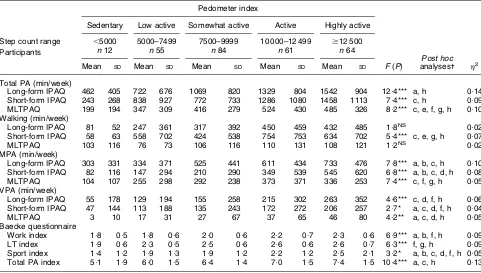
five step count groups were found for total PA, MPA and VPA reported in the long-form IPAQ, short-form IPAQ and MLTPAQ. For walking, only data based on the short-form IPAQ differed significantly between the step count groups. The work, leisure-time, sport and total PA indices of the Baecke questionnaire differed significantly between the five step count groups.
In total, 80?6 % of participants reached 7500 steps/d, 45?0 % reached 10 000 steps/d and 39?4 % reached 12 500 steps/d, whereas 30 min MVPA/d was reached by 85?4 % according to the long-form IPAQ, 84?8 % according to the short-form IPAQ and 68?1 % according to the MLTPAQ (Fig. 1).
Using the long-form IPAQ, the step count thresholds of 7500, 10 000 and 12 500 steps/d and the 30 min MVPA/d recommendation were in agreement in respectively 77?7 %, 54?4 % and 48?7 % of the participants (see Table 4). Based on the short-form IPAQ, respectively 76?5 %, 51?8 % and 48?1 % of participants were well placed. Using the MLTPAQ, the recommendations were in agreement in respectively 71?9 %, 53?1 % and 51?9 % of the participants. Some 89?2 % of the participants reaching 7500 steps/d, 94?2 % of those reaching 10 000 steps/d and 93?4 % of those reaching 12 500 steps/d reached 30 min MVPA/d, according to the long-form IPAQ. With the short-long-form IPAQ these figures were respectively 88?0 %, 90?6 % and 91?8 %. Of the participants, 74?8 % reaching 7500 steps/d, 73?4 % reaching 10 000 steps/d and 75?4 % reaching 12 500 steps/d reached 30 min MVPA/d based on the MLTPAQ.
Discussion
The first aim of the present study was to evaluate the associations between step counts and questionnaire-based PA. Objectively measured step counts correlated positively with the subjectively reported PA levels. Significant, positive associations between step counts and questionnaire-based PA were also found in previous studies(9,31)conducted in the USA, where walking is one of the most commonly reported forms of PA(32). A median correlation of r50?33 (range: 0?02–0?94) was found between step counts and self-reported PA in a review of mostly non-European studies(33). Surprisingly, in the present study, a low correlation was found between step counts and walking reported in the long-form IPAQ, short-form IPAQ and MLTPAQ. An explanation for this remarkable finding could be the lack of sensitivity of questionnaires(34) to detect walking, resulting in under-reporting of walking behaviour. Bassett et al.(35) also found that subjects underestimated their daily walking distance in the College Alumnus Questionnaire, compared with pedometer-based values. Furthermore, different types of walking were assessed through the various ques-tionnaires. The long-form IPAQ asked about the combina-tion of walking in various domains (i.e. work, transport,
Ta ble 2 Correla tion m atrix: Spear man corre lation coef ficient (95 % CI) Short-form IPAQ MLTPAQ Baecke Q Step counts T otal PA -Walking -MPA -VPA -Total PA -Walking -MPA -VPA -Total PA index Long-form IPAQ Total PA -0 ? 37 (0 ? 27–0 ? 46) 0 ? 73 (0 ? 67–0 ? 78) 0 ? 36 (0 ? 26–0 ? 45) 0.30 (0.20–0.40) Walking -0 ? 19 (0 ? 08–0 ? 30) 0 ? 68 (0 ? 62–0 ? 74) 0 ? 24 (0 ? 13–0 ? 34) MPA -0 ? 31 (0 ? 21–0 ? 41) 0 ? 56 (0 ? 78–0 ? 63) 0 ? 40 (0 ? 30–0 ? 49) VPA -0 ? 25 (0 ? 14–0 ? 35) 0 ? 78 (0 ? 73–0 ? 82) 0 ? 41 (0 ? 31–0 ? 50) Short-form IPAQ Total PA -0 ? 28 (0 ? 17–0 ? 38) 0 ? 31 (0 ? 21–0 ? 41) 0 ? 31 (0 ? 21–0 ? 41) Walking -0 ? 15 (0 ? 04–0 ? 26) 0 ? 20 (0 ? 10–0 ? 31) MPA -0 ? 33 (0 ? 23–0 ? 43) 0 ? 41 (0 ? 31–0 ? 50) VPA -0 ? 20 (0 ? 09–0 ? 31) 0 ? 40 (0 ? 30–0 ? 50) MLTPAQ Total PA -0 ? 32 (0 ? 22–0 ? 42) 0 ? 40 (0 ? 30–0 ? 49) Walking -0 ? 10 ( 2 0 ? 01–0 ? 21) MPA -0 ? 32 (0 ? 22–0 ? 42) VPA -0 ? 16 (0 ? 05–0 ? 27) Baecke Q Total PA index 0 ? 44 (0 ? 35–0 ? 53) Work index 0 ? 19 (0 ? 08–0 ? 30) LT index 0 ? 44 (0 ? 35–0 ? 53) Sport index 0 ? 31 (0 ? 20–0 ? 41) IPAQ, International Physical Activity Questionnaire (short-form, s hort v ersion o f the questionnaire; long-form, long v ersion o f the questionnai re); MLTPAQ, Minnesota Leisure T ime P hysical A ctivity Questionnaire; PA, physical activity; MPA, moderate physical activity; VPA, vigorous physical a ctivity LT, leisure time. -In min.
home, leisure time) while the MLTPAQ assessed leisure/ pleasure walking and walking to work only. The pedometer measured all ambulatory activity throughout the day.
Furthermore, differences in questionnaire-based PA between groups based on the pedometer indices of Tudor-Locke and Bassett(5) were evaluated. Results
[image:5.595.53.534.71.344.2]showed that the classification of activity levels based on step counts also highlighted differences in self-reported levels of PA (low to medium effect sizes). The more active participants were, based on step counts, the higher the levels of total, MPA and VPA reported in the long-form IPAQ, short-form IPAQ and MLTPAQ. The application of
Table 3Differences in questionnaire-based physical activity (PA) across step count groups: healthy adult volunteers, Flanders, Belgium
Pedometer index
Sedentary Low active Somewhat active Active Highly active
Step count range ,5000 5000–7499 7500–9999 10 000–12 499 $12 500
Participants n12 n55 n84 n61 n64
Post hoc
Mean SD Mean SD Mean SD Mean SD Mean SD F(P) analyses- h2
Total PA (min/week)
Long-form IPAQ 462 405 722 676 1069 820 1329 804 1542 904 12?4*** a, h 0?14 Short-form IPAQ 243 268 838 927 772 733 1286 1080 1458 1113 7?4*** c, h 0?09 MLTPAQ 199 194 347 309 416 279 524 430 485 326 8?2*** c, e, f, g, h 0?10 Walking (min/week)
Long-form IPAQ 81 52 247 361 317 392 450 459 432 485 1?8NS 0
?02 Short-form IPAQ 58 63 558 702 424 538 754 753 634 702 5?4*** c, e, g, h 0?07
MLTPAQ 103 116 76 73 106 116 110 131 108 121 1?2NS 0
?02 MPA (min/week)
Long-form IPAQ 303 331 334 371 525 441 611 434 733 476 7?8*** a, b, c, h 0?10 Short-form IPAQ 82 116 147 294 210 290 349 539 545 620 6?8*** a, b, c, d, h 0?08 MLTPAQ 104 107 255 298 292 238 373 371 336 253 7?4*** c, f, g, h 0?05 VPA (min/week)
Long-form IPAQ 55 178 129 194 155 258 215 302 263 352 4?6*** c, d, f, h 0?06 Short-form IPAQ 47 144 113 188 135 243 172 272 206 257 2?7* a, c, d, f, h 0?04
MLTPAQ 3 10 17 31 27 67 37 65 46 80 4?2** a, c, d, h 0?05
Baecke questionnaire
Work index 1?8 0?5 1?8 0?6 2?0 0?6 2?2 0?7 2?3 0?6 6?9*** a, b, f, h 0?09 LT index 1?9 0?6 2?3 0?5 2?5 0?6 2?6 0?6 2?6 0?7 6?3*** f, g, h 0?09 Sport index 1?4 1?2 1?9 1?3 1?9 1?2 2?2 1?2 2?5 2?1 3?2* a, b, c, d, f, h 0?05 Total PA index 5?1 1?9 6?0 1?5 6?4 1?4 7?0 1?5 7?4 1?5 10?4*** a, c, h 0?13
IPAQ, International Physical Activity Questionnaire (long-form, long version of the questionnaire; short-form, short version of the questionnaire); MLTPAQ, Minnesota Leisure Time Physical Activity Questionnaire; MPA, moderate physical activity; VPA, vigorous physical activity.
Significance of differences between the five groups: *P#0?05, **P#0?01, ***P#0?001 (NS,P.0?05).
-Some post hocpairwise comparisons were not significantly different: a, sedentary–low active NS; b, sedentary–somewhat active NS; c, low active–
somewhat active NS; d, low active–active NS; e, low active–highly active NS; f, somewhat active–active NS; g, somewhat active–highly active NS; h, active–highly active NS.
7 500 steps/d
10 500 steps/d
12 500 steps/d
30 min MVPA/d long-form
IPAQ 100
80
60
80.6
45.0
39.4
85.4 84.8
68.1
40
20
0
%
30 min MVPA/d short-form
IPAQ
30 min MVPA/d (MLTPAQ)
Fig. 1Percentage of participants reaching the step count of 7500 steps/d, 10 000 steps/d and 12 500 steps/d, and the standard of
[image:5.595.133.457.423.582.2]these findings is that individuals who engaged more in MPA and VPA accumulated more steps per day. Again, unexpectedly, this was not the case for walking reported in the long-form IPAQ and MLTPAQ. Only walking in the short-form IPAQ differed significantly between step count groups. All indices (work, leisure-time, sport and total PA) based on the Baecke questionnaire also increased gra-dually when step counts augmented. Concluding, step counts are capable of discriminating between total, MPA and VPA reported in the different questionnaires.
A third objective of the present study was to compare currently used PA guidelines, to show differences in the percentages of participants reaching the step count thresholds. Of the participants, 80?6 % reached 7500 steps/d, 45?0 % reached 10 000 steps/d and 39?4 % reached 12 500 steps/d. The guideline of 30 min MVPA/d, on the other hand, was reached by 85?4 % according to
the long-form IPAQ, followed by 84?8 % according to the short-form IPAQ and by 68?1 % according to the MLTPAQ. There are various possible explanations for this dis-crepancy. It is known that over-reporting of PA may occur when using self-reported questionnaires, including the IPAQ(7). The lower percentage according to the MLTPAQ could be explained by the 1-year time frame of the questionnaire, which could cause recall biases. Also the fact that the MLTPAQ was interviewer-administered may have had an influence: research assistants were trained to detect over-reporting of PA(6).
The current study also explored whether reaching dif-ferent step count thresholds was sufficient to reach 30 min MVPA/d. When participants reached 7500 steps/d, the MVPA recommendation was reached in 89?2 % (by long-form IPAQ; 88?0 % by short-form IPAQ). Of participants, 94?2 % (by long-form IPAQ; 90?6 % by short-form IPAQ) of those reaching 10 000 steps/d reached 30 min MVPA/d. Participants reaching 12 500 steps/d reached 30 min MVPA/d in 93?4 % (by long-form IPAQ; 91?8 % by short-form IPAQ) of cases. All figures based on the MLTPAQ were lower (respectively 74?8 %, 73?4 % and 75?4 %). However, these results indicated that step count thresh-olds are stringent enough. Le Masurieret al.(19)found that 91 % of women reaching the 10 000 steps/d standard accumulated more than 30 min MVPA/d based on accel-erometer data. In the present study, it was easier for participants reaching the step count thresholds to reach 30 min MVPA/d, rather than the other way around. No more than half of the participants (respectively 49?6 %, 48?1 % and 48?6 % based on the long-form IPAQ, short-form IPAQ and MLTPAQ) reaching 30 min MVPA/d reached 10 000 steps/d, for example. Welk et al.(9) reported that participants who performed more than 30 min of PA daily reached at least 10 000 steps/d some 73 % of the time. Tudor-Locke et al.(36) found that approximately 3000 steps are expected in 30 min of moderate-intensity ambulatory activity.
The present average step count level (12 100 steps/d) is clearly higher than that of a representative sample of Belgian adults (9700 steps/d)(23). A possible explanation could be the fact that the present study population is a convenience sample of mostly working volunteers, implying cautious interpretations and limited general-izability of the results.
[image:6.595.59.292.110.470.2]The present results reflect that caution is needed when assessing PA standards, especially when using different methods. It is remarkable that despite moderate correla-tions between step counts and questionnaire-based PA, the percentages reaching the standards differ notably. The subjective nature of questionnaires, possibly causing over-reporting, can be an explanation of the discrepancy. To avoid this problem, a gold standard, such as doubly labelled water or accelerometers, could be used to determine if the 30 min MVPA/d guideline is effectively reached.
Table 4Number of participants reaching both, one or neither of
two types of physical activity recommendations: 7500 steps/d, 10 000 steps/d, 12 500 steps/d and the 30 min of moderate to vigorous physical activity (MVPA) per day standard, as assessed by three different questionnaires
7500 steps
30 min MVPA/d based ony Not reached Reached
Long-form IPAQ
Not reached 18 27
Reached 42 223
Short-form IPAQ
Not reached 17 30
Reached 43 220
MLTPAQ
Not reached 36 63
Reached 24 187
10 000 steps
Not reached Reached
Long-form IPAQ
Not reached 37 8
Reached 133 131
Short-form IPAQ
Not reached 34 13
Reached 136 126
MLTPAQ
Not reached 62 37
Reached 108 102
12 500 steps
Not reached Reached
Long-form IPAQ
Not reached 37 8
Reached 151 114
Short-form IPAQ
Not reached 37 10
Reached 151 112
MLTPAQ
Not reached 69 30
Reached 119 92
IPAQ, International Physical Activity Questionnaire (long-form, long version of the questionnaire; short-form, short version of the questionnaire); MLTPAQ, Minnesota Leisure Time Physical Activity Questionnaire.
In summary, there is a modest relationship between step counts and questionnaire-based PA in the present European sample. Objective pedometers not only pro-vide a measurement of walking but also give an indica-tion of total, MPA and VPA. Even though pedometers alone cannot discriminate between the intensity of activities nor reflect the amount of time spent in specific intensity PA categories, they provide sufficient informa-tion to be valuable in PA assessment in large, free-living populations. Less agreement was found between the currently used PA guidelines (30 min MVPA/d and step count thresholds), suggesting that caution is needed when comparing active quantities in different samples based on different methods.
Acknowledgements
The authors declare that they have no competing inter-ests. The study was not funded.
K.A.D.C. participated in the data collection, analysis and interpretation, and led the writing of the paper. G.M.C. and I.M.D.B. participated in the data collection, conceptualization of the study and provided substantive feedback on the manuscript. All authors have read and approved the final manuscript.
The authors would like to acknowledge all subjects participating in the study.
References
1. Blair SN, Cheng Y & Holder S (2001) Is physical activity or physical fitness more important in defining health benefits?
Med Sci Sports Exerc33, S379–S399.
2. Haskell W, Lee I, Pate R, Powell K, Blair S, Franklin B, Macera C, Heath G, Thompson P & Bauman A (2007) Physical activity and public health: updated recommenda-tion for adults from the American College of Sports Medicine and the American Hearth Association. Med Sci Sports Exerc39, 1423–1434.
3. Hatano Y (1993) Use of the pedometer for promoting daily walking exercise.Int Counc Health Phys Educ Recreation
29, 4–8.
4. Hatano Y (1997) Prevalence and use of pedometer.Res J Walking1, 45–54.
5. Tudor-Locke C & Bassett DR (2004) How many steps per day are enough? Preliminary pedometer indices for public health.Sports Med34, 1–8.
6. Montoye HJ, Kemper HC, Saris WH & Washburn RA (1996)
Measuring Physical Activity and Energy Expenditure. Champaign, IL: Human Kinetics.
7. Sallis J & Saelens BE (2000) Assessment of physical activity by self-report: status, limitations, and future directions.Res Q Exerc Sport71, 1–14.
8. Bassett DR, Ainsworth BE, Legget SR, Mathien CA, Main JA, Hunter DC & Duncan GE (1996) Accuracy of five electronic pedometers for measuring distance walked.Med Sci Sports Exerc28, 1071–1077.
9. Welk GJ, Differding JA, Thompson RW, Blair SN, Dziura J & Hart P (2000) The utility of the Digi-Walker step counter to assess physical activity patterns.Med Sci Sports Exerc32, S481–S488.
10. Shephard FK (1989) Assessment of physical activity and energy needs.Am J Clin Nutr50, 1195–1200.
11. Hornbuckle LM, Bassett DR & Thompson DL (2005) Pedometer-determined walking and body composition variables in African-American women.Med Sci Sports Exerc
37, 1069–1074.
12. Sequeira MM, Rickenbach M, Wietlisbach V, Tullen B & Schutz Y (1995) Physical activity assessment using a pedometer and its comparison with a questionnaire in a large population study.Am J Epidemiol142, 989–999. 13. Bouchard C, Shepard RJ, Stephens T, Sutton JR &
McPherson BD (1990) Exercise, Fitness, and Health. A Consensus of Current Knowledge. Champaign, IL: Human Kinetics.
14. Taylor HL, Jacobs DR, Schucker B, Knudsen J, Leon AS & Debacker G (1978) Questionnaire for the assessment of leisure time physical activities. J Chronic Dis 31, 741–755.
15. Craig CL, Marshall AL, Sjo¨stro¨m Met al.(2003) International Physical Activity Questionnaire: 12-country reliability and validity.Med Sci Sports Exerc35, 1381–1395.
16. Baecke JA, Burema J & Frijters JE (1982) A short questionnaire for the measurement of habitual physical activity in epidemiological studies. Am J Clin Nutr 36, 936–942.
17. Wilde BE, Sidman CL & Corbin CB (1002) A 10,000-step count as a physical activity target for sedentary women.Res Q Exerc Sport72, 411–414.
18. Hultquist CN, Albright C & Thompson DL (2005) Compar-ison of walking recommendations in previously inactive women.Med Sci Sports Exerc37, 676–683.
19. Le Masurier GC, Sidman CL & Corbin CB (2003) Accumu-lating 10,000 steps: does this meet current physical activity guidelines?Res Q Exerc Sport74, 389–394.
20. Miller R & Brown W (2004) Meeting physical activity guidelines and average daily steps in a working popula-tion.J Phys Act Health1, 217–225.
21. Crouter SE, Schneider PL, Karabulut M & Bassett DR (2003) Validity of 10 electronic pedometers for measuring steps, distance and energy cost. Med Sci Sports Exerc 35, 1455–1460.
22. Tudor-Locke C, Lind KA, Reis JP, Ainsworth BE & Macera CA (2003) A preliminary evaluation of a pedometer-assessed physical activity self-monitoring survey. Field Methods15, 1–17.
23. De Cocker K, Cardon G & De Bourdeaudhuij I (2007) Pedometer-determined physical activity and its compar-ison with the International Physical Activity Questionnaire in a sample of Belgian adults. Res Q Exerc Sport 78, 429–437.
24. Miller R, Brown W & Tudor-Locke C (2006) But what about swimming and cycling? How to ‘count’ non-ambulatory activity when using pedometers to assess physical activity?
J Phys Act Health3, 257–266.
25. De Backer G, Kornitzer M, Sobolski J, Dramaix M, Degre´ S, de Marneffe M & Denolin H (1981) Physical activity and physical fitness levels of Belgian males aged 40–55 years.
Cardiology67, 110–128.
26. Ainsworth BE, Haskell WL, Whitt MC et al. (2000) Compendium of physical activities: an update of activity codes and MET intensities. Med Sci Sports Exerc 32, 498–504.
29. Philippaerts FM, Westerdorp KR & Lefevre J (1999) Doubly labeled water validation of three physical activity ques-tionnaires.Int J Sports Med20, 284–289.
30. Tudor-Locke C, Ham S, Macera C, Ainsworth BE, Kirtland KA, Reis JP & Kimsey Jr CD (2004) Descriptive epidemiology of pedometer-determined physical activity. Med Sci Sports Exerc36, 1567–1573.
31. Bassett DR, Schneider PL & Huntington GE (2004) Physical activity in an old order Amish community.Med Sci Sports Exerc36, 79–85.
32. Crespo CJ, Keteyian SJ, Heath GW & Sempos CT (1996) Leisure-time physical activity among US adults.Arch Intern Med17, 423–473.
33. Tudor-Locke C, Williams JE, Reis JR & Pluto D (2002) Utility of pedometers for assessing physical activity: convergent validity.Sports Med32, 795–808.
34. Ainsworth BE, Leon AS, Richardson MR, Jacobs DR & Paffenbarger RS (1993) Accuracy of the college alumnus physi-cal activity questionnaire.J Clin Epidemiol46, 1403–1411. 35. Bassett DR, Cureton AL & Ainsworth BE (2000)
Measure-ment of daily walking distance – questionnaire versus pedometer.Med Sci Sports Exerc32, 1018–1023.
36. Tudor-Locke C, Sisson SB, Collova T, Lee SM & Swan PD (2005) Pedometer-determined step count guidelines for classifying walking intensity in a young ostensibly health population.Can J Appl Physiol30, 666–676.