0022-538X/95/$04.0010
Copyrightq1995, American Society for Microbiology
Encapsidation of Poliovirus Replicons Encoding the Complete
Human Immunodeficiency Virus Type 1 gag Gene by Using
a Complementation System Which Provides
the P1 Capsid Protein in trans
DONNA C. PORTER, DAVID C. ANSARDI,ANDCASEY D. MORROW*
Department of Microbiology, University of Alabama at Birmingham, Birmingham, Alabama 35294
Received 15 September 1994/Accepted 30 November 1994
Poliovirus genomes which contain small regions of the human immunodeficiency virus type 1 (HIV-1)gag,
pol, andenvgenes substituted in frame for the P1 capsid region replicate and express HIV-1 proteins as fusion
proteins with the P1 capsid precursor protein upon transfection into cells (W. S. Choi, R. Pal-Ghosh, and C. D. Morrow, J. Virol. 65:2875–2883, 1991). Since these genomes, referred to as replicons, do not express capsid proteins, a complementation system was developed to encapsidate the genomes by providing P1 capsid proteins intransfrom a recombinant vaccinia virus, VV-P1. Virus stocks of encapsidated replicons were generated after serial passage of the replicon genomes into cells previously infected with VV-P1 (D. C. Porter, D. C. Ansardi, W. S. Choi, and C. D. Morrow, J. Virol. 67:3712–3719, 1993). Using this system, we have further defined the role of the P1 region in viral protein expression and RNA encapsidation. In the present study, we constructed
poliovirus replicons which contain the complete 1,492-bpgaggene of HIV-1 substituted for the entire P1 region
of poliovirus. To investigate whether the VP4 coding region was required for the replication and encapsidation
of poliovirus RNA, a second replicon in which the completegaggene was substituted for the VP2, VP3, and VP1
capsid sequences was constructed. Transfection of replicon RNA with and without the VP4 coding region into cells resulted in similar levels of expression of the HIV-1 Gag protein and poliovirus 3CD protein, as indicated by immunoprecipitation using specific antibodies. Northern (RNA) blot analysis of RNA from transfected cells demonstrated comparable levels of RNA replication for each replicon. Transfection of the replicon genomes into cells infected with VV-P1 resulted in the encapsidation of the genomes; serial passage in the presence of VV-P1 resulted in the generation of virus stocks of encapsidated replicons. Analysis of the levels of protein expression and encapsidated replicon RNA from virus stocks after 21 serial passages of the replicon genomes with VV-P1 indicated that the replicon which contained the VP4 coding region was present at a higher level than the replicon which contained a complete substitution of the P1 capsid sequences. These differences in encapsidation, though, were not detected after only two serial passages of the replicons with VV-P1 or upon coinfection and serial passage with type 1 Sabin poliovirus. The results of this study demonstrate that the entire P1 region of the poliovirus genome can be substituted with a foreign gene without significantly affecting the capacity of the genome to replicate or be encapsidated.
Poliovirus is a single-stranded RNA virus which replicates in the cytoplasm of infected cells (17). The genomic RNA has a 22-amino-acid viral protein, VPg, covalently attached to its 59 end and a 39 poly(A) tail (16, 17). The viral genome acts as mRNA to direct the synthesis of a single long polyprotein which is processed by three viral proteases, 2Apro, 3Cpro, and
3CD (10, 19, 33, 38). Following its translation, 2Apro cleaves
between the P1 and P2 regions of the single polyprotein at a specific tyrosine-glycine amino acid pair, resulting in the re-lease of the P1 capsid precursor protein (25, 27, 37). The results of in vitro studies have demonstrated that the P1 tein is processed in trans by 3CD to generate the capsid pro-teins VP0, VP3, and VP1 (12, 39, 40). Previous studies from this laboratory have demonstrated that independent expres-sion of the P1 precursor protein and 3CD polyprotein with recombinant vaccinia viruses results in the processing and sub-sequent assembly into subviral intermediates in the infected cells (3, 4). The P2 and P3 regions of the genome are processed at glutamine-glycine amino acid pairs by 3Cproto generate the
nonstructural proteins, including 3Dpol, the viral
RNA-depen-dent RNA polymerase (19, 27).
Early studies of naturally occurring defective interfering par-ticles (DIs) of poliovirus demonstrated that these genomes contained deletions of the P1 region corresponding to the entire VP3 coding region and parts of the VP2 and VP1 coding sequences. All of the DIs maintained an intact VP4 coding region and the translational reading frame between the P2 and P3 region proteins (7, 13, 18). Subsequent studies using the infectious clone of poliovirus demonstrated that genomes con-taining an in-frame deletion of nearly the entire P1 region of poliovirus were replication competent after transfection into cells (14). Since regions of the P1 coding region of poliovirus could be deleted without affecting genome replication, several laboratories have described poliovirus genomes, referred to as replicons, which contain foreign gene segments substituted for the P1 capsid sequences (1, 6, 20, 28, 29). Studies have dem-onstrated that poliovirus genomes which contain the chloram-phenicol acetyltransferase (CAT) gene substituted in frame for nucleotides 756 to 1805 of the P1 capsid region (28) as well as genomes which contain the luciferase gene substituted for the entire P1 capsid region (1) replicate when transfected into * Corresponding author. Phone: (205) 5706. Fax: (205)
934-1580.
1548
on November 9, 2019 by guest
http://jvi.asm.org/
P1 capsid protein is provided in trans from a recombinant vaccinia virus, VV-P1, to encapsidate these genomes (22, 24, 29). Serial passage of the replicons with VV-P1 resulted in the generation of stocks of virus particles containing the replicon genomes. In this study, we have used this system to further define the role that the P1 region of poliovirus might play in the expression of viral proteins and RNA encapsidation. For our studies, we constructed poliovirus replicons which contain the complete HIV-1 gag gene (1.5 kb) substituted for the po-liovirus P1 coding sequences. To examine whether the VP4 coding region, which is conserved in all naturally occurring DIs of poliovirus, is required for replication and encapsidation of RNA, a second replicon in which the complete gag gene was substituted in frame at the 39end of the VP4 coding region, resulting in a deletion of the VP2, VP3, and VP1 coding se-quences, was generated. The protein expression and replica-tion capacity of each replicon were similar following transfec-tion. Although both replicon genomes were encapsidated in
trans with VV-P1, there was a difference in the levels of
en-capsidated replicon detected after extended serial passage. The results of these studies are discussed with regard to a potential role for the region encompassing the VP4 coding region in facilitating encapsidation and the use of these repli-cons for expression of foreign proteins.
MATERIALS AND METHODS
All chemicals were purchased from Sigma Chemical Company. Tissue culture media and supplements were purchased from Gibco/BRL Company. The [35S] Translabel (methionine-cystine) and methionine- and cystine-free Dulbecco’s modified Eagle’s medium (DMEM) were purchased from ICN Biochemicals. Restriction enzymes were obtained from New England Biolabs. The T7 RNA polymerase was prepared in this laboratory by the method of Grodberg and Dunn (8). Synthetic DNA primers were prepared at the UAB Comprehensive Cancer Center facility or obtained from Cruachem, Fisher Co. Tri Reagent-LS was obtained from Molecular Research Center, Inc.
Tissue culture cells and viruses.HeLa T4 and BSC-40 (African green monkey kidney cell line derived from BSC 1 cells) cell monolayers were grown in DMEM supplemented with 5% fetal calf serum and 13GMS-G supplement (complete medium). The stock of the poliovirus type 1 Mahoney used in this study was derived from transfection of an infectious cDNA clone of poliovirus obtained from B. Semler, University of California at Irvine (35). The stock of poliovirus type 1 Sabin was obtained from American Type Culture Collection. The recom-binant vaccinia virus VV-P1, which expresses the poliovirus P1 capsid precursor protein upon infection, has also been previously described (3). Antisera to HIV-1 p25/24 Gag (36) and the recombinant vaccinia virus, vVK1 (15), which expresses the Pr55gag
protein upon infection, were obtained through the AIDS Research and Reference Reagent Program. The antiserum to 3Dpol
has been previously described (11).
Construction of replicons containing the HIV-1gaggene.To subclone the HIV-1 poliovirus replicon genomes, modifications to the poliovirus cDNA plas-mid pT7-IC, which contains the poliovirus cDNA and has been described pre-viously (6), were made. A unique SacI restriction site was generated at the 59end of the P1 region in plasmid pT7-IC by a conservative single base change at nucleotide 748 by site-directed mutagenesis to generate the plasmid pT7-IC-SacI (34). The mutation was confirmed by sequence analysis of double-stranded DNA (34). A unique SnaBI restriction site was then generated in the same plasmid by PCR, at nucleotide 3359, using the synthetic DNA primers 59 -CAC-CCC-TCT-CCT-ACG-TAA-CCA-AGG-ATC-39 and 59
-GTA-CTG-GTC-ACC-ATA-59 -CCA-GTG-AAT-TCC-TAA-TAC-GAC-TCA-CTA-TAG-GTT-AAA-ACA-GC-39 and 59 -CTC-TAT-CCT-GAG-CTC-CAT-ATG-TGT-CGA-GCA-GTT-TTT-GGT-TTA-GCA-TTG-39. The primers were designed to include a 2Apro cleavage site (tyrosine-glycine amino acid pair [underlined] preceded by six wild-type amino acids: Thr-Lys-Asp-Leu-Thr-Thr-Tyr-Gly), corresponding to the authentic 2Aprocleavage site in the 3Dpolgene at nucleotide 6430 in the polio-virus genome, followed by a SacI restriction site at the 39end of the VP4 gene in the amplified fragment. The DNA fragment was ligated into pT7-IC-Pr55gag after digestion with EcoRI and SacI. The final construct was designated pT7-IC-Pr55gag(VP4/2A).
The construction and characterization of the replicon pT7-IC-Gag 1 have been described previously (6, 29). Briefly, the replicon was constructed by substitution of nucleotides 718 to 1549 of the HIV-1 gag gene (amplified by PCR) for the P1 coding region between nucleotides 1174 and 2470 in the infectious cDNA plas-mid pT7-IC. This substitution encompasses most of the VP2 and VP3 capsid sequences while maintaining the VP4 and VP1 coding regions.
Encapsidation and serial passage of replicons containing the HIV-1gaggene.
The encapsidation and serial passage of poliovirus replicons using VV-P1 have been previously described (22, 24, 29). Briefly, HeLa T4 cells were infected with 5 PFU of VV-P1, which expresses the poliovirus capsid precursor protein P1, per cell. At 2 h postinfection, the cells were transfected by the DEAE-dextran method with in vitro-transcribed RNA as previously described (6, 26, 29). The cultures were harvested at 24 h posttransfection by detergent lysis, overlaid on a 30% sucrose cushion (30% sucrose, 30 mM Tris [pH 8.0], 1% Triton X-100, 0.1 M NaCl), and centrifuged in a Beckman SW55Ti rotor at 55,000 rpm for 1.5 h (5, 29). The supernatant was discarded, and the pellet was washed under the same conditions in a low-salt buffer (30 mM Tris [pH 8.0], 0.1 M NaCl) for an additional 1.5 h. The pellets were then resuspended in complete DMEM and used for serial passage immediately or stored at2708C until used.
For serial passage of the encapsidated replicons and generation of virus stocks, BSC-40 cells were first infected with 10 to 20 PFU of VV-P1 per cell. At 2 h postinfection, the cells were infected with passage 1 of the encapsidated repli-cons. The cultures were harvested at 24 h postinfection by three successive freeze-thaws, sonicated, and clarified by low-speed centrifugation at 14,0003g
for 20 min. The supernatants were then stored at2708C or used immediately for additional passages by the same procedure.
Metabolic labeling and immunoprecipitation of viral proteins from infected cells.To metabolically label proteins from infected cells, the cultures were starved for methionine-cystine at the times postinfection indicated below by incubation in DMEM minus methionine-cystine for 30 min. At the end of this time, [35S] Translabel was added for an additional 1 h. Cultures were then processed for immunoprecipitation of viral proteins by lysing the cells with radioimmunoprecipitation assay (RIPA) buffer (150 mM NaCl, 10 mM Tris [pH 7.8], 1% Triton X-100, 1% sodium deoxycholate, 0.2% sodium dodecyl sulfate [SDS]). Following centrifugation at 14,000 3g for 10 min, the appropriate
designated antibodies were added to the supernatants, which were then incu-bated at 48C for 24 h. The immunoprecipitates were collected by addition of 100 ml of protein A-Sepharose (10% [wt/vol] in RIPA buffer). After a 1-h incubation at room temperature, the protein A-Sepharose beads were collected by brief centrifugation and washed three times with RIPA buffer. The bound material was eluted by being boiled for 5 min in gel sample buffer (62.5 mM Tris [pH 6.8], 2% SDS, 20% glycerol, 0.05% bromophenol blue, and 0.7 Mb -mercaptoetha-nol). The proteins were analyzed by SDS-polyacrylamide gel electrophoresis, and radiolabeled proteins were visualized by fluorography using sodium salicylate as previously described (5, 29). The immunoprecipitated proteins were quantitated by Phosphorimagery where indicated (Molecular Dynamics).
Nucleic acid hybridization of RNA.Total cellular RNA was prepared from cells transfected with equivalent amounts of in vitro-transcribed RNA by using Tri Reagent-LS as described by the manufacturer (Molecular Research Center, Inc.). The amounts of full-length RNA transcripts were estimated by agarose gel electrophoresis prior to transfection (6). The RNA was then denatured, sepa-rated on a formaldehyde–1.0% agarose gel, and transferred from the gel to a nitrocellulose filter by capillary action. Equivalent amounts of RNA, as measured by levels of rRNA, were loaded into each lane of the gel. For analysis of encapsidated replicon RNA, the RNA was isolated from virions (32) which had been concentrated through a sucrose cushion as previously described (5, 29). The
on November 9, 2019 by guest
http://jvi.asm.org/
RNA was denatured and spotted onto nitrocellulose by using a dot blot appa-ratus according to established protocols (34). The RNA was immobilized on the nitrocellulose by baking it in a vacuum oven at 808C for 1 h.
The conditions for prehybridization, hybridization, and washing of RNA im-mobilized on nitrocellulose were as described previously (6, 26, 29). Briefly, the blot was prehybridized in hybridization buffer (50% deionized formamide, 63 SSC [13SSC is 0.15 M NaCl plus 0.015 M sodium citrate], 1% SDS, 0.1% Tween 20, and 100mg of yeast tRNA per ml). The blot was then incubated in hybrid-ization buffer containing 106
cpm of a32
P-labeled riboprobe complementary to nucleotides 671 to 1174 of the poliovirus genome per ml (6, 26, 29). After hybridization, the blot was washed twice with 0.13SSC–0.1% SDS, once at room temperature and once at 658C. The blot was then exposed to X-ray film with an intensifying screen. The levels of RNA from each sample were quantitated by Phosphorimagery (Molecular Dynamics).
Passage of replicons containing the HIV-1gaggene with type 1 attenuated poliovirus.Virus stocks of encapsidated HIV-1-poliovirus replicons were serially passaged with wild-type poliovirus as previously described (24, 29). Briefly, BSC-40 cells were coinfected with 10 PFU of type 1 Sabin poliovirus per cell and a virus stock of encapsidated replicons at passage 21. The infected cells were harvested at 24 h postinfection by three successive freeze-thaws, sonicated, and
clarified by low-speed centrifugation. Approximately one-half of the supernatant was used for serial passaging by reinfection of BSC-40 cells. After 24 h, the cultures were harvested as described above and the procedure was repeated for an additional two serial passages.
RESULTS
Construction of poliovirus replicons containing the HIV-1
gaggene.To further define the requirements of the P1 region
[image:3.612.143.468.70.481.2]for the replication and encapsidation of poliovirus RNA, we substituted the complete gag gene of HIV-1 for the P1 capsid coding sequences. For these studies, the plasmid pT7-IC (Fig. 1A), which contains the promoter sequences for T7 RNA poly-merase positioned 59 to the complete poliovirus cDNA, was used (6). A unique SalI restriction site that can be used to linearize the cDNA before in vitro transcription is located after the poly(A) tract; the RNA transcripts from this cDNA are
FIG. 1. Poliovirus replicons which contain the complete gag gene of HIV-1. (A) Depiction of plasmid pT7-IC, which contains the complete poliovirus infectious cDNA clone, with relevant restriction sites indicated. The plasmid, which contains the T7 RNA polymerase promoter, is digested with SalI for in vitro transcription of RNA. (B) Construction of pT7-IC-Pr55gag
. Unique SacI and SnaBI restriction sites were created at nucleotides 748 and 3359, respectively, in the cDNA plasmid pT7-IC. A DNA fragment corresponding to the HIV-1 gag gene (nucleotides 345 to 1837) was amplified by PCR and inserted into the poliovirus cDNA between nucleotides 748 and 3359 by using the SacI and SnaBI restriction sites. (C) Construction of pT7-IC-Pr55gag
(VP4/2A). A DNA fragment was amplified by PCR from pT7-IC between a unique EcoRI site upstream of the T7 RNA polymerase promoter and nucleotide 949. The fragment, which contains the VP4 coding sequences with amino acids encoding a 2Apro
cleavage site (asterisk) and a SacI site at the 39end, was subcloned into pT7-IC-Pr55gag
by using the unique EcoRI and SacI restriction sites. In each construct, the insertion of the HIV-1 gag gene sequences maintains the translational reading frame with poliovirus. 59NTR, 59nontranslated region.
on November 9, 2019 by guest
http://jvi.asm.org/
infectious upon transfection into tissue culture cells (6). In order to substitute the entire P1 capsid region with the HIV-1
gag gene, a unique SacI restriction site was generated at
nu-cleotide 748, immediately following the translational start site of poliovirus. A unique SnaBI restriction site was generated at nucleotide 3359, which is 8 amino acids prior to the 2Apro
cleavage site (tyrosine-glycine) located at nucleotide 3386; pre-vious studies have suggested a requirement for the amino acid at the P4 position for autocatalytic processing of the polypro-tein by 2Apro(10). The resultant plasmid, pT7-IC-SacI-SnaBI,
was then used for insertion of the HIV-1 gag gene. The repli-con pT7-IC-Pr55gag(Fig. 1B) was constructed by insertion of
the complete HIV-1 gag gene from nucleotides 345 to 1837; the
SacI and SnaBI restriction sites were introduced at the 59and 39ends of the gene, respectively. Substitution of the entire P1 region from the translational start site of poliovirus to 2Apro
(nucleotide 3386), which autocatalytically cleaves from the polyprotein upon translation (37), results in expression of Pr55gagprotein after proteolytic processing of the polyprotein. Naturally occurring DIs of poliovirus contain heterologous deletions of the P1 coding region that encompass the VP3, VP1, and VP2 capsid sequences. All known poliovirus DIs maintain an intact VP4 coding region (18). A second replicon in which the gag gene was substituted in frame for the VP2, VP3, and VP1 capsid sequences, from nucleotides 949 to 3359 to maintain the VP4 coding region, was generated. For this construct, a DNA fragment was amplified by PCR from the plasmid pT7-IC containing sequences encoding VP4 followed by the codons for eight amino acids containing a tyrosine-glycine amino acid pair. Substitution of the EcoRI-to-SacI fragment into the replicon pT7-IC-Pr55gagresults in the final
plasmid pT7-IC-Pr55gag(VP4/2A), which contains the VP4
coding sequences fused in frame at the 59end of the complete
gag gene (Fig. 1C).
Expression and replication of replicons which contain the
HIV-1gaggene.Poliovirus-specific and HIV-1-specific protein
expression from the replicons which contain the HIV-1 gag gene was analyzed after transfection of replicon RNA into cells which had been previously infected with VV-P1 (Fig. 2). Under the conditions for metabolic labeling, the 3CD protein, which is a fusion between the 3Cproand 3Dpol proteins, is the
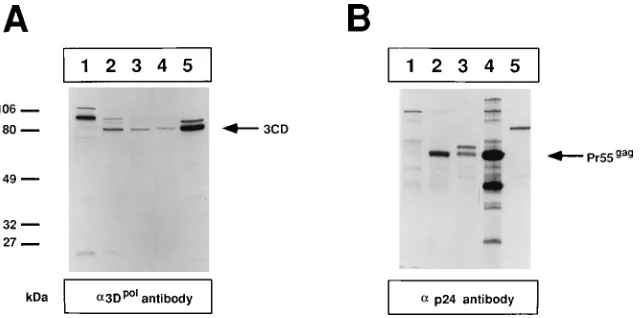
pre-dominant 3D-containing viral protein detected from poliovi-rus-infected cells (30). A protein with an approximate molec-ular mass of 72 kDa, corresponding to the 3CD protein of poliovirus, was detected from cells transfected with RNAs from pT7-IC-Pr55gag and pT7-IC-Pr55gag(VP4/2A) (Fig. 2A,
lanes 2 and 3, respectively) but not from mock-transfected cells (lane 1). The 3CD protein was also immunoprecipitated from cells transfected with RNA derived from the replicon pT7-IC-Gag 1 (Fig. 2A, lane 4), which was used as a positive control for transfections in these studies (29).
For analysis of the expression of HIV-1 Gag protein, the extracts were incubated with anti-p25/24 antibodies (Fig. 2B). A lysate from cells infected with the recombinant vaccinia virus vVK1, which contains the HIV-1 gene sequences encoding the complete gag and pol genes, was used as a control for Pr55gag protein expression (15). A protein with an apparent molecular mass of 55 kDa that comigrated with protein immunoprecipi-tated from cells infected with vVK1 (Fig. 2B, lane 4) was detected from cells transfected with RNAs from pT7-IC-Pr55gagand pT7-IC-Pr55gag(VP4/2A) (Fig. 2B, lanes 2 and 3,
respectively). In addition, a protein with a higher molecular mass was immunoprecipitated from cells transfected with RNA from pT7-IC-Pr55gag(VP4/2A) (Fig. 2B, lane 3). This
protein probably is a VP4-Pr55gagprecursor protein and will be characterized further in a subsequent study (30a).
The replication of the transfected RNA derived from the replicons was also analyzed by Northern (RNA) blotting (Fig. 3). HeLa T4 cells were transfected with RNAs transcribed in vitro from pT7-IC-Pr55gag, pT7-IC-Pr55gag(VP4/2A), and
pT7-IC-Gag 1. At 9 h posttransfection, total cellular RNA was isolated as described in Materials and Methods. The replicon RNA was detected by using a riboprobe complementary to nucleotides 671 to 1174 of the poliovirus genome (6, 26, 29). The migration of RNAs from pT7-IC-Pr55gag- and
pT7-IC-Pr55gag(VP4/2A)-transfected cells was slightly faster on the
formaldehyde-agarose gel than that of RNA from pT7-IC-Gag 1-transfected cells, which is consistent with the predicted 6.3-to 6.4-kb size for RNAs from pT7-IC-Pr55gag and
pT7-IC-Pr55gag(VP4/2A) versus the 7.0-kb size for RNA from
pT7-IC-Gag 1 (Fig. 3A). Quantitation of the major bands of radioac-tivity from each sample indicated that the values for
pT7-IC-FIG. 2. Analysis of protein expression from cells transfected with RNA derived from replicons containing the gag gene of HIV-1. Cells were infected with VV-P1 at a multiplicity of infection of 5. At 2 h postinfection, the cells were transfected with RNA derived from in vitro transcription of the designated plasmids. Cells were metabolically labeled, cell extracts were incubated with the antibodies indicated, and immunoreactive proteins were analyzed on SDS-polyacrylamide gels. (A) Cells were either mock transfected (lane 1); transfected with RNA derived from pT7-IC-Pr55gag(lane 2), pT7-IC-Pr55gag(VP4/2A) (lane 3), or pT7-IC-Gag 1 (lane 4); or infected with type 1 Mahoney poliovirus at a multiplicity of infection of 30 (lane 5). (B) Cells were mock transfected (lane 1), transfected with RNA derived from pT7-IC-Pr55gag(lane 2) or pT7-IC-Pr55gag(VP4/2A) (lane 3), infected with vVK1 at a multiplicity of infection of 10 (lane 4), or transfected with RNA derived from pT7-IC-Gag 1 (lane 5). Molecular mass standards and positions of relevant proteins are indicated.a3Dpol, anti-3Dpol;ap24, anti-p24.
on November 9, 2019 by guest
http://jvi.asm.org/
[image:4.612.144.466.71.230.2]Pr55gag and pT7-IC-Pr55gag(VP4/2A) were similar, although
the amounts of RNA detected from both replicons were less than that for RNA obtained from pT7-IC-Gag 1 (Fig. 3B). Together, these results demonstrate that the RNAs from pT7-IC-Pr55gag and pT7-IC-Pr55gag(VP4/2A) replicate to similar
levels in transfected cells.
Encapsidation and serial passage of replicons containing
the HIV-1 gaggene using VV-P1.Previous reports from this
laboratory have described the encapsidation of poliovirus rep-licons using a recombinant vaccinia virus, VV-P1, which ex-presses the P1 capsid precursor protein in trans (23, 24, 29). For the current studies, cells were infected with VV-P1 and then transfected with RNAs transcribed in vitro from pT7-IC-Pr55gag, pT7-IC-Pr55gag(VP4/2A), and pT7-IC-Gag 1. The
en-capsidated replicon genomes were passaged in cells which had been previously infected with VV-P1 for a total of 21 serial passages. Consistent with our previous nomenclature, the en-capsidated virus stocks of pT7-IC-Pr55gagand pT7-IC-Pr55gag
(VP4/2A) replicons are referred to as vIC-Pr55gag and
vIC-Pr55gag(VP4/2A), respectively (29).
For analysis of poliovirus and HIV-1-specific protein expres-sion, passage 21 virus stocks of encapsidated replicons were used to infect cells. After metabolic labeling, lysates from the cells were incubated with anti-3Dpol and anti-p24 antibodies
(Fig. 4). Although the 3CD protein was detected from each of the replicon virus stocks, decreased levels of 3CD protein from cells infected with virus stocks of vIC-Pr55gag (Fig. 4, lane 2)
compared with the levels of cells infected with virus stocks of vIC-Pr55gag(VP4/2A) (lane 3) and vIC-Gag 1 (lane 4) were
evident. Upon incubation of the lysates with anti-p24 antibod-ies, a protein with an apparent molecular mass of 55 kDa from the vIC-Pr55gag(Fig. 4, lane 7) and vIC-Pr55gag(VP4/2A) (lane
8) virus stocks was detected; this protein comigrated with Pr55gag expressed from cells infected with the recombinant vaccinia virus vVK1 (lane 10) (15). Again, infection of cells with the vIC-Pr55gag(VP4/2A) virus stock resulted in greater
levels of the 55-kDa protein compared with that of cells in-fected with vIC-Pr55gag. Consistent with the results of previous
studies, vIC-Gag 1 expressed an 80-kDa Gag-P1 fusion protein in infected cells (Fig. 4, lane 9) (29).
Since we demonstrated after transfection that RNA from each of the replicons resulted in similar levels of replication and protein expression, detection of reduced levels of protein expression in cells infected with vIC-Pr55gag compared with
vIC-Pr55gag(VP4/2A) could be the result of a difference in
infectivity (i.e., interaction with receptor or uncoating) be-tween the replicons. To address this question, we isolated RNAs from equivalent amounts of vIC-Pr55gag and
vIC-Pr55gag(VP4/2A) virus stocks, which had been serially
pas-saged with VV-P1 for 21 passages. Serial dilutions of the RNA were then spotted onto nitrocellulose and analyzed by using a riboprobe as described in Materials and Methods. Quantita-tion of the radioactivity from each sample by Phosphorimagery indicated values for vIC-Pr55gag(VP4/2A) virus stocks which
were approximately 15 times higher than the values obtained for RNA from vIC-Pr55gag (data not shown). The results of
these studies corroborate the differences in expression of 3CD and HIV-1 Gag protein observed for the replicons. To address the possibility that the replicons might have differences in infectious potential, cells were infected with equivalent amounts of encapsidated replicons, as determined by RNA hybridization, and metabolically labeled and
immunoprecipi-FIG. 3. Quantitation of replicon RNA from transfected cells by Northern blotting. Cells were transfected with equivalent amounts of RNA derived from in vitro transcription of the plasmids indicated above the lanes. At 9 h posttrans-fection, total cellular RNA was prepared, separated in a formaldehyde–1.0% agarose gel, blotted onto nitrocellulose, and analyzed by using a riboprobe complementary to nucleotides 671 to 1174 of the poliovirus genome. (A) North-ern blot. The order of the samples is indicated. The migration of RNAs of the predicted sizes which were derived from in vitro transcription of pT7-IC-Pr55gag and pT7-IC-Pr55gag
(VP4/2A) (arrow) and from pT7-IC-Gag 1 (29) (asterisk) are indicated. (B) Quantitation of the radioactivity of the Northern blot by Phos-phorimagery.
FIG. 4. Analysis of poliovirus and HIV-1-specific protein expression from cells infected with replicons encapsidated in trans by using VV-P1. Cells were transfected with RNA derived from in vitro transcription of the designated plasmids at 2 h postinfection with VV-P1. Encapsidated genomes were harvested from cells as described in Materials and Methods and used to reinfect cells which had been previously infected with VV-P1. The encapsidated replicon genomes were subsequently subjected to 21 serial passages in VV-P1-infected cells. Cells were infected with virus stocks at passage 21 and metabolically labeled. Cell lysates were incubated with the indicated antibodies, and immunoreactive pro-teins were analyzed on an SDS-polyacrylamide gel. Results are shown for mock-infected cells (lanes 1 and 6) and for cells mock-infected with vIC-Pr55gag
(lanes 2 and 7), vIC-Pr55gag(VP4/2A) (lanes 3 and 8), vIC-Gag 1 (lanes 4 and 9), type 1 Mahoney poliovirus (lane 5), or vVK1 (lane 10). Molecular mass standards and positions of relevant proteins are indicated.a3Dpol, anti-3Dpol;ap24, anti-p24.
on November 9, 2019 by guest
http://jvi.asm.org/
[image:5.612.320.551.73.202.2]tated with anti-3Dpolantibodies (Fig. 5A). Equivalent amounts
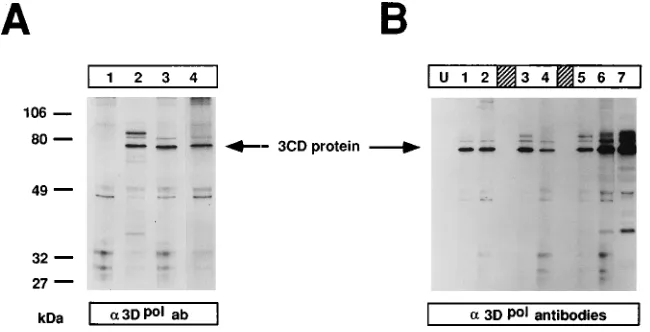
of a 72-kDa protein, corresponding to the 3CD protein, were detected from each of the replicon virus stocks. Quantitation of the radioactivity from each sample by Phosphorimagery confirmed that the levels of 3CD were similar (data not shown).
To determine whether the decreased levels of RNA isolated from the vIC-Pr55gagvirus stock at passage 21 compared with
the vIC-Pr55gag(VP4/2A) and vIC-Gag 1 virus stocks were
attributable to differences in the efficiency of encapsidation of RNA which contains the VP4 coding sequences versus the encapsidation of RNA which has a complete deletion of the P1 region, cells which had been previously infected with VV-P1 were infected with normalized amounts of each of the encap-sidated replicon virus stocks. After 24 h, complete cell lysis had occurred and the supernatant was processed as described in Materials and Methods; one additional passage was performed in cells previously infected with VV-P1. For analysis of protein expression from the serially passaged material, cells were in-fected with material from passages 1 and 2 and metabolically labeled, and the cell lysates were incubated with anti-3Dpol
antibodies (Fig. 5B). Similar amounts of the 3CD protein were detected from each of the passages of equivalent amounts of vIC-Pr55gag (Fig. 5B, lanes 1 and 2), vIC-Pr55gag(VP4/2A)
(lanes 3 and 4), and vIC-Gag 1 (lanes 5 and 6) replicon virus stocks with VV-P1. Thus, the reduced levels of RNA and 3CD protein expression detected from the vIC-Pr55gagreplicon
vi-rus stocks compared with those for vIC-Pr55gag(VP4/2A) and
vIC-Gag 1 after 21 serial passages with VV-P1 (Fig. 4) were not apparent after passage of the replicons with VV-P1 for 2 serial passages.
Since all known DIs of poliovirus contain an intact VP4 coding region, we examined whether the replicon which con-tains the VP4 coding sequences might have an advantage if the replicon had to compete with the wild-type genome for capsid proteins. Previous studies have demonstrated that vIC-Gag 1 could be maintained upon passage with type 1 Sabin poliovirus (24, 29). To determine whether vIC-Pr55gagand vIC-Pr55gag
(VP4/2A) could also be maintained upon passage with wild-type poliovirus, cells were coinfected with equal amounts of either vIC-Pr55gag, vIC-Pr55gag(VP4/2A), or vIC-Gag 1 and
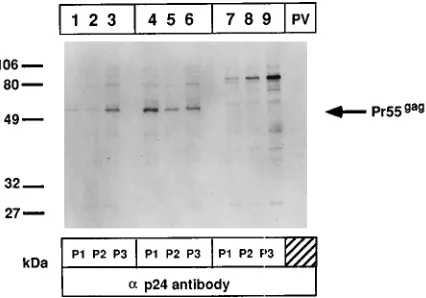
type 1 Sabin poliovirus. After 24 h, complete cell lysis had occurred and the supernatant was processed as described in Materials and Methods; two additional passages were per-formed. Cells were infected with material from each serial passage and metabolically labeled, and the cell extracts were incubated with antibodies to p24/25 protein (Fig. 6). No HIV-1-specific protein was found in cells infected with type 1 Sabin poliovirus alone (Fig. 6, lane PV); the 80-kDa gag-P1 fusion protein was detected from cells infected with material from passages 1 through 3 of the vIC-Gag 1 replicon and wild-type poliovirus (Fig. 6, lanes 7 to 9) (29). Upon serial passage of vIC-Pr55gag (Fig. 6, lanes 1 to 3) and vIC-Pr55gag(VP4/2A)
(lanes 4 to 6) virus stocks with type 1 Sabin poliovirus, a protein which migrated at approximately 55 kDa was detected from cells infected with material from passages 1 through 3. No consistent difference between the levels of Pr55gag expression from the two replicons was detected. Thus, the presence or absence of the VP4 coding region did not effect the capability of the replicon to compete with the wild-type poliovirus genomes for the P1 protein that was evident after three serial passages.
DISCUSSION
[image:6.612.144.469.72.238.2]In this article, we describe the construction and character-ization of poliovirus genomes which contain the complete 1.5-kb gag gene of HIV-1 substituted for the entire P1 region and a second construction in which the gag gene is positioned 39to the VP4 coding region of the P1 capsid region. Transfec-tion of RNA from each of the constructs into cells resulted in similar levels of protein expression and RNA replication. Both genomes were encapsidated upon transfection into cells pre-viously infected with VV-P1. Serial passage of the replicons with VV-P1 resulted in the production of virus stocks of each of the encapsidated genomes. Analysis of the levels of encap-sidated replicons after extended serial passage revealed that
FIG. 5. Analysis of protein expression from cells infected with normalized amounts of replicon virus stocks and material derived from serial passages of equivalent amounts of replicon virus stocks with VV-P1. (A) Cells were infected with normalized amounts of encapsidated replicon virus stocks and metabolically labeled. Cell lysates were incubated with anti-3Dpolantibody (a3Dpolab), and immunoreactive proteins were analyzed on an SDS-polyacrylamide gel. Results are shown for mock-infected cells (lane 1) and for cells infected with vIC-Pr55gag(lane 2), vIC-Pr55gag(VP4/2A) (lane 3), or vIC-Gag 1 (lane 4) replicon virus stocks. (B) Equivalent amounts of each of the replicon virus stocks were serially passaged in VV-P1-infected cells for two passages as described in Materials and Methods. Cells were infected with material derived from passages 1 and 2 and metabolically labeled. Cell lysates were incubated with anti-3Dpolantibody, and immunoreactive proteins were analyzed on an SDS-polyacrylamide gel. Results are shown for mock-infected cells (lane U); for cells infected with material from passage 1 of vIC-Pr55gagwith VV-P1 (lane 1),
material from passage 2 of vIC-Pr55gagwith VV-P1 (lane 2), material from passages 1 and 2 of vIC-Pr55gag(VP4/2A) with VV-P1 (lanes 3 and 4, respectively), and material from passages 1 and 2 of vIC-Gag 1 with VV-P1 (lanes 5 and 6, respectively), and for cells infected with type 1 Mahoney poliovirus (lane 7). Molecular mass standards and the position of the 3CD protein are indicated.
on November 9, 2019 by guest
http://jvi.asm.org/
the replicons which contain the VP4 coding region were present in the encapsidated virus stocks at higher levels than the replicons which contain the gag gene substituted for the entire P1 region; no difference in the levels of encapsidation of either replicon genome following limited serial passages in the presence of VV-P1 or Sabin type 1 poliovirus was detected.
The results of this study are significant because this is the first demonstration that poliovirus genomes which contain a foreign gene substituted for the entire P1 region can be en-capsidated by P1 provided in trans. The fact that the entire P1 gene of poliovirus can be substituted with a foreign gene re-sulting in an RNA genome with the capacity to replicate is consistent with previous studies which demonstrated that the entire P1 capsid region was not required for the replication of poliovirus RNA (14). Subsequent reports have also described poliovirus replicons containing a substitution of the entire P1 capsid sequences from nucleotides 756 to 3371 with the lucif-erase gene that maintain the capacity for replication, although encapsidation of this replicon was not reported (1). Our study is unique because we demonstrate that replicons containing a foreign gene substituted for the entire P1 region not only replicated but also could be encapsidated when we used a recombinant vaccinia virus, VV-P1, to supply the P1 capsid precursor protein in trans (2–5, 22–24, 29). Our system differs from earlier studies which described the encapsidation and propagation of poliovirus replicons which express a foreign gene (CAT) by coinfection of cells with type 3 poliovirus, resulting in mixed virus stocks of replicons and wild-type virus (28). Because the CAT gene was substituted for nucleotides 756 to 1805 of the poliovirus genome, it was not possible to evaluate whether the remainder of the poliovirus P1 region (VP2, VP3, and VP1) was required for encapsidation. Since studies from this laboratory have demonstrated that replicons containing foreign genes substituted between nucleotides 1174 and 2956 were encapsidated by P1 capsid protein provided in
trans by VV-P1, we would have predicted that replicons
con-taining substitutions between nucleotides 743 and 2956 should
be encapsidated. The results of our present study confirm and extend this prediction by demonstrating that replicons with substitutions of foreign genes for the entire P1 region of po-liovirus can be encapsidated.
Although the presence of the VP4 coding region was not absolutely required for RNA encapsidation, it was evident that replicons which contain a complete substitution of the P1 re-gion with the HIV-1 gag gene were encapsidated less efficiently than replicons which maintain the VP4 coding sequences (nucleotides 743 to 949) positioned 59to the gag gene. When RNA derived from each of the encapsidated replicon virus stocks after 21 serial passages with VV-P1 was isolated and quantitated by nucleic acid hybridization, the RNAs from vIC-Pr55gag(VP4/2A) and vIC-Gag 1 replicon virus stocks, which
contained VP4, were present at levels that were 15 and 50 times higher, respectively, than that of RNA from vIC-Pr55gag
virus stocks. These results are consistent with earlier studies of naturally occurring DIs of poliovirus which were shown to contain deletions of various sizes in the VP3, VP2, and VP1 capsid sequences, while maintaining an intact VP4 coding re-gion (18). On the basis of this finding, it was speculated that VP4 might contain regions required for poliovirus RNA en-capsidation (9, 14). Although it is clear from our results that VP4 is not required for encapsidation, the presence of VP4 might enhance RNA encapsidation. Since limited passage of equivalent amounts of each of the replicon virus stocks with VV-P1 indicated no significant difference between the encap-sidation of replicons containing VP4 and that of replicons which contain a deletion of the entire P1 coding region, it was possible that the effect of VP4 on encapsidation would be more apparent if the replicon RNA had to compete with the wild-type genomes for the P1 capsid protein. This situation would be analogous to the encapsidation of DIs in that the defective genome must compete effectively with the wild-type genome to be maintained in the virus stock. However, we determined that RNAs from vIC-Pr55gagand vIC-Pr55gag(VP4/2A) were
main-tained in virus stocks for three serial passages in the presence of type 1 poliovirus. Thus, during limited serial passage, the replicon genomes did compete effectively with type 1 Sabin poliovirus RNA for capsid proteins. It is possible that after extended serial passage of the virus stocks containing the rep-licons and type 1 Sabin poliovirus, genomes containing the intact VP4 coding region are more stable in the virus stocks than replicons which contain a substitution of the entire P1 region. Previous studies from our laboratory have demon-strated that replicons containing foreign genes substituted for nucleotides 1174 and 2470 were stably maintained after 10 serial passages with type 1 Sabin poliovirus (29). Experiments to determine if the replicons described here are also able to compete with wild-type poliovirus for capsid proteins after extended serial passages are under way.
[image:7.612.71.284.72.221.2]Finally, the results of this study establish a system for the future use of poliovirus as an expression vector for foreign genes. Although previous studies from this laboratory as well as others have suggested such a use for poliovirus vectors, potential drawbacks, such as the limited size of DNA that could be inserted and the potential instability of the resultant recombinant poliovirus genomes, have been indicated (20). By using the complementation system described in this report, it is possible to substitute the entire P1 region with at least 1.5 kb of foreign DNA. Recent studies have demonstrated that the size of the poliovirus genome (7.5 kb) can be increased by the addition of up to 1 kb (21). The upper size limit for the substitution of foreign genes into the poliovirus genome then might be as much as 3.6 kb of foreign DNA. One feature of the expression system described here is that the foreign protein is
FIG. 6. Analysis of protein expression from cells infected with material de-rived from the serial passage of encapsidated replicons with wild-type poliovirus. Cells were coinfected with equal amounts of either vIC-Pr55gag
, vIC-Pr55gag
(VP4/2A), or vIC-Gag 1 and type 1 Sabin poliovirus. The cells were harvested at 24 h postinfection and the supernatant was processed as described in Materials and Methods; two additional passages were performed. Cells were infected with material from each of the serial passages and metabolically labeled. The cell lysates incubated with anti-p24 (ap24) antibody, and immunoreactive proteins were analyzed on an SDS-polyacrylamide gel. Results are shown for cells infected with materials derived from the indicated passages (P1 to P3) of vIC-Pr55gag(lanes 1 to 3), vIC-Pr55gag(VP4/2A) (lanes 4 to 6), and vIC-Gag 1 (lanes 7 to 9) with type 1 Sabin poliovirus and for cells infected with type 1 Sabin poliovirus alone (lane PV). Molecular mass standards and the position of Pr55gag
protein are indicated.
on November 9, 2019 by guest
http://jvi.asm.org/
protein by using internal ribosomal entry sites positioned within the replicon (21). Studies to test this possibility are under way.
ACKNOWLEDGMENTS
The following reagents were obtained through the AIDS Research and Reference Reagent Program, Division of AIDS, NIAID, National Institutes of Health: vVK1 from Velissarios Karacostas and Bernard Moss and antiserum to HIV-1 p25/p24 from Kathelyn Steimer, Chiron Corporation.
This work was supported by PHS contract (Mucosal Immunology Research Group) AI 15128, the Pediatric AIDS Foundation (grant 50449-15), and PHS grant AI25005 from the National Institutes of Health (to C.D.M.).
REFERENCES
1. Andino, R., G. E. Rieckhof, P. L. Achacoso, and D. Baltimore. 1993. Polio-virus RNA synthesis utilizes an RNP complex formed around the 59-end of viral RNA. EMBO J. 12:3587–3598.
2. Ansardi, D. C., M. Luo, and C. D. Morrow. 1994. Mutations in the poliovirus P1 capsid precursor at arginine residues VP4-ARG34, VP3-ARG223, and VP1-ARG129 affect virus assembly and encapsidation of genomic RNA. Virology 199:20–34.
3. Ansardi, D. C., D. C. Porter, and C. D. Morrow. 1991. Coinfection with recombinant vaccinia viruses expressing poliovirus P1 and P3 proteins results in polyprotein processing and formation of empty capsid structures. J. Virol.
65:2088–2092.
4. Ansardi, D. C., D. C. Porter, and C. D. Morrow. 1992. Myristylation of poliovirus capsid precursor P1 is required for assembly of subviral particles. J. Virol. 66:4556–4563.
5. Ansardi, D. C., D. C. Porter, and C. D. Morrow. 1993. Complementation of a poliovirus defective genome by a recombinant vaccinia virus which pro-vides poliovirus P1 capsid precursor in trans. J. Virol. 67:3684–3690. 6. Choi, W. S., R. Pal-Ghosh, and C. D. Morrow. 1991. Expression of human
immunodeficiency virus type 1 (HIV-1) gag, pol, and env proteins from chimeric HIV-1–poliovirus minireplicons. J. Virol. 65:2875–2883. 7. Cole, C. N., D. Smoler, E. Wimmer, and D. Baltimore. 1971. Defective
interfering particles of poliovirus. I. Isolation and physical properties. J. Virol. 7:478–485.
8. Grodberg, J., and J. J. Dunn. 1988. OmpT encodes the Escherichia coli outer membrane protease that cleaves T7 RNA polymerase during purification. J. Bacteriol. 170:1245–1253.
9. Hagino-Yamagishi, K., and A. Nomoto. 1989. In vitro construction of polio-virus defective interfering particles. J. Virol. 63:5386–5392.
10. Harris, K. S., C. U. T. Hellen, and E. Wimmer. 1990. Proteolytic processing in the replication of picornaviruses. Semin. Virol. 1:323–333.
11. Jablonski, S. A., M. Luo, and C. D. Morrow. 1991. Enzymatic activity of poliovirus RNA polymerase mutants with single amino acid changes in the conserved YGDD amino acid motif. J. Virol. 65:4565–4572.
12. Jore, J., B. Degues, J. Jackson, P. H. Pouwels, and B. Enger-Valk. 1988. Poliovirus protein 3CD is the active protease for processing of the precursor protein P1 in vitro. J. Gen. Virol. 69:1627–1636.
13. Kajigaya, S., H. Arakawa, S. Kuge, T. Koi, N. Imura, and A. Nomoto. 1985. Isolation and characterization of defective-interfering particles of poliovirus Sabin 1 strain. Virology 142:307–316.
14. Kaplan, G., and V. R. Racaniello. 1988. Construction and characterization of poliovirus subgenomic replicons. J. Virol. 62:1687–1696.
15. Karacostas, V., K. Nagashima, M. Gonda, and B. Moss. 1989. Human immunodeficiency virus-like particles produced by a vaccinia virus expres-sion vector. Proc. Natl. Acad. Sci. USA 86:8964–8967.
16. Kitamura, N., B. L. Semler, P. G. Rothberg, G. R. Larsen, C. J. Adler, A. J.
Dorner, E. A. Emini, R. Hanecak, J. J. Lee, S. van der Werf, C. W. Anderson,
dicistronic poliovirus. Nature (London) 356:255–257.
22. Morrow, C. D., D. C. Ansardi, and D. C. Porter. Methods for the use of poliovirus vectors for gene delivery. In P. Robbins (ed.), Gene therapy protocols. Methods in molecular biology, in press. The Humana Press, Totowa, N.J. 23. Morrow, C. D., D. C. Porter, and D. C. Ansardi. New methods to study
poliovirus assembly and encapsidation of genomic RNA. In K. W. Adolph (ed.), Methods in molecular genetics: molecular virology techniques, part B, in press. Academic Press, Orlando, Fla.
24. Morrow, C. D., D. C. Porter, D. A. Ansardi, Z. Moldeveanu, and P. N. Fultz. 1994. New approaches for mucosal vaccines for AIDS: encapsidation and serial passage of poliovirus replicons that express HIV-1 proteins upon infection. AIDS Res. Hum. Retroviruses 10(Suppl. 2):561–566.
25. Nicklin, M. J. H., H. G. Krausslich, H. Toyoda, J. J. Dunn, and E. Wimmer. 1987. Poliovirus polypeptide precursors: expression in vitro and processing by exogenous 3C and 2A proteinases. Proc. Natl. Acad. Sci. USA 84:4002–4006. 26. Pal-Ghosh, R., and C. D. Morrow. 1993. A poliovirus minireplicon contain-ing an inactive 2A proteinase is expressed in vaccinia virus-infected cells. J. Virol. 67:4621–4629.
27. Palmenberg, A. C. 1990. Proteolytic processing of picornaviral polyprotein. Annu. Rev. Microbiol. 44:603–623.
28. Percy, N., W. S. Barclay, M. Sullivan, and J. W. Almond. 1992. A poliovirus replicon containing the chloramphenicol acetyltransferase gene can be used to study the replication and encapsidation of poliovirus RNA. J. Virol.
66:5040–5046.
29. Porter, D. C., D. C. Ansardi, W. S. Choi, and C. D. Morrow. 1993. Encap-sidation of genetically engineered poliovirus minireplicons which express human immunodeficiency virus type 1 Gag and Pol proteins upon infection. J. Virol. 67:3712–3719.
30. Porter, D. C., D. C. Ansardi, M. Lentz, and C. D. Morrow. 1993. Expression of poliovirus P3 proteins using a recombinant vaccinia virus results in pro-teolytically active 3CD precursor protein without further processing to 3Cpro and 3Dpol. Virus Res. 29:241–254.
30a.Porter, D. C., and C. D. Morrow. Unpublished data.
31. Ratner, L., W. Haseltine, R. Patarca, K. J. Livak, B. Starcich, S. F. Josephs,
E. R. Dornan, J. A. Rafalski, E. A. Whitehorn, K. Baumeister, L. Ivanoff, J. S. R. Petteway, M. L. Pearson, J. A. Lautenberge, T. S. Papas, J. Ghrayeb, N. T. Chang, R. C. Gallo, and F. Wong-Staal.1985. Complete nucleotide sequence of the AIDS virus, HTLV-III. Nature (London) 313:277–284. 32. Ricco-Hesse, R., M. A. Pallansch, B. K. Nottay, and O. M. Kew. 1987.
Geo-graphic distribution of wild poliovirus type 1 genotypes. Virology 160:311–322. 33. Rueckert, R. R. 1990. Picornaviridae and their replication, p. 507–548. In
B. M. Fields et al. (ed.), Virology, 2nd ed. Raven Press, New York. 34. Sambrook, J., E. E. Fritsch, and T. Maniatis. 1989. Molecular cloning: a
laboratory manual, 2nd ed. Cold Spring Harbor Laboratory Press, Cold Spring Harbor, N.Y.
35. Semler, B. L., A. J. Dorner, and E. Wimmer. 1984. Production of infectious poliovirus from cloned cDNA is dramatically increased by SV40 transcrip-tion and replicatranscrip-tion signals. Nucleic Acids Res. 12:5123–5141.
36. Steimer, K. S., J. P. Puma, M. D. Power, M. A. Powers, C.
George-Nasci-mento, J. C. Stephans, J. A. Levy, R. Sanchez-Pescador, P. A. Luciw, P. J. Barr, and R. A. Hallewell.1986. Differential antibody responses of individ-uals infected with AIDS-associated retroviruses surveyed using viral core antigen p25gagexpressed in bacteria. Virology 150:283–290.
37. Toyoda, H., M. J. H. Nicklin, M. G. Murray, C. W. Anderson, J. J. Dunn,
F. W. Studier, and E. Wimmer.1986. A second virus-encoded proteinase involved in proteolytic processing of poliovirus polyprotein. Cell 45:761–770. 38. Wimmer, E., R. J. Kuhn, S. Pincus, C.-F. Yang, H. Toyoda, M. J. H. Nicklin,
and N. Takeda.1987. Molecular events leading to picornavirus genome replication. J. Cell. Sci. Suppl. 7:251–276.
39. Ypma-Wong, M. F., P. G. Dewalt, V. H. Johnson, J. G. Lamb, and B. L.
Semler.1988. Protein 3CD is the major poliovirus proteinase responsible for cleavage of the P1 capsid precursor. Virology 166:265–270.
40. Ypma-Wong, M. F., and B. Semler. 1987. Processing determinants required for in vitro cleavage of the poliovirus P1 precursor to capsid proteins. J. Virol. 61:3181–3189.