0022-538X/97/$04.0010
Copyright © 1997, American Society for Microbiology
A Mutation in Tomato Aspermy Cucumovirus That Abolishes
Cell-to-Cell Movement Is Maintained to High Levels in
the Viral RNA Population by Complementation
IGNACIO M. MORENO,1,2JOSE´ M. MALPICA,3EMILIO RODRI´GUEZ-CEREZO,2ANDFERNANDO GARCI´A-ARENAL1*
Departamento de Biotecnologı´a, E.T.S.I. Agro´nomos, Universidad Polite´cnica de Madrid,1
and Area de Biologı´a Molecular y Virologı´a Vegetal, CIT-INIA,328040 Madrid,
and Centro Nacional de Biotecnologı´a, CSIC, Campus de
Cantoblanco, 28049 Madrid,2Spain
Received 29 May 1997/Accepted 10 September 1997
The nucleotide substitution C3A at nucleotide 100 of tomato aspermy cucumovirus (TAV) strain V (V-TAV) RNA segment 3 (RNA3) introduces an ocher stop at the fourth codon of the movement protein open reading frame. Experiments with RNA transcripts from full-length clones showed that this mutation abolished cell-to-cell movement and, thus, infectivity in planta. Heterogeneity analyses on stock V-TAV virion RNA showed that an A at position 100 was present in the molecular population of RNA3 at a frequency of 0.76 and that a C at this position was present at a frequency of 0.24. This result indicates that a fraction of RNA3 molecules complements cell-to-cell movement of movement-defective molecules. It was shown that the mutation C3A conferred enhanced RNA replication of the defective mutant in tobacco protoplasts. The effect of the mutation on replication was dependent on sequence context, since the same mutation did not affect the replication efficiency in the related TAV strain 1 RNA3. Competition experiments in tobacco protoplasts were done to estimate the fitness during a cell invasion cycle of the movement-defective mutant relative to the wild type (wt). From these data, a lower limit to the degree of complementation of movement-defective molecules by move-ment-competent ones could be estimated as 0.13. This estimate shows that complementation may play an important role in the determination of genetic structure in RNA genome populations. A further effect of the enhanced replication of the movement-defective mutant was the efficient competition with the wt for the initiation of infection foci in planta.
Molecular populations of RNA virus genomes are highly heterogeneous due to high error rates of RNA-dependent RNA polymerases plus high population numbers associated with fast replication cycles (for a review, see reference 8). In the absence of random effects due to population bottlenecks, i.e., when large populations are maintained and passaged at a high multiplicity of infection, the frequency of a mutant in the population will reach a steady-state value determined by its relative fitness. The relative fitness will be the result of trade-offs between the effect(s) of the mutation(s) on the different processes of the virus life cycle. Also, because different se-quence variants coexist in a close environment (for instance, in the same infected cell), complementation of functions will play an important role in the final outcome of these trade-offs and, thus, in the maintenance of deleterious or lethal mutants. Al-though the literature abounds with examples of phenomena that are due to complementation (see, for instance, references 20, 21, and 28), complementation has not been considered in models for RNA genome populations and, to our knowledge, no attempt has been made to quantify it.
In this work, we present an analysis of the trade-offs between the effects of a mutation in RNA segment 3 (RNA3) of tomato aspermy cucumovirus (TAV) on cell-to-cell movement and on RNA replication, two key points in the virus life cycle. TAV has a genome organization homologous to that of the type member of the cucumovirus genus, cucumber mosaic cucumo-virus (3, 22, 23). The cucumocucumo-viruses have a tripartite,
plus-sense RNA genome (reviewed in reference 26), of which the two larger segments (RNA1 and RNA2) encode proteins that are part of the viral RNA-dependent RNA polymerase. RNA3 encodes the movement protein (MP), which potentiates cell-to-cell spread (15), and the coat protein (CP). The CP, in addition to its structural function, plays important roles in the virus life cycle. Notably, it is needed for cell-to-cell movement and for efficient accumulation of the three genomic RNAs in plant protoplasts (4, 30, 31).
We recently reported that a mutation that introduces a stop codon interrupting the open reading frame (ORF) of the MP of TAV abolishes infectivity for tobacco leaves. Nevertheless, this mutation was found in at least a major fraction of the RNA3 molecules of the V strain of TAV (V-TAV) (22). We show here that a minor fraction of V-TAV RNA3 molecules lacks this mutation. We also show that the movement-defective mutant is replicated more efficiently than the wild type. We present quantitative data that allow the estimation of the complementation of movement by the wild type. The effect of mutations in other aspects of the virus life cycle is also ana-lyzed.
MATERIALS AND METHODS
Viral isolates and plasmids.Strains V-TAV and strain 1 of TAV (1-TAV) have been described previously (23). Virus strains and isolates were multiplied and assayed in Nicotiana tabacum cv. Xanthi-nc plants. Virus purifications were done as described by Habili and Francki (13), and total RNA purifications were done as described by Palukaitis et al. (25).
The construction of plasmids pV1, pV2, pV3, and p13, representing,
respec-tively, full-length RNA1, RNA2, and RNA3 of V-TAV and RNA3 of 1-TAV, and of plasmid pV*3, which has a unique A3C mutation at position 100 of the
insert relative to pV3, has been described before (22). Plasmid p13TAA was
* Corresponding author. Phone: 34-1-3365768. Fax: 34-1-3365757.
9157
on November 9, 2019 by guest
http://jvi.asm.org/
derived from p13by introducing a unique point mutation at position 100 of the
1-TAV RNA3 cDNA insert. For this, single-stranded DNA was prepared from an M13mp18 subclone of the KpnI-XbaI restriction fragment of p13and
oligo-nucleotide-directed mutagenesis was done as described previously (17). The oligonucleotide 59CATTTAAGGTA39(the mutated nucleotide is underlined) was used to substitute an A for the C at position 100. An M13mp18 subclone with this mutation was selected, and its 189-bp KpnI-XcmI restriction fragment was used to replace the p13KpnI-XcmI fragment. All plasmids were multiplied in
Escherichia coli DH5acells, and DNA was purified by standard procedures (29). Oligonucleotides.The following oligonucleotides were used for site-directed mutagenesis, molecular hybridization analyses, nucleotide sequence determina-tion, or reverse transcription (RT)-PCR amplification: Oligo-TAA—59CATTT TAAGGTA39, representing nucleotides 94 to 106 of 13and V*3(see below for
explanation of transcript names) RNAs; Oligo-TCA—59CATTTTCAGGTA39, representing nucleotides 94 to 106 of V3RNA; Oligo-V-36—59GATAGATAG
ATAGTA39, complementary to nucleotides 36 to 22 of V3and V*3RNAs;
Oligo-1-36—59TATATATATACAGTA39, complementary to nucleotides 36 to 22 of 13RNA; Oligo-TAV228—59TCCAGTGGTGGCGACCG39,
complemen-tary to nucleotides 228 to 212 of V3, V*3, and 13RNAs; Oligo-TAV498—59TG
GCAGGGAGATCG39, complementary to nucleotides 498 to 484 of V3, V*3,
and 13RNAs; and Oligo-TAV5—59GTTTACCAACCAAC39, representing
nu-cleotides 1 to 14 of V3, V*3, and 13RNAs.
Nucleic acid analyses. (i) Detection of viral RNAs in nucleic acid prepara-tions.TAV genomic RNAs were detected by Northern blot hybridization anal-yses, either in dot blots or after electrophoresis in 13Tris-borate-EDTA (TBE)– 1.2% agarose and transfer to nitrocellulose by capillarity (29). A32P-labelled
transcription probe complementary to the 391,167 nucleotides of V-TAV RNA3 was used. This probe hybridizes with the 39end of RNA1, RNA2, and RNA3 and with subgenomic RNA4 of both V-TAV and 1-TAV (22).
(ii) Analyses of heterogeneity at nucleotide 100 of RNA3.Total RNA or virion RNA preparations were used as templates for RT-PCR amplification of a frag-ment representing 498 nucleotides at the 59end of TAV RNA3. For RT-PCR, Oligo-TAV498 and Oligo-TAV5 were used. The amplified fragment was ana-lyzed by molecular hybridization with two procedures.
In the first procedure, the 498-bp fragment was blunt ended and cloned into
SmaI-linearized pUC18. More than 100 independent clones were obtained from
one RT-PCR; they were multiplied in E. coli DH5a, and plasmid DNA mini-preparations were made (29). For every clone, an amount of DNA corresponding to 0.75 ml of a bacterium-saturated culture was denatured in 0.4 M NaOH at room temperature and blotted to nitrocellulose filters by use of the Bio-Dot SF apparatus (Bio-Rad). The nitrocellulose filters were then hybridized sequentially to32P-labelled Oligo-TAA and Oligo-TCA as described by Sambrook et al. (29).
Hybridizations were done at 24°C in 63SSC (13SSC is 0.15 M NaCl plus 0.015 M sodium citrate)–53Denhardt’s reagent–250mg of tRNA per ml in the pres-ence of 13107to 23107cpm of labelled oligonucleotide.
In the second procedure, the 498-bp RT-PCR products, after denaturation in 0.4 M NaOH, were directly blotted to nitrocellulose filters by use of the Bio-Dot SF apparatus. The filters were hybridized sequentially to32P-labelled
Oligo-TAA, Oligo-TCA, Oligo-V-36, and Oligo-1-36, depending on the experiment, as described above. PCR products obtained from mixtures of pV3and p13DNAs or
V3and 13RNAs in the V3/13proportions 199, 99, 49, 15.7, 9, 4, 2.3, 1.5, 0.67,
0.43, 0.25, 0.11, 0.063, 0.02, 0.01, and 0.005 were blotted as controls for each nitrocellulose filter.
Northern blots were exposed to film and analyzed densitometrically, always against the calibration standards, with a One-Scanner (Apple Macintosh) and the National Institutes of Health Image Program.
Relative fitnesses were estimated from the ratios of variant RNAs at different times with the procedure described by Holland et al. (14).
Assays in plants and protoplasts.Plants and protoplasts were inoculated with full-length capped transcripts obtained from SacI-linearized plasmid DNA by in vitro transcription reactions with T7 RNA polymerase (Promega) in the presence of m7GpppG (New England BioLabs). These RNA transcripts were named for
the plasmids from which they were transcribed but without a “p” (i.e., V1, V2, V3,
13, V*3, and 13TAA). Combinations of these transcripts were used to inoculate
tobacco (N. tabacum cv. Xanthi-nc) plants, Chenopodium quinoa plants, or to-bacco protoplasts.
(i) Assays in tobacco plants.Full-length transcripts were combined in equal amounts to prepare V1V2V3, V1V2V*3, and V1V213inocula at a concentration of
200 to 500mg/ml in 0.1 M Na2HPO4. The quality and concentration of genomic
full-length transcripts were checked by agarose gel electrophoresis and ethidium bromide staining. One leaf of young tobacco plants with four expanded leaves was inoculated with 10ml of inoculum. At 14 days postinoculation (dpi), 200-mg samples were taken from the inoculated leaves of each plant and total nucleic acid preparations were obtained for analyses. For competition assays, 10 tobacco plants per treatment were inoculated with V1V2(V31V*3) and V1V2(V3113)
mixtures having equal or different amounts of full-length transcripts (see Re-sults). Also, virion RNA was obtained from V1V2V*3- and V1V213-infected
plants and passaged in tobacco by inoculation at 200mg/ml in 0.1 M Na2HPO4
as described above.
The percentage of infected cells in tobacco leaves inoculated with V1V2V3,
V1V2V*3, and V1V2(V31V*3) was estimated by counting immunofluorescent
protoplasts isolated from the inoculated leaves at several times after inoculation.
Approximately 100 mg was excised from the inoculated leaves, and protoplasts were isolated and processed as described by Taliansky and Garcı´a-Arenal (31) with an antiserum obtained against 1-TAV CP (anti-TAV CP) and a fluorescein isothiocyanate-conjugated secondary antibody (Sigma). After isolation, proto-plasts were further incubated for 12 h at 25°C in 0.6 M mannitol under contin-uous illumination before immunostaining. The number of fluorescent protoplasts was counted in a Zeiss fluorescence microscope. No fluorescent protoplasts were detected from mock-inoculated tobacco leaves. The percentage of infected cells was estimated from three inoculated plants for every treatment.
(ii) Competition assays with C. quinoa plants.For competition assays with
C. quinoa, V1V2V*3, V1V2(V*31V3), V1V213, and V1V2(131V3) mixtures
hav-ing equal amounts of each transcript were prepared to contain 200 to 500mg/ml in 0.1 M Na2HPO4. Five randomized half leaves of plants with seven expanded
leaves or more were inoculated with 6ml of every treatment. The number of necrotic local lesions induced in every half leaf was recorded at 7 dpi.
(iii) Protoplast preparation and inoculation.Protoplasts were prepared from mature tobacco leaves as described by Power and Chapman (27). Cell wall digestion was done with Mazerozyme R10 and Cellulase R10 (Serva) at 0.8 and 0.25% (wt/vol), respectively, in 0.6 M mannitol (pH 5.6 to 5.8) for 12 to 16 h at 25°C under constant light. For transfection, 106protoplasts in 400ml of 0.6 M
mannitol (pH 7.0) were mixed with 25ml of inoculum and electroporated at 120 V, 500 F, and 48Vin a BTX Electro Cell Manipulator 600. The inocula used contained approximately 10mg of mixtures V1V2V3, V1V2V*3, V1V213, and
V1V213TAA for replication assays and V1V2(V31V*3), V1V2(V3113), and
V1V2(V*3113) for competition assays. Transfected protoplasts were incubated
in 0.6 M mannitol (pH 5.6 to 5.8)–0.53Murashige-Skoog medium (ICN) at 25°C under continuous illumination. Samples of about 4 3105protoplasts were
removed at 24 and/or 48 h postinoculation. Total nucleic acid preparations were obtained from each sample and analyzed.
RESULTS
Sequence heterogeneity at nucleotide 100 of V-TAV RNA3.
Direct nucleotide sequence determination on virion RNA, as well as on a number of cDNA clones, had shown the presence of an ocher stop codon at the fourth codon of the MP ORF of V-TAV. This stop codon originated from a C3A transversion at nucleotide 100 of V-TAV RNA3, as determined by compar-ison with reported sequences for three other TAV strains (22). To analyze the possible heterogeneity at nucleotide 100 of V-TAV RNA3, cDNA was RT-PCR amplified from virion RNA with Oligo-TAV498 and Oligo-TAV5 (see Materials and Methods). The amplified fragment was cloned into pUC18, and the nature of the base at position 100 was identified by dot blot hybridization of plasmid DNA with 32P-labelled
TAA and TCA. Hybridization of TAA or Oligo-TCA probes occurred only if an A or a C was present, respec-tively, at nucleotide 100 (data not shown). Thus, this method clearly discriminated between the bases at this position. This finding was further confirmed by nucleotide sequence deter-mination of the insert in 10 clones each hybridizing with Oligo-TAA or Oligo-TCA. In all 20 clones, the base at position 100 was as expected from the hybridization results (data not shown). An analysis of 100 individual clones showed that in 76 of them, an A was present at position 100, and at 24 of them, a C was the base at this position. Since the stock of V-TAV in our laboratory has been repeatedly passaged in tobacco plants by sap inoculation over 10 years, we can consider that the 3:1 ratio for A/C at nucleotide 100 is an equilibrium frequency. None of the 100 analyzed cDNA clones failed to hybridize with either Oligo-TAA or Oligo-TCA, suggesting that the presence of a G or a U at position 100 of V-TAV RNA3 is extremely infrequent.
The mutation C3A at nucleotide 100 of V-TAV RNA3 re-sults in enhanced RNA replication.We previously showed that RNA transcripts from full-length cDNA clones of V-TAV RNA3 having an A at nucleotide 100 (pV3) were not infectious
for tobacco leaves. This was probably due to their inability to direct the synthesis of a full-length, functional MP (22). The high proportion of this RNA3 variant in V-TAV suggests that it may have a compensatory advantage for some other func-tion.
on November 9, 2019 by guest
http://jvi.asm.org/
The infectivity for tobacco protoplasts of RNA transcripts V1and V2in combination with RNA3 transcripts having an A
(V3) or a C (V*3) at nucleotide 100 was assayed. Both RNA
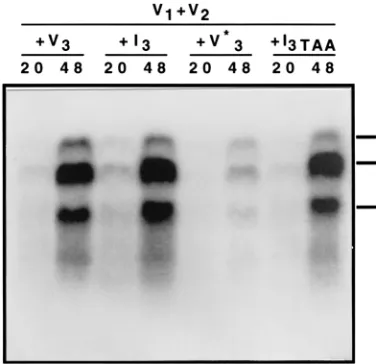
combinations were infectious for protoplasts, but RNA accu-mulation was more than two times higher for V1V2V3than for
V1V2V*3 (Fig. 1). Densitometric measurements of Northern
blots showed that the rate of RNA accumulation between 24 and 48 h postinoculation was four times higher for V1V2V3
than for V1V2V*3. Thus, the C3A mutation results in more
efficient replication of viral RNA.
To check if the C3A substitution confers enhanced repli-cation in a different strain of TAV, this mutation was intro-duced in plasmid p13, representing the full-length RNA3 of
1-TAV, to generate plasmid p13TAA. The sequences of pV3
and p13, in addition to the C/A base difference at position 100
of the insert, differ in 34 other point substitutions and dele-tions, of which 6 are in the 59untranslated region and 20 are in the 39 untranslated region (22). As shown in Fig. 1, both the final RNA accumulation and the accumulation rate were sim-ilar in protoplasts infected with V1V213and with V1V213TAA
and also were similar to the accumulation of V1V2V3. Thus,
the effect on RNA replication of the base at nucleotide 100 of RNA3 is context dependent.
The relative fitnesses for replication of RNAs V3, V*3, and
13were estimated from competition experiments. Protoplasts
were inoculated with RNA transcripts V1and V2 along with
equal amounts of transcripts V3 and V*3, V3and 13, or V*3
and 13. Total RNA was extracted from protoplasts 48 h
posti-noculation and analyzed for heterogeneity at position 100 of RNA3. For this, RNA preparations were used as templates for RT-PCR with primers Oligo-TAV498 and Oligo-TAV5, and the resulting 498-bp DNA products were screened by differ-ential hybridization with appropriate32P-labelled
oligonucle-otides. For the V3-V*3and V3-13competitions, hybridization
was done with Oligo-TAA and Oligo-TCA, and the intensity of the hybridization in the assay sample was compared with that of a set of PCR products obtained from mixtures with known amounts of V3and V*3. For each experiment, we confirmed
that the relationship between the A/C ratio in the V3-V*3
control mixture and the ratio between the intensities of
hybrid-ization with Oligo-TAA and Oligo-TCA of the PCR product was linear. This procedure gave results that agreed well with the analysis of individual cDNA clones (data not shown), and direct hybridization of PCR products allowed the analysis of the larger number of samples needed in competition experi-ments. The V*3-13 competition was analyzed similarly with
oligonucleotides Oligo-V-36 and Oligo-1-36. The data in Table 1 show that at 48 h postinoculation, both RNAs V3 and 13
competed efficiently against RNA V*3. The amounts of RNAs
V3 and 13relative to that of V*3 did not differ significantly.
From these values, the fitness of V3 relative to V*3 can be
estimated (as described by Holland et al. [14]) to be 7.85 ([88.7:11.3]/[50:50]). The relative amounts of V3and 13when
competing with each other did not differ significantly, indicat-ing similar relative fitnesses for replication, in agreement with the data in Fig. 1.
Estimation of the degree of complementation of RNA V3by
RNA V*3. Since the mutation C3A at nucleotide 100 of V-TAV RNA3 makes the RNA3 noninfectious for tobacco leaves, its maintenance in the V-TAV RNA population should be due to complementation by the wild-type RNA. Thus, the system allows us to estimate a lower limit for the amount of complementation. We define the degree of complementation (c) as the probability that a nonfunctional individual will ac-complish a function (cell-to-cell movement in this case) rela-tive to a functional individual. In our case, if p is the frequency of lethals (i.e., nonfunctional A-100 V3 RNA) in maturely
infected cells, the frequency in a newly invaded cell will be
pc/[(12p)1pc] [i.e., the number of nonfunctional individuals
divided by the total number, where (12p) is the frequency of
the wild type], and the relative frequency of lethal functional is
pc/(12p). On average, the final frequency of lethal in that cell,
under the steady state, will be p. So, the ratio between the final and the initial relative frequencies after a cell invasion cycle will be 1/c. Given that this ratio ought to be equal to the relative fitness in the same time interval (7), complementation can be estimated as the inverse of the relative fitness during a cell invasion cycle. The relative fitness was estimated from competition experiments in protoplasts to be 7.85 (see above). Thus, the amount of complementation of V3by V*3was
esti-mated to be 0.13. This estimate should be considered a lower limit, because any value below it will eliminate the lethal, but on the other hand, the lethal cannot multiply by itself.
Effect of the base at nucleotide 100 of V-TAV RNA3 on infectivity.The in planta relative fitnesses of RNAs V3and V*3
must at least be a compound of their relative fitnesses for RNA replication and for cell-to-cell movement. As RNA3 V3 was
[image:3.612.76.264.69.251.2]not infectious for tobacco leaves, its ability to promote cell-to-cell movement was analyzed. For this, tobacco leaves were inoculated with RNA transcripts in the combinations V1V2V3, FIG. 1. RNA accumulation in tobacco protoplasts for different TAV strains.
Northern blot of total RNA extracted from 400,000 transfected protoplasts at 20 or 48 h posttransfection. Protoplasts were transfected with transcripts V1and V2
plus transcript V3, 13, V*3, or 13TAA. The mobilities of RNA1-RNA2, RNA3,
and RNA4 are indicated from top to bottom.
TABLE 1. Competition of different TAV RNAs in tobacco protoplasts
Inoculuma % of TAV RNA3 in tobacco protoplasts b
V3 V*3 13
V1V2(V31V*3) 88.767.3 11.367.3
V1V2(V3113) 47.664.8 52.464.7
V1V2(V*3113) 6.463.3 93.663.3
aInocula were combinations of RNA transcripts V
1and V2and equal amounts
of the indicated RNA3 transcripts.
bAs determined by hybridization with 32P-labelled TAA and
Oligo-TCA of an RT-PCR-amplified product representing 498 nucleotides at the 59 end of RNA3, obtained from RNA extracted at 48 h postinoculation. Data are means6standard errors for three replicate experiments.
on November 9, 2019 by guest
http://jvi.asm.org/
[image:3.612.308.547.613.677.2]V1V2V*3, and V1V2(V31V*3), and the progress of the
infec-tion in inoculated leaves was monitored by quantifying the percentages of cells stained with anti-TAV-CP at various times after inoculation (Table 2). It was shown that V3was unable to
sustain cell-to-cell movement. Surprisingly, the progress of infection was much slower in leaves infected with V1V2
(V31V*3) than in leaves infected with V1V2V*3. The data
showed a delay of 9 to 6 days in the extent of mesophyll colonization. This could have been due to competition be-tween V3and V*3for the infection sites of the leaf epidermis,
which would have resulted in a smaller number of infection foci respective to leaves inoculated with V1V2V*3. The high
variances for the data obtained with V1V2(V31V*3) may also
reflect random competition.
Thus, a third factor, competition for infection sites, may play a role in the relative fitnesses of V3and V*3. This factor was
quantified by a local lesion assay with C. quinoa leaves (Table 3). Data from two different experiments showed that RNA transcripts V*3 and 13 were similarly infectious in C. quinoa
leaves. When V3RNA was present in the inoculum at a 1:1
ratio with V*3RNA, the number of necrotic local lesions was
significantly reduced, to about 15 to 20% of the number ob-tained when only V*3RNA was present in the inoculum. The
effect of V3on the number of local lesions when coinoculated
with 13was also significant but was less so than that of V*3(50
to 60%). Since the observed necrotic lesions must only be due to V*3or to 13, as V3is not infectious, this different degree of
interference indicates an additional effect of the different rep-lication efficiencies of V*3and of V3or 13.
Competition experiments were also done with tobacco leaves that were coinoculated with RNA transcripts V11V2
plus different relative amounts of RNA transcripts V3and V*3,
maintaining the same total amount of inoculum (Table 4). When the ratio of RNA V3to RNA V*3was 9:1, no infection
could be detected in any of 10 inoculated plants. When the V3/V*3ratio was 3:1 or 1:1, about 50% of the inoculated plants
were infected. These data are compatible with an efficient competition by V3against V*3for infection sites. Conversely,
all 10 plants inoculated with RNAs V1V2(V3113) were
in-fected, in agreement with the lower level of inhibition of 13
versus V*3 infection by V3 shown in Table 3. The data on
progeny viral RNA accumulation and on heterogeneity at nu-cleotide 100 (see Table 4) do not differ significantly for the different treatments, because of the very high level of disper-sion of the values for each plant. This finding may be explained by the effect of competition for a limited number of infection foci plus random rescue of V3by movement complementation
from nearby V3(or 13) infection foci. Even if data on relative
amounts of V3versus V*3or 13in progeny viral RNA do not
differ significantly between treatments, the average values show a trend suggesting that in planta, V3 competes more
efficiently with V*3than with 13.
To diminish the effects of competition for infection sites on the quantitation of V3and V*3relative fitnesses, another
ap-proach was followed. Tobacco leaves were inoculated with V1V2V3or with V1V213RNA transcripts, and the appearance
of the substitution C3A at nucleotide 100 of RNA3 was mon-itored. As shown in Table 5, upon a single passage in tobacco plants, an A was present in 6% of the molecules of RNA3. In V1V213-infected plants, the mutation leading to an A at
nu-cleotide 100 of RNA3 was not detected (Table 5). After two more passages in tobacco, V-TAV RNA3 molecules with an A at position 100 constituted about 20% of the population, while an A was not detected in 1-TAV RNA3 molecules. From the mutant/wild-type ratios at passages 1, 2, and 3, the fitness of V3
relative to that of V*3was estimated (14) to be 1.96.
DISCUSSION
High error rates for RNA-dependent RNA polymerases re-sult in the frequent appearance of mutations that for some well-characterized systems, such as poliovirus, Qb bacterio-phage, or vesicular stomatitis virus, have been estimated to occur at about 1 mutation per genome and per replication round (10). The fate of these mutations in RNA genome pop-ulations depends on the relative fitness of the mutants. Trade-offs between the effect(s) of the mutation(s) on different viral functions and complementation among sequence variants with different mutations determine the relative fitness and the equi-librium frequency of a mutant in the RNA population. We have analyzed here the factors involved in the maintenance to high levels in the RNA population of a mutation in TAV RNA3 that introduces a stop codon in the MP ORF and abolishes cell-to-cell movement and infectivity for whole leaves. The equilibrium frequency for the noninfectious mu-tant RNA with the stop codon was about 0.75. This finding suggests that the mutation leading to the loss of the movement function had a pleiotropic, positive effect on some other func-tion. It was in fact shown that the C3A substitution at nucle-otide 100 of V-TAV RNA3 conferred enhanced RNA repli-cation, resulting in an estimated (14) relative fitness for replication in competition experiments of 7.85. Indeed, it was the C at nucleotide 100 that led to a diminished replication rate, since the replication of V3RNA was similar to those of 13
[image:4.612.48.550.83.144.2]and 13TAARNAs. Nucleotide 100 of TAV RNA3 is in a region
TABLE 3. Effect of RNA V3on the infectivity of RNAs V*3and 13for C. quinoa leaves
Expt No. of necrotic lesions with the following TAV inoculum
a:
V1V2V*3 V1V2(V31V*3) V1V213 V1V2(131V3)
1 10.761.9 (a) 1.560.5 (b) 9.060.25 (a) 5.561.03 (c) 2 26.7610.2 (d) 5.463.3 (e) 31.6613.3 (d) 14.868.9 (e)
aData are the number of necrotic lesions (means6standard errors) for five
randomized half leaves. The same letter in parentheses indicates that the values were not significantly different. The V1V2V3 inoculum did not produce any
[image:4.612.308.549.639.692.2]necrotic lesions.
TABLE 2. Percentage of TAV-infected cells in directly inoculated tobacco leavesa
Inoculum % of TAV-infected cells at indicated dpi: Systemic symptoms15 dpi
6 9 12 15
V1V2V*3 2.3660.34 3.4360.59 39.0064.92 57.33617.75 Yes
V1V2V3 0.0360.03 0.0660.05 0.0060.00 0.0060.00 No
V1V2(V31V*3) 0.4060.23 1.9661.25 0.2360.19 3.8661.65 No
aDetermined from the number of epidermis and mesophyll protoplasts that immunostained with anti-TAV-CP antiserum. Data are means6standard errors for
three different plants.
on November 9, 2019 by guest
http://jvi.asm.org/
homologous to the ICR2-like region of cucumber mosaic cu-cumovirus RNA3 (18, 19, 26), which is needed for the efficient accumulation of RNA3 in the Bromoviridae (4, 19). The di-minished rate of V*3 accumulation may have resulted in a
lower level of accumulation of RNA1 and RNA2 because of the requirement of the CP for the efficient accumulation of viral RNA (4). The effect on replication of the base at position 100 was context dependent in a manner that we did not at-tempt to analyze. Thus, trade-offs must occur between the two opposite effects of the nature of the base at nucleotide 100 of V-TAV RNA3 in two key functions for the virus cycle.
The probability of the appearance of an A at position 100 of the 2,389-nucleotide-long V*3RNA3 (22) must be very small.
The accumulation upon passage of this mutant (the V3-like
mutant) allowed us to estimate its fitness relative to V*3 as
1.96. This value shows that, because of complementation of V3
cell-to-cell movement (see below), the in planta accumulation of this mutant was primarily determined by its advantage in replication rather than by its zero fitness for movement. Also, in addition to trade-offs between the relative fitnesses of V3
and V*3for replication and movement, a third factor,
compe-tition during the infection process, operates. Compecompe-tition for infection sites may be important in inoculations with RNA transcripts, as indicated by experiments with tobacco leaves (Table 4) and as shown by a local lesion assay with C. quinoa (Table 3). Nevertheless, a more precise quantification of this effect cannot be obtained, since the value determined with C.
quinoa may be different from that with tobacco. Also,
compe-tition for infection sites may be different at different infectivi-ties of the inocula: the level of competition may be much lower for the highly infectious viral RNA than for RNA transcripts. Thus, the level of competition for infection sites may have been much lower during passage of the V-TAV stock, which has resulted in an equilibrium frequency (A/C) of;3:1 at nucle-otide 100, than in experiments with RNA transcripts. The effect on infection would still favor the V3-like mutant over the
V*3one once the mutation has appeared in the population.
Point mutations that lead to enhanced viral replication but that are deleterious for other functions have not been reported often (for an example, see reference 34). The best known instances of defective mutants maintained through enhanced replication are those of defective interfering (DI) particles (DIP) or DI RNAs. DIP of animal viruses have been studied a great deal in cell cultures and, for the best analyzed systems, such as vesicular stomatitis virus and its DIP, the parameters for DIP appearance and competition have been estimated and used in the building of sophisticated population models (2, 16).
For DI RNAs of plant viruses, passage experiments with pro-toplasts also have linked DI RNA prevalence to enhanced fitness for replication (32, 33). The case that we report here is a more complex situation, since the analyzed mutation results in positive and negative effects on two different viral functions that occur at different times of the virus life cycle and, possibly, are also spatially segregated (1).
The analyzed system has allowed the estimation of the de-gree of complementation of movement-defective molecules of TAV RNA3 by movement-competent ones. Because of the importance of RNA viruses that infect animals and plants, much interest and effort have been devoted to the understand-ing of the factors that determine the genetic structure and evolution of their populations. High mutation rates during RNA replication or reverse transcription (10) plus fast repli-cation cycles leading to vast population numbers result in a swarm of sequence variants described as a quasispecies (9), for which quantitative models based on mutation frequencies and on the relative fitnesses of the mutants have been proposed (12). In addition to mutation and selection, genetic drift asso-ciated with population bottlenecks has been recognized as an important factor in determining the outcome of the quasispe-cies distribution (5, 11, 24). An additional important factor is the complementation of functions between different sequence variants. Although complementation may play an important role in the determination of the genetic structure of RNA genome populations, as it eliminates the effect of selection on deleterious mutants, to our knowledge, no attempt has been made to quantify it. As pointed out by Chao (6), viral quasi-species may be considered as a coinfection group, and selec-tion on coinfecselec-tion groups may be viewed as analogous to selection on diploid sexual individuals, albeit with a variable and statistically distributed ploidy. We present here a quanti-tative estimate of the degree of complementation. Our data show that the effect of complementation on the genetic struc-ture of the RNA population may be very important: in the analyzed system, the probability of a nonfunctional mutant performing the function was at least 0.13 that of the wild type, resulting in a mutant frequency of 0.76 due to trade-offs with the effect of the mutation on RNA replication.
ACKNOWLEDGMENTS
[image:5.612.50.290.83.156.2]This work was supported in part by grant AGF93-0101, CICYT, Spain. I. M. Moreno received a Formacio´n de Personal Investigador fellowship from the Ministerio de Educacio´n y Ciencia, Spain. TABLE 4. Competition of different TAV RNAs in tobacco leaves
Inoculuma V3in
inoculum progenyV3inb Virus RNAyieldc
No. of infected plants
(n510)
V1V2(V31V*3) 90 0
V1V2(V31V*3) 75 13.0610.1 0.0960.05 4
V1V2(V31V*3) 50 25.2611.4 0.1160.04 5
V1V2(V3113) 50 7.462.8 1.4560.56 10
aInocula were combinations of RNA transcripts V
1and V2and RNAs V3and
V*3or 13and V3in the ratios indicated in the second column.
bAs determined by hybridization with 32P-labelled TAA and
Oligo-TCA of an RT-PCR-amplified product representing 498 nucleotides at the 59 end of RNA3. Data are means6standard errors for 4, 5, or 10 infected plants, according to the treatment. Nucleic acids were extracted from inoculated leaves at 14 dpi.
cExpressed in micrograms per gram (fresh weight). Data are means6
stan-dard errors for 4, 5, or 10 infected plants, according to the treatment.
TABLE 5. Heterogeneity at nucleotide 100 of RNA3 in different TAV isolates
TAV isolatea Passage % of population with
b:
A C
V1V2V*3 1 6 94
2 7.2 92.8
3 19.9 81.1
V1V213 1 0 100
2 0 100
3 0 100
aV
1V2V*3and V1V213are virion preparations from tobacco leaves inoculated
with the indicated combinations of RNA transcripts for the first passage.
bAs determined by hybridization with 32P-labelled TAA and
Oligo-TCA of the 498-nucleotide RT-PCR-amplified product (see Materials and Meth-ods).
on November 9, 2019 by guest
http://jvi.asm.org/
[image:5.612.305.550.89.189.2]REFERENCES
1. Arce-Johnson, P., T. W. Kahn, U. Reimann-Philipp, R. Rivera-Bustamante, and R. N. Beachy.1995. The amount of movement protein produced in transgenic plants influences the establishment, local movement, and systemic spread of infection by movement protein-deficient tobacco mosaic virus. Mol. Plant Microbe Interact. 8:415–423.
2. Bangham, C. R. M., and T. B. L. Kirkwood. 1990. Defective interfering particles: effects in modulating virus growth and persistence. Virology 179: 821–826.
3. Bernal, J. J., E. Moriones, and F. Garcı´a-Arenal. 1991. Evolutionary rela-tionships in the cucumoviruses: nucleotide sequence of tomato aspermy virus RNA1. J. Gen. Virol. 72:2191–2195.
4. Boccard, F., and D. C. Baulcombe. 1993. Mutational analysis of cis-acting sequences and gene function in RNA3 of cucumber mosaic virus. Virology 193:563–578.
5. Chao, L. 1990. Fitness of RNA viruses decreased by Muller’s ratchet. Nature 348:454–455.
6. Chao, L. 1994. Evolution of genetic exchange in RNA viruses, p. 233–250. In S. S. Morse (ed.), The evolutionary biology of viruses. Raven Press, New York, N.Y.
7. Crow, J. F., and M. Kimura. 1970. An introduction to population genetics theory. Harper & Row, Publishers, Inc., New York, N.Y.
8. Domingo, E., and J. J. Holland. 1988. High error rates, population equilib-rium and evolution of RNA replication, p. 3–36. In E. Domingo, J. J. Holland, and P. Ahlquist (ed.), RNA genetics, vol. III. CRC Press, Inc., Boca Raton, Fla.
9. Domingo, E., J. J. Holland, J. Biebricher, and M. Eigen. 1995. Quasi-species: the concept and the word, p. 181–191. In A. Gibbs, C. H. Calisher, and F. Garcı´a-Arenal (ed.), Molecular basis of virus evolution. Cambridge Univer-sity Press, Cambridge, England.
10. Drake, J. W. 1993. Rates of spontaneous mutation among RNA viruses. Proc. Natl. Acad. Sci. USA 90:4171–4175.
11. Duarte, E., D. Clarke, A. Moya, E. Domingo, and J. J. Holland. 1992. Rapid fitness losses in mammalian RNA virus clones due to Muller’s ratchet. Proc. Natl. Acad. Sci. USA 89:6015–6019.
12. Eigen, M., and C. K. Biebricher. 1988. Sequence space and quasispecies distribution, p. 211–245. In E. Domingo, J. J. Holland, and P. Ahlquist (ed.), RNA genetics: variability of RNA genomes. CRC Press, Inc., Boca Raton, Fla.
13. Habili, N., and R. I. B. Francki. 1974. Comparative studies on tomato aspermy and cucumber mosaic viruses. I. Physical and chemical properties. Virology 57:392–401.
14. Holland, J. J., J. C. de la Torre, D. K. Clarke, and E. Duarte. 1991. Quan-titation of relative fitness and great adaptability of clonal populations of RNA viruses. J. Virol. 65:2960–2967.
15. Kaplan, I. B., M. H. Shintaku, Q. Li, L. Zhang, L. E. Marsh, and P. Palukaitis.1995. Complementation of virus movement in transgenic tobacco expressing the cucumber mosaic virus 3a gene. Virology 209:188–199. 16. Kirkwood, T. B. L., and C. R. M. Bangham. 1994. Cycles, chaos, and
evolu-tion in virus cultures: a model of defective interfering particles. Proc. Natl. Acad. Sci. USA 91:8685–8689.
17. Kunkel, T. A., J. D. Roberts, and R. A. Zakour. 1987. Rapid and efficient site-specific mutagenesis without phenotypic selection. Methods Enzymol. 154:367–382.
18. Marsh, L. E., and T. C. Hall. 1987. Evidence implicating a tRNA heritage for the promoters of positive-strand RNA synthesis in brome mosaic and related viruses. Cold Spring Harbor Symp. Quant. Biol. 41:311–341.
19. Marsh, L. E., G. P. Pogue, and T. C. Hall. 1989. Similarities among plant virus (1) and (2) RNA termini imply a common ancestry with promoter of eukaryotic tRNAs. Virology 172:415–427.
20. Mayo, M. A., and V. Zieglergraff. 1996. Molecular biology of luteoviruses. Adv. Virus Res. 47:413–460.
21. Meyers, M. A., and H. J. Thiel. 1996. Molecular characterization of pestivi-ruses. Adv. Virus Res. 47:53–118.
22. Moreno, I. M., J. J. Bernal, B. Garcı´a de Blas, E. Rodrı´guez-Cerezo, and F. Garcı´a-Arenal.1997. The expression level of the 3a movement protein de-termines differences in severity of symptoms between two strains of tomato aspermy cucumovirus. Mol. Plant Microbe Interact. 10:171–179.
23. Moriones, E., M. J. Roossinck, and F. Garcı´a-Arenal. 1991. Nucleotide sequence of tomato aspermy virus RNA 2. J. Gen. Virol. 72:779–783. 24. Novella, I. S., S. F. Elena, A. Moya, E. Domingo, and J. J. Holland. 1995. Size
of genetic bottlenecks leading to virus fitness loss is determined by mean initial population fitness. J. Virol. 69:2869–2872.
25. Palukaitis, P., S. Cotts, and M. Zaitlin. 1985. Detection and identification of viroids and viral nucleic acids by dot-blot hybridization. Acta Hortic. 164: 109–118.
26. Palukaitis, P., M. J. Roossinck, R. G. Dietzgen, and R. I. B. Francki. 1992. Cucumber mosaic virus. Adv. Virus Res. 41:281–348.
27. Power, J. B., and J. V. Chapman. 1985. Isolation, culture and genetic ma-nipulation of protoplasts, p. 37–66. In R. A. Dixon (ed.), Plant cell culture. IRL Press, Oxford, England.
28. Roux, L., A. E. Simon, and J. J. Holland. 1991. Effects of defective interfer-ing viruses on virus replication and pathogenesis in vitro and in vivo. Adv. Virus Res. 40:181–211.
29. Sambrook, J., E. F. Fritsch, and T. Maniatis. 1989. Molecular cloning: a laboratory manual, 2nd ed. Cold Spring Harbor Laboratory Press, Cold Spring Harbor, N.Y.
30. Suzuki, M., S. Kuwata, J. Kataoka, C. Masuta, N. Nitta, and Y. Takanami. 1991. Functional analysis of deletion mutants of cucumber mosaic virus RNA 3 using an in vivo transcription system. Virology 183:106–113.
31. Taliansky, M. E., and F. Garcı´a-Arenal. 1995. Role of cucumovirus capsid protein in long-distance movement within the infected plant. J. Virol. 69: 916–922.
32. White, K. A., and T. J. Morris. 1994a. Nonhomologous RNA recombination in tombusviruses: generation and evolution of defective interfering RNAs by stepwise deletions. J. Virol. 68:14–24.
33. White, K. A., and T. J. Morris. 1994b. Enhanced competitiveness of tomato bushy stunt virus defective interfering RNAs by segment duplication or nucleotide insertion. J. Virol. 68:6092–6096.
34. Yuan, T. T. T., A. Faruqi, J. W. K. Shih, and C. Shih. 1995. The mechanism of natural occurrence of two closely linked HBV precore predominant mu-tations. Virology 211:144–156.