0022-538X/96/$04.0010
Copyrightq1996, American Society for Microbiology
Disruption of Prion Rods Generates 10-nm Spherical Particles Having
High
a
-Helical Content and Lacking Scrapie Infectivity
DETLEV RIESNER,1* KLAUS KELLINGS,1KARIN POST,1HOLGER WILLE,2HANA SERBAN,2
DARLENE GROTH,2MICHAEL A. BALDWIN,2
ANDSTANLEY B. PRUSINER2,3
Institut fu¨r Physikalische Biologie und Biologisch-Medizinisches Forschungszentrum, Heinrich-Heine-Universita¨t Du¨sseldorf, 40225 Du¨sseldorf, Germany,1and Departments of Neurology2and Biochemistry and Biophysics,3
University of California, San Francisco, California 94143-0518
Received 26 July 1995/Accepted 30 November 1995
An abnormal isoform of the prion protein (PrP) designated PrPSc
is the major, or possibly the only, component of infectious prions. Structural studies of PrPSc
have been impeded by its lack of solubility under conditions in which infectivity is retained. Among the many detergents examined, only treatment with the ionic detergent sodium dodecyl sulfate (SDS) or Sarkosyl followed by sonication dispersed prion rods which are composed of PrP 27-30, an N-terminally truncated form of PrPSc. After ultracentrifugation at 100,0003gfor 1 h,;30% of the PrP 27-30 and scrapie infectivity were found in the supernatant, which was fractionated by sedimentation through 5 to 20% sucrose gradients. Near the top of the gradient, spherical particles with an observed sedimentation coefficient of ;6S, ;10 nm in diameter and composed of four to six PrP 27-30 molecules, were found. The spheres could be digested with proteinase K and exhibited little, if any, scrapie infectivity. When the prion rods were disrupted in SDS and the entire sample was fractionated by sucrose gradient centrifugation, a lipid-rich fraction at the meniscus composed of fragments of rods and heterogeneous particles containing high levels of prion infectivity was found. Fractions adjacent to the meniscus also contained spherical particles. Circular dichroism of the spheres revealed 60%a-helical content; addition of 25% acetonitrile induced aggregates high inbsheet but remaining devoid of infectivity. Although the highly purified spherical oligomers of PrP 27-30 lack infectivity, they may provide an excellent substrate for deter-mining conditions of renaturation under which prion particles regain infectivity.
The prion diseases include Creutzfeldt-Jakob disease of hu-mans as well as scrapie of sheep and bovine spongiform en-cephalopathy (8, 30, 31, 51). The human prion diseases are manifest as familial, sporadic, and infectious illnesses; the in-herited disorders are caused by mutations of the prion protein (PrP) gene on chromosome 20 which result in nonconservative amino acid substitutions (for a review, see reference 33). Pri-ons are proteinaceous, infectious particles that are composed largely, if not entirely, of an abnormal PrP isoform designated
PrPSc. Both PrPScand the cellular isoform PrPCare encoded
by the PrP gene; PrPScis derived from PrPCby a
posttransla-tional process (for a review, see reference 32). Limited
prote-olysis of PrPSc produces an N-terminally truncated protein
designated PrP 27-30 under conditions in which prion infectiv-ity is retained. PrP 27-30 forms rod-shaped polymers with the tinctorial properties of amyloid that are referred to as prion rods (38).
The transformation of PrPCinto PrPScinvolves a profound
conformational change. PrPC is predominantly an a-helical
protein, whereas PrPSc exhibits substantial b sheet and
re-duced amounts ofa helix (29, 42). Treatment of PrPSc with
solvents such as hexafluoroisopropanol (HFIP) increased the
a-helix content of PrPScand resulted in a substantial reduction
in scrapie infectivity (9, 43). Attempts to identify a chemical modification or auxiliary molecule that induces this conforma-tional change have been unrewarding. Analysis of peptides
generated from denatured PrPScby limited proteolysis failed
to identify any candidate covalent modification that might be
responsible for such a shift in tertiary structure (46). Despite an intensive search for a second component such as a scrapie-specific nucleic acid, none has been found; quantitative anal-yses of residual nucleic acids have eliminated oligonucleotides
greater than;80 nucleotides in length (15, 40).
Conformational studies of the PrP isoforms are complicated by the differences in solubility of these proteins. For example,
PrPCis soluble in nondenaturing detergents whereas PrPScis
not (21). To obtain high-resolution structural data, conditions
for solubilization of PrPScunder which scrapie prion infectivity
is retained need to be identified. Early attempts to solubilize scrapie infectivity (23) were unsuccessful, and the insolubility of the infectious particles retarded development of effective purification protocols (37, 44). Once the insolubility of scrapie infectivity was appreciated, it was used to enrich fractions for infectivity, which led to the discovery of PrP 27-30 (34). Some investigators were misled by the assumption that scrapie is caused by a virus and that the smallest infectious scrapie par-ticles were likely to be quite large (16), despite ionizing radi-ation data to the contrary (1).
Solubilization of PrPScand PrP 27-30 was effected when they
were mixed with phospholipids to form liposomes or deter-gent-lipid-protein complexes (7). The use of phospholipids to solubilize scrapie prions has not been helpful in structural studies of the prion proteins because such high concentrations of lipid are required. In some investigations, scrapie infectivity was reported to have observed sedimentation values as low as 2 to 3S (19). Recent claims that prion infectivity can be recov-ered from sodium dodecyl sulfate (SDS)-polyacrylamide gel electrophoresis (PAGE) in fractions containing PrP 27-30 (3) have not been confirmed (36). Attempts to renature scrapie infectivity from guanidinium (Gdn) thiocyanate or urea were unsuccessful (36), but one group of investigators reported
re-* Corresponding author. Mailing address: Institut fu¨r Physikalische Biologie und Biologisch-Medizinisches Forschungszentrum, Heinrich-Heine-Universita¨t Du¨sseldorf, 40225 Du¨sseldorf, Germany.
1714
on November 9, 2019 by guest
http://jvi.asm.org/
naturation of PrPSc from 3 M Gdn-HCl on the basis of the
restoration of resistance to proteinase K (17). Subsequent in-vestigations failed to confirm this report of renaturation (13). To identify conditions for solubilization of PrP 27-30, we examined a variety of ionic and nonionic detergents under conditions that were likely to retain scrapie prion infectivity. Sonication of purified prion rods in the presence of 0.2 to 0.3% SDS produced a soluble fraction that did not sediment during
centrifugation at 100,0003g for 1 h. This soluble fraction had
a high a-helical content and relatively low b-sheet content
compared with the amyloid polymers composed of PrP 27-30, and it contained spherical particles with an observed
sedimen-tation coefficient of 6S and a diameter of;10 nm. The spheres
were composed of four to six PrP 27-30 molecules; they con-tained little, if any, scrapie infectivity. While our studies did not yield infectious preparations of soluble prions, they did provide fractions of PrP 27-30 oligomers which could be characterized with respect to aggregation, proteinase K resistance, and con-formation.
MATERIALS AND METHODS
Chemicals and enzymes.HFIP and acetonitrile were of spectroscopic grade from Aldrich (Milwaukee, Wis.). All other chemicals and solvents from com-mercial sources were of reagent grade. Lipids were from Avanti Polar Lipids (Alabaster, Ala.). Dodecylmaltoside (dodecyl-b-D-maltopyranoside), lauryldim-ethylamineoxide, and thesit were kindly provided by W. Welte (Freiburg, Ger-many); the other detergents were from Calbiochem (San Diego, Calif.). Benzo-nase and proteiBenzo-nase K were from Merck (Darmstadt, Germany).
Purification of PrP 27-30 and bioassays.PrP 27-30 was purified from the brains of scrapie-infected Syrian hamsters (Lak:LVG; Charles River Laborato-ries) as described previously (38). The final purification step was either a sucrose gradient centrifugation or an ultrafiltration in which proteins of less than 300 kDa were removed and PrP was obtained in the retentate (10). Prions from both sources gave similar results.
Bioassays of scrapie prions were performed in Syrian hamsters by an incuba-tion time interval procedure (35). The same correlaincuba-tion between inoculated dose and incubation time was found for homogenates, purified prion rods from su-crose gradient centrifugation, and detergent-lipid-protein complexes, indicating that a variety of chemical treatments and fractionation procedures did not alter the relationship between inoculated dose and incubation time.
Sonication and differential centrifugation.Sonication was carried out in a biosafety hood with a cup horn sonicator (Branson) at 40 W for 5 min at temperatures not exceeding 178C unless otherwise stated. The sample was con-tained in a screw-cap Pyrex tube (1-cm diameter, 8 cm long) immersed 2 cm into the water bath of the sonicator and held at its top by a clamp. Thermostating of the sonication bath was established by a heat exchanger inside the hood and a thermostat (Haake) outside the hood. After sonication, the sample was centri-fuged in a 1.5-ml Eppendorf tube (Beckman Instruments, Palo Alto, Calif.) in a TL-100 ultracentrifuge (Beckman Instruments). Sonication carried out in 440ml of buffer A (20 mM morpholinepropanesulfonic acid [MOPS], 20 mM Tris [pH 7.2]) or buffer B (10 mM sodium phosphate [pH 7.0]) was followed by centrif-ugation in thick-wall polycarbonate tubes in a TLS-55 swinging-bucket rotor at 100,0003g for 115 min at 48C, and a 220-ml supernatant was collected from immediately below the meniscus. In this report, the procedure is referred to as the soluble fraction protocol. In another series of experiments, sonication was carried out in 250ml of buffer, and either the whole sample was loaded onto the sucrose gradient or the supernatant of 220 to 230ml was separated from the pellet by careful pipetting after centrifugation using a fixed-angle rotor TLA-100.3 at 60,0003g or 100,0003g for 1 h at 48C. Experiments in which the entire supernatant including the meniscus was collected are referred to as the total supernatant protocol.
Sucrose gradient centrifugation.The sucrose gradients were preformed step-wise with 5, 12.5, and 20% sucrose in 10 mM sodium phosphate buffer (pH 7) in 4-ml polyallomer tubes, with an effective column height of;53 mm. In some experiments, 0.2% SDS was added to the sucrose. A 200-ml aliquot of the supernatant from the solubilization centrifugation was loaded onto the gradient, and centrifugation was performed in an SW60 rotor at 60,000 rpm for 5.5 h at 48C. It was estimated that the largest particles in the supernatant from the solubilization centrifugation (;25S) would just reach the bottom of the gradient under these conditions. Fractions were collected from either the top or the bottom of the tubes.
PrP analysis.One volume of loading buffer was added to the protein sample, boiled for 5 min, and analyzed by SDS-PAGE (12% acrylamide) (18). Proteins were transferred onto an Immobilon P membrane (Millipore) (50); the mem-brane was blocked for 1 h with 5% nonfat dry milk in TBST buffer (10 mM Tris-HCl [pH 8.0], 0.15 M NaCl, 0.01% Tween 20) and subsequently incubated
with anti-PrP monoclonal antibody 3F4 (ascites fluid was 1:5,000) (14) in TBST for 1 h at room temperature and then with alkaline phosphatase-conjugated secondary antibody (Promega) for 30 min at room temperature (2). Immunore-active proteins were stained with 5-bromo-4-chloro-3-indolylphosphate (BCIP) and nitroblue tetrazolium. In most cases, PrP was determined from dot blots visualized with an enhanced chemiluminescence system (ECL kit RPV 2108; Amersham) and scanned with a densitometer.
Samples were incubated with proteinase K at 50mg/ml at 378C for 1 h; in some experiments, 10mg/ml at 378C for times between 1 and 30 min was used. The lower concentration was used to study samples exhibiting partial resistance. The digestions were terminated by the addition of phenylmethylsulfonyl fluoride at a final concentration of 7.5 mM.
CD.Circular dichroism (CD) spectra were recorded with a Jasco model 720 spectropolarimeter, using 1- or 5-mm-path-length cylindrical cells at room tem-perature. All measurements were carried out in buffer B containing 0.2% SDS, which allowed readings to be taken down to 190 nm; data could not be recorded below this wavelength because of excessive absorption by the buffer. Typically 20 to 50 spectra were recorded over the spectral range of 190 to 260 nm at a scan speed of 50 nm/min. A blank spectrum for the cuvette and buffer was recorded and subtracted from each spectrum; the largest amplitude of the blank was,5% relative to the spectra of the samples. Signal averaging allowed satisfactory CD spectra to be obtained with PrP 27-30 concentrations down to;10mg/ml. For those readings taken in the presence of acetonitrile, this reagent was added to the buffer after sonication. Quantitative secondary structure assignments were car-ried out with a computer program kindly provided by W. Curtis Johnson, Uni-versity of Oregon (12). The accuracy of these assignments may be limited by truncation of the data at 190 nm.
Electron microscopy.The samples were adsorbed for about 20 s onto glow-discharged, carbon-coated grids. Excess material and sucrose were washed away with three drops each of 0.1 and 0.01 M ammonium acetate. The grids were then stained with 2% uranyl acetate and viewed in a JEOL 100CX II electron micro-scope at 80 kV. Negatively stained catalase crystals were used for calibration. The diameter of the particles was measured parallel to one side of each print, independent of the orientation of the particles.
RESULTS
Dispersion of prion rods.Sonication of prion rods (;300mg of PrP 27-30 per ml) was performed in buffer A with a variety of detergents. After sonication, the samples were centrifuged
in a fixed-angle rotor at 60,000 3 g at 48C for 1 h, and the
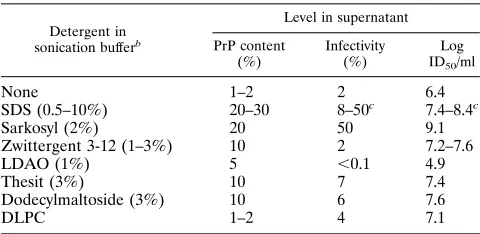
supernatant was sampled according to the total supernatant protocol. The effectiveness of the detergent was evaluated on the basis of the fraction of the PrP 27-30 and the scrapie infectivity remaining in the supernatant, as determined by Western blots and bioassays (Table 1). The most effective detergents were SDS and Sarkosyl, both of which liberated 20 to 30% of PrP 27-30 and prion infectivity in the supernatant. SDS concentrations of 0.5% up to 10% were investigated, but the extent of solubilization appeared to be independent of SDS concentration, probably because all concentrations were above
TABLE 1. Efficiency of solubilization of PrP 27-30 by sonication in buffer A containing various detergentsa
Detergent in sonication bufferb
Level in supernatant
PrP content (%)
Infectivity (%)
Log ID50/ml
None 1–2 2 6.4
SDS (0.5–10%) 20–30 8–50c 7.4–8.4c
Sarkosyl (2%) 20 50 9.1
Zwittergent 3-12 (1–3%) 10 2 7.2–7.6
LDAO (1%) 5 ,0.1 4.9
Thesit (3%) 10 7 7.4
Dodecylmaltoside (3%) 10 6 7.6
DLPC 1–2 4 7.1
a
PrP 27-30 content was determined with serial dilutions by Western blotting, and infectivity was determined by bioassays in Syrian hamsters. After solubiliza-tion centrifugasolubiliza-tion according to the total supernatant protocol, the PrP 27-30 content and the infectivities of the supernatant and pellet were added; the percentage of the soluble fraction is listed.
bLDAO, lauryldimethylamineoxide; DLPC, detergent-lipid-protein complex. cNot related to the SDS concentration in a monotonic way.
on November 9, 2019 by guest
http://jvi.asm.org/
[image:2.612.315.555.91.208.2]the critical micelle concentration (;0.24%). The finding that SDS and Sarkosyl did not inactivate scrapie infectivity at low concentrations is in agreement with earlier findings (37).
In additional studies, centrifugation was increased from
60,0003g to 100,0003g while other parameters were held
constant. The presence of protein in the supernatant after
centrifugation at 100,0003 g for at least 1 h with an 8-mm
column height is an accepted criterion for solubilization (11). Proteins or protein aggregates with a sedimentation coefficient
of larger than 25S, corresponding to an Mrof .106, would
sediment into the pellet during a 1-h centrifugation with 8-mm column height. The effect of SDS concentrations was reinves-tigated by applying concentrations of 0.05 to 1%. Maximum
solubilization was achieved at;0.3% SDS, which is near the
critical micelle concentration. For all subsequent experiments, the sonication was carried out with 0.2 or 0.3% SDS.
Time and temperature of sonication were varied between 5
and 30 min and 17 and 378C, respectively. The fractions of PrP
recovered in the supernatant according to the total superna-tant protocol were similar for all of the conditions examined. In an attempt to minimize denaturation, we used 5 min of
sonication starting at 78C, with the temperature increasing to
no more than 178C. It is noteworthy that prolonged sonication
of Syrian hamster brain homogenates did not reduce infectivity (41).
Chaotropic agents known to denature PrP 27-30 and destroy infectivity were used at low concentrations, e.g., 1 M urea or 0.5 M Gdn-HCl (36, 37). The effect of HFIP on prion infec-tivity was evaluated at a concentration of 10% (vol/vol). Su-crose was also added up to 25% (wt/vol), either alone or in combination with the other reagents. After sonication in 0.3% SDS, the fraction of PrP 27-30 remaining in the supernatant was considerably more sensitive to digestion with proteinase K than that in the prion rods found in the pellet (Fig. 1). Bioas-says of these digested supernatant fractions showed reductions in prion titers by factors 5, 16, 3, 50, and 5 in five independent experiments. While such changes are not significant, there was always a small reduction of titer. In contrast, HFIP diminished the infectivity drastically; other reagents did not appear to be promising, and so further studies were not performed. The apparent protection of sucrose against proteinase K digestion
is due to its influence of viscosity and density on the 100,0003
g centrifugation. Thus, in all subsequent experiments, the prion
sample for sonication contained only buffer and 0.2 or 0.3% SDS.
Sucrose gradient centrifugation analysis. To characterize the prions in the supernatant after sonication in 0.2% SDS, we designed a protocol using sucrose gradient centrifugation to determine whether PrP 27-30 and infectivity cosedimented. To minimize contamination of the supernatant fraction by any particles floating in the meniscus or particles loosely adherent to the pellet, centrifugation of the SDS-sonicated prion rods was performed in a swinging-bucket rotor, and only 50% of the supernatant was collected with a pipette from the upper por-tion of the liquid column. This is the soluble fracpor-tion protocol. To distribute the supernatant over the entire sucrose gradient
(5 to 20%) with a 53-mm column height, a value of 6.431011
rad2/s for
ʃv2dt (60,000 rpm, 5.5 h in a Ti60 rotor) was chosen.
The gradients were preformed with either no detergent or 0.2% SDS to test for reaggregation in the absence of SDS. Gradients were fractionated from either the top or the bottom to assess possible artifacts. Profiles for PrP 27-30 content and scrapie infectivity in the presence or absence of SDS in the sucrose gradients were similar; values are the means from four or five independent experiments (Fig. 2). The majority of PrP 27-30 was found in fractions 2 to 5 and sedimented as a
sym-metrical peak of;6S, but only;0.02% of the infectivity was
recovered in these fractions. It is noteworthy that the super-natant collected by the soluble fraction protocol contained only 6% of the total infectivity, of which 50% was loaded onto the gradient (Table 2). Because the specific infectivity in fractions 2 to 5 was nearly 3 orders of magnitude lower than that of the prion rods, we conclude that soluble PrP 27-30 prepared under these conditions is devoid of prion infectivity.
To explore the reasons for the low recovery of the infectivity in the supernatant fractions (Table 2) loaded onto the gradi-ents in Fig. 2 compared with the nearly 50% infectivity in the supernatant in the initial SDS sonication experiments (Table 1), prion rods were sonicated in 0.2% SDS and loaded directly onto the sucrose gradient without prefractionation by differ-ential centrifugation. Again, most of the PrP 27-30 was found in fractions 2 to 5 (Fig. 3), but some PrP 27-30 was also found
in the meniscus fraction. Most notably,;10750% infectious
doses (ID50) of prion infectivity per ml were found in the
meniscus and the adjacent fraction as well as at the bottom of the gradient, in contrast to fractions 3 to 5, containing most of the PrP 27-30, in which prion titers were lower by nearly a factor of 1,000. When prion rods were sonicated in 0.2% SDS and separated into supernatant and pellet fractions according to the total supernatant protocol (Table 1 and Fig. 1), the sedimentation profiles of PrP 27-30 and prion infectivity were similar to those shown in Fig. 3 (data not shown).
The prions in the meniscus fractions would seem to be of either small size or low density. Since the supernatant fractions prepared with the soluble fraction protocol would have elimi-nated the prions of low density but not those of small size, we conclude that the absence of infectivity in the meniscus frac-tion in Fig. 2 indicates a low density populafrac-tion of prions. Most likely the low density of the prions is due to lipids and possibly detergents bound to PrP 27-30. The origin of the lipids has to be the prion rods.
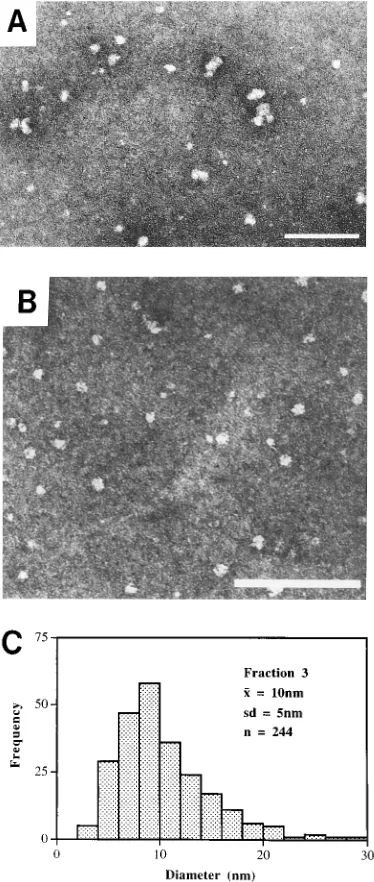
Ultrastructural analysis. Fractions 2 to 5 of the sucrose gradients (Fig. 2 and 3) contained numerous spherical particles (Fig. 4A and B). Since these fractions contain only PrP 27-30 as judged by SDS-PAGE, and no particles other than spheres were found by electron microscopy, we conclude that the spheres are composed of PrP 27-30. Most of the spheres ranged from 8 to 12 nm in diameter; a substantial portion had
diameters of;10 nm (Fig. 4C). We were unable to identify any
consistent substructure by using negative staining.
Since these particles were spherical, we estimated the
mo-FIG. 1. Western blot of PrP 27-30 in the supernatant prepared according to the total supernatant protocol. Samples designated ‘1’ were digested with 50mg of proteinase K per ml at 378C for 1 h. All sonication buffers contained buffer A and 0.3% SDS. The pellet after sonication without additives and centrifugation served as a control. The additives to the sonication buffer are indicated for the different samples. Sucr., sucrose. Molecular mass markers (M) are proteins of 106, 80, 49.5, 32.5, 27.5, and 18.5 kDa.
on November 9, 2019 by guest
http://jvi.asm.org/
lecular weight from the average sedimentation coefficient
(;6S) determined from the position of the peak fraction. The
partial specific volume (v) for a sedimenting particle was cal-culated according to the method of Durchschlag (6) to be 0.71
cm3 g21, on the basis of the following composition of PrP
27-30: 54% protein (v50.71 cm3g21), 18% carbohydrate (v5
0.65 cm3g21), 7% glycolipid anchor (v50.59 cm3g21), and
21% SDS, i.e., 0.4 g of SDS per g of protein (v50.82 cm3g21),
determined as described by Tanford (47) and assuming hydra-tion as 0.5 g of water per g of PrP 27-30 (the values for SDS binding and hydration being rough estimates only). Applying the standard method for evaluation of a spherical molecule of 6S (4), a molecular mass of 117 kDa was obtained, which corresponds to pentamer of PrP 27-30. Allowing for uncertain-ties in this calculation, we conclude that each of these spheres contains between four and six PrP 27-30 molecules. Although the 10-nm diameter is somewhat larger than expected for a globular aggregate of 117 kDa, errors in some of our estimates may account for this small discrepancy. On the other hand, the observed sedimentation values for PrP 27-30 and the spheres
suggest that PrP 27-30 is unlikely to form particles other than the spheres visualized by electron microscopy.
The meniscus fraction in Fig. 3 containing substantial infec-tivity possessed a heterogeneous array of particles, many of which are vesicular and appeared to be composed largely of lipid (Fig. 5A); in addition, aggregates of small rods were found (Fig. 5B). The finding of rod fragments in the meniscus fractions implies that the density of these fragments is below
1.018 g/cm3 (5% sucrose) and that they are associated with
substantial amounts of lipid. The pellet fraction also contained rod fragments which survived the sonication procedure (data not shown). Whether the spheres contain small amounts of lipid or other compounds remains to be determined.
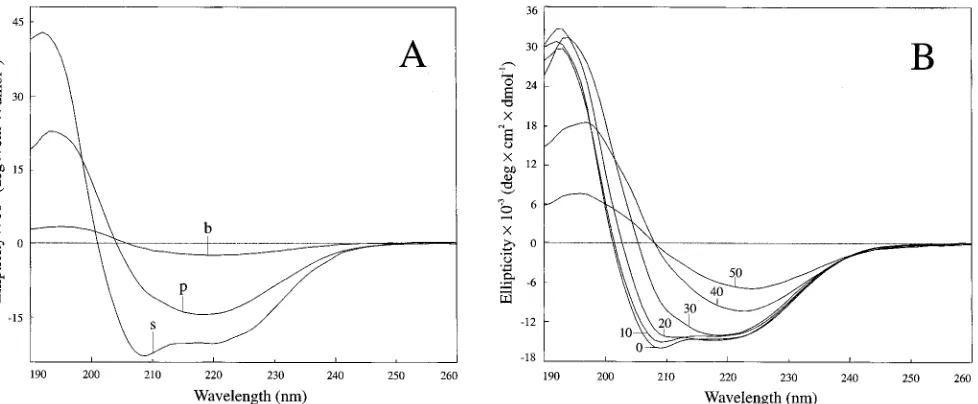
Conformational transitions.Conformational analyses were performed on the supernatant and the resuspended pellet frac-tions. After the supernatants were collected for sucrose gradi-ent analysis by the soluble fraction protocol, the remaining supernatant fractions were collected and examined by CD spectroscopy. The pellet was resuspended in an equal volume of the same buffer. The supernatant exhibited a spectrum
char-FIG. 2. Analysis by 5 to 20% sucrose gradient centrifugation of the supernatant prepared according to the soluble fraction protocol. The sedimentation profiles show PrP 27-30 (■) and infectivity (h) in the presence of 0.2% SDS and PrP 27-30 (å) and infectivity (Ç) without SDS in the gradient. All values are the means of four (without SDS) or five (with SDS) independent experiments. Relative units are depicted (in percentages) for PrP 27-30 and infectivity; the sum of all fractions is set to 100%. A value of 100 for prion infectivity corresponds to values of 105.2to 107.4ID
[image:4.612.147.469.73.261.2]50in the different gradients (see Table 2). Error bars are defined by the highest and the lowest values; they are shown for three fractions only but are characteristic for all fractions. The low level of prion infectivity and possibly the adjacent PrP peak contribute to the large error bars in fraction 2.
TABLE 2. Reduction in levels of infectivitya
Expt Sample
Log ID50 Recovery
(%)
Mean Range
A From the soluble fraction protocol
Pellet after solubilization centrifugation 9.0 7.3–9.3 94
Supernatant after solubilization centrifugation 7.8 6.1–8.7 6
Total infectivity recovered from sucrose gradient 6.8 5.2–7.4 0.6
B From the total supernatant protocol
Pellet after solubilization centrifugation 7.6 72
Supernatant after solubilization centrifugation 7.1 28
Total infectivity recovered from sucrose gradient 6.9 15
a
Prion rods were sonicated in 0.2% SDS and separated into pellet and supernatant after the solubilization centrifugation. The supernatant (soluble fraction protocol) was further loaded onto a sucrose gradient for size determination. For the calculation of recovery, the infectivities of the supernatant and pellet after solubilization centrifugation were added (100%); the corresponding percentages are listed. Mean values from experiment A are from 11 separate determinations; those from experiment B are from 2 determinations.
on November 9, 2019 by guest
http://jvi.asm.org/
acteristic of proteins with higha-helical content, whereas the
pellet exhibited a high b-sheet content. These spectra were
similar to those obtained on fractions prepared by using the total supernatant protocol; that is, the supernatant (Fig. 6A)
showed minima at 208 and 222 nm, characteristic fora-helical
structures. The pellet fraction gave a maximum at 195 nm and
a minimum at 218 nm, values which are representative ofb
sheets. The spectrum of the supernatant showed no changes over a 24-h period, suggesting that the PrP 27-30 remained soluble over this time interval. In contrast, the ellipticity of the resuspended pellet decreased measurably over 1 h in accord with the insolubility of the rods. When the prion rods were sonicated for up to 1 h without SDS, the supernatant fraction
gave a lower ellipticity spectrum with a characteristicb-sheet
signal, suggesting that the conformation of PrP 27-30 in the broken rods was unaltered by sonication.
Since acetonitrile is known to inducebsheets in peptides
(24, 26, 48), we studied the influence of acetonitrile on the spectrum of the supernatant fraction. Increasing the acetoni-trile concentration from 0 to 50% in increments of 10%
in-duced a progressive shift fromahelix tobsheet (Fig. 6B). The
proportions ofa-helix andb-sheet structures determined from
the CD spectra were tabulated (Table 3). Thea-helix content
of the supernatant fractions ranged from 40 to 60%; this vari-ation may be due to inconstancies in the SDS sonicvari-ation pro-cedure as well as the protocol used to separate the supernatant from the pellet after centrifugation in a fixed-angle rotor. The addition of 10 or 20% acetonitrile effected a small reduction in
the a-helix content and a concomitant increase in b-sheet
content; 30% acetonitrile produced approximately equal amounts
ofahelix andbsheet. The spectra of the resuspended pellet
resembled that of the supernatant to which 30% acetonitrile had been added (Table 3). Concentration of 40 or 50% ace-tonitrile seemed to denature PrP 27-30. The addition of 25 to 50% acetonitrile to the supernatant precipitated PrP 27-30 after exposure overnight, as assessed by centrifugation at
100,0003g.
Since infectious prion rods containing PrP 27-30 are rich in
bsheet, we investigated whether the increase inbsheet due to
acetonitrile was accompanied by an increase in infectivity. Ad-dition of 10 to 20% acetonitrile had no effect on prion
infec-tivity, while 30% acetonitrile reduced infectivity;75%.
Addi-tion of 40 to 50% acetonitrile diminished prion titers by a
factor of 103to 104. Thus, the conformational change induced
by acetonitrile is not equivalent to that which occurs during the
formation of PrPSc. It seems likely that acetonitrile at
concen-trations above 30% denatures PrPSc.
Electron microscopy was also used to monitor the effect of acetonitrile on the supernatant following SDS sonication and centrifugation. No rods were found in the presence of 25% acetonitrile, but aggregates could assemble from soluble PrP 27-30 (Fig. 5C).
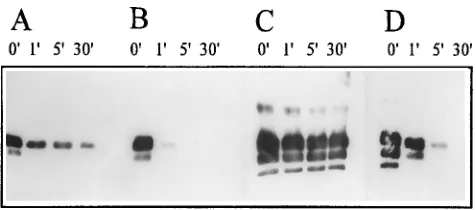
Fractions containing PrP 27-30 after sonication in 0.2% SDS and sucrose gradient centrifugation (Fig. 3) as well as after addition of 30% acetonitrile were examined for proteinase K resistance. The majority of the PrP 27-30 in the meniscus fraction was digested within the first minute, whereas the re-maining PrP 27-30 was stable for 30 min (Fig. 7A). This be-havior may reflect the array of structures found by electron microscopy (Fig. 5A and B), with aggregates of rods being responsible for the residual proteinase K resistance. In con-trast, the soluble PrP 27-30 from the peak fractions was di-gested nearly completely within the first minute (Fig. 7B). The pellet obtained after SDS sonication of prion rods followed by centrifugation in a fixed-angle rotor exhibited substantial pro-teinase K resistance (Fig. 7C). When the peak fraction was treated with 30% acetonitrile and precipitated PrP 27-30 was
recovered by a 100,000 3 g centrifugation, measurable but
modest proteinase K resistance was found (Fig. 7D).
DISCUSSION
Considerable evidence supports the hypothesis that a con-formational change in PrP underlies both the propagation of prions and the pathogenesis of prion diseases (5, 29). This
proposal emerges from spectroscopic studies comparing PrPC
in a purified sample with PrPSc in another highly enriched
fraction. Transgenetic studies argue persuasively that PrPCand
PrPScinteract during the formation of nascent PrPSc(39, 49).
The investigations reported here address this issue from the perspective of starting with a uniform sample of prions and modifying the structure of PrP 27-30 under relatively gentle
FIG. 3. Fractionation by 5 to 20% sucrose gradient centrifugation of the total sample after sonication in the presence of SDS. The sucrose gradient did not contain SDS. The sedimentation profiles show PrP 27-30 (■) and infectivity (h) as in Fig. 2, derived from the mean of two independent experiments. A value of 100 for prion infectivity corresponds to 106.9ID
50(see Table 2).
on November 9, 2019 by guest
http://jvi.asm.org/
conditions. Sonication in 0.2% SDS transformed prion rods into a variety of multimeric structures which were character-ized by solubility, conformation, proteinase K resistance, and infectivity.
Fractionation of prion rods.After sonication of prion rods
in the presence of 0.2% SDS, ;25% of the PrP 27-30 was
found in the supernatant after centrifugation at 100,0003g for
1 h. The pellet contained the majority of PrP 27-30, consisting of prion rods which withstood the SDS-sonication procedure, but the rods were smaller as measured by electron microscopy (data not shown). The CD spectrum of this pellet fraction
showed a more pronouncedb-sheet signal than that of prion
rods subjected to sonication in the absence of SDS (Fig. 6A). Disruption of prion rods by sonication in the presence of 0.2 to 0.3% SDS suggested that scrapie infectivity was preserved
under these conditions (Table 1), but fractionation by sucrose gradient centrifugation gave results which appeared inconsis-tent with the initial bioassay data (Fig. 2). This discrepancy seems to be due to the use of different protocols; there were high levels of infectivity in the total supernatant but low levels in the soluble fraction, using slightly different protocols for recovery of the supernatant fractions. Sonication in the
[image:6.612.340.530.71.584.2]pres-FIG. 4. Electron microscopy of the peak fractions collected from sucrose gradients after centrifugation. (A) Fraction 3 from gradient shown in Fig. 2. (B) Fraction 3 from gradient shown in Fig. 3. Bars5100 nm. (C) Size distribution of the spherical particles in panel A.
FIG. 5. Electron micrographs of fractions containing PrP 27-30. (A and B) Two samples of the meniscus fraction from the sucrose gradient illustrated in Fig. 3. The arrow points to residual rod fragments. (C) The supernatant fraction was prepared according to the total supernatant protocol, 25% acetonitrile was added, and the precipitate was collected by centrifugation. The resuspended pellet is shown. Bars5100 nm.
on November 9, 2019 by guest
http://jvi.asm.org/
[image:6.612.84.271.73.514.2]ence of SDS generated a lipid-rich fraction with a low buoyant density and substantial levels of scrapie infectivity (Fig. 3) that was included in the total supernatant but was excluded from the soluble fraction. The lipid-rich, infectious prions were iden-tified in the meniscus fraction of sucrose gradients when the total supernatant procedure was used to generate the sample loaded onto the gradient (Fig. 3). It should be emphasized that the lipids or other compounds which are responsible for the low density of the prions were not added during sonication but are constituents of the prion rods. A heterogeneous array of particles including spheres of different sizes, aggregates of spheres, and even small prion rod-like structures, were found by electron microscopy of lipid-rich fractions (Fig. 5). Also, a portion of the PrP 27-30 (Fig. 7) as well as the prion infectivity was destroyed by proteinase K digestion, whereas residual PrP 27-30 and infectivity resisted limited digestion. Possibly the rod-shaped structures in the lipid-rich fraction represent a proteinase K-resistant subpopulation of PrP 27-30 molecules that are associated with prion infectivity. Our results suggest-ing that lipids may stabilize the conformation of PrP 27-30 and thus preserve prion infectivity are consistent with earlier stud-ies in which delipidation led to inactivation of scrapie infectiv-ity (22). In fact, some investigators argue that the bovine spon-giform encephalopathy epidemic resulted from inadequate
delipidation of the protein-rich greaves which was processed into meat and bone meal (MBM). In contrast to earlier ren-dering procedures of animal offals using organic solvent
ex-traction, which produced MBM containing ;1% fat and
ap-parently devoid of prions, more recent protocols omitting
solvent extraction produced MBM containing ;14% fat in
which sheep prions and later those from cattle seemed to have survived (51).
Spherical particles composed of PrP 27-30.By sedimenta-tion analysis and electron microscopy, the spherical particles appear to contain four to six PrP 27-30 molecules. The PrP
27-30 molecules that form these spheres resemble PrPC and
denatured PrP 27-30 in several aspects: PrP 27-30 is soluble, it
is sensitive to proteinase K digestion, it has a higha-helical and
low b-sheet content, and it is not associated with scrapie
in-fectivity (9, 29, 42). Of note, PrP 27-30 denatured by exposure to 3 M NaOH, boiling in 2% SDS, or 6 M Gdn does not form spherical particles to our knowledge (25, 42). Although it
seems unlikely that PrPCforms spherical particles of four to six
molecules when it is tethered to the plasma membrane by its
glycerolphosphatidylinositol anchor, it is likely that PrPC
[image:7.612.67.556.72.274.2]ag-gregates into micelles when it is solubilized by exposure to nondenaturing detergents. Indeed, the formation of spheres by PrP 27-30 seems to be facilitated by SDS; whether PrP 27-30
FIG. 6. CD spectra. (A) Supernatant (s) and pellet (p) were prepared according to the total supernatant protocol in 10 mM phosphate buffer (pH 7.0) containing 0.2% SDS; broken rods (b) were obtained by sonication for 1 h in the absence of SDS and without centrifugation. (B) Supernatant after addition of 0 to 50% (in steps of 10%) acetonitrile. Ellipticities were calibrated according to an amino acid analysis of the sample and were corrected for dilution with acetonitrile.
TABLE 3. Effects of acetonitrile on the infectivity of the supernatant after solubilization centrifugation and on the secondary structure as determined by CD spectroscopya
Sample Acetonitrile
(%) Log ID50/ml
Infectivity (%)
Secondary structure (%)
ahelix bsheet Turns Other
Pellet fraction 0 9.6 83 29 31 10 30
Supernatant fraction 0 8.9 17 61 5 16 18
10 9.1 26 57 9 15 19
20 8.9 17 53 18 9 20
30 8.4 5 37 33 5 25
40 5.9 0.02 26 36 6 32
50 5.0 0.002 22 29 13 36
a
The total infectivity of pellet and supernatant (100%) after solubilization centrifugation was 9.7 log ID50/ml.
on November 9, 2019 by guest
http://jvi.asm.org/
[image:7.612.58.555.611.718.2]molecules in these spheres aggregate through their glycerol-phosphatidylinositol anchors or interact through other do-mains in the molecule redo-mains to be established.
The spheres of PrP 27-30 reported here resemble morpho-logically those generated by sonication of prion rods in the absence of SDS, a nonsedimenting fraction contained spherical particles of 8- to 20-nm diameter as judged by electron micros-copy, but the yield was so low that the particles could not be characterized in more detail (20). Some investigators at-tempted to determine the size of infectious prions by using sucrose gradient centrifugation after extraction of Creutzfeldt-Jakob disease-infected mouse brain preparations with Sarkosyl
and sonication (45). A noninfectious peak of;7S containing
PrP was found, which was interpreted as composed of ‘‘mono-meric or di‘‘mono-meric’’ PrP molecules. From these findings, the authors concluded that PrP can be separated from infectivity and therefore cannot be the major or essential component of the infectious prion. It seems likely that the 7S PrP peak in those studies is composed of the same spherical oligomers of PrP 27-30 reported here. Other studies described spherical particles with an average diameter of 12 nm in brain homoge-nates from scrapie-infected Syrian hamsters but not from un-infected controls (27). Similar spheres have also been found in homogenates prepared from the brains of patients who died of Creutzfeldt-Jakob disease (28). The investigators have re-ferred to the spherical particles as ‘‘virus-like’’ and suggest they
are the agents of the disease that induce the formation of PrPSc
as a secondary effect. Considering that the spheres in the brain homogenates were seen after digestion with proteinase K in the presence of detergent which produces PrP 27-30, it seems likely that these 12-nm spheres are the same as the spherical oligomers of PrP 27-30 reported here.
Conformational transitions of PrP 27-30.The higha-helical
content of PrP 27-30 in the spheres was converted intobsheet
by exposure to 25 to 30% acetonitrile. Under these conditions, the PrP 27-30 aggregated into insoluble, irregular polymers (Fig. 7) and exhibited partial resistance to digestion by pro-teinase K, which presumably is a consequence of the aggrega-tion. It seems likely that aggregation and insolubility of the
acetonitrile-treated spheres resulted from theb-sheet
confor-mation which PrP 27-30 acquired. These aggregates of PrP 27-30 were clearly distinct from the prion rods morphologically and did not possess scrapie infectivity as measured by bioassay in hamsters.
Evidence for intermediate, partially folded states of PrPSc
and PrP 27-30 have been obtained by exposure of these
pro-teins to 2 M Gdn-HCl or to pH ,2, using CD spectroscopy
(43). Whether these ‘‘molten globules’’ are equivalent to the structure of PrP 27-30 in the spherical particles reported here remains to be established. It is noteworthy that some
investi-gators have reported reversible denaturation of PrPScwith 3 M
Gdn-HCl on the basis of the restoration of resistance to pro-teinase K (17). In studies performed by some of us, no
evi-dence for renaturation of PrPScunder these conditions could
be obtained; it seems likely that some of the PrPScwas
dena-tured in 3 M Gdn-HCl and formed a proteinase K-sensitive fraction, while the remainder was not denatured, persisted as insoluble aggregates, and continued to be resistant to protease digestion (13). This interpretation is in accord with bioassays performed on prion fractions exposed to Gdn at various con-centrations followed by dilution; no restoration of infectivity could be demonstrated as reported here for the spheres con-taining PrP 27-30 (36). The relatively uniform size of the spheres suggests that the PrP 27-30 molecules comprising them possess a unique metastable conformation which produces this distinct quaternary structure. Whether conditions which rena-ture the PrP 27-30 in the spheres and restore scrapie infectivity can be identified remains unknown, but is certainly worthy of further investigation.
ACKNOWLEDGMENTS
This work was supported by research grants from the National Institutes of Health (NS22786), the Ministerium fu¨r Wissenschaft und Forschung of NRW, and the Bundesministerium fu¨r Forschung und Technologie.
REFERENCES
1. Alper, T., D. A. Haig, and M. C. Clarke. 1966. The exceptionally small size of the scrapie agent. Biochem. Biophys. Res. Commun. 22:278–284. 2. Blake, M., K. H. Johnson, G. J. Russel-Jones, and E. Gotschlich. 1984. A
rapid, sensitive method for detection of alkaline phosphatase-conjugated anti-antibody on Western blots. Anal. Biochem. 136:175–179.
3. Brown, P., P. P. Liberski, A. Wolff, and D. C. Gajdusek. 1990. Conservation of infectivity in purified fibrillary extracts of scrapie-infected hamster brain after sequential enzymatic digestion or polyacrylamide gel electrophoresis. Proc. Natl. Acad. Sci. USA 87:7240–7244.
4. Cantor, C. R., and P. R. Schimmel. 1980. Biophysical chemistry. W. H. Freeman and Co., San Francisco.
5. Cohen, F. E., K.-M. Pan, Z. Huang, M. Baldwin, R. J. Fletterick, and S. B. Prusiner.1994. Structural clues to prion replication. Science 264:530–531. 6. Durchschlag, H. 1986. Specific volumes of biological macromolecules and
some other molecules of biological interest, p. 45–128. In H.-J. Hinz (ed.), Thermodynamic data for biochemistry and biotechnology. Springer-Verlag, Berlin.
7. Gabizon, R., M. P. McKinley, and S. B. Prusiner. 1987. Purified prion proteins and scrapie infectivity copartition into liposomes. Proc. Natl. Acad. Sci. USA 84:4017–4021.
8. Gajdusek, D. C. 1977. Unconventional viruses and the origin and disappear-ance of kuru. Science 197:943–960.
9. Gasset, M., M. A. Baldwin, R. J. Fletterick, and S. B. Prusiner. 1993. Perturbation of the secondary structure of the scrapie prion protein under conditions associated with changes in infectivity. Proc. Natl. Acad. Sci. USA 90:1–5.
10. Hecker, R., A. Taraboulos, M. Scott, K.-M. Pan, M. Torchia, K. Jendroska, S. J. DeArmond, and S. B. Prusiner.1992. Replication of distinct prion isolates is region specific in brains of transgenic mice and hamsters. Genes Dev. 6:1213–1228.
11. Hjelmeland, L. M., and A. Chrambach. 1984. Solubilization of functional membrane proteins. Methods Enzymol. 104:305–318.
12. Johnson, W. C., Jr. 1990. Protein secondary structure and circular dichroism: a practical guide. Proteins 7:205–214.
13. Kaneko, K., D. Peretz, K.-M. Pan, T. Blochberger, R. Gabizon, O. H. Grif-fith, F. E. Cohen, M. A. Baldwin, and S. B. Prusiner.1995. Prion protein (PrP) synthetic peptides induce cellular PrP to acquire properties of the scrapie isoform. Proc. Natl. Acad. Sci. USA 92:11160–11164.
14. Kascsak, R. J., R. Rubenstein, P. A. Merz, M. Tonna-DeMasi, R. Fersko, R. I. Carp, H. M. Wisniewski, and H. Diringer.1987. Mouse polyclonal and monoclonal antibody to scrapie-associated fibril proteins. J. Virol. 61:3688– 3693.
[image:8.612.60.298.69.174.2]15. Kellings, K., N. Meyer, C. Mirenda, S. B. Prusiner, and D. Riesner. 1992. FIG. 7. Western blots showing variable proteinase K resistance of PrP 27-30
fractions from solubilization experiments. (A) PrP 27-30 from the meniscus of the gradient in Fig. 3. (B) PrP 27-30 from fraction 3 of the gradient in Fig. 3. (C) PrP 27-30 in the pellet from the soluble fraction protocol and (D) PrP 27-30 from fraction 3 of the gradient in Fig. 4 after addition of 30% acetonitrile. The incubation times were 0, 1, 5, and 30 min at 378C at a final concentration of 10 mg of proteinase K per ml.
on November 9, 2019 by guest
http://jvi.asm.org/
Further analysis of nucleic acids in purified scrapie prion preparations by improved return refocussing gel electrophoresis (RRGE). J. Gen. Virol. 73:1025–1029.
16. Kimberlin, R. H., G. C. Millson, and G. D. Hunter. 1971. An experimental examination of the scrapie agent in cell membrane mixtures. III. Studies of the operational size. J. Comp. Pathol. 81:383–391.
17. Kocisko, D. A., J. H. Come, S. A. Priola, B. Chesebro, G. J. Raymond, P. T. Lansbury, Jr., and B. Caughey.1994. Cell-free formation of protease-resis-tant prion protein. Nature (London) 370:471–474.
18. Laemmli, U. K. 1970. Cleavage of structural proteins during the assembly of the head of bacteriophage T4. Nature (London) 227:680–685.
19. Malone, T. G., R. F. Marsh, R. P. Hanson, and J. S. Semancik. 1978. Membrane-free scrapie activity. J. Virol. 25:933–935.
20. McKinley, M. P., M. B. Braunfeld, C. G. Bellinger, and S. B. Prusiner. 1986. Molecular characteristics of prion rods purified from scrapie-infected ham-ster brains. J. Infect. Dis. 154:110–120.
21. Meyer, R. K., M. P. McKinley, K. A. Bowman, M. B. Braunfeld, R. A. Barry, and S. B. Prusiner.1986. Separation and properties of cellular and scrapie prion proteins. Proc. Natl. Acad. Sci. USA 83:2310–2314.
22. Millson, G. C., G. D. Hunter, and R. H. Kimberlin. 1976. The physico-chemical nature of the scrapie agent, p. 243–266. In R. H. Kimberlin (ed.), Slow virus diseases of animals and man. American Elsevier, New York. 23. Millson, G. C., and E. J. Manning. 1979. The effect of selected detergents on
scrapie infectivity, p. 409–424. In S. B. Prusiner and W. J. Hadlow (ed.), Slow transmissible diseases of the nervous system, vol. 2. Academic Press, New York.
24. Nguyen, J., M. A. Baldwin, F. E. Cohen, and S. B. Prusiner. 1995. Prion protein peptides inducea-helix tob-sheet conformational transitions. Bio-chemistry 34:4186–4192.
25. Oesch, B., M. Jensen, P. Nilsson, and J. Fogh. 1994. Properties of the scrapie prion protein: quantitative analysis of protease resistance. Biochemistry 33: 5926–5931.
26. Otvos, L., Jr., G. I. Szendrei, V. M. Lee, and H. H. Mantsch. 1993. Human and rodent Alzheimer beta-amyloid peptides acquire distinct conformations in membrane-mimicking solvents. Eur. J. Biochem. 211:249–257. 27. Ozel, M., and H. Diringer. 1994. Small virus-like structure in fraction from
scrapie hamster brain. Lancet 343:894–895.
28. Ozel, M., Y.-G. Xi, E. Baldauf, H. Diringer, and M. Pocchiari. 1994. Small virus-like structure in brains from cases of sporadic and familial Creutzfeldt-Jakob disease. Lancet 344:923–924.
29. Pan, K.-M., M. Baldwin, J. Nguyen, M. Gasset, A. Serban, D. Groth, I. Mehlhorn, Z. Huang, R. J. Fletterick, F. E. Cohen, and S. B. Prusiner.1993. Conversion ofa-helices intob-sheets features in the formation of the scrapie prion proteins. Proc. Natl. Acad. Sci. USA 90:10962–10966.
30. Parry, H. B. 1983. In D. R. Oppenheimer (ed.), Scrapie disease in sheep, p. 1–192. Academic Press, New York.
31. Prusiner, S. B. 1982. Novel proteinaceous infectious particles cause scrapie. Science 216:136–144.
32. Prusiner, S. B. 1991. Molecular biology of prion diseases. Science 252:1515– 1522.
33. Prusiner, S. B. 1994. Inherited prion diseases. Proc. Natl. Acad. Sci. USA 91:4611–4614.
34. Prusiner, S. B., D. C. Bolton, D. F. Groth, K. A. Bowman, S. P. Cochran, and M. P. McKinley.1982. Further purification and characterization of scrapie prions. Biochemistry 21:6942–6950.
35. Prusiner, S. B., S. P. Cochran, D. F. Groth, D. E. Downey, K. A. Bowman, and H. M. Martinez.1982. Measurement of the scrapie agent using an incubation time interval assay. Ann. Neurol. 11:353–358.
36. Prusiner, S. B., D. Groth, A. Serban, N. Stahl, and R. Gabizon. 1993. Attempts to restore scrapie prion infectivity after exposure to protein dena-turants. Proc. Natl. Acad. Sci. USA 90:2793–2797.
37. Prusiner, S. B., D. F. Groth, S. P. Cochran, F. R. Masiarz, M. P. McKinley, and H. M. Martinez.1980. Molecular properties, partial purification, and assay by incubation period measurements of the hamster scrapie agent. Biochemistry 19:4883–4891.
38. Prusiner, S. B., M. P. McKinley, K. A. Bowman, D. C. Bolton, P. E. Bend-heim, D. F. Groth, and G. G. Glenner.1983. Scrapie prions aggregate to form amyloid-like birefringent rods. Cell 35:349–358.
39. Prusiner, S. B., M. Scott, D. Foster, K.-M. Pan, D. Groth, C. Mirenda, M. Torchia, S.-L. Yang, D. Serban, G. A. Carlson, P. C. Hoppe, D. Westaway, and S. J. DeArmond.1990. Transgenetic studies implicate interactions be-tween homologous PrP isoforms in scrapie prion replication. Cell 63:673– 686.
40. Riesner, D. 1991. The search for a nucleic acid component to scrapie infec-tivity. Semin. Virol. 2:215–226.
41. Rohwer, R. G., and D. C. Gajdusek. 1980. Scrapie—virus or viroid: the case for a virus, p. 333–355. In A. Boese (ed.), Search for the cause of multiple sclerosis and other chronic diseases of the central nervous system. Verlag Chemie, Weinheim, Germany.
42. Safar, J., P. P. Roller, D. C. Gajdusek, and C. J. Gibbs, Jr. 1993. Confor-mational transitions, dissociation, and unfolding of scrapie amyloid (prion) protein. J. Biol. Chem. 268:20276–20284.
43. Safar, J., P. P. Roller, D. C. Gajdusek, and C. J. Gibbs, Jr. 1994. Scrapie amyloid (prion) protein has the conformational characteristics of an aggre-gated molten globule folding intermediate. Biochemistry 33:8375–8383. 44. Siakotos, A. N., D. C. Gajdusek, C. J. Gibbs, Jr., R. D. Traub, and C. Bucana.
1976. Partial purification of the scrapie agent from mouse brain by pressure disruption and zonal centrifugation in sucrose-sodium chloride gradients. Virology 70:230–237.
45. Sklaviadis, T. K., L. Manuelidis, and E. E. Manuelidis. 1989. Physical prop-erties of the Creutzfeldt-Jakob disease agent. J. Virol. 63:1212–1222. 46. Stahl, N., M. A. Baldwin, D. B. Teplow, L. Hood, B. W. Gibson, A. L.
Burlingame, and S. B. Prusiner.1993. Structural analysis of the scrapie prion protein using mass spectrometry and amino acid sequencing. Biochemistry 32:1991–2002.
47. Tanford, C. 1980. The hydrophobic effect: formation of micelles and biolog-ical membranes. John Wiley & Sons, Inc., New York.
48. Taylor, J. W., and E. T. Kaiser. 1987. Structure-function analysis of proteins through the design, synthesis, and study of peptide models. Methods Enzy-mol. 154:473–498.
49. Telling, G. C., M. Scott, J. Mastrianni, R. Gabizon, M. Torchia, F. E. Cohen, S. J. DeArmond, and S. B. Prusiner.1995. Prion propagation in mice ex-pressing human and chimeric PrP transgenes implicates the interaction of cellular PrP with another protein. Cell 83:79–90.
50. Towbin, H., T. Staehelin, and J. Gordon. 1979. Electrophoretic transfer of proteins from polyacrylamide gels to nitrocellulose sheets: procedure and some applications. Proc. Natl. Acad. Sci. USA 76:4350–4354.
51. Wells, G. A. H., and J. W. Wilesmith. 1995. The neuropathology and epide-miology of bovine spongiform encephalopathy. Brain Pathol. 5:91–103.