0022-538X/97/$04.0010
Copyrightq1997, American Society for Microbiology
Episodic Evolution Mediates Interspecies Transfer of a
Murine Coronavirus
RALPH S. BARIC,1,2* BOYD YOUNT,1LISA HENSLEY,1SHEILA A. PEEL,1ANDWAN CHEN1
Program in Infectious Diseases, Department of Epidemiology, University of North Carolina at Chapel Hill,
Chapel Hill, North Carolina 27599-7400,1and Department of Microbiology and Immunology,
University of North Carolina at Chapel Hill, Chapel Hill, North Carolina 275992
Received 21 May 1996/Accepted 11 November 1996
Molecular mechanisms permitting the establishment and dissemination of a virus within a newly adopted host species are poorly understood. Mouse hepatitis virus (MHV) strains (A59, JHM, and MHV-A59/MHV-JHM) were passaged in mixed cultures containing progressively increasing concentrations of non-permissive Syrian baby hamster kidney (BHK) cells and decreasing concentrations of non-permissive murine DBT cells. From MHV-A59/MHV-JHM mixed infection, variant viruses (MHV-H1 and MHV-H2) which replicated efficiently in BHK cells were isolated. Under identical treatment conditions, the parental A59 or MHV-JHM strains failed to produce infectious virus or transcribe detectable levels of viral RNA or protein. The MHV-H isolates were polytrophic, replicating efficiently in normally nonpermissive Syrian hamster smooth muscle (DDT-1), Chinese hamster ovary (CHO), human adenocarcinoma (HRT), primate kidney (Vero), and murine 17Cl-1 cell lines. Little if any virus replication was detected in feline kidney (CRFK) and porcine testicular (ST) cell lines. The variant virus, MHV-H2, transcribed seven mRNAs equivalent in relative abun-dance and size to those synthesized by the parental virus strains. MHV-H2 was an RNA recombinant virus containing a crossover site in the S glycoprotein gene. At the molecular level, episodic evolution and positive Darwinian natural selection were apparent within the MHV-H2 S and HE glycoprotein genes. These findings differ from the hypothesis that neutral changes are the predominant feature of molecular evolution and argue that changing ecologies actuate episodic evolution in the MHV spike glycoprotein genes that govern interspe-cies transfer and spread into alternative hosts.
Zoonotic viruses are potentially rich sources of new emerg-ing viral diseases in humans and animals, yet the molecular and genetic mechanisms permitting the establishment and dissem-ination of such a virus within a newly adopted host are poorly understood (1, 2, 36, 39). While many suspect that most new viral diseases of humans arose by cross-species transmission from animal reservoirs, virology has largely remained outside the paradigm of the synthetic theory of evolution (34). Conse-quently, few studies have addressed at the molecular level the evolutionary mechanisms which contribute to the emergence and dissemination of new viral diseases in nature. This is un-fortunate since evolution occurs at about 1 million-fold faster in RNA viruses than in their eukaryotic host counterparts, providing unparalleled power in studying fundamental princi-ples in evolution (26).
Two principal mechanisms of evolution have been proposed at the molecular level. According to the more widely accepted neutral or nearly neutral theories (24, 27, 45), the majority of changes and polymorphisms at the molecular level result from the random fixation of selectively neutral or very nearly neutral mutations during continued pressure rather than by positive Darwinian natural selection. Since the majority of mutations are thought to be deleterious or lethal, silent substitution rates exceed replacement substitution rates because they are less subject to purifying selection. Mutation rates are believed to be relatively constant per generation, resulting in a near-constant molecular evolutionary clock, with functionally less important portions of genes evolving faster than more critical domains
(27, 45). In contrast, the episodic selection theory argues that molecular evolution is evolving in response to a slowly chang-ing environment (20, 21). Rates of evolution increase durchang-ing periods of environmental flux, negatively impacting progenitor viral quasispecies and selecting for the subsequent formation of new viral species (21). As environmental conditions change, previously deleterious alleles become more fit than the cur-rently fixed alleles. The population evolves in short bursts by positive Darwinian selection at the molecular level, followed by longer periods of time with low levels of nucleotide substitu-tion. Eldredge and Gould’s theory of punctuated equilibrium (14), which was first used to explain phenotypic radiation dur-ing primate evolution, has more recently been used to explain the evolution and origin of human immunodeficiency virus (HIV) and simian immunodeficiency virus at the molecular level (1). Punctuated equilibrium, like Gillespie’s episodic se-lection theory (20, 21), proposes that well-adapted populations maintain relatively low evolution rates until environmental conditions change, resulting in dramatic shifts in natural selec-tion and accelerating rates of evoluselec-tion. For uniformity, we will refer to these theories as episodic evolution.
Mouse hepatitis virus (MHV) and most other coronaviruses are extremely species and tissue specific in vivo and in vitro (28). Host range specificity is most likely mediated at entry since the MHV genomic RNA is infectious in nonpermissive cell lines (12, 13, 28). Expression of the MHV receptor, a biliary glycoprotein (Bgp1), converts nonpermissive Syrian baby hamster kidney (BHK), human, or primate cell lines into susceptible hosts for virus replication (12, 13). MHV contains a single-stranded positive-polarity RNA genome of about 32,000 nucleotides (nt) in length. The plasticity of the
corona-virus genome is evidenced by high mutation (;1024) and RNA
recombination (;20%) rates, predicting a significant latent
* Corresponding author. Mailing address: Department of Epidemi-ology, University of North Carolina at Chapel Hill, Chapel Hill, NC 27599-7400. Phone: (919) 966-3895. Fax: (919) 966-2089.
1946
on November 9, 2019 by guest
http://jvi.asm.org/
Virus strains and cell culture conditions.The MHV strains MHV-A59 and MHV-JHM were used throughout the course of these studies. Virus stocks were propagated in 150-cm2flasks containing DBT cells at 378C, and titers were
determined by plaque assay in DBT cells (4, 18). DBT cells were maintained at 378C in Dulbecco’s modified essential medium (DMEM) containing 6% fetal calf serum (FCS), 4% newborn calf serum, 5% tryptose phosphate broth (TPB), and 1% gentamicin-kanamycin (GIBCO). BHK cells were kindly provided by Robert E. Johnston (University of North Carolina) and propagated at 378C in DMEM containing 10% FCS, 5% TPB, and 1% penicillin-streptomycin (GIBCO). DDT-1 cells, a Syrian hamster smooth muscle cell line, were propagated at 378C in minimal essential medium (MEM) containing 10% FCS, 5% TPB, and 1% penicillin-streptomycin. CHO cells were maintained in MEM containing 10% FCS, 5% TPB, and 1% gentamicin-kanamycin at 378C. Human adenocarcinoma (HRT) cells were kindly provided by Brenda Hogue (Baylor College of Medi-cine) and maintained at 378C in DMEM-H (D-glucose; 4,500 ng/liter) containing
7% FBS, 10% TPB, and 1% penicillin-streptomycin. Porcine testicular (ST) cells were also provided by Brenda Hogue and maintained at 378C in Eagle’s MEM containing 10% FBS, 13nonessential amino acids, and 1% penicillin-strepto-mycin. Feline kidney (CRFK) cells were kindly provided by Julie Levy, North Carolina State University, and were maintained at 378C in DMEM-H containing 8% FCS and 1% gentamicin-kanamycin. African green monkey kidney (Vero) cells were maintained at 378C in Eagle’s MEM containing 10% FCS and 1% penicillin-streptomycin.
Selection for host range mutants.To select for host range mutants, MHV-A59, MHV-JHM, or an equal mix of both MHV-A59 and MHV-JHM was inoculated onto cultures containing 90% DBT and 10% BHK cells. Supernatants were harvested between 18 and 24 h postinfection, and the progeny virions were inoculated onto identical cultures of mixed cells. After;5 serial passages under similar conditions, the concentrations of cells were adjusted in 10% increments until cultures eventually contained 10% DBT and 90% BHK cells. After 89 serial undiluted passages, viruses were isolated from the mixed MHV-A59/MHV-JHM-infected cultures, which replicated and produced syncytia in BHK cells. Since these variants could not be efficiently passaged in BHK cells, persistently infected BHK cells were established with the mixed MHV-A59/MHV-JHM passage 89 virus stocks. Persistently infected cultures were passaged at 3- to 5-day intervals for an additional 3 months. Virus variants (MHV-H1, MHV-H2, etc.) which replicated to high titer, produced syncytia within 36 to 48 h, and could be continuously passaged in BHK cells were subsequently isolated. Virus variants were plaque purified in BHK cells, individual plaques were purified again by plaque assay in DBT cells, and virus stocks were propagated in BHK cells for further use.
Virus growth curves and RNA synthesis.Cultures of BHK, DDT-1, CHO, 17Cl-1, HRT, Vero, CRFK, and ST cells in 60-mm2dishes were infected with
MHV-A59, MHV-JHM, MHV-H1, or MHV-H2 at a multiplicity of infection (MOI) of 10. After 1 h at room temperature, the plates were washed twice with 4 ml of phosphate-buffered saline, overlaid with complete medium, and main-tained at 378C. Virus samples were harvested from supernatant culture fluids at the designated times, and virus growth curves were determined by plaque assay in DBT cells (4, 18). Intracellular RNA was also harvested from duplicate 60-mm2dishes, using RNA STAT-60 reagents as previously described (9).
To quantify levels of viral RNA, equivalent amounts of intracellular RNA (4.5 and 0.5mg) were bound to nitrocellulose filters by using a Bio-Rad slot blot apparatus. The blots were hybridized with a radiolabeled MHV-H2 cDNA probe which spans nt 844 to 1415 in the N (nucleocapsid) gene (47). Briefly, the MHV-H2 N gene was cloned by reverse transcriptase PCR. cDNA was tran-scribed by using random primers and 200 U of Moloney murine leukemia virus reverse transcriptase (BRL) in a 20-ml reaction mixture containing 1 mg of MHV-H2 intracellular RNA, 4ml of 53first-strand reaction buffer (BRL), 2ml of 0.1 M dithiothreitol (BRL), 1ml of 10 mM deoxynucleoside triphosphate (Pharmacia), and 1 U of RNase inhibitor (Promega) for 1 h at 378C. The cDNA
incubated at 378C. At the indicated times, the cultures were treated with actinomycin D (10 mg/ml) for 1 h and then radiolabeled with 300 mCi of [32
P]orthophosphate per ml for 1 h. The viral mRNAs were extracted and analyzed in 0.8% agarose gels containing Tris-borate-EDTA.
Cloning and sequencing the MHV-H2 genome.Intracellular RNA was isolated from MHV-H2-infected BHK cells at 24 h postinfection, using RNA STAT-60 reagents (total RNA/mRNA isolation reagent) as instructed by the manufacturer (Tel-Test “B”, Inc.). To clone the MHV-H2 genome, several reverse transcrip-tase PCRs were performed with primer pairs located between open reading frame (ORF) 1b (nt 8015) and the HE gene (nt 891), nt 696 to 2080 in the HE gene, nt 1991 in HE to nt 669 in S, nt 629 to 2119 in S, nt 2066 to 4060 in S, nt 4041 in S to nt 536 in ORF 5B, nt 324 in ORF 5B to nt 476 in N, and nt 780 in M to nt 1415 in N (3, 31, 32, 47, 50, 54, 65, 66). Individual PCR products were isolated from agarose gels by using Qiagen reagents (Qiagen, Inc., Chatsworth, Calif.) and subcloned into TA cloning vectors (Promega). Positive clones were sequenced by the dideoxy method.
Statistical analysis and mutation rate calculations.Rates of mutation fixation per year as well as nonsynonymous and synonymous mutation rates per year were calculated as described previously (24, 26). All statistical tests were performed with EPI 6 software (Centers for Disease Control and Prevention, Atlanta, Ga.; World Health Organization, Geneva, Switzerland). Two-by-two contingency tests were used to compare the frequency of nucleotide changes relative to the size of a particular gene. Chi square or Fisher exact tests were used to determine if significantly different mutation rates per year were detected within different MHV-H2 genes or clusters of genes. Using the same approach, chi square or Fisher exact tests were used to determine if significantly different synonymous and nonsynonymous mutation fixation rates occurred within different portions of the MHV-H2 genome.
RESULTS
Isolation of MHV variants that bridge the species barrier.
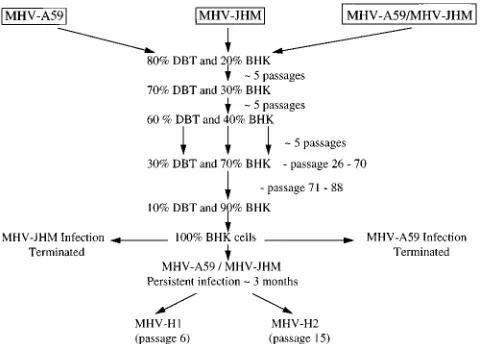
Because changing environmental niches appeared to favor the emergence and interspecies transfer of zoonotic pathogens in natural settings (36, 39), we passaged MHV in progressively decreasing concentrations of murine DBT cells (permissive) and progressively increasing concentrations of BHK cells (non-permissive). BHK cells were chosen since MHV fails to enter or replicate in these nonpermissive cells (9, 12, 13), yet MHV-JHM causes receptor independent fusion between murine and BHK cell lines in vitro (19). This may enhance the opportunity for virus evolution and adaptation to hamster cell lines. MHV-A59, MHV-JHM, or an equal mix of both viruses was serially passaged in separate cultures containing 90% DBT and 10%
BHK cells. Every;5 passages, the concentrations of DBT and
BHK cells were altered in 10% increments; i.e., virus from passage 5 was inoculated onto cultures containing 80% DBT and 20% BHK cells. Between passages 30 and 75, virus prog-eny were inoculated onto 70% BHK–30% DBT cell mixtures because inadequate virus replication was detected in higher ratios of BHK cells. After passage 75, the concentrations of cells was slowly adjusted to 90% BHK and 10% DBT cells over the next 14 passages. By passage 89, only the mixed
MHV-A59/MHV-JHM inoculum caused significant syncytia (;50%)
and cell death in 100% of BHK cells (Fig. 1). In contrast, only
on November 9, 2019 by guest
minor amounts of cytopathic effect and viral RNA were de-tected in MHV-A59- or MHV-JHM-infected BHK cells (data not shown).
Since virus evolution is enhanced during persistent infection (9) and because the progeny from the passage 89 MHV-A59/ MHV-JHM mixed infection were rapidly lost with serial pas-sage in 100% of BHK cells, we continuously cultured the per-sistently infected BHK cell survivors. Low levels of infectious virus were detected for 3 months, at which time progeny virions were serially passaged 15 times in 100% BHK cells, demon-strating that MHV host range mutants had evolved (Fig. 1). Viruses from passages 6 (MHV-H1) and 15 (MHV-H2) were plaque purified in BHK cells, and stocks were propagated for use in subsequent experiments. The MHV-H variants were small-plaque mutants in both BHK and DBT cells. In DBT cells, the MHV-H2 variant produced plaques significantly
smaller, 0.0760.02 mm, than the 0.2460.04-mm plaques for
MHV-A59 or MHV-JHM (P , 0.001). Interestingly, serial
passage of MHV-A59 or MHV-JHM singly infected mixed cultures did not result in the emergence of isolates that bridged the species barrier.
Virus growth curves in murine and Syrian hamster cell lines.To characterize the host range phenotype of the MHV-H variants, cultures of 17Cl-1 (murine) and BHK cells were in-fected with MHV-A59, MHV-JHM, MHV-H1, or MHV-H2 at an MOI of 10 for 1 h at room temperature. The cultures were overlaid with medium, and virus samples were isolated at dif-ferent times postinfection (Fig. 2). In 17Cl-1 cells, MHV-A59
and MHV-JHM replicated to titers approaching 108and 107,
respectively. Under identical conditions of treatment,
MHV-H1 and MHV-H2 replication was less efficient, with
titers approaching;43106. Both parental viruses, as well as
the MHV-H variants, produced significant syncytia in 17Cl-1
cells within;16 h postinfection. In agreement with previous
studies, no MHV-A59 or MHV-JHM replication was detected in BHK cells (9, 13, 28). Under identical treatment conditions, however, both hamster-derived variants produced extensive
syncytia and replicated to titers approaching 108within 36 to
48 h postinfection. Using a polyclonal antiserum against MHV-3 and fluorescent antibody staining techniques, we de-termined that MHV-specific antigens were clearly present in the MHV-H2-infected BHK cultures but not in those infected with MHV-A59 or MHV-JHM (data not shown). These data
suggested that H2 was antigenically similar to MHV-A59 and MHV-JHM.
The MHV-H2 isolate was also more virulent in murine DBT
and 17Cl-1 cells, resulting in.99.998% cell mortality in 30 h,
compared with only;96.0% cell mortality with MHV-A59 or
MHV-JHM. MHV-H2 was also extremely cytolytic and
de-stroyed over.99.998% of the BHK cell monolayer within 4
days postinfection. Under identical conditions, no BHK cell death was evident in MHV-A59- or MHV-JHM-infected cul-tures.
[image:3.612.59.301.70.242.2]Viral RNA synthesis in 17Cl-1 and BHK cells.To provide additional evidence that the MHV-H2 variant virus replicated efficiently in 17Cl-1 and BHK cells, cultures were infected and intracellular RNA isolated at different times postinfection. Equivalent amounts of intracellular RNA were bound to ni-trocellulose filters and probed with a PCR fragment spanning nt 844 to 1415 in the MHV-H2 N gene. The MHV-H2 probe detected MHV-A59 and MHV-H2 RNAs in 17Cl-1 cells, dem-onstrating that the MHV-H2 variant was closely related to the parental MHV strains (data not shown). The blots were scanned by AMBIS RIS, and levels of viral RNA were quan-tified and graphed (Fig. 3). Both parental viruses and MHV-H2 transcribed significant quantities of viral RNAs fol-lowing infection of 17Cl-1 cells. Interestingly, while MHV-H2 replicated to lower titers than either of the parental viruses in 17Cl-1 cells, equivalent amounts of viral RNA were detected with this assay. Consistent with the ability to make infectious virus, only MHV-H2 synthesized significant quantities of viral
FIG. 1. Selection scheme for host range mutants of MHV in vitro.
FIG. 2. Virus growth in murine and Syrian hamster cell lines. Cultures of 17Cl-1 and BHK cell lines containing 23106
cells were infected with MHV-A59, MHV-JHM, MHV-H1, or MHV-H2 at an MOI of 10 for 1 h at room temper-ature. The inoculum was removed, the monolayers were washed twice, and samples were taken at the indicated times for plaque assay in DBT cells.
on November 9, 2019 by guest
http://jvi.asm.org/
RNA in BHK cells (Fig. 3). Similar findings were evident with MHV-H1 (data not shown).
Viral transcription in 17Cl-1 and BHK cells.To compare the quantities and sizes of the parental and hamster-adapted viral mRNAs, cultures of 17Cl-1 and BHK cells were infected with MHV-H2, MHV-H1, MHV-A59, or MHV-JHM and
ra-diolabeled with [32P]orthophosphate from 6 to 7 and 17 to 18 h
postinfection, respectively. The different labeling periods re-flected the delay in MHV-H2 replication seen in BHK cells compared with its replication in murine cell lines. After radio-labeling, intracellular RNA was isolated and separated on 0.8% agarose gels. Seven viral mRNAs were synthesized by MHV-H2 and the parental viruses in 17Cl-1 cells, although the sizes of MHV-H2 mRNAs 2 and 3 were more like those of JHM (Fig. 4A). Similar findings were noted with MHV-H1 (data not shown). Increased rates of transcription were also noted with MHV-H2 in 17Cl-1 cells compared to the parental controls. As expected, only the MHV-H variants transcribed detectable levels of viral mRNA in BHK cells (Fig. 4B). These results suggest that the MHV-H2 and MHV-H1 isolates are more homologous to MHV-JHM than MHV-A59, especially in the S and HE glycoprotein genes.
Host range specificity of the MHV-H2 isolate.Genetic al-terations in the MHV-H variant viruses may have accorded a specific capacity to infect hamster cells or bestowed a broader host range specificity. To address this question, we analyzed the replication efficiencies of these viruses in various host spe-cies in vitro.
Cultures of cells were infected with MHV-A59 or MHV-H2, and virus titers and intracellular RNA were examined at dif-ferent times postinfection. Not surprisingly, MHV-H2
repli-cated most efficiently in cell lines derived from Mesocricetus
auratus(Syrian) hamsters (DDT-1) andCricetulus griseus
(Chi-nese) hamsters (CHO). In DDT-1 cells, MHV-H2 produced
were also evident in these cell lines (Fig. 6 and 7). Under identical treatment conditions, no parental MHV-A59 or MHV-JHM replication was apparent. These results indicated that genetic changes in the MHV-H2 genome have conferred a broad host range specificity. Since little virus replication and RNA synthesis were observed in ST (porcine) cells and no replication was evident in CRFK (feline) cells, specific host factors were still required to initiate a productive MHV-H2 infection (Fig. 6 and 7).
MHV-H2 genomic organization.To elucidate the molecular
basis for MHV interspecies spread, we sequenced the 39-most
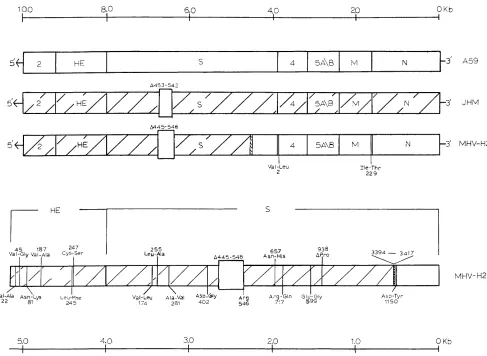
;10 kb of the MHV-H2 genome (Fig. 8 and Table 1).
MHV-H2 was an RNA recombinant virus containing a 59end
derived from MHV-JHM and a 39 end derived from
MHV-A59. The crossover site in MHV-H2 resided between nt 3394
and 3417 within the;4.1-kb S glycoprotein, effectively
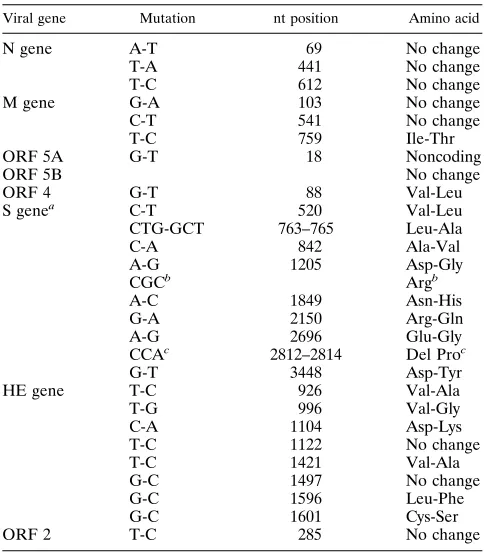
intro-ducing nine A59 amino acid changes into the MHV-JHM S glycoprotein gene (32, 50). No amino acid changes were detected in the N gene, SM glycoprotein gene (ORF 5B), ORF 5A, or ORF 2 genetic domain, demonstrating that these loci do not encode critical determinants of interspecies spread (Fig. 8 and Table 1). No alterations were noted within the
FIG. 3. Viral RNA synthesis in murine and Syrian hamster cell lines. Cul-tures of 17Cl-1 and BHK cell lines containing 23106
[image:4.612.71.287.70.312.2]cells were infected with MHV-A59 or MHV-H2 at an MOI of 10 for 1 h at room temperature. Intra-cellular RNA was isolated from the cells at the designated time points, equiva-lent amounts were bound to nitrocellulose filters and probed with an MHV-H2 N gene cDNA probe, and total counts per minute was quantified by AMBIS RIS.
FIG. 4. Viral RNA synthesis in murine and hamster cell lines. Cultures of 17Cl-1 or BHK cells were infected with MHV-A59, MHV-JHM, MHV-H1, or MHV-H2 at an MOI of 10 for 1 h. The cultures were radiolabeled with 300mCi of [32P]orthophosphate per ml from 7 to 8 h postinfection in 17Cl-1 cells or 17
to 18 h postinfection in BHK cells. Intracellular RNA isolated and separated on 0.8% agarose gels. (A) 17Cl-1 cells infected with MHV-A59 (lane 1), MHV-H2 (lane 2), or MHV-JHM (lane 3); (B) BHK cells infected with MHV-A59 (lane 1), MHV-H2 (lane 2), or MHV-H1 (lane 3).
on November 9, 2019 by guest
FIG. 5. Virus replication in Syrian and Chinese hamster cell lines. Cultures of Syrian hamster smooth muscle (DDT-1) or CHO cells were infected with MHV-A59 or MHV-H2 at an MOI of 10 for 1 h. The inoculum was removed, the monolayers were washed twice, and samples were taken at the indicated times for plaque assay in DBT cells. (A) Virus replication in DDT-1 and in CHO cells; (B) viral RNA synthesis in CHO and DDT-1 cells.
FIG. 6. Virus replication in primate and feline cell lines. Cultures of African green monkey kidney (Vero) and feline kidney (CRFK) cells were infected with MHV-A59 or MHV-H2 at an MOI of 10 for 1 h. The inocula were removed, the monolayers were washed twice, and samples were taken at the indicated times for plaque assay in DBT cells. (A) Virus replication in Vero and CRFK cells; (B) virus RNA synthesis in Vero and CRFK cells.
on November 9, 2019 by guest
http://jvi.asm.org/
MHV-H2 intergenic domains. A single C-terminal amino acid alteration was detected in the MHV-H2 M glycoprotein gene; this is an unlikely candidate for interspecies spread since it functions in assembly and release (3, 28). The amino acid 2
amino acids (48), resulting in the insertion of an Arg residue. A 3-nt deletion between nt 2813 and 2815 resulted in the loss of position 938 proline. An additional eight mutations were noted in the S glycoprotein; six resulted in amino acid changes within the S1 domain, including a position 717 Arg-Gln change that resided within the S1-S2 protease cleavage site (25). Two additional amino acid changes were noted in S2. Rates of HE mutation fixation were increased about 2.6-fold compared to
subgenomic ORFs which do not function in entry (P,0.03).
Interestingly, six of eight mutations resulted in amino acid changes (Table 1).
Evolutionary mechanisms for MHV-H2 interspecies
trans-fer.Since MHV-H2 was derived from known progenitor strains
over a 200-day period under clearly defined conditions of en-vironmental flux, this biological model allowed us to elucidate the molecular evolutionary processes governing virus host range specificity in vitro. We have demonstrated an increased rate of evolution in the S and HE glycoprotein genes relative to evolution rates noted in viral genes that do not function in entry, suggesting that specific portions of the MHV-H2 ge-nome may have evolved by episodic evolution. Overall rates of nonsynonymous mutations were also shown to be increased in the MHV-H2 attachment genes (HE and S) compared to the
remaining subgenomic ORFs (x2510.65,P,0.002) (Table
2). Individual increases in both the HE (x2511.71,P,0.001)
and S (x2 54.93,P, 0.03) genes compared to rates in the
remaining subgenomic ORFs were noted (Table 2). Inclusion of the 12-amino-acid deletion noted in the region of S gene polymorphism resulted in even greater statistical significance
(x2518.11,P,0.001) in the nonsynonymous mutation rate.
Importantly, no synonymous mutations were detected within the MHV-H2 S gene, and only two of eight mutations were synonymous in HE (Tables 1 and 2). In contrast, viral genes which did not function in entry demonstrated near genetic stasis, with synonymous changes predominating (Tables 1 and 2). Since neither lineage effects nor neutral theory could ac-count for the evolutionary pulse or the increased rate of non-synonymous mutations detected within the MHV-H2 HE and S genes, episodic evolution and positive Darwinian selection at the molecular level likely modulated interspecies transfer in vitro (14, 20, 21).
DISCUSSION
[image:6.612.64.297.64.614.2]Virus interspecies traffic.Animal virus host range specificity and the evolution of new viral diseases are complex phenom-ena involving interactions between the virus, the host, and the environment. Emerging viruses are frequently defined as either newly recognized viruses or viral pathogens that are rapidly
FIG. 7. Replication in human and porcine cell lines. Cultures of human adenocarcinoma (HRT) and porcine testicular (ST) cells were infected with MHV-A59 or MHV-H2 at an MOI of 10 for 1 h. The inoculum was removed, the monolayers were washed twice, and samples were taken at the indicated times for plaque assay in DBT cells. (A) Virus replication in HRT and ST cells; (B) virus RNA synthesis in HRT and ST cells.
on November 9, 2019 by guest
increasing in incidence or expanding in geographic range (1, 36). Recent examples include equine morbillivirus, HIV, han-tavirus, hemorrhagic fever viruses, arboviruses, and bovine spongiform encephalopathy, canine distemper, and influenza viruses (2, 36, 39). While these newly emerging pathogens are highly heterogeneous in their structures and replication strat-egies, many are zoonotic pathogens that have bridged the spe-cies barrier by evolving the capacity to interact with specific cellular factors which normally function to ablate virus entry, replication, or transmission in the new host species.
Coronaviridaeinclude a diverse group of highly species
spe-cific avian and mammalian viruses. While human coronavirus (HCV-229E and HCV-OC43) infections are associated with about 15 to 30% of the common colds in winter, human and murine-like neurotropic coronaviruses are also present in chronic neurological diseases such as multiple sclerosis (7, 42, 55). Newly emerging coronavirus infections include porcine epidemic diarrhea virus, a close relative of HCV-229E, and porcine respiratory disease virus, which probably evolved from transmissible gastroenteritis virus (5, 49).
Among RNA viruses, host range specificity is usually medi-ated at the level of entry and has been best studied in murine-adapted strains of picornaviruses and with influenza virus (63). In the Lansing strain of poliovirus, murine adaptation
primar-ily involved changes in the viral capsid proteins that permitted entry into the adopted host (41). Rhinovirus host range spec-ificity has been found to be mediated at entry and during virus replication (63, 64). Among influenza A viruses, host range discrimination was polygenic and primarily involved genetic determinants within the nucleoprotein that affected the repli-cation of the virus in various hosts (22, 51). Other influenza virus genes, including the hemagglutinin and polymerase genes, also encoded important determinants affecting host range specificity (6, 56, 58). Canine parvovirus type 2 emerged in 1978 as a variant of feline panleukopenia virus or some other closely related parvovirus infecting carnivores (46). Host range expansion was due to a few changes in a region of the virus capsid where three protein monomers interact (59). As for picornaviruses, variants of MHV-JHM that replicate effi-ciently and produce a panencephalitis with accompanying de-myelination in the primate central nervous system have been isolated after in vivo passage (43).
[image:7.612.66.553.66.422.2]In contrast to other models, we have isolated host range mutants by altering the natural ecosystem in vitro. By estab-lishing a transmission impediment (10, 26), new viral variants which replicated more efficiently than either parental strain in the new host cell environment evolved. Since MHV variant viruses isolated from persistently infected cultures of DBT
FIG. 8. Organization of the MHV-H2 genome. The organization of the MHV-A59 (open) and MHV-JHM (hatched) genomes are shown in relation to the organization of the MHV-H2 genome. Individual viral genes are boxed according to their locations in the MHV genome. MHV-H2 is an RNA recombinant virus containing portions of both MHV-A59 and MHV-JHM with the crossover site residing within the S glycoprotein gene. The region of polymorphism in the MHV-JHM S glycoprotein gene is extended by the removal of an additional 12 amino acids in the MHV-H2 genome (48). The locations of the amino acid changes in the MHV-H2 S and HE glycoprotein genes are also shown.
on November 9, 2019 by guest
http://jvi.asm.org/
cells do not evolve the capacity to replicate in hamster cell lines in vitro (9), it seems likely that the MHV-H host range variants evolved in response to the presence of increasing concentra-tions of BHK cells. Efficient MHV-H adaptation and replica-tion, however, were not accomplished until a persistent infec-tion was established in hamster cell lines. Although the mechanism is speculative, persistent infection may have se-lected not only for the emergence of resistant host cells that expressed little receptor protein but also for the subsequent coevolution of more virulent virus variants that recognized alternative receptors for entry (9).
Interestingly, serial passage of singly infected MHV-A59 and MHV-JHM cultures did not result in the emergence of isolates that replicated efficiently in hamster cell lines. While these findings do not imply that host range mutants of MHV-A59 or MHV-JHM cannot evolve under continued selection, mechanistically, rapid evolution in the MHV-H2 S glycopro-tein gene was primarily driven by RNA recombination. These findings suggest that RNA recombination maximizes the rate at which genetic variability accumulates in viral genes critical for host range specificity (16, 28). In support of this hypothesis, type-specific oligonucleotide probes demonstrated that at least five other MHV-H isolates were recombinant viruses contain-ing a genome organization like MHV-H2 (data not shown). The increased MHV-H virulence in vitro may also reflect a serious consequence of recombination and cross-species trans-mission of zoonotic viruses in nature, an extremely cytolytic course of infection in the adopted host (15). For example, simian immunodeficiency virus infection is extremely cytolytic in human cell lines yet produces a noncytolytic infection in the natural host (1).
zoonotic transfer resulted in increased morbidity and mortality in both equine and human hosts (40). These examples suggest that interspecies transfer of viruses may evolve by changes which confer broad host range specificity, followed by adapta-tion and speciaadapta-tion within a particular host.
MHV-H2 has likely remodeled its normal interactions with cellular receptors. Although we cannot exclude the possibility that mutations in the ORF 1a or ORF 1b polymerase gene may have contributed to MHV-H2 replication, the sequence data suggest that the HE and S glycoprotein genes represent the principal genetic determinants mediating interspecies traffic of coronaviruses. While the MHV HE glycoprotein is not re-quired for entry (31, 66), the MHV-H2 HE may now function like the bovine coronavirus HE glycoprotein and recognize neuramic acid residues on cellular proteins as receptors for entry (28, 60). Alternatively, the S glycoprotein gene interacts with the murine Bgp glycoprotein receptor (12, 13, 57, 66). Since human, rat, and murine Bgps are highly conserved in nature and vary by 60 to 90% at the amino acid level (30), this model may reveal whether phylogenetic homologs of the nor-mal receptor function as natural conduits for interspecies traf-fic of coronaviruses.
Interspecies transfer and coronavirus evolution. Phyloge-netic analysis of the group II coronaviruses have predicted two clades, one containing bovine coronavirus and HCV-OC43 and the other containing MHV and rat coronaviruses (37, 38, 67). Comparisons of sequences among the viruses indicate that the N and M structural proteins are most highly conserved, with the greatest sequence diversity evident in the S and HE glyco-protein genes. In the S gene, the greatest heterogeneity is detected within the S1 domain (31, 32, 37, 38, 48, 67). These
G-A 2150 Arg-Gln
A-G 2696 Glu-Gly
CCAc 2812–2814 Del Proc
G-T 3448 Asp-Tyr
HE gene T-C 926 Val-Ala
T-G 996 Val-Gly
C-A 1104 Asp-Lys
T-C 1122 No change
T-C 1421 Val-Ala
G-C 1497 No change
G-C 1596 Leu-Phe
G-C 1601 Cys-Ser
ORF 2 T-C 285 No change
[image:8.612.57.299.89.365.2]aDoes not include the 9-nt differences from MHV-A59. bResulting from the deletion in viral amino acids 445 to 546. cResulting from a 3-nt deletion in the S gene sequence.
TABLE 2. Fixation rates of synonymous and nonsynonymous substitutions for MHV-H2 genes
Viral gene(s)
No. of substitutions/site/yra
Synonymous Nonsynonymous
S/HE 6.7531024 4.7231023
M, N, 5AB, 4, 2 2.9231023 8.3631024
HE 2.7031023 8.1331023
S 0 3.5931023
N 3.2931023 0
M 4.6731023 2.4331023
5AB 2.7031023 0
4 0 4.4031023
2 2.1731023 0
aDoes not include alterations resulting from recombination and deletion.
on November 9, 2019 by guest
[image:8.612.317.555.601.717.2]findings may reflect evolutionary patterns detected in the MHV-H2 genome and suggest that the increased heterogene-ity noted in the HE and S genes in the group II coronaviruses was partially a consequence of interspecies transfer and adap-tation to new host species. Importantly, the S and HE glyco-protein genes of MHV-H2 contain less sequence variation than that noted among different MHV strains in nature (31, 32, 48, 66). These findings suggest that a relatively few amino acid alterations are needed to alter species specificity in coronavi-ruses.
Beyond the generalized interpretation that mutations in the MHV-H2 HE and S glycoprotein have expanded host range specificity, no predictions can be made concerning the impor-tance of individual mutations in this process. Certainly muta-tions likely function in the establishment and maintenance of MHV persistence in BHK cells or alter virus fusion, virulence, or cell cytopathic effects in vitro. For example, a position 717 Arg-Gln change within the S1-S2 putative host protease cleav-age site likely evolved as a consequence of persistence and functions to decrease the rate of MHV-H2-induced fusion. Similar mutations have been detected during persistent MHV infection in murine cell lines (25). The MHV-H variants should provide a means to identify virus residues that bind with cellular receptor proteins and permit the identification of host receptor protein residues that bind virus to initiate a produc-tive infection in different species.
Evolutionary mechanisms of virus interspecies spread.
While the neutral or nearly neutral allele theories have suc-cessfully accounted for many of the evolutionary phenomena observed at the molecular level (24, 27, 45), a number of findings have suggested that natural selection may also shape the genetic structure of populations (20, 21). In support of neutral theory, sequence analyses of many RNA and DNA viruses have demonstrated that the accumulation of synony-mous substitutions is about three- to fivefold higher than the rate for nonsynonymous substitutions and also revealed that many viral evolutionary clocks appear somewhat constant (24). In contrast, eastern equine encephalitis virus has displayed little genetic change over the past 50 years despite a prediction of high mutation frequency (61). In addition, several reports have demonstrated the accumulation of nonsynonymous sub-stitutions during RNA virus or retrovirus evolution (8, 11). Episodic selection theory proposes that molecular evolution may be limited by the rate of change in the environment, with one or more loci evolving by natural selection, genetic drift, and mutation in response to these changing conditions. Influ-enza A viruses have probably evolved by positive Darwinian selection in response to host immune selection because hem-agglutinins evolved more rapidly than nonstructural genes and fixed proportionately more nonsynonymous mutations in anti-genic sites in survivors than in nonsurvivors (17). Molecular evolution in the P gene of vesicular stomatitis virus correlates with a south-to-north geographic migration and is more con-sistent with episodic evolution and positive Darwinian selec-tion (44).
The extraordinarily high mutation rates seen in the MHV-H2 S and HE glycoprotein genes (Table 2) are compa-rable with rates observed in HIV and influenza virus except that the majority of MHV-H2 mutations result in nonsynony-mous changes. Although other mechanisms may also account for the emergence of new viral diseases in nature, our findings are most consistent with Gillespie’s episodic selection theory since nonsynonymous mutations predominate and lineage ef-fects could not account for the evolutionary pulse detected in these genes (14, 20, 21). In contrast to neutral theory, our findings also suggest that natural selection may actually
in-crease the evolution rates in functionally more important ge-netic domains such as receptor binding residues, thereby per-mitting more rapid viral adaptation, entry, and survival within alternative hosts. While neutral theory could explain the evo-lutionary changes seen in those MHV genes which did not function in entry, positive Darwinian natural selection in the S and HE glycoprotein genes was probably the principal force driving the adaptation of MHV-H2 to hamster cell lines. Un-fortunately, theories explaining evolutionary change and poly-morphism by natural selection are not as well developed as neutral theory because of the inherent difficulties in modeling ecosystems and identifying the targets of selection at the mo-lecular level (20, 21). More model systems are needed to de-termine whether neutral evolution is an important evolution-ary phenomena or represents, as suggested by some naturalists, little more than evolutionary noise (34).
ACKNOWLEDGMENTS
This research was supported by grant AI23946 from the National Institutes of Health and was performed during the tenure of an Es-tablished Investigator Award of the American Heart Association (AHA 89-0193) (R.S.B.). Wan Chen was supported by postdoctoral fellowship 5 T32 A107151-16 from the National Institutes of Health.
REFERENCES
1.Allan, J. S.1992. Viral evolution and AIDS. J. NIH Res.4:51–54. 2.Ampel, N. M.1991. Plagues—what’s past is present: thoughts on the origin
and history of new infectious diseases. Rev. Infect. Dis.13:658–665. 3.Armstrong, J., H. Niemann, S. Smeekens, P. Rottier, and G. Warren.1984.
Sequence and topology of a model intracellular membrane protein, E1 glycoprotein, from a coronavirus. Nature308:751–752.
4.Baric, R. S., K. S. Fu, M. C. Schaad, and S. A. Stohlman.1990. Establishing a genetic recombination map for MHV-A59 complementation groups. Vi-rology177:646–656.
5.Bridgen, A., M. Duarte, K. Tobber, H. Laude, and M. Ackermann.1993. Sequence determination of the nucleocapsid gene of a porcine epidemic diarrhea virus confirms that it is closely related to human coronavirus 229E and TGEV. J. Gen. Virol.74:1795–1804.
6.Brown, E. G.1990. Increased virulence of a mouse-adapted variant of influ-enza A/FM/1/47 virus is controlled by mutations in genome segments 4, 5, 7, and 8. J. Virol.64:4523–4533.
7.Burks, J. S., B. L. Pelletier, V. Calvez, and F. Colbere-Garapin.1980. Two coronaviruses isolated from central nervous system tissue of two multiple sclerosis patients. Science209:933–934.
8.Burns, D. P. W., and R. C. Desrosiers.1991. Selection of genetic variants of simian immunodeficiency virus in persistently infected rhesus monkeys. J. Virol.65:1843–1854.
9.Chen, W., and R. S. Baric.1996. Molecular anatomy of MHV persistence: coevolution of increased host resistance and virus virulence. J. Virol.70:
3947–3960.
10. Clarke, D. K., E. A. Duarte, A. Moya, S. F. Elena, E. Domingo, and J. Holland.1993. Genetic bottlenecks and population passages cause profound fitness differences in RNA viruses. J. Virol.67:222–228.
11. Diez, J., M. Davila, C. Escarmis, M. G. Mateu, J. Dominguez, J. J. Perez, E. Giralt, J. A. Melero, and E. Domingo.1990. Unique amino acid substitutions in the capsid proteins of foot-and-mouth disease virus from a persistent infection in cell culture. J. Virol.60:5519–5528.
12. Dveksler, G. S., C. W. Pensiero, C. B. Cardellichio, K. McCuaig, M. N. Pensiero, G.-S. Jiang, N. Beauchemin, and K. V. Holmes.1993. Several members of the mouse carcinoembryonic antigen-related glycoprotein family are functional receptors for the coronavirus mouse hepatitis virus-A59. J. Vi-rol.67:1–8.
13. Dveksler, G. S., M. N. Pensiero, C. B. Cardellichio, R. K. Williams, G.-S. Jiang, K. V. Holmes, and C. W. Dieffenbach.1991. Cloning of the mouse hepatitis virus (MHV) receptor: expression in human and hamster cell lines confers susceptibility to MHV. J. Virol.65:6881–6891.
14. Eldredge, N., and S. J. Gould.1977. Punctuated equilibria: an alternative phyletic gradualism, p. 82–115.InT. J. M. Schopf (ed.), Models in paleobi-ology. Freeman and Cooper, San Francisco, Calif.
15. Ewald, P. W.1990. Transmission modes and the evolution of virulence. Hum. Nat.2:1–30.
16. Fernandez-Cuartero, B., J. Burgyan, M. A. Aranda, K. Salanki, E. Moriones, and F. Garcia-Arenal.1994. Increase in the relative fitness of a plant virus RNA associated with its recombinant nature. Virology203:373–377. 17. Fitch, W. M., J. M. E. Leiter, X. Li, and P. Palese.1991. Positive Darwinian
evolution in human influenza A virus. Proc. Natl. Acad. Sci. USA88:4270– 4274.
on November 9, 2019 by guest
http://jvi.asm.org/
populations as quasispecies. Curr. Top. Microbiol. Immunol.176:1–43. 27. Kimura, M.1989. The neutral theory of molecular evolution and the world
view of the neutralists. Genome31:24–31.
28. Lai, M. M. C.1990. Coronaviruses: organization, replication and expression of genome. Annu. Rev. Microbiol.44:303–333.
29. Lai, M. M. C.1992. Genetic recombination in RNA viruses. Curr. Top. Microbiol. Immunol.176:21–32.
30. Lin, S.-H., and G. Guidotti.1989. Cloning and expression of a cDNA coding for a rat liver plasma membrane ecto-ATPase. The primary structure of the ecto-ATPase is similar to that of the human biliary glycoprotein I. J. Biol. Chem.264:14408–14414.
31. Luytjes, W., P. J. Bredenbeek, A. F. H. Noten, M. C. Horzinek, and W. J. M. Spaan.1988. Sequence of mouse hepatitis virus A59 mRNA 2: indications for RNA recombination between coronavirus and influenza C virus. Virology
166:415–422.
32. Luytjes, W., P. J. Bredenbeek, J. Charite, B. A. van der Zeijst, M. C. Horzinek, and W. J. Spaan.1987. Primary structure of the glycoprotein E2 of coronavirus MHV-A59 and identification of the trypsin cleavage site. Virology161:479–487.
33. Makino, S., J. G. Keck, S. A. Stohlman, and M. M. C. Lai.1986. High frequency RNA recombination of murine coronaviruses. J. Virol.57:729– 737.
34. Mayer, E.1994. Driving forces in evolution. An analysis of natural selection, p. 29–48.InS. S. Morse (ed.), The evolutionary biology of viruses. Raven Press, New York, N.Y.
35. Michler, R. E.1996. Xenotransplantation: risks, clinical potential and future prospects. Emerging Infect. Dis.2:64–70.
36. Morse, S. S., and A. Schluederberg.1990. Emerging viruses: the evolution of viruses and viral diseases. J. Infect. Dis.162:1–15.
37. Mounir, S., and P. J. Talbot.1992. Sequence analysis of the membrane protein gene of human coronavirus OC43 and evidence of O-glycosylation. J. Gen. Virol.73:2731–2736.
38. Mounir, S., and P. J. Talbot.1993. Molecular characterization of the S protein gene of human coronavirus. J. Gen. Virol.74:1981–1989. 39. Murphy, F. A.1994. New emerging and reemerging infectious diseases. Adv.
Virus Res.43:1–52.
40. Murray, K., P. Selleck, P. Hooper, A. Hyatt, A. Gould, L. Gleeson, H. Westbury, L. Hiley, L. Selvey, B. Rodwell, and P. Ketterer.1995. A morbil-livirus that caused fatal disease in horses and humans. Science268:94–97. 41. Murray, M. G., J. Bradley, X.-F. Yang, E. Wimmer, E. G. Moss, and V. R.
Racaniello.1988. Poliovirus host range is determined by a short amino acid sequence in neutralization antigenic site I. Science241:213–215. 42. Murray, R. S., B. Brown, D. Brian, and G. F. Gabirac.1992. Detection of
coronavirus RNA and antigen in multiple sclerosis brain. Ann. Neurol.
31:525–533.
43. Murray, R. S., G.-Y. Cal, K. Hoel, J.-Y. Zhang, K. F. Soike, and G. F.
51. Scholtissek, C., I. Koennecke, and R. Rott.1978. Host range recombinants of fowl plaque (influenza A) virus. Virology91:79–85.
52. Shope, R. E.1931. Swine influenza. III. Filtration experiments and etiology. J. Exp. Med.54:373–380.
53. Shope, R. E.1958. Swine influenza, p. 81–91.InH. W. Dunne (ed.), Diseases of swine, 1st ed. Iowa State University Press, Ames.
54. Skinner, M. A., D. Ebner, and S. G. Siddell.1985. Coronavirus MHV-JHM mRNA 5 has a sequence arrangement which potentially allows translation of a second, downstream open reading frame. J. Gen. Virol.66:581–592. 55. Stewart, J. N., S. Mounir, and P. J. Talbot.1992. Human coronavirus gene
expression in the brains of multiple sclerosis patients. Virology191:502–505. 56. Subbarao, E. K., W. London, and B. R. Murphy.1993. A single amino acid in the PB2 gene of influenza A virus is a determinant of host range. J. Virol.
67:1761–1764.
57. Suzuki, H., and F. Taguchi.1996. Analysis of the receptor binding site of murine coronavirus spike glycoprotein. J. Virol.70:2632–2636.
58. Tian, S.-F., A. J. Buckler-White, W. T. London, L. J. Reck, R. M. Chanock, and B. R. Murphy.1985. Nucleoprotein and membrane protein genes are associated with restriction of replication of influenza A/Mallard?NY/78 virus and its reassortants in squirrel monkey respiratory tract. J. Virol.53:771–775. 59. Truyen, U., J. F. Evermann, E. Vieler, and C. R. Parrish.1996. Evolution of canine parvovirus involved loss and gain of feline host range. Virology
215:186–189.
60. Vlasak, R., W. Luytjes, W. J. M. Spaan, and P. Palese.1988. Human and bovine coronaviruses recognize sialic acid containing receptors similar to those of influenza viruses. Proc. Natl. Acad. Sci. USA85:4526–4529. 61. Weaver, S. C., T. W. Scott, and R. Rico-Hesse.1991. Molecular evolution of
eastern equine encephalomyelitis virus in North America. Virology182:774– 781.
62. Webster, R. G., J. R. Geraci, G. Petursson, and K. Skirnmission.1981. Conjunctivitis in human beings caused by influenza A virus of seals. N. Engl. J. Med.304:911–914.
63. Wimmer, E.1994. Cellular receptors for viruses, p. 1–14.InE. Wimmer (ed.), Cellular receptors for viruses. Cold Spring Harbor Laboratory Press, Plainview, N.Y.
64. Yin, F. H., and N. B. Lomax.1983. Host range mutants of human rhinovi-ruses in which nonstructural genes are altered. J. Virol.48:410–418. 65. Yokomori, K., and M. M. C. Lai.1991. Mouse hepatitis virus S RNA
se-quence reveals that nonstructural proteins ns4 and ns5a are not essential for murine coronavirus replication. J. Virol.65:5605–5608.
66. Yokomori, K., L. R. Banner, and M. M. C. Lai.1991. Heterogeneity of gene expression of the hemagglutinin-esterase (HE) protein of murine coronavi-ruses. Virology183:647–657.
67. Zhang, X., K. G. Kousoulas, and J. Storz.1992. The hemagglutinin gene of human coronavirus OC43: Phylogenetic relationships to bovine and murine coronaviruses and influenza C virus. Virology180:221–228.