A STUDY ON
PATHACHAKKARAM
Dissertation Submitted To
THE TAMIL NADU DR.M.G.R. Medical University
Chennai – 32
For the Partial fulfillment for Awarding the Degree of
DOCTOR OF MEDICINE (SIDDHA)
(Branch V – NOI NAADAL)
DEPARTMENT OF NOI NAADAL
Government Siddha Medical College
Palayamkottai – 627 002
ACKNOWLEDGEMENT
First and foremost, gratitude to the Almighty for his showered
blessings to perform my duties in the dissertation works.
I wish to express my deep sense of gratitude to my parents and
my wife who are very supportive to me at all time.
I wish to express very much thankful to the esteemed authorities of the
Tamil Nadu Dr. M.G.R. Medical University, Chennai, The Director of
Indian medicine and homeopathy. The author expresses dignity and
gratitude to the Joint director of Indian medicine and homeopathy
Dr. I. Sornamariammal M.D(S)., Chennai for giving permission to
undertake this dissertation work.
I express my thanks to Dr. M. Dinakaran M.D (S)., Principal,
Govt Siddha Medical College, Palayamkottai for his permission to
undertake this dissertation work.
I also express my thanks to Dr. R. Devarajan M.D. (S).,
Vice principal, Head of the Department, Post Graduate Department of
Noi-Naddal branch, Govt Siddha Medical College, Palayamkottai for his
dynamic advice relating to all fields for this successful work.
I express my deep gratitude to Dr.Rajasekar M.D(S)., and
Dr.A.Vasuki M.D(S)., assistant lecturer for their valuable guidance and
I express my whole hearted thanks to Dr.S.K.Sasi M.D.(S)., assistant
lecturer for their encouragement and most valuable guidance to undertake
this dissertation study and timely help.
I express my thanks to Dr. Paramasivan M.D., (Pathology), Head of
the Department of pathology, T.V.M.C. Tirunelveli, for his valuable
guidance in the modern aspect of this study.
I express my sincere thanks to Dr.A. Arunagiri M.D. PGDHS
(Diab)., Shifa Hospital, Nellai, for his constant strategic support and
encouragement in completing this work.
I express my sincere thanks to Dr.Parimalam MS., Velaudhan Pillai
hospital, vannarapettai, for her valuable guidance.
I express my honorable thanks to Dr.R.SankaraNarayanan M.D. (S).,
assistant Lecturer, Department of Aruvai Maruthuvam for his valuable
guidance and encouragement in all aspect from time to time.
I express my thanks to Dr.Padma M.B.B.S, DMRD., Radiologist,
GSMC, Palayamkottai for her guidance in choosing dissertation topic.
I express my gratefulness to the librarian,
Mrs. T. Poongodi M.A. B.Lit., of GSMC, Palayamkottai for her
co-operation in referring the books.
The author express his thanks to Broad Band Net Café, (BBNC)
Palayamkottai. For their co-operation in bringing out this dissertation book
CONTENTS
Page No
Acknowledgement
I. Introduction 1
II. Siddha Physiology 4
III. Siddha Pathology 22
IV. Aim and Objectives 48
V. Elucidation about Pathachakkaram 50
VI. Detailed Pathological view of the Dissertation Topic
¾ Siddha View 52
¾ Modern View 58
VII. Theoretical view of Dissertation Topic in Modern Aspect
¾ Anatomy 63
¾ Physiology 75
¾ Pathology 81
VIII. Evaluation of the Dissertation Topic
¾ Materials and Methods 96 ¾ Clinical Parameters 97 ¾ Statistical analysis and Interpretations 99 ¾ Observation and results 99
IX. Discussion. 110
¾ Interpretation of Siddha Parameters 111 ¾ Interpretation of Modern Parameters 116 ¾ Highlights of the Dissertation topic 117
X. Conclusion 118
XI. Annexure
INTRODUCTION
Siddha system is one of the Ancient systems of medicine in India.
The system has been developed with philosophy or “Thathuvam” as its
base. Siddhars had given equal importance to “Vedantha” and
“Siddhantha”. This could be known by Thayumanavar’s Lines which
says,
‘Ntjhe;j rpj;jhe;j rkur ed;dpiy ngw;w tpj;jfr; rpj;jH fzNk”
Thd Siddha system flourished in south, Ayurvedha in north. The
origin of the Siddha system and the usage of medicinal plants belongs to
the age of the sangam literatures as early as 3000 B.C. Tholkappiam and
Thirumanthiram stand as a proof to this. It believes that all subjects in
the universe are composed of 5 basic elements (Pancha boothangal)
namely Earth, Water, Fire, Air and Sky. The diet is considered to be the
basic building material.
Siddhars had written their works on subjects, namely.
Alchemy (Rasavadham)
Medicine (Maruthuvam)
Surgery (Aruvai maruthuvam)
Asanam (Yoga)
They had also strictly emphasized on hygienic principles which
were neatly quoted in “Padarthaguna sinthamani”. With regard to Ivagai
nilam, Kalam, and Pozhuthu. According to this system “Mukkuttram” is
considerable to be responsible for any disease.
Disease is classified as,
i. Disease involves gross body (Udarpini)
ii. Disease involving subtle body (Manapini).
In siddha system the diseases are classified broadly as 4,448
diseases by siddhars , based on the “Tridoshic theory”
Aetiology (or) the cause for any disease is said to be diet and
day today activities. According to Thanvantri Vaithiyam
“PATHACHAKKARAM” – ghjr;rf;fuk<! Comes under the 9 types of
Patha rogangal.
The author of this dissertation work has selected
PATHACHAKKARAM” – one of the complications of the disease
“Madhumegam”. Improper treatment or improper diet of a
madhumegam patients leads to form “PATHACHAKKARAM”.
The word “Madhumegam” in Siddha terms correlates with that of
Twenty varieties according to the nature of urine have “ been
described in the ancient siddha texts under the subject “meha Neer”.
Depending upon, which of the three body humours is deranged four
varieties by Vali, six due to Azhal, and ten due to Iyam. One among in
Azhal is called Madhumegam (honey-Urine) or Kshaudra meham in
Ayurvedha. Shushrutha (600 BC) classified in to two, one congenital and
SIDDHA - PHYSIOLOGY
The science of the functions of the living organisms, its compounds,
the physical and chemical factors and processes involved is known as
physiology.
‘nrd;k khHrhPuk; njhz;Z}w;whW mq;Fykhk; nra;fpd;w mtutHfs; ifahNy jhd;”
! ! ! ! ! .!A+fpKdp itj;jpa rpe;jhkzp - 800!
The height of the human body is 96 inches or 8 saans of their own
hands.
The siddha Physiology involves the basis of
Thathuvas - ‘96’ Basic elements
Udal Kattugal - ‘7’ Somatic compounds
Vegams - ‘14’ Reflexial functions
Suvaigal - ‘6’ tastes
Udal Thee - ‘4’ Body fires
Udal Vanmai - ‘3’ Immunities.
The living and non living things which are present both in the
microcosm has 96 basic elements. These elements are responsible for the
creation, protection and destruction of life which is mediated through the
According to the “Yugi Vaidhya Chinthamani and Sathaga Naadi
Nool” the 96 Thathuvas are explained as follows.
96 Basic Factors:
‘cWjpahk; G+jhjp Nahiue;jhk;
caHfpd;w nghwp Ie;J Gyide;jhFk; fUjpahq; fd;k tpe;jphpa ike;Jk;
fbjhd Qhdtpe; jphpaike;Jk; jpUjpahe; jPjha fuzk; ehd;Fk;
jpwkhd mwpnthd;W ehbg;gj;Jk; kWjpahk; thAtJ gj;J khFk;
kfj;jhd thrake;R Nfhr kQ;Nr mQ;rNt ahjhu khW khFk;
mhpa kz;ly %d;W kyk; %d;whFk; njhQ;rNt Njhl %d;wPlid %d;Nwh
Nwhjfkha; Fz%d;W tpid apuz;lhk; jQ;rNt uhf nkl;ltj;ij iae;J
jaq;fpa NjhH fUtp fhlhd; njhz;Z}w;whW xQ;rNt naht;nthd;wha; tphpj;Jr; nrhy;Ntd;
cWjpahk; G+jhjp Aiuf;ff; NfNs.”
Pootham - 5 Naadi - 10 Dosham - 3
Pori - 5 Vayu - 10 Edanai - 3
Pulan - 5 Aasayam - 5 Gunam - 3
Kanmendhiryam - 5 Kosam - 5 Vinai - 2
Gnanendhriyam - 5 Aatharam - 6 Raagam - 8
Karanam - 4 Mandalam - 3 Avathai - 5
Arivu - 1 Malam - 3
Pancha Pootham – five basic elements
The fundamental principle of siddha science involves the five basic
elements namely.
1. Mann - Earth
2. Neer - Water
3. Thee - Fire
4. Vayu - Air
5. Aagayam - Eather
As per the siddha concepts, not only the universe but also the
It is well explained by “Sattamuni” as
‘mz;lj;jpYs;sNj gpz;lk;
gpzlj;jpYs;sNj mz;lk;”
Moreover any changes that occur in the universe has its impair
also in the body.
According to “Sathaga Naadi Nool” the Panchapoothic parts of
human body are explain as follows:
‘ghug;gh G+jike;J kz;> ePHNjA ghpthA thfha ike;jpdhNy Nrug;gh rlkhr;R kz;zpd; $W
nrwpkapH Njhy; vd; gpiwr;rp ehk; ige;jhFk; Neug;gh mg;Gtpd; $Wjpukr;ir
ePH%is Rf;fpy Nkhile;jhFk; fhug;gh NjA $W gakhq;fhuk;
fLk; Nrhk;gy; epe;jpiu ikJdq;fse;Nr mQ;rhd thAtpd; $wpUj;jy; Nyhly;
mid elj;jy; fplj;jYld; epw;wyQ;rhk; mQ;rhU khfhaf; $W fhkk;
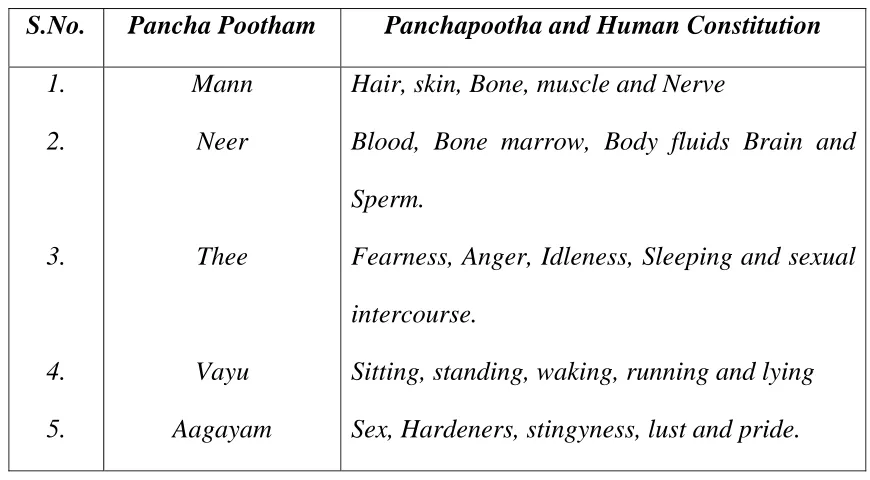
Table No: 1
S.No. Pancha Pootham Panchapootha and Human Constitution
1. 2. 3. 4. 5. Mann Neer Thee Vayu Aagayam
Hair, skin, Bone, muscle and Nerve
Blood, Bone marrow, Body fluids Brain and
Sperm.
Fearness, Anger, Idleness, Sleeping and sexual
intercourse.
Sitting, standing, waking, running and lying
Sex, Hardeners, stingyness, lust and pride.
2. Five sense organs (Porigal)
1. Skin
2. Tongue
3. Eye
4. Nose
5. Ear
3. The five object of sense (Pulankal)
1. Touch
2. Taste
3. Vision
4. Smell
4. The five organs of action (Kanmaenthrium)
1. Hands
2. Legs
3. Mouth
4. Anus
5. Genitalia
5. The five organ of perception (Gnanaenthrium)
1. Speech
2. Flexion and extension of Lower limb
3. Flexion and extension of Upper limb
4. Motion voided
5. Semen / ovum voided.
6. The four Intellectual Faculties (Karanam)
1. Mind
2. Research
3. Action
7. The Ten nerves (Naadi)
1. Idakalai - From right big toe runs opposite side to the
left nostril.
2. Pinkalai - From left big toe, runs opposite side to the
right nostril.
3. Suzumunai - Passes through both nostrils.
4. Sikuvai - For swallowing of food and water in the
uvula.
5. Puruden - It locates at right eye
6. Kanthari - It locates at left eye
7. Atthi - It locates at right ear
8. Alambudai - It locates at left ear
9. Sangini - Vagina or tip of the penis
10. Kuru - It locates Anus.
8. Vayu - Ten vital air forces
1. Pranan
2. Udhanan
3. Vyanan
4. Abanan
5. Samanan
7. Koorman
8. Kirukaran
9. Devadhathan
10. Dhananjeyan
9. Aasayam - Five visceral cavities
1. Amarvasayam - Stomach
2. Pahirvasayam - Liver, small intestine
3. Malavasayam - Rectum, large intestine
4. Salavasayam - Urinary bladder
5. Sukkila vasayam - Seminal vesicles (or) ovary
10. Kosam
1. Annamayakosam - Made up of seven udal thathukkal
2. Pranamayakosam - Conjunctions of pranan and
Kanmenthiriyam
3. Manomayakosam - Conjunction of manam and
Gnanenthiriyam
4. Vingnanamayakosam - Conjunction of Suzhuthi and
Gnanenthiriyam
5. Anandha maya kosam - Conjunction of Pranan and
11. Six stations of the soul (Aatharam)
1. Moolathaaram
It is a place of Kundalini a vital force.
2. Swathitanam
It is the place of earth
3. Manipooragam
It is the place of water.
4. Anaagatham
It is the place of fire.
5. Vishuthi
It is the place of air.
6. Aakinai
It is the place of space.
12. Mandalam
1. Agni mandalam - The area between mooladharam and
naabhi kamalam.
2. Gnayiru mandalam - The area between the chest and the neck
13. Malam
The three principles of moral exits
1. Motion
2. Urine
3. Sweat
14. Three humours (Thodam)
The physiological functions of the body are mediated by this three
humours which made up to five elements. These three functional factors
maintain the integrity of the human body.
These are
1. Vali - 10 types
2. Azhal - 5 types
3. Iyam - 5 types
Vali
The term Vali denotes vayu, pain, dryness and flatulence, vatham
and responsible for expiration and control of all movements.
Locations
Abanan, Faeces, Idakalai, Pelvic bone, Spermatic cord,
Character
It governs the other two basic elements and responsible for
all physical process in general, for this reason, disturbance in Vali
tend to have more severe complication than the other two humors
and other attach the mind as well as entire physical body and also
responsible for respiration.
Functions
Pain in the whole body, twitching, pricking pain,
inflammation, reddish complexion, roughness of skin, hardness of
limbs, astringent sense of taste in the mouth, constipation, oliguria,
blackish discolouration of the skin, stool, urine and muddy
conjunctiva.
Qualities Produced by Increased Vali
1. Vncious - Pasumai
2. Hot - Akkini
3. Solid - Katti
4. Soft - Miruthu
5. Stable - Sthiram
Opposite Qualities That reduces the Increased Vali
1. Dry - Varatchi
2. Cold - Kulirchi
3. Light - Elesu
4. Rough - Kadinam
5. Unstable - Asaithal
6. Subtle - Anuththusvam
AZHAL
Location
Pirana Vayu, Bladder, Moolagni, Heart, Unbilical region,
Abdomen, Sweating, Saliva, Blood, Eyes and Skin.
Characters
It gives digestion, hear, visual perception, hunger, thirst,
luster, complextion, understanding, intelligence, courage and
softness of the body.
Functions
Acidity, burning sensation in the thorax, yellowish
discolouration of the skin, eye, urine, sense of defaecation, profuse
sweating and dizziness.
Qualities Opposite Qualities
Hot - Akkini Cold - Kulirchi
Mobile - Oodurval Immobile - Nilaithalinmai
Acute - Kururam Harmless - Santham
Liquid - Salaroopam Solid - Katti
Sour - Pulippu Sweet - Inippu
Pungent - Kaaram Bitter - Kaippu
IYAM
Iyam is life representation of Appu and Mann Pootham. It is
responsible for maintenance of body structure and also responsible for
the defence mechanism.
Location
Samanan, Suzhumunai, Vinthu, Head, Fat, Bone narrow,
Blood, Nose, Colon, Joints, Chest and Tongue.
Characters
It givens stability, lubrication, holding together of the joints,
ability to hope with hunger, thirst, worry, etc.
Fair complexion, Itching, dullness, cold, heaviness, loss of
Qualities Opposite Qualities
1. Unctious - Eeram 1. Hot - Veppam
2. Sweet - Inippu 2. Pungent - Kaaram
3. Heavy - Paluvu 3. Light - Lesu
4. Cold - Kulirchi 4. Dry - Varatchi
5. Smooth - Miruthu 5. Rough - Kodinam
6. Stable - Asaivinmai 6. Mobile - Asaithal
7. Viscid - Valavaluppu 7. Sandy - Kasakasappu
15. Edanai - 3
1. Porul Pattru - Material bindings
2. Puthalva pattru - Offspring bindings
3. Ulaga pattru - Worldly bindings
16. Two deeds (Vinai)
1. Nal vinai - Good deeds
2. Thee vinai - Bad deeds.
17. Three cosmic Qualities (Gunam)
1. Sathuva Gunam - Goodness (or) virtue
2. Raasatha Gunam - Manifestation of passion, pride,
courage, zeal etc.
3. Thamatha Gunam - Ignorance manifested in torpor, sleep,
18. Five states of consciousness (Avathai)
1. Nanavu - Weak fullness
2. Kanavu - Dream
3. Urakkam - Sleep
4. Perurakkam - Stupor
5. Uyirppadakkam - State of samathy
Seven Constituent Elements (Seven Udal Thathukkal)
The seven thathus are responsible for the entire structure of the
body.
‘,urk; cjpuk; ,iwr;rp Njhy; Nkij kUtpa tj;jp thOk; nghL kr;ir gutpa Rf;fpyk; ghohk; cghjp cUgk yhYly; xd;nwd yhNk”
! ! ! ! ! ! !!!- jpUke;jpuk; 2086.
Saaram, Senneer, Oon, Kozhuppu, Enbu, Moolai, and Sukkilam
(or) Suronitham.
Functions of the udal thathukkal
1. Saaram
It strengthens the body and mind.
2. Senneer
3. Oon:
It gives the structures and shape to the body and is
responsible for the movement of the body.
4. Kozhuppu
It lubricates the joints and facilitates their functions.
5. Enbu
It forms skeleton of the body, protects, viscera’s and
concerned with body movement.
6. Moolai
It is present in the bones and gives strength.
7. Sukkilam (or) Suronitham
Mean for reproduction
14 - VEGANGAL – URGES
‘gjpdhd;F Ntfg; NgHfs;
gfHe;jpl mtw;iwf; Nfsha; tpjpj;jpLk; thjk; Jk;ky;
NkTePH kyq;nfhl; lhtp fjpj;jpL grpePH Ntl;if
fhrNkh bisg;G epj;jpiu kjpj;jpL the;jp fz;zPH
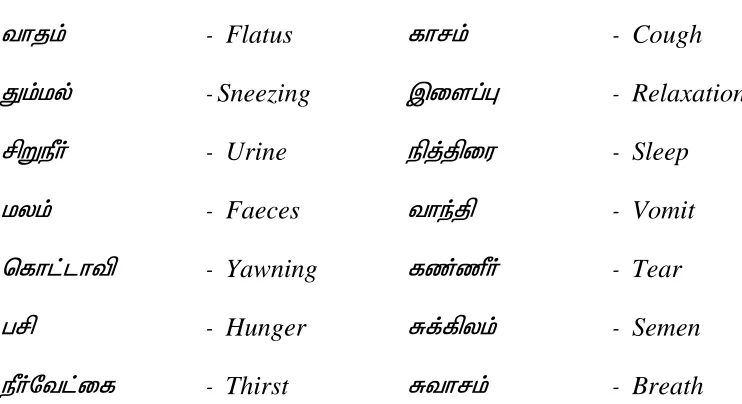
The 14 Reflexes are,
thjk; - Flatus fhrk; - Cough
Jk;ky;! ! - Sneezing ,isg;G - Relaxation
rpWePH - Urine epj;jpiu - Sleep
kyk; ! - Faeces the;jp - Vomit
nfhl;lhtp - Yawning fz;zPH - Tear
grp - Hunger Rf;fpyk; - Semen
ePHNtl;if - Thirst Rthrk; - Breath
If we control (or) repress any one of the above 14 urges, it will
create the diseases.
ARU SUVAIGAL
It is the peculiar sensation caused by the contact of soluble
substances with the tongue. These must be taken in a correct proportion
for healthy living since these have impact over the humours of the body.
Suvai are more related with the Udal Thathukkal and Uyir Thathukkal
Table - 2
Suvai Bootham Increased Uyirthathu
Inippu (Sweat) Pulippu (Sour) Uppu (Salt) Kaippu (Pungent) Kaarppu (Pingent) Thuvarppu
Water + Earth Fire + Water
Fire + Earth Ether + Ear
Air +Fire Air + Earth
[image:24.612.110.481.89.291.2]Udal Vanmai
Udal Vanmai is of three types, namely,
Iyarkai Vanmai
Seyarkai Vanmai
Kala Vanmai
Four Body Fires
1. Samakkini
Usual Routine activities of samana vayu are called
“Samakkini”. It is concerned with proper digestion of food.
2. Vishamakkini
It delays digestion of ingested foods and facilitates
indigestion.
3. Dheeksanakkini
It facilitates digestion of improperly cooked foods, ingested
by individual.
4. Mandakkini
It delays digestion of food stuffs, ingested with satiety,
favours, belching, flatulence, gurgling, and distention of abdomen.
SIDDHA PATHOLOGY
PATHOLOGY
The medical science and speciality practice that deals with all
aspects of disease but with special reference to the essential nature. The
cause and development of abnormal conditions as well as the structure
and functional changes that result from the disease processes is termed
as pathology.
BASICS OF SIDDHA PATHOLOGY
According to siddha pathology the human body is made of pancha
boothams. These boothams are grown in body by food, mediated through
the “Aru - suvaigal”. So that it is proved the “suvaigal” has got unique
place in the body system.
The five basic elements are taking part in the body through
“Uyir thathukkal.” These three types, of essential humours are formed
by the combination of
Idakalai + Abanan - vali
Pinkalai + pranan - Azhal
Suzhumunai + Samanan - Iyam
Functions of Uyir Thathukkal are,
! thjkha; gilj;J!!!! ! .!Creation
! gpj;j td;dpaha; fhj;J!!!!!! .!Protection!!
These vali, Azhal, Iyam humours will be in the proportion of
1: 1/2: 1/4 respectively.
Uyirthathukkal is responsible for Udal Thathukkal
The above basic structures of the body system are interlinked with
one another. These basic structures are affected by dietic factors,
physical activities, and environmental factors resulting the disease.
Noi – (Disease)
The disease is a disorder with a specific cause and recognizable
signs and symptoms, and bodily abnormality or failure to function
properly except that resulting directly from physical injury.
As per “Siddha Maruthuvanga Surukkam” it is defined as
follows.
‘clYld; ,ize;j capH mDgtpf;Fk; ,d;g czh;r;rpf;F khwhd czHr;rpNa gpzpapd; ,yf;fzkhFk;”.
Classification of diseases
Siddhar’s have identified 4,448 diseases. They have classified the
diseases mainly on the basis of three humors and its thontha states.
The diseases are diagnosed by the classical method of diagnosis
called “Envagai thervugal” and other specific parameters which are
General Aetiological factors
In siddha system of medicine, the common aetiological factors
are generally explained in three ways.
1. Agakkaaranam - Intrinsic factors
2. Purakkaaranam - Extrinsic factors
THE SCHEMATIC DIAGRAM FOR THE FORMATION OF
DISEASE
ngg<giv{l< Intrinsic Factors
Hxg<giv{l< Extrinsic Factors
Diet
Derangement of mukkuttram Alteration of udal kattugal Suppression of 14 vegangal
Environmental Changes Seasonal Changes Nilam
Occupation Ozhukkam
Omission of preventive aspects
ge<l!uqje Genetic factors
Uyirthathukkal (3 Humours)
The changes in any one of the above basic structures, from the
basis of pathology. This can be explained, briefly as follows.
mff; fhuzq;fs;
.
Intrinsic Factors
1. Diet -!czthjp nray;fs;
njhopy; Ghptjw;F Ntz;ba rf;jpia nfhLf;fTk;> clypy; epiy
ngwr; nra;aTk;> tsHf;fTk; xUtH Grpg;gNj czthFk;. ,t;tif
czthdJ mWRitfshy; MdJ. ,r;Ritfs; gQ;rG+j
$WghLfspdhy; cUthdJ.
,t;TlYk; gQ;rG+j $WghLfspdhy; MdJ vd;gJ rpj;j
kUj;Jt fUj;J> ,t;thW czthdJ jd; Ritfspd; %yk; gQ;rg+jf;
$w;Wg;gb mike;j capHjhJf;fisAk;> cly;jhJf;fisAk; tsHj;J
mjd; jd;dpiyf;F fhuzkhf mikfpfwJ.
vdNt cztpy; Vw;gLk; khw;wq;fs; clypYs;s capH>
cly;jhJf;fis ghjpj;J Nehia tUtpf;fpwJ.
cztpy; mWRitAk; fye;J ,Uf;Fk; NghJ ghjpg;ig
Vw;gLj;Jtjpy;iy> VjhtJ xU Ritia mjpfkhf cl;nfhs;Sk;
NghJ> fPo;f;fhZk; Neha;fs; Vw;gLk;.
1. Inippu (Sweet)
Increased Inippu suvai is responsible for obesity, indigestion,
2. Pulippu (Sour)
Increased Pulippu suvai is responsible for body weakness, dull
vision, giddiness, anaemia, dropsy, and feverishness, dryness of the
tongue, herpes, scabies and blister.
3. Uppu (Salt)
Increased Uppu suvai is responsible for ageing, falling of hair
and progressive weakness of the body.
4. Kaippu (Bitter)
Increased Kaippu suvai is related to Vali disorders of physical
constituents.
5. Kaarppu
Increased Kaarppu suvai is related to excessive dryness of the
tongue, defect in spermatogenesis, general malaise, lassitude, tremors
and back pain.
6. Thuvarppu
Increased Thuvarppu suvai is related to abdominal discomfort,
heart disease, tiredness, vascular constriction and constipation.
! ehk; cztpid cz;Zk; NghJ> VjhtJ xU Rit
mjpfg;gLk;NghJ Fw;wk; cz;lhFk;. ,ij fPo;f;fhZk; nra;Aspy;
mwpayhk;.
! ! ‘GspJtH tpQ;Rq;fwp ahw;G+hpf;Fk; thjk;
xspAtH ifg;Ngwpy; gpj;jQ; rPWk; - fpspnkhopNa fhHg;gpdpg;G tpQ;rpw; fgk; tpQ;RQ; rl;bujr; Nrug; GzH NehaZfhNj”
capHjhJf;fs; (Kf;Fw;w NtWghL)
It is of 3 types namely:
Vali
Azhal
Iyam
These Vazhi, Azhal, Iyam humours will be in the proportion of
1:1/2: 1/4 If there is any change (increase or decrease) from above,
caused by aetiological factors. (Diet, physical activities, environmental
factors etc.,) it will result the disease. This can be quoted in the following
Table - 3
Signs and Symptoms
Quantitative Vali Azhal Iyam
Character
Wasting, blackish
discolouration, tremors
Yellowish discoloration of
eyes, skin
Loss of appetite,
excessive salivation
Increased
Distended abdomen,
constipation, weakness,
Insomnia, Lack of
Inspiration.
Polyphagia, burning,
sensation all over the
body, sleeplessness. Diminished activity, heaviness, cough, dyspnoea, excessive sleep. Decreased
Body pain, feeble voice,
diminished capacity of
brain, syncope.
Decreased appetite,
symptoms associated with
defective growth of Iyam.
Giddiness, dryness of
the joints prominence
of bones, dry cough,
lightness, palpitation
excessive sweating
The human body is built up by the 7 Udal thathukkal which are
present in certain fixed proportions in every body. If there is any change
in the proportions the diseases will occur.
SAARAM
Increased Features
Features identical to those encountered in increased Iyam occurs
Decreased Features
Dryness of skin
Loss of weight
Tiredness
Diminished activity of sense organs
SENNEER
Increased features
Boil and tumours in different parts of the body.
Splenomegaly, hypertension
Reddish eye and skin
Jaundice and haematuria
Decreased Features:
Tiredness
Dryness
Lasstitude
Anaemia
OON
Increased Features
Tumours or extra growth around neck, face, abdomen, thigh,
Decreased features
Muscle wasting
Lethargic of sense organs
KOZHUPPU
Increased Features
Features of increased Oon, associated with dyspnoea on exertion.
Decreased Features
Joint pain
Emaciation
ENBU
Increased Features
Excessive ossification and dentition
Decreased Features
Weak bone, nails and teeth
Associated with splitting of hairs, nails.
MOOLAI
Increased Features
Heaviness of body
Swollen of interphalangeal joints
Oliguria
Decreased Features
Osteoporosis and sunken eyes.
SUKKILAM OR SURONITHAM
Increased Features
Increased sexual activity
Urinary calculi.
Decreased Features
Pain in the Genitalia accompanied by inability to
reproduce.
14 - VEGANKAL
The person who is trying to control or suppress the 14 vegams
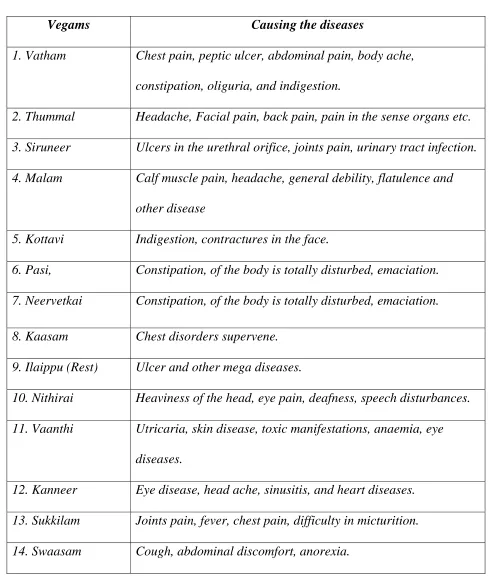
Table - 4
Vegams Causing the diseases
1. Vatham Chest pain, peptic ulcer, abdominal pain, body ache,
constipation, oliguria, and indigestion.
2. Thummal Headache, Facial pain, back pain, pain in the sense organs etc.
3. Siruneer Ulcers in the urethral orifice, joints pain, urinary tract infection.
4. Malam Calf muscle pain, headache, general debility, flatulence and
other disease
5. Kottavi Indigestion, contractures in the face.
6. Pasi, Constipation, of the body is totally disturbed, emaciation.
7. Neervetkai Constipation, of the body is totally disturbed, emaciation.
8. Kaasam Chest disorders supervene.
9. Ilaippu (Rest) Ulcer and other mega diseases.
10. Nithirai Heaviness of the head, eye pain, deafness, speech disturbances.
11. Vaanthi Utricaria, skin disease, toxic manifestations, anaemia, eye
diseases.
12. Kanneer Eye disease, head ache, sinusitis, and heart diseases.
13. Sukkilam Joints pain, fever, chest pain, difficulty in micturition.
Gwf;fhuzq;fs
<
-
Extrinsic Factors
Environmental Factors
‘mz;lj;jpYs;sNj gpz;lk;” - vd rl;lKdp $Wtjhy; mz;lj;jpy; Vw;gLk; khw;wq;fs; midj;Jk; gpz;lj;ij ghjpf;Fk; vd;gJ
njspthfpwJ.
kdpj rf;jpfSk;> cyf epfo;r;rpfSf;Ff; fhuzkhfpa rf;jpfSk;
xd;Wf;nfd;W njhlHGilait> kdpjDs; epw;Fk; rf;jpfshfpa
Kf;Fzk;> Kf;Fw;wk;> clw;fl;Lfs;> Nfhrq;fs;> Mjhuk; Kjypaitfs;
,aw;iff;F khwhfr; nray;gLk;NghJ gpzpfs; cz;lhfpd;wd.
,r;rf;jpfspd; tpistha;> tpal;bapy; mjhtJ cyfj;jpd; thd;
epiyfspy; khw;wk; cz;lhfp> G+fk;gk;> GaHfhw;J> ngUkio> nts;sk;>
flw;Nfhs;> ,tw;wpdhy; mopT Mfpait Vw;gLk;.
kdpj clypy; xU rpy cWg;Gfs; gpugQ;rj;jhy; gutp epw;Fk;> rpy
jj;Jtq;fspd; nghJthd rf;jpahy; nray;gLj;jg; gLfpwJ.
mt;thwhd cWg;Gfspy;>
jkufk; - #hpad;
%is - re;jpud;
gpj;jg;ig - nrt;tha;
EiuaPuy; - Gjd;
ePHFz;bf;fha; - Rf;fpud;
fy;yPuy; - FU
kz;zPuy; - rdp
vdNt Rw;Wr;#oypy; Vw;gLk; khWghLfs;> kdpjDf;F> Nehia
Nilam
! ! trpf;Fk; ,lq;fspd; ePH tsq;fSk;> fhyq;fSk;> Nehia
tUtpg;gjpy; Kf;fpa gq;F tfpf;fpd;wJ. kdpjd; trpf;Fk; ,lq;fs;
Itif jpizfshf gphpf;fg;gl;L mtw;wpy; Vw;gLk; Neha;fis gw;wp
$wpAs;sdH> mitahtd.
Kurinji - Fever, anaemia, Liver enlargement, iyaa disease,
etc.
Mullai - Vali and Azhal diseases are predominant
Marudham - Favourable places for Living
Neidhal - Vali diseases, elephantiasis, Hepatomegaly
Palai - Abode of all ailments
Seasonal Changes
! ! fhyk; vd;gJ MW gUt fhyq;fisAk;> MW nghOJfisAk;
gUtfhyq;fspy; Vw;gLk; khw;wq;fshtd.
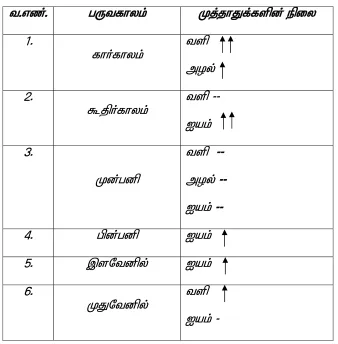
Table 5
t.vz;. gUtfhyk; Kj;jhJf;fspd; epiy
1.
fhHfhyk; tsp moy;
2.
$jpHfhyk; tsp --Iak;
3.
Kd;gdp
tsp --
moy; --
Iak; --
4. gpd;gdp Iak;
5. ,sNtdpy; Iak;
6.
KJNtdpy; tsp
Iak; -
- jd;dpiy tsHr;rp
- Ntw;Wepiy tsHr;rp
[image:40.612.138.476.117.461.2]OZHUKKAM
In this modern world, there is a wide opportunity for the human to
derail from the disciplined path. It is caused dreadful diseases to enter
into the man.
Omission of Preventive aspects
ekJ kUj;Jtj;jpy; $wg;gl;l xOf;fq;fis filgpbf;f jtWk;
NghJ Neha; cz;lhfpwJ.
gpzp mZfh tpjp:
! ‘jpz;z kpuz;Ls;Ns rpf;f tlf;fhkhw;
ngz;zpd;gh nyhd;iwg; ngUf;fhky; - cz;Zq;fhy; ePHfUf;fp NkhH ngUf;fp nea;Auf;fp A+z;ghHjk;
NgUiuf;fpw; NghNk gpzp”.
! ‘ghYz;Nghk;;: vz;iza; - ngwpd; ,snte;ePhpw; Fspg;Nghk;: gfw;GzNuhk;: gfw;WapNyhk;: ghNahjuK %j;j
VyQ;NrH #oypaNuh osntapYk; tpUK;NghJ
,uz;llf;Nfhk;: xd;iw tpNlhk;: ,lJifapw; gLg;Nghk; %yQ;NrH fwp EfNuhk;> %j;j - japH cz;Nghk;:
III Kanman – Genetic factor
Kanmavinai mentioned as an important cause for disease.
‘fd;kj;jhy; te;jtpid jPuhtpl;lhy;
fhankhope;Nj gpwf;Fq; fd;k Neha; tUFk; nrd;kj;jpy; tpe;Jtpl;Lr; nrdpj;jTld; tUFk; rPf;fpukha; eptHj;jp nra;J jPl;ir nra;tha; gd;kj;jpy; Jd;khHf;fg; ghtq;fs; jhD}iy ghuhkw; nghUswpahH gho;tpidf; fPlhthH
fd;kj;ij eptHj;jp nra;af; fLff; NfS fdj;j jahepjp fpilj;jhy; jLfhJ NehNa!”.
! ! ! ! ! !!!!!!!!!- Njud; itj;jpak; jU
GENERAL CAUSES FOR DISEASE
According to “Theran Karisal”
‘NehapDw; gj;jpNfs; Nehd;ik$H ike;jNd Nehahsp nad;gjW Nehasp Kd;Nd Neha;fs; tpid fhjuK Neha;fs; tuNtJ
Nehdhik ahy; ntFsp Nehdhj grpahy; Nehdhj ePHgLfy; Nehdhj czthy;
Nehf;fkU zkjhf Nehf;fpnahop njhopyhy; Nehf;fnud elkhb Nehf;fp elkplyhk;
Nehl;lf;fhuhp ehb Nehl;lnkhop Fuyhy; NehtpaH khnuhL Neht kUTjyhy;
Nehdhj tPukb Nehdtzp Fjyhy;
Neha;fSH gpj;jptU Neha;fs; tpid tpijaha; Neha;fs; tpid tayha; nka; Neha;fs; tsHgapuha;
NehAjT gydhJ Neha;fs; ntF Nkyhk; Nehjf Tiuj;jdkpe; Neha;fis NkNy
Nehapdpy; yhsH Nehd;ikap0jpzpNa”
! ! ! ! - Njud; fhpry;
1. Kanma vinai
2. Dietic factor
3. Hat redness with other things
4. Emotion and excitement
5. Starvation and fasting
6. Improper intake of water
7. Directly seeing the sun with naked eye
8. Always speaking with high pitched tone
9. Sexual contact with diseased lady
10. Idleness
11. Psycho somatic problems
12. Wearing wet cloths
‘gpzpfspd; Kjw; fhuzk;”
! ‘thjkyhJ NkdpnflhJ - tsHgpj;jj; jPjyhJ rj;jpalhJ - Nrj;Jkj;jpd; NfhjkyhJ tpf;fnylhJ - Flw;jz;zpy;
rPjkyhJ RuKk; tuhJ - jPjkhNk.”
‘ke;jkyhJ thA tuhJ - mdpygpj;jj;
njhe;jkyhJ %yk; tuhJ - njhlH thj ge;jkyhJ Fd;kk; tuhJ - gfHgpj;j
tpe;ijayhJ Nkfk; tuhJ - jPukhNk.”
‘murPuzkpd;wpr; Ruk; tuhJ - jphpNjhlf; fhuzkpd;wpr; re;ep tuhJ - fgkhd ePuJTkpd;wpr; Nrhig tuhJ - neLthjr;
rhHtJkd;wpr; #iytuhJ - tuhNj.”
‘mgj;jpakpd;wpj; NjhltpfhuK - kZfhJ mgj;jpakd;wp xsljpdPK - kZfhJ fgj;jpidad;wpf; fhr Rthrq; - fhzhJ
fgj;jpidad;wp tpaHit FspHr;rp - tuhNj.”
! ! ! ! ! ! ! - NjiuaH
NkYk;
! ‘kpfpDk; FiwapDk; Neha; nra;Ak; E}NyhH tdKjyh vz;zpa %d;W”.
! ! ! ! ! - jpUf;Fws<!
If there is any changes (increased or decreased) in the basic
structure mentioned in the basic of siddha pathology, resulting in disease.
PINIYARI MURAIMAI – DIAGNOSIS
Pini yari muraimai means method of finding out the diseases. The
following three words are combined to form this word piniyarimuraimai.
Piniyari Muraimai - Pini + Yari + Muraimai
Pini Means - The disease which catch the body
Yari means - Identifying the diseases
Muraimai means - Rules and methods
As per siddha literature, the diagnosis is based upon three main
principles.
1. Poriyal arithal
2. Pulanal arithal
3. Vinaathal
Poriyalarithal and pulanal arithal
Poriyal means five organs of perception pulangal means five objects
of the sense organs.
Porigal Pulangal
1. Nose - Smell
2. Tongue - Taste
3. Eyes - Vision
4. Skin - Touch
5. Ear - Sound
Vinaathal
It is asking questions concerned with the history of disease, and its
clinical symptoms etc., to the patient (or) asking to his neighbour, when
the patient is not able to speak, or the patient to be a child. These three
principles are affected through the Envagai thervugal.
ENVAGAI THERVUGAL
Envagai thervugal are having a broad and important role in
diagnosing the particular disease, It is very much needed to have a
through knowledge in it. According to siddha medical science without
having knowledge in envagai thervugal, we can’t diagnose the diseases.
“Theriyar” mentions the Envagai thervugal as follous.
‘nka;f;Fwp epwk; njhdp tpop ehtpUkyk; iff;Fwp”
! ! According to the “Noi - naadal” the eight types of Investigations
are Quoted as below.!
‘ehbg; gwprk; ehepwk; nkhop- tpop kyk; %j;jpukpit kUj;Jt uhAjk;”
1. Naadi - Pulse
2. Sparisam - Palpation
3. Naa - Tongue
4. Niram - Colour
6. Vizhi - Eye
7. Malam - Motion
8. Moothiram - Urine
1. Naadi (signs in hand pulse)
Is nothing but the vital energy that sustains the life in our body. It
has been considered for assessing the prognosis and diagnosis of the
disease. Any variation that occurs in the three humours is reflected in the
naadi. It serves as a good indicator of all ill health. It can be perceived
by feeling it at the appropriate sites.
2. Sparisam
Reveals that the structural and sensational changes present
through the body.
eg:
Skin temperature (Heat or cold)
Sweat
Dryness
Tenderness
Swellings
Nourishment etc.,
3. Naa (Tongue)
4. Niram (Colour)
It reveals that any change in the colour of the skin, nails, hairs,
conjunctiva teeth, mucous membrane. Etc.
5. Mozhi (Sound and speech variation)
It reveals that means the quality of sound the made of speech, and
intelligence is to be assessed.
6. Vizhi (Eye)
It reveals that the systemic changes in the organs, by changes in its
colour, structure of the eye and any discharge in the eye. It is also reveals
the function of the eye.
7. Malam (faeces)
The colour, amount, and consistency of the faeces will reflect the
pathological condition of the body.
8. Moothiram (Urine)
Urine is a fluid excreted by the kidney, which contains many of the
body’s metabolic end products, In modern aspect, biochemical analysis
of urine is commonly used in the diagnosis of the diseases and in
ePHf;Fwp rpwg;G
In siddha system of medicine examination of urine by neerkuri and
neikkuri are more useful to diagnose the disease.
! ! ! ! ‘jHf;f rhj;jphp fshNdhH
jq;fspy; NjHe;J ehb tHf;fkhk; ehb jd;dpy;
tLtJ kaf;fnkd;Nw cw;wePHg; ghPl;ir Ma;e;Nj
ciuj;jdH ,jw;F Neuha; kw;nwhU tpjpE}y; ,y;iy
kUj;Jtf; fiy ty;NyhHf;Nf” nghUs;:
kUj;Jtf;fiy ty;ytHf;F> Nehia fzpg;gjw;F ePHf;Fwpia
fhl;bYk; rpwe;j Kiw Ntwpy;iy vdyhk;.
Collection of urine for Neerkuri and Neikkuri
! ! ‘mUe;J khwp ujKk; mtpNuhjkha;
m0fy; myHjy; mfyhT+d; jtpHe;jow; Fw;wstUe;jp cwq;fp itfiw
Mbf; fyrj; jhtpNa fhJnga; njhU K$Hj;jf; fiyf;Fl;gl;L ePhpd;
NeHf;Fwp nea;f;Fwp epUkpj;jy; flNd”
! ! ! ! ! ! !!!!!!!!!!!!!!!!!!!- NjiuaH
urine of the patient is collected in a glass or a porcelain container.
Through the urine should be examined only according to the rules and
regulations, at times of emergency they can be relaxed which is quoted
as,
‘mUg;g Kw;whHf; ft;tpjp tpyf;Nf”
Neerkuri
! ! ! ‘tj;j ePHf;fhp vil kzk; Eiu vQ;rnyd;
iwe;jpaYsit aiwFJ KiwNa”
Colour, quantity, odour, frothy appearance constituents, specific
gravity of urine. Are physical findings.
1. Niram
It indicates the colour of urine, voided it may be yellow, red, green,
black, crystal and smoky etc.
2. Edai
It indicates the specific gravity of urine (increased (or) decreased
quantity)
3. Manam
It indicates the smell of urine, such as pleasant, foul smelling,
honey smell, fruit smell, and fish smell.
4. Nurai
5. Enjal
It indicates the inorganic and organic deposits like salts, crystals,
etc, and amount of urine extracted.
Neikuri
‘gpzpAs;NshH ePiuNaw;Wg; nghOJKd; itj;j gpd;dH
JzpTW JUk;gp nyz;iza; Njha;j;NjhL JspNa tpl;lhy;” mZfp ePHg; ghk;gpy; fhzpd; mjpy;Neha; tl;lkhapd;
jzptyfg; gpj;j Nehahe; jq;FKj; ija NehNa”.
A drop of gingili oil is dropped in to the centre of a upper surface
of the urine, if the oil spreads like snake indicates Vali, spreads like ring
indicates Azhal, remains floating as a pearl indicates Iyam, mixed
reaction of any two indicates thontham.
Basically siddha aims to maintain the equilibrium, between the five
elements deposit our constant interaction with the outer world.
The five elements, which work as and vital forces in the body and
perform all physical and mental functions are constantly affected by time
space and nutrition.
AIM AND OBJECTIVES
The author had selected the disease “PATHACHAKKARAM” for
dissertation work, because,
“Pathachakkaram” is a complication of Madhumegam (Diabetes
mellitus). The diabetes mellitus is an outstanding problem facing the
world nowadays affecting the both rich and poor societies. The rate, of
complication like diabetic foot is a guilt dread, of disability, long
stretches of hospitalization, mounting impossible expenses, with the ever
changing end result of on amputation. This makes the diabetic foot the
most feared and devastating complication of diabetes.
Aim
To study the disease on the basis of Siddha physiology and Siddha
pathology, emphasizing more importance to Mukkutram, Suvaigal, Panja
bootha theory, Udal thathukkal and diagnose the patient on the basis of
envagai thervugal and confirm the prognosis on the basis of “Neikuri”
Objectives
To fullfil the aim the following objectives has been drawn.
To collect all Literary evidences about Patha rogangal
diseses in detail
Pathology of the disease
Changes in the Mukkutram
To study in detail about the incidence of the disease with
age, sex, socio – economic status, habits and prevalence.
To bring forth the high lights of Siddha system of diagnosis,
Envagai thervu and modern aspects.
To confirm the diagnosis in Siddha system with the help of
modern parameters.
ELUCIDATION ABOUT PATHACHAKKARAM
‘fhZjw;F khpa jpkp nuhpg;G Kz;lha;f;
fdj;J typj; jpLfpypit As;sb thje;jhd; NrndhpA kf;fp tpjh; Nghyj; Njhd;wpj;
jpdthfp ePh; gha;e;J nrk;Gz;zhfpj; NjhD nkdp ypit ghjr; rf;fuj;jpd;
nwhFjp nadNt Kdptd; nrhd;dthNu.”
- jd;te;jphp itj;jpak; II k; ghfk;
ghjr; rf;fuk; - ghjj;jpy; tUk; xU tif tpuzk; - A kind of
festering sore in the foot.
jpkph; - czh;r;rpapd;ik> tpiwg;G> kuj;Jg; Nghjy; -
Numbness
vhpg;G - vhpj;jy;> mow;rp - Burning Sensations
fdk; - jbj;jy;> ghuk; nfhs;sy; -Heaviness
typ - Pain
cs;sb - cs;sq;fhy; - Plantor region
Nrndhp - mfykhd - Increased in size
mf;fp - Neha; -Callus
tpjh; (tpjuk;) - gpsg;G> ntbg;G - Fissure
jpdT - nrhwpT - Itching
nrk;Gz; - Erythematous ulcer
ghjk; - fhypd; mbg;gFjp - Plantor region
rf;fuk; - tl;lk;
¾ The features of peripheral neuropathy are mentioned in the first 2
lines of the poem.
They are,
Numbness, which is different from normal person.
Burning sensation in the foot.
Heaviness in the foot.
Pain in the foot.
¾ The formation of ulcer is described in next two lines of the poem.
They are callus formation.
Fissure in the callus.
Itching and oozing from the ulcer,
DETAILED PATHOLOGICAL VIEW OF
DISSERTATION TOPIC
SIDDHA VIEW
As per Siddha system, our human body works under the principle
of 96 Basic principles, any disturbances in the harmony of this 96
principles leads to changes in the homeostatic mechanism of 3 humours
and 7 Udal Kattugal and leads to disease.
Pathachakkaram, one among the 9 types of patha diseases as given
in the Patharoga Nithaanam, taken from the Thanvanthri vaithiyam.
Part-II.
‘cs;sbap NyjhD Kjpj;jpLk; Neh
nahUgjpd;Ng Uiuj;jpLt DyF jd;dpw; fs;skpy;yh Ts;sbapy; thjk; ghjr;
rf;fuk; fhw;fhj;jy; fhpthj Fl;lk; ts;sNy fUk;Gw;Wj; jirg; Gw;nwd;d
kUtpa nrq;FU thjr;#iy ghnjhpg;G nks;sNt apt;tifahk; Nehapd; NgH jd;id
tphpj;J kpf kUj;J Kdp tpsk;Gq; fhNz.”
9 Patha disease are,
ghjr; rf;fuk; fhpthFl;lk;
fhw; fhe;jy; fUk;Gw;W
jirg;Gw;W nrq;FU
ghj #iy ghnjhpg;G
gjfhp
Each patha diseases and their symptoms are being illustrated by
the author in separate poems.
Pathachakkaram is a complication of Madhu megam (Diabetes
mellitus)
Basic etiology of Mega noi is
‘gfH gpj;j tpe;ijayhJ Nkfk; tuhJ”.
- NjiuaH
So the basic cause is disturbance of Azhal humour. Intrinsic and
Extrinsic factors which affects the Azhal humors. ‘NfhijaH fytp Nghij nfhOj;j kPdpiwr;rp Nghij ghJtha; nea;Ak; ghYk; ghpTlDz; gPuhfpy;
Nrhj ghz;LUt kpf;f Rf;fpy gpuNkfe;jhd;
XJ ePhpopT Nru
mz;lnd twpe;J nfhs;Ns”.
‘cw;gtpf;Fk; ghy;nea;ah ypiwr;rp fs;shy; chpiraha; kPd;wd;dhy; tUtp Uj;j kw;gtpf;Fk; gjhu;j;jj; jhy;kJu t];jhy;
ke;jq;fs; jdpw;-nghrpj;jy; Ntfhg; gz;lk; Fw;gtpf;Fq; Fspe;jtd;d kq;if Nfh\;b Fwpj;jepj; jpiujtpHj yf;fpdp ke;jk;
jw;gtpf;FQ; rhPue;jhd; kpfg;g Uf;fy;
rQ;rye;jhd; gad;gLjy; jhpf;Fk; NehNa.”
- Yugi Vaithiya cinthamani
From the above causes, the Azhal Kuttram is increased.
‘gw;gpbj;j Nkfk; vd;why; gpj;j kPWk; ghyfNd fhq;if nfhz;L ePuhk; ghNu.”
- Paripoorana naadi
The above stanza says that, increased Azhal kuttram – increases
the moolakkanal, resulting in constant elimination of all the essential
nutrient from the body through urine.
Primiarily, due to intrinsic and extrinsic factors, the Azhal thathu
in the body gets vitiated initialy. This is followed by the derangement of
metabolic energy (Moolakkanal) caused by involvement of vali force,
ultimately the function of Vali and Iyam also become altered resulting in
disturbance in homeostatic mechanism and functions of all the seven
Gradually the Vital energy building factors essential for
physiological, psychological and social well being and are being
eliminated or excreted through urine due to increase in moolakkanal. As
a result of this vital energy lossiyya humours gets disturbed.
So in this disorder all “The three thodams, major subdivisions of
vali, and their functions and all the seven Udal kattugal are
simultaneously affected.”
This is indicated clinically by the weakness of seven UdalKattugal
and other complications, associated with this disease.
‘FwpAlNd Nkfj;jhd; nfhLik nra;J
Fiwe;J tUe;jhJ nty;yhq; Fd;wpg; NghFk;.”
- Pathinen siddhar naadi nool
The above stanza says that the metabolie fire become acute,
resulting in depletion of vital factors from the tissues leading to constant
elimination of all the essential nutrient from the body through copious
The symptoms of Pathachakkaram
‘fhZjw;F khpa jpkp nuhpg;G Kz;lha;f;
fdj;J typj; jpLfpypit As;sb thje;jhd; NrndhpA kf;fp tpjH Nghyj; Njhd;wpj;
jpdthfp ePH gha;e;J nrk;Gz;zhfpj; NjhD nkdp ypit ghjr; rf;fuj;jpd;
nwhFjp nadNt Kdptd; nrhd;d thNu.”
- Thanvanthri Vaithiyam – II part
In Agasthiyar naadi book
‘nrhy;yNt thjkJ kPwpw;why;
NrhHtile;j thAUtpy; Njfnkq;Fk;
nka;Klq;Fk; epkpunthz;zhj jpkpH cz;lhFk;.”
In Pathachakkaram patients degenerative changes first occur in
the peripheral nerves of the foot.
Abnormality in Azhal humour disturbes the normality of Vali
humour, there by alters the neural mechanism in the body leading to
degenerative changes in the peripheral nerves leading to Peripheral
neuropathy, following the features of,
‘fhZjw;F khpa jpkp nuhpg;G Kz;lha;f; fdj;J typj; jpLfpypit As;sb thje;jhd.”
Numbness in the foot
Burning sensation in the foot
Normally Vali is living in the nerves and its maintaining the
normal physiological function of the body. It maintains both sensory and
motor activities of the body. This concept is quoted as.
‘thjkha; gilj;J”
So any alteration in vatham, degenerative changes occurs in
nerves. It is quoted as.
‘thjkyhJ Nkdp nflhJ.”
The last line of the poem describes the following line,
‘NrndhpA kf;fp tpjH Nghyj; Njhd;wpj; jpdthfp ePH gha;e;J nrk;Gz;zhfpj;.”
The increased foot pressure causes the following features,
Callus formation
Fissure in the callus
Itching and whoozing
MODERN VIEW
‘fhZjw;F khpa jpkp nuhp;g;G Kz;lha;f;
fdj;J typj; jpLfpypit As;sb thje;jhd;.” ‘NrndhpA kf;fp tpjh; Nghyj; Njhd;wpj;
jpdthfp ePh; gha;e;J nrk;Gz;zhfpj;.”!!!!
In this poem the author Thanvanthri has explained the ailment in
the 2 steps
In first 2 lines the author expland about the feature of Peripheral
Neuropathy and in the next following 2 lines about the
complication of Peripheral Neuropathy.
Features of Peripheral Neuropathy
‘fhZjw;F khpa jpkp nuhp;g;G Kz;lha;f;
fdj;J typj; jpLfpypit As;sb thje;jhd;.”
!
jpkph; .!Numbness
vhpg;G - Burning Sensation!
fdk;!! .!Heaviness!
typ ! - Pain!
The above abnormal sensory phenomenon is divided in to two main
categories.
Negative phenomenon
Positive Phenomenon
The most common type of diabetic neuropathy affects the nerves in
the leg and usually known as Peripheral Neuropathy. It affects mainly the
sensory nerves although the Motor and Autonomic nerves can also be
involved with important consequences.
Negative phenomenon - jpkpH> fdk;
Negative phenomenon is Numbness and Heaviness. It represent
loss of sensory function and are characterized by diminished or absent
feeling, often experienced as numbness.
In contrast to positive phenomena, negative phenomena are
accompanied by abnormal findings on sensory examinations. In disorders
affecting peripheral sensation, It is estimated that at least half the
afferent axons innervations a given site are lost or functionless before
Sensory deficit can be demonstrated by clinical examination. This
estimate probably varies according to how rapidly sensory nerve fibers
have lost function. Sensory Symptoms may be either positive or negative.
But sensory signs on examination are always a measure of negative
Positive phenomenon - vhpj;jy;> typ
Positive Phenomenon is tingling (pins-and-needles). In addition
the tingling it include other altered sensations that are often described as,
Burning, pricking, band like, lancinations, aching, knifelike, twisting,
drawing, pulling, electrical or raw feelings. These descriptors are
frequently the actual words used by patients. Such sensations may or not
be experienced as painful.
Both this positive and negative phenomena causes, the patient
feels, the heaviness of foot
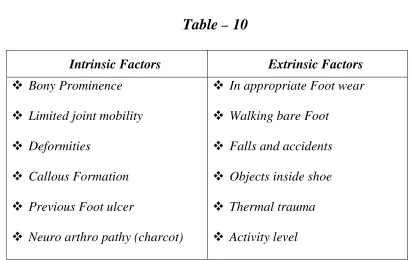
People with poorly controlled diabetes for a long time are more
likely to get chronic painful neuropathy.
A number of theories have been suggested, for the symptom. It is
thought that,
High blood glucose causes changes to the nerve fibers
which results in abnormal nerve signals.
High blood glucose causes changes to blood vessels
which supply the nerves.
Unknown factors release chemicals, that irritate the
Complication of Peripheral Neuropathy the Foot Ulcer
‘NrndhpA kf;fp tpjh; Nghyj; Njhd;wpj; jpdthfp ePh; gha;e;J nrk;Gz;zhfpj;.”!!!!
!
Nrndhp - Increase in size
mf;fp - Callus formation
tpjh; - Fissure
jpdthfp ePh;gha;e;J - Itching and whoozing
nrk;Gz; - Erythematous ulcer.
Formation of Callus – mf;fp
Callus is a cellular proliferation of epidermis produced by
repeated pressure of friction. It presents with firm, raised, superficial,
less demarcated, sis with localized area of compact scales.
Motor neuropathy leads to atrophy of the small muscles of the foot,
with an imbalance between flexors and extensors. These changes result
in clawing of the toes, prominent metatarsal heads, and forward
migration of the fibro fatty pads. As a result, high pressure develop is
Callus Formation.
Fissure Formation – tpjh;
High foot pressure combined with a dry, brittle skin (as a result of
autonomic neuropathy) leads to callus formation, which act as a foreign
body and can cause tissue damage and forms fissures leading to foot
ulceration.
Causes for itching and whoozing - jpdthfp ePh;gha;e;J
A combination of Neuropathy, hyperglycemia and ischemia worsen
the situation by reducing the defense mechanism. The diabetic foot ulcer
is easily infected.
Foot has several compartments which are inter-communication
and lack of pain due to neuropathy allows the patient to continue
ambulation, facilitating spread of infection from one compartment to
another.
So, infection of foot ulcer cause Itching And Whoozing from the
ulcer.
Erythematous Ulcer
-
nrk;Gz;Continued presence of infection, inside the foot leads to pressure
effects on capillaries and neurovascular bundles causing further damage
ANATOMY
As Pathachakkaram has Peripheral Neuropathy as cause of its
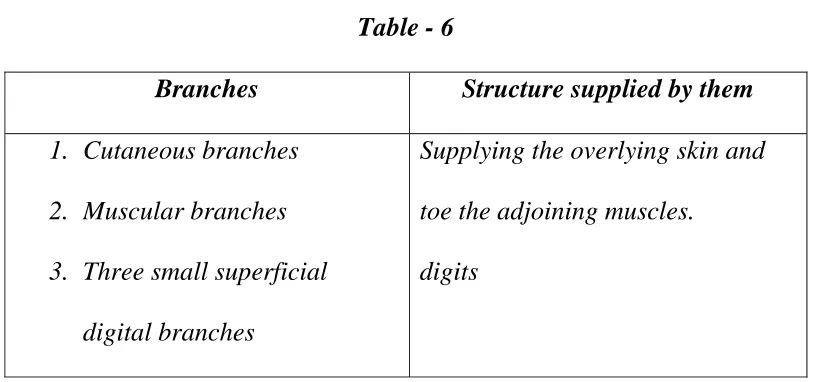
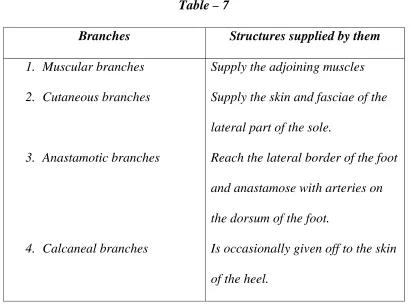
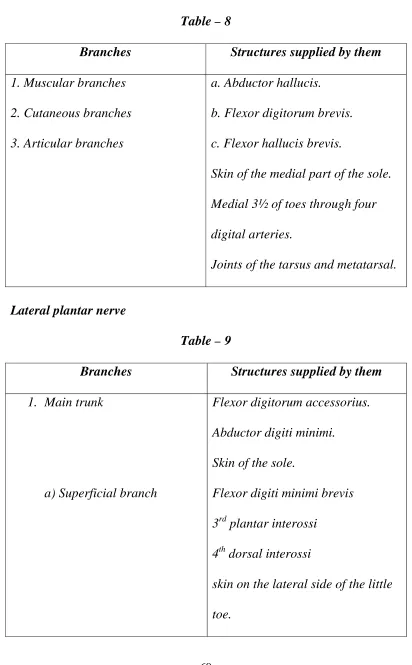
occurrence, here in this dissertation anatomy of both sole and Neuron are
described.
Anatomy of the Sole of foot
Muscles are arranged in four layers with the neurovascular
bundles between first and second layers and then between third and
fourth layers. There is only one plantar arch in the sole. All the intrinsic
muscles, i.e. muscles confined to the sole only are supplied of either of
the two plantar nerves. The extrinsic muscles of the sole are supplied by
the nerve of the respective compartment. The tendon and muscles of the
sole maintain, the arches of the foot.
The structure of the sole
Skin
Superficial Fascia
Muscles
Vessels and nerves
Skin
The skin of the sole, like that of the palm is
Thick for protection.
Firmly adherent to the underlying plantar aponeurosis creased.
These features increase the efficiency of the grip of the sole on
Nerve supply
The skin is supplied by three cutaneous nerves
The medial calcanean branches of the Tibial Nerve to the
posterior and medial portions.
Branches from the Medial plantar nerve to the smaller
anterolateral portion including the lateral one and half a digits.
These nerves are derived from spinal nerves L4, L5 and S1
In eliciting the plantar reflex, the area supplied by segment S1 is
stimulated.
Superficial Fascia
The superficial fascia of the sole is fibrous and dense. Fibrous
bands bind the skin to the deep fascia or plantar aponeurosis, and divide
the subcutaneaous fat into small and tight compartments, which serve as
water - cushions and rein force the spring-effect of the arches of the foot
during walking, running and jumping. The fascia is very thick and dense
over the weight-bearing points. It contains cutaneous nerves and vessels.
Deep Fascia
The deep fascia of the sole is specialized to form
The plantar aponeurosis in the sole.
The deep transverse metatarsal ligaments between the
Layers of the foot
The muscles of the sole are arranged in 4 layers.
I. First Layer
3 Short muscles lie side by side along the sole of the foot.
1. Flexor digitorum brevis
Action
It flexes the proximal interphalangeal and the metatarso
phalangeal. Its of the lateral 4 toes, and helps to reinforce the
longitudinal arch of the foot.
Nerve supply - Median plantar Nerve.
2. Abductor hallucis
Action - It moves the big toe away from the second toe.
Nerve supply - Medial plantar nerve.
II. Second layer
This consists of the long flexor tendons and their connections in the
sole. These are
Tendon of flexor hallucis longus.
Tendon of flexor digitorum longus.
Flexor accessories
Action
By pulling on the tendons of flexor digitorum longus, It
Lumbrical muscles
Nerve supply Median plantar N.
Lateral plantar N.
Action
It maintains extension of the digits at the interphalangeal
joints, while the flexor digitorum longus tendons, are flexing the
toes, so that in walking and running the toes do not buckle under.
III. Third Layer It consists,
1. Flexor hallucis brevis
Action - To flex the proximal phalanx of the big toe.
Nerve supply - Medial plantar nerve.
2. Adductor hallucis
Action
The muscle draws the big toe towards the axis of the
metatarsus and thus assists in maintaining the transverse arch.
Nerve supply - Lateral plantar nerve
3. Flexor digiti minim brevis
Action - To assist in flexing the little toe.
Nerve supply - Superficial branch of the lateral plantar nerves.
IV. Fourth layer