0022-538X193/074337-13$02.00/0
Copyright ©)1993, AmericanSocietyfor Microbiology
Alterations of the Three Short Open Reading
Frames
in the
Rous
Sarcoma Virus Leader RNA Modulate Viral
Replication and Gene Expression
ARISTIDISMOUSTAKAS,'t TAD S. SONSTEGARD,1 AND PERRYB. HACKEFTl2* Department of Genetics and Cell Biology, University ofMinnesota, St. Paul, Minnesota
55108-1095,1
and Institute
of
HumanGenetics,
University
of
Minnesota,
Minneapolis,
Minnesota554552
Received 28December 1992/Accepted 16 April 1993The Roussarcomavirus (RSV) leader RNAhas three shortopenreadingframes(ORF1toORF3) whichare
conserved in all avian sarcoma-leukosis retroviruses. Effectson viruspropagationweredeterminedfollowing
three types of alterations inthe ORFs: (i) replacement of AUG initiation codons in orderto prohibit ORF translation, (ii)alterations of the codoncontextaroundthe AUG initiationcodontoenhance translation of the normallysilentORF3, and(iii) elongation of the ORF coding sequences.Mutagenesis oftheAUG codons for ORF1 and ORF2 (AUG1 and AUG2) singly or together delayed the onset of viral replication and cell transformation. In contrast, mutagenesis of AUG3 almost completely suppressed these viral activities.
Mutagenesis of ORF3toenhance itstranslation inhibited viral propagation. When themutantORF3 included
anadditional frameshift mutationwhichextended the ORFbeyondtheinitiationsiteforthegag,gag-pol,and envproteins, hostcellswereinitiallytransformedbutdied soonthereafter. Elongation of ORF1 from7to62 codons led to the accumulation of transformation-defective virus with a delayed onset of replication. In contrast, viruses withelongationofORF1from7to30 codons,ORF2from 16to48codons,orORF3 from9 to64codons, withoutanyalterations inthe AUGcontext, exhibited wild-type phenotypes. These resultsare
consistent witha model thattranslation ofthe ORFs isnecessarytofacilitate virusproduction.
Three short open reading frames (ORF1 to ORF3) are
contained in the5' leader RNAsequencesof allknown avian
leukosis-sarcoma retroviruses (9,24, 25, 33, 53). The lengths
and the relative positions ofthe ORFs in the leader RNA
sequence arehighly conserved,butthe encodedamino acid
sequencesarenot(23, 24, 28).Thenucleotidessurrounding
the initiation codons of each of the three ORFs are also
conserved such that the first AUG codon is a favorable
initiator oftranslation whereas the second and thirdAUG
codons should be weaker sites of initiation(37, 50).
In previous studiesof the wild-type (WT) Rous sarcoma
virus (RSV) strain SR-A(SF), we demonstrated that the
AUG codon of ORF1 is the major ribosome-binding site within the RSV 5' leader (48-50). Furthermore, the
seven-amino-acid product of ORF1 was identified in vitro (24), indicating productive protein synthesis from the ORF. Ad-ditional translational studies invitro(29, 52)and in vivo(40, 42)have demonstrated that(i)either deletions ofone or more
ORFsormutagenesisof theirinitiation codons hadrelatively
minor effectsondownstreamgenetranslation, (ii)elongation
of the ORFs resulted in reductions in downstream transla-tionproportionalto theextentofelongation, and(iii)
muta-tion of thefirst AUG codontoACGproducedavirus witha delayed onset of propagation and cellular transformation
(50). These studies suggested that (i) the 5' leader RNA
sequencesof the multicistronicRSV mRNAswerescanned
byribosomal subunits(29, 48), (ii)ORF1 andORF2,butnot ORF3,weretranslated (24, 49,50), and(iii)the mechanisms
ofleaky scanning (37)and reinitiation (32, 47) explainedbest the efficient initiation of translation at the AUG codons of
themajorviralgenes (40).These effectsontranslation, plus
* Correspondingauthor.
tPresent address: Whitehead Institute for BiomedicalResearch, Cambridge, MA 02142.
the observation that ORFI was required for efficient RSV replication (50), suggested that conservation of the ORF
structuresmightbe essential formaintainingessential
activ-ities during the life cycle of the virus. Anotherreport (17), which emerged while our work was in progress, supports
thishypothesis.
Accordingly,westudied in detail the effects that
destruc-tion and/or length alterations of the ORFs had on viral replication aswell as on cellular viability and
transforma-tion. We found that inactivation of the AUG codons for ORF1and ORF2 attenuated viralreplicationwhereascertain alterations in ORF3destroyedviralreplicationand/or simul-taneously killed the host cell. Furthermore, extension of
ORF1 to more than 60 codons delayed the onset of viral
growth in away similar to that seen when ORF1was lost
(50). However, shorter elongations of ORF1 to ORF3 had little effectonthe virus. These resultsareconsistent withour hypothesis that the ORFs in avian retrovirus leader RNA
sequences are translated during infection and suggest that
the ORFsare importantfor efficient viral propagation. MATERIALSAND METHODS
Construction ofrecombinant RSVgenomescarryingmutant
ORFs. The in vitro, site-specific mutagenesis protocol, the
mutagenesis procedure, and construction of recombinant RSVgenomeshave been described in detail elsewhere (42, 50). All mutations were screened by restriction
endonucle-ase digests (GIBCO-BRL and New England Biolabs) and wereverifiedbyDNAsequencingafter reconstruction ofthe
finalclones. Figure 1 depictsthe ORFsequencesthatwere mutagenized and the nomenclature of the recombinant
clones.
Cellculture;transfectionand reinfection of CEFs. Primary
chicken embryo fibroblast (CEF) cultures were prepared
4337
on November 9, 2019 by guest
http://jvi.asm.org/
C c GUQ
ORF 1: UUGAUGGCCGGACCGUUGATTCCCTGACGA
40
3G
100
ORF2: UGCAUGAAGCAGAAGGCUUCAUUUGGUGAC
CA 4
CCCGACGUGAUAGUUAGGGAAULUGG
120
OAU
Cj 9
;Tt
t+@
ORF 3: UCGAUGACCCUGGUGGAGGGGGCUGCGGCUUAGGGA
220
G-O
[image:2.612.82.267.71.238.2]G O
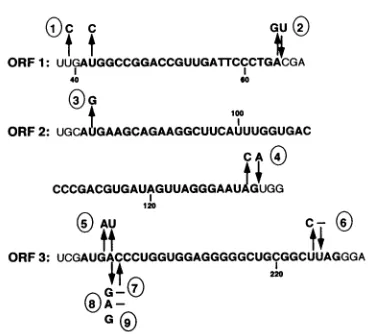
FIG. 1. Site-specific mutations of the RSV leader ORFs. The nucleotide sequences of the ORFs are shown in bold, with the
flankingthree bases at each end shown inlightertype.Mutations in
the AUGcodonsorthe flankingbasesareshown byarrows. The
mutationswerenucleotidesubstitutionsexceptfor nucleotide dele-tions indicated by dashes(6, 7, and8)and insertions indicatedby arrows pointing downward between adjacent bases (2 and 4).
Mutations were screenedby alterationsinrestriction endonuclease cleavage sites.Mutationdesignations: 1, AUG1; 2,TC1; 3, AUG2;
4, TC2; 5, AUG3; 6, TC3; 7,FS3; 8,FS3R; 9,AUG3'.
from 12-day, virus-free chicken embryos (SPF-COFAL/
MAREK; SPAFAS, Inc.) and were maintained in M199
medium (GIBCO) supplemented with 10% tryptose phos-phate broth (Sigma), 1% chicken serum (GIBCO), and 5%
fetal bovine serum (HyClone Laboratories, Inc.). CEFs between passages 2 and 5 were transfected with 10 ,ug of linearized viral DNA per 100-mm-diameter tissue culture dishbyusingDEAE-dextran(Pharmacia)andeither
chloro-quine (Sigma) or serum-free shock (40, 50, 57). Every independent transfection experiment included a positive
control using the WT clone,anegativecontrol of thevector
DNA, pUC19, and a mocktransfection lacking input of any DNA. Media collected from transfected plates were mea-sured for reverse transcriptase activity so that equal virus titers could be used to reinfect fresh CEFs.
Soft agar assays. Fresh CEFs were plated in 60-mm-diameter gridded plates, infected with serially diluted viral stockswhichwere collected from the transfected cultures, and overlaid with agar(Difco)afterovernight incubation for thefocus assay(31). Foci(focus-formingunits [FFU])were scored 5 to 7 days postinoculation. Two plates per viral stock dilution were included in every independent
experi-ment, and three experimentswere runfor each virus.
Reversetranscriptase assays. Culture medium from
trans-fectedorreinfected cellswasclarified from cells by
centrif-ugation at 2,000 x gfor 10 min, and supernatant aliquots
were assayed for reverse transcriptase under conditions described previously (22, 46). Incorporation of
[32P]dTMP
(Amersham) into DNA was assayed by the DEAE filter-binding technique (22) followed by Cerenkov counting.Isolation and analysis of RNAs. Total RNA was isolated
from confluent irnfected cells (12), and formaldehyde-gel electrophoresis and RNAblotting analysis were performed
(12,50). The probes used for hybridization of the RNA blots
were a full-size proviral 9.6-kbp DNA, a 450-bp
HindIII-XbaI DNA fragment encoding the C terminus of the env
polyprotein, anda2-kbp chicken ,-actin cDNA(13), which
servedas acontrolof the mRNA levels loadedon thegels.
All probes were uniformly radiolabeled with
[a-32P]dATP
(Amersham) by usingrandomprimers.Analysis
of Pr76"9 and pp6Ov production. CEFsweretransfected as described above. Transfected CEFs were
cultured 9to12days priortoharvest.
Immunoprecipitations
were done as previously described by Wills et al.
(57).
Monolayerswere labeled byincubation in 800
RI
of methi-onine-free,serum-free medium(Sigma) containing50 ,uCiof[35S]methionine
(specific activity,
>1,100
Ci/mmol;
ICNBiomedicals) for2.5 h. Cell cultureswerethenfractionated
in 1 ml oflysisbuffer (25mMTris hydrochloride [pH 8.0],
0.15 MNaCl, 1%TritonX-100,1% deoxycholate, 100 ,ug of
phenylmethylsulfonyl fluoride per ml, 5 ,g ofpepstatin A
perml,5 ,ugofleupeptinperml) andincubated at4°Cfor 8 hwith eitherananti-RSVantiserum(generously
provided by
J. Wills, Pennsylvania State University) or a monoclonal
antibody for v-src (Oncogene Science). Protein-antibody complexes were collected with
protein
A(Sigma)
and washed withlysis
buffer (26). Sampleswere denatured by boiling in sample buffer (0.0625 M Tris-Cl [pH6.8],
2%sodium dodecylsulfate
[SDS],
10%glycerol,
5% 2-mercap-toethanol) for 90 spriortoelectrophoresis
on 1.5-mm-thick SDS-10%polyacrylamide
gels(Protogel;
National Diagnos-tics, Inc.).Gelswerefixed(40%
methanol, 7% aceticacid),
stained(0.025% Coomassie blue
R-250),
destained(7%
ace-ticacid, 5%
methanol)
bystandardmethods(6),
and soaked for 30 min in Fluoro-Hance(Research
ProductsInternation-al). After drying, radioactive bands were detected with X-Omat AR5 film(Eastman KodakCo.).
Light and scanning electron microscopy. CEF cultures
were observed withaZeiss IM35 invertedlight microscope
and photographed with a mounted Contax 137 automatic camera, using the 1Ox or 16x objective. For scanning electronmicroscopy,cellswereculturedon
glass
coverslips
for 3 to 4
days,
washed with 0.1 MKPO4,
fixed withglutaraldehyde,stained withosmiumtetroxide,
processed
asdescribedpreviously
(10),
andanalyzedwithaHitachiS-450scanning electron microscope, emittingat 10 kV.
RESULTS
Effectsonviral activitiesbymutagenesisofAUG codonsin theRSVleadersequence.The strategy used for
assessing
the roleof the ORFs in the 5' leader sequence of RSV isdepicted
inFig. 2. Essentially,permuted,linearized DNAconstructs containing site-specific mutations were transfected into CEFs. Following uptake of the constructs, the viral
long
terminal repeat was able to direct viral RNA
synthesis,
which inturnservedtoprovideboth mRNA for viral
protein
synthesis and RNA genomes for the assembly of nascentvirusthatcould subsequentlyinfectother CEFs asdetailed
previously (50). Five assays were conducted to evaluate viral activities and the course ofviral
replication.
Reversetranscriptase assayson samples of extracellular media
(as-say 1) provided a quantitative measure of the number of releasedviral particles; focus formation assays in soft agar
(assay 2) providedacomplementary insightinto theabilityof released particles totransform CEF cells; Northern (RNA)
blot assays of intracellular viral RNA (assay 3) indicated both the relativeconcentrations and the sizes ofRNA, which in turn gave the rate of accumulation of normal and trans-formation-defective (td) virus; immunoprecipitation
analysis
of the viralproteins Pr769agand
pp60vs?C
(assay4)
indicatedsteady-state levels of viral protein synthesis; and
on November 9, 2019 by guest
http://jvi.asm.org/
PERMUTEDRSVI RSV
-CONSTRUCT VIRUS
TRANSFECTION
2PfINFECTIN 0
TRANSFORMED
CEFs
VIRAL ASSAYS
1.ReverseTranscriptaseAssay 2.SoftAgar Assay
3. RSVRNA Levels(Northern)
4. Light&Scanning ElectronMicroscopy 5.Immunoprecipitation
(Pr76%
pp6O-'FIG. 2. Experimental strategy for examining ORF mutations. The linearized RSV mutant constructs are shown as the parallel
lines which were transfected into CEFs. The upper horizontal pathwayindicates that sometransfected cells will produce viruses thatarecapable of infectingneighboring cellsandestablishingover
time a plate of virus-infected cells, generally obvious by their transformed morphologies (shaded, roundedcell patterns). Assays of viralactivity includedreversetranscriptase activities and ability
to form focionsoft agar. Assays for intracellular viral RNAand proteins and for morphological features by light and scanning electron microscopy established the presence and transforming
abilityof RSV in these cells.
scopic analysis of cellular morphology (assay 5) allowed
assessments ofcytopathology resulting from several of the
viral mutants. Assays 1 and 2 were quantitative over a
10,000-foldrange, assays3 and 4 hadabouta20-foldrange,
andassay5wasqualitative. All experimentswere repeated
aminimumoffive times.
Previously, we found that mutagenesis of the initiation
codon ofORF1 (AUG- ACG) ledto anattenuated rate of
viral replication (50). We extended this analysis by
inacti-vating ORF2 and ORF3 by mutagenesis of their AUG codons (designated AUG mutants; Fig. 1). Reverse tran-scriptase activities for theWTvirusand the fiveconstructs
with mutations in one or more of the AUG codons in the leader sequence of RSV RNA are shown in Fig. 3A. The
accumulation kineticsofmutantsAUG1 and AUG2and the doublemutantAUG12 clearly show delays in therelease of
enzyme-containing virus. In contrast, mutants AUG3 and
AUG123 did not release detectable levels of reverse tran-scriptase-containing particles, demonstrating the dominant phenotype of the AUG3 mutation. The delay in released reversetranscriptase activity from theAUG12-infected cells
compared with the reversetranscriptase activities fromthe individualAUG1 and AUG2 mutations indicatedanadditive
effect of the single mutations when linked together. In
multipletransfection experiments, the reverse transcriptase kineticcurvesoftheAUG1 and AUG2 virusesreproducibly
showed the firstappearanceofenzymeactivityin the culture medium7to10 daysposttransfection,and the maximal level ofradionucleotideincorporationwasintherangeof 2 x 10³ to5x 103cpm/ltlofmedium (Fig. 3A). TheWT virus clearly spread atthemostrapidrate. Steady-statelevels ofreverse transcriptaseproductionwereintherangeof2,000to 3,000
cpm/,ulof medium for allcultures that wereableto release measurablelevels ofvirus.
Toensurethat thedelayedonsetsofreversetranscriptase
activitywereduetoeffectsontheviral life cycleandnotto
some aspect of transfection or to either reversion of the mutant toWTor another suppression mutation, subsequent infections of fresh CEF cultures with virus-containing media collected from the initially transfected cultures were per-formed, and viral activity was monitored by reverse tran-scriptase (Fig. 3B) and focus formation (Table 1) assays. Equal titers of virus, measured by reverse transcriptase activity, were used in all reinfection experiments. The re-verse transcriptase curves from reinfected cultures mani-fested shorter overall lags in the onset of reverse tran-scriptase activity, as a result of the difference between infection and transfection, but the delays in viral growth between the mutant and WT viruses were the same in transfected and infected cells (compare Fig. 3A and B), indicating that the delayed onset of particle release was not due to back or complementing mutations in the viral ge-nome. The reverse transcriptase kinetics, summarized in Fig. 8, clearly demonstrate that mutations in the ORFs designed to prevent their translation impaired viral replica-tion. Quite unexpectedly, mutations in AUG3 had the most pronounced effect even though all of our previous experi-ments indicated that this ORF is translationally inactive. These findings spurred further inquiry into the role of the ORFs in viral replication and pathology.
Effects of elongated ORFs on viral replication and gene expression. The sizes of the ORFs in the avian retroviruses are absolutely conserved even though the termination codons are variable in different viral strains (24). This conservation suggests that length may be important to ORF function. This hypothesis was tested by mutagenesis of the termination codons (TC mutants) to sense codons, with or without appropriate frameshifts to fuse the ORFs in frame.
The strategy used for the AUG mutants was employed to construct the TC mutants. The lengths of the ORFs in the TC
mutants changed from 7, 16, and 9 amino acids in the WT virus to 30 and 9 amino acids in TC1, 7 and 48 amino acids in TC2, and a single, 64-amino-acid ORF in TC1TC2. As
shownin Fig. 3C and D and Table 1, mutants TC1, TC2, and
TC3 produced reverse transcriptase-containing viruses and
manifested transforming activity levels comparable to the
WT level, whereas theTC1TC2 double mutant exhibited a
substantially retarded release of reverse
transcriptase-con-tainingparticles and was unable to transform CEFs. These
data indicatethat viruses with elongated leader ORFs of 30
to 48 codons behaved as WT. But when the RSV leader
sequence contained a longer ORF of 62 codons behind an
AUG codon with a translationally favorable context, the transforming capacity of the virus was reduced at least 10,000-fold belowWT levels.
In allcases except theTC1TC2double mutant, there was
a correlation between focus formation ability and reverse
transcriptase activity. The presence of enzymatic activity in
the absence of transforming capability suggested that the
RSV parental genomemight have lost its src oncogene. This
hypothesis couldbe tested by analysis of viral RNA
follow-ingtransfectionto determine whether td virus was produced.
RSV RNA accumulation in both the transfected and
rein-fected CEFs supported the observation that the three single
TCmutations hadlittle or no effect on virus production (Fig.
4A
[TC11
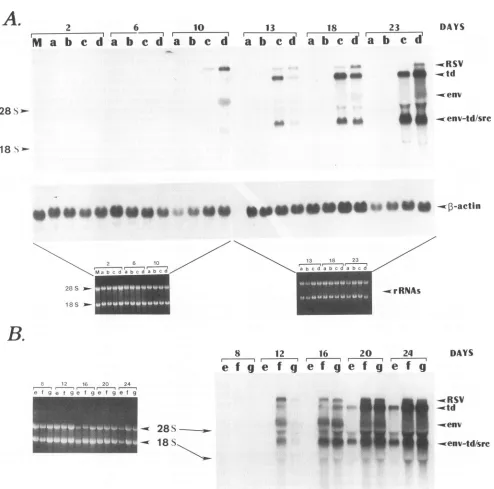
and B [TC2 and TC3]). Although mutants TC1 andTC2 exhibited a slower rate of appearance of RSV RNA
soon after transfection, their RNA levels achieved that of
WTvirus by day 12.Mutant TC3accumulated viral RNA at
thesame rate as did WT virus.RSV RNA analysis from CEF
cultures reinfected with mutant viruses revealed the same
profiles of RNA accumulation as in the transfection
on November 9, 2019 by guest
http://jvi.asm.org/
[image:3.612.69.307.77.237.2]TRANSFECTION
C)
U
0*
*
P4)
U M4)
I
'1
INFECTION
DAYS
FIG. 3. Reverse transcriptase assays of mutantviruses. As described in Materials and Methods, RNA-dependent DNA polymerase activities were quantified in aliquots of media isolated following transfection and reinfection ofCEFs. (A, C, and E) Enzymeactivities followingtransfectionof CEFs with theindicatedDNAconstructs;(B, D,andF)results of infection of CEFs withparticlesharvested 10to 18days posttransfection.
ments(41). RNA blots revealed that the three single termi-nationcodon mutants rapidly accumulated td virus (Fig. 4A, lanes c;Fig. 4B, lanes f and g). The transformed phenotype ofcells infected with either TC1 orTC2 peaked at 15 or 8
days postinfectionand thereafter regressed somewhat,
pre-sumably as aresultof the accumulation of the observed td viruseslackingsrc(19).To ensuretheidentity of the td RNA
speciesobserved inourRNAanalysis,wereprobed the blots withanenv-specific probe (41). We found the samepattern
of RNAspeciesaswith the full-sizegenomic RSVprobe at
latetime points, confirmingthat the abundant
low-molecu-lar-weight species that migrated near the position of src
mRNA on days 18 and 23 (Fig. 4A, lanesc andd) andon days20 and 24(Fig. 4B, lanes e tog)was envmRNA from td virus.
The patterns of viral protein synthesis in the mutants provided further insightinto the effects of ORF mutations. Proteins from transfected cells were immunoprecipitated
with either anti-RSV antibody, which precipates Pr769'9
from cellular lysates, or
anti-pp60vsr
to determine theon November 9, 2019 by guest
http://jvi.asm.org/
[image:4.612.120.496.75.562.2]TABLE 1. Cell transformationassay
Virus FFU/mla
WT... 5.0 x 10⁴
AUG1... 2.0 x 10⁴ AUG2... 3.2 x 10⁴ AUG3... 55
AUG12... 2.2x 10⁴
AUG123... ... <10
TC1... 2.0 x 10⁴
TC2... 2.0x10⁴
TC3... 2.5 x 10⁴ TC12... <8
FS3... <8
FS3R... 4.5 x 10⁴
AUG3+TC3 ... ... <10
TClFS3... <8
FS3TC3... 68
aDeterminedasdescribed in theMaterials and Methods.
bAneventualtiter of 2.2x10⁴could be reached, but only after
consider-able time;AUG12 isa veryslow virus.
effects on translation ofunspliced and spliced RSVmRNA
(Fig. 5). Pr769ag was efficiently made in cells transfected withWT,AUG1, AUG2, TC1, TC2, and TC3 virusesbutnot in AUG3- andAUG123-transfected cells (Fig. 5A). In
con-trast,expression ofpp60vsC (Fig. SB)wassomewhat higher inAUG1-, AUG2-, and TC3-transfected cells than in
WT-infected cells. There was no evidence ofsrc expression in AUG3-,AUG12-, and AUG123-transfected cells after 9to12 days ofincubation, in keeping with the lack of other viral activities in these cells. Thesedataaresummarized in Fig. 8. Incontrast to the single TCmutants, the double termina-tion codonmutantTC1TC2 producedundetectable levels of transforming activity (Table 1) and a delayed onset of replication (Fig. 3C and D). This mutant's reverse tran-scriptase profile resembled that of the AUG1 and AUG2 viruses, but the inability of the TC1TC2 virus to induce cellular transformation clearly distinguished it from the AUGmutants. Only the td RNA species accumulated after day 20 posttransfection (Fig. 4B, lanes e), whereas no full genomic or src RNA species ever appeared in cells trans-fected with thedoublemutant.Thismutantvirusapparently required alag period ofabout a week before it could attain
detectable levels of growth, by which time it had lost its
oncogene and consequently its transforming ability. The levels of Pr769ag made by this mutant were undetectable
after 12 days, indicating a translational effect of the long
upstream ORF on downstream initiation of protein
synthe-sis.
Changing the AUG codoncontext ofORF3 abolished viral replication. The effects of elongating ORF1 into ORF2 and
ORF3 in theTC1TC2 doublemutant mayhave been due to disturbing ORF3 alone, which, as shown previously bythe AUG3mutant,wasimportanttoviralreplication.To further
probe the important aspects ofORF3 onviral propagation, we examined the effects of alterations in the ORF3 coding sequence. Fivemutantswere examined(summarizedinFig. 8). The first, FS3, had a frameshift mutation in the fourth nucleotide, which produceda translationallyfavorable
initi-ation codon (35, 36) which was identical in nucleotide context to the AUG codon of ORF1with respect to nucle-otides -3 and +4(Fig. 1) and whichelongated ORF3 to64
codons, which is about the lengthof the single ORF in the
defective mutant TC1TC2 (62 codons) and equal to the
lengthofORF3 in mutant TC3,which showed a WT pheno-type.The other fourmutants wereFS3R, which restored the translational context of AUG3 back to its normal context whilemaintainingtheframeshift; FS3TC3, which maintained the frameshift but shortened the mutant reading frame of FS3 (64 codons) by a mutation in TC3 to 26 codons;
TC1FS3, which was constructed to test whether a single 30-codon ORF upstream of ORF3mightaffect its translation
differentlythan whentwoshorterORFspreceded it as with
FS3; and AUG3+TC3, which had (i) the translationally enhanced codoncontext forAUG3, (ii) the same extension of ORF3 as in the FS3 mutant, and (iii) nearly the same amino acid sequenceatitsamino-terminal endasthe normal ORF3. With these mutants, wecould distinguisheffects of AUG initiation codon context, amino acid sequence of the encoded leaderpeptide,andORFlength.
ImprovingtheAUGcontextof theelongated ORF3 from
AUGA to AUGGj resulted in severely defective viruses
(FS3, FS3TC3, TC1FS3, and AUG3+TC3) with respect to focus formation activity (Table 1), reverse transcriptase activity (Fig.3EandF),and viralproteinsynthesis(Fig. 5). Incontrast,FS3R,with the same,elongated length in ORF3 but with theoriginalAUG3 codon context, had viral activi-ties thatweresimilartothose of WTvirus. The activities of thesemutantssuggestedthat alterations of the fourth base of ORF3 hadextremeconsequencesfor viralreplication. RNA blot analysis (Fig. 4A, lanes a and b) did not reveal any
RSV-specific
RNA species at any time posttransfection.DNAblotanalysisontransfected CEFsindicated abundant
levelsofunintegratedviralfragmentsthat carried the intro-duced mutation(s) upto7daysposttransfection (41). Thus, the viral DNAwasintroduced into the cellsuccessfullybut
was unable to support subsequent viral replication. This
finding
suggeststhat thechange of the AUG codon context in position +4 of ORF3 was sufficient for the severely defective phenotype. Furthermore, results for mutants FS3R, AUG3+TC3, and FS3TC3together indicate that the defect in the FS3 mutation neednothave been due eithertothe extension of ORF3 which overlapped with the gag
coding regionor tothe alteration in thecodingsequenceof the ORF3 peptide. The TC1FS3 mutant had properties identical to those of the FS3 mutant, consistent with the
previous
observation that the TC1 mutation alone had noobservable effectonviral
replication.
CellularsenescenceofFS3-infected CEFs. Duringthe
mul-tiple
transfectionexperimentsusedwith theFS3 construct, individual cells appearedtobe transformed (Fig. 6,arrow-heads).
Transformantswere alsoobserved upon reinfection of freshCEFs with cell-free media from transfected cultures. Suchtransformantswere few,scattered in the culture dish,andsurroundedby lysedcell material that dissociated from the
plate
and floated in the medium (Fig. 6B, arrows).Transformedcells died 4to6h afterformation.Intriguingly,
severalhours afterdeath,newtransformantswerelocated in
thesame area.These observationssuggested that the virus in the infected cellwas unable to replicate and spreadbut
could inducea
cytopathic
effect.To substantiate this observation, cell morphology was examined
by
scanning
electronmicroscopy. Figure
7showsrepresentativemicrographsofCEFs infected with WT RSV
(panels
1 and2)
and with thetwo mutantsFS3 andTC1FS3(panels
3 to6).
Whereas cells infected with WT RSVexpressed the distinct surface
morphology
(2, 3, 55)
ofa transformedfibroblast(panels
1and2,
T),
cultures infected with FS3 and TC1FS3 looked like uninfected fibroblastson November 9, 2019 by guest
http://jvi.asm.org/
2 6 10 Ir
M
a
b
c d
a
b
c
d
a
b
c
d
ao
'pg
28S
M-*;a
13 18 23
a
b
c
d
a
b
c
d
abc d
-a
flit'
DAYS
-FRSV
9_ -td
--env
$
eat
~env-td/src
18 S g..
-atb"0
6"W
@*
'1 4-..
-actin._""~~~~~~~~~~~~~~00
"ZZ
_Ir~~~~~.%04*
emc*"
_od
_ 0002 6 10 13 18 I23
177~~~~~~~~~~ I~~~a6 cd a bcda bcd Mab cd4 abcd ab r-di
8 12 16 20 24
e
f g
e
f
ef g
ef g
e
f
g
3 1 2 16 20 24
e f e ar- ---- Il e f g e f ge f ge f g ef g
-" 28S
--
18
Son #II...
SW*: Om*_
X.:'I ,ss
i ' * " E
iW*
aw
ili
*: ..,
FIG. 4. Northern analysis of RSV RNAs in transfected CEFs. Autoradiograms of the RNA profiles are shown from samples from
transfected cellsthatwereseparatedon1.2%agarosegels containing formaldehyde. (A) Theupperpanel shows results for mock-transfected
CEFs(lane M)andCEFs transfected with FS3, TC1FS3,TC1,andWTRSV(lanesatod, respectively). The lower panelshowsboth the original gelsintheupperpanelstained withethidiumbromidetoshow18S and 28S rRNA levels and thesamefilters blotted witha
0-actin
mRNAprobe for internal standardization of the viral RNA signals. (B) ViralRNApatternsfrom cells transfected withmutantconstructs TC1TC2, TC3, and TC2 (lanesetog,respectively). The panelatthebottomleftshows the ethidium bromide stainingofthe rRNAsfromthe samplesin theupperpanel. The number above eachsetof lanes correspondstothenumberofdaysafter transfection that the sampleswere
harvested foranalysis. Positions of the full-size genomicRNA(RSV),tdgenomic RNA (td),envmRNA(env),srcmRNA,andenv(td) mRNA (which comigrates with thesrcmRNA) (env-td/src)aredesignatedatthe right.
(panels 3 and 5, F). Only after systematic searches were
individual transformants identified from the two mutants (panels4 and6, T); pairs of transformants which mighthave
suggestedassociateddaughter cells undergoing mitosiswere
neverobserved. Thesurface morphologywasdifferentthan
that of WT RSV transformants. The cells infected with
mutant viruses expressed a phenotype which lacked the normal rich and dense network of microvilli and extended
philopodia (panels1 and2, large arrowheads)and had short and loosely scattered microvilli (panels 4 and 6, small
A.
28 S
i-18S
B.
- rRNAs
DAYS
-tRSV
ritd
--env-eienv-td/src
on November 9, 2019 by guest
http://jvi.asm.org/
[image:6.612.61.555.70.559.2]A &#O+OOO4\C\4G<NGN&§5vGbS
B G¢¢ 4 ¢ B < p~. 4 @ s*@5NG^G~~t 5 5t
FIG. 5. Analysis of viral protein in cells infected with mutant viruses. Cell lysates were obtained from [35S]Met-labeled cells transfected 9 (A) and 12 (B) days prior with the indicated mutants. Proteins were immunoprecipitated as described in Methods and Materials and separated on 10% polyacrylamide gels. The viruses arelabeled above the lanes. A molecular weight standard was run in each gel (not shown). (A) Proteins precipitated with anti-RSV antiserum. The position ofpr76gag is noted by thearrowat the right. (B)Protein precipitated with app6oVsP monoclonal antibody. The position ofpp60V<$ is noted by the arrow at the right; both bands are forms ofpp6ov-s?C (58).
arrowheads). Furthermore, these putative mutant transfor-mants showed a very lowabundance of ruffles relative to the WTtransformants. The limited number of surface membrane structures might be indicative of abortive efforts for cell division which resulted in subsequent senescence.
DISCUSSION
The results presented in this report support our hypothesis that the ORFs in the leader RNA sequences of avian retroviruses are translated and important for viral replica-tion. Inactivation of AUG1 and AUG2 individually or to-gether delayed and/or reduced the levels of viral RNA synthesis.Mutagenesis of AUG3 eliminated viral replication almost completely. Alteration of the context of the ORF3 initiation codon had a similar debilitating effect on the retrovirus. Extensions of ORFs in some circumstances sup-pressed viralpropagation. The effects of the ORF mutagen-esisexperiments are summarized in Fig. 8. Mutations in the leader RNA sequence could have had effects on reverse transcription-proviral insertion, viral RNA translation, and/or viral RNApackaging. The following two hypotheses could account for our observations that mutations in the leader RNA interferred with viral replication. (i) Mutations in the leader ORFs may affect translation of gag,gag-pci, env, and src mRNAs. (ii) ORF mutations may alter RNA secondary structural motifs required for reverse transcrip-tion and/or packaging of the viral RNA.
Hypothesis 1: the ORF mutations affect synthesis of RSV proteins. Mutations inAUGi and AUG2 had relatively small effects, generally retarding the rate of viral propagation, whereas the AUG12 mutant caused a more pronounced reduction in the ability of RSV to replicate (Fig. 3) and reduced thesynthesis of viral proteins (Fig. 5). These results are in accord with previous evidence which indicated that the first two ORFs are translated (50). The presence of at least one ofthe first two ORFs appears to be important for improving translational efficiency of the gag,pci, and env codingregions by facilitating ribosomal movement along the unusually long 5' leader region or for altering the folded
structure of the viral RNA to facilitate viral RNA packaging. The major effects following alteration of ORFs that we observed differ from those reported by
Donze
and Spahr (17). In our experiments, mutagenesis of AUG3 in mutants AUG3 and AUG123 completely suppressed viral replication, as measured by reverse transcriptase activity and spread ofcellular transformation (Fig. 3 and 8), whereas their equiva-lent mutants, pAM3 and pAMuP, actually enhanced viral replication and delayed transformation only in the case of pAM3. Additionally, we found that mutation of AUG2 in mutants AUG2 and AUG12 delayed the onset of reverse transcriptase activity by 1 to 2 weeks and reduced its level nearly 10-fold, whereas the equivalent mutants in the Donze and Spahr study, pAM2 and pAMlAM2, showed no reduc-tion in activity. Since their assays were conducted at a single time, in contrast to our measurements over 2 weeks, and since thesite-specific mutations altered different nucleotides in their mutants, the cause of the differences in results cannot be completely resolved.
The role of ORF3 is perplexing. All of our previous assays of translational activity suggested that it is relatively silent (48-50), yet mutation of its initiation codon (AUG3) or change in the context of its AUG codon
(AUG3+
and the FS3 mutant series) are all compatible with ORF3 being translationally active. Nevertheless, the effects of the muta-tions in ORF3 can be rationalized by consideration of its location in the leader. ORF3 is situated in a particularly metastable region of RNA secondary structure that overlaps a region required for RNA packaging and virion formation; ORF3 is also proximal to the AUG initiation codon for all of the structural proteins of the virus (23). Accordingly, high rates of ORF3 translation in theAUG3+
and FS3 mutants may prohibit efficient gag,gag-pol, and env protein synthe-sis, by converting scanning subunits into complete ribo-somes before they encounter the fourth AUG codon, thereby inhibiting viral propagation. An alternative hypoth-esis (17) that the effects of the FS3 mutation were due to the encoded polypeptide in the elongated ORF3 is unlikely. Although the FS3 mutation changed the eight amino-proxi-mal amino acids (excluding the N-terminal methionine) of ORF3, mutant FS3R, which differed from FS3 at only one site (Thr to Ala in the second residue), had the WT pheno-type even though the remaining 63 amino acids were the same. Moreover, theAUG3+TC3 mutant with an enhanced AUG3 codon context but the same amino-terminal residues as in the normal ORF3 was as inactive as the FS3 mutants. Thus, comparison of the FS3, FS3R, andAUG3+TC3
mu-tants as well as examination of ORF3 sequences in other replication-competent avian retroviruses (24, 28) are consis-tent with a model wherein the effects of the FS3 mutation were due to enhanced translation of ORF3 that reduced translation of the major viral proteins which initiate at the fourth AUG codon. In the same fashion, the FS3 mutation should reduce translation of the spliced env mRNA because theterminationcodon of the elongated ORF3 resides down-stream from the env initiation codon (Fig. 1).Alteredtranslation may explain potential lethal effects of the FS3 mutation. In the spliced src mRNA, the elongated ORF3 terminates within the fourth upstream ORF, which is normally translated (30). Moreover, just as nonsense codons in the gaggene can destabilize unspliced RSV mRNA (7), theoverlap of the FS3 ORF into the gag coding sequences could also destabilize the unspliced mRNA by the same mechanisms. Accordingly, our model suggests that transla-tionthrough ORF3 of mutant FS3 suppresses gag and env translation but may enhance src protein synthesis to
on November 9, 2019 by guest
http://jvi.asm.org/
[image:7.612.79.291.80.209.2](A)
(B)
sg3'X -\ f| j
2.i
ip ~ ~~~ - *1I-a~y
I > L _ _ - f,6,- _ <
|
if
l
M
~~~~~~~~~~~~~~~N
g g
X^<F#I-%~~~~~~~~~
IC1-L4E
tAFS3E
_
[image:8.612.89.513.70.609.2]TCI-FS3
FIG. 6. Light micrographsof uninfectedCEFs (CEF)andCEFs infected with WTormutant(TC1,FS3,andTC1FS3)virus.Micrographs
of tissue-cultured cellswereobtained 18days posttransfection (A, x90magnification)and 14days postinfection (B,x145magnification).The micrographsofcellsharboringWTand TC1 virusesclearlyshowmultipletransformedCEFs.Thepicturesof FS3- andTCIFS3-infectedcells
show individual transformedCEFs(arrowheads)andsenescentcells(arrows)locatedatareaspreviously occupied bytransformedCEFs. toxic levels(58).We arecurrentlyexaminingthispossibility
(52, 58).
From theforegoing considerations, destruction of AUG3
toeliminate thenormallytranslationallysilent ORF3was not expected to have any effect on viral protein synthesis. However, alteration of AUG3 inactivated the virus. As
explained below, mutantswith theAUG3 mutation maybe impairedasthe result ofaninabilityto
productively
encap-sidate theviral RNA.Extensions of the ORFs could affect either translation of viralproteinsorpackaging. TheTC1 andTC2 mutations did
notappearto affect otherimportant
cis-acting
sequences inCEF
WI
on November 9, 2019 by guest
http://jvi.asm.org/
-... I
[image:9.612.64.558.82.447.2]I
FIG. 7. Scanningelectronmicrographsof CEFs infected withWITRSV(1and2),FS3(3and4),andTC1FS3(5and6).Cell cultureswere
preparedformicroscopyat12dayspostinfection.Panel 1 shows four transformed CEFs(T)andneighboringuninfectedfibroblasts(F); panels 3 and 5 showsnormal CEF celllayers (F); panels2,4,and 6 showindividual transformed CEFs (T)andunderlyingnormal fibroblasts(F). Networks ofmicrovilliareindicatedbyarrowheads(largearrowheads,rich and densenetworks;smallarrowheads,poor and loosenetworks). Twoindividual ruffles of the transformed cell inpanel2arelabeled R. Magnifications: 1, x800; 2, x1,400; 3, x1,000; 4, x2,000; 5, x1,200; 6, x2,400.
the RSV leader, since neither mutation had a substantial effect on virus propagation. However, replication of the double mutant (TC1TC2) was profoundly retarded. These results suggest that if ORF 1 exceeds a threshold length,
between 48 and 62 codons, ribosomes would no longerbe
abletoreinitiateatthe initiation codon for the gag gene. The
proposal that threshold lengths of nascent polypeptides
longer than 50to 60 amino acids may lead to translational termination issupported bythe effects of upstream ORFson polycistronicmRNAs inplant protoplasts (20)andthe mode of translational regulation of tubulin protein synthesis in animal cells (21). Coincidentally, the average
ribosome-protected length of nascent peptide sequence is about 50 amino acids (39), suggesting that once the nascent peptide
protrudes from the 80S ribosome, further reinitiation of translation is inhibited. Thus, the data for the TC mutants further support our previous conclusion
(50)
that ORFi is translated in vivo.Additionally, the data support the hypothesisthat either translation ofelongatedORFsorenhanced translation ofan
ORF that overlaps the gag coding region interferes with translation of themajorviralproteins. These conclusions are in accordwithourprevious findings (48-50) and are further developed in the accompanying report (42), wherein the intrinsic translationalefficiencies of the mutant viral RNAs
areexamined.
Hypothesis 2: theORF mutationsmay affectRNA
confor-mationsrequired forviralreplication. Reverse transcription and encapsidation of retroviral RNA require recognizable motifs in the leader sequence (1, 4, 5, 8, 15, 23, 34, 44, 51). Following infection, viral RNA is reverse transcribed by
reverse transcriptase, which requires a specific RNA
con-formation around theprimer bindingsite, thePBLloop (23). Alteration of this structure impairs provirus synthesis and virus spread (1, 14). The AUG2 mutation is in the PBL structureand maysubtly alter the folded pattern of thebases
in a mannersimilartothat observedbyCobriniketal. (14).
Since the AUG codon ofORF1is outside thePBLstructure
(23), it is less likely that the effect of the AUG1 mutation interferes in thismannerwithreversetranscription. Incells
on November 9, 2019 by guest
http://jvi.asm.org/
gag pol env src
-
-~~~~
\1
2
3
wr
AUG1
AUG2
AUG31
AUG12
1-
1a
AUG123
TC1
I-I-
I-TC2
TC3
TCITC2
FS3 3
TCI FS3 _ g 3
FS3R
FS3TC3
AUG3TC3
ONSET OF
ORF RT.
CHANGE ACTIVITY
[image:10.612.136.483.73.523.2]aCoo m (DAY TXFABILITY RSVRNA
Pr7rpp'o
FIG. 8. Summaryof RSVmutantclones andphenotypes.The RSVgenomicRNA is shown at thetop.Its four genesareshownaslarge
boxes,andORF1toORF3 in the 5' leadersequenceareshown in theexpandedsegments belowthemapof the entire virus. The ORFsare
indicatedbythe numbers above the WTdiagram,and thenumbers of encoded amino acidsareindicated below the ORFs. Sites of mutations
areindicatedbyvertical linesabove themaps.Alterations of initiationortermination codonsareindicatedby dashes,the frameshifts in the
FS3mutantsareindicatedby asterisks, and thebase substitution in the +4position of theAUG3codon is indicated byaplus sign. The
tabulation indicateschangesin ORFlengths(A&ORF),the number ofdays posttransfectionwhenreversetranscriptase (R.T.) activitywasfirst
noted(Fig. 3),therelative level of transformation(TXF)taken from Table1,thelevels of intracellular retroviralRNAdetectedbyNorthern blotanalysis (Fig.4 and reference52),and thelevels ofsteady-state Pr76gagandpp6OvsrCdetectedbyimmunoprecipitation (Fig. 5). Symbols for the transformationassay: +++, >3 x 10⁴ FFU/ml; ++,100to3 x 104FFU/ml; +, 10to100FFU/ml; -,10FFU/ml.
producing virus, full-length retroviral RNA molecules con-tinually enter pools to become eithertemplates forprotein synthesis or substrates for encapsidation. We hypothesize
that a biochemical equilibrium mediated by the Pr769ag
concentration determines thepoolinto which anRNAgoes
afterleavingthenucleus.Asimplemodel is thatcompetition
between ribosome formationatthegaginitiationcodon and
gagpolyprotein association with the T packaging motifon
the viral RNA determines the equilibrium. Accordingly,
when an RNA enters the polysome pool, the increased
production ofgag proteintends to shift the equilibrium to packaging by raising the probability that a Pr769'g protein
will bindtothe leader andpreventfurther ribosomal subunit
scanning. Likewise, association ofgagproteinswith RNA during packagingandsubsequentvirusexportwill lower the
intracellularPr76gag concentration, thereby shiftingthe
equi-librium backsothatnewly synthesized RNA would associ-atewith ribosomes. This equilibrium could bedisrupted by
NONE T+1-I
hORF 1I 14 +
AORF212 1 +
AORF3 NONE - _
&ORF 1, 17 + +
-2OI 1,7OI:
AORF1 5
2z3 NONE --_
ORF1
-OF S 5 ++ +++ +
ORF 2
-R48 5 ++ ++ _
ORF3+3-==
.-64 5 *I1 4+
ORFI
->62 10 .td
-ORF3 NN
30 NONE --_
ORF3
-64
ORF3
->26 NONE
--ORF3
->64 NONE
-7-...1-...,.,.I
.1
on November 9, 2019 by guest
http://jvi.asm.org/
AUG3 MUTANT
60
TG
rG GG GGC\ C / G GG)
T
T-AC
A C-GJ C-G T-A G- C T-A C-G I-C A ENERGY -23.5 AG CG G G G A AG-CC G-C G T C- G T G A-T T G C- G 20T-A G G C- G T G c-doTdT C
C G
C G
T C
AC-G T
C-G T-A C-G T G G-C T-A C-G I-C A
ENERGY w -23.2
GGG G 40
C AG CGA GG
TAT/Gc T G
T G C G-C C-G611
C-GCT
T
A T
C-GGA C-G T- A C-G T G G- C T-A C-G I-C A
ENERGY - -22.2
GTTC G
G T AG TA G-C G- C G T C- G T G A- T T G
20-C
G TA G G C- GcT*G
c
T* \TG
cG-C GcG
C G
T C
AC- G T T C-G T G G-C T-A C-G I-C A
ENERGY - -23.3
[image:11.612.67.561.79.348.2]a b a b
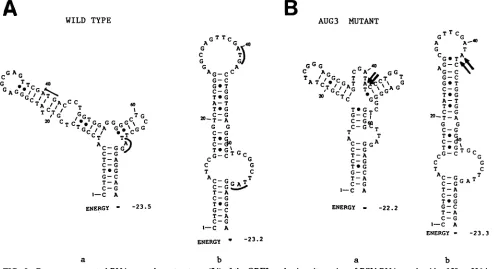
FIG. 9. Computer-generatedRNAsecondarystructures (24)of theORF3packagingsiteregion of RSV RNA, nucleotides 159to236 in the SR-A(SF) strain.Nucleotide 1 in thestructurescorrespondstoresidue159.(A)Alternativestructuresof thisregion for the WTsequence,
with the initiationandtermination codonsoverlined. TheAGofconformationsa and bare -23.5and -23.2kcal (1 kcal = 1.484 kJ)/mol,
respectively. (B) Comparablestructuresin theAUG3 RNA(arrowsindicatethemutations).Note thattheequilibrium is shifted in the opposite directionin AUG3 RNAcomparedwith theWT RNA and that themultiple-loopstructureaintheAUG3mutanthasaconformationdifferent
from that ofstructureain the WTsequence.
either interference with Pr76&ag protein synthesis or
alter-ation of the motifs of RNA structure recognized by the packaging proteins.
Selection of viral RNA forpackaging requiresaparticular
sequence in the leader RNA(4, 5, 8, 15, 27, 34, 38, 44, 51)
thatcanform alternative conformationsof folded RNA(23) (Fig. 9). ORF3 overlaps this metastable sequence required
for efficient RNApackaging (51),andmutationsin thisORF
may inhibit encapsidation by altering required secondary structure in its vicinity. As shown in Fig. 9, the AUG3 mutation alters both theequilibriumof structuresaand b and
the folded pattern of structure a. In the model presented above, the AG values indicate that the RNA in the AUG3
mutant would assume conformation b four times more frequently than it would in the WiT virus. Thus, though ample gag protein would be made in AUG3-transfected cells,thestructureofthe AUG3 RNAmaynotbeasableto
assume afoldedstructurecompatibleforpackaging. Prelim-inary observations on the intracellular level of Pr769ag
polyproteinsynthesisinAUG3mutant-transfected cells
sup-portthishypothesis (42). Bythismodel, augmented
transla-tionthroughORF3 in theencapsidation recognition region, by complete 80Sribosomes rather thanbyscanning
riboso-mal subunits, might interfere with the process of Pr769ag
bindingtothe RSV RNA and theencapsidation process(8, 18, 35, 45).Our modelparallels ahypothesisthat ribosome bindingtoRNAandtranslationmayaffectencapsidation of hepadnavirus RNA (11, 43). This model has the further
attractive feature ofreconciling arecent reportwhich
con-flicts with our observations. Donze and Spahr (17) have suggested that ORF3 is translationally active and that the
encoded peptide participates in some step, other than the
packaging reaction, required in the viral life cycle.However, their ORF3 mutants
pAM3185
and pAM3224 (17) contradictthis conclusion, as do all of our findings with our ORF3 mutantsreported here, the translational effects of the ORF3
mutants (42), and ribosome binding studies which indicate
that ORF3 is translated at mostto onlya small extent(48, 50).All of their criticalchangesinORF3wereinterpreted in terms of amino acid changes in the peptide without any apparent consideration of effects on RNA structure.
Alter-ation in RNAfoldingcould be thekeytotheincapacitation
of themutantsinthesestudies of leader function. Relatively
small alterations of RNA structure in other regions of the
RSV and other retroviral leader RNAs have beenshownto
havemajorconsequences (1, 14, 27).
Thephenomenon ofcell transformationfollowed by early
cell death described inthis work isunprecedented. Subgroup
A avian retroviruses usually do not induce cytopathic ef-fects. In thecaseswhere cytotoxicityhas been observed in
cells infected withcertain othersubgroups ofavian
retrovi-ruses, senescence has been attributed to superinfection
phenomena (56).Adelayintheacquisitionofsuperinfection
resistanceseems tolead tomassive second-round infection and transientaccumulation oflargeamountsofunintegrated
viral DNA whose dose must have been lethal. Another
hypothesis proposes linkage of the receptor (specific for
subgroupBviruses)with cell metabolism andthetriggering
ofcytopathic phenomena bythe interaction of thereceptor
with variantenvglycoproteins (16).Neither ofthese hypoth-eses explains our results. We observed transformation of
host cellspriortotheir senescence,indicatingtranslation of
A
WILD TYPEB
on November 9, 2019 by guest
http://jvi.asm.org/
the splicedsrcmRNA.Possibly, pp60vsrc expression from a
virus that cannot be assembled and mature efficiently,
be-cause of either low levels of gag, gag-pol, and/or env
proteinsor adefect in packaging initiation duetotranslation through thepackaging site, might lead tocytopathic effects.
Amoreattractive hypothesis is that the FS3 mutation affects pp60v-src synthesis from the spliced src mRNA, thereby
raising the concentration of the oncoprotein to cytotoxic
levels (54). We are currently investigating this possibility
(58).
Insummary, wehaveprovidedanextendedanalysis of the
role of the ORFs in the RSVleader RNA. Our data suggest that the viral life cycle is sensitive to the presence of the
three ORFs which may be involved in the partitioning of RNAinto polysomal and packaging pools.
ACKNOWLEDGMENTS
Wethank R. Petersenand S. Belzer for preparingprimary CEFs from embryonated eggs; R. Petersen and T. Holm for help in
mutagenizing the stop codon of ORF1; J. Wehner for assistance during the construction of mutants FS3 and TC1; R. Kuehn for assistance with the scanning electron microscopy; D. Johnson for
computer assistance in RNA folding; J. Wills (Pennsylvania State
University) for the gift of the anti-RSV antiserum; and L. Wu, J. Essner, S. Fahrenkrug, R. Iwan, and the J. Wills laboratory for helpfulconversations during thecourseof thiswork.
This project was supported by NIH (ROl CA 43881) and the
American Cancer Society (NP-790) grants toP.B.H. and by funds from the Aristotle Onassis Fellowship Fund and a University of MinnesotaGraduate School fellowship to A.M.
REFERENCES
1. Aiyar, A., D. Cobrinik, Z. Ge, H.-J. Kung, and J. Leis. 1992. Interaction betweenretroviral U5RNAand theTPC loop of the tRNATIP primer is required for efficient initiation of reverse
transcription. J.Virol. 66:2464-2472.
2. Allred,L. E., and K. R. Porter.1979.Morphology of normal and transformedcells. In R.0. Hynes (ed.), Surfaces of normal and
malignantcells. John Wiley & Sons,NewYork.
3. Ambros,V. R., L. B. Chen, and J. M. Buchanan. 1975. Surface ruffles as markers for studies of cell transformation by Rous sarcomavirus. Proc. Natl. Acad. Sci.USA 72:3144-3148. 4. Anderson, D. J., P. Lee, K.L.Levine,J.Sang, S. A. Shah,0. 0.
Yang, P. R. Shank, and M. L.Linial. 1992. Molecular cloning andcharacterization of the RNA packaging defectiveretrovirus SE21Q1b.J. Virol.66:204-216.
5. Aronoff,R., and M. Linial. 1991. Specificity ofretroviral RNA packaging. J. Virol. 65:71-80.
6. Ausubel, F. M., R. Brent, R. E. Kingston, D. D. Moore, J. A. Smith, J. G. Seidman, and K. Struhl (ed.). 1987. Current protocols in molecular biology. John Wiley and Sons, New York.
7. Barker, G. F., andK. Beemon. 1991. Nonsense codons within the Rous sarcoma virus gag gene decrease the stability of
unspliced viral RNA. Mol. Cell. Biol. 11:2760-2768.
8. Bieth, E.,C. Gabus,and J.-L. Darlix.1990.Astudy of the dimer formation ofRoussarcomavirus RNA andof its effectonviral protein synthesis invitro.Nucleic AcidsRes. 18:119-127. 9. Bizub, D., R. A. Katz, and A. M. Skalka. 1984. Nucleotide
sequence of noncoding regions in Rous-associated virus-2: comparisons delineate conservedregions important in replica-tionand oncogenesis.J. Virol.49:557-565.
10. Boyde,A., R. A. Weiss, and P.Vesely.1972. Scanningelectron microscopyof cellsin culture. Exp. Cell Res. 71:313-324. 11. Chang, L.-J., D. Ganem, and H. E. Varmus. 1990. Mechanism
oftranslation of the hepdnaviral polymerase (P) gene. Proc.
Natl. Acad. Sci. USA 87:5158-5162.
12. Chomczynski, P., and N. Sacchi. 1987. Single-step method of RNAisolationby acidguanidinium thiocyanate-phenol-chloro-formextraction. Anal. Biochem. 162:156-159.
13. Cleveland, D. W., M. A. Lopata,R.J.MacDonald, N. J.Cowan,
W. J. Rutter, and M. W. Kirschner. 1980. Numberand evolu-tionaryconservationof a-and ,-tubulin and cytoplasmic 13-and
y-actin genes using specific cloned cDNA probes. Cell
20:95-105.
14. Cobrinik, D., L. Soskey, and J. Leis. 1988. A retroviral RNA secondary structure required for efficient initiation of reverse
transcription. J. Virol.62:3622-3630.
15. Darlix, J.-L. 1986. Control ofRoussarcoma virus RNA
trans-lationandpackaging by the5' and 3' untranslated sequences.J. Mol.Biol. 189:421-434.
16. Dorner, A. J., andJ. M.Coffin.1986. Determinants for receptor
interaction and cellkillingon theavian retrovirus glycoprotein
gp85.Cell45:365-374.
17. Donze, O., and P.-F. Spahr. 1992. Role of the open reading
frames of Rous sarcoma virus leader RNA in translation and
genome packaging. EMBO J. 11:3747-3757.
18. Dupraz, P., and P.-F. Spahr. 1992. Specificityof Roussarcoma virusnucleocapsid protein in genomic RNA packaging. J. Virol.
66:4662-4670.
19. Estis, L. F., and H. M. Temin. 1979.Suppression of multiplica-tion of aviansarcoma virus byrapidspread of
transformation-defective virus of the same subgroup. J.Virol.31:389-397.
20. Futterer, J., and T.Hohn. 1992. The role of anupstream open reading frame in thetranslationofpolycistronic mRNAs in plant
cells.Nucleic Acids Res. 20:3851-3857.
21. Gay, D. A., S. S. Sisodia, and D. W. Cleveland. 1989. Autoreg-ulatory control of1-tubulin mRNAstabilityislinked to
trans-lationelongation. Proc.Natl. Acad. Sci. USA 86:5763-5767. 22. Goff, S., P. Traktman, and D. Baltimore. 1981. Isolation and
properties of Moloney murine leukemia virus mutants: use ofa rapid assay forrelease of virion reversetranscriptase. J. Virol.
38:239-248.
23. Hackett, P. B., D. P. Johnson, M. W. Dalton, and R. B. Petersen. 1991. Phylogenetic and physical analysis of the5' leader RNA sequences of avian retroviruses. Nucleic Acids Res. 19:6929-6934.
24. Hackett, P. B., R. B. Petersen, C. H. Hensel, F.Albericio, S.I. Gunderson, A. C.Palmenberg,and G. Barany. 1986.Synthesis in vitro of a seven amino acid peptide encoded in the leader RNA ofRous sarcoma virus. J. Mol. Biol. 190:45-57. 25. Hackett, P. B., R. Swanstrom, H. E.Varmus, and J. M. Bishop.
1982. The leader sequence of the subgenomic mRNAs ofRous sarcoma virus is approximately 390nucleotides. J. Virol. 41: 527-534.
26. Harlow, E., and D. Lane. 1988. Antibodies: a laboratory man-ual. Cold Spring Harbor Laboratory, Cold Spring Harbor, N.Y. 27. Harrison, G. P., and A. M. L.Lever. 1992. The human immu-nodeficiency virus type 1 packaging signal and major splice donor region have a conserved stable secondary structure. J. Virol.66:4144-4153.
28. Hensel, C. H. 1987. Influences of RNA structure on initiation of protein synthesis on Rous sarcoma virus RNA. Ph.D. thesis. University of Minnesota, St. Paul.
29. Hensel, C. H., R. B. Petersen, and P. B. Hackett. 1989. Effects of alterations in the leader sequence of Rous sarcoma virus RNA oninitiation of translation. J. Virol. 63:4986-4990.
30. Hughes, S., K.Mellstrom,E.Kosik, F. Tamanoi, and J.Brugge.
1984. Mutation of a termination codon affects src initiation. Mol. Cell. Biol. 4:1738-1746.
31. Hunter, E. 1979. Biological techniques for avian sarcoma vi-ruses. Methods Enzymol. 38:379-393.
32. Johansen, H., D.Schumperli, and M. Rosenberg. 1984. Affecting geneexpression by altering the length and sequence of the 5' leader. Proc. Natl. Acad. Sci. USA 81:7698-7702.
33. Katz, R. A., B. R. Cullen, R. Malavarca, and A. M. Skalka. 1986. Role of the avian retrovirus mRNA leader inexpression: evidence for novel translational control. Mol. Cell. Biol. 6:372-379.
34. Katz, R. A., R. W. Terry, and A. M. Skalka. 1986. Aconserved cis-acting sequence in the 5' leader of avian sarcoma virus RNA isrequired for packaging. J. Virol.59:163-167.
35. Kozak, M. 1987. At least sixnucleotides preceding the AUG
on November 9, 2019 by guest
http://jvi.asm.org/
initiator codonenhance translationinmammalian cells. J. Mol. Biol.196:947-950.
36. Kozak, M. 1987. An analysis of 5'-noncoding sequencesfrom 699 vertebrate messenger RNAs. Nucleic Acids Res. 15:8125-8148.
37. Kozak, M. 1992. A consideration ofalternative models for the initiation oftranslationineukaryotes. Crit.Rev.Biochem. Mol.
Biol. 27:385-402.
38. Linial, M., and D. Blair. 1982. Genetics of retroviruses, p. 649-783. In R.Weiss,N.Teich,H.Varmus,and J.Coffin(ed.),
RNA tumor viruses. Cold Spring Harbor Laboratory, Cold
SpringHarbor,N.Y.
39. Malkin, L. I., and A. Rich. 1967. Partial resistanceofnascent polypeptide chains to proteolytic digestion due to ribosomal
shielding.J. Mol. Biol. 26:329-346.
40. Moustakas, A. 1991. Geneticanalysis of the three short open
reading frames of the Rous sarcoma virus leader RNA se-quence. Ph.D.thesis. University ofMinnesota,St. Paul. 41. Moustakas,A.,and T.Sonstegard.Unpublisheddata. 42. Moustakas, A., T. S. Sonstegard, and P. B. Hackett. 1993.
Effects of theopen readingframes in the Rous sarcomavirus leaderRNA on translation. J. Virol.67:4350-4357.
43. Nassal, M., M.Junker-Niepmann,and H.Schaller. 1990.
Trans-lationalinactivation of RNAfunction: discriminationagainst a subsetofgenomictranscripts duringHBVnucleocapsid
assem-bly. Cell 63:1357-1363.
44. Nishizawa, M., T. Koyama, and S. Kawai. 1985. Unusual
features of the leader sequence of Roussarcomavirus packag-ingmutantTK15. J. Virol. 55:881-885.
45. Oertle, S., and P.-F. Spahr. 1990. Role of the gagpolyprotein
precursor in packaging and maturation of Roussarcomavirus
genomicRNA.J. Virol. 64:5757-5763.
46. Olsen, J. C., and R. Swanstrom. 1985. A newpathwayin the
generation of defectiveretrovirus DNA. J.Virol. 56:779-789. 47. Peabody, D. S., and P. Berg. 1986. Termination-reinitiation
occursin the translation of mammalian cell mRNAs. Mol. Cell. Biol. 6:2695-2703.
48. Petersen, R. B., and P. B. Hackett. 1985. Characterization of ribosome binding on Rous sarcoma virus RNA in vitro. J. Virol. 56:683-690.
49. Petersen, R. B., C. H. Hensel, and P. B. Hackett. 1984.
Identi-fication ofaribosome-bindingsitefor a leader peptide encoded
byRous sarcomavirus RNA. J. Virol. 51:722-729.
50. Petersen, R. B., A. Moustakas, and P. B. Hackett. 1989. A mutation in the short 5'-proximal open reading frame on Rous sarcomavirus RNA alters virus production. J. Virol. 63:4787-4796.
51. Shank, P. R., and M. Linial. 1980. Avian oncovirus mutant
(SE21Q1b) deficient in genomic RNA: characterization of a deletion in the provirus.J. Virol. 36:450-456.
52. Sonstegard, T. Unpublisheddata.
53. Swanstrom, R., H. E. Varmus, and J. M. Bishop. 1982. Nucle-otide sequence of the 5'noncoding region and part of the gag geneof Roussarcomavirus. J.Virol. 41:535-541.
54. Tarpley, W. G., and H. M. Temin. 1984. The location of v-src in a retrovirus vectordetermines whether the virus is toxic or
transforming. Mol.Cell. Biol.4:2653-2660.
55. Wang, E., and A. R. Goldberg. 1976. Changes in microfilament
organization and surface topography upon transformation of
chickembryo fibroblastswith Rous sarcoma virus. Proc. Natl. Acad. Sci. USA 73:4065-4069.
56. Weller, S. K., A. E. Joy, and H. M. Temin. 1980. Correlation between cell killing andmassive second-round superinfection by members of some subgroups of avian leukosis virus. J. Virol. 33:494-506.
57. Wills, J. C., R. C. Craven,andJ. A.Achacoso. 1989.Creation
and expression ofmyristylated forms of Rous sarcoma virus
Gag protein inmammaliancells. J.Virol. 63:4331-4343. 58. Wu, L.-W.Unpublisheddata.



![FIG. 5.viruses.ProteinsMaterialspositioneachtransfectedareantiserum.are(B) Analysis of viral protein in cells infected with mutant Cell lysates were obtained from [35S]Met-labeledcells 9 (A) and 12 (B) days prior with the indicated mutants](https://thumb-us.123doks.com/thumbv2/123dok_us/1300601.83150/7.612.79.291.80.209/proteinsmaterialspositioneachtransfectedareantiserum-analysis-protein-infected-obtained-labeledcells-indicated-mutants.webp)