Proceedings ascilite 2011 Hobart: Concise Paper
1077
Collaborative Community Mentoring Program (C²MP)
–
Addressing
the changing demands of a professional community of learners
through engaging digital networks
Shirley Reushle
Australian Digital Futures Institute
University of Southern Queensland
The notion of mentoring is ancient. The original mentor was described by Homer as the "wise and trusted counsellor" who Odysseus left in charge of his household during his travels. In modern times, the concept of mentoring has found application in virtually every forum of learning. Greater use of communication technologies has provided significant opportunities for relationships to form and grow in digital environments and with the ease of linking dispersed individuals and groups using these technologies, opportunities for interaction and collaboration are extensive. This paper investigates the concept of collaborative mentoring in digital environments and explores strategies and technological tools for supporting and developing shared meaning and conducting rational discourse. The ascilite pilot Collaborative Community Mentoring Program (C²MP) is provided as an example. An early attempt at building a model for collaborative mentoring in digital environments is explored using an adaptation of a three-element Community of Practice framework, progress of the pilot mentoring program is reported and a process for evaluating the pilot is outlined.
Keywords: mentoring, digital, interaction, collaboration, Collaborative Community Mentoring Program, evaluation
Introduction
Proceedings ascilite 2011 Hobart: Concise Paper
1078
climb the career ladder. It usually focused on a dyadic, mentor– protégé model involving a more skilled senior person sponsoring and encouraging a junior person. In more recent times, the concept of mentoring has focused more specifically on career direction and progression, goal setting, role modelling, networking, establishment of support systems, and a revitalisation of self (Willcoxson & Aniftos, 2002; McCormack & West, 2006). Peer mentoring has also been highly effective and while it may be important that the mentor should be experienced and able to share the wisdom of that experience with the protégé, it has not been necessary for the mentor to be at a very senior level within an organisation. Peer mentoring tends to reflect a non-hierarchical nature of the process, a characteristic that can address problematic issues in senior–junior mentoring relationships such as power, dominance, dependency and transference.Mentees invariably report a range of benefits gained from access to advice and networks provided by interacting with a mentor. This includes the expansion of self-confidence, taking a more positive approach to problem solving, achieving greater research and study outputs, extending knowledge, expertise and experience and success in applying for jobs which are more rewarding and offer greater challenges (Gardiner, 2005). What is not so widely known and is frequently contrary to initial expectations is that mentors have reported an increase in their own networks across organisations, greater knowledge of other areas and disciplines, and being able to give greater focus to their own career development needs.
Since 2003, ascilite has conducted a Community Mentoring Program (CMP) as part of its suite of activities to support its members. Approximately 40 members have taken part over the eight years with the program proving to be a valuable service to those members. In a membership survey conducted by ascilite in 2010, data revealed that 59.6% of respondents regarded the community mentoring program as a worthwhile initiative but a
significant minority (36%) was not sure about the value of continuing the program. Not only that, the majority of respondents (82.8%) had seldom or never engaged with the program. Upon consideration of how this service might be modified to increase engagement and spread the ―reach‖ of the Program, the ascilite Executive chose to pilot a collaborative program (referred to as C²MP) which was introduced in early 2011 and runs in parallel to the existing CMP.
Collaborative Community Mentoring (C²MP) – a pilot program
The C²MP aims to build on the strengths of the Community Mentoring Program and extend the reach
and benefits of mentoring across the ascilite community. The Program has been guided by the
following assumptions:
• collaborative activity supports the creation of community (Palloff & Pratt, 2007) and the concept that: when I succeed, we succeed.
• collaborative activity can help alleviate isolation by purposefully connecting scholars with one another. This community learning experience will provide more opportunities to extend and deepen understanding, test out ideas by sharing them with a supportive group, and receive critical and constructive feedback from a number of colleagues.
• there are clear parallels between social constructivist models for online learning and collaborative mentoring. • digital technologies provide significant opportunities to link dispersed individuals and groups for interaction
and collaboration.
• digital technologies also provide an excellent way to ―capture‖ the interactions, referred to by Reushle (2005) as VIP communication: Visible, Instant and a Permanent record.
• knowledge-building discourse is a crucial element of this process which results in refining and transforming ideas and knowledge "through the discursive practices of the community – practices that have the
advancement of knowledge as their explicit goal" (Scardamalia, 2002, p.12).
• scholarly rigour can be enhanced through working in interdisciplinary and collaborative teams.
• this opportunity will encourage ascilite members to work collaboratively and engage creatively on shared learning, teaching and research questions and challenges.
Proceedings ascilite 2011 Hobart: Concise Paper
1079
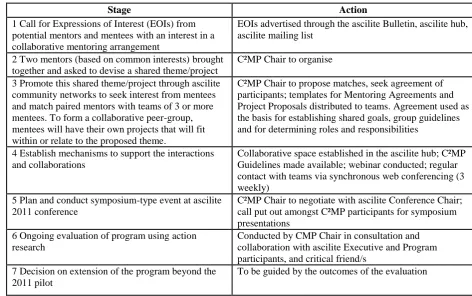
Table 1: C²MP process for implementation
Stage Action
1 Call for Expressions of Interest (EOIs) from potential mentors and mentees with an interest in a collaborative mentoring arrangement
EOIs advertised through the ascilite Bulletin, ascilite hub, ascilite mailing list
2 Two mentors (based on common interests) brought together and asked to devise a shared theme/project
C²MP Chair to organise
3 Promote this shared theme/project through ascilite community networks to seek interest from mentees and match paired mentors with teams of 3 or more mentees. To form a collaborative peer-group, mentees will have their own projects that will fit within or relate to the proposed theme.
C²MP Chair to propose matches, seek agreement of participants; templates for Mentoring Agreements and Project Proposals distributed to teams. Agreement used as the basis for establishing shared goals, group guidelines and for determining roles and responsibilities
4 Establish mechanisms to support the interactions and collaborations
Collaborative space established in the ascilite hub; C²MP Guidelines made available; webinar conducted; regular contact with teams via synchronous web conferencing (3 weekly)
5 Plan and conduct symposium-type event at ascilite 2011 conference
C²MP Chair to negotiate with ascilite Conference Chair; call put out amongst C²MP participants for symposium presentations
6 Ongoing evaluation of program using action research
Conducted by CMP Chair in consultation and collaboration with ascilite Executive and Program participants, and critical friend/s
7 Decision on extension of the program beyond the 2011 pilot
To be guided by the outcomes of the evaluation
Tools used for the support and development of the C²MP
The ascilite hub has been used as a central point of contact for participants in the Program. A dedicated area for the Program is hosted in the hub‘s Moodle environment and is used for social interaction, focused discussions and the sharing of ideas (through the forums), resource building and planning (using the wiki), seeking and providing feedback (and clarification of ideas), and linking to the web conferencing facility (Wimba). Regular synchronous gatherings are conducted in the Wimba classroom.
In addition to the Moodle application, participants are encouraged to use other media for communication, information sharing and knowledge construction including Skype, Facebook, Twitter, Google docs and so on. A wiki in the Moodle space has been set aside for exploring other media for interaction and collaboration and participants are encouraged to seek out and test applications and then share their experiences with the other Program participants.
Model for collaborative mentoring
Proceedings ascilite 2011 Hobart: Concise Paper
1080
Groups of people who share a concern, a set of problems, or a passion about a topic, and whodeepen their knowledge and expertise in this area by interacting on an ongoing basis.
Asynchronous interaction and collaboration in the ascilite hub has been accompanied by regular synchronous gatherings using the web conferencing facility Wimba which incorporates VoIP (Voice over Internet Protocol) for natural communication, a limited interactive whiteboard, text chat, and application sharing facilities. This has enabled C²MP participants to structure their interactions according to Wenger‘s (1998) combination of three fundamental Community of Practice elements:
1. A domain of knowledge that creates a common ground and a sense of common identity (builds member capacity)
2. A community of people who care about the domain and create the social fabric of learning (grow a learning community)
3. A shared practice developed to become effective in the domain (innovations are noted by the participants and this saves reinventing the wheel)
Communities of Practice should not be confused with project teams, task forces and even regular meetings and do not have formal institutional structures or hierarchical leadership. Many of these traditional organisational structures do not foster participation as this generates too many questions and raises issues of power and control. For this reason, the C²MP rejects meeting-style activity, preferring to refer to any synchronous activity as ―gatherings‖. The focus for any activity will most likely emerge from member negotiation and there is continual potential for new direction. Active participation and collaborative decision-making is encouraged and members may assume different roles with hierarchical, authoritarian management replaced by self-management and ownership of work (McDonald & Star, 2008). The community focuses on authentic tasks and activities and members are able to share, debate and build expertise within a safe and supportive community.
Evaluation of the program
Proceedings ascilite 2011 Hobart: Concise Paper
1081
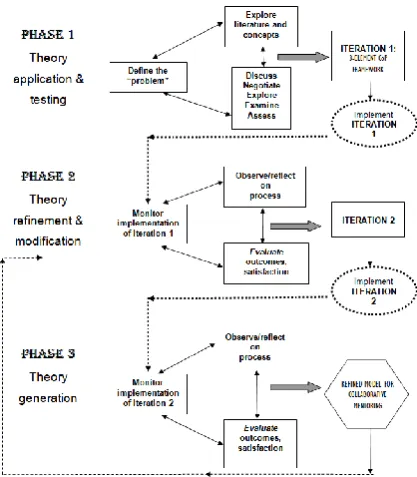
Figure 1: Evaluation process
Analysis of findings will be conducted in a cyclical way and emerging insights and trends identified will shape and refine the focus of the subsequent iterations of the pilot. The evaluation will focus on both the process and outcomes of the project, assessing the progress of the pilot‘s associated activities and their impact. Questions relating to the experience gained by participating, benefits, self-perceived knowledge advancement , support and feedback received from mentors and the other community collaborators, perceived value of the discourse and lessons learned will be explored and will inform the decisions taken on the future direction and sustainability of the C²MP. Indicators of success will be increased domain knowledge, intensity of discussions, reflection on and in practice, project progression/completion, publication output and a strong sense of community that provides professional support for members.
Because the C²MP is in its early stage, evaluation data, findings and recommendations will be reported upon at a later point in time.
Conclusion
Network-enhanced interaction can fulfill some pragmatic human needs at certain points in time by providing access, convenience, flexibility, utility, speed, and cost-effectiveness. Anecdotally, it appears that it can provide far more than this, as illustrated in this paper. Apart from having access to several experienced colleagues during the conduct of the Collaborative Community Mentoring Program, mentees are also able to interact and
Proceedings ascilite 2011 Hobart: Concise Paper
1082
than on or about them.Even though the pilot has been running for a short period of time, the process is already creating as many questions as answers. How might this approach be applied in other contexts? For instance, might it be a solution as we face the issue of providing quality supervision to increasing numbers of research and higher degree students scattered across the globe? Might the approach be used to provide professional development
opportunities to dispersed groups of professionals in industry? Although this current work is aiming to articulate a model for the provision of collaborative mentoring opportunities for ascilite members, just how generalisable this approach will be to other contexts is not yet evident but certainly worth exploring.
References
Kárpáti, A., & Dorner, J. (2008). The mentored innovation model in e-learning courses for teacher education. Proceedings of EDEN Annual Conference Lisbon 2008,
http://www.eden-online.org/papers/publications/proceedings/Lisbon_08/papers/C3/249.html
Gardiner, M. (2005). Making a difference. Flinders University mentoring scheme for early career researchers. Seven years on. Adelaide, South Australia: Flinders Press.
McCormack, C., & West, D. (2006). Facilitated group mentoring develops key career competencies for university women: a case study. Mentoring & Tutoring: Partnerships in Learning 14(4), 409–431.
McDonald, J., & Star, C. (2008). The challenges of building an academic community of practice: An Australian case study. In Engaging Communities Proceedings HERDSA 2008 International Conference.
http://conference.herdsa.org.au/2008/
Palloff, R.M., & Pratt, K. (2007). Building online learning communities. San Francisco, CA: Jossey-Bass.
Reushle, S.E. (2005). Inquiry into a transformative approach to professional development for online
educators. Unpublished thesis. http://eprints.usq.edu.au/1494/
Salmon, G. (2002). Approaches to researching teaching and learning online. In C. Steeples & C. Jones
(Eds.),
Networked learning: Perspectives and issues
(pp. 195-212), London: Springer.
Scardamalia, M. (2002). Collective cognitive responsibility. In B. Jones (Ed.). Liberal education in the knowledge age. Chicago: Open Court.
Wenger, E. (1998). Communities of practice: Learning, meaning, and identity. Cambridge: Cambridge University Press.
Wenger, E., McDermott, R., & Snyder, W. (2002). Cultivating communities of practice. Boston, MA: Harvard Business School Press.
Willcoxson, L., & Aniftos, M. (2002). Tracking the benefits of mentoring in higher education: Research challenges. Effective Teaching and Learning 2002 conference, Brisbane.
Please cite as: Reushle, S.E. (2011). Collaborative Community Mentoring Program (C²MP) – Addressing the
changing demands of a professional community of learners through engaging digital networks. In G. Williams, P. Statham, N. Brown & B. Cleland (Eds.), Changing Demands, Changing Directions. Proceedings ascilite Hobart 2011. (pp.1077-1082).
http://www.ascilite.org.au/conferences/hobart11/procs/Reushle-concise.pdf
Copyright © 2011 Shirley E. Reushle.