“A generation of
disengaged children
is waiting in the
wings…”
EX CURRICULA
Sonia Sodha
Julia Margo
Youth disengagement is a big and costly problem: the current generation of 16–18 year olds not in education, employment or training (‘NEET’) will cost society an estimated £31bn over their lifetime, including the costs of unemployment, to health services and to the criminal justice system. A shocking one in ten children are entering school without the tools to benefit from their education and little chance of success.
Policies to tackle this problem have had limited success. This report shows that what has been missing is a properly-resourced, early intervention approach to tackle
disengagement amongst younger children who lack the skills they need - skills like concentration, good behaviour and connecting with others – and who are at risk of ending up as tomorrow’s generation of NEETs.
Drawing on original analysis of the Millennium Cohort Study – which surveyed the families of over 15,000 5 year olds – it sets out recommendations in the areas of parenting and early years provision for 0-5 year olds, behaviour and exclusion, special educational needs and spreading evidence-based, preventative practice in schools
Sonia Sodha is head of the Progressive Austerity programme at Demos. Julia Margo is director of research at Demos.
Ex Curricula
|
So
nia
So
dh
a ·
Ju
lia
M
arg
o
ISBN 978-1-906693-34-3£10
This project was supported by:
ideas to give people more power over their own lives. Our vision is of a democracy of powerful citizens, with an equal stake in society.
Demos has several core research programmes in 2010: Capabilities, Citizenship, Security, Economic Life, Progressive Austerity and Extremism. We also have two political research programmes: the Progressive Conservatism Project and Open Left, investigating the future of the centre-Right and centre-Left.
In all our work we bring together people from a wide range of backgrounds to develop ideas that will shape debate in the UK and beyond, and engage a broad and diverse audience worldwide.
ISBN 978 1 906693 34-3 Series design by modernactivity Copy edited by Stacey Jackson, Solcroft Typeset by Chat Noir Design, Charente Printed by Lecturis, Eindhoven Set in Gotham Rounded and Baskerville 10
the copyright. We therefore have an open access policy which enables anyone to access our content online without charge.
Anyone can download, save, perform or distribute this work in any format, including translation, without written permission. This is subject to the terms of the Demos licence found at the back of this publication. Its main conditions are:
· Demos and the author(s) are credited
· This summary and the address www.demos.co.ukare displayed · The text is not altered and is used in full
· The work is not resold
· A copy of the work or link to its use online is sent to Demos
You are welcome to ask for permission to use this work for purposes other than those covered by the licence. Demos gratefully acknowledges the work of Creative Commons in inspiring our approach to copyright. To find out more go to
Acknowledgements 7
About the authors 9
About the project 11
Summary
13Introduction
351 Mapping educational disengagement
432 The drivers of educational disengagement
573 What’s wrong with the current policy
framework
874 Special educational needs
995 Behaviour, exclusions and alternative
provision
133(with Max Wind-Cowie and Will Bradley)
6 The funding of schools
1537 Parenting and development in the early years
1718 Spreading evidence-based, preventative
practice at the local level
209Appendix Workshops on tackling
educational disengagement in association
with Beatbullying
247(by Thaddaeus Douglas, Emma Jane Cross, Richard Rose and Jessica von Kaenel-Flatt)
Notes 263
Acknowledgements
This report could not have been written without assistance from many individuals and organisations. We would particularly like to thank the Private Equity Foundation for its generous financial support of this research project, and Shaks Ghosh, Fiona Murray and Sophie Livingstone for their invaluable input. Action for Children, Creative Partnerships, the Helen Hamlyn Trust and the YMCA are all partners of the Capabilities Programme at Demos of which this research is part.
We would also like to extend thanks to BeatBullying, which worked with us on the qualitative workshops with 11-14-year-olds at risk of disengagement. The workshops were led by Thaddeus Douglas, Policy and Research Manager at BeatBullying. Laura Smart, Diane Lench, Aaron Abraham, Dewayne Artery, John Odimayo, Juliet Brown, Patrick Gifford and Matthew Winn also facilitated and/or helped to design the workshops. Thaddeus Douglas, Emma Jane Cross, Jessica von Kaenel-Flatt and Richard Rose wrote the summary of the workshop findings, an appendix to this report. Special thanks are due to the young people who generously gave us their time and took part in the workshops, and to the schools and pupil referral units (PRUs) which made the workshops possible.
We would like to thank the individuals from organisations and charities working with children and young people who met with us in the course of this research, including people from Community Links, Action for Children, The Place 2 Be, the NSPCC, IntoUniversity, Fairbridge, School-Home Support, Skill Force, Beatbullying, City Year, Open Futures and the YMCA. Particular thanks are also due to the practitioners who took part in our practitioner panel, to Laura Ballantyne, Pete Whyte and Robbie Smith who facilitated a visit to the Fairbridge centre in Southampton, and to Surrey Square Junior School in Southwark which hosted a visit to their Place 2 Be service.
Thanks are also due to Mick Brooks and Jan Myks from the National Association of Head Teachers for convening a roundtable of its members to help inform the project findings, and to the heads who took part.
provided ideas and analysis, including John Craig, Jean Gross, David Hargreaves, Ruth Lupton and Neil Sherlock. Particular thanks are due to Jean Gross for her input into the chapter on special educational needs.
We would also like to thank colleagues at Demos including Will Bradley, Tom Saunders, Katy Wells and Fayyaz Muneer for their invaluable research support; Will Bradley and Max Wind-Cowie for research and drafting assistance with the chapter on behaviour; Peter Harrington, Beatrice Burks and Claire Coulier for their work on the production of this report, and media and events associated with the project; and Silvia Guglielmi for her work in the early stages of the project.
Any errors or omissions remain the authors’ own. Sonia Sodha and Julia Margo
in 2009, which focused on children and young people, parenting and education policy. Her research interests lie in children and young people’s wellbeing and education. Prior to joining Demos, Sonia was a research fellow at the Institute for Public Policy Research. Her publications include A Stitch in Time (Demos, 2009), Thursday’s Child (ippr, 2008), Those Who Can? (ippr, 2008),
Get Happy (Action for Children, 2007) and The Saving Gateway
(ippr, 2006). In 2010, Sonia is leading a new programme of work at Demos on Progressive Austerity.
Julia Margois Director of Research at Demos. Julia is a regular commentator in the international and national press. She also writes for national, online and specialist press and is an experienced chair and public speaker on a wide range of
subjects. Previously Julia was Associate Director and Head of the Strategic Research Team at the Institute for Public Policy Research (ippr). She was also editor of Public Policy Research
About the project
Summary
The number of young people not in education, employment or training (NEET) continues to confound policy makers. Policy initiatives have not worked to combat this seemingly intractable problem, largely because they are designed to impact too late, when a young person’s disengagement from their education is already endemic.
The focus of resource and policy needs to be turned on its head. We spend vast sums on dealing with the consequences of disengagement. The current generation of 16-18-year-olds who are NEET will cost society an estimated £31 billion over their lifetime, including the costs of unemployment, to health services and to the criminal justice system. Another estimate has put the yearly cost at £4.6 billion.
This report is concerned with identifying the earliest possible point of intervention to prevent disengagement – at the point at which the risk factors for disengagement start to arise. Waiting until a young person is NEET to address the problem does both them and society a huge disservice.
The extent of disengagement
The latest figures show there were 261,000 - one in seven – 16-18-year-olds who were NEET in November 2009. Amongst the current school-age population, there is evidence of
disengagement amongst a significant minority of young people, expressed through underachievement, attitudes to school, truancy and challenging behaviour.
· Educational underachievement:Pupil attainment data show that at every key stage, significant numbers of pupils fail to make the progress expected each year. These figures are higher for pupils from deprived backgrounds.
· Attitudes towards education:The UK has one of the highest proportions of children with poor attitudes towards their reading in the developed world. In a national survey, one in ten children thought the statement ‘I hate school/college’ was mostly true, and a further three in ten that it was partly true. Our qualitative research supports these findings: out of the 75 pupils we spoke to, just under a third of pupils did not find lessons interesting and more than half agreed with the statement ‘lessons were boring and seemed pointless’.
· Persistent truancy:One in 20 secondary school pupils persistently truant and almost 2 per cent of primary pupils persistently truant.
· Risky behaviour:England and the UK have notoriously high rates of young people engaging in unsafe risky behaviours. One in three 13 and 15-year-olds have been drunk at least twice, the highest rate of underage drunkenness in the OECD. The UK also reports the fourth highest rate of teenage pregnancy (after Mexico, Turkey and the USA). Furthermore, just under 10 per cent of 15-year-olds in the UK had used cannabis in the last 30 days prior to responding to the survey. New data shows that young people from poor families are more likely to smoke frequently than their more affluent peers: 6 per cent of 14-year-olds from the poorest fifth of househ14-year-olds said they smoked frequently, compared to 1 per cent of those from the richest fifth. But young people from affluent backgrounds are more likely to drink alcohol frequently than their poorer peers: 8 per cent of 14-year-olds from the richest fifth of households said they drunk regularly, compared to 5 per cent of those from the poorest fifth.
Risk factors for disengagement
Persistent disengagement is often underpinned by a range of risk factors that manifest themselves early in a child’s life. New data indicates potential rises in problems amongst the primary school age population.
· Poor literacy and numeracy:Every year, 8 in 100 primary school pupils leave primary school in England with reading and/or maths skills below those of the average seven-year-old: the equivalent of just over 46,000 11-year-olds in 2009. This is underpinned by earlier issues: up to 50 per cent of children are starting primary school without the language and
communication skills they need for school in some deprived areas. A poll of parents in 2010 found that one in five boys (22 per cent) and 13 per cent of girls experience slight or significant difficulty when learning to talk or understand speech.
behavioural issues that make it difficult for them to learn in the classroom and form relationships with their peers. The difference between children from the poorest and richest fifth of families is stark – 18.4 per cent from the poorest fifth of families compared to 4.4 per cent of those from the richest fifth.
· Mental health problems:Demos analysis has found that approx-imately 59,000 five-year-olds – 10.3 per cent – are starting school with emotional issues. Almost 10 per cent of children aged 5-15 suffer from a mental health disorder.
· Risk factors for disengagement:Data indicate that one in five children in primary schools suffers from consistently low or declining wellbeing, and that these children are most likely to be boys, low achievers and from disadvantaged backgrounds, equating to approximately 820,000 children.
· Low aspirations: Low aspirations about educational achievement are linked with poorer educational outcomes, although the relationship between aspirations and attainment is a reciprocal one. Groups that are at particular risk of lower aspirations are boys, young people from some minority ethnic groups, and young people from disadvantaged backgrounds.
For example, 49 per cent of 14-year-olds from the poorest fifth of families say they are likely to apply to university, compared to 77 per cent from the richest fifth of families.
A further set of risk factors concern the environment in which children live and grow, their relationship to adults and parental expectations and aspirations:
· Parenting and the home environmentare the most profound factor influencing child outcomes. Who your parents areis strongly associated with outcomes: having a parent with a low level of education, a mother who is young and low-income parents are all factors associated with poorer behavioural and cognitive development.
development. Positive and warm family interactions at age 14 such as having meals together, going out as a family and lower frequency of arguments are associated with improved behavioural outcomes at age 16 – an increase in one standard deviation in the quality of ‘non-education family interaction’ is associated with a 2.1 percentage point reduction in the likelihood of being a frequent smoker, a 1.4 percentage point reduction in the likelihood of frequently drinking alcohol, and a 3.5 percen-tage point reduction in the likelihood of ever having played truant by age 16.
· Data show that mothers who experience high anxiety late in their pregnancy (32 weeks) were twice as likely to have a child with behavioural difficulties at age 4 (10 per cent compared to 5 per cent). Boys with mothers experiencing high anxiety late in their pregnancy were also twice as likely to have ADHD (attention-deficit, hyperactivity disorders) (one in ten rather than one in 20).
· Parental expectations:Parental aspirations are significantly correlated with a child’s academic attainment. Parental aspirations has been found to be more important for children from disadvantaged backgrounds, but are lower in poorer families: 76 per cent of parents of 14-year-olds in the poorest fifth of families want their child to stay on in full-time education beyond the age of 16, compared to 91 per cent of parents in the top income quintile. The gap gets bigger as their children grow older – by the time their child is 16, 28 per cent of poor parents have stopped wanting their child to stay on in full-time education, compared to 10 per cent of parents from the top income quintile. 85 per cent of parents from poorest income quintile talk to their 14-year-old about their year ten choices, compared to 99 per cent of parents from richest quintile. 79 per cent of the poorest fifth of parents say they have attended a parents’ evening at school in the last 12 months compared to 98 per cent of the richest fifth of parents.
· School factors:the most important factor in terms of a school’s impact on outcomes is the quality of teaching. Other factors that are important to both academic and behavioural outcomes are the emotional quality of the classroom, and the warmth of adult-child interactions in a school.
· Poverty and schooling:Young people from the poorest fifth of families are less likely to go to a school in England with an outstanding Ofsted report (16 per cent compared to 27 per cent from the richest fifth of families). They are less likely to say they are happy at school (84 per cent compared to 89 per cent from the richest fifth) and are less likely to say it is valuable (80 per cent compared to 89 per cent).
These findings present a compelling case for an early intervention strategy that operates from birth to protect children who are at risk of falling into the disengaged group. But the current policy approach is not based enough around a strategy of prevention and early intervention.
Problems with the current policy, and how to fix them
Education policy has served children at average attainment levels quite well over the last decade. But it has failed to properly support children at the bottom end of the attainment spectrum. Unless this is rectified soon, there will be a sub-stantial legacy of a future generation of NEETs that could have been avoided.
There are two systemic problems with the current policy approach to disengagement. First, there is a lack of spending on prevention and early interventions, spending on children to prevent their needs escalating in the first place. Although there has been progress on this, it has been far too slow – with the result that for too many children, their needs have to escalate and become very serious before they can receive support. This is bad for the children involved and for society at large.
There are excellent, evidence-based initiatives that exist that can improve children’s outcomes by intervening early – one-to-one tuition programmes such as Reading Recovery, early parental support programmes such as Family Nurse Partnership, and parenting skills programmes such as Incredible Years. But access to these kinds of programmes is not widespread. This is due to a mix of structural and cultural barriers:
1 The national policy framework does not unambiguously
promote a prevention and early intervention approach. Despite a national commitment to it, children at the lower end of the attainment spectrum have been poorly served by the standards agenda. In particular, there are systemic issues around how children with special educational needs and persistently poor behaviour are supported.
2 Funding for early intervention is too often associated with
short-term, unsustainable ring-fenced grants rather than long-term funding given to schools.
3 There is sometimes a failure to pick up when children have
additional needs early enough.
4There are structural barriers at the local level. In particular, there
are unclear lines of responsibility between different agencies and a child’s outcomes.
5 There are also cultural issues – and a somewhat natural tendency
to focus resources on children with the highest level of need, rather than also funding preventative interventions to prevent need escalating.
In specific areas, outlined below, there are serious problems with the current policy approach.
Screening and assessment
a stronger focus on medical screening and diagnosis than on cognitive, linguistic and behavioural development. This is despite the fact that very effective assessment tools exist, for example to identify the incidence of postnatal depression in mothers and poor behavioural development in children. The government has not put enough emphasis on effective screening of additional needs.
This is a huge issue: many needs are missed because health visitors do not always pick up on postnatal depression, unless trained, and early years professionals do not always pick up on a child’s additional needs.
We need a universal assessment tool for all children in order to enable the most at-risk children to be identified early, and directed to appropriate support from early years services. The universal tool should be evidence-based and light-touch, but enable early years and education professionals such as health visitors, nursery nurses and teachers with basic training to recognise underlying issues where they exist and enable them to refer a child and family on for more specialised assessment: · It should span education, health and social service needs,
covering physical development, emotional and behavioural development, cognitive development, linguistic development, attachment and bonding in the early years, and temperament. · It should make use of evidence-based, validated assessment
tools, building on epidemiological tools already in the field. · It would consist of a streamlined common, light touch
assess-ment for all children at six months, age one, age two to two and a half, age three to three and a half and age five and ongoing through school that could be carried out by professionals such as health visitors, early years professionals, teachers and nurses with basic training.
· This would be used to flag additional needs – including additional learning needs – and would lead to more specialised assessment for children with high levels of need.
· This would be streamlined into one additional needs assessment from birth to age 18 that would take into account additional learning needs and Special Educational Needs.
Special Educational Needs (SEN)
The current system for supporting children identified as having special educational needs is no longer fit for purpose. It is failing on numerous accounts:
· It fails to identify children’s additional learning needs early on. Many children’s SEN needs go undetected in primary school and even secondary school.
· Additional resources are provided only when children have repeatedly failed.
· There is inequity of provision – there are huge postcode lotteries. · There is inequity in who receives additional support – many have
argued that it does not make sense to single out one group of children (those identified as having SEN) for an elaborate system of assessment and resourcing, but not equally needy children such as those who are looked after or in trauma as a result, for example, of abuse or bereavement.
· The system is confusing – engendering high levels of parent dissatisfaction.
· Ultimately, it fails to improve outcomes – this is because SEN resources are not being spent effectively. Too much is spent on assessment and support in class from relatively unskilled teaching assistants and not enough on effective, evidence-based services to improve outcomes.
This is reflected in the poor outcomes for children identified as having SEN. Just one in five children with statements achieve expected levels of attainment in English and maths at age 11, compared to around 90 per cent of their peers. Children identi-fied as having SEN are also around four times as likely to be per-sistent truants, and are more likely to have been bullied at school.
is an approach based on access to specified services or inputs, relying on assessment and categorisation to channel access to particular services. The second is a system based strongly on outcomes-based accountability – in which schools and services are held accountable for outcomes rather than inputs.
Our current system is based on the first route – and this has been counterproductive to improving outcomes for children because the huge focus on paperwork and bureaucracy has distracted from the issue of whether resources are being spent effectively to improve outcomes. This is in contrast to the strong outcomes-based accountability in place for other children.
Recommendations for SEN
· Classification. The current system of categorising SEN is out of date and has not kept pace with social and medical change. There should be a review of SEN categories, with the aim of moving towards a definition of ‘children with additional learning needs’. · Assessment. There should not be a separate ‘SEN’ assessment
system, but the light-touch universal assessment of children aged 0–18 outlined above, with extra assessment as and when required for children with additional learning needs.
· Funding.
· Funding of SEN/additional learning needs services should be ring-fenced before the general schools budgets in any future fiscal consolidation.
· Funding of SEN budgets should happen jointly by the Department of Health and Department for Children, Schools and Families (DCSF), and should go jointly to primary care trusts and local authorities, with children’s trusts determining the division of funding based on local needs. This is in light of evidence that in many areas, there are difficulties in accessing health services like Child and Adolescent Mental Health Services and speech and language therapy due to the separation of education and health budgets.
Schools should be able to ‘delegate’ this back up to local authorities should they wish.
· Funding for additional learning needs should occur on the basis of deprivation and pupil learning needs as assessed by light tough assessment (for example, the entry profile of children at ages 5, 7 and 11).
· Accountability. There should be strong outcomes-based accounta-bility to ensure children with additional learning needs access high quality and evidence-based provision that they do not all currently have access to. Accountability needs to span school self-evaluation, any measure like the School Report Card, School Improvement Partners, Ofsted inspection frameworks and targets. Targets should be reformed so they are based on average perfor-mance rather than threshold targets, and floor targets should be introduced relating to children at the very low end of the attain-ment spectrum. There should be a new guarantee for parents whose children are identified as having additional learning needs, based on outcomes, not specific forms of provision. · Building the expertise of schools and expanding access to excellent,
evidence-based provision. Schools would be able to use their deprivation and needs-based funding to buy access to high-quality, evidence-based intervention for their pupils. As Jean Gross has argued, schools should be supported by local, specialist multi-agency learning support centres, funded and provided by local authorities. These support centres would have responsibility for assessing the additional learning needs of children flagged up by the light-touch assessment tool, developing a plan of action for children with the highest-level needs including support for schools and parents, and convening local additional needs panels consisting of multi-agency workers and representation from schools and parents, which would assess the need for specialist and expensive interventions for children with the highest level of need.
Managing behaviour and exclusion
commonly the way children with additional learning needs are dealt with. Three-quarters of children who are excluded are identified as having SEN, 27 per cent of children with autism have been excluded from school, and exclusion rates are as much as 17 times higher than the average for some groups of children identified as having SEN. This is in contrast to the international context – most countries do not have provisions for formal exclusion in the law in the same way we do in England. Accountability for a child’s outcomes once excluded is weak and unclear – heads are no longer responsible, and accountability passes to local authorities – but systems for holding local authorities to account are very poor.
The quality of alternative provision for children who have been excluded from mainstream school is too often of poor quality – despite the fact that much more is spent per child on pupil referral units (PRUs) than in mainstream schools. There is too often the assumption that children who are excluded may only benefit from vocational provision. There has been a lack of drive in this area from the government with regard to reforms that will practically work in driving up standards of alternative provision. There is also a lack of early intervention and prevention for children who are starting to display behavioural issues – for example, through initiatives like nurture groups, learning mentors and learning support units. This could be tackled by giving schools more freedom in how to spend long-term funding streams rather than giving them short-term, unsustainable grants for these initiatives – but accompanied by strong outcomes-based accountability for how these children do.
Recommendations for behaviour
there should be no permanent ‘exclusion’ in the sense of a child leaving a school roll. Heads should remain accountable for children – until they move to a new school. That way, heads are encouraged to buy in the best possible provision for children in alternative provision in conjunction with the local authority. · Training. There should be more and better training on behaviour
management as part of initial teacher training and continuing professional development.
· Improving evidence-based practice in alternative provision. There needs to be better dissemination of evidence-based practice and early intervention interventions to tackle behavioural issues. Local authorities should be charged with the responsibility of ensuring there is sufficient high quality alternative provision in their planning functions.
· Accountability. The quality assurance of alternative provision needs to happen on the same basis of quality assurance of schools – Ofsted should inspect alternative provision provided by the voluntary and community sector and private sector on the same basis it does PRUs.
· Funding of early intervention. Schools should have increased deprivation and need-based funding to spend on early intervention approaches (see below).
The funding framework
The way in which schools are funded significantly impacts upon their ability to tackle disengagement – and the early risk factors associated with it (such as additional learning and behavioural needs). The current school funding system is hopelessly complex and is poor at targeting extra funding at schools with the highest proportions of children with additional needs. Local authorities only allocate about 40–50 per cent of deprivation funding towards the schools that children from poor backgrounds (eligible for free school meals) attend. There are a number of key problems with the system:
· The system privileges stability (ie few changes from year to year) over equity (funding reflecting the actual makeup of a school’s population).
· Delegation of funding by local authorities to schools for early intervention work varies widely.
Recommendations for the funding framework
A funding system needs to be based on the following principles: · Simplicity and transparency with respect to a breakdown of
responsibility between DCSF, local authority and school there should be a clear statement of what the division of responsibility is between the department, the local authority and the school in terms of provision and funding.
· Equity. Funding should reflect the learning needs of children in a school.
We recommend a pupil premium system of funding. The base level of funding a school received would be based on pupil numbers and an area-based adjustment for costs. The premium element would be based on the following measures of additional need:
· Deprivation. Free school meals eligibility is too blunt a tool to measure deprivation. There should be a more sophisticated, tiered indicator that would also take in children in low-income working households in receipt of working tax credit.
· Additional learning needs, as assessed by the light-touch assessment tool discussed at age 5, 7, and 11. Prior attainment would feed into this tool.
accountability to give schools much more freedom to spend increased amounts of flexible funding on early intervention additional services to improve outcomes – including SEN provision, welfare provision, increasing staff salaries to attract staff with higher levels of expertise, and preventative behavioural strategies such as nurture groups and learning mentors.
More money should be devolved directly to schools, which can delegate this funding back up to the local authority to spend on provision of central services should they wish. But some central funding for local authorities must be retained so they can provide services that would not exist if all funding was
decentralised to schools – such as services for children with high-level additional needs and early years services.
The exact mechanism and extra amount that should be distributed through the premium funding formula will be the subject of future Demos work. However, any ‘premium funding’ must be ringfenced from any future cuts to future cuts to an education budget as higher priority than the general school budget. There would need to be a gradual move to this system to avoid any big losers with respect to school budgets in the short term.
Parenting and development in the early years
The last decade has witnessed the building of a much-improved infrastructure through which early years services can be delivered – including free universal access to early years education for three and four-year-olds, health visitors and Sure Start Children’s Centres. Significant questions remain however about how to ensure this infrastructure delivers evidence-based services to those who need them.
Health visitors
properly trained, and signpost families onto other early years services. But this vital service is being compromised by low and falling numbers, and a high workload. The availability of the service varies considerably from area to area, with health visitor budgets ranging from £60 to almost £400 per child across different areas of England. The ratio of children to full-time health visitors varies from 165 children to a health visitor to almost 900 in some areas.
Sure Start
Sure Start Children’s Centres are the infrastructure through which many of the government’s early years services are provided. There is a great deal of freedom for local authorities and children’s trusts to determine which services are delivered through local children’s centres – spanning early years education, health services and early intervention social services. The co-location of these various services on one site has been a huge step forward for children’s policy, and is one the government should be commended for. But evaluation of early Sure Start services has suggested that the positive impact has been fairly modest. There are therefore questions about how to ensure that the Sure Start infrastructure has the maximum impact possible in terms of the services it delivers.
Early years education
There is now free and universal access to early years education. However, the quality of provision varies across the country, and it is poorest in the most deprived areas: 10.8 per cent of nurseries in the 10 per cent most deprived areas were judged as inadequate by Ofsted, compared to 5.3 per cent in the 10 per cent most affluent.
Recommendations for parenting and early years
cash transfers), paid to at-risk, low-income parents who complete evidence-based parenting interventions.
· Universal health visitors. There are not enough health visitors to provide a progressive universal service: light-touch health visiting for everyone, with more intensive support available for those who need it. To rectify this there need to be reforms to training and career structure, with a view to increasing the number of health visitors over the next few years, including a fast-track, intensive programme for current nurses who want to train as health visitors; direct-entry courses for people wanting to train as health visitors, as there are for midwifery; and more specialised training for health visitors relating to the broader aspects of the role as well as the medical aspects. There needs to be a proper career structure for health visitors, spanning trainees to senior practitioners qualified to deliver programmes such as the Family Nurse Partnership. All health visitors should be trained in diagnosing postnatal depression and in cognitive behavioural therapy techniques to combat maternal depression in light of the evidence that this can be very effective.
· Sure Start. Sure Start needs to be built on from the primarily universal service it is now, to become a service that is much more effectively progressive universal– in which intensive interventions are targeted only at the families that need them. This requires a more sophisticated approach than one that is just based on area-based targeting, as the original Sure Start programme was. · Sure Start Children’s Centres should be funded on the basis of
deprivation and the needs of their population, in the same way that we recommend schools are funded, through a ‘pupil premium’ for Sure Start. Children’s Centres – like schools – should be required to set out how they spend this deprivation and needs-based funding.
· The accountability framework for Sure Start Children’s Centres needs to be strengthened, so they are held more directly accountable for the outcomes they achieve.
· There should be financial incentives for local Children’s Centres to commission evidence-based practice (see section below). · Early years education. Our recommendations mirror our
is more expensive to provide because it requires more qualified teachers and better child to staff ratios. We therefore recommend early years education funding should be on the basis of
deprivation and needs through a ‘pupil premium’, as for Sure Start and schools, with early years providers required to set out how they spend deprivation and needs-based funding.
· A public health approach to parenting. Building on international evidence from Australia and New Zealand that public health messaging on parenting via DVDs and television programmes can be very effective, the government should undertake consultation work with parents to develop public health messaging on parenting.
Spreading evidence-based, preventative practice at the local level
The case for evidence-based practice is intuitively obvious: only by using evidence-based practice can schools and local
authorities be sure that they are improving children’s outcomes. But evidence-based practice is not currently widespread. There are five important barriers:
· We do not know enough about what works
· We do not know enough about how to scale up evidence-based practice
· The commitment to evidence-based practice does not always match the commitment to improving children’s outcomes at the local level
· There are significant gaps in the supply side of evidence-based interventions
· Funding
Recommendations for more prevention
Building up the evidence base about what works and scaling up evidence-based practice
There needs to be a government-funded but independent aca-demic centre for evidence-based practice in improving children’s outcomes. This should be charged with the following functions: · pulling together the existing evidence base in an easily digestible
tool for practitioners and commissioners
· proactively encouraging evaluation of interventions by
channelling government funding towards promising, but yet to be rigorously evaluated, programmes
· kitemarking effective interventions
· providing advice and support on evidence-based practice. · undertaking and disseminating research on how to scale up
evidence-based practice.
Creating the demand for evidence-based practice
· Evidence-based practice should be disseminated using models such as a telephone-based consultancy service or an online social networking service. It should also be disseminated through established networks such as local authorities, Ofsted and school improvement partners.
· There should be a financial ‘match’ for schools to spend on kitemarked, evidence-based programmes approved by the independent national centre on evidence-based practice in improving children’s outcomes.
Ensuring there is enough supply of evidence-based practice
Funding early intervention programmes
The cost-benefit ratios of early intervention for early intervention programmes can be very high. For example, Life Skills Training (a curriculum school-based programmes to reduce substance and alcohol misuse and smoking in USA schools) is estimated to save over $25 for every dollar spent on the programme. Given these cost-benefit ratios, it is fair to ask why more early intervention is not happening – and why it seems to require a subsidy from central government. There are two key issues:
· Local budgets stuck in silos: in England, the budgets of different agencies (health, policing and education, for example) are very siloed – there is no agency or local government institution with responsibility for overall budgets. This means spending by one agency (for example, a school) may generate savings for another (for example, health) – but the fact that these are two different budgets means these savings are not taken into account. The establishment of children’s trusts was intended to solve this problem, but evidence suggests they have not worked in doing so.
· The long timescales involved in capturing savings: there are long timescales involved before savings can be captured. Many programmes require upfront investment and deliver savings over a long timescale of ten to 15 years. This does not fit in with political time horizons – politicians are held accountable for outcomes today, not in 15 years’ time. It is also difficult to capture the benefits of a prevention programme – because doing so requires predicting lower need for services in the future, and cutting those services back, which requires making people redundant and is politically unpopular.
Introduction
Almost one in seven 16-18-year-olds in England were not engaged in education, employment or training (NEET) in November 2009.1Most of this group move in and out of
employ-ment or education rather than being permanently disengaged from it, but the personal and social costs are high. For young people, being NEET is associated with a host of poor employ-ment and health outcomes later in life, and a greater likelihood of offending and ending up in prison. And for society, one recent estimate suggested the cost of each person who is NEET between the ages of 16 and 18 in the UK, is almost £120,000 in 2009 prices, accounted for by the costs of unemployment, health services and the criminal justice system.2This puts the cost of
the current generation of 16-18-year-olds who are NEET at over £31.3 billion over their lifetimes. Another estimate suggests the cost is around £4.6 billion a year:3more than double the annual
spend on Sure Start.
Reducing the number of young people who are NEET has been a sustained policy focus for the government. But the approach has been flawed, focusing on young people who are already NEET. Being NEET is not a start point but an end point for young people who became disengaged and disaffected from their education earlier on. In fact, educational disengagement is often the key precursor to becoming NEET.
In the last five years, the number of young people aged 16 to 18 who are NEET in England has increased from 189,800 to 261,000, despite significant investment in trying to tackle this issue, and almost one in five young people aged 16 to 24 were NEET in November 2009 (1.08 million). An effective strategy must respond to disengagement at the earliest point at which risk factors are apparent, rather than once problems have become severe.
Our research reveals risk factors for educational disengage-ment: behavioural and conduct problems, poor literacy and numeracy, poor communication skills and extreme poverty. In the most severe cases, these factors will have had an effect on a child’s engagement with education before the age of seven. The scale of the problem is vast, but not insurmountable.
Our analysis of a 2005 survey5suggests just over 11 per
cent of children are starting school without the behavioural skills they need for learning; up to half of children in some deprived areas are starting school without basic communication skills; and 8 in 100 children start secondary school with reading and maths ability below that of the average seven-year-old. Intervening early to tackle these issues with evidence-based prevention programmes will save huge amounts of public funds in the future.
To combat the number of young people who are NEET, the government has now wielded what some might consider to be the last tool in the box: compulsion. The compulsory participa-tion age in educaparticipa-tion or training in England will be raised from 16 to 17 in 2013, and to 18 in 2015. The objective that all young people ought to be in education or training until they are 18 is very laudable. However, whether raising the participation age is the best way to do this is another question altogether. Even today, 1 in 20 secondary school pupils in England persistently truants, missing a fifth or more of the school year – despite their education being ‘compulsory’.6The ambition that all young
education would be more effective. The central argument of this report is that a remedial approach to disengagement is ineffective and inefficient. Instead, the education system needs to tackle the root causes of disengagement at the very earliest stages possible. The issue with government policy is not a lack of drive to change the system: there has been a huge amount of education reform over the last decade. Rather, the approach has, in parts, been misguided. It has served children with average levels of attainment fairly well, but it has failed children who significantly underachieve.
The real problem has been the lack of a successful strategy to tackle children performing very poorly at school. The educa-tion system is one that is characterised by acceptable perfor-mance at the mean – both England and the UK perform around average in reading and maths in international league tables, and above average in science.7However, overall performance
levelled off from 2000 onwards after early successes made in the late 1990s in Key Stage 1 and 2 results at ages seven and 11.8But
the most intractable issue has been the ‘long tail’ of under-achievement, with a significant minority of children being left behind, particularly those from poorer backgrounds. It has been estimated that, in England, 16 per cent of children make no progress at all in English and maths between the ages of seven and 11,9and 8 per cent of children leave primary school with very
low levels of literacy and/or numeracy (below level 3).10Children
from disadvantaged backgrounds are out-performed by their peers at every stage of the educational system – and this gap widens as children age.
To the government’s credit, early intervention and prevention have been important themes in the policy agenda. Their roots in government policy documentation date back to 2000, and much earlier still in initiatives organised by charities and services. However, there remains a disjunct between the strong commitments to early intervention in statements like The Children’s Plan,11and what is happening before children go to
First, while the government has been keen to tug on centrally controlled, and thus easily manipulated, levers like the curriculum taught in schools, it has been reluctant to undertake similarly fundamental reform of the areas that really matter to children at risk of being disengaged. For example, on politically difficult issues such as special educational needs, exclusion and alternative provision, the government has been too wary to make the reforms that could make a positive difference. Given current policy on special needs and exclusion, it is little surprise that prevention is not more widespread. There has been too much dragging of feet, and the time and energy needed to reform these structures properly has not been forthcoming.
Second, the education system has in recent years been characterised by two agendas that have often been in tension: the ‘standards agenda’, and the Every Child Matters (ECM) agenda. The standards agenda is rightly focused on improving standards in schools but it is focused on key stage testing and public examinations: fairly narrow measures of attainment and out-comes with questionable accuracy. Unfortunately, many would argue that what is measured – primarily a narrow measure of academic attainment – is driving the education system. The ECM agenda stresses the importance of improving outcomes for children across a broader range of five outcomes: being healthy, staying safe, enjoying and achieving, making a positive
contribution and achieving economic wellbeing. Of course, the two agendas should not be in tension in theory: improving children’s wellbeing across a broad range of outcomes needs to and should be the foundation for improving educational standards – but in practice they have clashed.
every day in schools and local authorities up and down the country are just as important for children as those taken by the secretary of state. The issue is that there has been little
enthusiasm for the grittier job of supporting schools and local services to make the best decisions possible. The services that children have access to are determined locally, not centrally, and much of what can be done to tackle educational disengagement is not within the remit of bureaucrats in Whitehall but of schools and local service providers. Yet there has been a failure to engage with this issue properly in Westminster and Whitehall. The question of how best to support local decision-makers to spread evidence-based practice that improves outcomes and tackles disengagement remains unanswered.
Last, there has been a failure to properly join up different areas of policy – most notably, education, parenting and family policy, and early years agendas. Section 1 of this report discusses what underpins disengagement and draws out the complexity of factors that span school, home and the community. It must be the case that a strategy to tackle disengagement effectively spans this range of factors. But, partly because of the political diffi-culties involved, there is not an effective strategy for tackling parental and home-based risk factors for disengagement, and this needs to be addressed. Parental engagement with education tends to be discussed in quite mechanistic terms, such as how information travels between, teachers, pupils and parents. Education policy, as it relates to parents, has not taken into account some of the sophisticated advances in the study of parenting in disciplines such as psychology.
The result is that, despite significant education reforms in the last decade, England is still saddled with a system that fails children who are underachieving. This is underpinned by some worrying trends in wellbeing and attitudes towards learning. UK studies suggest that one in five children suffers from declining or consistently low wellbeing during primary school.12When it
group of 41 countries,13and more recent research has found that
there has been no improvement since.14
A discussion about education reform in 2010 would not be complete without a discussion on the current political and economic climate. Politically, there is a broad consensus across all three main parties that more power should be devolved to schools over their budgets. The Conservatives and Liberal Democrats are both committed to the idea of a ‘pupil premium’: a transparent and national per-pupil funding formula that channels extra resources directly to schools for pupils from deprived backgrounds, with more flexibility for schools on how they spend their budgets. This is a good policy. However, important details still need to be expanded upon.
First, English schools already have a fairly high degree of autonomy over spending decisions compared to other OECD nations when it comes to core areas of education spend (only the Netherlands has more financially autonomous schools).15
However, English schools have widely differing powers over supplementary funding intended to provide extra services such as welfare support and counselling services. Some local authorities devolve supplementary funding to the schools and give them the power to commission their own services. In other areas, local authorities retain this funding, provide the services themselves, and schools have no choice but to use them. Sometimes they are excellent, but they can also be poor. There is, therefore, an important question concerning which pots of money schools will control in an increasingly decentralised system. Will they universally be able to commission their own support services? This is important because these are the funding sources that are often crucial to children at risk of becoming disengaged.
Economically, this is a time in which all public services are facing cuts in the years to come as the government, of whatever political persuasion, seeks to consolidate the fiscal deficit. Politicians across the spectrum have promised frontline services will be ring-fenced, and it is likely that schools’ core budgets will be protected, rightly or wrongly. However, many budgets that impact schools indirectly, for example, local children’s services, are likely to be cut. This will put extra pressure on the system and could disproportionately impact the most vulnerable children at risk of becoming disengaged. Questions about what improves outcomes, and what represents value for money, will become even more important as the historic public spending increases come to a halt.
This report has two parts. Part one (chapters 1 and 2) maps educational disengagement in England. It demonstrates that although disengagement is a complex phenomena, its symptoms afflict a significant minority of children and young people who go on to suffer poorer outcomes than their peers in adulthood. It discusses the complex myriad of factors that underpins
1
Mapping educational
disengagement
Young people who are NEET go on to experience long-term negative outcomes in terms of their future employment and across a broad range of measures. For example, youth unemployment has been estimated to result in a wage scar on individuals in the UK of between 8 and 15 per cent.16Young
people who are NEET also claim to be less happy and confident across all aspects of their life including education, work and training. In a UK survey of young people who are NEET, a quarter said being unemployed caused arguments with their family; over one in five that they lost the confidence to go to job interviews as a result of being NEET; and more than one in ten said unemployment drove them to drugs or alcohol.17They are
also more likely to suffer poor health outcomes: an alarming result from a recent small-scale survey in one city in the north of England found one in seven young people who are NEET die within ten years of leaving the school system.18
As well as these long-term individual costs, young people who are NEET have been estimated to cost society up to £120,000 (in 2009 prices) per individual over the course of a lifetime.19
As with most indicators of disengagement, there is a strong link with deprivation. The probability of being NEET in
England is over seven times greater for children from the poorest fifth of households:20young people from the richest fifth of
families are 8.1 percentage points less likely to be NEET than young people from the poorest fifth of families. This is a huge gap given the overall NEET rates of around 13.4 per cent.
adulthood to the point at which disengagement emerges fully-fledged at around age 14.
This chapter maps disengagement amongst the school age population and focuses on teenagers, aged 13 to 17 years old, since educational disengagement is much less prevalent and persistent among primary school aged children. Chapter 2 goes further back to identify the early life experiences that predate and underpin disengagement.
To produce an original and accurate picture, this report uses its own ‘metric’ to measure disengagement, and while the measures used are necessarily quite crude (educational disengagement is a tricky thing to measure), it has aimed to capture the many different forms that disengagement takes. The findings are an illuminating indication of just how early on negative attitudes can take root. Our review is based on analysis of the Longitudinal Study of Young People in England (LSYPE), the Millennium Cohort Study and our own qualitative research (discussed below and summarised in the appendix).
We are interested in disengagement when it is long-term and persistent. Most children will go through patches of disliking school, teachers and particular subjects, but the group concerned here becomes chronically disillusioned. Disengage-ment does not necessarily have a visible status: children and young people ‘acting out’ or physically removing themselves from participation by truanting or exhibiting challenging behaviour. These children and young people are easy to identify. The panel of education practitioners we spoke to as part of our research stressed some groups of children, and particularly girls, passively withdraw from education, cognitively or emotionally, without displaying ‘acting out’ signs. Our metric therefore includes a range of attitudinal factors including attitudes to learning. We also included educational under-achievement, truancy, exclusion and behaviour both in and out of school.
To supplement the review of the evidence presented here, we also undertook qualitative research with 75 young people showing signs of disengagement in Key Stage 3 (age 11 to 14) from four schools and two PRUs in England (see the appendix for the full methodology and conclusions). This is in light of the fact that, while there has been much research on disengagement with young people in the 14 plus age group, and particularly those over 16, there has been much less research specifically related to the nature, causes and scale of disengagement in the primary and Key Stage 3 years.21The qualitative workshops
allowed us to gain a deeper understanding of how young people themselves view disengagement, and the factors they see as important for making school engaging. Key points from this research are highlighted throughout this report.
This chapter starts with the central thesis: the relationship between educational disengagement and becoming NEET.
The impacts of educational disengagement
Educational disengagement is linked to a wide range of poor life outcomes for young people. There is a close relationship between a young person’s attitude towards their learning, their enjoyment of it, and outcomes. The extent to which a young person thinks education is worthwhile is often referred to as their extrinsic attitude towards education, and the extent to which they enjoy school as their intrinsic attitude towards education. International data suggest that the extent to which children enjoy their learning is, unsurprisingly, linked to their success.22
Many of the symptoms of disengagement considered here are associated with a much higher chance of being NEET – and other negative outcomes. For example, LSYPE data show young people with more positive attitudes towards their education were less likely to be NEET at age 17.23Finding school worthwhile at
at age 16. Young people who said they enjoyed school at age 14 were less likely to be NEET at age 17 and less likely to engage in risky behaviours at ages 14 and 16. A one standard deviation increase in enjoyment of school is associated with a 0.6 percentage point reduction in the probability of being NEET at 16 (but also, unexpectedly, a GCSE score of around seven points less). Children who do poorly at school in England are more likely to be NEET: over a quarter of those who obtain no GCSEs go on to be NEET.24And only one in ten of those who
are below expected levels of attainment at age ten go on to get five good GCSEs.25
Truancy is itself associated with a range of negative outcomes for children and young people that span attainment, anti-social behaviour, drug and alcohol misuse, and youth offending. One study found a quarter of those truanting in year 11 went on to become NEET the following year.26In the LSYPE,
starting to truant between the ages of 14 and 16 was associated with getting ten GCSE points fewer at age 16, controlling for a wide range of other factors.27
Like persistent truanting, exclusion is associated with a range of negative outcomes including a much higher chance of being NEET aged 16 to 18. In LSYPE, being suspended from school between the ages of 14 and 16 was also associated with getting around 26 fewer GCSE points at age 16, controlling for a wide range of other factors.28
Young people who engage in risky behaviours in adolescence also suffer poorer educational outcomes. For example, young people smoking more than six cigarettes a week at age 16 do worse in terms of GCSE outcomes at age 16.29
So how extensive is the problem? Our review of the evidence suggests England does have a problem with
Young people’s attitudes towards and enjoyment
of learning
The UK fares poorly on international measures of attitudes towards learning. It has one of the highest proportions of children with poor attitudes towards reading in the developed world.30In
an English survey, one in ten children thought the statement ‘I hate school/college’ was mostly true, and a further three in ten that it was partly true.31Our research supports these findings:
just under a third of the 75 young people we spoke to in our qualitative research did not find lessons interesting, and more than half agreed with the statement ‘lessons were boring and seemed pointless’. They also expressed their negativity towards specific teachers with comments centred on those teachers per-ceived as never rewarding achievement or good behaviour. What was also apparent was the desire for pupils to have teachers who were more engaged in their teaching and to be ‘better trained’.
This was explored in more detail by asking the young people to role-play good and bad teaching styles. Good styles included ‘energetic’ teachers who used activities and games, and those that focused on rewarding positive behaviour. Bad teachers were too critical, disengaged themselves and focused their attention on the disruptive pupils, rather than praising and recognising those behaving well. Of the 75 pupils that took part four in ten thought ‘teachers tend to focus on bad behaviour and ignore the good’. The importance of teaching styles for children’s engagement is highlighted by the fact that four in ten said that difficult relationships with teachers was the main reasons for their disengagement.
Our qualitative research also explored the factors that contribute to good and bad learning environments and, hence, affect attitudes towards and enjoyment of learning. Over half said disruption in the classroom was the main barrier to their enjoyment of learning. When asked ‘What are the worst things about school?’ common responses included: ‘people yelling’, ‘when your lessons get disrupted’ and ‘mucking about in the class’. What these responses show is that children, engaged or disengaged, prize quiet and calm learning environments.
towards learning are partly created by children internalising implicit messages about the importance of doing well in tests and exams.32
Children from more disadvantaged backgrounds are less likely to say they have had a positive learning experience.33This
is likely to reflect different experiences of education however (see discussion below), and research has indicated that poorer attitudes to school among children living in poverty are partly underpinned by a lack of confidence in their own ability.34
Educational underachievement
Educational underachievement is not necessarily a sign of disengagement, but it is an important indicator as children and young people who are disengaged are less likely to make good progress at school. Pupil attainment data show that at every key stage, there are significant numbers not making the progress expected each year. These figures are higher for those from deprived backgrounds. At every key stage, children with good prior attainment who are eligible for free school meals (FSM), a good indicator of deprivation, are less likely to make the expected progress than their peers from more advantaged backgrounds. So, as children grow older, those from more advantaged backgrounds move up the attainment spectrum, and those from poorer backgrounds move down it.35
This pattern is also reflected in absolute attainment levels. In 2008/09, 101,700 pupils failed to reach the expected standard at Key Stage 2 (age 11), and 126,280 at Key Stage 3 (age 14). In 2007/08, 209,383 pupils failed to gain five or more GCSE/NQ standard grade level passes at grades A*-C. Socioeconomic background exerts a stronger pull on attainment in England than in many other OECD countries.36Although there is
evidence the socioeconomic gap has started to narrow,37it
The link between deprivation and attainment is strongest for White boys: less than one in five White boys eligible for FSM get 5 A*–C GCSEs including English and maths.38
LSYPE data show that only one in five young people from the poorest fifth of households got five good GCSEs (in 2006) including English and maths (5 A*–C grades), compared to almost three-quarters of young people from the richest fifth of households: a gap of over 50 percentage points.39
Truancy
Truancy can often be a sign of disengagement, particularly when it is persistent. In the autumn term of 2008, almost 4.3 million days of school were missed. Of these, 1.5 million were missed from primary school.40In 2007/08, 1.01 per cent of possible half
days were missed due to unauthorised absence and there were around 233,340 persistent absentees in primary, secondary and special schools (or 3.6 per cent of enrolments).41The 1 in 20
secondary school pupils who persistently truant account for a third of all school absences. Older pupils truant more: 5.6 per cent of secondary school pupils are ‘persistent truants’, missing more than 20 per cent of the school year. But this report is particularly interested in the 1.7 per cent of primary children who persistently truant.42While not all older pupils who truant
will have done so when at primary school, children who persistently truant are much more likely to continue to do so throughout the remainder of their school career – unless the issue is effectively addressed.
Like other indicators of disengagement, there is a strong link with socioeconomic background. Truancy is highest among pupils from deprived backgrounds: over 8 per cent of secondary school pupils eligible for FSM are persistent truants, three times the rate for the rest of the student population. In the LSYPE, one in four 14-year-olds from the poorest fifth of households said they played truant, compared to 8 per cent of 14-year-olds from the richest fifth of households.43This gap narrows by the time
16. It should be noted that some of this difference might be partly due to the fact that young people from deprived back-grounds are more likely to be carers. Persistent truancy rates are slightly higher among girls than boys.
Behaviour and exclusion
‘Acting out’ in the classroom can be an important sign of a young person switching off their learning, and it can also be linked to the quality of teaching and learning. Poor behaviour has a knock-on impact on other pupils’ learning, often disrupting the whole class. Poor behaviour by one or two individuals triggers poor behaviour on a wider scale. It is important to note, however, that poor behaviour is a symptom of behavioural disengagement and can also be a cause of further
disengagement, particularly when it is underpinned by disorders such as conduct disorder or Attention Deficit Hyperactivity Disorder (ADHD). See chapter 2 for a discussion of these.
Ofsted rates behaviour in the majority of primary and secondary schools as ‘good’ or ‘outstanding’, but in a significant minority of secondary schools (one in four) pupil behaviour is no better than satisfactory.44Disruptive behaviour
disproportionately occurs in schools in disadvantaged areas.45
Research suggests that up to 5 per cent of pupils may display challenging behaviour at some stage in their school career.46
As well as being an important sign of disengagement, bad behaviour can have adverse effects on the wider school
environment. A key concern for the 75 young people we spoke to in our qualitative research was safety: only three in ten felt their schools was safe, 13 per cent felt unsafe, and 12 per cent said their school was scary. Only 18 per cent of young people agreed with the statement ‘students care about each other’. Bullying and child-on-child violence were both included in response to ‘What are the worst things about school?’.
2006/07, the last year for which data is available, 6,080 pupils were permanently excluded from schools in England.48For
fixed-term (temporary) exclusions in the same year, there were: · 363,270 from secondary schools, with an average length of 3.3
days
· 45,730 from primary schools, with an average length of 2.7 days · 16,600 from special schools, with an average length of 2.7 days.
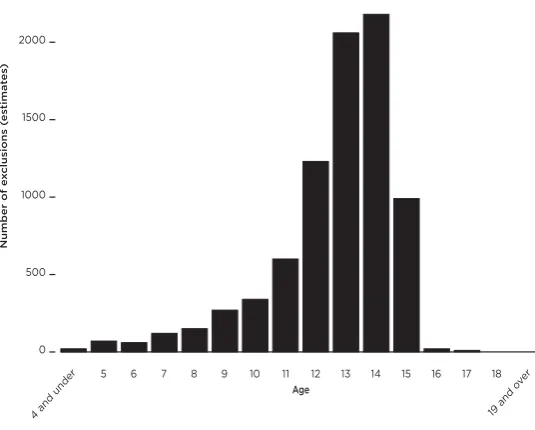
The peak age for exclusions is between 13 and 14 (year groups 9 and 10). Figure 1 shows approximately 54 per cent of all permanent exclusions were pupils from these year groups.
[image:53.340.47.315.74.289.2]While national data on the attainment of pupils who have had fixed-term exclusions is not available, Portsmouth City Council has published figures as part of their strategy for
Figure 1 Permanent exclusions in England 2007/08
19 and
ove
r
Numb
e
r
of
ex
cl
u
s
i
o
n
s
(es
t
ima
te
s)
0 500 1000 1500 2000
4 and
und
reducing fixed-term exclusions.49In 2005/06 pupils with one or
more exclusion attained on average just over two GCSE A*–C grades, compared to an average attainment of five A*–Cs for all pupils. At Key Stage 3 the average point score for excluded pupils was just below 25 compared to just below 30 for all pupils. A similar gap existed at Key Stage 2, with an average score for excluded pupils of fewer than 24, compared to just less than 27 for all pupils.
In 2008, around 70,000 pupils were taught in PRUs after being excluded from mainstream schools: most were boys aged 11 to 15.50There is limited performance data available for pupils in
alternative provision, but what there is indicates very poor outcomes. In 2006, only 1 per cent of 15-year-ol