City, University of London Institutional Repository
Citation
: Wood, C. E., Richardson, M., Johnston, M., Abraham, C., Francis, J.,
Hardeman, W. and Michie, S. (2015). Applying the behaviour change technique (BCT)
taxonomy v1: a study of coder training. Translational Behavioral Medicine, 5(2), pp. 134-148.
doi: 10.1007/s13142-014-0290-z
This is the published version of the paper.
This version of the publication may differ from the final published
version.
Permanent repository link:
http://openaccess.city.ac.uk/11974/
Link to published version
: http://dx.doi.org/10.1007/s13142-014-0290-z
Copyright and reuse:
City Research Online aims to make research
outputs of City, University of London available to a wider audience.
Copyright and Moral Rights remain with the author(s) and/or copyright
holders. URLs from City Research Online may be freely distributed and
linked to.
City Research Online:
http://openaccess.city.ac.uk/
[email protected]
TBM
Applying the behaviour change technique (BCT) taxonomy
v1: a study of coder training
Caroline E Wood, PhD,
1Michelle Richardson, PhD,
2Marie Johnston, PhD,
1,3Charles Abraham, PhD,
4Jill Francis, PhD,
5Wendy Hardeman, PhD,
6Susan Michie, DPhil,
1Abstract
Behaviour Change Technique Taxonomy v1 (BCTTv1) has been used to detect active ingredients of interventions. The purpose of this study was to evaluate effectiveness of user training in improving reliable, valid and confident application of BCTTv1 to code BCTs in intervention descriptions. One hundred sixty-one trainees (109 in workshops and 52 in group tutorials) were trained to code frequent BCTs. The following measures were taken before and after training: (i) inter-coder agreement, (ii) trainee agreement with expert consensus, (iii) confidence ratings and (iv) coding competence. Coding was assessed for 12 BCTs (workshops) and for 17 BCTs (tutorials). Trainees completed a course evaluation. Methods improved agreement with expert consensus (p<.05) but not inter-coder agreement (p=.08,p=.57, respectively) and increased confidence for BCTs assessed (bothp<.05). Methods were as effective as one another at improving coding competence (p=.55). Training was evaluated positively. The training improved agreement with expert consensus, confidence for BCTs assessed, coding competence but not inter-coder agreement. This varied according to BCT.
Keywords
Behaviour change techniques, Taxonomy, Training methods
INTRODUCTION
Effective interventions aimed at changing health behaviours of individuals, communities and popula-tions are needed to improve health and reduce the
prevalence of disease [1, 2]. Such interventions are
often complex and comprise several potentially
inter-acting active components [3]. This can make them
challenging to accurately replicate in research, to syn-thesise across studies in evidence reviews and to trans-late into practice. Thus, to inform the development of more effective health behaviour change interventions and to enhance the understanding of their mecha-nisms of action, it is crucial that researchers report interventions with clarity and detail.
In the last decade, several guidance documents have been published aimed at improving methods of specifying and reporting interventions in published
reports. For example, CONSORT (The Consolidated
Standards of Reporting Trials [4, 5]) and TREND
statements (Transparent Reporting of Evaluations
with Nonrandomised Designs [6]) and the UK
Medi-cal Research Council’s (MRC) evaluation framework
[7,8]. CONSORT advises researchers to report the
‘precise details’of the intervention as‘actually admin-istered’. In contrast to interventions in biomedicine,
no standardised language exists for reporting the
‘ac-tive components’delivered in behaviour change
inter-ventions [9]. For example, different labels are
some-times used to identify the same techniques, and differ-ent techniques may be iddiffer-entified by the same label
(e.g. behavioural counselling). The precise ‘active
ingredients’of interventions are often therefore
diffi-cult to establish.
To address this gap and to provide a more rigorous methodology for characterising intervention content, researchers have begun to specify the active ingre-dients of interventions in terms of their component behaviour change techniques (BCTs). BCTs are de-fined as the observable, replicable components of behaviour change interventions. They are the smallest components compatible with retaining the proposed mechanisms of change and can be used individually
or in combination with other BCTs [10–12]. Goal
setting, self-monitoring of behaviour and action plan-ning are all examples of BCTs.
The first cross-behaviour classification system to demonstrate inter-coder reliability in identifying 22
1UCL Centre for Behaviour Change, Research Department of Clinical, Educational and Health Psychology, University College London, 1-19 Torrington Place, London, UK 2Health Services and Population Research, Kings College London, London, UK
3Institute of Applied Health Sciences, University of Aberdeen, Aberdeen, UK
4University of Exeter Medical School, University of Exeter, Exeter, UK 5School of Health Sciences, City University London, London, UK 6
Primary Care Unit, Institute of Public Health, University of Cambridge, Cambridge, UK
Correspondence to: S Michie [email protected]
Cite this as:TBM2015;5:134–148
doi: 10.1007/s13142-014-0290-z
Implications
Practice: New users of behaviour change tech-nique taxonomy v1 (BCTTv1) are advised to com-plete v1 training before starting to code behaviour change interventions.
Policy: Transparent reporting of BCT content is required to successfully evaluate, replicate and syn-thesise evidence from interventions.
Research: Further research is needed to assess effectiveness of training for all 93 BCTs in v1.
BCTs and 4 BCT packages in descriptions of
interven-tions was published in 2008 [13]. Building on this and
five other taxonomies [14–18], Michie and colleagues
developed BCT taxonomy v1 (BCTTv1); the first cross-behaviour, hierarchically organised taxonomy. It was established by international expert consensus and comprises 93 clearly labelled, well-defined behav-iour change techniques with demonstrated reliability in specifying 26 of the most frequently occurring BCTs
[10,12].
Identifying (coding) BCTs involves a deductive pro-cess of categorising qualitative information (e.g. descriptions of interventions) using an established cod-ing framework and instructions. The process of codcod-ing BCTs is a highly skilled task requiring familiarity with the BCT labels and definitions and one which involves coders making a series of complex interpretative
judg-ments [19,20]. Achievement of good inter-coder
reli-ability (i.e. the extent to which coders agree on the presence/absence of BCTs identified in intervention descriptions using the taxonomy as a coding frame-work) is therefore not only a function of the clarity of the taxonomy and its coding guidelines but also of the competences of its coders.
To maximise the reliability and confidence of using the taxonomy, coders should be trained to reliably recognise BCTs as defined by the taxonomy rather than
relying on their own subjective judgements [21].
Inter-coder reliability has been demonstrated in using BCT taxonomies amongst coders with varying amounts of
training and experience [13,15,16,18,22,23]. Where
reported, training in taxonomies has mainly involved manual-based coding instructions, provision of one-to-one feedback from taxonomy developers and prompt-ing of codprompt-ing practice. The intensity and the delivery of training has varied with some coders receiving inten-sive one-to-one feedback from developers and others training themselves by working through a coding man-ual. Systematic development and documentation of the training process and evaluation, involving the compar-ison of coding competence to apply BCT taxonomies both reliably and with accuracy before and after train-ing, will establish whether systematic training can en-hance coding competence.
One objective of BCT training is to teach users to recognise a BCT as it is defined in the taxonomy rather than relying on their own subjective judgements which
might be triggered by the BCT label [21, 24]. It is
additionally important to assess whether training
enhan-ces the ‘validity’ of coder judgements: the extent to
which coders agree with BCTs agreed on as present or absent by expert BCT coders. Expert coding, assessed here as a consensus between expert BCT coders, is the
closest we have to an objective standard of‘validity’. An
effective training programme, therefore, would be one that not only enhances inter-coder agreement between trainees but that also enhances agreement with expert consensus about BCTs identified.
The research literature suggests that collaborative or cooperative training strategies (i.e. working together in small groups towards a common goal) and active
learning techniques, such as discussion, are more ef-fective than traditional, lecture-style training for ac-quiring new knowledge, building skills and increasing
motivation for improving new skills [25]. An effective
training programme is built on four basic principles: (1) setting of training goals involving provision of information or concepts to be learned, (2) demonstra-tion of knowledge and skills to be learned, (3) practice or rehearsal of skills learned and (4) provision of
feed-back to trainees during and after practice [26, 27].
Skills are more likely to be retained and improve future practice if trainees feel challenged, receive pos-itive feedback and find the learning process interesting
and enjoyable [27,28]. Coder training incorporating
these principles and BCTs has previously been evalu-ated in using the taxonomy to specify BCTs in written descriptions of behavioural support in smoking
cessa-tion [29]. This study found that training delivered in a
short, 3-h workshop, delivered to a mix of research psychologists and non-psychologist practitioners sig-nificantly improved coding competence in terms of their agreement with expert consensus about which BCTs were present.
The popularity of the BCT approach (in particular the specification of interventions using BCT taxono-mies) has prompted high demand for training in the reliable and valid application of BCTTv1. In response to this, two methods of training (workshops and tuto-rials) were developed based on previous BCT coder training conducted within the research teams of the study investigators and the established principles of learning and coding listed above. They were designed to train coders to accurately identify the most frequent-ly occurring BCTs from BCTTv1, i.e. those which were found to occur most frequently in intervention descriptions. The decision was made to train and as-sess coders in the most frequently occurring BCTs as training 93 BCTs was not feasible within the proposed timeframe nor was it practical for trainees to learn at such a high level of intensity. Additionally, it was decided that frequently occurring BCTs would be more accessible to trainees as well as more useful for them to learn. Two methods of training were devel-oped: workshops, which involved face-to-face group training for 1 day, and group-based distance tutorials, which were delivered via teleconference call to groups of two to four trainees in four, 1-h sessions held over 4– 8 weeks. Tutorial training enabled training of coders internationally. This paper presents two sub-studies which report an initial evaluation of the effectiveness of these training methods and address the following research questions:
(1) Does face-to-face training (1-day workshops) and distance training (group tutorials) improve the re-liable specification of behaviour change interven-tions by BCT as assessed by increased:
(i) Inter-coder agreement about BCTs identified (ii) Agreement with BCTs identified by expert
consensus
(iii) Confidence ratings for BCTs identified as present
(2) Do trainees evaluate BCTTv1 training as a useful experience?
(3) What proportion of trainees reaches an acceptable standard of competence following training?
ONE-DAY WORKSHOPS Method
Design
Coding competence was assessed before and after each workshop by coding assessment tasks. To over-come potential practice effects, the assessments were administered in a counter-balanced design so that a random 50 % of trainees completed assessment task A at the beginning of the workshop and task B at the end, and the other half of trainees completed task B fol-lowed by task A. Trainee experience of training was assessed at the end of the training in a confidential evaluation questionnaire.
Participants
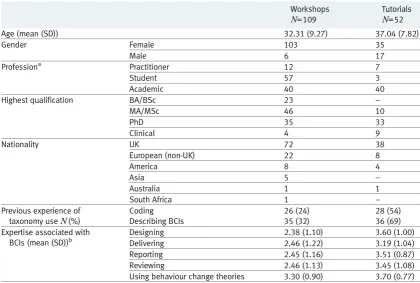
Participant details are presented in Table1.
Work-shops were offered to those interested in investigating, reviewing, designing or delivering behavioural inter-ventions; no previous knowledge or experience was
required. They were advertised via scientific and pro-fessional organisations and the BCT Taxonomy
Proj-ect website (http://www.ucl.ac.uk/health-psychology/
bcttaxonomy/). Five workshops were conducted for
the groups of between 9 to 29 trainees (n=109).
Materials
Training—Coding manuals of previous taxonomies [12,
13] were used to inform the development of the
work-shop training programme. Trainees were taught 24 of the frequently identified BCTs from BCTTv1. Train-ing involved trainees watchTrain-ing three short PowerPoint presentations and participating in a series of interactive coding exercises as a group, individually and in pairs. Content was structured around a series of learning
objectives (e.g. ‘to learn the need for precise BCT
labels and definitions’,‘to avoid wrongly inferring the
presence of a BCT’) and was designed in terms of BCTs that aimed to positively influence coding behav-iour and changing skilled behavbehav-iour (e.g. graded tasks, behavioural practice/rehearsal, instruction on how to perform the behaviour, feedback on behaviour; for a
full list of BCTs used, see Table 2). Workshop tasks
were delivered according to a number of different
formats: via a ‘ready, steady, point!’ task for which
[image:4.595.144.565.451.734.2]trainees were shown a short excerpt on the presenta-tion screen and asked, when prompted, to point to the left if BCT X was present, to the right if BCT Y was present or to the ceiling if there were unsure (see
Table 1| Demographic characteristics of workshop and group tutorial trainees
Workshops Tutorials
N=109 N=52
Age (mean (SD)) 32.31 (9.27) 37.04 (7.82)
Gender Female 103 35
Male 6 17
Professiona Practitioner 12 7
Student 57 3
Academic 40 40
Highest qualification BA/BSc 23 –
MA/MSc 46 10
PhD 35 33
Clinical 4 9
Nationality UK 72 38
European (non-UK) 22 8
America 8 4
Asia 5 –
Australia 1 1
South Africa 1 –
Previous experience of taxonomy useN(%)
Coding Describing BCIs
26 (24) 35 (32)
28 (54) 36 (69) Expertise associated with
BCIs (mean (SD))b
Designing 2.38 (1.10) 3.60 (1.00)
Delivering 2.46 (1.22) 3.19 (1.04)
Reporting 2.45 (1.16) 3.51 (0.87)
Reviewing 2.46 (1.13) 3.45 (1.08)
Using behaviour change theories 3.30 (0.90) 3.70 (0.77)
aData was unavailable for two tutorial trainees
bResponse scale ranging from 1 (none) to 5 (a great deal)
Ta bl e 2 | Summary o f 1 -d ay workshop s cont e nt and le a rni n g o bject ives C o nten t B ri ef descr iptio n Lea rni n g o bj ecti ves B CT s u sed Pr es e n ta ti on Bac k g rou nd to B e h a vio u r C h a ng e Te chniques O u tl in es the g oals fo r the day, defines a nd co nc eptual is es the ter m ‘ BC T ’ a n d co m m uni cate s ne ed fo r a g ree d stan d ar d list o f B C Ts in behavioural m edicine • To unde rstan d a ims, obj e ct ive s an d lea rni n g ou tc om es • To lear n n ee d fo r pre ci s e labe ls a n d def ini tio n s • Cre d ib le so ur ce • S o cia l re wa rd • Pro s a n d con s • C o mpar ati ve ima g ini ng o f futur e ou tcom es A sse ssm en t U si ng the tax on om y Tra in e e s w ork ind iv id u a lly to id en ti fy pre sen ce / a b se n ceo f 1 2B C Tsi na ni n te rv e n ti o nd e sc ri p ti o n • To assess pret ra in in g u se of BC Ts • Ins tructio n o n h ow to pe rform the behaviour • Be hav iou ra l p ra ct ic e/r e h e a rsa l Ta sk Rea d y, steady , po in t! Tr ai nee s sho w n a sho rt e xc e rpt o n scre en an d, w h e n prompted, a sked to po int le ftB C T1 , ri g h tf o r B C T2 o r to the ceil ing if unsure • To lear n B C Ts 1 – 2l a b e ls a n d d e fi n it io n s • To lear n a ppro p ri ate lev el s o f infe re n ce a n d dis crimination • S o cia l compa rison • S a li enc e o f co nsequ e nc es • Gr ade d tas k • B e ha viour p ra cti ce/r e he ar sal • Feedback on behaviour Mo rni n g b re a k Pr ese n tati on Id e n tif yi n g b eha vio ur s a nd B C Ts D e fin e s b e h avi o u r and th e di st in cti o n b etw e e n behaviour a nd behavio u r o ut co me • To learn w hat a b e haviour is a nd th e d ifference between a behavi ou r a nd a b e h avi o u r ou tcom e • B e ha viour p ra cti ce/r e he ar sal • Feedback on behaviour • Ge n e ra li sa tio n of target behaviour • S o cia l compa rison • Feedback on behaviour • S o cia l re wa rd Ta sk Id e n tif yi n g b eha vio ur s a nd B C Ts Tr ai nee s wo rk in pai rs to h ig hl ig h t ex ac t w o rds show in g b ehav io ur an d B CT in tw o shor t ex ce rpts • To learn h o w to identify BCT 3 – 6 in w ritten tex t • To co nside r descr iptio ns in detai l • B e ha viour p ra cti ce/r e he ar sal • Feedback on behaviour Ta sk Id entify ing B C Ts in repor ts BCT s 7 – 12 ca rds a re pl a ced a ro u n d the ro o m . Tr ai n e e s show n fiv e e xc er pts tak e n fr om re a l intervent io n s; for repo rts one a nd two, trainees asked w hen p ro mpted, to point a t th e co rrect B C T ca rd. Fo r re p o rt s thre e to fi ve , tr a in ee s a sk e d to id en ti fy pr es e n ce of B C Ts 7 – 12 • To consol id ate p re vious le a rn in g o f B CTs 1 – 12 • To lear n h ow to re li a b ly id enti fy B C Ts in re a l an d in cre asi n g ly com pl e x re por ts • S o cia l re wa rd • Ins tructio n o n h ow to pe rform the behaviour • B e ha viour p ra cti ce/r e he ar sal Ta sk P ro vi d in ge xa m p le so f B C Ts Tr a in e e sw o rki ng ro u p so f fo u rt og e n e ra tet h e ir o w n ex am pl e s o f BC Ts 7 – 12 and th e n feedb a ck to the re st o f th e g ro up • To lear n B C Ts th ro u g h deta il ed co nside rati o n o f ex ampl e s Lu nch b re a k Ta sk Rol e play E xpert tutor s act o ut two rol e p lays with six o f B C Ts 13 – 24 in ea ch. Tr a in ee s a sk ed to ide n tify pr ese n ce of BC Ts • To lear n B C Ts 1 3 – 24 la be ls an d d ef in iti o n s an d re co g n is e the m a s d eli ver ed in pra ctic e • B e ha viour p ra cti ce/r e he ar sal
[image:5.595.146.530.67.759.2]Table2). Tasks increased in difficulty as the workshop progressed from simple tasks and coding short excerpts through to more difficult tasks involving the coding of longer, more complex excerpts. Each 1-day workshop was delivered by two experienced BCT coders (BCTT project team members).
Measures
Trainee’s previous experience—Trainees were asked if they had previously: (1) designed or reported behaviour change interventions that specifically identified BCTs, (2) been involved in writing manuals or protocols of interventions, and (3) undertaken a narrative or sys-tematic review of behaviour change literature. They also rated their expertise (i.e. knowledge, skills and familiarity) in the areas of designing, writing, reporting and systematic reviewing of behaviour change inter-ventions using response options from 1 (‘no experi-ence’) to 5 (‘a great deal of experiexperi-ence’).
Evaluating training effectiveness in increasing coding com-petence—Coding competence for 12 BCTs was assessed before and after training. Trainees were asked to iden-tify the presence/absence of BCTs in descriptions of two behaviour change interventions targeting increas-ing physical activity and increasincreas-ing safe needle clean-ing behaviour, respectively. They were also asked to rate how confident they were of their identification
using +/++, whereby ‘+’ represented ‘BCT present
in all probability but evidence not clear’ and ‘++’,
‘BCT present beyond all reasonable doubt; clear evi-dence available’. The intervention descriptions used were written (by CA and MR) to highlight the learning principles taught and to ensure the inclusion of the frequent BCTs covered by the training.
To assess trainees’agreement with expert consensus,
six highly experienced BCT coders who had been involved in developing BCTTv1 (study team mem-bers: MJ, SM, JF, WH, CA and MR) worked in pairs (which were randomly allocated) and independently coded the descriptions using BCTTv1. Expert consen-sus was developed by the discussion of any discrep-ancies within each of the pairs. SM and the study researcher (MR) reviewed remaining discrepancies where a resolution was not immediately obvious. The list of BCTs agreed on as a result of this process was then circulated to the whole study team to agree the final BCT codings. We used this consensus as a
criterion against which trainee coders’ codings were
compared and validity was assessed. Consensus was reached about the presence of 12 BCTs in the descrip-tions: self-monitoring of behaviour, feedback on be-haviour, behavioural practice/rehearsal, nonspecific reward, goal setting (outcome), material reward (be-haviour), credible source, problem solving, demon-stration of the behaviour, information about health consequences, goal setting (behaviour) and social sup-port (unspecified).
Training effectiveness was evaluated by changes in inter-coder agreement, in trainee agreement with
[image:6.595.143.250.87.756.2]expert consensus, in the proportion of high (i.e. ++) confidence ratings for the 12 BCTs assessed and in the proportion of trainee coders reaching an accept-able standard of competence. Agreement (both inter-coder and with expert consensus) was assessed using prevalence and bias-adjusted
kap-pa (PABAK) [30, p. 425] (see Analysis) and
ac-ceptable standard of competence was defined in terms of trainee agreement with expert consensus
(for rationale, see “Analysis”).
Evaluating trainee experience of training—To evaluate and to inform improvement and optimisation of future training methods, trainees rated the usefulness of the presentations and individual and group tasks (i.e. ‘ready, steady, point!’tasks, identifying BCTs in pub-lished reports and identifying BCTs in role plays; see
Table2for more details) in helping them to build skill
and knowledge, using response options from 1 ‘not
useful’ to 5 ‘useful’. All trainees were asked to
respond to four open-ended questions: (1) what part(s) of the training did you find the most useful? (2) what part(s) or aspect(s) of the train-ing, if any, did you find least useful? (3) would you like future training? If so, do you have a specific proposal? and (4) please provide any other feedback about using BCT taxonomies.
Procedure
Prior to attending the workshop, all trainees were sent
two articles as preparatory reading [10, 11]. At the
beginning of the workshop, they were asked to pro-vide demographic information (i.e. age, gender, na-tionality, professional background and highest qualifi-cation). All trainees completed an assessment of their coding competence before and after training and com-pleted a training evaluation questionnaire. They re-ceived a BCTTv1 training certification at the end of the workshop and individual feedback on their coding competence assessments via email.
DISTANCE GROUP-BASED TUTORIALS Method
Design
Training was conducted over four, 1-h sessions. Train-ing was held over an average period of 6 weeks with a minimum of 1 week in between each tutorial session. Each tutorial group was led by an experienced BCT
tutor. Experienced BCT tutors (N=10) included five
members of the BCTTv1 study team (MJ, SM, WH, JF and MR) and five experts in behaviour change. The five experts had previously been involved as part of their own research and practice on at least one occa-sion, in designing and reporting behaviour change interventions which identified BCTs, in writing man-uals of interventions, had undertaken systematic or narrative reviews of behaviour change interventions or had published behaviour change studies. For 9 out of the 10 groups, tutorial sessions took place via
teleconference call. Trainees’coding competence was
assessed before and after training by assessment tasks
and trainees’evaluation of training (in terms of
useful-ness) was assessed after training in an evaluation questionnaire.
Participants
Participant details are presented in Table 1. Tutorial
training was advertised via the same networks as 1-day workshops. BCTT project team members were also asked to identify colleagues from their own teams/ networks. Those interested in taking part were asked
to complete a self-evaluation form. Trainees (n=52)
were invited to join the training if they indicated they had some previous experience in investigating, design-ing and/or deliverdesign-ing behaviour change interventions and were available over the training period. As a greater level of commitment was required from tuto-rial trainees (i.e. commitment to attend four tutotuto-rial sessions and completion of work in their own time followed by a study task), trainees were recruited from those who expressed an interest in taking part in the training and subsequent study task. They were offered an honorarium on completion of the study task. Train-ees were contacted and recruited via email, with the offer of an honorarium of £560 on completion of a coding task for research purposes (estimated to take 2 days) following the group tutorial training
programme [31].
Materials
Training—Training was structured around the same BCTs, learning principles and objectives as workshops
(see Table3) with the content adapted to cover a wider
range of 44 BCTs from BCTTv1. Content was deliv-ered according to a training manual. Coding manuals
of previous taxonomies [13,26] were used to inform
the development of the manual. Training was piloted in a face-to-face format with one group of trainees and these data were included in the analyses. The other nine tutorial sessions were conducted via teleconfer-ence call.
Each tutorial group had four trainees who were paired
into two sets of‘buddies’. The purpose of the buddy
system was to provide trainees with both practical and
emotional forms ofsocial supportduring their training
and to foster independent and sharedproblem solving.
Prior to each session, coders independently completed and submitted a preparatory coding task (comprising one, two or three exercises dependent on tutorial ses-sion) to their tutor before discussing with their buddy. Each buddy pairing was asked to discuss their task in advance identifying key questions and issues they wanted to raise during the tutorial session. Trainees were encouraged to log the outcome of their buddy
conversation in their ‘learning log’ to maximise the
usefulness of the tutorial session and to help identify areas for discussion and reflection. Tutors assessed
their groups’ completed coding tasks and compared
trainee coding to consensus coding (i.e. BCTs consen-sually agreed on as present by experienced BCT coders). Tutors led a discussion of the discrepancies between trainee and expert coding during the tutorial session.
Measures
Trainee’s previous experience—Previous experience was assessed as for workshops.
Evaluating training effectiveness in increasing compe-tence—Trainees were asked to identify the presence/ absence of BCTs in intervention descriptions before and after training. Two descriptions were used: one for the before training assessment task and one for the after training assessment task. The target behaviour for both interventions was increasing healthy eating and physical activity. Descriptions were written (by CA and MR) to highlight the learning principles and to ensure inclusion of the frequent BCTs taught in training. Expert consensus was reached about the pres-ence of 17 BCTs from BCTTv1 in each of the two descriptions: feedback on behaviour, credible source, information about health consequences, social support (practical), information about social and environmen-tal consequences, social support (unspecified),
monitoring of outcome(s) of behaviour without feed-back, nonspecific reward, demonstration of the behav-iour, Adding objects to the environment, goal setting (behaviour), problem solving, self-monitoring of out-come of the behaviour, goal setting (outout-come), ioural practice/rehearsal, self-monitoring of behav-iour, instruction on how to perform the behaviour and material reward (behaviour).
Trainees were provided with a training taxonomy (a shortened version of BCTTv1 comprising 44 BCTs) and coded the presence/absence of BCTs in the descriptions, rating their confidence in each BCT iden-tification using the same +/++ ratings as for workshops.
Training effectiveness was evaluated by changes in inter-coder agreement, agreement with expert consen-sus and in the proportion of high (i.e. ++) confidence ratings for the 17 BCTs assessed. As an additional measure of effectiveness, tutorial trainees completed measures of perceived confidence and reported inten-tions to use a taxonomy to code reports and describe behaviour change interventions, using response options ranging from 1 (‘strongly disagree’) to 5 (‘strongly agree’), before and after training.
[image:8.595.145.566.80.438.2]Evaluating trainee experience of training—Using the same response options as for 1-day workshops, Table 3| Summary of learning principles and learning objectives for group-based tutorials
Tutorial session Learning principle introduced in the session
Learning objectives
1 Only code BCTs that are directly
applied to the target behaviour(s) and population(s)
•To understand and accurately apply General coding instructions (8 preliminary steps) and Learning principle 1
•To reliably identify the presence/absence of BCTs 1–10
2 Do not infer the presence of a BCT.
The description must correspond to the definition of the BCT given in the taxonomy. If you are unsure, do not code the BCT as present
•To consolidate understanding and accurate application of General coding instructions (8 preliminary steps) and Learning principle 1 •To understand and accurately apply Learning principle 2
•To reliably identify the presence/absence of BCTs 1–20 in longer, more complex pieces of text
3 Take care distinguishing between
BCTs that only differ in terms of their behaviour change type (i.e. behaviour vs. outcome)
•To consolidate understanding and accurate application of general coding instructions (eight preliminary steps) and learning principle 1 and 2
•To understand and accurately apply Learning principle 3
•To understand the need for clear BCT labels and definitions
•To reliably identify the presence/absence of BCTs 1–32
4 Code technical terms and packages
of BCTs that map onto BCTs in the taxonomy
•To consolidate understanding and accurate application of General coding instructions (eight preliminary steps) and learning principle 1, 2 and 3
•To understand and accurately apply Learning principle 4
•To reliably identify the presence/absence of BCTs 1–44 in longer more complex pieces of text
trainees rated perceived usefulness of the reading materials provided prior to the first tutorial session, the materials provided for sessions 1 to 4, the content and the structure of the sessions and the preparatory coding tasks completed prior to each session, the bud-dy system and the learning log. They completed the same open-ended evaluation items as for workshops.
Procedure
Prior to their first tutorial session, trainees were sent the same two preparatory reading articles and completed the same measures (i.e. demographic information, ex-perience in the use of BCTs and BCT taxonomies) as for workshops. Tutorial trainees were also asked to watch a short, introductory PowerPoint presentation on the advantages and challenges associated with the use of the BCT approach in specifying the content of behav-iour change interventions. All trainees completed the
coding competence assessment task (see“Measures”)
before training. After their final tutorial session, trainees completed the after training coding competence assess-ment task and a training evaluation questionnaire. Trainees received individual feedback on their coding competence assessments and more generic feedback on some of the common coding discrepancies their group and that other groups had across the four tutorial ses-sions. Trainees received their feedback and a BCTTv1 training certificate via email.
Analysis
The following analyses were performed on data
col-lected from workshopsandtutorials.
Inter-coder agreement about BCTs identifiedwas assessed
by using PABAK [30]. PABAK was used rather than
Cohen’s kappa [32] or percentage agreement as it
adjusts for potential chance agreement between coders and high prevalence of negative agreement (i.e. when both coders agree the BCT is absent). For the purposes of analysis, trainees were randomly allocated into cod-ing pairs across workshop/tutorial groups uscod-ing a ran-dom number generator. Coder pairings were kept the same for both before and after training analyses. Where both trainees identified the BCT as present or absent, agreement was recorded and where one trainee identified the BCT but the other did not identify the BCT, disagreement was recorded. PABAK was calcu-lated for each pair and means reported across pairs and for each of the BCTs assessed. The percentage of cod-ing pairs achievcod-ing good reliability (i.e. a PABAK score of .60 and above) before and after training was also calculated. To assess improvement in inter-coder agreement for each of the BCTs assessed, the frequency of agreements and disagreements between coding pairs was calculated for each BCT and entered into a Fisher’s
exact test (to allow for cell counts of less than five) [33].
Trainee agreement with expert consensuswas assessed by calculating the number of BCTs identified by each trainee that were also identified by expert consensus.
The number of agreements and disagreements be-tween trainees and experienced BCT coders were recorded and were used to calculate PABAK. Means were reported across trainee-expert consensus pairings and for each of the BCTs assessed. Where a trainee identified the BCT identified as present by expert consensus, agreement was recorded and where the trainee did not identify the BCT, or identified a BCT not included in the consensus, disagreement was recorded. To assess improvement in trainee agreement with expert consensus for each of the BCTs assessed, the frequency of agreements and disagreements be-tween coding pairs was calculated for each BCT and entered into a Fisher’s exact test (to allow for cell
counts of less than five) [33].
Confidence for BCTs identifiedwas assessed by calcu-lating the frequency and percentage of high confidence
ratings (i.e.‘++’: BCT present beyond all reasonable
doubt; clear evidence available) for BCTs identified as present. High confidence ratings were included in the analysis so that we could easily distinguish BCTs iden-tified with certainty. The percentage of high confi-dence ratings for each BCT was also reported to iden-tify which of the BCTs assessed was identified with confidence by the greatest percentage of trainees. The threshold was set at 90 %. This decision to use this value was arbitrary and served only to highlight the greatest percentage of trainees identifying with confidence.
Change following trainingwas assessed using paired
samplest tests to assess change in the following: (i)
agreement between trainees about BCTs identified (inter-coder PABAK), (ii) the number of BCTs identi-fied by trainees also agreed on as present by expert consensus, (iii) trainee agreement with expert consen-sus (trainee-consenconsen-sus PABAK) across trainee-consen-sus pairings and across the BCTs assessed, (iv) high
confidence ratings (i.e.‘++’) for BCTs identified as
present, (v) perceived confidence and (vi) reported intention to use BCT taxonomies in the future. Paired
ttests were used as exploratory data analysis testing for
normality indicated that the distributions for all varia-bles did not deviate significantly from that of a normal
distribution (allp’s<.05).
Trainee’s previous experience—Frequencies and percen-tages were calculated to describe the number and proportion of trainees with previous experience of BCT taxonomy use. Means and standard deviations
were calculated to describe trainee’s expertise
associ-ated with behaviour change interventions (separate means were calculated for each of designing, deliver-ing, reportdeliver-ing, reviewing experience and for use of behaviour change theories; an overall mean was cal-culated across these categories).
Evaluation of training—Means and standard devia-tions were used to summarise trainee ratings of the content of the training and ratings of the materials used. A content analysis of the written feedback was conducted by two researchers (CW and KS) to identify training components that participants found useful or not so useful; CW read the feedback generated by
trainees and conducted the first round of analysis; KS checked allocation to content categories. Discrepan-cies were resolved through discussion between the two researchers.
The proportion of trainees reaching an acceptable standard of competence following training—We conceptualised an acceptable standard of competence as being the extent to which individual trainees agreed with expert
con-sensus. Landis and Koch [34] suggested that kappa
values of .60–.79 indicate‘substantial’reliability with
those above .80, indicating‘outstanding’reliability. We
used this as a guide and considered that trainees achieving a PABAK score of .60 and above to have reached an acceptable standard of competence. A chi-squared test was used to explore the proportion of workshop and tutorial trainees reaching the compe-tence criterion, before and after training. We assessed the effectiveness of workshop and tutorial training in increasing competence using a 2 (before vs. after train-ing)×2 (workshop vs. distance tutorial) analysis of variance.
RESULTS
Evaluating effectiveness of training in increasing coding competence
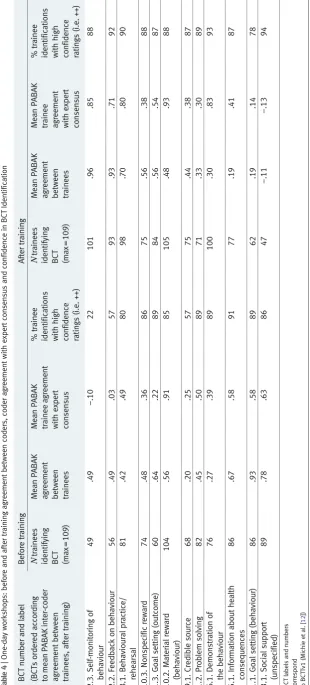
One-day workshops (see Tables1and4)
Trainee’s previous experience—Participant details are
pre-sented in Table1.
Inter-coder agreement between trainees—A trend
indicat-ed that average inter-coder agreement increasindicat-ed (t(54)=
1.77,p=.08) (before training: mean PABAK=.39,
SD=.34; after training: mean PABAK=.50, SD=.26). Inter-coder agreement increased for 6 of the 12 BCTs assessed: self-monitoring of behaviour, feedback on be-haviour, behavioural practice/rehearsal, nonspecific re-ward, credible source and demonstration of the behav-iour (average increase in PABAK for these six BCTs = .26; SD = .18; range = .03–.47). However, change across the 12 BCTs was nonsignificant,
t(11)=.90,p=.39. The number of agreements for the
BCT material reward (behaviour) was high before training, leaving little scope for improvement. Reli-ability was maintained after training. There was a significant increase in the number of agreements be-tween trainee coders for demonstration of the
behav-iour (p<.05) but significant decreases for the BCTs
social support (unspecified) and credible source (both
p’s<.05).
Agreement with expert consensus—Trainee agreement
with expert consensus increased (t(108)=3.26,p<.05)
(before training: mean PABAK=.39, SD=.29; after training: mean PABAK=.50, SD=.28). Across the BCTs assessed, agreement increased for eight of the 12 BCTs: self-monitoring of behaviour, behavioural practice/rehearsal, nonspecific reward, feedback on behaviour, goal setting (outcome), material reward (behaviour), credible source and demonstration of the behaviour (average increase in PABAK for these eight BCTs=.36; SD=.33; range=.02–.95).
However, change across the 12 BCTs was
nonsignifi-cant (t(11)=.56,p=.59). The number of trainee
agree-ments with expert consensus for the BCT material reward (behaviour) was high before training, leaving little scope for improvement. Agreement with expert consensus was maintained after training. Significant increases were seen in the number of agreements be-tween trainee coders and expert consensus for goal setting (outcome), demonstration of the behaviour, feedback on behaviour, behaviour practice/rehearsal
and self-monitoring of behaviour (all p’s < .05).
Significant decreases were seen for the BCTs goal setting (behaviour) and social support
(unspeci-fied) (both p’s>.05).
Confidence for BCTs identified—The number of high
confidence ratings (i.e. ‘++’) that trainees assigned
increased (t(108)=4.89,p<.05) (before training: mean
number of BCTs =8.38, SD =1.91; after training: mean number of BCTs=9.56, SD=1.93). Across the BCTs assessed, the number of high confidence ratings
also increased (t(11)=2.89, p<.05). The number of
high confidence ratings increased for 6 of the 12 BCTs: feedback on behaviour, behavioural practice/rehears-al, self-monitoring of behaviour, credible source, ma-terial reward, demonstration of the behaviour. One of the BCTs, information about health consequences was rated with high confidence before training, by over 90 % of trainees. Four of the BCTs, demonstration of the behaviour, material reward (behaviour, behaviou-ral practice/rehearsal and self-monitoring of behav-iour, were rated with high confidence after training, by over 90 % of trainees.
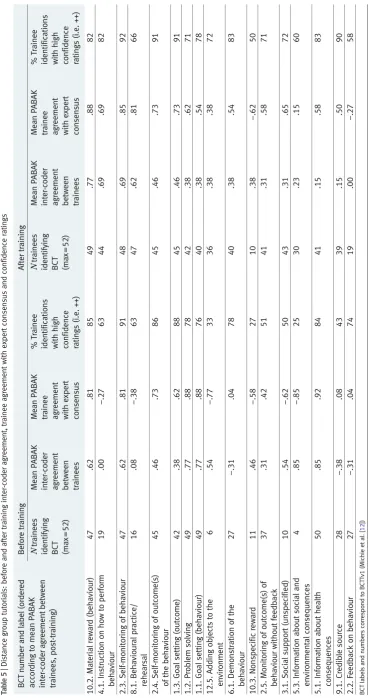
Distance group-based tutorials (see Tables1and5)
Trainee’s previous experience—Participant details are
presented in Table1.
Inter-coder agreement between trainees—There was no change in overall inter-coder agreement from before
to after training (t(25)=.57, p=.57). Across BCTs
assessed, inter-coder agreement increased for 8 of the 17 BCTs: feedback on behaviour, goal setting (out-come), credible source, demonstration of the behav-iour, behavioural practice/rehearsal, self-monitoring of behaviour, instruction on how to perform behav-iour, material reward (behaviour) (average increase in PABAK for these eight BCTs = .38; SD = .26; range=.08 to .69) but change across the 17 BCTs was
nonsignificant (t(16)=.28,p=.78). As for workshops,
the number of agreements between trainee coders for the BCT material reward was high before training, leaving little room for improvement. The number of agreements between trainee coders increased for the BCTs information about health consequences and instruction on how to perform the behaviour (all
p’s<.05). A significant decrease in the number of
agreements was seen for the BCT information about
social and environmental consequences (p<.05).
Agreement with expert consensus—Agreement with
ex-pert consensus increased (t(51)=6.60, p<.05) (before
training: mean PABAK=.57, SD=.11; after training: mean PABAK = .72, SD = .14). Across the BCTs assessed, trainee agreement with expert consensus also
Ta bl e 4 | One-d a y w orks hop s: b efore a nd afte r training a greement b etwe en cod e rs, co d er agreement w it h e xpert conse nsus a n d co n fi dence in B CT Ident ificatio n BC T n u m ber a nd label B efore training A fter train ing (BCTs o rdered acco rding to me an P A BAK int er-co d er agre em ent b e twe en tr ain e e s, a ft er train ing) N tra ine es iden tifying BCT (max = 109 ) Me an PA BA K a g re em ent be tw ee n trai nee s Me an P A BA K tr ainee a gree me nt wi th e xpe rt co nse n sus %t ra in e e ide n tifica tio n s wi th high co nfidence ratings (i.e. ++) N tra ine es identi fy ing BC T (m a x=1 0 9 ) Me an PA BA K agre em ent be tw ee n trai nee s Me an PABA K tra ine e a g re em en t wi th e xpert co nse n sus %t ra in e e id e n ti fi ca tions wit h h igh confide n ce ratin g s (i.e. ++) 2.3. Self-monitorin g o f behaviour 49 .49 − .1 0 2 2 101 .9 6 .85 88 2.2 . Feed bac k o n behaviour 5 6 .49 .0 3 5 7 9 3 .9 3 .71 9 2 8.1 . B e havioural p ractic e/ rehearsal 81 .42 .49 80 98 .7 0 .80 90 10. 3. Nonspec if ic reward 7 4 .48 .3 6 8 6 7 5 .5 6 .38 8 8 1.3 . G o al setting (outc om e) 60 .64 .22 89 84 .5 6 .54 87 10. 2. Materi al re wa rd (b ehaviour) 104 .56 .91 85 105 .4 8 .93 88 9.1 . Credibl e so urce 68 .20 .25 57 75 .4 4 .38 87 1.2 . P rob lem s o lving 82 .45 .50 89 71 .3 3 .30 89 6.1. Demons tration o f the b ehav io ur 76 .27 .39 89 100 .3 0 .83 93 5.1 . In form ation a bo ut heal th cons equen ces 86 .67 .58 91 77 .1 9 .41 87 1.1 . G o al setting (beh a vio u r) 86 .93 .58 89 62 .1 9 .14 78 3.1 . So cial suppo rt (unspecified) 89 .78 .63 86 47 − .1 1 − .13 9 4 BC T lab els a nd nu mbers correspond to BCT Tv1 (Mich ie e t a l. [ 12 ])
[image:11.595.148.459.67.754.2]increased (t(16)=2.35,p<.05). Agreement increased for 11 of the 17 BCTs: credible source, information about social and environmental consequences, social support (unspecified), monitoring of outcome(s) of haviour without feedback, demonstration of the be-haviour, adding objects to the environment, goal set-ting (outcome), behavioural practice/rehearsal, self-monitoring of behaviour, instruction on how to per-form the behaviour, material reward (behaviour) (av-erage increase in PABAK for these 11 BCTs=.62; SD=.50; range=.04–1.27). As for workshops, the number of trainee agreements with expert consensus for the BCT material reward (behaviour) was high before training, leaving little scope for improvement. The number of agreements was also high for the BCTs problem solving and self-monitoring of behaviour. Significant increases were seen in the number of agree-ments between trainee coders and expert consensus for information about social and environmental con-sequences, instruction on how to perform the behav-iour, behaviour practice/rehearsal, demonstration of the behaviour and adding objects to the environment
(allp’s<.05). Significant decreases were seen for the
BCTs goal setting (outcome) and credible source (both
p’s>.05).
Confidence for BCTs identified—The number of high
confidence ratings (i.e.‘++’) that trainees assigned did
not change (t(51)=−.57,p=.57). The number of high
confidence ratings also increased across 13 of the 17
BCTs assessed (t(16)=−3.40,p<.05). Confidence
in-creased for 13 of the 17 BCTs: credible source, infor-mation about social and environmental consequences, social support (unspecified), monitoring of outcome(s) of behaviour without feedback, nonspecific reward, demonstration of the behaviour, adding objects to the environment, goal setting (behaviour), self-monitoring of outcome(s) of the behaviour, goal setting (outcome), behavioural practice/rehearsal, self-monitoring of be-haviour and instruction on how to perform the behav-iour. One of the BCTs self-monitoring of behaviour was rated with high confidence before training, by over 90 % of trainees. Four BCTs were rated with high confidence after training, by over 90 % of trainees: self-monitoring of outcome(s) of behaviour, self-monitor-ing of behaviour, goal settself-monitor-ing (outcome) and credible source.
There was a significant increase in perceived
confi-dence in using the taxonomy (before training:M=
3.42, SD =1.00; after training: M= 4.08, SD= .56)
(t(51)=−5.27, p<.001). Reported intention to use
BCT taxonomies in the future remained high from
before (M=4.23, SD=.74) to after training (M=4.16,
SD=1.02) (t(51)=.44,p=.66).
Proportion of trainees reaching an acceptable standard of coding competence—Of the 109 workshop trainees, 25 achieved a PABAK score (in terms of agreement with expert consensus) of .60 or above and therefore met the criteria representing an acceptable standard of coding competence before training and 50 met the
criterion after training (χ2 (df=1, n=218)=12.70,
p<.05). Of the 52 tutorial trainees, 18 met the criterion
before training and 41, after training (χ2 (df=1,n=
104)=20.72,p<.05). The proportion of trainees
reach-ing the standard increased across workshop and tuto-rial training: 46 % of workshop trainees and 78 % of tutorial trainees achieved a PABAK score of .60 or above (workshops: mean PABAK=.74, SD=.09; tutorials: mean PABAK=.77, SD=.10). The change in coding competence was significant for both workshops and tutorials and that training methods were as effective as one another at increasing competence
(F(1,318)=.35,p=.55). Of the 12 BCTs assessed in
workshops, two met the competence criterion of .60 before training and five met the criterion after training
(χ2 (df=1, n=24)=1.82, p=.81). Of the 17 BCTs
assessed in tutorials, seven met the competence crite-rion of .60 before training and eight met the critecrite-rion
after training (χ2 (df=1,n=34)=.12,p=.73).
Evaluating trainees’experience—Training was evaluated positively by trainees with all components receiving uniformly high ratings (on the scale of 1 to 5) in terms
of usefulness (workshops:M=4.62; SD=.68; range=
3–5; tutorials:M=4.30, SD=.67; range 4 to 5).
Train-ees reported that the combination of practical tasks and the opportunity for structured discussion during the tutorial sessions was particularly useful. Many reported that the tutorial sessions offered an opportunity
to learn the‘consensus answers and the rationale behind
coding’. They felt the sessions provided them with the chance to learn why specific BCTs had been coded in
specific contexts and then‘discuss any reasons for
dis-crepancies with other members of the group’. The ma-jority commented that having access to a wide range and number of excerpts taken from published reports pro-vided a useful opportunity to practice their newly learned skills. Skills training activities such as using the taxonomy to code short excerpts and longer descriptions from published intervention reports were rated as useful op-portunities to apply their skills learned over the course of
the day. A few trainees reported that the‘Ready, steady,
point!’exercises were a useful method to help increase
ability to identify BCTs at speed. Whilst the majority
agreed that the‘Learning Log’and‘Buddy system’
com-ponents were both useful in principle, feedback sug-gested that trainees wanted more guidance on how to use them. For example, some found them difficult to put into practice due to time constraints. This was particular-ly an issue for trainees from different time zones.
DISCUSSION
Training in using BCTTv1 in the form of 1-day work-shops or group tutorials improved average trainee agreement with expert consensus and increased the proportion of trainees reaching an acceptable standard of coding competence, to 46 and 78 %, respectively. Not including BCTs with high agreement before traing, the number of agreements between trainees in-creased for 9 % of BCTs in workshops and 12 % in tutorials and increased the number of trainee agree-ments with expert consensus for 40 % of BCTs in
workshops and 33 % in tutorials. Training improved
trainees’confidence in coding BCTs. However, it did
not improve agreement between coders about the presence and absence of BCTs in descriptions of be-haviour change interventions. The opportunity to ap-ply knowledge and new skill in a number of coding tasks followed by group discussion was evaluated as being a useful approach by trainees.
These data provide insight for the following reasons. First, we identified BCTs for which training was effec-tive. This is where inter-coder agreement and agree-ment with expert consensus was poor before training but good after training, for example, behavioural prac-tice/rehearsal. Second, we identified BCTs that can be reliably and accurately identified with limited training. The BCT material reward (behaviour) achieved good reliability across both methods, before and after train-ing. Amongst tutorial trainees, the BCTs self-monitor-ing and self-monitorself-monitor-ing of outcome(s) of behaviour also achieved good reliability before and after training. Third, we identified BCTs that consistently achieved poor reliability. That is, BCTs that achieved poor reli-ability before and/or after training, e.g. goal setting (outcome), social support (unspecified) and informa-tion about social and environmental consequences.
In order to decrease the number of BCTs falling into this final category may mean that further refinement of labels and examples is needed or that more intensive training is needed before trained coders are able to identify them with high reliability and validity. The learning curve may be steeper for some BCTs than for others. The plan is for an international consortium to consider the experiences of users and published data from BCTTv1 and release BCTTv2 in a number of years when there is sufficient evidence to support a new version. Drawing on the feedback from trainees, one approach could be to further clarify the distinction between similar BCTs in the same grouping, e.g. goal setting behaviour and goal setting outcome, social support practical and social support unspecified to help coders distinguish between different types of
BCTs, i.e. ‘behaviour’ versus ‘outcome’ BCTs. We
acknowledge that learning rates amongst trainees
may differ and also that a certain amount of
‘unlearn-ing’may be required before trainees can achieve good
reliability and validity. For example, reliability got worse for some BCTs and it was possible for inter-rater reliability to be high and remain high even when criterion validity was low. It may be that trainees need to change their interpretation of a specific BCT label as it is understood within their own discipline or experi-ence to how the BCT is defined in BCTTv1. This may explain why some BCTs achieved poor reliability and validity before and/or after training, especially amongst tutorial trainees who started with a greater level of experience and expertise related to the use of BCT taxonomies. However, it may also suggest that these BCT definitions need further clarification. As BCTTv1 develops, it is likely that the number of BCTs that can be effectively trained will increase.
At a more general level, the data suggest that training was beneficial for different types of trainee and across different modes of delivery. Differences between the two training methods in the percentage of trained coders reaching an acceptable standard of coding competence
may partly be due to differences in competencebefore
training. One-day workshops required a lower level of commitment from trainees compared to the level re-quired from tutorial trainees. Workshops may have therefore attracted trainees with lower personal involve-ment and consequently perhaps lower competence in BCT coding. Tutorial training required trainees to make a commitment of at least 6 weeks and would naturally attract trainees with a vested interest. The fact that tuto-rial training allows for consolidation of learning between sessions and discussion and meaningful engagement with other trainees may also account for the higher proportion of competent coders after training. To take training in use of BCTTv1 forward, an online training programme has been developed using the tutorial
ses-sion model (seewww.bct-taxonomy.com).
An effective training programme should not only increase ability but also trainee confidence in applying new knowledge and skill. Training increased confi-dence in identifying BCTs assessed for both methods of training, and tutorial trainees also reported in-creased overall confidence in using the taxonomy. One could infer that the learning environment provid-ed by tutorials (i.e. a support network built over the period of multiple and regular sessions, increased time for reflection and practice) encouraged tutorial trainee confidence to increase more readily. The current study found an increase in confidence yet modest levels of inter-coder agreement and trainee agreement with ex-pert consensus, after training. These data highlight that a highly confident coder is not necessarily a competent coder. We have carried out further work to explore how confidence and competence relate to one another
[31]. Forty coders trained in use of BCTTv1 via
dis-tance group tutorial training completed a coding exer-cise whereby they identified BCTs in 40 intervention descriptions published in protocols. They completed the exercise again, 1 month later. We assessed inter-coder reliability, validity of their coding (i.e. inter-coder agreement with BCT identifications consensually agreed on by the taxonomy developers), test retest reliability and coding confidence. Our analyses showed that inter-coder reliability and validity of BCT identification tended to be negatively correlated with coder confidence. This suggests that confidence is perhaps not such a useful indicator of accuracy of BCT identification. It is important to acknowledge that con-fidence in applying BCTTv1 requires learning the complexities and challenges it faces; an understanding which is likely to improve with practice and perhaps one which may not have been fully achievable in an intensive 1-day workshop. Future research should also examine how confidence changes over time and with further training experience.
Whilst empirical comparison of the two training methods was not the focus of this paper, some
reflections are possible about the feasibility and accept-ability of each approach. Workshops may be consid-ered the more cost- and time-effective option given that a relatively large group of coders can be effectively yet intensively trained over the course of a day. How-ever, small group tutorial training, delivered over a longer period of time provides a learning environment including a support network, time for practice and time for reflection between sessions.
It is important to remember that the assessment of training effectiveness was based on trainee coding of just one intervention description before and after train-ing. The training materials used in 1-day workshops and tutorials were written to exemplify particular BCTs, to highlight the learning principles and to ensure inclu-sion of the frequent BCTs targeted for training. In general however, the quality of published intervention descriptions is poor with different BCTs described using different terminology and referred to using different
terminology [35,36]. As the use of BCT methodology
increases, BCT content is likely to become much clear-er, leading to increased reliability of identifying BCTs
[29]. It is also important to acknowledge that our
train-ees were predominantly female and from the UK. We had hoped to reach a wide range of trainees across nationality and gender by advertising workshops and tutorials on BCTT project website. As the use of BCTT methodology increases, it will be possible to recruit a wider range of trainees to evaluate training effective-ness. Finally, it should be acknowledged that coder pairings (both inter-coder pairings and trainee-expert consensus pairings) were the same for analyses of data before and after training. In the ideal assessment of inter-coder reliability, coders would be compared with all other coders and a multi-rater kappa statistic would be used to analyse the resultant data. This type of analysis will be possible in the future using a multi-rater equivalent of the PABAK statistic. So that the analyses
could be compared with previous work (e.g. [12]), it was
decided that randomly allocating trainees into pairings and calculating PABAK would be the best approach to take in the current work.
To maintain good levels of accuracy and reliability,
knowledge and skills should be maintained [37]. We are
currently evaluating the long-term impact of BCT
train-ing [38] but would recommend that coders already
trained in use of BCTTv1 regularly review training materials (to maintain and further develop their knowl-edge and skills) before using the taxonomy and check their reliability before beginning data extraction. To provide this opportunity, and in order to train new coders using BCTTv1, we have developed an open-access online BCTTv1 training course which can be
accessed atwww.bct-taxonomy.com. The online
train-ing programme is based on the tutorial traintrain-ing model, e.g. inclusion of practice coding tasks, feedback on completed coding tasks and assessments, the possibility for structured discussion led by an expert BCT tutor, access to a support network to foster continued learning and implementation of the taxonomy and access to a wide range of additional resources. Coders will be
trained on a greater number of BCTs than those taught and evaluated in the current paper.
Acknowledgments:The present work was carried out as part of the Behaviour Change Technique Taxonomy project funded by the Medical Research Council via its Methodology panel [G0901474/1]. We are grateful to all trainees, workshop facili-tators and expert tutors who participated in the training. We are also grateful to Kate Sheals (KS), Siri Steinmo and Bianca Serwinski for their help in preparing the data for this paper and to Felicity Roberts, Elena Panagiotopoulou and Linda Duffy for their previous work on the project.
Conflict of interest:The authors declare that they have no conflict of interest.
Ethical Standards:All procedures were conducted in accordance with institutional ethical standards and with the British Psychological Society Code of Ethics and Conduct (2009).
Open AccessThis article is distributed under the terms of the Creative Commons Attribution License which permits any use, distribution, and repro-duction in any medium, provided the original author(s) and the source are credited.
1. Murray CJL, Richards MA, Newton JN, et al. UK health performance: findings of the global burden of disease study.Lancet. 2010;2013:997-1020.
2. National Institute for Health and Clinical Excellence.Health systems and health-related behavior change: a review of primary and sec-ondary evidence. London: National Institute for Health and Care Excellence; 2007.
3. Craig P, Dieppe P, Macintyre S, et al. Developing and evaluating complex interventions: the new medical research council guidance. BMJ. 2008;337:a1655.
4. Moher DG, Schulz KF, Altman DG. The CONSORT statement: revised recommendations for improving the quality of reports of parallel-group randomised trials.BMC. 2001;1:2.
5. Moher DG, Schulz KF, Altman DG. The CONSORT statement: revised recommendations for improving the quality of reports of parallel-group randomised trials. Clin Oral Investig. 2003;7:2-7.
6. Des Jarlais DC, Lyles C, Crepaz N, et al. Improving the reporting quality of nonrandomized evaluations of behavioral and public health interventions: the trend statement. AJPH. 2004;94:3.
7. Medical Research Council.A framework for development and eval-uation of RCTs for complex interventions to improve health. London: Medical Research Council; 2000.
8. Campbell M, Fitzpatrick R, Haines A, et al. Framework for design and evaluation of complex interventions to improve health.BMJ. 2000;321:694-696.
9. McCleary N, Duncan EM, Stewart F, et al. Active ingredients are reported more often for pharmacologic interventions than non-pharmacologic interventions: an illustrative review of reporting practices in titles and abstracts. Trials. 2013;14:146.
10. Michie S, Abraham C, Eccles MP, et al. Strengthening evalu-ation and implementevalu-ation by specifying components of be-havior change interventions: a study protocol. Impair Sci. 2011;6:10.
11. Michie S, Johnston M. Theories and techniques of behavior change: developing a cumulative science of behavior change.Health Psychol Rev. 2012;6(1):1-6.
12. Michie S, Richardson M, Abraham C, et al. The behavior change technique taxonomy (v1) of 93 hierarchically clus-tered techniques: building an international consensus for the reporting of behavior change interventions. Ann Beh Med.
2013.
13. Abraham C, Michie S. A taxonomy of behavior change tech-niques used in interventions. Health Psychol. 2008;27:3. 379–387.
14. Michie S, Hyder N, Walia A, et al. Development of a taxon-omy of behavior change techniques used in individual be-havioral support for smoking cessation. Addict Behav. 2011;36:315-319.
15. Michie S, Ashford A, Sniehotta FF, et al. A refined taxonomy of behavior change techniques to help people change their physical activity and healthy eating behaviors: the calore taxonomy.Psychol Health. 2011;26:1479-1498.
16. Michie S, Whittington C, Hamoudi Z, et al. Identification of behavior change techniques to reduce excessive alcohol consumption. Ad-diction. 2012;107:1431-1440.
17. Dixon D, Johnston M. Health behavior change competency frame-work: competences to deliver interventions to change lifestyle
behaviors that affect health.National Health Service Scotland, 2010.
18. Abraham C, Good A, Huedo-Medina TB, et al. Reliability and utility of the sharp taxonomy of behavior change techniques.Psychol Health,
2012; sup1: 1–357.
19. Hak T, Bernts T. Coder training: explicit instruction and implicit socialization? In: Krippendorff K, Bock A, eds.The content analysis reader. Thousand Oaks: Sage; 2009:220-233.
20. Bernard RM, Abrami PC, Lou Y, et al. How does distance education compare with classroom instruction? A meta-anal-ysis of the empirical literature.Rev Educ Res. 2004;74:379-439.
21. Potter WJ, Levine-Donnerstein D. Rethinking validity and reliability in content analysis.J App Commun Res,1999: 258–284.
22. Michie S, Abraham C, Whittington C, et al. Effective techniques in healthy eating and physical activity interventions: a meta-regres-sion.Health Psychol. 2009;28(6):690-701.
23. Dombrowski SU, Sniehotta FF, Johnston M, et al. Optimizing acceptability and feasibility of an evidence-based behavioral inter-vention for obese adults with obesity-related co-morbidities or additional risk factors for co-morbidities: an open-pilot interven-tion study in secondary care.Patient Educ Couns. 2012;87(1):108-119.
24. Murphy C, Ciszewska-Carr J. Sources of difference in reliability: identifying sources of difference in reliability in content analysis of online asynchronous discussions.Int Rev Res in Online Dist Learn,
2005.
25. Pollock PH, Hamann K, Wilson BM. Learning through discussions: comparing the benefits of small-group and large-class settings.J Polit Sci Educ. 2011;7:48-64.
26. Salas E, Cannon-Bowers JA. The science of training: a decade of progress.Ann Rev Psychol. 2001;52:471-499.
27. Salas E, Kosarzycski MP, Burke S, et al. Emergent themes in dis-tance learning research: some food for thought.Int J Manag Rev. 2002;4:135-153.
28. Bandura A.Social learning theory. Englewood Cliffs: Prentice-Hall; 1977.
29. Lorencatto F, West R, Seymour N, et al. Developing a method for specifying the components of behavior change interventions in practice: the example of smoking cessation.J Consult Clin Psychol. 2013;81:528-544.
30. Byrt T, Bishop J, Carlin JB. Bias, prevalence and kappa.J Clin Epi-demiol. 1993;46:423-429.
31. Michie S, Wood CE, Johnston M, Abraham C, Francis J, et al. Behav-iour change techniques: the development and evaluation of a tax-onomic method for reporting and describing behaviour change interventions.Manuscript under review.
32. Cohen J. Weighted kappa: nominal scale agreement with provision for scaled disagreement or partial credit.Psychol Bull. 1968;70:213-220. 33. Fisher RA. Statistical methods for research workers, Edinburgh:
Oliver and Boyd.
34. Landis JR, Koch GG. The measurement of observer agreement for categorical data.Biometrics. 1977;33(1):159-174.
35. Glasziou PP, Chalmers I, Altman DG, et al. Taking healthcare inter-ventions from trial to practice.BMJ. 2010;341:c3852.
36. Hoffman TC, Erueti C, Glasziou PP. Poor description of non-pharma-cological interventions: analysis of consecutive sample of rando-mised trials.BMJ. 2013;347:f3755.
37. Aguinis H, Kraiger K. Benefits of training and development for individuals and teams, organisations and society.Annu Rev Psy-chol. 2009;60:451-474.
38. Abraham C, Johnston M, Michie S. et al. Are behavior change interventions replicable? Identifying reliable and valid behavior change techniques using BCT taxonomy v1 (BCTTv1), In prep 2013.