The R&D Boundaries of the Firm
—A Problem-Solving Perspective
Shaopeng Huang‡, Darryl Holden University of Strathclyde
Abstract
This paper considers, theoretically and empirically, how different organization modes are aligned to govern the efficient solving of technological problems. The data set is from the Chinese consumer electronics industry. Following the problem solving perspective (PSP) within the knowledge-based view (KBV), we develop and test several PSP and KBV hypotheses, whilst controlling for some relevant transaction cost economics (TCE) and other variables, in an examination of the determinants of the firms’ R&D organization choice. The results show that a firm’s existing knowledge base is the most important explanatory factor. Problem complexity and decomposability are also found to be important, but it is suggested, contrary to the view of PSP, that they are better treated as separate variables, and that equity-based alliances tend to be reserved for the most complex problems.
Key Words: Problem solving perspective; knowledge-based view; firm boundaries; organization choice
JEL classifications: L22, L23, L24, M10, M16, O31, O32.
‡Corresponding author: Shaopeng Huang, Department of Economics, University of Strathclyde, 130
Rottenrow G4 0GE, Glasgow, UK; TEL : +44 (0)141 548 3868; E-mail: [email protected]
1. Introduction
The emergence of the problem-solving perspective (PSP) (Macher, 2006; Nickerson and Zenger, 2004) within the knowledge-based view (KBV) is a major development in the theory of the firm. It seeks to combine transaction cost economics (TCE) (Williamson, 1985, 1996), complexity theory (Simon, 1962; Kauffman, 1995) and the KBV of the firm (Conner, 1991; Conner and Prahalad, 1996; Foss, 1996; Kogut and Zander, 1992) to explain how different organization modes are aligned to govern the efficient creation of valuable knowledge. In this perspective the firm is a knowledge-bearing problem solving entity, with the key tasks of management being the identification of valuable problems and the organization of solution searches. The firm, by organizing problem finding and problem solving efficiently, creates value.
Although adopting a different unit of analysis than TCE, the PSP applies similarly the logic of ‘discriminating alignment’ (Williamson, 1991) in evaluating the relative efficiency of different organization modes for organizing problem solving. Based on previous work, a few dimensions are identified as being crucial to understanding the impediments to problem solving. Furthermore it is contended that, as far as the costs and competencies of implementing solution searches for different types of problem are concerned, the few generic organization modes differ systematically with respect to incentive intensity, communication channels, dispute resolution regimes, etc. Finally, the PSP works out the match between problem/knowledge attributes and the few generic organization modes in an economizing manner that realizes superior search performance.
As a ‘new’ perspective, empirical research of the PSP is underdeveloped in that few studies (Macher, 2006; Macher and Boerner, 2012) are directly devoted to its empirical examination. This paper seeks to address this shortcoming by developing and testing some PSP/KBV hypotheses whilst controlling for some relevant TCE and other variables, in an examination of the firm’s choice between in-house, equity-based alliance, contract-based alliance, and outsourcing as R&D organization mode. The multinomial logit model, discussed in section 4, is used to explain the three relative probabilities
Pr( )
Pr( - )
option
in house (1)
problem structure), and measures of knowledge tacitness and social distribution as predictors. In particular, we argue that intensity of knowledge set interactions and decomposability are analytically distinguishable. We treat them as two separate variables and find that they have significant, and rather different, organizational ramifications. Knowledge codifiability and social distribution, by contrast, are only marginally significant at best. With reference to other closely related literature, we further contend that a firm’s existing knowledge base has profound impacts on the organization of its problem solving but that this dimension has been relatively underexplored in the existing PSP literature. We introduce an appropriate measure into the analysis and find it to be a significant predictor. A few relevant TCE variables are also included as controls and some of them, such as physical asset specificity and appropriability, turn out to be significant, although the estimation results are not always completely consistent with TCE predictions.
2. Literature Review and Hypotheses Development
In the PSP, the ‘problem’ is the basic unit of analysis and the profitable discovery of a high-value solution for a given problem is the central rationale for the organization choice. It is assumed that new knowledge is generated by combining existing knowledge, and that a solution to a problem represents a unique combination of existing knowledge. For a given problem, the set of all possible combinations of relevant knowledge can be presented as a solution landscape, the topography of which defines the value of each solution. Accordingly, problem solving can be seen as the search over the solution landscape for high value solutions (Nickerson and Zenger, 2004).
match between problem attributes, knowledge characteristics, and organization modes. They argue (Leiblein and Macher, 2009; Macher, 2006; Nickerson and Zenger, 2004) that given the above-mentioned advantages, together with the control mechanisms and low-powered incentives characteristic of internal organization (Williamson, 1991), hierarchies are better able to implement heuristic search through information dissemination, consensus building, and authority direction as compared to markets. Therefore, hierarchies realize solution search performance advantages for ill-structured, complex or non-decomposable problems. By contrast, markets enjoy certain advantages arising from more specialized expertise (Hayek, 1945), high-powered incentives, decentralized decision making (Williamson, 1991), and more direct competitive pressures (D'Aveni et al., 1994), so that markets improve the speed/quality of problem solving via directional search when technological development involves well-structured, simple or decomposable problems. Adopting Williamson’s (1991) view that collaborative arrangements (alliances) are ‘hybrid’ modes of organization lying somewhere between market and hierarchy along a hypothetical continuum, in the PSP literature, the discriminating alignment has been extended to include the choice of collaborative arrangements (alliances) (Leiblein and Macher, 2009) where it is argued that alliances (in particular, joint ventures) are better than markets in solving ill-structured or complex problems, but perhaps not as suitable for the most ill-ill-structured or complex problems as hierarchies.
In the PSP literature, however, the organizational implications of a firm’s existing knowledge base have been relatively underexplored, although recent literature (Macher and Boerner, 2012) has begun to address the issue, as anticipated by Nickerson and Zenger (2004). By contrast, in the KBV literature (for a review, see Grant, 2003) upon which the PSP is grounded, it is firmly held that a firm’s existing knowledge base has profound organizational consequences, and this view has been applied to the organization of a firm’s R&D activities (e.g., Zhang et al., 2007). Given this, we suggest that this dimension is of particular relevance to the organization of problem solving and that its role should be highlighted.
2.1 Complexity (Intensity of Knowledge Set Interactions) and Decomposability
decomposable (non-decomposable) system, the interactions amongst subsystems are negligible (essential); whilst in a nearly decomposable system, the interactions amongst the subsystems are weak, but not negligible.
Based primarily on Simon’s contributions, the complexity of problems is divided into three broad categories (Nickerson and Zenger, 2004), depending on the extent to which relevant knowledge sets interact to produce a valuable solution (Leiblein and Macher, 2009).
For (fully-) decomposable and low-interaction problems, interdependencies amongst relevant knowledge sets are negligible and decomposition into sub-problems is easy. Solving such problems requires little coordination and knowledge sharing. Local trial-and-error (directional) search through experiential learning and feedback provides certain advantages. Decomposability also implies that the solutions to sub-problems are additive (Leiblein and Macher, 2009) as sub-problems can be solved independently and simultaneously, with the optimal solutions being readily aggregated to give a globally optimal solution for the original problem.
At the other extreme are non-decomposable and high-interaction problems, for which there exist intensive and extensive interactions amongst knowledge sets, with there being no practical pattern of decomposability. To solve such problems, cognitive/heuristic search is prescribed, calling for problem solvers to collectively develop cognitive maps to navigate the search (Gavetti and Levinthal, 2000; Simon, 1988), necessitating the sharing/exchange of knowledge amongst multiple actors. As specialists from different fields are cognitively constrained in their learning capacity the task of coordinating and integrating specialists’ knowledge is demanding (Hsieh et al., 2007). Moreover, given self-interestedness, incentive impediments such as knowledge appropriation hazards and strategic knowledge accumulation hazards tend to complicate the organization of solution discovery (Nickerson and Zenger, 2004). Between the extremes are nearly-decomposable and moderate-interaction problems, for which the knowledge set interactions are moderate. Sub-problems associated with distinctive knowledge sets can be identified but non-trivial interdependencies amongst the sub-problems remain. Near-decomposability also means that knowledge set interactions within sub-problems are greater than amongst sub-problems so that solution search requires some knowledge sharing and coordination. Accordingly, the aforementioned coordination and incentive challenges still apply, albeit on a reduced scale.
magnitude of interdependence)1 (Nickerson and Zenger, 2004). Simple problems involve a small number of relevant knowledge sets interacting in more predictable ways, mapping into smooth solution landscapes. Complex problems entail a larger number of relevant knowledge sets, amongst which there are pervasive interactions and extensive connectivity, with the implied solution landscapes tending to be more rugged. As the likelihood of conflicting constraints across choices increases with N and K (Kauffman, 1993) the solving of complex problems requires the balancing of multiple design choices, adding to the difficulty of finding the global optima (Jonassen, 2004).
Notwithstanding the above, it seems to the authors that both Nickerson and Zenger (2004) and the wider PSP literature do not particularly differentiate between knowledge set interactions and problem decomposability. Theoretically, they are considered as two concomitant aspects of problem complexity (Nickerson & Zenger, 2004) and empirically they are treated as a single variable (Macher, 2006; Macher and Boerner, 2012). However, knowledge set interactions and problem decomposability are analytically distinguishable and do not always move in the same direction, although both are determined jointly by N and K. Specifically, knowledge set interactions capture the intensity of interactions whereas decomposability depends on the pattern of such interactions (Nickerson and Zenger, 2004; Simon, 1962). In particular decomposability indicates that such interactions tend to cluster tightly into nearly isolated subsets (Ethiraj and Levinthal, 2004).
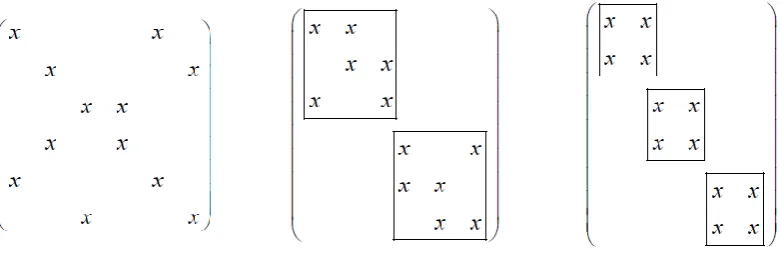
To illustrate the difference, consider the three NK systems in Figure 1. In each case, N=6, K=1 and there are 12 interactions amongst the elements. In terms of intensity of knowledge set interaction the three systems are equally complex, but they exhibit different patterns of decomposability.
[INSERT FIGURE 1 AROUND HERE]
System 1 displays random interactions with no obvious pattern of decomposability, whilst systems 2 and 3 can be decomposed into two and three subsystems respectively. In terms of non-decomposability, system 1 is more complex than system 2, which is, in turn, more complex than system 3.
1K is defined as the number each of the N consisting knowledge sets is affected by other knowledge sets
in the same problem. A problem is of minimum complexity when each knowledge set is independent
(K=0), and of maximum complexity when each relevant knowledge set is affected by all other knowledge
Given the above analysis, knowledge set interactions and problem decomposability are treated as separate variables in this study and we try to differentiate empirically their respective effects on organization choice.
2.2 Definiteness of Problem Structure
In complexity theory the definiteness of problem structure has long been recognized as a distinct dimension of problem complexity (Simon, 1973). According to Simon, virtually all problems are initially ill-structured. They become well-structured as problem solvers become increasingly prepared for, and more familiar with, them. Such a process of formalization renders problems solvable. Well-structured problems are the outcomes of problem defining processes and the accumulation of problem solving techniques.
In the PSP literature, this dimension was introduced by Macher (2006). Building mainly on Simon’s work, and with reference to the NK system, Macher argues that problems can be characterized along a continuum of problem definiteness, ranging from ill-structured to well-ill-structured. The extent to which a problem is well-ill-structured depends on the characteristics of the problem domain, as well as on the clarity of the problem solving mechanisms. Ill-structured problems have poorly defined initial states (ambiguous N and K) (Jonassen, 2004) and unexpected/unknown knowledge set interactions (Fernandes et al., 1999), so that appropriate approaches to problem solving are unclear. By contrast, well-structured problems are those with well-defined initial states (unambiguous N and K) and well understood knowledge set interactions. Accordingly, approaches to problem solving are explicit and well-accepted.
As these differences also affect problem decomposability (Ethiraj and Levinthal., 2004; Levinthal, 1997) a connection between problem structure and decomposability can be made (Macher, 2006). Ill-structured problems cannot be decomposed because the knowledge set interactions are often unexpected/unknown, making solution search difficult. The knowledge set interactions for well-structured problems, though not necessarily decomposable, are better understood, implying that solution searches are more transparent.
In summary, in the above two subsections it is argued that coordination and incentive challenges to problem solving vary systematically across problem types, with which different search methods can be matched in a way that realizes superior search performance. Combining insights from both the TCE and the KBV, it is further argued (Nickerson and Zenger, 2004) that the costs and competencies of implementing different search methods differ across the few generic organization modes, so that solution search for a particular type of problem can be most efficiently organized by some specific mode. In the PSP literature (Macher, 2006; Nickerson and Zenger, 2004), the discriminating alignment dictates that markets are most suitable when problems are simple, decomposable and well-structured. By contrast, hierarchies entail high organization costs and should only be adopted when the benefits from building consensus or supporting authority direction are high, this being the case when the problem is complex, non-decomposable and ill-structured.
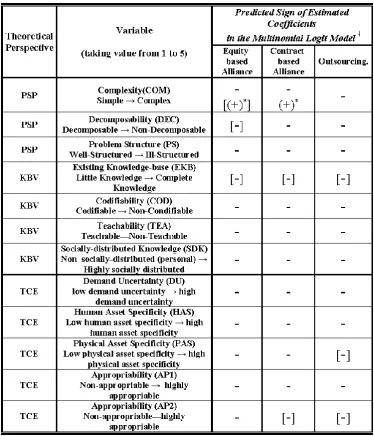
The above discussion implies that, in accordance with the general PSP predictions and given that alliances are treated as ‘hybrid’ modes of organization, the variables measuring problem complexity (intensity of knowledge set interaction), decomposability, and definiteness of problem structure (COM, DEC, PS) will have a negative impact on each of the three relative probabilities in equation (1) (See Table 1). Hypothesis regarding COM, DEC, and PS are presented more fully in section 2.5.
2.3 A Firm’s Existing Knowledge Base
Above, it is noted that the extent to which a problem is well-structured depends on how well solvers are prepared for it. It should be emphasized that the idea can in fact be operationalized on two different levels, with, in our view, distinct organizational consequences. On a collective level, whether a problem is well-structured depends on how much human beings as a whole know about the problem, and the extent to which they have developed corresponding problem solving techniques. This, as we understand it, is what is discussed in the previous section. On an individual level, given the ‘state of the art’ for solving a specific problem, whether and how well/fast a problem solver is able to find a solution also depends on how well this solver is equipped with relevant knowledge. Problem structure is thus solver-dependent, and consequently related to a firm’s existing knowledge base. A given problem can pose radically different challenges for different solvers with different knowledge backgrounds, thus leading to different organization choices and performances.
possession”. Similar points have been made more explicitly by Macher and Boerner (2012) who contend that firms with more technological knowledge in relevant fields can improve performance not only via experiential learning by doing, which tends to favour the choice of internal development, but also through better supplier relationship management, which instead tends to favour the choice of markets, so that a firm’s technological knowledge base is “likely to have organization and performance implications that depend in part on the structure of technological development” (Macher and Boerner, 2012: p. 3). In other words, a firm’s existing knowledge base affects the organization and the performance of its technological problem solving, both through its independent effect2 and through its interaction effect with the structure of the problem. Notwithstanding this, the possible linkage between a firm’s existing knowledge base and its organization choice is still underexplored in the PSP literature. By contrast in the KBV (Grant, 2003), the organizational learning (Boerner et al., 2001), and the innovation literatures (Teece et al., 2010), a firm’s existing knowledge base has been found, both theoretically and empirically, to have profound organizational consequences. Its implications for the organization of R&D have also been explored (e.g., Zhang and Baden-Fuller, 2010; Zhang et al., 2007).
As also noted by Macher and Boerner (2012), in the KBV literature the firm is conceptualized as a routine-based, history-dependent knowledge bearing social entity that adapts experimentally and incrementally to its past experiences (Penrose, 1955). In this view, the existing knowledge base provides the firm with information filters (Arrow, 1974), absorptive capacity (Cohen and Levinthal, 1990), and routines (Nelson and Winter, 1982) that facilitate the integration of knowledge (Kogut and Zander, 1992) and improve problem solving efficiency in specific technological areas (Nelson and Winter, 1982). Accordingly, more experienced/knowledgeable firms achieve superior performance in technological development, irrespective of the mode chosen (Macher, 2006). Moreover, as more experienced/knowledgeable firms enjoy experiential learning-by-doing and uncertainty reduction performance advantages, they tend to in-source technological development (Argote, 1999). More generally, in this literature it is firmly held that firms tend to internalize activities in which they have superior capabilities and outsource those in which they have inferior capabilities (Argyres, 1996). Recent work (Coombs and Metcalfe, 2000; Grant and Baden-Fuller, 2004) also reveals that, in many cases, firms participate in various forms of alliance mainly to access
2 However the authors state that more experienced firms perform better both “in developing
external complementary knowledge/capabilities. A link between alliance participation and a firm’s knowledge base can thus be established.
Applying the above insights in the context of technological problem solving, it can be argued that a firm with a higher level of knowledge in relevant fields is more likely to organize problem solving in-house rather than through markets, ceteris paribus. Similarly, when a firm is trying to solve a complex problem, for which it has considerable knowledge but is nevertheless lacking in some critical knowledge direction, it would, depending on the attributes of the problem, leverage various forms of collaborative arrangement to access external complementary knowledge.
In short, the above discussion tends to imply that, again in accordance with the general PSP/KBV prediction and given that alliances are treated as ‘hybrid’, the variable measuring a firm’s existing knowledge base (EKB) will have a negative impact on each of the three relative probabilities in equation (1) (See Table 1). Hypotheses regarding EKB are further developed in section 2.5.
2.4 Knowledge Tacitness and Social Distribution
Apart from the make-or-buy decision, similar reasoning has been applied to alliance governance (Kogut, 1988), with subsequent development due to Heiman and Nickerson (2002, 2004), who incorporate the logics of the PSP and the TCE. Heiman and Nickerson argue that inter-firm collaboration can be understood as a problem solving process involving the combining of the distinct knowledge sets of the participants, often tacit and socially distributed. Given bounded rationality, such knowledge characteristics can interact with problem complexity to pose significant challenges for the sharing/transferring of knowledge in the process of joint solution search. To overcome these challenges various knowledge management practices, such as high-bandwidth communication channels and common communication codes, are often adopted, which in turn give rise to higher knowledge appropriation hazards via increased knowledge transparency. Efficient governance of inter-firm collaboration should therefore address the problems of knowledge transfer and knowledge expropriation jointly, while an equity-based alliance can deal with both problems more effectively than a contract-based alliance. On the one hand, with the aid of the hierarchical structure and the concomitant coordination/administrative apparatuses, an equity-based alliance is better able to accommodate the afore-mentioned knowledge management practices, making it a superior vehicle for transferring/sharing complex knowledge. On the other hand, equity-based governance also provides better safeguards against misappropriation of knowledge as shared ownership tends to alleviate opportunistic incentives, increase monitoring, and enhance managerial controls. Given that alliances are treated as ‘hybrid’, the above discussion tends to imply that the variables measuring the tacitness (operationalized by the two dimensions of codifiability and teachability, see section 3.3) and social distribution of relevant knowledge, COD, TEA, and SDK, will have a negative impact on each of the three relative probabilities in equation (1) (See Table 1).
2.5 Hypotheses
Based on the above review we have the hypotheses summarized in the upper section of Table 1, with reference to which we note the following.
pair of organization modes can be inferred accordingly. In particular, given the focus of the paper, the following (default) hypotheses are highlighted.
Hypotheses A1/A2/A3: The more complex (in terms of intensity of relevant knowledge sets interactions) (A1), the more non-decomposable (A2), the more ill-structured (A3) a technological problem is, the more likely that internal organization will be chosen by the firm to organize the technological problem solving over alliance and outsourcing, ceteris paribus.
Hypothesis B: The higher the level of the firm’s existing knowledge base in relevant fields, the more likely that internal organization will be chosen by the firm to organize the technological problem solving over alliance and outsourcing, ceteris paribus. Second, the view that alliances are ‘hybrid’ modes of organization has long been questioned (Atik, 1995; Meanrd, 2012). Oxley, who extended the ‘hybrid’ view by constructing the above mentioned market-hierarchy ordering of various alliance forms, observed subsequently that although her categorization was “a useful contribution”, “attempts to order the numerous alliance forms on a single continuum were futile because of conceptual as well as practical barriers” (Oxley, 2012: p. 148-149). Moreover, as argued by Kay (1997), a joint venture, presumably the most important ‘hybrid’ mode, is typically plagued by the problem of being the servant of several masters, with the implied contractual, control, and appropriability problems all tending to exacerbate transaction costs relative to a pure hierarchy. Much of the managerial literature also suggests that a joint venture is often viewed by managers as the most expensive mode of organization, a last resort dominated by other modes (Brechbuhl, 2006). In this perspective, it is problematic to treat alliances (in particular, joint ventures) as ‘hybrid’. Rather, they should be viewed as independent modes of organization. Although such expensive modes are generally avoided, alliances do offer some unique benefits, in particular access to external complementary knowledge in the face of solving a non-decomposable, complex problem that is beyond the firm’s existing capabilities/knowledge base. It can therefore be argued that the likelihood of knowledge/capabilities bottlenecks increases with problem complexity, and that such bottlenecks might be expected to lead the firm to referring to external sources for complementary knowledge, most possibly by forming alliances with other firms (Coombs and Metcalfe, 2000). In the context of choosing between in-house and alliance, it is reasonable to argue that the more complex the problem the less likely it can be solved internally, for lack of complete knowledge, and therefore the more likely the problem solving will be organized by alliance. More explicitly we have
the firm to organize the technological problem solving over internal organization, ceteris paribus.
The implications are noted as alternative hypotheses in the second row of Table 1. In our view, these alterative hypotheses are consistent with the logics of the PSP and the KBV, although at odds with the ‘hybrid’ view of alliances.
Given space constraints and the focus of the article, we do not review relevant TCE literature. For the few TCE variables included in this study, we adopt rather standard hypotheses as found in some highly cited TCE literature (Oxley, 1997; Robertson and Gatignon, 1998; Williamson, 1985). More explicitly, we hypothesize that the higher the demand uncertainty, that the more specific the relevant human/physical asset is, and that the more appropriable the relevant knowledge is, the less likely that equity-based alliance, contracted-based alliance, or outsourcing will be chosen over in-house to organize problem-solving. See the lower section of Table 1.
[INSERT TABLE 1 AROUND HERE]
3. Empirical Setting
3.1 Data Collection
Data were collected by survey administered by structured interview. Some of the questions are adapted from previous studies (e.g., Kogut & Zander, 1993) whilst others are originally constructed to capture information on certain underexplored variables, in particular the PSP variables. Obtaining responses from executives is often problematic with a survey, and the response rates for R&D related surveys are typically low (Mairesse and Mohnen, 2010). Given this, a consultancy company with connections to the targeted industry was contracted to help distribute the questionnaire designed by the authors and to conduct part of the interviews.
In the survey, three types of information were collected. First, respondents were asked to give examples, based on provided definitions, of the organization modes of their R&D projects involving an international element3. Second, respondents were asked to evaluate, again based on provided definitions, various attributes of the R&D projects using pre-defined five point Likert scales, focussing on the central PSP, and other control, variables. Third, additional background information regarding the reported R&D project and the firm, e.g. firm size and origin, was also collected.
3 An international R&D project is defined as one that involves cooperation with a foreign
To control for inter-industry differences, the sectoral coverage of the study was confined to the consumer electronics industry, which includes (a) PC and peripherals, (b) mobile handset and other personal communication devices, and (c) household appliances and audio/video equipment.
The target response group of the survey was corporate informants with knowledge of their company’s project-level R&D activities, including R&D directors, R&D project managers, senior R&D researchers, etc.
The survey followed a rather standard procedure. The consultancy company compiled from their database a list of consumer electronics companies that might have participated in international R&D4. Companies on the list were randomly selected, with a senior manager in the selected company then being contacted by telephone to enquire into the possibility of survey participation. If rejected, the surveyors moved on to the next company on the list until the pre-set sample size5 was reached. In total 96 companies were contacted, with 50 agreeing to participate in the survey.
For these 50 companies structured interviews based on the pre-designed questionnaire were then arranged. The interviews were conducted through on-site visits by trained surveyors in 2010, usually lasting 1–2 hours. Follow-up contact with 50% of the interviewees was subsequently made by a supervisor to double-check the procedure and results. In the interview, each respondent was encouraged to report a diversified selection of their company’s international R&D projects. However, given the time-consuming and attention-demanding nature of the questionnaire, and that a single informant is more likely to over- or under-report certain phenomena (Phillips, 1981), the maximum number of projects reported by a single respondent was restricted to 3. Overall, 111 people from these 50 companies were interviewed, providing detailed information on 142 international R&D projects.
3.2 General Industrial Background
In the past two decades China’s manufacturing sector in general, and consumer electronics industry in particular, has witnessed the rapid globalization of innovation activities, with a large proportion of R&D activities in this industry being attributable
4 Given that small companies are less active in R&D (Acs and Audretsch, 1991), an annual
turnover of $2 million was (arbitrarily) set as the threshold for choosing candidate companies. We experimented with different thresholds by appropriate re-estimation and find the substance of our conclusions is unchanged.
5 Given the number of covariates we are particularly interested in (the few PSP variables and
to multinational R&D presence in China (Boutellier et al., 2008; Rowen et al., 2008), either independently or in cooperation with indigenous firms (Li and Yue, 2005). Over the period, almost all major global players have become entrenched in this less regulated and highly competitive industry (McKinsey, 2003), making it of considerable interest for examining the determinants of the organization choice for R&D, given the diversity of the complexity of technological problems to be solved and of the participants’ knowledge endowments.
There is little systematic information regarding the overall status of international R&D activities in the Chinese consumer electronics industry.Nevertheless, the following information revealed by previous studies can be used as a benchmark to evaluate the representativeness of our sample. Prior studies (e.g., Zhou et al., 2010) indicate that manufacturing activities in this industry are highly concentrated in the following three regions: the Pearl River Delta (centered around Shenzhen and Dongguan), and, to a lesser extent, the Yangtze River Delta (centered around Shanghai and Suzhou), and the Bohai-Rim (centered around Beijing and Tianjin). The location of R&D activities in this industry is somewhat different as studies suggest that foreign R&D facilities in China are predominantly concentrated in Beijing and Shanghai6, with Tianjin, Suzhou and the Cantonese cities of Guangzhou and Shenzhen as secondary locations (Boutellier et al., 2008).
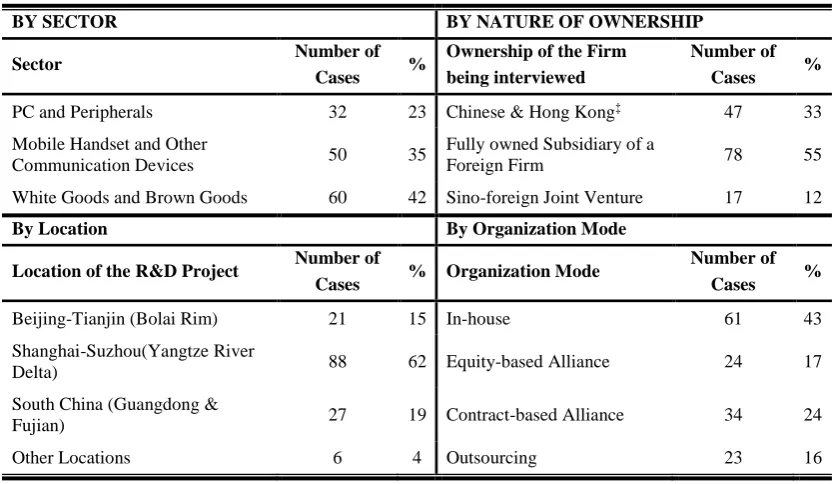
Given this background information, we believe the current sample is representative of the population in terms of geographic and sectoral distribution, type of ownership, etc. (see Table 2).
[INSERT TABLE 2 AROUND HERE]
3.3 The Variables: Definition and Measurement 3.3.1 Dependent Variable
The dependent variable, organization mode, is an unordered discrete variable classified into three broad categories: in-house, collaborative arrangements (alliances) and outsourcing (arm’s-length like contract) (Robertson and Gatignon, 1998). With contract-based and equity-based collaborative arrangements treated separately (Pisano, 1989), a total of four organization modes results, namely.
In-house — the firm undertakes the R&D project internally.
6 According to Boutellier et al. (2008), by September 2006, 67% of the 495 foreign R&D
Outsourcing — the firm contracts out an R&D project to some other organization to
find a solution for a technological problem.
Collaborative arrangements (alliances) —which allows for a wide variety of ‘hybrid’ organization modes. In this study, contract-based and equity-based collaborative arrangements are distinguished. In the first case no equity exchange is involved, whereas in the second case partner firms refer to some equity-based arrangement as an umbrella structure to support their joint R&D projects, either setting up a joint venture and undertaking joint R&D projects in this new legal entity, or alternatively taking/cross-taking minority equity stakes to support such projects.
3.3.2 Independent Variables
All independent variables, unless stated otherwise, are measured using a five point Likert scale. Table 3 presents descriptive statistics for these variables and Table 4 presents correlations.
[INSERT TABLE 3 AROUND HERE]
[INSERT TABLE 4 AROUND HERE]
Complexity (intensity of knowledge-set interactions) and decomposability are treated as separate variables. Along with problem structure, these three variables are defined in the same manner as in sub-sections 2.1 & 2.2.
Complexity (Intensity of Knowledge Set Interactions) (COM) measures the number of relevant knowledge sets and the intensity of their interactions for the technological problem under consideration.
Decomposability (DEC) measures the extent to which the technological problem under consideration can be divided into sub-problems.
Problem Structure (PS) measures the extent to which the technological problem under consideration is well structured.
The questionnaire items relating to these four variables are presented in Appendix I 7. Given the focus of the paper, we treat the following few KBV and TCE variables as control variables in our analysis. Following some highly cited literature, these variables are defined as follow.
Knowledge Tacitness is operationalized by the two dimensions of codifiability (COD)
and teachability(TEA) (Zander and Kogut, 1995). Codifiability is defined as the extent to which it is easy to find/prepare relevant reference materials (e.g., books, manuals) in order to provide a new team member with most of the critical knowledge. Teachability is defined as the extent to which it is easy for a new team member to learn, by working with, and being mentored by, a skilled team member, the core knowledge and skills required to solve the problem.
Social Distribution of Knowledge (SDK) is defined as the extent to which the knowledge required to solve the problem under consideration is possessed by one or a few individual experts, as opposed to being widely distributed amongst a group of experts, so that no single expert can solve the problem.
Demand Uncertainty (DU) is defined as the difficulty of forecasting the future demand for the product/service to which the R&D project under consideration is intended to contribute (Robertson and Gatignon, 1998).
Human Asset Specificity (HAS) is defined as the extent to which the skills and knowledge developed/accumulated in the R&D project under consideration are useful outside the project. Physical asset specificity (PAS) is defined as the extent to which the investment in physical assets to support the R&D project under consideration can be redeployed outside the project (Williamson, 1985).
Appropriability of the relevant knowledge is defined as (AP1) the extent to which the R&D project under consideration can be easily imitated by an outsider (e.g., by reverse engineering or inventing around), and (AP2) the extent to which the departure of one or a few key R&D team members to a competitor would lead to substantial leakages of relevant knowledge to that competitor (Oxley, 1997).
In addition to the above variables we include firm size and firm origin in our analysis as basic firm controls.
7 Given space constraints the appendix does not contain the complete questionnaire. However
Firm size (SZE) is measured by the natural logarithm of the firm’s revenue (in millions of US dollars) in the year when the project was started.
Firm Origin (FOR) is a dummy variable that equals one if the firm is a foreign (non-Chinese) firm, and zero otherwise.
4. Multinomial Analysis of Organization Choice
We assume that the probability of project i being organized by mode j is given
by
1
ij i j
il i l
V x
ij V J x
l l
e e
P
e e
(2)where xi is a vector of characteristics of the ith R&D project and the j are unknown parameter vectors to be estimated. The final expression in (2) defines the multinomial logit model. Parameter estimation is typically, and is here, maximum likelihood estimation with the first vector 1 set at zero to ensure identification. Given 1 = 0 we have
1
ln ij i j 2,...
i
P
x j
P
(3)
Differentiation of (3) gives
1 1
1
( / ) ( / ) 1
= /
ij i ij i
jk
ik ik ij i
ln P P P P
x x P P
(4)
so that an increase in xik increases (decreases) Pij /Pi1, the likelihood of mode j relative to mode 1, when jk is positive (negative). A zero jk implies that Pij /Pi1does not change as xik changes although the individual Pij and Pi1 will change, as noted by
Hoetker (2007), and as reflected in the calculation of absolute, rather than relative, probabilities in section 4.2. Further a zero jkdoes not remove xikfrom the model. Removal of xik from the model requires jkbeing zero for j = 2… , a total of 3 restrictions if there are 4 alternatives, as here. The derivative in (4) leads to an interpretation of jk as the proportionate increase in Pij /Pi1 when xik increases by one
1
exp( ) 2,...
ij
i j i
P
x j
P (5)
and so on exp(jk) as the implied multiplication when xik increases by one unit. The implied proportionate change in Pij /Pi1 is thenexp(jk) 1 . The value of exp(jk) is reported as RRR (relative risk ratio) in Table 4. (RRR-1)100 then gives the percentage change in Pij/Pi1implied by a unit change inxik.
4.1 Multinomial Logit Estimation Results
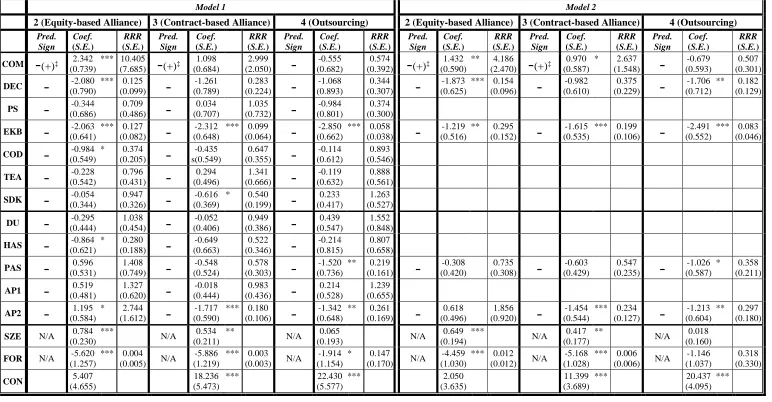
Using the 142 sample observations, we estimate a multinomial logit model (Model 1) explaining the choice between in-house, equity-based alliance, contract-based alliance, and outsourcing, with all independent variables included, and with in-house being the base alternative. The left section of Table 5 presents the results.
[INSERT TABLE 5 AROUND HERE]
Equity-based alliance
For this alternative eight variables are significant at the 10% level or better, four (EKB, COM, DEC and COD) being PSP/KBV variables and two (HAS, AP2) being TCE variables.
The coefficient of EKB is negative and significant at the 1% level, suggesting that when a firm has increasingly more complete relevant knowledge it is more likely that problem solving will be organized in-house rather than by alliance.
The coefficients of COM and DEC are both significant at the 1% level, but with different signs. The positive (negative) COM (DEC) coefficient suggests that, ceteris paribus, equity-based alliance is increasingly preferred to in-house as problem complexity increases, whilst in-house is increasingly preferred to equity-based alliance as problem non-decomposability increases.
organization is generally believed to be the most efficient mode for overcoming the appropriability problem. Notice that AP2 is also significant, but with a negative coefficient, in the estimation results relating to contract-based alliance.
The coefficients of the firm control variables are both significant at the 1% level. The positive (negative) coefficient of SZE (FOR) implies that the larger the firm size the more likely that equity-based alliance will be chosen over in-house, and that a foreign firm is less likely than a Chinese firm to choose equity-based alliance over in-house, ceteris paribus.
Contract-based Alliance
For this alternative five variables are significant at the 10% level or better, two (EKB, SDK) being PSP/KBV variables and one (AP2) being a TCE variable.
SDK is significant at the 10% level for contract-based alliance but is not significant for equity-based alliance. The RRR values indicate that a unit increase in SDK reduces the relative probability of choosing contract-based alliance and equity-based alliance (over in-house) by 46% and 5.3% respectively. Therefore, when an R&D project involves highly socially distributed knowledge, alliance in general, and contract-based alliance in particular, is less likely to be chosen over in-house. COM is not significant for contract-based alliance but is, at the 1% level, for equity-based alliance. The RRR values indicate that a unit increase in COM increases the relative probability of choosing contract-based and equity-based alliance over in-house by 199.9% and 940.5% respectively. Thus the effect of COM on contract-based alliance is both smaller and less significant than that on equity-based alliance, suggesting that the more complex the problem is the more likely that alliance will be chosen over in-house, with a preference for based alliance rather than contract-based alliance. Given that, unlike equity-based alliances, contract-equity-based alliances do not generally have access to such governance apparatus as high bandwidth communication channels, collocation of team members, and centralized administrative coordination, and that equity-based alliances are supported by enhanced incentive alignment associated with shared equity, it is reasonable to argue that of the two types of alliance, contract-based alliance is particularly unsuitable for mobilizing socially distributed knowledge, and that equity-based alliance is far more effective in dealing with a more complex problem.
results might be partially8 justified on two grounds, both pointing to a greater effectiveness of an equity-based alliance in dealing with appropriability problems. First, equity-based alliances are supported by shared ownership, helping to moderate opportunistic inclinations of participating parties. Second, the administrative structure that comes with shared ownership also furnishes an equity-based alliance with enhanced administrative controls over unintended leakage of appropriable knowledge. The coefficients of the firm control variables are again significant, with the same signs as for the alternative of equity-based alliance, suggesting that changes in firm size and firm origin have similar effects on both types of alliance.
Outsourcing
For this alternative four variables are significant at the 10% level or better, one (EKB) being a PSP/KBV variable and two (PAS, AP2) being TCE variables. Seemingly, transaction cost considerations play a more decisive role for the choice of outsourcing than for the other alternatives.
The coefficient of EKB is again negative and significant at the 1% level, suggesting that a higher level of existing knowledge base favours the choice of in-house over outsourcing. The negative coefficients of PAS and AP2 suggest that as the physical assets invested to support an R&D project become more specific, and that as the relevant knowledge becomes more appropriable, it is more likely that the project will be organized internally rather than by outsourcing.
In summary the model performs fairly well, with the overall ‘hit rate’ of 73.2% being considerably higher than that of random prediction, 25%, and that implied by assigning all observations to the most common alternative, 43.96%. However, the poor ‘hit rate’ of 37.5% for the alternative of equity-based alliance should be noted9.
Intuition suggests that the two types of alliance should not be combined given that the coefficients of AP2 are of different signs, and that a higher COM value favours the choice of both types of alliances over in-house, but with the increased probability going mostly to equity-based alliance. A more formal approach is to test for the equality of all elements of vectors βi and βj, excepting the constant, to determine whether categories
i and j can be combined. Thus fourteen restrictions are required if the two types of alliances are to be combined. Two test statistics are readily available to test these
8 The positive AP2 coefficient for equity-based alliance is, however, inconsistent with theory
and difficult to rationalise.
9 The hit rates for the alternatives of in-house, contract-based alliance and outsourcing are
restrictions. A likelihood ratio test, χ2(14) = 21.23, has a p value of 0.096, and a Wald statistic, χ2(14) = 33.29, has a p value of 0.003, implying the null can be rejected at the 10% and 1% significance levels respectively. On balance. the evidence is against the combining of the two types of alliance.
Although deleting variables is not generally encouraged (Hausman & McFadden, 1984; Jeremy & Long, 2001), given the small sample size of the study (Hosmer et al., 2013; Vittinghoff and McCulloch, 2007) it seems worth considering some simplification. Here we consider removing a variable from the model if the statistic for the null of three zero coefficients for the variable has a p value above 0.20. The variables PS, COD, TEA, SDK, DU, HAS and AP1 are identified by this procedure, with a statistic for their joint removal (21 zero coefficients) being χ2(21) = 8.55. The p value of 0.286 implies that the restrictions cannot be rejected at conventional significance levels. Removal of these variables leads to the estimation results in the right hand section of Table 5 (Model 2). Note that the ‘hit rate’10 is almost as good as that of Model 1 and that the effects of the remaining variables are structurally similar to those of Model 1 in that, with few exceptions11, significance levels are rather stable. In other words, the results concerning the few surviving variables seem to be robust across the two specifications.
4.2 Predicted Probabilities and Marginal effects
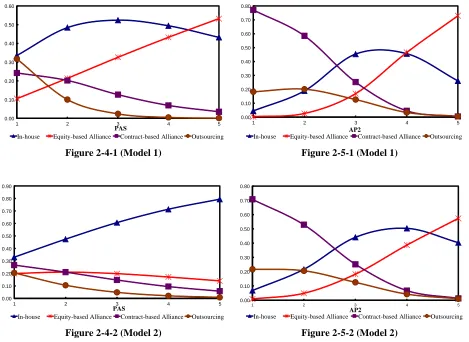
The above discussion considers probabilities relative to the base alternative of in-house so that is not clear how the absolute probabilities of the four alternatives are affected by the change of variables. However, it is a straightforward exercise to calculate the predicted probabilities for each alternative at different values of the explanatory variables, as in Figure 2. For example, sub-figures 2-1-1 and 2-1-2 show how the four probabilities change as COM varies from one to five in Model 1 and Model 2 respectively, with the other variables at their sample means. The other sub-figures are similarly constructed12.
[INSERT FIGURE 2 AROUND HERE]
Both sub-figure 2-1-1 and 2-1-2 suggest that the probability of equity-based alliance is more sensitive to variation in COM than is the probability of contract-based alliance, with the first probability being substantially larger when COM equals five. Outsourcing
10 The overall ‘hit rate’ of model 2 is 71.1%, but for the alternative of equity-based alliance, the
‘hit rate’ further reduces to 29.2%. The hit rates for the alternatives of in-house, contract-based alliance and outsourcing are 88.5%, 70.6% and 69.6% respectively.
11 Most notably, COM’s coefficient for the alternative of contract-based alliance, and DEC’s
coefficient for the alternative of outsourcing are significant in Model 2, both with the anticipated sign, whilst AP2 is no longer significant for the alternative of equity-based alliance.
or in-house are more likely to be chosen for solving problems of lowest complexity and equity-based alliance is most likely for solving the most complex problems. For problem of intermediate complexity, internal organization is the first choice.
In sub-figures 2-2-1 and 2-2-2 the probability of in-house increases substantially with DEC, while the probability of equity-based alliance tends to decrease. DEC seems to have little effect on the probabilities of contract-based alliance and outsourcing. Sub-figures 2-3-1 and 2-3-2 suggest that the two types of alliance are similarly affected by variation in EKB, with an initially increasing, and finally decreasing probability. Outsourcing and in-house are the most likely alternatives at low and high EKB respectively. For intermediate values of EKB contract-based alliance is just the most likely. Therefore, when a firm is confronted with a problem for which it has little background knowledge, outsourcing is most likely to be chosen as the organization mode, whereas with a high level of background knowledge, problem solving is most likely to be organised internally.
Sub-figures 2-4-1 and 2-4-2 show that increasing PAS tends to increase the probability of in-house and decrease the probabilities of contract-based alliance and outsourcing. However, the two models differ regarding the probability of equity-based alliance, in that the probability increases substantially with PAS in Model 1 but is not at all sensitive to PAS in Model 2.
Sub-figures 2-5-1 and Figure 2-5-2 suggest that increasing AP2 tends to increase the probabilities of in-house and equity-based alliance and decrease the probabilities of contract-based alliance and outsourcing. The results support generally the view that in-house and equity-based alliance are more effective in coping with the appropriability problem than contract-based alliance or outsourcing (Oxley, 1997). However, in both sub-figures, equity-based alliance is more likely than in-house when AP2 equals five. This result is at odds with the predictions of TCE theory, wherein hierarchy is viewed as the most effective mode for dealing with the appropriability problem.
4.3 Testing the IIA Assumption
probit is very complicated for all but small J13. In fact the statistic proposed by Hausman and McFadden (1984) is frequently presented as a test of the IIA property after multinomial logit estimation. It is based on a comparison of the initial multinomial logit estimates with the estimates obtained when alternatives are removed and estimation is repeated. We conduct the test for both Models 1 and 2, with values judged by reference to the 2
(30) (2
(16)) distribution in Model 1 (2) since only 30 (16) of the full set of 45 (24) parameters are re-estimated when an alternative is removed. For both models, none of the statistics leads to rejection of IIA. This conclusion takes negative calculated values to not indicate evidence against IIA, this seemingly being standard practice in the literature 14. The related suest Hausman statistic which is guaranteed to be positive (Long and Freese, 2014), is available in STATA, and leads to the same conclusion regarding IIA.
4.4 Discussion
Complexity, Decomposability and Problem structure
The empirical results suggest that problem complexity and decomposability are important factors shaping a firm’s R&D organization choice, while the effects of problem structure are less evident.
For equity-based alliances, and for outsourcing in model 2, DEC has a significantly negative coefficient, suggesting that non-decomposable problems are more likely to be solved in-house than by equity-based alliance because, as we understand it, such problems are more effectively managed through the extensive knowledge exchange characteristic of internal organization. By contrast, the coefficient of COM is significant, and positive, for equity-based alliance (and for contract-based alliance in model 2),
13 Both multinomial logit and probit are additive random utility models wherein utility ij
U =
ij ij
V , with Vij (ij) being the deterministic (random) component of utility, and with the j which
lead to a maximum of the Uij being selected by agent i. Multinomial logit and probit differ in
the assumptions made about the distribution of ijacross i and j. As a practical matter it does
not seem possible to implement the multinomial probit with no alternative-specific variables, as here, in STATA (StataCorp, 2013), which we take to be the `industry standard’.
14 A 2
statistic ought not to be negative. Hausman and McFadden (1984: p. 1226) suggest there
suggesting, rather counterintuitively given general PSP arguments, that more complex problems are more likely to be solved by equity-based alliance than in-house.
Overall, the results are mixed. On the one hand, there is support for the PSP argument that in-house is most effective for solving non-decomposable problems (Nickerson and Zenger, 2004), and that the more hierarchical equity-based alliance is more likely to be chosen over contract-based alliance when problem complexity is high (Heiman and Nickerson 2004). On the other hand, the results reveal that COM and DEC’s effects on the probability of choosing equity-based alliance are in opposite directions, contradicting the PSP view that they are two concomitant properties of the same factor (Nickerson and Zenger, 2004). Relatedly, it is also suggested that, contrary to the general PSP prediction, equity-based alliance is even more likely to be chosen over in-house to solve a more complex problem.
A Firm’s Existing Knowledge Base
The empirical results also suggest that a firm’s existing knowledge-base is one of the most important single explanatory variables. When a firm is confronted with a problem for which it has much (little) relevant knowledge it tends to organize the problem solving in-house (by outsourcing). Between these two extremes alliances are most likely to be chosen, with the contract-based alliance being the more preferred. These findings are generally in line with the KBV and with the bulk of empirical evidence in the KBV literature (e.g., Argyres, 1996; Bigelow and Argyres, 2008; Madhok, 2002; Poppo and Zenger, 1998), which clearly indicates that a firm’s existing knowledge base has a strong independent effect on its organization choice.
Knowledge Tacitness and Social Distribution
TCE Variables
In both models 1 and 2 PAS is significant, at at least the 10% level, for the choice between in-house and outsourcing, and AP2 is also significant, at at least the 5% level, for the choice between in-house and contract-based alliance, and the choice between in-house and outsourcing. However the positive AP2 coefficient for the alternative of equity-based alliance in model 1 is at odds with theoretical prediction. Moreover, as concerns over appropriability are known to be related to the institutional environment, for which China is not known to be particularly strong, the generality of the results regarding appropriability should be cautioned.
In summary it seems fair to conclude that each theoretical perspective receives some support from our results but that PSP/KBV variables such as EKB, COM and DEC appear to be the most important in this particular sample.
5. Conclusions
This paper contributes to the PSP of the boundary determination of the firm, both theoretically and empirically. On the basis of a review of existing PSP literature it is argued that intensity of knowledge set interactions and decomposability are conceptually distinguishable and should be treated as separate variables. With reference to other closely related literature, it is also argued that a firm’s existing knowledge can be expected to be important in the organization of its problem solving activities, notwithstanding that this dimension has been relatively underexplored in the existing PSP literature.
In the empirical setting of the Chinese consumer electronics industry we examine the determinants of a firm’s organisation choice for its R&D (technological problem solving) activities. Existing knowledge base is found to be a strongly significant explanatory variable. Problem complexity and decomposability are also found to be important, with their effects not always being in the same direction. Non-decomposability tends to favour the choice of in-house while complexity tends to favour the choice of equity-based alliance. These results seemingly support the argument that complexity and decomposability should be treated as separate variables. They also suggest that, as far as the competencies of governing different types of problem solving are concerned, alliances are probably not the mediocre ‘hybrid’ modes of organization as they seem to be reserved for the most complex problems.
(Nickerson and Zenger, 2004). In fact, in the KBV and the PSP, the respective effects of existing knowledge base and problem complexity on the organization choice are two sides of the same coin. Given problem complexity, it is predicted that the larger the firm’s existing knowledge base the more likely problem solving will be organized internally. Similarly, it seems equally valid to argue that, given a firm’s existing knowledge base, the more complex the problem is the more knowledge sets will be involved and the more likely the firm will be lacking in some critical knowledge component (Coombs and Metcalfe, 2000; Grant and Baden-Fuller, 2004). In the face of choosing between in-house and alliance, it is therefore reasonable to argue that higher problem complexity tends to favour the choice of alliance rather than in-house, as an alliance enables a firm to go beyond its existing knowledge base and to access often tacit and socially embedded external complementary knowledge, thus making it better able to cope with a more complex problem in a limited time span. It should nevertheless be noted that the study is limited in that, although we estimate the relationship between organization choices and contextual characteristics (e.g. a firm’s existing knowledge bases and complexity of the problem to be solved), we are not able to estimate directly whether alliance is more efficient in accessing/creating new knowledge, or more generally, whether deviation from predicted choice leads to poorer performance, thus making the performance implications of organizational choices drawn from our analysis less convincing.
Finally, whilst some TCE variables are found to be significant for certain organization choices, the results are relatively more supportive of the PSP and the KBV than of TCE. Given that the study concerns the determinants of the firms’ R&D organization choice, the generality of this conclusion should be cautioned.
References
Acs, Z. J. and D. B. Audretsch. 1991. “R&D Firm Size and Innovative Activity,” In Acs, Z. J., and D. B. Audretsch (Eds.), Innovation and Technological Change: An International Comparison. Ann Arbor: University of Michagan Press, 1991, Argote, L. 1999. “Organizational Learning: Creating, Retaining and Transferring
Knowledge.” Kluwer Academic.
Argyres, N. 1996. “Evidence on the Role of Firm Capabilities in Vertical Integration Decisions.” Strategic Management Journal. 17(2): 129-150
Arrow, K. 1974. The Limits of Organization. New York: Norton
Atik, J. (1995). “Complex enterprises and quasi-public goods.” Journal of International Business Law. 16(1): 1-40.
Boerner, C., J. Macher, and D. Teece. 2001. “A Review and Assessment of Organizational Learning in Economic Theories.” In Dierkes, M., A. Berthoin-Antal, J. Child, I. Nonaka (Eds.), Handbook of Organizational Learning and Knowledge: 89-117. New York: Oxford University Press
Boutellier, R., O. Gassmann, and M. Zedtwitz. 2008. Managing Global Innovation: Uncovering the Secrets of Future Competitiveness (3 ed.). Berlin: Springer Brechbuhl, H. 2006. Strategic Partnering: Managing Joint Ventures and Alliances.
Hanoverm, NH: Tuck School of Business at Dartmouth
Chesbrough, H. 2003. Open Innovation: The New Imperative for Creating And Profiting from Technology. Cambridge: Harvard Business School Press
Cohen, W. and D. Levinthal. 1990. “Absorptive Capacity: A New Perspective on Learning and Innovation.” Administrative Science Quarterly. 35(1): 128-153 Conner, K. 1991. “Historical Comparison of Resource-Based Theory and Five Schools
of Thought within Industrial Organization Economics: Do We Have a New Theory of the Firm?” Journal of Management, 17(1): 121-154
Conner, K. and C. Prahalad. 1996. “A Resource-Based Theory of the Firm: Knowledge Versus Opportunism.” Organization Science 7(5): 477-501
Coombs, R. and J. Metcalfe. 2000. “Organizing for Innovation: Co-Ordinating Distributedinnovation Capabilities” In Foss, N. J., and V. Mahnke (Eds.), Competence, Governance,and Entrepreneurship: 209-231. Oxford: Oxford University Press
D'Aveni, R. and D. Ravenscraft. 1994. “Economies of Integration Versus Bureaucracy Costs: Does Vertical Integration Improve Performance?” The Academy of Management Journal, 37(5): 1167-1206
Demsetz, H. 1988. “The Theory of the Firm Revisited.” Journal of Law, Economics and Organization, 4(1): 141-161
Ethiraj, S. and D. Levinthal. 2004. “Bounded Rationality and the Search for Organizational Architecture: An Evolutionary Perspective on the Design of Organizations and Their Evolvability”. Administrative Science Quarterly. 49(3): 404-437
Fernandes, R. and H. Simon. 1999. “A study of how individuals solve complex and ill-structured problems.” Policy Sciences. 32(3): 225-245
Foss, N. 1996. “Knowledge-based Approaches to the Theory of the Firm: Some Critical Comments.” Organization Science. 7(5): 470-476
Gavetti, G. and D. Levinthal. 2000. “Looking Forward and Looking Backward: Cognitive and Experiential Search.” Administrative Science Quarterly. 45(1): 113–137
Grant, R. 2003. “The Knowledge-based View of The Firm.” In Faulkner, D. and A/ Campbell (Eds.), The Oxford Handbook of Srategy, Vol. 1: 197-221. Oxford: Oxford University Press
Grant, R. and C. Baden-Fuller. 2004. “A Knowledge Accessing Theory of Strategic Alliances.” Journal of Management Studies, 41(1): 61-84
Hausman, J. and D. McFadden. 1984. “Specification Tests for the Multinomial Logit Model.” Econometrica, 52(5): 1219-1240
Hayek, F. v. 1945. “The Use of Knowledge in Society.” American Economic Review. 35(4): 519-530
Heiman, B. and J. Nickerson. 2002. “Towards Reconciling Transaction Cost Economics and the Knowledge-based View of the Firm: The Context of Interfirm Collaborations.” International Journal of the Economics of Business, 9: 97-116
Heiman, B., J. Nickerson. 2004. “Empirical evidence regarding the tension between knowledge sharing and knowledge expropriation in collaborations.” Managerial and Decision Economics. 25(6-7): 401-420
Hippel, E. v. 1994. “‘Sticky Information’ and the Locus of Problem Solving: Implications for Innovation.” Management Science. 40(4): 429-439
Hsieh, C., J. Nickerson and T. Zenger. 2007. “Opportunity Discovery, Problem Solving and a Theory of the Entrepreneurial Firm.” Journal of Management Studies. 44(7): 1255-1277
Hoetker, G. 2007. “The use of logit and probit models in strategic management research: Critical issues.” Strategic Management Journal. 28(4): 331-343.
Hosmer, D., S. Lemeshow and R. Sturdivant. 2013. “Special Topics”. Ch. 10 in Applied Logistic Regression, 377-457, John Wiley & Sons.
Jonassen, D. 2004. Learning to Solve Problems: An Instructional Design Guide. San Francisco, CA: Pfeiffer/Jossey-Bass
Kauffman, S. 1993. The Origins of Order: Self-Organization and Selection in Evolution. Oxford: Oxford University Press
Kay, N. 1997. Pattern in Corporate Evolution. Oxford: Oxford University Press Kogut, B. 1988. “Joint ventures: Theoretical and empirical perspectives.” Strategic
Management Journal. 9: 319-332
Kogut, B. and U. Zander. 1992. “Knowledge of the Firm, Combinative Capabilities, and the Replication of Technology.” Organization Science. 3(3): 383-397 Kogut, B. and U. Zander. 1993. “Knowledge of the Firm and the Evolutionary Theory
of the Multinational Corporation.” Journal of International Business Studies. 24(4): 625-645