Joining forces in manufacturing value chains for
collaborative R&D and innovation: An SME perspective
Aylin Ates ([email protected])
Strathclyde Business School, University of Strathclyde, Glasgow, UK
Abstract
This paper presents a multiple case study research, which aims to develop a better understanding into how policy makers can facilitate acceleration of R&D and innovation in manufacturing SMEs. The results demonstrate that low perception of value of R&D projects, risk of failure and a lack of networking are identified as the key barriers. The research results suggest that a low perception of value of R&D and innovation is largely a symptom of those barriers. In order to overcome these barriers, manufacturing SMEs need support to access to the customer needs, de-risk R&D and innovation projects and be informed about available funding through simplified communication mechanisms.
Keywords: Innovation, R&D management, High value manufacturing
Introduction
In recent years, the UK economy has seen a shift from outsourcing and offshoring trends to bringing manufacturing back to the UK. While approximately 22% of Germany’s output is linked to manufacturing, it is only about 10% in the UK (House of Commons UK, 2015). In order to rebalance the economy and sustain this trend, the manufacturing sector needs to innovate and differentiate their products and services continuously. Technologies continuously evolve and are superseded by new emerging technologies. This trend suggests that investing into skills development, technological innovation and game changing R&D to design, make and deliver more sophisticated products and services are necessary (BIS, 2015). It has been projected that reshoring a new group of goods and services to the UK could potentially create 100-200,000 extra UK jobs while increasing the UK GDP by 0.4-0.8% (equivalent to £6-12 billion added to the economy) by the mid-2020s (BIS, 2015; PWC, 2014).
elements and key stakeholders in the right ways at the right time is a difficult task for policy makers (Spanos, Vonortas, & Voudouris, 2015; Hoffman, Parejo, Bessant, & Perren, 1998).
Current research highlight that the R&D function can be outsourced from a large firm to contractors to subcontracting SMEs. Alternatively, collaborative R&D can be implemented through open innovation ecosystems in various industries both in high and low tech industries, service and manufacturing sectors (Chesbrough, 2003; Chesbrough & Crowther, 2006; Chesbrough, Kim, & Agogino, 2014). This may suggest that UK SMEs can co-create value and win business if they collaborate, innovate and invest into R&D to be able to compete with global value chains. However, there is a gap in knowledge regarding a better understanding of the context, barriers, boundary conditions, and critical success factors for accelerated innovation and R&D in smaller firms (Chesbrough, 2012). Therefore, this study intends to fill this gap in literature by investigating the following research objective: what are the barriers and drivers for enhanced collaborative R&D and innovation in manufacturing SMEs? By addressing this objective, this research aims to shed lights on what makes innovation and R&D more feasible and meaningful for manufacturing SMEs while joining forces in the value chains to create high value. This paper proceeds by (a) reviewing existing literature in mainstream SME innovation and R&D management research from academic journal databases and policy reports (a) carrying out a comparative benchmarking analysis between UK and other competing nations, (c) conducting empirical work by collecting data from a sample of manufacturing companies within UK’s metals industry, (d) presenting the findings and (e) making contributions to the fields of value chains and innovation.
Literature Review
Driven by shortening of product life cycles, increased global competition and rapid technological developments in the new digital age, companies must accelerate their R&D and innovation capabilities to stay competitive (Belderbos, 2003; Francis & Bessant, 2005). However, while there have been increasing numbers of practitioner-based measures, rankings and innovation indexes, they often remain disconnected from the academic research (Crossan & Apaydin, 2010). The terms innovation, research, R&D, and New Product Development (NPD) are often used interchangeably and as a substitute for creativity, new knowledge, incremental or step change. It is not clear which concepts deal with a company-wide focus on new product generation and bold actions that bring step change to the firm and society (Reid, Roberts, & Moore, 2015; Calantone, Harmancioglu, & Droge, 2010). Consequently, there seems to a confusion among practitioners regarding the terminology, meanings, expectations, required investment, payback periods and timelines (Harmancioglu, Droge, & Calantone, 2009; Andrew, Sirkin, & Butman, 2006).
development of new methods of production; and establishment of new management systems. It is both a process and an outcome. Innovation is more than a creative process and includes application and exploitation. It emphasizes intended benefits such as value-added across different business areas with a commercial focus.
Although Schumpeter clearly positioned the definition of innovation within the realm of the firm and outlined its extent as product, process, and business model, there are continuing debates over various aspects of invention such as its essentiality and adequacy, intentionality, useful nature, successful application and diffusion to qualify as innovation (Hobday, 2005; Klein & Knight, 2005; Pittaway, Robertson, Munir, Denyer, & Neely, 2004; Camison-Zornoza, Lapiedra-Alcami, Segarra-Cipres, & Boronat-Navarro, 2004; Holland, 1997). On the other hand, considering innovation as an organizational capability within the boundaries of the firm is challenged by influential academic researchers as can be seen in the open innovation paradigm (Chesbrough, 2004; Chesbrough & Rosenbloom, 2002; Chesbrough, 2003a; Chesbrough & Teece, 1996). Open innovation as a concept was first introduced by Henry Chesbrough and has created a new way of thinking about the innovation capabilities which are practiced not only within the boundaries of the firm (Chesbrough, 2012). Instead, open innovation practices are seen to be extended to include activity networks of suppliers, customers, partners, large and small businesses, universities, innovation centers, third parties, and society.
A review of SME and manufacturing value chain perspective
Today’s organizations are increasingly competing on the basis of ‘supply chain versus supply chain’ rather than ‘firm versus firm’ (Shi & Yu, 2013; Ketchen, Rebarick, Hutt, & Meyer, 2008). Within this context, ‘best value supply chains’ are emerging as a means to create competitive advantage and superior performance (Ketchen & Hult, 2007; Boyer & Hult, 2005). An emphasis on strategic supply chain management does not necessarily entail a need to use cutting-edge and expensive equipment, nor to accentuate strong teamwork at all stages in the chain. Instead, the essential focus is on matching the chain’s approach to multiple competing priorities of agility, adaptability and alignment (Lee, 2004). In high value supply chains, total value across speed, quality, cost and flexibility is considered rather than only transactional costs (Morrow, Sirmon, Hitt, & Holcomb, 2007).
markets.
For example, the Automotive Council in the UK has identified some £2.5bn of metals-related content out of a total of £5bn of opportunities for UK suppliers, which is based on reshoring demand to achieve an average of 60% local content. In order to exploit supply opportunities particularly within the next generation innovative product value chains, the Automotive Council suggests three distinct modes of improvement areas where UK value chains show shortfalls (Davies et al., 2014):
• There is no qualified and dependable source available in the UK. Rectifying this deficiency would require enticing domestic or foreign suppliers to invest in the UK to build, or in the case of electronics, to rebuild this capability.
• There is insufficient capacity at existing UK suppliers. Rectifying this gap would require additional investment into existing UK suppliers, and in turn, access to finance to invest in additional capacity.
• UK suppliers are available, but lack the technical capability to win this business. Rectifying this gap would require both additional investment into existing UK suppliers, as well as skill development in terms of manufacturing process technology.
The automotive industry has embarked on a set of actions to engage with potential local suppliers and SMEs and appears keen to see a greater proportion of its future supplies coming from UK-based suppliers (BIS, 2015). In order to achieve this, a particular category of innovation support will be required for SME organizations who are considering a major change in their manufacturing methods, materials or design methodology to meet future market challenges and OEM needs. This particular SME innovation support needs to include collaborative R&D in the value chains as well as SME focused support mechanisms (Spanos et al., 2015; Raymond & St-Pierre, 2010; Shefer & Frenkel, 2005; Carayannis, Alexander, & Ioannidis, 2000; Staropoli, 1998).
A review of UK innovation performance
The manufacturing sector is vital to the UK’s financial stability and its continued growth is important to building a balanced and competitive economy (Hoffman et al., 1998). The manufacturing industry adds £6.7 trillion to the global economy and directly employs 2.6 million people in the UK. Manufacturing accounts for 54% of all UK exports making the UK the 11th largest goods exporter in the world. The manufacturing industry as a whole accounts for 72% of R&D expenditure and manufacturing output accounts for 11% of total UK GVA (Gross Value Added).
to commercialize, a number of new ‘intermediate sector’ organizations such as Catapults (www.catapult.org.uk) are set up to focus on working closely with businesses in the areas of translational research and commercialization of new technologies born in British universities.
[image:5.595.137.460.266.443.2]Studies have found evidence of a complex positive relationship in which innovation, R&D and exporting are mutually reinforcing (BIS, 2011). In 2013, goods account for 63% of UK total exports, however they account for 86% of South Korea’s exports, 77% of French exports, 83% of German exports, 88% of Japanese exports, and 94% of Chinese exports which has emerged as a leading export country from a zero export country in the 80s. The country comparisons are presented in Figure 1 based on the data available through The World Bank Metadata Database (World Bank Group, 2015).
Figure 1 – Manufacturing exports (% of merchandise exports)
Gross Expenditure on R&D (GERD) is a measure which represents a percentage of the GDP. The UK shows a lower R&D expenditure compared to the competing nations as can be seen in the Figure 2 (World Bank Group, 2015). Due to the size of the UK, it is unlikely that it will be among the top spenders in absolute terms; however there is a slight paradox as South Korea is one of the global leaders in R&D intensity and it is smaller than the UK in both geographic size and population.
Figure 2 – Total GERD as % of GDP (2011)
(Private and 3rd sector GERD) = (Total R&D expenditure) – (Government financed GERD)
Methodology
Due to the exploratory nature of enquiry, a qualitative research design, involving multiple case studies, was adopted (Yin, 2012; Eisenhardt, 1989). The unit of analysis is the company rather than any specific R&D or innovation project examples as this research aims to understand the overall context of where R&D and innovation is practiced rather than the process itself.
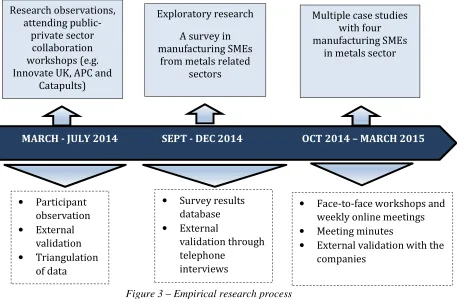
The first phase of this research includes participant observations and attending expert workshops at government level and led by industry (Figure 3). The second phase involved an exploratory survey questionnaire. The sampling frame for the survey study was derived from a database of contacts of two research partners. These two innovation centers are part of UK government’s High Value Manufacturing Catapult. The survey questionnaire was developed online and the survey link sent to the companies by email. 413 members and 97 companies were invited to respond to the survey during October 2014. 45 usable questionnaires were returned representing a response rate of 11%, which was satisfactory, given the seniority of the respondents and the confidentiality and complexity of the questionnaire related to R&D and innovation projects.
The distribution of the responses in terms of size are as follows: SMEs (47%) and large companies (53%) which represents a balanced sample. The companies are suppliers to various metals related manufacturing sectors in the UK (e.g. aerospace, energy and automotive). The survey instrument was implemented online and included Yes/No type of questions as well as allowing free text entry. This approach was considered to be more favorable due to the exploratory nature of the research.
Figure 3 – Empirical research process
The third phase of the empirical research included seven online meetings with four manufacturing SMEs, which were conducted on a weekly basis. The online meetings focused on discussing the results of the survey and identifying the R&D and innovation needs of companies more in depth. A consolidating workshop was organized in order to integrate meeting discussions in a facilitated environment. The key findings will be discussed in order to better understand how R&D and innovation can be effectively accelerated in manufacturing SMEs.
Results
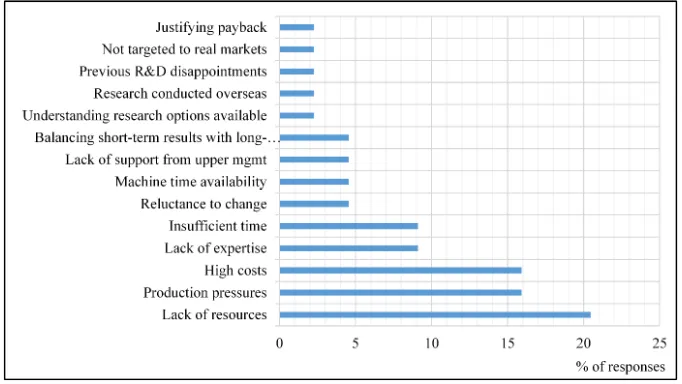
The online survey asked free text based questions to managers to identify their company’s key issues regarding R&D and innovation. There were a number of issues identified (see Figure 4) such as production pressures, lack of investment, lack of a robust business case and lack of awareness generally. These issues are echoed in the following quotes:
We are a sub-contractor so don’t hold the IP for design of product. Process Change Innovation is hampered by cost and time to implement changes in our industry. We also have a lack of skills in the engineering team with an increase in salaries.
Balancing day to day operations with development activity is not easy. Payback on development projects is an issue for us. Insufficient time to carry out R&D due to production pressures and capacity constraints.
No clear benefits of some innovation activities, understanding the practicalities and when we would see the benefits.
We haven’t looked beyond customer specifications to see what else we could offer, or how to use our manufacturing processes differently.
Although the firms are experiencing difficulties in dedicating time between short and
MARCH - JULY 2014 SEPT - DEC 2014 OCT 2014 – MARCH 2015
Research observations, attending
public-private sector collaboration workshops (e.g. Innovate UK, APC and
Catapults)
Exploratory research
A survey in manufacturing SMEs
from metals related sectors
Multiple case studies with four manufacturing SMEs
in metals sector
• Participant
observation
• External
validation
• Triangulation
of data
• Survey results
database
• External
validation through telephone
interviews
• Face-to-face workshops and
weekly online meetings
• Meeting minutes
• External validation with the
long term business targets, our data shows that R&D and innovation is seen as important with 80% of respondents indicating that R&D and innovation is in their company’s board agenda. Moreover, the investment in R&D and innovation is generally less than 1% in the sample. In order to better understand the resource allocation and strategic commitment towards more R&D and innovation, the survey included a section on whether the company had an R&D and innovation strategy: 63% of the respondents said ‘Yes’ and 37% said ‘No’. 42% of the respondents said they had an on-site R&D and innovation facility while 58% said they did not have any. For the suppliers that are part of a larger corporate organization, 29% of them had a centralized R&D and Innovation facility whereas 71% did not have any R&D facility neither in the UK nor abroad.
Figure 4 – Key barriers for R&D and innovation
Furthermore, this study found that management teams in the companies investigated had various experiences regarding developing strategies for R&D and innovation. Some companies integrated new product development, process/ method development and digital innovation as part of their strategic plans. On the other hand, some companies focused their strategic plans around small incremental changes in quality, cost and delivery, as evidenced by the following quotations:
We plan to be an innovative supplier who have a process to add value to customer requirements. 5 year strategic plan is under development. Also a 30 year vision being worked on, with emphasis on value added differentiated products.
There is a strategic plan which involves engineers’ discussions for the next generation product requirements with designers. The engineers then ensure that they match the manufacturing capability to the new design requirements to ensure that the manufacturing capability is in line with this new requirement.
Unaware of the details, other than looking at alternative manufacturing processes and materials to be used for future wind turbine shaft and hub components, as turbines get larger there will need to be a step change in design and process.
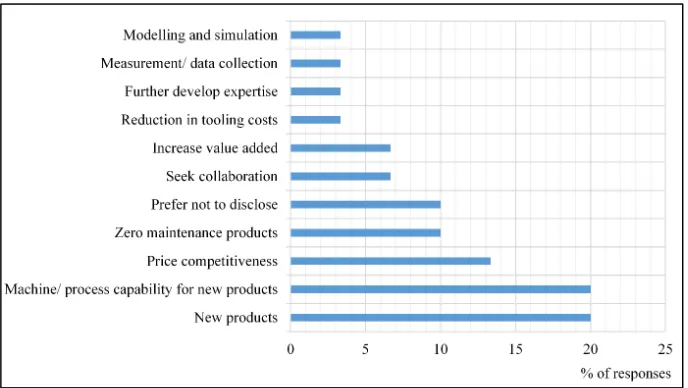
Figure 5 – Focus of current R&D and innovation projects
It is evident that innovation activities are mainly customer driven activities and there is a lack of collaboration culture with external partners. There is also a stronger focus on short term innovation activities rather than step change innovation since they contribute to bottom line and profitability.
If we participate in collaborative ventures - how do we protect our know-how? We have finite resources and it is a fine balance between cost and benefit. Lack of awareness of what support is available from government…too complicated and variable.
On the other hand, 40% of the survey participants stated that they had been involved in some sort of R&D and innovation partnerships or collaborations in the past. They had varying views regarding whether these collaborative R&D and innovation activities were successful or not. Main reasons were a lack of understanding of the real issues and challenges facing industry and lack of financial evaluation. The issues related to past experiences are reflected in the following comments:
10 years ago the company was very proactive in collaborating with universities through PhD students and there was some success. However, the focus on short term results has meant that this activity has dwindled.
We worked with local universities but found that their outcomes were more theory based than practical; they are measured on publications whereas we need better margins/ more volume.
Conclusion
Although it is widely recognized that UK value chain companies and SMEs must innovate to be competitive in a global market, this study addressed a gap in knowledge regarding a better understanding of the context, barriers, and enablers to make accelerated innovation and R&D meaningful for those companies. This research concludes that UK companies invest less in R&D activity than those in major industrial nations, with 1.7% GDP invested in R&D in the UK compared with France at 2.3%, Germany at 2.9% and South Korea’s 4.4%. Much of the innovation activity has a somewhat narrow view, focused on incremental improvement (of product and process) as opposed to targeting step-change or breakthrough developments.
Firstly, surveys, workshops, interviews and discussions with SMEs have identified a low tolerance for failure with little headroom for speculative activity. Even where investment does take place, this is often sub-critical collaborative activity due to uncertainty of open innovation, protection of know-how and fear of sharing. Secondly, the landscape in terms of publically funded support is unclear to SMEs, with respect to both what is available, how to make it work, and the differences between regions. SMEs perceive that it is difficult to access OEMs to develop innovative solutions. Informing the local value chains of the future direction of large OEMs would be beneficial so suppliers/ SMEs can start to think of innovation areas that align with potential customer needs. There is also a view that larger companies are more competent at securing government funding for R&D and innovation projects but there is little trickle down to the value chain. This research highlighted that SMEs have issues around how to build a consortium to attract external R&D and innovation funding. A perceived low value of R&D and innovation among SMEs is largely a symptom of those points as described above.
Consequently, this study concludes that UK manufacturing SMEs require: (1) access to customer/OEM needs - a clearer view of the potential customers and their needs, manufacturing issues in order to identify how they can best innovate to improve their operations, (2) de-risking R&D and innovation - pooling resources and developing a more networked approach to innovation, (3) learning from other sectors both in the UK and abroad– cross sector collaboration and technology transfer through linking companies together which have common interests but not directly competing, and (4) simplified communication – R&D support in terms of expertise, financial support, tax credits and equipment to accelerate innovation should be better communicated.
While this study provides useful contributions into understanding barriers and drivers for R&D and innovation in the UK manufacturing value chains, its limitations should also be acknowledged. This study used a literature review and a survey and multiple case study method for exploratory purposes. It is recognized that the sample is limited and cannot be described as representative for the whole UK manufacturing value chains and SMEs. Hence, it is recognized that extending this study through the usage of a large scale survey using more sophisticated quantitative data analysis methods and/ or supplementing it through more in-depth qualitative methods such as further interviews would represent an area for future enquiry; this may also generate richer, crisper and more definitive results.
References