LASER DRIVEN NUCLEAR PHYSICS AT ELI–NP
F. NEGOITA1,*, M. ROTH2, P.G. THIROLF3, S. TUDISCO4, F. HANNACHI5, S. MOUSTAIZIS6, I. POMERANTZ7 , P. MCKENNA8, J. FUCHS9, K. SPHOR10, G. ACBAS1, A. ANZALONE4, P. AUDEBERT9, S. BALASCUTA1, F. CAPPUZZELLO4,11, M.O. CERNAIANU1, S. CHEN9,
I. DANCUS1, R. FREEMAN12, H. GEISSEL13, P. GHENUCHE1, L. GIZZI14, F. GOBET5, G. GOSSELIN15, M. GUGIU1, D. HIGGINSON9, E. D’HUMIÈRES16, C. IVAN1, D. JAROSZYNSKI8, S. KAR17, L. LAMIA4,11, V. LECA1, L. NEAGU1, G. LANZALONE4,18,
V. MÉOT15, S.R. MIRFAYZI17, I.O. MITU1, P. MOREL15, C. MURPHY19, C. PETCU1, H. PETRASCU21, C. PETRONE21, P. RACZKA20, M. RISCA1, F. ROTARU1, J.J. SANTOS16,
D. SCHUMACHER12, D. STUTMAN1, M. TARISIEN5, M. TATARU1, B. TATULEA1, I.C.E. TURCU1, M. VERSTEEGEN5, D. URSESCU1, S. GALES1, N.V. ZAMFIR1 1 ELI-NP, “Horia Hulubei” Institute for Physics and Nuclear Engineering, 30 Reactorului Street,
RO-077125 Bucharest-Magurele, Romania
2 Institut fur Kernphysik, Technische Universitat Darmstadt, Schloßgartenstrasse 9, D-64289 Darmstadt, Germany
3 Ludwig-Maximilians-Universität Munich, D-85748 Garching, Germany 4 INFN - Laboratori Nazionali del Sud – Via S. Sofia 62, 95123 Catania, Italy
5 Centre d’Etudes Nucleaires de Bordeaux Gradignan, Universite Bordeaux1, CNRS-IN2P3, Route du solarium, 33175 Gradignan, France
6 Technical University of Crete, Chania, Crete, Greece 7 Tel Aviv University, P.O. Box 39040, Tel Aviv 6997801, Israel 8 Department of Physics, University of Strathclyde, Glasgow, G4 0NG, UK
9 Laboratoire pour l'Utilisation des Lasers Intenses, UMR 7605 CNRS-CEA-École Polytechnique-Université Paris VI, 91128 Palaiseau, France
10 University of the West of Scotland, Paisley, PA1 2BE Scotland, UK
11 Dip. di Fisica e Astronomia, Univ. degli Studi di Catania – Via S. Sofia 64, 95123 Catania, Italy 12 Department of Physics, The Ohio State University, 191 West Woodruff Avenue, Columbus, Ohio
43210, USA
13 Justus-Liebig-University Giessen, Ludwigstrasse 23, 35390 Giessen, Germany 14 Istituto Nazionale di Ottica - UOS, Area della Ricerca del CNR, Via G. Moruzzi 1 - 56124 Pisa,
Italy
15 Commissariat à l’énergie atomique, Service de Physique Nucléaire Boite Postale 12, F-91680 Bruyères-le-Châtel, France
16 CELIA, Université Bordeaux1, 351 Cours de la Libération, F-33405 Talence cedex, France 17 School of Mathematics and Physics, The Queen’s University of Belfast, Belfast BT7 1NN, UK
18 Università degli Studi di Enna “Kore” – Via delle Olimpiadi, 94100 Enna, Italy 19 Department of Physics, University of York, York YO10 5D, UK
20 Institute of Plasma Physics and Laser Microfusion, Hery Street 23, 01-497 Warsaw, Poland 21 “Horia Hulubei” Institute for Physics and Nuclear Engineering, 30 Reactorului Street, RO-077125
Bucharest-Magurele, Romania
Abstract. High power lasers have proven being capable to produce high energy γ-rays, charged particles and neutrons, and to induce all kinds of nuclear reactions. At ELI, the studies with high power lasers will enter for the first time into new domains of power and intensities: 10 PW and 1023 W/cm2. While the development of laser based radiation sources is the main focus at the Beamlines pillar of ELI, at ELI-NP the studies that will benefit from High Power Laser System pulses will focus on Laser Driven Nuclear Physics (this TDR, acronym LDNP, associated to the E1 experimental area), High Field Physics and QED (associated to the E6 area) and fundamental research opened by the unique combination of the two 10 PW laser pulses with a gamma beam provided by the Gamma Beam System (associated to E7 area). The scientific case of the LDNP TDR encompasses studies of laser induced nuclear reactions, aiming for a better understanding of nuclear properties, of nuclear reaction rates in laser-plasmas, as well as on the development of radiation source characterization methods based on nuclear techniques. As an example of proposed studies: the promise of achieving solid-state density bunches of (very) heavy ions accelerated to about 10 MeV/nucleon through the RPA mechanism will be exploited to produce highly astrophysical relevant neutron rich nuclei around the N~126 waiting point, using the sequential fission-fusion scheme, complementary to any other existing or planned method of producing radioactive nuclei.
The studies will be implemented predominantly in the E1 area of ELI-NP. However, many of them can be, in a first stage, performed in the E5 and/or E4 areas, where higher repetition laser pulses are available, while the harsh X-ray and electromagnetic pulse (EMP) environments are less damaging compared to E1.
A number of options are discussed through the document, having an important impact on the budget and needed resources. Depending on the TDR review and subsequent project decisions, they may be taken into account for space reservation, while their detailed design and implementation will be postponed.
The present TDR is the result of contributions from several institutions engaged in nuclear physics and high power laser research. A significant part of the proposed equipment can be designed, and afterwards can be built, only in close collaboration with (or subcontracting to) some of these institutions. A Memorandum of Understanding (MOU) is currently under preparation with each of these key partners as well as with others that are interested to participate in the design or in the future experimental program.
Key words: high-power laser interaction, laser particle acceleration, nuclear excitation in plasma, nuclear reactions in plasma, laser driven neutron generation
1. INTRODUCTION
The present Technical Design Report (TDR) is rather meant as an advanced conceptual design report, similar to all the other TDRs for experiments prepared at this stage within the Extreme Light Infrastructure – Nuclear Physics (ELI-NP) project, for the purpose of evaluation of feasibility and overall project coherence before going into detailed design of experimental devices.
- 10 PW with a repetition rate of 1 pulse per minute or higher - 1 PW with a repetition rate of 1 Hz
- 100 TW with a repetition rate of 10 Hz
All outputs are expected to have their central wavelength at approximately 800 nm, a pulse duration of about 25 fs (if larger, the energy per pulse will be increased to reach the specified power), a pre-pulse contrast of 1:1012 and a Strehl
ratio of 0.7.
At present there are two major laser systems operational or under construction that deliver intense pulses of laser light, the National Ignition Facility (NIF) at the Lawrence Livermore National Laboratory (LLNL) in the US and the Laser Megajoule (LMJ) in France. Both laser systems are dedicated to the compression and heating of matter using energies up to the megajoule range to explore exotic states of matter, perform classified research for defense applications and ignite a burning fusion capsule for energy research. In contrast, ELI-NP not only is a pure civilian facility for fundamental research only, but also exceeds the capabilities of both laser systems in terms of beam intensity by orders of magnitude. Currently NIF is augmented with the addition of a short pulse laser system (ARC, Advanced Radiography Capability). The design goal of this system is kJ in energy delivered in picosecond pulse duration, resulting in a PW class laser power. However, as this system is attached to NIF and suffers from limitations in
focusing, the maximum intensity achievable will be of the order of 1019-1020 W/cm2, about three orders of magnitude below the design goal of
ELI-NP. ELI-NP therefore complements the large systems, as it exchanges energy for intensity to explore novel aspects of nuclear phenomena not accessible by the other systems.
2. PHYSICS CASES
2.1 NUCLEAR FUSION REACTIONS FROM LASER-ACCELERATED FISSILE ION BEAMS
capture process (s-process) along the valley of stability leading to about half of the heavier nuclei (red arrow) and the rapid neutron capture process (r-process). The astrophysical site of the r-process nucleosynthesis is still under debate: it may be cataclysmic core collapse supernovae (II) explosions with neutrino winds [1-4] or mergers of neutron-star binaries [5-7]. For the heavier elements beyond barium, the isotopic abundances are always very similar (called universality) and the process seems to be very robust. Perhaps also the recycling of fission fragments from the end of the r-process strengthens this stability. Presently, it seems more likely that a merger of neutron star binaries is the source for the heavier r-process branch, while core collapsing supernova explosions contribute to the lighter elements below barium.
Figure 1 – Chart of the nuclides indicating various pathways for astrophysical nucleosynthesis: thermonuclear fusion reactions in stars (orange vector), s-process path (red vector) and the r-process
generating heavy nuclei in the Universe (red pathway). The nuclei marked in black indicate stable nuclei. For the green nuclei some nuclear properties are known, while the yellow, yet unexplored regions extend to the neutron and proton drip lines. The blue line connects nuclei with the same neutron/proton ratio as for (almost) stable actinide nuclei. On this line the maximum yield of nuclei produced via fission-fusion (without neutron evaporation) will be located. The elliptical contour lines correspond to the expected maximum fission-fusion cross sections decreased to 50%, 10% and 0.1%,
respectively, for primary 232Th beams.
The modern nuclear equations of state, neutrino interactions and recent supernova explosion simulations [2] lead to detailed discussions of the waiting point N=126. Here measured nuclear properties along the N=126 waiting point may help to clarify the sites of the r-process.
Fig. 2 shows the measured solar elemental abundances of the r-process nuclei together with a theoretical calculation, where masses from the Extended Thomas-Fermi plus Strutinski Integral (ETFSI) mass model [8] have been used together with several neutron flux components, characterized by a temperature T9, neutron
assumed in the nuclear mass calculations to achieve a better agreement between observed and calculated abundances. The three pronounced peaks visible in the abundance distribution seem to be of different origin, which is also reflected in the theoretical calculations shown in Fig. 2, where contributions from different temperatures and neutron densities are superimposed to the observed data. We note the pronounced third peak in the abundance distribution around A = 180−200, corresponding to the group of elements around gold, platinum and osmium, where until now no experimental nuclear properties have been measured for r-process nuclei. Several astrophysical scenarios try to explain this third abundance peak.
Figure 2 – Observed elemental solar abundances in the r-process mass range (black symbols) in comparison with calculated abundances (red line and symbols), normalized to silicon=106. The theoretical predictions show the elemental abundances for stable isotopes after α and β decay as obtained in the ETFSI-Q mass model [8,10] for a wide range of neutron densities nn (in 1/cm3) and temperatures T9 (in units of 109K) and including shell quenching effects. Included with permission
from [11].
around the N=126 waiting point will represent an important step forward in solving the difficult and yet confusing site selection of the third abundance peak of the r-process.
The key bottleneck nuclei of the N=126 waiting point around Z~70 are about 15 neutrons away from presently known nuclei (see Fig. 1), with a typical drop of the production cross section for classical radioactive beam production schemes of about a factor of 10-20 for each additional neutron towards more neutron-rich isotopes. Thus presently nothing is known about these nuclei and even next-generation large-scale ’conventional’ radioactive beam facilities like FAIR [12], SPIRAL II [13] or FRIB [14] will hardly be able to grant experimental access to the most important isotopes on the r-process path. The third peak in the abundance curve of r-process nuclei is due to the N = 126 waiting point as visible in Fig. 1. These nuclei are expected to have rather long half-lives of a few 100 ms. This waiting point represents the bottleneck for the nucleosynthesis of heavy elements up to the actinides. From the view point of astrophysics, it is the last region, where the r-process path gets close to the valley of stability and thus can be studied with the new isotopic production scheme discussed below. While the waiting point nuclei at N = 50 and N = 82 have been studied rather extensively [15, 16, 17, 18], nothing is known experimentally about the nuclear properties of waiting point nuclei at the N=126 magic number. Nuclear properties to be studied here are nuclear masses, lifetimes, beta-delayed neutron emission probabilities Pn and the
underlying nuclear structure. If we improve our experimental understanding of this final bottleneck to the actinides at N=126, many new visions open up: (i) for many mass formulas (e.g. [19]), there is a branch of the r-process leading to extremely long-lived superheavy elements beyond Z=110 with lifetimes of about 109 years. If
these predictions could be made more accurate, a search for these superheavy elements in nature would become more promising. (ii) At present the prediction for the formation of uranium and thorium elements in the r-process is rather difficult, because there are no nearby magic numbers and those nuclei are formed during a fast passage of the nuclidic area between shells. Such predictions could be improved, if the bottleneck of actinide formation would be more reliably known. (iii) Also the question could be clarified if fission fragments are recycled in many r-process loops or if only a small fraction is reprocessed.
This description of our present understanding of the r-process underlines the importance of the present project for nuclear physics and, particularly, for astrophysics.
2.1.1 RPA for heavy ions
generation and leads to the interaction dominated by the radiation pressure [20, 21]. It has been shown that RPA operates in two modes. In the first one, called ’hole-boring’, the laser pulses interact with targets thick enough to allow to drive target material ahead of it as a piston, but without interacting with the target rear surface [20]. The first experimental observation of RPA in the ’hole-boring’ regime was achieved in experiments led by the Munich group [25, 26]. The RPA laser ion acceleration mechanism in general provides the highest achievable efficiency for the conversion from laser energy to ion energy and for circularly polarized laser light RPA holds promise of quasi-monoenergetic ion beams. Due to the circular polarization, electron heating is strongly suppressed. The electrons are compressed to a dense electron sheet in front of the laser pulse, which then via the Coulomb field accelerates the ions. This mechanism requires very thin targets and ultra-high contrast laser pulses to avoid the pre-heating and expansion of the target before the interaction with the main laser pulse. The RPA mechanism allows to produce ion bunches with solid-state density (1022 - 1023/cm3), which thus are ~1014 times
denser than ion bunches from classical accelerators. Correspondingly, the areal densities of these bunches are ~107 times larger. It is important to note that these
ion bunches are accelerated as neutral ensembles together with the accompanying electrons and thus do not Coulomb explode.
2.1.2 Stopping power of very dense ion bunches
In nuclear physics, the Bethe-Bloch formula [27] is used to calculate the atomic stopping of energetic individual electrons [28] by ionization and atomic excitation. For relativistic electrons, the other important energy loss is bremsstrahlung. The radiation loss is dominant for high energy electrons, e.g. E≥ 100 MeV and Z=10. If, however (see below), the atomic stopping becomes orders of magnitude larger by collective effects, the radiation loss can be neglected. For laser acceleration, the electron and ion bunch densities reach solid state densities, which are about 14-15 orders of magnitude larger compared to beams from classical accelerators. Here collective effects become important. One can decompose the Bethe-Bloch equation according to Ref. [29] into a first contribution describing binary collisions and a second term describing long range collective contributions. Ref. [30] discusses the mechanism of collective deceleration of a dense particle bunch in a thin plasma, where the particle bunch fits into part of the plasma oscillation and is decelerated 105 − 106 stronger than
predicted by the classical Bethe-Bloch equation [27] due to the strong collective wakefield. For ion deceleration we want to use targets with suitably low density. These new laws of deceleration and stopping of charged particles have to be established to use them later in experiments in an optimum way.
much smaller than the ion bunch length (≈ 500 nm) and collective acceleration and deceleration effects cancel each other. Only the binary collisions are important.
Hence, we may consider the dense ion bunch as consisting (in a simplistic view) of 300 layers with Angstrom distances. Here the first layers of the bunch will attract the electrons from the target and – like a snow plough – will take up the decelerating electron momenta. The predominant part of the ion bunch is screened from electrons and we expect a significant (here assumed as ≈ 102 fold) reduction
in stopping power. The electron density ne is strongly reduced in the channel
because many electrons are driven out by the ion bunch and the laser. Again, all these effects have to be studied in detail. It is expected that the resulting very dense ion bunches should have a time evolution and the reaction products are emitted at different times and angles. Therefore, for the characterization of the dense bunches and their time evolution, the detection system needs to capture the reaction products, emitted at different times (analogous to time of flight measurements), and measure their angular distributions. Of course, the temporal evolutions, which can be followed, vary greatly depending on the temporal resolution of the diagnosis system. In a preliminary phase, it is expected that electrons and ions are emitted due to the Coulomb explosion of a part of the initially formed bunch (pre-bunch emission). Then, the remaining bunch will have a slower temporal evolution, which can be followed as a function of its time of flight in free space. The experimental study of deceleration of dense, high speed bunches of electrons and ions will require:
• Bunch characterization in free space: its components, their energies and the ion charge states, their angular distribution and temporal evolution; due to the large number of particles, the detection solid angles must be small (of the order of 10-7 sr
or less).
• Tracking the changes introduced by bunches passing through different materials (solid or gas) and their deceleration study. Studies will be carried out depending on laser power and target type and thickness and for deceleration - depending on material type and its thickness.
2.1.3 Fission-Fusion reaction mechanism
The basic concept of the fission-fusion reaction scenario draws on the ultra-high density of laser accelerated ion bunches. Choosing fissile isotopes as target material for a first target foil accelerated by an intense driver laser pulse will enable the interaction of a dense beam of fission fragments with a second target foil, also consisting of fissile isotopes. So finally in a second step of the reaction process, fusion between (neutron-rich) beam-like and target-like (light) fission products will become possible, generating extremely neutron-rich ion species.
For our discussion we choose 232Th (the only component of chemically pure
Th) as fissile target material, primarily because of its long half-life of 1.4·1010
years, which avoids extensive radioprotection precautions during handling and operation. Moreover, metallic thorium targets are rather stable in a typical laser vacuum of 10−6 mbar, whereas, e.g., metallic 238U targets would quickly oxidize.
Nevertheless, in a later stage it may become advantageous to use also heavier actinide species in order to allow for the production of even more exotic fusion products. In general, the fission process of the two heavy Th nuclei from beam and target will be preceded by the deep inelastic transfer of neutrons between the inducing and the fissioning nuclei. Here the magic neutron number in the superdeformed fissile nucleus with N=146 [31, 32] may drive the process towards more neutron-rich fissioning nuclei, because the second potential minimum acts like a doorway state towards fission. Since in the subsequent fission process the heavy fission fragments keep their A and N values [33], these additional neutrons will show up in the light fission fragments and assist to reach more neutron-rich nuclei.
Fig. 3 shows a sketch of the proposed fission-fusion reaction scenario. The accelerated thorium ions will be fissioned in the CH2 layer of the reaction target,
whereas the accelerated carbon ions and deuterons from the production target generate thorium fragments in the thick thorium layer of the reaction target. This scenario is more efficient than the one where fission would be induced by the thorium ions only. In view of the available energy in the accelerating driver laser pulse, the optimized production target should have a thickness of about 0.5 μm for the thorium as well as for the CD2 layers. The thorium layer of the reaction target
would have a thickness of about 50 μm. Using a distance of 2.8 Å between atoms in solid layers of CH2, the accelerated light ion bunch (1.4·1011 ions) corresponds
to 1860 atomic layers in case of a 520 nm thick CD2 target.
has been chosen such that the produced fission fragments will be decelerated to a kinetic energy which is suitable for optimized fusion with the target-like fission fragments generated by the light accelerated ions in the Th layer of the reaction target, minimizing the amount of evaporated neutrons. For practical reasons, we propose to place the reaction target about 0.1 mm behind the production target, as indicated in Fig. 3. After each laser shot, a new double-target has to be rotated into position.
Figure 3 – Sketch of the target arrangement envisaged for the fission-fusion reaction process based on laser ion acceleration, consisting of a production and a reaction target from a fissile material (here
232Th), each of them covered by a layer of low-Z materials (CD2 and CH2, respectively). The thickness of the CH2 layer as well as the second thorium reaction target have to be limited to 70 μm
and 50 μm, respectively, in order to enable fission of beam and target nuclei. This will allow for fusion between their light fragments, as well as enable the fusion products to leave the second
thorium reaction target.
In general, the fission process proceeds asymmetric [33]. The heavy fission fragment for 232Th is centered at A=139.5 (approximately at Z=54.5 and N=84)
close to the magic numbers Z=50 and N=82. Accordingly, the light fission fragment mass is adjusted to the mass of the fixed heavy fission fragment, thus resulting for 232Th in A
L=91 with ZL ≈ 37.5. The width (FWHM) of the light fission
fragment peak is typically ΔAL = 14 mass units, the 1/10 maximum width about 22
mass units [33].
So far we have considered the fission process of beam-like Th nuclei in the CH2 layer of the reaction target. Similar arguments can be invoked for the
deuteron- (and carbon) induced generation of (target-like) fission products in the subsequent thicker thorium layer of the reaction target, where deuteron- and carbon-induced fission will occur in the 232Th layer of the reaction target. Since we
can consider the 2.8·1011 laser-accelerated deuterons (plus 1.4·1011 carbon ions)
we conclude a corresponding fission probability in the Th layer of the reaction target of about 2.3·10-5, corresponding to 3.2·106 target-like fission fragments per
laser pulse. A thickness of the thorium layer of the reaction target of about 50 μm could be exploited, where the kinetic proton energy would be above the Coulomb barrier to induce fission over the full target depth. In a second step of the fission-fusion scenario, we consider the fission-fusion between the light fission fragments of beam and target to a compound nucleus with a central value of A~182 and Z~75. Again we employ geometrical arguments for an order-of-magnitude estimate of the corresponding fusion cross section. For a typical light fission fragment with A = 90, the nuclear radius can be estimated as 5.4 fm. Considering a thickness of 50 μm for the Th layer of the reaction target that will be converted to fission fragments, equivalent to 1.6·105 atomic layers, this results in a fusion probability of about
1.8·10-4. Very neutron-rich nuclei still have comparably small production cross
sections, because weakly bound neutrons (Sn~3 MeV) will be evaporated easily.
The optimum range of beam energies for fusion reactions resulting in neutron-rich fusion products amounts to about 2.8 MeV/u according to PACE4 [34] calculations. So, e.g., the fusion of two neutron-rich 98
35Br fission products with a
kinetic energy of the beam-like fragment of 275 MeV leads with excitation energy of about 60 MeV to a fusion cross section of 13 mb for 189
70Yb119, which is already
8 neutrons away from the last presently known Yb isotope. One should note that the well-known hindrance of fusion for nearly symmetric systems (break-down of fusion) only sets in for projectile and target masses heavier than about 100 amu [35, 36]. Thus for the fusion of light fission fragments, we expect an unhindered fusion evaporation process. A detailed discussion of the achievable fission-fusion reaction yield is given in Ref. [37]. In addition to the scenario discussed above, the exceptionally high ion bunch density may lead to collective effects that do not occur with conventional ion beams: when sending the energetic, solid-state density ion bunch into a solid carbon or thorium target, the plasma wavelength (λp ≈ 5 nm,
driven by the ion bunch with a phase velocity corresponding to the thorium ion velocity) is much smaller than the ion bunch length (≈ 560 nm) and collective acceleration and deceleration effects cancel. As discussed already before, only the binary collisions remain and contribute to the stopping power. In this case the first layers of the impinging ion bunch will attract the electrons from the target and like a snow plough will take up the decelerating electron momenta. Hence the predominant part of the ion bunch is screened from electrons and we expect a drastic reduction of the stopping power. The electron density ne will be strongly
Fig. 4 displays a closer view into the region of nuclides around the N=126 waiting point of the r-process, where nuclei on the r-process path are indicated by the green color, with dark green highlighting the key bottleneck r-process isotopes [38] at N=126 between Z=66 (Dy) and Z=70 (Yb). One should note that, e.g., for Yb the presently last known isotope is 15 neutrons away from the r-process path at N=126. The isotopes in light blue mark those nuclides, where recently beta half-lives could be measured following projectile fragmentation and in-flight separation at GSI [39]. Again the elliptical contour lines indicate the range of nuclei accessible with our new fission-fusion scenario on a level of 50%, 10% and 10−3 of the maximum fusion cross section between two neutron-rich light fission fragments in the energy range of about 2.8 MeV/u, respectively.
Figure 4 – Chart of nuclides around the N=126 waiting point of the r-process path. The blue ellipses denote the expected range of isotopes accessible via the novel fission-fusion process. The indicated lines represent 0.5, 0.1 and 0.001 of the maximum fusion cross section after neutron evaporation. In green the N=126 nuclides relevant for the r-process are marked, with the dark green color indicating
the key bottleneck nuclei for the astrophysical r-process.
products of interest in the diagnostics and identification stage of the experimental setup.
Requested beams
For an estimate of the required laser intensities, focal spot area and target thickness, the 1-D RPA model as outlined in [20] is sufficient. It holds true for the relativistic ’hole-boring’ regime of RPA. The following laser beam parameters have been assumed for the rate estimates:
2 laser beams, each with an energy of 150 J per pulse and a pulse length of 21 fs (corresponding to a power of ~7 PW). The focal spot on the thorium production target should have a diameter of 3 μm, leading to a focused intensity of approximately 1023 W/cm2.
Targets
The target arrangement we want to use is depicted in Fig. 3 introduced before. It consists of two targets, termed production target and reaction target. The first is composed of a double layered, made from thorium and from deuterated polyethylene, CD2. The two layers serve for the generation of a thorium ion beam
and a beam containing carbon ions and deuterons. The reaction target has also a sandwich structure. The first layer is made from CH2 and causes fission of the
accelerated thorium nuclei. The second layer is a pure thorium film. The accelerated carbon ions and deuterons lead to fission of these thorium nuclei. Fusion of the fragments created in both layers generates neutron-rich nuclei in a mass range towards the waiting point N=126.
Instrumentation and detectors
Exploring this ’terra incognita’ of yet unknown isotopes towards the r-process waiting point at N= 126 certainly calls for a staged experimental approach, starting with the development of laser ion acceleration of heavy ions (i.e. heavier than carbon as the presently heaviest species studied). Such preparatory studies will also be performed by the Munich group in Garching at the new CALA laser facility. Further studies should focus on the range and electronic stopping powers of dense laser-accelerated ion beams, followed by systematic optimizations of target properties in order to optimize the yield of fission fragments.
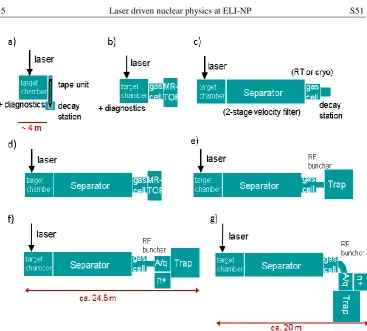
according to successive project phases, where measurements of fusion products will be performed primarily in two stages. A first phase will aim at an identification of the produced isotopes via decay spectroscopy using a transport system (e.g. tape) directly behind the target chamber used to transport the reaction products to a remote, well-shielded detector system, where the characterization of the implanted fusion products could be performed either via β--decay studies using, e.g., LaBr3 scintillation detectors or spectroscopy with high-resolution
germanium detectors (case a) in Figure 5 below), or after thermalization in a buffer gas stopping cell [40] and separation in a (multi-reflection) time-of-flight (MR-TOF) separator as developed by the Giessen group [41] (b). This device is particularly attractive when aiming at isotopic species with lifetimes shorter than 50 ms. Such a spectrometer could be operated either as an isobar separator or directly for mass measurements with a mass accuracy of up to 10−7. The probably most essential and also most demanding experimental task will be the separation of the reaction products. Fusion products with about 2-3 MeV/u will have to be separated from faster beam-like fission fragments with about 7 MeV/u, or target-like fragments with about 1 MeV/u, which could be achieved with a (2-stage) velocity filter. This separator has to accept a much broader momentum and charge-state range than typically requested from existing comparable devices operated at conventional accelerator facilities. This separator (e.g. 2-stage velocity filter) selects the ions of interest in order to prepare them (again after thermalization in the gas cell, followed by cooling and bunching in, e.g., a radiofrequency quadrupole ion guide, before then being transferred to perform either selective spectroscopic studies (c) or precision mass measurements either in the MR-TOF (d) or a Penning trap mass spectrometer (e), the latter potentially operated in an upgraded version with highly-charged ions to increase the performance (f). When using a Penning trap, such a setup would be similar to the SHIPTRAP facility at GSI [42] or ISOLTRAP at ISOLDE/CERN [43] for mass measurements with an accuracy of Δm/m ≈ 10−8, (corresponding to about 10 keV/c2 [44]) for isotopes
with half-lives longer than circa 100 ms, while the MR-TOF would grant complementary access also to shorter-lived species with half-lives longer than about 1 ms.
Figure 5 – Schematical view of the experimental arrangement for fission-fusion studies for different phases of the experimental development process. Measurements of fusion products will be performed
primarily in two stages, first aiming at an identification of the produced isotopes via decay spectroscopy using a transport system (e.g. tape) directly behind the target chamber (a),or after thermalization in a buffer gas stopping cell and separation in a (multi-reflection) time-of-flight separator (MR-TOF) as developed by the Giessen group [41] (b) while later on a separator (e.g. 2-stage velocity filter) selects the ions of interest in order to prepare them (again after thermalization in the gas cell) either for selective spectroscopic studies (c) or for precision mass measurements either
in the MR-TOF (d) or a Penning trap mass spectrometer (e), the latter potentially operated with highly-charged ions to increase the performance (f). In case of length problems of the setup to be integrated into the available floor space, also a (90 deg.) bent RFQ for extraction and bunching could
be foreseen.
Theoretical support
Theoretical calculations and simulations will be needed at different stages of the present proposal:
present proposal. Here we draw on the support by the LMU theory group of H. Ruhl.
- Detailed simulations of the acceleration process of heavy ions and the subsequent nuclear interactions in the fission and fusion stage of the proposed novel reaction scheme will be required to specify the properties of the produced reaction products during the fission-fusion process and to quantify the expected range of neutron-rich fusion products.
Implementation scheme
2.2 NUCLEAR (DE-)EXCITATION INDUCED BY LASERS
In hot plasma various mechanisms of nuclear excitation and de-excitation may appear. Beside direct interaction with free electrons and X-rays/γ-rays through mechanisms such as:
- photoexcitation,
- electron inelastic scattering, - stimulated gamma ray emission,
other excitation/de-excitation mechanisms involving the bound states of electron cloud:
- Internal Conversion (IC): nuclear de‐excitation resulting in the emission of an orbital electron to the continuum,
- Bound Internal Conversion (BIC): same as IC, but the electron is promoted to a bound state,
- NEEC (Nuclear Excitation by Electron Capture from continuum): inverse of IC,
- NEET (Nuclear Excitation by an Electronic Transition): inverse of BIC will occur with different rates compared to isolated atoms or materials in normal conditions. Significant changes in nuclear life-times are predicted in hot and dense plasmas [45], as in the case of the 6.85 h isomeric state of 93Mo shown in Figure 6.
Here, the 4.85 keV photoexcitation from the 21/2+ to the 17/2+ state, followed by
the decay of the last one through a much faster transition towards the 13/2+ state,
corresponds to an effective lifetime decrease of the 21/2+ isomeric state in plasma
conditions. Such a mechanism of induced energy release (2.5 MeV in case 93Mo) as
a result of an excitation of much lower energy (500 time less in the case of 93Mo)
has potential applications for energy storage with much higher energy density compared to electrochemical processes in batteries.
The possible changes of lifetimes of nuclei having beta-decaying isomeric states at low energy above the ground state, as 176Lu, 26Al and 34Cl, are also highly
relevant for astrophysical nucleosynthesis processes.
The NEET and NEEC mechanisms are schematically presented in Figure 7. The NEET has been observed [46-48] in normal (cold) target conditions in several heavy nuclei: 197Au, 189Os and 193Ir with probabilities P
NEET ~ 10–8 or lower. These
probabilities are in good agreement with theoretical predictions. Higher probabilities for the NEET process are reported [49] in 237Np, however, the
experimental value of (2.1±0.6)×10–4 is much larger than the theoretical predictions
[50]. We note also that the BIC process, i.e. the reverse of NEET, has been observed in 125Te [51]. The NEEC process was never observed.
Figure 7 – Schematic representation of the NEET and NEEC processes of nuclear excitations.
The possibilities to create hot plasma offered by lasers opened new opportunities to study these phenomena. The presence of ions in different charge states, each of them with various electron configurations, enhances the chances for existence of an electronic transition, corresponding to an X-ray line, of “equal” energy and multipolarity with the nuclear transition. However, none of NEET, NEEC or BIC processes have been observed in plasmas. Moreover, in each ion the ionization state and electron configurations will change at high rate in a complex interplay of collision/excitation/deexcitation mechanisms, depending on the rapidly evolving properties of the plasma. This makes a theoretical description very difficult. Understanding and optimizing plasma formation using various targets and irradiation conditions are the keys for observation of nuclear excitations, while the possibilities for extending the plasma lifetime by trapping it using very high pulsed magnetic fields, as suggested in section 2.4, has also to be explored.
Several attempts have been done to evidence nuclear excitation in laser plasma in:
- 235U, having an isomeric state of T
1/2=26.8 min at only 76.8 eV above the
ground state and
Eelectronic Enuclear
Atom Nucleus
NEET
0
Eelectronic Enuclear
Atom Nucleus
NEEC
e
- 181Ta, which has an isomer of T
1/2=6.05 µs at an excitation energy of 6.237
keV.
The positive results for NEET reported by Andreev et al. [52] in 181Ta have
not been confirmed by more recent experiments [53] of the ENL (Excitations Nucléaires par Laser) group from CENBG, who has under study two other candidates for NEET: 201Hg and 84Rb.
Figure 8 – The calculated NEET rate in 201Hg is plotted as function of plasma density and temperature [54].
In Figure 8, the calculated NEET rate [53] in 201Hg (excited state at 1.56 keV
with T1/2=81 ns) is plotted as a function of plasma density and temperature. Values
larger than 104 s1 are obtained for temperatures of 500 – 700 eV and densities
down to 2103g/cm2 achievable with uncompressed (0.9 ns) ELI-NP laser pulses.
Needed intensities are of order of 1015 W/cm2, corresponding to a focal spot of
~100 µm.
In Figure 9, the partial level scheme of 84Rb (left panel) and the excitation
rates of the 5– state at 3.498 keV above the isomeric state of T1/2=20.26 min at
463.6 keV, are shown [53, 55]. According to the ISOMEX code based on the relativistic average atom model, the NEET process is expected to dominate for temperatures around 400 eV with a rate around 3.5×10³s1.
To study this case, before plasma creation with the laser, the desired
isomeric state has to be created through nuclear reactions. The 1 PW-class PHELIX laser installed at GSI near the UNILAC heavy ion accelerator is well suited for such experiments. Otherwise, at ELI-NP, the presence of two high power high repetition laser pulses allows to use one for particle acceleration and isomeric state production while the other one, uncompressed, can be used for plasma formation and heating. The most appropriate production mechanism has to be defined for each isomer under study: besides the proton or heavy ion acceleration, the electron-to-gamma conversion in high Z target should be considered as well. In any case, the needed energies of accelerated particles are not very high, the optimization should to be targeted towards highest possible particle fluxes and low divergence, such as to keep the high density of isomers in a spot of ~250 µm on the secondary target. For the study of 84mRb, taking into account its lifetime, asequence of 60 minutes of 100TW laser @10 Hz is needed to reach the maximum production. The isomer will be populated by the 76Ge(12C, p+3n)84mRb reaction.
Afterwards, a high energy long duration laser shot will produce the hot and dense plasma in which the nuclear excitations take place.
The isomeric production yields and the problem of measuring γ-rays from short lived isomers produced by high power lasers has been addressed [56] in a recent experiment at the ELFIE-100 TW facility at LULI on the 90Nb nucleus,
produced in the 90Zr + p reaction. The level scheme of 90Nb (see Figure 10)
Figure 10 – Partial level scheme of 90Nb with spin assignments and half-lives.
Figure 11 – Left: Diagram of the experimental setup. Right: signal traces measured with an oscilloscope. The blue trace corresponds to the LaBr3 detector placed inside the interaction chamber,
the yellow trace corresponds to a similar detector (not gated), placed as a reference outside the interaction chamber.
For the detection of γ-rays, a LaBr3 scintillator coupled to a
gated-photomultiplier tube (PMT) has been installed at ~10 cm from the Zr target. The properties of LaBr3 scintillators (165% photon yield compared to NaI and 16 ns
yield of the 18.8 s isomer. The off-line processing of traces from the oscilloscope has shown that the digitizer gives good results also during the first millisecond. The obtained bi-dimensional spectra are shown in Figure 12. One can observe well separated signatures from the isomers of interest, together with (i) the 511 keV line corresponding to + decay of 27Si populated by the proton reaction in the Al holder
of the Zr target and (ii) the 206 keV isomer in 79Br due to photonuclear reactions in
the scintillator itself. We remark also the very low background in the range of tens of millisecond after the main pulse.
Figure 12 – In-situ single shot bi-dimensional energy-time gamma spectra obtained with a Zr secondary (isomeric) target and a LaBr3 detector.
Based on these results, with several improvements in progress (increasing the lead shield around detector and optimizing its shape, using a calibrated LED signal to correct the pulse height during the recovery period etc.) it seems possible to measure lifetimes of the order of 100 µs or even below in high power laser experiments. The technique can be used as on-line diagnostic method, well adapted for high-repetition lasers, complementing the activation technique that requires transport of irradiated the sample in front of gamma detectors placed outside the experimental hall.
The 1015 W/cm2 laser intensity used for plasma creation does not generate
very energetic electrons or hard X-rays, such that much shorter lifetimes will be possible to observe. With adequate shielding and filtering, the 218.3 keV transition of only 9 ns in case of 84mRb might be measured.
The results on yields are also encouraging: the number of isomers produced per shot was around 106 in the 50 µm Zr target for the 18.8 s and 6 ms isomers. The
ELI-NP laser parameters promise to increase this number to ~108 isomers per shot.
26Al case
intensities, a new world of possibilities opens up to study their behavior for the first time under the extreme temperature and pressure conditions present in the inner cores of planets and stars. The quest to study nuclear astrophysics with ELI should focus on the most prominent puzzling systems. Hence the SUPA collaboration proposes to study the possible enhancement of the decay of the long-lived 26Al
radioisotope in astrophysical environments with ELI. This endeavor would be a complementary effort to already established successful experimental research projects of current SUPA physicists (S.D. Pain) at the Holifield Radioactive Ion Beam Facility at Oak Ridge.
The γ-ray mapping of the 26Al decay across the galaxy provides one of the
most interesting constraints on nuclear physics parameters in astrophysical environments. The 26Al nucleus was the first radioisotope detected in the
interstellar medium, by the observation of the characteristic 1809 keV γ-emission associated with the decay of its ground state [58]. As the half-life 26gsAl (5+) state is
7.2×10⁵ years, the presence of this nucleus provides evidence of ongoing galactic
nucleosynthesis. Wolf-Rayet stars and Asymptotic Giant Branch (AGB) stars and novae [59] have been suggested as possible sources of the origin of 26Al. At a
temperature of T=0.03GK, the 26gsAl(p,γ)27Si reaction is expected to be the main
destruction mechanism for the 26Al isotope. However, at these hot stellar
temperatures, the dominant contribution to the 26gsAl(p,γ)27Si reaction rate is
capture through low-lying resonances, for which the strengths have not been measured and an experimental benchmarking of theoretical studies, such as Hauser-Feshbach based calculations [60], remains elusive. The disintegration process of 26Al is further intricated by the presence of a 0+ isomer at 228 keV above
the ground state. This isomer, which originates like the ground state from the coupling of the two unpaired nucleons in the odd-odd 26Al system, is prohibited to
decay into 26gsAl due to the large spin difference 26mAl decays via β+ emission with
T1/2 = 6.35 s directly to 26gsMg (0+). This is a very specific and complicated
scenario.
Equilibration between 26gsAl and 26mAl can only proceed via the coupling
through a sequence of intermediate states (IS), for which no branching ratios are experimentally established. Theoretical work [61] based on shell-model calculations predicts a dramatic reduction of the effective life time τeff (26gsAl) by a
factor of 109 within the temperature range from 0.15 to 0.4 GK, superseding
previous estimates by Ward and Fowler [62] by orders of magnitude. This significant decrement of τeff is due to a variety of physical processes triggered and
population of these states, and thus their contribution to the true astrophysical disintegration rate, will reflect an overlap of Boltzmann distributions from ground
and excited state in the hot and dense environmental conditions provided [63]. The ELI laser system will deliver energetic particle and radiation bursts of sufficient intensity to create planet and stellar-like environmental conditions. Most importantly, these radiation pulses are ultrashort in time and synchronous, thus providing ideal conditions for an ’astrophysical laboratory’ capable of resolving ps time scales. In a first instance, we want to expose a miniature 26Al target specimen
to an isochorically heated environment with ELI. Work by Patel et al. shows that isochorical heating by laser induced thermally distributed proton beams with end-energies of only a few MeV can be used to create very localized (⊘=50μm) high energy-density plasma states [64]. In this study a ’modest’ 10 J, 100 fs high intensity laser system was able to produce several tens of eV within the ps time domain. The ELI system, even in the first phase, will be able to surpass these values by several orders of magnitude, especially once the onset of the pressure dominant acceleration regime is established as predicted by Esirkepov [65]. For increasing laser intensity, the electromagnetic field will eventually start to directly interact with the nucleus, thus presumably contributing further to an enhancement of the decay probability. In all instances, the spatial confinement of particles and radiation emerging from laser acceleration will help this particular investigation tremendously. The isotope 26Al is only available in minute quantities, which will
just allow the production of miniature pellet targets or thin layers on backing or radiator materials. The onset of an enhanced transition rate and the coupling of ground and isomeric state via IS can be deciphered via the 511 keV annihilation radiation following the β+ decay of 26mAl. The coincident 511 keV photons are
measurable with semiconductor or scintillation detector systems and would exhibit a characteristic temporal behavior with T1/2 = 6.35 s. Ideally, a fast target
transportation would need to be developed to retrieve the target probe from the interaction zone after irradiation.
We are aware of the many conceptual and technical aspects that need to be addressed prior to such an experimental engagement with ELI. Most importantly, once ELI parameters are firmly established, precise yield estimates have to be undertaken. Furthermore, we have to consider the reaction yield for the
26Al(γ,n)25Al channel with S
n(26Al)=11.4 MeV, which also causes the emergence of
511 keV annihilation radiation with T1/2=7.18 s, as 25Al is a β+ emitter. This
suggests, e.g., the use of neutron detectors for discrimination. Moreover, as the decay of 25Al also produces a coincident 1612 keV γ-ray with low branching,
particle reaction channel yields have to be estimated, Hauser-Feshbach calculations have to be performed for increasing temperatures [66]. Besides theoretical codes, GEANT4, SRIM [67] and LASNEX [68] simulations need to be undertaken. Furthermore, there may be a need to development of a special target chamber due to the radioactivity of the target probe. We also propose to implement prima facie experiments on bulk targets of stable isotopes that have low-lying isomeric states with similar life-times as proof of concept studies (e.g. 107,109Ag). Results will be
first and foremost interpreted in light of the theoretical evaluations shown in [61]. The study of 26Al could become a benchmark experiment, as it would manifest ELI
as a novel accelerator system, providing environments of astrophysical interest. It will align and allow a further development of existing projects with radioactive beam facilities that will deliver a lot of interesting results for nuclei of pronounced astrophysical interest in the next years.
2.3 NUCLEAR REACTIONS IN LASER PLASMAS
Plasma is by far the most common form of matter known. Plasma in the stars and in the tenuous space between them makes up over 99% of the visible universe and perhaps most of that which is not visible. On earth we live upon an island of "ordinary" matter. Given its nature, the plasma state is characterized by a complexity that vastly exceeds that exhibited in the solid, liquid, and gaseous states. Correspondingly, the physical properties of nuclear matter (structure, life times, reaction mechanisms etc.) could be drastically changed inside the plasma. These studies represent one of the most far ranging, difficult and challenging research areas today, implications could cover others fields, from quantum physics to cosmology, astrophysics etc.
In this context, one of the most crucial aspects concerns the role of electron screening.
Direct and indirect measurements of the relevant cross sections have been performed over the years. Direct measurements using accelerated beams show that, at very low energies, the electrons in the target’s atoms partially screen the Coulomb barrier between the projectile and the target [69], resulting in an enhancement of the measured cross section compared with the bare nucleus cross section [70]. The electron screening effect is significantly affected by the target conditions and composition [71], it is of particular importance for the measurement of cross-sections at extremely low energetic domains including plasma effects, i.e. in an environment that under some circumstances and assumptions can be considered as “stellar-like” (for example, for the study of the role played by free/bounded electrons on the Coulombian screening can be done in dense and warm plasmas).
section has been successfully measured in certain cases by using several indirect methods [72].
Usually, astrophysically relevant reactions are performed in the laboratories with both target and projectile in their ground state. However, in high temperatures plasmas (108K), an important role can be also played by the excited states, as
already deeply discussed in the pioneering theoretical work of Bahcall and Fowler [73]. In that case, the authors studied the influence of low lying excited 19F states
on the final 19F(p,alpha) reaction, predicting an increase of a factor of about 3 in
reaction rate at temperatures of about 1-5 GK.
Thus determining the appropriate experimental conditions that allow to evaluate the role of the excited states in the stellar environment could strongly contribute to the development of nuclear astrophysics. The study of direct measurements of reaction rates in plasma offers this chance. In addition, other new topics can be conveniently explored, such as three body fusion reactions as those predicted by Hoyle [74], lifetime changes of unstable elements [75] or nuclear and atomic levels [76] in different plasma environments; other fundamental physics aspects like non-extensive statistical thermodynamics [77] can be investigated in order to validate/confute the general assumption of local thermal equilibrium that is traditionally done for plasmas.
Figure 13 – Calculated screening factor for the D+D reaction as a function of electron temperature and density. Highlighted are the typical solar values.
Although it seems practically impossible to reproduce in the laboratory the extreme properties of stellar matter, according to a method commonly used in other fields of plasma physics, it is possible to rescale the plasma parameters (temperature and density) in order to make the laboratory conditions similar to the ones of an astrophysical plasma. As an example, Figure 13 shows the calculation of the screening factor for the D+D reaction as a function of electron temperature and density. It can be noticed that the typical values of solar screening can be reproduced in alternative plasma conditions of temperature and density.
tens of petawatts of power (e.g. ELI-NP) into small volumes of matter at high repetition rates will give the unique opportunity to investigate nuclear reactions and fundamental interactions under extreme plasma conditions [78], including also the influence of huge magnetic and electric fields, shock waves, intense fluxes of X and -rays originating during plasma formation and expansion stages.
2.3.1 First cases of study
To investigate these research topics, we are proposing the construction of a general purpose experimental setup, where it will be possible to study the electronic screening problem in a wide variety of cases and configurations with different purposes. In particular, we propose to study the screening effects on low energy fusion reactions and on weakly bound nuclear states (Hoyle, Efimov [79] etc.). Concerning the first question, among the various nuclear reactions which have attracted relevant attention also for astrophysical or cosmological reasons, we would select the 13C(4He,n)16O and 7Li(d,n)4He-4He reactions: the former for its
relevance in the frame of stellar nucleosynthesis, the latter for the role played in Big Bang primordial nucleosynthesis. Through the laser-target interaction, we aim at producing plasmas containing mixtures of 13C + 4He and 7Li + deuterons in order
to investigate inner-plasma thermo-nuclear reactions.
The 13C+4He reaction is of key interest for the investigation of the helium
burning process in advanced stellar phases [80]. In particular, it can be activated at the base of AGB stars, thus constituting one of the most interesting neutron sources in stellar conditions. These are in turn important for the so-called “slow-process”, i.e. the neutron induced reactions responsible of the heavy elements production. Thus, by gaining further knowledge about the 13C+alpha reaction, it will be
possible to evaluate more carefully the available neutron flux for the following s-process nucleosynthesis. For the astrophysical factor S(E) of 13C(alpha, n)16O
reaction no experimental data are available in the region below 270 keV, but only model predictions [81].
The 7Li(d,n)4He-4He reaction was recently addressed by Coc et al. [82] as
one of the most important reactions affecting the CNO abundances produced during the primordial nucleosynthesis (BBN). From such an analysis, it was found that the 7Li nucleosynthesis is strongly influenced by the 7Li(d,n) 4He-4He reaction
rate. Data collected by these authors give a variation of two orders of magnitude on the 7Li abundance during the BBN epoch, around 1 GK of temperature, with
consequently of the BBN at a temperature of about 1 GK. This critical temperature domain will be affordable by the petawatts laser facility of ELI-NP [84], including the configuration based on two laser beams producing colliding plasmas [85, 86].
In relation to the weakly bound nuclear states, as a first case of study we propose to investigate the 11B(3He, d)12C* reaction in a plasma. Nucleonic matter
displays a quantum-liquid structure, but in some cases finite nuclei behave like molecules composed of clusters of protons and neutrons. Clustering is a recurrent feature in light nuclei, from beryllium to nickel. Cluster structures are typically observed as excited states close to the corresponding decay threshold; the origin of this phenomenon lies in the effective nuclear interaction, but the detailed mechanism of clustering in nuclei has not yet been fully understood. The second J = 0+ state at 7.654 MeV in 12C, first predicted by Hoyle [74] in 1953 and thus
called the Hoyle state, plays a central role in nuclear physics. It is a well-known fundamental testing ground of models of the clustering phenomena in light nuclei, which is highlighted by recent developments of ab initio theoretical calculations that are able to calculate light nuclei such as 12C. The Hoyle state plays a central
role in stellar helium burning by enhancing the production of 12C in the Universe,
allowing for life as we know it. It is the first and quite possibly still the best example of an application of the anthropic principle in physics. Early on after the discovery of the Hoyle state, it was suggested by Morinaga [87] that we can learn more about the structure of the Hoyle state by studying the rotational band built on top of it, which led to a 50-yr long search for the second 2+ state in 12C. Recently,
the existence of the second 2+ state in 12C has been the subject of much debate.
The current evaluation of the triple- reaction rate assumes that the decay of the 7.65 MeV 0+ state in 12C, proceeds sequentially via the ground state of 8Be.
This assumption has been sustained also by a new upper limit of 5x10⁻³ on the
direct decay of the Hoyle state at 95% of C.L. [88] extracted from the study of the 11B(3He, d) reaction. This assumption is challenged by the recent identification
of two direct -decay branches with a combined branching ratio of 17.5% [89]. If correct, this would imply a corresponding reduction in the triple- reaction rate with important astrophysical consequences. This data has been extracted by the fragmentation of quasi-projectiles from the nuclear reaction 40Ca + 12C at
25MeV/nucleon, used to produce excited states candidates to -particle condensation. This approach differs from the previous one for the presence of nuclear medium. In the 11B(3He, d), carbon Hoyle state is populated and decay in
2.3.2 Methodology
To perform the proposed experiments, providing relevant data concerning the aforementioned reactions and others, we aim to take advantage from the excellent and unique performance of the ELI-NP facility and realize an experimental setup where two laser beams generate two colliding plasmas. The reaction products (neutrons and charged particles) will be detected through a new generation of plastic scintillators wall and through a new silicon carbides wall. The sketch of this configuration is drawn in Figure 14.
Figure 14 – Layout of the experimental setup. a) Target configuration, the main laser pulse impinging on B, C or Li thin foil generates a primary plasma which impacts on a second plasma slab produced
through the interaction of a secondary laser pulse on a He or D2 gas jet target. b) Layout of the detectors configuration; the setup combine high granularity SiC charged particles detectors (in
vacuum) and a new generation of neutrons time-of-flight detectors (in air).
Target configuration
The use of colliding plasma plumes suitable for nuclear physics studies was proposed few years ago by some of us [85] and recently adopted also by other research teams [86]. The basic principle is the following: a first laser pulse imping on a 13C, 7Li or 11B solid thin target (few micro-meters) producing, through the
well-known TNSA (Target Normal Sheath Acceleration) acceleration scheme, boron, carbon or lithium plasma. The rapidly streaming plasma impacts on a secondary plasma, prepared through the interaction of a second laser pulse on a gas jet target (made by 4He, D
2 or 3He). TNSA was intensively studied in the last years;
experiments [90] and models [91] show that this acceleration scheme works very well in the intensity domain between 1018-1020W/cm2. The produced ions expand
atomic number 𝐸𝑚𝑎𝑥𝑖 ∝ 𝑍. Figure 15(a) shows some carbon ions energy distributions [94] measured in a TNSA regime at 6-7×10²⁰ W/cm2. These
experimental observations are well described and predicted by theoretical models (see [91] and reference there in). A further fine-tuning can be done acting on other parameters: i.e. the laser incident angle or polarization [94], the structure of the target surface [95], or the target thickness [93, 96]. The total number of accelerated ions obviously depends on the target composition [90]; in particular, for a single component target we can estimate that it roughly corresponds to the removed mass. In this last condition also a fraction of protons was experimentally observed due to the presence of hydrogenated contaminants on the target surface. This component can be in any case reduced through a preliminary heating of the target surface.
Due to the wide possibility of ions properties tuning (energy and number, especially), the idea underlying this proposal is to take advantage of the unique opportunities provided by ELI-NP (high rep. rate and petawatts laser) to operate in the TNSA domain (few 1018 W/cm2) in order to ensure, by using large focal spots,
the production of a very large flux of ions (some estimates are shown in Figure 15(b)) with energy distributions optimized for our purpose (lower high energy cut-off) in order to make possible the study of nuclear reactions at very low cross-section in a plasma environment.
As already mentioned before, after the production, B, C or Li ions forward-streaming towards the gas-jet made by 4He, D
2 or 3He. There, a second laser pulse
synchronized with the first one, can be used to obtain a helium or deuterium (depending on the reaction under analysis) plasma with a low center of mass velocity, but with densities ranging in the 1018 - 1020 ions/cm3 domain [97]. The
properties of the secondary plasma (working as a “plasma target”) can be modified or tuned, depending on the energetic domains one wants to explore. By using femtosecond pulses, secondary plasma temperatures lie in the tens of eV range. For reactions with fully-thermalized plasmas at medium-high ion temperatures, the duration of the secondary laser beam can be extended in the nanosecond domain: temperatures or few keV for deuterons or alpha particles can be obtained in this case.
laser pulses impinge on a thick target with micro cells, filled with gaseous elements (He, D) and enclosed from both sides by thin nanostructured carbon or lithium foils. In such a configuration the “in-cell” gas is self-ionized by the impact with plasmas generated on the two surfaces and can be further compressed by the shock waves developed during the laser–matter interaction. High plasma densities are expected in this case, however, contaminants due to nanotechnological and nanofabrication processes can play an important role, which has to be investigated.
Figure 15 – a) Carbon ions energy distributions measured along the target normal axis at the rear side for laser incident angles of 0° and 35° with respect to the target normal axis and intensities of ~ 5×10²⁰ W/cm2 (data taken from Ref. [93]). b) Maximum number of carbon ions expected at ELI-NP as a function of the laser power. The estimation has been obtained by using laser pulses focalized on a
1 m fully drilled target [93], in order to achieve intensity (working with two focal spot radii of 160 and 50 m respectively) of 5×10¹⁸ W/cm2 and 5×10¹⁹ W/cm2.
Detectors
The proposed activity requires also the construction of a highly segmented detection system for neutrons and charged particles. The segmentation is required for the reconstruction of the reaction’s kinematic. The “ideal” neutron detection module for these studies must have: high efficiency, good discrimination of gammas from neutrons, good timing performance for TOF neutron energies reconstruction. In addition, it must be able to work in hard environmental conditions, like the ones established in the laser-matter interaction area. All these aspects may be met by configuration based on 50x50x50 mm PPO-Plastic scintillator plus a SiPM read-out and a totally digital acquisition of the multi-hit signals (Figure 16(b)).
![Figure 29 – Accelerator based, ns-level resolution FNRR. Figures adopted from [152]. (a) The sample containing carbon rich and nitrogen rich materials](https://thumb-us.123doks.com/thumbv2/123dok_us/1547202.107246/47.595.146.451.306.487/figure-accelerator-resolution-figures-adopted-containing-nitrogen-materials.webp)