SHORT COMMUNICATION
Heavier alkali-metal gallates as platforms for accessing
functionalized abnormal NHC carbene-gallium complexes
Marina Uzelac,*
[a]Alan R. Kennedy,
[a]Alberto Hernán-Gómez,
[a]M. Ángeles Fuentes
[a]and Eva
Hevia*
[a]Abstract: By sequentially treating the unsaturated carbene IPr (IPr = 1,3-bis-(2,6-diisopropylphenyl)imidazol-2-ylidene) with heavier alkali-metal alkyls NaR or KR (R = CH2SiMe3) and GaR3, novel heteroleptic gallates 1 and 2 have been prepared. Incorporating anionic NHC ligands, these bimetallic complexes react selectively with electrophilles to afford neutral abnormal NHC Ga complexes under mild conditions.
N-heterocyclic carbenes (NHCs), particularly imidazol-2-ylidenes, have played a pivotal role in advancing key areas of modern chemistry including transition-metal catalysis,[1] stabilisation of
low valent main-group compounds[2] and the development of
frustrated Lewis pair systems,[3] to name just a few. By modifying
the substituents on the N atoms or at the backbone of the imidazole ring, the electronic and steric properties of NHCs can be finely tune, making these commodity ligands extremely versatile.[4,5] Typically imidazol-2-ylidenes bind to metal
fragments through their C2 (normal) position although in some cases coordination can occur via a carbon from the imidazole backbone (C4 or abnormal coordination).[4,5] NHCs can also
exist as anionic moieties, as the result of their formal deprotonation, acting as a bridge between two metal centres employing simultaneously their C2 and C4 positions.[6]
Interestingly, Robinson has shown that electrophilic interception of anionic NHC complexes with MeOTf or HCl∙NEt3 can be
employed to prepare abnormal NHC complexes (aNHCs) of B and Zn.[7] More recently our group has also used a similar
approach for the synthesis of aNHC complexes of Ga and Fe, where the normal C2 position of the carbene is blocked by a methyl group.[8,9] Carbanionic NHCs can be prepared by several
methods including chemical reduction and metal-mediated C-H activation, however deprotonative metallation appears to be one of the most versatile approaches.[10]
The vast majority of the studies on NHC metallation have focussed on using organolithium reagents as a base,[6,8]
although mixed-metal systems such as zincates and magnesiates have shown great promise for the zincation or magnesiation of IPr (IPr = 1,3-bis-(2,6-diisopropylphenyl)imidazol-2-ylidene).[11,12] Extending the scope
of these investigations here we explore the metallating ability of heavier alkali-metal alkyls to prepare gallate complexes containing anionic NHC fragments and their applications to access novel aNHCs Ga complexes with a variety of substituents.
We started our studies by employing heavier alkali-metal alkyls
NaR and KR (R = CH2SiMe3) for direct metallation of IPr as this
methodology seems to be underdeveloped. Treating a hexane suspension of IPr with MR (M = Na, K), led to the instant formation of yellow solids which were completely insoluble even when using large amounts of the more polar solvent THF. Interestingly, addition of GaR3 solubilised these products
allowing the isolation of heteroleptic alkali-metal gallates (THF)3Na[:C{[N(2,6-iPr2C6H3)]2CHCGa(CH2SiMe3)3}] (1) and
(THF)3K[:C{[N(2,6-iPr2C6H3)]2CHCGa(CH2SiMe3)3}] (2) in 71 and
76% isolated yields respectively (Scheme 1).
Scheme 1. Stepwise indirect gallation of IPr affording alkali-metal gallates 1 and 2.
Formation of gallates 1 and 2 can be rationalised in terms of a stepwise indirect gallation process. IPr is first deprotonated at the C4 position by the highly polar MR reagent (I in Scheme 1), which can then undergo fast transmetallation with the more electronegative Ga fragment, with the alkali-metal being trapped by the vacant C2 site of the carbene (Scheme 1). Although the solids obtained by treating IPr with MR cannot be characterised, due to their lack of solubility, the isolation of 1 and 2 provides compelling proof that these heavier alkaline metal alkys can in fact metallate this NHC. Interestingly, when the single metal alkyl reagents are combined to form tetraorganogallates MGaR4,[13] the metallation process is inhibited yielding instead
the coordination adducts [IPr2K][GaR4] (see SI for details) which
highlights the potential of using bimetallic systems in a sequential manner.[14] While the relevant M+IPr− salts (I) are
obtained via direct metallation, it should be noted that Goicoechea has structurally characterised K+IPr−·2THF as the
result of the reaction of the lithiated IPr with potassium tert-butoxide.[15]
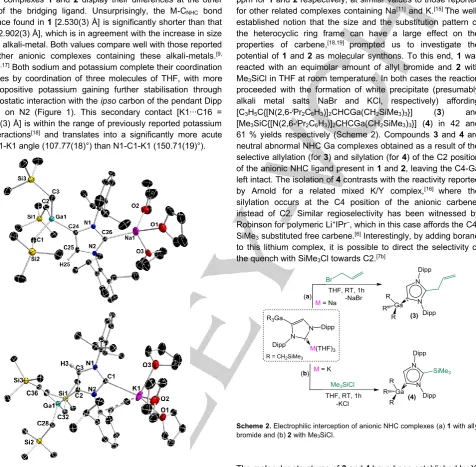
Both sodium (1) and potassium gallate (2) exhibit discrete contacted ion-pair (CIP) structures where anionic NHC ligand coordinates to the alkali metal through its normal C2 position while Ga occupies the position previously filled by a H atom, bonding to the C4 position (Fig 1). The Ga-C4 distances (i.e. C24 for 1 and C2 for 2 in Fig 1) of 2.050(2) Å for 1 and 2.050(3) Å for 2 are close in value with the Ga-Calkyl bonds (average
2.027 Å and 2.028 Å for 1 and 2 respectively) and they are also in excellent agreement with the bond distances found in the previously reported lithium congener.[8] The narrow variation
observed for the Ga-C bond lengths together with very similar
[a] M. Uzelac, Dr A. R. Kennedy, Dr A. Hernán-Gómez, Dr M. Á. Fuentes, Prof E. Hevia
WestCHEM, Department of Pure and Applied Chemistry University of Strathclyde
Glasgow, G1 1XL (UK)
E-mail: [email protected], [email protected]
Supporting information for this article is given via
R = CH2SiMe3
N N Dipp Dipp N N Dipp Dipp M hexane MR M N N Dipp Dipp M(THF)3 Ga R R R
M = Na (1)
GaR3
THF
IPr
M = K (2) Dipp = 2,6 -iPr2-C6H3
I
step 1
SHORT COMMUNICATION
bond angles [mean angle 108.15° for 1 and 109.46° for 2] reveal an almost ideal tetrahedral geometry of gallium centre in both compounds. With the virtually identical environment around Ga-atom, complexes 1 and 2 display their differences at the other end of the bridging ligand. Unsurprisingly, the M-CNHC bond
distance found in 1 [2.530(3) Å] is significantly shorter than that of 2 [2.902(3) Å], which is in agreement with the increase in size of the alkali-metal. Both values compare well with those reported for other anionic complexes containing these alkali-metals.[9, 11,13,16,17] Both sodium and potassium complete their coordination
spheres by coordination of three molecules of THF, with more electropositive potassium gaining further stabilisation through electrostatic interaction with the ipso carbon of the pendant Dipp group on N2 (Figure 1). This secondary contact [K1∙∙∙C16 = 3.301(3) Å] is within the range of previously reported potassium π-interactions[18] and translates into a significantly more acute
N2-C1-K1 angle (107.77(18)°) than N1-C1-K1 (150.71(19)°).
Figure 1. Molecular structure of 1 (top) and 2 (bottom) with 50% probability displacement ellipsoids. All hydrogen atoms except the one left on imidazole ring and disorder components in THF ligands have been omitted for clarity. Dashed lines represent secondary interactions.
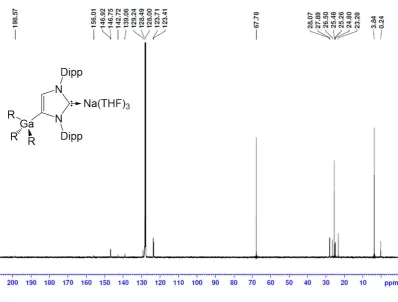
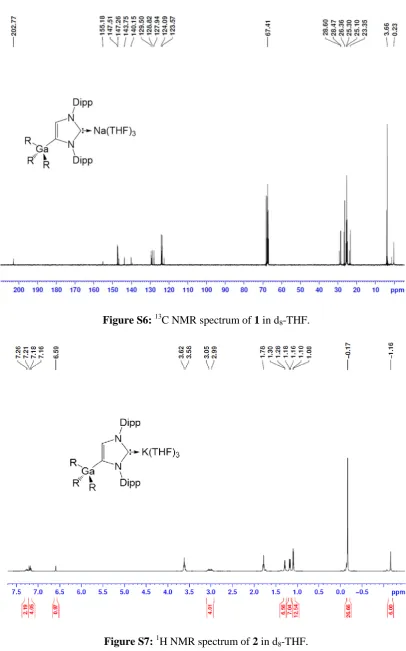
From the NMR data of 1 and 2 in d8-THF solutions, the
metallation of IPr is evident by the large downfield shift of the C4 resonance in the 13C NMR spectra (from 122.3 in free IPr to
155.2 and 153.6 ppm respectively) as well as the presence of a diagnostic singlet integrating 1H in the 1H NMR spectra for the
imidazole CH (at 6.64 and 6.59 ppm respectively versus 7.19 in free IPr). The loss of symmetry in the imidazole ring is reflected
in the 1H and 13C NMR spectra with the appearance of two
distinct sets of Dipp signals. In addition, the carbenic C atom attached to the alkali-metal can be observed at 202.8 and 210.7 ppm for 1 and 2 respectively, at similar values to those reported for other related complexes containing Na[11] and K.[15] The
well-established notion that the size and the substitution pattern of the heterocyclic ring frame can have a large effect on the properties of carbene,[18,19] prompted us to investigate the
potential of 1 and 2 as molecular synthons. To this end, 1 was reacted with an equimolar amount of allyl bromide and 2 with Me3SiCl in THF at room temperature. In both cases the reaction
proceeded with the formation of white precipitate (presumably alkali metal salts NaBr and KCl, respectively) affording [C3H5C{[N(2,6-iPr2C6H3)]2CHCGa(CH2SiMe3)3}] (3) and
[Me3SiC{[N(2,6-iPr2C6H3)]2CHCGa(CH2SiMe3)3}] (4) in 42 and
61 % yields respectively (Scheme 2). Compounds 3 and 4 are neutral abnormal NHC Ga complexes obtained as a result of the selective allylation (for 3) and silylation (for 4) of the C2 position of the anionic NHC ligand present in 1 and 2, leaving the C4-Ga left intact. The isolation of 4 contrasts with the reactivity reported by Arnold for a related mixed K/Y complex,[16] where the
silylation occurs at the C4 position of the anionic carbene, instead of C2. Similar regioselectivity has been witnessed by Robinson for polymeric Li+IPr−, which in this case affords the
C4-SiMe3 substituted free carbene.[6] Interestingly, by adding borane
to this lithium complex, it is possible to direct the selectivity of the quench with SiMe3Cl towards C2.[7b]
Scheme 2. Electrophilic interception of anionic NHC complexes (a) 1 with allyl bromide and (b) 2 with Me3SiCl.
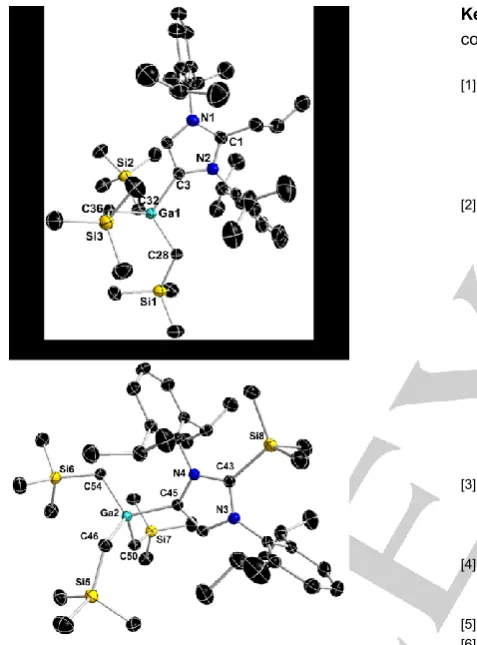
The molecular structures of 3 and 4 have been established by X-ray crystallography (Fig 2). The Ga-C4 distances (i.e. C3 and C45 for 3 and 4 respectively) showed very little variation [2.0802(18) and 2.0887(16) Å] to that found in [aIPr∙GaR3][8]
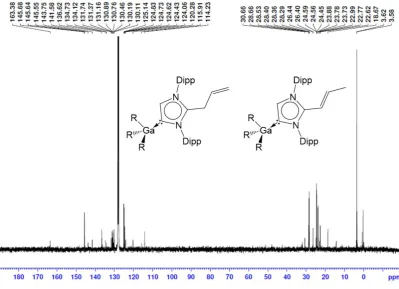
(2.0759(16) Å) where the C2 position of the carbene is occupied by a H atom, suggesting that the substituents on the C2 of the imidazole ring have little influence in the strength of the Ga-C4 bond. Another interesting trend is that despite the neutral constitution of these novel abnormal NHCs, the Ga-C bond distances are only slightly elongated to those discussed for the anionic precursors 1 and 2. Structural analysis of 3 revealed it to be a cocrystal which contains CH2-CH=CH2 and CH=CH-CH3 as
[image:2.595.68.545.124.591.2]SHORT COMMUNICATION
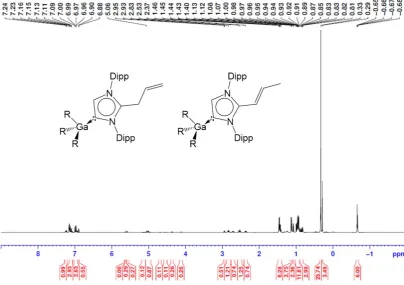
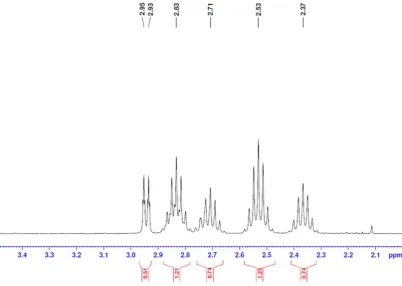
composition in the solution, NMR spectroscopic analysis of 3
proved to be extremely complex in the allylic section (from 3 to 6 ppm); although it should be noted that no interconversion between these two isomers is observed over prolonged periods of time. Despite its complexity, the 1H NMR spectrum displays
four septets for the CH of isopropyl groups, while an informative resonance at 163.4 ppm is observed for the carbenic carbon. A similar chemical shift was observed for 4 (167.6 ppm) along with another signal at 148.8 ppm, which can be assigned to the C of the imidazole ring that is now bonded to a SiMe3 group.
Figure 2. Molecular structure of 3 (top) and 4 (bottom) with 50% probability displacement ellipsoids. All hydrogen atoms have been omitted for clarity. For compound 3 only the CH2-CH=CH2 fragment is shown. The unit cell of 4 contains three crystallographically independent molecules with identical connectivity. One of these molecules is shown here.
Collectively these findings show the ability of heavier alkali metal alkyls to effectively metallate unsaturated NHC IPr when operating in tandem with a gallium alkyl, affording sodium and potassium gallate complexes 1 and 2 respectively. Electrophilic interception of these bimetallic compounds selectively yielded neutral abnormal Ga NHC complexes disclosing the preference of anionic ligand present in 1 and 2 to react with electrophiles via its C2 position while preserving the Ga-C4 bond.
Experimental Section
Full experimental details and copies of NMR spectra are included in the Supporting Information. CCDC 1501619-1501622 contain the
supplementary crystallographic data of this paper. These data can be obtained free of charge from the Cambridge Crystallographic Data Centre via www.ccdc.cam.ac.uk/data_request/cif.
Acknowledgements
We thank the European Research Council (ERC) for their generous sponsorship of this research.
Keywords: gallium • sodium • potassium • carbene ligands • coordination chemistry
[1] a) M. Scholl, S. Ding, C. W. Lee, R. H. Grubbs, Org. Lett. 1999, 1, 953-956; b) C. Valente, S. Calimsiz, K. H. Hoi, D. Mallik, M. Sayah, M. G. Organ, Angew. Chem. Int. Ed. 2012, 51, 3314-3332; Angew. Chem. 2012, 124, 3370-3388; c) S. Diez-Gonzalez, N. Marion, S. P. Nolan,
Chem. Rev. 2009, 109, 3612-3676; d) D. Enders, O. Niemeier, A. Henseler, Chem. Rev. 2007, 107, 5606-5655.
[2] a) Y. Wang, Y. Xie, P. Wei, R. B. King, H. F. Schaefer III, P. v. R. Schleyer, G. H. Robinson, Science, 2008, 321, 1069-1071; b) A. Sidiropoulos, C. Jones, A. Stasch, S. Klein, G. Frenking, Angew. Chem. Int. Ed. 2009, 48, 9701-9704; Angew. Chem. 2009, 121, 9881-9884; c) R. S. Ghadwal, H. W. Roesky, S. Merkel, J. Henn, D. Stalke, Angew. Chem. Int. Ed. 2009, 48, 5683-5686; Angew. Chem. 2009, 121, 5793-5796; d) C. Jones, A. Sidiropoulos, N. Holzmann, G. Frenking, A. Stasch, Chem. Commun. 2012, 48, 9855-9857; e) Y. Wang, Y. Xie, P. Wei, R. B. King, H. F. Schaefer III, P. v. R. Schleyer, G. H. Robinson, J. Am. Chem. Soc. 2008, 130, 14970-14971; f) M. Y. Abraham, Y. Wang, Y. Xie, P. Wei, H. F. Schaefer III, P. v. R. Schleyer, G. H. Robinson,
Chem. Eur. J. 2010, 16, 432-435; g) H. Braunschweig, R. D. Dewhurst, K. Hammond, J. Mies, K. Radacki, A. Vargas, Science 2012, 336, 1420-1422.
[3] a) L. J. Hounjet, D. W. Stephan, Org. Process Res. Dev. 2014, 18, 385-391; b) D. W. Stephan, Acc. Chem. Res.2015, 48, 306-316; c) M. Tamm in Frustrated Lewis Pair I: Uncovering and Understanding (Eds.: G. Erker, D. W. Stephan), Springer, 2013, pp 121-155.
[4] a) M. Albrecht, Chem. Commun. 2008, 3601-3610; b) O. Schuster, L. Yang, H. Raubenheimer, M. Albrecht, Chem. Rev.2009, 109, 3445-3478; c) M. Albrecht, Science 2009, 326, 532-533.
[5] R. H. Crabtree, Coord. Chem. Rev. 2013, 257, 755-766.
[6] Y. Wang, Y. Xie, M. Y. Abraham, P. Wei, H. F. Schaefer III, P. v. R. Schleyer, G. H. Robinson, J. Am. Chem. Soc. 2010, 132, 14370-14372. [7] a) Y. Wang, Y. Xie, M. Y. Abraham, R. G. Gilliard Jr., P. Wei, C. F. Campana, H. F. Schaefer III, P. v. R. Schleyer, G. H. Robinson, Angew. Chem. Int. Ed. 2012, 51, 10173-10176; Angew. Chem. 2012, 124, 10320-10323; b) Y. Wang, M. Y. Abraham, R. G. Gilliard Jr., P. Wei, J. C. Smith, G. H. Robinson, Organometallics 2012, 31, 791-793; c) M. Chen, Y. Wang, R. J. Gilliard Jr., P. Wei, N. A. Schwartz, G. H. Robinson, Dalton Trans. 2014, 43, 14211-14214.
[8] M. Uzelac, A. Hernán-Gómez, D. R. Armstrong, A. R. Kennedy, E. Hevia, Chem. Sci. 2015, 6, 5719-5728.
[9] L. C. H. Maddock, T. Cadenbach, A. R. Kennedy, I. Borilovic, G. Aromí, E. Hevia, Inorg. Chem. 2015, 54, 9201-9210.
[10] J. B. Waters, J. M. Goicoechea, Coord. Chem. Rev. 2015, 293-294, 80-94.
[11] D. R. Armstrong, S. E. Baillie, V. L. Blair, N. G. Chabloz, J. Diez, J. Garcia-Alvarez, A. R. Kennedy, S. D. Robertson, E. Hevia, Chem. Sci.
2013, 4, 4259-4266.
[12] A. J. Martínez-Martínez, M. Ángeles Fuentes, A. Hernán-Gómez, E. Hevia, A. R. Kennedy, R. E. Mulvey, C. T. O’Hara, Angew. Chem. Int. Ed. 2015, 54, 14075-14079; Angew. Chem. 2015, 127, 14281-14285. [13] D. R. Armstrong, E. Brammer, T. Cadenbach, E. Hevia, A. R. Kennedy,
[image:3.595.74.313.197.520.2]SHORT COMMUNICATION
[14] a) D. R. Armstrong, E. Crosbie, E. Hevia, R. E. Mulvey, D. L. Ramsay, S. D. Robertson, Chem. Sci. 2014, 5, 3031-3045; b) W. Clegg, E. Crosbie, S. H. Dale-Black, E. Hevia, G. Honeymann, A. R. Kennedy, R. E. Mulvey, D. L. Ramsay, S. D. Robertson, Organometallics 2015, 34, 2580-2589.
[15] J. B. Waters, J. M. Goicoechea, Dalton. Trans. 2014, 43, 14239-14248. [16] P. L. Arnold, S. T. Liddle, Organometallics 2006, 25, 1485-1491. [17] P. K. Majhi, G. Schnakenburg, Z. Kelemen, L. Nyulaszi, D. P. Gates, R.
Streubel, Angew. Chem. Int. Ed. 2013, 52, 10080-10083; Angew. Chem.
2013, 125, 10264-10267.
[18] a) F. Feil, S. Harder, Organometallics 2000, 19, 5010-5015; b) G. C. Forbes, A. R. Kennedy, R. E. Mulvey, B. A. Roberts, R. B. Rowling,
Organometallics 2002, 21, 5115-5121; c) K. L. Hull, I. Carmichael, B. C.
Noll, K. W. Henderson, Chem. Eur. J.2008, 14, 3939-3953; d) M. Uzelac, I. Borilovic, M. Amores, T. Cadenbach, A. R. Kennedy, G. Aromí, E. Hevia, Chem. Eur. J. 2016, 22, 4843-4854; d) M. S. Hill, G. Kociok-Köhn, D. J. MacDougall, Inorg. Chem. 2011, 50, 5234-5241; e) M. I. Lipschutz, T. Chantarojsiri, Y. Dong, T. D. Tilley, J. Am. Chem. Soc. 2015, 137, 6336-6372.
[19] M. N. Hopkinson, C. Richter, M. Schedler, F. Glorious, Nature, 2014,
510, 485-496.
[20] D. Mendoza-Espinosa, B. Donnadieu, G. Bertrand, J. Am. Chem. Soc.
SHORT COMMUNICATION
Entry for the Table of Contents
(Please choose one layout)
Layout 2:
COMMUNICATION
Electrophilic interception of alkali-metal gallates, obtained using by indirect gallation of IPr has revealed a versatile method to access C2-substituted abnormal NHC Ga complexes
M. Uzelac,* A. R. Kennedy, A. Hernán-Gómez, M. Á. Fuentes, E. Hevia*
Page No. – Page No.
Heavier alkali-metal gallates as platforms for accessing
functionalised abnormal NHC-gallium complexes
N
N Dipp Dipp
i) MR
N N
Dipp Dipp
M(THF)3 Ga
R
R R ii) GaR3
IPr
EX -MX
SHORT COMMUNICATION
Additional Author information for the electronic version of the article.
Z. Anorg. Allg. Chem.
2016
·
ISSN 0044–2313
SUPPORTING INFORMATION
Title:
Heavier Alkali-metal Gallates as Platforms for Accessing Functionalized Abnormal NHC
Carbene-Gallium Complexes
Electronic Supporting Information
Heavier alkali-metal NHC gallates as platforms for accessing
functionalized abnormal carbene-gallium complexes
Marina Uzelac,*
[a]Alan R. Kennedy,
[a]Alberto Hernán-Gómez,
[a]M. Ángeles Fuentes
[a]and Eva
Hevia*
[a]WestCHEM, Department of Pure and Applied Chemistry, University of Strathclyde, 295 Cathedral
Street, Glasgow, G1 1XL, UK
[email protected]
[email protected]
Contents
General experimental details ... 2
X-Ray Crystallography ... 2
Synthesis of products ... 3
Representative reaction of alkali-metal gallate with IPr ... 6
Electronic Supporting Information
General experimental details
All reactions were carried out using standard Schlenk and glove box techniques under an inert
atmosphere of argon. Solvents (THF, hexane, benzene and toluene) were dried by heating to reflux
over sodium benzophenone ketyl and distilled under nitrogen prior to use. NMR spectra were
recorded on a Bruker DPX 400 MHz spectrometer, operating at 400.13 MHz for
1H, and 100.62 MHz
for
13C{
1H}. Elemental analyses were obtained using a Perkin Elmer 2400 elemental analyser. Allyl
bromide was purchased from Sigma Aldrich Chemicals and used as received. Me
3SiCl was purchased
from Sigma Aldrich Chemicals, dried over calcium hydride and stored over 4 Å molecular sieves
prior to use. [Ga(CH
2SiMe
3)
3],
1
[NaCH
2SiMe
3],
2[KCH
2SiMe
3]
2a,3and IPr
4were prepared according
to literature methods.
X-Ray Crystallography
Crystallographic data for
2
,
3
and
4
were measured at 123(2) K with an Oxford Diffraction Gemini S
instrument with graphite-monochromated Cu (λ=1.54180 Å) radiation. For
1
an Oxford Diffraction
Xcalibur E instrument and Mo (λ=0.71073 Å) radiation was used. All structures were refined to
convergence on
F
2using all unique reflections and programs from the SHELX family.
5The final
model for all structures
included constraints and restraints on bond lengths and displacement
parameters that were required to model disordered groups. THF ligands (for
1
and
2
) and three SiMe
3groups of
4
were modelled as disordered over two sites. For
3
several different models were
investigated. The final model for the alkene fragment contained disordered CH
2-CH=CH
2(40.8 %)
and CH=CH-CH
3(59.2 %) fragments and three separate disorder components. Selected
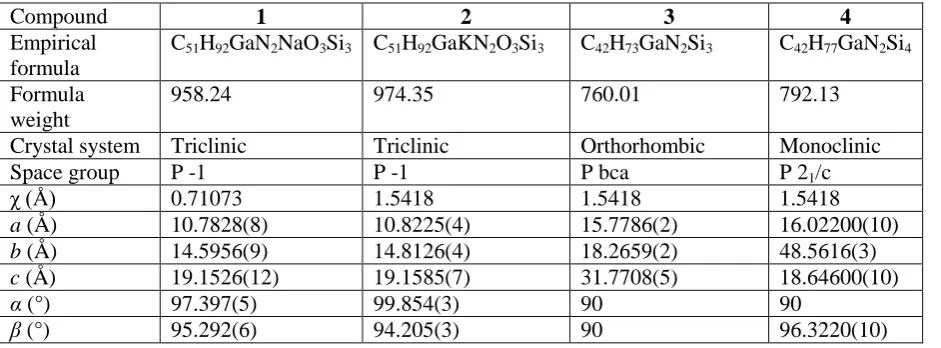
[image:9.595.67.538.456.630.2]crystallographic data are presented in Table S1 and full details in cif format can be obtained free of
charge from the Cambridge Crystallographic Data Centre
via
www.ccdc.cam.uk/data_request/cif
.
Table S1:
Selected crystallographic and refinement parameters for compounds
1
-
4
.
Compound
1
2
3
4
Empirical
formula
C
51H
92GaN
2NaO
3Si
3C
51H
92GaKN
2O
3Si
3C
42H
73GaN
2Si
3C
42H
77GaN
2Si
4Formula
weight
958.24
974.35
760.01
792.13
Crystal system
Triclinic
Triclinic
Orthorhombic
Monoclinic
Space group
P -1
P -1
P bca
P 2
1/c
χ (Å)
0.71073
1.5418
1.5418
1.5418
a
(Å)
10.7828(8)
10.8225(4)
15.7786(2)
16.02200(10)
b
(Å)
14.5956(9)
14.8126(4)
18.2659(2)
48.5616(3)
c
(Å)
19.1526(12)
19.1585(7)
31.7708(5)
18.64600(10)
α
(°)
97.397(5)
99.854(3)
90
90
β
(°)
95.292(6)
94.205(3)
90
96.3220(10)
1
L. M. Dennis, W. Patnode, J. Am. Chem. Soc. 1932, 54, 182.
2
a)A. J. Hart, D. H. O’Brien, C. R. Russell,
J. Organomet Chem.
1974
, 72, C19; b) W. Clegg, B. Conway, A. R.
Kennedy, J. Klett, R. E. Mulvey, L. Russo,
Eur. J. Inorg. Chem.
2011
, 721.
3
B. Conway, D. V. Graham, E. Hevia, A. R. Kennedy, J. Klett, R. E. Mulvey,
Chem. Commun.
2008
, 2638.
4
L. Hintermann,
Beilstein Journal of Organic Chemistry
2007
, 3, 1.
Electronic Supporting Information
γ
(°)
105.058(6)
104.535(3)
90
90
V
(Å
3)
2861.6(3)
2907.28(18)
9156.7(2)
14419.37(17)
Z
2
2
8
12
μ
(mm
-1)
0.589
2.160
1.771
1.934
2θmax (°)
54.994
146.792
146.484
146.57
Measured
reflections
27405
22187
41291
163145
Unique
reflections
13103
11344
9105
28653
Observed
reflections
9034
9125
7610
24954
R
int0.0523
0.0567
0.0405
0.0345
R [on F, obs
refln only]
0.0538
0.0661
0.0391
0.0411
wR [on F
2, all
data]
0.1197
0.1792
0.1064
0.1079
GoF
1.019
1.027
1.024
1.029
Largest
diff
peak/hole (e Å
-3
)
0.614/-0.811
1.504/-0.487
0.367/-0.213
0.951/-0.313
Synthesis of products
Synthesis of (THF)3Na[:C{[N(2,6-
iPr2C6H3)]2CHCGa(CH2SiMe3)3}] (
1
)
Equimolar amounts of Na(CH
2SiMe
3) (0.22g, 2 mmol) and IPr (0.8 g, 2 mmol) were
suspended in hexane (10 mL) and stirred for 2h at room temperature. To the obtained slurry,
a hexane solution of Ga(CH2SiMe3)3 (0.66 g, 2 mmol in 10 mL hexane) was added
via
cannula and stirred over night at room temperature. The reaction mixture was then
concentrated to approximately 5 mL and 1 mL of THF was added to afford a straw solution.
Overnight storage of the solution at -30 °C provided a batch of colourless crystals (1.36 g, 71
%). %). It should be noted that two coordinated THF molecules are lost upon drying
in
vacuo
. Anal. Calcd for C43H76N2Si3NaOGa: C, 63.44; H, 9.41; N, 3.44. Found: C, 63.21; H,
9.44; N, 3.70.
1
H NMR (298 K, C
6D
6) δ(ppm)
-0.62 (6H, s, C
H
2SiMe3), 0.37 (27H, s, Si(CH
3)3), 1.04(12H, d, CH(C
H
3)2), 1.31 (20H, mult, CH(CH
3)2 + THF), 1.57 (6H, d, CH(CH
3)2), 3.00 (2H,sept, C
H
(CH3)2), 3.09 (14H, mult, THF), 3.21 (2H, sept, C
H
(CH3)2), 6.99 (1H, s, imidazole
backbone C
H
), 7.08 (2H,
p
-C
H
), 7.16-7.21 (4H, mult,
m
-C
H
overlapping with C
6D
6).
13
C{
1H} NMR (298 K, C
6D
6)
δ(ppm)
0.2 (
C
H2SiMe3), 3.8 (Si(
C
H3)3), 23.3 (CH(
C
H3)2),
Electronic Supporting Information
123.4 (Ar-
C
H), 123.7 (Ar-
C
H), 124.5 (Ar-
C
H), 128.5 (Ar-
C
H), 129.2 (imidazole backbone
C
H), 139.1 (Ar-
C
), 142.7 (Ar-
C
), 146.8 (Ar-
C
), 146.9 (Ar-
C
), 156.0(
C
-Ga), 198.6 (
C
:).
1
H NMR (298 K, d
8-THF) δ(ppm)
-1.18 (6H, s, C
H
2SiMe
3), -0.17 (27H, s, Si(C
H
3)
3),
1.09-1.19 (12H, mult, CH(C
H
3)
2), 1.30 (6H, d, CH(C
H
3)
2), 3.0 (4H, mult, C
H
(CH
3)
2), 6.64 (1H, s,
imidazole backbone C
H
), 7.18-7.36 (6H, mult,
m
-C
H
+
p
-C
H
).
13C{
1H} NMR (298 K, d
8-THF) δ(ppm)
0.2 (
C
H
2SiMe
3), 3.7 (Si(
C
H
3)
3), 23.3 (CH(
C
H
3)
2), 25.1 (CH(
C
H
3)
2), 25.3
(CH(
C
H
3)
2), 26.4 (CH(
C
H
3)
2), 28.5 (
C
H(CH
3)
2), 28.6 (
C
H(CH
3)
2), 123.6 (Ar-
C
H), 124.1
(Ar-
C
H), 127.9 (Ar-
C
H), 128.8 (Ar-
C
H), 129.5 (imidazole backbone
C
H), 139.1 (Ar-
C
),
142.7 (Ar-
C
), 147.3 (Ar-
C
), 147.5 (Ar-
C
), 155.2 (
C
-Ga), 202.8 (
C
:).
Synthesis of (THF)3K[:C{[N(2,6-
iPr2C6H3)]2CHCGa(CH2SiMe3)3}] (
2
)
Equimolar amounts of K(CH2SiMe3) (0.26 g, 2 mmol) and IPr (0.8 g, 2 mmol) were
suspended in hexane (10 mL) and stirred for 2h at room temperature. To the obtained slurry,
a hexane solution of Ga(CH2SiMe3)3 (0.66 g, 2 mmol in 10 mL hexane) was added via
cannula and stirred over night at room temperature. The reaction mixture was then
concentrated to approximately 5 mL and 1 mL of THF was added to afford a straw solution.
Overnight storage of the solution at -30 °C provided a batch of colourless crystals (1.48 g, 76
%). It should be noted that one coordinated THF molecule is lost upon drying
in vacuo
. Anal.
Calcd for C47H84N2Si3KO2Ga: C, 62.57; H, 9.38; N, 3.10. Found: C, 62.71; H, 9.62; N, 3.45.
%).
1
H NMR (298 K, d
8-THF) δ(ppm)
-1.16 (6H, s, C
H
2SiMe
3), -0.17 (27H, s, Si(C
H
3)
3), 1.09
(12H, d, CH(C
H
3)
2), 1.17 (6H, d, CH(C
H
3)
2), 1.29 (6H, d, CH(C
H
3)
2), 3.02 (4H, mult,
C
H
(CH
3)
2), 6.59 (1H, s, imidazole backbone C
H
), 7.15-7.28 (6H, mult,
m
-C
H
+
p
-C
H
).
13
C{
1H} NMR (298 K, d
8-THF)
δ(ppm)
0.2 (
C
H
2SiMe
3), 3.7 (Si(
C
H
3)
3), 23.2 (CH(
C
H
3)
2),
24.9 (CH(
C
H
3)
2), 25.3 (CH(
C
H
3)
2), 26.4 (CH(
C
H
3)
2), 28.4 (
C
H(CH
3)
2), 28.6 (
C
H(CH
3)
2),
123.2 (Ar-
C
H), 123.7 (Ar-
C
H), 127.6 (Ar-
C
H), 128.2 (Ar-
C
H), 128.6 (imidazole backbone
C
H), 140.8 (Ar-
C
), 144.3 (Ar-
C
), 147.3 (Ar-
C
), 147.4 (Ar-
C
), 153.6 (
C
-Ga), 210.7 (
C
:).
Synthesis of [C
3H
5C{[N(2,6-
iPr
2C
6H
3)]
2CHCGa(CH
2SiMe
3)
3}] (
3
)
To a THF solution of
1
(0.48 g, 0.5 mmol in 5 mL of THF) allyl bromide (0.06 g, 43 μL, 0.5
Electronic Supporting Information
temperature and then filtered through Celite. Orange filtrate was layered with 3 mL of hexane
and stored at -33 °C to afford colourless crystals of title compound (0.16 g, 42%). Anal.
Calcd. for C
42H
73N
2Si
3Ga: C, 66.37; H, 9.68; N, 3.69. Found: C, 65.69; H, 9.66; N, 3.84. The
NMR analysis is very complex and the reported chemical shifts are for both CH=CH-CH
3and CH
2-CH=CH
2fragments.
1
H NMR (298 K, d
8-THF) δ(ppm)
-0.67 (6H, mult, C
H
2SiMe
3), -0.29 and -0.33 (27H, s,
Si(C
H
3)
3), 0.81-1.46 (24H, mult, CH(C
H
3)
2), 2.35(0.8 H, mult, C
H
(CH
3)
2), 2.51(1.2 H, mult,
C
H
(CH
3)
2), 2.70(0.8 H, mult, C
H
(CH
3)
2), 2.85 (1.2 H, mult, C
H
(CH
3)
2), 2.95 (0.5 H. d,
CH=CH-C
H
3), [4.12, 4.36, 4.54, 4.67, 5.00, 5.60] (CH
2-CH
=C
H
2 + CH
=C
H
-CH3), 6.88 (7H,
mult, imidazole backbone C
H
+ Ar-C
H
),
13C{
1H} NMR (298 K, d
8-THF)
δ(ppm)
0.3
(
C
H2SiMe3), 3.6 (Si(
C
H3)3), 22.6 (CH(
C
H3)2), 22.8(CH(
C
H3)2), 23.0(CH(
C
H3)2),
23.7(CH(
C
H3)2), 23.8(CH(
C
H3)2), 23.9(CH(
C
H3)2), 24.4(CH(
C
H3)2), 24.5(CH(
C
H3)2),
24.6(
C
H(CH3)2), 26.4(
C
H(CH3)2), 28.3(
C
H(CH3)2), 28.4(
C
H(CH3)2), 28.5(
C
H(CH3)2),
28.7(
C
H(CH3)2), 30.1 (CH=CH-
C
H3), [114.2, 115.9, 120.3, 124.1, 124.4, 124.6, 124.7,
124.8, 125.1
C
H2-
C
H=
C
H2 +
C
H=
C
H-CH3], [130.1, 130.2, 130.5, 130.8, 130.9, 131.2,
131.4, 131.7 aromatic
C
H + imidazole backbone
C
H ], [134.1, 134.7, 136.6 Ar-
C
], 141.6
(
C
2-C), [143.7, 145.5, 145.6, 145.7 Ar-
C
], 163.4 (
C
-Ga).
Synthesis of [Me3SiC{[N(2,6-
iPr2C6H3)]2CHCGa(CH2SiMe3)3}] (
4
)
To a THF solution of
2
(0.49 g, 0.5 mmol in 5 mL of THF) dried TMSCl (0.05 g, 63 μL, 0.5
mmol) was inducing precipitation. Obtained suspension was stirred for 1h at room
temperature and then filtered through Celite. Clear filtrate was layered with 2 mL of hexane
and stored at -33 °C to afford colourless crystals of title compound (0.24 g, 61%). Anal.
Calcd for C
42H
77N
2Si
4Ga: C, 63.68; H, 9.80; N, 3.54. Found: C, 62.89; H, 9.46; N, 3.60.
1
![Figure S1: 1H NMR spectrum of [{K(IPr)2}+{Ga(CH2SiMe3)4}-] in C6D6.](https://thumb-us.123doks.com/thumbv2/123dok_us/1564495.109049/13.595.80.498.277.574/figure-s-nmr-spectrum-ipr-ga-ch-sime.webp)
![Figure S2: 13C NMR spectrum of [{K(IPr)2}+{Ga(CH2SiMe3)4}-] in C6D6.](https://thumb-us.123doks.com/thumbv2/123dok_us/1564495.109049/14.595.78.502.80.383/figure-s-nmr-spectrum-ipr-ga-ch-sime.webp)