Oral History
Angela Bartie and Arthur McIvor
This is part of the series Essays on the Local History and
Archaeology of West Central Scotland, commissioned for
the Regional Framework for Local History and Archaeology,
a partnership project led by Glasgow Museums, with
representatives from the councils of East Dunbartonshire,
West Dunbartonshire, Glasgow, Inverclyde, North Lanarkshire,
South Lanarkshire, Renfrewshire and East Renfrewshire.
Dr Angela Bartie is Lecturer in History at the University of Edinburgh; Arthur
McIvor is Professor of History at the Faculty of Humanities and Social Sciences,
University of Strathclyde. Arthur McIvor is Director of the Scottish Oral History
Centre and both authors are accredited representatives of the Oral History
Society Regional Network.
Figure 1. Neil Rafeek with oral history interviewee Hannah Frank, 2005.
What is ‘Oral History’?
By its very nature ‘oral history’, as we know it, is a relatively recent phenomenon, although humankind has relied on the oral transmission of history for many thousands of years. In essence, the term oral history refers to a methodology designed to reconstruct the past through people’s memories, usually via a planned interview. An oral history interview results in an eyewitness personal testimony that is recorded on to audio tape, sound file or film and is often transcribed or summarized – sometimes with time-codes relating to the recording – to produce a written version of the interview. It is a great potential source of twentieth- and twenty-first-century history, especially, though not exclusively, that relating to everyday life and the experiences of the marginalized in society. It enables the investigation of thinly documented and poorly preserved areas of the past, as well as completely new domains of human experience. Crucially, due to the interactive nature of interviews, oral history allows for the exploration of specific themes and issues (fig. 1).
Modern oral history originated after World War II and a number of factors combined to vastly increase its popularity in the post-war years. With the advent of relatively cheap and portable tape recording, alongside the development of ‘social history’, it really took off in Britain in the 1960s (see Thompson 2000, Chapter 2). Michael Roper has described two phases in its evolution: ‘Oral history in the reconstructive mode’ up to the 1970s and thereafter ‘Oral history in the interpretive mode’ (Roper 2000, 346).
The latter is more self-critical and reflexive about the process. It engages with the ways in which memories are ‘constructed’ by the individual, and examines how individuals narrate their pasts. In short, interviews are seen as interpretations of the past rather than as representative. It is important that this is considered by all those conducting oral histories.
Oral History and West Central Scotland
In this essay we refer to some of the numerous oral history projects that have been undertaken by a variety of individuals, groups and organizations in – or relating to – west central Scotland. For a more comprehensive survey of Scotland see Bartie and McIvor’s recent article in the Scottish Historical Review
(2013). In the absence of any register of what oral histories have been conducted, the Scottish Oral History Centre (SOHC) has begun to seek out this information and compile a list. There are also plans to establish a National Sound Archive (NSA) in Scotland, and the Isle of Skye-based Tobar an Dualchais has undertaken an audit of oral history collections across Scotland on behalf of the NSA Steering Group. From our initial enquiries, we have found that there is a wealth of oral history material ‘out there’ but, without a central record, it frequently lies undiscovered. It is often the case that no thought is given to the value of recordings or transcriptions after the project for which they were conducted has ended. Consequently, many interviews are never archived at all, with
anecdotal evidence suggesting that numerous tapes lie languishing in drawers or cupboards of the interviewer’s home or workplace. Proper archiving and cataloguing could avoid interviews being conducted unnecessarily, allow comparative work to be done between existing and new interviews, or between two existing collections, and safeguard these valuable sources for future use.
There are a number of interesting collections of oral histories located in west central Scotland, with interviews which have a richness and diversity that reflects the cultural, political and economic history of its people. Museums hold collections ranging in size and focus. Glasgow Museums holds a number of interviews, including those conducted for the 2000 Glasgow Lives Project, a substantial oral history project undertaken on a range of topics, which resulted in the collection of a wealth of material: this has been used in exhibitions and has huge potential for future research. Recently, in 2010–11, the 2000 Glasgow Lives collection was digitized and summarized as part of an Arts and Humanities Research Council (AHRC)-funded project led by Dr David Walker and Professor Arthur McIvor at the Scottish Oral History Centre. The aim here was to make this extensive collection more accessible to the public and to researchers. This has already resulted in some interesting initiatives, including use of extracts from the collection in a memoryscape (recorded recollections of individuals connected with a particular location, made for people to listen to – either through equipment on site or on their own audio devices whilst visiting the site online) created by David Walker; in a novel by Bella Bathgate; in an art installation created by Nikki Gear for the Special Care Maternity Unit,
©
The Scottish Or
Southern General Hospital, Glasgow; in several academic studies – including a PhD on the Reserved Occupations in wartime Glasgow by Alison
Chand at the University of Strathclyde; and in an investigation of Glasgow dialect and sound change conducted by Jane Stuart-Smith, Claire Timmins and Tamara Rathcke at the University of Glasgow.
Glasgow Museums also holds interviews – including more recent DVD films – that focus on working lives in the Springburn area of Glasgow, particularly in the railway works. The M74 Oral History Project, undertaken by Glasgow Museums for Transport Scotland, formed part of a wider public engagement during the largest archaeological dig conducted in Europe in 2008–9. The oral history interviews conducted by Dr David Walker helped inform the archaeological interpretations and was used in the exhibition Uncovering Industry: The M74 Dig (Scotland Street School Museum, August 2008–February
2009; figs 2–5). The exhibition used memories from residents and videos of archaeologists at work to bring the M74 Dig to life and explored the history of the industrial heartland of Glasgow, Renfrewshire and South Lanarkshire. Another recent oral history project
©
The Scottish Or
al History Centre and
CSG CIC Glasgow Museums and Libr
aries Collections
©
The Scottish Or
al History Centre and
CSG CIC Glasgow Museums and Libr
[image:3.595.304.539.54.238.2]aries Collections
[image:3.595.56.292.54.319.2]Figure 3. Christina McNair aged about 14, outside her home at the Lower English Buildings at the Govan Iron Works.
Figure 2. Mrs Christina Wilson, nee McNair, aged 90, when she was interviewed by Dr David Walker for the exhibition Uncovering Industry: The M74 Dig.
©
The Scottish Or
al History Centre and
CSG CIC Glasgow Museums and Libr
[image:3.595.56.540.481.772.2]aries Collections
undertaken by Dr Walker for Glasgow Museums focused on Glasgow dock workers.
Motherwell Heritage Centre holds around 350 interviews, most of which are transcribed, covering a range of subjects including iron and steelworks, leisure pursuits, the changing landscapes of communities and growing up. It also holds interviews on sectarianism that were conducted by a youth group in the community for an exhibition on that theme. West Dunbartonshire Council has oral histories within its industrial archive collection; it has been awarded Heritage Lottery Funding to catalogue and digitize these. The Auld Kirk Museum in Kirkintilloch holds the transcripts of a fairly major oral history project that focused on industry and working life in the area, undertaken in the 1980s, whilst Hamilton Museum holds a series of DVDs of recorded interviews of World War II veterans who were part of the Cameronians (Scottish Rifles) regiment.
Collections relating to specific communities can also be found in the Scottish Jewish Archives Centre; the Anderson Mel-Milaap Centre, which holds testimonies by the Glasgow Sikh community; and OurStory Scotland, which records the life experiences of Scotland’s LGBT (lesbian, gay, bisexual and transgender) community. In fact, oral history undertaken within and about particular communities blossomed in the early 1980s and, with the
subsequent (albeit fluctuating) availability of funding
for local history and regeneration projects, has only increased in popularity. In the last few years, the SOHC has been increasingly approached by members of local and community history groups looking to gain training in the practicalities of conducting oral history or assistance with interviewing. These have included the Migration Lives Group, the Scottish Council on Deafness, the Richmond Fellowship (Lanarkshire), the Loch Lomond Heritage Group, Low Parks Museum in Hamilton, Rainbow Lives (Kirkcaldy), the Paisley Local History Society, Thera Trust (Strathmartine Hospital Histories), Glasgow Film, the Inverclyde Community Development Trust, the Fife Cultural Trust, the Watt Library (Greenock), the Pollok Storytelling Group, Renfrewshire Council, the Scottish Community Development Centre and the Govanhill People’s History Project. The last group – which has completed more than 100 interviews of people from a range of different racial and ethnic backgrounds – represents an excellent example of a Heritage Lottery-funded local community oral history project.
[image:4.595.58.542.486.784.2]The universities in west central Scotland also store a significant amount of material. At present, our own SOHC Archive at the University of Strathclyde includes the following collections: Ayrshire Women and World War II; Collective Historical Memory; Up Helly Aa, Shetland; Football Supporters Associations in Scotland; Fathering in Ayrshire in the 1960s; Communist Women in Scotland; Domestic Violence in Interwar Glasgow; the University of Strathclyde 1945–75; Asbestos Related Diseases in the West of Scotland; Coal Miners and Occupational Health; and Glasgow Working Lives. More collections, mainly outcomes of staff and student research projects,
Figure 5. Gurdev Azad Singh Pall (left) with his two sisters Asha and Sukwant in the 1950s. Gurdev was interviewed by Dr David Walker in 2008 and his testimony provides insight into Sikh life in Glasgow in the mid twentieth century.
©
The Scottish Or
al History Centre and
CSG CIC Glasgow Museums and Libr
are due to be catalogued in the near future. These relate to occupational health in both the aluminium and chemical industries, forensic science, Glasgow gangs, and the Edinburgh Festival. The SOHC also holds copies of some key oral history projects, including the transcripts of the 80 interviews undertaken by the Stirling Women’s History Project in the early 1980s and digital copies (audio and transcripts) of the numerous interviews conducted by Ian MacDougall of the Scottish Working People’s History Trust. Glasgow Caledonian University holds a number of oral histories, including some relating to local labour activists, while Glasgow University Archive Services holds numerous recordings made by the Govan Reminiscence Group.
We should not forget other oral history archives with material relating to west central Scotland, for example the School of Scottish Studies Archive (University of Edinburgh), the Economic and Social Data Service Qualidata Archive (Essex) and the British Library Sound Archive (London). Furthermore, media sources such as the BBC and STV also have both audio and visual recordings.
A newer form of oral history recording, ‘witness seminars’ – where several people associated with a particular set of circumstances or events are invited to meet together to discuss, debate and agree or disagree about their memories – also offers other possibilities (fig. 6). Recordings of events organized at Glasgow Caledonian University, including seminars on the Upper Clyde Shipbuilders dispute and the Anti-Apartheid Movement, are available on the university’s website. Witness seminars were initially developed by the Institute of Contemporary British History and since 1990 have been utilized extensively by the Wellcome Trust to explore the history of medicine. The proceedings of most of their meetings have been transcribed and made available to the public (see ‘Online Resources’ at the end of this essay).
Schools have also been responsible for generating oral history projects and archiving testimonies. The Scottish Oral History Centre initiated a new oral history project in 2013 working with 14–15-year-old pupils at Springburn Academy in north Glasgow. This training and project support is led by Andy Clark (SOHC) under the Research Council’s UK Models of University– Schools Engagement (MUSE) initiative and integrates with the honours-year undergraduate class taught at the University of Strathclyde, Work Placement in Oral History (led by David Walker). The schoolchildren presented their findings at a SOHC seminar in April 2014 and Andy Clark gave a talk on the Springburn project at the Oral History Society annual conference in July 2014, which was subsequently published (for more information on this see Clark 2015).
Issues
We have already mentioned some of the issues: a lack of a central catalogue, poorly stored recordings or transcriptions, and the often limited use made of interviews already conducted. Even when collections of interviews are identified as potentially valuable for use, it can prove difficult to access the material: frequently, there are no catalogues or summaries of the interviews, search room facilities can be inadequate and older recordings might have deteriorated in quality. A major issue that has often been overlooked is that of copyright. Until the interviewee signs a copyright clearance form transferring rights to a named archive, organization or individual, he/she continues to own the copyright for his or her speech – while whoever made the recording, or their employer, owns the copyright for the recording. It is imperative that, if the interviews are to be used in a public arena in any way, that copyright clearance is obtained.
What next?
Oral history has the potential to facilitate a refocused history that enables poorly documented areas of everyday life in west central Scotland to be investigated and resurrected from obscurity. This can be achieved by ‘life story’ interviews and targeted questioning on particular topics and issues. We believe that it is important to engage with the public in identifying what gaps exist in oral histories, and to involve them in decisions about future research agendas and possibly about the process of recording and collating as well. In reflecting on the research agenda for the future, however, we might consider the need for neglected and marginalized groups within Scottish society (including ethnic minorities) to record their experiences; an exploration of the effects of deindustrialization on communities; and engagement with such themes as sectarianism, racism and sexism.
[image:5.595.56.291.585.774.2]Oral history is time, labour and cost intensive and
Figure 6. Scottish Oral History Centre Occupational Health Witness Seminar, 2008.
©
The Scottish Or
an ongoing problem is that of funding for projects. Collaboration between academic, public sector and community/local groups in west central Scotland to identify the key gaps in recordings, develop a research agenda and source funding could greatly invigorate this field (fig. 7). This has been done to great effect in Montréal, Canada, where the work of the Centre for Oral History and Digital Storytelling, led by Professor Steven High, provides a model academic–community ‘alliance’ to which we might aspire.
To summarize, we would argue that the development of oral history requires, ideally, a Scottish Sound Archive, or at least the establishment of a central electronic catalogue of oral history resources; the digitization of existing archived tapes; the creation
of a subject-indexed searchable website; expansion of a flexible menu of oral history training classes, continuing professional development (CPD) and courses, including a specialist Postgraduate Diploma/ Masters in Oral History (currently being planned at the SOHC at the University of Strathclyde); and the initiation of a series of new research projects.
At the centre of all of this should be dialogue and co-ordination between all those involved in the creation, storage, training in and use of oral history.
Acknowledgements
We are particularly grateful to our colleague Dr David Walker who kindly read through and commented on this essay and assisted with the provision of illustrations.
©
The Scottish Or
[image:6.595.57.542.55.379.2]al History Centre
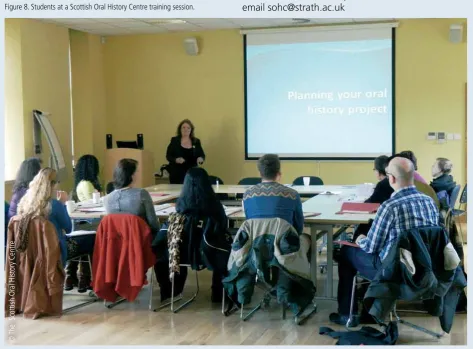
The Scottish Oral History Centre was established at the University of Strathclyde in 1995 as a research and training centre. Since its inception it has been involved in a wide range of training, research and outreach activities designed primarily to encourage the use of ‘best practice’ oral history methodology in Scotland (fig. 8). Over the years the SOHC has provided advice, support and training to a variety of organizations including Glasgow Museums. The SOHC also runs an oral history work-placement programme with Glasgow Museums and other west central Scotland
archives and museums.
The SOHC relocated in 2013 to a new purpose-built centre in the Curran Building at the University of Strathclyde, where it operates as a hub for oral history activity within the wider community. Facilities include a laboratory with 16 workstations for teaching and oral history post-production, space for laptops users, a specialist library, an archive and special-projects room, and rooms for interview recording and editing. The centre provides a lively research environment facilitating new projects and teaching in all aspects of oral history theory and methodology.
The SOHC has an archive containing sound files and some summaries and transcriptions from recent projects, such as those relating to the history of work; the workplace and communities; occupational health; the social impact of deindustrialization; arts and culture and youth and gangs in post-World War II Britain; the Special Operations Executive (SOE) and the wartime Reserved Occupations.
The SOHC team also provide regular training seminars at introductory and advanced levels and are happy to tailor the training for academic or community-based projects and groups. In addition the SOHC hosts a regular seminar series which features ‘work-in-progress’, hosts workshops on oral history theory and practice and runs an annual postgraduate oral history conference. Most recently the SOHC has created links beyond the University of Strathclyde and has developed a strong working relationship with the Centre for Oral History and Digital Storytelling based at the Concordia University in Montréal, Quebec.
Information about the staff and associates and their research interests and projects is available on the SOHC website at:
www.strath.ac.uk/humanities/research/history/sohc/ The SOHC welcome enquires:
The Scottish Oral History Centre
©
The Scottish Or
[image:7.595.62.536.420.769.2]al History Centre
Abrams, L (2010) Oral History Theory, Routledge.
Bartie, Angela and McIvor, Arthur (2013) Oral History in Scotland,
Scottish Historical Review, XCII, April 2013, 108–136.
Clark, Andrew (2015) Collaborating with schools: challenges and
opportunities for oral historians, Oral History, 42, 1, Spring 2015, 107–15. Mackay, N (2006) Curating Oral Histories: From Interview to Archive, Left Coast Press.
Oral History, published biannually: the Journal of the Oral History Society.
Perks, Robert and Thomson, Alistair (eds) (2006) The Oral History Reader, 2nd edition, Routledge.
Roper, M (1996) Oral History, in The Contemporary History Handbook, eds B Brivati, J Buxton and A Seldon, Manchester.
Thompson, Paul (2000) The Voice of the Past: Oral History, 3rd edition, Oxford University Press: a detailed account of the history and development of oral history.
Ward, Alan (1995) Copyright and Oral History: Is your oral history legal and ethical?, Oral History Society: the tool of the trade for oral historians in Britain, which is also available through the website of the UK Oral History Society (see Online Resources).
Online resources
• www.strath.ac.uk/humanities The Scottish Oral History Centre web pages – search for SOHC within the University of Strathclyde website – includes information on oral history training and CPD courses, as well as the research projects and archives of the SOHC, which include a wide range of oral history work relating to west central Scotland. See below for more information.
• www.glasgowlife.org.uk/museums Glasgow Museums’ Collections Navigator, within the Learning and Research/Colleges and Universities pages of Glasgow Museums’ website, provides information on and access to a wide range of oral resources, including the 2000 Glasgow Lives, M74, Glasgow Dockers, Voices from the Yard and Springburn oral history collections.
• www.gcal.ac.uk/archives/witness/ index.html
The website of Glasgow Caledonian University includes recordings of ‘witness seminars’ relating to the Upper Clyde Shipbuilders’ dispute and the Anti-Apartheid Movement.
• www.ourstoryscotland.org.uk/ oralHistory/tales
Information on and extracts from oral history recordings relating to the LGBT community in Scotland.
• www.ed.ac.uk
The School of Scottish Studies, University of Edinburgh, has been collecting oral material since 1951 and hosts the largest audio archive in Scotland, which includes a significant amount of material relating to west central Scotland: search for ‘sound-archive’ within the university’s website.
• www.bl.uk/nsa
The British Library Sound Archive holds numerous oral history interviews relating to west central Scotland, including those with a number of labour activists. They also offer training, in collaboration with the UK Oral History Society (see next entry).
• www.oralhistory.org.uk
The website of the UK Oral History Society provides a wide range of information and resources relating to oral history practice, including training programmes and ethics (such as the Alan Ward guide noted in the bibliography at www.oralhistory.org. uk/ethics/index.php).
• www.wellcome.ac.uk The Wellcome Trust has made transcripts of some of their Wellcome Witnesses to Twentieth Century Medicine seminars available through their website: enter ‘Witness’ into the website search box to locate them.