City, University of London Institutional Repository
Citation
:
Charalambous, T., Kalyvianaki, E., Hadjicostis, C. N. and Johansson, M. (2013).
Distributed Offline Load Balancing in MapReduce Networks. Paper presented at the 2013
IEEE 52nd Annual Conference on Decision and Control (CDC), 10-12-2013 - 13-12-2013,
Florence, Italy.
This is the accepted version of the paper.
This version of the publication may differ from the final published
version.
Permanent repository link:
http://openaccess.city.ac.uk/8182/
Link to published version
:
Copyright and reuse:
City Research Online aims to make research
outputs of City, University of London available to a wider audience.
Copyright and Moral Rights remain with the author(s) and/or copyright
holders. URLs from City Research Online may be freely distributed and
linked to.
City Research Online: http://openaccess.city.ac.uk/ [email protected]
Distributed Offline Load Balancing in MapReduce Networks
Themistoklis Charalambous, Evangelia Kalyvianaki, Christoforos N. Hadjicostis and Mikael Johansson
Abstract— In this paper we address the problem of bal-ancing the processing load of MapReduce tasks running on heterogeneous clusters, i.e., clusters composed of nodes with different capacities and update cycles. We present a fully decentralized algorithm, based on ratio consensus, where each mapper decides the amount of workload data to handle for a single user job using only job specific local information, i.e., information that can be collected from directly connected neighboring mappers, regarding their current workload usage and capacity. In contrast to other algorithms in the literature, the proposed algorithm can be deployed in heterogeneous clusters and can operate asynchronously in both directed and undirected communication topologies. The performance of the proposed algorithm is demonstrated via simulation experiments on large-scale strongly connected topologies.
I. INTRODUCTION
Cloud computing is being rapidly adopted since it enables quick application deployment over a potentially very large pool of commodities with little capital investment and with moderate operating costs. One of the fast emerging Cloud applications is big-data computing that handles massive-volumes of data. Modern applications in this domain employ theMapReduceparadigm [1] to execute scalable and parallel processing of data, leveraging on the scalable infrastructure of Cloud data centers. For example, Google uses MapReduce to execute popular applications such as web search indexing, Google News and Google Maps [2]. Facebook relies on the MapReduce paradigm to perform data warehousing opera-tions [3].
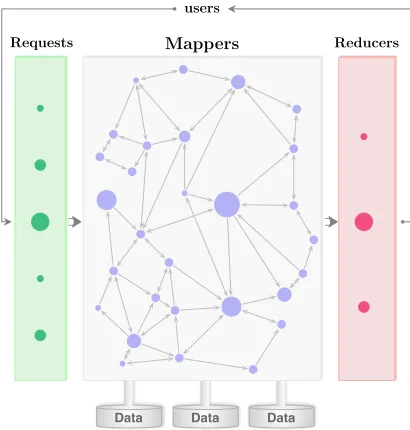
MapReduce is designed for scalable and parallel process-ing of large volumes of data by dividprocess-ing the input data into smaller chunks and distributing its processing into a network of processing elements. It employs a programming model that transforms all input data into key/value pairs for ease of processing. Input data is processed by two successively executed phases: the map and the reduce, also shown in Figure 1. In the map phase, each of the input data chunks is processed independently by a mapper to produce a new list of key/value pairs. In the reduce phase, all pairs with common keys generated in the map phase are merged into a final list of key/values pairs. Scalability is achieved by distributing the workload, first within the network of mappers
Themistoklis Charalambous and Mikael Johansson are with the School of Electrical Engineering, Royal Institute of Technology (KTH), Stockholm, Sweden. E-mails:{themisc,mikaelj}@kth.se.
Evangelia Kalyvianaki is with the School of Informatics, City University London, UK. E-mail: [email protected].
Christoforos N. Hadjicostis is with the Department of Electrical and Computer Engineering at the University of Cyprus, Nicosia, Cyprus. E-mail: [email protected].
Data Data
Data
Requests Mappers Reducers
[image:2.612.333.538.158.373.2]users
Fig. 1. MapReduce model: a user request is first processed by a network of mappers forming a digraph. The result from each mapper is then sent to the reducers to form the final answer. The area of circles represent the volume of data chunks assigned to mappers and reducers. Arrows among mappers represent the exchange ofcoordinatinginformation.
and then within the network of reducers; different mappers and different reducers can be executed in parallel.
MapReduce is designed to achieve high-job completion speedups through parallelism. However, in practice, a job might be significantly prolonged due to imbalances in work-load processing, especially in heterogeneous clusters of nodes [4], [5]. Initial work on MapReduce [1] assumed homogeneous clusters where mappers and reducers are run-ning on nodes with equal processing capacities. In this case, and when the input data set is divided across equally-sized chunks, the completion time of a MapReduce job roughly equals the sum of completion times of atypicalmapper and atypicalreducer. However, in several cases, job completion times were observed to be higher than expected because of
distribution and transfer of data across racks [5]. Therefore, it is important that the workload distribution among mappers and reducers is balanced and the transfer of data across racks is minimized.
Different approaches exist to mitigate the effects of strag-glers at run-time after the detection of a delayed mapper or reducer task. The most common approach replicates the execution of data processed by stragglers using back-up [1] and speculative execution [4] to re-process the data chunks assigned to stragglers. Ananthanarayananet al.[5] present an alternative system that combines specialized solutions based on root-cause analysis of outliers, network-aware placements, and duplication. Ahmad et al. [6] take on-line decisions to balance the communication of the mapping phase based on cluster measurements. Others employ centralized solutions to map tasks or data to nodes prior to application execution. For example, Alma et al.[7] build a job scheduler that assigns MapReduce tasks to nodes in order to meet pre-defined job completion deadlines. Similarly, Xie et al.[8] partition data to nodes for balanced load processing in heterogeneous clusters.
In this paper we present a distributed algorithm to address the problem of balancing the data workload assigned to mappers in massively large-scale clusters that consist of several tens of thousands of nodes [9]. Our goal is to address the load-balancing problem in heterogeneous networks of clustersbeforea job commences to process data. In this way, we avoid the increased network communication overhead resulting from balancing the load at run-time, as measured by [6], and allow for advanced data transfers to nodes prior to execution. Our algorithm works in the following way. When a new MapReduce job arrives, the mappers com-mence to exchange coordinating information locally (with neighboring mappers with which they have a communication link established) about their total job workload demand and capacity, as shown in Figure 1. More specifically, a ratio consensus algorithm is deployed which enables (synchronous and asynchronous) asymptotic convergence to proportional balance among mappers of the data to be processed, in a completely distributed fashion. With proportional balancing, each mapper is assigned workload proportional to its re-source availability (which in general could be time-varying). In this way, we expect all mappers to finish processing simul-taneously with minor variations, thus preventing increased processing time due to imbalances.
The proposed distributed algorithm has the following advantages over other suggested methods (e.g., Gonzalez-Ruizet al. [10]):
(i) The assumption that cluster nodes need to be homoge-neous and have the same resource capacity is lifted. We allow for heterogeneous nodes and the load is distributed according to the nodes’ capacities (in terms of CPU, memory, disk space, etc.). Also, a network topology might be weighted due to different bandwidth capabilities or time-varying delays. (ii) The link-level delay in the exchange of loads between nodes needs neither to be negligible nor synchronous. Our algorithm is shown to exhibit asymptotic converge, even in
the presence of delays, provided that the delays are bounded. (iii) The assumption that the network is undirected is lifted and we consider directed graphs (digraphs). In practical scenarios, the network topology might become loosely di-rected because of delays, packet losses and asymmetric links. In addition, the directed graph structure reduces overhead communication (e.g., there is no need for acknowledgements) and can admit faster convergence.
(iv) The distributed consensus algorithm itself constitutes a novel distributed solution to the problem of workload balancing in heterogeneous large-scale MapReduce clusters. We perform simulations over small- and large-scale strongly connected topologies of mappers. Results show that, unlike other algorithms, our algorithm converges asymptot-ically to proportional balancing in both synchronous and asynchronous settings.
The remainder of this paper is organized as follows. In Section II we provide necessary notation and background on graph properties. Section III presents the model adopted, along with theoretical results that support the use of the sug-gested algorithm. In Section IV we formalize the distributed algorithm for the load balancing problem in heterogeneous MapReduce networks. Section V presents preliminary results with numerical examples from simulations. Finally, Sec-tion VI presents concluding remarks and future direcSec-tions.
II. NOTATION
The sets of real, integer and natural numbers are denoted byR,ZandN, respectively; their positive orthant is denoted by the subscript+(e.g.,R+). Vectors are denoted by small
letters whereas matrices are denoted by capital letters. AT
denotes the transpose of matrix A. By 1 we denote the all-ones vector and by I we denote the identity matrix (of appropriate dimensions). A matrix whose elements are nonnegative, called nonnegative matrix, is denoted byA≥0
and a matrix whose elements are positive, called positive matrix, is denoted byA >0.
Let the exchange of information between nodes (where mappers are located) be modeled by a weighted directed graph G(V,E, P) of order n (n ≥ 2), where V =
{v1, v2, . . . , vn} is the set of nodes,E ⊆ V × V is the set of
edges, andP = [pji]∈R+n×nis a weightedn×nadjacency
matrix wherepjiare nonnegative elements. A directed edge
from node vi to nodevj is denoted by εji = (vj, vi)∈ E,
which represents a directed information exchange link from nodevi to nodevj, i.e., it denotes that nodevj can receive
information from node vi. A directed edge εji ∈ E if and
only ifpji>0. The graph is undirected if and only ifεji∈ E
impliesεij ∈ E.
All nodes that can transmit information to nodevjdirectly
are said to be in-neighbors of nodevj and belong to the set
Nj− ={vi∈ V :εji∈ E}. The cardinality of Nj−, is called
the in-degree of vj and it is denoted by D−j =|N
−
j |. The
nodes that receive information from nodevj are called
out-neighbors of nodevj and belong to the setNj+={vl∈ V :
εlj ∈ E}. The cardinality of Nj+, is called the out-degree
of vj and it is denoted byD+j = |N
+
is called strongly connected if there exist paths from each vertex in the graph to every other vertex. This means paths in each direction: a path from vi tovj and vice versa, for
allvi, vj ∈ V.
III. MODEL ANDAPPLICATION OFTHEORETICAL
RESULTS
In this section, we establish some basic notions that are needed for the development of our algorithm. In the MapReduce paradigm, where mappers (nodes) can exchange information via interconnection links (edges), the exchange of information between mappers can be captured by a digraph (directed graph)G= (V,E).
Each nodevj (mapper) updates and sends its information
regarding its current load and capacity to its out-neighbors (and also receives similar information from its in-neighbors) at discrete times t0, t1, t2, . . .. We index nodes’ information
states and any other information at time tk by k. We use
xj[k] ∈ R to denote the information state (or estimate)
of node vj at time tk. When there exist no delays in the
communication links, each node updates its information state xj[k] by combining the available information received by
its neighbors xi[k] (vi ∈ Nj−) using a weighted linear
combination. More specifically, the positive weights pji[k]
capture the weight of the information inflow from agent vi
to agent vj at time k (note that unspecified weights in P
correspond to pairs of nodes(vj, vi)that are not connected
and are set (without loss of generality) to zero, i.e.pji[k] = 0,
∀εji ∈ E/ ). In this work, we assume that each node vj can
choose its self-weight and the weights on its out-going links εlj, vl∈ Nj+, only. In its general form, each node updates
its information state according to the following relation:
xj[k+ 1] =pjj[k]xj[k] +
X
vi∈Nj−
pji[k]xi[k], k≥0, (1)
where xj[0] ∈ R is the initial state of node vj. If we let
x[k] = (x1[k] x2[k] . . . xn[k])T and P[k] = [pji[k]] ∈ Rn+×n, then (1) can be written in matrix form as
x[k+ 1] =P[k]x[k], (2)
wherex[0] = (x1[0] x2[0] . . . xn[0])T ≡x0. In this work,
we consider a static network (as it is usually the case for distributed resources in applications such as the Cloud) and hence the graph remains invariant. In this case, the weights can be chosen to be constant for all times k (i.e., pji[k] =
pji ∀k), and equation (2) can be expressed as x[k+ 1] =
P x[k].
We will be interested in having the nodes reach asymptotic average consensus, i.e., be able to calculate (for largek) the average of their initial values. In other words, we would like
lim
k→∞xj[k] =
Pn
`=1x`[0]
n ,∀vj∈ V . (3)
Ratio consensus. In [11], an algorithm is suggested that solves the average consensus problem in a directed graph in which each nodevj distributively sets the weights on its
self-link and outgoing-links to beplj= 1+1D+
j
,∀(vl, vj)∈ E,
so that the resulting weight matrixP is column stochastic, but not necessarily row stochastic. Average consensus is reached by using this weight matrix to run two iterations with appropriately chosen initial conditions. The algorithm is stated below for the specific choice of weights mentioned above (which assumes that each node knows its out-degree). Note, however, that the algorithm also works for any set of weights that adhere to the graph structure and form a primitive column stochastic weight matrix.
Lemma 1: [11] Consider a strongly connected graph G(V,E). Let yj[k] and zj[k] (for all vj ∈ V and k = 0,1,2, . . .) be the result of the iterations
yj[k+ 1] =pjjyj[k] +
X
vi∈Nj−
pjiyi[k], (4a)
zj[k+ 1] =pjjzj[k] +
X
vi∈Nj−
pjizi[k], (4b)
whereplj = 1
1+D+j for vl ∈ N
+
j (zeros otherwise), and the
initial conditions arey[0] = (y0(1) y0(2) . . . y0(|V|))T ≡
y0andz[0] =1. Then, the solution to the average consensus
problem can be asymptotically obtained as
lim
k→∞µj[k] =
P
v`∈Vy0(`)
|V| , ∀vj∈ V ,
whereµj[k] =yj[k]/zj[k].
Robustified ratio consensus. An adaptation of the above approach to a protocol where each node updates its infor-mation statexj[k+ 1] by combining the available (possibly
delayed) information received by its neighbors xi[s] (s ∈ Z, s≤k, vi∈ Nj−) using constant positive weightspjiwas
developed in [12]. Integerτji[k]≥0is used to represent the
delay of a message sent from node vi to node vj at time
instant k. We require that 0 ≤ τji[k] ≤ ¯τji ≤ τ¯ for all
k ≥ 0 for some finite τ¯ = max{τ¯ji}, τ¯ ∈ Z+. We make
the reasonable assumption that τjj[k] = 0, ∀vj ∈ V, at all
time instances k (i.e., the own value of a node is always available without delay). Each node updates its information state according to the following relation:
xj[k+ 1] =pjjxj[k] +
X
vi∈Nj−
¯
τ
X
r=0
pjixi[k−r]Ik−r,ji[r],
(5)
fork≥0, wherexj[0]∈Ris the initial state of nodevj;pji
∀εji∈ E formP = [pji]that adheres to the graph structure,
and is primitive column stochastic; and
Ik,ji(τ) =
(
1, if τji[k] =τ,
0, otherwise. (6)
In the absence of delay, we have τji[k] = 0 and one
should point out that the update relation (5) reduces to (1) with constant weights. Equation (5) is just a mathematical way of saying that each node vj considers at time k all the
sent at earlier time steps (i.e.,k, k−1, k−2, . . . ,0) and the assumption of bounded delay means that we only need to consider in the inner summation k, k−1, k−2, . . . , k−τ¯; thus, we make the following assumptions:
(A1) The graph is strongly connected, and the (nonnegative) weightspjiare nonzero (strictly positive) forj=iand (vj, vi) ∈ E, and satisfy P
n
l=1plj = 1 (so that they
form a column primitive stochastic matrixP). (A2) There exists a finiteτ¯that uniformly bounds the delay
terms; i.e.τji[k]≤τ <¯ ∞for all links(vj, vi)∈ E at
time instant k. In addition, τjj[k] = 0for all vj ∈ V
and allk.
Lemma 2: [12,Lemma 2] Consider a strongly connected digraph G(V,E). Let yj[k] and zj[k] (for all vj ∈ V and
k= 0,1,2, . . .) be the result of the iterations
yj[k+ 1] =pjjyj[k] +
X
vi∈Nj−
¯
τ
X
r=0
yji[k−r]Ik−r,ji[r],
zj[k+ 1] =pjjzj[k] +
X
vi∈Nj−
¯
τ
X
r=0
zji[k−r]Ik−r,ji[r],
under Assumptions (A1) and (A2). The initial conditions are y[0] = (y0(1) y0(2) . . . y0(|V|))T ≡ y0 and z[0] = 1,
andIk,ji is an indicator function that captures the bounded
delayτji[k]on link (vj, vi)at iterationk (as defined in (6),
τji[k] ≤ τ¯). Then, the solution to the average consensus
problem can be asymptotically obtained as
lim
k→∞µj[k] =
P
v`∈Vy0(`)
|V| , ∀vj∈ V ,
whereµj[k] =yj[k]/zj[k].
At this stage, this is the only reported distributed coordi-nation algorithm that is able to reach average consensus in directed graphs with asynchronous operation of the nodes. These properties make the robustified ratio consensus suit-able for the application we discuss in the sequel.
IV. WORKLOADBALANCING IN AHETEROGENEOUS
MAPREDUCENETWORK
In this section, we apply the robustified ratio consensus described previously for balancing the workload in massively large-scale (and possibly asynchronous) MapReduce clusters. The suggested algorithm can be applied during either the map or the reduce phase. For simplicity, the current discus-sion describes only the load distribution on the network of mappers.
Consider a new MapReduce jobdthat needs to process a set of input data. The total demand of resources required by din the map phase is given by ρd. We assume that ρd can
be approximately estimated via offline application profiling, e.g., using historical data over similar jobs executed in the same network [7]. We target the problem of dividing the set of input data intovariable-sizedchunks and assign each chunk with a mapper process so that all mappers commence and complete processing synchronously with small differ-ences. In this way, we address the problem of stragglers
due to data processing load imbalances in heterogeneous net-works. To this end, we exploit each mapper (node) according to its capacity, in order to finish its allocated workload at approximately the same time as the other mappers (we say approximately because in this work we treat load as a real number, essentially ignoring any quantization constraints).
We assume that the input data set is stored on a global file system accessible by all mappers, e.g., GFS [13] or HDFS [14], and suppose that each mapper runs on a separate node. A node can be either a physical or a virtual machine (VM). Let πmax
j , ∀j ∈ {1,2, . . . , n}, n = |V|, be the
maximum processing capacity that node vj can provide
towards the map phase. For a single resource type, e.g., CPU resource,πmax
j corresponds to the maximum available CPU
capacity of the node. In the case of a physical machine, the maximum available CPU capacity corresponds to the total capacity of the machine’s CPU, if no other job is being processed at the time. In the case of a VM, πmax
j
equals to the portion of the machine’s CPU that this VM is capped to use; we assume that the virtualization layer enforces strict performance isolation among co-located VMs. We also assume that the node measuresπmax
j using offline
analysis, e.g., [7], based on its current utilization. Also, a network topology might be weighted due to different bandwidth utilizations and delays because of traffic from other jobs in the data center. As a result, some node-to-node paths may be in reality very slow during the execution of information exchange (due to large delays), for example [15], thus making the connection topology a directed graph.
The distributed algorithm converges to a balanced load distribution through information exchange between nodes. At time tk of information exchange between nodes, we
use πj[k] ∈ R to denote the amount of resources that
node vj intends to contribute towards the map phase and
let πmax
j ∀j ∈ {1,2, . . . , n}, be the capacity mapper vj
can provide. As soon as consensus is reached, say after m steps, node vj chooses its state πj[m], 0≤πj[m]≤πmaxj ,
based on the available local information atvj, such that the
total resource demanded ρd is equal to the total amount of
resources offered by the nodes, provided the total capacity of resources available is greater than the demanded one, i.e.,
ρd=
X
v`∈V
π`[m], (7a)
such that 0≤πj[m]≤π
max
j , ∀vj∈ V, (7b)
0≤ρd≤
X
v`∈V
π`max,χmax. (7c)
It is noted in [11] that a simple, feasible solution π† to the problem is given by
πj†=
ρd
χmaxπ max
j , ∀vj∈ V , (8)
which is always less than the capacityπmax
j of CPU resource
atvj. However, for each node vj to be assigned πj†,
knowl-edge of χmax and ρ
d are required at each node vj; these
values have to be computed in a distributed fashion. Each node vj updates its demanded amount πj[k] by
amount of its neighbors (πi[s] s ∈ Z, s ≤ k, vi ∈ Nj−),
according to the following relation:
πj[k+ 1] = 1
1 +Dj+πj[k]+ X
vi∈Nj−
¯
τ
X
r=0
1
1 +Di+πi[k−r]Ik−r,ji[r], (9)
for k≥0, where πj[0]∈Ris the initial state of nodevj.
If we run the two iterations, as in Lemma 2 (withyj[0] =
πj[0]andyj[0] =pimaxj ), we have
lim
k→∞µj[k] =
P
v`∈Vπ`[0]
P
v`∈Vπ
max
` [0] = ρd
χmax, ∀vj ∈ V.
As a result, nodevj can obtain the amount of its load as
lim k→∞µj[k]π
max
j =
ρd
χmaxπ max
j . (10)
The workload offered is found in a distributed fashion and it is equal to the feasible solution noted in (8).
V. NUMERICALEXAMPLES
In this section, we demonstrate the properties and per-formance of our algorithm through simulations for various network types. Comparisons with other approaches are also provided.
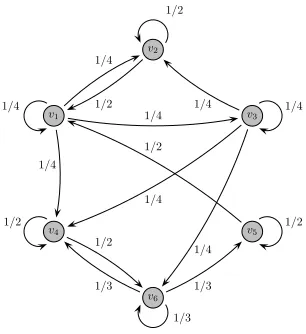
First, we consider a small directed network consisting of six mappers (see Figure 2) in order to illustrate how the algorithm operates. Each nodevj chooses its self-weight and
v1
v2
v3
v4 v5
v6
1/4 1/4
1/2 1/2
1/3
1/2
1/4
1/2 1/4
1/4
1/4
1/4
1/4
1/2
1/2
[image:6.612.320.549.291.402.2]1/3 1/3
Fig. 2. A directed network consisting of six nodes.
the weights on its outgoing links to be(1+Dj+)−1(such that
the sum of all weights assigned by each nodevj to its
out-going links is equal to 1). In this example, the demanded workload amount injected into the network of mappers is given byπ[0] = (15 0 0 0 0 0)T, i.e., all the workload
is passed to the network through one of the mappers (this could be the case in reality). The capacity of the mappers in this network is given byπmax[0] = (3 3 3 3 4 4)T, where
π[0], πmax[0] ∈ Rn
+. We induce asymmetric time-varying
delays1 into the communication between the mappers, with maximum delayτ¯= 5(in the simulations, a link is delayed with a probability0.5, and the magnitude of the delay is an integer chosen with equal probability from{1,2,3,4,5}.
When each node updates its information stateyj[k] using
equation (4a), the information state for the whole network is given byy[k+ 1] =P y[k], where
P=
1/4 1/2 0 0 1/2 0 1/4 1/2 1/4 0 0 0 1/4 0 1/4 0 0 0 1/4 0 1/4 1/2 0 1/3
0 0 0 0 1/2 1/3 0 0 1/4 1/2 0 1/3
.
When delays are present the two iterations proceed accord-ing to equation (9), and the network of resources reaches consensus ρd/χmax = 15/20; this is illustrated in Figure
3. The amount of workload for the MapReduce job offered
0 10 20 30 40 50
0 5 10
15 Ratio at each node vs Number of iterations
Number of iterations
Ratio at each node
Fig. 3. The ratio at each node converges toρd/χmax= 15/20.
in the network by each node is proportional to its resource capacities. In this case, we have resources with two different capacities: four of them have capacity equal to 3, and two of them have capacity equal to 4. Since the ratioρd/χmax = 0.75, then two of the values converge to 9/4 and three of them to 3, as shown in Figure 4. This is achieved by having
0 10 20 30 40 50
0 5 10
15 Workload at each node vs Number of iterations
Number of iterations
Workload
[image:6.612.100.253.428.595.2]at each node
Fig. 4. The amount of workload offered in the network by each node according to (10) in the presence of asymmetric time-varying delays.
the capacity values as the initial conditions for the second iteration, instead of having all ones. Note that delays affect
1By asymmetric time-varying delays we mean that at each of the outgoing
[image:6.612.322.550.530.639.2]the convergence rate; in general, the larger the delays, the lower the convergence rate of the algorithm.
Remark 1: Note that the superiority of the robustified ratio consensus [12], proposed for this application, over other approaches in the literature (e.g., [16]) is justified indirected
networks and inasynchronous operation. In these cases, no comparisons are possible since existing algorithms cannot be used.
In the following example, we consider a set of 500
mappers each with initial workloadπj[0] = 3. However, half
of them have capacity πmax
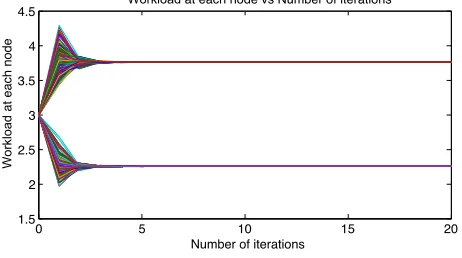
j = 3and the other half πimax= 5, i 6= j. By ratio consensus, according to equation (9), with no delays, the network of resources reach consensus ρd/χmax= 0.75. As a result, half of the values converge to 9/4 and the other half to15/4, as shown in Figure 5.
0 5 10 15 20
1.5 2 2.5 3 3.5 4
4.5 Workload at each node vs Number of iterations
Number of iterations
Workload
[image:7.612.61.292.251.380.2]at each node
Fig. 5. The amount of workload offered in the network by each node according to (10) for a set of500mappers, with no delays.
It is important to note that the time required to converge to the proportional workload would not differ much (or at all) for more mappers in the network, since the information and adaptation is made locally. Traditional schedulers in Hadoop [17]—the popular MapReduce implementation— implement incremental assignments of fixed-size chunks to mappers, i.e., every time a mapper has finished processing a chunk, it notifies the scheduler and receives the next chunk. This scheme requires direct communication of hundreds of thousands of mappers directly with the scheduler multiple times, leading to increased numbers of messages exchanged. Our approach, requiring only local information sharing, shows fast convergence to the aggregate workload that each mapper eventually processes.
VI. CONCLUSIONS
Motivated by real-world conditions of node heterogeneity and existence of delays, we proposed a distributed algorithm for workload distribution in MapReduce networks of clusters. Our suggested algorithm allows mappers on heterogeneous nodes to operate asynchronously and converge asymptot-ically to proportional workload balancing between them, with limited local information exchanges. The algorithm was shown to converge to the exact proportional workload
in directed networks in the presence of delays, something that cannot be achieved by classical consensus algorithms. The properties and performance of the suggested algorithm were illustrated for small and large-scale strongly connected topologies of mappers. The algorithm was compared with alternative algorithms for workload balancing.
REFERENCES
[1] J. Dean and S. Ghemawat, “MapReduce: simplified data processing on large clusters,” inProceedings of the 6th Symposium on Operating Systems Design & Implementation (OSDI). ACM, 2004, pp. 137–150. [2] “SIGMETRICS tutorial: MapReduce The Programming Model and Practice,” online, 2009, http://research.google.com/archive/papers/ mapreduce-sigmetrics09-tutorial.pdf.
[3] A. Thusoo, Z. Shao, S. Anthony, D. Borthakur, N. Jain, J. Sen Sarma, R. Murthy, and H. Liu, “Data warehousing and analytics infrastructure at Facebook,” inProceedings of the 2010 ACM SIGMOD International Conference on Management of Data, 2010, pp. 1013–1020. [4] M. Zaharia, A. Konwinski, A. D. Joseph, R. Katz, and I. Stoica,
“Improving MapReduce performance in heterogeneous environments,” inProceedings of the 8th USENIX Conference on Operating Systems Design and Implementation (OSDI), 2008, pp. 29–42.
[5] G. Ananthanarayanan, S. Kandula, A. Greenberg, I. Stoica, Y. Lu, B. Saha, and E. Harris, “Reining in the outliers in MapReduce clusters using Mantri,” in Proceedings of the 9th USENIX Conference on Operating Systems Design and Implementation (OSDI), 2010, pp. 1– 16.
[6] F. Ahmad, S. T. Chakradhar, A. Raghunathan, and T. Vijaykumar, “Tarazu: optimizing MapReduce on heterogeneous clusters,” in Pro-ceedings of 17th Conference on Architectural Support for Program-ming Languages and Operating Systems (ASPLOS), 2012, pp. 61–74. [7] A. Verma, L. Cherkasova, and R. H. Campbell, “ARIA: automatic resource inference and allocation for MapReduce environments,” in
Proceedings of the 8th ACM International Conference on Autonomic Computing (ICAC), 2011, pp. 235–244.
[8] J. Xie, S. Yin, X. Ruan, Z. Ding, Y. Tian, J. Majors, A. Manzanares, and X. Qin, “Improving MapReduce performance through data place-ment in heterogeneous Hadoop clusters,” inIEEE International Sym-posium on Parallel & Distributed Processing, Workshops and PhD Forum (IPDPSW), 2010, pp. 1–9.
[9] E. Kotsovinos, “Virtualization: blessing or curse?”Queue, vol. 8, pp. 40–46, 2010.
[10] A. Gonzalez-Ruiz and Y. Mostofi, “Distributed load balancing over directed network topologies,” inProceedings of the American Control Conference (ACC), 2009, pp. 1814–1820.
[11] A. D. Dom´ınguez-Garc´ıa and C. N. Hadjicostis, “Coordination and control of distributed energy resources for provision of ancillary services,” in First IEEE International Conference on Smart Grid Communications, 2010, pp. 537–542.
[12] C. N. Hadjicostis and T. Charalambous, “Asynchronous coordination of distributed energy resources for the provisioning of ancillary services,” inProceedings of the49thAnnual Allerton Conference on
Communication, Control, and Computing (Allerton), September 2011, pp. 1500–1507.
[13] S. Ghemawat, H. Gobioff, and S.-T. Leung, “The Google file system,” in Proceedings of the 19th ACM Symposium on Operating Systems Principles (SOSP), 2003, pp. 29–43.
[14] K. Shvachko, H. Kuang, S. Radia, and R. Chansler, “The Hadoop distributed file system,” IEEE 26th Symposium on Mass Storage Systems and Technologies (MSST), pp. 1–10, 2010.
[15] T. Benson, A. Akella, and D. A. Maltz, “Network traffic characteristics of data centers in the wild,” in Proceedings of the 10th Annual Conference on Internet Measurement (IMC), 2010, pp. 267–280. [16] L. Xiao, S. Boyd, and S. Lall, “Distributed average consensus with
time-varying metropolis weights,” inProceedings of the International Conference on Information Processing in Sensor Networks (IPSN), 2005, pp. 63–70.