
JOURNAL OF VIROLOGY, Jan.1978,p.339-348 Copyrighti 1978 AmericanSocietyforMicrobiology
Vol. 25, No. 1 Printed inU.S.A.
Comparison of Two Viable Variants of Simian Virus 40
ALAN C. KAY, G. R. KOTESWARA RAOt, AND MAXINE F. SINGER* Laboratoryof Biochemistry, National Cancer Institute, Bethesda, Maryland20014
Received for publication19July1977
The DNAs oftwo viable strains of simian virus 40, 776 and 777, have been compared by using restriction endonucleases. Differences between the two strains were detected at five separate points on the simian virus 40 genome. One of thesedifferences, in the region of DNA coding for the major viral coat protein, was confirmed bytryptic peptide analysis of coat proteins from thetwostrains. Somephysiologicaldifferences betweenthe twostrainswere examined andcan, ingeneral, be explained by differences observed between the DNAs of thetwo strains. In addition, defective variants derived from strain 777 interfere more
efficiently with the replication of strain 777 than with the replication of strain 776.
Theexistence of viable variant strains of sim-ian virus 40 (SV40) that differ in plaque size,
oncogenicity, and temperature sensitivity (34), aswell as in host range (22) and in immunolog-ical properties (23), has been known for some time. The variants have been designated as large-, small-, or minute-plaque strains. Some strains havemoreprecisedesignations (e.g., 776, 777, Rh 911, etc.). Differences in the size of someof thefragments producedfrom the DNA of variantsbycombined action of therestriction endonucleases Hindll and HindIm (endo R *HindII/R HindIII[32]) have been observed (19, 20), and electrophoretic differences have been found between the major capsid proteins oflarge andsmall-plaquestrains (1).
Maps of the digestion products of SV40 DNA
byvariousrestriction enzymes are now available, including those of endoR HindII, R-HindI (5,37),R *EcoRll (33),R Hae III(33, 38), and R-Alu I (12, 39). Also, genetic analyses and
transcriptionstudies have indicated the approx-imate regions coding for the four known viral-coded proteins: T-antigen, VP1, VP2, and VP3 (3, 13, 35), and these studies have been con-firmed and extended by complementation of temperature-sensitive mutants with wild-type restriction fragments (15) by linked
transcrip-tion-translationof viralproteins from restriction
fragments (29) and by nucleotide sequence de-termination (36). It is, therefore, now possible
tocorrelatedirectly differences between variant
DNAs as seen inrestrictionendonuclease stud-ies with alterationsinviral-coded proteins and attemptto explainphysiological variations
be-tweenvirusstrains.
t Present address:DepartmentofBiochemistry,Institute ofMedical Sciences, Banaras Hindu University, Varanasi,
221005India.
We report here more detailed analyses of a
large-plaque strain (777) and a small-plaque
strain (776), using endonucleases R-HindII, R HindlI, R HaeIII,and R-Alu I. The dif-ferences between the two strains were located
onthe SV40 map. Oneparticular difference in theregion codingfor viralcoatproteinwas con-firmed by demonstrating differences between thetrypticpeptide patternsof the twoisolated viralproteins.
MATERLALS AND METHODS Cellsand virusstocks.All experimentswere car-riedoutwith theBSC-1 line ofmonkeykidney cells. Cells were cultured as described previously (17). Stocksofplaque-purified SV40, strains776 and777,
werekindly provided byDaniel Nathans andErnest Winocour, respectively. Theplaque from which the 777 stock was derived was named CVB (16). New stockswerepreparedinthislaboratory by infecting
confluentmonolayersof BSC-1 cellsatmultiplicities of infection(MOI) of less than10- PFU/cell. When thecytopathiceffectwascomplete, thelysateswere
collected and treated as previously described (16). ViruswastitratedbyplaqueassayonBSC-1 monolay-ers(16).
Defective virus stocks were all derivatives of the passage seriesdesignated CVB,seriesoneinprevious papers,and the serieswasoriginallyinitiatedwitha
stockofCVB(777),(16,25,28).
Labeling of cultures and preparation of la-beled DNA forrate studies. At varioustimesafter infection(timesindicatedwith eachexperiment),the mediumwasremoved from platesandreplacedwith identical fresh medium (modified Eagle no. 2 with 2% bovine fetalserum)containing 10ytCiof
[methyl-3H]thymidine(about 20Ci/mmol,NewEngland Nu-clearCorp., Boston, Mass.) per ml. After further in-cubation at37°Cfor the times indicated in each ex-periment, the radioactive mediumwasremoved,the cells were washed twice with ice-cold
phosphate-339
on November 10, 2019 by guest
http://jvi.asm.org/
340 KAY, RAO, AND SINGER
buffered saline, and viral DNA was isolated by the procedure of Hirt(10). Samplesof the Hirt superna-tantfluids were made 1 M in NaOH, incubated at 100°C for 20 minand neutralized withHCl,andthen DNA wasprecipitated byaddition of anequalvolume of 20% trichloroacetic acid. More than 95% of the DNA inthesupernatantfractionobtainedbythe Hirt procedurefrom SV40-infectedcells is generallyviral DNA (10, 17),and the totalacid-precipitable radioac-tivity inthose supernatant fractions was,therefore, taken to represent synthesis of viral DNA in rate studies.
InhibitionofviralDNA synthesis by defective virus.BSC-1 cellswere grown toconfluency in 16-mmminiwells(ca. 8x 10⁴cells perwell).Wells were infected at different MOI withwild-typevirus(776or 777) in the presence and absence of CVP8/1/P4, a defective virus derived from777.A0.1-mlportionof undiluteddefective virus stockwasused.All infections werecarriedoutin atotal volume of 0.2 ml. After2h ofadsorption at37°C, the infection media were re-moved,Eagleno. 2 with 2% fetal bovineserum was added,and incubationat37°Cwascontinued. Thirty-six hoursafterinfection,thecellswerelabeled for1h with 0.2 ml of fresh medium per wellcontaining
[3H]-thymidine (20,uCi/ml). Viral DNA was isolated by theprocedureof Hirt(10).Duplicate 5O-il aliquotsof each Hirt supernatant (0.3 ml, total volume) were taken,treatedasabove,and counted.
Restriction endonuclease analyses. Strain 777 DNA wasextractedfrom infected cellsbythemethod of Hirt (10), and form I DNA was purified bytwo bandings in CsCl-ethidium bromide gradients (24). Strain 776 DNAwasobtaineddirectlyfrompurified viralparticles, and form I DNAwaspurified by one centrifugationinCsCl-ethidiumbromide.
Endo R HindII/R*HindIll were prepared by G.R.K.R.and RobertDiLauro; endo R Hae III was prepared by R.D.; and endo R AluI wasprepared byR.D.andA.C.K., usingthe methods of Smith and Roberts etal. (31,26,27,respectively). EndoR EcoRI (Miles)was acommercialpreparation.
Incubationscontained,inavolume of 90
pi,
1,ugof DNA;inthe case of mixeddigests,0.5,ugeachof 776 and 777 form I DNA. Endo R-HindII/R HindIII digestswerecarriedoutinthe presence ofasolution containing6.6 mM Tris-hydrochloride (pH 7.5), 8.7 mMMgCl2,and35mMNaCl.Endo R Hae IIIdigests containedasolution of 6 mMTris-hydrochloride(pH 7.9),6mMMgCl2,and6mM2-mercaptoethanol,and endo R-Alu I digestscontained 10mMTris-hydro-chloride(pH7.6)-7mMMgCl2-7mM 2-mercaptoeth-anol. Incubations were started by adding sufficient enzymetodigest twice the amount of DNApresent in anovernightincubation,asdeterminedpreviously bytitration. Incubationwascarriedoutovernightat
370C in stoppered tubes. Fresh enzyme was then added,and incubationwascontinued for several hours. The reactionwas stoppedby addition of 10 ul of a solution containing 2.5% sodium dodecyl sulfate (SDS),60%glycerol,and 0.1%bromophenolblue.
Electrophoresis was carriedout onpolyacrylamide slabgels (16by14by0.15cm). The4%/6%gelswere madebypolymerisinga6%acrylamidesolution (acryl-amide-bisacrylamide, 25:1) in the bottom two-thirds
of thegel and then a 4% solution (acrylamide-bisac-rylamide, 20:1) in the top one-third of thegel.Other gels were made entirely with the 6% solution. Gels andrunningbuffer contained 0.04 M Tris base-0.02 Msodium acetate-0.002 M EDTA brought to pH 7.8 withglacial acetic acid. Gels were prerun for at least 15min at 100 V. Samples ofdigestscontaining between 0.2 and 0.5 ,ug of DNA were layered on the gel and were run at 100 V until the marker dye was at the bottomof the gel (3 to 5 h).
Gelswerestainedby immersing them in 500 ml of watercontaining 0.5 ,ug of ethidium bromide per ml for 25 min. Gels, supported by a quartz plate, were illuminatedwith a short-wave UV-light box (Minera-light,model C-51, Ultra-Violet Products Inc., San Ga-briel,Calif.) andphotographed through an A-23 filter (Kodak) withPolaroid 57film. The intensity of the DNA bands is proportional to the concentration of nucleotide bases present, i.e., a large fragment will show a more intenseband than a smaller fragment present inequimolaramounts.Therefore,aband hav-ing a greaterintensitythan that of a bandmigrating moreslowlyinthegelindicates thepresence of more than one fragment in that band. Similarly, a low relativeintensityindicates that afragmentissubmolar with respect to other bands. Bands were identified as those characterizedinprevious workby bothvisual comparison of the relative size of bands on asingle gelandbysemilogarithmic plotsof sizeagainst mobil-ity.
Trypticpeptide analysis.Radioactive virus was
prepared byinfecting BSC-1cellswith either 776 or 777 (about10PFU/cell), adding labeled media from 20 to 92 h after infection, andthen letting infection go tocompletion.Radioactive virus waspurifiedfrom thelysates bythe method ofPagano (24).
Strain 776 was labeled with both [14C]lysine and ["4C]arginine (10 ,uCi of [14C]lysine per ml, specific activity, 300mCi/mmoland 5,uCiof["4C]arginineper ml, specific activity,312mCi/mmol wasused for la-beling).Strain777waslabeled in twoparallel prepa-rations, one with [3H]lysine (using 10 yCi/ml; spe-cificactivity,38.9Ci/mmol)and the otherbatch with [3H]arginine(10,uCi/ml;specific activity,23Ci/mmol). The radioactive viral preparationswere disrupted with SDS in2-mercaptoethanol at 1000C and sepa-rated onSDS-polyacrylamide gels,using the system ofLaemmli (14) with a 15% acrylamide running gel and a 4% stacking gel. The positions of the viral proteins were localized by autoradiography for the
'4C-labeled776 and byfluorography (2) forthe two
3H-labeledpreparations of 777. VP1 and VP2 run close together, butformdistinctbands. To minimize con-tamination withVP2,onlythetop two-thirds of the VP1 bands wasexcised from thegels.
The gel slice containing the 14C-labeled 776 VP1 wasreswollenin 4ml of 1% ammoniumbicarbonate; thesolutionwasdiscarded;4ml offresh solution was addedalongwith160,ug oftolylsulfonylphenylalanyl chloromethylketone(TPCK)-treated trypsin (Worth-ington), and the mixturewasincubatedovernightat
370C.
Theammonium bicarbonate solutionwaspipet-ted off andstored; 3ml offresh solutioncontaining
90
jig
ofTPCK-treatedtrypsinwasadded; and incu-bation continued overnight. This solutionwas thenon November 10, 2019 by guest
http://jvi.asm.org/
pipetted off andpooledwith the first. Thepoolwas centrifugedtoremovesmallpiecesofpolyacrylamide andgelpaperbacking.A25-.ugamountof freshtrypsin was added tothe supernatant fluid, andincubation wascontinued for6h.The solution was lyophilized todryness,taken up in10mlofwater, andlyophilized again.Thisprocedurewasrepeatedtwice.
The gel slices containing the 3H-labeled VPls of the two 777 preparations were treated in the same way, except that the gelslices were first swollen in waterandthen soakedovernightindimethylsulfoxide to removethe2,5-diphenyloxazolethatwasin thegels because of thefluorographyprocedure.
Thetrypticpeptideswereanalyzedon anAminex A-5 (Bio-rad) column (0.2 by 15 cm, Altex), equili-bratedin 0.05 Npyridine adjustedtopH2withformic acidatatemperature of 500C (maintained bya cir-culatingwaterjacketaround the column), keepinga constantflowrateof 6ml/hwithacheminertmetering pump(Chromatronix),the pressurevaryingfrom 200 to400lb/in2. Samplewasappliedinthesamebuffer with asampleloopattacheddirectlytothe top of the column,and the columnwaswashed withthisbuffer. Fractions (0.25 ml) were collecteddirectly into Bio-vial(Beckman) scintillation vials.Aftercollecting20 fractions, alineargradientofstartingbuffer and 1N pyridine, adjustedtopH4.9with acetic acid (15ml ofeach),waspassed throughthecolumn, followedby awash with 1N NaOH(about 7.5ml).The column wasregeneratedby washingwitha10-mlsolutionof 0.2N pyridine, 10mlof 0.2 Npyridine-formate (pH 2)then10mlofstartingbuffer.
A 0.35-ml amount of water was added to each fraction followed by3ml ofAquasol (NewEngland Nuclear), andsampleswere counted for5mineach inaBeckman LS-355liquidscintillationspectrometer. 3Hcountswerecorrected for14Cspillover.
Themethods fortrypsinization directly in thegel slices andfor thetrypticpeptide analysiswerekindly
suppliedbyC. Cole of StanfordUniversity. RESULTS
DNA digestionwith restriction
endonu-cleases.Form IDNA
(covalently
closedsuper-helical circles) from SV40 strains 776 and 777 were digested either
singly
or together with either the combined endonucleases RHindII/R- HinduI or with endonucleases R Hae IIIorR-AluI,and the
digestion
products
wereseparated by
electrophoresis
onpolyacryl-amide gels (Fig. 1). This methodwill
generally
separate DNA
fragments
on the basis ofsize,
but base
composition
mayalsoinfluencemobil-ity(19, 40).The variousfragments observedand
their estimated sizes are summarized in Table
1.Thepositionof the variousendonuclease frag-ments onthe SV40genomeareshown inFig.2. To piece together the results obtained with the various restriction endonucleases, we will
start nearthesingleendoR EcoRIsiteonthe SV40 genome (zero on the map inFig. 2) and work clockwise, assuming that a difference of
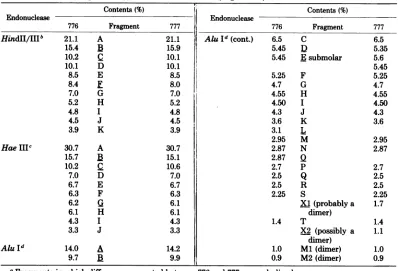
mobilityinthegelsindicates adifferencein size. TheendoR *HindIII/R HindIl-Ffragment of 777is smaller than that of 776. The endo R Hae
Il-B fragment (Fig. 2) is also smaller in 777 than in 776, and to about the same extent as the difference between the HindII/HindIII-F fragments(0.3 to 0.4% of the totalSV40 genome length). The endo R-Alu I-L fragment of 776, which is fully contained within the endo R *HindII/R-HindIII-F region, is not seen in
the 777 digests. The results aretherefore
con-sistent withadifference, probablyadeletionof about 20 basepairs, betweenmappositions 0.02
and0.05. The endo R-EcoRI site at map
posi-tionzerois present in both 777and 776. How-ever,the size ofthe endoR Alu I-L fragment of 776 is 3.1% ofthe SV40 genome length (39),
and, ifthe only difference in 777 was a 0.3 to 0.4% deletion, one would expect to see a
frag-mentof about2.6to2.7% in the endo R * Alu I digest of777.It ispossible that the extra material
apparently associated with the endo R * Alu I-M, N region in 777 corresponds to the endo R-Alu I-L of 776, butseveraladditionalsmaller fragments are also notedso thatthisregion of 777 may be cleaved more extensively by endo R-Alu I than is 776. Also, theendoR *Alu I-E fragment is adjacent to the endo R Alu I-L fragment, and thetwo submolarbands seen in the 777digest,onemovingequallywith the 776 endo R-Alu I-E fragment, and one moving
slightlyslower, probablyarise from this region (seebelow).
Next,the endo R * Hae III-C fragment of 777 islargerthan that of 776. Endo R-Alu I-I, and
-Q fragments seem to be identical in 776 and
777 (and both strains have the single endo R *Bam I site at position 0.17), but the endo R *AluI-Afragmentof777appears tobelarger
than that of776. The differencewould,
there-fore, lie between map positions 0.175 and 0.21. This region is contained within the endo R-HindII/R-HindIII-B fragment, and, in the
mixed 776 and 777 digest, the endo
R
HindII/R
HindIl-B
fragments seem toseparateslightly, providingfurther
confirmation
that thisregionisaffected.
Theendo R-Alu I-Bfragmentof 777 is larger than that of 776. This fragment is contained within theendo R*
Hindll/R
*HindIII-Afrag-ment and shares sequences with the endo
R-Hae III-E and -A fragments. We do not
see a difference between the endo
R
HindII/R
-HindIII-A fragments of 776 and777, butasmall differenceinsuch alarge frag-ment would not be readily noticeable. (In
un-published experiments, T. Vogel has observed that endo R
HindII/R
-HindIII-A of 777 isslightly largerthan thecorresponding 776
on November 10, 2019 by guest
http://jvi.asm.org/
FIG. 1. Polyacrylamide gel electrophoresis ofre8triction endonucleasefr-agmentsderivedfr-om 776and 777form IDNA with EndoRB HindH/IR HindIII, Endo RB HotIII, and Endo B Alu I. (A) A 4%/6%
polyacrylamide gel ofrestriction fr-agments produced by endo B HindIIIRB HindIII (slots 1 through 3), endo B Hae III (slots 4 through 6% and endo B Alu I(slots 7 through 9). In each series, the firstslot containsa digest of776DNA, the secondadigestof777DNA,and the thirdamixeddigest ofboth DNAs. Each sample contained about 0.3 u.g ofDNA. In slots 1 through 3 there appears to be some material migratingbetween the endoB
HindIIIRB
HindIII-I and-Jfragmnents.Thiswasnotnotedonother occasionsandseemstobespurious. (B)A 6%polyacrylamidegel ofrestrictionfr-agmentsproduced byendo R Hot III
(slots1through 3)and endo B Alu I(slots4through 6). The orderofDNAs is thesame asinFig.1A. Each sample contained about 0.3gLgofDNA. (C) The bottomportion ofa 6%polyacrylamidegel ofrestriction
fr-agmentsproduced byendo B-Alu I. In this case, eachsamiplecontained about0.45pgof DNA, and the photographwastaken withalongerexposure.
on November 10, 2019 by guest
http://jvi.asm.org/
[image:4.505.68.464.61.540.2]TWO VIABLE SV40 VARIANTS 343 TABLE 1. Comparison of restriction endonucleasefragmentsofSV40strains 777 and 776a
Contents(%) Contents (%)
Endonuclease Endonuclease
776 Fragment 777 776 Fragment 777
HindII/IIIb 21.1 A 21.1 AluId (cont.) 6.5 C 6.5
15.4 B 15.9 5.45 D 5.35
10.2 C 10.1 5.45 E submolar 5.6
10.1 D 10.1 5.45
8.5 E 8.5 5.25 F 5.25
8.4 F 8.0 4.7 G 4.7
7.0 G 7.0 4.55 H 4.55
5.2 H 5.2 4.50 I 4.50
4.8 I 4.8 4.3 J 4.3
4.5 J 4.5 3.6 K 3.6
3.9 K 3.9 3.1 L
2.95 M 2.95
HaeIIIc 30.7 A 30.7 2.87 N 2.87
15.7 B 15.1 2.87 Q
10.2 _ 10.6 2.7 P 2.7
7.0 D 7.0 2.5 Q 2.5
6.7 E 6.7 2.5 R 2.5
6.3 F 6.3 2.25 S 2.25
6.2 Q 6.1 Xl (probably a 1.7
6.1 H 6.1 dimer)
4.3 I 4.3 1.4 T 1.4
3.3 J 3.3 X2 (possibly a 1.1
dimer)
Alu Id 14.0 A 14.2 1.0 Ml(dimer) 1.0
9.7 B 9.9 0.9 M2(dimer) 0.9
aFragmentsinwhichdifferences are noted between 776 and 777 are underlined.
bEndoR HindII/R HindIII. Thedistances migrated bythe variousfragmentsin the gel (Fig. 1A) were
measured. Asemilog graph, using publishedvalues for the size of the endo R HindII/R HindIIIfragments of776 expressed aspercentage of total SV40genomelength (38),wasconstructed, and the sizes of the777
fragments were estimated. Certain ofthe size differences between fragmentsfrom 776 and 777 have been notedpreviously (19, 20).
cEndo R-HaeIII. A similar graphwasconstructedusingdistances obtained inthe 6%gel (Fig. 1B) and
publishedvalues forthe endo R * HaeIIIfragmentsof 776(38).The sizes of the 777fragmentswereestimated. dEndoR Alu I. Agraphwasconstructed, using publishedvalues for the endo R Alu I-A to -S fragments of776 (39) but omitted theAlu I-Bfragment. Thepublishedvalue for thisfragment is 11.1% of the SV40 genome length. Inourgelsystem, boththe 776 and777Alu I-B fragments migrateconsiderablyfaster than expectedforthe 11.1%size.Therefore,ourvaluesforthe Alu I-Bfragmentswerecalculated from thegraph. Forboth 776 and 777, the sizes offragmentssmaller than Alu I-S were estimated fromFig.1C, using published values for the776Alu I-L to -Sfragments.The endo R Alu I-D to -F fragment region of thegeliscomplex. The endo R* Alu I-Ffragmentsof 776 and777appear tobe identical. The endo R Alu I-D and -Efragments of 776migratetogether. In777,afragmentrunsbehindthe endo R Alu I-Ffragmentbutapparentlyfaster than the 776 endo R *AluI-Dand -Efragments.There is another 777 endo R Alu Ifragment runningequally with the 776endo R AluI-D and -Efragmentsandalso anotherfragment running justbehind thisposition. These lasttwo 777fragmentsappear,from theirintensity, tobesubmolar. Thesetwo submolar bands have beendetected in endo R *AluIdigestsof threedifferentpreparationsofformI777DNA.All the DNAswere
preparedfrom cellsinfectedatlowMOIwithplaque-purifiedvirus.Strain777appearstolack the endo R Alu I-L and -O fragments found in 776 (Fig. 1B and C), and the 777 digest contains severalsmall fragments, labeled Xl andX2,whichappear, from theirintensities, tocontainmorethanonefragmentandare notseen in the 776digests.Apreviouslyunidentified bandmigratingbetween endo R Alu I-S and Xl isseeninboth 777and 776digests.
ment.) The sameappliestotheevenlarger endo
R-Hae III-A fragments. With a smaller
frag-ment, such asthe endoR Hae III-Efragment,
we should be able to see this difference, but none is apparent on the gels. By elimination then, thedifference lies between mappositions
0.54and 0.585.Another, less likely, explanation
is that 777 is missing the endo R-Alu I site
clockwise from the B fragment (39); however,
the observed differenceinsize ofthe endo R* Alu I-B fragments of the two strains is not large
enoughtobeexplainedin thisway.
The endo R-HindII/R HindIII-C fragment of777issmallerthanthatof 776. The situation
on November 10, 2019 by guest
http://jvi.asm.org/
344 KAY, RAO, AND SINGER
FIG. 2. Circularmapof theSV40genomeshowing
restriction endonucleasesitesof776 DNA. Themap was drawnfromdatapresentedinreferences5 and 37for endo R HindIIIR HindIII, reference 33for endoR*HaeIII,and inreference39forendo R Alu
I.
is thesamewith the endo R*HaeIII-Gfragment
of 777. TheregionoftheSV40genomeinwhich
the endo R-Hae III-G fragment is found has
been showntobe anomalousuponendo R* Hae Im digestion (12, 18), but the anomalies were
attributedtothe method ofenzymepreparation
rather thantothe DNA used (18).Inourcase,
since thesameenzymepreparationwasusedon
twoDNAs, and since the mixeddigestshowsa
mixed pattern, the differences appear to arise
fromthenatureof thetwoDNAs. Nodifference can be seen inthe endo R*Alu I-Rfragments (andboth 777 and 776contain the singleendo R-Hap II site located within Alu I-R), but,
whereas in the 776 endo R*Alu Idigest the-D and -Efragmentsrantogether,inthe 777digest afragment ran slightlyfaster. Considering the
evidence of the endo R*HindII/R *HindIIIand endo R-HaeIm digests,thisfragment probably
arises fromthe endo R*Alu I-Dregion (which
iswhyweconsider thatthetwosubmolarbands observed in thisregionofthegelarise fromthe endo R AluI-E portionof the SV40 genome).
The difference between the twostrains, there-fore, lies between the endo R*Hae III-M/-G junctionand the endoR*AluI-D/-Rjunction, i.e., betweenmappositions0.66and0.71.
Finally,the endo R-AluIdigest of777
pro-ducesno fragment migratingatthe positionof
the 776 endo R*AluI-0 fragmentoranyextra fragment migrating close by. There does not
appeartobeanysignificant differencebetween
the two strains with respect to their endo R HindII/R * HindIII-D fragments. Endo R HaeIII cuts thisregion of the SV40 genome into piecestoo small for us to see on our gel. Thesimplest explanation is that in 777 the endo R Alu I-0 region contains at least one extra endo R-Alu Isite, created possibly by a single
base pair change, and that some of the small endo R-Alu I fragments found in 777 but not
in 776arise from thisregion of the genome. Peptide analysis. The endo R * Alu I-L and -Efragments lie in that part of theSV40 genome that codes for the major viral capsid protein VP1(27, 35). We,therefore, analyzed the tryptic
peptides obtained from purified VPls of both 776 and 777. One (776) waslabeled simultane-ously with both[14C]lysineand[14C]arginine in ordertolabel all thetryptic peptides.The other virus (777)waslabeled intwoparallel prepara-tions with either[3H]lysineor[3H]arginine.VP1 contains about 40 to 50 lysines and arginines
(34).
Thepatternobserved with VPls from 776 and 777,labeled in bothlysineandarginine (the two
3H-labeled777 preparations were mixed in this
experiment),areshown inFig.3.It canbe seen that while the pattems are basically similar,
there areseveral differences. The 776 prepara-tion hasapeptideeluting just beforepeak 1 of 777. This is reflected in a low 3H-14C ratio in this region. The 776 VP1 appears tolack both
peaks 5 and 7 found in the VP1 of 777.
Also,
from the 3H-14C ratio, 777 appears to have an
extrapeptideinpeak10. Fromsimilarcolumns run with VP1 from 777 labeled only in either lvsine orarginine, allthepeptides found in 777 but not in 776 VP1 are lysine peptides (data
notshown). Sincethere are somanypeptides,
counts neverreallyfelltobase linelevels, mak-ing itimpossibletoquantifyaccurately the num-ber ofpeptides in a peak. It seems, however,
thatthe 777 VP1 iS missing onepeptidefound inthe 776 VP1 but has atleastthreeadditional
lysine peptides. Such apattern cannot arise if the only difference between the DNAs of 776 and 777 in theregioncodingfor theirrespective VPls isa
simple
deletioninthe Alu-Lfragmentof777.
Physiological comparison of strains 778 and777. Figure4shows therateof viral DNA synthesisatvarious times after infection of the BSC-1 line ofmonkey kidneycells with either strain 776 or 777 at an MOI of 10 PFU/cell.
The rateswereestimatedbymeans of 1-h label-ing periodswith
[3H]thymidine.
Other experi-ments (data notshown) indicated that the in-corporation of[3H]thymidineintoviral DNA of eitherstrain is linear from timezeroofthepulse J. VIROL.on November 10, 2019 by guest
http://jvi.asm.org/
[image:6.505.71.256.55.265.2]U
x
I q
5_ 4 o
0
3 x
o0
40 50 60 70 80 90 100 110 FRACTION NUMBER
FIG. 3. TIyptic peptide patterns of VPls from strains 776 and 777.Onepreparation of VP1 of776 labeled in both lysine and arginine with '4C and twopreparations of VPI from777, onelabeled with
I3H]lysine
and the other with pHiarginine, werepurifiedanddigestedwithtrypsin.Thefigureshows thepeptidepatterns obtainedon anAminex-A5 col-umnforamixtureofthe14C-labeledVP) of776and
theLH]lysine-and
PH]arginine-labeled
VP1sof777. Theinputratiooff3H]lysine-to-[3H]arginine counts inthe mixture was4.7:1; thisratio was calculatedconsideringthe ratioof 114C]lysine to['4C]arginine used in thepreparation of VP1 of776and the pub-lishedratioof lysinetoarginineresiduesintheVP1 of 777 (9).0,3Hcounts;0, 14Ccounts;A, 3H-14C ratio
foreachfraction. Thepeaksobserved with777VP1
arenumbered, andarrowsindicate differences ob-servedbetween thetwopatterns.
upto at least 1 hand,further, that the rateis
dependentonMOIuptoavalue of 50PFU/cell
(25). The observedratesof DNA synthesisare
similar with both 776 and 777atalltimesafter
infection.However,there isamarked difference
in yieldof thetwo viruses obtained from
com-plete infection ofacellmonolayer. Ifinfection
is madeataverylowMOI(about 1o-3 PFU/cell)
and isallowed tocontinue until fullcytopathic
effectsareobserved,then 776consistently yields
only about one-tenth toone-fourththe number of PFUs that one obtains with 777 (in this lab-oratory typically about 108 PFU/ml of lysate
for 776 and 109PFU/ml for 777, or. about 250 and2,500 PFU produced percell). These num-bers arehigher than, but consistentwith, differ-encesthat Takemotoetal. observed with small-andlarge-plaque SV40 variants oninfection of primary African green
monkey
kidney cells (34). Defectiveinterfering viruses have been found toarisewith many animalviruses,and, in several instances, interference bydefective viruses has beenshowntobespecificfor ahomologous virus system(11). We have observed such a specificity by comparing the effect of defective virus de-rived from strain 777 on thereplication of wild-type strains777and776viral DNA.Coinfectionof BSC-1 cells with wild-type plaque-purified
777 SV40 and a defective variant derived from
serialundiluted passage of strain777(designated CVP8/1/P4 [25]), results in almost complete inhibition,atall MOItested, of the rate of viral DNA synthesis compared with that observed withwild-type ;infectionalone (Table2). How-ever, asshown in Table 2, thesame concentra-tions of 777-derived defectiveinhibit 776 DNA synthesis to a much lesser extent. In other
ex-100
_
50-10
O10 20 3 40 5
z
5
0i
cn
z
0
0.5
0.1
0 10 20 30 40 50
HOURS AFTER INFECTION
FIG. 4. Comparison of rates of viral DNA synthe-sisafter infectionwith strains 776 and 777. Confluent monolayersofBSC-1 cells were infected with strain 776 orstrain 777at anMOI of 10. The cells were labeledwith
PH]thymidine
atindicatedtimesafter infection. The valuesarecorrected for incorporation inmock-infected cells.0,776; *,777.on November 10, 2019 by guest
http://jvi.asm.org/
[image:7.505.54.244.52.384.2] [image:7.505.278.425.355.586.2]346 KAY, RAO, AND SINGER
TABLE 2. Inhibition of viral DNA synthesis by defective virusa
Wild- CP/ Expt1 Expt2
type MOI 1/P4 cpm/ %Inhi- cpm/ %Inhi-50id bition 50
1d
bition777 1 - 212 226
5 - 1,576 1,509
10 - 2,988 2,757
20 - 6,391 4,588
777 1 + 0 100 0 100
5 + 0 100 0 100
10 + 32 99 0 100
20 + 247 96 86 98
776 1 - 514 355
5 - 2,777 2,035
10 - 3,895 3,883
20 - 5,551 5,648
776 1 + 255 50 83 77
5 + 1,092 61 387 81
10 + 2,423 38 2,299 41
20 + 2,857 49 4,096 27
aBSC-1
celLs
wereinfected with either 776 or 777at the MOI shown in the presence or absence of CVP8/1/P4, a 777-derived defective virus (0.1 ml of undiluted defective virus stock per 8 x 10⁴ cells). Thirty-sixhours afterinfection,cells werepulsedfor 1hwith[3H]thymidine, viral DNA was extracted by the method of Hirt (10), and two
5SOp
aliquots of eachHirt supernatant fraction(outof a total volume of 0.3ml)were counted. The values in thetable are the averages for the twoaliquots. Inhibition of viral DNA synthesisiscalculated for each MOI of wild-type virus. The counts per minuteof 50 1l incorporated into similarsamplesfrom mock-infected controlcells have been subtracted (358 cpm/50pl
in experiment 1; 315 cpm/50id
in experiment 2). Infection with CVP8/1/P4alone gave 203cpm/50IL inexperiment 1and 121cpm/50pil
inexperiment 2.periments (not shown), at concentrations of CVP8/1/P4orCBV/1/P8 (another 777-derived defective) that inhibited777DNAsynthesis by 70%, therewas no inhibition at allof776DNA
synthesis.
DISCUSSION
Differences between the DNAs of the SV40
variants776and777have been detected at five
distinctpointsof theSV40genome byrestriction
endonucleaseanalysis.Themostobvious differ-ence,and onethat has beenreportedinpassing several times. (19, 20), is a deletion of about 0.5% of the SV40 genome in the endo
R-HindII/R.HindIII-F fragment of 777. We cannowlocalize the defectmoreprecisely within the endo R-Alu I-L fragment between map positions0.02and0.05.This is within theregion knowntocode for themajor capsid protein VP1, and, indeed,thetryptic peptide patterns of VPls
from 776and 777aredifferent to some extent.
However, the differences observed, with 777
lackingoneof the776VP1tryptic peptidesbut having at least threeadditionalones, cannotbe
accountedforbyasimpledeletion. Witha
sim-ple deletion that did notinvolve any
lysine
or arginineresidues, the twoproteinswouldhave the samenumber oftryptic peptides, but with onebeing altered. If the deletion involvedargi-nines orlysines, then the 777VP1 would have fewertrypticpeptidesthan the VP1 of 776. That
something more than a simple deletion is
in-volved is also indicated
by
the appearance oftwosubmolar bandsin theendo R-Alu I
digest
of 777 DNA. These submolar bandsprobably
arise from the
region
corresponding
totheendo R-Alu I-E fragment of 776, aregion
that is adjacent tothe endoR *Alu I-Lfragment
and is also involved in coding for VP1. The reason for thesubmolar amountsis notknown, but it might reflect variation in the modification of bases in this region. Complex differences be-tween the capsid protein genes of 776 and 777 are also suggested by complementation tests. Strain 777 is a temperature-sensitive variant that growspoorlyat40-41°C (21; Y. Gluzman,E. Kuff, and E. Winocour, submitted for publi-cation). Whereas 777 can fully complement
tsA30mutants at 40 to
410C,
itdoes not comple-menttsB204ortsC219mutants(Gluzman,Kuff, and Winocour, submitted for publication).tsB204 mapsin the endo R *HindII/R*
HindIII-F fragment, and tsC219 maps in the endo
R-HindII/R-HindIII-J fragment (15), which containsmostofthe endo R Alu I-E fragment (Fig. 2). While it ispossiblethat777 is amutant of the tsBC type, most of which map in the endo R-HindII/R HindIII-G fragment (14), ourdata suggest that it isadouble mutant with defects in both the endo R-Alu I-L and -E
regions.
Other differences between 777 and 776 are locatedat mappositions 0.175to0.21 and 0.54
to0.585. Theformerdifference is at or near the terminationpointforreplication(4) and for early (13) and late (6) transcription, whereas the latter difference is contained within the earlyregion
of transcription (15). Interestingly, both
differ-ences arelocated inregions that are not neces-sary for viablegrowth (19, 30). The viable dele-tion mutants were not tested for temperature
sensitivity.
Another differenceisfoundintheregion 0.66
to 0.71,near the origin ofDNA replication (4, 8). Viable deletions have alsobeen mapped in
this region (19, 30), and large tandem repeats ofnucleotidesequencesoccur inthisregion (6).
Finally,
thereis adifferencebetween the twostrainsintheir endoR-AluI-0 fragments.This
on November 10, 2019 by guest
http://jvi.asm.org/
differencemay wellbeminor,perhaps involving only a single base pair change resultingin an
extra endo R Alu I site in this region of 777
DNA. There may be little or no repercussion
upon the viral protein VP2 coded for by this
region (29).
Restriction endonucleaseanalysis only reveals
differences in nucleotide sequences related to the specific cleavage sites. Clearly, other
se-quencealterationsmaybeinvolved in the
phe-notypic differences between viral strains. Only comparativesequenceanalysiscanresolvethese
details.
Strain 776isasmall-plaque variant of SV40.
Inourhands,777generallygives larger plaques than 776,although the777plaquesvaryinsize. Inaddition,temperaturesensitivity, deletion in the endo R-HindII/R-HindIl-F fragment, and altered coatprotein all suggestthat 777is related to the large-plaque strains previously studied (1, 20, 34). Large-plaque strainsare
re-portedtobemoreoncogenic than small-plaque
strains (34), are immunologically distinct (23),
andare morerestricted in hostrange(22). Many
ofthesedifferencesareprobably relatedtothe differences in thegenethatcodes for themajor coat protein. Host restriction may involve an
early step in infection, ablock inpenetration, or uncoating of the virus particle (22). Strain
777,havingadifferentcapsid than776,maynot
be so well recognized byreceptors on the cell
surface.Thatdifferent strainsare
immunologi-cally distinct suggests that differences in the
capsidsareexpressedonthesurface of the virus.
This wouldbeunderstandable, since the capsid is a complex structure and it would be more
difficult to alter markedly those parts ofthe protein involved ininteractions with its
neigh-bors and still maintain the specific viral struc-ture.Thatthe endoR AluI-L and -Efragment regionof the DNAcodes foranexteriorpartof
the virus is also indicatedbythe alteredsurface chargeof thetsB204mutant (41).
Other differences between 776 and 777 are
theirplaque morphologyand the lower apparent
yield of 776,even though the ratesof 777 and
776 viral DNA synthesis observed at a given
MOIareverysimilar. Bothphenomenamaybe
relatedto the altered capsid. If, because of its capsid,776adherestocells moreefficientlythan 777,then, althoughthe actual burst size of the twovirusesmaybesimilar,morenewly
synthe-sized776maybe usedupinsubsequent
reinfec-tions than is the case with 777. After all the
cells in the monolayer have been killed, the apparentyield of776would be lower. Another factor could beagreaterloss of776by
adsorp-tion tocelldebris.Similarly, if777adsorbsless
efficiently than 776, then released 777 virions
may have a greater opportunity to diffuse, therebyspreading theareaof subsequent infec-tions and leading to a larger plaque size. A
similarexplanation has previously been offered forsmall- andlarge-plaquevariants of polyoma
(7).
Thespecificity of the phenomenon of interfer-enceby defective virions is also observed with 776 and 777. Again, this may be related to dif-ferences in the capsids,with defectives bearing the 777 capsidbeing unable to compete
effec-tively withwild-type 776 for adsorption. How-ever, inother defectiveinterferingvirus systems,
adsorptiondoesnotseem tobe the site of the effect(11). It isinterestingthatone of the dif-ferences observed between 776 and 777 occurs neartheorigin of DNAreplication.Itis,perhaps, this differencethat prevents defectivesderived from 777 from interfering with the replication of 776.
Finally, we would stress the importance of
recognizng
that the variousSV40 strains in usein different laboratories may contain multiple differences in their genomes. Given the
wide-spread and necessarypracticeofplaque purifi-cation,eventhose strains considered of common origin may havedevelopeddifferences over the
years.
ACKNOWLEDGMENIE
We aregratefultoErnest Winocour andTikvaVogel and theircolleagues,formakingtheir dataavailabletousbefore publication,andtoC.Cole,for adviceconcerningthetryptic peptideanalysis.
LITERATURE CITED
1.Barban,S.1973.Electrophoretic differencesin thecapsid proteinsof simian virus 40plaquemutants.J. Virol. 11:971-977.
2. Bonner, W.M.,and R. A.Laskey.1974.Afilmdetection methodfortritium-labelled proteinsand nucleic acids inpolyacrylamide gels.Eur. J. Biochem. 46:83-88. 3. Chou,J.Y.,and R.G.Martin.1974.Complementation
analysis of simian virus 40 mutants. J. Virol. 13:1101-1109.
4. Danna,K.J.,and D. Nathans.1972.Bidirectional rep-licationof simian virus40DNA. Proc.Natl. Acad.Sci. U.S.A. 69:3097-3100.
5. Danna, K.J.,G. H.Sack, Jr.,and D. Nathans. 1973. Studiesofsimian virus40DNA. VII. Acleavagemap of theSV40 genome. J.Mol.Biol. 78:363-376.
6. Dhar, R., K. N. Subramanian, J. Pan, and S. M. Weissman.1977.Structure ofalargesegment ofthe genome of simianvirus 40 that does notencodeknown proteins. Proc. Natl. Acad. Sci. U.S.A. 74:827431.
7.Diamond,L,andL. V.Crawford.1964.Some charac-teristicsoflarge-plaqueandsmall-plaque lines of
poly-omavirus.Virology 22:235-244.
8. Fareed,G.C.,C. F.Garon,and N. P.Salman. 1972. Originand direction of simianvirus40deoxyribonucleic acidreplication.J.Virol.10:484-491.
9.Greenaway, P.J., and D. LeVine. 1973. Amino acid compositions of simian virus 40 structural proteins. 25,
on November 10, 2019 by guest
http://jvi.asm.org/
348 KAY,
Biochem. Biophys. Res. Commun. 52:1221-1227. 10.Hirt,B. 1967.Selective extraction of polyoma DNA from
infected mouse cell cultures. J. Mol. Biol. 26:365-369. 11. Huang,A. S. 1973. Defective interfering viruses. Ann.
Rev.Microbiol. 27:101-117.
12. Jay, E.,andR. Wu. 1976. Arthrobacter luteus restriction endonuclease recognition sequence and its cleavage mapofSV40DNA.Biochemistry 15:3612-3620. 13. Khoury,G.,P.Howley,D.Nathans, andM.Martin.
1975.Posttranscriptional selection ofsimianvirus 40-specific RNA. J. Virol. 15:433-437.
14.Laemmli, U. K. 1970. Cleavage of structural proteins during theassemblyof the head ofbacteriophageT4. Nature(London)227:680-685.
15.Lai,C. J., andD.Nathans. 1975. A map of temperature-sensitivemutantsof simian virus 40.Virology66:70-81. 16. Lavi, S., and E. Winocour. 1972. Acquisition of
se-quenceshomologous tohost DNAby closedcircular simian virus 40 DNA. J. Virol. 9:309-316.
17. LeBlanc,D.J., andM.F.Singer.1974.Localization of replicatingDNAof simian virus40inmonkeykidney cells. Proc. Natl. Acad.Sci.U.S.A. 71:2236-2240. 18.Lebowitz, P.,W.Siegel, and J. Sklar.1974.
Hemophi-lusaegyptiusrestriction endonucleasecleavagemap of the simian virus40genome and its colinear relation with theHenophilus influenzaecleavagemap ofSV40. J.Mol.Biol. 88:105-123.
19.Mertz, J.E., andP.Berg.1974.Viable deletionmutants
of simian virus 40: selective isolation bymeansofa
restrictionendonucleasefromHemophilus parainflu-enzae.Proc.Natl.Acad. Sci. U.S.A. 71:4879-4883. 20. Nathans, D.,and K J. Danna. 1972. Studies ofSV40
DNA. IH.DifferencesinDNA from various strains of SV40.J. Mol.Biol. 64:515-518.
21. Ossowski,L 1972.The effect ofhightemperature on biological functionsof three strains ofSV-40.Virology 49:612-614.
22. Ozer, H.L,and K. K. Takemoto. 1969.Siteof host restriction of simian virus40 mutantsinanestablished African green monkey kidney cell line. J. Virol. 4:408-415.
23. Ozer,H.L,K. K.Takemoto,R.L.Kirschstein, and D.Axelrod. 1969. Immunochemical characterization ofplaquemutantsof simian virus40.J.Virol.3:17-24. 24. Pagano, S.P.,andC. A. Hutchison m. 1971. Small circular viral DNA:preparationandanalysis,p. 79-123. In K.Maramoroschand H.Koprowski (ed.),Methods invirology,vol.5.Academic PressInc.,NewYork. 25. Rao,G. R.K., andM. F. Singer. 1977.Studieson a
defectivevariantof simian virus 40 that is substituted withDNAsequencesderived frommonkey. I.Origin, properties, and purification. J. Biol. Chem. 252:5115-5123.
26.Roberts, R.J., J.B. Breitmeyer, N.F.Tabachnik, and P. A.Myers.1975.Asecondspecificendonuclease
fromHaemophilusaegyptius. J. Mol. Biol. 91:121-123. 27. Roberts,R. J., P. A. Myers, A. Morrison, and K. Murray. 1976. Aspecific endonuclease from Arthro-bacter luteus. J. Mol. Biol.102:157-165.
28. Rozenblatt, S., S. Lavi, AL F. Singer, and E. Wino-cour. 1973. Acquisition of sequenceshomologous to host DNA byclosed circular simian virus 40 DNA.m. Host sequences. J. Virol. 112:501-510.
29. Rozenblatt, S., R. C. Mulligan, M. Gorecki, B. E. Roberts, andA.Rich.1976.Direct biochemical map-ping of eukaryotic viral DNA by means of alinked transcription-translation cell-free system. Proc. Natl. Acad. Sci. U.S.A. 73:2747-2751.
30. Shenk, T.E., J.Carbon, andP.Berg. 1976. Construc-tionandanalysisofviabledeletion mutants of simian virus 40. J. Virol. 18:664-671.
31. Smith,H. 0. 1974. Restriction endonuclease from He-mophilusinfluenzaeRD.Methods Mol. Biol.7:71-85. 32. Smith, H. O.,andD.Nathans. 1973. Asuggested no-menclature for bacterial hostmodification and restric-tion systems and their enzymes. J. Mol. Biol. 81:419-423.
33. Subramanian,K.N.,J.Pan,S.Zain,andS.KLWeis
man. 1974.The mapping and ordering of fragments of SV40 DNAproducedbyrestrictionendonucleases.Nuc. Acids Res. 1:727-752.
34. Takemoto, K. K., R. LKirschstein,and K.Habel. 1966. Mutants ofsimian virus 40differing inplaque size, oncogenicity, and heat sensitivity. J. Bacteriol. 92:990-994.
35.Tegtmeyer, P., and H. L. Ozer. 1971. Temperature-sensitivemutantsofsimianvirus 40infectionof per-missivecells. J. Virol. 8:516-524.
36. VandeVoorde, A., R.Contreras, R. Rogiers, and W. Fiers.1976.TheinitiationregionoftheSV40 VP1 gene.Cell9:117-120.
37.Yang, R., K. Danna, A. Van De Voorde, and W. Fiers. 1975. Location of thesmallrestriction fragments, Hind-L, Hind-M andHpa-E, on the simian virus 40 genome.Virology68:260-265.
38. Yang, R.C. A., A. Van de Voorde,and W. Fiers. 1976.Cleavage map of thesinian-virus-40genomeby the restrictionendonucleaseHI ofHaemophilus aegyp-tius. Eur. J. Biochem. 61:101-117.
39. Yang, R.C. A., A. Van deVoorde, andW. Fiers. 1976.Specific cleavage andphysical mapping of simian-virus-40 DNAbytherestriction endonuclease of Ar-throbacter luteus. Eur. J. Biochem. 61:119-138. 40. Zeiger,R.S.,R.Salomon, C.W.Dingman, and A. C.
Peacock.1972.Role of base composition in the electro-phoresisofmicrobial and crab DNA inpolyacrylamide gels.Nature(London)NewBiol. 238:65-69.
41.Zweig, M., S.Barban,and N. P.Salman.1976. Anal-ysisof simian virus40wild-typeand mutant virionsby agarosegel electrophoresis.J.Virol.17:916-923.
J.
on November 10, 2019 by guest
http://jvi.asm.org/


![FIG. 3.purifiedI3H]lysinestrainsforlabeledtwotheconsideringofumnusedlishedtheinservedareThe the 777 TIyptic peptide patterns of VPls from 776 and 777](https://thumb-us.123doks.com/thumbv2/123dok_us/1535347.106121/7.505.278.425.355.586/fig-purifiedi-h-lysinestrainsforlabeledtwotheconsideringofumnusedlishedtheinservedarethe-tiyptic-peptide-patterns-vpls.webp)

