City, University of London Institutional Repository
Citation:
Styles, Luke (2016). Collaboration as Compositional Process; aTransdisciplinary Perspective.. (Unpublished Doctoral thesis, Trinity Laban Conservatoire of Music and Dance/City University London)
This is the accepted version of the paper.
This version of the publication may differ from the final published
version.
Permanent repository link:
http://openaccess.city.ac.uk/16658/Link to published version:
Copyright and reuse: City Research Online aims to make research
outputs of City, University of London available to a wider audience.
Copyright and Moral Rights remain with the author(s) and/or copyright
holders. URLs from City Research Online may be freely distributed and
linked to.
Collaboration as Compositional Process; a
Transdisciplinary Perspective.
Luke Styles
Submitted for the degree of Doctor of Philosophy at Trinity Laban Conservatoire of Music and Dance for the PhD in Creative Practice, Music.
Submitted March 2016 to City University, Northampton Square, London EC1V 0HB.
Table of Contents
List of tables and figures 3
Acknowledgements 4
Declaration 5
Abstract 6
Introduction 7
Chapter 1: Contextual Considerations 9
1.1 Collaboration 9
1.2 A transdisciplinary perspective 13
1.3 A theatrical context 16
1.4 Jong 18
1.5 Remember Me: A Desk Opera 20
1.6 Astronomer 21
1.7 Bow Down 23
1.8 An operatic context 26
Chapter 2: Case Studies 36
2.1 Handspun 36
2.2 The Photocopier 44
2.3 Macbeth and collaboration with Ted Huffman 48
2.4 Play (after Beckett ) 60
2.4.1 You Choose a Bat 62
2.4.2 On a Bench 64
2.5 Unborn In America and collaboration with Peter Cant 67
2.6 Summary 79
Conclusion 80
References Cited 83
General Bibliography 86
Appendix 1: Operas 88
Appendix 2 : Non-vocal works details 89
Online Recordings:
Thesis Works, http://www.lukestyles.com/Luke_Styles_Composer/phd.html
List of tables and figures Chapter 1
Table 1. Forms of working relationship 10
Fig. 1.1 Jong title page 31
Fig. 1.2 Jong bar 8 32
Fig. 1.3 Jong bar 279 33
Fig. 1.4 Jong bar 350 - end 34
Fig. 1.5 Bow Down page 2 35
Chapter 2
Fig. 2.1 Handspun bar 1 and 2 39
Fig. 2.2 Handspun bar 39 40
Fig. 2.3 Handspun bar 103 and 104 42
Fig. 2.4 The Photocopier end of the sticks section, bar 107 46
Fig. 2.5 Macbeth opening recitativo 51
Fig. 2.6 Macbeth second battle scenes 52
Fig. 2.7 Macbeth witches 1 54
Fig. 2.8 Macbeth witches 2 55
Fig. 2.9 Macbeth soliloquy 56
Fig. 2.10 Macbeth ambition and Banquo 57
Fig. 2.11 Macbeth witches 3 58
Fig. 2.12 Macbeth ambition and Banquo 2 59
Fig. 2.13 You Choose a Bat bars 1 - 3 62
Fig. 2.14 You Choose a Bat bar 207 and 208 64
Fig. 2.15 On a Bench bar 1 65
Fig. 2.16 On a Bench bar 45 65
Fig. 2.17 On a Bench bar 79 66
Fig. 2.18 Unborn scene 5 draft 70
Fig. 2.19 Unborn scene 5 final 71
Fig. 2.20 Unborn scene 1 75
Fig. 2.21 Unborn, I don’t need you Madonna 75
Fig. 2.22 Unborn blues scale 1 76
Fig. 2.23 Unborn blues scale 2 76
Acknowledgements
I would like to thank my supervisors, Prof. Paul Barker and Dr. Dominic Murcott for their support, advice and for challenging and inspiring me. I wish to thank my previous supervisors, Dr. Jonathan Owen Clarke and Prof. Michael Finnissy for guiding me in the early stages of my research.
Declaration
Abstract
The aim of this research is to investigate the process of creating four non-vocal and two operatic works. In order to meet this aim, collaboration and transdisciplinarity were identified as common features in each of the works. Collaboration occurred with musicians and artists from other disciplines. The theory of transdisciplinarity has been applied to understand how my music might combine with the various elements within a work to form an autonomous synthesis.
Collaboration and transdisciplinarity are contextualised in respect to my works and the works of other selected 20th and 21st century composers. How I perceive opera and its dramatic source is examined in works by composers from the 18th to 20th centuries. I created all of the compositions for the theatre and therefore certain aspects of acting techniques also form part of this research, particularly the ideas of Artaud, Brook and Stanislavsky.
A series of six case studies reveals the nature of collaboration and working relationships in each creative process. They also consider where the works could be seen from a transdisciplinary perspective. I interrogate my compositional process and its products through practice-based research, to these ends. Results reveal different forms of collaboration with instrumentalists, non-musician performers and directors.
Collaboration in workshops is seen to enable the connection between elements in the works to take place towards a sense of transdisciplinarity.
Introduction
This thesis comprises: four non-vocal works; two operas; and an exegesis of their
process through practice-led research.1 All of these works were created with other artists through a process of collaboration. The works are for a mixture of musician and non-musician performers.2 Throughout history composers such as Händel, Verdi and Britten have worked within the theatre,3 and I see myself following in this tradition. I will examine the work of selected 20th and 21st century composers with regard to the role of collaboration as compositional process and from a transdisciplinary perspective. I will also draw on examples of operas from the 18th to the 20th century to contextualise my understanding of opera as it applies to my works.
The nature of collaboration and different forms of working relationships will be explored to uncover how artists work together and how collaboration aids artists working in the theatre where creative decisions may not be limited to one artistic discipline. In this collaborative context, creating work as a composer does not restrict me to writing notes, but means that the composer has a potential role in creating all aspects of a work.4
The scores for each of the works, while containing as much of the information needed for a musician to prepare the music as necessary, do not contain the complete
information to realise a performance. In some instances scores contain information about how non-musician performers relate to composed music (in terms of cues or points of synchronisation between performers). The aspects of the performance which are not contained in the score can be seen in each of the videos, hence the two
components (score and video) are necessary to appreciate the complete works. These
1 Recordings of these works can be viewed at:
http://www.lukestyles.com/Luke_Styles_Composer/phd.html
2 With the exception of The Photocopier, which began as a piece for musician and physical performer and through collaboration evolved to become a work for solo percussionist.
3 Handel - ‘Handel as a Man of the Theatre’ (Trowell 1961, p. 17)
Verdi - ‘When Falstaff was staged in Rome in 1893, a committee of musicians came to pay homage to their country’s “greatest composer.” “No, no, don’t say great composer,” Verdi interrupted; “I am a man of the theatre.”’ (Van 1998, p. 30)
Britten - ‘In the thirty-year span of his career he wrote sixteen original works for the stage, together with a couple of adaptions’ (Diana 2011, p. 9)
evolved through the workshop and production process often through collaboration and this will be addressed in the case studies. Details of lighting, costume, staging and performance space will change for subsequent productions depending on the artists involved in realising them and therefore such details are not part of the scores. The nature of the works as more than the sum of their individual parts (e.g. more than the information contained in a score) reflects what could be seen as transdisciplinarity, a quality that arises when the elements of a work are interdependent in such a way that they constitute autonomous work.5
In Chapter 1 I will define collaboration and different forms of working relationships, and transdisciplinarity as it applies to my work. I will look at similar examples in selected works by other artists and this will further contextualise my own work and how the practice of other artists relates to my own. Each of my works have been created for the theatre and I will contextualise how I perceive a theatrical space and music’s relationship to it. I will then turn to define what is most important in my understanding of opera and its dramatic sources as it applies to Macbeth and Unborn In America.
In Chapter 2 I will undertake a series of case studies: Firstly the four non-vocal works will be considered (Handspun, The Photocopier and two parts of Play (after Beckett): On a Bench and You Choose a Bat) followed by the two operas (Macbeth and Unborn In America). Each of my non-vocal works involves a central collaboration with one other creative artist and each opera involves a similar collaboration with a
director/librettist. Collaboration with musicians/singers has also been part of making my works and the range of working relationships experienced in this process will be
explored. The four non-vocal works enabled me to create theatre works for musician and non-musician performers before composing the larger operatic works. The
collaboration in the non-vocal works with Peter Cant and Ted Huffman prepared me for the collaboration with these same director/librettists on the operas. I will conclude with a summary of what has been investigated and the process for creating my works.
Chapter 1: Contextual Considerations
1.1 Collaboration
I perceive the process of collaboration in my works as starting from a position where ‘[…] participants see themselves engaged in a joint task’ (John-Steiner 2000, p. 13). In my practice a joint task indicates that the collaborators are engaged in making the entire work, not just individualised parameters of it. I recognise different forms of working relationship that build on this initial premise for collaboration as well as acknowledging that not all shared creative practice is automatically collaborative.
Through a series of case studies into his own works, Sam Hayden looked at collaboration from the position of a ‘composer seeking to engage with the generic challenges of collaboration within current institutional and aesthetic contexts.’ (Hayden & Windsor 2007, p. 32) As a result of this Hayden and his co-author Windsor identify three forms of relationship between composers and performers of music:
DIRECTIVE: here the notation has the traditional function as
instructions for the musicians provided by the composer. The traditional hierarchy of the composer and performer(s) is maintained and the composer aims to completely determine the performance through the score.
INTERACTIVE: here the composer is involved more directly in negotiation with musicians and/or technicians. The process is more interactive, discursive and reflective, with more input from
collaborators than in the directive category, but ultimately, the composer is still the author.
COLLABORATIVE: here the development of the music is achieved by a group through a collective decision-making process. There is no singular author or hierarchy of roles. (Hayden & Windsor 2007, p. 33)
The relationship I have with performers in the realisation of my works is a mixture of all of the above three relationships. During the early stages of creating a work an interactive and collaborative relationship with performers (particularly musicians) takes place, where ideas are being suggested and I am making decisions about these ideas in a creative, often experimental environment.6 There are also occasions when I leave initial decisions about how to develop aspects of the music (such as dynamics, repetitions or
6 Here the term experimental is used to describe the exploration of creative ideas, such as sounds or types of movement. Experimental does not refer here to the environment, such as the rehearsal or
tempi) up to the performers and then together with them (and other collaborators) we decide what should be set in the score. A score may therefore include the multiple musical decisions that have been reached as a process of collaboration and composing alone, but not every aspect of a final performance involving multiple non-musical elements.
During rehearsals the relationship with performers moves towards a directive and interactive one. There will still be a dialogue with performers about how to interpret and perform the work, as interpretation needs to come from the performer, but as a
collaborator who can view the work outside of performing it, I am in a position to see and hear aspects of a performance that may be missed by the performers in the act of performance. It is therefore important to take on a directive relationship with performers at this stage in order to continue to shape the work that has been made collaboratively, ensuring that overall cohesion of the work remains, whilst performers are occupied with the act of performing.
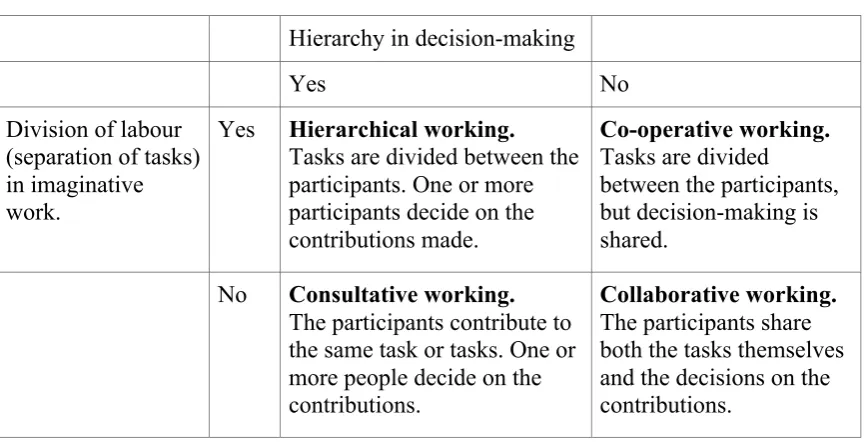
[image:11.595.101.534.484.705.2]Alan Taylor (2013) has proposed a hierarchy of decision-making and division of labour in imaginative tasks between people working together, to uncover different forms of working relationships.
Table 1. Forms of working relationship7
Hierarchy in decision-making
Yes No
Division of labour (separation of tasks) in imaginative work.
Yes Hierarchical working.
Tasks are divided between the participants. One or more participants decide on the contributions made.
Co-operative working.
Tasks are divided
between the participants, but decision-making is shared.
No Consultative working.
The participants contribute to the same task or tasks. One or more people decide on the contributions.
Collaborative working.
The participants share both the tasks themselves and the decisions on the contributions.
Within this table, the most common form of working relationship that occurred with the
other central artist in my works could be described as ‘Co-operative working’, in the sense that there was no hierarchy between us; decisions about the work were shared yet there was a division of labour in some imaginative tasks. For example in Handspun I composed the music and the aerialist/choreographer Ilona Jantti choreographed the movement, but we came together to agree on the suitability of both these and other aspects of the work. There were other stages of the various working relationships that involved a large amount of shared imaginative work prior to composing. These instances were both non-hierarchical and shared, and made this aspect of working ‘Collaborative working’ (according to Table 1). These instances often involved work on the scenario and libretto for the operas, the creation of a structure, and decisions about the physical elements (ropes, a photocopier, the relationship between an actor and a musician) in the non-vocal works. They also involved discussions about the type of music that might occur in the works. These stages of collaborative working, where artists were engaged in a conception of many aspects of the work, may lead to what could be perceived as transdisciplinarity in them.
Having another artist to create work with enables me to see the creative process that I am a part of reflected and interpreted by another artist. Ideas are reacted to and engaged with differently by collaborators as part of the process of making work, and it is
enriched when these multiple voices join together.
Social interaction involves two or more people talking or in exchange, cooperation adds the constraint of shared purpose, and working together often provides coordination of effort. But collaboration involves an intricate blending of skills, temperaments, effort and sometimes personalities to realize a shared vision of something new and useful. (Moran & John-Steiner, Vera 2004, p. 11)
The above raises certain aspects of collaboration which are part of my process, in particular the role of ‘people talking or in exchange’, the ‘blending of skills’ and the ‘shared vision of something new’. Discovering new perspectives on ideas and artistic practice is also important. ‘With adults who collaborate, it isn’t that they are stretched to the edges of their development; rather, they are stretched to see ideas in different
create together, going beyond individual conceptions of an idea or individual creativity.
In drawing their conclusions about collaborations in a number of case studies Hayden and Windsor state:
The most successful artistic collaborations described here occurred when the creative process arose from within the group and was not a pre-determined ideology. A successful collaboration was not
guaranteed by having good personal connections among those involved, but this was no disadvantage. A shared aesthetic goal seemed
important: incompatible aesthetics can impede successful collaboration by promoting conflicts in working methods and artistic aims. However, an artistic collaboration did not have to be democratic to be successful, and neither did a more collective and non-hierarchical way of working guarantee success. (Hayden & Windsor 2007, p. 38)
These findings resonate with my own work; my collaborations have begun without a fixed end result in mind; rather the work emerges through the collaboration. Each of my collaborations has benefited from very good personal communication. Where there has been some friction that was left unresolved then it has resulted in a tangible weakness in performance. Though the positive role of tension has also been part of my practice and is identified by Moran and John-Steiner (2004, p. 17) as one of ‘the three characteristics of true collaboration […] complementarity, tension, and emergence – that occur in real-life creative collaborations.’ tension and the ability to work through conflict have often led to identifying and solving artistic problems within a work.
What I have learnt to be important in a successful collaboration and in choosing the right collaborators is to have an honest discussion and understanding about what the type of working relationship may be, with an awareness that this might change. ‘[…] the performer may say that he or she is happy with having only technical input, but may act in a way that reflects a dissatisfaction with such a limited technical role.’ (Hayden & Windsor 2007, p. 30) When a performer in particular has underestimated the level of creative involvement they expect to have or when I have expected more creative input from a performer than I have received, then this is where difficulties in my working relationships have sometimes emerged. In addition to discussions, knowing when to bring performers into the creative process significantly determines the type of working relationship I want or can expect from performers.8
After seeing another artist’s work and feeling an impulse to collaborate with them, dialogue through talking has been my method for choosing my collaborators and discovering how we want to make work together. ‘All writers know from their own experience as writers that ideas are engendered and transformed in conversation, in collaboration, with those around us, with books we read, with stories we hear.’ (Ronald & Roskelly 2001, p. 264) The ideas that my collaborators and I bring to a first meeting immediately begin to undergo a transformation as they are discussed. Each collaborator brings new perspectives to an idea (as outlined above) and brainstorming is often part of a dialogue. Collaborators ‘get their ideas for a murder mystery or a critical essay on poetry from a habit of informal brainstorming conversation that draws on experiences and information they’ve each been absorbing.’ (Hunter & Fontaine 2005, p. 20) Brainstorming allows the possible approaches to an idea to be voiced freely and then scrutinised together. It allows collaborators to freely draw on their different knowledge bases and experiences as artists. What emerges through this process are a number of mutually agreed possible ways of progressing. These are then explored together and individually. Dialogues continue throughout the collaborative process and give the collaborators a context to fall back on when determining if what they are creating is what they both agreed they wanted to make, whether the work has become something different (in a positive or negative sense), or whether they should return to their original ideas to keep the work consistent and provide it with clear direction.
I have outlined: different forms of working relationships; the function of tension; and brainstorming and dialogue as they may relate to my work. I will now address
transdisciplinarity.
1.2 A transdisciplinary perspective
The theory of transdisciplinarity reflects my compositional method. It is a theory that readdresses the division of elements in a work where I see none. I regard it as an extension of intermediality9 for which the theatre can be a space to enable intermedial
Hayden and Windsor) working relationship with a performer then I include them (or they include me) at the outset of the process. If I see the relationship as directive with a hierarchical way of working, then I include them as late as possible. What I have tended to favour in my work has been a middle ground of interactive (Hayden & Windsor 2007) working, in which the performer is involved at the workshop stage, but not in the earlier phases of the creative process.
and transdisciplinary properties in a work to arise. Transdisciplinarity offers me a useful perspective to iterate the connections between the elements in my works.
As elements other than sound influence my compositional decision-making, music loses ‘the illusion of autonomy’:
As the prefix ‘trans’ indicates, transdisciplinarity concerns that which is
at once between the disciplines, across the different disciplines, and
beyond all discipline. Its goal is the understanding of the present world, of which one of the imperatives is the unity of knowledge. (Nicolescu 1998)
To a certain extent knowledge of extra-musical elements can be gained before a collaboration has begun (through research), but even if prior knowledge exists collaborators will gain specific knowledge about the elements involved in a work through working together. This may require collaborators to go beyond what they already know of their own disciplines and those of their collaborators. Nicolescu suggests that transdisciplinary work is aided by disciplinary knowledge and also that transdisciplinarity enriches disciplinary knowledge:
The discovery of these dynamics necessarily passes through disciplinary knowledge. While not a new discipline or a new superdiscipline, transdisciplinarity is nourished by disciplinary
research; in turn, disciplinary research is clarified by transdisciplinary knowledge in a new, fertile way. In this sense, disciplinary and transdisciplinary research are not antagonistic but complementary. (Nicolescu 1998)
In my worksdisciplinary knowledge was shared and transdisciplinary knowledge established through talking, demonstration and by starting to make work together. This transdisciplinary knowledge in turn enriched disciplinary knowledge when
collaborators made work alone. The better my collaborators and I understood what we each were doing or could do, the greater the possibility was for creating autonomous transdisciplinary work, free from disciplinary limitations.
As well as gaining and sharing knowledge to create a transdisciplinary work, this knowledge and the elements of a work need to be able to combine.
[…] transdisciplinary connections do not appear as a posteriori consequence, from previous developments occurred within the
specificity of a discipline; rather the necessity of combining elements of heterogeneous knowledge is a constitutive part of its very conditions of composition. These conditions are both reflected in the different
epistemological realms that the work traverses i.e. physical,
neurophysiological, sonic and visual art problems and in the divergent backgrounds of the involved actors (Matthias et al., 2008 quoted in Mongini 2013, p. 1)
It is not only as a result of different performers performing together that a work could be described as transdisciplinary. Neither can a work which makes use of music, for instance a dance work where music is treated as an accompaniment, be seen as
transdisciplinary, even if music is integral to the work, i.e. where the music is intrinsic for the dancers to feel a common sense of pulse. Transdisciplinarity is perceived when the creation of the elements in a work has occurred out of a relationship to each other and a necessity of combination.
There is something inherently transdisciplinary about creating works for the theatre, in the compositional process, performance and reception of them. Hence by positing my worksas works for the theatre there is an inherent potential for a transdisciplinary perspective to be applied to them. ‘Another way of looking at music theatre is to regard it as the result of the overlapping of several systems of expression that causes those systems to merge into a new supersystem.’(Salzman 2008, p. 320) Here we see a connection between the idea of ‘music theatre’10 and transdisciplinarity, albeit a word which Salzman does not use. As we have seen, transdisciplinarity ‘concerns that which
is at once between the disciplines, across the different disciplines, and beyond all discipline’ and this is echoed by Salzman in his ‘overlapping of several systems of expression’.
My practice involves collaborators engaged in the joint task of making an entire work, not individualised parameters of it. This understanding of who is making the work may suggest a transdisciplinary approach, as it requires cohesion of disciplinary knowledge. This cohesion is echoed when collaborators talk of a third voice emerging through
collaboration and the synthesis of collective ideas and skills into a new entity.
As a result of scaffolding, of writers working together to build a process and, in turn, create a piece of writing, the voices of the individual writers blend into a third. […] it is evidence that true collaboration occurs ‘when the product is so well integrated that it seems to be the creation of one mind’(Yancey & Spooner 1998). This shared voice is evidence of synergy - the ability ‘to accomplish things together that neither [writer] could have accomplished alone’ (Reither & Vipond 1989 quoted in Hunter & Fontaine 2005, p. 33)
In the following section I contextualise my own experience of collaboration and transdisciplinarity by other artists.
1.3 A theatrical context
In order to create works for the theatre it has been important for me to have an idea of
where theatre can take place. ‘I can take any empty stage and call it a bare stage. A man
walks across this empty space whilst someone else is watching him, and this is all that
is needed for an act of theatre to be engaged.’ (Brook 2008, p. 11) This minimalist view
as to the necessities ‘for an act of theatre to be engaged’ is the one that I have adopted in
my work. The performance space for each workbegan as an empty space and from this starting point my collaborators and I could perceive what was necessary to add to this
‘empty space’ in order to construct the theatrical acts of the works. ‘This is the empty space for which Brook has become famous. One starts from emptiness and absence and
adds essential elements.’ (Lavender 2001, p. 70)
A look at some of the techniques and ideas of the theatre will further contextualise how
my work is made. ‘In the theatre, a line is a sound, a movement is music, and the gesture
which emerges from a sound is like a key word in a sentence.’ (Artaud et al. 2004, p.
152) This approach to recognising musical potential in a movement, line or a gesture is part of how I perceive the transdisciplinary connections between the elements in my works and how I connect my composing to the non-musical elements in my works.
What do you want? What’s your desire? What do you want to achieve? Who do I want to influence and persuade? Such a desire or a drive or an impulse is what Stanislavsky called a ‘goal’ or a ‘task (zadacha), a word which then became translated in An Actor Prepares as the somewhat more scientific sounding OBJECTIVE. (Merlin 2014, p. 73)
Developing a language with performers and collaborators in which I can speak of the target or objective as something in the music that a performer can use to construct their performance has helped to build connections between the elements in a work, inviting a transdisciplinary perspective. The creation of targets and objectives has been a part of composing, wherein, for example, a phrase may be played or a bar repeated in such a way as to aim for an increasing level of tension. This tension is then the target or
objective of the music in performance (and probably the same target or objective for the other elements at play in this hypothetical moment). The use of cues is similar to
targets/objectives in that they may indicate a point in the performance that the
performers are aiming at. Cues are different though, as they are a practical means of co-ordination, rather than aiming at the more subjective notion of tone, intention or
emotion.
The targets and objectives for a performer (particularly the non-musician performers) in my works may come from the music, a text, the performer’s imagination or any other part of the work. The specific targets/objectives are not intended to be recognised by the audience in performance but they have been a useful technique for composing and rehearsing the works. Through the collaborative and production process of my works and due to my involvement in both these stages as a composer, a connection to the music for the discovery of a performer’s targets and objectives is something I have encouraged.
1.4 Jong
Jong by Lotta Wennäkoski11 shares both similarities and differences with my work and collaborative process, particularly with my work Handspun. Both works are for
musicians and circus performers, in Jong a juggler, in Handspun an aerialist. They involve musician and non-musician performers, and because of this, allude to the possibility of collaboration between a composer and other artists.
Both Jong and Handspun were programmed in the same concert (May 10th 2014 at the Helsinki Music Centre as part of Cirko Festival, Finland12), a decision by the festival organisers that points towards similarities between our two works. Following the concert I spoke to Wennäkoski about Jong, and I was interested in finding out how she collaborated with the juggler. She told me that the juggler first created a complete choreography and that she then composed to this. He videoed the choreography for her and she then set a tempo to his choreography (which can be heard consistently
throughout the work, as a kind of click track, for the juggler, with fluctuations on the
Tempo Primo of crotchet equals 92 – 96 throughout). This provided Wennäkoski with a predetermined duration and a visual cantus firmus for the work that Wennäkoski was able to decorate in her composing or treat as a kind of palimpsest, wherein the orchestral composition is written over the juggler’s choreography.
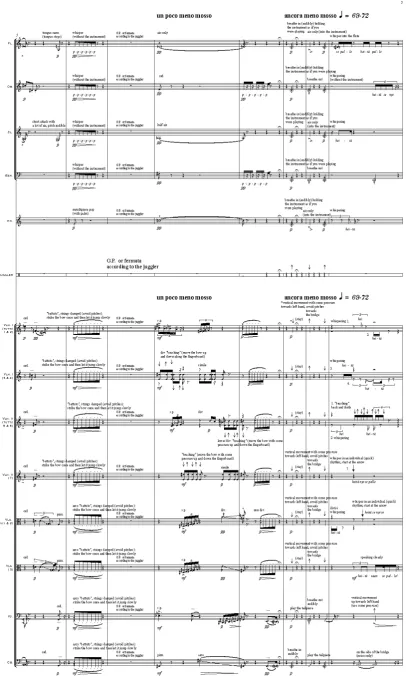
This method of composing to a pre-determined choreography seems to negate many aspects of collaboration that I have identified as part of my process. The title page of the score states that Jong is ‘music for juggler and chamber orchestra (the juggler's part is optional and free)’ (Wennäkoski 2012) (see Fig. 1.1). This immediately points to a difference in our works away from transdisciplinarity, primarily because elements of
Jong can be separated from one another and are perceived by the composer separately. If the music for Jong can be detached from the choreography then I would claim Jong
consists of two elements (an orchestral work and choreography for juggler), which can be performed together or separately, and as such these two elements are not one
11 ‘Lotta Wennäkoski (b.1970) is a leading figure of her generation. She began her musical training as a violinist with notable studies (violin and folk music) at the Béla Bartók Conservatory in Budapest (1989–90) before joining the Department of Music Theory at the Sibelius Academy (1990–94).’ (Howell 2012, p. 5)
(transdisciplinary) work but are two highly complementary separate works. This is similar to the works of Cage and Cunningham.13
As in my works, Jong indicates points of synchronisation between the performers through the score. In my works this is done through words (and will be addressed in more detail during the proceeding case studies), whereas in Jong the juggler has a part in the score, on its own stave and at times with notation. This gives a specified level of control over the juggler’s part and synchronisation with the orchestra. There is
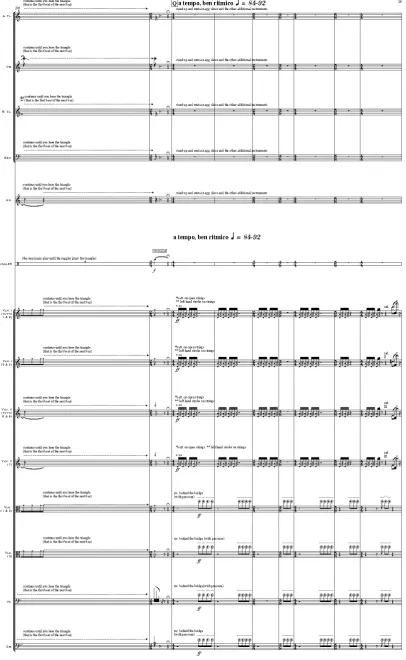
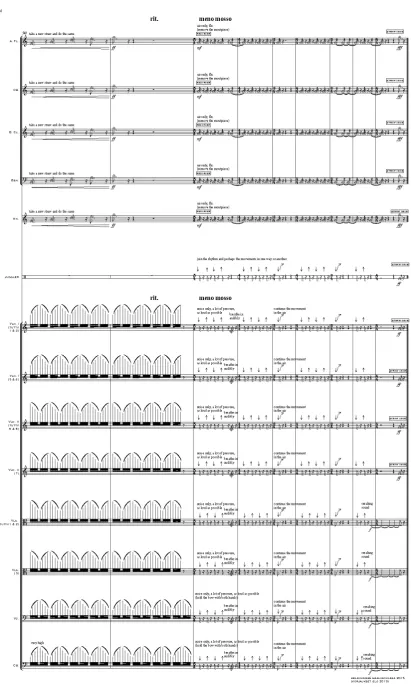
interaction between the juggler and the orchestra, for instance when the juggler leads fermatas at bar 8 (see Fig. 1.2) or when he controls the orchestra by playing the triangle at bar 279 (see Fig. 1.3), which indicates the end point of an orchestral gesture that the orchestra and conductor are waiting to be cued for. The end of the work involves a high degree of rhythmic synchronisation between the juggler and the orchestra (bars 350 – end, see Fig. 1.4) where rhythmic unison is indicated between the orchestra and juggler.
The sound of juggling allows Wennäkoski to occasionally treat the juggler as an extra percussionist (this is most apparent when juggling balls as opposed to clubs or rings. The sound of juggling creates a regular pulse, the tempo of which varies with the size of the arch of the balls and the number of balls being juggled). The sound of the juggler is a definite and considered part of the composition, both when it is notated and when Wennäkoski knows the sounds that will be made by the juggler and has factored this into the orchestration and composition of the work. Despite this connection of sounds, the lack of collaboration in Jong is evident in the score, wherein Wennäkoski locks the juggler and an existing choreography into an absolutely determined and fixed
composition.
1.5 Remember Me: A Desk Opera
Another work that offers the potential for collaboration between musicians with non-musician artists is Claudia Molitor's Remember Me: A Desk Opera, and specifically the production of this work as part of the 2013 Spitalfield’s Winter Festival.14 As an opera, this work involved singing, acting, text, lighting, design and a set. Typically opera presents itself as a highly collaborative medium due to the number of different artists of various specialities required to produce a performance. These can include but are not limited to composers, librettists, directors, conductors, designers, movement directors, singers, instrumentalists, stage managers and producers.
Remember Me is not an opera on a grand or even modest scale; it is a small-scale work, an opera in miniature, involving one performer, the composer herself.
In 2008 I inherited a writing desk from my grandmother. Upon opening it and exploring the contents, I realised that the inside of this desk was the only physical space that she could have truly called her own. Fascinated by this notion, immersed in Andrea Cavarero's writings on the female voice, baffled by the amount of opera being written in the 21st century, re-reading Dido and Eurydice' respective myths and listening to Gluck and Purcell's operas, I set out to explore new ways to engage with the idea of Opera. (Molitor 2012)
This description on the origins of the work is followed by a further insight into how the composer views composing and performing. ‘To me, composing and performing is, in part, a delving into a complex web of memories. My own, of which I have some
understanding, and each listener’s memories, of which I have little if any understanding, but yet rely on and seek to engage with.’ (Molitor 2013) Both these statements from the composer show the work and her compositional process to be somewhat biographical. The work is credited in the following way:
Concept, Composer, Text and Performer – Claudia Molitor Co-Director – Dan Ayling
Set Designer – James Johnson
Production Manager and Operator – Jack McConchie (Molitor 2012)
From these credits we can see that there are three individuals with whom the composer could have collaborated. What this also reveals is that Molitor takes on the key creative roles. The work therefore appears to be the result of one individual rather than that of collaborators engaged in a joint task, although it cannot be ruled out that the co-director, set designer, production manager and operator may have had creative input in the creation of the work. This is not a work that starts with a personal story and is then transformed into something new through collaboration. It is not my view that
collaboration is absent in this work (as that is near impossible in opera), rather that the composer is collaborating with herself in different guises. This is a role that I also undertake in Play (after Beckett) where I am both composer and writer of words collaborating with myself in the first instance of making the work, but later collaborating with others as the work moves to workshops and production.
Molitor is not alone in conceiving of an opera and writing the words and music herself. Wagner set an enduring precedent for this method of working and more recently Michel van der Aa was both composer and director of his opera Sunken Garden. Where
Remember Me suffers is from not employing another performer to perform the work. In her role as performer, Molitor does not give the work the stage presence that it could have benefited from. Her performance style referenced the controlled and crafted movements of Robert Wilson without the skill or control to make this effective. The work does appear to synthesise its various elements (music, text, set) in an
interconnected and interdependent way. This leads to a sense of transdisciplinarity in the work from an audience member’s perspective, but not as an obvious result of collaboration with other artists.
1.6 Astronomer
The ambitious dream of composer Edgard Varèse involving collaboration with multiple artists. ‘Carpentier states that as early as 1929 the composer was dreaming of a circus […] inspired by Barnum & Bailey as his preferred means of staging his mystery.’ (MacDonald 2003, p. 233) Similarly to Wennäkoski's Jong and my own Handspun, this is a work in which a composer has turned to circus performers.15 This work, which has
been called different things such as The One All Alone, L’Astronome (Astronomer) or
Espace, was never completed, although Varèsedoes talk about the music which he had composed and orchestrated for the project, but which is either lost, destroyed or remains undiscovered. Varèse imagined the work would encompass a number of media,
particularly physical performers, circus performers and non-verbal performers. The lead figure of the work was his arrow-maker ‘[…] to be played by an acrobat doing
somersaults, cartwheels and grotesque dances […]’ (Varèse 1972, p. 266-7 quoted in MacDonald 2003, p. 219) One of Varèse's main collaborators on Astronomer was the theatre maker Antonin Artaud and the two worked together on the concept and scenario of the work. Prior to collaborating with Artaud, Varèse had worked on the project with Louise Varèse, Alejo Carpentier, the Surrealist Robert Densnos and the Dadaist
Georges Ribemont-Dessaignes. In the collaboration between Artaud and Varèse both appear to have been interested in a non-verbal theatre of music and movement, which is a common factor in my non-vocal works.
Artaud seems to have proposed a relationship between music and text that implies a transdisciplinary perspective where ‘[…] Artaud’s aesthetic of the scenario, in which the text hardly exists before a performance and is essentially to be developed by the actors as moving hieroglyphs’ (MacDonald 2003, p. 240) This scenario could present more open points of connection with music before a text is spoken than after it.16 If Artaud was suggesting that the actors develop their performance, possibly including speaking text in response to the music and instructions in his scenario, then this motivation for the actor’s performance (through improvisation) strengthens the
transdisciplinary connections between music and the other elements of the work as the
connotations than contemporary dance or ballet. It is partly because of this that circus allows a wide range of music to connect with it. The combination of the unfamiliar, the new and the genre-less (in terms of implied music) are some of the factors that experientially also make collaborations with circus performers attractive partnerships for composers other than myself. Circus had been used before Varèse by Satie in Parade and Busoni intended his one-act operas Arlecchino and Turandot for puppet theatre presentation.
actor’s performance is a response to the music.17
Varèse talks about how the orchestra will relate to the other elements of the performance. He envisaged the role of the orchestra as a ‘mediator between the audience and what is taking place on stage.’ (MacDonald 2003, p. 229) This is an example of Varèse relating the function of music/orchestra to the audience and other aspects of the performance. I propose that the establishment of this type of relationship between elements in Astronomer and some of the working methods of Varèse and Artaud, if practised now, could be seen as transdisciplinary, for they were conceiving of one autonomous and connected work. I also propose that the work done on Astronomer
(particularly on the scenario) was collaborative, between artists engaged in a joint task.
1.7 Bow Down
An existing work for actors and musicians that can contextualise my work is Bow Down18by composer Harrison Birtwistle. I attended a performance of the work, produced by The Opera Group, as part of the Norfolk and Norwich Festival in May 2012.19Bow Down has informed my work because of the way divisions between actors and musicians are dissolved, the aspects of transdisciplinarity I observed in the work, the way the score suggests targets to performers as well as providing practical
coordination instructions, the physicality of the work and the use of a performance space.
‘It has been suggested that the actors in Bow Down “are just as much musicians as the musicians are actors”, and that there is only “a relatively slight difference in emphasis” (Adlington 2000) between the two.’ (Beard 2012, p. 302) The performance I saw did not separate performers into actors and musicians, and the score promotes equality
17 This idea invites similarities with methods of Artaud’s contemporary Stanislavsky and his Method of Physical Actions and Active Analysis where improvisation and a focus on physicality is used to develop an actor’s sense of character and deeper connection to a text before a playwright’s words become part of the rehearsal process. (Merlin 2014, p. 185-201)
18 'Bow Down was devised and first performed in the Cottesloe Theatre by members of the National Theatre of Great Britain on 5 July 1977, as part of the John Player Centenary Festival. […] The source material of Bow Down was the ancient and traditional ballad of The Two Sisters which exists in numerous and varied versions throughout Northern Britain, Scandinavia and America.' (Birtwistle & Harrison 1983)
between performers. The actors are asked to play instruments and the musicians are on stage (rather than hidden in a pit). The musicians (and actors) do not sit stationary through the performance but are required to move on stage. This requires a sharing of skills by performers and leads in part to ‘the blurring of generic boundaries, crossover and hybrid performances, intertextuality, immediacy, hypermediality and a
self-conscious reflexivity that displays the devices of performance in performance.’(Chapple & Kattenbelt 2006, p. 11). This corresponds with my understanding of
transdisciplinarity. To do this the performers need to master the relevant skills to make their performance convincing and Birtwistle does not impede this by demanding a level of instrumental proficiency from the actors that is too specialised. For the musicians, it is partly the role of the director to help them feel confident on stage and use their bodies and voices without exposing a potential lack of experience. In the production I saw, the director was Frederic Wake-Walker and the musicians all performed confidently on stage.
‘Most of the singing is performed by actors 3 and 7. Nevertheless, the musicians are given more complex music to play and a distinction is therefore retained between actors and musicians. What is called into question, however, is the distinction between
“music” and “action”.’ (Beard 2012, p. 303) Birtwistle allows the musicians to excel as musicians, whilst at the same time the singing by the actors and their use of percussion instruments strengthens the ties between them, dissolving the distinctions between these two types of performers and contributing to the work’s transdisciplinarity.
Transdisciplinarity may be perceived differently in my works (this will be explored in the case studies); when musicians were required to perform as actors, in my work The Photocopier and Molitor’s Remember Me, the performances suffered because of the lack of ability of the musicians to utilise a different set of performing skills, which they had not developed.
the performer’s ‘target’ but it still leaves room for a performer’s interpretation and the role of a director in a production. These directions are linked to specific durations of music, and the compositional process (from which one result is the score) therefore includes a documentation and specification of many aspects of the performance. This is another example of text's role in perceiving transdisciplinarity.
The Opera Group production of Bow Down placed great emphasis on the body and the performance space. ‘One cannot separate body and mind, nor the senses from the intellect, particularly in a field where the unendingly repeated jading of our organs calls for sudden shocks to revive our understanding.’ (Artaud et al. 2004, p. 122) The
production embraced the connections between all elements in the performance with the body being the central point for this connection (rather than objects or a set, in fact objects that were used were part of the performer’s body, i.e. instruments or clothes).
Bow Down ‘posits a wider, inclusive category that emphasises the common basis of all acts of performance in the human body.’ (Adlington 2000 quoted in Beard 2012, p. 303) The centrality of the body is partly indicated in the score, as we have seen, and comes from the means to create the work, these being actors and musicians that sing, play instruments and move in a space. This space is an ‘empty space’ and its emptiness enhances our focus on the bodies in this space. ‘Following Peter Brook’s notion of the “empty space”, which was indebted to Artaud and to Barrault’s concept of the “barren stage”, Bow Down was conceived and originally performed on an empty stage upon which the performers create their own environment.’ (Beard 2012, p. 296) The clarity and focus that the ‘empty space’ brings to the people in the performance space and their actions, aids the connection of the elements in the work, which is part of
transdisciplinary theory.
1.8 An operatic context
My understanding of opera is built on my understanding of theatre, detailed above, where the people on stage primarily sing instead of speak. Because of this what I perceive as operatic material is developed through my understanding of the individuals that sing. I perceive an operatic potential in characters and scenarios that invite the incredible, untrue and improbable.20 It is through this that a singer in the theatre engages my interest rather causing me to question why the individual is singing and not
speaking. I recognise these points in the following definition of opera.
Opera is a type of theatre in which most or all of the characters sing most or all of the time. In that very obvious sense it is not realistic, and has, through most of its 400-year history, often been thought exotic and strange. (Abbate & Parker 2012, p. 1)
I perceive the operatic voice as a stylised form of communication. The difference to the speech sounds that usually come out of human beings and the technique involved to produce the operatic voice are contributing factors to what I perceive as stylised. Simultaneously a person singing, albeit with the operatic voice, can suggest the un-stylised, via the fact that the sound comes from another human being and that as people we can all sing. We can therefore project ourselves into the position of an opera singer, even though the technique required to sing in such a way is not developed in everyone. It is still another person using the same anatomy to perform something extraordinary (and stylised). When an opera singer is performing actions they can emphasise this tension between the stylised and un-stylised, for instance if the characters or scenarios
are familiar. This is a tension that I perceive in verismo. ‘Carl Dahlhaus has argued within careful limits that outer realism can come into opera, although he also quotes
very fairly Busoni’s opposite view that the whole concept of verismo is “untenable”’ (Donington 1990, p. 151). I do not find verismo untenable, but I do not think it is where opera’s greatest strength lies, even in an accepted verismo opera such as Carmen, I propose that the inherent operatic tension comes from the extremity of the characters and situations which are not based in realism. The fiery gypsy Carmen is not the same as the housewife Nora.
In situating my preference for opera’s dramatic source to arise from ‘the incredible, the
untrue, the improbable’, I am more drawn to operatic material that will emphasise and
make plausible the stylised aspect of the operatic voice. This preference is something I recognise in the setting and characters of many operas. I will detail some examples below.
In Mozart’s The Magic Flute the audience is in a fairy-tale masonic-Egyptian world consisting of a Queen of the Night, the Bird-catcher Papageno and Sarastro the High Priest of the Sun, among other unusual characters. From the start of the opera the audience is confronted with incredible and improbable action: Prince Tamino is rescued from a serpent by three ladies who serve the Queen of the Night. As an audience
member this improbable opening action functions to immediately engage my attention in a life or death scenario with sympathy for the fantastical characters, where singing rather than speaking appears most appropriate.
In Janáček’s The Cunning Little Vixen the setting is real, a forest, but the characters that
sing are a combination of humans and animals. Some of the human characters include a
Priest, a Forester, the Forester’s Wife and a Schoolmaster and these are contrasted with
the more improbable animal characters such as the Vixen, the Fox, the Frog Child and the Grasshopper Child. This combination of both human and animal characters that sing establishes a commonality between these two different character groups. Seeing both human and animal characters gives the audience an insight to the thoughts and actions of these two groups21 that is not possible in the real world. Singing acts to make it dramatically plausible.
Wagner’s creation of his own mythology in the four operas of The Ring of the Nibelung
is derived largely from Teutonic22 sources and by its very nature mythology contains aspects of the unreal and incredible. ‘[…] in the case of The Ring, the gods and the other supernatural beings whom Wagner drew from Teutonic mythology are for many people
21 We can not hear the sung or spoken thoughts/conversations of animals, and rarely are human conversations sung outside of the theatre
obscure and puzzling figures.’ (Cooke 1979, p. 11) Whether or not the beings are
obscure, puzzling or intelligible, their fantastical nature is part of what makes them suitable operatic material from my perspective. The world of The Ring sits outside of a human reality just as the operatic voice sits outside of our everyday vocal experience.
The chief trouble is that the actions of these characters are not immediately intelligible in ordinary human terms. When Wotan, for example, gets two labourers to build him a castle, to help him establish his mastery of the world, the payment he offers them is his own sister-in-law; and the world he seeks to master is a curious one anyway, made up of gods, giants, water-nymphs, and dwarfs, with at first no human beings in sight at all. The castle Valhalla functions as a pure symbol of world-power, without any
recognizable human reality in the drama to correspond to it. (Cooke 1979, p. 11)
In the late 1940s and early 1950s science fiction was of interest to Benjamin Britten. Britten planned an opera for young people with the librettist William Plomer called
Tyco the Vegan.
Britten refers to a Prologue to the projected children’s opera, the subject-matter of which tapped into the growing public fascination for outer space and the possibilities of space travel prevalent in the early 1950s […] Plomer’s seven-page draft of the Prologue, all that apparently survived of the project, is at BPL23. Tyco the Vegan had replaced an earlier scheme to base a children’s opera on Beatrix Potter’s The Tale of Mr Toad. (Reed et al. 2008, p. 48)
On discovering this uncompleted project of Britten’s I went to the BPL in Snape and
read the prologue mentioned above, with the hope of refashioning it for my own science
fiction youth opera, Tycho’s Dream, listed in the Appendix. I did not use the prologue but I did incorporate the figure of Tycho Brahe24 (the same historical figure who Britten refers to as Tyco), the science fiction setting and a journey to the moon (which was part
of Britten’s Tyco) into my own Tycho’s Dream. In both Britten’s Tyco the Vegan and my own Tycho’s Dream the operatic material consists of incredible settings and the
improbability of non-human and historical figures mixing together with young people of the present day.
I perceive the theatre as a place of suspended disbelief and the central role of music and
23 BPL stands for the Britten Pears Library.
singing in opera are part of the suspension of disbelief where a theatrical world that is different from the world outside the theatre is created. Characters and settings that are
implausible contribute to the need for an audience’s suspended disbelief. This does not
exclude human emotions and real world ideas from entering into opera, rather, the means for presenting them should suit an operatic form, which we have seen favours the improbable, incredible and untrue.
Opera is a form that can allow a transdisciplinary perspective to arise, as the very nature of the form involves multiple disciplines, which have the potential to combine and connect.
Dance, music and poetry alone are each limited; where they reach their limits they feel their lack of freedom so long as they fail to hold their hand out to the other corresponding art forms in an unconditional acknowledgement of love. Grasping the outstretched hand already lifts them over the boundary; yet to embrace fully, to merge fully with the sister, to step over the set boundary and lose oneself there leads to the total collapse of the boundary; and if all boundaries thus fall then both art forms and boundaries disappear leaving only art, collective, limitless art itself. (Wagner 2013, p. 28)
The above quote encompasses the instinctive feelings I have always held as a composer. I see that the theory of transdisciplinarity reflects these instinctive feelings and I have therefore applied it when analysing my thesis works and processes. The reflection of transdisciplinary theory in the aim of dissolving the boundaries between elements in an opera stated by Wagner is also part of my aim in composing operas and has necessitated the collaborative work with other artists involved in the joint task of making each of the works in this thesis.
Long before the coining of transdisciplinarity, Carl Maria von Weber demonstrates an
intuitive understanding of it: ‘[…] a work of art complete in itself, in which all the
related parts and contributions are blended together and thus disappear, and somehow,
in disappearing, form a new world’ (Donington 1990, p. 78). This concept of opera has
the error in the art-genre of opera consists herein:
that a Means of expression (Music) has been made the end, while the End of expression (the Drama) has been made a means,
I do it nowise in the idle dream of having discovered something new, but with the object of posting the Error so plain that every one may see it, (Wagner 2008, pxxxii-xxxiii)
As with Wagner I am not stating this to show new clarity in operatic thought but to demonstrate the continuity of approach to both my non-vocal and opera work as it applies to collaboration and transdisciplinarity. What Wagner and Weber express and what I understand in creating my thesis works is: that the composition of music as part of drama needs to employ methods and understanding about how music and the other elements in a work (drama) can synthesise to become one thing, and that this is encompassed within transdisciplinary theory.
Chapter 2: Case Studies
The following case studies aim to reveal different aspects of collaboration in my compositional process and how the works might be viewed from a transdisciplinary perspective. The nature of the collaborations and how a transdisciplinarity might be perceived will be measured against factors I have identified as important to me in the previous chapter.
Four non-vocal works and two operas have been selected as the clearest examples of my research objectives, from a larger body of compositions composed during the research period. They are grouped together with key collaborators: Ilona Jantti on Handspun, Ted Huffman on The Photocopier and Macbeth, Peter Cant on Play (after Beckett) and
Unborn In America. The additional three operas written in this time are included in Appendix 1, particularly because of the collaboration process in their creation and the aspects of transdisciplinarity perceptible in them. Commission and performance details for each work are contained in Appendix 2. Examples that support my research
objectives will be drawn out of each work, rather than an analysis of every note. Some examples will highlight similarities in my approach but emphasis will be given to the differences between the works.
2.1Handspun
Handspun is a work that is performed by a cellist and an aerialist. The aerialist should not only be a skilled circus performer but also a trained dancer, as the work is best described as a contemporary aerial ballet.
‘Aerial’ ballets were all the rage in late-Victorian London. It mattered little that they were more circus acts than actual ballets; their female stars, swinging from either a trapeze or sturdy ropes, were worshipped on a par with the greatest ballerinas. (Poesio 2012)
The work lasts for between 22 and 25 minutes on average, with considerable flexibility in the tempo markings to allow for the cellist and aerialist to speed up or slow down in relation to the speed of the music or movement of the other performer. This is one reflection of the interconnected relationship between the two live
performers.
both performers are visible (the cellist is not hidden in a pit) and two ropes hang in the space. Four ropes are used in the work; each has a different length and/or angle of rigging. The difference between the ropes made us work on them differently and resulted in different music and movement being made for performance on each rope. We will see later how these ropes come to determine the structure of the work and what the difference in material may be on them.
Handspun was the second work that I created together with Ilona Jantti
(choreographer and aerialist). We had already established a creative language25 and levels of trust and understanding in each other’s abilities and our partnership. We received the commission in the autumn of 2011 for a premiere in February 2012, so had limited time to make the work. We began by talking to one another about the type of work we wanted to make. Unlike our previous work I wanted Handspun to involve a composed score and a performer that was not myself. Ilona wanted to work solely with ropes, and in particular, a diagonally rigged rope that would divide the performance space in half.
This first stage of collaboration (talking) set the broad parameters for the work and the decisions made at this point would in some way inform the further stages of collaboration and individual work. Following talking, Ilona created some material (a series of movements) on the diagonal rope and a rope that hung vertically from above, the long rope. This material was filmed and sent to me electronically and Ilona and I then discussed the material. I responded to this material by composing music that could be played together with these two types of ropes. I recorded this music with the cellist, who was the same performer in the first production and many of the subsequent productions of Handspun. Importantly none of this material (physical or sound) was thought of as fixed at this stage; it was the response to our discussions and to what the other had made. We consciously made more material than we envisaged would end up in the premiere of the work so that we could craft this material into a shape that we were satisfied with or, if appropriate, discard entirely.
Following this work Ilona, the cellist and I came together in a rehearsal space for what can be called workshopping. This is a creative time for working together, without the pressures of a rehearsal period, which requires one to perfect a finished work. It gave us the freedom to be together to test and experiment with ideas at a stage when the work was still being created. The time we had for our workshops was four days.
We proceeded by working with the material live that we had shared electronically to see how it might fit together. This led to decisions about the length, tempo and amount of material we needed in each section of the work. This involved me deleting bars of music, changing the tempo of passages or recomposing sections of music, in the room, which the cellist was then immediately able to play for Ilona and myself to hear. Equally, Ilona was able to amend her movements in response to our discussions and what she was hearing, in the moment. As the only
non-performer in the room I was able to judge how the elements of the work were working together and suggest changes or new ideas from this vantage.
Our work continued like this over the four days at the end of which we had created a draft work of four sections. This corresponded to the four types of rope in the work (long, short, floor, diagonal) reflected in the subtitles in the score of Handspun. We then worked individually refining music and movement, based on the collaborative work done together.
The long rope is the first rope to be used in the work and its position and individual qualities, due to its weight and length, can be seen by the viewer. These were characteristics which influenced the movement and music created for it.
39
made with the body, there is dropping and bouncing, hanging upside down, twisting and gentle rocking at the end of the section. All of these movements informed my
compositional decisions and create a connection between music and movement in my compositional process. This connection contributes to the transdisciplinarity in
Handspun. The resulting musical relationship to this section is of percussive music and hence this section is subtitled Percussive/Long Rope (bar 1 - 40). The predominant colours in Percussive/Long Rope are Bartók pizzicato, finger tapping, col legno
glissandi and arco sul ponticello. The arco sounds in Percussive/Long Rope are coloured in non-normale parts of the cello.
The gripping and climbing of the rope that is continually part of the work contributed to an enhanced textural and physical tangibility of the cello sounds (fingers tapping, strings snapping). It is also worth noting here that although the aerialist is
predominantly silent, her subtle foot sounds (stamping) and the sounds of sliding down the ropes (particularly on the diagonal rope) are musical contributions of their own.26 These sounds are not notated like the cello music, but their place in the sound world and timbral blend with the cello has been considered in the creation of the work.
At the start of the work, the grasping of the rope and the potential unfamiliarity of aerial performance to an audience is acknowledged by the time the aerialist takes in touching the rope, and this led to the composition of pauses in bars 1 - 3, 6, 14 and 17. The length of these pauses is to be judged by the cellist to establish a connection between the aerialist’s movement and the cellist’s music. As aerialist, music and audience become more engaged with the rope, the pauses become less frequent and the musical phrases become longer (e.g. bar 19 - 21 or 25 - 32).
Fig. 2.1Handspun bar 1 and 2
The thematic material in bar 1 dominates the Percussive/Long Rope section of the work.
26 This is similar, though not as pronounced, as the consideration of the juggler’s sounds in the orchestration of Jong, which was discussed in Chapter 1.
Violoncello
f f f f
Tempo 1.q = 96 (approx.)
p f p f f f p
accel. rit. A Tempo
4
f p f p f f f
8
p f p sfz f
12
p ppp sfz ppp sfz mf
Slightly Faster (Tempo 2.)
17
sfz pp sf ppp sfz f sfzpp
20
44
34
44
34
44
44
?
»
pizz.
Start when the rope is let go.
»
»
silent fingering 3»
pizz.
»
»
5 5 L. Styles 2011Handspun
Percussive/Long Rope?
Ÿ~~~~~~~~~~~~~~~~~~~~~~~~~~~~~~~~~~~~~~~~~~
»
pizz.»
»
3pizz. (as before)5 3
Ÿ~~~~~
?Ÿ
< >~~~~~~~~~~~~~~~~~~~
Ÿ~~~~~~~~~~~~~~~~~~~
pizz.3 3 3
Ÿ~~~~
?Ÿ
< >~~~~~~~~~~~~~~~~~~~~~
»
»
pizz.»
»
arco, col legno ricochet
Ilona gets on rope.
gliss. gliss. pizz.
»
»
5 5
?
»
repeat approx. 6 times
Ilona starts to go up the rope.
3 arco ricochet Slide down. gliss. Slide down. gliss.
Ilona does a big climb.
3
?
5pizz. arco, alla puntasul pont
»
pizz.arco, col legno ricochet
5
3
3
3 gliss.