City, University of London Institutional Repository
Citation
:
Pattni, K., Broom, M., Rychtar, J. & Silvers, L. J. (2015). Evolutionary graph
theory revisited: when is an evolutionary process equivalent to the Moran process?.
Proceedings of the Royal Society A: Mathematical, Physical and Engineering Sciences, 471,
e2182. doi: 10.1098/rspa.2015.0334
This is the accepted version of the paper.
This version of the publication may differ from the final published
version.
Permanent repository link:
http://openaccess.city.ac.uk/13209/
Link to published version
:
http://dx.doi.org/10.1098/rspa.2015.0334
Copyright and reuse:
City Research Online aims to make research
outputs of City, University of London available to a wider audience.
Copyright and Moral Rights remain with the author(s) and/or copyright
holders. URLs from City Research Online may be freely distributed and
linked to.
rspa.royalsocietypublishing.org
Research
Article submitted to journal
Subject Areas: 92D25, 60J80, 60J20
Keywords:
finite population, evolutionary dynamics, Moran process, fixation probability
Author for correspondence: Karan Pattni
e-mail: [email protected]
Mark Broom
e-mail: [email protected]
Jan Rychtáˇr
e-mail: [email protected]
Lara J. Silvers
e-mail: [email protected]
Evolutionary graph theory
revisited: when is an
evolutionary process
equivalent to the Moran
process?
Karan Pattni
1, Mark Broom
1, Jan Rychtáˇr
2and Lara J. Silvers
11Department of Mathematics, City University London,
Northampton Square, London, EC1V 0HB, UK 2Department of Mathematics and Statistics, The
University of North Carolina at Greensboro,
Greensboro, NC 27412, USA
Evolution in finite populations is often modelled using the classical Moran process. Over the last ten years this methodology has been extended to structured populations using evolutionary graph theory. An important question in any such population, is whether a rare mutant has a higher or lower chance of fixating (the fixation probability) than the Moran probability, i.e. that from the original Moran model, which represents an unstructured population. As evolutionary graph theory has developed, different ways of considering the interactions between individuals through a graph and an associated matrix of weights have been considered, as have a number of important dynamics. In this paper we revisit the original paper on evolutionary graph theory in light of these extensions to consider these developments in an integrated way. In particular we find general criteria for when an evolutionary graph with general weights satisfies the Moran probability for the set of six common evolutionary dynamics.
1
c
2
rspa.ro
y
alsocietypub
lishing.org
Proc
R
Soc
A
0000000
..
..
..
..
..
..
..
..
..
..
..
..
..
..
..
..
..
..
..
..
..
..
..
..
..
..
..
..
..
1. Introduction
2
When modelling population evolution we are concerned with the spread of heritable 3
characteristics in successive generations. The type of model that is used depends upon whether 4
the population size is assumed to be finite or infinite. The majority of classical evolutionary 5
models (see for example [1,2]) use infinite populations, although finite population models are 6
also well established, the most important models being those in [3,4]. These models are stochastic, 7
and are solved using classical Markov chain methodology [5,6,7]. See also [8,9] for an extension 8
to evolutionary games in finite populations. 9
The populations in the models described above, however, were “well-mixed”, i.e. every 10
individual was equally likely to encounter every other individual. Real populations of course 11
contain structural elements, such as geographical location or social relationship, which mean that 12
some pairs individuals are more likely to interact than others. In such circumstances we need to 13
be able to identify distinct individuals (or at least distinct classes of individuals), and considering 14
finite populations is perhaps more natural than infinite ones (although finite structures each 15
containing an infinite number of individuals, so called “island models”, were considered in [10]). 16
In [11] the modelling ideas of [3] were extended to consider such structured populations based 17
upon graphs, known as evolutionary graph theory. This has proved very successful, spawning a 18
large number of papers (for example [12,13,14,15,16,17,18,19]). For informative reviews see 19
[20,21]. 20
In an evolving population, we need to consider the mechanism of how the population changes, 21
called the dynamics. Informally, the dynamics specify the way in which heritable characteristics 22
are passed on from one generation to the next. For infinite populations the classical replicator 23
equation [22] is often used (although there are a number of alternatives), and in the stochastic 24
model of [3] there is a natural replacement dynamics built in. For structured populations this issue 25
is actually considerably more complex, and the order of births and deaths, and where selection 26
acts, is of vital importance [23,24]. We shall consider a set of dynamics that are commonly used 27
in evolutionary graph theory models. The relationship between dynamics and structure is of 28
key interest because the spread of heritable characteristics is directly dependent upon it. Whilst 29
having essentially no effect on populations with no structure, for constant fitness this relationship 30
potentially yields very different results on graphs. For non-constant fitness the results will vary 31
for different dynamics even in well-mixed populations [25]. 32
Under some circumstances it is, however, possible for the dynamics and structure to interact 33
in such a way that the spread of heritable characteristics behaves just as if the population was 34
homogeneous. This was a central theme of the classic paper [11], where two important results, 35
the circulation theorem and the isothermal theorem, were developed that addressed this question 36
(see also [26] for related work). In this paper we generalise the work of [11] to obtain a complete 37
classification of when the combination of a population structure and dynamics can be regarded 38
as equivalent to a homogeneous population in a precisely defined way, for the six most common 39
evolutionary dynamics and graphs with general weights. 40
2. The Model
41
We shall first describe the population model of [11], which generalises the model of [3] by 42
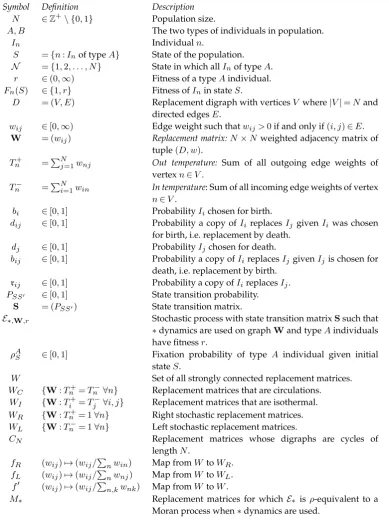
incorporating a replacement structure. The notation used in this paper is summarised in Table1. 43
The population has a constant sizeN∈Z,N≥2, consisting of individualsI1, . . . , IN. Every individual
44
is either of typeAorB.
45
This implies that there are2N different states of the population given by the combination of 46
typeAandBindividuals. We represent each state by a setSsuch thatn∈Sif an individualIn
47
is of typeA. We can easily revert to using the number of typeAindividuals,|S|, if the population 48
is homogeneous. The states ∅ and N={1,2, . . . , N} have only type B and A individuals 49
3
rspa.ro
y
alsocietypub
lishing.org
Proc
R
Soc
A
0000000
..
..
..
..
..
..
..
..
..
..
..
..
..
..
..
..
..
..
..
..
..
..
..
..
..
..
..
..
..
Individuals have a constant fitness that may depend upon their type.
51
The fitness of individuals in state S is thus given by the vector F(S) = (Fn(S))n=1,2,...,N
52
where 53
Fn(S) =
(
1 n /∈S,
r∈(0,∞) n∈S,
54 55
is the fitness ofIn. Here the fitnessrof a typeAindividual is given relative to the fitness of a type
56
Bindividual assumed to be 1. 57
During a stochastic replacement event (that happens in an instant) an exact copy of an individualIi
58
replaces an individualIj.
59
The replacement events may be restricted in the sense that not all individuals can replace 60
one another. To enforce such restrictions, [11] imposed a replacement structure using a weighted 61
directed graph given by the tuple (D, w)whereD= (V, E)is a directed graph, with setsV of 62
vertices andE of directed edges, andwis a map that assigns a weight to each edge such that 63
w:V ×V →[0,∞) : (i, j)7→wij. Each vertexn∈V representsInthereforeV ={1,2, . . . , N}so
64
|V|=N. We assume that(i, j)∈Eif and only ifwij>0, which indicates thatIican replaceIj.
65
Note that we allowwii>0and thereforeIican replace itself. All the information contained within
66
the weighted digraph (D, w) is conveniently summarised by the N×N weighted adjacency 67
matrixW= (wij)and therefore we will refer to(D, w)usingW, which we call thereplacement
68
matrix. 69
The replacement events are stochastic which means that there is a probability rij=
70
rij(F(S),W)associated with (a copy of)IireplacingIj. There are several potentialevolutionary
71
dynamics on graphs that govern how the probability is determined. There three main types of 72
dynamics that are summarised below, see also [21]. We use the convention thatIiis chosen for
73
birth andIjis chosen for death.
74
(i)Birth-Death(BD):Iiis chosen first thenIj. We have thati∈V is chosen with probability
75
biand then(i, j)∈Ei is chosen with probabilitydij, whereEiare all edges starting in
76
vertexi.dijis used to signify that there is ‘replacement by death’. Finally,rij=bidij.
77
(ii)Death-Birth(DB):Ijis chosen first thenIi. We have thatj∈V is chosen with probability
78
dj and then(i, j)∈Ejis chosen with probabilitybij, whereEjare all edges ending in
79
vertexj.bijis used to signify that there is ‘replacement by birth’. Finally,rij=dibij.
80
(iii)Link(L):IiandIjare chosen simultaneously. In this case(i, j)∈Eis simply chosen with
81
probabilityrij.
82
For each type of these dynamics, the natural selection can, through the fitness parameter, influence 83
either the choice at birth (resulting in adding “B”) or at death (adding “D”). It yields 6 kinds of 84
evolutionary dynamics on graphs summarized in Table2. These dynamics have been extensively 85
studied, in particular, see [27] for a detailed comparison of them. Of these, the BDB and LB 86
dynamics were used in [11]. 87
(a) The fixation probability
88
The fixation probability,ρAS =ρAS(∗,W, r), is the probability that the population with initial state
89
Sis absorbed inN where∗is the dynamics being used. 90
Given that the replacement events are random, the transitions between the states of the 91
population are described by a stochastic process, which we denote E. The properties of E
92
4
rspa.ro
y
alsocietypub
lishing.org
Proc
R
Soc
A
0000000
..
..
..
..
..
..
..
..
..
..
..
..
..
..
..
..
..
..
..
..
..
..
..
..
..
..
..
..
..
PSS0=PSS0(∗,W, r), are calculated using the replacement probabilities as follows: 94
PSS0=
X
i /∈S
rij(F(S),W) ifS0=S\ {j}for somej∈S,
X
i∈S
rij(F(S),W) ifS0=S∪ {j}for somej /∈S,
X
i,j∈S
∨i,j /∈S
rij(F(S),W) ifS0=S.
95
96
The transition probabilities,PSS0, satisfy the Markov property because they only depend upon 97
the state S, that is, the probability of transitioning from the present state to another state is 98
independent of any past and future state of the population. The stochastic processE∗,W,rwith
99
state transition matrixS=S(∗,W, r) = (PSS0)S,S0⊂{1,2,...,N} is therefore a Markov chain. The 100
Markov chainE∗,W,ris part of the class of evolutionary Markov chains described in [28].
101
The absorbing states ofE∗,W,rare∅,N, which means that if the population is in either one of
102
these states then it remains there indefinitely. This property ofE∗,W,rcan be used to measure the
103
success of a typeAindividual by calculating the probability that it fixates, that is, everyone in the 104
population is of typeA. The fixation probability is then given by solving 105
ρAS=
X
S0⊂{1,2,...,N}
PSS0ρAS0 (2.1)
106 107
with boundary conditionsρA∅ = 0andρAN= 1. 108
As demonstrated in [27], LB and LD dynamics may differ in time scale but they yield the 109
same fixation probabilities when fitness is constant (which is our case). Thus, for our purposes 110
the dynamics are the same and we will thus consider them together and denote them by L. 111
Fixation probability is not the only measure for evolutionary success and we can look at the 112
fixation time [29,30] as well. 113
(b) The Moran Process
114
The Moran process [3], a stochastic birth-death process on finite fixed homogenous population, 115
can be reconstructed asEBDB,WH,rfor a constant replacement matrix 116
WH= (1/N)i,j. (2.2)
117 118
For any r∈(0,∞)and any S⊂ {1, . . . , N}, the fixation probability for this process, orMoran
119
probability, is given by 120
ρAS =
1−r−|S|
1−r−N ifr6= 1,
|S|/N ifr= 1.
121
122
We are interested in characterizing graphs (and evolutionary dynamics) that yield the same 123
fixation probabilities as the homogeneous matrixWHgiven in (2.2). We note that for this matrix 124
all of the transition probabilitiesrijtake the same value independent ofi, jor the dynamics, and
125
consequently the fixation probability under each of the dynamics is the same. 126
(c) Classes of Graphs/ Matrices
127
The set of all admissible replacement matrices is defined as follows 128
W={W:for everyi, j, there isnsuch that (Wn)i,j>0}.
129 130
This definition means thatW is strongly connected as for any pair of verticesiandj, there is 131
a path (of lengthn) going fromitoj. Unless specified otherwise, we will consider admissible 132
5
rspa.ro
y
alsocietypub
lishing.org
Proc
R
Soc
A
0000000
..
..
..
..
..
..
..
..
..
..
..
..
..
..
..
..
..
..
..
..
..
..
..
..
..
..
..
..
..
As in [11], for anyW(admissible or not) we define thein temperatureofIn,Tn−, and theout
134
temperatureofIn,Tn+, by
135
Tn−= N
X
j=1
wjn and Tn+=
N
X
j=1
wnj.
136 137
Wis called acirculationifTn+=Tn−, for alln∈V and it is calledisothermalifTi+=T
−
j , for all
138
i, j∈V.Wis calledrightstochastic ifTn+= 1, for alln∈V and it is calledleftstochastic ifTn−= 1,
139
for alln∈V. The sets of all circulations, isothermal matrices, right stochastic matrices, and left 140
stochastic matrices, respectively are denoted byWC, WI, WR,andWLrespectively.
141
The setCN denotes the sets of matrices representingcyclesof lengthN, more specifically, for
142
(wij)∈CNwe havewii= 1/2fori= 1,2, . . . N,wi1i2=· · ·=winin+1=· · ·=wiN−1iN=wiNi1= 143
1/2for some permutationi1, i2, . . . , iN of the sequence1,2, . . . , N, andwij= 0otherwise.
144
We also define the mapsfR:W→WR,fL:W→WL, andf0:W→Wrespectively, by
145
fR (wij)=
w
ij
P
nwin
, fL (wij)=
w
ij
P
nwnj
, and f0 (wij)=
wij
P
n,kwnk
!
.
146 147
Note that fR preserves right stochastic matrices and fL preserves left stochastic matrices.
148
Moreover,fR(W) =fL(W)for allW∈WI. Also, sincef0 simply involves multiplyingW by
149
the constant1/Pn,kwnk, it implies thatW∈WC⇔f0(W)∈WC.
150
When the dynamics ∗, matrices W1 and W2, and fitness r are given, we say that an 151
evolutionary Markov chain E∗,W1,r is ρ-equivalent to E∗,W2,r if for every S⊂ {1, . . . , N},
152
ρAS(∗,W1, r) =ρAS(∗,W2, r), in which case we writeW1∼∗,rW2. 153
We are specifically interested in finding matrices equivalent to the Moran process. For a 154
dynamics∗, we define 155
M∗={W:W∼∗,rWHfor allr >0}. 156
157
3. Results
158
The map fR preserves the equivalence classes of BDB and BDD dynamics, fL preserves the
159
equivalence classes of DBB and DBD dynamics andf0preserves the equivalence classes for link 160
dynamics. Specifically, as one can see from the proofs in the Appendix, for anyWand anyr >0 161
W∼BDB,rfR(W), (3.1)
162
W∼BDD,rfR(W),
163
W∼DBD,rfL(W),
164
W∼DBB,rfL(W),
165
W∼L,rf0(W).
166 167
We thus obtain the following results, which completely specify the graphs which are equivalent 168
to the homogeneous matrixWHfor each of our evolutionary dynamics. 169
Proposition 1(Link). ML=WC. More precisely, the following statements are equivalent:
170
(a)Wis a circulation.
171
(b) For allr >0,W∼L,rWH. 172
(c) There isr >0such thatW∼L,rWH. 173
We note that WC=f0−1(WC) ={W:f0(W)∈WC} and thus, similarly to Proposition 2
174
below, Proposition1can be written asML=f0−1(WC).
6
rspa.ro
y
alsocietypub
lishing.org
Proc
R
Soc
A
0000000
..
..
..
..
..
..
..
..
..
..
..
..
..
..
..
..
..
..
..
..
..
..
..
..
..
..
..
..
..
Proposition 2 (BDB and DBD). MBDB=fR−1(WC) and MDBD=f
−1
L (WC). More precisely, the
176
following statements are equivalent:
177
(a)fR(W)is a circulation.
178
(b) For allr >0,W∼BDB,rWH. 179
(c) There isr >0such thatW∼BDB,rWH 180
The equivalent conditions for DBD are similar to the above for BDB butfRis replaced byfL.
181
Proposition 3 (BDD and DBB). MBDD=fR−1({WH} ∪CN) and MDBB=f
−1
L ({WH} ∪CN) .
182
More precisely, the following statements are equivalent:
183
(a)fR(W) =WHorfR(W)∈CN.
184
(b) For allr >0,W∼BDD,rWH. 185
The equivalent conditions for DBB are similar to the above for BDD butfRis replaced byfL.
186
In particular,MBDD⊂MBDBandMDBB⊂MDBD. The setsM∗are illustrated in Table2. 187
Note that unlike in Propositions1and2, Proposition3does not contain “anyrimplies allr". 188
In fact, whenr= 1, there is no selection and thus the dynamics BDB and BDD are the same (and 189
also the dynamics DBB and DBD are the same). Consequently, by Proposition2, 190
W∼BDD,1WH⇔fR(W)∈WC⇔W∈MBDB,
191
W∼DBB,1WH⇔fL(W)∈WC⇔W∈MDBD.
192 193
(a) Our results in the context of known results
194
For the LB dynamics, Proposition1was stated and proved in [11] as the Circulation theorem. For 195
the LD dynamics, Proposition1follows from the Circulation theorem and the result of [27] that 196
the fixation probabilities for LB and LD are the same. 197
As shown in Appendix(a), BDB is the same as the LB dynamics for right stochastic matrices 198
(in particular, for BDB dynamics, Proposition2can be seen as the Isothermal theorem from [11]). 199
Proposition2thus follows from Proposition1thanks to (3.1). The natural symmetries betweenfR
200
andfLand BDB and DBD dynamics allow us to extend the Isothermal theorem to DBD dynamics
201
as well (see also [31]). 202
Overall, Propositions1and2and the occurrence ofWCwithin them are consistent with the
203
claim made in [11] that the circulation criterion completely classifies all replacement matrices 204
whereE∗,W,risρ-equivalent to a Moran process.
205
Our most important new result is Proposition3. It shows that the BDD and DBB dynamics 206
require very strict conditions to yield the Moran process. Either the population structure is 207
homogeneous, or it is a directed cycle. This latter structure is an interesting theoretical example, 208
but is unlikely to apply to real populations, meaning that the homogeneous population is 209
practically the only way to get the Moran process for a realistic population. 210
(b) The importance of self-loops in BDD and DBB dynamics
211
Proposition 3 by definition requires that wii>0 ∀i= 1,2, . . . , N. Without such self-loops,
212
EBDD,W,r,EDBB,W,r cannot ever be ρ-equivalent to the Moran process. The ability of an
213
individual to replace itself therefore plays an important role in the replacement structure of the 214
population and cannot be discounted. For BD dynamics, when increasing the diagonal weights 215
ofW, the fixation probability decreases for BDB and increases for BDD. For DB dynamics, the 216
increase in fixation probability DBB is greater than that for DBD. For LB dynamics, the fixation 217
7
rspa.ro
y
alsocietypub
lishing.org
Proc
R
Soc
A
0000000
..
..
..
..
..
..
..
..
..
..
..
..
..
..
..
..
..
..
..
..
..
..
..
..
..
..
..
..
..
With BDD and DBB evolutionary dynamics on graphs one may encounter the following 219
problems if there are no self-loops. For DBB dynamics, a type A individual with almost infinite 220
fitness still has a fixation probability bounded away from 1 because even type A individuals 221
can be randomly picked for death and replaced by type B individuals [32, page 245]. With self-222
loops, however, a type A individual will almost always be replaced by itself (or another type A 223
individual) and therefore has a fixation probability approaching 1. Similarly, for BDD dynamics, 224
a type A individual with almost zero fitness does not have near probability 0 of fixating as type 225
A individuals can be randomly picked for birth and replace type B individuals [32, page 245]. 226
With self-loops, such an individual will almost always pick itself (or another type A) to replace 227
and therefore its fixation probability is near 0. Thus the inclusion of self-loops removes some 228
problematic features of the BDD and DBB dynamics, and makes them more attractive dynamics 229
to use in models. 230
4. Discussion
231
In this paper we have considered an evolutionary graph theory model of a population involving 232
general weights and a variety of evolutionary dynamics based upon the work of [11], which was 233
a development of the classical population model of [3]. In such populations, the population size 234
is fixed at all times and at successive discrete time points one replacement event occurs. Like the 235
aforementioned papers we consider two types of individuals, where fitness depends upon type 236
but no other factors (i.e. there are no game-theoretic interactions). In particular the single most 237
important property of such a process is the fixation probability, the probability that a randomly 238
placed mutant individual of the second type will eventually completely replace the population of 239
the first type. 240
This fixation probability depends upon the fitnesses of the two types of individuals, but 241
can also be heavily influenced by the population structure as given by the weights, and by 242
the evolutionary dynamics used. These effects are commonly observed, although in some 243
circumstances evolution proceeds as if as on a well-mixed population as from the original work of 244
[3], dependent only upon the fitnesses of the two types, and some important results in this regard 245
were already given in [11]. The aim of this paper was to provide a generalised set of conditions 246
for when this would be the case. 247
By defining what is meant by fixation-equivalence to the Moran process, we provided a general 248
result which, independent of the specific dynamics used, helps identify graphs that do not affect 249
the fixation probability. With respect to each of the standard dynamics, we then classified sets of 250
evolutionary graphs that have the same fixation probability as the Moran process (or well mixed 251
population). These sets include graphs that are circulations and therefore generalises the work of 252
[11]. 253
An important new result shows that the set of weights for which we obtain fixation equivalence 254
to the Moran process for the BDD and DBB dynamics is very restricted, and so that for most 255
populations with any structure this equivalence will not hold for these dynamics. We note also 256
that the inclusion of non-zero self weightswiieliminates some problematic features of these two
257
dynamics (i.e. that individuals with 0 fitness could fixate or those with infinite fitness could be 258
eliminated) and so improves the applicability of these dynamics. 259
Presenting evolutionary dynamics on graphs in the way that we have allows one to incorporate 260
a variety of dynamics in their analysis, both of standard type and other definitions. This will 261
improve our understanding of dynamics on graphs in general. We note that the list of dynamics 262
in Table2is not exhaustive. For example, [33] used imitation dynamics, which is a class of DBB 263
dynamics with an additional requirement wii>0∀i, and [34] consolidates the BDB and DBD
264
dynamics such that one is chosen with a given probability. 265
In general the inclusion of non-zero self weights, in contrast to many earlier evolutionary 266
graph theory works, allows for a greater flexibility of modelling. We note that this is consistent 267
with the original work of [3], which allowed self-replacement as an integral part of the process. 268
8
rspa.ro
y
alsocietypub
lishing.org
Proc
R
Soc
A
0000000
..
..
..
..
..
..
..
..
..
..
..
..
..
..
..
..
..
..
..
..
..
..
..
..
..
..
..
..
..
(at least for sufficiently large populations with intermediate fitness values), and it is likely that 270
it has often been excluded for reasons of convenience because of this without the ramifications 271
being fully considered in many later works. It is thus important to consider whether to include 272
such self weights when modelling spatial structure using evolutionary graph theory. 273
Data accessibility. There is no supporting data for this article.
274
Conflict of interests. We have no competing interests.
275
Author’s contributions. KP developed the original concept in discussion with MB, and carried out
276
the majority of the analysis and writing. MB, JR and LJS have all been closely involved in refining the
277
paper in terms of both analysis and presentation. In particular JR did significant work on the proofs, MB
278
on the Introduction/Discussion and LJS on the scientific presentation. All authors gave final approval for
279
publication.
280
Acknowledgements. We thank two anonymous reviewers for their valuable comments and suggestions.
281
Funding statement. The research was supported by Simons Foundation grant 245400 to JR, and a City of
282
London Corporation grant for KP.
283
References
284
1 Maynard Smith J. Evolution and the Theory of Games. Cambridge university press; 1982. 285
2 Hofbauer J, Sigmund K. Evolutionary games and population dynamics. Cambridge 286
University Press; 1998. 287
3 Moran PAP. Random processes in genetics. In: Mathematical Proceedings of the Cambridge 288
Philosophical Society. vol. 54. Cambridge Univ Press; 1958. p. 60–71. 289
4 Moran PAP. The statistical processes of evolutionary theory. Clarendon Press, Oxford; 1962. 290
5 Karlin S, Taylor HM. A first course in stochastic processes. London, Academic Press; 1975. 291
6 Landauer R, Buttiker M. Diffusive traversal time: Effective area in magnetically induced 292
interference. Physical Review B. 1987;36(12):6255. 293
7 Antal T, Scheuring I. Fixation of strategies for an evolutionary game in finite populations. 294
Bulletin of Mathematical Biology. 2006;68(8):1923–1944. 295
8 Taylor C, Fudenberg D, Sasaki A, Nowak MA. Evolutionary game dynamics in finite 296
populations. Bulletin of Mathematical Biology. 2004;66(6):1621–1644. 297
9 Nowak MA, Sasaki A, Taylor C, Fudenberg D. Emergence of cooperation and evolutionary 298
stability in finite populations. Nature. 2004;428(6983):646–650. 299
10 Maruyama T. Effective number of alleles in a subdivided population. Theoretical Population 300
Biology. 1970;1(3):273–306. 301
11 Lieberman E, Hauert C, Nowak MA. Evolutionary dynamics on graphs. Nature. 302
2005;433(7023):312–316. 303
12 Allen B, Traulsen A, Tarnita CE, Nowak MA. How mutation affects evolutionary games on 304
graphs. Journal of Theoretical Biology. 2012;299:97–105. 305
13 Antal T, Redner S, Sood V. Evolutionary dynamics on degree-heterogeneous graphs. Physical 306
Review Letters. 2006;96(18):188104. 307
14 Broom M, Rychtáˇr J. An analysis of the fixation probability of a mutant on special classes 308
of non-directed graphs. Proceedings of the Royal Society A: Mathematical, Physical and 309
Engineering Science. 2008;464(2098):2609–2627. 310
15 Broom M, Rychtáˇr J, Stadler BT. Evolutionary dynamics on graphs-the effect of graph 311
structure and initial placement on mutant spread. Journal of Statistical Theory and Practice. 312
2011;5(3):369–381. 313
16 Ohtsuki H, Hauert C, Lieberman E, Nowak MA. A simple rule for the evolution of cooperation 314
on graphs and social networks. Nature. 2006;441(7092):502–505. 315
17 Ohtsuki H, Nowak MA, Pacheco JM. Breaking the symmetry between interaction and 316
replacement in evolutionary dynamics on graphs. Physical Review Letters. 2007;98(10):108106. 317
18 Shakarian P, Roos P. Fast and deterministic computation of fixation probability in evolutionary 318
9
rspa.ro
y
alsocietypub
lishing.org
Proc
R
Soc
A
0000000
..
..
..
..
..
..
..
..
..
..
..
..
..
..
..
..
..
..
..
..
..
..
..
..
..
..
..
..
..
19 Voorhees B, Murray A. Fixation probabilities for simple digraphs. Proceedings of the Royal 320
Society A: Mathematical, Physical and Engineering Science. 2013;469(2154). 321
20 Allen B, Nowak MA. Games on graphs. EMS Surveys in Mathematical Sciences. 2014;1(1):113– 322
151. 323
21 Shakarian P, Roos P, Johnson A. A review of evolutionary graph theory with applications to 324
game theory. Biosystems. 2012;107(2):66–80. 325
22 Taylor PD, Jonker LB. Evolutionary stable strategies and game dynamics. Mathematical 326
Biosciences. 1978;40(1):145–156. 327
23 Masuda N, Ohtsuki H. Evolutionary dynamics and fixation probabilities in directed networks. 328
New Journal of Physics. 2009;11(3). 329
24 Hadjichrysanthou C, Broom M, Rychtáˇr J. Evolutionary games on star graphs under various 330
updating rules. Dynamic Games and Applications. 2011;1(3):386–407. 331
25 Wu B, Bauer B, Galla T, Traulsen A. Fitness-based models and pairwise comparison models of 332
evolutionary games are typically differentâ ˘AˇTeven in unstructured populations. New Journal 333
of Physics. 2015;17(2):023043. 334
26 Slatkin M. Fixation probabilities and fixation times in a subdivided population. Evolution. 335
1981;p. 477–488. 336
27 Masuda N. Directionality of contact networks suppresses selection pressure in evolutionary 337
dynamics. Journal of Theoretical Biology. 2009;258(2):323–334. 338
28 Allen B, Tarnita CE. Measures of success in a class of evolutionary models with fixed 339
population size and structure. Journal of Mathematical Biology. 2014;68(1-2):109–143. 340
29 Broom M, Hadjichrysanthou C, Rychtáˇr J. Evolutionary games on graphs and speed of 341
the evolutionary process. Proceedings of the Royal Society A: Mathematical, Physical and 342
Engineering Science. 2010;466. 343
30 Frean M, Rainey PB, Traulsen A. The effect of population structure on the rate of evolution. 344
Proceedings of the Royal Society of London B: Biological Sciences. 2013;280(1762):20130211. 345
31 Kaveh K, Komarova NL, Kohandel M. The duality of spatial death–birth and birth–death 346
processes and limitations of the isothermal theorem. Royal Society Open Science. 2015;2(4). 347
32 Broom M, Rychtáˇr J. Game-theoretical models in biology. CRC Press, Boca Raton, FL; 2013. 348
33 Ohtsuki H, Nowak MA. The replicator equation on graphs. Journal of Theoretical Biology. 349
2006;243(1):86–97. 350
34 Zukewich J, Kurella V, Doebeli M, Hauert C. Consolidating birth-death and death-birth 351
processes in structured populations. PloS one. 2013;8(1):e54639. 352
35 Kemeny J, Snell JL. Finite Markov Chains. Van Nostrand; 1960. 353
36 Sood V, Antal T, Redner S. Voter models on heterogeneous networks. Physical Review E. 354
2008;77(4):041121. 355
37 Nakamaru M, Matsuda H, Iwasa Y. The evolution of cooperation in a lattice-structured 356
population. Journal of theoretical Biology. 1997;184(1):65–81. 357
38 Nowak MA, May RM. Evolutionary games and spatial chaos. Nature. 1992;359(6398):826–829. 358
39 Nakamaru M, Nogami H, Iwasa Y. Score-dependent fertility model for the evolution of 359
cooperation in a lattice. Journal of Theoretical Biology. 1998;184:101–124. 360
40 Santos FC, Pacheco JM. Scale-free networks provide a unifying framework for the emergence 361
of cooperation. Physical Review Letters. 2005;95(9):098104. 362
Appendix
363
A. Proofs
364
(a) BDB is the same as LB for right stochastic matrices
365
For BDB dynamics we haverij=bidij. By definitionPijbidij= 1, we can therefore write this as
366
rij=bidij.Pn,kbndn,k. Substitutingbi=Fi.PNm=1Fm gives
367
rij=
dijFi.PNm=1Fm
P
n,k
dnkFn.PNm=1Fm
=P dijFi
n,kdnkFn
.
10
rspa.ro
y
alsocietypub
lishing.org
Proc
R
Soc
A
0000000
..
..
..
..
..
..
..
..
..
..
..
..
..
..
..
..
..
..
..
..
..
..
..
..
..
..
..
..
..
369
If W is right stochastic, i.e. PNn=1win= 1 for all i= 1,2, . . . N, for BDB dynamics we have
370
thatdij=wij.PNn=1win=wijgivingrij=wijFi.Pn,kwnkFn which is the LB dynamics as
371
required. We also have that DBD is the same as LD for left stochastic matrices. The explanation 372
follows the same procedure as above. 373
(b) Lemma
1
(Forward Bias)
374
The key Lemma1stated below is used in the proofs of all propositions and it relies heavily on the 375
notion offorward biasof stateSwhich is then given by the ratio of the probabilities of a forward 376
transition to a backward transition fromS. A forward and backward transition fromS occurs 377
when the number of typeAindividuals increase and decrease by one respectively, which happen 378
with probability 379
PS+=X
n /∈S
PS,S∪{n} and PS−=
X
n∈S
PS,S\{n}. 380
381
Lemma 1(Constant Forward Bias). LetEbe an evolutionary process on statesS⊂ {1,2, . . . , N}with
382
transition probabilitiesPS,S0that satisfy 383
•PS,S0>0only ifSandS0differ in at most one element 384
•for everyS6=∅,{1, . . . , N}, there areS+andS−such that|S+|=|S|+ 1and|S−|=|S| −1 385
andPS,S+>0, PS,S−>0. 386
Then, the following are equivalent
387
a) There is a constantc >0such that for allS⊂ {1,2, . . . , N}
388
ρAS=
1−c−|S|
1−c−N ifc6= 1,
|S|/N ifc= 1 389
390
b)Ehas constant forward bias, that is, there is a constantdsuch that for allS⊂ {1,2, . . . , N}
391
PS+.PS−=d.
392 393
Moreover, if either (a) or (b) hold, thenc=d.
394
Note that a similar result is given in [11,20] where the forward bias is explicitly defined as 395
rX
a∈S
X
b /∈S
wab
, X
a∈S
X
b /∈S
wba,
396 397
which is what one gets when using Link dynamics, or BDB dynamics ifW∈WR. Note that in
398
Lemma1the forward bias is defined independent of the dynamics and therefore applies to all 399
dynamics that satisfy the assumptions. 400
Proof. “(a)⇒(b)": Take anyS⊂ {1,2, . . . , N}. It is known that 401
ρAS=
X
S0
PS,S0ρAS0=PS,SρAS + X
n /∈S
PS,S∪{n}ρAS∪{n}+X
n∈S
PS,S\{n}ρAS\{n}
402 403
and usingPS,S= 1−PS+−P
−
S gives
404
0 =X
n /∈S
PS,S∪{n}
ρAS∪{n}−ρAS
+X
n∈S
PS,S\{n}
ρAS\{n}−ρAS
. (A 1)
11
rspa.ro
y
alsocietypub
lishing.org
Proc
R
Soc
A
0000000
..
..
..
..
..
..
..
..
..
..
..
..
..
..
..
..
..
..
..
..
..
..
..
..
..
..
..
..
..
406
Forc6= 1, equation (A 1) simplifies to 407
0 =1−c −|S|−1
−1 +c−|S|
1−c−N P
+
S +
1−c−|S|+1−1 +c−|S|
1−c−N P
−
S ⇒
408
PS+.PS− =c −|S|
−c−|S|+1
c−|S|−1−c−|S|= 1−c c−1−1=c.
409 410
Forc= 1, equation (A 1) simplifies to 411
0 = (|S|+ 1− |S|)PS++ (|S| −1− |S|)PS−⇒ PS+.PS−= 1.
412 413
“(b)⇐(a)”: The state transition matrixS= (PS,S0)can be scaled to giveS0= (PS,S0 0)such that 414
PS,S0 = 0 and PS,S0 0=PS,S0/(1−PS,S) =PS,S0/(PS++PS−) where S is a non-absorbing state. 415
The fixation probabilityρAS will be the same whetherS0 orSis used. This is because equation 416
(2.1) can be rearranged as follows 417
ρAS =
X
S0
PSS0ρAS0⇒ ρAS =PSSρAS + X
S0:S06=S
PSS0ρAS0⇒ 418
ρAS(1−PSS) =
X
S0:S06=S
PSS0ρAS0⇒ ρAS= X
S0:S06=S
PSS0
PS++PS−ρ
A S0. 419
420
Let {S0,S1, . . . ,SN}be a partition of the states S such that S∈ Si if |S|=i. The probability
421
Pi,j(S)of transitioning from stateS∈ Sitolumped stateSjwith respect toS0is
422
Pi,j(S) =
0 j6=i±1,
1/(d+ 1) j=i−1,
d/(d+ 1) j=i+ 1
fori= 1,2, . . . , N−1. (A 2)
423
424
This can be easily verified, for example, takej=i−1then 425
Pi,i−1(S) =
X
S0∈Si−1
PS,S0 0= X
S0∈Si−1
PS,S0
PS++PS− = PS− PS++PS−=
1 1 +d
426 427
since the forward bias is equal tod. Equation (A 2) satisfies the necessary and sufficient condition 428
for the Markov chain with state transition matrixS0to be lumpable with respect to the partition 429
{S0,S1, . . . ,SN}(Theorem 6.3.2 page 124, [35]). LetSˆ= (Pi,j)be the state transition matrix for
430
this lumped Markov chain then the probabilityPi,jof transitioning from lumped statesSitoSj
431
is given by 432
Pi,j=Pi,j(S).
433 434
The state transition matrixSˆdescribes a random walk with absorbing barriers and therefore the 435
probabilityρAi of typeAindividuals fixating when the population starts in lumped stateSi is
436
calculated using the methods in [5] to give 437
ρAi = 1 + i−1
X
j=1
j
Y
k=1
Pk,k−1
Pk,k+1
, 1 +
NX−1
j=1
j
Y
k=1
Pk,k−1
Pk,k+1
.
438 439
In this case, 440
ρAi =
1−d−i
1−d−N d6= 1,
i/N d= 1
441 442
since Pk,k−1/Pk,k+1= 1/r for k= 1,2, . . . , N−1. By definition, ρAS =ρ A
i where i=|S| as
443
12 rspa.ro y alsocietypub lishing.org Proc R Soc A 0000000 .. .. .. .. .. .. .. .. .. .. .. .. .. .. .. .. .. .. .. .. .. .. .. .. .. .. .. .. ..
(c) Proposition
1
(Link)
445
The following statements are equivalent: 446
(a)Wis a circulation. 447
(b) For allr >0,W∼L,rWH. 448
(c) There isr >0such thatW∼L,rWH. 449
(d) For allr >0and for allS⊂ {1,2, . . . , N}, the forward bias ofEL,W,risr, i.e.
450
PS+.PS− =r.
451 452
(e) There isr >0such that for alla∈ {1,2, . . . , N}, the forward bias of the one element set 453
S={a}isr, i.e. 454
X
b6=a
P{a},{a,b}
Pa,∅
=r.
455 456
Proof. For LB dynamics the forward bias is given by 457
PS+ PS− =
X
a∈S
X
b /∈S
wabFa
X
n,k
wnkFn
X
a∈S
X
b /∈S
wbaFb
X
n,k
wnkFn
=
rX
a∈S
X
b /∈S
wab
X
a∈S
X
b /∈S
wba
.
458
459
For LD dynamics the forward bias is given by 460
PS+ PS− =
X
a∈S
X
b /∈S
wab/Fb
X
n,k
wnk/Fk
X
a∈S
X
b /∈S
wba/Fa
X
n,k
wnk/Fk
=
rX
a∈S
X
b /∈S
wab
X
a∈S
X
b /∈S
wba
.
461
462
“(a)⇒(d)”:Wis a circulation i.e.Tn+=Tn− for alln∈ {1, . . . , N}and thus
463
X
a∈S
X
b /∈S
wab=
X
a∈S
X
n
wan−
X
k∈S
wak
=X
a∈S
Ta+−
X
k∈S
wak
⇒
464
X
a∈S
X
b /∈S
wab=
X
a∈S
Ta−−
X
k∈S
wka
=X
a∈S
X
n
wna−
X
k∈S
wka
⇒
465
X
a∈S
X
b /∈S
wab=
X
a∈S
X
b /∈S
wba.
466 467
Note that Pa∈SPb /∈Swab6= 0 becauseW is admissible and represents a strongly connected
468
graph. Thus, the forward bias for both LB and LD is equal tor. 469
“(d)⇒(e)" is trivial as (d) is much stronger than (e). 470
“(e)⇒(a)" Letaandris fixed. By above calculations of the forward bias, we have 471
X
b /∈S={a}
wab=
X
b /∈S={a}
wba⇒ −waa+
N
X
i=1
wai=−waa+ N
X
i=1
wia⇒
N
X
i=1
wai= N X i=1 wia 472 473
thereforeWis a circulation. 474
“(d)⇒(b)" follows from Lemma1. 475
“(b)⇒(c)" is trivial. 476
13
rspa.ro
y
alsocietypub
lishing.org
Proc
R
Soc
A
0000000
..
..
..
..
..
..
..
..
..
..
..
..
..
..
..
..
..
..
..
..
..
..
..
..
..
..
..
..
..
(d) Proposition
2
(BDB and DBD)
478
More precisely, the following statements are equivalent: 479
(a)fR(W)is a circulation.
480
(b) For allr >0,W∼BDB,rWH. 481
(c) There isr >0such thatW∼BDB,rWH 482
(d) For allr >0and for allS⊂ {1,2, . . . , N}, the forward bias ofEBDB,W,risr, i.e.
483
PS+.PS− =r.
484 485
(e) There isr >0such that for alla∈ {1,2, . . . , N}, the forward bias ofEBDB,W,rof the one
486
element setS={a}isr, i.e. 487
X
b6=a
P{a},{a,b}
Pa,∅
=r.
488 489
Proof. Let U= (uij) =fR(W) = wij/Pnwin
then for BDB dynamics the forward bias of 490
EBDB,W,ris given by
491
PS+ PS−=
X
a∈S
X
b /∈S
Fa
X
n
Fn
wab
X
n
wan
X
a∈S
X
b /∈S
Fb
X
n
Fn
wba
X
n
wbn
=
rX
a∈S
X
b /∈S
uab
X
b /∈S
X
a∈S
uba
492
493
and therefore the forward bias ofEBDB,W,ris the same as forward bias ofEBDB,U,r.
494
Similarly, with almost identical working as above, when V=fL(W), the forward bias of
495
EDBD,W,ris the same as forward bias ofEDBD,V,rand is given by
496
PS+ PS− =
X
a∈S
X
b /∈S
1/Fb
X
n
1/Fn
wab
X
n
wnb
X
a∈S
X
b /∈S
1/Fa
X
n
1/Fn
wba
X
n
wna
= X
a∈S
X
b /∈S
vab
1
r
X
a∈S
X
b /∈S
vba
.
497
498
and the proof of the Proposition for DBD closely follows the one for BDB given below withUand 499
fRappropriately replaced byVandfL.
500
“(a)⇒(d)”: IfU=fR(W)∈WC, i.e. ifUis doubly stochastic, then the forward bias (forS6=
501
∅,N) is equal to 502
PS+ PS−=
rX
a∈S
X
n
(uan)−
X
k∈S
(uak)
X
a∈S
X
n
(una)−
X
k∈S
(uka)
=
r
|S| −X
a∈S
X
k∈S
uak
|S| −X
a∈S
X
k∈S
uka
=r
503
504 505
“(d)⇒(e)" is trivial as (d) is stronger than (e). 506
“(e)⇒(a)" Letaandris fixed. By above calculations of the forward bias, we have 507
X
a∈S
X
b /∈S
uab=
X
a∈S
X
b /∈S
uba.
14
rspa.ro
y
alsocietypub
lishing.org
Proc
R
Soc
A
0000000
..
..
..
..
..
..
..
..
..
..
..
..
..
..
..
..
..
..
..
..
..
..
..
..
..
..
..
..
..
509
Consider the statesS={a}in which there is only one individual of typeAthen 510
X
b /∈S
uab=
X
b /∈S
uba⇒ −uaa+
N
X
i=1
uai=−uaa+ N
X
i=1
uia⇒ 1 =
N
X
i=1
uia
511 512
is true for alla= 1,2, . . . , Nand thereforeUis doubly stochastic and thusfR(W)is a circulation.
513
“(d)⇒(b)" follows from Lemma1. 514
“(b)⇒(c)" is trivial. 515
“(c)⇒(e)" follows from Lemma1. 516
(e) Proposition
3
(BDD and DBB)
517
The following statements are equivalent: 518
(a)fR(W) =WHorfR(W)∈CN.
519
(b) For allr >0,W∼BDD,rWH. 520
Proof. The replacement probabilities rij(F(S),W) for BDD dynamics can be rewritten as
521
rij(F(S),U) where U= (uij) =fR(W) = wij/Pnwin
by multiplying the numerator and 522
denominator withPnwinas follows
523
rij(F(S),W) =
1
N
wij/Fj(S)
P
nwin/Fn(S)
= 1
N
wij/ Fj(S)Pnwin
P
nwin/ Fn(S)Pnwin
⇒
524
uij/Fj(S)
P
nuin/Fn(S)=rij(F(S),U)
525 526
and therefore we have thatW∼BDD,rU, for allr >0. The forward bias usingUfor stateS is
527
given by 528
PS+ PS−=
X
a∈S
X
b /∈S
1
N
uab/Fb
X
n
uan/Fn
X
a∈S
X
b /∈S
1
N
uba/Fa
X
n
ubn/Fn
= X
a∈S
X
b /∈S
uab
X
n
uan/Fn
1
r
X
a∈S
X
b /∈S
uba
X
n
ubn/Fn
. (A 3)
529
530
Similarly, letV= (vij) =fL(W) = (wij/Pnwnj). Then for DBB dynamics we have
531
bij=
wijFi
P
nwnjFn=
wijFi/Pnwnj
P
nwnjFn/Pnwnj
=PvijFi
nvnjFn
532 533
and therefore the forward bias when usingVis given by 534
PS+ PS−=
X
a∈S
X
b /∈S
1
N
vabFa
X
n
vnbFn
X
a∈S
X
b /∈S
1
N
vbaFb
X
n
vnaFn
=
rX
a∈S
X
b /∈S
vab
X
n
vnbFn
X
a∈S
X
b /∈S
vba
X
n
vnaFn
.
535
536
The proof of the Proposition for DBB closely follows the one for BDD given below withUandfR
537
appropriately replaced byVandfL.
538
(i) If
U
∈
C
N, then
U
∼
BDD,rW
H539
IfU∈CN then there are only two nonzero elements in each row. In particular, in rowiofUwe
540
15
rspa.ro
y
alsocietypub
lishing.org
Proc
R
Soc
A
0000000
..
..
..
..
..
..
..
..
..
..
..
..
..
..
..
..
..
..
..
..
..
..
..
..
..
..
..
..
..
ka6=awe have that for allS
542
uab
X
n
uan/Fn(S)
= uab
uaa/Fa(S) +uaka/Fka(S) =
(
0 ifb6=ka,
1/2
1/2r+1/2 ifb=ka.
543
544
Similarly, in the denominator of equation (A 3) fora∈S,b /∈Sandkb6=bwe have that for allS
545
uba
X
n
ubn/Fn(S)
= uba
ubb/Fb(S) +ubkb/Fkb(S) =
(
0 ifa6=kb,
1/2
1/2+1/2r ifa=kb.
546
547
This means that equation (A 3) for allScan be written as 548
x/2 1/2r+ 1/2
1
r y/2
1/2 + 1/2r =rx/y
549 550
where x(y) is the number of nonzerouab (uba) terms in the numerator (denominator). If we
551
partition the vertices of the digraph ofUinto any two setsV1, V2then the number of edgese(i, j)
552
ande(j, i)fori∈V1andj∈V2are by definition the same because it is a cycle. This means that
553
for a∈S andb /∈S the number of nonzerouab, uba terms in the numerator and denominator
554
respectively are the same hence x=yandrx/y=r as required. As per Lemma1,EBDD,U,r is
555
ρ-equivalent to the Moran process. 556
(ii) If
U
∼
BDD,rW
Hfor all
r >
0
, then
U
=
W
Hor
U
∈
C
N557
By Lemma1, the forward bias (A 3) is equal torfor allS⊂ {1, . . . , N}giving 558
X
a∈S
X
b /∈S
uab
X
n
uan/Fn
=X
a∈S
X
b /∈S
uba
X
n
ubn/Fn
⇒
559
X
a∈S
X
b /∈S
uab
X
j /∈S
uaj+
1
r
X
i∈S
uai
=X
b /∈S
X
a∈S
uba
X
j /∈S
ubj+
1
r
X
i∈S
ubi
. (A 4)
560
561
Note that ifr= 1, (A 4) holds for allU∈WC. From now, we will considerr6= 1only. For clarity,
562
the remainder of this section of the proof is broken down into the following six steps. 563
Step 1: Derivation of general state dependent row-sum equation
564
LetU(a, S) =Pi∈Suai, i.e.1−U(a, S) =Pj /∈Suaj. Equation (A 4) thus becomes
565
X
a∈S
1−U(a, S)
1−U(a, S) +U(a, S)/r=
X
b /∈S
U(b, S)
1−U(b, S) +U(b, S)/r⇒
566
X
a∈S
1
1 +U(a, S)(1/r−1)=
N
X
n=1
U(n, S)
1 +U(n, S)(1/r−1). (A 5) 567
568
Equation (A 5) can be written as a Taylor series as follows 569
X
a∈S
∞ X
k=0
(−1)k(1/r−1)k[U(a, S)]k=
N
X
n=1
U(n, S) ∞ X
k=0
(−1)k(1/r−1)k[U(n, S)]k⇒
570
X
a∈S
∞ X
k=0
(1−1/r)k[U(a, S)]k=
N
X
n=1
∞ X
k=0
16
rspa.ro
y
alsocietypub
lishing.org
Proc
R
Soc
A
0000000
..
..
..
..
..
..
..
..
..
..
..
..
..
..
..
..
..
..
..
..
..
..
..
..
..
..
..
..
..
572
For equation (A 6) to hold for allrthe coefficients of(1−1/r)kshould be same, that is, for allk
573
X
a∈S
[U(a, S)]k=
N
X
n=1
[U(n, S)]k+1. (A 7) 574
575
Step 2: The diagonal of
U
consists of non-zero elements
576
Consider the stateS={a}then equation (A 7) gives 577
ukaa= N
X
n=1
ukna+1. (A 8)
578 579
If uaa= 0 or 1 then (A 8) implies that all off-diagonal terms in column nare zero which is a
580
contradiction withW(and thus alsoU=fR(W)) being strongly connected, which means that
581
0< uaa<1.
582
Step 3: The
n
thcolumn of
U
contains
m
n
nonzero elements, all equal to
1
/m
n583
Since0< uaa<1, we can divide equation (A 8) byukaagiving
584
1 =
N
X
n=1
una
una
uaa
k
. (A 9)
585 586
We have that 587
lim
k→∞ u
na
uaa
k
=
∞ una> uaa,
1 una=uaa,
0 una< uaa,
588
589
and therefore (A 9) implies that 0≤una≤uaa. There must be n6=a such that una=uaa as
590
otherwise, by (A 9), we would haveuaa= 1. LetCa={i:uia=uaa}. (A 9) becomes
591
1 = X
i∈Ca
uaa
+ X
j /∈Ca
ukja+1 uk
aa
=|Ca|uaa+
X
j /∈Ca
ukja+1 uk
aa
. (A 10)
592 593
As k→ ∞, (A 10) implies that uaa= 1/|Ca|. Thus, again by (A 10),uja= 0for all j /∈ Ca. This
594
means that in column nofUthere should be mn=|Cn|with2≤mn≤N nonzero elements,
595
includingunn, that are all equal to1/mn.
596
Step 4:
m
nis the same for all
n
597
Considering stateS={i, j}and usinguaa= 1/ma, (A 7) can be written as follows
598
(uii+uij)k+ (uji+ujj)k=α
1
mki+1 +β
1
mkj+1 +γ
1
mi
+ 1
mj
k+1
(A 11) 599
600
whereα, β, γare the number of rows where1/miis adjacent to 0, 0 is adjacent to1/mj, and1/mi
601
is adjacent to1/mj in columnsiandjrespectively. More precisely,αis the cardinality of the
602
setKiji ={n:uni= 1/mi, unj= 0},βis the cardinality of the setKijj ={n:uni= 0, unj= 1/mj}
603
andγis the cardinality of the setKijij={n:uni= 1/mi, unj= 1/mj}.
604
Since Ci=Kiji ∪K ij
ij and Cj=K j ij∪K
ij
ij, we have that mi=α+γ andmj=β+γ. Since
605
Kiji , K j ij, K
ij
ij are disjoint, we haveα+β+γ≤N. Now, consider the different possibilities we
606
17
rspa.ro
y
alsocietypub
lishing.org
Proc
R
Soc
A
0000000
..
..
..
..
..
..
..
..
..
..
..
..
..
..
..
..
..
..
..
..
..
..
..
..
..
..
..
..
..
Case 1: 608
uii= 1/mi, uij= 0in rowianduji= 1/mi, ujj= 1/mj in rowj. Thusα, γ≥1and therefore
609
equation (A 11) gives 610
1
mk i
+ m
i+mj
mimj
k
= α
mki+1 + β mkj+1 +γ
m
i+mj
mimj
k+1
⇒
611
1 (α+γ)k +
α+β+ 2γ
(α+γ)(β+γ) k
= α
(α+γ)k+1 +
β
(β+γ)k+1 +γ
α+β+ 2γ
(α+γ)(β+γ) k+1
⇒
612
(β+γ)k+ (α+β+ 2γ)k [(α+γ)(β+γ)]k =
α(β+γ)k+1+β(α+γ)k+1+γ(α+β+ 2γ)k+1 [(α+γ)(β+γ)]k+1 ⇒
613
(β+γ)k+ (α+β+ 2γ)k=α(β+γ)
k+1+β(α+γ)k+1+γ(α+β+ 2γ)k+1
(α+γ)(β+γ) ⇒
614
(β+γ)k+ (α+β+ 2γ)k=α(β+γ)
k
α+γ +
β(α+γ)k
β+γ +
(αγ+βγ+ 2γ2)(α+β+ 2γ)k
αβ+αγ+βγ+γ2 ⇒
615
γ(β+γ)k
α+γ =
β(α+γ)k
β+γ +
(γ2−αβ)(α+β+ 2γ)k
αβ+αγ+βγ+γ2 .
616 617
Ask→ ∞, we get(β+γ)k6= (α+γ)k±(α+β+ 2γ)k sinceα+β+ 2γ > β+γ, α+γ hence 618
we wantγ2=αβto get rid off(α+β+ 2γ)k. This implies thatβ+γ=α+γ⇒ α=β⇒ α= 619
β=γgivingmi=mj.
620
Case 2: 621
uii= 1/mi, uij= 1/mj in rowianduji= 0, ujj= 1/mjin rowj. This case is symmetrical to
622
Case 1 and therefore we get thatα=β=γgivingmi=mj.
623
Case 3: 624
uii= 1/mi, uij= 1/mjin rowianduji= 1/mi, ujj= 1/mjin rowj. Thusγ≥2and therefore
625
equation (A 11) gives 626
2 m
i+mj
mimj
k
= α
mki+1 + β mkj+1 +γ
m
i+mj
mimj
k+1
⇒
627
2
α+β+ 2γ
(α+γ)(β+γ) k
=α(β+γ)
k+1+β(α+γ)k+1+γ(α+β+ 2γ)k+1
[(α+γ)(β+γ)]k+1 ⇒
628
2 (α+β+ 2γ)k=α(β+γ)
k+1+β(α+γ)k+1+γ(α+β+ 2γ)k+1
(α+γ)(β+γ) ⇒
629
2 (α+β+ 2γ)k=α(β+γ)
k
α+γ +
β(α+γ)k
β+γ +
(αγ+βγ+ 2γ2)(α+β+ 2γ)k
αβ+αγ+βγ+γ2 ⇒
630
(2αβ+αγ+βγ)(α+β+ 2γ)k
αβ+αγ+βγ+γ2 =
α(β+γ)k
α+γ +
β(α+γ)k
β+γ .
631 632
Ask→ ∞, we get (α+β+ 2γ)k6= (β+γ)k+ (α+γ)k sinceα+β+ 2γ > β+γ, α+γhence 633
we want2αβ+αγ+βγ= 0⇒α, β= 0givingmi=mj.
634
Case 4: 635
uii= 1/mi, uij= 0 in row i and uji= 0, ujj= 1/mj in row j. Thus α, β≥1 and therefore
636
equation (A 11) gives 637
1/mki + 1/mkj=
α mki+1 +
β mkj+1 +γ
m
i+mj
mimj
k+1
⇒
638
1 (α+γ)k +
1 (β+γ)k =
α
(α+γ)k+1 +
β
(β+γ)k+1 +γ
γ+β+ 2γ
(α+γ)(β+γ) k+1
⇒
18
rspa.ro
y
alsocietypub
lishing.org
Proc
R
Soc
A
0000000
..
..
..
..
..
..
..
..
..
..
..
..
..
..
..
..
..
..
..
..
..
..
..
..
..
..
..
..
..
(β+γ)k+ (α+γ)k [(α+γ)(β+γ)]k =
α(β+γ)k+1+β(α+γ)k+1+γ(α+β+ 2γ)k+1 [(α+γ)(β+γ)]k+1 ⇒
640
(β+γ)k+ (α+γ)k=α(β+γ)
k+1+β(α+γ)k+1+γ(α+β+ 2γ)k+1
(α+γ)(β+γ) ⇒
641
(β+γ)k+ (α+γ)k=α(β+γ)
k
α+γ +
β(α+γ)k
β+γ +
γ(α+β+ 2γ)k+1
αβ+αγ+βγ+γ2.
642 643
Ask→ ∞, we get06= (α+β+ 2γ)ksinceα, β≥1hence we require thatγ= 0to get an equality. 644
Conclusion from all the cases above 645
We see thatmi6=mjis potentially possible only in Case 4. However,Uis strongly connected. If
646
one connectsiandjby a pathi=i0, i1, i2, . . . in=j, then one hasmik=mik+1asikandik+1 647
must fall into Case 1, Case 2 or Case 3 above. Thusmi=mj. This implies that every column of
648
Uhas2≤m≤Nnonzero elements, includingunn, that are all equal to1/m. This is also true for
649
every row ofUbecause it is right stochastic by definition. 650
Step 5: There exists state
S
such that
C
a=
C
a0for all
a, a
0∈
S
651
We can define the stateRx={n:uxn=uxx}then, by definition,x∈ Rxand|Rx|=msince there
652
aremnonzero elements in rowxofU. Consider the stateS=Rx\ {y}fory∈ Rx\ {x}. For this
653
S(as well as any other state), we have that 654
ifn∈Sthen 1/m
ifn /∈Sthen 0 )
≤U(n, S)≤min(m,m |S|).
655 656
We can therefore write equation (A 7) in the form 657
min(m,|S|)
X
i=1
λS(i)
i
m
k
=
min(m,|S|)
X
i=0
λ0S(i)
i
m
k+1
(A 12) 658
659
whereλS(i)is the number ofU(n, S)terms equal toi/mforn∈Sandλ0S(i)is the number of
660
U(n, S)terms equal toi/mforn∈ N, which means thatλ0S(i)≥λS(i)fori6= 0. The ratio of the
661
left-hand side and right-hand side of equation (A 12) should always be equal to one. Therefore, 662
ask→ ∞, we require that 663
λS(imax) =λ0S(imax)
imax
m
664 665
whereimaxis the largestisuch thatλS(i)>0.
666
We have thatimax=m−1in equation (A 12) because|S|=m−1soU(x, S) = (m−1)/m.
667
This means that for stateS, ask→ ∞, we require that 668
λS(m−1) =λ0S(m−1)
m−1
m .
669 670
SinceλS(m−1)is an integer,λ0S(m−1)has to be a multiple ofmand the only possible value
671
that satisfies this criteria isλ0S(m−1) =mhenceλS(m−1) =m−1.
672
Sinceλ0S(m−1) =mthere existmrowsj1, j2, . . . , jmsuch thatU(jn, S) = (m−1)/m, that is,
673
ujna= 1/m∀a∈S. This means thatCa={j1, j2, . . . , jm} ∀a∈ShenceCa=Ca0 for alla, a 0
∈S. 674
Step 6:
m
= 2
or
m
=
N
675
By contradiction, assume that 2< m < N. We can consider another state S0=Rx\ {z} such
676
that z∈ Rx\ {x, y}. We then have that imax=m−1in equation (A 12) because|S0|=m−1
677
so U(x, S0) = (m−1)/m. As before, this means that Ca=Ca0 for all a, a0∈S0. Since x∈S, S0 678
and Rx=S∪S0 we have that Ca=Ca0 for all a, a0∈ Rx. For 2< m < N this implies that
679
verticesi∈ Rxare disconnected fromj∈ N \ Rxand we therefore have disconnected graphs,
680