This is a repository copy of The Case for High Speed Rail.
White Rose Research Online URL for this paper:
http://eprints.whiterose.ac.uk/2236/
Monograph:
Nash, C. (1991) The Case for High Speed Rail. Working Paper. Institute of Transport
Studies, University of Leeds , Leeds, UK.
Working Paper 323
Reuse
See Attached
Takedown
If you consider content in White Rose Research Online to be in breach of UK law, please notify us by
White Rose Research Online
http://eprints.whiterose.ac.uk/
Institute of Transport Studies
University of Leeds
This is an ITS Working Paper produced and published by the University of
Leeds. ITS Working Papers are intended to provide information and encourage
discussion on a topic in advance of formal publication. They represent only the
views of the authors, and do not necessarily reflect the views or approval of the
sponsors.
White Rose Repository URL for this paper:
http://eprints.whiterose.ac.uk/
2236/
Published paper
Working
Paper
323
January
1991
THE CASE FOR HIGH SPEED RAIL
C A Nash
ABSTRACT
There is currently a wave of high speed rail proposals sweeping through Europe, amounting to some 7000 route kilometres of new construction and 8000 of upgraded track and costing of the order of 58 billion ecu (in 1985 prices). There is therefore an urgent need for a careful assessment of the costs and benefits, both of the network as a whole and of the individual component parts of it.
The principal benefits of high speed rail are taken to be the revenue, traffic and time savings it generates; relief of congestion , accidents and environmental effects of other modes of transport and its alleged local and regional development benefits. Clearly many of these benefits depend on how far it really does divert traffic from these modes as opposed to generating totally new trips. At the same time, high speed rail schemes have significant environmental costs.
Evidence on all of these issues is examined, and it is concluded that the evidence for environmental and development benefits is limited, although in the former case in particular much depends on the exact circumstances. Given the wide variety of options in terms of speeds and mix of upgrading versus new construction, careful appraisal is very important, and a traditional transport cost-benefit analysis and environmental impact assessment appear well equipped to capture the main costs and benefits.
1. INTRODUCTION
Modern European interest in high speed trains started in a relatively modest way, with the new line from Paris to Lyons (opened in 1981-3), a number of new stretches of high speed line in Germany and a new Rome- Florence route in Italy. From these isolated national beginnings, the Union International des Chemins de Fer developed the concept of a European Master plan covering the whole continent with new and upgraded high speed lines. This plan became less a pipedream and more a practical reality as France and Italy expanded their plans into entire networks of new lines, and new countries added their own proposals to the list - Britain, Belgium and the Netherlands through the construction of the Channel Tunnel and its associated high speed lines; Spain, through the Madrid-Seville new line and the proposals to link Madrid and Barcelona to each other and to the rest of the European network; Austria and Switzerland with their ambitious upgrading plans and finally the countries of Eastern Europe following the collapse of communism and the growth of East-West links. The concept emerged of a 15000km network of high speed routes (comprising 7000km new and 8000km upgraded infrastructure) linking all the major cities of Europe, and costing some 58 billion ecu (Community of European Railways, 1989).
Expenditure of this magnitude requires careful appraisal. It is the aim of this paper to consider the relevant factors which should be taken into account in such an appraisal, and to review the evidence on the benefits and costs of high speed trains such as it is at the present time. First we list the relevant costs and benefits as we perceive them. In the next section, we consider the demand for high speed rail services and the extent to which they may divert traffic from other modes. We then consider the issues of time savings and accident savings both to rail users and to users of other modes, before turning to the important issue of environmental costs and benefits. Finally, we consider the issue of development benefits before we present our conclusions.
2. COSTS AND BENEFITS OF HIGH SPEED RAIL
In any appraisal, it is necessary to think clearly about the base case against which the proposal in question is to be compared. In the case of high speed rail proposals, we presume that the most likely base case is a continuation of conventional services over the network of routes in question, although various alternative levels of upgrading should also be considered. One of the great strengths of the upgrading of inter city public transport by means of what is essentially conventional rail technology rather than a totally new technology - such as maglev - is that high speed trains can operate over existing track (albeit at reduced speed). Thus strategically placed new or upgraded stretches of infrastructure can lead to major improvements in a whole network of services. (This benefit will be less readily available in Spain, however, inasmuch as the new high speed routes are being constructed to the standard European track gauge rather than the broader Spanish gauge.) The result is that a multitude of different options for various levels of improvement exists and needs to be considered.
Obviously, the first item in any appraisal is likely to be the construction cost of the high speed line, together with the change in operating cost to which it will lead. When this is brought together with the extra revenue earned by the services in question, we are in a position to undertake a financial appraisal of the proposal. This extra revenue will be the result of increased demand, and can be taken in the form of higher traffic levels, higher fares or some combination of the two.
To the extent that it is not possible to devise pricing structures that capture all the benefits to users in the form of extra revenue, there will be some benefits to users from introduction of the new service. These may be quantified in terms of the reduction in generalised cost (journey time plus schedule delay plus fare, all valued in money terms) for existing travellers, plus the consumers surplus (evaluated on the usual assumption of half the benefit to existing travellers) for generated traffic. A study of a British upgrading proposal concluded that such benefits would amount to some 44 % of the extra revenue generated by the service improvement (DTp, 1984).
The next benefit that is often ascribed to high speed trains is that of reducing road congestion and accidents; a similar consideration regarding air congestion is becoming increasingly important. Clearly the essential information here is the extent to which the high speed train diverts traffic from these two modes, together with the extent to which those modes would have been congested in the absence of high speed rail.
This is also the key consideration in judging the environmental effects of high speed rail. Like all transport systems, high speed rail systems impose environmental costs of landtake, noise, visual intrusion and air pollution. The issue is whether they impose lower costs than other forms of transport, and if so, whether they divert sufficient demand from those modes to lead to a net environmental improvement.
Local and regional development benefits are increasingly being cited as reasons for proceeding with high speed rail investments that are not justified on other grounds. To the extent that these are seen as comprising a higher overall level of economic activity, the extra incomes generated may reasonably be introduced into a cost-benefit analysis. Otherwise the benefit comes from the relocation of employment to places where it is seen by the government as being most needed. In Britain, it is common to value jobs created in development areas at the opportunity cost of creating a similar number of jobs by fiscal or other incentives.
3. DEMAND FOR HIGH SPEED RAIL
The potential market for high speed rail may be divided broadly into business and leisure travellers. Business travellers are usually travelling at their company's expense, and are willing to pay highly for speed , comfort and convenience. Door to door travel time is the key variable in determining their choice of mode. Such travellers almost always have cars available, and for shorter journeys, the door to door convenience of the car is hard to beat. If cars on motorways can be taken to average say 100km per hour, then rail must be sufficiently faster to offset the extra access and waiting time involved. If this typically amounts to something of the order of 1 hour, then on a 200km journey, rail would need to be faster than 200km per hour end to end to beat car; on a 300km journey, 150km per hour would suffice. Obviously, the higher the rail speed, the greater the catchment area for which the rail service can compete with car.
hours, however short the journey. Thus the three hour journey time is often seen as an important watershed for rail services. However, it is important to recognise that many business trips will have one or other end located out of the city centre, so that some access time for the rail service must be added on as well. The lower the rail journey time falls below 3 hours, again, the greater the potential catchment area for the rail service. On the other hand, where there is no direct air service, or frequencies are poor, rail may compete in the business market with substantially longer journey times.
The leisure market is generally much more price sensitive, with lower values of time. Nevertheless, improved rail speeds may lead to some substitution from the main leisure competitor - the car- as well as some diversion from coach amongst those with no car available. It is also in the leisure market that one would expect that the potential for generating totally new trips, for instance by making a day or weekend social or recreational trip feasible where it was not before, would be highest.
How does the evidence from introduction of high speed services to date match up to these expectations? In Britain, the history of high speed rail services in Great Britain so far rests mainly with two trains; the Advanced Passenger Train and the High Speed Diesel Train (or InterCity 125). The routes for which these two trains were primarily intended are illustrated in Figure 1.
First we have the West Coast Main Line. Electrification of this was completed from London direct to Crewe, Manchester and Liverpool in 1966; the route via Birmingham was completed in the following year. Trains heading north from Crewe still had to change to diesel traction at that point until electrification through to Glasgow opened in 1974. None of this route would really qualify as a high speed route by today's standards. Initially, electric traction was limited to a top speed of 160kmph; later this was raised to 180kmph for locomotives equipped with high speed pantographs. Nevertheless, the combination of speed and frequency introduced with the new traction was hitherto unparalleled in Great Britain with 25% reductions in journey time being typical. It was on this route, with its numerous curves and gradients - particularly north of Preston - that it was intended to raise speeds further by the use of the 250kmph Advanced Passenger Train (APT), the tilting coaches of which would be permitted to run at higher speeds than those of conventional rolling stock, especially on curves. Although prototype trains of this type made a few runs in service in 1981, they did not achieve the required degree of reliability, and the project was subsequently scrapped (Potter, 1987). With the failure of this train to enter regular service, no major improvement in speeds has yet been achieved on this route.
The history of the other group of lines shown in Figure 1 has been very different. Operated by diesel traction, they saw incremental improvement until the introduction of the 200kmph high speed diesel train in the mid 1970's. This is a more conventional non-tilting train, more appropriate to routes with few curves, or where more money has been spent on straightening them out. It was first introduced on the routes from London to Bristol and Swansea in 1976, and was phased in on the East Coast Main Line from London to Leeds, Newcastle and Edinburgh over the period 1978-79. The same rolling stock has since been introduced on other routes, although as the infrastructure was generally not improved to permit speeds in excess of 160kmph, the improvement in journey time resulting was much less significant. Thus most of the evidence discussed here regarding high speed services in Britain relates to the introduction of this train.
changed mode or was wholly new business. The estimated change in traffic, and the mean change in journey time, is illustrated for some of the major flows in Table 1. Generally traffic rose by some 25-50%. It is seen that the percentage increase in traffic generally exceeded the percentage time saving. A regression of the percentage change in traffic on the percentage change in journey time produced an elasticity of -1.3; that is to say that on average a 1% reduction in journey time had produced a 1.3% rise in traffic. Examination of the other modes suggested that there had been a substantial diversion of business traffic from air, but little diversion of business or leisure traffic from road. Presumably, then, most of the additional rail leisure traffic consisted of journeys which would not otherwise have been made by any mode. A subsequent study undertaken at Leeds University which concentrated explicitly on the choice between rail and air suggested that if rail could achieve comparable door-to-door journey times to air, and at a lower price, then air would retain little traffic other than those feeding into other air services (Leake, 1971). In other words, in terms of other features of service quality, rail was rated at least as good as air. Given the long access and egress journeys involved in air travel for the majority of passengers, this suggested that particular rewards would come from reducing rail journey times below a threshold of around 3 hours, as was indeed achieved in the case of the stations listed in Table 1.
When the time came to forecast the increase in patronage that would result from introduction of the diesel powered High Speed Train, it was thought prudent to assume a rather lower level of extra traffic than was implied by the earlier work, partly because traffic was starting from a higher base, and it seemed likely that the relevant elasticity would fall as traffic grew. So it proved. Initial monitoring work within BR concentrated on use of the "control flow" technique. Under this method, no attempt was made to explain actual changes in patronage over time. Rather, each route on which services had been improved was compared with one or more unimproved routes which displayed a similar path in traffic over time up to the time of improvement of the first route (Shilton, 1982). More recently, application has been made of time series regression analysis in two studies at Leeds University. The first used annual data on flows between all major conurbations over a 10 year period - a total of some 45 flows (Fowkes, Nash and Whiteing, 1985). In a pooled time series/cross section model, year on year percentage changes in traffic were regressed on a variety of explanatory variables, including fares, average earnings and car ownership. The effects of major service changes were estimated by use of dummy variables. This procedure combines some of the features of control flow analysis with regression analysis. Important variables are introduced explicitly, but any systematic unexplained growth in traffic will also be disallowed when estimating the effect of service variations. The mean effect of the High Speed Train on traffic was found to be of the order of 15% growth in traffic over the course of 2 years; that of the extension of the West Coast Main Line electrification to Glasgow was slightly higher. The results are summarised in Table 2.
In the most recent study, time series regression has been applied to individual origin-destination pairs, using 4-weekly data (Owen and Phillips, 1987). The wide range of results obtained for the effects of the High Speed Train is illustrated in Table 3. The biggest effects were found at Bath and Swindon, which as well as enjoying the greatest improvement in service, are the closest stations in the sample to London. The increase in traffic may therefore include some commuting from areas which were previously thought to be outside the London commuter belt. Increases on the East Coast route to York and Leeds are rather lower, whilst to Plymouth (a route dominated by leisure traffic, and over which the full speed potential could only be used for a short distance) no significant effect could be found. It is interesting to note the degree to which increases were greater in first class traffic than in second; this of course implies that the total increase in revenue will be considerably greater than the increases in traffic.
was some sign (not borne out by the Plymouth example above) that traffic increased by a certain amount when the High Speed Train was introduced regardless of the extent of the time saving produced; conversely the increase in traffic was found to be less in the small number of cases where a major speed improvement had been introduced without new rolling stock. This led to an alternative hypothesis that something like half of the increased traffic was due to the improved comfort and "image" of the new rolling stock, with a true journey time elasticity of around -0.4 (Shilton, 1982). This hypothesis will be further discussed in the light of the "stated preference" results outlined in the next section.
The higher increase in first class traffic suggests that the high speed train may have led to a greater increase in business than leisure travel. However, there is little evidence on the extent to which traffic was diverted from car or air; the study referred to above assumed a 50/50 split of diversion from road (mainly car) and generation (DTp, 1984).
The evidence from the French TGV is more helpful here, as well as relating to a truly high speed service. The overall growth in rail traffic in the corridor amounted to some 75%, at a time when intercity rail travel elsewhere in France was stagnating. (Farber, 1990). This suggests a journey time elasticity considerably higher than for the British high speed train. At the same time surveys suggested that of this traffic some 33% had diverted from air, 18% from road and 49% was generated.(Bonnafous, 1987). This suggests that the high speed train is more successful in competing with air than with the car; it is also consistent with the hypothesis that there is a high degree of generation of new traffic, which we would expect to be mainly leisure. Whilst the key origin destination pair of Paris and Lyon is well within the 3 hour rail journey time threshold, substantial traffic increase has been experienced on much longer journeys such as that to Marseilles (5 hours) and Nice (7 hours).
It should be noted however that rail may be more successful in taking traffic from other modes if either external circumstances or deliberate policies worked to encourage this (higher costs of motoring, increased congestion, reduced airport capacity for short distance flights etc).
4. TIME AND ACCIDENT SAVINGS
In this section, we shall consider the benefits of high speed rail services in terms of time savings to rail travellers. In the next section, we consider a wider range of issues. In a road investment appraisal in Britain, time savings by travellers would be directly taken into account as a major social benefit. However, in Britain, main line rail improvement schemes are evaluated on purely commercial criteria. Thus the key question for British Rail is how far such benefits may be converted into additional revenue.
A recent study sponsored by the Department of Transport with support from British Rail made extensive use of these methods to study what leisure travellers would be willing to pay to save travel time (MVA Consultancy, University of Leeds and University of Oxford, 1987). We undertook both the part of this study which dealt with long distance rail leisure travel, and a parallel project financed by the Science and Engineering Research Council which studied business travel (Marks, Fowkes and Nash, 1986). The results of these two projects will now be discussed.
In the study of leisure travel, passengers were interviewed on trains between London and Manchester, Birmingham and Manchester and Bristol and London. The resulting data was used to calibrate a discrete choice model from which the value passengers placed on savings in travel time could be estimated. As expected, there was a strong - though less than proportional - relationship between values of time savings and income, with the upper income group having a value twice that of the lowest. There was also some variation according to exact journey purpose, with an overall average of 5.9p per minute in 1985 prices. Results are given in Table 5.
For business travellers, the issues are more complicated. Typically, business travellers choose themselves between the alternative modes their employers will permit them to use. Since their employers pay the costs, one might expect them always to use the highest quality mode permitted, although this does not actually appear to be the case. Ultimately, then, what a business traveller is willing to pay to save time is the product of what the employer is willing to pay for as well as what choice the employee makes. Other relevant considerations, are that long distance rail journeys typically start and end outside the normal working day, so that time savings are often converted into leisure time rather than devoted to additional work, and that time spent on the train can be usefully employed, for work or for eating a meal. These factors might lead to an expectation that the value employers place upon saving time for their workforce might be somewhat below the conventional British Department of Transport assumption that this equates to the wage rate plus a markup for the overhead costs of employing labour.
We thus undertook studies of the preferences of both a sample of employers regarding overall travel policy, and a sample of employees with respect to specific long distance journeys. In the stated preference exercise with the latter, it was made clear that the employee would be given a fixed expenses budget, and would be entitled to keep any unspent surplus. Thus the employees' willingness to pay represents a willingness to pay out of their own pocket. By contrast, the employer's willingness to pay represents a willingness to pay out of the funds of the organisation in question. Table 6 shows the two values, together with the results of applying the standard method of valuing business travel time used by the British Department of Transport. In a situation where some of any time savings would be devoted to leisure and some to work, we would expect the appropriate valuation of travel time savings to lie somewhere between the employers' and the employees' valuation. Thus the standard Department of Transport assumption appears to lead to a reasonable estimate of what might be a typical valuation in practice, although one might of course still doubt whether such a high value - representing in part at least a benefit in terms of extra leisure time to a particularly well-paid sector of the community - should be taken as an appropriate valuation from the point of view of society as a whole.
underestimate) would lead to an annual benefit of some £25m.
We may also use these values of travel time savings as the basis for a further estimate of the travel time elasticity of demand for rail travel. We approach this question by asking what increase in traffic the time saving would lead to if fares remained unchanged. We already have (from the time series regressions referred to earlier) a fairly precise and robust estimate of the sensitivity of traffic levels to fares as being an elasticity of the order of -1.0. If we assume that the leisure travel elasticity is around -1.25, with a somewhat lower elasticity of, say, -0.5 for business travel, we may estimate the corresponding journey time elasticities from a knowledge of the value of time savings and of fares and journey times. Obviously the latter will vary from route to route, and according to the type of ticket bought. In 1985, British Rail Inter City receipts averaged about 4.3p per km, but with variations from 10p per km for first class travel on prime business routes to bargain fares as low as 2.5p. Suppose that we assume that on average business travellers pay 50% more than leisure and that business travel accounts for 25% of travel. A reasonable mean speed assuming adjustment time to assume would be around 16 km per minute. This would lead to typical journey time elasticities in the leisure market of the order of -0.8, whilst for business travel a typical value would be around - 0.6. These results would suggest an average journey time elasticity very close to the value of -0.8 given by the High Speed Train monitoring studies, lending support to the view that the extra traffic was produced largely by the journey time reductions, with only a modest effect of other quality of service variables.
Assuming this sort of level of generated traffic (which accords with the evidence quoted earlier) there is little doubt that the introduction of the high speed train on the East Coast Main Line was financially very profitable for BR. The total cost of 28 high speed sets was some £50m in 1978 prices, but since it released modern air conditioned stock for service elsewhere it avoided a similar expenditure on conventional rolling stock. Only some £15m (1978 prices) was spent on upgrading track and signalling (Table 7). Estimates by one of our students suggest on an incremental cost and revenue basis an internal rate of return of 19-22%, rising to 56-61% when time savings to users are added in (Mafurirano, 1983), in comparison with continuing to run the existing service.
In the absence of major new road capacity, a further obvious benefit of high speed rail is relief of congestion. Britain is already facing acute and worsening congestion, not just in cities, but also on some interurban motorways and trunk roads. The same study as referred to in the previous paragraph examined the degree to which removing traffic from various categories of road would yield benefits in terms of reduced travel time and accidents for remaining road users. The figures for reduced congestion, uprated both for inflation and for revisions in the real values of time, are shown in Table 8. Both congestion and accident benefits were very significant relative to the extra revenue generated by faster speeds even in the 1984 study although this was partly offset when the loss of revenue to the exchequer from a reduction in taxed road transport in favour of untaxed rail was taken into account.
5. ENVIRONMENTAL EFFECTS
will be important how densely populated the area is and whether the topography makes it easy to fit in the new infrastructure.
Regarding noise, the above study concluded that a high speed rail route and a new motorway would create approximately the same level of noise measured in terms of Equivalent Continuous Sound Level. However, there is evidence that the more intermittent nature of rail noise is less disturbing than motorway noise (Fields and Walker, 1982). Again, however, comparison of a new high speed rail route with adding lanes to an existing motorway would show rail as creating additional noise nuisance unless it can be located in an existing noisy transport corridor or conversely well away from centres of population.
Less effort seems to have been devoted to comparing the environmental effects of rail and air. It is obviously in the vicinity of the airport that air creates its major landtake and noise disbenefits. By postponing the need to develop new or expanded airports, high speed rail could have a very real benefit here.
On air pollution there are two issues, a local one and a global one, but for inter city travel it may reasonably be presumed that it is the global one (emissions which contribute to acid rail and the greenhouse effect) that is predominant. For oil based transport modes, it is reasonable simply to compare primary energy use by mode (Table 9). This suggests that if car and air were to be replaced by a high speed train, the reduction in energy consumption would be substantial. Even if 50% of the traffic carried by a high speed rail service were generated, a high speed rail link which diverted the remaining 50% of traffic from air and car would save energy. However, in looking at speeding up an existing rail service, one would have to take account of the fact that rail energy consumption begins to rise rapidly with speed, so that the energy consumption for existing rail travellers will be much higher than otherwise.
A further major problem is that high speeds almost invariably involve electric traction, and much then depends on how the electricity is generated. In a country with plentiful nuclear or hydro electricity, the emissions consequences of high speed rail may be very slight (although there remain other, perhaps more significant environmental objections to nuclear power). In Britain, with its current dependence on coal fired power stations, the emissions consequences are more serious, although it has been estimated that there superior running efficiency means that electric express trains produce a similar amount of greenhouse gases to diesel per passenger km. (Hughes, 1990).
6. DEVELOPMENT BENEFITS
Within Britain, the argument that new road infrastructure should be constructed for local or regional economic development benefits has long been viewed with suspicion. Most studies have concluded that new road infrastructure achieves little other than a limited amount of relocation usually at a local level (Parkinson, 1981).
On the face of it high speed rail infrastructure appears less likely to have an impact than new roads. Even with the improved service, rail will be used for a much smaller proportion of business trips than road, and high speed rail is of limited benefit to freight. Yet much of the argument for extension of the French TGV to extra regions, and for the development of high speed links between the Channel Tunnel and the north of Britain has rested on supposed regional development benefits.
Again, the best evidence on the effects of the high speed train relates to the Paris-Lyon TGV. Bonnafous (1987) undertook surveys both of business travellers and of a large sample of enterprises in the Rhone-Alps region. As expected, he found the effect of the high speed train on industrial location to be very marginal. More significant were the effects on tourism and service industries. Although there was a big increase in day trips to tourist attractions, there was no evidence that the high speed train benefitted the winter sports business, and hotel stays in big cities were reduced as day trips became more easy. On the other hand, Lyons based service industries such as market research, advertising and consultancy did greatly expand their number of clients in the Paris area, with no evidence of a similar invasion of the much smaller Lyons market by Paris based firms.
Thus there is some evidence of regional development benefits to the service sector, but it remains doubtful whether this should be a major consideration when considering investment in high speed trains.
7. CONCLUSIONS
There is still too little evidence of the effects of high speed trains to be very certain about their costs and benefits, particularly given the degree to which their effects vary according to circumstances. However, the following conclusions appear appropriate from the evidence to date.
Firstly, increases in rail speeds can generate substantial increases in traffic and revenue, particularly for journeys in the middle distance range. This extra traffic will be part generated and part diverted from air or car. Rail appears to be particularly competitive with air where it achieves comparable door to door journey times.
Secondly, higher speeds will bring benefits to users which cannot all be captured in the form of extra revenue. It may also bring limited benefits in the form of time and accident cost savings on other modes of transport. However, the main benefit of removing traffic from other modes will be a reduced need for expensive and environmentally intrusive new infrastructure on those modes.
Thirdly, neither the environmental nor the development benefits of high speed rail appear particularly convincing. On the environmental issue, much depends on the exact circumstances; the net effects of high speed rail could be beneficial or damaging. Regarding regional development, there is some evidence of benefits to the service industries.
Appraisal is particularly important given the enormous range of possibilities regarding design speeds and mixture of upgrading and new construction.
REFERENCES
A. Bonnafous (1987): The Regional Impact of the TGV (Transportation, 14, pp.127-137)
Community of European Railways (1989): Proposals for a European High Speed Network
Department of Transport (1984): Economic Evaluation Comparability Study - Final Report
Earth Resources Research (1989): Atmospheric Emissions from the Use of Transport in the UK (1989).
A.W. Evans (1969): Inter City Travel and the London Midland Electrification. Journal of Transport Economics and Policy, Vol III, 69-95.
K. Farber (1990): The European High Speed Train Project (Conference on high speed trains, entrepreneurship and society, Stockholm School of Economics)
J.M. Fields and J.G. Walker (1989): The Response to Railway Noise in Residential Areas of Great Britain. Journal of Sound and Vibration, 85, 177-255
A.S. Fowkes, C.A. Nash and A.E. Whiteing (1985): Understanding Trends in Inter-City Rail Traffic in Great Britain. Transportation Planning and Technology. Vol 10, 65-80.
P. Hughes (1990): Transport and Pollution. What's the Damage? (Local Transport Today Conference on Environmental Policy in Local Transport)
G.R. Leake (1971): Inter City Modal Split in Great Britain - Air versus Rail. Centre for Transport Studies, University of Leeds.
D. Mafurirano (1983): A Comparison of Cost-Benefit and Financial Rates of Return of an Inter City Rail Improvement Project (unpublished MSc Dissertation, University of Leeds).
P. Marks, A.S. Fowkes and C.A. Nash (1986): Valuing Long Distance Business Travel Time Savings for Evaluation: A Methodological Review and Application. Planning and Transportation Research and Computation Summer Annual Meeting.
MVA Consultancy; Institute for Transport Studies, University of Leeds; Transport Studies Unit, University of Oxford (1987): The Value of Travel Time Savings, Policy Journals.
A.D. Owen and G.D.A. Phillips (1987): The Characteristics of Railway Passenger Demand: An Econometric Investigation. Journal of Transport Economics and Policy. Vol XXI, 231-253.
M. Parkinson (1981): The Effect of Road Investment on Economic Development in the UK (Department of Transport, Government Economic Service, Working Paper No 43).
S. Potter (1987): On the Right Lines? The Limits of Technological Innovation (Frances Pinter, London).
J.K. Steer and L. Willumsen (1981): An Investigation of Passenger Preference Structures. Planning and Transportation Research and Computation Summer Annual Meeting.
TABLE 1
EFFECT OF ELECTRIFICATION OF WEST COAST MAIN LINE
MAJOR FLOWS
% CHANGE % CHANGE IN
IN JOURNEY BETWEEN LONDON AND TRAFFIC TIME
MANCHESTER +27 -26
LIVERPOOL +58 -24
PRESTON +46 -16
CREWE +35 -34
TABLE 2
% INCREASE IN TRAFFIC DUE TO IMPROVED SERVICES
POOLED TIME SERIES/CROSS SECTION REGRESSION
MEAN OF ALL RELEVANT INTER-CONURBATION FLOWS
CREWE- HIGH GLASGOW SPEED ELECTRI-
TRAIN FICATION
FIRST YEAR EFFECT +11% +16%
SECOND YEAR EFFECT +4% +2%
TOTAL EFFECT +15% +18%
TABLE 3
% INCREASE IN TRAFFIC DUE TO HIGH SPEED TRAIN ON SELECTED
ROUTES TO/FROM LONDON
TIME SERIES REGRESSION RESULTS
FIRST STANDARD CLASS CLASS TOTAL
BATH 84 43 54
SWINDON 112 30 42
CARDIFF 57 27 34
BRISTOL 55 26 28
YORK 22 17 23
LEEDS 28 15 19
PLYMOUTH 0 0 0
MEDIAN OF 12 FLOWS 32 16 23
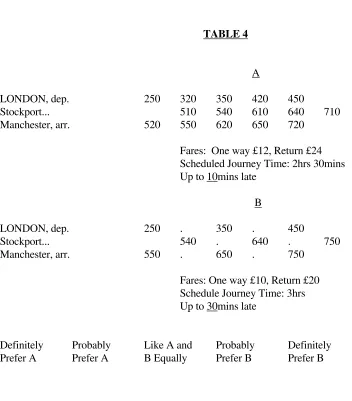
TABLE 4
A
LONDON, dep. 250 320 350 420 450
Stockport... 510 540 610 640 710 Manchester, arr. 520 550 620 650 720
Fares: One way £12, Return £24
Scheduled Journey Time: 2hrs 30mins Up to 10mins late
B
LONDON, dep. 250 . 350 . 450
Stockport... 540 . 640 . 750 Manchester, arr. 550 . 650 . 750
Fares: One way £10, Return £20 Schedule Journey Time: 3hrs
Up to 30mins late
TABLE 5
VALUES OF LONG DISTANCE LEISURE TIME SAVINGS STATED PREFERENCE TECHNIQUE
VISITING FRIENDS AND RELATIVES 6.6
HOLIDAY 4.8
RETURNING HOME 4.6
OTHER 6.6
OVERALL 5.9
TABLE 6
VALUES OF LONG DISTANCE BUSINESS TIME SAVINGS
EMPLOYEE'S WILLINGNESS TO PAY 12.0p/MINUTE
CURRENT DEPARTMENT OF TRANSPORT
ASSUMPTIONS 16.0p/MINUTE
EMPLOYER'S WILLINGNESS TO PAY 23.0p/MINUTE
TABLE 7
ECML HIGH SPEED DIESEL SERVICES
CAPITAL COSTS (1978 PRICES)
ROLLING STOCK £50
TABLE 8
BENEFITS FROM REMOVING ROAD TRAFFIC
(JULY 1988p PER PCU REMOVED)
CAPACITY UTILISATION 70 90 100
RURAL
MOTORWAY 2.4 3.0 4.7 DUAL CARRIAGEWAY 1.8 2.4 3.0 SINGLE CARRIAGEWAY (10m) 2.4 3.3 4.7 SINGLE CARRIAGEWAY (7m) 2.4 3.0 3.5
URBAN
SUBURBAN DUAL CARRIAGEWAY 4.7 7.7 10.0
SUBURBAN SINGLE CARRIAGEWAY 7.7 13.0 17.1 URBAN NON-CENTRAL 9.4 15.9 21.2 URBAN CENTRAL 18.3 34.8 49.0
SOURCE: DEPARTMENT OF TRANSPORT (1984) ECONOMIC EVALUATION
TABLE 9
PETROLEUM USE BY TRANSPORT MODE (LITRES PER HUNDRED PASSENGER KM)
CURRENT
LOAD FULLY FACTORS LOADED
COMMUTING CAR 9.2 3.0
AIRCRAFT 9.0 5.8
OFF-PEAK CAR 4.2 2.4
HIGH SPEED TRAIN* 2.0 1.0
EXPRESS COACH 0.9 0.7
SOURCE: EARTH RESOURCES RESEARCH: ATMOSPHERIC EMISSIONS FROM THE USE OF TRANSPORT IN THE UK (1989)
TABLE 10
CHANNEL TUNNEL RAIL LINK PROPOSALS
MAXIMUM SPEED JOURNEY TIME (mins) (kmph) (London to Channel Tunnel)
EXISTING ROUTE 150 70
ROUTE 2 TO WATERLOO 220 48
ROUTE 2 TO KINGS CROSS 220 47
SOURCE: BR (1988) CHANNEL TUNNEL TRAIN SERVICES. BR STUDY