A Practical Guide to
Data Base
James Hannan,
Editor•
Contributors To This Volume
Grayce Booth
Honeywell Information Systems, Phoenix AZ
Martin E. Modell
Systems Architect, Merrill Lynch, New York NY
T. William aile
Consultant, Surrey, England
Bernard K. Plagman
The PLAGMAN Group, New York NY
Myles E. Walsh
Director of Information Systems Planning, CBS, New York NY
Jay-Louise Weldon
Graduate School of Business Administration, New York University, New York NY
J. Chris Wood
Datacrown Incorporated, Arlington VA
John W. Young, Jr.
A Practical Guide to
A
AUERBACH
.
~
Data Base
Management
Edited by James Hannan
AUERBACH Publishers Inc
Pennsauken NJ
VAN NOSTRAND REINHOLD COMPANY
Library of Congress Catalog Card Number 82-11340
ISBN 0-442-20916-9
All rights reserved. No part of this work covered by the copyright hereon
may be reproduced or used in any fonn or by any means-graphic,
electronic, or mechanical, including photocopying, recording, taping,
or infonnation storage and retrieval systems-without written
pennis-sion of the publisher.
Printed in the United States of America
Published in
the United States in 1982
by Van Nostrand Reinhold Company Inc
135 West 50th Street
New York NY 10020 USA
16 15 14 13 12 11 10 9 8 7 6 5
Library of Congress Cataloging in Publication Data
Main entry under title:
A Practical guide to data base management.
(Auerbach data processing management library; v. 4)
1. Data base management. I. Hannan, James,
1946-
. II. Series.
QA76.9.D3P725 1982
658' .054
82-11340
Contents
Preface
viiIntroduction
ixChapter
1
Data Base: A Management Perspective
Martin E. Modell ... .
2
Justifying a Data Base System
John W. Young, Jr.
...
93
Pitfalls to Avoid in DBMS Implementation
Planning
T. William Olle • • • • • • • • • • • • • • 0 • • • • • • • • • • • • • • • • • 19
4
Trade-offs in Data Base Design
Jay-Louise Weldon
...
275
Systems Development in a Data Base
Environment
Bernard K. Plagman • • • • 0 • • • • • • • • • • • • • • • • • • • • • • • 37
6
Restart and Recovery in DBMSs
J. Chris Wood • • • • • • • • • 0 • • • • • • • • • • • • • • • • • 0 • • • • • 49
7
Concurrency in DBMSs
John W. Young, Jr. • • • • • • • • • • • • • • • • • • • • • • • 0 • • • • • 59
8
Administration of Data Bases in a Distributed
Environment
Bernard K. Plagman
...
719
Distributed Data Bases on U Dlike Computers
Grayce Booth ... 81
10
IMS/VS Implementation Case Study
Preface
In its relatively brief existence, the computer has emerged from the back rooms of most organizations to become an integral part of business life. Increasingly sophisticated data processing systems are being used today to solve increasingly complex business problems. As a result, the typical data processing function has become as intricate and specialized as the business enterprise it serves.
Such specialization places a strenuous burden on computer professionals. Not only must they possess specific technical expertise, they must understand how to apply their special knowledge in support of business objectives and goals. A computer professional's effectiveness and career hinge on how ably he or she manages this challenge.
To assist computer professionals in meeting this challenge,
AUERBACH Publishers has developed the AUERBACH Data Processing
Management library. The series comprises eight volumes, each addressing the
management of a specific DP function:
A Practical Guide to Data Processing Management A Practical Guide to Programming Management
A Practical Guide to Data Communications Management A Practical Guide to Data Base Management
A Practical Guide to Systems Development Management A Practical Guide to Data Center Operations Management A Practical Guide to EDP Auditing
A Practical Guide to Distributed Processing Management
Each volume contains well-tested, practical solutions to the most common and pressing set of problems facing the manager of that function. Supplying the solutions is a prominent group of DP practitioners-people who make their living in the areas they write about. The concise, focused chapters are designed to help the reader directly apply the solutions they contain to his or her environment.
AUERBACH has been serving the information needs of computer professionals for more than 25 years and knows how to help them
increase their effectiveness and enhance their careers. The AUERBACH Data
Processing Management library is just one of the company's many offerings in
this field.
James Hannan Assistant Vice President AUERBACH Publishers
Introduction
An increasing number of organizations have come to view the computerized data used in their operations as a valuable asset. This viewpoint has led to greater demands on DP professionals to manage their organizations' data more efficiently and effectively, spawning the concept of data resource management. In their attempts to meet those demands, many DP professionals have turned to data base technology.
Data base, as both a concept and a set of technologies , has been in existence for more than two decades. The data base approach to information systems evolved, in large measure, in response to the problems associated with what can be termed the "applications-centered approach." With the latter, separate data files are built for different applications; each application defines its own data elements together with their relationships and storage structures. The collection of these discrete, independent applications is considered an organization's "information system." The problems with such a system are obvious: data redundancy, processing and storage inefficiencies, excessive program maintenance, and questionable data consistency, integrity, and reli-ability.
In contrast, the data base approach stresses minimal data redundancy, faster processing times, reduced storage requirements, program independence from changes in the storage structure or logical views of data, and central administration and definition of data. Achieving these goals, however, is no simple matter.
Adopting the data base approach requires not only a sizable investment in expensive technology, but a fundamental change in information management practices. Without such a change, even the best data base manage-ment system (DBMS) can become little more than a sophisticated access
device. This volume of the A UERBACH Data Processing Management Library
is designed to help those charged with planning, implementing, and maintain-ing a data base environment make cost-effective decisions regardmaintain-ing the avail-able technological tools and management techniques that comprise the data base approach.
We have commissioned an outstanding group of data base practitioners to share the benefits of their extensive and varied experience. Our authors have written on a carefully chosen range of topics and have provided proven, practical advice for managing the data base function productively.
In Chapter One, Martin E. Modell discusses the formidable management issues that must be resolved in establishing a data base environ-ment and provides a strategy for careful planning and coordination of a data base project.
An important planning issue is convincing upper management to approve a data base project-they must be provided with reliable information
and apprised of the specific benefits to be achieved. In his "Justifying a Data
Base System," John W. Young, Jr., discusses the reasons for initiating a data base project and provides a practical and systematic method for justifying the data base approach to management.
Selecting and installing a DBMS also requires careful plan-ning; both managerial and technical problems will likely be encountered. T. William Olle describes and analyzes many of these problems and offers practical advice on how to avoid them in Chapter Three.
Designing a data base and developing systems in a data base environment are complex undertakings. The factors involved in data base design are numerous and interrelated. Attempting to consider all their relation-ships can enmesh the designer in seemingly endless analysis. To aid the data base designer, Jay-Louise Weldon describes the methods for recognizing and evaluating the trade-offs inherent in data base design in Chapter Four. In Chapter Five, Bernard K. Plagman highlights the problems that systems devel-opers are likely to encounter in a data base environment and describes ways for solving them.
. Data sharing is a key component-and a major benefit-of a
data base environment. Unfortunately, it is often very difficult to convince users to share' 'their" data. Understandably, users will agree to share data only if their requirements for acceptable downtime and system throughput are met. Thus effectively dealing with such crucial issues as restart/recovery and con-currency is vital to the success of the data base approach in any organization. J. Chris Wood addresses the former issue in his "Restart and Recovery in DBMSs" and discusses how to design effective restart and recovery mecha-nisms. John Young treats the latter issue in Chapter Seven and proposes a workable solution to concurrency-a locking mechanism that minimizes the possibility of deadlock.
Distributed data base environments pose a unique set of mana-gerial and technical problems. Administrative control of data in such an environment is mandatory. The traditional role of the data/data base adminis-trator, however, is patterned fora centralized environment. Thus new strategies for administration and control must be developed. In Chapter Eight, Bernard Plagman examines alternative strategies and offers practical guidelines that can be followed in this area.
The problems associated with administering and controlling data in a distributed environment are compounded when the data resides on unlike computers. Grayce Booth discusses these problems and suggests pro-gram and data migration as methods of solving them in Chapter Nine.
Introduction
The old saw, "Experience is the best teacher," is well illus-trated in Myles E. Walsh's description of a successful IMS/VS implementa-tion. In Chapter Ten, Walsh describes the background of the project, the project teams, the sequence of project events, training, and the lessons his organization learned.
~
Data Base:
A Management
Perspective
INTRODUCTION
by Martin E. Modell
The compilation of transactions generated as a result of doing business
results in infonnation. In a sense, this infonnation can be called a data base. A
company data base, in its broadest sense, consists of all infonnation, or data, that comprises the records of the finn.
Organizations are slowly realizing that data is one of their most valuable resources; in fact, some companies today would go out of business if they lost access to their data files. These same companies are also recognizing that rapid access to timely, accurate data enables them to grow and prosper as never before.
Some companies, however, find themselves in a precarious position. They have acquired the technological tools to manage their data, with the intention of using that technology to create corporate data bases. They have not, how-ever, come to grips with the problems of tailoring their systems, much less their organizations, to reflect the thinking that must accompany the establish-ment of a data base environestablish-ment. In addition, they have not adequately defined their concept of data base, nor have they recognized that such defini-tion is necessary. Neither have they adequately defined the parameters of a data base environment; moreover, there is still confusion about the terminol-ogy of technological implementation.
The use of integrated file structures, in which users share common data, implies centralized control, which, in tum, can cause many organizational problems. The question of data ownership is one of these problems. There is a function that originates data, a function that maintains it, a function that relies on it for daily operations, and a function that detennines its termination. These functions may reside in many corporate areas. Who may authorize access to this data? Who may authorize change or modification? Who actually owns the data?
This chapter addresses the new organizational relationships, requirements, and management approach that should be developed when establishing a data
base environment. It examines the design criteria for a data base environmerit
evaluating data base alternatives. A rationale for the analysis that leads to the objective detennination of data structures and, therefore, data base require-ments within an organization is presented, as is a discussion of data base-related cost considerations.
DATA AS A RESOURCE-TECHNOLOGY VERSUS METHODOLOGY
The value of data is assessed by the extent to which it can be retrieved, processed, and presented to aid a particular decision or action. Data has no value if it cannot be located or processed in time. The value of data also depends on the accuracy and precision of its definition and the acceptability of that definition to the recipient.
Information within an organization is analogous to a river-it flows from point to point with little effective control or standardization, and its bounda-ries are ill defined. Thus, its accuracy is usually suspect, and its usefulness is severely diminished.
There is a growing realization that data, or· information, is a business resource and must be managed as such. Because traditional techniques for resource management only partially address this task, new methodologies must be developed.
What makes this concern both unique and difficult is that all other re-sources have a logical place of control and residence within an organization. Information and data, however, pervade the organization, and they are gener-ally inaccurately identified, ill defined, and ill controlled at the organizational level. The challenge in harnessing these resources is not so much a technolog-ical issue as it is a question of methodology. The technology of data base is not new; but the methodology of data resource management is.
The Rationale for Creating a Data Base
With the growth of computer capacity and speed, we can now process information rapidly and consistently . We also have the technical tools and facilities to control, manage, and present information. The methodologies and techniques of design, the designs themselves, and the processing, however, still only replicate the manual processes they have supplanted. Thus, we are coupling primitive methodology and advanced technology in order to process information. We still process raw, unorganized data to produce information with marginai or narrow usefulness.
Organizations need to record data for both short- and long-term use. The systematic, short-term, accurate recording of data is basic to the successful daily operation and long-term survival of the organization. By providing a permanent record of the corporation's activities, the archiving of data sustains the auditing, statistical, forecasting, and control functions.
A MANAGEMENT PERSPECTIVE 3
instance, are usually stored in the payroll or accounting department, personnel records in the personnel department.
Some records, however, are stored in more than one functional area. Copies of purchase orders, for example, might be kept in purchasing, inven-tory, receiving, quality control, accounting, and in the originating department itself. As each area performs its part of the processing, the base information is
modified. ~ly, if ever, are all copies of the base information changed in
unison; thus, to gain a complete picture of a particular transaction, one must look into the files of each area that had access to or processed the purchase order in some way.
As a result (and to the detriment of the firm), the information in each processing area is incomplete or, worse, inaccurate. At best, it is suspect. In any caSe, only those areas that have copies can use the information. Thus, the view management has of information it receives is biased toward the area from which it was obtained (i.e., only information germane to a given area can be expected from that area).
RELATION OF DATA BASE TO MIS
The term information has been used to designate data arranged in an ordered and useful form. Thus, management information can be thought of as
information acquired as a result of business operations and presented to
man-agement in order to achieve specific purposes or enhance understanding.
The theoretical aim of a management information system (MIS) is to create
an integrated series of systems (one for each major organizational function) to
provide management with the information it needs, how and when it needs it. The greatest problem in the creation of a management information system arises from the traditional, functional approach to data. Usually, no single file
of information is sufficient to answer more than simple queries. Answering
complex questions requires going to multiple files, extracting information, and creating another file, which then must be processed in the required man-ner.
Corporate Information System. A corporate information system implies that while individual functional areas may have their separate systems, for corporate purposes there must be a certain level of aggregation and integration that allows upper management to view the corporate functional system from an organizational level. Thus, the unifying thread of a corporate information system is not the fact that it is a single system serving all. but rather that the data, which acts as the base for all parts, is common to all who need informa-tion. The integration is really a consolidation of all like elements of data (i.e.,
those related to the same subject [although not necessarily real-world]
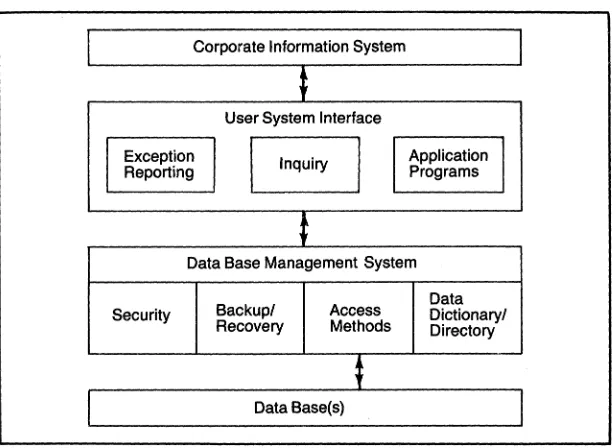
and the relationships that exist among them. Thus, management information systems can be transformed into corporate information systems founded on the data base approach (see Figure 1-1).
Corporate Information System
User System Interface
I
Exception ReportingI
~
I
Application Programs1
Data Base Management System
Backupl Access Data
Security Dictionaryl
Recovery Methods Directory
t
[image:17.414.50.358.101.325.2]Data Base(s)
Figure 1-1. Major Elements of a Corporate Information System
Multiple Management Levels
All managers need an understanding of the purpose of their organization (i.e., its policies, programs, plans, and goals). Individual managers differ, however, in their other informational requirements, the ways in which they have to view information, their analytical approaches in using it, and their conceptual organization of relevant facts.
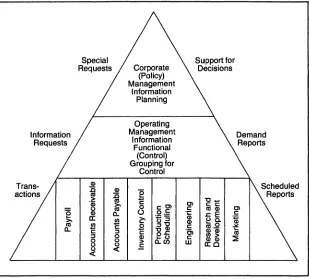
An additional factor that complicates the management of information is the organizational level of the individual manager (see Figure 1-2). A manager at
a lower operating level needs information to help him make daily operating
decisions. At the upper levels, however, information is needed to support long-range planning and policy decisions. Managers at the various
organiza-tionallevels also require different degrees of information summarization. In
addition, they must be able to probe the corporate data base in order to obtain answers to questions, especially those that are vague or poorly defined when first asked. The success of corporate information systems thus depends on methodologies that produce:
• A common data base (or base of data)
• A common and consistent definition of the components of that data base that is accepted throughout the organization
• A data organization flexible enough to support structured or
A MANAGEMENT PERSPECTIVE Information Requests
e
~ Il. Special Requests 0):c
III .~ O)&!
II: .!9 r:::: ::::I~
0)i
Il..!9 r:::: ::::I
~
Operating Management Information Functional (Control) Grouping for Control~
0 r::::0l <..>.2:E
~ 0::::1.9 ::::I'C 'CO)
r:::: o.r:::: ~ .. u .E Il.W
Ol ' C _ r::::r:::: r:::: (110) Ol
"i
.r::::E r::::0) ~o.
~
r:::: 111.2
'6> 0)0)
III
r:::: 8J~ :::!!
[image:18.414.50.359.66.345.2]W a:c
Figure 1-2. Levels of Information Required In an Organization
Data Base
5
Tmditionaliy, DP support activities have been oriented toward single de-partments and functional operational applications. In most cases, information is defined and organized differently for each application; thus, the data is often expensively duplicated (with an increase in the possibility of error) and impossible to integrate in meaningful ways. Information from payroll and personnel ftles, for example, could be combined only with great difficulty because of the different methods of classifying or identifying employees. Better integration of information-producing activities should lead to informa-tion that is more complete and relevant. The cotpOrate move toward a data base environment must attempt to achieve this.
Because many organizational units would be able to use such a common data resource, a centralized function is required to manage and protect it. Each unit cannot be allowed to modify data at will. Access to, and the processing of, the data base must be controlled.
The management of data is analogous to the management of finances. Just as there is a controller to manage money, there must be an administrator to manage data. Just as the controller uses ledgers, balance sheets, statements, and journals to record and control financial items, the data administrator uses function logical designs, libraries, documentation, and dictionaries to control and structure data items.
Each element of data has a source, an owner, and at least one use. The data
administrator can use the aforementioned tools to describe them. He can also employ data base management systems to store data and to provide access and security.
Data Base Administration
The data administration function must deal with the following questions: • Most information systems today serve the needs of operatiiJ.g supervi-sors and, to a lesser extent, middle managers, with little or no direct support provided to upper management. How can data bases be struc-tured to satisfy the information needs of all levels of management? Is it possible to organize and structure a single set of data bases to meet the needs at each level, or must different data bases be created for different horizontal levels?
• Can different functional areas share a data base? Can a single data base supply the information needed by managers at different levels with diverse functions, or must separate, vertical data bases be designed for each gross function? Should an attempt be made to integrate function-ally separate data requirements into one data base that will serve the broader needs of a cross-function environment?
• Managers at the higher levels need information about the external world. The quality of externally produced data, however, is more difficult to control than internal data quality since the definition is less precise; moreover, external data is expensive to obtain. Should data from external sources be incorporated into the data base(s)? Can we ensure that this information is complete, timely, and accurate? • Different managers occupying the same position over a period of time
will have different informational needs, and the system should not have to be redesigned to meet these changing requirements. Can suitable flexibility be built into the logical data structures that underlie the data base(s)? .
A MANAGEMENT PERSPECTIVE 7
(Le., a centralized data base). In this context, the impact of each of these forms on the organization must be evaluated.
This evaluation should not be performed from the perspective of the
soft-ware that makes data base implementation possible. It should not deal with
the hardware and personnel problems inherent in a data base environment. Rather, the methodology for evaluation should focus on:
• Defining the data base requirements • Designing the structure
• Specifying the degree of sharing that will occur • Protecting the data base( s)
This evaluation should be augmented with an analysis of the required decision-support framework and the effect that the data base discipline will have on the organization's operations. In addition, the data administration function should be clearly defined.
COST IMPLICATIONS
Another management consideration is the cost of data base implementa-tion. This is especially so because the cost of a data base program can differ considerably from other DP costs. The payoff period from the data base program is longer than that derived from increasing the hardware configura-tion or adding programmers. Because DP has grown so rapidly, managers are accustomed to change; however, in the past, change occurred in direct re-sponse to a strong user demand. This is not the case in the data base environ-ment. The manager must fully appreciate the cost behavior of the data base
program and make a concerted effort to control costs.
Out-ot-Pocket Costs. Since out-of-pocket costs have an immediate im-pact on the operating budgets, the high cost of the data base effort is of great concern to the line manager. The high cost includes the price of software, hardware, and programmers and extends to the labor costs of developing standards and procedures and coordinating numerous requirements.
Misuse ot Data Base Software. Another type of cost that may be incurred is that resulting from misuse of data base software. In order to compromise between going to a full-fledged data base system and maintaining the user's custom system, nonstandard use of data base software may be implemented. A situation can therefore result in which semi-integrated files are processed using data base software. This becomes a costly compromise when expensive maintenance problems, poor system integration, and inefficient use of soft-ware result.
Hidden Costs. Managers who commit to data base technology must
• The relationship between software and hardware (because new soft-ware may require additional core or hardsoft-ware).
• Software changes requiring unanticipated hardware upgrades to main-tain improvements or realize performance.
• User need to commit large blocks of time to integrate previously
inde-pendent systems. (The delays that can be caused in this situation are
costly.)
• The cost of running parallel systems (especially disk and labor costs). • The task of keeping up with the latest software releases to realize the
benefits of new capabilities.
• The need for specific documentation and procedures.
• An initial increase in applications design time because of the learning curve and the requirement for more coordination.
Data Resource Accounting System. Giving data the status of a corporate resource has important ramifications in terms of accounting. Most manage-ment control and accounting systems do not provide a good mechanism for apprising management of its data costs; therefore, the need for a data resource accounting system is evident. Most firms treat the costs of creating data or a data base as an expense and do not attempt to give the product an asset value. To many firms, data is a more important asset than the physical plant; yet this fact is not reflected on the books. Data, as a resource and asset, has many
attributes that should be captured in the accounting practice for tax putposes
and should be used to reflect the true market value of the organization.
CONCLUSION
In preparing for a data base environment, management should focus on the
issues described in this chapter and emphasize the management of data as a
resource. The formation of an organizational unit to address data administ~
tion issues is an important step in this direction.
Blbliograpby
Davis, Gordon B. MantJgement ltiformation Systems. New York: McGraw-Hill Book Compnny, 1974.
Sandets, Donald H. Computers and MantJgement in a Changing Society, 2nd ed. New YOlk: McGraw-Hill Book Compnny, 1974_
72
Justifying a
Data Base
System
INTRODUCTION
by
JohnW.
Young, Jr.Justifying a data base system to management is a precarious process. Because data base is a relatively new concept in the DP industry, many organizations are switching to a data base approach, with little or no under-standing of the concept. What is worse, management is often asked to decide on a data base project on the basis of incorrect or insufficient information or
false justifications. If management is provided with the wrong information, it
is likely to reject the project. On the other hand, false justification may convince management to approve a data base project that will only be
aban-doned when it fails to produce the promised results. It is vital, therefore, to
the success of a data base project (and, consequently, to the welfare of the organization) that the data base system be carefully designed to meet user needs and that the real benefits to be gained from its implementation be fully and correctly presented to management.
A data base system represents a philosophy of organizing data into an integrated whole to meet the following objectives:
• Protect the integrity of the data
• Make all data easily available to whichever users and programs need it, both for one-time requests and for new application systems
• Minimize unnecessary data redundancy
• Bring the data under the unified control of a DBMS in order to meet the first three objectives
This chapter discusses the data base system approach but does not discuss specific data base management systems.
FAVORABLE ENVIRONMENT FOR A DATA BASE SYSTEM
Reports Are Wrong. The many reasons why reports are often wrong range from the mundane (e.g., an error during initial data entry) to the exotic (e.g., an incorrect program flow is produced by an unanticipated and
unprece-dented set of data values or conditions). In fact, these two types of errors
constitute a large percentage of the errors in single-fIle applications.
Another major source of error involves programs that read several fIles at the same time. Resulting report errors occur because of a lack of fIle
synchro-nization. This problem can be illustrated with the following example.
A bank maintains a fIle of savings customers and a fIle of checking custom-ers. A report is to be prepared listing all customers who have both kinds of
accounts; the fIles are to be matched based on customer name and address. If
the savings fIle is updated on second shift and the checking fIle on third shift, a problem can occur: if a change of address received for a customer is to be applied to both fIles that night and the match report is run at the end of the second shift (i.e., before the checking fIle is updated), that customer's ad-dresses will not match, and the report will be incorrect. This problem is further (and perhaps permanently) compounded if the customer gives the new
address as "517 North Pennsylvania
st"
on one change form and "517 N.Penn" on the other. Only a very sophisticated matching program can detect the fact that these addresses are really the same.
Reports Do Not Reflect Current Information. If information is main-tained in a collection of separate fIles, the time lag in updating them can result in reports not bearing current information. Thus, in an online order entry system in which several fIles contain stock levels and orders and queries arrive continuously, timely reports can be achieved only if much effort is devoted to synchronization.
Reports Are Too Hard to Get. To improve their decision making, man-agement constantly demands more and better-organized information. Because these demands are often unpredictable, however, providing this kind of infor-mation can be a major source of frustration to management and the DP department alike. In addition, producing the desired reports often involves assembling and processing information from various sources within the total body of information available to the organization, and developing programs that use multiple fIles is a difficult job. There are several complicating factors: • One or more of the fIles may lack proper documentation (e.g., certain fields may no longer exist although the most recent record layouts show
that they do, or there may be dummy records with check totals that are
known only to the programmer who put them there). • The fIles may be sorted on different keys.
• The owner of one of the fIles may not wish to surrender it, thus setting off a series of management clashes.
JUSTIFYING A DATA BASE SYSTEM 11
requested infonnation is unavailable even though the basic data elements
required to produce it exist in machine-readable fonn [1].
Symptoms of File-Related Problems
The problems that prompt the preceding complaints can manifest them-selves in many ways. Typical symptoms of these problems include:
• A large backlog of unftlled requests to the DP department.
• Managers attempting to manually combine the data from several re-ports. (This is often an indication of the DP department's inability to combine infonnation from several ftles in a single report.)
• Taking an excessive amount of time to close the books each month. In the competitive business world, it is unrealistic and unreasonable to require a manager to make month-end decisions before month-end data is available.
UNFAVORABLE ENVIRONMENT FOR A DATA BASE SYSTEM
There are certain environments in which a data base system might be inappropriate. Although certain conditions may not entirely preclude consid-eration of a data base system, the environment must be examined carefully to ensure that it is well suited to a transition to data base.
Satisfied Users
The purpose of a data base system is to provide more accurate and timely
infonnation to the user community. If the community is satisfted with the
present information system, it would be presumptuous to attempt to justify
changes or additions to the system. It should be carefully verifted, however,
that the users are really satisfted with the system and are not just adopting an attitude of "Oh, what's the use of asking for anything else; we'll never get it anyway!"
Recently Introduced File Systems
The chief beneftt of a data base system results from replacing a
heteroge-neous collection of mes with an integrated data base. If there have been
recent, substantial investments in the development of ftle-oriented systems, however, it may be difficult to cost justify moving to a data base approach.
Lack of Proper Organizational Environment
Data base systems are a revolutionary departure from the traditional ftle-oriented approach to data handling. The transition to a data base environment can be hindered by several organizational factors [2].
fulfill those objectives. It should be noted, however, that once the system is
installed, it can help cope with moderately changing goals.
High Personnel Turnover. Employees must be trained in the design and use of systems in the data base environment. Conducting this training when there is constant staff turnover is a very difficult task.
Management Resistance to New Ideas. Changing to a data base envi-ronment introduces new DP concepts and techniques but also shifts the rela-tionships between the DP organization and the users. Management at all levels must be prepared to accept the organizational and procedural changes that are required in this new environment-an environment in which data is viewed as a corporate asset as significant as inventory or buildings.
Lack of Technical Foundation
Data base management systems are intended to handle a variety of com-plex batch and online requirements and to provide satisfactory throughput and response times. Designing the logical and physical structure of the data base and properly interfacing programs to the data base usually require a moderate to high degree of specialized knowledge and technical skill. Although this skill may not be currently available in the DP organization, the personnel who are to work with the data base must quickly acquire the necessary in-depth technical expertise through self-study, courses and seminars, and vendor training.
Inadequacies in this area quickly become apparent when an application runs several times more slowly in the data base environment than it did using
conventional files. If such a situation arises, it may be necessary to seek
expert advice from a consultant or vendor representative. Such help may also be necessary to fill in gaps in employees' technical training (e.g., to indicate design errors and to show how to avoid similar errors in the future).
The lack of appropriate or adequate technical background can result in wasteful use of computer resources, poor response to user needs, and, worst of all, a data base whose contents mayor may not be correct. Such factors can jeopardize the whole data base project. It is important to avoid these pitfalls by ensuring that the installation has people capable of being trained as well as
the resources available to prepare them for their new responsibilities.
Lack of Data Base Administration
Administration of the data base resource by a single centralized group is essential to the effectiveness of the data base approach. This does not mean that the needs or wishes of individual managers are ignored but, rather, that the data base administration staff controls the development of the system and ensures that a coordinated structure is planned from the beginning. Failure to
JUSTIFYING A DATA BASE SYSTEM 13
function can result in a patchwork of system fragments instead of a smoothly functioning integrated data base.
JUSTIFYING A DATA BASE MANAGEMENT SYSTEM
The arguments for justifying a data base management system (DBMS) to management must be carefully formulated. The acquisition and installation of a DBMS represents a substantial investment and is likely to be undertaken only if equally substantial potential benefits can be documented. Fortunately, those benefits are often evident, and the DP department almost always has the support of the users in presenting them. When possible, the benefits should be quantified so that actual financial savings can be shown.
The principal justifications for a DBMS are described in the following sections.
Increased Data Integrity
Correctness. Since a given data element exists at only one place in a data base, there is no possibility of inconsistent versions of an element. The value of this can be described in terms of the consequences, possibly financial, of
incorrect or inconsistent data use in critical operations. It should also be
pointed out, if true, that validation criteria are applied to prevent incorrect data from entering the data base.
Security. DBMSs usually have some security mechanism to prevent un-authorized access to data. This facility keeps sensitive personal or corporate data from being compromised and thus avoids consequent financial liability or loss of competitive advantage.
Protection and Recovery. It has been pointed out that data is an impor-tant corporate resource that merits the same degree of protection as any other property. Each system user must be assured that once their data has been entrusted to the data base system, it will be safe from damage. Just as guards protect physical property, the DBMS safeguards the data. System cost can be measured against the consequences to the organization if portions of its opera-tional information (e.g., accounts receivable) are lost.
Better Response to User Needs
Special Reports. The users' need to quickly obtain organized and format-ted special reports from existing data is undoubformat-tedly a major factor in decid-ing to install a DBMS. The value of this DBMS capability can be measured against two criteria:
• The cost to the organization of not having the desired information available
New Applications. Users are continually expanding their horizons in terms of what new applications can be introduced profitably. DBMSs hasten the development of new applications in two ways. Since the data and its description is centralized, it is easier to plan new applications; that is, infor-mation about scattered and uncoordinated files does not have to be assembled from multiple sources of perhaps questionable accuracy. In addition, DBMSs provide tools for faster and more accurate programming of new applications. Thus, programmers can usually devote more effort to the functioning of the system and less to the details of record storage, access, and processing. This faster development is reflected in three benefits that can be presented as part of DBMS justification:
• Less effort is required on the part of system analysts and programmers, resulting in a saving in personnel costs.
• The benefits of new applications are realized sooner; thus, return on
investment starts earlier.
• A shorter development cycle provides less chance for changing applica-tion requirements; thus, the development process is simplified.
Improved Usability of Data
Improved Timeliness. The fact that data in a data base is easier to keep
updated results in several advantages. First, decisions are made on the basis of
the latest information. In presenting this justification, examples should be submitted of cases in which rapidly changing conditions made it essential for management to have the very latest data-cases in which there would have been a financial penalty if the most recent data was unavailable. Second, the organization can directly achieve a monetary gain through faster information processing (e.g., bills can be sent out in 5 days instead of 15). The increased value of the funds being available sooner can be calculated and presented.
More Flexible Data Structures. A characteristic of DBMSs is that they allow for more flexible associations among data elements. Although this advantage is difficult to quantify, it clearly results in both easier system design and in a better fit between user needs and system output.
Less Redundancy. Data storage is now sufficiently inexpensive that the nonredundancy offered by the data base approach may not be a major benefit. The improVed consistency of data, however, as well as the savings in not having to update multiple copies of the same information should be consid-ered for presentation as part of DBMS justification.
Easier Adaptation to Future Change
Data Independence. A major advantage of the data base approach is that it largely insulates application programs from the effects of changes in logical
data structures or in physical data organization, hardware, or media. If such
JUSTIFYING A DATA BASE SYSTEM 15
Distributed Data Processing. The centralized control and knowledge in-herent in a data base can make a transition to distributed OP much easier. This justification is usually purely qualitative.
False Expectations
There are, however, two areas in which it might be thought that a data base could reduce the requirements for OP resources but in which savings are
seldom achieved: staff size and computer resources. It is widely believed that
a smaller OP staff would be required with a data base system. This is almost
certainly false for the first year of development. It usually requires two to
three years to begin realizing savings in personnel. By that time, additional requirements have appeared, necessitating additional staff members.
If an organization has much redundant data that is being synchronized and
maintained, there is a chance that a data base system would slightly reduce computer resource utilization. In general, however, OBMSs require more computer resources because they are generalized and are designed to satisfy a wide range of requirements.
ESTIMATING THE COST OF A DATA BASE SYSTEM
Although some of the benefits of data base implementation are difficult to quantify, estimating the associated cost is a relatively straightforward process. Since the cost is totally dependent on the nature and size of the organization and on the scope of the proposed data base environment, no attempt is made
in this chapter to present absolute times or costs of these efforts. It should be
noted, however, that part of the justification process is to carefully estimate the cost of each task and its duration. This can be done by deciding how many users would have to be interviewed, how long each interview would take, how much work would be involved in writing up the interview results, and so on.
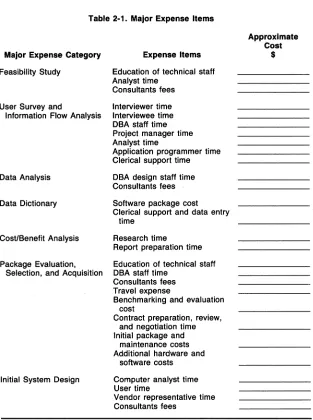
In the following paragraphs, a typical data base project has been divided into a number of major tasks that should be considered when determining the cost of data base implementation. Table 2-1, which identifies the major cost items associated with each task, can serve as a checklist of cost items in each category.
Feasibility Study. This study presents the current state of an information system in order to decide whether it is worthwhile to further investigate the possible installation of a data base system.
User Survey and Information Flow. A comprehensive examination of the
Table 2·1. Major Expense Items
Major Expense Category Feasibility Study
User Survey and
Information Flow Analysis
Data Analysis
Data Dictionary
Cost/Benefit Analysis
Package Evaluation, Selection, and Acquisition
Initial System Design
Expense Items Education of technical staff Analyst time
Consultants fees Interviewer time Interviewee time DBA staff time Project manager time Analyst time
Application programmer time Clerical support time DBA design staff time Consultants fees Software package cost Clerical support and data entry
time Research time
Report preparation time Education of technical staff DBA staff time
Consultants fees Travel expense
Benchmarking and evaluation cost
Contract preparation, review, and negotiation time Initial package and
maintenance costs Additional hardware and
software costs Computer analyst time User time
Vendor representative time Consultants fees
Approximate Cost
$
possible new activities, improved decision making, and so on. The work needed to thoroughly document the results of the study must not be over-looked.
JUSTIFYING A DATA BASE SYSTEM 17
Cost/Benefit Analysis. It is a good idea to do the benefit half of this task concurrently with the user survey. When a user mentions a particular data base service, the interviewer should request an estimate of the value of such a service (i.e., what the interviewee would be willing to pay for it).
Data Analysis. This is a study of the interrelationships among data entities in an organization. Such a study requires careful attention to detail; review by an external source (e.g., a consultant) may also be required.
Package Evaluation, Selection, and Acquisition. Selecting the most suitable data base package is a time-consuming and expensive process. It is important, therefore, that the evaluation criteria be chosen carefully to ensure appropriateness. Once selected, each criterion should be assigned a numerical weight that roughly approximates its perceived value. This facilitates compar-ison of the value of each criterion relative to the value of any other criterion. It also provides a simple method of assigning a single relative score to each package under consideration. The weighting scheme can be supplemented by preparing one list of characteristics that any package must have to be consid-ered and another list of those attributes that it must not possess.
It is important not to skimp in the selection process. Although this process may be as costly as the package itself, the long-term costs and adverse consequences of choosing the wrong system make economizing in this area most unwise. Thus, although benchmarking can be expensive, it is sometimes recommended when deciding among several data base packages.
The costs involved in the actual acquisition of a DBMS (e.g., travel and contract preparation) should not be neglected. Naturally, the cost of the DBMS itself, maintenance fees, and the expense of any additional hardware and software required are of primary concern.
Initial System Design. The duration and cost of developing the initial application to use the DBMS depends on the application itself. In addition to the direct cost of the application are costs associated with training personnel in the system design techniques appropriate for the data base environment. It should be noted that if the first project fails, the entire data base effort will probably be scrapped; thus, it is usually advisable to procure outside help for the initial implementation.
CONCLUSION
In a data base presentation for management, most costs and benefits are quantifiable. Quantifiable costs should be grouped in one section, nonquanti-fiable ones in another. A note of caution: an unsupportable dollar value assigned to a benefit may be vulnerable to attack by financial executives.
Once one figure has been discredited, it is often assumed that all are suspect.
should be carefully and realistically derived to minimize delay and to avoid embarrassment after the project has been approved.
References
1. Nolan, Richanl. "Computer Data Base: The Fuwre is Now.'· Harvard Business Review (September-October 1973).
2. CODASYL Systems Committee. Selection and Acquisition 0/ Data Buse Management Systems. Association for Computing
@
Pitfalls to Avoid in
DBMS Implementation
Planning
by T. William aileINTRODUCTION
It is unfortunate that in the application of DP techniques during the past 20
years, many people have not learned from the mistakes of others. When an organization is planning for a DBMS, the potential benefits and risks are
extremely high. It is essential, therefore, to be very careful and to consider all
related aspects of a situation before making a decision.
DBMS implementation planning has a number of pitfalls that can be avoided. These include:
• Accepting a DBMS without careful evaluation • Using the DBMS as a sophisticated access method • Not recognizing the need to analyze application data
• Applying outdated information systems design methodologies • A lack of management commitment
• Failure to recognize the intangible benefits • Forgetting the data dictionary
In addition, several technical problems must be given careful attention. These pitfalls and problems are discussed in this chapter.
TIMING THE DECISION
In a recent work, R.L. Nolan [1] states that organizations have a traditional learning curve to surmount as they absorb and attempt to profit from DP technology. Nolan's "stage hypothesis" identifies four stages of the learning curve:
• Stage I-initiation • Stage 2-contagion • Stage 3-control • Stage 4-integration
It is interesting to note that data base management starts to play a role in
have to be rewritten in a consolidation of this type. Stage 4 is the stage in which the applications using the central data base are used in an online mode.
The point of this analysis is that all installations will sooner or later con-sider using a DBMS to consolidate applications and to obtain the benefits that can be achieved by integrating flIes into carefully designed and centrally controlled data bases.
Nevertheless, it is not always obvious when an installation should make the
move into data base management, and it is even less obvious how rapidly it
should proceed. There have been many sad tales of installations that made the move too early and too quickly and failed completely. Conversely, some installations proceeded so slowly that the result was disappointing.
Some organizations, however, have taken the bold step from a manual information system to a fully integrated data base approach. This is possible only when highly skilled personnel or consultants with related experience are available.
Making the move to a DBMS at the wrong time can be devastating. The problems with moving too early are related to the maturity of the data process-ing function in the organization, while movprocess-ing too late can cause loss of a competitive edge in the marketplace.
PROBLEMS PECULIAR TO ALL DBMSs
A number of DBMS-related problems can occur quite independently of the DBMS to be used. (This chapter borrows from a paper written by E.H. Sibley that was presented at the 1977 IFIP Congress in Toronto [2].)
Technical Expenise Required
Assuming that the use of a DBMS requires no more expertise than does the use of conventional DP is analogous to taking a pilot out of a small, propeller-driven aircraft and putting him in charge of a commercial jetliner. The fact that he has flown a somewhat older kind of aircraft means only that he is a reasonable candidate for being trained to fly a jet. A similar argument can be applied to DP and DBMS personnel. Implementation of a DBMS lives or dies on the expertise available to do the job. Note that consultants can be con-tracted with and/or experienced personnel identified or recruited to ensure successful design and installation.
DBMS IMPLEMENTATION PLANNING 21
Accepting a DBMS without Careful Evaluation
A number of fully developed DBMSs are currently available commer-cially. Users of IBM equipment are particularly fortunate because they can choose from more than five DBMSs, all of which have enjoyed from 6 to 10 years of useful (and, to a varying extent, productive) life. These DBMSs, however, vary considerably in technical characteristics; thus, a careful (six-month) comparative evaluation is essential.
In the early 1970s, there were not nearly as many DBMSs to choose from. A situation occurring frequently in Europe today is one in which a U.S. parent company who made its choice of DBMS in 1971 or 1972 now insists that its European subsidiary make the same choice. This can be unfortunate.
Using the DBMS as a Sophisticated Access Method
It is sometimes tempting to use a DBMS as nothing more than an elaborate
indexed sequential-access method. As such, a fairly simple application's magnetic file or existing ISAM file would be replaced by a fairly simple data base. This is an easy approach that may, in fact, offer some of the widely known advantages (e.g., better data independence) of using a DBMS. Doing this, however, is simply ignoring most of the potential DBMS advantages. The effect is rather like paying for a jet airliner and flying it at propeller-driven-aircraft speeds.
To obtain reasonable advantages from using a DBMS, one should select an initial application that requires between 15 and 20 record types. This will spur correct implementation of the DBMS and check any temptation to misuse the software.
Not Recognizing the Need to Analyze Application Data
The need to analyze application data is now widely discussed by people experienced in the selection and application of DBMSs. The value of a data model (sometimes called a conceptual schema) as an indispensable aid to understanding the meaning of the data is now recognized. A data model should be designed first, and then the functions to be computerized should be analyzed and designed in terms of that data model.
It would be unfair to claim that there is a complete lack of controversy
The comerstone of the kind of data model advocated here is a data struc-ture diagram (see Figure 3-1). This example shows a purchasing application
in which tender, price quotations, and purchase orders can be requested. The
diagram shows the static relationships between the various entities, each of which is illustrated in a rectangular box. The arrows between boxes show classic one-to-many relationships. Failure to perfonn the kind of analysis required to prepare a data model before selecting a DBMS is one of the most common and dangerous pitfalls that can be encountered in moving to a DBMS environment.
Request
Product
-
Supplier r- PriceQuotation
~
4-
I
II
I
+
i
t
Possibility RPQ Line
to Supply Sent to in
Product Supplier RPQ
l
I
t
Purchase Quotation I-Order
"-J
,
Purchase Line in
Order Quotation
[image:35.414.61.368.172.450.2]Line
Figure 3·1. Purchasing Example
Applying Outdated Information Systems Design Methodologies
Many useful design methodologies have emerged from conventional DP. Some of these techniques become part of an installation's design standard. Although it is good to have a systematic approach to design, the impact of data base design requirements on the information systems design methodol-ogy is often underestimated.
There are many design methodologies that rely on a basic INPUT-PROCESS-OUTPUT analysis. Such methodologies have a role to play in the
DBMS IMPLEMENTATION PLANNING
23
however, to avoid being too insistent about reconciling conventional infonna-tion systems design methodology with data base design techniques.
Lack of Management Commitment
It is tempting for managers to regard DBMS implementation (and, indeed,
all problems connected with DP) as technical problems that they should not
have to address. Unfortunately, the move to a DBMS cannot be ignored by
management. If, for example, technical personnel choose to use the DBMS as
an elaborate access method, management will probably not be affected by the changeover but will continue to experience frustration in its attempts to obtain
integrated infonnation overviews from the DP department. If the DBMS is to
be correctly implemented, management's commitment must be a driving force.
Failure to Recognize Intangible Benefits
After more than two decades of business experience with computers, it is understandable that management should seek cost justification for moving into a DBMS environment. All too often, management has approved the expenditure of funds only to be disappointed by the abortive or superficial nature of the results. The fact is that because many advantages of a data base environment are intangible, it is often difficult to produce two columns of
figures that detail all associated costs and benefits. They become apparent
only after several applications have been successfully implemented and inte-grated and are fully operational. At that point, it is quite possible that the systems will link across functional lines, providing unanticipated advantages to upper management.
Forgetting the Data Dictionary
A data dictionary should be thought of as a special data base in which one stores data about the data in the main data base [3]. The term meta-data-base is sometimes used to describe this special kind of data base. When an organi-zation has a large number of record types, data items, and programs, a data dictionary can be used as an administrative tool for controlling the record, item, and program names and showing how they are used in relation to each other.
It should be pointed out that a data dictionary is perfectly valid in the
context of conventional application systems; however, with DBMSs, the mass of data about data is even more critical. This infonnation should be stored in a data dictionary, which, by the way, can also conveniently store the results of the data analysis activity previously discussed.
PROBLEMS PECULIAR TO SPECIFIC DBMSs
Restrictive Structuring Facilities
Each DBMS has certain restrictions in the way the designer can structure the data base. A restriction of this kind can be overcome simply by defining extra record types and extra relationships. This extra structure is often referred to as clutter. While a detailed discussion of this topic is outside the scope of this chapter, it is important to be aware of the problem because it can seriously
influence the choice and operation of a DBMS. If a detailed DBMS selection
study is performed in conjunction with an analysis of application data, the clutter that must be introduced into the data base design because of the shortcomings of a particular DBMS will become apparent and can be further evaluated.
Hidden Execution-Time Overheads
DBMSs vary considerably in the efficiency of the generated code. Even if the data base is reasonably well defined within the confines of the structuring facilities, the user can still get a nasty shock when application program execu-tion time is measured. This is particularly true for online systems in which terminal response time is so noticeable.
The difficulty with hidden execution-time overheads is basically this: the DBMS is designed so that it is easy for the applications programmers to write programs that are logically and functionally correct and will produce the desired result. This implies that the application programmer need not know
what goes on behind the scenes. In fact, in order to write reasonably efficient
code, the programmer does have to know what goes on behind the scenes. Consequently, an ease-of-use advantage may not exist. To circumvent this problem, careful analysis of DBMS structure and code is necessary. In addi-tion, emphasis must be placed on training people to the level of expertise required to work the new system.
Difficulty in Achieving the Desired Level of Data Independence
The possibility for achieving improved data independence is frequently cited as one of the prime reasons for using a DBMS.
Most systems must be extended after some period of use. This extension may involve designing and preparing new programs to process the existing data base. This does not usually create problems. The extensions may,
how-ever, require adding items to the existing data base. It may be necessary to
add new items to existing record types, add completely new record types, or
create new relationships between new and existing record types. If this can be
done without affecting existing application programs, one can claim that the DBMS is supporting a reasonable level of data independence. With some commercially available DBMSs, however, it is simply not possible to add new data items to existing record types.
DBMS IMPLEMENTATION PLANNING
25
rewrite. Because this can be extremely expensive and cancels one of the prime reasons for using DBMS, it is most important to check data independence functions when performing the recommended DBMS comparative evaluation.
CONCLUSION
The major pitfalls of DBMS implementation and use can be avoided through:
• The competence of the technical personnel and the involvement and commitment of management.
• Careful analysis of application data in order to understand the inherent complexities prior to embarking on an evaluation of DBMSs. • Careful evaluation of available DBMSs and data dictionaries before
committing the organization to a particular system.
• Choosing a pilot application system for the DBMS that is neither too small nor too large; suitable size is between 15 and 20 record types.
References
1. Nolan, R.L. "Thoughts about the Fifth Stage." Data Base, Vol. 7, No.2 (Fall 1975), pp. 4-10.
2. Sibley, E.L. "The Impact of Data Base Technology on Business Systems." Proceedings IFIP 77 Congress. Toronto, Canada, 1977, pp.589-596.
3. Plagman, Bernard K. "Data DictionarylDirectory System-A Tool for Data Administration and Control." Portfolio
22·0\-02. AUERBACH Data Base Management. Pennsauken NJ: AUERBACH Publishers Inc.
Bibliography
Gosline, W. George. "Data Independence in DBMS-Parts I and II. " Portfolios 22-03-08 and 22-03-09. AUERBACH Data Base
~
Trade-offs in
Data Base
Design
INTRODUCTION
by Jay-Louise Weldon
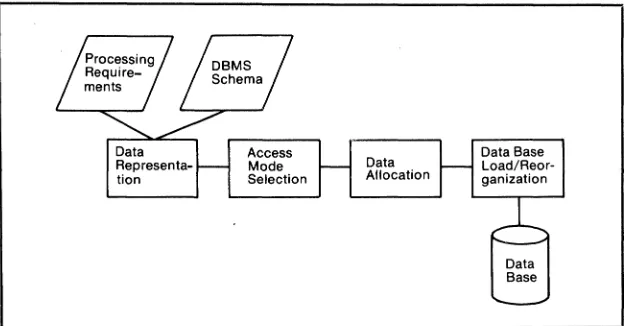
In its broadest sense, data base design encompasses activities that range from the identification of end-user requirements to the final arrangement of data values on a physical device. The first phase of the design process, logical design [1], results in a formal description of the entities and relationships that must be captured by the data base to meet user requirements. The second phase, physical design [2], determines how the logical data base (the data base schema or data submodel [3]) should be physically represented for the
most efficient data storage and processing. Many design decisions must be
made during both phases; decisions made in one may affect the choices available in the other. The designer who errs in either phase or lacks knowl-edge of one phase's effect on the other can expect suboptimal results.
Many organizations are beginning to recognize the importance of the data ' base design process. Business organizations are increasingly moving from the traditional approach of developing data fIles that support specific applications
to developing large, integrated data bases that can be shared by many users. In
such an environment, design errors can be costly, not only to one application
system but to any user accessing shared data. Design errors can also be costly
in terms of excess or inefficient processing, excess device capacity, lengthy application development times, frequent data base reorganization, or required reprogramming of application programs.
Unfortunately, many organizations approach the data base design process with little or no understanding of the trade-offs. The designer must often make decisions based on intuition or experience with non-data-base systems. De-sign errors can be minimized, however, if the deDe-signer views the data base design process as a series of trade-offs.