rspb.royalsocietypublishing.org
Darwin review
Cite this article:
Brockhurst MA, Chapman T,
King KC, Mank JE, Paterson S, Hurst GDD. 2014
Running with the Red Queen: the role of biotic
conflicts in evolution.
Proc. R. Soc. B
281
:
20141382.
http://dx.doi.org/10.1098/rspb.2014.1382
Received: 12 June 2014
Accepted: 10 September 2014
Subject Areas:
evolution
Keywords:
Red Queen hypothesis, coevolution,
sexual selection
Author for correspondence:
Michael A. Brockhurst
e-mail: [email protected]
Electronic supplementary material is available
at http://dx.doi.org/10.1098/rspb.2014.1382 or
via http://rspb.royalsocietypublishing.org.
Running with the Red Queen: the role of
biotic conflicts in evolution
Michael A. Brockhurst
1, Tracey Chapman
2, Kayla C. King
3, Judith E. Mank
4,
Steve Paterson
5and Gregory D. D. Hurst
51Department of Biology, University of York, Wentworth Way, York YO10 5DD, UK
2School of Biological Sciences, University of East Anglia, Norwich Research Park, Norwich NR4 7TJ, UK 3Department of Zoology, University of Oxford, Oxford OX1 3PS, UK
4Department of Genetics, Evolution and Environment, University College London, London WC1E 6BT, UK 5Institute of Integrative Biology, University of Liverpool, Liverpool L69 7ZB, UK
What are the causes of natural selection? Over 40 years ago, Van Valen proposed the Red Queen hypothesis, which emphasized the primacy of biotic conflict over abiotic forces in driving selection. Species must continually evolve to survive in the face of their evolving enemies, yet on average their fit-ness remains unchanged. We define three modes of Red Queen coevolution to unify both fluctuating and directional selection within the Red Queen frame-work. Empirical evidence from natural interspecific antagonisms provides support for each of these modes of coevolution and suggests that they often operate simultaneously. We argue that understanding the evolutionary forces associated with interspecific interactions requires incorporation of a community framework, in which new interactions occur frequently. During their early phases, these newly established interactions are likely to drive fast evolution of both parties. We further argue that a more complete synthesis of Red Queen forces requires incorporation of the evolutionary conflicts within species that arise from sexual reproduction. Reciprocally, taking the Red Queen’s perspective advances our understanding of the evolution of these intraspecific conflicts.
1. Introduction
The Red Queen does not need changes in the physical environment, although she can accommodate them. Biotic forces provide the basis for a self-driving. . .perpetual motion of the effective environment and so of the evolution of the species affected
by it. [1, p. 19]
Van Valen’s ‘Red Queen hypothesis’ (RQH) emphasized the primacy of biotic interactions over abiotic forces in driving evolution. This was a revolutionary advance in biological thinking on the sources and modes of selection driving evolutionary change. Previously, the view of evolution by natural selection was that of a ‘hill climbing’ process, which shaped organisms to be well adapted to their environment. Because abiotic environments commonly change slowly with respect to the inhabiting organisms, evolution was thought to slow to a halt as the optimal phenotype is reached, recommencing only when conditions change. Biotic environments, by contrast, are themselves subject to evolution and so can change rapidly. According to the RQH, each adaptation by a species is matched by counteracting adaptations in another interacting species, such that perpetual evolutionary change is required for existence. Despite continued evolution, average relative fitness remains constant: evolution is a zero-sum game.
In the original paper, the RQH is proposed as a microevolutionary mechanism to explain a macroevolutionary observation: that the probability of taxon extinction appears independent of age. Van Valen named this the Law of Constant Extinction [1]. This law has proved controversial, and the strength of the supporting fossil evi-dence has been called into question [2]. Yet the broader insight that intrinsic biotic
&
2014 The Authors. Published by the Royal Society under the terms of the Creative Commons Attributionconflicts should drive perpetual evolutionary change, and that this could have macroevolutionary consequences, has been hugely influential [3,4]. Over the past 40 years, research inspired by the RQH has advanced our understanding of evolution in two major areas: first, the microevolutionary dynamics arising from biotic conflicts, and second, the role for biotic drivers in macroevolution. Citations of ‘a new evolutionary law’ reveal a recent surge of interest in the RQ, mirrored by recent increases in the numbers of published studies on the RQH (electronic sup-plementary material, figure S1). The RQ is therefore a pervasive concept in biology, but its usage has somewhat diverged as the RQ metaphor has been applied to different fields.
For many evolutionary biologists, the RQH is most strongly associated with debates surrounding the evolution of sex. The RQH provides a mechanism by which sexual species are pro-tected from elimination by asexuals despite the latter’s higher per capita reproductive rates. The maintenance of sexuals relies on rapid host–parasite coevolution such that parasites disproportionately infect common, asexual host genotypes, and rare genotypes, such as those possessed by sexuals, can avoid parasite adaptation. This body of theory [5] has been tested across a range of natural systems (e.g. [6–8]), providing compelling empirical support for this idea. However, Van Valen’s original insight—that biotic conflicts are the primary driver of evolutionary change—has far wider implications. Here, we try to provide a holistic, biological view of the impor-tance of RQ processes in interspecific conflicts, and how the study of the microevolutionary process described by the RQH has also been extended, beyond sex, to the maintenance of gen-etic diversity and rapid evolutionary change in communities. We then examine how intraspecific conflicts that follow from the evolution of sex can also be viewed in RQ terms.
2. Microevolution of interspecific conflicts
(a) Which species interactions sustain perpetual
evolution?
As originally conceived, the RQH encompassed all biotic con-flicts over energy distribution (currency of the RQ) among species, thus unifying all trophic levels within the same frame-work [1,9]. As a result, Van Valen’s RQH made no distinction between competitive and antagonistic (e.g. predator–prey, parasite–host) species interactions. Coevolutionary theory, however, suggests that these forms of biotic interaction vary in their propensity to sustain the perpetual, reciprocal coevolu-tionary cycles often called ‘Red Queen dynamics’. Competition
is generally unlikely to drive perpetual evolutionary change of this kind. Coevolution of competitors tends towards character displacement [10], and thus weakens the intensity of the biotic interaction and the strength of selection over time. By contrast, RQ dynamics are more readily observed in models of antagon-istic coevolution whereby the strength of selection acting on each species is roughly symmetrical. Symmetry is fulfilled in most host–parasite interactions, which have become the major focus of the microevolutionary research into the RQH, often in the context of the host–parasite coevolution selecting for sex [11,12]. The potential for RQ dynamics is expected to be limited when there is asymmetry in the strength of selection, such as that often found in many predator–prey interactions [13] (the ‘life-dinner principle’ [14]). However, important exceptions exist—in situations where prey have physical or chemical defences that make them dangerous to predators the strength of selection is likely to be more equitable [15].
(b) Three modes of Red Queen dynamics
We define three broad classes of RQ dynamics distingui-shed by the modes of selection operating and the genetic architecture of coevolving traits (table 1):
(1) Fluctuating Red Queen (FRQ), in which fluctuating selection drives allele frequency oscillations in both parties. For the FRQ to operate, interactions between antagonists require tight matching of traits under the control of few genetic loci. Exploiter populations track the common genotype of the victim species, and rare victim genotypes are at an advantage because they avoid exploitation. Allelic diversity is maintained within populations because matching pairs of antagonists’ alleles undergo continuous time-lagged, negative frequency-dependent oscillations (e.g. [16]). (2) Escalatory Red Queen (ERQ), in which directional selection
[image:2.595.42.553.101.202.2]drives escalation of polygenic or quantitative trait values. The outcome of interactions is determined by the differ-ence between antagonists’ traits along a unidirectional axis [17]. Both antagonists are therefore under selection to ‘exceed’ the trait of the other species and coevolution proceeds as an arms race of recurrent selective sweeps. Arms races do not necessarily continue indefinitely and may either reach a stable equilibrium or drive one species extinct, bringing dynamic coevolution to an end [14]. However, RQ coevolutionary cycling can occur if the evolution of extreme trait values is bounded by costs or constraints and periods of escalation are followed by de-escalation [18].
Table 1.
Distinguishing the three modes of Red Queen. We define three distinct modes of RQ that are theoretically capable of sustaining perpetual
coevolutionary cycling: Fluctuating Red Queen, Escalatory Red Queen and Chase Red Queen (defined in the main text). While we believe that each mode is
necessary, it is less certain whether these modes are sufficient to encompass all manifestations of RQ dynamics in nature. It is possible (although given the
intensive research over the past 40 years perhaps unlikely) that additional modes remain to be described theoretically.
FRQ
ERQ
CRQ
genetic architecture
few major loci
polygenic or quantitative trait
polygenic or quantitative trait
basis of interaction
matching
difference
matching
selection mode
fluctuating
directional (unidimensional)
directional (multidimensional)
allele frequency dynamics
oscillations
selective sweeps
selective sweeps
adaptive landscape
multiple fitness optima
fixed fitness optimum
shifting fitness optimum
rspb.r
oy
alsocietypublishing.org
Pr
oc.
R.
Soc.
B
281
:
20141382
(3) Chase Red Queen (CRQ), in which local directional selection drives coevolutionary chases between exploiter and victim around phenotype space. Here, the coevolutionary game constantly changes. CRQ will generally occur when the interaction has a more complex genetic basis and hence can chase in multiple ways (in multidimensional phenotype space). Victims are under selection to increase phenotypic distance throughde novoevolution of novelty, while exploi-ters are under selection to reduce phenotypic distance. Coevolution proceeds as a series of selective sweeps, which reduces genetic diversity within populations but drives divergence between populations. Sustained cycles of coevolutionary chase may occur through phenotype space whereby the direction and intensity of selection vary according to the relative locations of the species in phenotype space [19,20].
(c) Red Queen over space and time
For FRQ coevolutionary interactions, the phase of allele fre-quency oscillations is likely to vary among populations. The genotypes or traits that are common and beneficial in one sym-patric set of populations of interacting antagonists may be neither common nor beneficial in another. Thus, an antagonist species can be locally adapted to their sympatric interacting species population, but perform poorly in an interaction with an allopatric population. This has been widely demonstrated in host–parasite interactions, whereby parasites are better at infecting sympatric hosts, but allopatric hosts are better at
resisting infection [21,22]. Consistent with this idea, parasites have been shown in natural systems to ‘track’ common host genotypes over time and subsequently drive down their fre-quency in the population [7,23,24]. Given that one genotype cannot dominate under this scenario, FRQ dynamics are pre-dicted to maintain high levels of within-population genetic diversity (electronic supplementary material, box S1), and thus sexual reproduction (see above). Among populations, field collections of asexually reproducing invertebrates have revealed positive relationships between the diversity of clonal genotypes within a population and the frequency of infection by parasites [7].
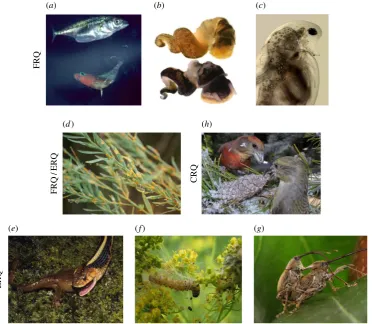
ERQ coevolution can give rise to spatial variation in the extent of coevolutionary escalation. Indeed, spatial variation is a potential signature of correlated defence and counter-defence trait evolution [25–28] (e.g. as between camellia peri-carp thickness and camellia weevil rostrum length; figure 1). At the genomic level, bacteriophage phi-2 showed evidence of increased population divergence, as well as rapid evolution-ary change, in response to ERQ coevolutionevolution-ary dynamics with the bacterial host, Pseudomonas fluorescens[29]. Likewise, in CRQ interactions, divergence can be observed in the forms of the matching traits (e.g. [30,31]), such as the morphologies of lodgepole pine seed cones and the bills of seed predatory cross-bills (electronic supplementary material, figure S2; cf. [32]). Moreover, there is evidence from a range of natural species inter-actions that is consistent with on-going selective sweeps driven by directional selection (e.g. [28,33–35]). The de-escalatory phase of ERQ dynamics is less well documented, although
FRQ
FRQ
/ERQ
CRQ
(a)
(d) (h)
(e) (f) (g)
(b) (c)
[image:3.595.117.490.42.366.2]ERQ
Figure 1.
Natural systems used to explore Red Queen dynamics. (
a
–
c
) FRQ dynamics: (
a
) stickleback fish and trematode parasites, (
b
)
Potamopyrgus antipodarum
snails and trematode parasites, and (
c
)
Daphnia
waterfleas and microparasites. (
d
) Mixed FRQ/ERQ dynamics:
Linum marginale
and
Melampsora
rust fungus. (
e
–
g
)
ERQ dynamics: (
e
)
Taricha
newts and
Thamnophis
snake predators, (
f
) wild parsnip and predatory webworms, and (
g
)
Camellia
and weevil predators. (
h
) CRQ
dynamics: Crossbills and lodgepole pine trees. Photo credits: (
a
) M. Milinski; (
b
) C. Lively and G. Harp; (
c
) J. Wolinska and P. Juracka; (
d
) P. Thrall and
J. Burdon; (
e
) B. Brodie III; (
f
) M. Berenbaum; (
g
) H. Toju; (
h
) C. Benkman. (Online version in colour.)
rspb.r
oy
alsocietypublishing.org
Pr
oc.
R.
Soc.
B
281
:
20141382
patterns consistent with ERQ cycles have been described for some of the defensive chemical and counterdefences in wild pars-nip and its specialized webworm herbivore [28]. Contemporary phenotypic mismatches between levels of toxin and antitoxin in natural populations of newt versus its garter snake predator are also suggestive of a de-escalatory phase in a coevolutionary interaction [36].
(d) Mixed modes of Red Queen
Recent empirical data suggest that the traditional theoretical dichotomy between fluctuating and directional reciprocal selection during coevolution may be an oversimplification. Mixed modes of reciprocal selection (i.e. combinations of fluc-tuating and directional selection) have been observed to operate within a given species interaction (i) at different loci within a genome, (ii) at different stages of a coevolutionary interaction, (iii) under different environmental conditions and (iv) at different spatial scales, as discussed below. This detailed view of the modes of selection operating has bene-fited from advances in experimental approaches to studying coevolution where the action of other sources of selection can be ruled out [37].
(1) Different modes of coevolution within a genome.Different modes of selection were observed operating at different loci within the same genome in nematode hosts experimentally coevol-ving with a bacterial parasite [38]. This suggests that infection/resistance is a multiphase process [39,40], and that different components of the immune response may be simultaneously under contrasting modes of selection. Pat-terns of genetic diversity across the genome are therefore probably shaped by a patchwork of evolutionary processes. (2) Change in the mode of coevolution over time. Temporal changes in the mode of coevolution are also evident. As demonstrated in a recent experimental study of coevolu-tion of the bacterium P. fluorescens and phage phi-2, a prolonged period of escalatory arms race coevolution can be a prelude to sustained FRQ dynamics [41]. An initial phase of escalating bacterial resistance and phage infectivity traits gave way to continual turnover of bac-terial and phage genotypes with different specificities of resistance and infectivity, respectively, with no further change in the magnitude of these traits. This switch appeared to occur because accumulating costs of bacterial resistance progressively weakened the ability of bacteria to respond to directional selection [41].
(3) Environmental impacts on the mode of coevolution. Further observations of the Pseudomonas–phage experimental system suggest that the prevailing environment can shift the mode of coevolution, even in the early stages. While nutrient-rich liquid media supports an ERQ coevolution-ary arms race, coevolution of the same bacteria–phage interaction in soil always follows a FRQ dynamic [42]. Once again this change in the mode of reciprocal selection appears to be mediated by the costs of bacterial resistance, which are elevated in nutrient-poor soil environments. (4) Different modes of coevolution across spatial scales.Evidence
from field studies of wild flax–flax rust populations reveals different modes of reciprocal selection depending upon the spatial scale of observations. At large spatial scales, covariation in population-level resistance and infectivity is consistent with ERQ coevolution [43], yet
at smaller spatial scales, short-term within-population temporal change in resistance and infectivity traits and the underlying genes appears consistent with FRQ coevolution [44].
The discovery that mixed modes of reciprocal selection operate across a range of interspecific antagonisms broadens the scope for perpetual RQ coevolution, particularly in ERQ systems where arms races occur and de-escalatory phases have not yet been observed.
(e) Red Queens in the community
The standard model of RQ interactions focuses on the ability of evolution to be sustained in pairwise interactions that themselves persist indefinitely. However, each pair of antag-onistic species are probably only co-travellers for a finite period of time. The ‘end’ of interactions may be associated with mutual extinction (e.g. parasite removes its host species), with the victim evolving to remove the exploiter, or through the parasite fading out epidemiologically, because of evolved or externally forced changes in the demography/ density of the host.
One property of antagonism is thus that any particular exploiter species is likely to be lost from a particular victim species. Pathogens able to attack the most common host species and impose selection (via FRQ dynamics) have been suggested to maintain species diversity in plant [45] and hybridizing communities [46] by preventing domination by one species. Clade selection for parasites that can shift to new host species may result, and exploiters that lose the ability to shift are doomed.
An important property of novel interactions is that they are likely to impose strong selection on both parties. The parasite finds itself in a novel host environment, in which rapid adaptation is likely, and the host is exposed to a novel parasite, which may interact with them via systems pre-viously not exposed to selection. The early phase of novel interactions associated with host shifts is thus likely to be dominated by episodes of directional selection, rather than cycling of existing allelic variants. It is notable that granuly-sin, a gene with one of the strongest signatures of selection in the human lineage [47], is associated with resistance to
Mycobacterium tuberculosum, a pathogen that emerged in humans following urbanization [48]. Thus, the ability of a particular interaction to create continued change may rep-resent a fraction of evolution driven by current antagonistic partners. We need to expand our view of antagonistic inter-actions to the community context and recognize that an intrinsic property of antagonism is the presence of host shifts. A further aspect of community context that requires con-sideration is extension of models beyond binary interactions. In nature, hosts carry a variety of antagonists, as well as related beneficial microbes. While some immune pathways may be specific to particular pathogens, others may have interplay with other pathogens and beneficial symbionts. Adaptation with respect to one party may thus impact upon others, such that the community context of antagonists and symbionts may modulate dynamics from that expected in simple binary interactions. For instance, the gut is host to pathogens, commensals and beneficial microbes. It has recently been observed that hybrid Nasonia fail to regulate the development of their gut microbiota, with hybrid larvae
rspb.r
oy
alsocietypublishing.org
Pr
oc.
R.
Soc.
B
281
:
20141382
killed by the pathological impact of their own gut microbiome [49]. Here, selection on the innate immune system with respect to different microbiome members may in turn lead to diver-gence between species. Clearly, a community coevolutionary context will sometimes be essential to understand evolutionary patterns and outcomes.
3. Microevolution of intraspecific conflicts
When Van Valen conceived the RQ, he conceptualized it purely in terms of interactions between members of different species. However, our current, broader view—as continual evolution in the absence of environmental change—allows it to extend to intraspecific interactions. The evolution of sex, itself a poten-tial consequence of interspecific RQ forces, establishes the possibility of conflicts over gene transmission during meiosis or reproduction, creating the conditions for the evolution of self-ish genetic elements. It also establself-ishes the possibility of conflict between the sexes, and between parents and offspring [50]. The RQ is a useful vehicle for exploring these interactions as (i) the interactions are antagonistic and (ii) the strength of selection is symmetric between interacting parties. We first define the major battlegrounds of conflicts—within genomes, between the sexes, within the sexes, and between parents and offspring—and then in each case assess the role of the RQ.
(a) Red Queen and intragenomic conflict
Selfish genetic elements are genes (or sets of co-inherited genes) whose spread through populations imposes a cost to the individual that bears them [51]. For instance, a meiotic drive element in a heterozygote establishes overrepresenta-tion of the chromosome bearing it in the gamete pool, commonly through preventing the formation of gametes that lack it. This behaviour aids the spread of the driver into the population, but does so at a cost to the individual carrier. Because drive elements are costly, mutations that pre-vent their deleterious action may spread in response to the presence of a driving chromosome, and these ‘suppressors’ produce selection on the drive element itself.
Intragenomic conflicts are known to undergo escalatory arms race dynamics, and are also likely to show FRQ behaviour. ERQ dynamics are best characterized in theDrosophila simulans
‘Winter’ meiotic driver, which comprises an X-linked geneDox
(Distorter on X) that drives against the Y chromosome in males [52].Doxis suppressed by an autosomal gene,Nmy(Not much yang) [53]. Consistent with ERQ dynamics, there is evidence of recent selective sweeps at both loci [54], occurring more recently in both cases than the origin of the genes themselves, implying they are not in the first phase of an arms race, but an escalation.
FRQ behaviour has not yet been observed in nature for selfish genetic elements, but is predicted to occur both for meiotic drive [55,56] and cytoplasmic male sterility (CMS) [57]. In CMS, certain mitochondrial genotypes prevent pollen production in hermaphrodite plants. This phenotype diverts resource to ovules, which drives the maternally inherited mito-type into the population. CMS mitomito-types select for the presence of restorer loci that rescue anther/pollen activity. There are genetic specificities in this system likely to support FRQ dynamics, with multiple CMS mitotypes alongside multiple restorers, with particular restorers effective against only certain mitotypes [58,59]. However, the frequent emergence of both
CMS and meiotic drive in hybrid individuals suggests some CMS mitotypes and driving chromosome types become per-manently suppressed within species [57]. Thus, RQ dynamics are limited in duration, and the continued existence of conflicts is associated with recurrent mutation to transmission distortion.
(b) Red Queen and sexual conflict
Conflict between the sexes occurs because of differences in the evolutionary interests of sexes (in dioecious species) or of sex functions (in hermaphrodites) [60 –62]. It reflects sex differences in costs of reproduction and situations in which the genes residing in each sex, or sex function, can gain fit-ness by causing the other sex to invest more [60,62– 65]. For example, if males gain fitness through investing in longer matings, but females simultaneously lose fitness because long copulation is costly (e.g. predation risk), there will be sexual conflict over mating duration [66]. This can lead to sexually antagonistic selection [65,67,68].
Sexual conflict is most intense when current mates have low interest in the success of their partner’s future reproduc-tive bouts; for example, where there is promiscuity and low relatedness between mating partners [69]. The interactions show equality or symmetry—bothparties have to interact to gain fitness, unlike the asymmetrical relations between pre-dators and prey. However, intersexual interactions can develop asymmetry as it nearly always pays for males, but not necessarily for females, to mate [60].
Surprisingly, despite the power of the RQ metaphor and its potential to illuminate sexually antagonistic interactions, it has seeped into the study of sexual conflict rather than being a central part of its development [67]. The application of the RQ in sexual conflict has generally been rather vague, partly because the RQ has never been clearly defined for sexual conflict, and also because of conceptual confusion more generally about what forms of dynamic evolutionary change are defined by the RQ.
To understand the explanatory power of the RQ in sexual conflict we can consider how applicable it is to either of the major routes by which sexual conflict may be manifested. Sexual conflict is commonly partitioned according to genetic architecture [67].Intralocus sexual conflictcan occur if (i) alterna-tive alleles of the same gene have differential effects on male versus female fitness, or (ii) the expression of a single allele has a different optimum level in males versus females—and hence cannot simultaneously be optimized for both sexes. We expect the potential for RQ dynamics to be limited under intralocus sexual conflict because the underlying alleles involved are not free to cycle through time and space.
Ininterlocus sexual conflict, the two sexes express different genes that influence a single shared trait (e.g. the different gene(s) in males and females that affect mating frequency) [60,65]. There is abundant experimental evidence of traits that function to increase male fitness at the expense of that of their mates, and of counterselection to minimize costs that these traits impose on females [65,70–72]. We envisage that a core feature of interactions between males and females is the coordination of a complex series of events in courtship and mating required for successful reproduction. An efficient way to initiate this is for females to use cues (such as the receipt of seminal fluid molecules) from courting or mating males to initiate reproductive processes such as oviposition/egg
rspb.r
oy
alsocietypublishing.org
Pr
oc.
R.
Soc.
B
281
:
20141382
production only once a mating has occurred. However, it then becomes possible for males to evolve to highjack or exploit those pathways to cause females to invest more than is optimal from the female point of view. For instance, sex peptide (a semi-nal fluid protein) reduces the likelihood of female remating in
Drosophila melanogaster. The origin of the sex peptide receptor pre-dates the evolution of sex peptide itself [73]. Sex peptide appears to have hijacked the receptor’s ancestral function. This is akin to sensory exploitation as envisaged under sexual selection [74] and creates a two-locus sexual conflict system.
A suite of dynamic interactions are possible under interlo-cus conflict [60,75–79]. While some of these involve evolution to equilibrium, and in others only one sex is expected to evolve, three are characteristic of the RQ (see electronic supplementary material, box S2 for discussion of the evidence from sexual con-flict in support of FRQ, ERQ and CRQ). The type of dynamic expected to occur under interlocus sexual conflict depends on mechanistic details such as dominance and the number of loci involved [60,79]. This parallels thinking about the impor-tance of the extent of gene-for-gene models versus other mechanisms in interactions between hosts and parasites. Improved understanding of the evolutionary dynamics of sexual conflict clearly requires a deeper understanding of its mechanistic underpinnings.
Theory suggests two other features of RQ dynamics under sexual conflict. First, if traits under sexually antagonistic coevo-lution are also subject to other components of natural selection then the likelihood of RQ dynamics will be reduced [79]. This is consistent with RQ theory, which stresses the importance of low pleiotropy in interacting traits [80]. Second, more than one mode of RQ dynamics may operate simultaneously, and, as observed from host–parasite interactions, different modes may also operate through time from the origin to maintenance of a sexually antagonistic interaction [60,81].
Conflict within sexes arising from sexual selection can also represent a potent opportunity for Red Queen dynamics. Intra-sexual asymmetric competition displays ERQ dynamics in a number of cases, as evidenced by highly elaborate traits. Sperm competition associated with polyandry can drive the evolution of extreme ejaculate sizes, and variation in sperm morphology and size [82]. FRQ dynamics are also evidenced in the evolution of alternate mating tactics, such as calling and satellite male crickets [83]. Some of these traits show frequency-dependent cycling. For example, the three male mating types of the side-blotched lizard (Uta stansburiana) cycle in frequency, owing to a non-transitive (i.e. ‘rock–paper– scissors’) interaction [84].
A requirement for the RQ is that there is sufficient contin-ued genetic variation fuelling ongoing sexual conflict. The continued running of the RQ is supported by genomic evi-dence. From sea urchins [85] toDrosophila[86,87], it is clear that genes involved both explicitly and more peripherally in reproduction often show rapid rates of evolution, often owing to positive selection [88 –90]. However, it should be cautioned that only a fraction of these changes will be due to RQ processes associated with sexual conflict. Sex-biased genes are typically identified using whole-transcriptome pro-filing, and this approach amalgamates several types of genes into one class. For example, only some sex-biased genes have a direct role in gamete production or fertilization, while many others are related to other sexual dimorphisms [91]. The uncertain role of the RQ is also a result of doubt over what proportion of these genes is involved in interlocus conflict
versus how many of them simply reflect intralocus conflict over optimal expression between males and females, or are a product of sexual selection on one sex only. This mishmash of different types of genes into studies of sex-biased genes results from the fact that genome-wide expression and sequence data are relatively cheap and easy to generate com-pared with detailed tests of interactions, functionality and fitness effects. To demonstrate a role for the RQ conclusively, studies integrating functional genetics and sex-specific fitness or phenotypic effects (e.g. [92]) are required.
(c) Red Queen and parent – offspring conflict
Trivers [93] recognized that where an individual reproduces sexually, parental and offspring optima for resourcing diverge whenever care has a cost to the parent. Divergence in parental and offspring optima are a potential source of evolutionary conflict where offspring can manipulate parental investment. The divergence in the interests of individual offspring and their resourcing parent is greatest where a parent changes sexual partner. Polyandry both decreases relatedness of the current sibling to future (half-) siblings (widening the gap between parental and offspring optima for investment) and produces sexual conflict over resourcing, as their partner’s future offspring will be unrelated [94]. Candidate genes involved in sexual conflict over resourcing can be ascertained from transcriptome profiling, which allows genes with parent-of-origin expression to be identified. The unusual expression pattern of these genes is thought on some occasions to be the result of interlocus sexual conflict between the mother and father over resource allocation, played out through the developing fetus [94], such as in the classic example of human insulin-like growth factor 2 and its receptor. These loci have been through countless rounds of adaptation and counter-adaptation (ERQ), and mis-expression has severe phenotypic consequences for offspring [95].
It has been suggested that vivipary provides the most prob-able ground for the operation of RQ within parent–offspring interactions. Crespi & Semeniuk [96] argued that placentation in mammals created extended and more intimate parent–off-spring interactions, thus intensifying conflicts. Provisioning of seed in plants, orchestrated by both maternal plant and seed genotype, is likewise a potent potential battleground [97]. As expected from a conflict model, large seed sizes (typical of over-exploitation of maternal plant by the seed) are dis-proportionately observed where pollen comes from another population, so long as this population is not selfing (which would reduce conflict) [98]. Furthermore, genomic data are consistent with RQ dynamics. Mammalian genes that show parent-of-origin differences in expression evolve more rapidly [99–101]. However, aside from the classic example of human insulin-like growth factor 2, it is unclear what fraction of imprinted genes is associated with parent–offspring conflicts. Similar to the potential role of the RQ in driving accelerated evolution of sex-biased genes, detailed gene-by-gene studies of the interactions and functions of each gene identified in tran-scriptome profiling are required to quantify the importance of the RQ in the evolution of these genes.
4. Conclusions and prospects
For the past 40 years, Van Valen’s RQH [1] has transformed our understanding of how biotic interactions can shape the
rspb.r
oy
alsocietypublishing.org
Pr
oc.
R.
Soc.
B
281
:
20141382
evolution and diversity of species in nature. The RQH continues to stimulate research on interspecific antagonistic coevolution, notably host–parasite coevolution. The applicability of the concept has even spilled over into medicine (electronic sup-plementary material, box S3), whereby understanding the relationship between the adaptive immune system and disease evolution may aid in the treatment of infection and symptoms. The RQ is probably a more dominant driver of evolutionary change in nature than is presently recognized. Additional sys-tems should now be used to test for the role of RQ coevolution in maintaining trait variation and the ubiquity of sex. Further-more, the genomic revolution has afforded researchers an unprecedented, detailed and unbiased view of the RQ’s role in shaping adaptation at the molecular level. Recapitulating phenotypic patterns at the molecular level has revealed that the RQ maintains high levels of within-population genetic diversity (electronic supplementary material, box S1), imposes multiple modes of selection on the genome and can drive rapid evolutionary change. Development of the functional genetics of interactions (within and between species) and comparative analyses has also revealed that ‘fast-evolving genes’ are com-monly those at the interface of biotic interactions. Exploring patterns of molecular coevolution may serve to further uncover the signature of the RQ.
Finally, the adoption of a broad definition of RQ dynamics will offer a wider scope for the investigation of perpetual co-evolution. For example, the previous lack of application to intraspecific conflicts may have been owing to conceptual uncertainty about RQ dynamic evolutionary changes. There are numerous parallels between inter- and intraspecific coevo-lutionary dynamics: the RQH may provide a new evocoevo-lutionary framework for studying intraspecific conflicts, which may often be better described by ERQ and CRQ dynamics. In addition, future work may also explore interspecific RQ coevo-lution with more ecological realism. Virtually all organisms live in diverse communities where any interaction has more than two players, and the evolution occurs within a network. If antagonists can switch to new victims in the community and victims can be attacked by multiple enemies, evolutio-nary changes may occur via ERQ, CRQ or mixed modes of selection, indefinitely.
Acknowledgements. Two reviewers provided helpful comments on a
previous version of the manuscript. M.A.B. is grateful to Richard Law for sharing his theoretical insights into the Red Queen concept.
Funding statement.This work was supported by grants from the Royal
Society, the Natural Environment Research Council and the European Research Council.
References
1. Van Valen L. 1973 A new evolutionary law.Evol. Theory1, 1 – 30.
2. Benton MJ. 2009 The Red Queen and the Court Jester: species diversity and the role of biotic and abiotic factors through time.Science323, 728 – 732. (doi:10.1126/Science.1157719)
3. Venditti C, Meade A, Pagel M. 2010 Phylogenies reveal new interpretation of the Red Queen.Nature
463, 349 – 352. (doi:10.1038/nature08630) 4. Ezard THG, Aze T, Pearson PN, Purvis A. 2011
Interplay between changing climate and species’ ecology drives macroevolutionary dynamics.Science
332, 349 – 351. (doi:10.1126/science.1203060) 5. Lively CM. 2010 A review of Red Queen models
for the persistence of obligate sexual reproduction.
J. Hered.101, S13 – S20. (doi:10.1093/jhered/ esq010)
6. Busch JW, Neiman M, Koslow JM. 2004 Evidence for maintenance of sex by pathogens in plants.
Evolution58, 2584 – 2590. (doi:10.1111/j.0014-3820.2004.tb00886.x)
7. Jokela J, Dybdahl MF, Lively CM. 2009 The maintenance of sex, clonal dynamics, and host – parasite coevolution in a mixed population of sexual and asexual snails.Am. Nat.174, S43 – S53. (doi:10.1086/599080)
8. Lively CM, Craddock C, Vrijenhoek RC. 1990 Red Queen hypothesis supported by parasitism in sexual and clonal fish.Nature344, 864 – 866. (doi:10. 1038/344864a0)
9. Liow LH, Van Valen L, Stenseth NC. 2011 Red Queen: from populations to taxa and communities.
Trends Ecol. Evol.26, 349 – 358. (doi:10.1016/J.Tree. 2011.03.016)
10. Lawlor LR, Maynard Smith J. 1976 Coevolution and stability of competing species.Am. Nat.110, 79 – 99. (doi:10.1086/283049)
11. Salathe M, Kouyos RD, Bonhoeffer S. 2008 The state of affairs in the kingdom of the Red Queen.Trends Ecol. Evol.23, 439 – 445. (doi:10.1016/J.Tree.2008. 04.010)
12. Lively CM. 1996 Host – parasite coevolution and sex—do interactions between biological enemies maintain genetic variation and cross-fertilization?
Bioscience46, 107 – 114. (doi:10.2307/1312813) 13. Abrams PA. 2000 The evolution of predator–prey
interactions: theory and evidence.Annu. Rev. Ecol. Syst.
31, 79–105. (doi:10.1146/Annurev.Ecolsys.31.1.79) 14. Dawkins R, Krebs JR. 1979 Arms races between and
within species.Proc. R. Soc. Lond. B205, 489 – 511. (doi:10.1098/rspb.1979.0081)
15. Brodie ED, Brodie ED. 1999 Predator–prey arms races.
Bioscience49, 557–568. (doi:10.2307/1313476) 16. Hamilton WD. 1980 Sex versus non-sex versus parasite.
Oikos35, 282–290. (doi:10.2307/3544435) 17. Nuismer SL, Ridenhour BJ, Oswald BP. 2007
Antagonistic coevolution mediated by phenotypic differences between quantitative traits.Evolution
61, 1823 – 1834. (doi:10.1111/J.1558-5646. 2007.00158.X)
18. Sasaki A. 2000 Host – parasite coevolution in a multilocus gene-for-gene system.Proc. R. Soc. Lond. B267, 2183 – 2188. (doi:10.1098/rspb.2000.1267) 19. Gavrilets S. 1997 Coevolutionary chase in exploiter –
victim systems with polygenic characters.J. Theor. Biol.186, 527 – 534. (doi:10.1006/Jtbi.1997.0426) 20. Kopp M, Gavrilets S. 2006 Multilocus genetics and
the coevolution of quantitative traits.Evolution60,
1321 – 1336. (doi:10.1111/J.0014-3820.2006. Tb01212.X)
21. Lively CM. 1989 Adaptation by a parasitic trematode to local populations of its snail host.Evolution43, 1663 – 1671. (doi:10.2307/2409382)
22. Ebert D. 1994 Virulence and local adaptation of a horizontally transmitted parasite.Science
19, 1084 – 1086. (doi:10.1126/science.265. 5175.1084)
23. Wolinska J, Spaak P. 2009 The cost of being common: evidence from naturalDaphnia
populations.Evolution63, 1893 – 1901. (doi:10. 1111/j.1558-5646.2009.00663.x)
24. Decaestecker E, Gaba S, Raeymaekers JAM, Stoks R, Van Kerckhoven L, Ebert D, De Meester L. 2007 Host – parasite ‘Red Queen’ dynamics archived in pond sediment.Nature450, 870 – 874. (doi:10. 1038/nature06291)
25. Toju H, Abe H, Ueno S, Miyazawa Y, Taniguchi F, Sota T, Yahara T. 2011 Climatic gradients of arms race coevolution.Am. Nat.177, 562 – 573. (doi:10. 1086/659624)
26. Toju H, Sota T. 2006 Imbalance of predator and prey armament: geographic clines in phenotypic interface and natural selection.Am. Nat.167, 105 – 117. (doi:10.1086/498277)
27. Brodie ED, Ridenhour BJ, Brodie ED. 2002 The evolutionary response of predators to dangerous prey: hotspots and coldspots in the geographic mosaic of coevolution between garter snakes and newts.Evolution56, 2067 – 2082. (doi:10.1111/j. 0014-3820.2002.tb00132.x)
28. Berenbaum MR, Zangerl AR. 1998 Chemical phenotype matching between a plant and its insect herbivore.Proc.
rspb.r
oy
alsocietypublishing.org
Pr
oc.
R.
Soc.
B
281
:
20141382
Natl Acad. Sci. USA95, 13 743–13 748. (doi:10.1073/ pnas.95.23.13743)
29. Paterson Set al. 2010 Antagonistic coevolution accelerates molecular evolution.Nature464, 275 – 278. (doi:10.1038/nature08798) 30. Parchman TL, Benkman CW. 2002 Diversifying
coevolution between crossbills and black spruce on Newfoundland.Evolution56, 1663 – 1672. (doi:10. 1111/j.0014-3820.2002.tb01478.x)
31. Brooke MD, Davies NB. 1988 Egg mimicry by cuckoosCuculus canorusin relation to discrimination by hosts.Nature335, 630 – 632. (doi:10.1038/ 335630a0)
32. Nuismer SL, Gomulkiewicz R, Ridenhour BJ. 2010 When is correlation coevolution?Am. Nat.175, 525 – 537. (doi:10.1086/651591)
33. Charlat S, Hornett EA, Fullard JH, Davies N, Roderick GK, Wedell N, Hurst GDD. 2007 Extraordinary flux in sex ratio.Science317, 214. (doi:10.1126/science.1143369) 34. Spottiswoode CN, Stevens M. 2012 Host–parasite arms races and rapid changes in bird egg appearance.Am. Nat.179, 633–648. (doi:10.1086/665031) 35. Wilfert L, Jiggins FM. 2013 The dynamics of
reciprocal selective sweeps of host resistance and a parasite counter-adaptation inDrosophila.
Evolution67, 761 – 773. (doi:10.1111/J.1558-5646. 2012.01832.X)
36. Hanifin CT, Brodie ED, Brodie ED. 2008 Phenotypic mismatches reveal escape from arms-race coevolution.PLoS Biol.6, 471 – 482. (doi:10.1371/ Journal.Pbio.0060060)
37. Brockhurst MA, Koskella B. 2013 Experimental coevolution of species interactions.Trends Ecol. Evol.
28, 367 – 375. (doi:10.1016/j.tree.2013.02.009) 38. Schulte RD, Makus C, Hasert B, Michiels NK,
Schulenburg H. 2010 Multiple reciprocal adaptations and rapid genetic change upon experimental coevolution of an animal host and its microbial parasite.Proc. Natl Acad. Sci. USA107, 7359 – 7364. (doi:10.1073/Pnas.1003113107)
39. Fenton A, Antonovics J, Brockhurst MA. 2012 Two-step infection processes can lead to coevolution between functionally independent infection and resistance pathways.Evolution66, 2030 – 2041. (doi:10.1111/j.1558-5646.2012.01578.x)
40. Agrawal AF, Lively CM. 2003 Modelling infection as a two-step process combining gene-for-gene and matching-allele genetics.Proc. R. Soc. Lond. B270, 323 – 334. (doi:10.1098/rspb.2002.2193) 41. Hall AR, Scanlan PD, Morgan AD, Buckling A. 2011
Host – parasite coevolutionary arms races give way to fluctuating selection.Ecol. Lett.14, 635 – 642. (doi:10.1111/j.1461-0248.2011.01624.x) 42. Gomez P, Buckling A. 2011 Bacteria – phage
antagonistic coevolution in soil.Science332, 106 – 109. (doi:10.1126/Science.1198767) 43. Thrall PH, Burdon JJ. 2003 Evolution of virulence in
a plant host – pathogen metapopulation.Science
299, 1735 – 1737. (doi:10.1126/science.1080070) 44. Thrall PH, Laine AL, Ravensdale M, Nemri A, Dodds
PN, Barrett LG, Burdon JJ. 2012 Rapid genetic change underpins antagonistic coevolution in a natural host – pathogen metapopulation.Ecol. Lett.
15, 425 – 435. (doi:10.1111/J.1461-0248.2012. 01749.X)
45. Clay K, Reinhart K, Rudgers J, Tintjer R, Koslow J, Flory SL. 2008 Red Queen communities. InInfectious disease ecology: the effects of ecosystems on disease and of disease on ecosystems(eds RS Ostfeld, F Keesing, VT Eviner), pp. 145 – 178. Princeton, NJ: Princeton University Press.
46. Wolinska J, Lively CM, Spaak P. 2007 Parasites in hybridizing communities: the Red Queen again?
Trends Parasitol.24, 121 – 126. (doi:10.1016/j.pt. 2007.11.010)
47. Chimpanzee S, Analysis C. 2005 Initial sequence of the chimpanzee genome and comparison with the human genome.Nature437, 69 – 87. (doi:10.1038/ nature04072)
48. Stenger Set al. 1998 An antimicrobial activity of cytolytic T cells mediated by granulysin.Science
282, 121 – 125. (doi:10.1126/science.282.5386.121) 49. Brucker RM, Bordenstein SR. 2013 The hologenomic
basis of speciation: gut bacteria cause hybrid lethality in the genusNasonia.Science341, 667 – 669. (doi:10.1126/science.1240659) 50. Partridge L, Hurst LD. 1998 Sex and conflict.
Science281, 2003 – 2008. (doi:10.1126/science. 281.5385.2003)
51. Werren JH. 2011 Selfish genetic elements, genetic conflict, and evolutionary innovation.Proc. Natl Acad. Sci. USA108, 10 863 – 10 870. (doi:10.1073/ pnas.1102343108)
52. Tao Y, Araripe L, Kingan SB, Ke Y, Xiao H, Hartl DL. 2007 A sex-ratio meiotic drive system inDrosophila simulans. II: an X-linked distorter.PLoS Biol.5, 2576 – 2588. (doi:10.1371/journal.pbio.0050293) 53. Tao Y, Masly JP, Araripe L, Ke Y, Hartl DL. 2007
A sex-ratio meiotic drive system inDrosophila simulans. I: an autosomal suppressor.PLoS Biol.5, 2560 – 2575. (doi:10.1371/journal.pbio.0050292) 54. Kingan SB, Garrigan D, Hartl DL. 2010 Recurrent
selection on the Winterssex-ratiogenes in
Drosophila simulans.Genetics184, 253 – U406. (doi:10.1534/genetics.109.109587)
55. Hall DW. 2004 Meiotic drive and sex chromosome cycling.Evolution58, 925–931. (doi:10.2307/3449187) 56. Carvalho AB, Vaz SC, Klaczko LB. 1997
Polymorphism for Y-linked suppressors of sex-ratio in two natural populations ofDrosophila mediopunctata.Genetics146, 891 – 902. 57. Frank SA. 1989 The evolutionary dynamics of
cytoplasmic male sterility.Am. Nat.133, 345 – 376. (doi:10.1086/284923)
58. Koelewijn HP, Vandamme JMM. 1995 Genetics of male sterility in gynodioeciousPlantago coronopus. 1. Cytoplasmic variation.Genetics139, 1749–1758. 59. Koelewijn HP, Vandamme JMM. 1995 Genetics of
male sterility in gynodioeciousPlantago coronopus. 2. Nuclear genetic-variation.Genetics
139, 1759 – 1775.
60. Parker GA. 1979Sexual selection and sexual conflict, pp. 123 – 166. New York, NY: Academic Press. 61. Charnov EL. 1979 Simultaneous hermaphroditism
and sexual selection.Proc. Natl Acad. Sci. USA76, 2480 – 2484. (doi:10.1073/pnas.76.5.2480)
62. Trivers RL. 1972 Parental in investment and sexual selection. InSexual selection and the descent of man
(ed. B Campbell), pp. 136 – 179. London, UK: Heinemann.
63. Rice WR. 1992 Sexually antagonistic genes— experimental evidence.Science256, 1436 – 1439. (doi:10.1126/science.1604317)
64. Rice WR. 1996 Sexually antagonistic male adaptation triggered by experimental arrest of female evolution.Nature381, 232 – 234. (doi:10. 1038/381232a0)
65. Arnqvist G, Rowe L. 2005Sexual conflict. Princeton, NJ: Princeton University Press.
66. Bretman A, Westmancoat JD, Chapman T. 2013 Male control of mating duration following exposure to rivals in fruitflies.J Insect Physiol.5, 824 – 827. (doi:10.1016/j.jinsphys.2013.05.011)
67. Rice WR, Holland B. 1997 The enemies within: intergenomic conflict, inerlocus contest evolution (ICE), and the intraspecific Red Queen.Behav. Ecol. Sociobiol.41, 1 – 10. (doi:10.1007/s002650050357) 68. Holland B, Rice W. 1998 Chase-away sexual
selection: antagonistic seduction versus resistance.
Evolution52, 1 – 7. (doi:10.2307/2410914) 69. Dawkins R. 1976The selfish gene. Oxford, UK:
Oxford University Press.
70. Wigby S, Chapman T. 2004 Female resistance to male harm evolves in response to manipulation of sexual conflict.Evolution58, 1028 – 1037. (doi:10. 1111/j.0014-3820.2004.tb00436.x)
71. Lew TA, Morrow EH, Rice WR. 2006 Standing genetic variance for female resistance to harm from males and its relationship to intralocus sexual conflict.Evolution60, 97 – 105. (doi:10.1111/j.0014-3820.2006.tb01085.x)
72. Lew TA, Rice WR. 2005 Natural selection favours harmful maleDrosophila melanogasterthat reduce the survival of females.Evol. Ecol. Res.7, 633 – 641. 73. Kim YJet al. 2010 MIPs are ancestral ligands for the sex peptide receptor.Proc. Natl Acad. Sci. USA107, 6520 – 6525. (doi:10.1073/pnas.0914764107) 74. West-Eberhard MJ. 1979 Sexual selection, social
competition, and evolution.Proc. Am. Phil. Soc.
123, 222 – 234.
75. Frank SA. 2000 Polymorphism of attack and defense.Trends Ecol. Evol.15, 167 – 171. (doi:10. 1016/S0169-5347(99)01814-5)
76. Rowe L, Cameron E, Day T. 2003 Detecting sexually antagonistic coevolution with population crosses.
Proc. R. Soc. Lond. B270, 2009 – 2016. (doi:10. 1098/rspb.2003.2453)
77. Rowe L, Cameron E, Day T. 2005 Escalation, retreat, and female indifference as alternative outcomes of sexually antagonistic coevolution.Am. Nat.165, S5 – S18. (doi:10.1086/429395)
78. Gavrilets S, Hayashi TI. 2005 Speciation and sexual conflict.Evol. Ecol.19, 167 – 198. (doi:10.1007/ s10682-004-7916-4)
79. Hayashi TI, Vose M, Gavrilets S. 2007 Genetic differentiation by sexual conflict.Evolution61, 516 – 529. (doi:10.1111/j.1558-5646.2007.00059.x) 80. Rosenzweig ML. 1996 And now for something
completely different: genetic games and Red
Queens.Evol. Ecol.10, 327. (doi:10.1007/ BF01237690)
81. Rowe L, Day T. 2006 Detecting sexual conflict and sexually antagonistic coevolution.Phil. Trans. R. Soc. B361, 277 – 285. (doi:10.1098/rstb.2005.1788)
82. Parker GA, Pizzari T. 2010 Sperm competition and ejaculate economics.Biol. Rev.85, 897 – 934. (doi:10.1111/j.1469-185X.2010.00140.x) 83. Cade WH. 1981 Alternative male strategies—
genetic differences in crickets.Science212, 563 – 564. (doi:10.1126/Science.212.4494.563) 84. Sinervo B, Lively CM. 1996 The rock–paper–scissors
game and the evolution of alternative male strategies.
Nature380, 240–243. (doi:10.1038/380240a0) 85. Metz EC, Palumbi SR. 1996 Positive selection and
sequence rearrangements generate extensive polymorphism in the gamete recognition protein bindin.Mol. Biol. Evol.13, 397 – 406. (doi:10.1093/oxfordjournals.molbev.a025598) 86. Begun DJ, Whitley P, Todd BL, Waldrip-Dail HM,
Clark AG. 2000 Molecular population genetics of male accessory gland proteins inDrosophila.
Genetics156, 1879 – 1888.
87. Swanson WJ, Clark AG, Waldrip-Dail HM, Wolfner MF, Aquadro CF. 2001 Evolutionary EST analysis identifies rapidly evolving male reproductive
proteins inDrosophila.Proc. Natl Acad. Sci. USA98, 7375 – 7379. (doi:10.1073/pnas.131568198) 88. Clark NL, Aagaard JE, Swanson WJ. 2006 Evolution of
reproductive proteins from animals and plants.
Reproduction131, 11–22. (doi:10.1530/rep.1.00357) 89. Swanson WJ, Vacquier VD. 2002 The rapid evolution
of reproductive proteins.Nat. Rev. Genet.3, 137 – 144. (doi:10.1038/nrg733)
90. Parsch J, Ellegren H. 2013 The evolutionary causes and consequences of sex-biased gene expression.Nat. Rev. Genet.14, 83 – 87. (doi:10.1038/nrg3376)
91. Mank JE, Wedell N, Hosken DJ. 2013 Polyandry and sex-specific gene expression.Phil. Trans. R. Soc. B368, 20120047. (doi:10.1098/rstb. 2012.0047)
92. Connallon T, Clark AG. 2011 Association between biased gene expression and mutations with sex-specific phenotypic consequences inDrosophila.
Genome Biol. Evol.3, 151– 155. (doi:10.1093/gbe/ evr004)
93. Trivers RL. 1974 Parent – offspring conflict.Am. Zool.
14, 249 – 264.
94. Wilkins JF, Haig D. 2003 What good is genomic imprinting: the function of parent-specific gene expression.Nat. Rev. Genet.4, 359 – 368. (doi:10.1038/nrg1062)
95. Wutz A, Smrzka OW, Schweifer N, Schellander K, Wagner EF, Barlow DP. 1997 Imprinted expression of the Igf2r gene depends on an intronic CpG island.Nature389, 745 – 749. (doi:10.1038/39631)
96. Crespi B, Semeniuk C. 2004 Parent – offspring conflict in the evolution of vertebrate reproductive mode.Am. Nat.163, 635 – 653. (doi:10.1086/382734) 97. Haig D, Westoby M. 1989 Parent-specific gene
expression and the triploid endosperm.Am. Nat.
134, 147 – 155. (doi:10.1086/284971)
98. Willi Y. 2013 The battle of the sexes over seed size: support for both kinship genomic imprinting and interlocus contest evolution.Am. Nat.181, 787 – 798. (doi:10.1086/670196)
99. Gregg C, Zhang JW, Butler JE, Haig D, Dulac C. 2010 Sex-specific parent-of-origin allelic expression in the mouse brain.Science329, 682 – 685. (doi:10.1126/ science.1190831)
100. Gregg C, Zhang JW, Weissbourd B, Luo SJ, Schroth GP, Haig D, Dulac C. 2010 High-resolution analysis of parent-of-origin allelic expression in the mouse brain.
Science329, 643 – 648. (doi:10.1126/science.1190830) 101. Wang X, Miller DC, Harman R, Antczak DF, Clark AG. 2013 Paternally expressed genes predominate in the placenta.Proc. Natl Acad. Sci. USA110, 10 705 – 10 710. (doi:10.1073/pnas.1308998110)