Wireless LANs.
.
White Rose Research Online URL for this paper:
http://eprints.whiterose.ac.uk/116793/
Version: Accepted Version
Article:
Lagkas, T. orcid.org/0000-0002-0749-9794, Papadimitriou, G.I., Nicopolitidis, P. et al. (1
more author) (2007) Priority-Oriented Adaptive Control With QoS Guarantee for Wireless
LANs. IEEE Transactions on Vehicular Technology, 56. 4. pp. 1761-1772. ISSN 0018-9545
https://doi.org/10.1109/TVT.2007.897223
[email protected] https://eprints.whiterose.ac.uk/ Reuse
Unless indicated otherwise, fulltext items are protected by copyright with all rights reserved. The copyright exception in section 29 of the Copyright, Designs and Patents Act 1988 allows the making of a single copy solely for the purpose of non-commercial research or private study within the limits of fair dealing. The publisher or other rights-holder may allow further reproduction and re-use of this version - refer to the White Rose Research Online record for this item. Where records identify the publisher as the copyright holder, users can verify any specific terms of use on the publisher’s website.
Takedown
If you consider content in White Rose Research Online to be in breach of UK law, please notify us by
Abstract—In today’s wireless networks there is a great need for QoS, because of the time-bounded voice, audio and video traffic. A new QoS enhanced standard is being standardized by the IEEE 802.11e workgroup. It uses a contention free access mechanism called Hybrid Control Channel Access (HCCA) to guarantee QoS. However, HCCA is not efficient for all types of time-bounded traffic. This work proposes an alternative protocol which could be adapted in HCF (Hybrid Coordination Function). The Priority Oriented Adaptive Control with QoS Guarantee (POAC-QG) is a complete centralized channel access mechanism, it is able to guarantee QoS for all types of multimedia network applications, it enhances the parameterized traffic with priorities, and it supports time division access using slots. Furthermore, it instantly negotiates the quality levels of the traffic streams according to their priorities, supporting multiple streams to the best quality it can achieve. POAC-QG compared to HCCA, provides higher channel utilization, adapts better to the characteristics of the different traffic types, differentiates the traffic streams more efficiently using priorities, and generally exhibits superior performance.
Index Terms— HCCA, IEEE 802.11e, POAC-QG, WLAN MAC protocol
I. INTRODUCTION
N modern networks, the need to integrate data with multimedia traffic is obvious. Voice, audio and video have to be efficiently transmitted along with the traditional data traffic. The multimedia network applications that concern real-time traffic have some special transmission demands regarding the quality of the communication. Real-time applications require Quality of Service (QoS) guarantee, because they are time-bounded, while slightly unreliable connections are allowed. On the other hand, data traffic does not demand low delay or jitter, but reliability is essential. Thus, today’s networks should be able to meet all types of traffic requirements.
In wired networks, the available resources seem sufficient
Manuscript received February 16, 2006.
T. D. Lagkas, is with the Department of Informatics, Aristotle University, 54124 Thessaloniki, Greece ([email protected]).
G. I. Papadimitriou, is with the Department of Informatics, Aristotle University, Box 888, 54124 Thessaloniki, Greece ([email protected]).
P. Nicopolitidis, is with the Department of Informatics, Aristotle University, 54124 Thessaloniki, Greece ([email protected]).
A. S. Pomportsis, is with the Department of Informatics, Aristotle University, 54124 Thessaloniki, Greece ([email protected]).
to provide QoS, but in Wireless Local Area Networks (WLANs) supporting QoS is challenging. Wireless networks are characterized of unreliable links and limited bandwidth, that is why guaranteeing QoS is a difficult issue. Medium Access Control (MAC) protocols play a crucial role in QoS support. The IEEE 802.11e [1] workgroup proposes the HCF channel access mechanism, which considers a contention based (Enhanced Distributed Channel Access - EDCA) and a contention free protocol (HCCA). HCCA requires central control and can guarantee QoS in many cases. However, it does not efficiently support Variable Bit Rate (VBR) traffic, while the bandwidth utilization is not high. Considering that a lot of real-time applications (such as live video) produce VBR traffic, and the fact that the WLAN bandwidth is scarce, a more efficient protocol could be used.
This work proposes the Priority Oriented Adaptive Control with QoS Guarantee (POAC-QG) protocol which is able to cooperate with EDCA under the HCF model. It belongs to the centralized reserved access protocols. It supports real-time applications, by providing delay and jitter guarantees for both CBR (Constant Bit Rate) and VBR traffic. Priorities are used in order to differentiate the Traffic Streams (TSs). POAC-QG instantly negotiates the quality levels of the TSs, supporting as many TSs as possible to the best quality it can achieve. Infrastructure network topology with central control is required. It is considered that the POAC-QG scheme is implemented in the Access Point (AP), which is responsible for guaranteeing QoS for the real-time TSs. Data communications that are not time-bounded use EDCA. This paper assumes that stations are able to communicate directly when they are in range, however, the model where the AP acts as a packet forwarder could be also used. HCF also provides a Direct Link Protocol (DLP) as an extra feature.
This paper is organized as follows. Section II discusses traffic categorization and examines WLAN MAC protocols presented in literature highlighting the QoS capabilities. Section III presents the IEEE 802.11e HCF medium access control, focusing on the HCCA mechanism. In Section IV, the proposed POAC-QG protocol is analyzed, the respective algorithm is examined in depth, and the considered frame structure is presented. Section V presents the simulation environment and the simulation results, which prove the efficiency of POAC-QG by comparing it with HCCA. Section VI concludes the paper.
Priority Oriented Adaptive Control with QoS
Guarantee for wireless LANs
T. D. Lagkas, G. I. Papadimitriou, Senior Member, IEEE, P. Nicopolitidis, and A. S. Pomportsis
II. ACCESS CONTROL AND QOS FOR WIRELESS NETWORKS
Medium access control protocols are responsible for ensuring efficient and fair sharing of the available bandwidth. There are various relative proposals in the literature for different kinds of network conditions [2]–[24]. In wireless networks, the role of the MAC protocol is crucial. The available resources are limited, so there is a great need for efficient control of the transmissions. QoS support is also strongly related with the access control mechanism. A QoS supportive MAC protocol is able to distinguish different types of traffic and treat them accordingly. Usually, traffic is prioritized and high priority data is favored by the access control mechanism.
A. Traffic Categorization
Traffic can be categorized according to the transmission requirements [8]. Various ways to classify traffic have been proposed. First of all, we can distinguish between non-real-time (such as background data) and real-non-real-time traffic (such as voice and video). Background data traffic is not time-critical. It does not require low delay or jitter, but it demands reliable packet delivery. Usually, it is considered as low priority traffic and an acknowledgement mechanism is used to ensure reliability. On the other hand, real-time traffic mainly concerns digital voice and video transmission and is time-bounded. Low packet delay is required in order to have qualitative audio and video reproduction. Jitter must be also kept at low values, because the packet buffer size is limited and the lifetime of the packets is small. For these reasons, high jitter increases the packet drop ratio. Live voice and video transmissions are even more demanding, because they involve extra delay caused by the real-time digital encoding at the source. However, some packet losses or bit errors can be allowed, because high reliability is not essential.
Traffic is also classified according to the way packets are generated [9]. When packets of the same size are generated at constant time intervals, then traffic is characterized as Constant Bit Rate (CBR). Numerous real-time voice and video digital encoders, such as G.711 and MPEG-4 respectively, produce CBR traffic. The advantage of this kind of traffic generation is that transmission time intervals can be reserved at the beginning of the communication and remain unchangeable and sufficient for its whole duration. The disadvantage is that usually this type of encoders are not bandwidth optimized, although they are rather fast. Variable Bit Rate (VBR) traffic is produced when the generated packets are not of the same size or the generation time interval is not constant. VBR traffic is common in both background data and real-time transmissions. Background data VBR traffic is usually called nrt-VBR (non-real-time Variable Bit Rate), while rt-VBR (real-time Variable Bit Rate) traffic mainly concerns compressed voice and video transmission. VBR voice-audio and video encoders, such as MPEG Audio Layer 3 and H.261 respectively, are not particularly bandwidth demanding, but the encoding time is rather long. Furthermore,
the initially reserved average bandwidth for a rt-VBR communication is usually not capable to provide sufficient QoS, because the transmission requirements change dynamically. Since bandwidth is limited, particularly in wireless networks, the use of efficient VBR digital coding techniques is necessary. For this reason, adaptive control mechanisms that can efficiently support both CBR and VBR traffic seem nowadays quite useful. A summary of this traffic classification is given in Table I.
B. WLAN MAC Protocols
Providing QoS in ad-hoc wireless networks is a difficult task. The absence of central control is the reason why QoS cannot be guaranteed. However, the use of packet priorities can partially provide QoS, thus, there are some distributed MAC protocols that favor high priority packets. In decentralized WLANs, the level of QoS support depends on the network characteristics, such as load and number of stations. Specifically, distributed access mechanisms are contention based, thus, high load and increased number of stations cause high collision rate and low channel utilization. Under these conditions, packet delay and jitter are increased. Thus, QoS cannot be really guaranteed in ad-hoc WLANs. The EY-NPMA (Elimination Yield – Non Preemptive Multiple Access) protocol [10], [11] used in HIPERLAN (HIgh PERformance Local Area Network), which is standardized by ETSI (European Telecommunications Standards Institute), and the EDCA protocol used by IEEE 802.11e provide partial QoS for ad-hoc WLANs.
Infrastructure wireless networks, where central control is employed, are more suitable for supporting QoS. The access control and the schedule mechanism are implemented in the AP, which is responsible for giving transmission permissions to the mobile stations. One of the centralized access methods that provide QoS involves station polling according to the previous or following packet priorities. This method does not include bandwidth reservation. The AP analyzes the feedback and decides which station should be allowed to transmit, taking into account packet priorities. These polling schemes usually ensure low collision rate and high channel utilization, and they can provide QoS but with no guarantees. The QAP (QoS supportive Adaptive Polling) [12], [13] and the GRAP (Group Randomly Addressed Polling) protocols [14] belong to this class of access mechanisms.
The MAC protocols that can actually guarantee QoS in a WLAN are the reservation centralized protocols. The access
TABLE I.CLASSIFICATION OF TRAFFIC
Traffic Type Examples Characteristics
CBR (Constant Bit Rate)
real-time voice-video
efficient bandwidth reservation fast digital encoding increased produced data nrt-VBR
(non-real-time Variable Bit Rate)
background data transmission
high reliability required delay-jitter tolerant
rt-VBR (real-time Variable Bit Rate)
real-time audio-video
mechanisms of this class give the ability to the different TSs to reserve bandwidth. According to this model, the stations send transmission requests to the AP asking for transmission intervals, usually using a contention based scheme. The scheduling algorithm implemented in the AP decides the bandwidth distribution in the contention free period according
to the stations’ requests, the priorities, the available resources
etc. This type of channel access method guarantees QoS by ensuring that the packet delay of a TS will not exceed an agreed maximum limit, however the values of the actual packet delay and jitter vary and depend on the specific MAC protocol. The usual drawbacks of this model include the waste of bandwidth at the contention based period, because of the high collision probability, and the inability to efficiently support all types of real-time traffic. Specifically, if the assigned transmission periods remain constant for the whole duration of the communication, then VBR traffic cannot be efficiently supported. Representative reservation centralized WLAN MAC protocols are: DQRUMA (Distributed-Queuing Request Update Multiple Access) [15], MASCARA (Mobile Access Scheme based on Contention and Reservation for ATM) [16], DSA++ (Dynamic Slot Assignment) [17], DTDMA (Dynamic Time Division Multiple Access) [18], and PRMA (Packet Reservation Multiple Access) [19]–[21]. Variants of these protocols have also been proposed in literature. The general concept of the previously mentioned protocols is focusing on the real-time traffic and the use of a simple contention based scheme, like Slotted ALOHA, for the transmission of the requests and the non-real-time data. The hybrid solution proposed by the IEEE 802.11e workgroup is examined in the next section. This classification of the QoS supportive MAC protocols is presented in Table II.
III. THE IEEE 802.11E HCF MEDIUM ACCESS CONTROL
IEEE 802.11 is a standard concerning the WLANs [25]. It has dominated the market providing data rates up to 54 Mbps (802.11a/g). The employed MAC protocol does not support QoS. However, some modifications that enhance partial QoS support have been proposed [26].
A. HCF Operation
The need for QoS in the modern WLANs has led IEEE to
form the 802.11e workgroup [1]. The 802.11e channel access mechanism is called HCF and it comprises a contention based scheme (EDCA) and a contention free scheme (HCCA). HCCA is able to guarantee QoS to some degree. It operates in infrastructure mode and its role is to efficiently support real-time voice and video communications. EDCA is designed to support prioritized traffic similar to DiffServ, whereas HCCA supports parameterized traffic similar to IntServ.
The basic concept of HCF is the transmission opportunity (TXOP), that is the time interval in which a station (also called quality enhanced station in 802.11e) is allowed to transmit. In HCCA, the TXOP is decided by the AP according to the QoS request. Specifically, the Hybrid Coordinator (HC) is responsible for the central control and it is co-located with the AP. However, here, we never refer particularly to the HC, but generally to the AP.
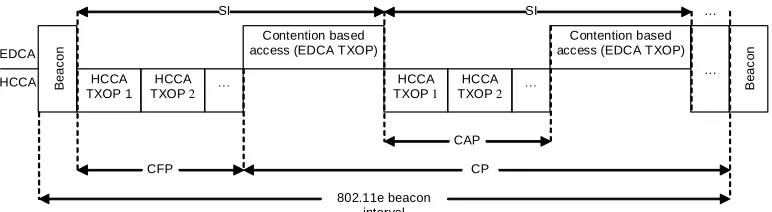
The superframe of HCF is defined as the beacon interval. It is composed of alternated modes of Contention Period (CP) and optional Contention-Free Period (CFP), as it can be seen in Fig. 1. EDCA operates only in CP while HCCA can operate both during CP and CFP. HCCA mode can be started by the AP several times during a CP and these periods are called Controlled Access Periods (CAPs). The beacon transmitted by the AP at the start of every superframe contains control information, such as the maximum duration of CFP, the maximum duration of TXOP et al. The end of CFP is signaled by the AP using a CFP-End message. When the AP wants to initiate a CAP, it occupies the channel and uses a CF-Poll message to grant a HCCA-TXOP to a station.
In HCCA, every TS has its own packet buffer. The traffic specification (TSPEC) is responsible for the TS management. It provides the management link between higher layer QoS protocols such as IntServ or DiffServ with the 802.11e channel access functions (HCCA or EDCA, respectively). TSPEC describes characteristics of TSs, such as the mean data rate, the MAC Service Data Unit (MSDU) size and the maximum Required Service Interval (RSI). Each TS first sends a QoS request to the AP containing these characteristics. The scheduling algorithm calculates first the minimum value of all the RSIs, and then chooses the highest submultiple value of the beacon interval duration as the selected Service Interval (SI), which is less than the minimum of all the maximum RSIs. SI is the time interval between any two successive TXOPs allocated to a station.
TABLE II.CLASSIFICATION OF QOS SUPPORTIVE MAC PROTOCOLS
Protocol Type Examples Characteristics
Distributed EY-NPMA EDCA
no infrastructure required low performance poor QoS support
Centralized
Random Access QAP GRAP
high performance not guaranteed QoS support
low feedback requirements
Reserved Access
DQRUMA MASCARA
DSA++ DTDMA
PRMA HCF
increased QoS guarantee not optimal channel
B. HCCA Scheduling
The simple scheduling algorithm used in HCCA calculates the TXOPs allocated to the different TSs as follows. The TXOP corresponds to the duration required to transmit all packets generated during a SI in a TS buffer. The mean number of packets (Nij) generated in the TS buffer (j) for a station (i) during a SI is:
ij ij ij
M SI r
N (1)
where
r
ij is the application mean data rate and Mij is the nominal MSDU size. The TXOP (Tij) is finally as follows:) 2SIFS R
M , 2SIFS R
M N max(
T ACK
max ACK ij
ij
ij T T (2)
where R is the transmission rate supported by the physical layer and Mmax is the maximum MSDU size. The time interval corresponds to the overhead during a TXOP. Equation (2) guarantees that the TXOP will be long enough for the transmission of at least one packet with maximum size. The total TXOP assigned to a station is the sum of the TXOPs assigned to the different TSs of this station, that is:
Fi 1 j
ij
i T
TXOP (3)
where Fi is the number of TSs in station i. The admission control algorithm checks for available bandwidth before assigning TXOP to a new TS. The fraction of total time assigned to a station i is: TXOPi SI. If the total number of QoS stations that are assigned TXOPs is K, then the scheduler needs to check if the new request of TXOPK+ 1 will keep the fraction of time allocated for TXOPs lower than the maximum fraction of time that can be used by HCCA:
K
1
i Beacon
CAPLimit 1
K
T T SI TXOPi SI
TXOP (4)
where TCAPLimit is the maximum duration of HCCA in a beacon interval (TBeacon).
There are some drawbacks concerning the operation of HCCA. Regarding the polling mechanism, some valuable bandwidth is spent because of the polling packets sent to the stations. The use of acknowledgements is bandwidth costly, too. Since, the target is to attain high throughput rather than reliability, acknowledging the real-time traffic packets seems useless. Also, all the stations have to stay constantly fully awake waiting for data packets or polls, so there is increased
power consumption. Concerning the scheduling algorithm, a major drawback is the fact that the allocated TXOPs are fixed. Thus, VBR traffic cannot be supported efficiently, because possible sudden increases in the bit generation rates would cause increased delays and packet drops. Furthermore, the scheduling algorithm does not take into account prioritized TSs. It just uses the quality requirements in order to assign TXOPs. This means that the traffic is not efficiently differentiated according to the demands for QoS support. These issues and the solutions given by the proposed POAC-QG protocol are detailed in the next sections.
IV. THE POAC-QG PROTOCOL
This work proposes the Priority Oriented Adaptive Control with QoS Guarantee protocol. This access mechanism operates in infrastructure WLANs and can be used in a 802.11e network in place of HCCA. The need that has led to the development of this protocol is the necessity for bandwidth saving, strict QoS with efficient VBR traffic support, and traffic type distinction. POAC-QG is presented analytically in this section.
A. Overview of the Protocol
The superframe used in POAC-QG is separated into real-time traffic (RT) periods and background traffic (BT) periods. POAC-QG operates during the RT periods, which are contention free. During the BT periods a contention based access mechanism can be used. The 802.11e superframe is suitable for adapting POAC-QG into it. The CFPs and CAPs correspond to the RT periods, and the CPs during which EDCA takes place correspond to the BT periods.
The POAC-QG access mechanism is not based on polling, but on a TDMA scheme. The concept is to reduce the bandwidth waste due to the polling model, keep the stations synchronized by dividing the RT period into time slots, and keep them informed of the time interval, source and destination of the coming transmissions. Thus, a potential power saving model could be used, since stations can stay in
“sleep” mode during the RT period and “wake” only to
transmit or receive data. The AP uses the beacon signal to inform the stations of the assigned slots for real-time traffic transmissions and the SI duration for the current superframe. In the beginning of every SI, except from the first one in the superframe, the AP broadcasts a SI_Start message which
B
e
a
c
o
n
HCCA TXOP 1
HCCA
TXOP 2 …
Contention based access (EDCA TXOP)
HCCA
TXOP 1
HCCA
TXOP 2 …
Contention based access (EDCA TXOP)
…
B
e
a
c
o
n
EDCA
HCCA
CFP CP
CAP
802.11e beacon interval (superframe)
[image:5.612.117.503.52.158.2]SI SI …
SI SI SI Beacon
Beacon Interval (super-frame) [default duration: 500ms]
RT BT
Time Slots
TS_A1 TS_A2 +QoS Request
…
[image:6.612.315.567.48.298.2]Beacon
Fig. 2. The POAC-QG superframe
The AP has collected the QoS requests from the stations
Start of super-frame (beacon interval)
The AP uses the beacon/SI_Start to inform the stations of the assigned
time slots for real-time traffic and the SI duration
The real-time traffic period takes place
The background traffic period takes place
Calculate SI duration
Adjust the assigned bandwidth of the running
Traffic Streams
Assign bandwidth to the new requesting Traffic
Streams
Recalculate SI duration
Assign time slots
Superframe end?
No Yes
Fig. 3. POAC-QG operation overview carries the same information with the initial beacon signal. If a
station fails to receive the beacon signal, it defers, until it successfully receives a SI_Start (or a new beacon signal).
When a station becomes aware of the beacon information, it ignores all subsequent SI_Start messages in the current superframe. We assume that the stations send their QoS requests for every TS during the BT periods or the last RT slots assigned to them. An overview of the superframe is shown in Fig. 2.
It is known that a multimedia application can be carried out with different quality levels (depending on the codec, the audio-video quality etc). The admission control negotiates instantly multiple quality levels that can be supported by the requesting TS. The corresponding algorithm tries to serve the higher priority TSs with maximum quality level, but it can lower the provided quality levels in order to allocate slots for lower priority TSs, as well. It is of course assumed that the higher the quality level is, the higher are the resource requirements (bandwidth, delay). The main purpose of the protocol is to serve as many TSs as possible, favor the higher priority TSs, and provide the higher possible quality levels. When a station sends a QoS request to ask for slots for its TSs, it includes the traffic specifications of the different quality levels (traffic rate, maximum inter-transmission interval, maximum and nominal packet size).
Every running TS can ask for a different number of RT slots, according to its current traffic rate and the total size of its buffered packets. So, the QoS request frame that can be sent at the end of the assigned slots or during the BT periods, includes traffic specifications for both running and new TSs. This way VBR traffic can be efficiently supported. The algorithm calculates first the minimum value of all the maximum inter-transmission intervals required by the running and the new TSs, and then chooses the highest submultiple value of the beacon interval duration as the selected SI, which is less than the minimum of all the maximum inter-transmission intervals. Then, the AP allocates slots for the running TSs according to their latest requests. The reason why the running TSs are examined first is the effort of the protocol to keep the quality of the existing communications steady. After all, a new requested voice call can wait for admission, but it is unacceptable for a running call to be suddenly terminated or experience increased delays. The rest of the bandwidth is then assigned to the new TSs, according to the admission control mechanism. The new SI duration is calculated, based on the requests of the accepted TSs and
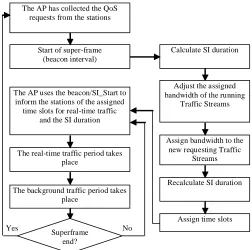
finally the time slots are assigned to the running and the new accepted TSs. In Fig. 3, an overview of the processes that take place according to POAC-QG is presented.
B. Admission Control
Before assigning bandwidth to the new requesting TSs, these are sorted according to their priorities (highest priority first). The corresponding algorithm starts with the highest priority TS and checks if there is enough available bandwidth in order to serve the specific TS with maximum quality level. Otherwise, the QoS requirements of the lower quality level are checked. If neither the minimum quality level can be supported, then the TS is rejected and the next priority TS is examined. When there is no bandwidth left to serve a TS with minimum quality, then the quality levels of the previously examined higher priority TSs are lowered in order to save some bandwidth for the new TS. When the quality levels of the high priority TSs are lowered, then we also check if it becomes possible to increase the quality of the low priority TSs. This
TABLE III.EXAMPLE OF THE QUALITY LEVELS NEGOTIATION IN THE TRAFFIC STREAMS ADMISSION PROCEDURE
Priority_A Priority_B Priority_C Priority_D
Case 1 High QL Out Low QL High QL
If more than the available bandwidth is required for case 1, then go to case 2
Case 2 Retain High QL Out Retain Low QL Drop to Low QL
If more than the available bandwidth is required for case 2, then go to case 3
Case 3 Drop to Low QL Out Raise to High QL Raise to High QL If more than the available bandwidth is required for case 3, then go to case 4
Case 4 Retain Low QL Out Retain High QL Drop to Low QL
If more than the available bandwidth is required for case 4, then go to case 5
Case 5 Retain Low QL Out Drop to Low QL Raise to High QL
If more than the available bandwidth is required for case 5, then go to case 6
Case 6 Retain Low QL Out Retain Low QL Drop to Low QL
If more than the available bandwidth is required for case 6, then go to case 7
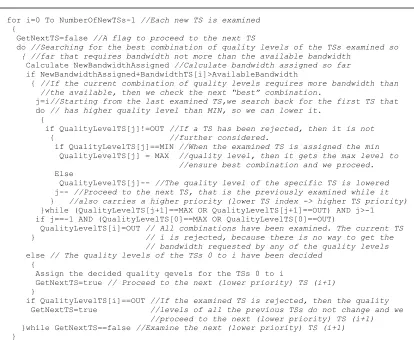
[image:6.612.49.289.70.142.2]way, the best combination of supported quality levels is provided. An example of this process is described in Table III, where we assume two available Quality Levels (High QL, Low QL) and four new TSs with different priorities (Piority_A is the highest, while Priority_D is the lowest). The first three TSs are already examined. Let us assume that, so far, Priority_A TS has been accepted with High QL, Priority_B TS has been rejected, Priority_C TS has been accepted with Low QL, and Priority_D TS is now examined for admission. This means that we are looking for the best quality levels combination of these four TSs, which can be served using the current available bandwidth. In this example there are seven possible cases. Each time, the algorithm checks if there is enough available bandwidth in order to serve the TSs providing the corresponding quality levels combination. If there is not, then we proceed to the next best quality levels combination (case). The final case is the rejection of the examined TS (quality level: OUT). A simple form of the code is presented in Fig. 4.
C. Control Adapted to Requirements
The POAC-QG protocol efficiently supports VBR real-time traffic by adapting to the changing requirements of the running TSs. When the AP assigns RT slots to a station, it provides some extra slots allocated for its QoS request frame transmission. The station uses this frame to send the TSPECs both of the new requesting and the running TSs. Before sending a QoS request, the station calculates the current traffic
rate of all the running TSs by counting the generated bits for a short time interval (default value is 2 sec). It also includes in the QoS request the size of the corresponding packet buffer. At the start of every superframe, the AP assigns slots to the running TSs according to their new QoS requests. The rest of the RT bandwidth is then assigned to the new TSs as we have already discussed. The quality level initially provided to a TS remains static, because our aim is to have steady and reliable transmissions.
The algorithm that assigns time slots to the running TSs tries to adapt to the variable traffic rate without sudden alterations of the allocated bandwidth. When there is not enough RT bandwidth, it assigns a proportion of the requested bandwidth to each TS according to its priority. It is considered that all the generated and buffered packets of a TS can be transmitted during a SI, if the allocated bandwidth corresponds to the theoretical traffic rate:
SI ts BufferedBi CurrentTR
lTR
Theoretica (5)
where CurrentTR is the current traffic rate defined in the QoS request. Since we try to avert sudden and continuous alterations of the allocated bandwidth, a proportion of the requested bandwidth accession or reduction is considered to be the target. Specifically, the considered target traffic rate is:
) PreviousTR alTR
(Theoretic ent
BW_DifPerc PreviousTR
TargetTR (6)
where PreviousTR is the traffic rate corresponding to the bandwidth assigned during the previous superframe, and
for i=0 To NumberOfNewTSs-1 //Each new TS is examined
{
GetNextTS=false //A flag to proceed to the next TS
do //Searching for the best combination of quality levels of the TSs examined so
{ //far that requires bandwidth not more than the available bandwidth
Calculate NewBandwidthAssigned //Calculate bandwidth assigned so far
if NewBandwidthAssigned+BandwidthTS[i]>AvailableBandwidth
{ //If the current combination of quality levels requires more bandwidth than
//the available, then we check the next “best” combination.
j=i//Starting from the last examined TS,we search back for the first TS that
do // has higher quality level than MIN, so we can lower it.
{
if QualityLevelTS[j]!=OUT //If a TS has been rejected, then it is not
{ //further considered.
if QualityLevelTS[j]==MIN //When the examined TS is assigned the min
QualityLevelTS[j] = MAX //quality level, then it gets the max level to
//ensure best combination and we proceed.
Else
QualityLevelTS[j]-- //The quality level of the specific TS is lowered
j-- //Proceed to the next TS, that is the previously examined while it
} //also carries a higher priority (lower TS index -> higher TS priority)
}while (QualityLevelTS[j+1]==MAX OR QualityLevelTS[j+1]==OUT) AND j>-1 if j==-1 AND (QualityLevelTS[0]==MAX OR QualityLevelTS[0]==OUT)
QualityLevelTS[i]=OUT // All combinations have been examined. The current TS
} // i is rejected, because there is no way to get the
// bandwidth requested by any of the quality levels
else // The quality levels of the TSs 0 to i have been decided
{
Assign the decided quality qevels for the TSs 0 to i
GetNextTS=true // Proceed to the next (lower priority) TS (i+1)
}
if QualityLevelTS[i]==OUT //If the examined TS is rejected, then the quality
GetNextTS=true //levels of all the previous TSs do not change and we
//proceed to the next (lower priority) TS (i+1)
}while GetNextTS==false //Examine the next (lower priority) TS (i+1)
[image:7.612.98.512.43.388.2]}
BW_DifPercent (default value is 0.8) is the percentage of the requested bandwidth accession or reduction which is considered to be the target. We also use a down limit for the target traffic rate related to the initial traffic rate requested, in order to avoid packet drops in cases of sharp increase of the generated packets after a long silent interval.
Obviously, when a TS requests to give back some of its
assigned bandwidth because it doesn’t need it anymore, this is
done with no further consideration. An issue arises when there is not enough bandwidth to cover all the extra requests of the running TSs. For this reason, an algorithm that distributes the available bandwidth taking into account the traffic priorities has been developed. It initially calculates the percentage of the available bandwidth that each requesting TS deserves (eligible bandwidth). The available bandwidth corresponds to the slots left in the maximum RT period, after assigning to all the running TSs the slots that already occupied in the previous beacon interval and freeing the returned slots. The eligible bandwidth percentage depends on the traffic priority and the amount of extra bandwidth requested by the TS. Specifically, we use the weights W_PR (default value is 5) and W_BW (default value is 1) to control the contribution of the traffic priority and the extra bandwidth requested, respectively, to the eligible extra bandwidth. It is obviously assumed that the traffic priority is clearly the most significant factor. The equation that gives the non-normalized eligible bandwidth percentage for the TS i is:
PerBW[ i] W_BW
PerPR[ i] W_PR
Per[ i] (7)
where PerPR is the normalized traffic priority:
Number OfRequestingTSs-1
0 j
ight[ j] PriorityWe
ight[ i] PriorityWe
PerPR[ i] (8)
and PerBW is the normalized extra bandwidth requested:
NumberOfRequestingTSs-1
0 j
quested[ j] ExtraBW_Re
quested[ i] ExtraBW_Re
PerBW[ i] (9)
We use the term “priority weight” instead of just “priority”,
because the weight of a traffic priority might be considered to be different than the index of the specific priority. We assume
1 Priority ight
PriorityWe (10)
(e.g. priority: 0 weight: 1). Since the AP is the “heart” of the WLAN and it often interconnects the WLAN with the backbone wired network, any traffic coming from the AP should be served with definitely higher priority. In order to favor the AP TSs, we use the W_AP (default value is 5) factor to calculate the non-normalized eligible bandwidth percentage. So, for every TS i transmitted by the AP it stands:
PerBW[ i] ) W_BW
PerPR[ i] W_PR
Per[ i]W_AP( (11)
We finally normalize:
NumberOfRequestingTS1
0 j
Per[ j] Per[ i]
nPer[ i] (12)
At each step, if the eligible bandwidth of a TS is higher than its requested bandwidth, then the latter is immediately granted
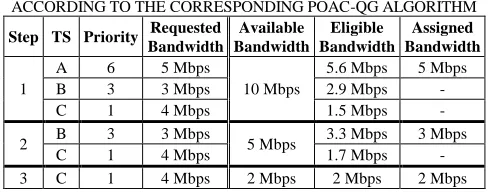
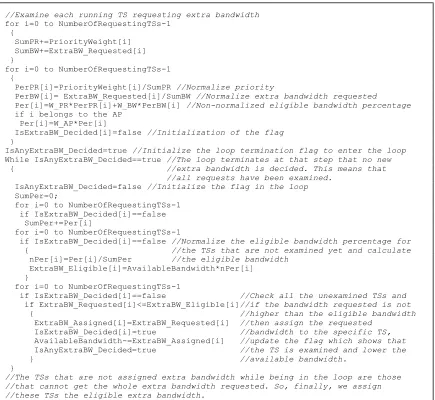
to this TS. Finally, a proportion of the requested bandwidth is assigned to the TSs that cannot be fully served. The algorithm that calculates the extra bandwidth that would be assigned to every requesting TS is presented in pseudo-code form in Fig. 5. An example is given in Table IV. This method of continuous and dynamic bandwidth assignment completes the support provided by POAC-QG to VBR traffic.
V. PERFORMANCE EVALUATION
At this point, it should be mentioned that it is not feasible to model channel access in POAC-QG based on the concept of the classical Bianchi two-state Markov chain [27]. The access scheme of POAC-QG is deterministic, since the AP is
[image:8.612.319.563.71.167.2]informed of the stations’ transmission needs by the QoS request frames. POAC-QG, does not actually involve any idle time during the RT slots. However, we do use a three-state Markov process to simulate the link status between each pair of stations, as it is explained later. Regarding the proposed mechanism for TS admission control and dynamic adjustment of the allocated resources, the algorithmic complexity and heuristic nature makes further theoretical analysis impossible and actually unnecessary. In related work, it can be seen that this is a common concept. In [28], the proposed SETT-EDD scheduling algorithm for HCCA is evaluated via simulation and no theoretical analysis is performed. The authors state that the typical two-state Markov chain used to model the channel does not accurately represent a WLAN with link adaptation. In [29], there is no theoretical analysis of the open-loop and closed-loop scheduling proposals for HCCA. It is stated that the authors are not particularly concerned in finding a theoretical optimal scheduler, since it could turn out to be computationally complex or lose its optimality properties due to implementation impairments. In [30], no Markov modeling is used for the analysis of the proposed FHCF scheduling scheme for HCCA. Similarly to our approach, the authors propose a formula for resource allocation based on the queue length. Lastly, in [31], a TS admission control is proposed for HCCA, employing a sequence of computations and checks which involve the traffic specifications and the available resources. However, no asymptotic analysis is performed to validate the efficiency of the mechanism, instead, simulation comparison is used.
TABLE IV. EXAMPLE OF ASSIGNING EXTRA REQUESTED BANDWIDTH TO THREE RUNNING TRAFFIC STREAMS (A, B, C) ACCORDING TO THE CORRESPONDING POAC-QG ALGORITHM
Step TS Priority Requested Bandwidth
Available Bandwidth
Eligible Bandwidth
Assigned Bandwidth
1
A 6 5 Mbps
10 Mbps
5.6 Mbps 5 Mbps
B 3 3 Mbps 2.9 Mbps -
C 1 4 Mbps 1.5 Mbps -
2 B 3 3 Mbps 5 Mbps 3.3 Mbps 3 Mbps
C 1 4 Mbps 1.7 Mbps -
A. Simulation Environment
In the developed simulation environment, the condition of any wireless link was modeled using a finite-state machine with three states. These are the following [33], [34]:
- State G denotes that the wireless link is in a relatively
“clean” condition and is characterized by a small BER, which
is given by the parameter G_BER.
- State B denotes that the wireless link is in a condition characterized by increased BER, which is given by the parameter B_BER.
- State H denotes that the pair of communication stations is out of range (hidden stations).
We assume that the background noise is the same for all stations, and thus, the principle of reciprocity stands for the condition of any wireless link. Therefore, for any two stations A and B, the BER of the link from A to B and the BER of the link from B to A are the same. The time spent by a link in states G, B and H is exponentially distributed, but with
different average values, given by the parameters TG, TB, TH, respectively. The status of a link probabilistically changes between the three states. When a link is in state G and its status is about to change, the link transits either to state H, with probability given by the parameter Ph, or to state B, with transition probability 1 – Ph. When a link is in state B and its status is about to change, the link transits either to state H, with probability given by the parameter Ph, or to state G, with transition probability 1 – Ph. Finally, when a link spent its time in state H, it transits either to state G or B, with the same probability (0.5). It can be easily seen that by setting the parameter Ph to zero, a fully connected network topology can be assumed, whereas for values of Ph greater than zero, the effect of the well-known “hidden station” problem on protocol performance can be studied.
//Examine each running TS requesting extra bandwidth
for i=0 to NumberOfRequestingTSs-1 {
SumPR+=PriorityWeight[i] SumBW+=ExtraBW_Requested[i] }
for i=0 to NumberOfRequestingTSs-1 {
PerPR[i]=PriorityWeight[i]/SumPR //Normalize priority
PerBW[i]= ExtraBW_Requested[i]/SumBW //Normalize extra bandwidth requested
Per[i]=W_PR*PerPR[i]+W_BW*PerBW[i] //Non-normalized eligible bandwidth percentage
if i belongs to the AP Per[i]=W_AP*Per[i]
IsExtraBW_Decided[i]=false //Initialization of the flag
}
IsAnyExtraBW_Decided=true //Initialize the loop termination flag to enter the loop
While IsAnyExtraBW_Decided==true //The loop terminates at that step that no new
{ //extra bandwidth is decided. This means that
//all requests have been examined.
IsAnyExtraBW_Decided=false //Initialize the flag in the loop
SumPer=0;
for i=0 to NumberOfRequestingTSs-1 if IsExtraBW_Decided[i]==false SumPer+=Per[i]
for i=0 to NumberOfRequestingTSs-1
if IsExtraBW_Decided[i]==false //Normalize the eligible bandwidth percentage for
{ //the TSs that are not examined yet and calculate
nPer[i]=Per[i]/SumPer //the eligible bandwidth
ExtraBW_Eligible[i]=AvailableBandwidth*nPer[i] }
for i=0 to NumberOfRequestingTSs-1
if IsExtraBW_Decided[i]==false //Check all the unexamined TSs and
if ExtraBW_Requested[i]<=ExtraBW_Eligible[i]//if the bandwidth requested is not
{ //higher than the eligible bandwidth
ExtraBW_Assigned[i]=ExtraBW_Requested[i] //then assign the requested
IsExtraBW_Decided[i]=true //bandwidth to the specific TS,
AvailableBandwidth-=ExtraBW_Assigned[i] //update the flag which shows that
IsAnyExtraBW_Decided=true //the TS is examined and lower the
} //available bandwidth.
}
//The TSs that are not assigned extra bandwidth while being in the loop are those //that cannot get the whole extra bandwidth requested. So, finally, we assign //these TSs the eligible extra bandwidth.
for i=0 to NumberOfRequestingTSs-1 if IsExtraBW_Decided[i]==false
[image:9.612.92.527.48.448.2]ExtraBW_Assigned[i]=ExtraBW_Eligible[i]
AP
Station k
Station k - 1
Station k + 1
Station k + 2
Backbone Network
Bi
-
directional Voice
Communication
Bi
-
directional Live Video
Communication
Video On-
Demand
Transmission
[image:10.612.50.292.50.228.2]
Fig. 6. Transmissions in the first simulation scenario
In a “clean” network, it stands for the inter-station links: TG=3 sec, TB=1 sec, TH=0.5 sec, G_BER=0, B_BER=0, Ph=0. Similarly, for the AP-station links it stands: TG_AP=6 sec, TB_AP=0.5 sec, TH_AP=0.25 sec, G_BER_AP=0, B_BER_AP=0, Ph_AP=0. The links among the AP and the stations are considered to be more reliable than the inter-station links, because the range of the AP is usually greater
than the stations’ range, its emitted signal is usually stronger,
and its default position is the center of the cell. In a rather not
“clean” wireless environment, it stands for the inter-station links: TG=3 sec, TB=1 sec, TH=0.5 sec, G_BER=0, B_BER=0.00001, Ph=0.05. For the AP-station links it stands: TG_AP=6 sec, TB_AP=0.5 sec, TH_AP=0.25 sec, G_BER_AP=0, B_BER_AP=0.000001, Ph_AP=0.01. The BERs are assumed to be resulted after the application of the standard’s predefined coding techniques.
The default values of the network parameters used in our simulation scenarios are presented here. The medium bit rate is 36 Mbps, the signal propagation delay is 0.0005 ms corresponding to distances among the stations of 150 m, the maximum percentage of the superframe reserved for RT transmissions is 0.95, and the maximum allowed packet size is 10 KB. According to the specifications of 802.11e, we
consider the following total packet sizes: “POLL”=34 bytes, “BEACON”=124 bytes, and “QoS_Request”=44 bytes. The
total overhead of every traffic packet is 106 bytes, including physical, MAC, RTP, UDP, IP, and SNAP headers.
Regarding the simulation engine, the random number generator used by our simulator is a classic multiplicative congruential random number generator with period 232 provided by ANSI C. The simulation results presented in this section are produced by a statistical analysis based on the
“sequential simulation” method [35]. We perform simulations
in a sequential way, until the relative statistical error of the estimated mean value falls below an acceptable threshold. When the relative statistical error is low, the confidence interval is narrow, since the relative statistical error is defined as the ratio of the half-width of the given confidence interval at the point estimate. For this statistical analysis we used 95% confidence intervals. The relative statistical error threshold
varies depending on the meaning of the metric and the magnitude of its value. However, this threshold was usually assumed to be lower than 2% and never exceeded 5%.
B. First Simulation Scenario
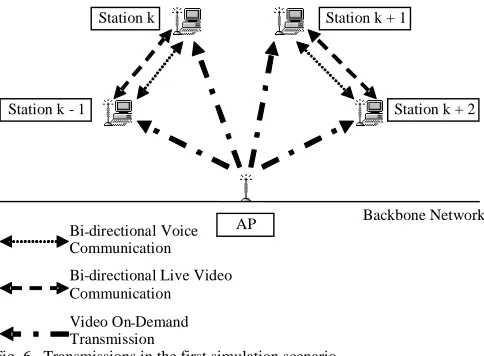
We have used two simulation scenarios to compare the performance and the general behavior of the HCCA and the POAC-QG protocols. We consider only real-time traffic streams, because the background traffic access mechanism (EDCA) is the same for the two cases. In the first scenario, we have live voice and video communications (bidirectional transmissions) between the adjacent mobile stations (station 1 communicates with station 2, station 3 communicates with station 4 and so on), and a video on demand traffic stream transmitted by the AP to each station. In Fig.6, we have a representation of the transmissions taking place in the first simulation scenario. Our aim is to compare the QoS provided by the two protocols, when there is just one quality level, that is there is no QoS negotiation. So, in this case, the proposed QoS negotiation mechanism of POAC-QG does not affect the simulation results. The characteristics of the network traffic can be found in Table V. The simulation duration is 30 sec, every communication lasts for 20 sec, a new set of transmissions (voice, live video, video on demand) are generated every second, and the simulated WLAN consists of 10 mobile stations (that is 30 traffic streams). Also, we
consider “clean” links, so we used the respective network parameters’ values mentioned earlier. It should be noticed that
in both scenarios, we do not drop the packets that exceed their delay bound, so as to get results from all transmissions.
In the first simulation scenario, we get measurements of the packet jitter and the TS buffer size. These two metrics are representative of the capability of the MAC protocol to efficiently provide QoS. In Fig. 7, we have plotted the results regarding packet jitter. It is obvious that in all cases POAC-QG exhibits much lower jitter than HCCA. The jitter of the voice packets is always kept below 50 ms. The graph that concerns live video, shows that POAC-QG can efficiently support VBR traffic by providing significantly low jitter values. Furthermore, it is capable of successfully serving high bit-rate CBR traffic streams, like video on demand. This superior performance of POAC-QG is partially owed in its ability to adapt to the special requirements of every TS and continuously provide the bandwidth actually needed.
TABLE V. CHARACTERISTICS OF THE TRAFFIC TYPES USED IN SIMULATION SCENARIO 1
Application Coding
Packet Data Size
(bytes)
Packet Interarrival
Time (ms)
Data Bit Rate
Packet Delay Bound (ms)
Voice (Priority: 6)
G.711
(PCM) 160 20
64 Kbps (CBR) 50
Live Video (Priority: 5)
H.261 [QCIF]
Exponential [20-1024] Mean: 660
Exponential Mean: 26
~200 Kbps (VBR) 100
Video on Demand (Priority: 4)
MPEG-4
[4CIF] 800 2
[image:10.612.315.567.65.188.2]a) Voice 0 50 100 150 200 250
Packets Receiv ed (%)
J it te r (m s )
0 50 100
b)
Liv e Video
0 200 400 600 800
Packets Received (%)
J it te r (m s )
0 50 100
c) Video On-Demand 0 200 400 600 800 1000
Packets Receiv ed (%)
J it ter (m s ) HCCA POAC-QG
[image:11.612.49.288.52.414.2]0 50 100
Fig. 7. Packet jitter measurements concerning a) voice, b) live video, and c) video on demand traffic
[image:11.612.320.565.52.252.2]AP Station k Backbone Network Bi-directional Voice Communication Bi-directional Live Video Communication Video On-Demand Transmission
Fig. 8. Transmissions in the second simulation scenario
The buffer size of the source station was also measured when a packet was transmitted. It is important for the source to be able to transmit on time the RT packets that arrive at the TS buffer. The ideal case would be the constant counterbalance of the transmission rate and the packet generation rate. However, in a real situation, it is quite difficult to adapt the transmission rate to the packet generation rate. This is particularly true when dealing with VBR traffic, where the packet generation rate changes continuously. In such cases, when a large number of packets suddenly arrive at the buffer, the station might be unable to transmit all packets on time, so there could be packet drops due to lack of buffer space or excess of packet lifetime. The results (which are relative to the jitter results) showed that in all cases POAC-QG manages to “unload” the buffers more efficiently than HCCA. This happens because of the proposed adaptive bandwidth assignment mechanism which continuously provides transmission rates according to the current packet generation rates. Also, the optimized access mechanism, which provides resources saving, significantly contributes to the superior performance of POAC-QG.
C. Second Simulation Scenario
In the second simulation scenario, our aim is to examine the packet delays and the QoS negotiation efficiency of
POAC-QG in a rather not “clean” environment. For these reasons, we
used two quality levels (MIN, MAX) and we set the network parameters to the earlier mentioned values that correspond to links of decreased reliability. The employed traffic model involves only AP-station communications. We have live voice and video communications (bidirectional transmissions) between the AP and each station, while the AP transmits a video on demand TS to each station. In Fig. 8, we have a representation of the transmissions taking place in the second simulation scenario. The traffic characteristics can be found in Table VI. We notice that voice and live video traffic support two quality levels, while video on demand traffic actually supports a single quality level. This is not a problem for the operation of POAC-QG, since it does not require that all TSs support all the provided quality levels. The simulation duration is 60 sec, every communication lasts for 30 sec, half of the transmission sets (voice, live video, video on demand) start at the beginning of the simulation and the other half start 30 sec later, and we simulated 15 WLAN topologies consisting of 2
TABLE VI. CHARACTERISTICS OF THE TRAFFIC TYPES USED IN SIMULATION SCENARIO 2
Application QL Coding
Packet Data Size (bytes) Packet Inter- arrival Time (ms) On/Off Periods (sec) Data Bit Rate Packet Delay Bound (ms) Voice (Priority: 6)
MAX G.711 (PCM) 160
20 Expo. (mean) On: 1.5 Off: 1.8 64 Kbps (CBR) 50 MIN G.729_A (CS- ACELP)
20 8 Kbps
(CBR)
Live Video (Priority: 5)
MAX H. 261 [CIF] Expo. [40-2048] Mean: 1320 Expo. Mean: 13 Always On ~800 Kbps (VBR) 100
MIN H.261 [QCIF] Expo. [20-1024] Mean: 660 Expo. Mean: 26 ~200 Kbps (VBR) Video On-Demand (Priority: 4)
MAX MPEG-4
[4CIF] 800 2
0 0.1 0.2 0.3 0.4 0.5 0.6 0.7 0.8 0.9 1
0 15 30 45 60 75 90 105 120 135 150 Total Offered Streams
[image:12.612.52.293.54.245.2]Q _ S c o re POAC-QG HCCA
Fig. 10. Q_Score versus the number of the total offered traffic streams
0 10 20 30 40 50 60 70 80 90 100
0 15 30 45 60 75 90 105 120 135 150 Total Offered Streams
Nu m b er o f S tr ea m s
POAC-QG MIN POAC-QG MAX POAC-QG OUT
HCCA MIN HCCA MAX HCCA OUT
Fig. 11. The number of the traffic streams assigned the minimum quality level or the maximum quality level or they were rejected versus the number of the total offered traffic streams
0 25 50 75 100 125 150 175 200 225 250 275 300
0 15 30 45 60 75 90 105 120 135 150 Total Offered Streams
De
lay
(
m
s)
POAC-QG Voice HCCA Voice POAC-QG Live Video HCCA Live Video POAC-QG Video on Demand HCCA Video on Demand
Fig. 9. Average packet delay versus the number of total offered traffic streams
to 30 stations (that is 10 to 150 TSs).
In Fig. 9, we have plotted the average packet delay versus the number of the total offered TSs. In all cases (voice, live video, video on demand traffic), POAC-QG provides lower packet delays than HCCA, while the latter some times fails to provide delays lower than the maximum tolerable value. It should be noticed, that the total number of offered streams corresponds to the streams scheduled to take place during each simulation. However, some of them may not get permission to start at all due to limited available bandwidth. Also, the served TSs are assigned different quality levels with different bandwidth requirements, and not all of the accepted streams are served for the same time. For these reasons, we need a new metric in order to get a clear and fair view of the comparison of POAC-QG and HCCA.
We call this new metric “Q_Score”. It depends on the priority of each served TS, its quality level, the number of
served TSs, and the network’s throughput. First of all, we define the factor “Q_Factor” which concerns the assigned quality level. Q_Factor is higher when a TS is assigned the MAX quality level. However, we want to get a clearly higher score when serving two MIN TSs than one MAX TS. Since it is more important to serve multiple low quality TSs than one with high quality, we decided to set Q_Factor=1 when the TS is assigned the MIN quality level, and Q_Factor=1.1 when it is assigned the MAX quality level. First, we calculate the score for each TS:
Ratio TimeServed ht iorityWeig Factor Q Score
StreamQ_ _ Pr (13)
where the PriorityWeight depends on the stream’s traffic priority and the TimeServedRatio is the ratio of the time interval the TS was served to the total time it was scheduled to last. At this point, it should be reminded that according to our simulation settings all TSs are scheduled to last no more than the simulation duration. So, in an ideal situation, all the TSs would be completed before the simulation termination. The IdealStreamQ_Score is the score of a MAX quality TS that is completed before the simulation termination
(TimeServedRatio=1). It stands:
ht iorityWeig Factor MaxQ Score mQ
IdealStrea _ _ Pr (14)
The RatioNetQ_Score, which concerns the total offered streams, is defined as:
OfferedStreams
i eams OfferedStr i Score mQ IdealStrea Score StreamQ Score RatioNetQ 1 1 _ _ _ (15)
Finally, we calculate each simulated network’s Q_Score in relation to the score of the same network when using a different protocol. It stands:
ughput HigherThro Throughput Score RatioNetQ Score
Q_ _ (16)
for the network with the lower throughput and Q_Score=RatioNetQ_Score for the network with the higher throughput. For example, if a HCCA network has RatioNetQ_Score=1 and Throughput=0.6, and the same network using POAC-QG has RatioNetQ_Score=1 and Throughput=0.8, then the Q_Score for the HCCA network is 0.75 while for the POAC-QG network is 1. Thus, Q_Score as it is formed in equation (16), can only be used to compare the performance of two networks and not as an individual metric.
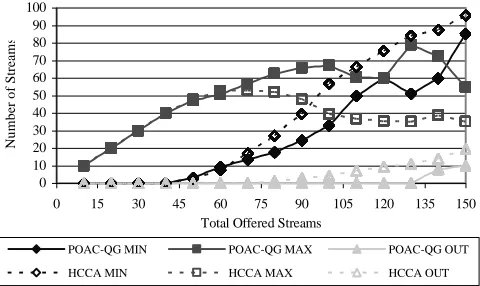
[image:12.612.323.560.55.190.2] [image:12.612.322.562.227.370.2]MAX and MIN quality level TSs, as shown in Fig. 11. It appears that POAC-QG always serves as many TSs as possible to the best quality it can achieve.
VI. CONCLUSION
This work proposed the Priority Oriented Adaptive Control with QoS Guarantee (POAC-QG) protocol for WLANs. It can be adapted into the HCF protocol of the IEEE 802.11e standard in place of HCCA. A TDMA scheme is adopted for the access mechanism. POAC-QG is designed to efficiently support all types of real-time traffic. It guarantees QoS both for CBR and VBR traffic, by continuously adapting to their special requirements. Since numerous network multimedia applications produce VBR traffic, it is essential to support it with high quality. HCCA, on the other hand, appears to be unable to efficiently support VBR traffic. POAC-QG makes extended use of traffic priorities in order to differentiate the TSs according to their application. The proposed superframe using slots decreases the total overhead, provides better synchronization, since every station is informed by the beacon of the exact time slots assigned to each station, and thus it potentially allows the use of an efficient power saving mechanism. POAC-QG employs a direct QoS negotiation mechanism that supports multiple quality levels for the TSs. This mechanism and the dynamic bandwidth allocation provide support to multiple TSs to the best quality the protocol can achieve. The simulation results reveal this behavior and show that POAC-QG always performs superiorly than HCCA when comparing the packet jitter, TS buffer size and packet delay. As future work, POAC-QG can be enhanced with a power saving mechanism and it can be combined with an efficient background traffic protocol in place of EDCA in order to form a complete high performance protocol for infrastructure WLANs.
REFERENCES
[1] IEEE 802.11e WG, “P802.11e: Draft Amendment to Standard [for] for Information Technology-- Telecommunications and Information Exchange Between Systems--LAN/MAN Specific Requirements-- Part 11 Wireless Medium Access Control (MAC) and Physical Layer (PHY) specifications: Amendment 7: Medium Access Control (MAC) Quality
of Service (QoS) Enhancements,” Draft Version: D13 2005.
[2] P. Nicopolitidis, M. S. Obaidat, G. I. Papadimitriou and A. S.
Pomportsis, “Wireless Networks”, Wiley, January 2003.
[3] P. Nicopolitidis, G. I. Papadimitriou and A. S. Pomportsis, “Distributed Protocols for Ad-Hoc Wireless LANs: A Learning-Automata-Based
Approach”, Ad Hoc Networks, Elsevier, vol.2, no.4, pp. 419-431, October 2004.
[4] P. Nicopolitidis, G. I. Papadimitriou and A. S. Pomportsis, “Learning -Automata-Based Polling Protocols for Wireless LANs”, IEEE Transactions on Communications, vol.51, no.3, pp. 453-463, March 2003.
[5] P. Nicopolitidis, G. I. Papadimitriou and A. S. Pomportsis, “Using Learning Automata for Adaptive Push-Based Data Broadcasting in
Asymmetric Wireless Environments”, IEEE Transactions on Vehicular
Technology, vol.51, no.6, pp. 1652-1660, November 2002.
[6] G. I. Papadimitriou, A. S. Pomportsis, "Adaptive MAC protocols for broadcast networks with bursty traffic", IEEE Transactions on Communications, vol.51, no.4, pp.553 - 557, April 2003
[7] G. I. Papadimitriou and A. S. Pomportsis, "Learning Automata-Based TDMA protocols for Broadcast Communication Systems with Bursty Traffic", IEEE Communication Letters, vol.4, no.3, pp.107-109, March 2000.
[8] Ajay Chandra, V. Gumalla, and John O. Limb, “Wireless Medium
Access Control Protocols,” IEEE Communications Surveys, pp. 2-15, Second Quarter 2000.
[9] Ian F. Akyildiz, Janise McNair, Loren Carrasco, Ramon Puigjaner,
“Medium Access Control Protocols for Multimedia Traffic in Wireless
Networks,” IEEE Network Magazine, vol. 13, no. 4, pp. 39-47, July / August 1999.
[10] EN 300 652 V1.2.1 (1998-07), ETSI, Broadband Radio Access Network (BRAN); HIgh PErformance Radio Local Area Network (HIPERLAN) Type 1; Functional Specification.
[11] G. I. Papadimitriou, T. D. Lagkas, and A. S. Pomportsis, “HIPERSIM: A Sense Range Distinctive Simulation Environment for HiperLAN
Systems,” Simulation, Transactions of The Society for Modelling and
Simulation International, Volume 79, Number 8, pp. 462-481, August 2003.
[12] T. D. Lagkas, G. I. Papadimitriou, and A. S. Pomportsis, “QAP: A QoS
supportive Adaptive Polling Protocol for Wireless LANs,” Computer
Communications, Elsevier, Vol. 29, pp. 618-633, 2006.
[13] T. D. Lagkas, G. I. Papadimitriou, and A. S. Pomportsis, “A High
Performance QoS Supportive Protocol for Wireless LANs,” Proceedings
of IEEE MELECON 2004, pp. 571-574, Dubrovnik, Croatia, May 2004.
[14] Kwang-Cheng Chen, Cheng-Hua Lee, “Group randomly addressed polling for wireless data networks,” in Proc. IEEE ICC, pp. 1713-1717, 1994.
[15] M. J. Karol, Z. Liu, and K. Y. Eng, “An Efficient Demand- Assignment
Multiple Access Protocol for Wireless Packet (ATM) Networks,”
Wireless Networks, ACM-Press, Baltzer Science Publishers, vol. 1.3, pp. 267- 79, 1995.
[16] F. Bauchot, S. Decrauzat, G. Marmigere, L. Merakos, and N. Passas,
“MASCARA, a MAC Protocol for Wireless ATM,” Proceedings of ACTS Mobile Summit ’96, Spain, Nov. 1996.
[17] D. Petras, and A. Kramling, “MAC protocol with polling and fast collision resolution for an ATM air interface,” IEEE ATM Workshop, San Francisco, CA, Aug. 1996.
[18] D. Raychaudhuri, L. J. French, J. Siracusa, S. K. Biswas, R. Yuan, P. Narasimhan, and C. A. Johnston, "WATMnet: A Prototype Wireless ATM System for Multimedia Personal Communication," IEEE Journal on Selected Areas in Communications, vol. 15, no. 1, pp. 83-95, Jan. 1997.
[19] J. G. Kim and I. Widjaja, "PRMA/DA: A New Media Access Control
Protocol for Wireless ATM", Proceedings of ICC’96, Dallas Texas, pp.
1-19, June 1996.
[20] D. A. Dyson and Z. J. Haas, “The dynamic packet reservation multiple
access scheme for multimedia traffic,” ACM/Baltzer Journal of Mobile
Networks & Applications, 1999.
[21] G. Bianchi, F. Borgonovo, L. Fratta, L. Musumeci, and M. Zorzi, “C -PRMA: A centralized packet multiple access for local wireless
communications,” IEEE Transactions on Vehicular Technology, vol. 46,
May 1997.
[22] Imrich Chlamtac, Marco Conti, Jennifer J.-N. Liu, “Mobile ad hoc
networking: imperatives and challenges,” ELSEVIER Ad Hoc Networks
1, 13-64, 2003.
[23] Jaime Sanchez, Ralph Martinez, Michael W. Marcellin, “A survey of
MAC protocols proposed for Wireless ATM,” IEEE Network Magazine,
vol. 11, no. 6, pp. 52-62, Nov/Dec 1997.
[24] Teerawat Issariyakul, Ekram Hossain, and Dong In Kim, “Medium access control protocols for wireless mobile ad hoc networks: issues and
approaches,” Wireless Communication and Mobile Computing, 3:935 -958, 2003.
[25] IEEE 802.11 WG, International Standard [for] Information Technology
– Telecommunications and Information Exchange between systems-Local and metropolitan area networks-Specific Requirements – Part 11:Wireless LAN Medium Access Control (MAC) and Physical Layer (PHY) specifications, Reference number ISO/IEC 8802-11:1999(E), 1999.
[26] Qiang Ni, Lamia Romdhani, and Thierry Turletti, “A Survey of QoS
Wireless Communication and Mobile Computing (JWCMC), John Wiley and Sons Ltd., Volume 4, Issue 5: pp. 547-566, 2004.
[27] G. Bianchi, “Performance Analysis of the IEEE 802.11 Distributed
Coordination Function,” IEEE Journal on Selected Areas in
Communications, 18(3):535-547, 2000.
[28] A. Grilo, M. Macedo, M. Nunes, “A scheduling algorithm for QoS
support in IEEE 802.11e networks,” IEEE Communication Magazine,
pp. 36-43, June 2003.
[29] P. Larcheri, R. Lo Cigno, “Scheduling in 802.11e: Open-Loop or Closed-Loop?,” Proc. WONS 2006, Jan.18-20, Les Menuires, France, 2006.
[30] Qiang Ni, Pierre Ansel, and Thierry Turletti, “A Fair Scheduling
Scheme for HCF,” IEEE 802.11e Working Group Document: IEEE
802.11-03-0577-01-000e, July 23, 2003.
[31] Chun-Ting Chou, S. N. Shankar, K. G. Shin, “Achieving per-stream QoS with distributed airtime allocation and admission control in IEEE
802.11e wireless LANs,” Proceedings IEEE INFOCOM 2005, vol. 3,
pp. 1584-1595, 2005.
[32] IEEE 802.11g WG, International Standard for Information Technology
– Telecommunications and Information Exchange between systems-Local and metropolitan area networks-Specific Requirements - Part 11:Wireless LAN Medium Access Control (MAC) and Physical Layer (PHY) specifications, Amendment 4: Further Higher Data Rate Extension in the 2.4GHz Band, 2003.
[33] E. Gilbert, “Capacity of a burst noise channel,” Bell Syst. Tech. J., vol. 39, pp.1253-1265, Sept. 1960.
[34] M. Zorzi, R. R. Rao, and L. B. Milstein, “On the accuracy of a
first-order Markov model for data transmission on fading channels,” in Proc.
ICUPC, Tokyo, Japan, pp. 211-215, Nov. 1995.
[35] Krzysztof Pawlikowski, Hae-Duck Joshua Jeong, and Jong-Suk Ruth
Lee, University of Canterbury, “On Credibility of Simulation Studies of
Telecommunication Networks”, IEEE Communications Magazine,
vol.40, no.1, pp.132-139, Jan. 2002.