Rochester Institute of Technology
RIT Scholar Works
Theses
Thesis/Dissertation Collections
12-6-1986
A study of the application of paper spread function
data to the prediction of physical dot areas for offset
lithography
Paul Lewis
Follow this and additional works at:
http://scholarworks.rit.edu/theses
This Thesis is brought to you for free and open access by the Thesis/Dissertation Collections at RIT Scholar Works. It has been accepted for inclusion
in Theses by an authorized administrator of RIT Scholar Works. For more information, please contact
Recommended Citation
A
STUDY
OF
THE
APPLICATION
OF PAPER
~3F'h:Fr,U
F
'-I
I
,IC-'
1 Uhl
D(YU)
TO
THE
:
F'RED I CT I ON
Dr
F·HY
~'. T
U,L.
DDT
(:)r.:[
~,
~;
FDI:;:
DFFSET L
I
THOGRAF'H'!
'
b
y
F·
a.u.l E.. Lel,AJi s
B ..
S.
Vi~qinja
Pol
y
technic Institute
(197(3)
A
thesi
s
5ubmjtted
in
pa~ti2l
fulfillment
of th
e
~equi~ement5
for the
deg~ee
of
Ma
ster
of
Science
in
the
Cente~
for
Im
aging
Science in
the
Colle
ge
of
Graphic Arts
and
Photog~aphy
of
the
R
oche
~
ter
Institute of Technology
.Julle~
19136
Si
~lni
:
,tuT':o'
crf
tho:::~ {1Llthol~
_._
..
_
.
_
__
____________
~g!Jl.E.:..b~wi~
___ _
Cente~
fo~
Imaging Science
College of Graphic Arts and Photography
Rochester Institute of Technology
Rochester, New York
CERTIFIC
A
TE OF APPROVAL
M.S. DEGREE THESIS
The M.S. Degree Thesis of Paul E. Lewis
has been e
x
amined and approved
by the thesis committee as satisfactory
for the thesis requirement for the
Master of Science degree
Mr. Joe H. Altman, Thesis Advisor
Mr. Peter G. Engeldrum
Dr. Ronald Francis
---THESIS
RELE
ASE
PERMISSION FORM
RO
CHESTER INS
TITUTE OF TECHNOLOGY
COLLEGE OF GRAPHIC ARTS
AND PHOTOGRAPHY
Title
of thesis
B §IYQY
QE
I~~ BEEbl~BIIQ~
QE
EBE~B §EB~Bg
EY~~IIQ~
Q010
TO THE
EB~Ql~I!Q~
QE
E~Y§!~Bb
QQI
BB~B§
EQB
QEE§~I bII~99B8E~Y
D"
.
l
.
tE
~
E~~l
~~ ~~~i5, p~efe~
rep~oduction
is made.
A
STUDY
OF
THE
APPLICATION
OF
PAPER
SPREAD
FUNCTION
DATA
TO
THE
PREDICTION
OF
PHYSICAL
DOT
AREAS
FOR
OFFSET
LITHOGRAPHY
by
PAUL
EUGENE
LEWIS
Submitted
to
the
Center
for
Imaging
Science
in
partial
fulfillment
of
the
requirements
for
the
Master
of
Science
degree
at
the
Rochester
Institute
of
Technology
ABSTRACT
This
investigation
was
aimed
at
establishing
a
relationship
between
the
optical
spread
function
of
four
common
printing
stocks
(cast
coat,
enamel
gloss,
enamel
dull
and
ledger)
and
a
Yule
-Neilsen
n
value
in
predicting
physical
dot
Area,
for
offset
lithographic
printing.
Using
an
offset
press
each
paper
stock
was
printed
with
a
test
target
containing
common
screen
frequencies
at
percent
dot
areas
from
5-90"/.
and
solid
ink
patches
adjacent
to
each
tint.
Using
planimetry
and
macrodensi
tometry
,exact
n
values
were
calculated
for
comparison
with
the
measured
spread
function
of
that
same
paper
stock.
No
relationship
between
the
optical
spread
functions
of
the
printing
stocks
and
a
Yule
-Neilsen
n
value
was
found.
Coated
stocks
(i.e.,
cast
coat,
enamel
gloss
and
enamel
dull)
behaved
differently
than
uncoated
stock
with
respect
to
n
VITA
Prior to entering the
graduate
program
in
Imaging Science,
I
worked
in
photo-finishing
laboratories for
six
years.
I
was
awarded
a
graduate
assistantship
by
the
Imaging
Science
Department
and
worked
for
two
consecutive
years
with
the
United
States
Navy
summer
training
program.
The
second
year
with
the United
States
Navy
summer
program
I
taught
color
theory
and
automated
printing.
In
addition,
I
worked
for
the
R.I.T.
photo-finishing
laboratory
as
a
technical
associate
and
laboratory
ACKNOWLEDGEMENTS
I
would
like
to
thank
the
following
people
for
sharing
their
experience,
and
donating
the
time
necessary
for
the
successful
completion
of
this
project:
Mr.
Joe
H.
Altman,
retired
Senior
Research
Associate
for
the
Eastman
Kodak
Co.,
who
as
my
thesis
advisor,
was
unbelievably
generous
with
his
time
and
effort
in
the
supervision
of
this
project;
Mr.
Peter
G.
Engeldrum,
of
the
R.I.T.
Center
for
Imaging
Science,
for
his
advice
and
enthusiasm;
Mr.
Milton
Pearson
of
the
R.I.T.
Research
Corp.,
for
his
technical
assistance;
and,
Mr.
William
Eisner
Director,
and
staff,
of
the
Technical
and
Educational
Center
of
the
Graphic
Arts
DEDICATION
This
thesis
is
dedicated
to
Ruth
and
Walter
Hess
whose
confidence
in
me
resulted
in
its
undertaking,
and
to
Claudia
whose
support
and
understanding
Table
of
Contents
SECJION
PAGE
#
Introduct
i
on
1
Exper i
mental
14
Results
27
Discussion
40
Conclusion
56
References
59
APPENDIX
A
Description
of
edge
projection
system.
62
APPENDIX
B
Controlling
program
for
Micro-densi tometer
.65
APPENDIX
C
Program
that
calculates
spread
function
from
edge
gradient
data.
68
APPENDIX
D
Program
that
calculates
area
under
normalized
spread
function,
and
corrected
MTF.
71
APPENDIX
E
Materials
evaluated
in
measurement
of
system
MTF.
78
APPENDIX
F
Calculation
of
theoretical
system
MTF.
80
APPENDIX
G
Calculation
of
n
values.
84
APPENDIX
H
Linearity
comparison
of
TR927
and
M/M
densitometers.
91
APPENDIX
I
Calculation
of
percentdot
areas.
92
APPENDIX
J
Partial
derivatives
of
the
Yule
List
of
Tables
TABLE
CONTENTS
PAGE
1
Paper
stocks
and
basis
weights.
14
2
Parameters
describing
behavior
of
light
in
samples.
36
3
Average
basis
weight
and
thickness
for
press
sheet
and
additional
sample.
38
4-6
Analysis
of
variance
on
n
values.
41-42
7-8
Difference
in
percent
between
measured
and
predicted
areas
(cast
coat,
enamel
gloss,
enamel
dull)
and
(ledger).
46-47
9-11
Analysis
of
variance
on
para
meters
describing
sample
spread
functions.
49-50
12
Partial
derivatives
of
Yule
-Neilsen
equation
listed
in
order
List
of
Figures
FIGURE
CONTENTS
PAGE
1
Simplified
concept
of
light
inter
action
with
halftone
tint.
1
2
Repeating
rectangular
wave.
6
3
Test
pattern
layout.
18
4
Measurement
of
dot
area,
by
planimetry.
24
5-12
Graphs
of
edge
gradient,
spread
function
and
corrected
MTF
28-3'
for
all
samples.
13
Plot
of
n
value
as
a
function
of
measured
7.
dot
area
at
all
screen
frequencies.
38
14
Spread
function
comparison
for
all
Introduction
In
the
printing
industry
a
continuoustone
scale
is
simulated
by
using
halftone
dots.
The
ability
to
reproduce
and
maintain
a
given
aim
density
(under
a
certain
set
of
press
conditions)
is
essential
to
quality
printing.
Varying
halftone
tint
density
is
accomplished
by
varying
the
dot
area
( 1 )
in
the
space
under
consideration
.Maintaining
constant
tint
density
requires
a
quick
and
accurate
method
of
monitoring
the
dot
area
during
a
press
run.
In
the
printing
industry
today,
this
has
been
accomplished
to
a
great
extent
by
the
trial
and
error
application
of
an
n
value
to
the
Yule-Neil
sen
equation.
The
model
of
what
happens
to
light
as
it
interacts
(2)
with
a.
halftone
dot
pattern
is
a
very
complicated
one
Consider
a
checkerboard
pattern,
in
which
the
dot
area
is
507.,
on
a
white
paper
substrate.
It
should
absorb
less
than
507.
of
the
incident
light,
since
the
black
dots
never
totally
absorb
all
of
the
light
incident
on
them
(i.e.,
there
is
some
reflection).However,
such
a.
pattern
usually
absorbs
more
than
507.
of
the
incident
flux
and
reflectance
is
less
50%
Absorbed
on
Entering
Paper
NX \\\N
\\
V,
N^
L\
I
Half
of
Remainder
Absorbed
on
Leaving
Paper
u
" '. 1,\
*t
ti
H
\
Total
Absorption
=75%
Reflectance
=25%
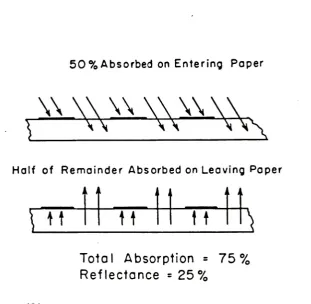
Figure
(1)
Simplified
concept
of
light
interaction
with
a
halftone
tint.
[image:13.522.98.410.104.408.2](2)
Yule
and
Neilsen
conceptualized
the
interaction
of
light
with
a
halftone
reproduction
in
four
stages.
1.
Allow
one
unit
of
light
to
reach
the
reproduction.
Some
of
the
one
unit
is
reflected
back
(s),
and
(1-s)
is
not.
2.
(1-s)
is
transmitted
through
the
surface
and
dot
pattern.
As
a
result
a
fraction
proportional
to
the
dot
area
and
its
transmi ttance
is
absorbed
a*(l-Ts)
(where
Ts)
is
the
transmi
ttance
of
the
dot
and
a
is
the
dot
area).
This
is
what
is
available
to
the
paper
surface
(i.e.,
i-a*(l-Ts>
)
.3.
A
fraction
of
i-a*(l-Ts)
is
absorbed
by
the
paper.
4.
That
which
is
not
absorbed
by
the
paper
is
diffused
by
it
and
after
internal
reflections
re-emerges
from
the
surface.
Here
it
again
takes
another
trip
through
the
dot
pattern,
which
again
absorbs
l-a*(l-Ts>.
(2)
According
to
Yule
and
Neilsen
,the
fraction
of
incident
light
which
emerges
is
found
by
multiplying
all
the
above
events
together
and
adding
in
the
surface
reflectance.
This
results
in
the
following
equation
for
the
model
of
light
interacting
with
a
halftone
pattern
(the
equation
gives
the
reflection
of
a
macroscopic
area
of
a
halftone
pattern).
R=s+Rp(l-s) Cl-a(l-Ts) :
(1).
The
squared
term
denotes
two
trips
through
the
pattern.
Rp
is
the
reflectance
of
the
paper,
Ts
is
the
transmi ttance
of
For
practical
measurement
reasons,
equation
(1)
can
be
converted
to
contain
density
terms.
The
following
is
the
derivation
of
equation
(1)
in
terms
of
density
and
in
addition
the
reasoning
behind
its
further
transformation
from
the
Murray
-Davies,
to
the
Yule
-Neilsen
equations.
Starting
with;
R
=s+Rp (1-s) :i-a(l-Ts) 1
(1).
Rp
is
omitted
by
considering
the
density
of
the
paper
to
be
0. 0
(Rp=l)
,thus,
R
=s+(l-s)
Cl-a(l-Ts)
]
(2).
The
value
of
s
(the
surface
reflectance)
depends
on
the
gloss
of
the
paper
and
ink.
It
is
never
(according
to
Yule
and
Neilsen)
greater
than
0.04,
and
if
the
surface
is
very
glossy
it
may
be
disregarded,
leaving:
R
=El-a(l-Ts) 1
(3)
.If
a
=1.0
equation
(3)
becomes:
Rs
=Ts
or
1/2
Rs
=Ts
Where
Rs
is
the
reflectance
of
the
solid
ink.
Converting
now
to
the
more
practical
density
form:
1/2
2
R
=Cl-ad-(Rs)
) 1
(4)
.Since
Ds
= -log(Rs)1/2
D
= -21ogCl-a(l-(Rs)) D
(5).
1/2
Since
Ds/2
=1/2
(-Ds/2)
1/2
=
log(Rs)
,
leaving
10
=(Rs)
(-Ds/2)
1/2
By
substitution
of
10
for
Rs
in
equation
5,
we
now
arrive
at
the
Murray-Davies
equation:
D
=-21ogCl-a(l-antilog
(-Ds/2) 1
(6).
(2)
Yule
and
Neilsen
substituted
a
compensating
factor
n
in
the
Murray-Davi
es
equation
to
make
the
calculated
results
more
closely
fit
the
observed
data
for
a
diffusing
substrate.
This
results
in
what
is
termed
the
Yule-Neil
sen
equation
:
D
=-n
log
CI
-ad -antilog
(-Ds/n) 1
(7).
Equation
(7)
is
widely
used
in
the
printing
industry today
to
predict
the
density
from
the
physical
dot
area
of
a
halftone
print.
(3)
It
has
been
demonstrated
by
Pearson
,that
the
value
of
n
depends
on
the
following
parameters
(listed
in
order
of
their
significance
in
contributing
to
the
value
of
n)
:
1.
The
spread
function
of
the
paper.
2.
The
halftone
screen
frequency
(v)
.3.
Dot
area
(a)
.4.
Solid
ink
density.
Because
the
Yule-Neil
sen
equation
is
based
on
such
a
simple
model
of
what
happens
in
a
halftone
print;
it
is
not
unless
a
correct
value
is
chosen
for
n
.For
that
reason(4)
(5)
various
researchers
(Wakeshima
and
Kunishi
,Lembeck
,(6)
Ruckdeshel
and
Hauser
)
have
chosen
to
take
different
approaches
to
the
modelling
of
the
equation,
or
to
the
prediction
of
an
n
value
for
the
existing
equation.
The
Yule-Neil
sen
observation
that
light
entering
a
halftone
may
exit
at
another
point
has
been
(6)
characterized
by
Ruckdeshel
and
Hauser
in
terms
of
the
convolution
of
the
point
spread
function
of
paper
(i.e.,
uncoated
paper)
with
the
halftone
pattern.
This
gives
rise
to
the
following
equation:
I (x)
=I(x')
G(x-x>)
d:
(8)
Where
x'indicates
the
position
of
the
incident
light,
x
represents
the
position
of
the
exiting
light,
1
(>.<')
represents
the
halftone
pattern
and
G(xx7)
represents
the
point
spread
function.
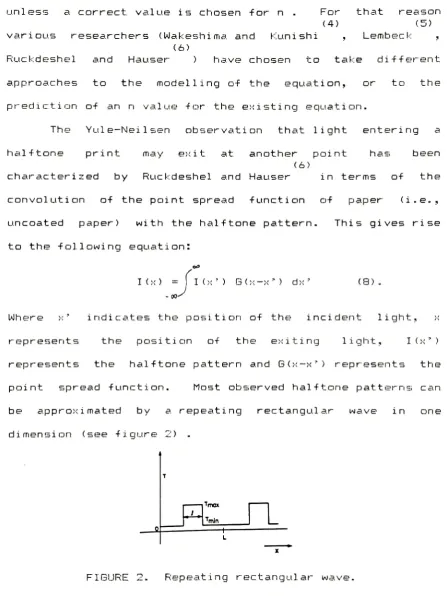
Most
observed
halftone
patterns
can
be
approximated
by
a
repeating
rectangular
wave
in
one
dimension
(see
figure
2)
.,i_
Tmo
Tmln
[image:17.522.37.485.58.654.2](6)
For
this
reason
a
Fourier
series
representation
of
the
halftone
pattern
(see
equation
9)
can
be
substituted
for
I(x')
in
equation
(8).
T(x)
=Tmin
+
(Tmax-Tmin)
m
1
2
*>
(-1)
mfM
2/fTmx
-
+
-^>
sin
cos
L
/H"
mv=i
m
2L
L
(6)
(9)
Ruckdeschel
and
Hauser
have
also
reported
that
a
normalized
Gaussian
function
fits
observed
data
quite
well
for
an
uncoated
paper
spread
function,
G(x-x'),
and
is
of
the
form:
Gg(x-x')
=exp[-(x-x')
/6
1
/fT6~
(10)
If
the
transmission
of
the
ink
layer
is
T(x)
and
the
incident
light
intensity
is
Io,
then
the
light
intensity
pattern
returning
from
the
paper
can
be
represented
as:
J (
x
)
=T (
x)
f
la
oo-s
T(x' )G(x-x'
)dx
(11)
They
further
state
that
the
average
reflection
of
a
length
of
image
having
dimension
2x
becomes:
X
R
=l/2x
/
J (x)dx
(12)
.Substitution
into
equation
(11)
of
the
normalized
Gaussian
(i.e.,
equation
(10)
)
for
G
and
the
Fourier
series
representation
of
the
halftone
pattern
(i.e.,
equation
(9)
>
for
T
yields
the
light
intensity
pattern
for
a
screen
Ruckdeschel
and
Hauser
equation
for
the
reflectanceof
a
screen
halftone
(see
equation
(13)
).
R
=Cl-Ca(l-\/l
Rd) :
Ca(l-Ca)
(1-\/Rd)
x
+
S
El-Cad-\/Rd)
1
(13)
Where
1 /L
=line
repetition
frequency,
Ca
=area
coverage
(i.e.,
1-1/L),
Rd
=one
way
dot
transmi ttance
and
S
=the
series
raitio
resulting
from
the
integration
of
equation
(11)
(see
equation
(14)
).
sin
(m-TTl/L)
m
exp[-(mTT6/L)
1
S
(14)
.;in
(m-fTl/L)
m
Setting
equation
(13)
equal
to
the
Yule
-Neilsen
(i.e.,
equation
(7)
)
in
which
n
=2,
an
improved
number
for
n
can
(6)
n
=2.
log
Cl-Ca(l-\/pd)
1
1/n
log
El-Cad-(Rd)
)]
Ca
(1-Ca)
(1
-vW
log
1
+
Cl-Ca(l
-/Rd)]
1/n
log
El-Cad
-(Rd)
)
1
(15)
(6)
According
to
Ruckdeschel
and
Hauser
equation
(8)
may
be
simplified
for
screens
in
which
the
transmi ttance
of
the
dot
approaches
zero
(i.e.,
Rd=0)
,and
for
small
area,
coverages
where
Ca
and
1
/L
both
approach
zero.
Under
this
condition
S
becomes
approximately
exp
(-"1T6/L)
,where
6"i
s
the
paper
spread
function
width.
This
results
in
the
following
equation
for
the
improved
prediction
of
n:
n
=2-exp
(-TT6*/L)
(16).
For
G
-0.
1mm
the
values
of
n
show
a
good
fit
at
low
area
coverages
on
uncoated
paper.
For
high
and
middle
fractional
areas,
respectively,
equation
(8)
reduces
to
the
following
equati one:
n
=2-CS/El+Ca(s-l)
11
(17)
n
=(6)
Ruckdeschel
and
Hauser
based
on
their
argument
(presented
above)
and
experimental
results,
have
reported
the
following
information.
For
Xerox
4024
DP
paper,
the
Yule
Neilsen
equation
is,
in
principal,
adequate
in
approximating
the
relationship
between
average
reflection
density
and
area
coverage.
However,
since
n
becomes
increasingly
dependent
on
area
coverage
in
shadow
and
highlight
areas,
the
Yule-Neilsen
equation
should
not
be
used
for
prediction
in
these
areas.
Tone
reproduction
properties
as
affected
by
light
scattering
properties
can
be
specified
by
6"the
spread
function
di
stance.
The
distance
6"was
obtained
by
measuring
the
reflectance
profile
of
a
blackened
razor
edge
placed
in
close
contact
with
the
paper
substrate.
However,
no
reference
to
the
illumination
of
the
paper
substrate
was
given.
(7)
Yule,
Howe
and
Altman
have
reported
in
detail
about
a
device
for
measuring
the
spread
function
of
papers.
This
(8)
device
is
very
similar
to
that
of
F.C.
Eisen
.The
very
important
difference
is
in
the
edge
that
is
projected.
Yule,
Howe
and
Altman
chose
to
use
a
low
contrast
edge
made
on
a
high
resolution
photographic
plate.
A
luminance
ratio
between
the
two
sides
of
this
edge
could
be
selected
so
that
it
is
within
the
linear
operating
range
of
the
instrument's
They
also
proposed
that
with
such
a
device
the
direct
measurement
of
the
spread
function
could
be
made
on
any
paper
stock.
The
basis
of
this
method
is
the
fact
that
if
a
knife
edge
is
projected
by
an
optical
system
onto
the
paper,
the
intensity
distribution
across
the
edge
is
equal
to
the
integral
of
the
line
spread
function.
E(x'
)=
f
A(x)dx
(19)
-ooJ
(7)
Yule,
Howe
and
Altman
have
suggested
that
if
the
spread
function
is
Gaussian
than
only
a
single
number
describing
its
width
is
an
adequate
description.
They
also
point
out
that
if
the
spread
function
of
the
instrument
is
not
narrow,
(measured
by
scanning
a
naninternal
ly diffusing
medium)
this
system
spread
function
should
be
removed
from
the
data.
Based
on
spread
function
measurements
made
on
their
scanning
device
and
the
printing
of
a
halftone
screen
test
target
on
four
papers
(baryta
coated,
titanium
dioxide
(7)
coated,
cast
coated,
and
uncoated)
Yule,
Howe
and
Altman
have
reported
the
following
results.
Reflection
densities
of
halftone
tints
were
highest
for
papers
with
the
widest
spread
functions
and
where
high
screen
frequencies
(i.e.,
greater
than
133
lines/in.)
were
used.
There
is
a
definite
correlation
between
the
width
of
the
spread
function
and
the
difference
between
the
equivalent
and
actual
dot
area.
Also,
the
change
in
tone
scale
due
to
light
spreading
is
screen
period.
This
causes
papers
with
wide
spread
functions
to
produce
higher
highlight
contrast,
darker
middletones
and
flatter
shadows.
It.
may
be
argued
that
the
Yule-Neilsen
model
is
too
simple
an
explanation
of
what
happens
to
light
in
a
halftone
print.
However,
the
Yule-Neilsen
equation
has
proved
(3)
adequate
in
predicting
the
relationship
between
reflection
density
and
physical
dot
area,
provided
the
correct
n
value
can
be
found.
The
principle
factors
in
contributing
to
n
are
the
following,
ranked
in
their
order
of
(3)
importance
:
1.
Paper
spread
function
2.
Halftone
screen
frequency
(v)
3.
Dot
area
(a)
4.
Solid
ink
density
(Ds)
Paper
spread
function
can
be
measured
using
a
device
similar
(7)
to
that
described
by
Yule,
Howe
and
Altman
.Screen
frequency
does
not
change
as
a
result
of
the
offset
(9)
lithographic
printing
process
.The
percent
dot
area
of
the
halftone
tint
can
be
measured
accurately
by
use
of
a
(9)
planimeter
.Using
a
reflection
densitometer,
the
solid
ink
density
of
a
halftone
dot
can
be
determined
by
measuring
a
large
enough
area
of
printed
solid
ink
adjacent
to
the
(9)
halftone
tint
under
consideration
The
objective
of
this
research
(using
the
above
measured
optical
spread
function
of
four
common
printing
stacks
(cast
coated,
enamel
gloss,
enamel
dull
and
ledger)
and
a
Yule
Neilsen
n
value
in
predicting
physical
dot
area
-for offsetlithographic
printing.
By
establishing
this
relationship,
n
values
can
be
determined
for
paper
stacks
prior
to
offset
lithographic
printing
by
measurement
of
their
optical
spread
functions.
Since
the
Yule
-Neilsen
equation
affords
quick
and
accurate
dot
area
calculation,
provided
the
correct
n
value
is
used,
dot
gain
could
then
be
monitored
during
a
EXPERIMENTAL
PAPER
SAMPLES
Table
(1)
lists
the
four
paper
stocks
used
in
this
experiment
along
with
their
basis
weights.
PAPER
STOCK
BASIS
WEIGHT
(GRAMS /SQUARE
METER)
cast
coat
(MFG)
190
enamel
gloss
(MFG)
95
enamel
dull
(MFG)
103
ledger
(MFG)
93
Table
(1).
Paper
stocks
and
basis
weights.
APPARATUS
Paper
edge
gradient
measurements
were
made
on
a
Xerax
scanning
reflection
Macro/Micro
densitometer
located
in
the
Microdensi
tometry
Laboratory
of
the
Rochester
Institute
of
Technology.
The
following
is
a
general
description
of
the
components
of
this
instrument:
1.
A
focusable
head
which
contains
the
following:
a)
A
pellicle
mirror
and
ground
glass
for
focusing
the
instrument
on
the
sample.
b)
A
.1157NA
lens
for
the
collection
of
reflected
flux
from
the
sample.
c)
A
PMT
(photomul
tipl ier
tube)
is
used
for
detection
of
the
reflected
flux.
apertures.
e)
A
cylinder
containing
a
variety
of
filters
that
can
be
placed
between
the
PMT
and
its
incident
flux.
2.
The
signal
from
the
PMT
is
conducted
by
shielded
cable
to
a
housing
containing
the
following
components:
a)
An
analog
to
digital
converter
for
digital
signal
readout
from
the
PMT.
b)
Gain
controls
for
the
calibration
of
the
instrument.
c)
A
logging
circuit
for
digital
density
readings.
3.
A
scanning
stage
is
located
directly
beneath
the
instrument
head
and
contains
the
following
components:
a)
A
flat
surface
upon
which
the
sample
is
placed.
b)
Stepping
motors
which
control
the
X-Y
movement
of
this
stage.
The
movement
of
the
stage
and
collection
of
data
is
controlled
by
a
Wang
computer
interfaced
to
the
instrument.
The
following
modifications
have
been
made
to
this
(10)
instrument
since
its
use
by
Brian
T.
Pridham
:
1.
An
RCA
1P21
photomul
ti
pi
i
er
tube
was
installed
replacing
the
original
Hamamatsu
R446.
This
tube
is
more
sensitive,
allowing
greater
range
in
the
measurement
of
reflected
flux.
2.
The
scanning
stage
(originally
flat
white)
has
been
painted
flat
black
to
eliminate
reflection
from
the
stage
back
through
the
sample.
3.
A
special
illuminating
system
for
the
projection
of
a
low
contrast
edge
has
been
mounted
on
the
scanning
stage.
This
edge
was
made
from
a
Kodak
High
Resolution
Plate
with
a
transmission
ratio
from
light
to
dark
of
10:1
(see
appendix
A
for
detailed
description).
4.
A
Kodak
Wratten
#58
filter
was
mounted
between
the
PMT
and
its
incident
flux.
This
replaces
the
narrow
banded
(530nm,
14nm
bandpass)
green
filter.
This
increased
the
operating
range
and
signal
to
noise
ratio
of
the
i
nstrument
.EXPERIMENTAL
PROCEDURE
Sample
Measurement
on
Xerox
Macro/Micro
Densitometer:
From
a
500
sheet
batch
of
each
stock
(i.e.,
cast
coated,
enamel
gloss,
enamel
dull
and
ledger)
edge
gradient
measurements
were
made
on
the
following:
1.
The
actual
press
sheet
containing
the
printed
halftone
test
target.
2.
An
additional
sheet
of
the
same
stock
for
comparison
to
the
press
sheet
measured
above.
The
procedure
for
edge
gradient
measurements
is
as
follows:
1.
The
optical
system
of
the
reflection
mi
crodensi
tometer
was
focused
on
the
paper
sample.
2.
The
projection
system
was
then
aligned
with
the
optical
system
of
the
densitometer.
projection
focus
positions
and
the
scan
with
the
steepest
edge
gradient
was
selected
as
representativeof
the
paper
sample.
Printing
of
Halftone
Paper
Samples:
A
ByChrome
Percentage
Scale
on
Film
was
used
to
make
the
printing
plate
from
which
the
test
pattern
was
printed.
This
percentage
scale
on
film
consisted
of
the
following:
1.
Halftone
dot
screens
of
150,
133,
120,
110,
100,
85
and
65
lines/inch.
2.
Each
of
the
above
screens
has
a
range
of
percent
dot
areas
from
5-907..
The
paper
stocks
were
printed
on
a
Heidelberg
M0ZP
19
X
25.5"offset
lithographic
press
using
Marathon
Hard
Dry
Black
ink.
From
the
printed
halftone
test
pattern
n
values
were
calculated
for
the
following
tints,
on
all
four
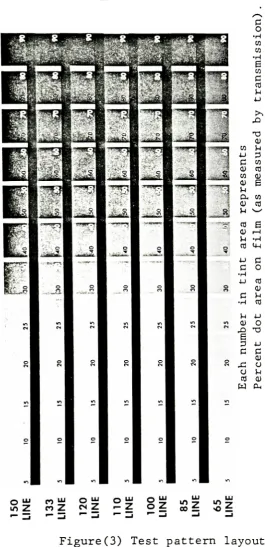
paper
stocks
(see
figure
3
for
test
pattern
layout):
1.
Line
screens
of
150,
133,
100
and
65
lines/in..
+
0uj M"J
OS
o!J
o!
K
Z
coZ
esZ
-Z
oZ
-3
J'"-J
"-!
""-<
LU Ul
[image:29.522.30.296.105.653.2]DATA
COLLECJION
Edge
Gradient
Measurements:
The
stepping
motor
on
the
Xerox
Macro/Micro
densitometer
is
computer
controlled.
A
scanning
program
was
written
to
take
advantage
of
this
feature.
The
program
finds
the
projected
edge
on
the
instrument
stage,
backs
off
.5mmand
then
scans
the
edge
averaging
10
readings
at
each
sample
position
(see
appendix
B
for
program
listing).
Because
the
sample
positions
are
fixed
at
/\X =.0127mm
apart,
a
scanning
aperture
of
1
X
.025mmwas
selected.
This
is
equivalent
to
(11)
sampling
at
the
Nyquist
Interval
.According
to
Shannon's
sampling
theorm
the
sampling
interval
/^X
should
be
the
(11)
following
:
AX
^
l/2Umax
(20)
.The
maximum
spatial
frequency
(i.e.,
Umax)
that
can
be
imaged
by
the
selected
scanning
aperture
(i.e.,
1
X
.025mm)is
40
cycles/mm.
Substitution
of
this
value
for
Umax
in
the
above
equation
allows
for
the
fixed
stepping
increment
of
.0127mm..For
the
purposes
of
establishing
a
relationship
between
the
spread
function
of
each
sample
and
a
Yule
-Neilsen
n
value,
a
quantitative
description
of
the
behavior
of
incident
light
in
each
sample
is
needed.
The
following
paragraphs
describe
the
three
quantitative
values
used
and
how
they
were
Corrected
Spread
Function
Width:
From
the
reflection
edge
gradient
measurementsthe
derivative
(i.e.,
slope)
between
each
step
was
calculated
by
a
computer
program
using
equation
(21)
(see
appendix
C
for
computer
program
listing).
Ders(I)
=(Edge ( I )
-Edge
(1+1 ))/. 0127
(21).
Where
Edged)
is
an
array
containing
the
reflectance
edge
gradient
data
and
Ders(I)
is
an
array
containing
the
calculated
derivative
between
consecutive
edge
gradient
sample
positions.
By
definition,
the
array
Ders
contains
the
uncorrected
sample
spread
function.
This
array
was
then
normalized
(i.e.,
each
value
for
Ders ( I )
was
divided
by
the
value
at
Ders(I)max.)
resulting
in
the
uncorrected
normalized
sample
spread
function.
This
uncorrected
normalized
sample
spread
function
contains
the
convolution
of
both
the
paper
and
instrument
spread
functions.
The
width
of
the
convolutions
of
two
functions
is
approximately
the
sum
of
the
(11)
two
widths
.Therefore,
the
width
of
the
scanning
aperture
(i.e.,
.025mm>was
subtracted
from
the
width
of
the
uncorrected
spread
function.
This
was
used
as
the
corrected
spread
function
width.
Area
Under
Uncorrected
Spread
Function:
The
uncorrected
normalized
sample
spread
function
was
then
truncated
at
a.
point
on
either
side
of
the
actual
edge
discrete
Fourier
Transform
DFT
(see
appendix
D
for
computer
program
containing
DFT).
Equati
on
(22)
shows
the
definition
of
the
Fourier
Transform
using
the
uncorrected
normalized
sample
spread
function,
unssf.
-(i2/ftvx>
UNSSF (v)
=unssf
(x)
exp
dx
(22).
Where
UNSSF
(v)
=Fourier
Transform
of
the
uncorrectednormalized
sample
spread
function
unssf
(x)
and
v
=spatial
frequency
(i.e.,
cycles/mm).
A
computer
program
using
a.
Fast
Fourier
Transform
calculates
discrete
Fourier
Transform
values
of
UNSSF
(v)
(see
appendix
D
-forprogram
listing).
The
criterion
used
to
truncate
the
spread
function
is
as
foil
ows:
1.
Approaching
the
edge
the
spread
function
was
truncated
at
the
first
point
where
the
derivative
approaches
zero
and
previous
derivatives
are
no
greater
than
points
well
ahead
of
the
projected
edge.
2.
After
passage
of
the
edge
the
spread
function
was
truncated
at
the
first
point
where
the
derivative
approaches
zero
and
subsequent
derivatives
are
no
greater
than
points
well
behind
the
projected
edge.
The
area
under
the
uncorrected
normalized
spread
function
is
equal
to
the
integrated
reflectance
across
the
projected
edge.
According
to
the
Central
Ordinate
property
of
Fourier
(11)
Transforms
;
the
area
under
this
uncorrected
normalized
equal
to
the
central
ordinate
of
its
Fourier
Transform.
Therefore,
this
quantitative
value
was
used
for
its
ease
in
comparison
of
relative
differences
in
the
integrated
reflectance
across
the
projected
edge
between
different
paper
samples.
Spatial
Frequency
at
407.
Corrected
MTF:
Because
of
the
difficulty
in
finding
a.
material
that
would
be
an
ideal
diffuse
reflector
with
no
internal
scatter
and
high
reflectance,
the
actual
system
(i.e.,
edge
progection
system
and
Xerox
Macro/Micro
densitometer)
spread
function
could
not
be
measured
(see
appendix
E
for
materials
tried).
The
Fourier
Transform
of
the
uncorrected
normalized
sample
spread
function
UNSSF
contains
the
Fourier
Transform
of
both
the
paper
sample
and
the
system.
To
find
the
Fourier
Transform
of
just
the
paper
sample,
the
theoretical
MTF
(Modulation
Transfer
Function)
of
the
system,
SYSMTF,
was
removed
from
UNSSF
in
frequency
space
by
division.
The
following
paragraphs
describe
how
SYSMTF
was
calculated
and
removed
from
UNSSF
resulting
in
the
corrected
MTF.
The
theoretical
MTF
of
each
lens
in
the
system
(i.e.,
.08
NA
projection
lens
and
.1157NA
collection
lens)
were
(12)
calculated
using
the
Hufnagle
formula
for
a
diffraction
limited
lens
at
530nm
(i.e.,
peak
transmission
wavelength
of
the
Wratten
#58
filter).
This
formula
was
used
instead
of
the
actual
formula
since
its
accuracy
is
actual
values
and
affords
much
easier
MlF
calculation.I
he
formula
i
s
as
follows:
4
Ta(w)
=1
-1.25(w/w0)
+
0.25(w/w0)
(23).
where
w
=radius
frequency
and
wO
=2NA/
.
00053mm.
The
Fourier
Transform
of
the
scanning
aperture
and
its
resultant
MTF
were
calculated
by
the
following."sine
(,025v)
(24)
.where
v
=spatial
frequency
(cycles/mm),
.025 =scanning
aperture
width
in
mm
and
sinc(.025v)
=the
following:
sin
CiT.025v)
sinc(.025v)
=(25).
"fT
.025v
Because
an
optical
system
can
be
considered
a
linear
system,
the
MTF
of
the
entire
system
SYSMTF
can
be
calculated
by
the
product
of
the
individual
MTF's
frequency by frequency
(see
appendix
F
for
calculations).
The
corrected
MTF
was
obtained
by
complex
division
in
frequency
space
in
the
manner
described
by
equation
(26")
(see
appendix
D
for
computer
program).
Corrected
MTF(v)
(26)
UNSSF (v)
SYSMTF
(v)
The
spatialfrequency
at
which
the
corrected
MTF
=0.4
is
the
value
reported
as
Spatial
Frequency
at
407.
corrected
MTF.
Calculation
of
Exact
n
Value:
From
the
printed
samples
the
following
measurements
were
made
and
applied
to
the
Yule
-Neilsen
equation
to
obtain
the
exact
n
value.
1.
In
order
to
measure
by
planimetry
the
desired
tint
areas
the
following
procedure
was
used:
a)
Photomicrographs
were
made
on
Polaroid
film
type
52
using
a
Nikon
OPT I PHOT-POL
microscope.
b)
The
following
magnifications
were
used
to
get
four
to
six
dots
on
a
sheet
of
film.
Screen
freq.
lines/in.
Magnification
150,
133
200 X
100
160X
65
100X
c)
Concentric
circles
were
used
to
find
the
center
of
each
dot.
The
centers
were
connected
by
fine
tip
ink
pen
.d)
The
dots
and
areas
inside
the
connected
concentric
circles
were
measured
by
planimetry.
The
measured
area
resulting
from
the
connection
of
the
centers
of
the
dots
was
used
as
the
unit
area.
Percent
dot
area
was
obtained
through
the
division
of
the
combined
measured
dot
areas
by
the
unit
area
(see
figure
4).
2.
A
K&E
Compensating
Polar
Planimeter
was
used
to
measure
the
dot
and
unit
areas.
3.
Tint
density
was
measured
on
a
Macbeth
TR
927
reflection
densitometer
(using
the
green
Wratten
#61
filter).
This
filter
was
used
because
its
transmi ttance
measure
the
edge
gradients
of
the
samples.4.
Solid
ink
densities
were
also
measured
on
this
instrument,
with
the
Wratten
#61
filter.
5.
The
Yule
-Neilsen
equation
was
used
with
the
above
measured
areas
and
densities
to
calculate
an
exact
n
value
(using
iteration)
for
the
sample
tint
in
question
(see
appendix
G,
calculation
of
n
values).
_UnL_ax.a.
Figure (4)
Measurement
of
Percent
dot
area
by
planimetry.
LINEARITY
OF
THE
MACBEJH
AND
XEROX
M/M
DENSITOMTTERSl
To
ensurethat
the
low
contrast
edge?
(mentioned
in
the
apparatus
section)
with
its
transmission
ratio
of
10:1
would
be
within
the
linear
range
of
Xerox
M/M
densitometer
and
that
both
instruments
were
operating
in
a
linear
range,
the
following
procedure
was
used:
range
to
cover
107.
transmission
(i.e.,
reflection
density
of
1.0
or
greater)
was
measured
on
both
instruments.
2.
The
density
measurements
from
the
Macbeth
TR
927
were
plotted
against
the
percent
maximum
reflectance
readings
taken
on
the
Xerox
M/M
densitometer.
The
results
showed
a
RESULTS
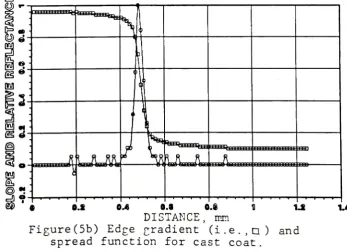
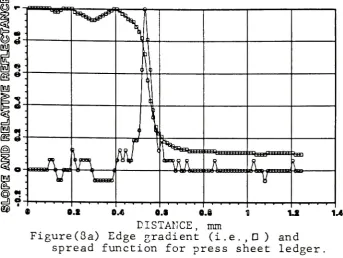
Figures
5-12
contain
graphs
of
the
reflection
edge
gradient,
uncorrected
normalized
spread
function
and
corrected
MTF's
for
the
press
sheet
and
additional
sample
of
each
paper
stock
(i.e.,
cast
coat,
enamel
gloss,
enamel
dull
O.i
0.8
11
1-
14
DISTANCE,
mm
Figure
(5a)
Edge
gradient
(i.e.,n)
and
spread
function
for
press
sheet
cast
coat
.m
ted
""ill
L
^^Skno-(
11
"
i
'
I
LAJ&
*\
mTttlllMlJ,,,
J
\
' ' ' '
O.i
04
0.1
0.8
11
tl
14
DISTANCE,
mm
[image:39.522.90.433.49.297.2] [image:39.522.84.432.421.673.2]m
DQfl
Is
is
S
58*
ari^****"***3
^tHH+^H3^;
^
^
i
( m
ad^
iw
W-
A
Y
1
O.I
04
0.0
0.8
1
?.S
14
DISTANCE,
mm
Figure
(6a)
Edge
gradient
(i.e.,
a)
and
spread
function
for
press
sheet
enamel
^loss
0Q0
oy
=3
KM
<H4
s3?
I^Wriri"^
ifcgfrf^
i
-hi
-\
A
AooT1
a
oajyil]
k
.,., n\sAuLiiiua
;
VV\r
0.1
04
0.0
0.8
11
1.S
DISTANCE,
mm
Figure(6b)
Edge
gradient
(i.e.,D)
and
spread
function
for
enamel
gloss.
[image:40.522.83.440.53.305.2]o.s
04
0.0
0.8
D
1.1
14
DISTANCE,
mm
Figure
(7a)
Edge
gradient
(i.e.,D
)
and
spread
function
for
press
sheet
enamel
dull
m
(3
m
ii
3'
2^
yW
^
i
miHlumPfr
Um
M
!
1 '
0.1
04
0.0
0.8
DISTANCE,
mm
Figure(7b)
Edge
gradient
(i.e.,0)
and
[image:41.522.81.445.59.322.2] [image:41.522.88.433.436.683.2]m
Hi**
DBS
|2
DGfl
S3
2
<l\l>
^JU
'h
*
w
!
t^n-imttfJttfem
uw
* ' '
'
0.1
04
0.0
0.8
11
tl
DISTANCE,
mm
Figure(3a)
Edge
gradient
(i.e.,D)
and
spread
function
for
press
sheet
ledger
14
DISTANCE,
mm
Figure
(8b)
Edge
gradient
(i.e.,n)
and
[image:42.522.82.426.58.316.2] [image:42.522.85.425.437.688.2]o '
-P^n
\
s,
**\
\
2
o
1-1.1
0
7.1
10
11.1
II
17.0
10
U.I
10
SPATIAL
FREQUENCY
Figure
(9a)
Corrected MTF
for
press
sheet
cast
coat
7.1
HO
12.1
tl
17.0
10
U.I
SPATIAL
FREQUENCY
[image:43.522.91.438.67.300.2]s
-e
-3
15
0"
o-
_-7.1
10
11.1
11
17.1
10
U.I
U
SPATIAL
FREQUENCY
Figure
(10a)
Corrected
MTF
for
press
sheet
enamel
gloss
0 '
\
**
e
-\,
3"
2
**
o-0
I
10
HI
10
II
SPATIAL
FREQUENCY
Figure(lOb)
Corrected
MTF
for
enamel
gloss.
[image:44.522.78.426.435.673.2]4
2
LW^I
I
II
I
11
I
I
SPATIAL
FREQUENCY
Figure
(11a)
Corrected
MTF
for
press
sheet
enamel
dull
4
2
SPATIAL
FREQUENCY
[image:45.522.83.435.428.666.2]