12-1957
Processing of monazite sands
John J. BarghusenIowa State College M. Smutz Iowa State College
Follow this and additional works at:http://lib.dr.iastate.edu/ameslab_iscreports Part of theMaterials Chemistry Commons
This Report is brought to you for free and open access by the Ames Laboratory at Iowa State University Digital Repository. It has been accepted for inclusion in Ames Laboratory ISC Technical Reports by an authorized administrator of Iowa State University Digital Repository. For more information, please [email protected].
Recommended Citation
Abstract
For the past ten years, much effort has been expended by several research teams to develop an economic process for recovering thorium, rare earths and uranium from monazite sands. Recently, a process was
developed at the Ames Laboratory which possessed many attractive features. The major disadvantage inherent to the process was the large cost for oxalic acid. The oxalic acid was used to precipitate rare earth and thorium oxalates from a sulfate and phosphate solution of these elements. The object of the oxalate precipitation was to separate the thorium and rare earths from uranium, sulfate and phosphate ions. Since this method for
processing monazite sands was so attractive, concerted effort was made to discover a method whereby the oxalic acid could be recycled.
Disciplines
Chemistry | Materials Chemistry
I
sc
AL
rsc,-f1J,J7
ISC-947
CHEMISTRY -GENERAL
UNITED ENERGY COMMISSION
PROCESSING OF MONAZITE SANDS
By
John J. Barghusen M. Smutz
December 1957 Ames Laboratory Iowa State College Ames, Iowa
Work performed under Contract No. W-7405-eng-82.
LEGAL NOTICE
This report was prepared as an account of Government sponsored work. Neither the United States, nor the Commission, nor any person acting on behalf of the Commission: A. Makes any warranty or representation, express or implied, with respect to the accuracy, completeness, or usefulness of the information contained in this report, or that the use of any information, apparatus, method, or process disclosed in this report may not infringe privately owned rights; or
B. Assumes any liabilities with respect to the use of, or for damages resulting from the use of any information, apparatus, method, or process disclosed in this report.
As used in the above, "person acting on behalf of the Commission" includes any em-ployee or contractor of the Commission to the extent that such emem-ployee or contractor prepares, handles or distributes, or provides access to, any information pursuant to his employment or contract with the Commission.
This report has been reproduced directly from the best available copy.
Printed in USA. Price $2.50. Available from the Office of Technical Services, Department of Commerce, Washington 25, D. C.
Processing of Monazite Sands* John J. Barghusen and ~. Smutz
Abstract
For the past ten yea.re, much effort has been expended by several research teams to develop an economic process for re-covering thorium, rare earths and uranium from monazite sands. Recently, a process was developed at the Ames Laboratory which possessed many a.ttre.ctive features. The major disadvantage
inherent to the process was the large cost for oxalic acid. The oxalic acid was used to precipitate rare earth and thorium oxalates from a sulfate and phospha.te solution of these
ele-ments. The object of the oxalate precipitation we.s to sep-arate the thorium and rare earths from uranium, sulfate and phosphate ions. Since this method for processing mona.zi te sands was so attractive, concerted effort was made to dis-cover a method whereby the oxalic acid could be recycled.
A process was developed whereby the oxalate ions used to precipitate the mixed thorium and rare earth oxalates can be recycled. The mixed oxalates were digested with a 2.6 normal solution of sodium hydroxide for one hour at
96°C. The products of the reaction were the mixed hydroxides and a ~olution of sodium oxalate. Even though an excess of sodium hydroxide provided greater yields of sodium oxalate, it was found more economical to use a stoichiometric amount of caustic in the diges tiona. The sodium oxalate was washed from the hydroxide cake with several batches of hot we.ter. This solution was then recycled to precipitate another batch
* This report is based on a Ph.D. thesis by John J. Barghusen submitted December, 1957, to Iowa State College, Ames, Io1~a.
ISC-947
of oxalates. It wa.s found that approximately 95 per cent of the stoichiometric quantity of oxalic acid used to precipitate the mixed oxala.tes can be recycled in the sodium oxalate oolu-tion.
The monazite sulfate solution was diluted with 4.5 parts
by volume of water. The pH of the solution was raised to
about 1.3 by adding ammonium hydroxide. It was found tha.t a pH of about 1.5 affords the best conditions for the o:xala.te
precipitation. Since some sodium hydroxide wa.s recycled with
the sodium oxalate solution, less ammonium hydroxide was needed to raise the pH or the solution to 1.5. The sodium oxalate recycle solution was added to precipitate the mixed
oxalates. Sufficient oxalic acid was added to make up the
deficiency in oxalate ions a.nd to provide a ten per cent excess. The cake was filtered and washed with an oxe.la.te wash solution.
A small scale run was made using this oxala.te recycle technique. The results indicated that the method could be
adapted successfully to the monazite process.
The possibility of recovering uranium from the ox alate
filtrate by anion exchange was investiga.ted. Uranium was
successfully recovered from the monazite sulfate solution
using a strong base anion exchange resin -Dowex-1. By pro-viding a residence time of 40 minutes, about 90 per cent of
ISC-947
the uranium was eluted from the resin with an eluant·o.? normal in nitric acid e.nd 0.5 normal in sodium nitrate. Phosphate and oxalate ions did not seem to interfere with
the process.
Cost estimates were made for the oxalate recycle process
and the previous Ames oxalate process. It was found that the
oxalate recycle process was economically superior to the
former one. The production costs for producing one pound of
thorium were $9.93 and $13.12, respectively. The economic
advantage was entirely in the quantity of oxalic acid required
TABLE OF CONTENTS
.
.
.
.
.
.
.
.
. . .
. .
.
.
.
. .
INTRODUCTION .
PREVIOUS WORK.
.
.
. . .
.
. . . .
. .
.
.
.
EXPERIMENTAL WORK.. .
. . •
•. . .
.
. .
.
.
Page
1 13 28
Oxalate Recovery by Nitric Acid Dissolutions. 28 Oxalate Recovery with Sodium HYdroxide. . . .
30
Proposed process • • • • . • • • . • Process variables • • . • • • . • • · .
Nature of the hydroxide Qake • • • .
Ox~a te recycle runs • • . . .
.
.
.
Recovery of Uranium • •
.
.
. . .
..
. .
COST ANALYSIS . • • • • .. . . .
.
. . .
Equipment Costs • • • Fixed Capital Cost •• Production Cost • • • Cost Comparison • • •
.
. . .
.
. .
.
.
. . .
.
.
. .
. . .
.
.
. .
.
.
.
.
.
.
. .
. .
.
.
. .
.
.
.
.
30 31 49 53 63 73 77 85 89 94
RESULTS AND CONCLUSIONS . •
. . .
BIBLIOGRAPHY • • . • • . . . •.
.
.
. .
.
INTRODUCTION
Within the last decade monazite has become an important
strategic mineral. The reason for the sudden interest in
this mineral arises from two important scientific discoveries
made since 1942. First, it was discovered that thorium can
be transmuted into fissionable uranium-233 by absorbing a
slow neutron and then undergoing two beta disintegrations.
Thorium, ther~fore, may provide an important part in the
development of nuclear power. Secondly, a method has been
developed for separating the monazite rare earths from each
other by ion exchange.
Monazite is the most common and important thorium min•
eral. It is also a major source or the rare earth elements
of low atomic weight. Monazite is normally found in the form
of a sand of high density which has collected into deposits
of considerable size by the action of tides or other forms
of water flow. The sands are yellow-brown in color and are
relatively paramagnetic. This latter property provides a
means for separating the monazite from associated minerals.
The sands may be beneficiated by table concentration, which
separates the sands from less dense minerals, followed by
magnetic separation.
Monazite is essentially the orthophosphate of the rare
of the total rare earth content is cerium. The rare earth
phosphates comprise about 80 to 90 per cent of the total
weight. Depending on the source, the thorium content varies
·from about four per cent up to ten per cent. Uranium is
present in monazite sands, but only as a minor constituent.
The uranium content varies from 0.2 per cent up to O.? per
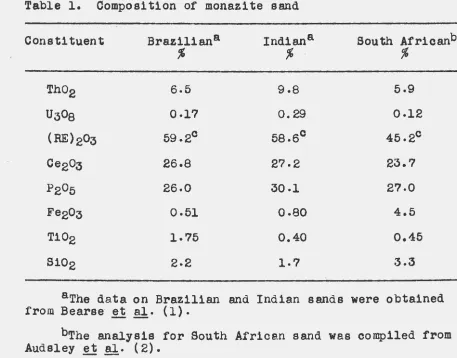
cent. Typical analyses for monazite sands from various
sources are given in Table 1.
Table 1. Composition of monazite sand
Constituent Brazilian a Indiana South Africanb
%
%
%
Th02 6.5 9.8 5.9
U308 0.17
o.
29 0.12(RE)203 59.2c 58.6c 45.2c
Ce2o3 26.8 27.2 23.?
P205 26.0 30.1 27.0
Fe203 0.51 o.ao 4.5
Ti02 1.75 0.40 0.45
8102 2·2 1.? 3.3
aThe data on Brazilian and Indian sands were obtained from Bearse et al. ( 1).
bThe analysis for South African sand was compiled from Audsley et al. (2).
[image:10.570.38.495.309.667.2]Due to the recent recognition of thorium as a potential reactor fuel by the Atomic Energy Commission, Ames Laboratory started a research program to develop a process for producing pure thorium compounds from monazite. The result of this
effort.was two distinctly different processes. The initial process was handicapped by several expensive filtration
steps. The latest process involved the use of a considerable quantity of expensive oxalic acid.
The object of this investigation was, therefore, to
develop a process economically superior to the previous ones. In order to present the details of the purpose clearly, and the reasons for the choice of action, the two processes will be described at this point in some detail·
In 1952, Shaw et al. developed a process for separating thorium from monazite sand {3). A descriptive flow sheet of the process is shown in Figure 1. The sands are ground to 95 per cent minus 65 mesh, and then digested in 93 per cent
sulfuric acid for four hours at 210°0. The acid to sand weight ratio, based on 100 per cent sulfuric acid, is 1.56.
This digestion produces a rubber-like dough material which is quite soluble in cold water. Ten pounds of cold water per
I I
ACID
PULVERIZER MONAZITE
SAND
MONAZITE SAND DILUTION DIGESTER {JACKETED) 28%
AMMONIA I • • 1 WATER DIGEST FOUR HOURS AT 210°C "
3.2%NH
DILUTION WATER ADDED IN A RATIO
RARE EARTH
28% NH
URANIUM
OFSIXTOONf • • • •
PH 1.05
SOLUTION
THORIUM
PRECIPITATI PH 2.3
THORIUM PHOSPHATE CONCENTRATE
INSOLUBLE
MONAZITE SULFATE SOLUTION STORAGE
SAND 8 SLUDGE
28% NH URANIUM SOLUTION
RARE EARTH PRECIPITATION
RARE EARTH CONCENTRATE
SLUDGE
SETTlER
UNDIGESTED SAND SILICA FOR RECYCLE SLUDGE
WASTE LIQ.UOR
URANIUM PRECIPITATION
[image:12.566.56.708.18.542.2]URANIUM CONCENTRATE Figure 1.. Flow aheet for selective precipitation of thorium, -rare earth,
and uranium concentrates
solution. The undigested sand is recycled.
The monazite sulfate solution is diluted with six parts
by volume of water to provide an ionic concentration suitable
for the complete precipitation or thorium. The pH of the
solution is raised to 1.05 by adding a solution two normal
in ammonium hydroxide (3.2% NH3). The thorium phosphate
precipitate is al·lowed to settle while the clear supernatant
rare earth-uranium solution is decanted to the next
precipi-tation step. Approximately an equal weight of rare earths
is occluded or co-precipitated with the thorium phosphate
precipitate.
The thorium phosphate cake is purified according to the
flow sheet presented in Figure 2· This process was developed by Whatley et al. (4) in 1953.
The wet phosphate cake is dried to remove about 80 per
cent of the water present to avoid diluting the extractor
feed solution. The dried cake is dissolved in 63 per cent
nitric acid; the quantity of acid being sufficient to make
a ~elution 13 normal in nitric acid.
The heart of the purification process is the
counter-current liquid extraction step. The feed enters the center
of the extractor with the extraction section to the left of
rthe feed and the scrub section to the right. The solvent,
consisting of 80 per cent tributyl phosphate (TBP) and 20
THORIU
PHOSP CONCE
M
fiArr-- • DRYER
"4TRATE - --WATER VAPOR
~
EVAPo-/ ... RAT OR
NITRIC
I
STILL' ' - / ACID I [image:14.539.30.723.17.506.2]FEED SCRUB DISSOLVER .
..
SETTLER STORAGE STORAGE... ...
--
0.5M-·
-NITRIC ACID
' ~
-·
- --_·~~
-_. . . . ..-I
63°/o NITRIC SLUDGE FILTER
ACID
-STORAGE
WATER
I
- STRIP
~ lr
EXTRACTION ... SCRUB STRIP
.L SECTION r- SECTION SECTION ~
I
,
~-
l
_.WATER VAPORNITRIC ACID )-~...-SULFURIC --
,
ACID ...
EVA
PO-SOLVENT EVA
PO-RATOR RARE EARTHS STORAGE RAT OR
~TO SEPARATE 80% TBP
~ RECOVERY ~0%01LUENT ~
Figure 2. Purification of thorium concentrate by countercurrent liquid extraction
PURE
--
THORIUMNITRATE
of the six stage extraction section. As the solvent proceeds
through the extraction section, all of the thorium and a
majority of the rare earths are transferred from the aqueous
to the organic phase. The organic phase is then scrubbed
with a dilute solution of nitric acid in the nine stage
scrub section of the extractor. This scrubbing operation
transfers virtually all of the rare earths from the TBP to
the aqueous scrub solution, returning them to the center of
·the extractor. Th.e organic phase leaving the scrub section
contains essentially pure thorium. The thorium may be
stripped from the organic with a solution of 0.3 M sulfuric
acid.
The rare earth-uranium filtrate from the first
selec-tive precipitation step is treated to produce a rare ee.rth
fraction. The filtrate is neutralized to a pH of 2.3 by
adding concentrated ammonium hydroxide (see Figure 1). The
rare earth sulfates are precipitated, but not
quantita-tively. About 2.5 per cent of the rare earths remain in
solution. Almost half of the total uranium content of the
sands accompanies the rare earth sulfate precipitate.
The rare earth concentrate is filtered, washed, end
then digested in a solution of sodium hydroxide. The
caustic digestion removes the interfering sulfate and
phos-phate ions in solution while the rare earth hydroxide
in nitric acid. Uranium may be recovered by solvent
extrac-tion, or by some other means such as chemical precipitation.
It has been demonstrated that the individual rare earths, as
occurring in monazite send, may be separated by liquid
ex-traction in a nitrate system (5), or by ion exchange (6).
The uranium rich filtrate is neutralized to a pH of 6
by adding concentrated ammonium hydroxide. The uranium
con-centrate is dissolved in six normal nitric acid and conta.cted
with undiluted tributyl phosphate to extract the uranium.
Griffith and Smutz (7) have demonstrated that essentially
all of the uranium appearing in the concentrate can be
re-covered with a high degree of purity.
There a.re several comments which are necessary to present
a complete understanding of the monazite process just
de-scribed. The process shown in Figure 1, without any further
purification processes, is not a very expensive one. The
major cost is that incurred with the three filtration steps.
When the cost for purifying the thorium concentrate is
added, the process becomes competitive with others. When
the cost for purifying the other two fractions is a.dded, then
the overall monazite process may be no longer economically
competitive.
It is also important to note that of the three
stituents only one does not distribute itself among the
con-centrate. The rare earths are distributed in all three
concentrates. Uranium appears in two concentra,tes. This
adds to the difficulty of the proces~ especially if any
interest were centered on the recovery of uranium.
Therefore, Welt and Smutz (8) investigated the
possibil-ity of overcoming the difficulties inherent in the process
developed by Shaw and Whatley. The result of Welt and
Smutz1s efforts is the process shown in Figure 3.
Monazite sand is digested with sulfuric acid to produce
a monazite sulfate solution according to the procedure
developed by Shaw et a1. (3). The monazite sulfate solution
is diluted with 4.5 parts by volume of water.to provide a.n
ionic concentration appropriate for the oxalate
precipita-tion of thorium and rare earths. The pH of the diluted
solu-tion is raised to 1.0 by the addisolu-tion of concentrated
ammo-nium hydroxide. At this point the rare earth and thorium
oxalates are precipitated by the addition of a ten per cent
solution Of oxalic acid in water. This precipitate is
fil-tered and washed with an oxalic acid wash solution containing
one per cent oxalic acid in 0.3 normal nitric acid.
The uranium remains in solution and is recovered by
(
direct extraction with ten per cent octylpyrophosphoric acid
in kerosene. By reducing the uranium with ferrous sulfate
and adding hydrofluoric acid, the uranium is recovered as
DISSOLUTION WATER 93%SULF'URIC I ··-- · --··--··z• ·
-A~D I
MONAZITE SAND
PULV.ERIZER
DILUTION MONAZITE SAND DIGESTER(JACKETED) DIGEST FOUR HOURS AT 210°c
SAND a SLUDGE
REMOVAL
MONAZITE SULFATE SOLUTION STORAGE
INSOLUBLE
FILT"ATE
SAND 8 SLUDGE UNDIGESTED SAND
TO R~CYCLE
URANIUM
TETRAFLUORIDE CALCINES
· j
RARE EARTHS CERIUM AND THORIUM FREE
CEROUS CERIUM
THORIUM
STRP
TIP "ECYCLE
WATE.R PURE THORIUM
Figure 3. Flow sheet tor the oxalate monaz1 te p~cees
~
[image:18.539.24.715.37.500.2]The rare earth and thorium oxalate ce.ke is calcined at
0
500 C to produce the corresponding oxides. The oxides are dissolved in eight normal nitric acid and fed to a
counter-current extractor. Undiluted tributyl phosphate is used as
the solvent. Tne scrub solution is eight normal nitric acid.
All of the thorium and most of ti1e cerium ere extracted into
the solvent. The remaining rare earths are recovered in the
raffinate product. The tributyl phospha.te phase is contacted
with a solution 0.1 normal in sodium nitrite to reduce the eerie cerium t'o the cerous valence state. Cerous cerium is
only slightly soluble in tributyl phosphate and therefore is
removed completely in the strip solution. Thorium is stripped
from the tributyl phosphate with either water or two per cent
sulfuric acid. The thorium may be recovered as the nitrate
by evaporating the solution to dryness, or by precipitating
with oxalic acid.
A cost analysis of this process showed that pure thorium
could be produced at a cost competitive with the original
Ames process developed by Shaw and Whatley. The major cost
figure for the oxala.tion process was oxalic acid. Since for ·
every one hundred pounds of oxala.tes produced only six pounds
are thorium oxalate, it is evident that the thorium cost is
greatly influenced by the price of oxa.lic acid. Oxalic acid
is not an inexpensive chemical; recent prices are quoted e.t
a portion, or all, of the oxalic acid, a considerable
sav-ings on the production of thorium could be realized.
It was 'the objective of this research to develop a more
economical process for recovering thorium, rare earths, and
uranium from monazite. Since the process developed had
many desirable features, it was apparent that the process
merited further study. Attention was focused on developing
a means for ~ecovering oxalic acid, since the oxalic acid
cost was the largest single 1 tem in the cost for producing
PREVIOUS WORK
Monazite sand has been processed on an industri~.l scale
since about 1880. At that time the sands were processed to
recover thorium and cerium for use in incandescent ge.s
mantles. Until 1942, the manufacture of gas mantles
con-sumed a majority of the monazite production. Recently a
number of industrial uses have been found for the rare earth
elements; ru1d monazite, a major source of these elements, is
being processed in considerable quantity to obtain pure rare
earths. Much of the thorium obtained concurrently is being
used in nuclear reactors.
Ever since Dr. C. Auer von \velsbe.ch invented an
effi-cient incandescent gas mantle, many persons have tried to
develop a means for obtaining pure thorium and rare earths
from monazite sand. The ultimate process for which most
investigators have strived is a. one step separation in which
both the rare earths and thorium ere recovered in high yield
and purity. No such process has been developed; but several
methods have been devised whereby thorium and rare earths
may be separated economically.
The reason why such difficulty accompanies the
separa-tion of rare ee.rths and thorium lies primarily with the
chemical similarity between the two species. The rare ee~th
elements found in mona.zi te are among the first eight elements
elements are promethium and europium; the latter occurs in
monazite only to the extent of 0.01 per cent. Only recently
has thorium been designated as a member of a series of
elements similar in cha.rac ter to the lanthanides. Previous
to the discovery of the transuranium elements, thorium
occu-pied the position IV-A in the seventh period of the periodic
chart. In a number of respects this designation was quite
proper since thorium forms many compounds which are chemically
and physically similar to compounds of zirconium and hafnium.
It is now accepted that thorium is the second member of the
actinide series and is analogous to cerium in the lanthanide
group.
Thorium is more basic than the trivalent la.nthanides;
but eerie cerium and thorium possess an equal basicity (9).
Both the ionic and crystal radii of thorium e.nd the
lanthan-ides are nearly identical (10). Unlike cerium, which is
both tetravalent and trivalent, thorium only forms
com-pounds which exhibit a valence of four. ·Since the remainder
of the lanthanides are primarily trivalent, a major
differ-ence in valdiffer-ence exists between the two species. This is
illustrated vividly in the cation exchange of thorium and
rare earths, where the highly charged thorium ion iS strongly
held to the resin while the trivalent rare earth ions are
easily eluted from the resin (9, 11).
and the lanthanides from a dilute acid solution. Since
thorium oxalate is considerably less soluble in dilute
min-eral acids than the rare ea.rth oxalates, it has been
pro-posed that a separation could be based on this phenomenon
(9, 12). Both the rare earth oxalates and thorium oxalate
are soluble in high concentrations of mineral acids (9, 13).
The nature of the dissolved oxalates is not clee.rly
under-stood, but it is presumed to be an oxalato complex. Whether
a majority of the oxalate undergoes decomposition in high
nitric acid concentrations is not explained in the
litera-ture, but this quite likely ma.y occur. Thorium oxala.te is
rather soluble in sulfuric acid. concentrations a.bove four
normal. At concentrations above six normal, thorium oxalate
is converted to the sulfate (9). Thorium oxalate will
dis-solve in solutions of potassium or ammonium oxalate (9).
Rare earth oxalates are almost insoluble in a.mmonium
oxa-late, but are appreciably soluble in a.lkali oxala.te
solu-tions (13).
Thorium sulfate exists in a nurnb~r of hydrated forms,
all of which may form metastable solutions in water (9).
Anhydrous thorium sulfate can be obtained as a precipitate
from a hot solution containing concentrated sulfuric acid
(2). Like the rare earth sulfates, thorium sulfate forms
double salts with the alkali metals. In the case of thorium,
The rare earth sulfate double salts are quite insoluble (13) •
Tne differences in solubility \~hich exist between the
rare earth and thorium sulfate species afford a number of
separa.tion techniques which h~ve been used in the processing
of monazite on a large scale. Anhydrous thorium sulfate may
be selectively precipitated from hot monazite sulfate
solu-tion by the addisolu-tion of preheated concentrated sulfuric acid. ·
The temperature of this solution is raised to 200°0 to
en-hance the precipitation of thorium sulfate. Approximately ·
90 per cent of the thorium is precipitated from the solution,
and ~m equal quantity of rare earths accompanies the
pre-cipitate (2).
It is possible to precipitate thorium sulfate
acta-hydrate from monazite sulfate solution by the addition of
cold concentrated sulfuric acid. In this case the acid
re-quirement is much greater than for the preparation of
anhy-drous thorium sulfate .< 2).
Under certain conditions a supersaturated solution of
thorium sulfate enneahydrate can be produced. Within the
b
temperature range of 45 to 50 C the solution is quite stable·
By cooling the sulfate solution, crystals of thorium sulfate
enneahydrate are produced with a purity of about 98 per cent.
About 15 per cent of the thorium remains in the mother liquor
( 12).
with the a.lkali elements. The corresponding thorium double
sulfate salts are more soluble than thorium sulfate. This
difference in the relative solubility of the double
sul-fates has produced a number of methods for processing
mona-zite sand. Pilkington and 'Vlylie ( 15) developed an
inexpen-sive process for producing rare earth and thorium compounds
from monazite. Approximately 99 per cent of the rare earths
can be recovered by adding a solution containing 400 grams
per liter of sodium sulfate to monazite sulfate solution.
Approximately half of the thorium accompanies the rare earths
during the precipitation. The thorium which remains in
solu-tion may be recovered as tne oxalate. This product is not
pure thorium oxalate, but contains about 30 per cent rare
earths.
By adding a solution of ammonium sulfate to monazite
sulfate solution, 60 per cent of the rare earths can be
precipitated from the solution. The rare earth ammonium
double sulfate is relatively free from thorium {16).
Due to the slight difference in basicity existing
be-tween thorium and rare earths, thorium phosphate may be
precipitated selectively from monazite sulfate solution by
adjusting the hydrogen ion concentration. A rather
signifi-cant difference exists in the pH at which thorium and rare
earth phosphates are precipitated from solution. The pH
a base such as ammonium hydroxide
(3).
In both methods,thorium phosphate is quantitatively precipitated at a pH
of one. However, a considerable quantity of rare earths
accompanies the precipitate.
Most of the precipitation techniques which have just
been described are primarily useful only for sulfate
solu-tions resulting from the digestion of monazite with sulfuric
acid. Although the sulfuric acid digestion( is most commonly
employed, caustic digestion of the sand has recently become
an important alternative to the acid process. Digestion of
the phosphates. of thorium and the rare earths with an a.lkali
hydroxide produces the hydrated metal oxides of these
ele-ments.
In 1952 Battelle Memorial Institute developed a process
involving the digestion of monazite sand with a ?3 per cent
sodium hydroxide solution (1, 19). A flow sheet for the
process is shown in Figure 4. Ground monazite is reacted for
three hours at 138°0 with ?3 per cent sodium hydroxide
solu-tion. The products of the reaction are the hydra. ted metal
oxides of thorium and .rare earths, insoluble sodium uranate,
and soluble trisodium phosphate.
The insoluble material is filtered hot at 80°C. The
filtrate co~taining excess caustic and trisodium phosphate is
treated to recover and recycle the sodium hydroxide and to
!
I
REPULPER,
FILTER a RARE EARTH DRIER FILTRATE
_f
ION HN0 3
PARTIAL
H
SETTLER H H C L SOLUTION 1---.J~.NEUTRALIZE R a OF5.8PH FILTER RARE EARTHS
SOLUBLE
TRISODIUM TO PHOSPHATE RECOVERY
THORIUM a URANIUM CAKE
PHOSPHATE-AND CAUSTIC AND CAUSTIC RECYCLE
Jl
DEIONIZED
0.5N HN~3 ~
l
I
_1
TRIBUTYL ...----PHOSPHATE
TO RECYCLE
I •IDISSOLVER~FILTER I ~
I
INSOLUBLE RESIDUETRIBUTYL f
PHOSPHATE RARE EARTHS
I
THORIUMNITRATE PRODUCT
•
•
URANIUM NITRATE PRODUCT
SOLVENT EXTRACTION COLUMNS
Figure 4. Flow sheet fer recovering thorium and uranium from monazite as
developed at Ba~telle Memorial Institute
...,
[image:27.543.62.648.66.454.2]The hydrous oxide cake is dissolved in hydrochloric acid·
Recycle caustic is a_dded to the solution to ra.ise the pH to
5.8 in order to precipitate the thorium and uranium. About
three per cent of the total rare earths present precipitate
with the thorium and uranium. The filter cake is repulped
and refiltered to remove the rare earths. Even s~ the rare
earths amount to seven per cent of the thorium-uranium ca.ke.
The filtrate containing essentially all of the rare earths
is further neutralized producing a rare earth hydroxide
con-centrate.
The thorium-uranium cake is dissolved in nitric acid.
The thorium and uranium are removed from the rare earths in
an extractor using a solvent mixture of tributyl phosphate
and Gulfsprey naphtha. Thorium is selectively stripped from
the uranium with dilute nitric acid. The uranium is stripped
from the solvent with deionized water.
Very high recovery was obtained for the rare earths,
thorium and uranium. The purity of e.ll these products was
very high.
Since the discovery of nuclear fission, considerable
effort has been expended to discover methods for separating
uranium from associated ions. One of the first and most
suc-cessful methods studied was solvent extraction. Within the
last few years this technique has been applied to a. number of·
from phosphoric acid (20), separation of uranium from rare
earth nitrates with tributyl phospha.te ( 7), and the direct
extraction of monazite sulfate solutions with emines (21).
Much research has been conducted in the field of ion
exchange for the recovery of uranium; and recently several
processes have been adapted in industrial applications. The
first full scale entry of ion exchange in the metallurgical
field was the anion exchange of uranium at the Witwatersrand
gold-uranium mines (22). The original discovery of the
anion excnange of uranium was made at Ba.ttelle Memorial
Institute ( 23).
Although considerable study has been me.de on the
chem-istry of uranyl sulfate solutions, tae nature of the ura.nium
sulfate ionic species is not clearly understood. A rather
peculiar situation exists in the phenomena of ion exchange
of uranium from sulfate solutions. Positive uranyl ions can
be removed on cation exchangers; also, a negative ure.nyl
sulfate ionic species can be a.dsorbed on anion resins. This
fact can be explained by postulating the existence of several
forms of uranium in equilibrium (24). The species are:
uranyl cation,
uo
2+2; unionizeq uranyl sulfate,uo
2so4;
divalent uranyl sulfate complex, U02(S04)2 - 2 ; and a
tetravalent uranyl sulfate complex, U02(S04)3 - 4 . The
uo2+2 + so4
=
___:..uo 2so4
-.;:----uo 2so4 + so4
=
___:.... --.::---- U02( 804) 2 -2uo 2so4 + 2so4
=
~U02(S04)3 -4
----
•The removal of any one species would drive the reactions
in the direction of forming more of the species which was
remov~d. Ultimately all of the uranium in solution would be
converted to that species. Thus, uranium ma.y be
quantita-tively removed from a sulfate solution by either cation or
anion exchange.
Since tne primary purpose of purifying uranium by ion
exchange is to remove uranium from interfering metal cations,
much attention has been given to the anion exchange
tech-nique ·rather than to methods involving cation recovery.
Although uranium can be adsorbed quantitatively on cationic
resins, there is little selectivity in the adsorption or
subsequent elution ( 25). Uranium, however, may be separated
from small amounts of rare earths by cation exchange using a
nitrate system. The uranium is eluted prefe·rentially from
the resin with one normal oxa.lic acid ( 26).
In the monazite process developed by Welt and Smutz
( 8), a uranium rich solution is produced after the ra.re
earths and thorium are precipitated as the oxalates. This
solution is rich in sulfate and phosphate ions. Since excess
oxalic acid is used to precipitate the rare earths and
acid in 0.3 normal nitric acid) is used to wash the cake,
the uranium filtrate contains a small amount of oxalate ~nd
nitrate ions. Among the metallic ions which are present in
solution are calcium, iron, aluminum and titanium. Iron is
the only metal present 11>1hich forms a stable anion complex
and which can seriously interfere with the adsorption of
uranium. The competition from iron, however, can be greatly
diminished by reducing the iron to the ferrous state by
adding metallic iron or aluminum to the uranium solution
( 24).
The effect of phosphate ions upon the adsorption of
~
ura.nyl sulfate is not known, except that the phosphate ions
do adsorb. Nitrate ions do not sho\·l any special e,ffinity
for the resin, but in low concentration they seem to
inter-fere seriously with the adsorption of uranium. At high
nitrate concentrations, above 0.5 molar, there is no
adsorp-tion of uranium (24).
No information is available on the effect of oxalate
ions on the adsorption of uranium. It is known that uranium
forms a carbonate complex quite similar to the tetravalent
sulfate complex (24). It is quite probable that oxalate
ions might form a similar complex with uranium.
Three different acids have been used to elute uranium
from the resin. An eluting solution containing one mole of
been used with some success. Since sulfa.te solutions depend
on mass action displacement for the removal of uranium, th'?
volume requirement is large, and the elution time is long~
Therefore, dilute solutions of hydrochloric acid or nitric
acid have found much favor over sulfuric acid solutions.
A solution 0.9 normal in ammonium chloride and 0.1 normal in
hydrochloric acid has been found effective. Very good
re-sults have been obtained using a solution 0.1 normal in nitric
acid and 0.9 normal in sodium nitrate (24, 27, 28). ·
Ion exchange has been successfully used to recover
uranium and rare earths from the ore xenotime.a The mineral
is essentially ytt~ium phospha.te with rare earths, uranium
and thorium associated with the yttrium. The ore is digested
with sulfuric acid to produce e soluble sulfate cake. This
material is leached with cold water. The sulfate leach is
charged to an anion exchange resin to adsorb the uranyl
sul-fe.te anion. ·The resin, Dowex-1, is originally in the
sul-fate cycle. The adsorbed uranium is eluted with a solution
0.9 normal in sodium nitrate and 0.1 normal in nitric acid.
The column is then washed with a 0.5 norr.as.l sulfuric acid
solution to prepare the resin for the next batch of uranium.
Approximately all of the uranium is recovered on the
resin. The rare earths and yttrium are adsorbed on cation
exchangers and recovered in pure fractions by eluting with
0-015 molar ethylenediaminetetraacetic acid (29).
The most expensive single item in the monazite process
developed by Welt and Smutz (8) was the cost for oxalic acid.
If by some means oxalate could be recycled, either in the
form of oxalic acid or as an oxalate salt, considerable
sav-ings could be experienced.
Oxalic acid can be manufactured by one of several
dif-ferent means (30). It may be obtained from glucose by
oxidation with nitric acid, or from alkali fusion of
cellu-lose. The process which is most commonly employed is the
reaction of sodium hydroxide with carbon monoxide to form
sodium formate. Heating sodium formate at 400°C produces
sodium oxalate which may be converted to oxalic acid. The
reactions involved are:
NaQH + CO
2HCOONa
(COON a) 2 + Ca( OH) 2
(C00)2Ca + H2S04
Pressure..,. HCOONa
4oo0
c ""
(COON a) 2 + H2(COO) 2Ca + 2NeOH
( COOH) 2 + CaS04
Rare earth oxalates may be converted to the hydroxides
by digestion with alkali hydroxides (13). The oxalate is
recovered as soluble sodium oxalate. Although no
informa-tion is available on a similar reacinforma-tion occurring with
carried out. This method for solubilizing oxalate ions
has been carried out successfully by the Bureau of Mines in
a process for obtaining rare earths from bastnaesite.a
The rare earth oxalates are converted to a heavy slurry
in water. Sodium hydroxide is added as the solid with
con-stant stirring. Ten per cent excess alkali is used. Water
is added to keep the slurry fluid. The mixture is stirred
and heated for two hours. The slurry is cooled, filtered,
and washed with two portions of hot water equal in volume to
the filtrate. The filtrate and wash waters are combined and
evaporated until crystals of sodium oxalate start to form.
The slurry is cooled and filtered. Crystals of pure sodium
oxalate s~e produced which are then recycled.
Since this process requires a considerable amount of
wash water to completely remove the sodium oxalate from the
hydroxide cake, some rare earth oxalates which are slightly
soluble in alkaline oxalate solutions are not completely
recovered in the hydroxide cake. Therefore, this process
was abandoned in favor of a process for recovering the
oxa-late ion as oxalic acid. Considerable success was achieved
with a process based on the sodium formate method for
manu-facturing oxalic acid.a
EXPERIMENTAL WORK
Oxe~ate Recovery by Nitric Acid Dissolution
Both thorium and rare earth oxalates are soluble in ·
mineral acids of high concentrations. In order to recover
and recycle oxalate ions by the dissolution of the mixed
oxalates in a mineral acid, one of the two species must be
removed from solution. Either thorium and rare earth
cations, or the oxalate anion must be removed from the acid
solution. The process that was investigated involved the
dissolution of the thorium and rare earth oxalates in
con-centrated nitric acid followed by a solvent extraction
operation to remove both thorium and rare earths from the
oxalate solution.
Nitric acid was chosen for this investigation because
. both rare earth and thorium nitrates are known to be
ex-tracted from acid solutions into tributyl phosphate (4, 5, .
19). Sulfuric acid and hydrochloric acid solutions are not
amenable to extraction processes using tributyl phosphate.
I
The solubility of rare earth end thorium oxalates in
ni trio acid was the controlling feature of the proposed
process; for not only did it affect the nitric acid
require-ment, but also it influenced the extraction process and the
quantity of base used to partially neutralize the nitric
acid-oxalate solution before the oxalate ions could be
I
recycled. It was found that the solubility of the mixed
oxalates (94 per cent rare earth oxides, six per cent thorium
oxide) was 40.1 grams per liter of 14 normal nitric acid·
At concentrations less than 14 normal, the solubility of
mixed oxalates was considerably less. Once the oxalates
had dissolved, however, the solution could be diluted to
about eight normal in nitric acid before any precipitat~
separated from the solution. It was also found the.t if the
oxalate solution were contacted with undiluted tributyl
phosphate which was not. pre-equilibra.ted with concentrated
nitric acid, the solvent would extract nitric acid causing
rare earth and thorium oxalates to precipitate from the
t
solution. This necessitated the use of tributy·l phosphate
which was pre-equilibrated with concentrated nitric acid
( 15 .6 normal) .
An oxalate cake containing 3.7 grams of mixed oxides
was dissolved in 90 milliliters of 14 normal nitr.ic acid.
The oxalate cake was prepared by diluting 100 milliliters of
a monazite sulfate solution with 450 milliliters of water,
adjusting the pH to 1.5 with ammonium hydroxide, and
pre-cipitating the oxalates by adding a concentrated oxalic acid
solution to the sample. The nitric acid~oxalate solution
was contacted twice with 100 milliliters of tributyl
phos-phate pre-equilibrated with concentrated nitric acid. The
aqueous product, containing oxalic acid end nitric acid, was
essentially free from rare earths end thorium. The aqueous
solution was neutralized to a pH of 1.5 by e.dding sodium
hydroxide pellets to provide a hydrogen ion concentration
commensurate to that used for oxalate precipitation from
monazite sulfate solutions. When the oxalate recycle
solu-tion was added to a diluted monazite sulfate solusolu-tion also
at a pH of 1.5., a substantial. quantity of precipitate was
produced indicating that oxalate ions were recycled.
A·cost analysis made on this process obviated any
fur-ther study o~ oxalate recovery by this method. In order to
recover
20
'
cents worth of oxalic acid, approximately ,$1.80worth .of nitric acid and sodium hydroxide would have to be
used. The nitric acid cost included only the quantity of
I
acid used to dissolve the oxalate cake. Although oxa.late
ions may be recycled by the nitric acid dissolution method,
it
would be uneconomical to do so.Oxa~ate Recovery with Sodium Hydroxide
Since the chemical costs of the nitric acid method of
oxe~ate recycle were prohibitive, it was decided to
investi-gate thoroughly the caustic digestion process which had proved
sue cessful with bastna.esi te rare earth ox ala tee.
Proposed process
In order to successfully recycle oxalate, either the
earths and thorium must be separated from the solution. In
this proposed process the separation is automatically
achiev-ed; the oxalate is recovered in solution as sodium oxalate,
while the rare earths and thorium remain as the insoluble
hydroxides. The process which was proposed at the outset
of the investigation is detailed below:
1. The mixed thorium and rare earth oxalates, produced,··
by the method developed by Welt and Smutz {8), ere
filtered ·and washed with oxalic acid wash solution. '
2. The oxalate cake is digested directly with a
solu-tion of sodium hydroxide. The mixture is heated
and digested for about two hours.
3. The resulting rare earth and thorium hydroxide cake
is washed free of sodium oxalate with hot water.
4. The sodium oxalate solution is recycled to
precip-itate more oxalates.
5. The rare earth.,,and thorium hydroxide cake is dried
at 120°0 and dissolved 'in nitric acid to produce a
nitrate eoiution appropriate for the solvent
extrac-tion separaextrac-tion of thorium.
Process variables
At the outset of this investigation, it was decided
to determine the optimum conditione for the metathesis of
which were studied were the concentration of sodium hydroxide,
excess sodium hydroxide required, time of digestion, and
temperature of digestion. During these investigations, it
was found that the spluble sodium oxalate was rather
diffi-cult to remove from the hydroxide cake. Therefore, careful
consideration was given to establishing the minimum washing
requirements in order to avoid recycling an excessively le.rge·
volume of liquid.
It was planned that the experimental work would
cul-minate in a large scale run testing whether or not the
pro-posed process was satisfactory. This run would involve the
processing of a considerable quantity of Idaho monazite
sul-fate solution. To avoid depleting the supply of this
solu-tion, a simulated monazite nitrate solution was prepared by
dissolving monazite rare earth nitrates in water and adding
thorium nitrate until the thorium oxide content was six per
cent of the to tal mineral oxides. The mixed oxalates
ob-tained from the Idaho monazite sulfate solution analyzed
)
approximately six per cent thorium oxide and 94 per cent
rare earth oxides.
The simulated monazite nitrate solution was used in all
the exploratory research on the caustic digestion of the
rare earth and thorium oxalates. The procedure used in all
of the experiments was essentially a.s follows. An aliquot
quantity of oxalic acid solution was a.dded to precipitate
the rare earth and thorium oxalates. The oxalate precipitate
was filtered and washed with distilled water rather than the
usually prescribed oxalate wash solution. The cake was
dried at room temperature. The cake was placed in an
Erlen-meyer flask and the prescribed quantity of sodium hydroxide
solution was added. The mixture was heated for a specified
time at a temperature within the range of 60 to 90°0. The
hydroxide cake was filtered and washed thoroughly with hot
water. The filtrate was analyzed for oxalate by titrating
either the total quantity of solution, or an aliquot, with
a solution of potassium permanganate. The oxalate recycled
was calculated as an equivalent quantity of mixed oxides.
The per cent recovery of oxala.te was determined from the
ratio of ~e grams of mixed oxides recovered and the grams
of mixed oxides in the original oxalate cake.
In this work, the concentrations of sodium hydroxide
solutions were expressed as percentages which were identice.l
to the number of grams of sodium hydroxide dissolved in 100
milliliters of water. A ten per cent solution, therefore,
was prepared by dissolving ten grams of sodium hydroxide in
100 milliliters of water.
It was rather arbitrarily decided to add the sodium
hydroxide to the oxalate cake in the form of a solution,
slurry. This facilitated handling of the caustic, since the
solutions could be made up previous to the experimental runs
a.nd carefully metered into the reaction vessels when the runs
commenced. In other circumstances, it might be desirable to
add the caustic in the solid form to the oxalate slurry,
whereby the heat of solution of the sodium hydroxide would
be utilized in rapidly raising the temperature of the
re-actants to the digestion temperature.
Concentration of sodium hydroxide. In order to determine
the effect tnat the concentration of sodium hydroxide had on
tne recovery of oxalate, several runs were made using 2.5,
5.0, 10.0, and 20.0 per cent solutions of sodium hydroxide.
In each run a stoichiometric quantity of sodium hydroxide
was used, and the reactants were digested for two hours at a
constant temperature of 75°0. In this series of runs,
approximately 4.47 grams of oxides in the form of oxalates
were digested with caustic for each determination. · At the
end of the digestion the mixture was filtered and the
hydroxide cake was thoroughly washed with hot water. In
order to insure that the sodium oxalate was completely washed
from the cake, one liter of hot water was used. The results
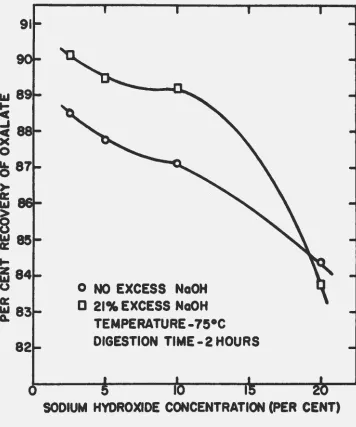
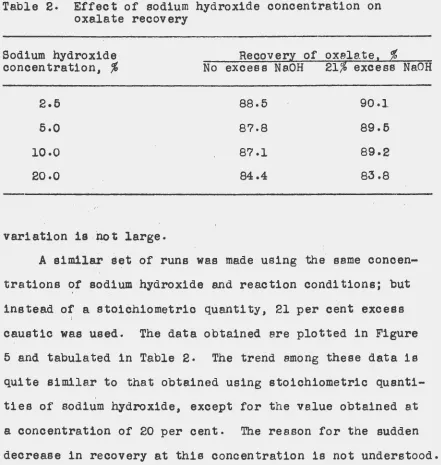
of these runs are plotted on a graph in Figure 5, and the
actual values obtained are tabulated in Table 2. The data
clearly indicate that the greatest recovery is obtained
0 NO EXCESS NaOH
D
21% EXCESS NaOHTEMPERATURE-75°C
DIGESTION TIME- 2 HOURS
SODIUM HYDROXIDE CONCENTRATION (PER CENT)
[image:43.539.97.453.161.588.2]Table 2. Effect of sodium hydroxide concentration on oxalate recovery
Sodium hydroxide · Recoverl of oxalate1 ~
concentration,
%
No excess Ne.OH 21% excess NaOH2.6 88.6 90.1.
5.0 87-8 89.6
1o.o 87.1 89·2
20.0 84.4 83.8
•' " .• 1..·
variation. ~s'.flO~ large.
A
similar ·~et of runs was made using the' sameconcen-tra.tions ~t' sodium hydroxide and reaction condi tiona; but
' I ' '
instead of a stoichiometric quantity, 21 per cent excess
I
caustic was used. The data obtained are plotted in Figure
5 and tabula ted in Table 2. The trend among these data is
quite similar to that obtained using stoichiometric
quanti-I
ties of sodium hydroxide, except for the value obtained at
a concentration of 20 per cent. The rea.son for the sud.den
decrease in recovery at this concentration is not understood.
As a result of these experiments it was decided to make
all further studies using 21 per cent excess of ten per cent
solutions of sodium hydroxide. The decision to use ten per
cent sodium hydroxide solutions was based primarily on the
volume of solution involved, since it is usually more
[image:44.541.49.490.71.536.2]The volume requirements for processing rRre ef>.rth and thorium
oxalates are tabulated in Table 3. It was desired the.t the
oxa.la.te recycle volume not be considerably greatar than the
volume of an equivalent que.nti ty of a ten per cent oxalic
acid solution. By comparing Table 3 with Figure 5, it can
Tftble 3. Comparison of solution volumes a
Solution volume1 milliliters
Solution Stoichiometric 21~ excess
10/t oxalic acid 1,138 1,277
2.5% sodium hydroxide 2,890 3,497
5.0,% sodium hydroxide 1,445 1,748
10.0~ sodium hydroxide 722 874
20-0% sodium hydroxide 361 437
aBasia of calculation: 100 gr8ms of mixed oxides
(94 per cent rare earth oxides, six per cent thorium oxide).
be seen that the choice of ten per cent sodium hydroxide
solution was judicious. Actually, no recoverable oxalate is
jeopardized by this choice, since the use of 21 per cent
excess of a ten per cent caustic solution results in the
'same recovery of oxals.te as s. stoichiometric quantity of 2.5
per cent caustic, and considera.bly less liquid is used.
Excess sodium hydroxide. In order to determine the
hydroxide goes to completion, a series of runs was made using
a great excess of sodium hydroxide. In each run 7.96 grams
of mixed oxides, in the form of oxalates, were digested with
a ten per cent solution of sodium hydroxide for three hours
at a temperature of 75-85°0. Duplicate runs were made using
100, 300, and 500 per cent excess caustic. The results are
tabulated in Table 4 and are graphically presented in Figure
6. The values for no excess bs.se and 21 per cent excess base
were taken from the experimental runs just previously
dis-cussed.
Table 4. Effect of excess sodium hydroxide on oxalate recovery
%
excess sodium hydroxide Recovery of oxalate,None 87.1
21 89.2
100 93.3
300 94.7
500 95.1
Although the graph in Figure 6 plainly indicates tha.t
%
a greater amount of oxalate may be recovered by using excess
sodium hydroxide, it is not economical to do so. This is
<l
X
0
I.L
0
>-a::
l&J
~
0 l1Ja::
t-z
l&J
0
a::
l&J
Q.
0
CONCENTRATION NaOH - 10°/o TEMPERATURE -75-85°C DfGESTION TIME ... 3 HOURS
100 200 300 400
PER CENT EXCESS SODIUM HYDROXIDE
Figure 6. Effect of QXcess sodium hydroxide on oxalate recovery
500
~
[image:47.539.68.658.56.469.2]Table 5. Cost for recovering oxalatea
Oxalate Cost Worth of Difference
Excess Pounds recovery, of recovered in cost,
NaOH NaOH .% NaoHb oxalic acidc or profit
None 72.24 87.1 $3.61 $18.84 $15.23
10,% 79.46 88.2 $3.97 $19.08 $15-11
21% 87.41 89-2 $4.37 $19.29 $14-92
50% 108.36 91.1 $5.42 $19-70 $14.28
80.% 130.03 92.6 $6.50 $20.03 $13.53
100% 144.48 93.3 $7.22 $20.18 $12.96
aBasia: 100 pounds of mixed oxide processed as oxa.1ate
(94 per cent rare ea~th oxides, six per cent thorium oxide).
boost for s.odium hydroxide, $0.05 per pound.
ccost for oxalic acid, $0.19 per pound.
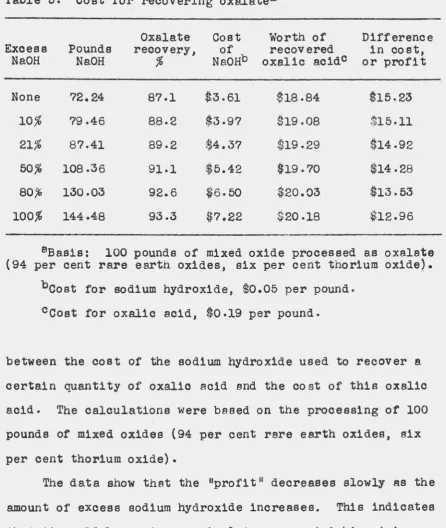
between the cost of the sodium hydroxide used to recover a
certain quantity of oxalic acid and the cost of this oxalic
acid. The calculations were based on the processing of 100
pounds of mixed oxides (94 per cent rare e~th oxides, six
per cent thorium oxide).
The data show that the 11profi t 11 decreases slowly as the
amount of excess sodium hydroxide increases. This indicates
that it would be most economical to use a stoichiometric
quantity of sodium hydroxide or a very slight excess.
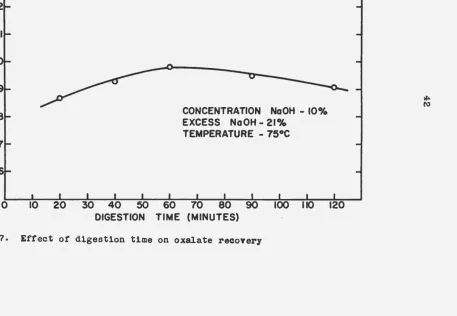
[image:48.539.46.493.86.615.2]recovery of oxalate was determined by digesting 7.96 grams of mixed oxides, in the form of oxalates, with 21 per cent excess of' a ten per cent sodium hydroxide solution at 75°0
for various lengths of time. The time intervals studied were 20, 40, 60, 90, end 120 minutes. \'/hen the tempere,ture of the reactants reached 60°0, the timing of the
sam~les
began. The resul t·s obtained are te.bulated in Table 6. A·graphical presentation of the results is shown in Figure 7.
Table 6. Effect of dig~stion time on oxalate recovery
Digestion time, minutes Recovery of oxalate,
%
'
20 88.7
40 89.3
60 89.8
90 89.5
120 89.1
With only a slight difference in recovery existing among the runs made, the choice of the optimum digestion time must depend on other factors besides oxalate recovery. Since time is a costly item in itself, probably the optimum d1ges1tion time is between 30 and 45 minutes.
I
Digestion temperature. The effect of temperature upon the recovery of oxalate was determined by digesting several
0
CONCENTRATION NoOH - 10°/o EXCESS NoOH- 21°k
TEMPERATURE - 75°C
[image:50.545.88.601.100.437.2]mixed oxalate samples in 21 per cent excess of a ten per cent
sodium hydroxide solution. Each sample was digested for one
hour after the temp era ture reached 60°C or, a.s in the case
of the first two runs, the temperature under consideration.
Tne results of this study appear in Figure 8. The data are
also tabulated below in Table 7.
Table 7. Effect of digestion temperature on oxalate recovery
Digestion temperature, °C Recovery of oxa.lete,
28 77.6
53 88.9
67 89.4
80 90.6
92 91.6
The data obtained in this run indicate that heating
the reaction mixture considerably improves the oxala.te recovery. The best digestion temperature is near the
boiling point of the solution.
%
Washing of hydroxide cake. During the experimental runs
just described, it was found that a considerable quantity of
'\'Iash water was necessary to remove all of the sodium oxalate
from the hydroxide cake •. Since an excess of sodium hydroxide
CONCENTRATION NaOH -10°/o EXCESS NaOH .. 21 °/o . DIGESTION TIME- I HOUR
·~
[image:52.541.72.479.59.642.2]excess of base and incomplete conversion, it was decided to
investigate whether the solubility of sodium oxalate in
sodium hydroxide might e.ffect the washing operation.
There were no data available on ~he solubility of sodium
oxalate in sodium hydroxide. Seidell {31) gives the
follow-ing data on the solubility of sodium oxalate in water. Sodium
oxalate, as shown by the data in Table 8, is not very soluble
Table
a.
Solubility of sodium oxalate in wateraTemperature, °C
0
10
15
20
25
30
40
50
60
70
80
100
8Data from Seidell {31).
Gre.ms sodium oxalate per 100 grams of saturated solution
2-62
2.96
3.f.3
3.30
3.48
3.67
4.01
4.37
4.70
5.05
5.40
[image:53.541.61.487.194.638.2]in cold water. Therefore, the wash should be very hot in
order to achieve good recovery.
The solubility of sodium oxalate in sodium hydroxide
was determined at 28°0. A quantity of pure sodium oxalate
was dissolved in the sodium hydroxide solution and the
solu-tion was agitated for at least three hours. At all times
there was an excess of undissolved sodium oxalate present.
The solution was filtered, and an aliquot from the filtrate
was titrated with potassium permanganate to determine the
concentration of sodium oxalate in the solution. The data
obtained are tabulated in Table 9. The same data are
graphically presented in Figure 9.
The results of this investigation indicated that the
solubility of sodium oxalate was considerably diminished in
the presence of a small amount of sodium hydroxide. This
Table 9. Solubility of sodium oxalate in sodium hydroxide at 28°0
Normality of sodium hydroxide
0
0.10
o.
501.00
1.?5
Grams sodium oxalate per 100 milliliters of solution
3.?2
3.44
1.94
0.96
[image:54.525.41.478.451.676.2]:!
a:
0
z
01 I I I I I I l;=:::tc) I I
0 -- ·- ·- - - -- - --
[image:55.539.125.614.119.390.2]