Article
Activity-Based Costing Analysis for Train Station’s
Service
Anucha Watanapa
1,a,*
, Siwadol Pholwatchana
2,
and Wisitsree Wiyaratn
31 Department of Production Technology Education, Faculty of Industrial Education and Technology, King Mongkut’s University of Technology Thonburi, Bangkok 10140, Thailand
2 Freight Transport Laemchabang Station Container Transport Bureau, The State Railway of Thailand 3 Faculty of Industrial Education and Technology, King Mongkut’s University of Technology Thonburi, Bangkok 10140, Thailand
*E-mail: [email protected]
Abstract. Laem Chabang train station is subsidiary to container transportation office of The State Railway of Thailand.Its operation is divided into two main parts: Laem Chabang station and Laem Chabang Port station operates 24 hours a day. This report does research on services of both stationsthat can be categorized into two types: container train service and oil train services which are different in their processes. This report analyses activity-based costing especially in the Laem Chabang train station’s direct expense which does not include other organizations’ expenses such as mechanical department, civil department or signalling department. Formerly, The State Railway of Thailand had not been calculating this kind of cost, the workgroup thus attempts to make activity-based costing of Laem Chabang train station to improve its service procedure and reduce its future cost. From calculation cost of service of Laem Chabang train station by applying activity-based costing, the cost of activity for each type of train is revealed. The cost of service for oil train is 1,575.85 baht per train, for container train entering zone B port is 809.61 baht per train and for container train entering zone C port is 811.76 baht per train. It is found that cost of service for oil train is the highest due to its lower client which is about one-eighth of container train. In order to reduce cost, it can be considered to operate more oil trains or to decrease the number of labour related to oil train because labour salary is about 83% of the total cost. Thus, optimization of labour can clearly lower overall cost.
Keywords: Activity-Based costing, train station cost of service, container transportation, optimization.
ENGINEERING JOURNAL Volume 20 Issue 5
1.
Introduction
Activity-based costing (ABC) is a new cost management system which encourages the executives’ interest in importance of costing and activity management, and simultaneously informs useful information for better product costing, cash and liquidity management and decision than traditional cost accounting system [1-2]. The information is in form of more reliable product and production cost. At the same time, it notifies the executives what activity is worth for business process and product. When look at the big picture, ABC is the method which helps costing be more accurate i.e. ABC identifies activities related to production of each category of product by analyzing resources used by the activity and activity driver of each activity. It can thus clearly determine resource usage of each product. ABC is different from the traditional method as it uses the activity instead of cost center [3]. In addition, ABC helps costing allocation to be more accurate by using numerous allocation criteria. Banomyong et al., (2006)[4] introduced a research on ‘logistic cost control using cost accounting system’ which was done by using activities based costing to study production industry management system for improving production management which focused on production cost data, and to find out more accurate unit cost by using canned sweet corn as a case study. Akkarachaipanit (2001)[5] researched on activity costing of logistic business for the purpose of capability of more accurately analyzing activity cost, cost-to-serve and customer cost of one operator who do business by accumulating merchandises from its customer in suburb area and then deliver to the destination in other province. The research developed activity cost model in 5 steps covering all activities in administration, warehouse and transportation department. Moreover, the model can express cost caused by car usage separately in outward trip and return trip. It can also show useful managing of car’s capacity and the cost caused by ineffective use.. Adil Baykasoglu and Vahit Kaplanoglu (2008) [6] studied implementation of ABC in Turkey land transportation. This research used AHA procedure together with ABC to select cost driver to improve performance of spreading overheads to activities which makes cost analyzing be more effective to land transportation firm when compared to traditional costing system. According to “Activity-based costing in distribution business” (Worawattananon, 2005) [7], ABC concept has been used in many businesses because it can show the actual cost of operation which helps to plan strategies properly. However, one reason why this concept has not been widely used in distribution business is because of limitation of knowledge in developing and implementing ABC in practice. This research thus aim at understanding the process of developing ABC and its implementation to reveal the cost of distributing each product. The study collected information of cost and activities done by one distributor which distribute consumer product to the destinations in any provinces in Thailand. The research showed that, for the case of sharing resources to hand out product, ABC is a tool that can help analyze exact cost of distribution, and help identify sources of the cost which assist the operator in managing the cost and planning strategies. In addition, even if the resources are not shared, the model can be used to analyze data to monitor efficiency of resource usage which can be considers as one of the way to advance internal processes and activities. There are 5 reasons ABC is useful for management: 1. It makes product/service costing more accurate. 2. It makes performance measurement more effective. 3. It is cost reduction. 4. It is decision support for executives. 5. It provides organization’s continuous improvement. Laem Chabang train station is subsidiary to container transportation office of The State Railway of Thailand. Its main objective is to provide services to container and oil trains. There are about 900 – 1000 container trains and about 120 oil trains (inbound-outbound) using the services each month. Its operation is divided into two main part: Laem Chabang station and Laem Chabang Port station. There are two parts in its operation. The first is support part performed by, for example, station masters and clerks who work in shifts of twelve hours. Another part is operation part performed by, for example, shuntman, marshalling operator, train dispatchers who work in shifts of eight hours. In Laem Chabang station, there are five workers in each shift: one station master, one shuntman, one marshalling operator, one security officer and one dispatcher. In Laem Chabang Port station, there are seven workers in each shift: one station master, one clerk, one shuntman, one marshalling operator and three dispatchers.
described using resources into activities by pushing the appropriate resources when calculating the cost of the activity. Therefore, activity-based costing to consider things like cost of living driven cost management refers to the horizontal oriented activities. For further details about the performance of the activities by causing the activity or driving costs, which will lead to an operational unit in the form of non-monetary. Evaluation workshops (Operating Measure), which is the process of cost due to the activities of vertically.
Fig. 1. ABC Model by the Consortium for Advance Manufacturing-International (CAM-I) in 1991[8].
2.
Activity-Based Costing Methodology
In private sector, activity-based costing is a way to allocate resources cost of an organization based on production or service activities provided for customers. ABC is a tool which can provide understanding in product cost, customer cost and benefits so it is used to support strategic decision making such as pricing, outsourcing and process measurement. Figure 2 shows activity-based costing is earmarked for expenses related to the cost of the activities involved in the process of production and services. Step action: Step 1 is to identify or determine the activity. Step 2 the cost of inputs or resources is calculated. Step 3 put the cost of the resources used in each is calculated in step 2 and distributed according to each activity based on number of practical steps to implement. Step 4 import data of costing of activities. Step 5 data collection and the amount of each activity is done. Step 6 the cost per unit of activity is calculated by bringing the total cost of each activity divided by the volume of work.
Traditional product assessment is based on values of direct labour, direct material and compute overhead costs in the form of a ratio. This method works especially for factor with less diverse products. However, for more product variety factory, overhead costs are apparently more dominant as can be seen from, for example, setup, indirect material and design cost. Therefore, ABC is a new method used to compensate that vulnerability by estimating cost from various activities such as production and finance which relate to the product. Activity-based costing methodology (ABC) is based on two hypotheses:
[image:3.595.176.418.162.445.2]2.1. Implementation of ABC Consists of Six Steps:
Fig. 2. Six steps required to implement an ABC system: Ray Garrison and Eric W. Noreen (1999) [9]. 2.2. Interview and Data Collection
Research methodology on activity-based costing of Laem Chabang train station services is focused on compiling gathered data, making and analyzing information to improve management of logistic part of the organization since it has been using only traditional costing. To reveal the actual cost of servicing activities, the researchers hence solely study on cost associated with the station services by applying activity-based costing in analyzing so the organization adapt the output to improve its process in providing competitiveness in global market.
2.2.1. Study, interview and collect data from operation of employees in organization units and department 2.2.2. Study servicing procedure of Laem Chabang train station
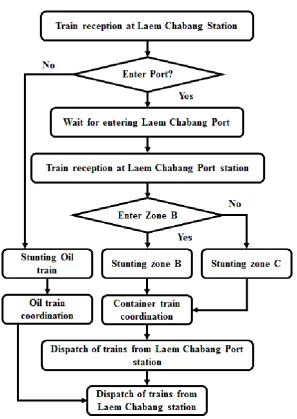
For operational processes of the station, there are two part of execution, at Laem Chabang station and at Laem Chabang Port. It consists of seven steps:
Processes Step 1: reception of trains at Laem Chabang station: receive both container and oil trains, inform traffic controller of time schedule and coordinate to rotate train crew’s shift.
Processes Step 2: train waiting for service: in case of Laem Chabang Port station is not available; the trains have to wait at Laem Chabang station.
Processes Step 3: reception of trains at Laem Chabang Port station: receive only container trains, record the arrival time
Processes Step 4: shunting operation: shunt in between the train
Processes Step 5: container train coordination. When the train is placed at the loading point, there will be coordination to freight operators to perform freight operation, documentation, statistical summary, collecting freight.
Processes Step 6: dispatch of trains from Laem Chabang Port station: dispatch trains from Laem Chabang Port station to Laem Chabang station
[image:4.595.155.414.109.294.2]Fig. 3. Flow chart of service for oil train.
3.
Research Results and Discussion
3.1. Research on Activity-Based Costing of Laem Chabang Train Station
[image:5.595.150.448.69.489.2]Table 1. Relation between process and type of service.
No. Activity A Type of service B C
1 Reception of trains at Laem Chabang station 2 Train awaiting for service
3 Reception of trains at Laem Chabang Port station
4 Shunting
Crude oil Zone B Zone C 5 Marshalling Crude oilContainer
6 Dispatch of trains from Laem Chabang Port station 7 Dispatch of trains from Laem Chabang station
Remark: = Perform operation; =Not perform operation.
3.2. Research on Production Cost Classified by Resources
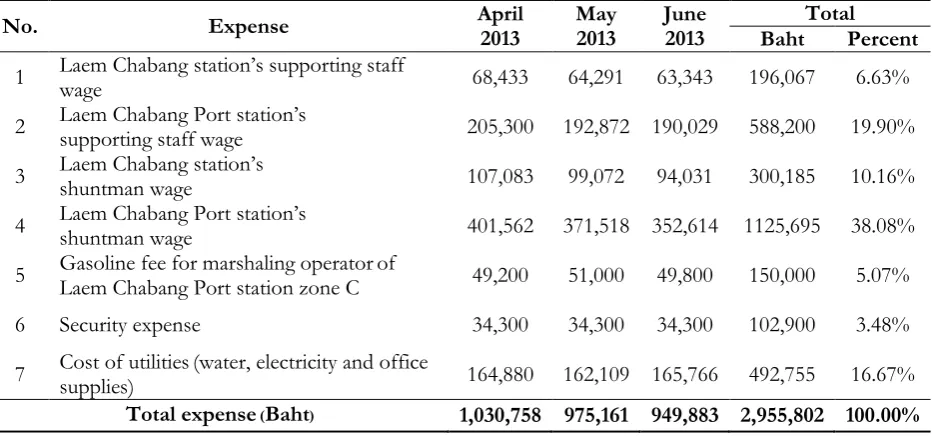
Three months retroactive study on expense caused at the station is conducted. The cost which is composed of labor wages from both operation and supporting staff and both Laem Chabang station and Laem Chabang Port station, and overhead costs is analyzed and classified into group of similar expenses.
Expense of the station is mainly from labor wages; additional expense is from cost of utilities such as water, electricity, security, transportation fee for zone C staff and office supplies. The recorded expense is summarized in Table 2. Moreover, the workgroup has gathered working data of Laem Chabang train station workers in many forms such as hours of work and waiting time of trains as shown in Table 3, which is to be used for costing in next steps.
Table 2. Expense of Laem Chabang train station.
No. Expense April 2013 May 2013 June 2013 Baht Total Percent
1 Laem Chabang station’s supporting staff wage 68,433 64,291 63,343 196,067 6.63% 2 Laem Chabang Port station’s supporting staff wage 205,300 192,872 190,029 588,200 19.90% 3 Laem Chabang station’s shuntman wage 107,083 99,072 94,031 300,185 10.16% 4 Laem Chabang Port station’s shuntman wage 401,562 371,518 352,614 1125,695 38.08% 5 Gasoline fee for marshaling operatorLaem Chabang Port station zone C of 49,200 51,000 49,800 150,000 5.07%
6 Security expense 34,300 34,300 34,300 102,900 3.48%
7 Cost of utilitiessupplies) (water, electricity and office 164,880 162,109 165,766 492,755 16.67%
Total expense (Baht) 1,030,758 975,161 949,883 2,955,802 100.00%
*Source: Laem Chabang train station payroll account, Laem Chabang train station cash book. 3.3. Cost-to-Activity Allocation Criteria
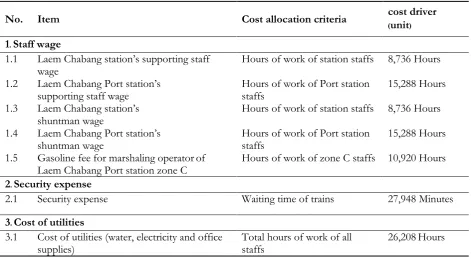
[image:6.595.64.535.103.285.2] [image:6.595.67.534.458.676.2]Table 3. Work load of Laem Chabang train station for cost drivers.
No. Item Unit April Work load
2013 May 2013 June 2013 Total 1 Hours of work of Laem Chabang station staff Hour 2,880 2,976 2,880 8,736 2 Hours of work of Laem Chabang Port station staff Hour 5,040 5,208 5,040 15,288 3 Hours of work of security officer Hour 720 744 720 2,184 4 Hours of work of zone C staff Hour 3,600 3,720 3,600 10,920
5 Total hours of work Hour 8,640 8,928 8,640 26,208
6 Waiting time of trains at Laem Chabang station Minute 10,302 9,486 8,160 27,948 *Source: Hours of work is calculated using workers’ working time, Trains’ waiting time is accumulated from Laem Chabang station’s token book.
Table 4. Cost-to-activity allocation criteria.
No. Item Cost allocation criteria cost driver (unit)
1. Staff wage
1.1 Laem Chabang station’s supporting staff
wage Hours of work of station staffs 8,736 Hours
1.2 Laem Chabang Port station’s
supporting staff wage Hours of work of Port station staffs 15,288 Hours 1.3 Laem Chabang station’s
shuntman wage Hours of work of station staffs 8,736 Hours
1.4 Laem Chabang Port station’s
shuntman wage Hours of work of Port station staffs 15,288 Hours 1.5 Gasoline fee for marshaling operatorof
Laem Chabang Port station zone C Hours of work of zone C staffs 10,920 Hours 2. Security expense
2.1 Security expense Waiting time of trains 27,948 Minutes
3. Cost of utilities
3.1 Cost of utilities (water, electricity and office
supplies) Total hours of work of all staffs 26,208Hours
Cost divers shown in the table comes from:
(1) Hours of work of staff which are calculated from number of workers for each duty multiply with 24
(2) Waiting time of trains which is summarized from transportation statistics
3.4. Activity-Based Costing Calculation
[image:7.595.80.520.104.222.2] [image:7.595.63.535.282.541.2]Table 5. Cost allocation.
No. Activity Service cost (Baht) Total
Labor Security Utilities
1 Reception of trains at Laem Chabang station 412,089.16 - - 412,089.16
2 Train awaiting for service - 102,900 - 102,900
3 Reception of trains at Laem Chabang Port station 262,238.56 - - 262,238.56
4 Shunting operation
Crude oil 149,850.60 - - 149,850.60
Zone B 262,238.56 - - 262,238.56
ZoneC 187,313.25 - - 187,313.25
5 Train coordination Crude oil 149,850.60 - 179,183.64 329,034.24
Container 262,238.56 - 313,571.36 575,809.92 6 Dispatch of trains from Laem Chabang Port station 262,238.56 - - 262,238.56 7 Dispatch of trains from Laem Chabang station 412,089.15 - - 412,089.15
Total 2,360,147 102,900 492,755 2,955,802
The cost allocation is calculated from each activity cost multiplied with actual work load of the activity and then divided by total work load of the category. Any activity which cannot be categorized will not be calculated for costing.
3.5. Activity Cost Assignment
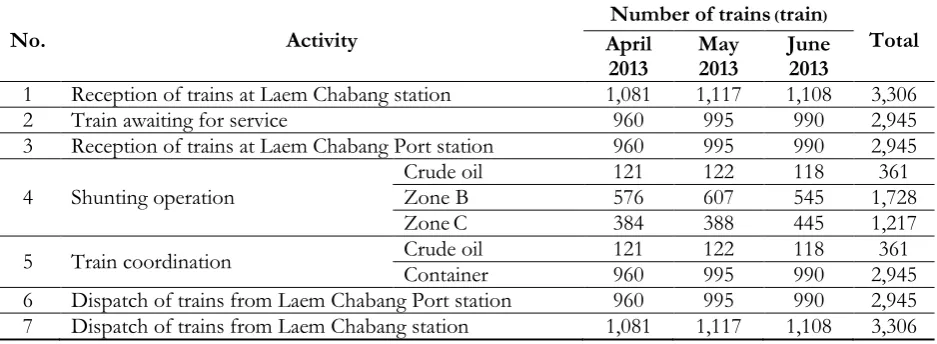
This step is to assign total expense of each activity to a variable which is a number of trains serviced by each activity. The workgroup has collected number of trains which is served by the station from time record of the station master for three months as well as accumulated expense as shown in Table 6. The trains will run into different processes.
Table 6. Number of trains served by each activity.
No. Activity
Number of trains (train)
Total April
2013 May 2013 June 2013
1 Reception of trains at Laem Chabang station 1,081 1,117 1,108 3,306
2 Train awaiting for service 960 995 990 2,945
3 Reception of trains at Laem Chabang Port station 960 995 990 2,945 4 Shunting operation
Crude oil 121 122 118 361
Zone B 576 607 545 1,728
ZoneC 384 388 445 1,217
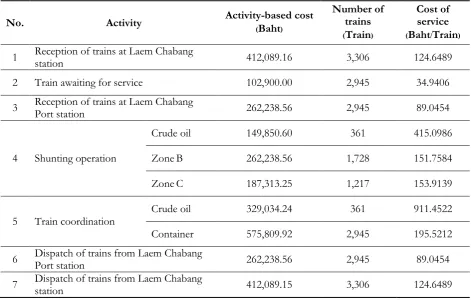
[image:8.595.65.533.105.399.2] [image:8.595.65.534.574.746.2]Cost of service can then be calculated by dividing expense of each activity by number of trains served by the activity. The cost of service is shown in Table 7.
Table 7. Assignment of cost to train service.
No. Activity Activity-based cost(Baht)
Number of trains (Train)
Cost of service (Baht/Train)
1 Reception of trains at Laem Chabang station 412,089.16 3,306 124.6489
2 Train awaiting for service 102,900.00 2,945 34.9406
3 Reception of trains at Laem Chabang Port station 262,238.56 2,945 89.0454
4 Shunting operation
Crude oil 149,850.60 361 415.0986
ZoneB 262,238.56 1,728 151.7584
ZoneC 187,313.25 1,217 153.9139
5 Train coordination Crude oil 329,034.24 361 911.4522
Container 575,809.92 2,945 195.5212
6 Dispatch of trains from Laem Chabang Port station 262,238.56 2,945 89.0454 7 Dispatch of trains from Laem Chabang station 412,089.15 3,306 124.6489
From studying to find cost of service per train of Laem Chabang train station, the cost of activity per train has been revealed as shown in Table 7. However, there are three types of train served at the station; the train is served by different processes depending on its type (as in Table 1). Cost of service per train for each type is summarized in Table 8.
Table 8. Cost of service per train by type of train.
No. Activity A Type of service B C
1 Reception of trains at Laem Chabang station 124.6489 124.6489 124.6489
2 Train awaiting for service 34.9406 34.9406
3 Reception of trains at Laem Chabang Port station 89.0454 89.0454
4 Shunting operation Crude oil Zone B 415.0986 151.7584
Zone C 153.9139
5 Train coordination Crude oilContainer 911.4522 195.5212 195.5212 6 Dispatch of trains from Laem Chabang Port station 89.0454 89.0454 7 Dispatch of trains from Laem Chabang station 124.6489 124.6489 124.6489
Cost of service (Baht/Train) 1,575.85 809.61 811.76
4.
Conclusions
[image:9.595.62.534.141.443.2] [image:9.595.63.534.538.712.2]container train entering zone B port is 809.61 baht per train and for container train entering zone C port is 811.76 baht per train.
From the above information, cost of service for oil train is found to be the highest due to its lower client which is about one-eighth of container train; that is conforms to the law of demand and supply. In order to reduce cost, it can be considered to operate more oil trains or to decrease the number of labour related to oil train because most of the cost occurs from labor salary (about 83%). Thus, optimization of labour can clearly lower overall cost. However, rail transportation show to grow in the future. Even if the number of worker cannot be reduced, overall cost of the station will decrease due to the increase of transportation so Laem Chabang train station and container transportation office must retain the number of labour in order to support that expansion in the future which will result in increasing of profit per train.
References
[1] H. T. Johnson, “The decline of cost management: A reinterpretation of 20th century cost accounting history,” Journal of Cost Management, pp. 5-12, Spring 1987.
[2] K. E. David and L. J. Robert, “Why Is ‘Integrated’ ABC Better?,” Journal of Corporate Accounting &
Finance, pp. 45-53, March/April 2002.
[3] H. T. Johnson, “Activity-Based Management: Past, Present, and Future,” The Engineering Economist, vol. 36, no. 2, pp. 219-238, Spring 1991.
[4] B. Ruth. (2006). Logistic cost analysis by activity-based costing. Bangkok: The Japan External Trade Organization
[JETRO Bangkok].
[5] A. Suppakarn, “Activity-based costing analysis for the trucking business,” M.S. thesis, Chulalongkorn University, Bangkok, 2001.
[6] B. Adil and K. Vahit, “Application of activity-based costing to a land transportation company: A case study,” IE. Dept., Gaziantep Univ., Gaziantep Tyrkey, 2008.
[7] W. Pimchanok,“Activity-based costing model for distributing business,” M.S. thesis, Chulalongkorn University, Bangkok, 2005.
[8] M. Marivic, “Activity based costing (ABC) vs. traditional cost accounting system among top 500 corporations in the Philippines,” College of Business and Economics, De La Salle University, Manila, 2004.
![Fig. 1. ABC Model by the Consortium for Advance Manufacturing-International (CAM-I) in 1991[8]](https://thumb-us.123doks.com/thumbv2/123dok_us/8108823.235783/3.595.176.418.162.445/fig-abc-model-consortium-advance-manufacturing-international-cam.webp)
![Fig. 2. Six steps required to implement an ABC system: Ray Garrison and Eric W. Noreen (1999) [9]](https://thumb-us.123doks.com/thumbv2/123dok_us/8108823.235783/4.595.155.414.109.294/fig-steps-required-implement-abc-garrison-eric-noreen.webp)