This is the author’s version of work that was submitted and accepted for publication in the following source:
Hoare, K., Mills, J. & Francis, K. (2012). Sifting, sorting and saturating data in a grounded theory study of information use by practice nurses: A worked example. International Journal of Nursing Practice, 18(6): 582-588.
This definitive version of this work is available at: Wiley Online Library
http://onlinelibrary.wiley.com/doi/10.1111/ijn.12007/pdf
© Copyright 2012 Wiley Publishing Asia Pty Ltd
1 Sifting, sorting and saturating data in a grounded theory study of information use by practice
nurses: A worked example.
Abstract
The terminology used to analyse data in a grounded theory study can be confusing. Different grounded theorists use a variety of terms which all have similar meanings. In the following study we use terms adopted by Charmaz including: initial, focused and axial coding. Initial codes are used to analyse data with an emphasis on identifying gerunds, a verb acting as a noun. If initial codes are relevant to the developing theory, they are grouped with similar codes into categories. Categories become saturated when there are no new codes identified in the data. Axial codes are used to link categories together into a grounded theory process. Memo writing accompanies this data sifting and sorting. The following article explains how one initial code became a category providing a worked example of the grounded theory method of constant comparative analysis. The interplay between coding and categorisation is facilitated by the constant comparative method.
Key Words. Constructivist grounded theory, practice nurses, New Zealand, general practice, new
graduate nurses.
Introduction
2 These two studies provided the platform for the reported research, the intention of which was to investigate the use of information by practice nurses.
Methods
The first author and lead researcher (KH) observed information use in her own general practice over a three month period. Colleagues in KH’s own general practice were invited to participate in the study following explanation and discussion of the project at a clinical meeting. Consent forms were then left for interested participants to complete. Only those who completed consent forms were observed and interviewed. Following this initial ethnographic phase, participants were then recruited through an advertisement distributed through the first author’s primary health care networks. Eleven practice nurses were interviewed from alternate general practices to KHs, including one experienced practice nurse, twice. The process of selecting participants who had volunteered to participate in the study was through theoretical sampling, described elsewhere (12) Five participants were new graduate nurses (GN), while the remainder were experienced practice nurses (EPN) who had worked in general practice for over three years. The study was approved by the Monash University Standing Committee on Ethics in Research involving Humans in April 2009. Practice nurses were interviewed at their place of work.
Results
The grounded theory.
The core category constructed in this study is entitled Reciprocal Role Modelling. Three categories make up Reciprocal Role Modelling: Becoming Willing, Realising Potential and Becoming a Better Practitioner. This article describes how one initial code became elevated to the second category, Realising Potential. KH wrote the storyline of data pertaining to this category, weaving the
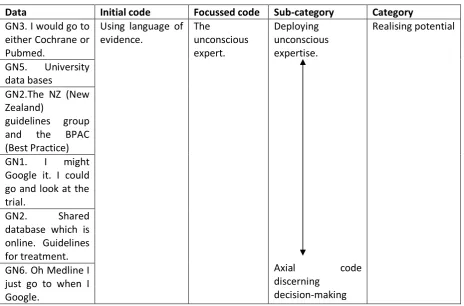
3 The story of how Realising Potential began to be constructed from the initial code ‘using the language of evidence’ is as follows. Graduate nurses (GN) know where to access information, they are unconscious experts at sourcing information, because they have been used to using technology from a young age but don’t necessarily recognise this as a useful skill to have. They are familiar with using computers and smart phones and know the potential of this equipment for finding information. GNs are aware of credible sources of evidence for practice having just graduated from university and use the language of evidence in their everyday work. Over time, experienced practice nurses (EPN) become aware of how skilled GNs are at finding things out, and the GNs are encouraged to deploy their unconscious expertise in order to assist EPNs in their work (see Table 3). At this juncture EPNs are realising the potential of the GN in sourcing information for them which in turn assists them to become better practitioners.
The following sections of this article illustrate how the authors constructed the category, Realising Potential, tracing the thread of one initial code. The grounded theory of Reciprocal Role
Modelling comprises numerous codes and sub-categories which have been fully described
elsewhere. Coding
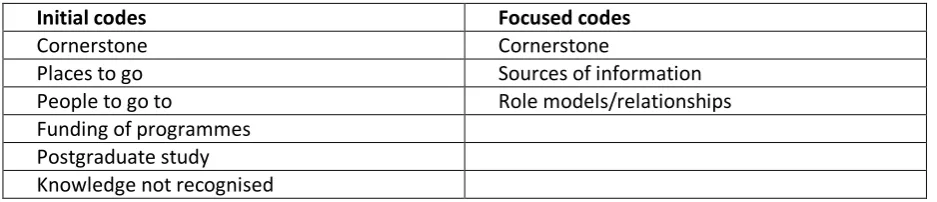
4 Table 1. Initial and focussed codes in the very early stage of a grounded theory study
Initial codes Focused codes
Cornerstone Cornerstone
Places to go Sources of information
People to go to Role models/relationships
Funding of programmes Postgraduate study Knowledge not recognised
Throughout the data collection phase, memos are written as the researcher(s) reflects on their coded data, thinking about further avenues to heighten their theoretical sensitivity to the phenomenon in question (15). Following is the first memo KH wrote, during the period of ethnographic observation and analysis which was prior to interviewing participants. Memos demonstrate rigour and trustworthiness in the research process as they form an audit trail of the researcher’s evolving theory (2) through recording both thinking and decision making.
Memo 18th September 2009
Already I can see that education impacts on how nurses retrieve information. Nurse A did not
mention using the internet or decision-making tools whereas nurse B knew all the sites to go
to.
The above memo is ordinary and mundane, nothing very exciting seemed to be happening in the data, however when this memo is compared with later memos, it is evidential of KH’s very concrete thinking at the early stage of the research study. The memo was absent of new insights in the area of information use, one reason may be the lack of gerunds in the initial codes generated.
5 Table 2. Initial coding using gerunds in a grounded theory study
Initial Codes
Being a leader
Recognising poor practice Being new
Using the language of evidence
As an example of how initial coding should stay close to the data (8, 14), the following data fragment illustrates the initial code ‘being new’ where a GN explains how EPNs initially treat the GNs when they first start working in general practice.
GN3 ‘they know that we’re new and I still think they perceive us as students so therefore they go right back to the beginning and explain everything.’
Elevating codes to categories
In the final grounded theory Reciprocal Role Modelling the initial code ‘using the language of evidence’ was elevated to the sub-category of ‘deploying unconscious expertise’, which is part of the category Realising Potential. The following demonstrates how the constant comparative method, which is a key feature of grounded theory (2), was employed to identify participants whose responses could be initially coded as ‘using the language of evidence.’ GN3 was asked which resources she would use for information:
GN3 ‘the best practice guidelines based on you know the NZ (New Zealand) guidelines group and the BPAC (Best Practice) and all of those sorts of things.’
The next GN who was interviewed talked openly with no prompting about where she would go to source information:
GN4 ‘Usually I would go to either Cochrane or Pubmed if I had access to it. I find Cochrane quite hard to search on but I find Pubmed quite easy to search cause it’s got a lot of stuff or New Zealand Medical Journal as well and Kai Tiaki.’
6 Although some of the EPN’s mentioned sources of evidence-based information, particularly if they had undertaken postgraduate study, they did not volunteer their knowledge to the interviewer in the same way that the GNs did. KH employed the constant comparative method to examine the different ways GNs and EPNs reported how they would source information. The language of evidence ‘tripped off the tongues’ of the GNs. EPNs were more likely to seek support for information from a colleague, usually a doctor (EPN1) or ‘from cell groups’ EPN3 (peer education groups). Coding with the gerund ‘using the language of evidence’ illustrates the actions and processes associated with a code which if, for example, the code had been named ‘evidence use’ would not have revealed the same attributes. Charmaz suggests that coding with gerunds helps you see actions large and small and so identify sequences and thus make connections in the data. (8)
In this study, GNs use the language of evidence in reference to Cochrane, Pubmed and university databases. Every GN interviewed used this same language of evidence, hence the initial code became a focussed code, and then when analysed alongside other codes was elevated to the sub-category ‘deploying unconscious expertise.’ Overall, this sub-category was constructed from data that provided evidence of GNs unconsciously helping others find information, the following example is illustrative of this construct. GN1 is discussing her EPN mentor who was undertaking postgraduate study and needed a reference for her assignment:
GN1 ‘she’d found all the articles she wanted in the back of one of her books she’d been given like quite a recent publication so no worries about using that from that reference list. There were like ones that she wanted and she couldn’t find them on the internet so she had to get me to find them for her.’
7 value of GNs and how they were ‘awesome’ because of their familiarity with the processes of sourcing contemporary evidence for practice:
KH ‘and how do you find them (GN’s) in terms of their information and knowledge?’
EPN2 ‘awesome yeah a lot of these new graduate nurses have come out with a lot of knowledge and erm new information and what’s best practice at the moment.’
The participant (EPN2) is a leader in a large general practice with personal expectations that as a leader she should help other nurses develop their skills by providing education sessions and encouraging them to seek postgraduate opportunities. KH theorised that this positive attitude towards best practice and information use was a property of ‘embracing graduate nurses.’ ‘Flip-flopping’ the participant’s characteristics may reveal negative attitudes towards GNs. KH theorised that a nurse without obvious leadership traits in a role where she provided assistance to the general practitioner, who had not undertaken any postgraduate study and who was of the older ‘baby boomer generation’ (16), may not have the same attitude to GNs as EPN2. Using theoretical sampling, KH then interviewed EPN3 who on the surface was characterised by the opposite of EPN2. Ironically, the interview with EP3 dispelled KH’s assumptions about how she would relate to GNs and instead provided her with a ‘light bulb’ moment in the process of analysis. EPN3 stated that working with a new graduate nurse ‘has allowed me to become a better practitioner’ which in turn became an in-vivo code which are considered ‘symbolic markers of participants speech and meanings.’(8) Although Charmaz suggests in-vivo codes may not become a significant category in some grounded theory studies, through the process of constantly comparing it with other data, it eventuated that this code had sufficient weight for it to be elevated to the category of Becoming a Better Practitioner, one of three that constitute the core category Reciprocal Role Modelling.
8 was the only nurse in the practice who had undertaken postgraduate study in a health related field but had never worked with a graduate nurse which led KH to think about what this might mean for the dynamic of information sourcing in this general practice.
Memo August 12th 2011
It’s all about attitudes and expectations. I was thinking about EPN1 and her resentment
about sharing information at times with some of her colleagues because they didn’t
recognise her knowledge gained through postgraduate study. She had expectations that
there should be some acknowledgement / reward (financial or a leadership position). New
graduate nurses have no expectations. Sourcing information is part of their way of being
because that’s what they’ve always done, so when they give out information to a skilled
practice nurse or doctor they don’t expect recognition. In fact they’re highly delighted by
feeling useful and a very small amount of praise is sufficient for them.
This memo displays KH’s increasing theoretical sensitivity to the process of GNs sourcing information for their colleagues in general practice. KH realised that unlike the EPN in the memo, who expected some reward for her abilities at information sourcing, GNs had no expectations because they weren’t cognisant of their skills; they were ‘unconscious experts’ (Table 3).
Category building
Table 3 depicts the second category Realising Potential, tracing how the code ‘using the language of evidence’ once saturated was escalated into the sub-category of ‘deploying unconscious expertise’ along with other saturated codes (reported elsewhere.). Table 4 illustrates three other codes which contributed to the category of Realising Potential to explain that more than one code collapses to comprise a category. Each of the codes in Table 4 had sufficient data to saturate the code. An axial code (8) that links deploying unconscious expertise to the first category of Becoming Willing, is
9 the GN is employing his/her unconscious expertise in knowing which member of the team to seek information from. Conditional to ‘discerning decision-making’ in the Becoming Willing category is a supportive multi-disciplinary learning environment. Strauss suggests that axial coding attends to the dense relationships built around the axis or intersection of categories (17). ‘Discerning decision-making’ is axial to deploying unconscious expertise.
Table 3. Saturating the code of ‘using the language of evidence.’
Data Initial code Focussed code Sub-category Category GN3. I would go to
either Cochrane or Pubmed.
Using language of
evidence. The unconscious expert. Deploying unconscious expertise. Axial code discerning decision-making Realising potential
GN5. University data bases
GN2.The NZ (New Zealand)
guidelines group and the BPAC (Best Practice)
GN1. I might
Google it. I could go and look at the trial.
[image:10.595.68.530.583.763.2]GN2. Shared database which is online. Guidelines for treatment. GN6. Oh Medline I just go to when I Google.
Table 4. Other initial codes which collapsed into the category of Realising Potential.
Initial code Focussed Code Sub-category Category
Being helpful The Unconscious expert Deploying unconscious expertise
Realising Potential
Using unconscious skills
The Unconscious expert Deploying unconscious expertise
Realising Potential
10
information expertise
In the process of category building, KH and JM printed information from the QSR NVivo 8 software package which is how KH had coded the data electronically. Using scissors, coded and categorised data fragments were separated with some sorted to different categories after further examination of the codes and their meaning. This activity took place on a large table. Using a white board to diagram and explore the data together, resulted in organising categories in such a way that they integrated into a grounded and yet abstract explanation of what was going on in the data, which eventually became the theory of Reciprocal Role Modelling. In the process of category
building, analysis shifts up a gear from the messy complexity of raw data represented in both initial and focussed codes, to conceptual abstract categories that thread together to form the core category of the penultimate theory. Increasing the level of abstraction is reliant on the use of abduction which is defined as a “form of reasoning that begins with an examination of the data and the formation of a number of hypotheses that are then proved or disproved during the process of analysis (2)” Abductive thought is characterised by both logic and innovation (18) and it is innovation that is greatly aided by the use of diagramming and the tactile nature of moving data fragments around as described previously. At the point of theory integration, researchers can be confident enough to hone and refine their categorisations outside of the confines of electronic coding which keeps one so close to the raw data that it is difficult to conceptualise a grounded theory that has application across a multitude of scenarios. Asking the question ‘does this theory have application for (insert any number of occupations)’ tests the level of abstraction reached in the grounded theory constructed.
Discussion
11 On the contrary, EPNs were of the older Baby Boomer or Generation X generations and use of computer technology by these groups has been less favourably reported (20). Intergenerational preceptorship is a novel concept (21) and a literature review conducted following the construction of the theory of reciprocal role modelling revealed no other studies had investigated this area of enquiry. The needs of a changing generational workforce must be addressed in future planning as Baby Boomers are on the brink of retiring. New technology, evidence and information constantly inform clinical practice, and so adopting strategies that recognise GNs’ information finding skills may be a way to retain nurses in practice and allow them to maximise their attributes. The theory of reciprocal role modelling has what Glaser describes as ‘grab and fit’ (14), as it is plausible and resonates with health professionals. The strength of this study is the transparency with which grounded theory methods were explicated, the limitation is that the study was small and conducted in one area in New Zealand. As with any constructivist grounded theory, another researcher may have constructed alternative meanings from the data.
Recommendations for future investigation of reciprocal role modelling include the time factor in establishing the relationship and the personal qualities of the EPNs and GNS.
Conclusion
12 References.
1. Strauss A, Corbin J. Basics of qualitative research: Grounded theory procedures and techniques. 2nd ed. Thousand Oaks, CA: Sage; 1998.
2. Birks M, Mills J. Grounded theory. A practical guide. London: Sage Publications Ltd; 2011. 3. Bryant A, Charmaz K. The Sage handbook of grounded theory. London: Sage Publications Ltd.; 2007.
4. Noerager Stern P, Porr C. Essentials of accessible grounded theory. Walnut Creek, CA: Left Coast Press, Inc; 2011.
5. Glaser B, Strauss A. The Discovery of Grounded Theory:strategies for qualitative research. New Brunswick: Transaction Publishers; 1967.
6. Hood J. Orthodoxy vs power: The defining traits of grounded theory. In: Bryant A, Charmaz K, editors. The Sage handbook of grounded theory. London: Sage Publications Ltd.; 2007. p. 151-64. 7. Mills J, Bonner A, Francis K. The development of constructivist grounded theory.
International Journal of Qualitative Methods. 2006;5(1):1-10.
8. Charmaz K. Constructing grounded theory. London: Sage.; 2006.
9. Charmaz K. Constructionism and the Grounded Theory Method. In: James A Holstein, Jaber F Gubrium, editors. Handbook of Constructionist Research. New York: The Guilford Press; 2008. p. 397-412.
10. Hoare K, Mills J, Francis K. The role of Government policy in supporting nurse-led care in general practice in the United Kingdom, New Zealand and Australia: an adapted realist review. Journal of Advanced Nursing. 2011.
11. Hoare K, Steele J, Ram F, S, Arroll B. Evidence-based resource use by Practice Nurses in the Greater Auckland region. New Zealand Medical Journal. 2008;121(1283).
12. Hoare K, Mills J, Francis K. Dancing with data: An example of acquiring theoretical sensitivity in a grounded theory study. . International Journal of Nursing Practice. in press.
13. Birks M, Mills J, Francis K, Chapman Y. A thousand words paint a picture: The use of storyline in grounded theory research. Journal of Research in Nursing. 2009.
14. Glaser B. Theoretical sensitivity. Mill Valley, California: The Sociology Press; 1978.
15. Birks M, Chapman Y, Francis K. Memoing in qualitative research: Probing data and processes. Journal of Research in Nursing. 2008;13(1):68-75.
16. Dols J, Landrum P, Wieck K. Leading and managing an intergenerational workforce. Creative Nursing. 2010;16(2):68-74.
17. Strauss A. Qualitative analysis for social scientists. Cambridge, UK: Cambridge University Press; 1987.
18. Reichertz R. Abduction: The logic of grounded theory. In: Bryant A, Charmaz K, editors. The Sage handbook of grounded theory. London: Sage Publications Ltd; 2007.
19. Strauss W, Howe N. Generations: The History of America's Future 1584 to 2069. New York: William Morrow & Company; 1991.
20. Hu J, Herrick C, Hodgin K. Managing the multigenerational nursing team. Health Care Manager. 2004;23(4):334-40.