help to build character and
close the attainment gap…”
LEARNING BY DOING
20 years at the centre of the policy debate, with an overarching mission to bring politics closer to people.
Demos is now exploring some of the most persistent frictions within modern politics, especially in those areas where there is a significant gap between the intuitions of the ordinary voter and political leaders. Can a liberal politics also be a popular politics? How can policy address widespread anxieties over social issues such as welfare, diversity and family life? How can a dynamic and open economy also produce good jobs, empower consumers and connect companies to the communities in which they operate?
Our worldview is reflected in the methods we employ: we recognise that the public often have insights that the experts do not. We pride ourselves in working together with the people who are the focus of our research. Alongside quantitative research, Demos pioneers new forms of deliberative work, from citizens’ juries and ethnography to social media analysis.
Demos is an independent, educational charity. In keeping with our mission, all our work is available to download for free under an open access licence and all our funders are listed in our yearly accounts.
ISBN 978-1-909037-86-1
Series design by Modern Activity Typeset by Modern Activity
the copyright. We therefore have an open access policy which enables anyone to access our content online without charge.
Anyone can download, save, perform or distribute this work in any format, including translation, without written permission. This is subject to the terms of the Demos licence found at the back of this publication. Its main conditions are:
· Demos and the author(s) are credited
· This summary and the address www.demos.co.uk are displayed · The text is not altered and is used in full
· The work is not resold
· A copy of the work or link to its use online is sent to Demos
1
2
3
4
5
6
Acknowledgements
Executive summary
Introduction
Background: ‘non-formal learning’
and character
Findings – young people’s attitudes
towards non-formal learning
Findings – teachers’ attitudes towards
non-formal learning
Case study: Scouting and schools
Conclusions and recommendations
Technical appendix
Notes
References
9
11
21
27
41
57
67
81
91
97
Acknowledgements
First and foremost, we would like to thank Wayne Bulpitt, Liam Burns, Alison Cokeley-Clarke, Hayley Murphy, Matt Hyde and all at The Scout Association for their support of this work and our continuing collaboration on the vital subjects of non-formal education and character.
We would like to thank all of those who contributed to or participated in the research. We are grateful to those who participated in the workshops - particularly the Scout adult volunteers who travelled from every part of the country to share their expertise. Special thanks are due to those schools and Scout groups that opened themselves up for observation and interviews. Thanks also to Tiziana Del Bene and all at Populus Data Solutions, and Philip Collie and the team at SchoolZone, for their excellent work on the fieldwork and analysis for the surveys.
At Demos, particular thanks go to Louis Reynolds for his research support throughout, especially in developing the survey questionnaires, and his assistance in drafting Chapter 5. Thanks to Alice Crawford, Sophie Gaston and Megan Poole for their work disseminating the findings, and to Daniela Puska for expertly steering the report through production.
Executive summary
Educating for the development of character is back on the agenda and is likely to define Education Secretary Nicky Morgan’s tenure. Yet the high-stakes accountability of Ofsted inspections and league tables has in recent years led to schools too often turning inward to focus on preparing students to pass exams. There are too few opportunities to take part in ‘non-formal learning’ activities in schools: activities that can
help young people to build vital character attributes.
The evidence suggests that character attributes not only reinforce academic learning but also have a significant positive influence on various later life outcomes, including those relating to health, wellbeing and careers. It also indicates that participation in non-formal learning activities –
semi-structured activities such as sport, drama and debating, which are primarily delivered outside the classroom – play a vital role in developing these attributes.
In this report we present our research into whether non-formal learning is sufficiently embedded into the British education system. Our research shows that large numbers of young people in the UK – particularly from disadvantaged backgrounds – do not have enough opportunity to take part in non-formal learning and are therefore at risk of not developing key skills important for success. Moreover, an overwhelming majority of teachers see non-formal learning as vital, and want to see it more strongly embedded into the education system.
based on surveys of adult Scouts volunteers (n = 1,125) and young people in Scouting between the ages of 12 and 25 (n = 1,172), a workshop with adult volunteers who were also teachers and head teachers, and ethnographic case studies of school and Scouting partnerships across the UK. Our case study reveals the attitudes towards partnership from the perspective of non-formal learning providers, different models such partnerships can take, and some of the challenges in forging these partnerships. The insights from our case study are thus highly applicable for education policy-makers, school leaders and the wider non-formal education sector.
Findings
We present a summary of the findings from all of our research below.
Young people and those involved in Scouting
Our surveys of 14–18-year-olds and young people in Scouting showed there are interesting and important differences in respondents’ reporting of social and emotional skills, oppor-tunities to take part in non-formal learning, and a desire for more opportunities.
There is a significant appetite for there to be more non-formal learning opportunities in school among British students, particularly uniformed activities, like those provided by The Scout Association, the Girl Guides and the Cadet Forces:
· Uniformed activities were most likely to be seen as under-provided by schools, followed by social action.
· Approximately one in four students said that schools did not provide enough opportunities to take part in deliberative activities like debating societies, youth parliaments or a model UN (23 per cent), or outdoor activities like hiking, camping or Duke of Edinburgh (22 per cent).
However, our research revealed that there are substantial differences in the opportunities of students to take part in non-formal learning and their desire to have more opportunities between those on free school meals and those who ineligible for free school meals (FSM), and experiences of students who attended state schools and those who attend fee-paying schools.
Students on FSM were notably less likely to report taking part in sport, outdoor activities and social action:
· One in three (34 per cent) non-FSM students reported taking part in social action compared with one in four (26 per cent) FSM students.
· More than half (54 per cent) of FSM students reported taking part in sport activities, compared with 64 per cent of non-FSM students.
· One-third (33 per cent) of FSM students reported taking part in outdoor activities compared with 43 per cent of non-FSM students.
Students who attended state secondary schools were more likely than students who attended fee-paying schools to say that their school did not provide opportunities to take part in non-formal learning:
· There were similar differences for outdoor activities
(49 per cent compared with 82 per cent), deliberative activities (40 per cent compared with 80 per cent) and uniformed activities (19 per cent compared with 42 per cent).
Students on FSM were more than twice as likely to report never experiencing non-formal learning pedagogies in the classroom, such as project-based learning, class presentations or school trips:
· One-sixth (16 per cent) of respondents on FSM reported ‘none of the above’ when asked if they had experienced non-formal classroom pedagogies compared with less than one-twelfth (7 per cent) of non-FSM students.
Approximately half of all students and 58 per cent of FSM students want to see non-formal learning count towards GCSEs or A-levels:
· FSM students were notably more likely to wish this than non-FSM students. For example, 58 per cent of FSM agreed that social action should count towards qualifications compared with 49 per cent of non-FSM.
· Half of FSM students agreed that uniformed activities should count towards qualifications, compared with approximately one in three non-FSM students.
· Across all non-formal learning activities, young people in Scouting were more likely than non-Scouts to want to see these activities count towards their GCSE and A-level qualifications.
Students on FSM were substantially more likely to want more opportunities to take part in Scouting through their schools:
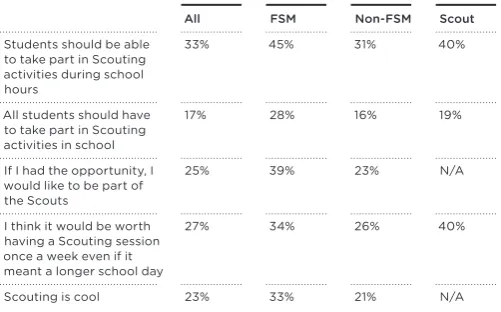
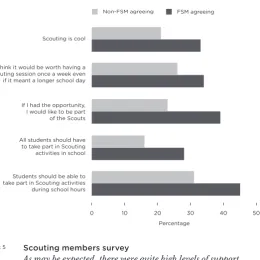
· More than one-third (39 per cent) of FSM students agreed that if they ‘had the opportunity, they would like to be part of the Scouts’ compared with less than one-quarter (23 per cent) of non-FSM students.
Our surveys also suggest that taking part in non-formal learning activities helps to boost self-reporting of strong social and emotional skills and positive attitudes towards school. For example, our survey of young people in Scouting showed that Scouts were more likely to report taking part in all non-formal learning activities than the respondents in our survey of 14–18-year-olds. While we cannot draw a causal link, our survey nonetheless revealed that young people in Scouting display more positive attitudes towards school than young people in general:
· Young people in Scouting were half as likely as young people in general to say that school was a waste of time.
Indeed, young people in Scouting were substantially more likely to report higher levels of character attributes than young people in general on every measure:
· On every character attribute measure we tested for, young people in Scouting scored at least 10 percentage points higher top marks than those not – and 20 percentage points higher in most other cases.
Teachers
Our survey of teachers – and our workshop with education experts – showed that they were highly supportive of embed-ding non-formal learning activities more consistently and permanently into the education system.
· Nine out of ten teachers have favourable attitudes towards non-formal learning, while half of respondents (51 per cent) strongly agreed that their students would benefit from non-formal education opportunities.
Teachers strongly reject the idea that schools should only adopt a formal approach to teaching and learning:
· More than two-thirds (68 per cent) disagreed that schools should only focus on ‘formal learning’, 29 per cent of whom strongly disagreed.
A majority of teachers want non-formal education to be recognised in the national curriculum, and even compulsory for students:
· Three out of four teachers (72 per cent) agreed that non-formal education should be recognised in the national curriculum, and 68 per cent agreed that given the opportunity they would like to help deliver more non-formal education activities in their schools.
· Nearly two-thirds (63 per cent) of teacher respondents agreed that non-formal education activities should be compulsory for the students at their schools.
Lack of time in the timetable and pressures from the inspectorate were cited as the biggest barriers to providing more non-formal learning activities:
· Nine out of ten teachers cited ‘a lack of time in the timetable’ as the biggest barrier.
Most teachers support greater partnerships between their schools and Scouting to provide non-formal learning activities:
· Most teachers responded positively when asked about various forms of collaboration: 58 per cent would welcome partnerships between their school and Scouts to provide students with other types of learning activities, 60 per cent thought that non-formal learning activities like Scouts should play a bigger role in the education system, and 60 per cent thought that every pupil in the UK should have the opportunity to take part in activities like Scouting as part of their school routine.
Adult volunteers in Scouting
Embedding non-formal learning into the education system requires commitment and support from non-formal education providers, and the volunteers and young people they work with. Non-formal education providers would operate differ-ently, but our case study of The Scout Association provides important insights for organisations across the non-formal education sector. Our survey and workshops with adult volunteers showed the following:
· A majority of Scout volunteers support The Scout Association partnering with schools, seeing such partnerships as mutually beneficial and particularly important for students disengaged from the education system.
· Just over half (53 per cent) of adult volunteers supported the idea of Scouting being delivered in schools, while only 26 per cent disagreed.
Adult volunteers felt that Scouting in schools should remain voluntary, and that there should not be a one- size-fits-all approach:
· Adult volunteers were particularly keen that the fundamentals of Scouting – elements like the Scout Promise, law and ‘learning by doing’ – should be actively protected.
· Examples from our case studies show a variety of approaches to Scouts partnering with schools.
Recommendations
In our recent report Character Nation, we made a series of recommendations that would help to increase opportunities for non-formal learning in the English education system.1
These recommendations include:
· The expansion of Ofsted’s remit to assess the developmental activities of students outside school and in the wider community should be explored, learning from the Scottish model.
· The Department for Education (DfE) should introduce a new National Baccalaureate for 14–19 education that would include achievement outside of the classroom.
· School performance tables should place more emphasis on good quality destination data, so that schools are judged on their real-world impact.
After our recent research we now make the additional recommendations:
· The Government should ensure that initial teacher training covers non-formal education pedagogies, including learning outside the classroom and character education.
· Through local authorities or regional schools commissioners, the Government should provide guidance on quality non-formal education provision to schools, to enable them to make informed decisions based on the evidence.
· Schools should take the lead in providing non-formal learning opportunities to their students through their everyday practice, in collaboration with expert organisations at a school, borough or academy chain level.
· A member of each school’s leadership team should have a specific responsibility for interaction with local community groups.
· When recruiting teaching staff and allocating workloads, schools should take account of an individual’s ‘value-added’, non-formal learning provision and not just their subject-specific contribution.
· Schools are diverse, and so any approach taken by providers should reflect this and not attempt to meet all needs.
· Non-formal learning providers should look at their existing processes and consider how best to adapt them to work more closely with schools.
· To demonstrate the value of their model, providers should attempt to evaluate its impact across both educational and ‘character’ outcomes, as well as accredit these outcomes for
1
Introduction
For too long there has been a false choice between academic standards and activities that build character and resilience. But the two should go hand in hand… As much as I want the next generation to be able to solve a quadratic equation, I also want them to be able to make a compelling pitch for a job, and to be able to bounce back if things don’t work out. That’s why we’ve invested in areas like music, sport and debating that help to shape and teach important values like hard work, discipline, teamwork.
Nicky Morgan2
Since Nicky Morgan became Education Secretary in July 2014, character education – education that develops capabilities like resilience and empathy – has shot up the agenda. The DfE has made character a distinct policy priority, highlighted best practice through its inaugural Character Awards and set aside a £5 million grant to support character-building approaches in schools.
This renewed interest in character education in part reflects concerns – from employers and the education sector itself – that the practice of education has become overly reductive, training students to pass written exams but not adequately preparing them for the twenty-first-century labour market and the bigger tests that they will face in life.
While character can be taught in the classroom – as Demos and the Jubilee Centre for Character and Virtues recently argued in the report Character Nation – it is also developed through participation in a range of activities and experiences outside the school setting.3 Extra-curricular activities such as sport, music and
However – as the name implies – the provision of
extra-curricular activities can be seen as an extra: an important but nonetheless non-essential aspect of the education system. As a result, its provision can be patchy, with fee-paying, independent schools apparently offering a wide variety of extra-curricular activities, and students at state schools tending to have fewer opportunities. Furthermore, with the high-stakes accountability associated with school inspections and
performance tables, it is tempting for schools to neglect extra-curricular opportunities in a single-minded focus on bolstering attainment.
On the other hand, the evidence – explored in the next chapter – suggests that participation in extra-curricular activities can boost attainment and positive attitudes towards school, particularly for young people who may have negative experiences of education.4 Without these opportunities, these
young people are also less likely to develop the character attributes that the Education Secretary identifies – rightly – as vital to success in the labour market and later in life.5
Policy is helping to encourage the take-up of non-formal learning: the proliferation of academies and free schools in England, and resultant school autonomy and freedom, has led schools to adopt and emphasise different forms of pedagogy that are akin to ‘non-formal learning’. For example, schools from the Studio Schools to School21 in Newham focus on ‘project-based learning’, which aims to foster better team-working, communication, leadership and self-direction skills. In Scotland, the Curriculum for Excellence has focused on young people’s broader outcomes, encouraging the use of non-formal learning activities to ensure young people are confident individuals and responsi-ble citizens.6 And in Wales, the new National Youth Work
Strategy explicitly encourages collaboration between youth work provision and formal education.7
well-known. Additionally, there has recently been a significant increase in the number of organisations that work with young people providing opportunities for taking part in outdoor challenges and social action – encouraging young people to work together to tackle issues in their local area. With the launch of National Citizen Service in 2012, the Step Up To Serve #iwill Campaign, which aims to get 60 per cent of young people taking part in social action by 2020, and the
Generation Change partnership of 18 youth social action organisations, there is now a strong emphasis on non-formal learning through social action for young people in the UK.
In this report, therefore, we investigate how non-formal learning activities can be expanded and provided to all young people in the UK. Through a review of the evidence on non-formal learning and attitudinal research among young people, teachers and youth sector practitioners and partici-pants, the report analyses the appetite for more non-formal learning in schools, and how this might be structured to ensure proper engagement on all sides.
The Scout Association – the UK’s biggest mixed youth organisation, with groups led by adult volunteers – is the non-formal education organisation that provides our case study in this report: we conducted surveys of adult volunteers and young members, and a workshop with volunteers. This report forms the first part of a wider project investigating the power of non-formal learning – with the support of the DfE’s Character Grant, The Scout Association will pilot a non-formal learning approach in six schools in England, to be evaluated by Demos researchers for publication in March 2016.
with young people more generally on their perceptions of social and emotional skills, and attitudes towards non-formal learning.
2
Background:
‘non-formal learning’
and character
In this chapter we outline the definition of ‘non-formal learning’, the activities it might involve and in which contexts they take place. We also outline and analyse the existing evidence base on the positive impact it can have on young people taking part.
Defining ‘non-formal learning’
The definition of ‘non-formal learning’ used in this report draws on recent work carried out by Unesco and the OECD in providing a clear and pragmatic three-part definition of learning contexts: formal, informal and non-formal.8
According to these definitions, ‘formal learning’ is characterised by a highly organised and structured environ-ment, clear aims and learning outcomes, and the use of exams, validation and certification to test and signal that these learning outcomes have been met. In other words, ‘formal learning’ is the type of learning most commonly associated with schools: with teachers delivering lessons to students according to a curriculum, the students then being assessed through exams and awarded qualifications.
However, students learn more in a school environment than just what is formally taught in a classroom. According to the OECD, ‘people, by virtue of their very experience, are constantly exposed to learning situations’.9 This is classified
In other words, informal learning does take place in school settings, through students learning important cultural norms and social skills, but it is not a clearly designed ‘lesson’ that is delivered by teachers in the classroom.
Between formal and informal learning lies ‘non-formal learning’. This is less organised than formal learning, but still consists of planned activities and educational objectives. It is also seen as being more concerned with action, and learning by doing and from experience; and more holistic, with a particular focus on developing social and emotional skills.11 However, the
[image:30.340.42.295.240.449.2]precise definition of ‘non-formal learning’ can be the subject of disagreement – for example, over whether the definition applies to the ‘context’ of the activity (where it takes place) or the activity itself (sport, creative activity or youth social action).
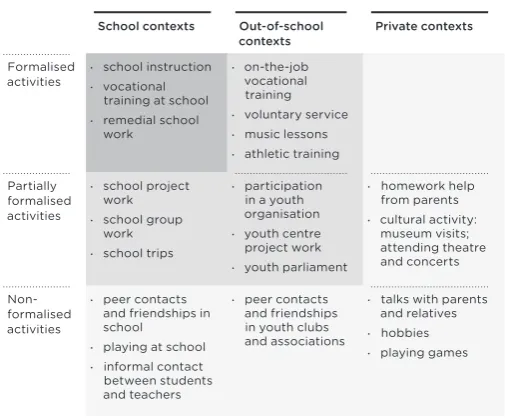
Table 1 Types of learning based on context and activity
School contexts Out-of-school
contexts Private contexts
Formalised
activities ·· vocational school instruction training at school
· remedial school work
· on-the-job vocational training
· voluntary service
· music lessons
· athletic training Partially
formalised activities
· school project work
· school group work
· school trips
· participation in a youth organisation
· youth centre project work
· youth parliament
· homework help from parents
· cultural activity: museum visits; attending theatre and concerts Non-formalised activities
· peer contacts and friendships in school
· playing at school
· informal contact between students and teachers
· peer contacts and friendships in youth clubs and associations
· talks with parents and relatives
· hobbies
· playing games
According to Unesco:
Non-formal education is an organized educational activity outside the established formal system that is intended to serve an identifiable learning clientele with identifiable learning objectives. Non-formal education can be delivered by governments, UN agencies, trade unions, sports clubs and national institutions but the biggest provider of NFE [non-formal education] remain youth organizations, especially volunteer-led youth NGOs, which base their educational programmes on equality, diversity and
responsible global citizenship.12
As table 1 outlines, activities can be described as ‘non-formal learning’ in a ‘formal education’ context if the activity is flexible or self-directed, such as project-based learning or the experience of a school trip. Equally, formalised and structured ‘extra-curricular’ activities taking place outside school such as sport, music lessons or social action pro-grammes like National Citizen Service can also provide opportunities for non-formal learning.
Finally, activity which is only partially structured and takes place outside school is also considered to be non-formal learning – this includes youth parliaments, uniformed groups such as The Scout Association and the Girl Guides, community project work and involvement in flexible social action.
Moreover, according to Unesco,
The importance of non-formal education, as generally practiced by youth NGOs and other providers, results from the specific characteristics that are intrinsic to it and which are, to a large
extent, not present in either formal or informal education.14
· group work
· student presentations · competitive activity
· lessons designed by students · school trip, or an overnight stay · outdoor activities
· work in the community
· mentoring or support from an older student
· work according to written instructions (e.g. a worksheet) · long-term project work
· hosting guests · work experience15
The Government provides very little guidance on ‘non-formal learning’ extra-curricular activities outside school settings, not defining or monitoring them centrally and leaving provision up to schools and their surrounding communities. However, it does consider them an important part of the educational offer of a school, as former Education Secretary Michael Gove put it:
I have never visited a school that excelled academically, which didn’t also excel in extra-curricular activities. As top heads and teachers already know, sports clubs, orchestras and choirs, school plays, cadets, debating competitions, all help to build character and instil grit, to give children’s talents an opportunity to grow and
to allow them to discover new talents they never knew they had.16
Drawing on statutory guidance on ‘positive activities’ issued under the last government, and a list of enrichment activities from a 2014 DfE research paper, the following broad categories of extra-curricular activity can be outlined:
· sports activities (like team or individual sports) · creative activities (like art, drama and model-making) · volunteering or social action (helping out your community
or doing things for charity)
· deliberative activities (like debating societies, a model UN, youth parliaments or school elections)
· uniformed activities (like The Scout Association, the Combined Cadet Force or Army Cadet Force, or similar organisations)17
The current extent of young people’s participation in these activities is described in more detail in the chapters that follow. However, it is clear that there is a great deal of non-formal learning already taking place in schools today: most schools provide trips and outdoor learning experiences in delivering the curriculum. Sutton Trust polling from 2014 found that 76 per cent of parents reported that their child had taken part in regular extra-curricular activity over the last 12 months.18
Moreover, extra-curricular activity is becoming increasingly important in university admissions: a survey of university admissions officers earlier this year found that 59 per cent believed that participation in extra-curricular activity had become more important in their decision-making.19
Non-formal learning activities – classroom pedagogies and out-of-classroom experiences – are receiving renewed attention because research shows that they can assist with academic and character development, and social and emotional skills.
Non-formal learning and character
Demos’s previous research on character, published in
Building Character, looked at three character ‘capabilities’:
· application, or ‘the ability to concentrate, discipline and motivate oneself to persist with and complete a task’ · self-regulation, or ‘emotional control and emotional
resiliency – an ability to bounce back from disappointment, conflict and distress’
More recently, a meta-review of the related concept ‘non-cognitive skills’ undertaken by Leslie Gutman and Ingrid Schoon of the Institute of Education on behalf of the Education Endowment Foundation provided a list of eight competencies which they considered to be modifiable, including some of the above: self-perception, social skills, motivation, perseverance, resilience, creativity and metacognition.21 The recent review
of social and emotional learning commissioned by the Early Intervention Foundation, Cabinet Office and the Social Mobility and Child Poverty Commission used a similar group-ing of ‘social and emotional skills’ in their longitudinal work.22
In the US, two of the most prominent names associated with the recent revival of character are Paul Tough, author of How Children Succeed, and James Heckman. Paul Tough, drawing on the work of the KIPP (Knowledge is Power Program) schools, has focused his research on the importance of ‘grit’ or resilience.23 James Heckman and his various
collaborators use what personality psychologists call the Big Five character skills, often referred to using the acronym OCEAN: openness to experience, conscientiousness, extraver-sion, agreeableness and neuroticism (or emotional stability).24
Much of this work focuses on what might be described as performance skills and attributes: things that make us more effective undertaking a task, managing stress or working in a team. Researchers tend to have focused less on the moral dimensions of character, such as honesty, integrity and dignity. The Jubilee Centre based at the University of Birmingham has been at the forefront of making the case for the importance of moral character virtues. Their Framework for Character Education in Schools includes four core dimensions of ‘character’:
· moral virtues such as courage, honesty, humility and gratitude · civic virtues such as service and volunteering – the moral
virtues acting in society at large
· intellectual virtues such as curiosity and critical thinking · performance virtues such as resilience, application and
The importance of these various skills, attributes and virtues has recently been reflected in government policy, with the Cabinet Office prioritising them through its Skills for Life and Work agenda, and the DfE through the Character Awards and Character Grant. The DfE drew on this research to define character as including the following traits,
attributes and behaviours:
· perseverance, resilience and grit · confidence and optimism · motivation, drive and ambition · neighbourliness and community spirit · tolerance and respect
· honesty, integrity and dignity
· conscientiousness, curiosity and focus26
Why does character matter?
The existing evidence base shows that possessing these character attributes matters for a range of later life outcomes, including educational attainment, employability, mental and physical health, life satisfaction and wellbeing. For the first report of the aforementioned review of social and emotional skills, researchers at the Institute of Education looked at the long-term impacts of social and emotional skills in childhood and adolescence. It was found that social and emotional skills at the age of 10 were more important than cognitive skills at that age when predicting mental health and life satisfaction in later life. The researchers also found that self-control and self-regulation in childhood were associated with better ‘mental health, life satisfaction and wellbeing, income and
labour market outcomes, measures of physical health, obesity, smoking, crime and mortality’.27 They also found correlations
between positive life outcomes and healthy self-perceptions, self-awareness, social skills and conscientiousness.
The evidence also suggests there is a correlation between character attributes and educational attainment.28 Studies
of social and emotional skills led to improved academic achievement as well as positive educational attitudes, behav-iour and attendance.29 This has also been highlighted by
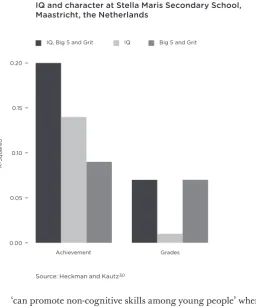
Heckman, who found that character traits can have a bigger impact on academic grades than measures of IQ (figure 1).
There is also evidence to suggest that character attributes are becoming even more important because of recent changes to the labour market. The Institute for Public Policy Research report Freedom’s Orphans found that analysis of longitudinal studies in 1958 and 1970 showed that ‘in just over a decade, personal and social skills became 33 times more important in determining relative life chances’.31 This is reflected in the
Confederation of British Industry’s and other employers’ consistent calls for schools to do more to build character.32
The moral and civic dimensions of character have also grown in significance recently, with concerns over radicalisa-tion and integraradicalisa-tion leading the Educaradicalisa-tion Secretary to encourage all schools to develop British Values by enshrining it as a separate criterion in the Ofsted inspection framework.33
Recent research by the Jubilee Centre has provided unique insight into the moral reasoning and character of the current generation of young people, assessing the ability of a sample of 10,207 students through moral dilemma tests: finding that British students on average struggled both to choose the moral course of action and provide the correct justification.34
Non-formal learning: the evidence
Taking part in extra-curricular activities or non-formal learning activities like those provided by The Scout Association and the Girl Guides has always been seen as important for the develop-ment of young people. However, with a greater emphasis on demonstrating impact, there is now evidence showing a link between non-formal learning and positive outcomes including educational attainment and development of the character attributes mentioned above. The literature review of ‘non-cognitive skills’ published by the Education Endowment Foundation found that school-based mentoring programmes
0.00 0.05 0.10 0.15 0.20
IQ, Big 5 and Grit
R-Squar
ed
IQ Big 5 and Grit
‘can promote non-cognitive skills among young people’ when the mentor receives training and supervision, and that the mentoring relationship is long-lasting.35
[image:37.340.38.295.64.372.2]Heckman and Kautz also found that service learning programmes – where students learn through a volunteering programme taking place in the community – ‘suggest moderate effects for academic outcomes and small effects for non-cognitive outcomes including social skills, self-perceptions, and motivation’ and that school-based social and emotional learning programmes are ‘effective at fostering positive outcomes and preventing negative ones’.36
Figure 1 The variance in achievement tests and grades through
IQ and character at Stella Maris Secondary School, Maastricht, the Netherlands
Source: Heckman and Kautz30 0.00
0.05 0.10 0.15 0.20
IQ, Big 5 and Grit
R-Squar
ed
IQ Big 5 and Grit
Heckman and Kautz also look at adolescent mentoring, residential and work experience programmes, finding them to be effective in improving outcomes, particularly in educational attainment and employment.37
The Demos report Scouting for Skills presents findings from a survey of 800 employers suggesting that employers view taking part in non-formal learning activities as highly valuable. Around 6 out of 10 employers thought that people they recruited who participated in Scouts ‘showed confidence and leadership ability’ and ‘had strong team-working skills’, and 41 per cent reported that participation in non-formal learning programmes like the Scouts ‘would be a positive influence on their decision to hire new employees’.38
The evidence base on the effectiveness of non-formal learning interventions is still developing, as highlighted by strand 2 of the review of social and emotional learning, which emphasised the relatively low standards of evidence of out-of-school programmes.39
A Demos paper commissioned by the Cabinet Office to accompany the review examined this in closer detail, concluding that evaluation in the UK youth sector is currently undergoing a period of significant development, driven by the Step Up To Serve’s #iwill Campaign and Generation Change, so standards of evidence are rapidly improving.40 In any case, there is good evidence on the
overall impact of the non-formal learning activities laid out above, as described below.
Sport
Creative activity
Participation in creative activity such as art and drama has been shown to have a significant impact on educational outcomes, with positive effects on attainment and intermediate outcomes such as self-concept and social capital, according to a DCMS-supported study. This study found that arts participa-tion had significant civic impacts, improving an individual’s capacity for ‘cultural citizenship’ and increasing community cohesion and social inclusion.42
Volunteering and youth social action
Taking part in volunteering and youth social action can also have a significant impact on educational and character outcomes. The recent Behavioural Insights Team evaluation of three youth social action programmes operated by the Citizenship Foundation, Envision and Voluntary Action within Kent found significant evidence of impact on empathy, coop-eration, grit, resilience, problem-solving skills, sense of com-munity and educational attitudes. It further found that participation led to higher wellbeing and willingness to be involved in community-related activity in future.43
The Jubilee Centre has reported that youth social action can be an important means of young people developing their character, particularly with regard to the civic and moral virtues.44 It also influences employability: an impact
evalua-tion of the Institute for Volunteering Research found that volunteering could help develop vital job skills such as communication, teamwork and social skills.45 The impact
of youth social action programmes on educational attainment is currently being investigated by Durham University with the support of the Education Endowment Foundation, due to publish in late 2016.46
Outdoor activities
Classroom published by the previous Department for Education and Skills led to Ofsted investigating the power of outdoor learning in a 2008 report. The authors concluded:
Learning outside the classroom can help to make subjects more vivid and interesting for pupils and enhance their understanding. It can also contribute significantly to pupils’ personal, social and
emotional development.48
They also argued that outdoor learning could help to overcome underachievement, and also that external agencies could play a key role in delivering this kind of learning. More recently, an Education Endowment Foundation evidence review found that outdoor adventure programmes had a ‘small to medium effect’ on social and emotional skills and academic achievement. The picture should become clearer later this year, as the Institute for Outdoor Learning is due to publish a comprehensive evidence review of its impact.49
Deliberative activity
Taking part in deliberative activity such as debating can have a significant positive impact on academic and character development. A comprehensive review of the evidence under-taken by the CfBT Education Trust and the English Speaking Union found significant impacts on attendance and attainment – with one study from the US finding that debaters in urban
high schools were 25 per cent more likely to complete school, and African American males who took part in debate were 70 per cent more likely to complete. It also finds significant impacts on communication, confidence and critical thinking, with one meta-analysis arguing that participation in communi-cation skills classes can increase critical thinking skills by as much as 44 per cent.50
Uniformed groups
above, and do so in a non-time bound and progressive way. The Scout Assocation’s impact assessment report conducted by Public and Corporate Economic Consultants shows that ‘the nature and scale of Scouting brings significant personal and professional development opportunities’ to its members, with over 90 per cent of respondents improving their character skills such as relationship-building, leadership ability or team-working.51
Conclusion: what is non-formal learning
and what should we call it?
Drawing from this discussion, we understand that non-formal learning:
· can take place either outside school, or in particular school settings
· involves particular activities, which are either relatively unstructured, or structured but not in a school setting · achieves particular outcomes, often with a focus on
character development
In the workshops held as part of this project, education experts and representatives from the youth sector were concerned that the treatment of this kind of learning as ‘non-formal’, ‘extra-curricular’ or ‘enrichment’ would somehow
denigrate it, making it less integral to the curriculum and therefore less worthy of schools’ time. Some preferred the term ‘co-curricular’, with the implicit suggestion that these activities help to achieve the curriculum’s objectives.
3
Findings – young
people’s attitudes
towards non-formal
learning
In order to understand the potential appetite for non-formal learning among students, we undertook a nationally repre-sentative survey of young people between the ages of 14 and 18 years in England, Wales, Scotland and Northern Ireland. We also conducted the same survey with 1,172 current
participants aged 12–25 in Scouting across the UK, and draw comparisons where appropriate throughout this chapter. The findings from our young people in Scouting survey is presented in discrete boxes at the end of each section to provide easy identification and comparison.
In our surveys we asked young people including those in Scouting a range of questions about background, ethnicity, religion, the schools they attended in primary and secondary education, and whether they received free schools meals (FSM). The demographic breakdown of the surveys is included in the technical appendix at the end of this report.
higher levels of participation in non-formal learning activities, more positive attitudes towards school, and significantly higher levels of character attributes.
Social and emotional skills
and attitudes to education
As noted above, there is good evidence that taking part in non-formal learning activities can facilitate the development of ‘character’ attributes and social and emotional skills, which are otherwise not developed in a more traditional, formal education setting. In both of our surveys we sought to test whether there was a link between self-reported character attributes and participation in ‘non-formal learning’.
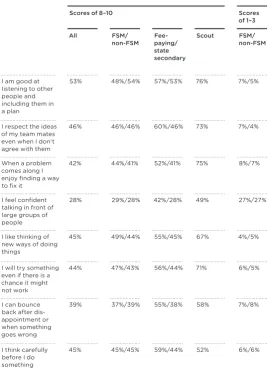
Table 2 shows the percentage of respondents who agreed most strongly (scores of 8–10) with various statements on social and emotional skills. About half or just under half of respondents strongly agreed with the statements – with the exception of the one on public speaking skills, where just over one in four felt that they were ‘confident talking in front of large groups of people’.
Interestingly, there were only a few instances where respondents who received FSM were less likely than those who did not receive FSM to report strong agreement that they had these skills. However, there were more substantial gaps between respondents who attend or attended a fee-paying secondary school and those who attend or attended a state secondary school on almost all measures of social and emo-tional skills that we included in the survey. (The sample for fee-paying respondents was 70 people.)
Table 2 The proportion of respondents who scored 8–10 when
considering various statements on their social and emotional skills, and FSM and non-FSM respondents who scored 1–3
Scores of 8–10 Scores of 1–3 All FSM/
non-FSM Fee-paying/ state secondary
Scout FSM/ non-FSM
I am good at listening to other people and including them in a plan
53% 48%/54% 57%/53% 76% 7%/5%
I respect the ideas of my team mates even when I don’t agree with them
46% 46%/46% 60%/46% 73% 7%/4%
When a problem comes along I enjoy finding a way to fix it
42% 44%/41% 52%/41% 75% 8%/7%
I feel confident talking in front of large groups of people
28% 29%/28% 42%/28% 49% 27%/27%
I like thinking of new ways of doing things
45% 49%/44% 55%/45% 67% 4%/5%
I will try something even if there is a chance it might not work
44% 47%/43% 56%/44% 71% 6%/5%
I can bounce back after dis-appointment or when something goes wrong
39% 37%/39% 55%/38% 58% 7%/8%
I think carefully before I do something
Box 1 Young people in Scouting survey results
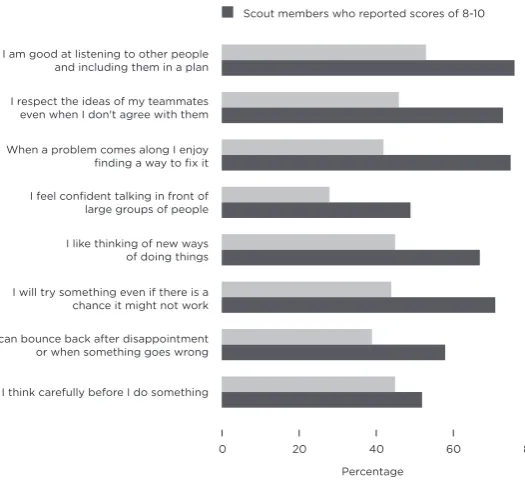
Figure 2 shows that young people in Scouting consistently reported having significantly stronger character attributes and social and emotional skills than young people in general.
On every measure (except for ‘I think carefully before I do something’ – where there was still a +10 percentage point difference), there is at least a +20 percentage point difference between young people in Scouting and young people in general.
Young people in Scouting were also more positive about school:
Figure 2 The proportion of 14–18-year-old and Scout respondents
who scored 8–10 when considering various statements on their social and emotional skills
Percentage
14-18 year olds who reported scores of 8-10 Scout members who reported scores of 8-10
I am good at listening to other people and including them in a plan
I respect the ideas of my teammates even when I don't agree with them
When a problem comes along I enjoy finding a way to fix it
I feel confident talking in front of large groups of people
I like thinking of new ways of doing things
I will try something even if there is a chance it might not work
I can bounce back after disappointment or when something goes wrong
I think carefully before I do something
· Approximately nine out of ten said they received good marks
in school compared with eight out of ten of young people not involved with Scouts.
· Less than 5 per cent agreed with the statement that ‘school
was a waste of time’, compared with 9 per cent of young people in general.
· Only 13 per cent agreed that ‘most of the time I don’t/didn’t
[image:47.340.43.293.230.479.2]want to go to school’, compared with 25 per cent of young people in general.
Figure 3 The proportion of respondents who agreed
with various statements on school
Percentage
All respondents Non-FSM respondents FSM respondents Scout respondents
I get/got good marks for my work
School is/was a waste of time
People think/thought my school is a good school
Most of the time I don’t/didn’t want to go to school
We also wanted to better understand young people’s attitudes towards and experience of school. We asked respondents to state whether or not they agreed with a series of statements on school (figure 3). While on average young people were very positive about their experience of school, there were marked differences between the responses of FSM and non-FSM stu-dents, and between those of Scouts and non-Scouts. Non-FSM students were more positive than their counterparts about every statement, including most significantly, ‘Most of the time I don’t want to go to school’, where there was a 12 point gap – FSM students also reported receiving worse grades and were
more likely to consider school a waste of time.
While more work needs to be done on the contributing factors when comparing the demographic backgrounds for both groups, our surveys appear to demonstrate what many Scout volunteers and teachers believe about the benefits of taking part in non-formal learning activities such as Scouts. This should be a compelling rationale for investigating the scale of such partnerships to a much greater extent across the education system.
Taking part in non-formal learning activities
Drawing on the definitions of non-formal learning derived from the DfE which we outlined above, we asked young people whether they had taken part in extra-curricular activities and whether they did so in school or outside school. Overall, approximately nine out of ten (87 per cent) young people reported taking part in at least one of these activities in the past 12 months. Sport activities were most popular (two out of three reporting taking part), followed by creative activities (two out of five) and outdoor activities (two out of five). One-third of respondents reported that they had undertaken voluntary work (32 per cent).
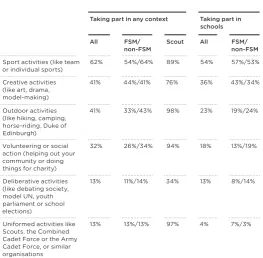
activities (12 per cent of 14-year-olds compared with 21 per cent of 18-year-olds). As table 3 shows, there are notable differences between how much FSM and non-FSM respondents take part in volunteering or social action activities, sport and outdoor activities. Again, young people in Scouting were significantly more likely to report taking part in ‘non-formal learning’ activities – and not just those in the categories of ‘uniformed’ and ‘outdoor’ activities.
Table 3 The proportion of respondents taking part in
non-formal learning in any context and in schools
Taking part in any context Taking part in schools All FSM/
non-FSM Scout All FSM/non-FSM
Sport activities (like team
or individual sports) 62% 54%/64% 89% 54% 57%/53% Creative activities
(like art, drama, model-making)
41% 44%/41% 76% 36% 43%/34%
Outdoor activities (like hiking, camping, horse-riding, Duke of Edinburgh)
41% 33%/43% 98% 23% 19%/24%
Volunteering or social action (helping out your community or doing things for charity)
32% 26%/34% 94% 18% 13%/19%
Deliberative activities (like debating society, model UN, youth parliament or school elections)
13% 11%/14% 34% 13% 8%/14%
Uniformed activities like Scouts, the Combined Cadet Force or the Army Cadet Force, or similar organisations
Box 2 Young people in Scouting survey results
As was to be expected, young people in Scouting were signifi-cantly more likely to report taking part in uniformed activities and outdoor activities – with nearly 100 per cent reporting participation in each. Also highly significant, however, is that nearly all young people in Scouting (94 per cent) reported taking part in volunteering and social action. And indeed young people in Scouting were more likely to take part in all non-formal learning activities, including sport, creative and deliberative activities.
Are non-formal learning activities
taking place in school?
Table 3 shows that outdoor activities and volunteering activities were most likely to take place outside schools (23 per cent in school compared with 41 per cent in any context for outdoor activities, and 18 per cent in school compared with 32 per cent in any context for volunteering activities). Uniformed activities were also more likely to take place outside school (7 per cent in school versus 13 per cent in any context). By contrast, 100 per cent of deliberative activities took place in school.
Respondents who receive or received FSM were slightly more likely to report taking part in non-formal activities like sport and creative activities inside school rather than in an outside school setting. Yet FSM respondents were less likely to take part in outdoor activities or volunteering activities outside schools.
Which non-formal learning activities
do schools not provide enough of?
By a substantial margin, respondents thought that uniformed activities were most likely to be seen as under-provided by schools: 43 per cent of young people disagreed that schools provided enough opportunities to take part in uniformed activities, followed by 24 per cent who cited lack of volunteer-ing opportunities, and just under one in four who wanted more opportunities to take part in deliberative and outdoor activi-ties (23 per cent and 22 per cent respectively).
Bearing in mind the small sample, there are significant differences between respondents who attend or attended fee-paying secondary schools and those who attend or attended state secondary schools. For example, 39 per cent of state school respondents agreed that their school provided enough opportunities for volunteering and social action compared with 70 per cent of fee-paying school respondents, enough outdoor activities (49 per cent state school respondents agreed compared with 82 per cent fee-paying school
respondents), enough deliberative activities (40 per cent state school respondents agreed compared with 80 per cent fee-paying school respondents) and enough uniformed activities (19 per cent state school respondents agreed compared with 42 per cent fee-paying school respondents).
Box 3 Young people in Scouting survey results
Scouting were slightly more likely than young people in gen-eral to report that schools should provide more opportunities for all non-formal learning activities – reflecting a greater recognition for the importance of these activities given their higher levels of participation.
Should non-formal learning activities
count towards qualifications?
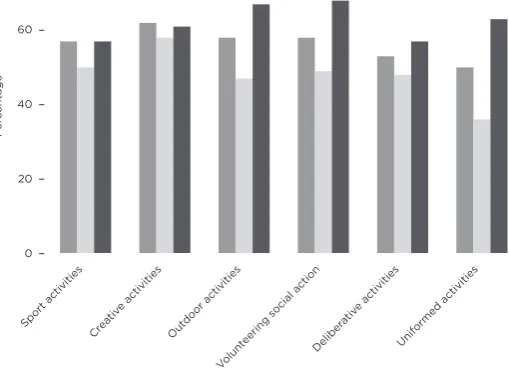
Approximately half of all respondents wanted to see non-formal learning count towards GCSEs or A-levels or their equivalents – with the highest levels of support for creative activities (58 per cent) and lowest levels of support for uni-formed activities (38 per cent). While there was little difference in support levels from students at fee-paying schools compared with those at state secondary schools, there were some notable differences between the views of FSM students and those of non-FSM students (figure 4).
For example, FSM students were some ten percentage points more likely than non-FSM students to want outdoor activities and volunteering or social action activities to count towards their qualifications. While the precise cause of this difference is unclear, it could be because FSM students have fewer opportunities to take part
in these activities outside school, or they are more likely to be disengaged in more academic subjects and formal learning activities, as the question addressing their attitudes towards school laid out above in figure 3 would indicate.
Box 4 Young people in Scouting survey
[image:53.340.44.299.151.335.2]Across all non-formal learning activities, young people in Scouting were more likely than those not in Scouting to want to see these activities count towards their GCSE and A-level qualifications. There was most support for seeing volunteering and social action count towards qualifications (68 per cent), followed by outdoor activities (67 per cent), uniformed activi-ties (63 per cent), creative activiactivi-ties (61 per cent), deliberative activities (57 per cent) and sports activities (57 per cent). Figure 4 The proportion of respondents who agreed that
various non-formal learning activities should count towards qualifications
0 20 60
40
P
er
centage
Sport activities Crea
tive activities
Outdoor activities Volunt
eering social actionDeliber ative activities
Uniformed activities
Non-FSM agreeing that non-formal learning should count towards qualifications FSM agreeing that non-formal learning should count towards qualifications
Non-formal learning pedagogies
We asked respondents whether they undertook a range of other activities that could be classified as non-formal learning pedagogies, as outlined in the previous chapter, for example, group work, presentations to the class or school, trips or overnight stays, work experience placement, long-term projects, competitions, activities in the community, or lessons designed by students. Non-FSM students were more likely to have taken part than FSM students in all of these activities. Indeed, 16 per cent of FSM students said that they had never taken part in any of them, compared to just 7 per cent of non-FSM students.
Young people’s perceptions of Scouting
We also asked respondents specific questions about Scouting, in order to determine if their support for more non-formal learning related to their support for a particular model. Among our sample, nine out of ten respondents said that they knew what the Scouts were (85 per cent FSM students com-pared with 91 per cent of non-FSM respondents). One in three respondents (33 per cent) agreed with the statement ‘people like me do not take part in Scouts’, while approximately the same number (30 per cent) disagreed. Similarly, approximately one in four agreed with the statement ‘Scouting is cool’, while just over one in four (28 per cent) disagreed. On these state-ments, there was no significant difference in responses by FSM eligibility or other demographics.
There were also mixed levels of support for delivering Scouting activities in school. While notable numbers of respondents were interested in having the opportunity to take part in schools, more students were against the idea than for it:
· One in four (27 per cent) agreed ‘that it would be worth having a Scouting session once a week even if it meant a longer school day’ (42 per cent disagreed).
[image:55.340.55.306.187.343.2]· One in four (25 per cent) agreed that ‘if I had the opportunity, I would like to be part of the Scouts’ (45 per cent disagreed).
Table 4 The proportion of respondents who agreed with
various statements on Scouting, by whether on FSM
All FSM Non-FSM Scout
Students should be able to take part in Scouting activities during school hours
33% 45% 31% 40%
All students should have to take part in Scouting activities in school
17% 28% 16% 19%
If I had the opportunity, I would like to be part of the Scouts
25% 39% 23% N/A
I think it would be worth having a Scouting session once a week even if it meant a longer school day
27% 34% 26% 40%
Scouting is cool 23% 33% 21% N/A
As might be expected, the majority (57 per cent) disagreed that ‘all students should have to take part in Scouting activities in
Figure 5 The proportion of respondents who agreed
with various statements on Scouting
Box 5 Scouting members survey
As may be expected, there were quite high levels of support among young people in Scouting for the provision of more activities in schools.
Approximately half (48 per cent) agreed that ‘Scouting activities should take place in schools during one afternoon a week’, while 40 per cent agree that ‘people should be able to take part in Scouts during school hours’; 40 per cent also agreed that ‘it would be worth having a Scouting session once a week even if it meant a longer school day’. There was particu-larly strong support for students having the opportunity to take part in Scout activity centres (87 per cent). As might be ex-pected, 42 per cent agreed that ‘badge and awards gained through Scouting should be a formal part of school assessments’.
0 10 20 30 40 50
Percentage
Non-FSM agreeing FSM agreeing
Students should be able to take part in Scouting activities during school hours All students should have to take part in Scouting activities in school If I had the opportunity,
I would like to be part of the Scouts I think it would be worth having a Scouting session once a week even if it meant a longer school day
However, young people in Scouting disagreed with mak-ing Scoutmak-ing compulsory: only one in five (19 per cent) agreed that ‘all students should have to take part in Scouting activities in school’. Similarly, one in five agreed that they did not ‘think Scouts should work with schools at all’.
There was recognition that Scouts would have to change if it were to be delivered in schools among half of respondents. But young people in Scouting seemed comfortable with different models of Scouting. For example, 58 per cent agreed that Scouting activities could easily take place at the end of the school day with teachers as leaders, and 71 per cent said that they were ‘confident that at least a few of my teachers at school could deliver Scouting activities’.
Conclusions
As the findings presented above show, there is significant appetite among British young people for more opportunities to take part in non-formal learning. But even more importantly, there were important differences in their opinions of existing provision and the desire for more ‘non-formal learning’ provi-sion, socio-economic background and school type. While discrepancies were not necessarily consistent across all meas-ures – and while small sample sizes (for young people attending fee-paying schools, for example) need to be taken into account – nonetheless there appear to be unequal opportunities for
British young people.
It is particularly worrying that our research and pre-existing research suggests there is a link between taking part in these activities and having strong character attributes. Indeed, our survey with young people in Scouting showed they had substan-tially higher levels of social and emotional skills, a trend that is backed up by the evidence presented in the previous chapter.
4
Findings – teachers’
attitudes towards
non-formal learning
In order to understand if teachers desire more non-formal learning activities in schools, we designed and commissioned a representative survey of 800 teachers, heads of department, deputy heads and head teachers across the UK, which was undertaken by the polling company Schoolzone. The full breakdown of respondents’ job roles, number of years teaching, and school type is included in the technical appendix of this report.
School provision of non-formal learning activities
Figure 6 shows the non-formal learning activities provided in the schools in which the teachers work. (These are the activities that we asked young people about in the previous chapter.) As with young people, teachers were most likely to report that their schools provided sport and creative activities, while uniformed activities were infrequently or never provided. The majority (58–73 per cent) of teachers reported that their school provided volunteering, deliberative activities and outdoor learning activities either ‘somewhat often’ or ‘not very often’.
of schools provide opportunities to participate, only a minority of young people take these up. Equally, young people might be unaware of the opportunities their school provides, or teachers might be over-optimistic and overestimate the opportunities available.
Non-formal learning pedagogies
We asked a subsample of our teachers (including classroom teachers, subject coordinators and heads of department, year and key stage, n = 500) whether through their work in the classroom they personally provided or were involved in
Percentage Very often Not very often
Somewhat often Never
Sports activities
(team or individual sports)
Creative activities
(art, drama, model-making etc.)
Volunteering or social action
(for a charity or within a community)
Outdoor activities
(hiking, camping, horse-riding etc.)
Deliberative activities
(debating society, model UN, youth parliament etc.)
Uniformed activities
(Scouts, the Combined Cadet Force, the Army Cadet Force etc.)
[image:60.340.39.292.147.432.2]0 20 40 60 80
Figure 6 Activities for students offered in schools
the same list of non-formal learning pedagogies that we asked students about. As seen in figure 7, group work was by far the most common form of learning strategy, followed by written instruction classwork, long-term project work and student presentations. Half (51 per cent) of teachers had never hosted guests or outside speakers, 46 per cent had never personally helped coordinate work experience visits, and 46 per cent had never worked in the community in the last 12 months. One in three teachers said that they had never taken part in lessons designed by students.
While this shows mixed levels of engagement when providing non-formal learning, our survey reveals there are very high levels of teacher support for more.
Appetite for non-formal learning activities
Three out of five teachers strongly agreed that non-formal education can help young people develop important social and emotional skills, as well as skills that are important for the workplace (figure 8). Over half (54 per cent) of respond-ents strongly agreed that their studrespond-ents would benefit from non-formal education opportunities. Combining the ‘strongly agree’ and ‘agree’ we see that over nine out of ten teachers have favourable attitudes towards providing non-formal education opportunities.
Figure 7 How often in the last 12 months teacher respondents
were able to take part in or were involved with activities as part of their work
Percentage
At least once a week At least once a year At least once a month
At least once a term
Never
Group work
Student presentations to the class or school
Competitive activities
Lessons designed by students
Trip or overnight stay
Outdoor activities
Work in the community/fieldwork
Mentoring or support from an older student
Work following written instructions
Long-term project e.g. coursework
Hosting guests
Work experience placement/visit
Figure 8 The extent to which teacher respondents
agree or disagree with statements about non-formal education
Percentage
Strongly agree Disagree
Agree
Neither agree nor disagree
Strongly disagree
Given the opportunity, I would like to help deliver more non-formal education activities in my school The provision of non-formal learning activities should be given more weight when schools are assessed Non-formal education should be recognised in the National Curriculum Regular participation in non-formal education should be compulsory for stu