www.c2learn.eu
CO-CREATIVITY EVALUATION
ANALYSIS
C
2LEARN PROJECT DELIVERABLE NO. D5.4.2
Author(s): OU: Chappell, K., Walsh, C., Kenny, K., Wren, H., Craft, A.1; BMBF:
Schmoelz, A., Aichhorn, A., Dober, R., Jastraunig, M.; EA: Stouraitis, E., Koulouris, P.; UEDIN: Scaltsas, T., Stenning, K., Alexopoulos K.
Dissemination level: Public
The C2Learn project has been supported by the European Commission through the Seventh Framework Programme (FP7), under grant agreement no 318480 (November 2012 – October 2015). The contents of this document do not represent the views of the European Commission and the Commission cannot be held responsible for any use which may be made of the information contained therein. Responsibility for the information
and views set out in this document lies entirely with the authors. © C2Learn Consortium, 2015. Reproduction is authorised provided the source is acknowledged.
1
Version: 4.0, 31st October 2015 FINAL Page | 2
DOCUMENT IDENTITY
Project Category Details
Deliverable Code D5.4.2
Full title Co-Creativity Evaluation Analysis
Work package WP5
Task T5.5 Co-Creativity Evaluation Analysis
Consortium partners leading UEDIN
Consortium partners contributing OU, EA and BMBF
DOCUMENT HISTORY
Version Date Handling partner Description
1.0 12/09/2014 UEDIN/OU/EA/BMBF Initial draft of D5.4.1.
1.1 03/10/2014 UEDIN/OU/EA/BMBF Additions to initial draft.
1.2 17/10/2014 UEDIN/OU/EA/BMBF Further additions.
2.0 24/10/2014 UEDIN/OU/EA/BMBF Major internal review/revision. Significant expansion.
3.0 31/10/2014 UEDIN/OU/EA/BMBF Final draft of D5.4.1
3.1 15/08/2105 UEDIN/OU/EA/BMBF Initial draft of D5.4.2.
3.2 UEDIN/OU/EA/BMBF Major internal
Version: 4.0, 31st October 2015 FINAL Page | 3
Significant expansion.
3.3 20/10/2015 UEDIN/OU/EA/BMBF Further additions.
Version: 4.0, 31st October 2015 FINAL Page | 4
EXECUTIVE SUMMARY
C2Learn at a glance
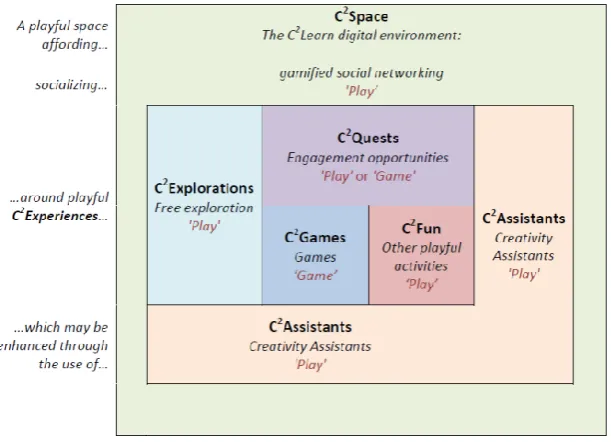
[image:4.595.146.452.424.645.2]C2Learn (www.c2learn.eu) is a three-year research project supported by the European Commission through the Seventh Framework Programme (FP7), in the theme of Information and Communications Technologies (ICT) and particularly in the area of Technology-Enhanced Learning (TEL) (FP7 grant agreement no 318480). The project started on 1st November 2012 with the aim to shed new light on, and propose and test concrete ways in which our current understanding of creativity in education and creative thinking, on the one hand, and technology-enhanced learning tools and digital games, on the other hand, can be fruitfully combined to provide young learners and their teachers with innovative opportunities for creative learning. The project designs an innovative digital gaming and social networking environment incorporating diverse computational tools, the use of which can foster co-creativity in learning processes in the context of both formal and informal educational settings. The C2Learn environment or C2Space is envisioned as an open-world ‘sandbox’ (non-linear) virtual space enabling learners to freely explore ideas, concepts, and the shared knowledge through participating in C2Experiences assisted by the systems artificial intelligence (AI) known as C2Assistants (Figure 1). This innovation is co-designed, implemented and tested in systematic interaction and exchange with stakeholders following participatory design and participative evaluation principles. This happens in and around school communities covering a learner age spectrum from 10 to 18+ years.
Figure 1: C2Learn's C2Space and its subcomponents
About this document
Version: 4.0, 31st October 2015 FINAL Page | 5
Version: 4.0, 31st October 2015 FINAL Page | 6
CONTENTS
Executive summary ... 4
List of figures ... 7
List of tables ... 7
List of abbreviations and terms ... 8
1. Introduction ... 9
2. UK and Austrian pilot (M21 cycle) analysis synthesis... 9
2.1 Synthesized comments on co-creativity ... 9
2.1.1 Ethics and impact of ideas ... 10
2.1.2 Engaging in dialogue ... 10
2.1.3 Being in control ... 11
2.1.4 Engaged action ... 11
2.1.5 Intervention and reframing ... 12
2.1.6 4Ps ... 13
2.1.7 Undertaking a journey of becoming ... 13
2.1.8 Generating quiet revolutions ... 14
2.1.9 Pedagogic strategies ... 14
3. UK and Greek pilot (M30-M36 cycles) analysis synthesis ... 16
3.1 Synthesized comments on co-creativity ... 17
3.1.1 Ethics and impact on ideas ... 18
3.1.2 Engaging in dialogue ... 20
3.1.3 Being in control ... 21
3.1.4 Engaged action ... 23
3.1.5 Intervention and reframing ... 25
3.1.6 4Ps ... 26
3.1.7 Undertaking a journey of becoming ... 27
3.1.8 Generating quiet revolutions ... 27
Version: 4.0, 31st October 2015 FINAL Page | 7
4. UK and Austrian pilot (M30-M36 cycles) analysis synthesis ... 32
4.1 Synthesized comments on co-creativity ... 33
4.1.1 Ethics and impact of ideas ... 33
4.1.2 Engaging in dialogue ... 35
4.1.3 Being in control ... 36
4.1.4 Engaged action ... 37
4.1.5 Intervention and reframing ... 38
4.1.6 4Ps ... 40
4.1.7 Undertaking a journey of becoming ... 41
4.1.8 Generating quiet revolutions ... 41
4.1.9 Pedagogic strategies ... 42
5. Socratic Dialogue review based on the pilot findings ... 45
5.1 Reflective tool ... 45
5.2 Co-Creativity fostering tool ... 47
5.3 Evaluative tool ... 47
References ... 49
LIST OF FIGURES Figure 1: C2Learn's C2Space and its subcomponents ... 4
LIST OF TABLES Table 1: Methodological information for UK and Greek Primary School analysis ... 17
Version: 4.0, 31st October 2015 FINAL Page | 8
LIST OF ABBREVIATIONS AND TERMS
A) Abbreviated names of the project consortium partners
Abbreviation Explanation
EA Ellinogermaniki Agogi, Greece (coordinator)
UEDIN The University Of Edinburgh, UK
OU The Open University, UK
NCSR-D National Center For Scientific Research "Demokritos", Greece
UoM Universita ta Malta, Malta
SGI Serious Games Interactive, Denmark
BMBF Bundesministerium für Bildung und Frauen, Austria (Former: BMUKK)
B) Other abbreviations
Abbreviation Explanation
CER Creative Emotional Reasoning
LDS Living Dialogic Space
MIA Multimodal Interaction Analysis
SD Socratic Dialogue
Version: 4.0, 31st October 2015 FINAL Page | 9
1. INTRODUCTION
The present document, deliverable D5.4.2, is the final installment of a document describing the outcomes of the Co-creativity Evaluation Analysis of data and information gathered through the pilot activities (M21, M30 and M36 Pilot Cycles), following the methodology defined by T2.3. Led by the UEDIN team, in close collaboration with OU, EA and BMBF, it sets out in detail the qualitative and quantitative analysis performed, according to the defined conceptual foundations and assessment methodology of the project (D2.3.1-2), leading to syntheses of the pilot findings. This is complemented by a review of the Socratic Dialogue tool, in light of the pilot findings.
2. UK AND AUSTRIAN PILOT (M21 CYCLE) ANALYSIS SYNTHESIS
This section synthesises the common analytic outcomes, as well as the differences, in response to the C2Learn Research Questions, based on formal analyses of the UK and Austrian data, from the M21 Pilot Cycle.2 It must be remembered that the Austrian data was collected within an intensive week of secondary school piloting in one school and the UK data was collected across one primary and one secondary school site working over longer time periods. This difference in context and longevity was considered as part of the synthesis and is commented on as appropriate across the writing below.
This synthesis of the more formal analyses of the UK and Austrian pilot data is generally in agreement with the informal findings from the Greek pilot.
1. How do participants manifest co-creativity (WHC and CER) through C2Learn gameplay?
The analysis for Question 1 uses the Co-creativity categorisation framework to structure the Findings:
2.1 SYNTHESIZED COMMENTS ON CO-CREATIVITY
In the UK especially, there was discussion from the students that suggested they felt that “creativity”, and “imagination” might exist in the game per se. UK teachers had mixed views on whether students were being creative in their thinking process. On the one hand they thought they were thinking creatively when, for example, they made connections between 4Scribes cards, on the other hand they thought they weren’t thinking creatively enough, especially in terms of being too literal when interpreting cards. In Austria, there was much less discussion of creativity per se within the game, with evidence regarding creativity closely related to the WHC categories. In Austrian discussions though, there was articulation of the “playful” and “motivational” benefits of the game per se in relation to learning.
Version: 4.0, 31st October 2015 FINAL Page | 10
2.1.1 ETHICS AND IMPACT OF IDEAS
(Generating, exploring and enacting new ideas with valuable community impact (discarding other ideas that do not.)
There was a very small amount of data to indicate that some of the UK primary and secondary students and some of the Austrian students may have been paying attention to ethics and impact. In the UK, this came from teachers noticing that some secondary students were knowingly negatively disrupting fellow students’ directions of play. Although others of the UK secondary students felt they were developing new ideas which made a ‘positive difference’ “quite a lot”; this was registered both through their wheel scores and reported on in the students’ interviews. Secondary students’ interviews in Austria and the UK and the primary teacher interview also exhibited primary and secondary students weighing up the ‘pros and cons’ of pushing their own 4scribes ending or that of others, as well as debating the most interesting elements of their stories on the grounds of their ethical impact (eg the right person being allowed to survive in the story). Although the UK primary and secondary teachers especially felt that the students were not referring directly to ethics, there were some hints that the UK children and young people were thinking about the rights and wrongs of how they structured the story and how this impacted on their fellow gameplayers. The evidence for the Austrian secondary students, specifically in terms of the teacher’s commentary, showed that thinking about ethics was more explicit. Examples include applying empathy to prevent negative outcomes, selecting a ‘better’ person to survive over a more superficial person, debating ideas such as “compassion” and using their card intervention to ensure a protagonist’s well-being. This was supported by the students’ own ratings of themselves as ‘quite a lot’ or ‘a lot’ on this category on the creativity wheel.
2.1.2 ENGAGING IN DIALOGUE
(Posing questions, debating between ideas, finding ways to negotiate conflict or to go in a different direction to others if conflict not resolved.)
Version: 4.0, 31st October 2015 FINAL Page | 11
2.1.3 BEING IN CONTROL
(Taking charge of parts of the creative process (understanding rules of the system, decisions have consequences, making decisions, taking action.)
The UK secondary data showed a variety of takes on the idea of ‘Being in control’. It translated as students not feeling in control due to the way the 4Scribes rules made them play. It also translated as students taking control to play strategically around some of these issues in order to lead the story to their desired ending. UK primary students also showed evidence of being in control as well as wanting to be in control of the game; and both sets of UK students showed evidence of using humour as part of achieving this. This range of types of control is perhaps reflected in the UK secondary students’ responses on the creativity wheel where students mostly responded on the middle level, with one on the lowest level. Interestingly the UK secondary teacher questioned whether having to have a winner forced a level of competitiveness which was detrimental to fostering their co-creativity, which links to the point above regarding Austrian students being able to remove competitiveness in favour of collaboration by showing each other their cards. The UK secondary teacher also pointed out that they thought that overall the detachment between player turns limited any tactical manoeuvres, and in turn perhaps the control the students felt they had over the game. The UK primary teacher recognised that the possibility of being in control in a competitive way was perhaps not an advantage as it allowed more dominant children to take the lead. Similar relationship dynamics were identified in the Austrian secondary student groups with, despite the best efforts of students who noticed the imbalances in control and tried to rebalance them, some students took such passive roles that they asked their group leader what to write on the card. Stepping back more generally to consider the Austrian secondary data though, there was evidence of most of the participants being able to exert some kind of control over gameplay and of their creative experience through it, via transforming the meanings of cards, and even going so far as to create an unrequested rap (spoken word poetry) out of their story. The Austrian researcher highlighted students being in control, both individually and as a group (apart from the one student indicated above in the passive role) as a strong factor in the development of the game, with them going so far as changing the rules across gameplay and disrupting the initial input from the teacher.
2.1.4 ENGAGED ACTION
(Being immersed in the experience. Being addicted, not able to stop, trying repeatedly. Such immersion sometimes leads to taking risks.)
Version: 4.0, 31st October 2015 FINAL Page | 12
possible when players had their turn, a longer kind of immersion in the game in the UK secondary site was not possible in its current format. In contrast, the UK primary teacher reported that the children wanted to continue playing after the pilot as they understood the game better, the more engaged they became, although also indicating that their engagement might be due to the competitive nature of the game. In the Austrian secondary site there also seemed to be a range of engagement in the game, which might have been connected to the meaningful interlinking of learning activities and their relationship to who was in control of group dynamics, with the suggestion that those more in control were more engaged. There was also evidence from one of the Austrian groups of extremely deep immersion in the C2Learn gaming activity which saw them gaming in their non-contact time, creating a DVD cover, writing a script – all unrequested by their teacher. The Austrian researcher commented on the implications of this for the development of C2Learn activities in the classroom more widely and understanding how the activities could build into other non-digital teaching and learning in different curriculum areas.
The Austrian researcher highlighted a possible extension of the engaged action category which will need further investigation in the next stages of piloting to verify it. This was the notion of collaborative transformational agency where students’ and teachers’ lived experience saw collaborative agency as a great driver for engagement in their class and beyond. In the Austrian analysis, the experiences of collaboratively transforming meaning by the students emerged throughout the pilot phase. It is difficult to judge whether this collaborative transformational agency was due to the intensity of the Austrian pilot which occurred during a one week intensive workshop based on curriculum crossing domains (German, music , IT). From here this theme needs to be considered across the UK and Austrian sites in the next C2Learn pilot in order to try to ascertain whether it has the potential to occur in other C2Learn sites too as a part of C2Learn gameplay.
2.1.5 INTERVENTION AND REFRAMING
(Specific changes in thinking patterns, and in particular reasoning processes. Changes in expression, primarily in linguistic terms, but also encompassing other modes as well.)
Version: 4.0, 31st October 2015 FINAL Page | 13
2.1.6 4PS
(Evidence of high participation [engagement and involvement], high pluralities [taking on many roles, personae, perspectives], high playfulness [operating in an as if and playful manner] and high possibilities [generating many ideas through what if and as if thinking].)
In the UK sites, students expressed differing views about their participation and possibilities in the game. The two students that marked themselves as relatively high on participation described their gameplay as “fun” and “exciting”. This was supported in the video capture where they appear to enjoy the competitiveness of disruptor gameplay where they exhibit possibility thinking within a playful role. For example, one student contributed a very imaginative twist to the story which illustrated his imagination and the accompanying possibility thinking at play. Possibility thinking was also evidenced in the UK in post gameplay discussion, when students were thinking of ways in which the game could work in school. In English they believed it could be a revision activity, with certain vocabulary or punctuation being incentivised. They also saw the potential for using the game as a story telling tool. Even though one student marked herself into the negative zone on participation and possibility, on the film capture she animatedly found a way for those who had been left behind to be reintegrated into the story. This illustrates participation in picking up on and developing part of the story line perhaps a little more than her own grading gives her credit for on the Axes. UK teachers reported they believed 4Scribes had real potential for combining playfulness and possibilities. One SE teacher mentioned that he could perceive the benefits of “disciplining their creativity”, because he saw this as good for students’ thinking skills. This perhaps relates to how he perceived the quality of the students’ participation. Importantly, the UK teachers recognised the need for more playing time in order for the students to get comfortable enough to start to think ahead during gameplay. There was little evidence of discussion of the idea of pluralities in the UK, but this is likely because of the limited nature of the piloting and the prototype in this phase.
The Austrian secondary data illustrates self-reported high possibility and high participation by all students involved. All gameplay activities had a strong group dynamic and different degrees of high participation, where at times there were leaders, who took control over almost the activities and others have been rather passive, but still report high participation and possibilities. One students on the lower spectrum of high participation stated on interview that she liked the gameplay activity but she is not good friends with the leading participants and as a result felt demotivated due to the group dynamic, but not due to the gameplay
2.1.7 UNDERTAKING A JOURNEY OF BECOMING
(Over time, noticeable changes in participants’ dispositions and/or personalities. This may involve smaller incremental changes.)
Version: 4.0, 31st October 2015 FINAL Page | 14
personalities. In the Austrian site, the researcher observed an incremental and cumulative change in one student’s dispositions and/or personalities who was new to the class. At the beginning of the pilot, the student was very cautious and self-contained but as gameplay continued over the course of the one week intensive, the student became highly engaged especially when the students collaboratively transformed the story into a screenplay that was produced into a film. At the end of the pilot, when his group showed the film and everybody was watching, his heart started to pump so hard, that he showed everybody his chest and how it moved with the heartbeat. On film, he exclaimed with a surprised smile, “I have never felt something like this before”. This example succinctly illustrates one participants’ journey of becoming, as he transformed from a newcomer to what the teacher has described as ‘the hero of the group’.
2.1.8 GENERATING QUIET REVOLUTIONS
(Over time more noticeable changes in the creative community stemming from creative ideas generated; might comprise smaller incremental changes.)
In the UK, the short time frame of the pilot limited to possibilities to generate quiet revolutions, yet one noticeable change was that the students’ exhibited more confidence amongst themselves. The teachers also commented that was evident amongst the group of students and believed if 4Scribes was used with more students at scale, rather than just the pilot students who volunteered, it likely had the potential to boost student confidence more generally. This highlights the potential for change might be possible through gameplay and immersion in C2Learn gaming and social networking environment and that researchers should remain alert to this during the next piloting phase. In the Austrian site, like due to the compressed timescale, quiet revolutions were not observed, but what was observed was students revisiting their playing 4Scribes and the collaborative stories they authored. The Austrian researcher noted the group grew more cohesive as a result of this revisiting activity. This is something to be considered in the subsequent pilot, the idea of revisiting collaborative storylines and the possibility of generating quiet resolutions upon reflection of gameplay.
2.1.9 PEDAGOGIC STRATEGIES
(Evidence teachers proactively valuing learners’ ideas and actions; enabling learners to take the initiative; ensuring sufficient space and time for ideas and actions to emerge getting alongside the learner and learning as fellow collaborator.)
Version: 4.0, 31st October 2015 FINAL Page | 15
Version: 4.0, 31st October 2015 FINAL Page | 16
3. UK AND GREEK PILOT (M30-M36 CYCLES) ANALYSIS SYNTHESIS
This section synthesises the common analytic outcomes, as well as the differences, in response to the C2Learn Research Questions, based on formal analyses of the UK and Greek data, from the M30 and M363 Pilot Cycle (Primary school).
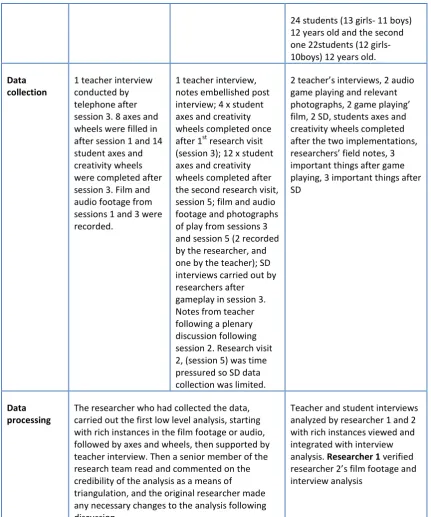
English primary 1 (SE) English primary 2 Greek primary
Contextual information
Gameplay took place across 3 sessions with 3 classes of year 5 and 6 children. Game play was across 3 sessions and three classes of year 5 and 6 children, using paper prototypes. A research visit in February worked with 2 groups of 4 children (2 male and 2 female in each group). These eight then
disseminated their learning to their classmates between visits. In March a follow up research visit worked with 24 children in 6 groups.
Game play was across 5 sessions and 4 groups of 4 year 5 children, using galaxy tablets, and accessing the 4scribes tool. A research visit in May worked with one group of 4 children. In June a follow up research visit worked with three groups of 4 children. One group in this second visit began with digital tools, however technical difficulties meant that they completed their gameplay on paper.
Game play was across 2 sessions and one class of year 6 children, using digital and paper prototypes. The classroom was divided into 4 groups. Each group consisted of three teams. Each team includes two players. This research worked with one focus group of 6 children. In addition to this focus group, this paper involves analysis’ comments for the whole class. The first visit to this 6 grade classroom was at 17th of March 2015 and a second round took part at 28th of April 2015. Students played a 4scribe (basic version) history lesson scenario (2 hours) [scenario: How you can live under social and economic rules of Ottoman Empire] and a 4scribe (basic version) geography scenario (2 hours) [scenario: You lost in a mountain and you are seeking how you will go back] in digital or paper-based form (due to technical problems). In addition to the previous
implementation, researchers attended to the classroom two additional hours applying SD and filling in the research forms. All students created their own pseudonyms so as to complete researcher’s form. It is
important to underline that students did not use their pseudonyms during game play but only when they completed the researchers’ forms.
3
Version: 4.0, 31st October 2015 FINAL Page | 17
24 students (13 girls- 11 boys) 12 years old and the second one 22students (12 girls-10boys) 12 years old. Data
collection
1 teacher interview conducted by telephone after session 3. 8 axes and wheels were filled in after session 1 and 14 student axes and creativity wheels were completed after session 3. Film and audio footage from sessions 1 and 3 were recorded.
1 teacher interview, notes embellished post interview; 4 x student axes and creativity wheels completed once after 1st research visit (session 3); 12 x student axes and creativity wheels completed after the second research visit, session 5; film and audio footage and photographs of play from sessions 3 and session 5 (2 recorded by the researcher, and one by the teacher); SD interviews carried out by researchers after gameplay in session 3. Notes from teacher following a plenary discussion following session 2. Research visit 2, (session 5) was time pressured so SD data collection was limited.
2 teacher’s interviews, 2 audio game playing and relevant photographs, 2 game playing’ film,2 SD, students axes and creativity wheels completed after the two implementations, researchers’ field notes, 3 important things after game playing, 3 important things after SD
Data processing
The researcher who had collected the data, carried out the first low level analysis, starting with rich instances in the film footage or audio, followed by axes and wheels, then supported by teacher interview. Then a senior member of the research team read and commented on the credibility of the analysis as a means of triangulation, and the original researcher made any necessary changes to the analysis following discussion.
[image:17.595.83.515.69.587.2]Teacher and student interviews analyzed by researcher 1 and 2 with rich instances viewed and integrated with interview analysis. Researcher 1 verified researcher 2’s film footage and interview analysis
Table 1: Methodological information for UK and Greek Primary School analysis
3.1 SYNTHESIZED COMMENTS ON CO-CREATIVITY
Version: 4.0, 31st October 2015 FINAL Page | 18
1. How do participants manifest co-creativity (WHC and CER) through C2Learn gameplay?
The analysis for Question 1 uses the Co-creativity categorization framework to structure the Findings:
3.1.1 ETHICS AND IMPACT ON IDEAS
(Generating, exploring and enacting new ideas with valuable community impact [discarding other ideas that do not].)
In the English Primary 1, there is a good amount of data to indicate that some of the students were paying attention to ethics and the impact of their ideas. There was evidence across all but one of the categories, with at least 1 rich instances per sub-category that students were demonstrating that they thought about the consequences of their ideas, exploring and actioning new ideas and exhibiting awareness and concern for the impact of new ideas on the group’s values. The data indicated that there was evidence across most of the categories but students primarily demonstrated that they thought about the
consequences of their ideas. In English Primary 1, In the March 23rd 2015 pilots the student’s awareness of ethics and impact of ideas seemed to lead to more surprising ideas, for example we noticed that: “students showed an understanding of ethical decision making but chose to use some ideas which could be considered unethical in order to get to their ending” and that: “One player decided to kill his dad for money and to help him win”. When rating themselves on the creativity wheels on ‘exploring new ideas that make a positive difference’, most of the young people felt that they were doing this quite a lot. Only three students thought they were doing this a lot even though this was one of the most evidenced of the WHC categories.
In English Primary 2, there was also a good amount of evidence of children attending to ethics and impact of ideas, half of which was generated from rich instances of gameplay, half of which was generated from rich instances of gameplay. In the Greek Primary School, there was primarily evidence of students exploring an actioning new ideas, thinking about the consequences of their ideas, creating new associations between ideas and actively explores the consequences of the newly created associations between ideas. Team work and collaboration were primarily the catalyst for attending to ethics and impact of ideas in the Greek primary school.
Exploring and actioning new ideas
Version: 4.0, 31st October 2015 FINAL Page | 19
more through this system, but again it was the higher ability children, they were the ones who spotted these ideas they developed the ideas themselves, in their heads, and saw links. Lower level children, I’m not so sure they would.” and in a specific session “Well it was interesting that Jaboscus was saying earlier, with the water shortage, that he wanted to take it from someone, give it to others who were more needy. So certainly he was looking at it as he felt Robin Hood’s system, taking from those who’ve got abundance and giving to those who’ve got not much. In Greek Primary School, students used the card “learn” as a stimuli to create a new idea when students use the meaning of the word and not just the word”. On interview the teacher reported, in regards to the history scenario, where gameplay took place, “they felt that they created themselves something new in terms of history lesson and that is interested to them”. After gameplay, on interview a student Melopoulos reported: ‘The game gave us a chance to use our creativity and the imagination that we needed in order to develop our own stories’
Thinking about the consequences of their ideas
Across all 3 sites, there was evidence of the children thinking about the consequences of their ideas. In English Primary 1, one student was thinking deeply about ethics, both inside and outside of the story when he tried to ensure the betrayal between child and parents was resolved. However, in the process added a twist to undo the bits in the story that had caused a little upset between the players, Bob said: “Meanwhile Ginny knew she betrayed her parents so she got a box of treasure from heaven using a ghost body, then turned invisible and gave the box to her parents” The teacher also confirms this one interview, “some students were beginning to think about the consequences of their ideas. They took into account other people’s characters and what they wanted to do. I think that very much depended on the innate ability of the children” and “the children themselves wouldn’t have worried about impacting on other people” but that: “for some children, they wouldn’t want to perceive it as them spoiling another story, if they were a little bit more focused on achieving their ends”. In the English Primary 2, there is also fairly strong evidence pointing to children thinking about the consequences of ideas. In the May session this seemed to be particularly apparent, where the character in the story assumed power, “They won’t be able to kill me, I’m the man of Earth.” In the Greek Primary school, in the second pilot, within the geography scenario, Sakis Theodoropoulos pointed out that gameplay ‘puts me in thought process’ and ‘It (Gameplay) depends on peoples’ imagination’, both highlighting that students were thinking about the consequences of their ideas, because without doing so the gameplay would likely be boring.
Understanding different ideas are of different value to the community
Version: 4.0, 31st October 2015 FINAL Page | 20
water seems to have sparked concern for the wider community, with the introduction of a community minded outlaw – stealing from the rich to give to the poor noted by Jaboscus, and commented upon by the teacher at the end of the session. “Me and Metal Mario are going to share it, we’re going to steal it from you – I’m going to be like Robin Hood, steal it from the wealthy give it to the poor”. “Well it was interesting that Jaboscus was saying earlier, with the water shortage, that he wanted to take it from someone, to give it to others who were more needy. So certainly he was looking at it as he felt Robin Hood’s system, taking from those who’ve got abundance and giving to those who’ve got not much” A strong sense of morality seems to be in evidence, which was reinforced in another group by Taby“In silence wrote ‘The woman came to and said you did not have to keep the water you just give it to someone that really needs it.”
Overall the evidence across the three sites showed that the students were thinking about the consequences of ideas whilst attending to ethics and the impact of ideas. There was also a small amount of data which suggested some students were exhibiting awareness and concern of new ideas on the group’s values, exploring and actioning new ideas and creating new associations between ideas. The Greek teacher sums it up this way: “It was nice that children use dilemmas or they got in touch with their cognitive experiences or dilemmas. In this way the imagination expands. The conclusion is not clear because we want more implementation. If we had not the technical problems, maybe I could notice more the substance”. Across all three sites, teachers (and researchers) noted that if there had not been so many technological problems, there would likely be more robust evidence of the students attending the ethics and impact of ideas.
3.1.2 ENGAGING IN DIALOGUE
(Posing questions, debating between ideas, finding ways to negotiate conflict or to go in a different direction to others if conflict not resolved.)
Debating between ideas
Across all 3 sites, there is evidence that there was quite a lot of dialogue taking place during gameplay. In SE1, Following the 23rd February 2015 session the teacher noticed that the students were debating between themselves about the story they had constructed:
“When they came back from working with you,..the conversations that they had had with you, they had continued all the way down the corridor, down to my classroom, and into the cloakroom. So, it had engaged them enough for them to keep going, discussing, and going over what things had happened and what they might change, I do remember that”.
Version: 4.0, 31st October 2015 FINAL Page | 21
of Water be against The Girl of Fire?”. When rating themselves on the creativity wheels most students thought that they worked on their own and with other people quite a lot. In the Greek Primary School, students were always active dialoguing during gameplay. The teacher confirmed that one person had a leading role during the procedure but this behavior changed during the second implementation. Students engaged in dialogue in helpful ways as they worked together as a team.
Posing questions with and of others
There was 1 strong rich instance in this category in the English Primary 2, and this was the only rich instance across the ‘engaging in dialogue section. When Jaboscus says “I’m the woman off water. We had this argument last time. To be ‘of’ something means to be made of it.” [Long dialogues, involving the researcher and Sambot.] “It doesn’t mean their spiritual form dies as well” he is posing questions of his group, and suggesting that this is not the first time these issues have been discussed. He also attempts to draw the researcher into the conversation, widening the dialogue beyond his play group.
Overall across all three sites, the evidence suggests that dialogue was mostly used for debating ideas
3.1.3 BEING IN CONTROL
(Taking charge of parts of the creative process [understanding rules of the system, decisions have consequences, making decisions, taking action].)
In the English Primary 1, there is evidence that students were using different techniques to take control. This category was the most evidenced through actual game play. There were also instances of students trying to take ownership of and change the story when they didn’t approve of it. An example of this is when one student eliminates the character that had killed other characters off: “Using the symbol that was in the magic unicorn hoof she brought everyone back to life, but the rabid man Paul died and was never able to be brought back to life”. One student recognised how going last would enable him to change the story at the end towards his direction: “I hope I get the last card, and then I am able to change it.” Players also used teamwork to control the direction of the story as some of the players teamed up against Brian to destroy his evil character. This is recognised by Brian and he then realises the importance of teamwork in the construction of the story when he says: “Are you on my side? Which team are you on?”
Version: 4.0, 31st October 2015 FINAL Page | 22
In SW1, there was considerable evidence of ‘being in control’. They are dealt with separately below:
Taking charge of different parts of the creative process: The teacher identified that there were particular children who were more likely to ‘lead’. “This group, there was a very strong character in there and she was leading the pack a lot more”. The teacher also believed that the children were unused to having the power to change their roles. “it’s not for you to adapt that character, that character is what it says on the card, and that doesn’t change.” A strong theme that seemed to emerge was one of teacher control, but the evidence gives an interesting contradiction between what the teacher said he had done overall “I’ve taken a very back seat during C2Learn and given them all the autonomy to completely control their game”and what he actually did“So everything is teacher led, and that’s fine, but a question mark icon in the top corner would help.” There was also suggestion from the teacher that the app was exerting a level of control over the storymaking, inhibiting the children’s creativity by imposing spelling and grammar rules, “because it’s their own story they should be dictating punctuation not being prompted, and also spelling mistakes, if they’re made, they shouldn’t be too hung up on them,”“Some of them were getting frustrated at actually a lot of things they were writing were being underlined, that was a bit demotivating. Whereas if we completely cut that out of the app, they could write without that stigma, or thinking ‘oh not only am I struggling with writing a story, in a given time limit, in a given word limit, with a card I’m not sure what it is, but also my spelling’s not right, my punctuation is a bit sloppy’”
Understanding the rules and that they have consequences: The teacher noticed discussion between the children about what could and could not happen, “A lot of refreshing their memories as to what can and can’t be included in the story, and there was a lot of rebuttals. Like people saying you can’t include that that’s not… they were looking at continuity much more in the story.” as well as some attempts to re-engineer the rules to meet their own ends. “I think they understand them enough that they want to play just within them, some of the children; they want to stretch them a little bit.” The inbuilt unfairness of the voting system was cause for concern early in this pilot, with children noticing that the order of play impacts on the success or failure of the endings. “The system is not fair because the last person to add their paragraph gets to lean the story towards their ending more than the first person.”
Version: 4.0, 31st October 2015 FINAL Page | 23 Overall, across all three settings analysis of the data suggested that the main element of control was evidenced through taking charge of the story in order to get to the student’s ending or to undo previous parts of the story. There was also a small amount of data to suggest that some students were mainly making decisions and taking action when they wanted to change (control) the perspective of the story. The English Primary 2 data provided the largest count of evidence overall and there appears to be some evidence that the children were enabled to be decisive, regardless of ability, and the methods the employed seem to evidence a level of confidence, which transcends gameplay ability. The Greek data confirms this, “I think if they played more, they would have started to see those links a little bit more clearly. Their ability to manipulate the events to their own conclusion, I think that would have got better with experience”(T)
3.1.4 ENGAGED ACTION
(Being immersed in the experience. Being addicted, not able to stop, trying repeatedly. Such immersion sometimes leads to taking risks.)
The English Primary 1 and 2 and Greek Primary data indicates there was quite a lot of engaged action taking place during both pilots. There was evidence recorded across all of the categories in the English Primary 1 and 2, but students were mostly showing immersion.
This was evidenced through teacher and researcher observations rather than the rich instances of gameplay. In regards to immersion: “Students were engaged throughout and ensured the story flowed from one to another”; “Players were engaged with the gameplay during their turns but were a little distracted when it was not their go”;“I was quite surprised that once they had played the game, how enthusiastic and engaged they must have been to come back into the classroom being really buzzy about it”.
In regards to coming up with surprising ideas: one student, who was not taking the game seriously at the beginning, came up with the most surprising twist to the story of the group: “Jimmy was writing a book by candlelight, as the woman of water fell the candle flickered – when she hit the ground the candle went out – he was left in darkness” and when another student suggested that “you have to kill me because you love me so much” In English Primary 2, This area was the most evenly rated on the creativity wheels, with 5 ‘a lot’ 5 ‘quite a bit’ and 6 ‘a bit’. Evidence also comes from a rich instance, but it is from a part of gameplay which occurred after the digital tool failed, and the children were playing on paper. ChiChi invented a card for her turn, saying that she had forgotten her original cards. The card she invented, whilst following the format of 4Scribes, i.e. a baby, was particularly useful to her in achieving her secret ending. “Baking Baby – I made them up”
Version: 4.0, 31st October 2015 FINAL Page | 24
were engaged throughout and ensured the story flowed from one to another.” and that at times the engagement occurred during their turn but less so when it wasn’t. In the 23rd March 2015 pilots immersion was observed again but this time the students became more engaged as the story developed: “Students were more engaged when trying to direct the story towards their endings.” The Greek teacher highlights how students attempted to take risks “they tried to present something new even if there had some difficulties but they surpassed. I do not know how it influenced the plot of the story if this brought out from a context they were but I think they can control it if they had some cards, these cards were few”.
In English Primary 2 data also indicates there was quite a lot of engaged action taking place during both pilots. Immersion in and does parts of the game/ activities addictively: There was some evidence from gameplay of immersion, both in the children’s behavior, and also their conversation outside of their turn. A verbal outburst from two players, plushy friend and metal Mario “Ay Ay Ay” seems to have been linked to forging alliances within the story, with a view to reaching their ends, and isolating another player, Sambot. They appear to be immersed in the story outside of their turns. The teacher did not feel that the children were immersed in the games, “Stories did not keep children entertained between their turns “because their imaginations were really engaged when they were doing stuff, but when they weren’t involved their minds were wandering to other things and then they were losing interest towards the end.” In the plenary session much earlier in the pilot, he expressed the same belief “Children not using the App have to wait a long time before taking their turn and have nothing to occupy them. The teacher admits however that the children are keen to take part in the C2Learn activities “but when I’ve said that we’re doing C2Learn they have been engaged. They’ve wanted to do it.”
Taking risks and leave his/her comfort zone: On two occasions in different game sessions, it appeared that the children did not understand the word on their cards. Instead of stopping, or asking for help, these children played on. This seems to be a brave move for such young children. The teacher agreed that this behaviour seems to suggest an element of risk taking “Some were taking risks by using the cards because the card was quite complex and I had an idea that they only has a vague grasp of what it was suggesting.”
Version: 4.0, 31st October 2015 FINAL Page | 25 Overall across all three pilot sites, the main element of engaged action that was evidenced was immersion and wanting to play the game. This was observed mostly by teachers and researchers but was demonstrated in gameplay and wanting to continue gameplay. There was disengagement when the students were in-between turns.
3.1.5 INTERVENTION AND REFRAMING
(Specific changes in thinking patterns, and in particular reasoning processes. Changes in expression, primarily in linguistic terms, but also encompassing other modes as well.)
In English Primary 1, evidence of intervention and reframing to create new perspectives and new connections was observed in most of the sessions. For example Bobby Junior said: “Can I say who the person talking is?” as he wanted to change the perspective of the narrative and Brian asked: “Shouldn’t The Elder Woman of Water be against the Girl of Fire?” in order to try to change the collaborative story into a conflicting one. A new connection was suggested by Lara when she advised another player to respond to: “was she going to go left or was she going to go right? But The Woman of Wind swept her up with the wind” and Julie brings all elements of the story together through the suggestion that the wind is instrumental in making the circus go ‘crazy’ when she added: “and there was loads of wind on the island…and that’s why the circus is going crazy”, thus creating new connections and perspective of the story at once. These examples suggest that the intervention and reframing tended to happen when cooperation was occurring in the story.
In English Primary 2 there was more evidence of Intervention and reframing than in English Primary 1, Using stimuli in creative activity was evidenced when a child seeing the character on the card in a more personalised way, as the ‘wind grandma’ rather than the old woman of wind’ “The woman of fire joins up with the wind grandma and tries to destroy everyone who opposes them” to the boy who ignored the word on his card, and gained his inspiration from the image instead. “The farmer got magical powers from dodo whispering” The student used the image on the card in place of the word. The authoring of the co-creative story itself seemed to stimulate imaginative thought processes. The teacher seems to view the stimulus in a more pragmatic fashion, as a means to an end “definitely that system of writing scaffolds how to write a story, and the assisting with cards does help them when they get stuck or they don’t know what to do” “That gives them that springboard into actually writing the story.” The plenary session on the 11th May seems to largely support the teacher’s thoughts, that this game could be a tool to stimulate the imagination. “Sometimes, it depends on the context. If you have to write a story in class then you have no idea sometimes what to write. This game helps because you get a card and if the card is relevant then it starts your imagination working more.”
Version: 4.0, 31st October 2015 FINAL Page | 26
‘crazy’ connections are made. Using stimuli to help develop a new perspective of the challenge: At the first research visit Jaboscus responds “The past is past” to a comment from Sambot regarding the finality of death, at the second research visit, he was again responding to Sambot, and refers back to another game play session, suggesting that they have had ongoing debate. The crux of the matter was again Sambot attempting to kill Jaboscus’ character, and Jaboscus using philosophical thought to counter the death. “I’m the woman off water. We had this argument last time. To be ‘of’ something means to be made of it.” Long dialogues, involving the researcher and Sambot. “It doesn’t mean their spiritual form dies as well”. Jaboscus first seems to limit the impact of time on his current situation, and then seems to become quite spiritual when discussing the survival of his character, the woman of water. It may be that the student’s comment is correct in limiting the craziness of the stories to the imaginations of the players. “However, if people have good imaginations then the story can go crazy easily, but then it can turn out really good.”
In the Greek Primary School, there is limited evidence of intervention and reframing, but the students did believe they were using the stimulus a lot or quite a lot to think in new ways. .
Overall the evidence suggests that the English students were creating connections between ideas, developing new perspectives and sometimes going beyond the material provided by the challenge. The evidence also suggests that the English students, and to some extent the Greek students, were creating connections between ideas, developing new perspectives and sometimes going beyond the material provided by the challenge though gameplay.
3.1.6 4PS
(Evidence of high participation [engagement and involvement], high pluralities [taking on many roles, personae, perspectives], high playfulness [operating in an as if and playful manner] and high possibilities [generating many ideas through what if and as if thinking].)
In the English Primary 1 and the Greek Primary School, data identified in the rich instances demonstrated high participation or high possibilities which suggests that there were times where students were experiencing engagement, being involved in the process and were sometimes thinking about the possibilities of the game. There was a small amount of evidence to suggest some of the students were using pluralities and playfulness to help with the construction of their story. Greek students commented: ‘We could all express our opinions’ and I liked that every child could freely express his/her opinion about each story’.
Version: 4.0, 31st October 2015 FINAL Page | 27
the use of pluralities was when the whole group took on a new personae. This occurred when Dermatologist used a strange accent when he said “the elder woman of water”, which the rest of the group then adopted.
In the English Primary 2, the evidence for 4 Ps was spread across the categories, with 6 rich instances of possibilities 5 of pluralities, 4 of participation and 2 Playfulness. This suggests that on many occasions children were generating possibilities, as well as taking on many roles, personae and perspectives. There is limited evidence of engagement and evidence of playfulness. At the first research visit all four children marked themselves highly for possibility, but were divided as to whether they had participated, Plushy friend and Sambot marking high participation, while Metal Mario and Jaboscus marked themselves very low on this scale. The rich instances would suggest that Sambot has correctly rated himself, as he has contributed two rich instances in the participation category, whereas Plushy friend has none. Jaboscus has contributed the only two examples of generating possibilities in that session.
Overall, the data illustratesstudents believed they were experiencing high participation and possibilities during game play however, the data from the axes and wheels showed that the students were not always recognising this. Evidence showed the use of pluralities during game play when the students were thinking of others, bringing in previous characters and storylines and using different accents.
3.1.7 UNDERTAKING A JOURNEY OF BECOMING
(Over time, noticeable changes in participants’ dispositions and/or personalities. This may involve smaller incremental changes.)
In the English Primary 1, overall there was very little evidence of changes in student behaviour over time. Researchers saw small amounts with the groups who were present for both pilots, there was not any clear evidence from the students and the teacher didn’t recognise any in these pilots but thought there may have been if the pilots were digital. In
English Primary 2 and the Greek Primary School, there was a small amount of evidence to suggest that there were changes to children’s behaviour over time, but that this was not a JOB.
3.1.8 GENERATING QUIET REVOLUTIONS
(Over time more noticeable changes in the creative community stemming from creative ideas generated; might comprise smaller incremental changes.)
Across all three pilot sites, there was no evidence of generating quiet revolutions. However, this was to be expected given that quiet revolutions are anticipated to take place over extended periods of activity, which was not the nature of these pilots
Version: 4.0, 31st October 2015 FINAL Page | 28
(Evidence teachers proactively valuing learners’ ideas and actions; enabling learners to take the initiative; ensuring sufficient space and time for ideas and actions to emerge getting alongside the learner and learning as fellow collaborator.)
In the English Primary 1, evidence showed that C2Learn made the teacher make the students more aware of what they were doing through discussion of the wheel categories. The teacher thought this led to increased talking in class. The teacher also thought that C2Learn made her more explicit and focused on what she was doing in class and the data showed that she had started to think about different scenarios she could use in the game especially to help the students with resolution. “Had I not been involved with C2Learn, I don’t think I’d be as explicit as I was, so I think it helped me to focus on that a little bit more.” There was also evidence of the teacher thinking about ideas of how to use C2Learn in the classroom in the future: “and I was thinking today about stories that they could create you know based around somebody who was either being healthy or unhealthy… so I do think it would require a little bit more thought going into it, but I think you could build on other scenarios within that.”
In English Primary 2, The teacher stated that the C2Learn model was how he would like to teach. He stated that he had taken a “back seat during the C2Learn pilot”. However his control was evident both in his interview “So everything is teacher led, and that’s fine,” and in the field notes “Halfway through play – the other half of the class returned from outdoor play, and were instructed to read quietly. This meant that the teacher renewed focus on silence – so as not to disturb the readers.” It appears that the teacher believed he was teaching during the C2Learn project in a more relaxed way, but in fact he seems to have been exerting a level of control over space, dialogue and volume, and student activity.
In the Greek Primary School, the teachers noted the Socratic Dialogues gave them a chance to understand children’s opinion about their role across gameplay. “I think in everything there maintain a measure. It is a positive tool as we can see in this moment but this could not be repeated so often. This is my opinion. We should test it sometimes during the school season. All the others should connect with other activities with the lesson. ” and “As we say C2learn, it is the meaning of creativity. I think that we already work with creativity’s axe. I cannot say that this (C2learn) rebut the teaching. Our goal is to foster creativity. So, every teaching which corresponds to creativity is legitimate”.
Question 1 Summaries for main categories
Version: 4.0, 31st October 2015 FINAL Page | 29 yet this was not necessarily the case in Greece. Overall across the 5 co-creativity categories, it is therefore possible to say that the primary students evidenced some co-creativity when they were engaging with C2Learn tools and environments. Out of the 4Ps, participation and possibilities were the most evidenced across the three sites; there was limited evidence of pluralities in England and little evidence of playfulness as well when a student noted how the game was more fun than work. Perhaps to be anticipated, there was little evidence of journeys of becoming or quiet revolutions because of the curtailed length of the pilots and continuous failure of the C2Space on the tablets.
2. How does manifesting of co-creativity (WHC and CER) in C2Learn change over time?
Assessment of students’ lived-experience in terms of co-creativity along the WHC dimension.
In both of the English primaries, there is some evidence of change over time. In the English Primary 1, the rich instances data showed most of the students thought that they tried out new ideas and different ways of doing things either the same or less in the second pilot than they did in the first. They also thought that they would think about what might happen because of their ideas either less or the same in the second pilot. In contrast, however, most of the students thought they could decide which ideas were valuable to the community more in the second pilots showing an increase in the ratings in the second pilots. In regards to engaged action, there was a noticeable change in the rating over time with one student in this category. Magnificent Swimmer rated getting addicted to the game and taking herself out of her comfort zone a bit in the first pilots and a lot in the second. She also thought that she came up with ideas that surprised others quite a lot in the first pilots but a lot in the second pilots.
In the English Primary 2, at the second research visit, small changes were noticed. From the first research visit, although the students have reduced their self-assessment by this time. At the first research visit only thinking about the consequences of ideas generated rich instances, whereas the second visit generated rich instances of Understanding different ideas are of different value to the community and Actively explores the consequences of the newly created associations between ideas. With the creativity wheel, some small changes were evident, with players reducing their ranking for poses questions with and of others, but
increasing negotiates conflict or goes in a different direction. In regards to the 4Ps, at the first research visit all four children marked themselves highly for possibility, but were divided as to whether they had participated, Plushy friend and Sambot marking high participation, while Metal Mario and Jaboscus marked themselves very low on this scale. The rich instances would suggest that Sambot has correctly rated himself, as he has contributed two rich instances in the participation category, whereas Plushy friend has none. Jaboscus has contributed the only two examples of generating possibilities in that session. After the second visit all four had moved their assessment to high for both participation and possibility. The rich instances show that these four children contributed many instances of
4Ps.
Version: 4.0, 31st October 2015 FINAL Page | 30
also a will to work with children of a similar ability level “they kind of sought each other out “. He believed that with more sessions the ability groupings would become the norm “we’d have one group which was very high level, very competitive and everyone’s arguing, one group which is kind of midlevel and everyone’s actually working very well together and being quite humble about each other’s ideas, and then a lower group who potentially need a lot of assistance to actually get them to work as a group” “So I think they would separate, given the opportunity and given enough practice, into those sort of categories.”
It is possible that there was a slight change in the behaviour of Sambot over the piloting period. During the first research visit he was highly vocal, and contributed 3 of the 5 rich instances, however in the second research visit he contributed no rich instances. On one occasion he was seen to be playing a clapping game with a friend in another group, and he also isolated himself, saying ‘go away’ and pushing plushy friend away. He seems to have moved from being a controlling member of the group to an outsider. Comparing the children’s axes, shows that Plushy friend and Sambot did not think their possibility or participation had changed over time, but both Metal Mario and Jaboscus moved from negative participation to strongly positive participation. The rich instances do not support this self-assessment.
In the Greek Primary, despite the fact that students expressed their huge interest about the games, they did not seriously change their thinking patterns. Deeper engagement and more implementations are needed so as to form a conclusion.
3. What role is played by C2Learn technological tools and corresponding pedagogical
interventions, focusing in particular on students’ experience?
In the English Primary 1, the pilot was conducted with paper versions of the 4scribes game. It was evident that both the teacher and student were disappointed by the lack of digital tools. Analysis of all of the data demonstrated that aspects of the WHC features were displayed through the use of the cards despite the teacher’s dislike of them. The teacher thought that the images on the cards were sometimes hard for the students to understand and reframe, she said: “The pictures on the cards often threw them”. However, the rich instances data showed that there was a fair amount of reframing occurring throughout the games and that there were two instances of students who used the images very creatively to go beyond what was presented before them. For example used the ‘book’ image to suggest that the death of the previous character had an effect on the whole environment: “Jimmy was writing a book by candlelight, as the woman of water fell the candle flickered – when she hit the ground the candle went out – he was left in darkness”. Another student, One Direction Lover used her girl of earth image to make connections to the circus: “But the amazing girl of earth (lily) made a brilliant new tent, for doing the circus with the animals, out of trees”
Version: 4.0, 31st October 2015 FINAL Page | 31
4. Development and refinement of C2Learn’s Assessment Methodology tools with particular focus on:
[a] Tailoring of categories to C2Learn’s game(s)/gaming environment.
None recorded
[b] Developing the Socratic Method type interview protocol in relation to C2Learn’s game(s)/gaming environment.
None recorded
[c] Specifying the Computational Creativity metrics to be used.
None recorded
[d] Refining the rest of the evaluation tools in relation to C2Learn’s game(s)/gaming environment.
Version: 4.0, 31st October 2015 FINAL Page | 32
4. UK AND AUSTRIAN PILOT (M30-M36 CYCLES) ANALYSIS SYNTHESIS
This section synthesises the common analytic outcomes, as well as the differences, in response to the C2Learn Research Questions, based on formal analyses of the UK and Austrina data, from the M30 and M36 Pilot Cycle (Secondary School).
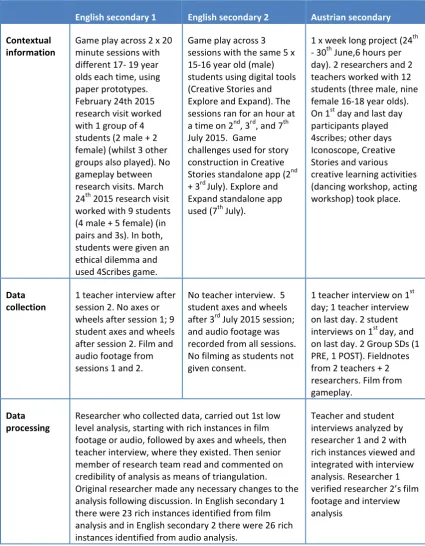
English secondary 1 English secondary 2 Austrian secondary
Contextual information
Game play across 2 x 20 minute sessions with different 17- 19 year olds each time, using paper prototypes. February 24th 2015 research visit worked with 1 group of 4 students (2 male + 2 female) (whilst 3 other groups also played). No gameplay between research visits. March 24th 2015 research visit worked with 9 students (4 male + 5 female) (in pairs and 3s). In both, students were given an ethical dilemma and used 4Scribes game.
Game play across 3 sessions with the same 5 x 15-16 year old (male) students using digital tools (Creative Stories and Explore and Expand). The sessions ran for an hour at a time on 2nd, 3rd, and 7th July 2015. Game challenges used for story construction in Creative Stories standalone app (2nd + 3rd July). Explore and Expand standalone app used (7th July).
1 x week long project (24th - 30th June,6 hours per day). 2 researchers and 2 teachers worked with 12 students (three male, nine female 16-18 year olds). On 1st day and last day participants played 4scribes; other days Iconoscope, Creative Stories and various creative learning activities (dancing workshop, acting workshop) took place.
Data collection
1 teacher interview after session 2. No axes or wheels after session 1; 9 student axes and wheels after session 2. Film and audio footage from sessions 1 and 2.
No teacher interview. 5 student axes and wheels after 3rd July 2015 session; and audio footage was recorded from all sessions. No filming as students not given consent.
1 teacher interview on 1st day; 1 teacher interview on last day. 2 student interviews on 1st day, and on last day. 2 Group SDs (1 PRE, 1 POST). Fieldnotes from 2 teachers + 2 researchers. Film from gameplay.
Data processing
Researcher who collected data, carried out 1st low level analysis, starting with rich instances in film footage or audio, followed by axes and wheels, then teacher interview, where they existed. Then senior member of research team read and commented on credibility of analysis as means of triangulation. Original researcher made any necessary changes to the analysis following discussion. In English secondary 1 there were 23 rich instances identified from film analysis and in English secondary 2 there were 26 rich instances identified from audio analysis.
[image:32.595.84.510.160.707.2]Teacher and student interviews analyzed by researcher 1 and 2 with rich instances viewed and integrated with interview analysis. Researcher 1 verified researcher 2’s film footage and interview analysis