A
CADEMIC NUMERACY AS A FRAMEWORK FOR
COURSE DEVELOPMENT
Linda Galligan
University of Southern Queensland [email protected]
This paper defines academic numeracy around three features: competence, confidence and critical awareness of both the context of mathematics and students’ own relationship with mathematics. It then uses this definition to frame a course and assessment for 1st year nursing students to develop their mathematics skills needed for their degree.
What does it mean for nurses to be numerate? How can universities assist in increasing nursing numeracy so students become more competent, confident and aware of the mathematics needed in their future career? This paper will first define numeracy in the university setting and then describe one course developed, at the University of Southern Queensland, around this concept of numeracy in terms of competence, confidence and critical awareness. It will show the results of some data from an evaluation of the effectiveness of the course in terms of these three factors and the consequent improvements to the next iteration of the course.
Academic Numeracy
There have been numerous discussions on the definition of numeracy (Coben et al., 2008; Ellerton, Clarkson, & Clements, 2000; FitzSimons & Coben, 2009; Galligan & Taylor, 2008; Kemp, 1995, 2005; Maguire & O’Donoghue, 2002; Miller-Reilly, 2006). From these discussions five main elements emerge that are important in the context of numeracy for nursing students:
1. numeracy is more than just basic skills,
2. it is different from school mathematics,
3. it is embedded in context and may have multiple layers,
4. it may change over time, and
5. it involves both competence and confidence.
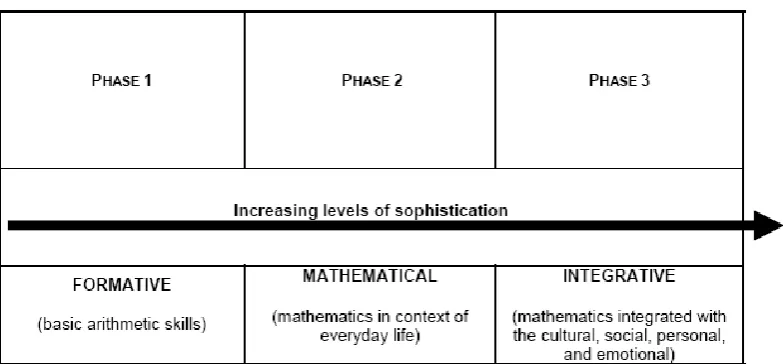
Maguire and O’Donoghue (2002) provided a useful framework to conceptualise the numeracy maze (Figure 1). This framework exemplifies the first and third element of numeracy.
Figure 1. A continuum of the concept of numeracy showing increased level of sophistication from left to right (from Maguire & O’Donoghue, 2002).
[image:2.595.86.478.508.690.2]as much of what is needed may be basic mathematical skills, but the approach may be very different in context. On the surface it may appear that a nurse would use proportional reasoning, for example, to calculate a dose, but in reality a variety of approaches could be taken. Phase 2 corresponds to functional literacy and quantitative literacy. So, for example, fractions, decimals and percentages are couched in contextual examples of drug calculations. However, numeracy is more complex than that. Maguire and O’Donoghue (2002) are joined by others in the area to agree that numeracy is both sophisticated and multifaceted (Phase 3). As well as mathematics, it includes cultural, social, personal and emotional aspects. Here, for example, what are nurses’ past emotions about and confidence in studying mathematics? Do they understand the implications of their numeracy knowledge? What are their experiences and knowledge in nursing already that can be shared by the student nursing community?
The second of the five main elements of the definition of numeracy, that it is different from school mathematics, can be summarised in FitzSimons’ (2006) work. She brought a new dimension to the numeracy debate by focusing on Bernstein’s concepts of vertical and horizontal discourse. While vertical discourse centres on mainly school mathematics, horizontal discourse is closely linked to numeracy as it is related to on-going practices; is affective; has specific immediate goals and is highly relevant. She emphasised that these discourses are different with different practices and that vertical discourses will not guarantee numerate activity.
The third and fourth element of numeracy relates to numeracy being “dynamic and contextually bound to time and place” (van Groenestijn, 2002 in FitzSimons, 2006). We must acknowledge the time dependency of numeracy. The course described in this paper was developed in the first decade of the 21st century and changes are already noticeable in this current decade. While there has been debate over multi-literacies in these ‘New Times’, no similar debate has emerged in mathematics and numeracy. Zevenbergen (2004) introduced the notion of multiple numeracies. She poses the question of whether there are different forms of numeracies in these changing times and concluded that we may need to re-theorize knowledge, skills and dispositions to re-conceptualise definitions of numeracy relevant to workforce needs.
Finally there is an element of numeracy that appears critical in nursing: “numeracy under pressure” (Coben et al., 2008). Nurses need a sense of confidence and competence and as Coben defines numeracy (2000):
To be numerate means to be competent, confident, and comfortable with one's own judgements on whether to use mathematics in a particular situation and if so, what mathematics to use, how to do it, what degree of accuracy is
appropriate, and what the answer means in relation to the context. (p. 48)
Nursing is a very specific vocational career and numeracy in this context is reflected in a definition of health numeracy: (Golbeck, Ahlers-Schmidt, Paschal, & Dismuke, 2005)
To the five elements of numeracy outlined above, must be added the context of the university setting, to create a definition of academic numeracy. In 2005 my colleague Janet Taylor and I (Galligan & Taylor, 2005) developed a definition of academic numeracy:
a critical awareness which allows the student to situate, interpret, critique, use and perhaps even create mathematics in context, in this case the academic context. It is more than being able to manipulate numbers or being able to succeed at mathematics. (p. 87)
For the nursing context, the definition of academic nursing numeracy needs to include ideas of integration with the cultural, social, personal and emotional. It needs to incorporate ideas of confidence and competence. It also needs context, location and time as central ideas to the definition. Within this research, I defined academic numeracy as:
mathematical competence in the particular context of the profession and the academic reflection of the profession at the time;
critical awareness of the mathematics in the context and in students’ own mathematical knowledge and involves both cognitive and metacognitive skills; and
confidence highlighting its deeply affective nature (Galligan, 2011a)
The paper first outlines the course and assessment in terms of this definition of academic numeracy and then highlights some of the assessment results.
The Course
Prior to 2006, a number of approaches had been taken to develop nursing students’ numeracy levels at the USQ (Galligan & Pigozzo, 2002). In 2006 USQ’s nursing program was reaccredited with the Australian Nursing and Midwifery Council (ANMC). This meant courses, especially those offered in first year, were revised. When planning the reaccreditation, it was decided by the Department of Nursing, that nursing students needed to develop some key academic skills in first semester of first year, as a separate course. Two new integrated first year nursing courses were developed (Lawrence, Loch, & Galligan, 2010) that included Information Technology and mathematics (one course) and literacies skills (second course). The aims of first course were to develop students’ numeracy and Information Technology skills directly linked to their degree. These skills were addressed by embedding aspects of the other courses taken in the students’ first semester and course content encountered later in the program.
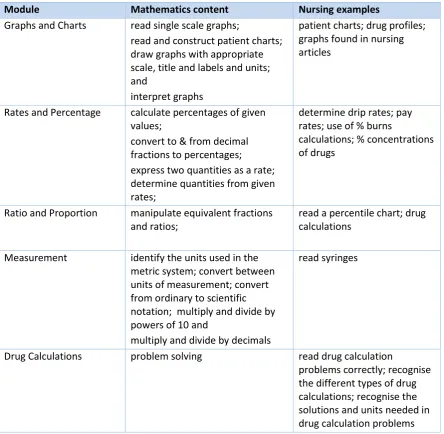
The course described in this paper, consisted of 10 × 2 hour tutorial style sessions, six of which were numeracy related. Table 1 highlights some of the mathematics needed and the context in which it is seen, and each tutorial session concentrated on one of these modules. While the concepts of decimals, fractions, percentage, proportion, measurement, and scale are all studied at the primary level at school, many adults have not mastered these concepts and this has implications in nursing (Hilton, 1999; Pirie, 1987).
Table 1. Mathematical content of course
Module Mathematics content Nursing examples
Arithmetic and Formulas basic operations, fractions, decimals, squares, and order of calculations and use formulas
Module Mathematics content Nursing examples
Graphs and Charts read single scale graphs;
read and construct patient charts; draw graphs with appropriate scale, title and labels and units; and
interpret graphs
patient charts; drug profiles; graphs found in nursing articles
Rates and Percentage calculate percentages of given values;
convert to & from decimal fractions to percentages; express two quantities as a rate; determine quantities from given rates;
determine drip rates; pay rates; use of % burns
calculations; % concentrations of drugs
Ratio and Proportion manipulate equivalent fractions and ratios;
read a percentile chart; drug calculations
Measurement identify the units used in the metric system; convert between units of measurement; convert from ordinary to scientific notation; multiply and divide by powers of 10 and
multiply and divide by decimals
read syringes
Drug Calculations problem solving read drug calculation
problems correctly; recognise the different types of drug calculations; recognise the solutions and units needed in drug calculation problems
In addition features of the course included: Social presence in the online format; videos of a nursing practitioner; video clips of adults the context of everyday life; photos of drugs and their use in some assessment tasks; cartoons; and extra optional material.
[image:5.595.68.513.70.504.2]The course took the definition of academic numeracy, outlined in the introduction, and incorporated these features into teaching and assessment sections of the course (Galligan, 2011b) as summarised in Table 2.
Table 2. Course components and links to definition of numeracy
Item Course components Numeracy component
1 Maths Relationship scale Critical Awareness 2 Discussion Forum Critical Awareness
3 Self-Test Competence & Confidence 4 6 maths tests Competence
In class, students were asked to discuss and rate their past relationship with mathematics (item 1). They were also directed to read two articles on the relationship between mathematics and nursing. Using these two exercises as a basis they were asked to reply to the questions “Describe your previous experiences with mathematics in a couple of sentences” and “How do you think mathematics…will be important for you as a nursing student, and later as a professional” in an online forum (item 2).
In 2008, this data was coded into a 5 point scale, overall, about one-quarter of the students (206 students) claimed that they “disliked” or “hated” mathematics. An example of each category is highlighted below:
I ended up changing from Maths B to A but not before developing a loathing for it!! (Hate)
Maths I do not like it. For me it’s like great mystery (Dislike)
Sometimes numbers just don’t make sense to me…I do blame the teachers and their inability to find why maths perplexed me so much, but in high school I do blame myself…now I find maths much better, I am no longer afraid of numbers and can grasp the theory and at least try to put it in practice – even if the answer is wrong. (Neutral)
Maths has always been an enjoyable experience for me. (Like)
I learned mathematics at school and really love mathematics…(Love)
As part of a first assignment ask, students were asked to complete a 32 item maths test (Galligan, 2011b) where the marks they received was on the completion of the test, not whether they got it right or wrong (item 3). For each question students’ were asked to rate (five point scale) their confidence, and reflect on their answers in relation to their competence, confidence, and critical awareness. They also completed six short competence tests through the semester (item 4) and one Post-test (item 5) where they were asked to reflect on their current numeracy status. For item 5, marks were also allocated to their competence.
Generally, students performed well on the pre-test, with a median mark of 78%. An error analysis identified decimals, fractions, multiplicative thinking, careful reading, as well as an overall understanding of the connectedness of mathematics, as potential areas of improvement for students (Galligan, 2011b). However there were significant issues with both under-confidence (right but not confident) and over-confidence (wrong and confident). In addition, an analysis one class’s reflective comments (25 students) on confidence against their pre-test confidence scales suggested students’ reluctance to comment on confidence if they were wrong and highlighted lack of confidence even when right.
It is imperative for me to get this mathematical side of things such as, measurements, percentages, multiplications, divisions, fractions, down pat as it is a huge responsibility to have as a future Registered Nurse, to administer the right dosages to other people in need, so that they can feel better, they rely on that, and my aim in life is to help others in need, and I cannot let anyone down or hurt anyone in the process.
After one semester, there was significant improvement in students’ mathematical confidence and competence related to nursing numeracy. There was an overall decrease in students’ over-confidence (wrong and confident) and a decrease in students’ confidence in the six ‘over-confident’ questions identified in the pre-test. From the post-semester survey and students’ reflective comments, the majority of students found the course useful, relevant and helpful in building confidence and competence. There was evidence that students were using checking mechanisms to ensure their answer was correct. Students also had fewer comments about their lack of knowledge in some areas, which was reflected in the increase in results and confidence in almost all of the questions and student comments about learning some specific skills in the course. For example one student wrote at the end:
This semester has been very helpful for me. …, it was good to revise it and be able to practice it and put it into the nursing context for the future. I have only improved slightly from the readiness test to the [end] test but relating to the feedback – confidence levels – I felt much more confident the second time …, most other areas I just need to revise and practice the questions in a nursing context. The main thing I am still having a little trouble with is drug calculations but with practice and revision plus more work on it next semester, I will hopefully become confident with it. Overall the course was very
beneficial to me.
Discussion
While there were improvements in all but one of the questions, there were still four areas of concern, i.e., in reading, rounding, decimals, and algebraic manipulation in the post-test. This deeper understanding of students “stuck points” had consequences for course improvement. In the next iteration of the course there was:
• An increased emphasis placed on reading a question carefully and correctly, de-construct and re-de-construct into a new form, as well as on looking and checking the answer. Students sometimes mentioned making ‘silly’ errors. Any attempt to engage students in addressing these ‘silly’ mistakes may be of crucial importance in nursing.
• Explicit teaching of rounding decimals and the consequences of incorrect rounding in the context of nursing.
• Revisiting the basics of the number system, particularly decimals. This could be via highly contextual scenarios. For example, the time question of turning decimal hour time (i.e. 1.2 hrs) into minutes could be tested in the CMA’s during the semester and more scaffolded learning objects inserted into the material.
• More linkages of rearranging formula with context. For example, in a rate problem the drug may be administered at 8mL/minute and the volume is 200 ml to go through, how much time is required? While many can do this intuitively, students have two formulas which are used regularly in their degree program although perhaps less so in their careers (Hoyles, Noss, & Pozzi, 2001): total volume
total time
r and time=total volume rate or an
infusion formula volume to be infused =volume in drops
time in minutes and a related formula for time to finish infusion: time in minutes = volume in drops
volume to be infused Being able to manipulate these equations, aids in understanding the formulas so they are not simply black box approaches to nursing numeracy. Whether understanding this level of mathematics is crucial to nursing or just useful is unknown.
These are just the results from the pre- and post-test data. There were other CMAs which gave a finer grained look at the numeracy in nursing. Some of the results in these CMAs reinforced the issues highlighted above, but also highlighted areas that may need more attention. These included:
1. Thinking fractionally:
If students see the first part of a drug calculation, formula dose required
× stock volume
dose in stock as a fraction of the stock volume it may prevent
some errors in the checking stage of calculation.
If students think of problems such as 6 15
7 ? as equivalent fractions, it may help in the reflection/checking stage.
2. Thinking decimally:
Students need to take notice of scale in between units. Not only can this be emphasized in syringe problems, but also in graph reading. The error needs to be highlighted to alert students.
The concept of division by a decimal creating a larger number is poorly understood so some specific scaffolding may help.
The concept of cancelling zeros and moving decimal points is poorly understood. Students come from school with these approaches, but have an incomplete understanding of why these ‘tricks’ work. Students can use a calculator to do the problems, but again a checking/estimation mechanism is important.
3. Thinking proportionally:
In the CMAs there were a number of questions which revealed some students’ inability to think proportionally at different levels. This is linked again to the
There appears to be some misunderstanding of percentages, especially in relation to the decimal equivalent.
Thinking proportionally, decimally, fractionally could then be combined into thinking multiplicatively (but highlighting the connections).
4. Thinking statistically:
Students were able to do an average problem, with just some revision.
Students had more trouble reading a frequency histogram, without explicit instruction.
There were some more statistics in the course, where students were asked to interpret journal articles that were used in other courses. This was performed very badly, with most students ignoring any statistical terminology or conclusions. If nurses are required to read and understand these articles, then statistical literacy is of importance and this will need to be addressed.
5. Thinking mathematically:
In many quizzes students demonstrated a lack of a logical step by step approach to problems.
Students appeared not to see the correct notation and the importance of it.
Rounding appropriately was a major issue and there is a need to highlight why and when it is needed.
Using estimation is a skill underutilised. Students need to think of the implications of the answer or result.
6. Thinking like a nurse:
Safety of the patient is crucial, so it is essential to link the mathematics done with the consequences.
Thinking logically and systematically is crucial in nursing (I recently interviewed a nutritionist in a hospital who said these are skills needed in hospitals).
Day to day reporting of patients’ results, etc., needs to be communicated clearly to other people, such as doctors or other nurses
Making an error can have consequences for both patient and nurse.
Conclusion
This paper outlined a definition of academic numeracy that was mapped on a course for first year nursing. The definition was able to drive the assessment and test whether the assessment was successful in improving students’ competence, confidence and critical awareness. It was able to highlight areas of improvement for the next iteration of the course. Future challenges include delivering this course in the online and blended environment and providing the support for other lecturers in the course to ensure they have the same understanding of the nature of teaching mathematics in the context of a nursing environment.
References
Coben, D. (2000). Section 1: Perspectives on research on adults learning mathematics (introduction). In D. Coben, J. O’Donoghue & G. E. FitzSimons (Eds.), Perspectives on adults learning mathematics: Research and practice (pp. 47-51). Dordrecht, NL Kluwer Academic Publishers.
Coben, D, Hall, C, Hutton, B. M, Hall, D, Sabin, M, & Weeks, K. (2008). Numeracy for nursing: The case for a benchmark. In J. O'Donoghue (Ed.), The Changing Face of Adults Mathematics Education: Learning from the past, planning for the future. Proceedings of ALM-14, the 14th International Conference of Adults Learning Mathematics - A Research Forum (ALM), held at the University of Limerick, Ireland, 26-29 June, 2007 (pp. 88-102). Limerick: University of Limerick in association with ALM.
Ellerton, N.F., Clarkson, Philip C., & Clements, M.A. (2000). Language factors in mathematics teaching and learning. In K. Owens & J. Mousley (Eds.), Research in mathematics education in Australasia 1996-1999 (pp. 29-95). Sydney: MERGA inc. FitzSimons, Gail E. (2006). Numeracy. Retrieved 12/01/2010, 2010, from
http://www.statvoks.no/emma/index_numeracy_gail_middle.htm
FitzSimons, Gail E., & Coben, Diana. (2009). Adult numeracy for work and life: Curriculum and teaching implications of recent research. In R. Maclean & D. Wilson (Eds.), International Handbook of Education for the Changing World of Work, 1 Bridging Academic and Vocational Learning (pp. 2371-2745). Netherlands: Springer.
Galligan, L. (2011a). Developing a model of embedding academic numeracy in university programs: A case study from nursing. Unpublished doctoral thesis. (PhD), Queensland University of Technlogy, Brisbane.
Galligan, L. (2011b). Measuring academic numeracy: Beyond competence testing. In Julie Clark, Barry Kissane, Judith Mousley, T. Spencer & S. T. . (Eds.), Mathematics: Traditions and [New] Practices (Proceedings of the 34th annual conference of the Mathematics Education Research Group of Australasia).and the Australian Association of Mathematics Teachers) (pp. 288-296). Adelaide: AAMT and MERGA. Galligan, L, & Pigozzo, R. (2002). Assisting Nursing Students Solve Drug Calculation Problems Using Metacognition and Error Analysis. Literacy & Numeracy Studies., 12(1), 45-62.
Galligan, L, & Taylor, J. A. (2008). Adults returning to study mathematics. In H. Forgasz, A. Barkatsas, A. Bishop, C. B, S. Keast, W. Seah & P. Sullivan (Eds.), Research in mathemaitcs education in Australasia 2004 - 2007 (pp. 99 -118). Rotterdam: Sense Publishers.
International Conference on Adults Learning Mathematics in Kungalv, Sweden. 29 June-2 July 2004. Goteborg, Sweden: Goteborgs Universitet.
Golbeck, Amanda L, Ahlers-Schmidt, Carolyn R, Paschal, Angelia M, & Dismuke, S. Edwards. (2005). A definition and operational framework for health numeracy. American Journal of Preventive Medicine, 29(4), 375-376.
Hilton, DE. (1999). Considering Academic Qualification in mathematics as an entry requirement for a diploma in nursing programme. Nurse Education Today, 19, 543-547.
Hoyles, Celia, Noss, RIchard, & Pozzi, Stefano. (2001). Proportional reasoning in nursing practice. Journal for Research in Mathematics Education, 32(1), 4-27.
Kemp, M. (1995). Numeracy across the tertiary curriculum. In R. P. Hunting, G. E. Fitzsimmons, P. C. Clarkson & A. J. Bishop (Eds.), International Commission on Mathematics Instruction Conference on Regional Collaboration (pp. 375-382). Melbourne: Monash University.
Kemp, M. (2005). Developing critical numeracy at the tertiary level. PhD Thesis. Murdoch
University, Perth. Retrieved from
http://wwwlib.murdoch.edu.au/adt/browse/view/adt-MU20060831.171947
Lawrence, Jill, Loch, Birgit, & Galligan, L. (2010). Employing and evaluating inter-disciplinary collaborations to redefine academic practices in a nursing program Reshaping Higher Education: Proceedings of the Higher Education Research and Development Society of Australasia. Melbourne: HERDSA.
Maguire, T, & O’Donoghue, J. (2002). A grounded approach to practitioner training in Ireland: Some findings from a national survey of practitioners in Adult Basic Education. . In L. Ø. Johansen & T. Wedege (Eds.), Numeracy for Empowerment and Democracy?: Proceedings of the 8th International Conference of Adult Learning Mathematics - A Research Forum (Vol. 8, pp. 120-132). Roskilde, Denmark, Roskilde University, Centre for Research in Learning Mathematics. Sevenage, UK.: Avanti Books.
Miller-Reilly, B. (2006). Affective change in adult students in second chance mathematics courses: three different teaching approaches. Unpublished PhD thesis. University of Auckland, Auckland.
Pirie, S. (1987). Nurses and mathematics: Deficiencies in basic mathematical skills among nurses. London: Royal College of Nursing.