2
About the authors
Whitney Crenna-Jennings joined the EPI team in November 2017. Prior to this, she worked as a
research assistant in the Department of Epidemiology and Public Health at UCL, focusing on the impact of the post-communist transition on population health in Eastern Europe. She also spent a year working on the Stigma Survey UK, a community-led study of the impact of stigma and
discrimination on people living with HIV in the UK. Whitney completed her undergraduate degree in History and International Relations at the University of Toronto. She graduated with Distinction in MSc Social Epidemiology at UCL in 2015
Jo Hutchinson is Director for Social Mobility and Vulnerable Learners at the Education Policy
Institute. Jo’s previous publications include ‘School inspection in England: Is there room to improve?’ and ‘Divergent pathways: the disadvantage gap, accountability and the pupil premium’. Jo was a co-author of ‘Closing the gap? Trends in educational attainment and disadvantage’, ‘Grammar schools and social mobility’, ‘Educational Outcomes of Children with English as an Additional Language’ and ‘Access to children and young people’s mental health services – 2018’. Prior to joining EPI, Jo spent ten years as a statistician at the Department for Education.
Acknowledgments
This report has been sponsored by the National Education Union (NEU). The NEU represents more than 450,000 teachers, lecturers, support staff and leaders working in maintained and independent schools and colleges across the UK.
About the Education Policy Institute
The Education Policy Institute is an independent, impartial, and evidence-based research institute that promotes high quality education outcomes, regardless of social background. We achieve this through data-led analysis, innovative research and high-profile events.
Education can have a transformative effect on the life chances of young people, enabling them to fulfil their potential, have successful careers, and grasp opportunities. As well as having a positive impact on the individual, good quality education and child wellbeing also promotes economic productivity and a cohesive society.
3 Benchmarking English Education
School Performance, Admissions, and Capacity Early Years Development
Vulnerable Learners and Social Mobility Accountability, Assessment, and Inspection Curriculum and Qualifications
Teacher Supply and Quality Education Funding
Higher Education, Further Education, and Skills
Our experienced and dedicated team works closely with academics, think tanks, and other research foundations and charities to shape the policy agenda.
This publication includes analysis of the National Pupil Database (NPD):
https://www.gov.uk/government/collections/national-pupil-database
The Department for Education is responsible for the collation and management of the NPD and is the Data Controller of NPD data. Any inferences or conclusions derived from the NPD in this publication are the responsibility of the Education Policy Institute and not the Department for Education.
Published April 2019 Education Policy Institute.
4
Contents
Foreword ... 5
Executive summary ... 7
Data scope and structure ... 9
Data Sources ... 9
Cohorts ... 9
Matching ... 9
Identifying schools and school types ... 10
CIN and CLA data structure ... 10
Fixed period exclusions data structure ... 10
Permanent exclusions data structure ... 11
Absence data structure ... 11
Working method ... 13
Step 1: Flagging pupil exits between terms ... 13
Step 2: Flagging pupil exits that are likely to be driven by family factors ... 13
Step 3: Investigating unexplained exits from schools ... 17
Test results ... 20
Termly exits: family-driven exits, unexplained exits and permanent exclusions ... 20
Unexplained exits per pupil ... 27
Breakdown of family-driven exits ... 28
Unexplained exits by origin and destination school type ... 32
School-level distribution of unexplained exits, family-driven exits and permanent exclusions ... 36
Pupil risk factors for unexplained exits ... 42
How to give feedback... 46
Consultation questions ... 46
Annex 1. Termly exits from secondary schools by cohort ... 48
Annex 2. School-level distributions of exits: 2011 cohort ... 52
Annex 3. School-level distributions of exits: 2014 cohort ... 57
Annex 4. Risk profile of pupils experiencing unexplained exits: 2011 cohort ... 62
5
Foreword
Over recent years, there has been growing concern about the prevalence of pupils being taken off school rolls without being formally excluded. This has attracted widespread media coverage in both the education sector and national press, with accusations that some schools and multi-academy trusts are “gaming the system” by removing pupils from their rolls so that those pupils are not then counted in the school(s) GCSE results.1 It is possible that other motivations exist, such as managing financial pressures and the cost of meeting additional needs.
Unlike formal exclusions, there is no requirement to record the reason why a pupil has been removed from a school roll. It is therefore difficult to establish whether such removals are happening because of the decisions that schools have taken (which may relate to the desire to improve the school’s exam results) or decisions that parents have taken (e.g. to move house, to send their child to a higher-performing school or to move their child to a special school).
Two important research reports published last year shed some light on the prevalence of pupil movement out of schools.
In June 2018, Ofsted published new analysis which tracked a cohort of pupils as they moved from year 10 to year 11 between January 2016 and January 2017 (it is important to note here that the January dates were chosen because, if a pupil is on a school roll in the January before they take their GCSEs, the results of that pupil will be attributed to the school, irrespective of whether the pupil has moved on since January).2 The report found that, by January 2017, 19,000 of those pupils (around three to five per cent of the total cohort), were no longer registered at the same school as in January 2016. Around half of those pupils were not reappearing on the roll of another state-funded school. Ofsted also found that pupils with Special Educational Needs and Disabilities (SEND) and those eligible for Free School Meals (FSM) were over-represented amongst the 19,000 pupils.
Ofsted’s analysis, however, was limited to one year only and could not distinguish between moves that could have been instigated by the pupil’s family (e.g. a house-move or a move to a special school) and those that could have been encouraged by the school. So while this research gave us a snapshot of pupil movement in years 10 and 11 in a given year, it was not able to tell us much more about the reasons behind those moves or whether the trend in these types of moves has been increasing or decreasing in recent years.
A separate report published (also in June 2018) by Education DataLab looked at a wider cohort of pupils – from year 7 to year 11.3 This report found that, in 2017, 22,000 pupils between year 7 and year 11 had left their school but were not attending any other state school. Education Datalab found that this figure was 10 per cent higher than in each of the three preceding years. This report also highlighted that pupils with SEND and eligible for FSM were disproportionately represented amongst the pupils who disappeared from state education.
While both reports have been helpful in highlighting the prevalence of pupils being taken off roll in recent years, neither has been able to distinguish between moves that appear to be driven by
1 For example, see: https://www.bbc.co.uk/news/education-42943997
6
parental choice and those that are unexplained (and could therefore warrant further investigation by either Ofsted or the Department for Education) and neither have been able to identify whether this issue is becoming more prevalent over time.
In this working paper, EPI researchers have sought to fill that evidence gap by analysing data from the National Pupil Database spanning more than 10 years. By analysing the pupil level data collected over those years, we are able to identify moves that appear to have been driven by parents and those that are unexplained. Our methodology (on which we are seeking feedback) is set out in detail in the ‘Working methods’ section.
While this paper sets out the trend and prevalence of formal exclusions, the primary focus of this paper is to shed further light on unexplained moves. The increase in recent years in formal exclusions has also been the subject of widespread media coverage and policy debate, and we do not attempt to comment on, or analyse, formal exclusions for now.
Unexplained moves are, by definition, not consistently recorded or regulated and there is therefore a pressing need to improve our understanding of the scale of the issue, the reasons behind these types of moves and the extent to which they affect vulnerable learners. Ofsted defines off-rolling as ‘the practice of removing a pupil from the school roll without a formal, permanent exclusion or by encouraging a parent to remove a child from the school roll, when the removal is primarily in the interests of the school rather than in the best interest of the pupil.’ While our methodology is different from Ofsted’s, it is the same phenomenon that we are offering a sharper quantification of. As both the approach and analysis presented in this paper are new, we are seeking feedback on our methodology and outputs before we further develop this work. Once we have considered that feedback and updated our methodology where necessary, we plan to publish a final report later in the summer. That final report will publish much greater detail, including showing where the
prevalence of unexplained moves is highest across the country and in different types of schools and school groups.
If you would like to provide comments on our methodology, you can do so by emailing us at
David Laws
7
Executive summary
This working paper presents estimates of different types of moves within the English school system for three cohorts of secondary pupils. The purpose of this paper is to lay out our methodology and findings to elicit feedback.
Our analysis investigates exits from secondary schools using longitudinal records on three different cohorts of pupils taking their GCSEs in 2011 (602,933 pupils), 2014 (616,829 pupils) and 2017 (603,705 pupils). First, we identified pupils who exited their school at some point in time between the autumn, spring and summer censuses in Years 7 to 11. From this group, we removed exits due to middle school transitions. From the remainder, we removed exits that were likely to have been driven by family reasons as discernible from the available data, as well as permanent exclusions. We were then able to focus on exits that we are calling ‘unexplained’ as they do not appear to be due to family or non-school related factors captured in the data.
Our test findings show that:
In each cohort, a substantial minority of pupils moved to a different school or left the state school system entirely for unknown reasons. These ‘unexplained’ exits numbered 47,225 in the 2011 cohort of pupils, 49,051 in the 2014 cohort and 55,309 in the 2017 cohort; this corresponds to 7.8 per cent of pupils in the 2011 cohort experiencing at least one
unexplained exit during secondary schooling, 7.2 per cent of pupils in the 2014 cohort and
8.1 per cent of the 2017 cohort.
Those most likely to experience an unexplained exit were:
pupils with a high number of authorised absences (approximately two in five of whom in the 2017 cohort experienced at least one unexplained exit);
pupils in contact with the social care system (one in three);
pupils who have experienced an official permanent exclusion (one in three) or fixed period exclusion (one in five);
those ever eligible for free school meals (one in seven); those from black ethnic backgrounds (one in eight); and those in the lowest prior attainment quartile (one in eight).
A small proportion of schools account for a large number of unexplained pupil exits: in the 2017 cohort, 330 schools (or six per cent of the total number of secondary and specialist schools) had at least 30 unexplained exits from their cohort during the five years of secondary. We used the threshold of 30 pupils to represent a class size. These schools accounted for almost a quarter (23 per cent) of the national number of unexplained exits. Schools with the highest numbers of unexplained exits were those in the middle of the
disadvantage distribution. In the 2017 cohort, the quintile (20 per cent) of schools with the least disadvantaged intake accounted for the smallest proportion of total unexplained moves (five per cent), while schools with the most disadvantaged intake accounted for the second lowest proportion (14 per cent). Fewer unexplained exits were accounted for by the most disadvantaged schools in recent cohorts compared with earlier cohorts.
The main limitation of this analysis is that we are only able to account for possible reasons for exits included in the information collected by the school census and other DfE datasets. We have
8
9
Data scope and structure
Data Sources
The following data sources were included in the dataset constructed for this working paper: School Census termly records autumn 2007 to summer 2017 [Oct/Jan/May]; Alternative Provision ‘AP’ Census 2008 to 2017 [Jan];
Pupil Referral Unit ‘PRU’ Census 2010 to 2013 [Jan];
Children Looked After ‘CLA’ Census 2006 to 2017 [Mar]. Contains episodes of care from as early as 1991 for children with ongoing care records since the collection started in 2006; Children In Need ‘CIN’ Census 2009 to 2017 [Mar]. Contains referrals as early as 1991 for
children with ongoing need records since the collections started in 2009;
Key Stage 2 prior attainment 2005/06 to 2011/12 and linked school census records 2002 to 2012 [Jan];
Get Information About Schools ‘GIAS’ records and link files [all records]; Ofsted Inspection Outcomes Data 2005 to 2017.
Cohorts
Cohorts were constructed with membership determined according to month and year of birth, aligning to the school year [September to August]. Cohort membership was based on the most recently recorded birth month and year for records with conflicting information recorded in earlier or later census returns. The analysis in this working paper is based on cohorts where the majority of children reached year 11 in 2010/11 (‘the 2011 cohort’), in 2013/14 (‘the 2014 cohort’), and in 2016/17 (‘the 2017 cohort’). The 2011 cohort is used to analyse school mobility in academic years 2013/14 to 2010/11, and so forth. This captures years 7 to 11 (inclusive) for most pupils. Secondary cohorts for the intervening years between 2011, 2014 and 2017, and primary school cohorts ending year 6 in 2012/13 to 2016/17 have also been constructed but are not analysed in this working paper; these cohorts will be examined in a subsequent report.
Matching
Records were matched across data sources, terms and years using the anonymised pupil matching reference ‘PMR’ as the sole matching key. Cohorts were constructed from the School Census, AP Census and PRU Census records to form the core of the analytical dataset. Duplicate records for the same time period and Census type were deleted based on file order to produce no more than one record per PMR at one point in time. It is possible to have records from the School Census, AP Census and/or PRU Census for the same child where they have been dual-registered or have moved between institutions over time; these records are retained in the analysis.
The time structure of the core dataset is longitudinal spanning 15 school terms. However, children only ever registered in the AP or PRU Censuses throughout years 7 to 11 only have data for five annual time points.
10
episode records, and Ofsted inspection records. For some statuses the position recorded is as at the date of the census. This was the case for School Census records such as Free School Meals status, AP and PRU records and some aspects of the CIN and LAC data.
Identifying schools and school types
Using the original School Census school unique reference number ‘URN’ identifiers we can identify what the status of a school was at the time when a pupil left that school; for example, whether that school was an academy or a local authority school, and whether it was a mainstream school or a special school or alternative provision school.
However, when determining whether a pupil has moved schools by comparing their URN in two different terms, sometimes the URN changes, for example due to academy conversion, without the child having moved anywhere. In order not to spuriously count these URN changes as moves, we also associate each child with a ‘stable URN’ for each term using the link files from GIAS.
Where two or more URNs are linked as predecessor or successor schools, we select one URN arbitrarily from each URN ‘family’ and recode all the variants of that school to create the ‘stable URN’ that determines whether a child has moved schools or not. This version of the URN is not used to attribute any characteristics of the school as these can change over time; it is solely used to identify when URN changes genuinely represent a move of school.
CIN and CLA data structure
The CIN and CLA data were restructured into termly variables using the date of referral for the CIN episode to assign a school term and year to each episode of need (CIN), or the date the CLA episode commenced (CLA). The latest record for each episode (defined by date) was retained and any earlier records for the same episode discarded.
Different episodes within each term for each child were then ordered by date. The first and last episodes within each term for each child were retained and any intervening episodes were dropped. Termly child-level variables describing first and last episodes were then created using a ‘cases to variables’ restructure command, and matched to the core cohort datasets.
We took this ‘first and last’ approach to structuring the data within each school term because there are sometimes several episodes within a term for one child that would be unmanageable to analyse in detail for this project. Selecting the first and last episodes per term enables most lasting changes in status or type of need or abuse to be captured without overloading the analysis with a level of detail that would be difficult to interpret.
Fixed period exclusions data structure
Exclusions data for 2005/06 to 2016/17 were matched into a single pupil level file covering these years using the PMR identifier variable. The exclusion start date was used to assign a school term and year to each exclusion.
11
Exclusion records with missing dates were assigned to the year in which the record was returned but without associating them with a term; these are then treated as having occurred ‘before’ school moves occurring between the summer term and the autumn term of the subsequent school year, or later, in the analysis.
Where partial duplicate records exist for the same child issued on the same date, records from mainstream schools were retained in preference to duplicates from AP, PRU or special schools. Then, for any remaining duplicate exclusion dates, exclusion records with longer duration were retained over those with shorter durations.
Then, for any remaining duplicate exclusion dates, records were prioritised according to the reason for exclusion, and those for reasons appearing earliest in the following list were retained: assault on a pupil, assault on an adult, sexual misconduct, racist abuse, bullying, verbal abuse of a pupil, verbal abuse of an adult, damage, theft, drug or alcohol related, persistent disruptive behaviour, other reason.
The list ordering is to some extent arbitrary but prioritises those reasons for exclusion that are likeliest to harm others. Only a small minority of exclusion records were date of issue duplicates, so the impact of the ordering is not large. In this way, only a single exclusions record was retained for a given date for each pupil (for those pupils with exclusions).
For each child, each term, in each school, aggregate variables were then created to capture the total number of fixed period exclusions, the number of fixed period exclusions for each reason, and the total number of sessions for which the child was excluded (for any reason).
There are no available administrative data to measure the use of isolation and/or internal exclusions as alternatives to fixed period exclusions, but we acknowledge that these form a part of the picture with respect to factors that may be associated with unexplained school exits.
Permanent exclusions data structure
The structuring of permanent exclusions was simpler due to the smaller numbers of these. For each child, year and term, exclusion records were ordered by the date they took effect. There were only a very small number of records with duplicate dates for the same child, and these were removed by retaining those with a reason appearing earliest in the list above.
For each permanent exclusion of each child in each term, aggregate variables were then created to capture the identity of the school that excluded the child and the reason for the exclusion. Children were permanently excluded a maximum of two times within any term and all records were retained so they could be associated with particular schools in the analysis.
Absence data structure
For school absences, a simpler approach was taken from that of exclusions. Data on absences by each child during the whole of the year 7 to 11 period were created. This is because absences were expected to be less directly associated with leaving a school’s roll than exclusions and are treated as an expression of the general vulnerability of the child in the analysis.
12
working paper, but intend to examine absences in relation to unexplained moves in more detail in the report that is to follow this working paper.
13
Working method
We analysed the secondary school records of:
602,933 pupils whose date of birth places them in the cohort taking their GCSEs in 2011; 616,829 pupils whose date of birth places them in the cohort taking their GCSEs in 2014; and 603,705 pupils whose date of birth places them in the cohort taking their GCSEs in 2017. The analysis followed the steps detailed below.
Step 1: Flagging pupil exits between terms
The first step of the analysis was to identify all pupils who exited a school between censuses. These exits can be divided into three categories:
a. pupils who were permanently excluded (we treated these as a separate category to family-driven and unexplained moves);
b. pupils who changed schools between censuses; and
c. pupils who moved from a school to an unknown destination.
Step 2: Flagging pupil exits that are likely to be driven by family factors
The second step of the analysis was to identify the pupils exiting schools for reasons which are likely to be unrelated to the school. These are listed below, along with further explanation and justification for why they were included. All ‘ever’ categories included records going back to autumn 2007 for all three cohorts.
For both exits from the system and exits to a different school, we flagged:
Box 1: Transitions
Any moves into schools in the autumn term in which at least 20 pupils joined that school and any moves out of a school in the summer term in which at least 80 per cent of pupils left that school were classified as transitions and not included in the figures presented here.
Box 2: Moves due to a permanent exclusion
14 Pupils with parents in military service
All pupils that were ever recorded as ‘service children’ were included in this group.
Pupils with Gypsy, Roma or Traveller (GRT) ethnicity and pupils with any absences due to their family travelling for occupational purposes.
All pupils that were recorded as having GRT ethnicity were included in this group, as well as all those ever recorded as absent from a session due to ‘traveller’ status.
For exits to a different school, we flagged:
Pupils who move from any type of school into a special school
These moves are likely to be decided with parental consent and in the interest of the pupil. Pupils who move to a school with a higher Ofsted grade
We deemed moves to better rated schools to be most likely driven by parental choice. Further analysis of school moves by Ofsted rating will be undertaken in the follow-up report to this working paper. In particular, we will consider whether cases of moves from schools rated ‘requires
improvement’ to schools rated ‘good’ are as likely to be family-driven moves as those from schools rated ‘good’ to schools rated ‘outstanding’.
Pupils who move to a different lower super output area (LSOA)
We assume that any school move that happens at the same time as an LSOA move (where the pupil’s home address has changed) is due to this home move. Each LSOA has a population of around 1500 people on average, with a minimum of 1000. It is therefore possible to move home without moving LSOA, but unlikely that this would require a change of school.
LSOA data for the summer and autumn 2011 censuses are missing, so we considered any school-to-school moves between the spring 2010 and spring 2012 censuses coinciding with a house move between these two points in time to be explained by the house move.
Box 3: Gypsy/Roma/Traveller pupils
15
LSOA information in the autumn 2007 and spring 2012 censuses for the 2011 cohort are also missing. Therefore, we are unable to identify the pupils that move LSOAs between autumn and spring 2007 and spring 2011 and spring 2012. Since LSOA movers make up the largest proportion of family-driven moves, we imputed values for the 2011 cohort to make total volumes of different types of exit comparable across cohorts. See Box 4 for more details.
Looked after pupils who are adopted
We included any looked after pupil whose period of care ended because they were adopted. Looked after pupils who experience a change in their legal care status
For pupils missing LSOA information, we flagged a change in their care legal status, used as a proxy for a change in their placement. We are missing care legal status data for the summer 2017 term because these data were not yet available at the time of our data request, but as this is a very small number of pupils it does not have a significant effect on overall volumes.
For exits from the system, we flagged:
Box 4: Missing data in the 2011 cohort
For the 2011 cohort, LSOA records for the autumn 2006/07 academic year and the spring 2010/11 academic year were missing from the data extracts we received, and records on the entry date and EAL status of late entrants, and late entrants with English as an additional language (EAL), who joined school after Reception but before Year 3 are not available because these are prior to when the data were first collected.
In order to fill in these gaps, we calculated the proportion of exits accounted for by LSOA moves in the corresponding terms in the 2014 and 2017 cohorts, took the average of these proportions, and used it to approximate the number of LSOA moves in the 2011 cohort terms missing data. We estimate that the number of pupils who moved to a different house who are not also included in another category of family-driven move to be 1446 in the autumn 2006/07 term and 134 in the spring 2010/11 term.
For missing data on late entrants and EAL late entrants who joined school after Reception but before Year 3, we used the average proportion of exits accounted for by this group of pupils across the 2014 and 2017 cohorts to estimate the exits accounted for by these pupils in the 2011 cohort. Based on this methodology, we estimate that number to be 3298.
16
Pupils who are late entrants to the school system, i.e. join at any point in time after Reception
We expect these pupils to be more likely to exit the school system before the end of secondary school, for reasons including moving to the independent schools sector. For the 2011 cohort, we only have data going back to Year 3, therefore it is not possible to distinguish between Year 3 arrivals or those who joined the system previously. In order to estimate the number of late entry pupils arriving between years 1 and 3 in the 2011 cohort, we took the average proportions of these groups of pupils in the 2014 and 2017 cohorts and used this average to estimate the number of pupils this would represent in the 2011 cohort. We then removed these pupils from overall volume figures, but not from termly move figures.
EAL pupils who are late entrants to the system, i.e. join at any point in time after Reception We used late entrant and EAL status as proxy markers of having a migrant background. We expect these pupils to be more likely than their peers to exit the school system before the end of secondary schooling for reasons including migration out of England.
Pupils who live on the Welsh or Scottish border in the term of the move
These pupils may have moved to a school in Wales or Scotland. In order to flag these pupils: 1. We identified the eastings and northings4 for Scottish and Welsh schools using their
postcodes.5
2. We then split the Scottish schools by primary and secondary, as we employed different thresholds to determine whether an LSOA in England is close to a Scottish school depending on whether it is a primary or secondary school. This is because secondary school pupils are likely to travel a longer distance than primary school pupils. The thresholds we used were five miles to a primary school and eight miles to a secondary school. There are no flags in the EduBase database to indicate whether Welsh schools are primary or secondary.6 Therefore, we used the eight-mile threshold for all Welsh schools.
4 Eastings and northings are map coordinates that specify a location.
5 Postcodes were obtained here: https://gridreferencefinder.com/postcodeBatchConverter/ 6 https://get-information-schools.service.gov.uk/
Box 5: Pupils with a migrant background
We used EAL status and late entrance (anytime after Reception) into the school system as proxy markers of having a migrant background. We assumed these late EAL entrants to be more likely to exit the English school system before GCSEs. Therefore, we assumed all moves out of the system by these pupils to be ‘explained’ by their migrant background. Despite these data limitations and the approach we have taken in this analysis, we acknowledge that migrant children are a vulnerable group and should not be discounted in the conversation around ‘unofficial’
17
3. For each of Scottish primary and secondary schools and Welsh schools, we matched the schools to all English LSOAs in order to calculate the distance between them each English LSOA.
4. We calculated the distance in metres between English LSOAs and schools using the
Pythagorean theorem: we took the square root of: ((eastings of LSOA – eastings of school)2 + (northings of LSOA – northings of school)2). We then converted the result into miles.
5. Next, we filtered out LSOAs that surpassed our thresholds i.e. those that were more than five miles from Scottish primary schools and eight miles from Scottish secondary and Welsh schools. For Welsh schools, we filtered out schools that were closed using EduBase data. Moving to a school in Wales or Scotland is still, to an extent ‘unexplained’. However, we have assumed that this could plausibly be due to a parental preference for the curriculum, qualifications or other aspects of the education system in Wales or Scotland, and need not necessarily reflect on the inclusiveness of the school previously attended in England.
Step 3: Investigating unexplained exits from schools
School-level distribution of unexplained exits in secondary
After removing the categories of pupils listed above, we are left with pupil exits that cannot be explained by the available data. For this reason, we have labelled these exits ‘unexplained.’ Next, we looked at the prevalence of these exits across schools. We aggregated the number of unexplained exits from schools by term and summed them over all terms in the five years of secondary for each cohort.
We also investigated the prevalence of unexplained exits by school level of disadvantage. We used the average proportion of FSM-eligible pupils in each school across all terms as a measure of the overall disadvantage level of the school.
Risk profile of pupils with at least one unexplained exit in secondary school
Finally, we looked at differences in the prevalence of total unexplained exits over the five years of secondary school by the characteristics listed below. Here we include an explanation for how we coded these characteristics from the original records:
Gender
We classified all pupils ever recorded as being male as male, and all other pupils as female. Ethnicity
We used pupils’ most recent ethnicity records: Any ‘other’
Bangladeshi Black African Black Caribbean Chinese
Indian
18 Other Black background
Other mixed background Other White background Pakistani
White and Asian White and Black African White and Black Caribbean White British
White Irish
Term of birth
We used pupils’ most recent month and year of birth records to flag pupils born in the spring, summer and autumn terms.
EAL status
We included pupils ever recorded as speaking English as an additional language who entered the school system in Reception. While EAL status may not necessarily mean that children are not proficient in English, nor that they are first generation migrants, it is used here as a proxy for
potential migrant status. If it was available, we would use actual migrant status for this purpose, but these data are not collected from schools.
FSM eligibility
We included pupils ever recorded as being eligible for free school meals. Looked after status
We classified these pupils into three groups:
pupils who have ever been in the care system;
pupils who entered the care system in secondary school; and
pupils in care who experienced a change in legal status in secondary school. We considered these groups to have different risk profiles and wanted to test differences in the prevalence of unexplained moves in each. These groups are not mutually exclusive, so the same pupil can appear in more than one of them.
Child in need status
We looked at two groups of children in need which we considered to have different risk profiles (not mutually exclusive):
pupils who have ever been recorded as a child in need; and pupils who became a child in need in secondary school. SEND type
We looked at the prevalence of unexplained moves among pupils ever identified with each type of SEND:
19 moderate learning difficulty; severe learning difficulty;
profound and multiple learning difficulty;
behavioural, emotional and social difficulty or (after 2014) social, emotional and mental health difficulty;
speech, language and communication difficulty; hearing impairment;
visual impairment;
multi-sensory impairment; physical disability;
autism spectrum disorder; or any other SEND.
Prior attainment quartiles
Reading and maths fine grades were used for all children who sat the KS2 tests at age 11. The available key stage 2 attainment data have changed slightly over time: in the 2011 cohort those who had missing test data had an English teacher assessment used, whereas in the 2014 and 2017 cohorts a reading teacher assessment was available instead.
We standardised the attainment scores by converting them into decimal rankings for the cohort, indicating each child's relative position in the attainment distribution. These rankings were then used to create prior attainment quartiles.
Absence record
We used the Department for Education’s threshold for persistent absentee pupils: any pupil that misses at least 10 per cent of sessions in a term. We looked at pupils that were persistently absent across all 14 terms of secondary school for the following reasons:
overall absences regardless of reason; illness and medical appointment absences;
authorised absences including exclusions and ‘other;’ and
unauthorised reasons, including lateness, unexplained and ‘other’ unauthorised reason. Fixed period exclusion record
We included pupils ever recorded as having at least one fixed period exclusion. Permanent exclusion record
20
Test results
Test results of our analysis are presented below. Table entries of ‘x’ mean the figures have been suppressed due to small numbers. We have suppressed pupil and school numbers of fewer than 10.
Termly exits: family-driven exits, unexplained exits and permanent exclusions
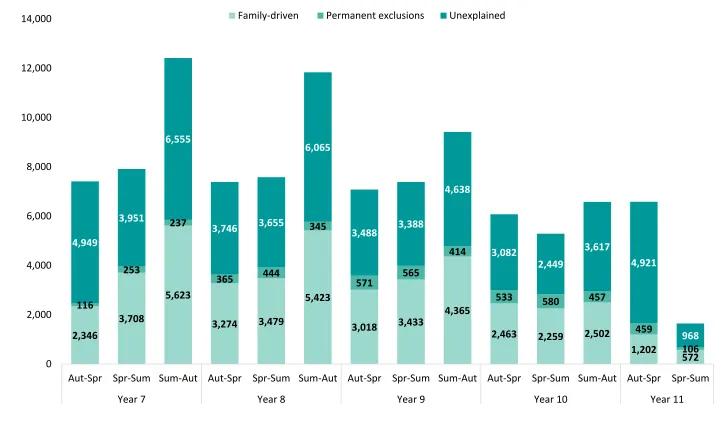
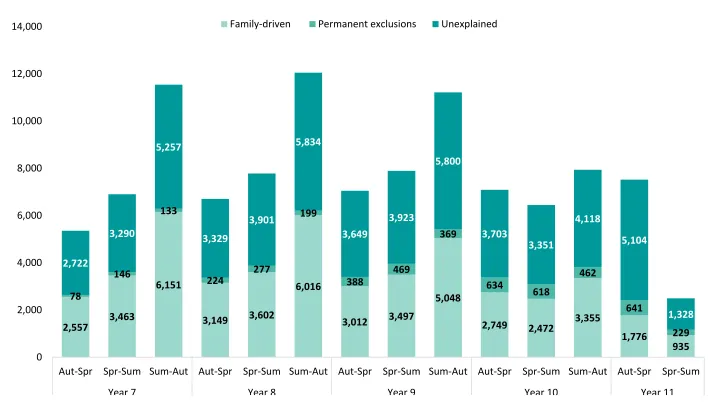
Figures 1.1 to 1.6 present the breakdown of family-driven and unexplained exits and permanent
exclusions by term for each cohort. We present (1) the total number of each type of exit and (2)
each type of exit as a proportion of the total cohort.
After removing family-driven exits and official permanent exclusions, we found that the total number of unexplained exits from schools for each cohort was:
47,225 in the 2011 cohort;7 49,051 in the 2014 cohort; and 55,309 in the 2017 cohort.
The 2017 cohort saw the highest number of unexplained exits, with more occurring particularly in Years 9 to 11 of secondary compared with the 2011 cohort. These figures represent total
unexplained exits; a small percentage of pupils experienced more than one unexplained exit in secondary school (see Figures 2.1 and 2.2).
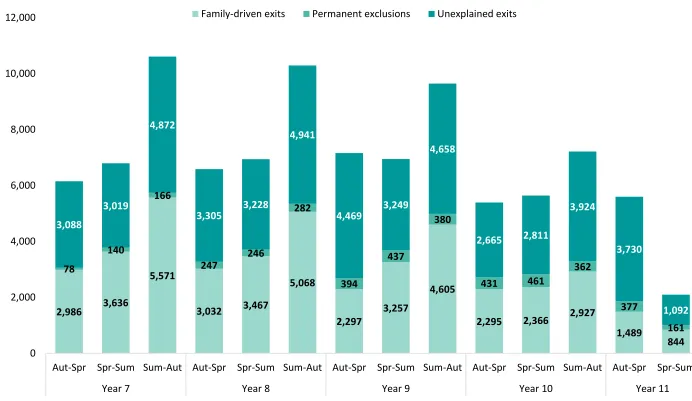
Annex 1 presents figures for total exits of any kind by term.
21
Figure 1.1. Type of termly exit for pupils in the 2011 cohort (number)7
2,346
3,708
5,623
3,274 3,479
5,423
3,018 3,433
4,365
2,463 2,259 2,502
1,202
572 116
253
237
365 444
345
571 565
414
533 580 457
459
106
4,949
3,951
6,555
3,746 3,655
6,065
3,488 3,388
4,638
3,082
2,449
3,617
4,921
968
0 2,000 4,000 6,000 8,000 10,000 12,000 14,000
Aut-Spr Spr-Sum Sum-Aut Aut-Spr Spr-Sum Sum-Aut Aut-Spr Spr-Sum Sum-Aut Aut-Spr Spr-Sum Sum-Aut Aut-Spr Spr-Sum
Year 7 Year 8 Year 9 Year 10 Year 11
22
Figure 1.2. Type of termly exit for pupils in the 2011 cohort (proportion of total cohort)7
0.39%
0.61%
0.93%
0.54% 0.58%
0.90%
0.50% 0.57%
0.72%
0.41% 0.37% 0.41%
0.20%
0.09% 0.02%
0.04%
0.04%
0.06% 0.07%
0.06%
0.09% 0.09%
0.07%
0.09% 0.10% 0.08%
0.08%
0.02%
0.82%
0.66%
1.09%
0.62% 0.61%
1.01%
0.58% 0.56%
0.77%
0.51%
0.41%
0.60%
0.82%
0.16%
0.00% 0.50% 1.00% 1.50% 2.00% 2.50%
Aut-Spr Spr-Sum Sum-Aut Aut-Spr Spr-Sum Sum-Aut Aut-Spr Spr-Sum Sum-Aut Aut-Spr Spr-Sum Sum-Aut Aut-Spr Spr-Sum
Year 7 Year 8 Year 9 Year 10 Year 11
23
Figure 1.3. Type of termly exit for pupils in the 2014 cohort (number)
2,986 3,636
5,571
3,032 3,467
5,068
2,297
3,257
4,605
2,295 2,366 2,927
1,489
844 78
140
166
247
246
282
394
437
380
431 461
362
377
161
3,088
3,019
4,872
3,305 3,228
4,941
4,469 3,249
4,658
2,665 2,811
3,924
3,730
1,092
0 2,000 4,000 6,000 8,000 10,000 12,000
Aut-Spr Spr-Sum Sum-Aut Aut-Spr Spr-Sum Sum-Aut Aut-Spr Spr-Sum Sum-Aut Aut-Spr Spr-Sum Sum-Aut Aut-Spr Spr-Sum
Year 7 Year 8 Year 9 Year 10 Year 11
24
Figure 1.4. Type of termly exit for pupils in the 2014 cohort (proportion of total cohort)
0.48% 0.59% 0.90% 0.49% 0.56% 0.82% 0.37% 0.53% 0.75%
0.37% 0.38% 0.47%
0.24% 0.14% 0.01% 0.02% 0.03% 0.04% 0.04% 0.05% 0.06% 0.07% 0.06% 0.07% 0.07% 0.06% 0.06% 0.03% 0.50% 0.49% 0.77% 0.54% 0.52% 0.72% 0.72% 0.53% 0.72% 0.43% 0.46% 0.63% 0.60% 0.18% 0.00% 0.20% 0.40% 0.60% 0.80% 1.00% 1.20% 1.40% 1.60% 1.80%
Aut-Spr Spr-Sum Sum-Aut Aut-Spr Spr-Sum Sum-Aut Aut-Spr Spr-Sum Sum-Aut Aut-Spr Spr-Sum Sum-Aut Aut-Spr Spr-Sum
Year 7 Year 8 Year 9 Year 10 Year 11
25
Figure 1.5. Type of termly exit for pupils in the 2017 cohort (number)
2,557 3,463
6,151
3,149 3,602
6,016
3,012 3,497
5,048
2,749 2,472 3,355
1,776
935 78
146
133
224 277
199
388
469
369
634
618
462
641
229
2,722
3,290
5,257
3,329
3,901
5,834
3,649
3,923
5,800
3,703
3,351
4,118
5,104
1,328
0 2,000 4,000 6,000 8,000 10,000 12,000 14,000
Aut-Spr Spr-Sum Sum-Aut Aut-Spr Spr-Sum Sum-Aut Aut-Spr Spr-Sum Sum-Aut Aut-Spr Spr-Sum Sum-Aut Aut-Spr Spr-Sum
Year 7 Year 8 Year 9 Year 10 Year 11
26
Figure 1.6. Type of termly exit for pupils in the 2017 cohort (proportion of total cohort)
0.42% 0.57%
1.02%
0.52% 0.60%
1.00%
0.50% 0.58%
0.84%
0.46% 0.41% 0.56%
0.29%
0.15% 0.01%
0.02%
0.02%
0.04% 0.05%
0.03%
0.06%
0.08%
0.06%
0.11% 0.10% 0.08%
0.11%
0.04%
0.45%
0.54%
0.87%
0.55%
0.65%
0.97%
0.60%
0.65%
0.96%
0.61%
0.56%
0.68%
0.85%
0.22%
0.00% 0.50% 1.00% 1.50% 2.00% 2.50%
Aut-Spr Spr-Sum Sum-Aut Aut-Spr Spr-Sum Sum-Aut Aut-Spr Spr-Sum Sum-Aut Aut-Spr Spr-Sum Sum-Aut Aut-Spr Spr-Sum
Year 7 Year 8 Year 9 Year 10 Year 11
27
Unexplained exits per pupil
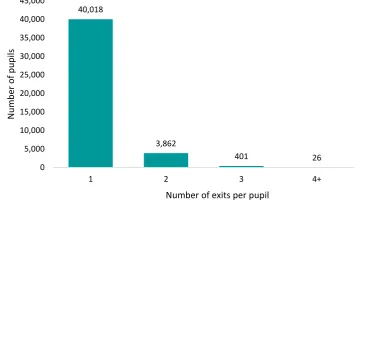
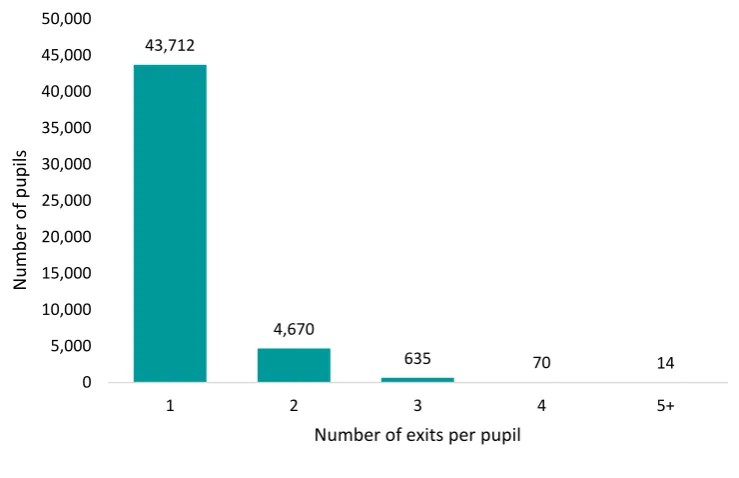
Figures 2.1 and 2.2 present the number of exits experienced by each pupil during the five years of secondary school in the 2014 and 2017 cohorts. We have not included a chart for the 2011 cohort as missing data means we are unable to provide an accurate estimate of number of exits per pupil.8 The number of pupils experiencing at least one unexplained exit from a school was:
46,759 in the 2011 cohort, or 7.8 per cent of the total number of pupils in the cohort; 44,307 in the 2014 cohort, or 7.2 per cent of the cohort; and
49,101 in the 2017 cohort, or 8.1 per cent of the cohort.
[image:27.595.80.452.329.681.2]While the large majority of this group experienced one exit, more pupils experienced more than one unexplained exit during secondary school in the 2017 cohort: 5,389 pupils (or 0.9 per cent of the total cohort) compared with 4,289 pupils in the 2014 cohort (0.7 per cent of the total cohort).
Figure 2.1. Number of unexplained exits per pupil between Year 7 and Year 11 in 2014 cohort
8 For the 2011 cohort, we are missing LSOA records for the autumn 2006/07 academic year and the spring 2010/11 academic year, and records on late entrants and EAL late entrants who joined school after Reception but before Year 3. We used the average proportion of (1) exits accounted for by LSOA movers at these two points in time and (2) late entrants joining between Year 1 and Year 3 in the other two cohorts to estimate the number of pupils with at least one school exit in 2011 who make up these groups. See ‘Working methods’ section for more detail.
40,018
3,862
401 26
0 5,000 10,000 15,000 20,000 25,000 30,000 35,000 40,000 45,000
1 2 3 4+
N
u
m
b
er
o
f p
u
p
ils
28
Figure 2.2. Number of unexplained exits per pupil between Year 7 and Year 11 in 2017 cohort
Breakdown of family-driven exits
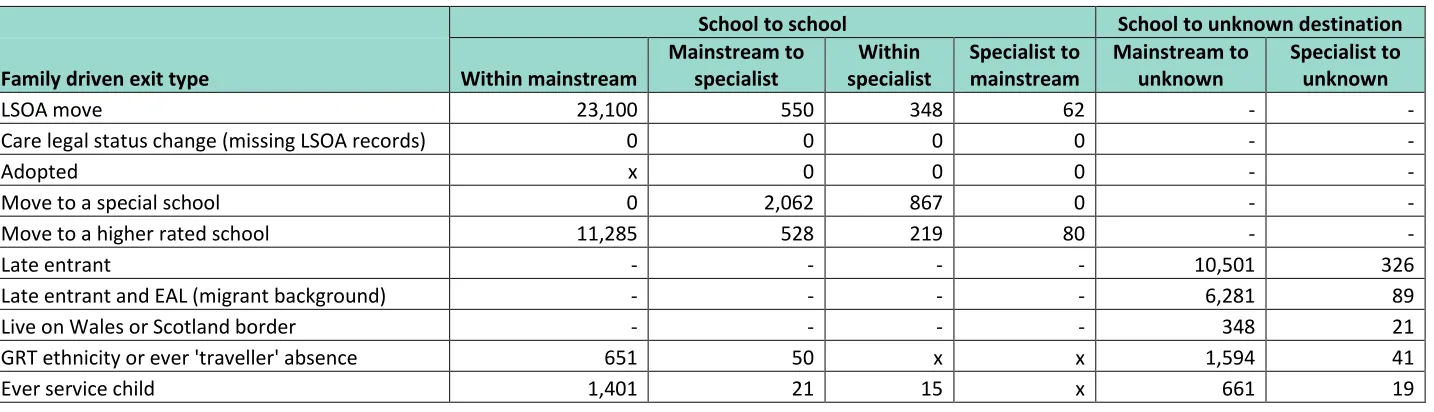
Figures 3.1 to 3.3 present the breakdown of driven exit types for each cohort. Most family-driven exits are due to LSOA moves (where the pupil has changed their home address), while a substantial proportion are due to moves to higher rated schools. Late entrants to the system make up a significant proportion of moves out of the English school system.
43,712
4,670
635 70 14
0 5,000 10,000 15,000 20,000 25,000 30,000 35,000 40,000 45,000 50,000
1 2 3 4 5+
N
u
m
b
er
o
f p
u
p
ils
29
Figure 3.1. Types of family-driven exits by origin and destination setting among pupils in the 2011 cohort9
School to school School to unknown destination
Family driven exit type
Within mainstream
Mainstream to specialist
Within specialist
Specialist to mainstream
Mainstream to unknown
Specialist to unknown
LSOA move 27,166 130 60 35 - -
Care legal status change (missing LSOA records) x 0 0 0 - -
Adopted x 0 0 0 - -
Move to a special school 0 972 278 0 - -
Move to a higher rated school 18,452 91 36 23 - -
Late entrant - - - - 11,149 90
Late entrant and EAL (migrant background) - - - - 5,593 18
Live on Wales or Scotland border - - - - 430 x
GRT ethnicity or ever 'traveller' absence 821 x x 0 1,286 x
Ever service child 1,228 x x 0 364 x
Note: X represents fewer than 10 but at least one case; small numbers are suppressed to prevent disclosure of data concerning individual children.
30
Figure 3.2. Types of family-driven exits by origin and destination setting among pupils in the 2014 cohort
School to school School to unknown destination
Family driven exit type Within mainstream
Mainstream to specialist
Within specialist
Specialist to mainstream
Mainstream to unknown
Specialist to unknown
LSOA move 23,100 550 348 62 - -
Care legal status change (missing LSOA records) 0 0 0 0 - -
Adopted x 0 0 0 - -
Move to a special school 0 2,062 867 0 - -
Move to a higher rated school 11,285 528 219 80 - -
Late entrant - - - - 10,501 326
Late entrant and EAL (migrant background) - - - - 6,281 89
Live on Wales or Scotland border - - - - 348 21
GRT ethnicity or ever 'traveller' absence 651 50 x x 1,594 41
Ever service child 1,401 21 15 x 661 19
31
Figure 3.3. Types of family-driven exits by origin and destination setting among pupils in the 2017 cohort
School to school School to unknown destination
Family-driven exit type Within mainstream
Mainstream to specialist
Within specialist
Specialist to mainstream
Mainstream to unknown
Specialist to unknown
LSOA move 23,080 1,000 531 191 - -
Care legal status change (missing LSOA records) 18 x x - - -
Adopted - 0 0 0 - -
Move to a special school 0 2,146 986 0 - -
Move to a higher rated school 11,245 1,156 290 288 - -
Late entrant - - - - 10,797 482
Late entrant and EAL (migrant background) - - - - 6,982 190
Live on Wales or Scotland border - - - - 369 22
GRT ethnicity or ever ‘traveller’ absence 756 129 28 21 1,930 112
Ever service child 1,532 49 13 x 619 33
32
Unexplained exits by origin and destination school type
Figures 4.1 to 4.3 present total unexplained exits in secondary by governance structure of origin and destination schools. Total number of exits are presented on the right and exits as a proportion of the total number of pupils in the origin school type are on the left.
As a reminder, moves to special schools from any type of school are classified as ‘family-driven’ moves, because the SEND code of practice means it is very likely that moves into special schools are with the agreement and support of the child’s parents. We do not make the same assumption about moves to alternative provision schools or pupil referral units because these are not regulated in the same way. These moves to alternative provision are included in the unexplained exits where they were not a result of an official permanent exclusion and did not fit any of the ‘family-driven’ explanations.
In the 2011 cohort, the proportion of pupils exiting academies to any destination was approximately 14 per cent of the total pupils in academies, compared with 10 per cent of pupils in LA maintained schools. The proportion of pupils exiting academies for unknown reasons with unknown destinations was larger than that of pupils in LA maintained schools.
In the 2014 and 2017 cohorts, proportions of exiting pupils were more similar across school types; there were, however, some differences between terms, with proportionally more pupils leaving academies to unknown destinations in Years 7 and 8 in the 2014 cohort, and more exiting LA maintained schools in Years 9 to 11.
A limitation of the Alternative Provision census is that it only collects a snapshot of pupils once a year in January. As a consequence of the termly structure of the mainstream school data being different from that of the annual alternative provision data, there is potential undercounting of cases where pupils moved into alternative provision and potential overcounting of cases where their destination was unknown.
33
Figure 4.1. Unexplained exits by origin and destination schools for 2011 cohort (proportion of pupils in origin school type on left; number on right)10
10 Due to the data missingness outlined in the ‘Working methods’ section, figures provided here are an over-estimation of true numbers.
9.8%
4.3%
0.3%
0.9%
4.3%
13.8%
0.6%
3.7%
2.1%
7.5%
0.0% 3.0% 6.0% 9.0% 12.0% 15.0% LA maintained to any destination
Within LA maintained
LA maintained to academy
LA maintained to AP
LA maintained to unknown
Academy to any destination
Within academy
Academy to LA maintained
Academy to AP
Academy to unknown
53,819
23,600
1,620
5,022
23,577
3,090
124
820
464
1,682
0 25,000 50,000 75,000
LA maintained to any destination
Within LA maintained
LA maintained to academy
LA maintained to AP
LA maintained to unknown
Academy to any destination
Within academy
Academy to LA maintained
Academy to AP
34
Figure 4.2. Unexplained exits by origin and destination schools for 2014 cohort (proportion of pupils in origin school type on left; number on right)
9.0%
3.8%
1.2%
0.7%
3.4%
7.2%
1.2%
1.6%
0.6%
3.9%
0.0% 3.0% 6.0% 9.0% 12.0% 15.0% LA maintained to any destination
Within LA maintained
LA maintained to academy
LA maintained to AP
LA maintained to unknown
Academy to any destination
Within academy
Academy to LA maintained
Academy to AP
Academy to unknown
36,282
15,213
4,797
2,659
13,613
11,583
1,863
2,602
916
6,202
0 25,000 50,000
LA maintained to any destination
Within LA maintained
LA maintained to academy
LA maintained to AP
LA maintained to unknown
Academy to any destination
Within academy
Academy to LA maintained
Academy to AP
35
Figure 4.3. Unexplained exits by origin and destination schools for 2017 cohort (proportion of pupils in origin school type on left; number on right)
11.0%
3.1%
3.2%
0.5%
4.3%
9.7%
3.3%
1.8%
0.3%
4.3%
0.0% 3.0% 6.0% 9.0% 12.0% 15.0% LA maintained to any destination
Within LA maintained
LA maintained to academy
LA maintained to AP
LA maintained to unknown
Academy to any destination
Within academy
Academy to LA maintained
Academy to AP
Academy to unknown
24,251
6,780
6,935
1,072
9,464
30,983
10,478
5,744
1,024
13,737
0 25,000 50,000
LA maintained to any destination
Within LA maintained
LA maintained to academy
LA maintained to AP
LA maintained to unknown
Academy to any destination
Within academy
Academy to LA maintained
Academy to AP
36
School-level distribution of unexplained exits, family-driven exits and permanent exclusions
Figures 5.1 to 5.4 present the total number of unexplained exits, family-driven exits and permanent exclusions from schools between Years 7 and 11 for the 2017 cohort. Figures for the 2014 and 2011 cohorts follow a similar distribution and are presented in Annexes 2 and 3. All figures except Figure 6.2 present exits from all school types, including mainstream and non-mainstream schools.11 Figure 6.2 presents the distribution of unexplained exits across all non-mainstream schools: these include special and independent schools, alternative provision and pupil referral units.
The number of unexplained exits per school during secondary school ranged from 0 to 116 for pupils in the 2017 cohort (schools with more than 40 moves have been combined in the chart to prevent disclosure of small numbers). We found that high numbers of unexplained exits in secondary school are concentrated among a small number of schools; these schools are mostly mainstream schools (see Figure 6.2). 330 schools (or 6 per cent of the total number of schools in the 2017 cohort) had at least 30 unexplained exits from their school during the five years of secondary. We used the
threshold of 30 pupils as this approximates to a class size. These schools accounted for over a fifth (23 per cent) of the total number of unexplained exits experienced by the cohort in secondary school.
11 This is because some new schools opened while others closed in the period during which the cohorts in this analysis were in secondary school. Schools are not counted as ‘new’ where there has been an academy conversion, sponsorship or other predecessor and successor relationship. Spurious pupil moves due to changes in the school URN for predecessor and successor schools have been cleaned from the data and are not
37
Figure 5.1. Total unexplained exits from mainstream and non-mainstream schools between Years 7 and 11 (2017 cohort)
1,114
404
239 206
160 168 152134 138 146 144 147157
136158 143 141
111 103 101 95 88 87 93
66 57 53 55 43 47
32 39 26 27 21 10 18 17 20 15 105
0 200 400 600 800 1,000 1,200
N
u
m
b
er
o
f
scho
o
ls
38
Figure 5.2. Total unexplained exits from non-mainstream schools between Years 7 and 11 (2017 cohort)12
12 Non-mainstream schools include special schools, alternative provision, pupil referral units and independent schools.
388
290
148
92
45 41
30 23
13
94
0 50 100 150 200 250 300 350 400 450
N
u
m
b
er
o
f
n
o
n
-m
ain
stre
am
scho
o
ls
39
Figure 5.3. Total family-driven exits from mainstream and non-mainstream schools between Years 7 and 11 (2017 cohort)
1,110
431
283
222
177 185 164 178 146173 178 169 160 167 173
145 132
102124 98 79 87
56 71 48 38 36 23 26 28 27 28 11
141
0 200 400 600 800 1,000 1,200
N
u
m
b
er
o
f
scho
o
ls
40
Figure 5.4. Total permanent exclusions from mainstream and non-mainstream schools (2017 cohort)
3,402
709
388
281
179 89
63 46 20 19 20
0 500 1,000 1,500 2,000 2,500 3,000 3,500 4,000
N
u
m
b
er
o
f
scho
o
ls
41
Figure 6.1 shows total unexplained exits from all schools by level of disadvantage, based on the proportion of pupils attending the school in secondary who were eligible for free school meals. The most and least disadvantaged schools are more likely than those in the middle of the distribution to have zero unexplained pupils exits. See Figure 6.2 for further information.
Figure 5.5 Total unexplained exits from all secondary schools by disadvantage quintile (2017 cohort)
0 200 400 600 800 1,000 1,200
42
Figure 6.2 presents the prevalence of unexplained exits by school disadvantage quintile for all three cohorts, and further illustrates that they are concentrated in schools in the middle of the
[image:42.595.76.510.217.468.2]disadvantage distribution. In the 2017 cohort, schools with the least disadvantaged intake accounted for the smallest proportion of total moves (5.0 per cent), while schools with the most disadvantaged intake accounted for the second lowest proportion of total moves (13.8 per cent). Between the 2011 and 2017 cohorts, the proportion of unexplained exits accounted for by the least disadvantaged schools rose (from 1.1 per cent), while the proportion accounted for by the most disadvantaged schools has fallen (from 23.5 per cent).
Figure 6.2. Proportion of total unexplained exits by school disadvantage quintile
Pupil risk factors for unexplained exits
Figures 7.1 to 7.3 present the prevalence of at least one unexplained exit in secondary school among sub-groups of pupils in the 2017 cohort. In all three cohorts, the same groups of pupils were more likely to experience unexplained exits (figures for the 2014 and 2011 cohorts can be found in Annexes 4 and 5):
pupils with a high number of absences (40.9 per cent of pupils who were persistently absent for authorised reasons experienced at least one unexplained exit in the 2017 cohort); pupils in contact with the social care system (of these, those most at risk were pupils who
entered into care in secondary school, 34.6 per cent of whom experienced an unexplained exit in secondary);
pupils who have been permanently excluded (32.1 per cent) or experienced a fixed term exclusion (21.8 per cent);
pupils with social, emotional or mental health needs (24.3 per cent); pupils who had ever been eligible for FSM (13.5 per cent); and
pupils with Black or mixed Black and White ethnic backgrounds (approximately 13 per cent). 1.1%
28.1%
27.1%
20.2%
23.5% 2.3%
21.6%
28.5%
30.6%
17.0% 5.0%
22.6%
29.1%
29.5%
13.8%
0.0% 5.0% 10.0% 15.0% 20.0% 25.0% 30.0% 35.0%
Least disadvantaged
Second quintile
Third quintile
Fourth quintile
Most disadvantaged
43
Figure 7.1. Proportion of pupil group experiencing at least one unexplained exit: demographics
Gender Ethnicity Birth term 8.1% 8.0% 8.3% 6.4% 5.1% 5.9% 8.0% 9.4% 12.5% 10.7% 4.6% 10.3% 8.3% 12.3% 12.7% 7.4% 8.4% 8.2% 6.0% 7.0% 8.4% 8.2% 8.7% 13.5%
0.0% 5.0% 10.0% 15.0% 20.0% 25.0% 30.0% 35.0% 40.0%
All
Female
Male
Bangladeshi
Indian
Other Asian background
Pakistani
Black African
Black Caribbean
Other Black background
Chinese
Other mixed background
White and Asian
White and Black African
White and Black Caribbean
Any other
White British
White Irish
Other White background
EAL (from reception)
Spring born
Summer born
Autumn born
44
Figure 7.2 Proportion of pupil group experiencing at least one unexplained exit: additional need13
13 ‘New LAC’ refers to pupils who entered the care system in secondary school. ‘LAC status change’ and ‘CIN status change’ refers to looked after pupils and pupils who are children in need who experienced a change of legal status in secondary school including moving out of the social care system.
27.5%
34.6%
34.2%
17.6%
19.4%
8.0%
10.0%
7.2%
7.8%
24.3%
9.9%
8.3%
9.6%
11.3%
8.4%
12.8%
12.7%
16.4%
11.8%
0.0% 5.0% 10.0% 15.0% 20.0% 25.0% 30.0% 35.0% 40.0%
Ever LAC
New LAC
LAC status change
Ever CIN
CIN status change
Specific learning difficulty
Moderate learning difficulty
Severe learning difficulty
Profound & multiple learning difficulty
Behavioural, emotional & social / SEMH
Speech, language and communication
Hearing impairment
Visual impairment
Multi-sensory impairment
Physical disability
ASD
Other SEND
NSA
Ever SEND SEND type
45
Figure 7.3. Proportion of pupil group experiencing at least one unexplained exit: pupil history
Considering the findings in Figures 6.2 to 7.3, the analysis suggests that individual risk factors including deprivation matter to a pupil’s chance of experiencing an unexplained exit, but that the risk is not highest in the schools with the highest concentrations of disadvantaged pupils.
12.1%
9.7%
7.3%
5.1%
22.2%
15.5%
40.9%
32.6%
21.8%
32.1%
0.0% 5.0% 10.0% 15.0% 20.0% 25.0% 30.0% 35.0% 40.0% 45.0%
Lowest quartile
25-49%
50-74%
Highest quartile
Persistent absentee
Persistent absentee_health reasons
Persistent absentee_authorised
Persistent absentee_unauthorised
Ever fixed period exclusion
Ever permanent exclusion Prior
attainment
Absence record
46
How to give feedback
We are seeking feedback on how we have analysed pupil mobility and how we have defined explained and unexplained school moves. While we are keen to hear suggestions of other reasons why a pupil might move out of a school, please note that we are not seeking personal or
professional opinions about whether school practices are right or wrong and neither are we seeking comments on the purpose of this research as a whole. Any comments that are not directly related to our questions as set out below will not be considered.
Responses will be considered for use in a further report on this subject looking at more detailed breakdowns of where the most unexplained moves have occurred. The acceptance and use of any suggestions received from you is at the sole discretion of the Education Policy Institute. You do not need to give us any personal details in order to send us feedback. Comments received will not be publicly attributed to you or your organisation without your prior consent. Any personal details you choose to supply will be managed according to our privacy policy: https://epi.org.uk/privacy-policy/
We have set up a dedicated e-mail address for feedback: [email protected].
Consultation questions
1. About you: Everyone is welcome to respond to this working paper. Please state your role / how you are interested in this working paper. You can choose not to answer this question but still answer other questions if you wish.
Parent, carer or young person
Teacher or school support staff in mainstream school Head teacher or senior leader in mainstream school
Teacher, leader or support staff in alternative provision, PRU or special school Multi Academy Trust representative
Local Authority representative
Other professional or volunteer working with children Academic or researcher
Non-profit organisation working with or advocating for children Other
2. Your views: Do you wish to suggest any changes or additions to the analysis in the working paper? For example, are the groups of 'explained' moves defined appropriately? Are there any other ways that we could use the data to get a better insight into unexplained moves?
For each suggestion please state what it is and why you think this would be beneficial.
3. Alternative explanations for school moves: Do you wish to propose any alternative reasons why some children move schools that we have not taken account of?
For each suggestion please state what it is and whether you believe this is a reason that is within the control of schools, or not within the control of schools. Please give any supporting details for
whether you believe this is within the control of schools or not.
47
For each suggestion please state what it is and give any details you can about how this could be done and/or why it is important.
We will consider feedback on the methodology, and comments on the test results that are relevant to the methodology. We are particularly interested in feedback on the following areas:
Our methodology for excluding transitions from moves
Categories of family-driven moves, and whether we have missed anything we are able to pick up in NPD data; also, whether there any problems with the categories we have included / how we have generated them based on the underlying data
We will not consider comments on the test results that have no relevance to the methods, views on whether the subject matter of the analysis should be investigated or reactions to government policy.
48
Annex 1. Termly exits from secondary schools by cohort
Figures A1.1 to A1.3 present the total volume of non-transition termly exits from schools between Years 7 and 11 for pupils in each cohort. Exits include:
between-school moves;
school to unknown destination moves; and permanent exclusions.